| 14641800989 | Human Systems | communities, culture, economies, interactions with the environment | | 0 |
| 14641802623 | Ecosystem | A biological community of interacting organisms and their physical environment. | | 1 |
| 14641804221 | Environmentalism | A social movement dedicated to protecting the earth's life support systems for us and other species. | | 2 |
| 14641805781 | Examples of abiotic factors | water, soil, light , minerals, wind, air, temperature, pollution, etc. | | 3 |
| 14641807714 | Examples of biotic factors | Plants, Animals, Fungi, Protists ( algae), and Monerans (bacteria) | | 4 |
| 14641824268 | ecosystem services | The processes by which life-supporting resources such as clean water, timber, fisheries, and agricultural crops are produced | | 5 |
| 14641825209 | environmental indicators | an indicator that describes the current state of an environmental system | | 6 |
| 14641825878 | Environmental indicators examples | biological diversity, food production, average global surface temp, CO2 concentrations, human population, resource depletion | | 7 |
| 14641828017 | genetic biodiversity | the total number of genetic characteristics in the genetic makeup of a species. Species with a higher genetic diversity are better able to adapt and respond to environmental change. | | 8 |
| 14641828552 | species biodiversity | refers to the number of different species in an ecosystem or in the biosphere as a whole. Ecosystems with a higher species diversity are more resilient and productive. This is commonly used by scientists as a critical environmental indicator. | | 9 |
| 14641828933 | ecosystem biodiversity | the variety of terrestrial and aquatic ecosystems found in an area or on the earth. A greater number of healthy ecosystems means a heather environment. | | 10 |
| 14641838796 | Species | a group of living organisms consisting of similar individuals capable of exchanging genes or interbreeding. | | 11 |
| 14641842577 | Speciation | the formation of new and distinct species in the course of evolution. | | 12 |
| 14641843526 | background extinction rate | The average rate at which species become extinct over the long term. One species per million should go extinct every year. Currently, there are 5,000 species per million going extinct each year. | | 13 |
| 14641894782 | human population | Nearing 8 Billion, and projected to grow to around 10 billion, where it will stabilize. | | 14 |
| 14641899417 | development | A process of improvement in the material conditions of people through diffusion of knowledge and technology. | | 15 |
| 14641943344 | sustainable development | Development that meets the needs of the present without compromising the ability of future generations to meet their own needs. | | 16 |
| 14641958194 | ecological footprint | the impact of a person or community on the environment, expressed as the amount of land required to sustain their use of natural resources. | | 17 |
| 14641964804 | Scientific Method | A series of steps followed to solve problems including collecting data, formulating a hypothesis, testing the hypothesis, and stating conclusions. | | 18 |
| 14642047104 | controlled experiment | An experiment in which only one variable is manipulated at a time. | | 19 |
| 14642047105 | natural experiment | An experiment in which nature, rather than an experimenter, manipulates an independent variable. | | 20 |
| 14642077770 | complexity levels of nature | Individual, Population, Community, Ecosystem, Biosphere | | 21 |
| 14656284901 | community ecology | The study of how interactions between species affect community structure and organization | | 22 |
| 14656291209 | distribution of species | Determined by three factors: Range of conditions in which the species can tolerate, ability to disperse to said area, and interactions with other species. | | 23 |
| 14656294138 | competition | A common demand by two or more organisms upon a limited supply of a resource; for example, food, water, light, space, mates, nesting sites. It may be intraspecific or interspecific. | | 24 |
| 14656296722 | competitive exclusion principle | An ecological rule that states that no two species can occupy the same exact niche in the same habitat at the same time. Two species competing for the same limiting resource cannot coexist. | | 25 |
| 14656299872 | resource partitioning | the differentiation of niches that enables similar species to coexist in a community | | 26 |
| 14656302935 | temporal resource partitioning | species reduce competition by utilizing same resource at different times | | 27 |
| 14656303339 | spatial resource partitioning | species reduce competition by utilizing same resource in different habitats | | 28 |
| 14656304632 | morphological resource partitioning | the evolution of differences in body size or shape | | 29 |
| 14656313654 | Predation | An interaction in which one organism kills another for food. | | 30 |
| 14656313655 | true predators | A predator that typically kills its prey and consumes most of what it kills. | | 31 |
| 14656314513 | herbivores | Consumer that eats only plants, typically eating a small portion of an individual plant without killing it | | 32 |
| 14656315785 | parasite | an organism that lives in or on another organism (its host) and benefits by deriving nutrients at the host's expense. | | 33 |
| 14656317042 | Pathogens | disease causing agents | | 34 |
| 14656318045 | Parasitoids | organisms that lay eggs inside other organisms | | 35 |
| 14656321501 | behavioral defenses | include hiding, fleeing, forming herds or schools, self-defense, and alarm calls | | 36 |
| 14656322653 | Mutualism | symbiotic relationship in which both species benefit from the relationship. One example is the relationship between plants and their pollinators. | | 37 |
| 14656331145 | Commensalism | A relationship between two organisms in which one organism benefits and the other is unaffected. One example could be birds using a tree as a nesting place. | | 38 |
| 14656332809 | symbiotic relationship | The relationship between two species that live in close association with each other. Commensalism, Mutualism, and parasitism are all symbiotic relationships. Interactions between species are very important in determining which species can live in a community. | | 39 |
| 14656339069 | keystone species | A species on which other species in an ecosystem largely depend, such that if it were removed the ecosystem would change drastically. Keystone species normally exist in small numbers. | | 40 |
| 14656344835 | predator-mediated competition | A situation in which predation reduces prey populations and gives an advantage to competitors that might not otherwise be successful. | | 41 |
| 14656350022 | ecosystem engineers | a keystone species that creates or maintains habitat for other species | | 42 |
| 14656356472 | Biomes | a broad, regional type of ecosystem characterized by distinctive climate and soil conditions and a distinctive kind of biological community adapted to those conditions. | | 43 |
| 14656362286 | tropical rainforest | a broadleaf evergreen forest found in wet and hot regions near the equator. Rainfall is abundant - more that 200 cm (80 in) per year - and temperatures are warm or hot year-round | | 44 |
| 14656363670 | Tropical seasonal forest/savannah | a biome marked by warm temperatures and distinct wet and dry seasons | | 45 |
| 14656365657 | subtropical desert | a biome prevailing at approximately 30 degrees N and 30 degrees S, with hot temperatures, extremely dry conditions, and sparse vegetation | | 46 |
| 14656370050 | woodland/shrubland (chaparral) | Hot, dry summers and mild rainy winters. 12 month growing season but restricted in summer and in winter. | | 47 |
| 14656372042 | temperate grassland/cold desert (Prairies, Pampas) | Biome has the lowest average precipitation of any temperate biome. Cold, harsh winters and hot, dry summers. | | 48 |
| 14656373229 | temperate seasonal forest | A biome with warmer summers and colder winters than temperate rainforests and dominated by broadleaf deciduous trees. | | 49 |
| 14656373586 | temperate rainforest | The cool, dense, rainy forests of the northern Pacific coast, southern Chile, New Zealand and Tasmania; enshrouded in fog much of the time; dominated by large conifers. Temperate rainforests have a nearly 12-month growing season with rainy winters and foggy summers. | | 50 |
| 14656381368 | boreal forest (taiga) | A dense forest of evergreens located in the upper regions of the Northern Hemisphere. Plant growth is more constrained by temperature than by precipitation. | | 51 |
| 14656382335 | Tundra | a vast, flat, treeless Arctic region of Europe, Asia, and North America in which the subsoil is permanently frozen. | | 52 |
| 14656383125 | polar ice caps | cold year round with very few plants. most animals live in the waters underneath ice | | 53 |
| 14656390145 | relationship between precipitation and temperature | For every 10 C temperature increase, plants need 20 mm more precipitation each month to supply their demand. | | 54 |
| 14656450863 | temperate | moderate; restrained | | 55 |
| 14656450864 | deciduous | (of plants and shrubs) shedding foliage at the end of the growing season | | 56 |
| 14656451247 | coniferous | bearing cones, as the pine tree | | 57 |
| 14656454585 | subtropical | adjacent to the tropics | | 58 |
| 14669372868 | aquatic biomes | Water covers nearly 75 percent of the earth's surface, in the form of oceans, lakes, rivers, etc. Aquatic biomes are categorized by salinity, depth, and water flow. | | 59 |
| 14669380054 | freshwater biomes | lakes, ponds, rivers, streams and wetlands | | 60 |
| 14669381495 | Saltwater/Marine biomes | Estuaries, coral reefs, open ocean | | 61 |
| 14669382348 | streams and rivers | Flowing fresh water that may originate from underground springs or as runoff from rain or melting snow. Main inputs in streams are organic matter from terrestrial biomes, such as fallen leaves which provide the base of the food web. Main inputs in rivers are aquatic plants where they are better suited to grow. Fast-moving rapids introduce more oxygen, allowing different species of fish to thrive. | | 62 |
| 14669428105 | lakes and ponds | An inland body of standing water, too deep to support emergent vegetation. | | 63 |
| 14669433783 | littoral zone | a shallow zone in a freshwater habitat where light reaches the bottom and nurtures plants | | 64 |
| 14669435442 | limnetic zone | In a lake, the well-lit, open surface waters farther from shore. | | 65 |
| 14669437488 | profundal zone | a region of water where sunlight does not reach, below the limnetic zone in very deep lakes | | 66 |
| 14669437529 | benthic zone | the muddy bottom of a lake, pond, or ocean | | 67 |
| 14669438567 | freshwater wetlands | An aquatic biome that is submerged or saturated by water for at least part of each year, but shallow enough to support emergent vegetation. Includes swamps, marshes, and bogs. Freshwater wetlands are also among the most productive biomes on earth and provide several critical ecosystem services. Wetlands store large amounts of rainwater, reducing the severity of floods and droughts, and filtering the water. | | 68 |
| 14669443315 | swamps | A wetland ecosystem in which shrubs and trees grow (emergent vegetation) | | 69 |
| 14669446179 | Marshes | a wetland typically covered with grasses | | 70 |
| 14669448785 | Bogs | ponds covered in thick floating mats of vegetation and spruce trees | | 71 |
| 14669497299 | Salt Marshes/Estuaries | A saltwater biome that contains non-woody emergent vegetation. Very productive, and the salinity may vary. | | 72 |
| 14669501400 | mangrove swamps | A swamp that occurs along tropical and subtropical coasts, and contains salt-tolerant trees with roots submerged in water. | | 73 |
| 14669504037 | intertidal zone | the narrow band of coastline between the levels of high tide and low tide | | 74 |
| 14669521291 | Coral reefs | Prominent oceanic features composed of hard, limy skeletons produced by coral animals; usually formed along edges of shallow, submerged ocean banks or along shelves in warm, shallow, tropical seas. Coral reefs are earth's most diverse marine biome. | | 75 |
| 14669529137 | open ocean | deep ocean water, located away from the shoreline where sunlight can no longer reach the ocean bottom (normally around 650 feet). | | 76 |
| 14669548892 | photic zone | Portion of the marine biome that is shallow enough for sunlight to penetrate. Algae are major producers. | | 77 |
| 14669548893 | aphotic zone | permanently dark layer of the oceans below the photic zone. Bacteria which preform chemosynthesis are the main producers. | | 78 |
| 14669810144 | Biosphere | Consists of all life on Earth and all parts of the Earth in which life exists, including land, water, and the atmosphere. | | 79 |
| 14697881985 | Flow of energy | The transfer of energy through an ecosystem from the sun (usually) to producers, to herbivores, to carnivores, and ultimately to decomposers. In the end, all of the energy that originally reached earth from the sun dissipates into the atmosphere and outer space as heat. Energy cannot be recycled, and life on earth depends on a constant influx of energy from the sun to replace what is lost. | | 80 |
| 14697886207 | biogeochemical cycle | process in which elements, chemical compounds, and other forms of matter are passed from one organism to another and from one part of the biosphere to another | | 81 |
| 14697889067 | hydrologic cycle | The cycle through which water in the hydrosphere moves. Heat from the sun causes water to evaporate from oceans, lakes, and soils. Photosynthesis releases water from their leaves to the atmosphere in a process called transpiration. The water vapor usually forms clouds, which produce precipitation in the form of rain, snow, and hail. Water can also be absorbed by the soil and move down into groundwater. Finally, water can move as runoff across the land surface and into streams and livers where they flow into lakes or oceans. | 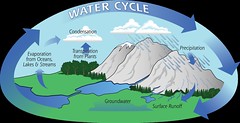 | 82 |
| 14697899815 | Evotranspiration | The combined amount of evaporation and transpiration. | | 83 |
| 14697901746 | Human impacts on water cycle | Clearing vegetation reduces the amount of transpiration. Clear cutting a forest leaves the soil exposed to erosion and flooding. Also, pavement reduces percolation, increasing runoff and evaporation. | 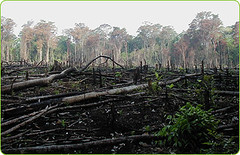 | 84 |
| 14697910159 | Percolation | The downward movement of water through soil and rock due to gravity. |  | 85 |
| 14697911935 | carbon cycle | the series of processes by which carbon compounds are interconverted in the environment, chiefly involving the incorporation of carbon dioxide into living tissue by photosynthesis and its return to the atmosphere through respiration, the decay of dead organisms, and the burning of fossil fuels. Carbon is the most important element in living organisms, making up to 20% of body weight. The carbon cycle begins with photosynthesis, where producers consume CO2 and incorporate the carbon into their tissues, some of this is returned to the atmosphere during transpiration and when decomposers break down the plant after it has died. Carbon moves up the food chain by consumers, and when these consumers die, decomposers release the carbon back into the atmosphere. A large amount of carbon is exchanged between the ocean and the atmosphere and enters the food web via photosynthesis by algae. A small fraction of this carbon is buried under the ocean and is compressed over millions of years to create fossil fuels. |  | 86 |
| 14697920645 | Carbon Cycle Steps | 1. Carbon enters the atmosphere as carbon dioxide from respiration and combustion.
2. Carbon dioxide is absorbed by producers to make carbohydrates in photosynthesis.
3. Animals feed on the plant passing the carbon compounds along the food chain. Most of the carbon they consume is exhaled as carbon dioxide formed during respiration. The animals and plants eventually die.
4. The dead organisms are eaten by decomposers and the carbon in their bodies is returned to the atmosphere as carbon dioxide. In some conditions decomposition is blocked. The plant and animal material may then be available as fossil fuel in the future for combustion. | | 87 |
| 14699371286 | Rapid carbon exchange | Carbon enters the system through autotrophs (self feeders) and is passed through the food web until it is released in cellular respiration or when decomposers break down dead organisms. | | 88 |
| 14699376980 | Long-term carbon exchange | Begins when carbon in the ocean sinks to the bottom and is buried, turned into sedimentary rock. Volcanoes and human burning of fossil fuels release the carbon into the atmosphere. Although the formation of fossil fuels happens very slowly, human release of the carbon happens very rapidly. | | 89 |
| 14699452272 | Carbon pools | Places where carbon accumulates in ecosystems | | 90 |
| 14699470736 | Macronutrients | The six key elements that organisms need in relatively large amounts: nitrogen, phosphorus, potassium, calcium, magnesium, and sulfur. | | 91 |
| 14699471689 | Nitrogen cycle in terrestrial ecosystems | The transfer of nitrogen from the atmosphere to the soil, to living organisms, and back to the atmosphere. Nitrogen makes up about 78% of the atmosphere (in the form of N2) and is essential for all living organisms. However, most organisms have no way to convert the N2 into a usable form. We rely on bacteria and single-celled prokaryotes to convert N2 into NH3 (ammonia) which can be used by plants to create organic molecules. The nitrogen is then spread through the food web. The nitrogen reenters the atmosphere by being transformed back into NH3 when an organism dies, and eventually into nitrites and nitrates. In the end, these are turned back into N2 by denitrifying prokaryotes. |  | 92 |
| 14699555575 | Nitrogen cycle in aquatic ecosystems | Marine bacteria convert N2 into NH3 and the NH3 is passed throughout the food webs. The N is cycled back into the atmosphere through nitrification and denitrification. However, some nitrogen-containing compounds fall to the ocean floor as sediment and get compressed into sedimentary rock. These rocks are eventually moved onto land by geological uplift and contribute to terrestrial ecosystems by releasing N as the rock wears away. | | 93 |
| 14699578028 | Human activity and the nitrogen cycle | lots of fixed nitrogen is made each year as a fertilizer to contribute to the agricultural sector. This excess of fixed nitrogen can have many negative effects on the environment including the production of acid rain and contributions to the greenhouse effect. Additionally, fertilizers may wash into the oceans through runoff and cause huge algae blooms which deplete the ocean of oxygen, creating "dead zones" | | 94 |
| 14699564800 | Denitrification | process by which bacteria convert nitrates into nitrogen gas | | 95 |
| 14699476585 | nitrogen fixation | process of converting nitrogen gas into nitrogen compounds that plants can absorb and use | | 96 |
| 14699490346 | Ammonification | The process by which fungal and bacterial decomposers break down the organic nitrogen found in dead bodies and waste products and convert it into inorganic ammonium | | 97 |
| 14699491665 | Nitrification | ammonia (NH3) is converted to nitrate ions (NO3)- | | 98 |
| 14699494618 | Leaching | Process in which various chemicals in upper layers of soil are dissolved and carried to lower layers and, in some cases, to groundwater. | | 99 |
| 14699524392 | limiting nutrient | single nutrient that either is scarce or cycles very slowly, limiting the growth of organisms in an ecosystem | | 100 |
| 14699525345 | Eutrophication | A process by which nutrients, particularly phosphorus and nitrogen, become highly concentrated in a body of water, leading to increased growth of organisms such as algae or cyanobacteria. | | 101 |
| 14699623082 | phosphorus cycle | The movement of phosphorus atoms from rocks through the biosphere and hydrosphere and back to rocks. | | 102 |
| 14699623874 | phosphorus cycle steps | Over time, rain and weathering or mining cause rocks to release phosphate ions and other minerals. This inorganic phosphate is then distributed in soils and water.
Plants take up inorganic phosphate from the soil. The plants may then be consumed by animals. Once in the plant or animal, the phosphate is incorporated into organic molecules such as DNA. When the plant or animal dies, it decays, and the organic phosphate is returned to the soil.
Some phosphorus is incorporated directly into rivers and streams where it is led into the ocean. Some of this sinks to the bottom and is turned into sedimentary rock where it is cycled back up to land.
Within the soil, organic forms of phosphate can be made available to plants by bacteria that break down organic matter to inorganic forms of phosphorus. This process is known as mineralization.
Phosphorus in soil can end up in waterways and eventually oceans. Once there, it can be incorporated into sediments over time. | | 103 |
| 14699645067 | Humans and the Phosphorus Cycle | Human mining, fertilizers, and cleaning detergents can add excess phosphorus to the environment. Phosphorus is a limiting nutrient, so if extra phosphorus is added to farms, plants will grow better. However, when this phosphorus enters aquatic ecosystems through runoff, it may create algal blooms and dead zones. | | 104 |
| 14707929087 | geologic cycle | The formation and destruction of earth materials and the processes responsible for these events. The geologic cycle includes the following subcycles: hydrologic, tectonic, rock, and biogeochemical. | | 105 |
| 14707944605 | tectonic cycle | the cycle of processes that build up and break down the lithosphere |  | 106 |
| 14707944606 | Lithosphere | A rigid layer made up of the uppermost part of the mantle and the crust. |  | 107 |
| 14707945574 | rock cycle | A series of processes on the surface and inside Earth that slowly changes rocks from one kind to another |  | 108 |
| 14707971949 | Micronutrients | vitamins, minerals, water | | 109 |
| 14708046127 | Carbon Reservoirs | fossil fuels, soils and sediments, solutes in oceans, calcium carbonate, plant and animal biomass, and the atmosphere | | 110 |
| 14710721822 | Atmospheric Fixation | Nitrogen fixation where lightning provides a huge amount of energy to break atmospheric nitrogen molecules apart, enabling them to form nitrogen oxides. This can then dissolve in rain, forming nitrate ion No3(-). | | 111 |
| 14710728611 | industrial fixation | in fertilizer manufacturing + release nitrogen oxides that are converted to nitric acid (acid precipitation) | | 112 |
| 14730374887 | nitrogen compounds | N2 (nitrogen gas)
NH4 (ammonium)
NH3 (ammonia)
NO3 (nitrate)
NO2 (nitrite)
N2O (nitrous oxide
NO2 (nitrogen Dioxide)
HNO3 (nitric acid) | | 113 |
| 14730379120 | Four main steps in the nitrogen cycle | 1.) Nitrogen fixation - N2 is converted to NH4 or NH3 by bacteria
2.) Ammonification (mineralization) - Decomposers turn organic material into NH4 or NH3
3.) Nitrification - Bacteria convert NH4 and NH3 into NO3 for plant uptake
4.) Denitrification - Bacteria convert NH4 and NH3 into N2 and N20 | | 114 |
| 14730398741 | assimilation (nitrogen cycle) | the absorption and digestion of food or nutrients by the body or any biological system. | | 115 |
| 14742365255 | ecosystem boundaries | Some ecosystems, such as a caves and lakes have very distinctive boundaries. However, in most ecosystems it is difficult to determine where one ecosystems stops and the next begins. | | 116 |
| 14742380508 | Ecosystem processes | the ways that energy and materials are transferred from one pool to another | | 117 |
| 14742398292 | primary consumers (herbivores) | consume producers | | 118 |
| 14742399018 | secondary consumers (carnivores) | obtain their energy by eating primary consumers | | 119 |
| 14742399866 | tertiary consumers (carnivores) | organisms in the fourth trophic level (eg, hawks and sea otters), which obtain their energy by eating secondary consumers | | 120 |
| 14742402555 | trophic levels | The hierarchical levels of the food chain through which energy flows from primary producers to primary consumers, secondary consumers and so on. | | 121 |
| 14742405205 | Omnivores | Consumers that eat both plants and animals. | | 122 |
| 14742405206 | detrivores/decomposers | eat nonliving organic matter, they recycle nutrients (mushroom feed on decaying plants) | | 123 |
| 14742406386 | detritus | Dead organic matter | | 124 |
| 14742407493 | GPP (Gross Primary Productivity) | The total amount of solar energy that producers in an ecosystem capture via photosynthesis over a given amount of time | | 125 |
| 14742410324 | NPP (Net Primary Productivity) | The energy captured by producers in an ecosystem minus the energy producers respire | | 126 |
| 14742526274 | Biomass | the total mass of organisms in a given area or volume. | | 127 |
| 14742529753 | standing crop | the amount of biomass present in an ecosystem at a particular time | | 128 |
| 14742539182 | ecological efficiency | the proportion of consumed energy that can be passed from one trophic level to another, ranging from 5-20% | | 129 |
| 14742541276 | trophic pyramid | a graphical representation designed to show the biomass or bio productivity at each trophic level in a given ecosystem. Energy and biomass is reduced greatly as we move up the pyramid. | | 130 |
| 14764144101 | Species interactions | competition, symbiosis, and feeding relationships
Symbiosis : any type of close and long-term biological interaction between two different biological organisms, be it mutualistic, commensalism, or parasitic.
Competition : is an interaction between organisms or species in which both the organisms or species are harmed. A limited supply of at least one resource (such as food, water, and territory) used by both can be a factor.
Feeding relationships: resource partitioning
temporal resource partitioning
spatial resource partitioning
morphological resource partitioning | | 131 |
| 14764269748 | Community | assemblage of different populations that live together in a defined area | | 132 |
| 14764304922 | niche | An organism's particular role in an ecosystem, or how it makes its living. | | 133 |
| 14764433808 | carbon source | Anything that releases more carbon than it absorbs | | 134 |
| 14765157849 | Photosynthesis | process by which plants and some other organisms use light energy to convert water and carbon dioxide into oxygen and high-energy carbohydrates such as sugars and starches | | 135 |