AP Notes, Outlines, Study Guides, Vocabulary, Practice Exams and more!

Biology Ch 9 - Assessment - Cellular Respiration Flashcards

Prentice Hall Biology 1 Chapter 9 Cellular Respiration Assessment p 237

Terms : Hide Images
1785633966In cells, the energy available in food is used to make an energy-rich compound called...ATP0
1785633967The first step in releasing the energy of glucose in the cell is known as...glycolsis1
1785633968The process that releases energy from food in the presence of oxygen is...cellular respiration2
1785633969Which organisms perform cellular respiration?mushrooms, ferns, polar bear, flower (all of the above)3
1785633970The net gain of energy from glycolsis is...2 ATP molecules4
1785633971Because fermentation takes place in the absence of oxygen, it is said to be...anaerobic5
1785633972The Krebs cycle takes place within the...mitochondrion6
1785633973The electron transport chain uses the high-energy electrons from the Krebs cycle to...convert ADP to ATP7
1785633974A total of 36 molecules of ATP are produced from 1 molecule of glucose as a result of...cellular respiration8
1785633975During heavy exercise, the buildup of lactic acid in muscle cells results in...oxygen debt9
1785633976What is a calorie? How do cells use a high-calorie molecule such as glucose?- the amount of energy needed to raise the temperature of 1 gram of water 1 degree celsius - cells break down the glucose releasing the stored energy a small amount at a time10
1785633977How is glucose changed during glycolsis? What products are produced as a result of glycolsis?- glucose is broken into 2 molecules of pyruvic acid -ATP molecules and high-energy electrons that are picked up by NAD+11
1785633978What are the two pathways that might follow glycolysis? What factor can determine which of those pathways a cell might follow?- After glycolsis, if oxygen is avialable, a cell might carry out the rest of cellular respiration. - If oxygen is not available, some cells carry out the rest of fermentation12
1785633979Use formulas to write a chemical equation for cellular respiration. Label the formulas with the names of the compounds.602 + C6 H12 O6 —> 6CO2 + 6H2) + Energy (Oxygen + Glucose —> Carbon Dioxide + Water + Energy)13
1785633987Draw and label a mitochondrion surrounded by cytoplasm. Indicate where glycolsis, the Krebs cycle, and the electron transport chain occur.14
1785633980How is NAD+ involved in the products of glycolosis? What happens to a cell's NAD+ when large numbers of high-energy electrons are produced in a short time?- NAD+ picks up high energy electrons - the high-energy electrons quickly fill all of the cell's available NAD+15
1785633981Which two compounds react during fermentation compares with alcoholic fermentation. Which reactant(s) do they have in common?- pyruvic acid & NADH - NADH passes high-energy electrons to pyruvic acid16
1785633982Write equations to show how lactic acid fermentation compares with alcoholic fermentation. Which reactant(s) do they have in common?Lactic Acid fermentation: glucose —> lactic acid Alcoholic Fermentation: glucose —> alcohol + CO2 - both have glucose as the reactant17
1785633983How are fermentation and cellular respiration similar? What is the main difference between their starting compounds?- both processes break down glucose and release the energy stored in the molecule & both start with glycolsis - cellular respiration requires oxygen and fermentation occurs WITHOUT oxygen18
1785633984Summarize what happens during the Krebs cycle. What happens to the high-energy electrons generated during the Krebs cycle?- Pyruvic acid is broken down into carbon dioxide in a series of reactions that give off energy - they are picked up by a series of electron carriers, and the energy is used to convert ADP into ATP19
1785633985How is ATP synthase involved in making energy available to the cell?ATP synthase is a large protein through which hydrogen ions (H+) pass, converting ADP into high-energy ATP.20
1785633986When runners race for about 20 minutes, how do the bodies obtain energy?they get energy from ATP in their muscles produced by lactic acid fermentation. In 20 minutes, bodies use cellular respiration to use stored carbs to make ATP21

PSAT High-Frequency Word List Flashcards

From the Barron's PSAT book (15th ed., 2010).

Terms : Hide Images
1786393965ampleabundant0
1786393966aristocracyhereditary nobility; priveleged class1
1786393967circumspectprudent; cautious2
1786393968clichéphrase dulled in meaning by repetition3
1786393969condoneoverlook voluntarily; forgive4
1786393970consolidationunification; process of becoming firmer or stronger5
1786393971conventionsocial or moral custom; established practice6
1786393972curtailshorten; reduce7
1786393973cynicalskeptical or distrustful of human motives8
1786393974dawdleloiter; waste time9
1786393975demeandegrade; humiliate10
1786393976denouncecondemn; criticize11
1786393977detachedemotionally removed; calm and objective; indifferent12
1786393978didacticteaching; instructional13
1786393979discernibledistinguishable; perceivable14
1786393980disinterestedunprejudiced15
1786393981disparagebelittle16
1786393982disparatebasically different; unrelated17
1786393983dispelscatter; cause to vanish18
1786393984divulgereveal19
1786393985docileobedient; easily managed20
1786393986doctrineteachings, in general; particular principle (religious, legal, etc.) taught21
1786393987eclipsedarken; extinguish; surpass22
1786393988enigmapuzzle; mystery23
1786393989enumeratelist; mention one by one24
1786393990erraticodd; unpredictable25
1786393991esoterichard to understand; known only to the chosen few26
1786393992espouseadopt; support27
1786393993esteemrespect; value28
1786393994expeditehasten29
1786393995exploitdeed or action, particularly a brave deed30
1786393996fallaciousefalse; misleading31
1786393997farcebroad comedy; mockery32
1786393998fastidiousdifficult to please; squeamish33
1786393999flippantlacking proper seriousness34
1786394000forthrightoutspoken; frank35
1786394001futileuseless; hopeless; ineffectual36
1786394002garrulousloquacious; wordy; talkative37
1786394003gluttonousgreedy for food38
1786394004gratifyplease39
1786394005gregarioussociable40
1786394006hamperobstruct41
1786394007heedpay attention to; consider42
1786394008iconoclasticattacking cherished traditions43
1786394009impedehinder; block; delay44
1786394010imperceptibleunnoticeable; undetectable45
1786394011implacableincapable of being pacified46
1786394012inconsequentialinsignificant; unimportant47
1786394013indictcharge48
1786394014industriousdiligent; hard-working49
1786394015ineptlacking skill; unsuited; incompetent50
1786394016ingenuousnaive and trusting; young; unsophisticated51
1786394017ingrateungrateful person52
1786394018inherentfirmly established by nature or habit53
1786394019innateinborn54
1786394020innocuousharmless55
1786394021inscrutableimpenetrable; not readily understood; mysterious56
1786394022intricacycomplexity; knottiness57
1786394023larcenytheft58
1786394024meekquiet and obedient; spiritless59
1786394025misrepresentgive a false or incorrect impression, usually intentionally60
1786394026outmodedno longer stylish; old-fashioned61
1786394027pacifistone opposed to force; antimilitarist62
1786394028paradoxsomething apparently contradictory in nature; statement that looks false but is actually correct63
1786394029patronizesupport; act superior toward; be a customer of64
1786394030pedanticshowing off learning; bookish65
1786394031perjuryfalse testimony while under oath66
1786394032perpetualeverlasting67
1786394033pervasivepervading; spread throughout every part68
1786394034petulanttouchy; peevish69
1786394035phenomenaobservable facts or events70
1786394036philanthropistlover of mankind; doer of good71
1786394037potencypower; effectiveness; influence72
1786394038pragmaticpractical (as opposed to idealistic); concerned with the practical worth or impact of something73
1786394039premiseassumption; postulate74
1786394040prevailtriumph; predominate; prove superior in strength, power, or influence; be current75
1786394041proliferationrapid growth; spread; multiplication76
1786394042prolificabundantly fruitful77
1786394043provocativearousing anger or interest; annoying78
1786394044prudentcautious; careful79
1786394045reclusehermit; loner80
1786394046relinquishgive up something with reluctance; yield81
1786394047repudiatedisown; disavow82
1786394048resolutiondetermination83
1786394049reticentreserved; uncommunicative; inclined to be silent84
1786394050reverentrespectful; worshipful85
1786394051strategemdeceptive scheme86
1786394052subduedless intense; quieter87
1786394053subversivetending to overthrow or destroy88
1786394054superfluousexcessive; unnecessary89
1786394055synthesiscombining parts into a whole90
1786394056taciturnhabitually silent; talking little91
1786394057temperamentcharacteristic frame of mind; disposition; emotional excess92
1786394058thwartbaffle; frustrate93
1786394059trepidationfear; nervous apprehension94
1786394060urbanesuave; refined; elegant95
1786394061utopiaideal place, state, or society96
1786394062vacillatewaver; fluctuate97
1786394063vigoractive strength98
1786394064volatilechangeable; explosive; evaporating rapidly99

American Pageant 15th Edition Flashcards

American History from the beginning to 1877. Chapters 1-4.

Terms : Hide Images
906118994Canadian ShieldFirst part of the North American land mass to emerge above sea level1
906118995IncasHighly advanced South American civilization that occupied present-day Peru until they were conquered by Spanish forces under Francisco Pizarro in 1532. The Incas developed sophisticated agricultural techniques, such as terrace farming, in order to sustain large complex societies in the unforgiving Andes Mountains.2
906118996AztecsNative American empire that controlled present-day Mexico until 1521, when they were conquered by Spanish Hernan Cortes. The Aztecs maintained control over their vast empire through a system of trade and tribute, and came to be known for their advances in mathematics and writing, and their use of human sacrifices in religious ceremonies.3
906118997Nation-StatesPolitical entities that exist simultaneously as sovereign geo-political units and national cultural communities.4
906118998Cahokiac. 1100 AD. Mississippian settlement near present-day East St. Louis, home to as many as 25,000 Native Americans.5
906118999Three-Sister FarmingAgricultural system employed by North American Indians as early as 1000 AD; maize, beans, and quash were grown together to maximize yields.6
906119000MiddlemenIn trading systems, those dealers who operate between the original producers of goods and the retail merchants who sell to consumers. After the eleventh century, European exploration was driven in large part by a desire to acquire alluring Asian goods without paying heavy tolls to Muslim middlemen.7
906119001CaravelSmall regular vessel with a high deck and three triangular sails. Caravels could sail more closely into the wind, allowing European sailors to explore the Western shores of Africa, previously made inaccessible due to prevailing winds on the homeward journey.8
906119002PlantationLarge-scale agricultural enterprise growing commercial crops and usually employed coerced or slave labor. European settlers established plantations in Africa, South American, the Caribbean, and the American South.9
906119003Columbian ExchangeThe transfer of goods, crops, and diseases between New and Old World societies after 1492.10
906119004Treaty of Tordesillas1494. Signed by Spain and Portugal, dividing the territories of the New World. Spain received the bulk of territory in the Americas, compensating Portugal with titles to lands in Africa and Asia.11
906119005ConquistadoresSixteenth-century Spaniards who fanned out across the Americas, from Colorado to Argentina, eventually conquering the Aztec and Incan Empires.12
906119006CapitalismEconomic system characterized by private property, generally free trade, and open and accessible markets. European colonization of the Americas, and in particular, the discovery of vast bullion deposits, helped bring about Europe's transition to capitalism.13
906119007EncomiendaSpanish government's policy to "command," or give, Indians to certain colonists in return for the promise to Christianize them. Part of the broader Spanish effort to subdue Indian tribes in the West Indies and on the North American mainland.14
906119008Noche TristeJune 30, 1520. "Sad Night," when the Aztecs attacked Hernan Cortes and his forces in the Aztec capital, Tenochtitlan, killing hundreds. Cortes laid siege to the city the following years, precipitating the fall of the Aztec Empire and inaugurating three centuries of Spanish rule.15
906119009MestizosPeople of mixed Indian and European heritage, notably in Mexico.16
906119010Battle of AcomaFought between Spaniards under Don Juan de Onate and the Pueblo Indians in present-day New Mexico. Spaniards brutally crushed the Pueblo peoples and established the territory as New Mexico in 1609.17
906119011Pope's RebellionPueblo Indian rebellion which drove Spanish settlers from New Mexico.18
906119012Black LegendFalse notion that Spanish conquerors did little but butcher the Indians and steal their gold in the name of Christ.19
906119013Ferdinand of AragonSpanish monarch, unified Spain and fought the Moors. With wife Isabella of Castile funded Christopher Columbus' voyage across the Atlantic in 1492, leading to his discovery of the West Indies.20
906119014Isabella of CastileSpanish monarch, along with her husband Ferdinand of Aragon,funded Christopher Columbus' voyage across the Atlantic in 1492, leading to his discovery of the West Indies.21
906119015Christopher Columbus1451-1506 Genoese explorer who stumbled upon the West Indies in 1492 while in search of a new water route to Asia. Columbus made three subsequent voyages across the Atlantic and briefly served as a colonial administrator on the island of Hispaniola, present day Haiti.22
906119016Francisco Coronado1510-1554. Spanish explorer who ventured from Western Mexico through present-day Arizona and up to Kansas, in search of fabled golden cities.23
906119017Francisco Pizarroc. 1475-1541. Spanish conquistador who crushed the Incas in 1532 and founded the city of Lima, Peru.24
906119018Bartolome de las Casas1474-1566. Reform-minded Spanish missionary who worked to abolish the encomienda system and documented the mistreatment of Indians in the Spanish colonies.25
906119019Hernan Cortes1485-1547. Spanish conquistador who defeated the Aztec empire and claimed Mexico for DSpain.26
906119020Malinche (Dona Marina)c. 1501-1550. Indian slave who served as an interpreter for Hernan Cortes on his conquest of the Aztecs. Malinche later married one of Cortes' soldiers, who took her with him back to Spain.27
906119021Moctezuma1466-1520. Last of the Aztec rulers, who saw his powerful empire crumble under the force of the Spanish invasion, led by Hernan Cortes.28
906119022Giovanni Caboto (John Cabot)c.1450-c.1498. Italian explorer sent by England's King Henry VII to explore the northeastern coast of North America in 1497-1498.29
906119023Robert de La Salle1643-1687. French explorer who led an expedition down the Mississippi River in the 1680s.30
906119024Father Junipero Serra1713-1784. Franciscan priest who established a chain of missions along the California coast, beginning in San Diego in 1769, with the aim of Christianizing and civilizing native peoples.31
906119025Protestant Reformation16th Century. Movement to reform the Catholic Church launched in Germany by Martin Luther. Reformers questioned the authority of the Pope, sought to eliminate the selling of indulgences, and encouraged the translation of the Bible from Latin, which few at the time could read. The reformation was launched in England in the 1530s when King Henry VIII broke with the Roman Catholic Church.32
906119026Roanoke Island1585. Sir Walter Raleigh's failed colonial settlement off the coast of North Carolina.33
906119027Spanish Armada1588. Spanish fleet defeated in the English Channel in 1588.. The defeat of the Armada marked the beginning of the decline of the Spanish Empire.34
906119028PrimogenitureLegal principle that the oldest son inherits all family property of land. Landowner's younger sons, forced to seek their fortunes elsewhere, pioneered early exploration and settlement of the Americas.35
906119029Joint-Stock CompanyShort-term partnership between multiple investors to fund a commercial enterprise; such arrangements were used to fund England's early colonial ventures.36
906119030Virginia CompanyEnglish joint-stock company that received a charter from King James I that allowed it to found the Virginia colony.37
906119031CharterLegal document granted by a government to some group or agency to implement a stated purpose, and spelling out the attending rights and obligations. British colonial charters guaranteed inhabitants all the rights of Englishmen, which helped solidify colonists' ties to Britain during the early years of settlement.38
906119032JamestownFirst permanent English settlement in North America founded by the Virginia Company.39
906119033First Anglo-Powhatan War1614. Series of clashes between the Powhatan Confederacy and English settlers in Virginia. English colonists torched and pillaged Indian villages, applying tactics used in England's campaigns against the Irish.40
906119034Second Anglo-Powhatan War1644-1646. Last-ditch effort by the Indians to dislodge Virginia settlements. The resulting peace treaty formally separated white and Indian areas of settlement.41
906119035House of BurgessesRepresentative parliamentary assembly created to govern Virginia, established a precedent for government in the English colonies.42
906119036Act of Toleration1649. Passed in Maryland, it guaranteed toleration to all Christians but decreed the death penalty for those, like Jews and atheists, who denied the divinity of Jesus Christ. Ensured that Maryland would continue to attract a high proportion of Catholic migrants throughout the colonial period.43
906119037Barbados Slave Code1661. First formal statute governing the treatment of slaves, which provided for harsh punishments against offending slaves but lacked penalties for the mistreatment of slaves by masters. Similar statutes were adopted by Southern Plantation societies on the North American mainland in the 17t and 18th centuries.44
906119038SquattersFrontier farmers who illegally occupied land owned by others or not yet officially opened for settlement. Many North Carolina's early settlers were squatters, who contributed to the colony's reputation of being more independent-minded and "democratic" than its neighbors.45
906119039Iroquois ConfederacyBound together five tribes--the Mohawks, the Oneidas, the Onondagas, the Cayugas, and the Senecas--in the Mohawk Valley of what is now New York State.46
906119040Tuscarora War1711-1713. Began with an Indian attack on Newbern, North Carolina. After the Tuscaroras were defeated, remaining Indian survivors migrated northward, eventually joining the Iroquois Confederacy as its sixth nation.47
906119041Yamassee IndiansDefeated by the South Carolinans in the war of 1715-1716. The Yamasee defeat devastated the last of the coastal Indian tribes in the Southern colonies.48
906119042BufferIn politics, a territory between two antagonistic powers, intended to minimize the possibility of conflict between them. In British North America, Georgia was established as a buffer colony between British and Spanish territory.49
906119043Henry VIII1491-1547. Tudor monarch who launched the Protestant Reformation in England when he broke away from the Catholic Church in order to divorce his first wife, Catherine of Aragon.50
906119044Elizabeth I1533-1603. Protestant Queen of England, whose forty-five year reign from 1558-1603 firmly secured the Anglian Church and inaugurated a period of maritime exploration and conquest. Never having married. she was dubbed the "Virgin Queen" by her contemporaries.51
906119045Sir Francis Drakec.1542-1595. English sea captain who completed his circumnavigation of the globe in 1580, plundering Spanish ships and settlements along the way.52
906119046Sir Walter Raleighc.1552-1618. English courtier and adventurer who sponsored the failed settlements of North Carolina's Roanoke Island in 1585 and 1587. Once a favorite of Elizabeth I, Raleigh fell out of favor with the Virgin queen after secretly marrying one of her maids of hour. He continued his colonial pursuits until 1618, when he was executed for treason.53
906119047James I1566-1625. Formerly James VI of Scotland, he became James I of England at the death of Elizabeth I. James I supported overseas colonization, granting a charter or the Virginia Company in 1606 for a settlement in the New World. He also cracked down on both Catholics and Puritan Separatists, prompting the latter to flee to Holland and, later, to North America.54
906119048Captain John Smith1580-1631. English adventurer who took control of Jamestown in 1608 and ensured the survival of the colony by directing gold-hungry colonists toward more productive tasks, Smith also established ties with Powhatan Indians through the chief's daughter, Pocahontas, who had "saved" Smith from a mock execution the previous year.55
906119049Powhatanc.1540s-1618. Chief of Powhatan Indians and father of Pocahontas. As a show of force, Powhatan staged the kidnapping and mock execution of Captain John Smith in 1607. He later led the Powhatan Indians in the first Anglo-Powhatan War, negotiating a tenuous peace in 1614.56
906119050Pocahontasc.1595-1617. Daughter of Chief Powhatan, Pocahontas "saved" Captain John Smith in a dramatic mock execution and served as a mediator between Indians and the colonists. In 1614, she married John Rolfe and sailed with him to England, where she was greeted as a princess, and where she passed away shortly before her planned return to the colonies.57
906119051Lord De La Warr1577-1618. Colonial governor who imposed harsh military rule over Jamestown after taking over in 1610. A veteran of England's brutal campaigns against the Irish, De La Warr applied harsh "Irish" tactics in his war against the Indians, sending troops to torch Indian villages and seize provisions. the colony of Delaware was named after him.58
906119052John Rolfe1585-1622. English colonist whose marriage to Pocahontas in 1614 sealed the peace of the First Anglo-Powhatan War.59
906119053Lord Baltimore1605-1675. Established Maryland as a haven for Catholics. Baltimore unsuccessfully tried to reconstitute the English manorial system in the colonies and gave cast tracts of land to Catholic relatives, a policy that soon create tensions between the seaboard Catholic establishment and backcountry Protestant Planters.60
906119054Oliver Cromwell1599-1658. Puritan general who helped lead parliamentary forces during the English civil War, and ruled England as Lord Protector from 1653 until his death in 1658.61
906119055James Olgethorpe1696-1785. Soldier-statesman and leading founder of Georgia. A champion of prison reform, Oglethorpe established Georgia as a haven for debtors seeking to avoid imprisonment, During the War of Jenkins's Ear, Oglethorpe successfully led his colonists in battle, repelling a Spanish attack on British territory.62
906119056HiawathaAlong with Deganawidah, legendary founder of the Iroquois Confederacy, which united the Mohawk, Oneida, Onondaga, Cayuga, and Seneca tribes in the late sixteenth century.63
906119057CalvinismDominant theological credo of the New England Puritans based on the teachings of John Calvin, Calvinists believed in predestination--that only "the elect" were destined for salvation.64
906119058PredestinationCalvinist doctrine that God has foreordained some people to be saved and some to be damned. Though their fate was irreversible, Calvinists, particularly those who believed they were destined for salvation, sought to lead sanctified lives in order to demonstrate to others that they were in fact members of the "elect."65
906119059ConversionIntense religious experience that confirmed an individual's place among the "elect," or the "visible saints." Calvinists who experience conversion were then expected to lead sanctified lives to demonstrate their salvation.66
906119060PuritanEnglish Protestant reformers who sought to purify the Church of England of Catholic rituals and creeds. Some of the most devout Puritans believed that only "visible saints" should be admitted to church membership.67
906119061SeparatistsSmall group of Puritans who sought to break away entirely from the Church of England; after initially settling in Holland, a number of English separatists made their way to Plymouth Bay, Massachusetts in 1620.68
906119062Mayflower CompactAgreement to form a majoritarian government in Plymouth, signed aboard the Mayflower. Created a foundation for self-government in the colony.69
906119063Massachusetts Bay ColonyFounded 1630. Established by non-separating Puritans, it soon grew to be the largest and most influential of the New England colonies.70
906119064Great Migration1630-1642. Migration of seventy thousand refugees from England to the North American colonies, primarily New England and the Caribbean. The twenty thousand migrants who came to the Massachusetts largely shared a common sense of purpose--to establish a model Christian settlement in the new world.71
906119065AntinomianismBelief that the elect need not obey the law of either God or man; most notably espoused in the colonies by Anne Hutchinson.72
906119066Fundamental Orders1639. Drafted by settlers in the Connecticut River Valley, document was the first "modern constitution" establishing a democratically controlled government. Key features of the document were borrowed for Connecticut's colonial charter and later, it state constitution.73
906119067Pequot War1636-1638. Series of clashes between English settlers and Pequot Indians in the Connecticut River Valley. Ended in the slaughter of the Pequots by the Puritans and their Narragansett Indian allies.74
906119068King Philip's War1675-1676. Series of assaults by Metacom, King Philip, on English settlements in New England. The attacks slowed the westward migration of New England settlers for several decades.75
906119069New England Confederation1643. Weak union of the colonies in Massachusetts and Connecticut led by Puritans for the purposes of defense and organization, an early attempt at self-government during the benign neglect of the English Civil War.76
906119070English Civil War1642-1651. Armed conflict between royalist and parliamentarians, resulting in the victory of pro-Parliament forces and the execution of Charles I.77
906119071Dominion of New England1686-1689. Administrative union created by royal authority, incorporating all of New England, New York, and East and West Jersey, Placed under the rule of Sir Edmund Andros who curbed popular assemblies, taxed resident without their consent, and strictly enforced Navigation Laws. Its collapse after the Glorious Revolution in England demonstrated colonial opposition to strict royal control.78
906119072Navigation LawsSeries of laws passed, beginning in 1651, to regulate colonial shipping; the acts provided that only English ships would be allowed to trade in English and colonial ports, and that all goods destined for the colonies would first pas through England.79
906119073Glorious (Bloodless) Rebellion1688. Relatively peaceful overthrow of the unpopular Catholic monarch, James II, replacing him with Dutch-born William III and Mary, daughter of James II. William and Mary accepted increased Parliamentary oversight and new limits on monarchical authority.80
906119074Salutary neglects1688-1763. Unofficial policy of relaxed royal control over colonial trade and only weak enforcement of Navigation Laws. Lasted from the Glorious Revolution to the end of the French and Indian War in 1763.81
906119075PatroonshipsVast tracts of land along the Hudson River in New Netherlands granted to wealthy promoters in exchange for bringing fifty settlers to the property.82
906119076QuakersReligious group known for their tolerance, emphasis on peace, and idealistic Indian policy, who settled heavily in Pennsylvania in the seventeenth and eighteenth centuries.83
906119077Blue lawsAlso known as sumptuary laws, they are designed to restrict personal behavior in accord with a strict code of morality. Blue laws were passed across the colonies, particularly in Puritan New England and Quaker Pennsylvania.84
906119078Martin Luther1483-1546. German friar who touched off the Protestant Reformation when he nailed a list of grievances against the Catholic Church to the door of Wittenberg's cathedral in 1517.85
906119079John Calvin1509-1564. French Protestant reformer whose religious teachings formed the theological basis for New England Puritans, Scottish Presbyterians, French Huguenots and members of the Dutch Reformed church. Calvin argued that humans were inherently weak and wicked, and believed in an all-knowing, all-powerful God, who predestined select individuals for salvation.86
906119080William Bradford1590-1657. Erudite leader of the separatist Pilgrims who left England for Holland, and eventually sailed on the Mayflower to establish the first English colony in Massachusetts. His account of the colony's founding, Of Plymouth Plantation, remains a classic of American literature and in indispensable historical source.87
906119081John Winthrop1588-1649. First governor of Massachusetts Bay Colony. An able administrator and devout Puritan, Winthrop helped ensure the prosperity of the newly-established colony and enforce Puritan orthodoxy, taking a hard line against religious dissenters like Anne Hutchinson.88
906119082Anne Hutchinson.1591-1643. antinomians religious dissenter brought to trail for heresy in Massachusetts Bay after arguing that she need not follow God's law's or man's, and claiming direct revelation from God. Banished from the Puritan colony, Hutchinson moved to Rhode Island and later New York, where she and her were killed by Indians.89
906119083Roger Williamsc.1603-1683. Salem minister who advocated a complete break form the Church of England and criticized the Massachusetts Bay colony for unlawfully taking land from the Indians. Banished for his heresies, he established a small community in present-day Rhode island, later acquiring a charter for the colony from England.90
906119084Massasoitc.1590-1661. Wampanoag chieftain who signed a peace treaty with Plymouth Bay settlers in 1621 and helped them celebrate the first Thanksgiving.91
906119085Metacom (King Philip)c.1638-1676. Wampanoag chief who led a brutal campaign against Puritan settlements in New England between 1675 and 1676. Though he himself was eventually captured and killed, his wife and son sold into slavery, his assault halted New England's westward expansion for several decades.92
906119086Charles II1630-1685. Assumed the throne with the restoration of the monarchy in 1660. Charles sought to establish firm control over the colonies, ending the period of relative independence on the American mainland.93
906119087Sir Edmund Andros1637-1714. Much loathed administrator of the Dominion of New England, which was created in 1686 to strengthen imperial control over the New England colonies. Andros established strict control, doing away with town meetings and popular assemblies and taxing colonists without their consent. When word of the Glorious Revolution in England reached the colonists, they promptly dispatched Andros back to England.94
906119088William IIIDutch-born monarch and his English-born wife, daughter of King James II, installed to the British throne during the Glorious Revolution of 1688. William and Mary relaxed control over the American polonies, inaugurating a period of "salutary neglect" that lasted until the French and Indian War.95
906119089Mary IIDutch-born monarch and his English-born wife, daughter of King James II, installed to the British throne during the Glorious Revolution of 1688. William and Mary relaxed control over the American polonies, inaugurating a period of "salutary neglect" that lasted until the French and Indian War.96
906119090Henry Hudson1565-1611. English explorer who ventured into New York Bay and up the Hudson River for the Dutch in 1609 in search of a Northwest Passage across the continent.97
906119091Peter Stuyvesant.1610-1672. Director general of Dutch New Netherland from 1645 until the colony fell to the British in 1664.98
906119092Duke of York1633-1701. Catholic English Monarch who reigned as James II from 1685 until he was deposed during the Glorious Revolution in 1689. When the English seized New Amsterdam from the Dutch in 1664, they renamed it in the Duke's honor to commemorate his support for the colonial venture.99
906119093William Penn1644-1718. Prominent Quaker activist who founded Pennsylvania as a haven for fellow Quakers in 1681. He established friendly relations with neighboring Indian tribes and attracted a wide array of settlers to his colony with promises of economic opportunity and ethnic and religious toleration.100
906119094Indentured ServantsMigrants who, in exchange for transatlantic passage, bound themselves to a colonial employer for a term of service, typically between four and seven years. Their migration addressed the chronic labor shortage in the colonies and facilitated settlement.101
906119095Headright SystemsEmployed in the tobacco colonies to encourage the importation of indentured servants, the system allowed an individual to acquire fifty across of land if he paid for a laborer's passage to the colony.102
906119096Bacon's Rebellion1676. Uprising of Virginia backcountry farmers and indentured servants led by planter Nathaniel Bacon; initially a response to Governor William Berkeley's refusal to protect backcountry settlers from Indian Attacks, the rebellion eventually grew into a broader conflict between impoverished settlers and the planter side.103
906119097Royal African CompanyEnglish joint-stock company that enjoyed a state-granted monopoly on the colonial slave trade from 1672 until 1698. The supply of slaves to the North American colonies rose sharply once the company lost its monopoly privileges.104
906119098Middle PassageTransatlantic voyage slaves endured between Africa and the colonies. Mortality rates were notoriously high.105
906119099Slave CodesSet of laws defining racial slavery beginning in 1662, including establishing the hereditary nature of slavery, and legally limiting the rights and learning of slaves.106
906119100New York Slave Revolt1712. Uprising of approximately two dozen slaves that resulted in the deaths of nine whites and the brutal execution of twenty-one participating blacks.107
906119101South Carolina Slave Revolt1739. Uprising, also known as the Stono Rebellion, of more than fifty South Carolina blacks along the Stono River. The slaves attempted to reach Spanish Florida but were stopped by the South Carolina militia.108
906119102Congregational ChurchSelf-governing Puritan congregations without the hierarchical establishment of the Anglican Church.109
906119103JeremiadOften-fiery sermons lamenting the waning piety of parishioners first delivered in New England in the mid-seventeenth century; named after the doom-saying Old Testament prophet Jeremiah.110
906119104Half-Way Covenant1662. Agreement allowing unconverted offspring of church members to baptize their children. It signified a waning of religious zeal among second and third generation Puritans.111
906119105Salem Witch TrialsSeries of witchcraft trials launched after a group of adolescent girls in Salem, Massachusetts, claimed to have been bewitched by certain older women of the town. Twenty individuals were put to death before the trials were put to an end by the Governor of Massachusetts.112
906119106Leislers Rebellion1689-1691. Armed conflict between aspiring merchants led by Jacob Leisler and the ruling elite of New York. One of many uprisings that erupted across the colonies when wealthy colonists attempted to recreate European social structure in the New World.113
906119107William Berkeley1606-1677. Royal governor of Virginia, with brief interruptions, from 1641 until his death. Berkeley, a member of Virginia's seaboard elite, drew the ire of backwater settlers for refusing to protect them against Indian attacks, eventually leading to Bacon's Rebellion.114
906119108Nathaniel Bacon1647-1676. Young Virginia planter who led a rebellion against Governor William Berkeley in 1676 to protest Berkeley's refusal to protect frontier settlers from Indian attacks.115
906119109Anthony Johnson?-1670. African slave who purchased his freedom and himself became a slave holder in Virginia, serving a testament to the relative fluidity of early colonial society.116

Week 11: U.S. History- "Civil War part. 1" Flashcards

The Civil War
A Civil War is a war between opposing groups of citizens from the same country. In 1861, two parts of America went to war against each other. After 4 years, the Union won. Many people died on both sides, and the South suffered terribly.
No one expected the Civil War to be long. It became one of the worst wars in American history.
WAR BEGINS
In April 1861, the Civil War begin at Fort Sumter. The fort belonged to the North, or the Union, but it was in South Carolina-deep in the South.

Terms : Hide Images
1338967422AbolitionistA person who worked to end slavery.1
1338967423Secedeseparate from Union2
1338967424Civil WarThe war that divides America in the 1860s. A war between citizens of the same country.3
1338967425ReconstructionThe period of time after the Civil War in which Southern states were rebuilt and brought back to the Union4
1338967426UnionDuring the Civil War, the Union came to mean the government and armies of the North5
1338967427CompromiseA way of settling disagreements in which each side gives away a little in its demands (ex. Missouri Compromise, Missouri admitted as slave, Maine as free-kept balance of power in Senate)6
1338967428ConfederacyAnother name for the Confederate States of America, made up of the 11 states that seceded from the Union7
1338967429Emancipation ProclamationA special order by President Lincoln on January 1st, 1863 declaring slaves in Confederate sates to be free8
1338967430Kansas-Nebraska ActAct passed in 1854 that created Kansas and Nebraska territories and abolished the Missouri Compromise by allowing states to determine whether slavery would be allowed in new territories9
1338967431Battle of GettysburgJuly 1st-3rd (1863) Union leaders defeated General Lee. A turning point battle during the Civil War10
1338967432Dred Scottformer slave who sued for his freedom in the Supreme Court.11
1338967433Abe LincolnPresident during the Civil War12
1338967434Harriet TubmanShe led 300 slaves to freedom, because of her bravery she is the symbol of the Underground Railroad13
1338967435Ulysses S. GrantGeneral for the Union, later became 18th President14
1338967436General Robert E. LeeGeneral for the Confederacy15
1338967437Fort SumterSouth Carolina, April 12-14, 1861, start of the Civil War16

American Revolution - Causes of American Revolution Flashcards

Analyze causes of the American Revolution, including The Proclamation of 1763, the Intolerable Acts, The Stamp Act, mercantilism, lack of representation in parliament, and British economic policies following the French and Indian War. Analyze reasons for and the impact of selected examples of civil disobedience in the U.S. history such as the Boston Tea Party

Terms : Hide Images
1232525154Why were the colonists taxed by the British government?Britain needed money to finance the war with France.1
1232525155What war was going on that caused the British to feel the need to tax the colonists?French and Indian War2
1232525156Who wins the French and Indian War?The British3
1232525157Britain wanted to avoid conflict with Native Americans, so Colonists were forbidden to cross Appalachian Mountains. This is known as the?Proclamation of 17634
1232525158Tax on legal documents, newspapers, wills, and basically every piece of paper used is called the?Stamp Act5
1232525159How does the Colonial Congress react to the Stamp Act?They organize a boycott6
1232525160Was does repeal mean?To take away, remove7
1232525161Who was appointed head of the Colonial Army?George Washington8
1232525162Colonists had to provide food, housing, blankets, candles, etc. for the British soldiers.Quartering Acts9
1232525163Colonists did not feel they should be paying taxes to a government that was not hearing their voice. This is called?No taxation without representation10
1232525164What did the Tea Act effectively give the British East Indian Company on that product?a monopoly11
1232525165What is a boycott?To reject/refuse something to buy or participate12
1232525166Who is given the sole opportunity to trade tea with the colonies?The East India Trading Company13
1232525167How do the colonists respond to the Tea Act?The Boston Tea Party14
1232525168What were people who supported the British called?Tories, Loyalist15
1232525169What company did the ships in the Boston Tea Party belong to?The East India Trading Company16
1232525170How does the British government respond to the Boston Tea Party?The Intolerable Acts17
1232525171What port was closed as a result of the Intolerable Acts?Port of Boston18
1232525172The colonial reaction to the Intolerable Acts is?The First Continental Congress19
1232525173What did the First Continental Congress send the British Parliament?A Declaration of Rights protesting the Intolerable Acts20
1232525174Who participated in dumping the some 90,000 pounds of tea at the Boston Tea Party?The Sons of Liberty21
1232525175These two were sought after by the British in ConcordJohn Hancock and Samuel Adams22
1232525176He was the rich businessman and smuggler who supported the Patriot causes. Name was written very large on Declaration of Independence.John Hancock23
1232525177Generally he is given credit along with William Dawes for warning the "British" regulars were arriving in force.Paul Revere24
1232525178First Battles in which the minutemen were quickly defeated by a large force of British regulars.Lexington25
1232525179Main reason that the British were going to ConcordTo seize weapons and ammunition26
1232525180Network of Individuals that kept people informed throughout the colonies.Committees of Correspondence27

Progressive Era Flashcards

Progressive Era test in AP History. Important Acts, groups and people from the Progressive Era. Also with all Amendments ratified during the Era.

Terms : Hide Images
989622416Progressive Movementreform effort, generally centered in urban areas and begun in the early 1900s, whose aims included returning control of the government to the people, restoring economic opportunities, and correcting injustices in American life.1
989622417Four main goals of Progressive Era1. Protect social welfare - correct injustices 2. Promoting moral movement 3. Create Economic reform - control big business 4. Foster efficiency2
989622418YMCASpiritual organization meant to provide healthy activities for young workers in the cities3
989622419Florence KelleyAn advocate for improving the lives of women and children. (Social Welfare). She was appointed chief inspector of factories in Illinois. She helped win passage of the Illinois factory act in 1893 which prohibited child labor and limited women's working hours.4
989622420Thorstein VeblinTheory of the Leisure Class, Conspicious Consumption5
989622421Prohibitionist groupsWCTU - Began in 1874 Anti-Saloon League - tried to pass laws forcing people to change6
989622422Economic panic1893. Americans questioned capitalism - criticized by Eugene V. Debs. Socialism started.7
989622423Ida M. Tarbellcriticized companies' cutthroat competition, exposed the Standard Oil Company and its ruthlessness, called the company the "mother of all trusts"8
989622424Louis D. BrandeisThis brilliant lawyer and later a justice of the Supreme court spoke and wrote widely about the "curse of bigness." He thought the government should help small businesses.9
989622425Frederick Winslow Taylortaylorism - Breaking things down into simple tasks, American mechanical engineer, who wanted to improve industrial efficiency. He is known as the father of scientific management, and was one of the first management consultants10
989622426Henry FordReduced workday to eight hours and paid five dollars a day11
989622427Robert M. LaFolleteGovernor of Wisconsin. Target railroad industry12
989622428Charles B. Aycock and James S. HoggGovernor of North Carolina and Texas - Protecting working children - health problems, stunted growth13
989622429National Child Labor committeefounded by Florence kelly which was organized to try and get lower labor hours for children14
989622430Keating-Owen ActProhibited the sale of interstate commerce goods produced by children15
989622431Meat Inspection ActLaw that authorized the Secretary of Agriculture to order meat inspections and condemn any meat product found unfit for human consumption.16
989622432Pure Food and Drug Actthe act that prohibited the manufacture, sale, or shipment of impure of falsely labeled food and drugs17
989622433National Association of Colored Womenorganization formed to fight against discrimination and for women's rights18
989622434Susan B. Anthonysocial reformer who campaigned for womens rights, the temperance, and was an abolitionist, helped form the National Woman Suffrage Assosiation19
989622435National Women Suffrage AssociationFormed in 1890 and united 2 major women's suffrage groups at that time discrimination, and recognition of human brotherhood20
989622436Mann-Elkins Act1910, gave right to prevent new rates if challenged in courts, communication now regulate directly by the Interstate Commerce Commission21
989622437Hepburn ActThis 1906 law used the Interstate Commerce Commission to regulate the maximum charge that railroads to place on shipping goods.22
989622438Newlands Act1902 act authorizing federal funds from public land sales to pay for irrigation and land development projects, mainly in the dry Western states23
989622439Payne-Aldrich TariffSigned by Taft in March of 1909 in contrast to campaign promises. Was supposed to lower tariff rates but Senator Nelson N. Aldrich of Rhode Island put revisions that raised tariffs. This split the Repulican party into progressives (lower tariff) and conservatives (high tariff).24
989622440Federal Trade Commissionan independent agency of the United States fedeal government that maintains fair and free competition25
989622441Underwood ActAn early accomplishment of the Wilson administration, this law reduced the tariff rates of the Payne-Aldrich law of 1909 by about 15 percent. It also levied a graduated income tax to make up for the lost revenue.26
98962244216th Amendment1913. Legalized federal income tax, Amendment to the United States Constitution (1913) gave Congress the power to tax income.27
989622443Federal Reserve Acta 1913 law that set up a system of federal banks and gave government the power to control the money supply28
989622444Carrie Chapman CattSpoke powerfully in favor of suffrage, worked as a school principal and a reporter ., became head of the National American Woman Suffrage, an inspiried speaker and abrilliant organizer. Devised a detailed battle plan for fighting the war of suffrage.29
98962244519th amendmentgranted women right to vote. 1920., Amendment to the U.S. Constitution (1920) extended the right to vote to women in federal or state elections.30
989622446Social Gospel Movementa social reform movement that developed within religious institutions and sought to apply the teachings of Jesus directly to society31

AP US History Chapter 7 Terms Flashcards

Terms for APUSH Chapter 7.

Terms : Hide Images
453821045John HancockAmerican revolutionary patriot who was president of the Continental Congress.0
453821046Lord NorthBritish Prime Minister during revolution. He had passed the Coercive Acts and supported the king greatly to the extent that Britain was ruled only by the king.1
453821047Gaspee IncidentA schooner was beached in Providence, RI, This upset Americans because it was one of the last of the customs racketeering ships. It was burned down by local inhabitants. It greatly angered the British and showed how militant the colonials were becoming.2
453821048George GrenvilleBecame prime minister of Britain in 1763 he persuaded the Parliament to pass a law allowing smugglers to be sent to vice-admiralty courts which were run by British officers and had no jury. He did this to end smuggling.3
453821049Samuel AdamsFounder of the Sons of Liberty and one of the most vocal patriots for independence; signed the Declaration of Independence.4
453821050Charles TownshendBrilliant British official who sponsored taxes for lead, glass, paper, paint & tea. Came up with Townshend Acts.5
453821051John AdamsA strong believer in colonial independence. He argued against the Stamp Act. He urged the Second Continental Congress to declare independence.6
453821052King George IIIKing of England during the American Revolution.7
453821053Baron Von SteubenPrussian soldier who helped train American forces at Valley Forge in the American Revolutionary War.8
453821054MercantilismAn economic policy under which nations sought to increase their wealth and power by obtaining large amounts of gold and silver and by selling more goods than they bought.9
453821055No taxation without representationReflected the colonists' belief that they should not be taxed because they had no direct representatives in Parliament.10
453821056John LockeEnglish philosopher who advocated the idea of a "social contract" in which government powers are derived from the consent of the governed and in which the government serves the people; also said people have natural rights to life, liberty and property.11
453821057Jean-Jacques RousseauEnlightened philosopher who believed that human beings are naturally good and free. Government should exist to protect common good.12
453821058Deismthe form of theological rationalism that believes in God on the basis of reason without reference to revelation.13
453827939Royal VetoBritish right to nullify any legislation passed by the colonial system if it went against Mercantilism.14
453827940Internal TaxationTaxations on personal goods and property.15
453827941External TaxationDealt with taxing goods that were being imported (Townshend acts).16
453827942Virtual RepresentationBritish governmental theory that Parliament spoke for all British subjects, including Americans, even if they did not vote for its members.17
453827943Boston MassacreBritish soldiers fired into a crowd of colonists, killing five. The colonists blamed the British and used this incident as an excuse to promote the Revolution.18
453827944HessiansGerman soldiers hired by George III to smash Colonial rebellion.19
453827945Crispus AttucksA free black man who was the first person killed in the Revolution at the Boston Massacre.20
453827946Sons of LibertySecret societies formed to protest new taxes passed by Parliament. Led the Boston Tea Party and threatened tax collectors.21
453827947Quebec ActSigned in 1774, intended to reorganize the way these British territories were governed.22
453827948Navigation ActsLaws that governed trade between England and its colonies. Colonists were required to ship certain products exclusively to England. These acts made colonists very angry because they were forbidden from trading with other countries.23
453840241Declaratory ActAct passed in 1766 just after the repeal of the Stamp Act. Stated that Parliament could legislate for the colonies in all cases.24
453840242First Continental CongressDelegates from all colonies except georgia met to discuss problems with Britain and to promote independence.25
453840243Quartering ActAn act passed by the British that allowed British troops to live in the homes of the colonists.26
453840244Sugar ActLaw passed by the British Parliament setting taxes on molasses and sugar imported by the colonies.27
453840245Townshend ActsLaws that taxed goods such as glass, paper, paint, lead, and tea.28
453840246The AssociationA document produced by the Continental Congress that called for a complete boycott of British goods. This included non-importation, non-exportation and non-consumption.29
453840247Stamp ActA tax that the British Pariliament placed on newspapers and official documents sold in the American Colonies.30
453840248Committees of CorrespondenceOrganization founded by Samuel Adams consisting of a system of communication between patriot leaders in New England and throughout the colonies.31
453840249Admiralty CourtsBritish courts established to try cases involving violations of the Navigation Acts.32
453840250Boston Tea PartyDemonstration by citizens of Boston who raided three British ships in Boston harbor and dumped hundreds of chests of tea into the harbor.33
453840251LoyalistsAmerican colonists who remained loyal to Britain and opposed the war for independence.34
453840252Stamp Act CongressGroup of colonists who protested the Stamp Act, saying that Parliament couldn't tax without colonist' consent.35
453840253Coercive ActsThis series of laws were very harsh laws that intended to make Massachusetts pay for its resistance. Also known as the Intolerable Acts.36
4538402542nd Continental CongressGroup of men who became the United States 1st Government. Responsible for the Declaration of Independence.37
453840255Casmir PulaskiPolish cavalry officer who died fighting in the Battle of Savannah.38

Biology Punnet squares Genetics Flashcards

Punnet square, Mendel, dominance rules

Terms : Hide Images
1790083008Meiosisspecialized cell division that forms gametes and splits the chromosome number in half.(2n to n)0
1790083009genotypegenetic makeup of an organism, with both alleles.1
1790083010incomplete dominancea condition in which the all the genotypes shows up. Ex. a mixture of traits like red, pink and white flowers2
1790083011codominancewhen both traits show up. Ex. black and white hairs show.3
1790083012genesequence of DNA that codes for a specific trait and is often made of 2 alleles.4
1790083013zygotefertilized egg5
1790083014Punnetdeveloped a method for determining probabilities of trait inherence6
1790083015somatic cellsall cells of an organism that are not gametes; are diploid; often called body cells.7
1790083016homozygoushaving two identical alleles for a particular trait8
1790083017traitspecific characteristic that varies from one organism to another9
1790083018mutationchange in DNA sequence that affects genetic information, and a sudden change in an allele.10
1790083019sex chromosomesone of two chromosomes that determines an individual's sex11
1790083020hybridoffspring of parents with different traits12
1790083021haploidterm for any cell with only a single set of chromosomes13
1790083022gametespecialized cell involved in sexual reproduction; are haploid14
1790083023Mendelmonk who first developed methods for researching genetic inheritance15
1790083024Karyotypephotograph of chromosomes grouped in order of pairs16
1790083025pure breedoffspring of the parents with the same traits17
1790083026geneticsscientific study of heredity18
1790083027phenotypephysical characteristics of an organism; shows the dominate trait19
1790083028diploidterm for any cell with both sets of chromosomes20
1790083029alleleone of a number of different forms of a gene; represented with a letter21
1790083030autosomal chromosomea chromosome that does not determine an individual's sex22
1790083031heterozygoushaving two different alleles for the same trait23
1790083032F1 or first filialfirst generation of offspring24

Nationalism Flashcards

The nationalistic movement was one which brought the nation together. The economy of the nation was a large force in the merging of the nation, and the government took considerable actions to piece it together.

Terms : Hide Images
1584858815Economic Independence after War of 1812The War of 1812 was in part responsible for creating a great sense of national purpose and awareness. There was a large dependency on trade, evident to merchants when the Embargo of 1807 and the War of 1812 suspended trade to Europe. This was an economic blow that had repercussions.0
1584858816Second Bank of the USAndrew Jackson vetoed the re-charter bill of the Second Bank of the United States on July 10, 1832, which was a blow against monopoly, aristocratic parasites, and foreign domination, as well as great victory for labor. Instead, Jackson created pet banks and destabilized the national currency and aid.1
1584858817Tariff of 1816 (protective):This was a protective tariff that was principally intended to hold the production of textiles and goods. This tariff was made in order to defend the industries that were established during the Napoleonic Wars and the War of 1812, promoting new industries. A revision was made in 1824 to clear problems that aroused.2
1584858818Rush-Bagot TreatyRush-Bagot was an agreement between the US and Great Britain concerning the Canadian border in 1817. The decision was that there would be a disarmament of the US-Canadian frontier, and that there would be a precedent for the amicable settlement of peace between the US and Canada.3
1584858819Convention of 1818Signed at London, by Richard Rush, Great Britain's Prime minister, and the French prime minister, Albert Gallatin. This treaty fixed the 49th parallel to divide the US and Canadian boundary, and also established fishing privileges for the United States off the coast of Labrador and Newfoundland.4
1584858820Panic of 1819Occurred when the Second Bank of the United States tightened its loan policy, triggering a depression, that caused distress throughout the country, especially western farmers. Even more so, British exports unloaded textiles, causing a great depression for farmers.5

Chapter 14&15: Mendel and the Gene Idea Flashcards

Genetics
Vocabulary (Chapter 14): character, trait, true-breeding, homozygous, heterozygous, hybridization, Law of Segregation, alleles, dominant, recessive, Punnett square, phenotype, genotype, testcross, monohybrid cross, dihybrid cross, Law of Independent Assortment, complete dominance, incomplete dominance, codominance, Tay-Sachs disease, pleiotropy, epistasis, multiple alleles, polygenic inheritance, quantitative characters, multifactorial characters, pedigree, carriers, albinism, cystic fibrosis, sickle-cell disease, Huntington's disease, achondroplasia, amniocentesis, chorionic villus sampling (CVS)
Objectives:
After attending lectures and studying the chapter, the student should be able to:
1. Define diploid and state which cells in your body are diploid.
2. State the number of chromosomes in your diploid cells and state how many of those
chromosomes came from your father and how many came from your mother.
3. Distinguish between autosomes and sex chromosomes, state how many of each are in
your diploid cells, and state the sex-chromosome combinations that are in human males
and human females.
4. Describe an individual's karyotype.
5. Explain the relationship between genes and chromosomes.
6. Explain the relationship between genes and alleles.
7. Describe linked genes.
8. State the number of alleles you have for each gene in your diploid cells and state how
many of those alleles came from your father and how many came from your mother.
9. Distinguish between an individual's phenotype and genotype.
10. Distinguish between autosomal traits and sex-linked traits.
11. Distinguish between complete dominance, incomplete dominance, and codominance.
12. Describe the multiple allele inheritance pattern of the human ABO blood type.
13. Describe and give an example of polygenic inheritance.
14. Describe and give an example of epistasis.
15. Describe and give an example of pleiotropy.
16.

Terms : Hide Images
1655912293Mendel used the scientific approach to identify what two laws of Inheritance?The Law of Segregation The Law of Independent Assortment0
1655912352CharacterAn observable heritable feature that may vary among individuals (flower color)1
1655912294TraitOne of two or more detectable variants in a genetic character.2
1655912295True-BreedingReferring to organisms that produce offspring of the same variety over many generations of self-pollination.3
1655912296hybridizationIn genetics, the mating, or crossing, of two true-breeding varieties.4
1655912297P GenerationThe true-breeding (homozygous) parent individuals from which F1 hybrid offspring are derived in studies of inheritance; P stands for "parental."5
1655912298F1 generationThe first filial, hybrid (heterozygous) offspring arising from a parental (P generation) cross.6
1655912299F2 generationThe offspring resulting from interbreeding (or self-pollination) of the hybrid FF1 generation.7
1655912353The Law of segregationMendel's first law, stating that the two alleles in a pair segregate (separate from each other) into different gametes during gamete formation.8
1655912354AlleleAny of the alternative versions of a gene that may produce distinguishable phenotypic effects.9
1655912300Dominant AlleleAn allele that is fully expressed in the phenotype of a heterozygote.10
1655912301Recessive AlleleAn allele whose phenotypic effect is not observed in a heterozygote.11
1655912302The Law of SegregationMendel's first law, stating that the two alleles in a pair segregate (separate from each other) into different gametes during gamete formation. Meaning that the gamete will receive one allele or the other12
1655912355Punnett SquareA diagram used in the study of inheritance to show the predicted genotypic results of random fertilization in genetic crosses between individuals of known genotype.13
1655912356HomozygousHaving two identical alleles for a given gene.14
1655912357HeterozygousHaving two different alleles for a given gene.15
1655912358PhenotypeExpressed. The observable physical and physiological traits of an organism, which are determined by its genetic makeup.16
1655912359GenotypeThe genetic makeup, or set of alleles, of an organism.17
1655912360TestcrossBreeding an organism of unknown genotype with a homozygous recessive individual to determine the unknown genotype. The ratio of phenotypes in the offspring reveals the unknown genotype.18
1655912303The Law of Independent AssortmentMendel's second law, stating that two or more pairs of alleles segregate, or assort, independently of each other pair during gamete formation. Meaning that the inheritance pattern or one trait won't affect the inheritance pattern of another19
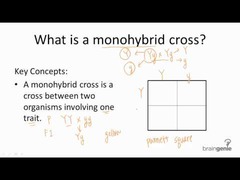
1655912361MonohybridsAn organism that is heterozygous with respect to a single gene of interest. All the offspring from a cross between parents homozygous for different alleles are monohybrids. For example, parents of genotypes AA and aa produce a monohybrid of genotype Aa.20
1655912362Monohybrid CrossA cross between two organisms that are heterozygous for the character being followed (or the self-pollination of a heterozygous plant).21
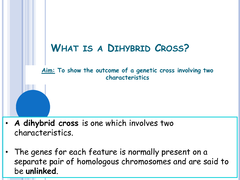
1655912363DihybridsAn organism that is heterozygous with respect to two genes of interest. All the offspring from a cross between parents doubly homozygous for different alleles are dihybrids. For example, parents of genotypes AABB and aabb produce a dihybrid of genotype AaBb.22
1655912364Dihybrid CrossA cross between two organisms that are each heterozygous for both of the characters being followed (or the self-pollination of a plant that is heterozygous for both characters).23
1655912304Multiplication ruleA rule of probability stating that the probability of two or more independent events occurring together can be determined by multiplying their individual probabilities (1/2 X 1/2 = 1/4)24
1655912305Addition ruleA rule of probability stating that the probability of any one of two or more mutually exclusive events occurring can be determined by adding their individual probabilities - use the number you got from the Multiplication Rule (1/4)25
1655912307Complete dominanceThe situation in which the phenotypes of the heterozygote and dominant homozygote are indistinguishable.26
1655912366Incomplete dominanceThe situation in which the phenotype of heterozygotes is intermediate between the phenotypes of individuals homozygous for either allele. Red flowers + White flowers = Pink flowers27
1655912308CodominanceWhen the two alleles for a specific trait each affect the phenotype in separate, distinguishable ways. Example: human blood groups = AB28
1655912309Tay-Sachs DiseaseA human genetic disease caused by a recessive allele for a dysfunctional enzyme, leading to accumulation of certain lipids in the brain. Seizures, blindness, and degeneration of motor and mental performance usually become manifest a few months after birth, followed by death within a few years.29
1655912310PleiotropyThe ability of a single gene to have multiple effects.30
1655912311EpistasisA type of gene interaction in which the phenotypic expression of one gene alters that of another independently inherited gene.31
1655912312Quantitative CharactersA heritable feature that varies continuously over a range rather than in an either-or fashion.32
1655912313Polygenic InheritanceAn additive effect of two or more genes on a single phenotypic character.33
1655912314Norm of ReactionThe range of phenotypes produced by a single genotype, due to environmental influences.34
1655912315MultifactorialReferring to a phenotypic character that is influenced by multiple genes and environmental factors35
1655912317PedigreeA diagram of a family tree with conventional symbols, showing the occurrence of heritable characters in parents and offspring over multiple generations.36
1655912318CarriersIn genetics, an individual who is heterozygous at a given genetic locus for a recessively inherited disorder. The heterozygote is generally phenotypically normal for the disorder but can pass on the recessive allele to offspring.37
1655912319Cystic FibrosisA human genetic disorder caused by a recessive allele for a chloride channel protein; characterized by an excessive secretion of mucus and consequent vulnerability to infection; fatal if untreated.38
1655912320Sickle Cell DiseaseA recessively inherited human blood disorder in which a single nucleotide change in the β-globin gene causes hemoglobin to aggregate, changing red blood cell shape and causing multiple symptoms in afflicted individuals.39
1655912321Huntington's DiseaseA human genetic disease caused by a dominant allele, characterized by uncontrollable body movements and degeneration of the nervous system; usually fatal 10 to 20 years after the onset of symptoms.40
1655912367AmniocentesisA technique associated with prenatal diagnosis in which amniotic fluid is obtained by aspiration from a needle inserted into the uterus. The fluid and the fetal cells it contains are analyzed to detect certain genetic and congenital defects in the fetus.41
1655912368Chorionic Villus Sampling (CVS)A technique associated with prenatal diagnosis in which a small sample of the fetal portion of the placenta is removed for analysis to detect certain genetic and congenital defects in the fetus.42
1655912323Chromosome Theory of InheritanceA basic principle in biology stating that genes are located at specific positions (loci) on chromosomes and that the behavior of chromosomes during meiosis accounts for inheritance patterns.43
1655912324Wild TypeThe phenotype most commonly observed in natural populations; also refers to the individual with that phenotype.44
1655912326Sex-Linked GeneA gene located on either sex chromosome. Most sex-linked genes are on the X chromosome and show distinctive patterns of inheritance; there are very few genes on the Y chromosome.45
1655912327X-Linked GenesA gene located on the X chromosome; such genes show a distinctive pattern of inheritance.46
1655912328Duchenne Muscular DystrophyA human genetic disease caused by a X-linked recessive allele; characterized by progressive weakening and a loss of muscle tissue. Typically occurs only in males.47
1655912329HemophiliaA human genetic disease caused by a X-linked recessive allele resulting in the absence of one or more blood-clotting proteins; characterized by excessive bleeding following injury.48
1655912330Barr BodyA dense object lying along the inside of the nuclear envelope in cells of female mammals, representing a highly condensed, inactivated X chromosome.49
1655912332Genetic RecombinationGeneral term for the production of offspring with combinations of traits that differ from those found in either parent.50
1655912333Parental TypesAn offsprring with a phenotyp that matches one of the true-breeding parental (P generation) phenotypes; also refers to the phenotype itself.51
1655912334Recombinant Types/RecombinantsAn offspring whose phenotype differs from that of the true-breeding P generation parents; also refers to the phenotype itself.52
1655912335Crossing OverThe reciprocal exchange of genetic material between nonsister chromatids during prophase I of meiosis.53
1655912336Genetic MapAn ordered list of genetic loci (genes or other genetic markers) along a chromosome.54
1655912337Linkage mapA genetic map based on the frequencies of recombination between markers during crossing over of homologous chromosomes.55
1655912338Map UnitsA unit of measurement of the distance between genes. One map unit is equivalent to a 1% recombination frequency.56
1655912340NondisjunctionAn error in meiosis or mitosis in which members of a pair of homologous chromosomes or a pair of sister chromatids fail to separate properly from each other.57
1655912341AneuploidyA chromosomal aberration in which one or more chromosomes are present in extra copies or are deficient in number.58
1655912342MonosomicReferring to a diploid cell that has only one copy of a particular chromosome instead of the normal two.59
1655912343TrisomicReferring to a diploid cell that has three copies of a particular chromosome instead of the normal two.60
1655912344PolyploidyA chromosomal alteration in which the organism possesses more than two complete chromosome sets. It is the result of an accident of cell division.61
1655912345Deletion(1) A deficiency in a chromosome resulting from the loss of a fragment through breakage. (2) A mutational loss of one or more nucleotide pairs from a gene.62
1655912346DuplicationAn aberration in chromosome structure due to fusion with a fragment from a homologous chromosome, such taht a portion of a chromosome is duplicated.63
1655912347InversionAn aberration in chromosome structure resulting from reattachment of a chromosomal fragment in a reverse orientation to the chromosome from which it originated.64
1655912348Translocation(1) An aberration in chromosome structure resulting from attachment of a chromosomal fragment to a nonhomologous chromosome. (2) During protein synthesis, the third stage in the elongation cycle, when the RNA carrying the growing polypeptide moves from the A site to the P site on the ribosome. (3) The transport of organic nutrients in the phloem of vascular plants.65
1655912349Down SyndromeA humaan genetic disease usually caused by the presence of an extra chromosome 21; characterized by developmental delays and heart and other defects that are generally treatable or non-life threatening.66
1655912351Genomic ImprintingA phenomenon in which expression of an allele in offspring depends on whether the allele is inherited from the male or female parent.67

Pages

Subscribe to CourseNotes RSS

Need Help?

We hope your visit has been a productive one. If you're having any problems, or would like to give some feedback, we'd love to hear from you.

For general help, questions, and suggestions, try our dedicated support forums.

If you need to contact the Course-Notes.Org web experience team, please use our contact form.

Need Notes?

While we strive to provide the most comprehensive notes for as many high school textbooks as possible, there are certainly going to be some that we miss. Drop us a note and let us know which textbooks you need. Be sure to include which edition of the textbook you are using! If we see enough demand, we'll do whatever we can to get those notes up on the site for you!