AP Notes, Outlines, Study Guides, Vocabulary, Practice Exams and more!

AP Flashcards

Terms : Hide Images
5697724949TheravadaSoutheast Asia0
5697724950Roman CatholicsSouth America, Southern Europe, Africa, Phillipines1
5697724951MahayanaEast Asia2
5697724952ProtestantNorth America, Europe3
5697724953Christian OrthodoxEurope and Russia4
5697724954AustronesianIslands above Australia, Madagascar5
5697724955HinduismIndus Valley6
5697724956BuddhismNepal7
5697724957Afro AsiaticIraq to Africa8
5697724958Balto SlavicOrthodox countries9
5697724959Hearth of AustronesianTaiwan10
5697724960Afro Asiatic HearthNorth Africa and Iraq11
5700289209Non Christian Religions in USNY, Cali, Illinois, Texas12
5700289210JewsMiddle East and US13
5700289211Sunni MuslimsNorth Africa, Middle East, Indonesia, North India, Pakistan14
5700289212Shia MuslimsIran, Iraq, Afghanistan, around Persian gulf15
57002892136 migrations in USANorth Europe to east coast, Africa to southern USA, other parts of Europe (Germany) to Northeast, Southern Europe to Northern USA, leaving south to developed areas, South America and Asia to southern border and Pacific coast16

APES Chapter 5 Vocab Flashcards

Terms : Hide Images
7813993924Species Richnessthe number of species in a given area0
7813993925Species Evennessthe relative proportion of individuals within the different species in a given area1
7813993926Phylogenythe branching pattern of evolutionary relationships2
7813993927EvolutionA change in the genetic composition of a population over time3
7813993928MicroevolutionEvolution below the species level4
7813993929MacroevolutionEvolution that gives rise to new species, genera, families, classes or phyla5
7813993930GenesA physical location on the chromosome within each cell of an organism6
7813993931Genotypesthe complete set of genes in an individual7
7813993932Phenotypesa set of traits expressed by an individual8
7813993933MutationA random change in the genetic code produced by a mistake in the copying process9
7813993934Recombinationthe genetic process by which one chromosome breaks off and attaches to another chromosome during reproductive cell division10
7813993935Artificial SelectionThe process in which humans determine which individuals breed, typically with a preconceived set of traits in mind11
7813993936Natural SelectionThe process in which the environment determines which individuals survive and reproduce12
7813993937FitnessAn individual's ability to survive and reproduce13
7813993938AdaptationsA trait that improves an individual's fitness14
7813993939Gene FlowThe process by which individuals move from one population to another and thereby alter the genetic composition of both populations15
7813993940Genetic DriftA change in the genetic composition of a population over time as a result of random mating16
7813993941Bottleneck EffectA reduction in the genetic diversity of a population caused by a reduction in its size17
7813993942ExtinctionThe death of the last member of a species18
7813993943Founder EffectA change in the genetic composition of a population as a result of descending from a small number of colonizing individuals19
7813993944Geographic IsolationPhysical separation of a group of individuals from others of the same species20
7813993945Allopatric SpeciationThe process of speciation that occurs with geographic isolation21
7813993946Reproductive Isolationthe result of two populations within a species evolving separately to the point that they can no longer interbreed and produce viable offspring22
7813993947Sympatric Speciationthe evolution of one species into two, without geographic isolation23
7813993948Genetically Modified Organisms (GMO)An organism produced by copying genes from a species with a desirable trait and inserting them into another species24
7813993949Range of Tolerancethe limits to the abiotic conditions that a species can tolerate25
7813993950Fundamental NicheThe suite of abiotic conditions under which a species can survive, grow, and reproduce26
7813993951Realized Nichethe range of abiotic and biotic conditions under which a species actually lives27
7813993952Distributionareas of the world in which a species lives28
7813993953Niche Generalista species that can live under a wide range of abiotic or biotic conditions29
7813993954Niche SpecialistA species that is specialized to live in a specific habitat or to feed on a small group of species30
7813993955Mass ExtinctionA large extinction of species in a relatively short period of time31
7813993956SpeciesA group of organisms that is distinct from other such groups in terms of size, shape, behavior, or biochemical properties, and that can interbreed with other individuals in its group to produce viable offspring32

AP Biology Cell Membrane Flashcards

Cell membrane structure and functions

Terms : Hide Images
7774219680Selective PermeabilityAllows some substances to cross more easily than others0
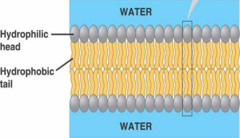
7774219681Amphipathicmolecule that has both a hydrophillic region and a hydrophobic region such as a phosopholipid1
7774219682phospholipid bilayera double layer of phospholipids that makes up plasma membranes2
7774219683Integral ProteinsProteins that extend through the phospholipid bilayer.3
7774219684Peripheral ProteinsA protein loosely attached to the surface of a membrane4
7774219685Glycoproteinsproteins that have carbohydrates covalently bonded to them5
7774219686cholesterolsteroid present in the plasma membranes of animal cells. A large amount of this in a phospholipid bilayer at High Temperatures reduces membrane fluidity, but at Lower Temperature prevents the membrane from solidifying.6
7774219687Concentration Gradienta difference in the concentration of a substance across a space7
7774219688Diffusionthe movement of molecules from an area of higher concentration to an area of lower concentration, so that they spread out evenly reaching equilibrium8
7774219689OsmosisThe diffusion of water across a selectively permeable membrane9
7774219690Transport Proteinsproteins that help to transport substances across cell membranes10
7774219691AquaporinsChannel proteins that help massive amount of water pass through the membrane; a lot in our kidneys11
7774219692Passive Transportmovement of materials through a cell membrane without using energy12
7774219693Isotonica solution whose solute concentration equals that inside a cell; the cell will not change13
7774219694Hypertonicthe solution with the greater concentration of solutes than that inside the cell; the cell will lose water to its environment--> Cell will shrivel up14
7774219695Hypotonicthe solution with the lower concentration of solutes than that inside the cell; water will enter the cell -> Cell will swell and burst15
7774219696OsmoregulationThe control of water balance16
7774219697TurgidVery firm (healthy state), especially for plant cells17
7774219698PlasmolysisAs a plant cell shrivels its plasma membrane pulls away from the wall18
7774219699Facilitated Diffusionpassive transport of ions or polar molecules across a plasma membrane by transport proteins19
7774219700Active Transporttransport of a substance through a cell membrane against the concentration gradient; requires energy20
7774219701Sodium-Potassium Pumpa carrier protein that uses ATP to actively transport sodium ions out of a cell and potassium ions into the cell21
7774219702Exocytosisprocess by which a cell releases large amounts of material by vesicles22
7774219703Endocytosisthe movement of a substance into a cell by a vesicle23
7774219704Phagocytosisa type of endocytosis in which microbes are taken in by immune cells of animals (mainly by macrophages)24
7774219705Pinocytosiscellular drinking25
7774219706Receptor-mediated endocytosisTaking in large amount of specific substances by binding to receptors, which form vesicles and are then taken in by the cell26

AP Psych: Chapter 3 Flashcards

Terms : Hide Images
7630972651SensationInformation brought in through our 5 senses0
7630977004StimuliAnything in the environment that is picked up by our senses Ex: dog barking, smelly garbage1
7630980043TransductionChanging physical energy into electrical signals (neural impulses) that can make their way to the brain Ex: vibrations of sound into neural messages2
7630989616Sensory ReceptorsSpecialized neurons or other types of cells triggered by different stimuli Ex: eyes & light, ears & vibrations, touch & pressure/temp., taste/smell & chemical substances3
7631001149Weber's Law (jnd)-just noticeable differences Easier to tell the difference between weak stimuli and harder to detect change when the stimulus is stronger Ex: it is easier to tell when music gets softer compared to it getting louder4
7631005326Gustav Fetcher-Absolute Threshold The lowest level of stimulation that can be consciously detected Ex: Whats the smallest amount of wasabi that can be in sushi for one to not notice?5
7631019852Subliminal Stimuliunconscious level of stimuli (below threshold)6
7631025231HabituationThe way the brains deals with unchanging information in environment Ex: the constant sound of the A/C becomes numb the longer we hear it7
7631032354Sensory AdaptationCells become less stimulated to unchanging stimulus Ex: the 3rd chip doesn't compare to the first8
7631048955Selective AttentionThe ability to focus on one stimulus ignoring other sensory input -can only see, hear or feel what we focus on9
76310557633 aspects to our perception of light1. Brightness 2. Saturation 3. Color10
7631056611Brightnessdetermined by amplitude of wave -higher wave = brighter light -lower wave = dimmer light11
7631061211Color (hue)determined by wavelength -longer wave = red -shorter wave = blue12
7631069853Saturationthe purity of the colors we see Ex: bright red sunsets13
7631074363Cornea-covers surface of eye and protects eye -focuses on most light coming in -fixed curvature (like a camera lens) -bends light waves so the image can focus on retina14
7631080660IrisA muscle that controls size of pupil (colored part of eye) -helps focus on image15
7631082685PupilChanges size depending on amount of light in environment -where light enters16
7631089036Aqueous HumorClear fluid that nourishes eye17
7631094584RetinaAbsorbs and processes light info -last stop until light becomes neural message to brain -contains the 3 layers of photoreceptor cells18
7631099418Photoreceptor cells1. Rods & Cones 2. Bipolar Cells 3. Ganglion Cells19
7631106203Rods-helps w/ dark adaptation -sensitive to changes in brightness -displays fuzzy images and shades of black, white and grey -peripheral retina20
7631116198Cones-help w/ light adaption (adapts quicker than rods) -concentrated in center of retina -displays fine detail and color vision -needs light to function well21
7631120955Optic Nerve-sends visual info to the brain b/c it connects our eyes to the neural parts of brain -made up of the axons of ganglion cells22
7631125812Blind spot-where optic nerve leaves the eye -no rods or cones, why we cant see at this point -contains gang. cells23
76311426363 color theoryThomas Young -3 types of cones: red, blue & green (primary colors of light) -the combo of cones and the rate they fire determines what color we see -differ shades of colors depend on intensity of light24
7631150583Opponent Process TheoryEdwald Hering -4 primary colors: red, green, blue, yellow -colors arranged in pairs (red -> green, blue -> yellow) -creates afterimage effect -processes beyond cones (bipolar or gang. cells to LGN of thalamus)25
7631163376Sound WavesWavelengths (vibrations) interpreted by the brain as a frequency or pitch26
7631174690Pitchhigh, med, low sound frequency and vibes -low pitch: frequencies further apart -high pitch: frequencies closer together27
7631178404Amplitudevolume (soft or loud)28
7631179670Timbrerichness of tone or sound (limited in range of frequencies)29
7631192255The Outer Ear-has the pinna, auditory canal, and eardrum30
7631200556Pinnavisible external part of ear -funnels sound waves from outside into ear -entrance to auditory canal31
7631204387Auditory/Ear Canalshort tunnel that connects to eardrum32
7631206763Eardrumvibrates in response to sound33
7631209034The Middle Ear3 tiny bones: 1. Hammer 2. Anvil 3. Stirrup -vibes of bones amplify vibrations from eardrum -allows easier processing of sound neurally34
7631218056Stirrupcauses membrane of inner ear to vibe35
7631218871The Inner Earaka. Oval Window 1. Cochlea 2. Basilar Membrane 3. Organ of Corti -where vibes set off chain reaction within inner ear36
7631223197Cochlea (coachella)when oval vibes, it causes cochlea fluid to vibe37
7631229652Basilar Membranefluid surrounding membrane running through cochlea38
7631232166Organ of Corticontains hair cells for sense of hearing39
7631234340Hair Cellssends auditory info through the auditory nerve then neurally to brain40
7631240881Auditory Nervecontains axons of all receptor neurons41
7631244662CHIConductive Hearing Loss -damage to eardrum or to bones of middle ear42
7631257733NHINerve Hearing Impairment -permanent hearing loss due to: -loss of hair cells in cochlea (inner ear auditory pathways) -exposure to loud noises (jamming too hard)43
7631269024Taste BudsGustation -receptor cell responsible for taste -line walls of papillae44
7631275034Papillaebumps on tongue45
76312788885 Basic Tastes1. Sweet 2. Sour 3. Salty 4. Bitter 5. Unami - savory -collaborate with smell, texture and temp. of food46
7631287775Taste Processmolecules dissolve into saliva -> molecules fit receptors -> signal fired in brain -> interprets taste47
7631291073Olfaction (Olfactory Sense)ability to smell odors -outer part of nose48
7631293108Olfactory Receptor Cellsturns odors into neural messages -little hairs or cilia -stimulated by molecules of substance in air -sniffing moves molecules into nasal cavities49
7631296826Olfactory Bulbstakes stimulus to brain, passes thalamus -sinus cavity on each side of brain50
7631299796Smell ProcessOlfactory receptors send neural signals to bulbs -> primary olfactory cortex -> orbitofrontal cortex and amygdala51
76313045123 Somesthetic Systems1. Skin Sense 2. Kinesthetic 3. Vestibular52
7631305592Skin Sensetouch, pressure, temp & pain53
7631306411Kinesthetic Senselocation of body parts -processed by joints, muscles and tendons Ex: dancing, running, walking54
7631310724Vestibular Sensebody position -keeping balance55
7631317649Color Blinddefective cones in retina56
7631321984Light Travel Process1. Rods & Cones 2. Bipolar Cells 3. Gang. Cells57
7631323712Olfactory Fatiguesmelling the same smell over a long period of time, the odor starts to fade58
7631332054Cochlear Implantmicrophone replaces outer & middle ear -sends signals from implant to cochlea then into electrical signals59
7631339197Bottom Up Processingtaking sensory info & assembling & associating it Ex: starting of a puzzle, more puzzles reveal picture60
7631348815Top Down Processingusing models, ideas, and expectations to interpret sensory info Ex: already knowing how to solve a puzzle61
7631351194Perceptual Illusionsincorrectly perceiving reality b/c of our senses62
7631353422Perceptual Setpast experiences/expectations influence our perception of concepts63
7631354710Mueller Lyer Illusion2 lines of the same length appear to be differ lengths64
7631357558Ponzo Illusionminds tendency to judge an objects size according to background -perception of depth65
7631361029Parapsychologytelekenesis, calirvoyance66
7631363563Perceptionbrain takes all sensations a person experiences, allows them to interpret Ex: a cloud might look like a cauliflower, but to another individual it may look like a cow67
7631368228Size Constancyinterpret an object as being the same size68
7631369132Shape Constancyperception of shapes69
7631369956Brightness Constancybrightness of object70
7631371877Figure Groundperceive objects or figures as existing on a background -illusions71
7631372833Reversible figuresfigure and background seems to switch back and forth72
7631374281Proximityperceive close objects73
7631374873Similaritythings that look similar74
7631375340Closuremind completes figures that are incomplete75
7631376090Continuitycontinuous pattern76
7631377794Contiguityperceive 2 things that happen close together in time as being related77
7631383612Depth Perceptionallows us to see 3D -how far/close objects are78
7631384338The Visual Cliffcreated by Elanor Gibson & Michael Walk -Can infants perceive the world in 3D for their age? -built table w/ drop off side and regular side, with same patter cloth -babies were scared to go on drop off side79
7631389155Monocular Cuesperceive depth with one eye80
7631389500Binocular Cuesperceive depth with both eyes to see entire area -rotation of our eyes to focus on single object -object close = convergence increases (eyes cross)81
7631395561Accomodationmuscular cue -lens changes shape/thickness, in response to near/far objects -cue for distance82

APES Friedland Chapter 6 Flashcards

Terms : Hide Images
9004076392intrinsic growth rate (r)has particular maximum potential for growth labeled (r)0
9004076393overshootwhen a population becomes larger than spring carrying capacity1
9004076394community-incorporates all populations pf organisms within a given are -boundries maybe defined by state or federal agencies responsible for managing it -scientists who study this are interested in how species interact with one another -exist within ecosystems2
9004076395growth ratenumber of offspring an individual can produce in given time period, minus deaths of individual or its offspring during the same period3
9004076396die-off-result of overshoot -population crash4
9004076397population-composed of all individuals that belong to the same species & live in a given area at a particular time -evolution occurs -scientists who study this are interested in factors that cause number of individuals to increase or decrease5
9004076398logistic growth model-describes population whose growth is initially exponential but slows as population approaches carrying capacity of environment (K) -s-shaped6
9004076399age structure-description of how many individuals fit into particular age categories -knowing this helps ecologists predict how rapidly populations can grow7
9004076400limiting resource-resource that a population cannot live without & which occurs in quantities lower than a population would require to increase in size -if this decreases, so does population size that depends on it *water, nitrogen, phosphorous*8
9004076401s-shaped curvelogistic growth model *Gause Paramecium experiments*9
9004076402sex ratio-ration of males to females -usually close to 50:50 -helps scientists estimate number of offspring a population will produce in the next generation *fig wasps=20 females:1 male*10
9004076403population ecology-study of factors that cause populations to increase or decrease -knowing these factors that affect population size helps implement measures to improve survival & reproduction11
9004076404carrying capacity (K)limit to how many individuals an environment can sustain12
9004076405j-shaped curve-exponential growth model -populations not limited by resources, growth is rapid, as more births occur with each step in time13
9004076406k-selected species-large organisms that reach reproductive maturity relatively late -produce few large offspring -provide parental care -pose challenge because populations grow slowly -endangered species cannot respond quickly to efforts to save it from extinction -because carrying capacity is denoted as k14
9004076407population density-number of individuals per unit area (or volume) -helps scientists estimate whether species is rare or abundant *coyote=1 per square km:12 per square km* -useful measure for wildlife managers whi must set hunting or fishing limits on species *offer more hunting/fishing permits for high zones & fewer for low zones*15
9004076408population size-total number of individuals within a defined area at a given time *california condor-combination of poaching, poisoning, flying into power lines=reduced but by captive breeding, increased16
9004076409density-independent factors-have same effect on an individual's probability of survival & amount of reproduction at any population size -bird populations are regulated by these *tornado, hurricane, flood, fire, volcano*17
9004076410density-dependent factors-influence individual's probability of survival & reproduction in a manner that depends on size of the population *amount of food available-food scarcity affect large populations over smaller ones*18
9004076411r-selected species-exhibit rapid population growth that is followed by overshoots & die-offs -small organisms that reach reproductive maturity relatively early -produce many small offspring -reproduce frequently -provide little/no parental care -because intrinsic growth rate is denoted by r *house mice, roaches, small fish, insects, weedy plants*19
9004076412population distribution-description of how individuals are distributed with respect to one another *random, uniform, clumped*20
9004076413clumped population distribution-large group, feeding opportunities & protection from predators *school fish, flocking birds, herding mammals*21
9004076414uniform population distribution-evenly spaced -plants produce toxins to prevent other plants of same species from growing close *nesting birds*22
9004076415random population distribution-no pattern *trees*23
9004076416survivorship curves-distinct patterns of survival over time *type I, II, III*24
9004076417type III survivorship curve-low survival early in life & rarely reach adulthood *r-selected species*25
9004076418type II survivorship curve-relatively constant decline *coral, squirrels*26
9004076419type I survivorship curve-as they approach old age, start to die in large numbers *k-selected species*27
9004076420exponential growth model-(N v t) = (N v 0) e ^ rt -e is base of natural logs, t is time -future size of population (N v t) depends on current size of population (N v 0), intrinsic growth rate of population (r) & amount of time (t) over which population grows -j-shaped28
9004076421corridors-strips of natural habitat that connect separated populations -provide connectedness among populations29
9004076422metapopulation-groups of spatially distinct populations that are connected by occasional movements of individuals between them -provide a species with some protection against threats such as diseases30
9004076423community ecology-study of how interactions between species affect community structure & organization31
9004076424competition-struggle of individuals to obtain a limiting resource32
9004076425competitive exclusion principle-principle stating that two species competing for the same limiting resource cannot coexist33
9004076426resource partitioning-situation in which two species divide a resource, based on differences in their behavior or morphology34
9004076427predationinteraction in which one organism kills & eats another35
9004076428parasites-live in or on organism they consume, known as host -rarely cause death to host, since they consume only small fraction of host *tapeworms, protists that live in bloodstream & cause malaria36
9004076429pathogens-parasites that cause disease in host *viruses, bacteria, fungi, protists, helminths37
9004076430parasitoids-organism that lay eggs inside other organisms -when eggs hatch, larvae consume host from inside out, which leads to death *wasps, flies38
9004076431mutualism-an interaction between species that increases the chances of survival or reproduction for both species -assist other species on order to benefit itself39
9004076432commensalism-relationship between species in which one species benefits & the other species is neither helped nor harmed *bird use tree as perch, fish use coral as place to hide from predators40
9004076433symbiotic-relationship of two species that live in close association with each other41
9004076434keystone species-species that are far more important in their community than their relative abundance might suggest -exists in low numbers *predators, source of food42
9004076435ecological succession-replacement of one group of species by another group of species over time -decades to centuries -in terrestrial community, can be primary or secondary43
9004076436primary succession-ecological succession occurring on surfaces that are initially devoid of soil *parking lot, newly exposed rock from glacier retreat, newly cooled lava44
9004076437secondary succession-succession of plant life that occurs in areas that have been disturbed but have not lost their soil -follows event like fire, hurricane -occur on abandoned agriculture field *New England farms45
9004076438pioneer species-species that can colonize new areas rapidly & grow well in full sunshine *aspen & cherry trees46
9004076439theory of island biogeography-demonstrates importance of both habitat size & distance in determining species richness47

AP Biology Cell Division Flashcards

Chapter 12
Cell Division / Mitosis
Vocabulary: gene, cell division, chromosomes, somatic cells, gametes, chromatin, sister chromatids, centromere, mitosis, cytokinesis, meiosis, mitotic phase, interphase, centrosome, aster, kinetochore, cleavage furrow, cell plate, mitotic spindle, binary fission, transformation, benign tumor, malignant tumor, metastasis
Objectives:
After attending lectures and studying the chapter, the student should be able to:
1. Define gene as it relates to the genetic material in a cell.
2. Describe the composition of the genetic material in bacteria, in archaea, and in eukaryotic cells.
3. State the location of the genetic material in prokaryotic and eukaryotic cells.
4. Distinguish between the structure of the genetic material as chromatin and as
chromosomes.
5. Distinguish between the function of the genetic material as chromatin and as
chromosomes.
6. Relating to eukaryotic cells:
a. Describe the centromere region in the genetic material.
b. State the role of cohesins in duplicated genetic material.
c. Describe the sister chromatids of a duplicated chromosome.
d. State the role of the kinetochores on the chromatids at the centromere of a duplicated
chromosome.
e. Describe spindle fibers and state their role in the separation of chromosomes during eukaryotic cell division.
f. Describe the role of centrosomes in the formation of the spindle apparatus.
g. Distinguish between a gene and an allele.
h. Describe homologous chromosomes.
i. Distinguish between an individual's genome and karyotype.
j. State the number of chromosomes in human haploid cells and in human diploid cells.
k. State which cells in humans are haploid, which cells are diploid, and which cells are neither.
7. State the two major parts of the cell cycle.
8. Describe the differences of growth characteristics between a cancerous (transformed) cell and a normal cell.
8. Relating to the prokaryotic cell cycle:
a. State the number of chromosomes in a prokaryotic cell.
b.

Terms : Hide Images
8571377513Cell CycleAn ordered sequence of events in the life of a cell0
8571377514MitosisA process of nuclear division in eukaryotic cells. Produces genetically identical cells1
8571377515CytokinesisThe division of the cytoplasm to form two separate daughter cells immediately after mitosis, meiosis I, or meiosis II.2
8571377516Cell DivisionThe reproduction of cells3
8571377517GenomeThe genetic material of an organism or virus4
8571377518ChromosomesA cellular structure carrying genetic material, found in the nucleus of eukaryotic cells. Each chromosome consists of one very long DNA molecule and associated proteins5
8571377519ChromatinThe complex of DNA and proteins that makes up eukaryotic chromosomes. When the cell is not dividing, exists in its dispersed form, as a mass of very long, thin fibers that are not visible with a light microscope6
8571377520Somatic CellsAny cell in a multicellular organism except a sperm or egg7
8571377521GametesA haploid reproductive cell, such as an egg or sperm. Unite during sexual reproduction to produce a diploid zygote.8
8571377522Sister ChromatidsTwo copies of a duplicated chromosome attached to each other by proteis at the centromere and sometimes, along the arms. While joined, two sister chromatids make up one chromosome. Chromatids are eventually separated during mitosis or meiosis II9
8571377523CentromereJoins two sister chromatids10
8571377524How many chromatids are in a duplicated chromosome?211
8571377525mitotic (M) phaseThe phase of the cell cycle that includes mitosis and cytokinesis.12
8571377526interphaseThe period in the cell cycle when the cell is not dividing. Cellular metabolic activity is high, chromosomes and organelles are duplicated, and cell size may increase. Often accounts for about 90% of the cell cycle.13
8571377527mitotic spindleAn assemblage of microtubules and associated proteins that is involved in the movement of chromosomes during mitosis.14
8571377528Transformation(1) The conversion of a normal animal cell to a cancerous cell. (2) A change in genotype and phenotype due to the assimilation of external DNA by a cell. When the external DNA is from a member of a different species, transformation results in horizontal gene transfer15
8571377529binary fissionA method of asexual reproduction by "division in half."16
8571377530asexual reproductionA type of reproduction involving only one parent that produces genetically identical offspring by budding or by the division of a single cell or the entire organism into two or more parts.17
8571377531sexual reproductionA type of reproduction in which two parents give rise to offspring that have unique combinations of genes inherited from the gametes of the two parents.18
8571377532diploid cellA cell containing two sets of chromosomes (2n), one set inherited from each parent.19
8571377533haploid cellA cell containing only one set of chromosomes (n).20
8571377535S PhaseThe synthesis phase of the cell cycle; the portion of interphase during which DNA is replicated.21
8571377536G2 PhaseThe second gap, or growth phase, of the cell cycle, consisting of the portion of interphase after DNA synthesis occurs.22
8571377537CentrosomeA structure present in the cytoplasm of animal cells that functions as a microtubule-organizing center and is important during cell division, contains the centriole.23
8571377538Metaphase PlateAn imaginary structure located at a plane midway between the two poles of a cell in metaphase on which the centromeres of all the duplicated chromosomes are located.24
8571377539Cleavage FurrowThe first sign of cleavage in an animal cell; a shallow groove around the cell in the cell surface near the old metaphase plate.25
8571377540Cell PlateA membrane-bounded, flattened sac located at the midline of a dividing plant cell, inside which the new cell wall forms during cytokinesis.26
8571377542G0 PhaseA nondividing state occupied by cells that have left the cell cycle, sometimes reversibly.27
8571377543Growth Factor(1) A protein that must be present in the extracellular environment (culture medium or animal body) for the growth and normal development of certain types of cells. (2) A local regulator that acts on nearby cells to stimulate cell proliferation and differentiation.28
8571377544What are the 4 phases of mitosis?Prophase Metaphase Anaphase Telophase29
8571377545ProphaseThe first stage of mitosis, in which 3 things happen: 1) chromatin condenses into chromosomes 2) Nuclear envelope breaks down 3) mitotic spindle fibers are assembled.30
8571377546MetaphaseThe 2nd stage of mitosis, in which the spindle is complete and the chromosomes, attached to microtubules at their kinetochores, are all aligned at the metaphase plate.31
8571377547AnaphaseThe 3rd stage of mitosis, in which the chromatids of each chromosome have separated and the daughter chromosomes are moving to the poles of the cell.32
8571377548TelophaseThe 4th and final stage of mitosis, in which daughter nuclei are forming and cytokinesis has typically begun.33
8571377549How many chromatids are in ONE duplicated chromosome?234
8571377550spindle fibersMicrotubules involved in the movement of chromosomes during mitosis.35
8571377554What are 2 parts of cell division?Mitosis and Cytokinesis Cell division consists of two processes: mitosis and cytokinesis. Mitosis— division of the nucleus and its chromosomes36
8571377559G1 PhaseThe first gap, or growth phase, of the cell cycle, consisting of the portion of interphase before DNA synthesis begins.37

AP Psychology Unit 5 Flashcards

Terms : Hide Images
8164009353consciousnessour awareness of ourselves and our environment, a part of the mind from which we can potentially retrieve a fact, an idea, an emotion, or a memory and combine it with critical thinking.0
81653550983 main functions of conciousnessrestricts our attention (selective attention); where sensation combines with memory, emotions, and motives; allows us to create a mental model of the world that we can manipulate (only HUMANS can do this!)1
8164184963states of conciousnessspontaneous states: daydreaming, drowsiness, dreaming physiologically enduced states: hallucinations, orgasms, food or oxygen starvation psychologically enduced states: sensory deprivation, hypnosis, meditation2
8164011682chronobiologya field of biology that examines organisms and their adaptation to solar- and lunar-related rhythms. These cycles are known as biological rhythms.3
8164013866biological rhythmsinclude circadian rhythms (24-hour clock) and Ultradian Rhythms (the cycles during our night's sleep)4
8164013867cortisolhormone that keeps you awake, may be associated with insomnia5
8164017812melatoninhormone that induces sleep, controlled by the pineal gland, connected to the wake-sleep cycles that builds up while we sleep.6
8164019930circadian rhythmsthe "body clock", 24-hour cycle that rules us all. This internal body clock is affected by external forces, such as sun rise and time zones. Ex: as we approach night time, our body temperatures begin to drop.7
8164022675free running cyclesis a sleep pattern that is not adjusted to the 24-hour cycle in nature nor to any artificial cycle8
8164022676entrainmentanything that impacts your sleep9
8164025337social entrainmentour circadian rhythms being off due to your social experiences.10
8164027767restorative theorytheory that REM sleep stimulates the brain in order to stimulate and restore neural pathways11
8164027768memory consolidation theorytheory that dreams are used to sort through the day's experiences and help us remember the day's events12
8164034990adaptive non-responding theorytheory for why we sleep that suggests that sleep was used to protect our ancestors from danger13
8164034991twilight statea dreamy state lacking touch with present reality, can sometimes be induced with narcotics14
8165673476sleepnatural shift in state of consciousness, we forget the moment we fall asleep, we are less aware of our surroundings15
8169443189sleep debtwhen you deprive yourself of multiple nights of sleep, brain can remember sleep debt for 2 weeks, not solved by 1 long sleep16
8169369620theories of sleepprotection, recuperation (brain can repair itself), memory (restore and rebuild our daily memories), creativity, growth17
8164040431R.E.Malso called paradoxical sleep or Rapid Eye Movement sleep, a recurring sleep stage when vivid dreams commonly occur. Muscles are relaxed (only minor twitching) except for eyes and groin, heart rate rises and breathing is rapid and irregular, it acts as a mental recovery from the day and you spend less and less time in REM as you get older. REM rebound, as the night goes on you spend less time in NREM-3 and more in REM18
8165478564sleep cycle(Ultradian Rhythms) goes 1, 2, 3, 2, REM, 2, 3, 2, REM... during a night the amount of NREM-3 sleep will decrease and REM sleep will increase.19
8165507402NREM-1slowed breathing, irregular brain waves, theta waves are prominent, easily awakened, may experience sensations of falling20
8165509254NREM-2sleep spindles and EEG activity, mainly theta waves, spend half of night's sleep in NREM-221
8165592096sleep spindlesNREM2, bursts of rhythmic brain-wave inactivity in response to K-complexes (ex: car honking) that keep us asleep22
8165509255NREM-3can be called slow-wave sleep, delta sleep, or deep sleep. Vital for restoring body's growth hormones and good overall health which is why it occurs in the first 30 min of sleep. Plays a critical role in physicial growth (Pituitary) and physicial recovery23
8164044028beta wavesbrain waves of an alert waking state24
8164047569alpha wavesrelatively slow brain waves of a relaxed, awake state (drowsy)25
8164047570theta wavesNREM-2 sleep waves, slower, high amplitude, low frequency26
8164052535delta waveslarge, slow brain waves associated with deep sleep (NREM-3), high frequency, low amplitude27
8164052536hallucinationsfalse sensory experiences, such as seeing something in the absence of an external visual stimulus (Sensory experiences that occur without a sensory stimulus.)28
8169131779hypnagogic sensationssensations such as falling, floating, or feeling "pinned down" (during NREM-1) that may later be incorporated into your memories29
8164056430sleep deprivationFatigue (NREM), impaired concentration (REM), depressed immune system (Viral Infections), slowed reaction time, greater vulnerability to accidents, higher risk of depression, increased ghrelin (hunger-arousing hormone) and decreases leptin (hunger supresses hormone)- makes you fat,30
8164056431insomniaDifficulty falling asleep and staying asleep, affects 10% of the population, "remedies" may actually worsen the problem: Sleeping pills: addicting, prevent Rem sleep and Alcohol: Prevents REM Sleep31
8164059380hypersomniais a sleep disorder characterized by excessive daytime sleepiness, excessive sleep periods each day, or the inability to feel refreshed after sleep.32
8164059381narcolepsysleep disorder where people may fall asleep at unpredictable or inappropriate times, person may go directly into REM sleep, affects less than .001 % of population, lack of neurotransmitter orexin (linked to alertness)33
8164061809sleep apneasleep disorder where a person stops breathing during their sleep (stop breathing 300-500 times a night). Wake up momentarily, gasps for air, then falls back asleep. Common in overweight males, can be helped by a CPAP macheine.34
8164061810night terrorsusually occur in children and are rarely remembered, REM-3 sleep, child may wake up screaming and have no idea why and have a rapid heartbeat and heavy breathing.35
8164064170nightmaresscary dreams that occur during REM sleep36
8164064225*incubus attackswhen you feel like there is another person on top of you preventing you from moving, usually sexual and scary37
8164072214superchiasmatic nucleus (SCN)cell clusters in the hypothalamus that controls the circadian rhythm. ex: it responds to light by causing the pineal gland to adjust melatonin production thus modifying our feelings of sleepiness.38
8164075075somnambulismsleep walking, NREM3, person can walk, talk and see, but will have little or no memory of the event when they wake up.39
8164075076somnilloquysleep talking, can occur in any stage of sleep40
8164077797dreama sequence of images, emotions, and thoughts passing through a sleeping person's mind usually in REM sleep. most dreams are negative and people commonly dream about failure, and people's dreams are rarely sexual contrary to popular belief41
8179942884theories to why we dreamFreud's theory that we dream to satisfy our wishes that can't be expressed during the day or even directly through our dreams, information processing theory that we dream to sift and sort through the days experiences and helps our memory Physiological function theory: Neural activity during Rem sleep provides brain stimulation and growth. activation-synthesis theory: dreaming is our brain's attempt to make sense of random neural firings in various parts of our brain. Cognitive Theory: Dream are the embodiment of thoughts.42
8164077798manifest contentthe remembered story line of a dream (Freud's dream theory)43
8164080532latent contentunderlying or hidden meaning of a dream (Freud's dream theory)44
8164082608REM reboundis the tendency for REM sleep to increase after a period in which the subject has experienced REM deprivation, shows importance of REM sleep45
8164082609hypnosisa social interaction in which one person (subject) responds to another person's (the hypnotist) suggestions that certain perceptions, feelings, thoughts, or behaviors will spontaneously occur, can be therapeutic and can alleviate pain by blocking our attention to painful stimuli (does not block sensory input to pain)46
8164264482limits to hypnosishypnosis doesn't enhance the ability to recall forgotten events, may even evoke false memories; a hypnotist can't force people to act against their will, they may perform unlikely acts, but not any more than a not-hypnotized person.47
8164086711hidden observera level of us that is always aware (divided consciousness theory)48
8164089175posthypnotic amnesiaperson's inability to recall events or information obtained while in a hypnotic state.49
8164091655posthypnotic suggestiona suggestion, made during a hypnosis session, to be carried out after the subject is no longer hypnotized, often by responding to a cue; has been used to alleviate headaches, asthma, and stress-related skin disorders.50
8164376294social influence theorybelief that hypnosis is not an altered state of concious, but rather a power of social influence that causes subjects to behave like "good hypnotic subjects" the more they like and trust a hypnotist, and the more they believe they are hypnotised.51
8164414873divided consciousness theorybelief that hypnosis is more than a person playing the role of a "good subject" and believe that hypnosis evokes a separate state of consciousness (dissociation) Ex: ice water experiment52
8164091656dissociationa split between levels of consciousness which allows some thoughts and behaviors to occur simultaneously as others. Used in hypnosis to alleviate pain by separating the physical stimulus of pain from the emotional suffering that defines our experience of pain53
8164094496psychoactive druga chemical substance that alters perceptions and moods, small enough to pass through the blood-brain barrier, (Alcohol, Marijuana, and Cocaine, etc.)54
8164094497addictionA compulsive craving for and use of a drug despite the known consequences, Drug addiction is not a disease55
8164096730toleranceDiminishing effect with regular use of drug, the user needs to take larger and larger doses before experiencing the drug's effect, body begins to stop producing these chemicals naturally56
8180113838Neuroadaptationwhen the user's brain chemistry adapts to offset the drug effects57
8164096731withdrawlDiscomfort and distress that follow discontinued use.58
8164100489physical dependencePhysiological need for a drug, marked by unpleasant withdrawal symptoms (physical pain and intense cravings)59
8164100490psychological dependenceA psychological need to use a drug, Ex: to relieve negative emotions60
8164103609depressantsDrugs that reduce neural activity and slow body functions, ex: alcohol, barbiturates (prescribed as tranquilizers), and opiates (Heroin and Morphine).61
8164105870stimulantsDrugs that excite neural activity and speed up body functions. Ex: Caffeine, Nicotine, Amphetamines, Cocaine, meth.62
8180193457amphetaminesDrugs that stimulate neural activity, causing sped-up body functions and associated energy and mood changes, increases the levels of dopamine and norepinephrine, results in short-term energy and euphoria, but eventually reduces baseline dopamine level, leaving user permanently depressed, Ex: Cocaine63
8164105887hallucinogensPsychedelic (mind-manifesting) drugs that distort perceptions and evoke sensory images in the absence of sensory input, Ex: LSD64
8164109302barbituratesDrugs that depress the activity of the central nervous system, reducing anxiety but impairing memory and judgment (tranquilizers), Nembutal, Seconal, and Amytal are sometimes prescribed for sleep or to reduce anxiety.65
8164109303opiatesOpium and its derivatives (morphine and heroin) depress neural activity, temporarily lessening pain and anxiety.66
8164114897ecstasy(also called MDMA) is a synthetic stimulant and mild hallucinogen, short-term health risks and long-term effects that include: high blood pressure, harm to serotonin-producing neurons, death, and it affects mood and cognition.67
8164117524LSD(Lysergic acid diethylamide)is a powerful hallucinogenic drug that can cause reactions such as anxiety, paranoia, and delusions68
8164117525THCthe major ingredient in marijuana; triggers a variety of effects including mild hallucinations.69
8164117526cocainea powerful and addictive stimulant, derived from the coca plant, producing temporarily increased alertness and euphoria, traps dopamine in synaptic gap and dopamine particles bind to receptor sites over and over and overstimulate the cell.70
8164120832methamphetaminea powerfully addictive drug that stimulates the CNS with speeded-up body functions and associated energy and mood changes; over time, appears to reduce baseline dopamine levels, works by entering the dopamine vesicles and pushing dopamine neurotransmitters out of the cell and into the synapse where they can connect to the receptor sites71
8164124908near-death experiencean altered state of consciousness reported after almost dying (such as by cardiac arrest) often similar to drug-induced hallucinations which might be caused by the brain being under stress such as oxygen deprivation.72
8164138197Allan Hobson & Robert McCarleypsychiatrists and neurophysiologists at Harvard's medical school who believed that dreams are nothing more than your attempt to interpret random electrical impulses produced by your brain in REM sleep.73
8164143587Eugene Aserinskydiscovered REM sleep, and found that dreams occur in REM sleep74
8164145512Nathaniel Kleitman75
8164148586William Dementstudied what would happen if a person was deprived of dreaming and REM sleep. He discovered that as a person is deprived of REM sleep, they try to spend more and more time in REM which is known as REM rebound, this shows the importance of REM sleep and dreaming.76
8164148587Sigmund Freudtheorized that dreams are the expression of un-conscious wishes that we are unable to have while awake. He also believed that dreams have a manifest content (surface meaning) and a latent content (true, underlying meaning)77
8164152273Ernest Hilgardbelieved hypnosis involves not only social influence but also a special dual processing state of dissociation (Divided-conciousness theory). He viewed hypnotic dissociation as a vivid form of everyday mind splits (dual processing)78
8164152274Martin Orne & Frederick Evansshowed that both hypnotized and unhypnotized subjects who were told to throw acid in a researcher's face followed through on the request, which shows that hypnotized people don't do anything that unhypnotized people can't also be convinced to do.79

AP Biology Cell Organelles Flashcards

Terms : Hide Images
7516798402Nuclear Envelope-surrounds genetic material -separates nucleus from the cytoplasm -double lipid bilayer regulates what goes into the cell -present in both animal and plant cells0
7516798403Golgi Apparatus-packaging organelle -located in the cytoplasm -takes in small molecules and forms more complex molecules -can either store the more complex molecules or release them -has two layers that surround an area of fluid that contains proteins, enzymes, and sugars -present in both animal and plant cells1
7516798404Endoplasmic Reticulum-network of membranous sacs and tubes -surrounds the nucleus in the cytoplasm -active in membrane synthesis and metabolic processes -has rough and smooth regions -has double membrane called cisternae where proteins are collected and synthesized -present in both animal and plant cells2
7516798405Mitochondria-cellular respiration -ATP is generated -double membrane increases surface area within the organelle to allow more chemical reactions to occur -located in cytoplasm -present in both animal and plant cells3
7516798406Chloroplast-produce food for plant cells -convert light energy from the sun into sugars -double membrane surrounds and protects inner chloroplasts -located in cytoplasm -only present in plant cells4
7516798407Ribosome-makes proteins -located in cytosol or endoplasmic reticulum -present in both animal and plant cells5
7516798408Lysosome-hold enzymes -digest food and break down dead cells -located in cytoplasm -present in both animal and plant cells6
7516798409Vacuole-storage -located in cytoplasm -present in both animal and plant cells7
7516798410Cytoskeleton-reinforces cell's shape -functions in cell movement -made of proteins -proteins attach to them for stability -located on the outside of the cell -present in both animal and plant cells8
7516798411Cell Wall-outer layer that maintains cell's shape and protects cell from mechanical damage -semi permeable -located on the outside of the cell membrane -only present in plant cells9
7516798412Prokaryotic Cells-no nucleus -circular DNA located in cytoplasm -single celled -no organelles -bacteria, archaea, and eubacteria -more basic -have cell membranes -have ribosomes10
7516798413Eukaryotic Cells-have nucleus -have linear DNA located in nucleus -have organelles -cells animals have -multicellular -more complex -cell membranes -ribosomes11
7516798415Cell Membrane-separates cell from aqueous environment and controls traffic in and out of the cell -collage of proteins and other molecules embedded in the fluid matrix of the lipid bilayer12

Pages

Subscribe to CourseNotes RSS

Need Help?

We hope your visit has been a productive one. If you're having any problems, or would like to give some feedback, we'd love to hear from you.

For general help, questions, and suggestions, try our dedicated support forums.

If you need to contact the Course-Notes.Org web experience team, please use our contact form.

Need Notes?

While we strive to provide the most comprehensive notes for as many high school textbooks as possible, there are certainly going to be some that we miss. Drop us a note and let us know which textbooks you need. Be sure to include which edition of the textbook you are using! If we see enough demand, we'll do whatever we can to get those notes up on the site for you!