

AP pysch Flashcards
Terms : Hide Images
| 13925089022 | cerebral cortex | outerlayer of cerebrum contains the dendrites | 0 | |
| 13925089023 | glial cells | cells in the brain which support nourishment and protection for neurons | 1 | |
| 13925089024 | pons | "bridge" between brain stem and cerebellum, helps with sleep | 2 | |
| 13925089025 | sympathetic nervous system | "fight or flight" response | 3 | |
| 13925089026 | Thalamus | "relay station" for sensory information, for smell,taste, etc | 4 | |
| 13925089027 | Amygdala | insticts, emotional, survival | 5 | |
| 13925089028 | cerebrum | contains two hemispheres everything but brainstem and cerebellum and limabic system | 6 | |
| 13925089029 | pituitary gland | "master gland" controls all other glands, communicates with nervous system | 7 | |
| 13925089030 | autonomic nervous system | automatic, unconscious, involuntary ex. heartbeat, breathing | 8 | |
| 13925089031 | serotonin | regulates mood, hunger, sleep undersupply=depression | 9 | |
| 13925089032 | action potential | a neural impulse, brief charge that travels down terminal | 10 | |
| 13925089033 | synapse | the gap between the axon terminal and the dendrite or cell body of receiving neuron | 11 | |
| 13925089034 | dendrites | receives neural messages | 12 | |
| 13925089035 | cell body/soma | hub of cell, contains the nucleus and metabolic process "post office" | 13 | |
| 13925089036 | axon | transmits a message | 14 | |
| 13925089037 | myelin | speeds up the message sent | 15 | |
| 13925089038 | interneurons | transmits neural stimulus between sensory and motor neurons sensory->interneurons->motos | 16 | |
| 13925089039 | reticular formation | "on switch" for attention, alertness | 17 | |
| 13925089040 | cerebellum | balance, unconscious, coordination | 18 | |
| 13925089041 | parasympathetic nervous system | "rest and digest" | 19 | |
| 13925089042 | plasticity | the brain can mold and adapt to circumstances | 20 | |
| 13925089043 | CT scan | series of x-rays taken from different angles good to see structure |  | 21 |
| 13925089044 | neurogenesis | growth and regeneration of neurons | 22 | |
| 13925089045 | frontal lobe | voluntary movement, problem-solving, decision-making, emotional regulation | 23 | |
| 13925089046 | nucleus accumbens | when you statisfy a drive locates at the center of brain | 24 | |
| 13925089047 | Dopamine | satisfaction of desire, | 25 | |
| 13925089048 | Acetylcholine | excites enables muscle action, learning, and memory | 26 | |
| 13925089049 | neurotransmitters | it triggers chemical messengers | 27 | |
| 13925089050 | PET scan | visual display of brain activity that detects a form of glucose for function |  | 28 |
| 13925089051 | MRI | magnetic fields and radio waves produce computer images of tissues for structure |  | 29 |
| 13925089052 | Norepinephrine | helps control alertness and arousal(fight or flight) | 30 | |
| 13925089053 | GABA | major inhibitory slows everything down | 31 | |
| 13925089054 | Medulla | unconscious vital functions heartbeat/breathing etc | 32 | |
| 13925089055 | endorphins | "good feelings" natural pain killer | 33 | |
| 13925089056 | EEG | amplified recording of the waves of electrical activity |  | 34 |
| 13925089057 | motor neurons | relays messages from brain to muscles sensory->interneurons-> motor | 35 | |
| 13925089058 | resting potential | positive outside - inside (charge when not firing) | 36 | |
| 13925089059 | depolarization | when a neuron fires more + go into cell and axon gates open | 37 | |
| 13925089060 | sensory neurons | sends messages from sensory receptors to the spinal cord sensory-> interneurons-> motor | 38 | |
| 13925089061 | axon terminal buttons | releases molecules to other neurons "mail man" | 39 | |
| 13925089062 | glutamate | major excitatory neurotransmitter involved in memory | 40 | |
| 13925089063 | fMRI | reveals blood flow for both structure and function |  | 41 |
| 13925089064 | peripheral nervous system | not brain and spinal cord | 42 | |
| 13925089065 | adrendal gland | secrets adrenaline | 43 | |
| 13925089066 | motor cortex | back of frontal lobe initiates voluntary movements | 44 | |
| 13925089067 | sensory cortex | front of parietal lobe receives sensory info | 45 | |
| 13925089068 | parietal lobe | sensory processes, attention, language, awareness, touch | 46 | |
| 13925089069 | wernicke's area | language input, ability to understand wern=learn | 47 | |
| 13925089070 | occipital lobe | visual information, shapes, colors | 48 | |
| 13925089071 | temporal lobe | sound information, short-term memory | 49 | |
| 13925089072 | right hemisphere | visual-spatial "bigger picture" | 50 | |
| 13925089073 | broca's area | language output | 51 | |
| 13925089074 | corpus callosum | allows two hemispheres to interact together | 52 | |
| 13925089075 | left hemisphere | language, attention to detail, rational, logic | 53 | |
| 13925089076 | somatic nervous system | voluntary, conscious activity | 54 | |
| 13925089077 | central nervous system | brain and spinal cord | 55 | |
| 13925089078 | hypothalamus | regulating temperature, hunger, thirst | 56 | |
| 13925089079 | hippocampus | process and formation of memory | 57 | |
| 13925089080 | vestibular sense | sense of equilibrium/balance | 58 | |
| 13925089081 | retinal display | by comparing images from the retinas in the two eyes the brain computes the distance | 59 | |
| 13925089082 | kinesthesis | senses the position and movement of individual body parts | 60 | |
| 13925089083 | frequency | how we perceive pitch | 61 | |
| 13925089084 | amplitude | how we perceive loudness | 62 | |
| 13925089085 | wave form | how we perceive quality of sound | 63 | |
| 13925089086 | feature detectors | neurons in the brain that respond to specific features of stimulus (shape, angle movement, etc) | 64 | |
| 13925089087 | cochlea | sound energy is converted into neural impulses | 65 | |
| 13925089088 | place theory | different pitches activate different places on the cochlea's membrane | 66 | |
| 13925089089 | conduction deafness | hearing loss due to sound waves not reaching the mechanism within ear, damage to ear canal | 67 | |
| 13925089090 | sensorineural deafness | hearing loss caused by damage of the inner ear or nerve from ear to the brain | 68 | |
| 13925089091 | volley principle | neurons alternate firing to process highest pitch sounds | 69 | |
| 13925089092 | gate- control theory | there is a gate in the spinal cord and when it is opened nerves are sent to the brain | 70 | |
| 13925089093 | gustatory sense | taste, chemical sense | 71 | |
| 13925089094 | olfaction | smell, chemical sense | 72 | |
| 13925089095 | young-helmholtz trichromatic theory | three different cones on eyes red, blue, green | 73 | |
| 13925089096 | McGurk effect | hearing and vision are linked | 74 | |
| 13925089097 | perceptual constancy | perceiving objects as unchanging even as illumation and retinal images change | 75 | |
| 13925089098 | synaesthesia | when one sensation produces/stimulates another | 76 | |
| 13925089099 | after-image | when one gets exhausted the other opposing one takes over ex. staring at a blue image for a lone time and then seeing yellow | 77 | |
| 13925089100 | stroboscopic motion | our brain perceives continuous movement | 78 | |
| 13925089101 | top-down processing | looking at situation overall ex. overlooking typos in a paper because you assume they are right | 79 | |
| 13925089102 | bottom-up processing | looking at each detail ex. looking at each detail of a painting | 80 | |
| 13925089103 | lens | helps focus shapes on retina | 81 | |
| 13925089104 | iris | dilates or constricts in response to light intensity and inner emotion | 82 | |
| 13925089105 | fovea | central focal point in the retina, cones cluster in and around | 83 | |
| 13925089106 | retina | converts light energy into neural impulses very responsive to light and pressure | 84 | |
| 13925089107 | weber's law | more intense stimuli need to change more to notice a difference | 85 | |
| 13925089108 | convergence | eyes turn inward to see things near you | 86 | |
| 13925089109 | signal detection theory | no single absolute threshold ex. experience, expectations, motivations | 87 | |
| 13925089110 | Gestalt | our tendency to integrate pieces into a meaningful whole | 88 | |
| 13925089111 | frequency theory | basilar membrane vibrates at frequency of the sound | 89 | |
| 13925089112 | phi phenomenon | an illusion of movement created when lights blink on and off in succession | 90 | |
| 13925089113 | blind spot | where the optic nerve leaves the eye | 91 | |
| 13925089114 | rods and cones | cones- near fovea, low dim light sensitivity, and color sensitive rods- located at periphery, high dim light sensitivity, not color sensitive | 92 | |
| 13925089115 | parallel processing | feature detectors fire simultaneously ex. when we see an object we don't just see color | 93 | |
| 13925089116 | transduction | coverts sensory energy into neural impulses | 94 | |
| 13925089117 | absolute threshold | weakest amount of stimulus that a person can detect 50% of the time | 95 | |
| 13925089118 | subliminal stimulation | perception below one's absolute threshold for conscious awareness | 96 | |
| 13925089119 | sensory adaptation | decreased sensation due to constant stimulation | 97 | |
| 13925089120 | optic nerve | nerve that carries neural impulses from eye to brain | 98 | |
| 13925089121 | cornea | protects the eye and bends light to provide focus | 99 | |
| 13925089122 | opponent-process theory | opposing retinal processes enable color vision | 100 | |
| 13925089123 | pupil | where light enters the eye | 101 | |
| 13925089124 | habituation | simplest form of learning-less responsive to a repeated stimulus | 102 | |
| 13925089125 | retrograde amnesia | inability to remember before the trauma | 103 | |
| 13925089126 | retroactive interference | new information disrupts memory of old information P.O.R.N. | 104 | |
| 13925089127 | proactive interference | old information disrupts memory of new information P.O.R.N. | 105 | |
| 13925089128 | Engrams | memory stored as biochemicals and synaptic changes how scientists trace memories | 106 | |
| 13925089129 | procedural memory | skills- motor ans cognitive ex. playing the piano | 107 | |
| 13925089130 | implicit memory | without conscious recall ex. riding a bike | 108 | |
| 13925089131 | self-reference effect | applying to your own experiences ex. to learn a word you think of examples that apply to your life | 109 | |
| 13925089132 | semantic encoding | the encoding of meanings ex. understanding words not just memorizing | 110 | |
| 13925089133 | serial position | items in the beginning and at the end are more likely to be recalled | 111 | |
| 13925089134 | mirror neurons | frontal lobe, fire when performing certain actions or when seeing them be performed | 112 | |
| 13925089135 | negative punishment | decrease behavior by removing good stimulus | 113 | |
| 13925089136 | positive punishment | decrease a behavior by presenting a bad stimulus | 114 | |
| 13925089137 | shaping | reinforce each step toward desired behavior, useful for complex behaviors | 115 | |
| 13925089138 | primary reinforcers | unlearned, natural, biological ex. eating when hungry | 116 | |
| 13925089139 | negative reinforcement | increases response by removing unpleasant stimulus ex. letting seniors exempt from finals | 117 | |
| 13925089140 | positive reinforcement | increases response by presenting pleasant stimulus ex. giving students candy when they raise their hand | 118 | |
| 13925089141 | high-order conditioning | adding 2nd CS to produce a 2nd CR | 119 | |
| 13925089142 | conditioned response | physical reflexes response to a conditioned stimulus tuning fork->salvation | 120 | |
| 13925089143 | conditioned stimulus | learned stimulus that causes response tuning fork->salvation | 121 | |
| 13925089144 | unconditioned response | reflexive response to unconditioned stimulus food->salvation | 122 | |
| 13925089145 | unconditioned stimulus | natural stimulus causing reflexive response food->salvation | 123 | |
| 13925089146 | behaviorism | a theory that human and animal behavior can be explained in terms of conditioning | 124 | |
| 13925089147 | classical conditioning | associate two stimuli together to anticipate events ex. a dog salivates to bell anticipating food | 125 | |
| 13925089148 | associative learning | learn that certain events occur together | 126 | |
| 13925089149 | instinctive drift | occurs when animals revert to their biologically predisposed patterns | 127 | |
| 13925089150 | episodic memory | personally experienced events ex. memories form a vacation | 128 | |
| 13925089151 | operant conditioning | associate a behavior with a good or bad result | 129 | |
| 13925089152 | anterograde amnesia | inability to remember information after trauma not making new memories | 130 | |
| 13925089153 | biological perspective | how your hormones and nuerotransmitters affect your brain | 131 | |
| 13925089154 | psychodynamic | unconscious mind and how your childhood affects your behavior | 132 | |
| 13925089155 | behavioral perspective | our behaviors are influenced by our observations and consequences | 133 | |
| 13925089156 | cognitive perspective | how our behaviors are influenced by how we interpret the world | 134 | |
| 13925089157 | humanistic perspective | our behaviors are influenced by our conscious choices and finding our true identity to reach self-fulfillment | 135 | |
| 13925089158 | social loafing | the tendency for people in a group to exert less effort | 136 | |
| 13925089159 | social facilitation | improved performance in presence of others for simple tasks or something you are good at | 137 | |
| 13925089160 | asch's line study | participants had to identify the line closest in length to other lines. The whole group said the same wrong answer. The one subject conformed with the group | 138 | |
| 13925089161 | deindividuation | losing self-awareness or self restraint, occurs when group participation makes people aroused | 139 | |
| 13925089162 | group think | occurs when desire for harmony in a decision-making group overrides alternatives | 140 | |
| 13925089163 | conciliation | graduated and reciprocated initiative in tension-reduction ex. giving someone a small positive gesture to reduce tension | 141 | |
| 13925089164 | cognitive dissonance theory | when we become aware that our attitudes and actions do not coincide so we feel uncomfy | 142 | |
| 13925089165 | self-serving bias | we are sensitive to how our behavior changes with the situation, we see our own behaviors as positive | 143 | |
| 13925089166 | normative social influence | influence resulting from a person's desire to gain approval and avoid disapproval ex. pretending to like a band your friends do | 144 | |
| 13925089167 | information social influence | influence resulting from one's willingness to accept other's opinions ex. when you don't know the answer so you go along with what others say | 145 | |
| 13925089168 | group polarization | beliefs that grow stronger as we discuss with like-minded people | 146 | |
| 13925089169 | frustration-aggression principle | the blocking of a goal that creates aggression | 147 | |
| 13925089170 | social exchange theory | maximize benefits and minimize costs ex. stopping to help because you are not running late | 148 | |
| 13925089171 | bystander effect | people are less likely to help when in a group of people | 149 | |
| 13925089172 | altruism | unselfish regard for the welfare of others | 150 | |
| 13925089173 | mirror- image perceptions | mutual views held by conflicting people ex. USA calling Russia "evil" and Russia calling USA"evil" | 151 | |
| 13925089174 | self-filling prophecies | a belief that leads to one fulfilling the role expected ex. a teacher expecting you to fail so you do | 152 | |
| 13925089175 | reciprocity norm | people help me if I help them | 153 | |
| 13925089176 | social responsibility norm | duty as a human to help others | 154 | |
| 13925089177 | confounding variables | other variables that could effect the results of an experiment | 155 | |
| 13925089178 | illusory correlation | the perception of a relationship where none exists | 156 | |
| 13925089179 | naturalistic oberservation | observe people's actions, does not explain behaviors but describes it | 157 | |
| 13925089180 | operational definition | specifies how a variable will be defined and measured so the experiment can be replicated | 158 | |
| 13925089181 | case study | one or a small group of people being analyzed and asked questions | 159 | |
| 13925089182 | social-cultural perspective | social environment influences our behavior | 160 | |
| 13925089183 | evolutionary perspective | your behavior is influenced by your survival needs and genetics | 161 | |
| 13925089184 | social trap | a situation where each party is rationally pursuing their self-interest rather than good of the group become caught in a mutually destructive behavior | 162 | |
| 13925089185 | fundamental attribution | we overestimate the influence of personality and underestimate the influence of situation | 163 | |
| 13925089186 | situational attribution | someone's "bad day" or "bad mood" | 164 | |
| 13925089187 | dispositional attribution | someone's enduring traits | 165 | |
| 13925089188 | null hypothesis | no relationships between variables | 166 | |
| 13925089189 | within-subjects design | comparing results within one subject | 167 | |
| 13925089190 | between-subject design | comparing results between two subjects | 168 | |
| 13925089191 | cross-sectional study | different groups compared at one time | 169 | |
| 13925089192 | longitudinal study | one group compared to a different times | 170 | |
| 13925089193 | receptive language | ability to comprehend speech | 171 | |
| 13925089194 | productive language | ability to produce words | 172 | |
| 13925089195 | linguistic determinism | language determines the way we think, culturally influenced | 173 | |
| 13925089196 | universal language | innately wired to have a complicated language, common structure | 174 | |
| 13925089197 | algorithms | step by step procedure that guarantees the right solution to a problem | 175 | |
| 13925089198 | heuristics | mental shortcut or rule of thumb that helps us solve problems | 176 | |
| 13925089199 | prototypes | best example of a concept/mental image | 177 | |
| 13925089200 | availability heuristic | judging a situation based on how similar the aspects are to the prototypes in our mind | 178 | |
| 13925089201 | representative heuristic | judging a situation on how easily examples come to mind | 179 | |
| 13925089202 | anchoring heuristic | human tendency to accept and rely on, the first piece of information received before making a decision | 180 | |
| 13925089203 | inductive reasoning | making generalizations from observations | 181 | |
| 13925089204 | deductive reasoning | takes general rule and applies it to specific cases | 182 | |
| 13925089205 | confirmation bias | seeking information that supports our preconceptions | 183 | |
| 13925089206 | Mental Set | tendency to stick to problem solving strategies that have worked in the past | 184 | |
| 13925089207 | functional fixedness | tendency to think of things only for usual functions | 185 | |
| 13925089208 | overconfidence | tendency to overestimate the accuracy of our knowledge | 186 | |
| 13925089209 | general intelligence (g) | the existence of a broad mental capacity that influences our cognitive ability | 187 | |
| 13925089210 | Gardner's multiple intelligence theory | intelligence is not just one dominant ability, outlines 8 different intelligence | 188 | |
| 13925089211 | Savant Syndrome | when a person with a mental disability demonstrates abilities far in excess of what is considered normal | 189 | |
| 13925089212 | Sternberg's three intelligences | practical, creative, and analytical intelligence | 190 | |
| 13925089213 | emotional intelligence | the capacity to be aware of, control, and express one's emotions, and to handle interpersonal relationships empathetically | 191 | |
| 13925089214 | aptitude test | the ability to learn or develop in an area | 192 | |
| 13925089215 | achievement test | to measure to the extent a person has acquired certain information | 193 | |
| 13925089216 | Flynn effect | the phenomenon in which there is a marked increase in intelligence test score averages over time | 194 | |
| 13925089217 | content validity | Refers to how accurately an assessment or measurement tool taps into the various aspects of the specific construct in question | 195 | |
| 13925089218 | predictive validity | is the extent to which performance on a test is related to later performance that the test was designed to predict | 196 | |
| 13925089219 | securely attached | distressed when the mom left nut greeted her positively when she returned | 197 | |
| 13925089220 | avoidant-insecure | little interest when mom left or returned | 198 | |
| 13925089221 | resistant-insecure | intense distress when mom left and rejected the mother when she returned | 199 | |
| 13925089222 | schema | mental structure which helps to organize knowledge | 200 | |
| 13925089223 | assimilation | placing new information on pre-existing schema | 201 | |
| 13925089224 | accommodation | modifying schema to fit new information | 202 | |
| 13925089225 | sensorimotor | ages=0-2 senses and actions, reflexes, basics of language, object permanence | 203 | |
| 13925089226 | preoperational | ages 2-6 egocentrism: one-dimensional thinking lacks conservation- does not recognize that basic properties of substances such as weight and mass remain the same while other features change theory of mind- realize people have different mental state | 204 | |
| 13925089227 | concrete operational | ages 7-12 logic-tangible objects rather than abstract ideas concept of reversibility | 205 | |
| 13925089228 | formal operational | 12+ cognitive maturity abstract thought | 206 | |
| 13925089229 | authoritarian | strict demands rely on force and communicate poorly | 207 | |
| 13925089230 | permissive | low/no parental control, warmth, easy going, warm and supportive | 208 | |
| 13925089231 | authoritative | high parental control and high warmth gives the children the best outcomes | 209 | |
| 13925089232 | pruning process | "use it or lose it" with neural pathways | 210 | |
| 13925089233 | preconventional morality | right and wrong determined by rewards | 211 | |
| 13925089234 | conventional morality | views of others matter, avoidance of blame seeking social approval | 212 | |
| 13925089235 | postconventional morality | judgements are based on abstract, more personal principles that aren't necessarily defined by society's laws | 213 | |
| 13925089236 | crystallized intelligence | tends to increase with age concrete intelligence | 214 | |
| 13925089237 | fluid intelligence | tends to decrease with age one's ability to reason | 215 | |
| 13925089238 | Id | pleasure, principle, the need to fulfill needs right now |  | 216 |
| 13925089239 | Ego | reality principle and defense mechanisms decision making component of personality | 217 | |
| 13925089240 | superego | morality principle, guilt | 218 | |
| 13925089241 | fixation | preoccupation for satisfying pleasure-seeking energies ex. if you don't release everything through the oral stage you will be a nail bitter | 219 | |
| 13925089242 | defense mechanisms | coping mechanisms->how we deal with stress | 220 | |
| 13925089243 | regression | returning to earlier, more comforting form of behavior | 221 | |
| 13925089244 | repression | pushing thoughts out of conscious awareness | 222 | |
| 13925089245 | rationalization | unconsciously generate self-justifying explanations instead of real reasons for action or event | 223 | |
| 13925089246 | reaction formation | expressing the opposite of how one truly feels | 224 | |
| 13925089247 | displacement | redirecting one's impulses toward another person or object | 225 | |
| 13925089248 | projection | disguising threatening impulses toward another person or object | 226 | |
| 13925089249 | sublimation | channeling one's impulses toward a different, more positive and acceptable goal or behavior | 227 | |
| 13925089250 | denial | rejecting the ego-threatening truth | 228 | |
| 13925089251 | inferiority complex | all children go through a period where you feel inferior and how you cope with it processes your personality | 229 | |
| 13925089252 | collective unconscious | shared pool of memories and ideas we all have | 230 | |
| 13925089253 | archetypes | similar roles in collective unconscious | 231 | |
| 13925089254 | projective tests | given ambiguous picture, make up story a and one's conscious may be woven into the story | 232 | |
| 13925089255 | terror-management theory | proposes a basic psychological conflict that results from having a desire to live, but realizing that death is inevitable | 233 | |
| 13925089256 | person-situation controversy | refers to the controversy concerning whether the person or the situation is more influential in determining a person's behavio | 234 | |
| 13925089257 | unconditional positive regard | we feel love and accepted despite our flaws | 235 | |
| 13925089258 | instinct theory | motivated by our inborn automated behavior | 236 | |
| 13925089259 | drive-reduction theory | drives arise from motivated state and the aim is homeostasis | 237 | |
| 13925089260 | optimum arousal theory | motivated to seek ways of increasing arousal when stimulation drops | 238 | |
| 13925089261 | maslow's hierarchy of needs | we strive to meet self-actualization | 239 | |
| 13925089262 | intrinsic motivation | motivated for internal pleasure and self-enjoyment | 240 | |
| 13925089263 | extrinsic motivation | motivated for external rewards | 241 | |
| 13925089264 | over-justification | less likely that a task will be done intrinsically when extrinsic reward is no longer given | 242 | |
| 13925089265 | achievement motivation | master tasks and take great pride in doing so | 243 | |
| 13925089266 | approach-approach conflicts | two desirable but conflicting choices | 244 | |
| 13925089267 | avoidance-avoidance conflicts | choosing between two undesirable choices | 245 | |
| 13925089268 | approach-avoidance conflicts | one choice has both attractive and unattractive features | 246 | |
| 13925089269 | multiple approach-avoidance conflicts | choosing between one option that has both positive and negative features and another that has both positive and negative features | 247 | |
| 13925089270 | lateral hypothalamus | tells us we are hungry, causes secretion of ghrelin | 248 | |
| 13925089271 | ventromedical hypothalamus | tells us we are full, causes secretion of PYY | 249 | |
| 13925089272 | set point theory | stable weight to which your body wants to return | 250 | |
| 13925089273 | unit bias | size of food portion will determine how much you eat | 251 | |
| 13925089274 | james-lange theory | stimulus->physiological arousal->emotion, fear | 252 | |
| 13925089275 | cannon-bard theory | stimulus->physiological arousal ->emotion, fear | 253 | |
| 13925089276 | Schachter two-factor | stimulus->physiological arousal ->cognitive interpretation-> emotion, fear | 254 | |
| 13925089277 | spillover effect | when one experience of one emotion affects our perceptions and our reactions | 255 | |
| 13925089278 | lazarus and cognitive appraisal | stimulus->cognitive appraisal(thought)->physiological ->emotion | 256 | |
| 13925089279 | relative deprivation | It refers to the discontent people feel when they compare their positions to others and realize that they have less of what they believe themselves to be entitled than those around them | 257 | |
| 13925089280 | facial feedback hypothesis | your facial expression intensifies your emotions | 258 | |
| 13925089281 | general adaptation syndrome | term used to describe the body's short-term and long-term reactions to stress. Alarm->resistance->exhaustion | 259 | |
| 13925089282 | adaptation-level phenomenon | describes the human tendency to judge various stimuli and situations relative to those we have previously experienced | 260 | |
| 13925089283 | Bipolar cells | specialized sensory neurons for the transmission of special senses. As such, they are part of the sensory pathways for smell, sight, taste, hearing and vestibular functions. | 261 | |
| 13925089284 | thorndike's law of effect | responses that produce a satisfying effect in a particular situation become more likely to occur again in that situation, and responses that produce a discomforting effect become less likely to occur again in that situation | 262 | |
| 13925089285 | circadian rhythms | Often referred to as the "body clock", the circadian rhythm is a cycle that tells our bodies when to sleep, rise, eat--regulating many physiological processes | 263 | |
| 13925089286 | latent learning | form of learning that is not immediately expressed in an overt response; it occurs without any obvious reinforcement of the behavior or associations that are learned | 264 | |
| 13925089287 | Elaborative rehearsal | a memory technique that involves thinking about the meaning of the term to be remembered, as opposed to simply repeating the word to yourself over and over | 265 | |
| 13925089304 | ebbinghaus forgetting curve |  | 266 | |
| 13925089288 | Miller's law | in working memory we can remember 7+-2 chunks | 267 | |
| 13925089289 | misinformation effect | memory bias that occurs when misinformation affects people's reports of their own memory | 268 | |
| 13925089290 | whorf theory of language | where your language affects your world view | 269 | |
| 13925089291 | Carl Jung | He proposed and developed the concepts of the extroverted and introverted personality, archetypes, and the collective unconscious | 270 | |
| 13925089292 | Iconic memory | The encoding of visual images | 271 | |
| 13925089293 | Echoic memory | memory of auditory stimuli | 272 | |
| 13925089294 | retrospective memory | memory for the past | 273 | |
| 13925089295 | prospective memory | is memory for the future | 274 | |
| 13925089296 | insight learning | The sudden realization of a problem's solution | 275 | |
| 13925089297 | problem-focused coping | attempting to alleviate stress directly by changing stressor | 276 | |
| 13925089298 | emotion-focused coping | attempting to alleviate stress by ignoring stressor and attending to emotional needs | 277 | |
| 13925089299 | spotlight effect | phenomenon in which people tend to believe they are noticed more than they really are | 278 | |
| 13925089300 | heriability | % liklihood that the variation among members of a group is due to genetics | 279 | |
| 13925089301 | chameleon effect | when we mimic others around us | 280 | |
| 13925089302 | effort-justification | if you have to put alot of effort into something you justify you must have enjoyed that task | 281 |
Flashcards
AP Literature Unit 1 Vocabulary Flashcards
Terms : Hide Images
| 14841393532 | Acquisitive | (adj.) able to get and retain ideas or information; concerned with acquiring wealth or property | 0 | |
| 14841393533 | Arrogate | (v.) to claim or take without right | 1 | |
| 14841393534 | Banal | (adj.) hackneyed, trite, commonplace | 2 | |
| 14841393535 | Belabor | (v.) to work on excessively; to thrash soundly | 3 | |
| 14841393536 | Carping | (adj.) tending to find fault, especially in a petty, nasty, or hairsplitting way; (n.) petty, nagging criticism | 4 | |
| 14841393537 | Coherent | (adj.) holding or sticking together; making a logical whole; comprehensible, meaningful | 5 | |
| 14841393538 | Congeal | (v.) to change from liquid to solid, thicken; to make inflexible or rigid | 6 | |
| 14841393539 | Emulate | (v.) to imitate with the intent of equaling or surpassing the model | 7 | |
| 14841393540 | Encomium | (n.) a formal expression of praise, a lavish tribute | 8 | |
| 14841393541 | Eschew | (v.) to avoid, shun, keep away from | 9 | |
| 14841393542 | Germane | (adj.) relevant, appropriate, apropos, fitting | 10 | |
| 14841393543 | Insatiable | (adj.) so great or demanding as not to be satisfied | 11 | |
| 14841393544 | Intransigent | (adj.) refusing to compromise, irreconcilable | 12 | |
| 14841393545 | Invidious | (adj.) offensive, hateful; tending to cause bitterness and resentment | 13 | |
| 14841393546 | Largesse | (n.) generosity in giving; lavish or bountiful contributions | 14 | |
| 14841393547 | Reconnaissance | (n.) a survey made for military purposes; any kind of preliminary inspection or examination | 15 | |
| 14841393548 | Substantiate | (v.) to establish by evidence, prove; to give concrete or substantial form to | 16 | |
| 14841393549 | Taciturn | (adj.) habitually silent or quiet, inclined to talk very little | 17 | |
| 14841393550 | Temporize | (v.) to stall or act evasively in order to gain time, avoid a confrontation, or postpone a decision; to compromise | 18 | |
| 14841393551 | Tenable | (adj.) capable of being held or defended | 19 |
Flashcards
AP Words Flashcards
Terms : Hide Images
| 14787781633 | Audience | who the author is directing his or her message towards hint - when you create a resume, the ________ is your potential employers | 0 | |
| 14787790939 | Attitude | the writer's personal views or feelings about the subject at hand hint - "the deplorable state of the school" implies a negative ________ | 1 | |
| 14787803810 | Aristotelian appeals | three different methods of appealing to an audience to convince them - ethos, pathos, logos hint - ethos: credibility; pathos: emotion; logos: logic | 2 | |
| 14787816029 | Argument | the combination of reasons, evidence, etc. the author uses to convince an audience of their position hint - in effective rhetoric, every phrase serves to further build the ________ | 3 | |
| 14787834903 | Analogy | explaining something complex by comparing it to something more simple hint - an amateur playing in a professional game is like an ibex stepping into a lion's den | 4 | |
| 14994583257 | Compare & Contrast | discussing the similarities and differences between two things to some persuasive or illustrative purpose hint - hybrid cars have a much smaller carbon footprint than other cars | 5 | |
| 14994612705 | Connotation | the implied meaning of a word; positive, negative, or neutral hint - conscientious: positive fussy: negative | 6 | |
| 14994632522 | Context | the extra-textual environment in which text is being delivered hint - time/place/occasion At a speech for an award, the immediate context is the ceremony, and the broad context is the purpose of the award | 7 | |
| 14994754488 | Counterargument | the argument against the author's position hint - if you wanted to eliminate the dress code, you are forcing people to spend money on expensive uniforms | 8 | |
| 14994767074 | Deductive Reasoning | a form of logical reasoning wherein a general principle is applied to a specific case hint - if all planets orbit a star, and theta II is a planet, then it must orbit a star | 9 |
Learning (AP Psychology) Flashcards
Terms : Hide Images
| 11782890917 | Learning | Relatively permanent change in an organisms behavior due to experience |  | 0 |
| 11782890918 | Associative Learning | Defined: learn by putting together two events Example: Expect to hear thunder after viewing lightening |  | 1 |
| 11782890919 | Habituation | Defined: An organisms decreasing response to a stimulus with repeated exposure to it Example: Your parents yell at you a lot and eventually you tune out their yelling |  | 2 |
| 11782890951 | Pavlov, Ivan | Contribution: developed the theory of "classical conditioning" while working with dogs Significance: Father of Classical Conditioning |  | 3 |
| 11782890920 | Watson, John B | Contribution: applies Classical Conditioning to Humans through the "Little Albert" Experiment Significance: Creates "Behaviorism" Theory |  | 4 |
| 11782890921 | Bretlands | Contribution: demonstrated the significance of biological/instinctive processes in operant conditioning by studying a variety of animals Significance: Creates the "Instinctive Drift" theory | 5 | |
| 11782890952 | Skinner, B.F. | Contributions: Invented the Operant chamber, aka his ________ box, to use in his research of animal learning. Significance: Father & Developer of Operant Conditioing |  | 6 |
| 11782890922 | Bandura, Albert | Contribution: Studied how children mimic others behaviors and repeat that same behavior Significance: Creates "Observational Learning" Theory |  | 7 |
| 11782890923 | Thorndike, Edward | Contribution: studied cats in puzzle boxes and recorded their behaviors Significance: Creates "Law of Effect" theory |  | 8 |
| 11782890924 | Garcia, John | Contribution: Demonstrated the significance of biological processes in classical conditioning Significance: Creates "Taste Aversions" theory |  | 9 |
| 11782890925 | Seligman, Martin | Contribution: Used dogs to demonstrates the significance of cognitive processes in classical conditioning Significance: Creates "Learned Helplessness" theory |  | 10 |
| 11782890926 | Tolman, Edward | Contribution: demonstrated the significance of cognitive processes in operant conditioning by studying rats in mazes Significance: Creates the "Latent Learning" theory |  | 11 |
| 11782890927 | Pavlov's Dogs | First experiment that created and demonstrate the theory of classical conditioning |  | 12 |
| 11782890928 | Little Albert | First experiment to demonstrate how emotions can be classically conditioned in humans Provides a foundation for the "Behaviorism Theory" | 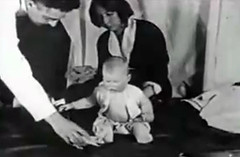 | 13 |
| 11782890953 | Classical Conditioning | Learning that takes place when two or more stimuli are paired together UCS = UCR; NS + UCS = UCR; & CS = CR |  | 14 |
| 11782890929 | Behaviorism | Psychologist: John B. Watson Defined: a theory that made psychology an objective science by making it based on observable (and only observable) events, not the unconscious or conscious mind. |  | 15 |
| 11782890954 | Unconditioned Stimulus | Part of Classical Conditioning It is the stimulus that triggers a natural reflexive response. Pavlov's Dogs: "Meat" Little Albert: "Loud noise" |  | 16 |
| 11782890930 | Unconditioned Response | Part of Classical Conditioning It is the unlearned, naturally occurring response to the stimulus Pavlov's Dogs: It was the "Salivating to the Meat" Little Albert: "Screaming at the Loud Noise" |  | 17 |
| 11782890955 | Conditioned Stimulus | Part of Classical Conditioning It initially has no effect but after conditioning, it triggers a natural reflexive response. Pavlov's Dogs: It was the "Bell" Little Albert: "White Mouse" |  | 18 |
| 11782890931 | Conditioned Response | Part of Classical Conditioning Occurs after conditioning when the conditioned stimulus (CS) triggers an innate response Pavlov's Dogs: It was the "Salivating to the Bell" Little Albert: "Screaming/Crying" | | 19 |
| 11782890932 | Neutral Stimulus | does not caused an unconditioned response but eventually becomes the CS | | 20 |
| 11782890956 | Acquisition of Classical Conditioning | Frequency: the more often the CS and the US are paired together Timing: the CS is presented a half a second before the US |  | 21 |
| 11782890957 | Extinction | Classical Conditioning: The disappearance of a behavior because CS no longer paired with the UCS Operant Conditioning: The disappearance of a behavior because it is no longer reinforced or punished |  | 22 |
| 11782890958 | Spontaneous Recovery | Classical Conditioning: When a previous CR returns after it has been extinguished Operant Conditioning: Occurs when a response begins again after extinction | 23 | |
| 11782890959 | Stimulus Generalization | Classical Conditioning: When the NS and the CS are different. (Example: Little Albert being afraid of any thing that is white and furry) Operant Conditioning: When a reinforced/punished behavior occurs in a setting/situation where it was NOT learned (Example: Not cursing at home or at school) |  | 24 |
| 11782890960 | Stimulus Discrimination | Classical Conditioning: When the NS and the CS are the same (Example: Little Albert being afraid of a white mouse) Operant Conditioning: When a reinforced/punished behavior occurs in a setting/situation where it was learned (Example: Cursing only at home because it is acceptable but not at school) |  | 25 |
| 11782890961 | Higher Order Conditioning | When the first CS is paired with a second CS The second CS is presented briefly before the first CS |  | 26 |
| 11782890962 | Taste Aversions | Psychologist: Garcia Defined: If you ingest an unusual food or drink and then become nauseous, you will probably develop an aversion to the food or drink. Significance: Violates the acquisition principles of classical conditioning |  | 27 |
| 11782890933 | Learned Helplessness | Defined: Exposure to inescapable and uncontrollable aversive (bad) events produces passive behavior Study: Seligman delivering shocks to dogs Example: If a student consistently fails math, they may start to give up or a sports team that consistently loses may start to belive they can't win | | 28 |
| 11782890963 | Biological Preparedness | Defined: humans and animals have predisposed fears that help us survive Examples; Phobia of heights keeps us away from danger | 29 | |
| 11782890964 | Operant conditioning | Defined: Learning is based on the association of one's behavior and its consequences. Consequences are reinforced or punished Example: You choose to break curfew based on the consequences |  | 30 |
| 11782890965 | Law of Effect | Psychologist: Edward Thorndike Defined: if a behavior results in a satisfying consequence, it will likely be repeated whereas; if a behavior results in a unsatisfying consequence, it will NOT likely be repeated Example: If you complement your mother and she lets you stay out past curfew, you will complement her again |  | 31 |
| 11782890934 | Skinner Box | Also known as: Operant Chamber Description: A chamber containing a bar or key that an animal (rat or pigeon) can manipulate in order to obtain a reward |  | 32 |
| 11782890966 | Positive Reinforcement | Part of Operant Conditioning Adding something to increase the likelihood of a behavior occuring again Example: Receiving $5 for every "A" in high school |  | 33 |
| 11782890967 | Negative Reinforcement | Part of Operant Conditioning Increasing the likelihood of a behavior occurring again by removing a negative stimuli Example: Taking aspirin to relieve a headache |  | 34 |
| 11782890968 | Primary Reinforcers | Reinforcers that are rewarding such as food, water, rest, whose natural properties are reinforcing. |  | 35 |
| 11782890969 | Secondary Reinforcers | Defined: Reinforcers that are rewarding because we learned that are reinforcing. Example: praise, money, the chance to play video games. |  | 36 |
| 11782890935 | Immediate Reinforcer | Defined: when you are immediately rewarded for a behavior (it's all about the short run) Example: skipping school and enjoying time with friends | 37 | |
| 11782890936 | Delayed Reinforcer | Defined: when you complete a behavior but not awarded immediately (it's all about the long run) Example: getting good grades in school and attending class in order to get a good job in the future | 38 | |
| 11782890970 | Positive Punishment | Part of Operant Conditioning Adding something to decrease the likelihood of a behavior occurring again Example: Spanking and yelling |  | 39 |
| 11782890971 | Negative Punishment | Part of Operant Conditioning Removing something to decrease the likelihood of a behavior occurring again Example: Grounding |  | 40 |
| 11782890937 | Concerns regarding Punishment | It does not teach the learner appropriate behavior and can also increase violent behavior in the learner Example: If your psychology teacher taught you everything you didn't need to know for the AP Psych Exam | 41 | |
| 11782890972 | Shaping | Part of Operant Conditioning Positively reinforcing closer and closer approximations of a desird behavior to teach a new behavior |  | 42 |
| 11782890938 | Discriminative Stimulus | Defined: the stimulus that elicits a response after association with reinforcement Example: Calling your friend one name but not using that same name with your parents | 43 | |
| 11782890939 | Superstitious Behavior | Defined: if a random reinforcement follows an event, the event will likely be repeated. Example: a lucky shirt, shoes, etc. | 44 | |
| 11782890940 | Continuous Reinforcement Schedule | Defined: When every behavior is reinforced Example: a multiple choice test Significance: best for "establishing" a behavior | 45 | |
| 11782890941 | Partial Reinforcement Schedule | Defined: When a random behavior is reinforced Example: Fixed Ratio, Variable Ratio, Fixed Interval, Variable Interval Significance: best for "maintaining" a behavior | 46 | |
| 11782890973 | Fixed-Ratio Schedule | Defined: schedule of reinforcement after a set number of responses. Example: Being paid for every 10 pizzas made |  | 47 |
| 11782890974 | Variable-Ratio Schedule | Defined: schedule of reinforcement after a varying number of responses. Example: playing a slot machine |  | 48 |
| 11782890975 | Fixed-Interval Schedule | Defined: schedule of reinforcement after a fixed amount of time has passed Example: cramming for an exam |  | 49 |
| 11782890976 | Variable-Interval Schedule | Defined: schedule of reinforcement after varying amounts of time Example: pop (surprise) quizzes in class |  | 50 |
| 11782890977 | Latent Learning | Defined: Learning that occurs but is not apparent until there is an incentive to demonstrate it Example: Tolman's rats would only complete the maze if there was cheese for them at the end of the maze |  | 51 |
| 11782890942 | Cognitive Maps | Defined: having the ability or know how to accomplish a particular task Example: Tolman's rats knew how to complete the maze |  | 52 |
| 11782890978 | Instinctive Drift | Defined: when animals revert to instinctive behaviors rather than the operantly conditioned behaviors Examples: Rats will not walk backward, chickens won't hit a ball and run to first base, and pigs won't put wooden dollars into a piggy bank | 53 | |
| 11782890979 | Insight Learning | Defined: suddenly knowing the solution to the problem Example: When taking a test and the previous answer comes to you without effort |  | 54 |
| 11782890943 | Intrinsic Motivation | Defined: the desire to perform a behavior effectively and for its own sake—rewards can carry hidden costs. Example: reading books because you find them rewarding |  | 55 |
| 11782890944 | Extrinsic Motivation | Defined: the desire to perform a behavior to receive external rewards or avoid threatened punishment. Example: reading a book because you need to get a good grade in your English class | | 56 |
| 11782890980 | Observational Learning | Defined: learn by watching others Example: BoBo Doll Study |  | 57 |
| 11782890945 | BoBo Doll Study | Psychologist: Bandura Description: Children watched (through a one way glass)a confederate play with the BoBo doll and then played with the BoBo doll in the same way as the confederate Significance: used to develop "observational learning" |  | 58 |
| 11782890946 | Mirror Neurons | Defined: frontal lobe neurons that fire when performing certain actions or when observing another doing so Example: explains why yawning is contagious | 59 | |
| 11782890947 | Densensitization | Defined: after viewing a similar act/behavior, you become less emotionally responsive (indifferent or unaware) to the stimulus Example: The first murder on TV is shocking but becomes less shocking as you watch violent television | 60 | |
| 11782890948 | Pro-Social Modeling | Defined: People who show nonviolent, helpful behavior prompt similar behavior in others Significance: When parents help their grandparents, the children will likely do the same |  | 61 |
| 11782890949 | Anti-Social Modeling | Defined: People show violent, selfish behavior prompts similar behaviors in others Significance: Watching violent TV prompts similar behaviors in others (pro-wrestling, etc.) | 62 |
Flashcards
Flashcards
Flashcards
Pages

Need Help?
We hope your visit has been a productive one. If you're having any problems, or would like to give some feedback, we'd love to hear from you.
For general help, questions, and suggestions, try our dedicated support forums.
If you need to contact the Course-Notes.Org web experience team, please use our contact form.
Need Notes?
While we strive to provide the most comprehensive notes for as many high school textbooks as possible, there are certainly going to be some that we miss. Drop us a note and let us know which textbooks you need. Be sure to include which edition of the textbook you are using! If we see enough demand, we'll do whatever we can to get those notes up on the site for you!
