AP Notes, Outlines, Study Guides, Vocabulary, Practice Exams and more!

AP Human Geography Chapter 5 Language Flashcards

Terms : Hide Images
11780990495Creole or Creolized LanguageA language that results from the mixing of a colonizer's language with the indigenous language of the people being dominated.0
11780990496DenglishCombination of German and English.1
11780990497DialectA regional variety of a language distinguished by vocabulary, spelling, and pronunciation.2
11780990498EbonicsDialect spoken by some African Americans.3
11780990499Extinct LanguageA language that was once used by people in a daily activities but is no longer used.4
11780990500FranglaisA term used by the French for English words that have entered the French Language; a combination of français and anglais, the French words for "French" and "English," respectively.5
11780990501IdeogramsThe system of writing used in China and other East Asian countries in which each symbol represents an idea or a concept rather than a specific sound, as is the ease with letters in English.6
11780990502IsoglossA boundary that separates regions in which different language usages predominate.7
11780990503Isolated LanguageA language that is unrelated to any other languages and therefore not attached to any language family.8
11780990504LanguageA system of communication through the use of speech, a collection of sounds understood by a group of people to have the same meaning.9
11780990505Language BranchA collection of languages related through a common ancestor that existed several thousand years ago. Differences are not as extensive or as old as with language families, and archaeological evidence can confirm that the branches derived from the same family.10
11780990506Language FamilyA collection of languages related to each other through a common ancestor long before recorded history.11
11780990507Language GroupA collection of languages within a branch that shares a common origin in the relatively recent past and display relatively few differences in grammar and vocabulary.12
11780990508Lingua FrancaA language mutually understood and commonly used in trade by people who have different native language.13
11780990509Literary TraditionA language that is written as well as spoken.14
11780990510Official LanguageThe language adopted for use by the government for the conduct business and publication of documents.15
11780990511Pidgin LanguageA form of speech that adopts a simplified grammar and limited vocabulary of a lingua franca; used for communications among speakers of two different languages.16
11780990512SpanglishCombinations of Spanish and English, spoken by Hispanic Americans.17
11780990513Standard LanguageThe form of a language used for official government business, education, and mass communications.18
11780990514Vulgar LatinA form of Latin used in daily conservation by ancient Romans, as opposed to the standard dialect, which was used for official documents.19
11781017895LogogramA symbol that represents a word rather than a sound.20
11781023888Received pronunciationThe dialect of English associated with upper-class Britons living in London and now considered standard in the United Kingdom21

AP World History APQT Review Flashcards

Terms : Hide Images
12829444847Paleolithic Era meansOld Stone Age0
12829468649The Roman, Han and Gupta empires all fell because of.Outside invasion1
12829500517NeolethicPracticed agriculture instead of hunting and gathering2
12829527563The very first place where agriculture was practiced was where?Fertile Crescent3
12829609157What era caused surplus of food, specialization of labor, centralized government?Neolethic Era4
12829643314Ziggurat areStepped pyramids5
12829648869Where are ziggurats from?Mesopotamia6
12829662343The Code of Hammurabi was from which empire?Babylonian7
12829688908What was the first law code called?Code of Hammurabi8
12829710206The early government was ruled by what?Theocracy9
12829726838What is "coerced labor"?Forced labor system10
12829743043Who was Socrates student?Plato11
12829743044Who was Plato's student?Aristotle12
12829753955What is animism?worship of nature13
12829762402What was the Jewish Diaspora?The dispersal of Jews14
12829773317What was one of the earliest civilization in Mesoamerica?Omlec15
12829782896Knowledge of what allowed for round trip in the Indian Ocean?Monsoon winds16
12829792154What disease affected the Han and the Roman Empire?Bubonic Plague17
12829799040What was the qanat system?Underground irrigation system in Persia18
12829818369Besides physical goods what interchangeable things were traded during the Classic Trade?Diseases and Knowledge19
12829828894What were the 3 types of societies during the early ages?Hunter-gathers Pastoral Nomads Agricultural20
12829845275Fist stone tools were used by the people of.Ethopia21
12829851304The control over what allowed humans to adapt to different climates?Fire22
12829860567Nile river, sub-Saharan Africa, Indus River, Yellow river were all places where what happened?Neolithic Revolution23
12829887582What plant was domesticated in South East Asia?Rice24
12829887584What plant was domesticated in Mexico?Maze25
12829897671What plant was domesticated in Andes?Potatoes26
12829904154What plant was domesticated in the Fertile Crescent?Wheat27
12829909504What plant was domesticated in Africa?Yam28
12829917268What is syncretism?mixing of religions29
12829927063Who emphasized the use of logic?Aristotle30
12829929493Who wrote the Republic?Plato31
12829983631Say the social hierarchy of India.32
12830003012Say the Social hierarchy of Egypt.33
12830033217What allowed Vikings to travel up rivers so quickly?Scandinavian longships34
12830044399What allowed the people of Arabia to travel long distances?Camels35
12830047505What allowed the people to travel in the Steppes?Horses36
12830065614After the death of Muhammad, political leadership fell to a caliph by the name ofAbu Baker37
12830072114Who did the Shia want to be the first leader?Ali38
12830082117Who helped spread Islam in Africa?Muslim merchants39
12830234892Neo-Confucianism is the mix ofConfucianism and Buddhism40
12830248378One of the First method of controlling power in post classic empires was.Patriarchy41
12830257477Equal field system in China is and example of a.Tribute System42
12830315854In the Inca Empire, long distance trade was done due to the.Inca Road43
12830328803What was the killing of thousands by Christians to spread Christianity called?Crusades44
12830337190What led to rapid population growth in Asia?Champa rice45
12830347913What allowed farming in harsh locations like cliffs?Terrace Farming46
12830515780What was the quick ships used by the Portuguese called?Caravel47
12830520262Who sponsored Columbus's voyage?Spain48
12830532362What did the Chinese sponsored voyages of Zheng He sought to establish?Chinese Dominance49
12830576913In Asia the Europeans sought for __________________ ____________________, while in the Atlantic they sought for ______________________ _______________________.Luxury goods Raw materials50
12830619648What allowed Europeans to become rich in the Americas?Cash Crops like sugar and tobacco51
12830635875Shia Islam in Persia.United Population52
12830643230Sufi Mysticism in Africa, Indian and Southeast Asia caused.Many to convert53
12830649651Sikhism is a blend of what two religions?Hinduism and Islam54
12830655668Japanese woodblock printing allowed forMass production of Art55
12830755223Say the social hierarchy of South America.Peninsulares Creoles Mestizo and Mulatos African slaves and Native americans56
12830780505Who defeated the Ming dynasty?Manchus57
12830786274The Manchus were the founder of what dynasty?Qing58
12830791659Who came on top on the Revolutions in Latin America?Creoles59
12830800283The Daimyo of Japan fell due to theTokugawa Shogunates60
12830814563Which Empire made Shia their Official religion?Safavid61
12830823080Which 3 empires were called the Gunpowder Empires?Mughal, Ottoman and Safavid62
12830968144Which empire had tolerance over religion?Ottoman Empire63
12831051938Which empire used Janissaries ?Ottoman64
12831059841What was used in China to place official in the government?Civil Service Exams65
12831071717The war that lasted 30 years in Europe over European nations regarding power and territory was called the.Thirty-Year's War66
12831081926The Ottoman and Safavid Empires fought over the control ofMesopotamia67
12831151927What is the God in Judaism called?Yahweh68
12831165587What is the holy book of Judaism?Torah69
12831203167Religions develop during which Era?Classical Era70
12831257257Confucianism started during what dynasty?Han71
12831263063Say the Chinese dynasties in orderShang Zhou Qin Han Sui Tang Song Yuan Ming Qing72
12831400314Which Roman emperor converts to Christianity?Constantine73
12831477051What 2 empires emerge during the classical era in India?Mauryan and Gupta74
12831482050What 2 empires emerge during the classical era in China?Qin and Han75
12831501490Governors in Persia were known asSatraps76
12831519130The Qin dynasty used what to rule their government?Legalism77
12831522604The Han dynasty used what to rule their government?Confucianism78
12831565332Rome went form being a ___________________ to an ________________________.Republic to an Empire79
12831570739Which ruler promoted Buddhism in India?Ashoka80
12831598133What 3 things did the Bantu migration spread?Agriculture Language Iron tools81
12831638479Hellenism akaSpread of Greek culture82
12831657082Sinification akaSpread of Chinese culture83
12831712405What religion was the last to develop?Islam84
12831841347What is the year 800 BCE to 600 BCE known asPaleolithic era85
12831868262What is the year 600 BCE to 600 CE known asClassical era86
12831889051What is the year 600 CE to 1450 known asPost-Classical era87
12831900023What is the year 1450 to 1750 known asAge of Exploration88
12831923077which dynasty built the grand canalSui89
12831951581Jizya akaTax on non-muslims90
12831986562Europe and Japan both hadFeudal systems91
12832024225Which Chinese dynasty did the Mongols conquer?Song92
12832169234What type of labor system was used in North American colonies?Indentured servitude93
12832175604What type of labor system was sued in the Caribbeans?Encomienda94
12832180526What type of labor system was used in Latin America?Mita95
12833526568Who founded legalism?Hanfeizi96
12833615097Who founded Daoism?Laozi97
12833623382Who were the 2 students of Confucius?Mencius and Xunzi98

AP World History Final Flashcards

Terms : Hide Images
12114773923Paleothic AgeOld Stone Age0
12114773924Neolithic Revolution (Agricultural Revolution)a fundamental change in the way people lived. The shift from hunting & gathering to agriculture led to permanent settlements, the establishment of social classes, and the eventual rise of civilizations.1
12114773925Hammurabi's Code of LawsFirst written set of laws in history2
12114773926Dynastya powerful family or group of rulers that maintains its position or power for some time3
12114773927ConfucianismA philosophy that adheres to the teachings of the Chinese philosopher Confucius. It shows the way to ensure a stable government and an orderly society in the present world and stresses a moral code of conduct.4
12114773928HinduismA religion and philosophy developed in ancient India, characterized by a belief in reincarnation and a supreme being who takes many forms5
12114773929Buddhismthe teaching of Buddha that life is permeated with suffering caused by desire, that suffering ceases when desire ceases, and that enlightenment obtained through right conduct and wisdom and meditation releases one from desire and suffering and rebirth6
12114773930Athenian DemocracyA type of government used in Athens which is sort of a combine of majority rule and democracy.7
12114773931Roman SenateA council whose members were the heads of wealthy, landowning families. Originally an advisory body to the early kings, in the era of the Roman Republic the Senate effectively governed the Roman state and the growing empire.8
12114773932MonotheismBelief in one God9
12114773933Barbariansuncivilized people10
12114773934IslamA religion based on the teachings of the prophet Mohammed which stresses belief in one god (Allah), Paradise and Hell, and a body of law written in the Quran. Followers are called Muslims.11
12114773935Ka'bathe stone cubical structure in the courtyard of the Great Mosque of Mecca, believed to have been built by Abraham and regarded by Muslims as the sacred center of the earth12
12114773936Five Pillars of IslamDeclaration of faith, prayer, alms, fasting, and pilgrimage13
12114773937CaliphSuccessor to Muhammad14
12114773938Crusadesa series of military expeditions in the 11th, 12th, and 13th centuries by Westrn European Christians to reclain control of the Holy Lands from the Muslims15
12114773939Civil Service ExamIn Imperial China starting in the Han dynasty, it was an exam based on Confucian teachings that was used to select people for various government service jobs in the nationwide administrative bureaucracy.16
12114773940Byzantine Empire(330-1453) The eastern half of the Roman Empire, which survived after the fall of the Western Empire at the end of the 5th century C.E. Its capital was Constantinople, named after the Emperor Constantine.17
12114773941ConstantinopleA large and wealthy city that was the imperial capital of the Byzantine empire and later the Ottoman empire, now known as Istanbul18
12114773942Orthodox ChristianityA branch of Christianity developed in the Byzantine Empire, after its split from the Roman Empire. It spread throughout the eastern Mediterranean and Russia.19
12114773943Iconoclastic Controversydebate between opponents and defenders of icons in the Byzantine Church; one of the issues that led to the split of the Christian church in 105420
12114773944Cyrillican alphabet drived from the Greek alphabet and used for writing Slavic languages21
12114773945MongolsA people of this name is mentioned as early as the records of the Tang Empire, living as nomads in northern Eurasia. After 1206 they established an enormous empire under Genghis Khan, linking western and eastern Eurasia.22
12114773946Middle AgesAlso known as the medieval period, the time between the collapse of the Roman Empire in the fifth century AD and the beginning of the Renaissance in the fourteenth century.23
12114773947SerfsPeople who gave their land to a lord and offered their servitude in return for protection from the lord.24
12114773948Vikingsone of a seafaring Scandinavian people who raided the coasts of northern and western Europe from the eighth through the tenth century.25
12114773949FeudalismA political system in which nobles are granted the use of lands that legally belong to their king, in exchange for their loyalty, military service, and protection of the people who live on the land26
12114773950ScholasticismA medieval philosophical and theological system that tried to reconcile faith and reason27
12114773951Gothic ArchitectureCharacterized by pointed arches, high ceilings, flying buttresses, and large stained-glass windows28
12114773952CuzcoThe capital city of the Incan Empire, Located in present-day Peru29
12114773953Japanese feudal systememperor, shogun, daimos, samurai, farmers, peasants, merchants on bottom because they don't produce anything30
12114773954Zheng HeAn imperial eunuch and Muslim, entrusted by the Ming emperor Yongle with a series of state voyages that took his gigantic ships through the Indian Ocean, from Southeast Asia to Africa.31
12114773955European RenaissanceThe era was marked by a revival of the art, architecture, thought, and culture of ancient Greece and Rome.32
12114773956Columbian ExchangeAn exchange of goods, ideas and skills from the Old World (Europe, Asia and Africa) to the New World (North and South America) and vice versa.33
12114773957Italian Humanismmany of the ideas that spread across Europe as a result of the printing revolution originated from this; the revival of classical literature, with its concern for purity in language and eloquence in style; one of the most admired achievements of the Renaissance; strong in northern and western Europe; their intellectual interests were in secular subjects, especially in mastering classical languages and in translating classical texts; established techniques for the recovery of accurate texts and had developed principles for compiling the scholarly editions that were distributed because of the printing presses34
12114773958Johannes GutenbergInvented the printing press35
12114773959movable typeindividual letters and marks that can be arranged and rearranged quickly36
12114773960MoscowCapital of Russia37
12114773961EncomiendasLand grants that included the right to demand labor or taxes from Native Americans38
12114773962Where did early civilizations develop?along rivers to have good farm land39
12114773963What civilization was located on the upper Nile River Valley? EgyptKush/Nubia40
12114773964features of civilizationcities, organized religion, art, writing system41
12114773965Strengths of early Chinese society-developed an impressive society with little outside help -elaborate intellectual life -irrigation systems -emperor was widely respected and feared -invented tea, locking gates, gun powder, etc.42
12114773966What did the Aryans bring to India?-the distinctive social system (caste system) -grew out of interaction of many culturally different Aryan peoples on the South Asian peninsula together with the development of economic and social differences among these peoples as the inequalities of "civilization" spread43
12114773967Castes of Ancient India-Brahmins= priests -Kshatriya= warriors -Vaisya= merchants -Sudras= peasant farmers -"Untouchables" (added later)= people who did dirty jobs44
12114773968What groups in India were most likely to convert to Islam?Buddhists and low caste Hindus45
12130083067How did the Roman Empire approach religious diversityTolerated religious diversity46
12130083068What happens to Islam after death of Muhammad-Arab armies set out to conquer parts of the weakened Persian and Byzantine Empires -Muslims rulers were much more tolerant of other religions than the Christian rulers of the time -Islam divides into Sunnis (caliph should be chosen by Muslim leaders), Sh'ia (descendants of Muhammad should be successors), and Sufi (heavy belief in mysticism and evangelical efforts)47
12130083069Why did conversion in the Islamic world slow?-The Umayyad Empire adopts Islam "submission" as a religion -Conversions slow because it meant that wealth had to be distributed to more people48
12130083070How did Islam impact africa-Replaced Christianity as a popular African religion during the post-classical period49
12130083071What were the languages of the Roman and Byzantine empiresRoman Empire: Latin Byzantine Empire: Greek50
12130083072What were some characteristics of classical American societies-Semi-sedentary: small scale agricultural that supports small populations with no large cities -Known for "mound building" -Ecological disruption probably accounted for decline of early Andean civilizations51
12130083073Human sacrifice in the Americas-In the Aztec Empire, human sacrifice played a large role in religious life -In the Inca Empire, human sacrifice took place on great public occasions or at times of special difficulty, but nothing remotely on the scale of the Aztec practice52
12130083074Aztec view of historysome people were chosen to serve the gods53
12130083090Confucianism vs Buddhism in post-classical China?-Buddhism spreads rapidly after the fall of the Han dynasty -Confucian and Daoist followers were upset with the alien religion -At the end of the Tang and with the start of the Song Dynasties, the dominant religion became Confucianism until 20th century54
12130083075What religion played a key role in the transmission of Chinese civilization to Japan?Buddhism55
12130083076Mongolian society/ military-Nomadic, pastoral people -Mongol forces were entirely Calvary riders -Used weapons such as bows, hatchets, maces, and bronze cannons56
12130083077Mongolian policy towards other religions?toleration57
12130083078What percentage of the European population died from the plague1/3 of the population58
12130083079What region of the world became the dominant culture in the period after 1450?Western Europe59
12130083080What european country starts the age of explorationPortugal60
12130083081Trade Routes of the world up to the Age of Exploration-Silk Road -Indian Ocean Trade -Trans-Saharan Trade -American Network (Mesoamerican and Andean civilizations had little contact) -Southeast Asia and Srivijaya -East Africa and Swahili civilization61
12130083082How does the religion of Islam spread-Conquest of weakened Byzantium and Persian Empires -Merchant activity (especially in West Africa and the Sahara) -Arab warriors never try to convert non-Muslims to Islam62
12130083083How did Mongol rule impact russiaThe Russians adopted Mongol rituals and practices and began to have behavior like the Mongols63
12130083084Why is Ethiopia such a unique kingdom in Africa?Adopted Christianity64
12130083085Where was the first Spanish colony established in the new worldHispaniola65
12130083086What factors did the Europeans have on their side when they took over the new world-In the best position geographically to explore the Americas -Immunities to diseases -Better weaponry66
12130083087Difference between Spanish and Portuguese empiresUnlike the Spanish empire that was almost exclusively American, the Portuguese empire included colonies and outposts in Asia and Africa as well as Brazil.67
12130083088How did gold impact the European economies negatively?Caused prices to rise and inflation to occur68
12130083089What culture in the Americas produced a written language?Maya69
12166172237What was different about the 15th century global trade network compared to previous trade networks ?-Traded across Atlantic Ocean -Included the Americas -In previous eras, most attention was given to the development of larger regional economies and cultural zones, rather than a truly global network -global70
12166731636Yellow River Civilization (Huang He)The first civilization established in Ancient China71
12166731637Indus River Valley Civilizationan ancient civilization thriving along the Indus River in what is now Pakistan and western India. This civilization is also sometimes referred to as the Harappan or Harappa-Mohenjodaro Civilization of the Indus Valley, in reference to the excavated cities of Harappa and Mohenjodaro72
12166731638Euphrates RiverA river in southwestern Asia that flows through the southern part of the Fertile Crescent.73
12166731639Tigris RiverRiver that flows across a low, flat plain in Iraq and joins the Euphrates River74

AP Lang Group 15 Flashcards

Terms : Hide Images
6604046347sanguineadjective - optimistic or positive, especially in an apparently bad or difficult situation.0
6604047187coupnoun - a sudden, violent, and illegal seizure of power from a government - also, a notable or successful stroke or move1
6604048354flagrantadjective - (of something considered wrong or immoral) conspicuously or obviously offensive - obviously inconsistent with what is right or proper2
6604049210intemperancenoun - lack of moderation or restraint.3
6604050224arbitraryadjective - based on random choice or personal whim, rather than any reason or system.4
6604051108nostalgiaNoun - pleasure and sadness that is caused by remembering something from the past and wishing that you could experience it again. Therefore, it means that it is not only sadness or sickness, but also the pleasure of remembering the past or taking interest in the past.5
6604053480deploreverb - to hate or dislike (something) very much : to strongly disapprove of (something)6
6604054309metonymynoun - a figure of speech in which something is referred to by using the name of something that is associated with it For example, a crown is associated with royalty, and is often used as a metonym for royal authority ("The edict issued today by the Crown forbids grazing in the commons").7

AP Biology Chapter 5 Flashcards

Terms : Hide Images
10752972514macromoleculea giant molecule formed by the joining of smaller molecules, usually by a dehydration reaction.0
10752972560Four classes of biological macromoleculesProteins, carbohydrates, nucleic acids, lipids1
10752972515polymera long molecule consisting of many similar or identical monomers linked together by covalent bonds.2
10752972516monomerthe subunit that serves as the building block of a polymer.3
10752972517dehydration synthesisa chemical reaction in which two molecules become covalently bonded to each other with the removal of a water molecule.4
10752972518hydrolysisa chemical reaction that breaks bonds between two molecules by the addition of water; functions in dis-assembly of polymers to monomers.5
10752972519proteina biologically functional molecule consisting of one or more polypeptides folded and coiled into a specific three-dimensional structure.6
10752972561Functions of proteinsstructural support, catalyst, transport, defense, movement, regulation7
10752972520amino acidan organic molecule possessing both a carboxyl and an amino group. The monomers of polypeptides. There are 20 different forms. Distinguished by side chains.8
10752972521peptide bondthe covalent bond between the carboxyl group on one amino acid and the amino group on another, formed by a dehydration reaction.9
10752972522Primary structurethe level of protein structure referring to the specific linear sequence of amino acids.10
10752972523secondary structureregions of repetitive coiling or folding of the polypeptide backbone of a protein due to hydrogen bonding between constituents of the backbone (not the side chains). Helix or pleated sheet.11
10752972524B pleated sheetprotein structure with two or more segments of the polypeptide chain link side by side (called B strands) connected by hydrogen bonds between parts of the two parallel segments of the polypeptide backbone.12
10752972525tertiary structurethe overall shape of a protein molecule due to interactions of amino acid side chains, including hydrophobic interactions, ionic bonds, hydrogen bonds, and disulfide bridges.13
10752972562amino acid side chainstypes of bonds/interactions in __________ : hydrophobic interactions, ionic bonds, hydrogen bonds and disulfide bridges14
10752972526quaternary structurethe particular shape of a complex, aggregate protein, defined by the characteristic three-dimensional arrangement of its constituent subunits, each a polypeptide.15
10752972563denaturationloss of a proteins normal 3D structure; can possibly be caused by pH and temperature which affect the ionic bonds, hydrogen bonds & hydrophilic interactions16
10752972527enzymea macromolecule serving as a catalyst, a chemical agent that increases the rate of a reaction without being consumed by the reaction. most of them are proteins.17
10752972528carbohydratea sugar (monosaccharide) or one of its dimers (disaccharides) or polymers (polysaccharides). Primarily C, H and O.18
10752972564What are the functions of carbohydratesfunction as energy source & structure19
10752972529monosaccharidethe simplest carbohydrate, active alone or serving as a monomer for disaccharides and polysaccharides. Also called simple sugars, they have formulas that are generally some multiple of CH2O (1:2:1).20
10752972530disaccharidea double sugar, consisting of two monosaccharides joined by a glycosidic linkage formed by a dehydration reaction.21
10752972531glycosidic linkagea covalent bond formed between two monosaccharides by a dehydration reaction.22
10752972532polysaccharidea polymer of many monosaccharides, formed by dehydration reactions.23
10752972533starcha storage polysaccharide in plants, consisting entirely of glucose monomers joined by x glycosidic linkages. Used for energy storage.24
10752972534glycogenan extensively branched glucose storage polysaccharide found in the liver and muscle of animals; the animal equivalent of starch.25
10752972535cellulosea structural polysaccharide of plant cell walls, consisting of glucose monomers joined by B glycosidic linkages. A type of plant starch.26
10752972536lipidsany of a group of large biological molecules, including fats, phospholipids, and steroids, that mix poorly, if at all, with water (hydrophobic). No true monomers.27
10752972565What are the three types of lipids?fats/oils, phospholipids & steroids28
10752972537fat/oila lipid consisting of three fatty acids lined to one glycerol molecule; also called a triacylglycerol or triglyceride. Function as energy storage.29
10752972538saturateda fatty acid in which all carbons in the hydrocarbon tail are connected by single bonds, thus maximizing the number of hydrogen atoms that are attached to the carbon skeleton.30
10752972539unsaturateda faty acid that has one or more double bonds betwen carbons in the hydrocarbon tail. such bonding reduces the number of hydrogen atoms attached to the carbon skeleton.31
10752972540fatty acida carboxylic acid with a long carbon chain. Vary in length and __________ linked to a glycerol molecule form a fat molecule, also called triglyceride.32
10752972541triglyceridea lipid consisting of three fatty acids linked to one glycerol molecule33
10752972542chitina structural polysaccharide, consisting of amino sugar monomers, found in many fungal cell walls and in the exoskeletons of all arthropods.34
10752972543trans fatan unsaturated fat, formed artificially during hydrogenation of oils, containing one or more trans double bonds.35
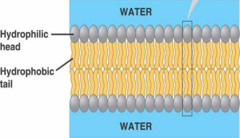
10752972544phospholipida lipid made up of glycerol joined to two fatty acids and a phosphate group. The hydrocarbon chains of the fatty acids act as nonpolar hydrophobic tails, while the rest of the molecule acts s a polar, hydrophilic head. They form bilayers that function as biological membrane.36
10752972566phospholipid bilayerfunction as membranes37
10752972545steroida type of lipid characterized by a carbon skeleton consisting of four fused rings with various chemical groups attached. Function as part of membranes or hormones.38
10752972546catalysta chemical agent that selectively increases the rate of a reaction without being consumed by the reaction.39
10752972547hydrophobica type of weak chemical interaction caused when molecules that do not mix with water coalesce to exclude water.40
10752972548disulfide bridgesa strong covalent bond formed when the sulfur of one cysteine monomer bonds to the sulfur of another cysteine monomer.41
10752972549polypeptidea polymer of many amino acids linked together by peptide bonds.42
10752972550nucleic acida polymer (polynucleotide) consisting of many nucleotide monomers; serves as a blueprint for proteins and, through the actions of proteins, for all cellular activities. the two types are DNA and RNA.43
10752972567nucleic acidfunctions as storage, transmission & use of genetic material44
10752972551nucleotidethe building block of a nucleic acid, consisting of a five-carbon sugar covalently bonded to a nitrogenous base and one or more phosphate groups.45
10752972568phosphodiester linkagebond between nucleotides in nucleotide chain to form polynucleotide46
10752972552polynucleotidea polymer consisting of many nucleotide monomers in a chain. The nucleotides can be those of DNA or RNA.47
10752972553pyrimidineone of two types of nitrogenous bases found in nucleotides, characterized by a six-membered ring. cytosine (c), thymine (T), and uracil (U)48
10752972554purinesone of two types of nitrogenous bases found in nucleotides, characterized by a six-membered ring fused to a five-membered ring. adenine (a) and guanine (G).49
10752972569RNAtransmission of information, consists of monomers with a ribose sugar and nitrogenous bases cytosine (C), guanine (G), adenine (A) & uracil (U). Single stranded.50
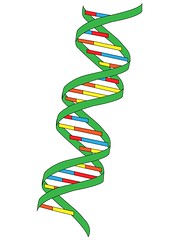
10752972555DNAa nucleic acid molecule, usually a double-stranded helix, in which each polynucleotide strand consists of nucleotide monomers with a deoxyribose sugar and the nitrogenous bases adenine (A), cytosine (C), guanine (G), and thymine (T); capable of being replicated and determining the inherited structure of a cell's proteins.51
10752972556deoxyribosethe sugar component of DNA nucleotides, having one fewer hydroxyl group than ribose, the sugar component of RNA nucleotides.52
10752972557ribosethe sugar component of RNA nucleotides.53
10752972558double helixthe form of native DNA, referring to its two adjacent antiparallel polynucleotide strands wound around an imaginary axis into a spiral shape.54
10752972559antiparallelreferring to the arrangement of the sugar-phosphate backbones in a DNA double helix (they run in opposite 5' -3' directions).55

AP Language Test Flashcards

Terms : Hide Images
8034701999Proto-TongueLanguage is a culture trait, learned from one generation to another.0
8034702000Proto-TongueIt is speculated that nearly 2.5 million years ago, language first developed in order to organize human activity.1
8034702001Language DivergenceOccurs when speakers of the same language scatter and develop variations of that original form of the language to meet their needs in the new surroundings.2
8034702002Language DivergenceThe proto-language may not have had words for concepts such as "snake" or "iceberg". Once the human group came into contact with these new concepts, they created new words for them.3
8034702003Language ShiftWhen speakers come into contact with other languages, a blending of the two or more languages can occur.4
8034702004Proto-TongueAll original speakers communicated in the _______, or original language.5
8034702005Proto-TongueOnce speakers diffused to various places on Earth through migration, language divergence occurred and new languages and dialects spawned from the ______.6
8034702006Language ShiftLanguage replacement occurs when invaders replace the language of those places they conquer.7
8034702007Language ShiftLanguage replacement can lead to language extinction, when a language is no longer used. Some argue that Latin is facing language extinction, as fewer and fewer people are using Latin.8
8034702008Reverse ReconstructionGeographers can trance diffusion paths of language through ______, the process of tracking a language's diffusion.9
8034702009Reverse ReconstructionThe process begins with the most recent places of the language's existence and moves backward through time, comparing words with geographic places and groups of people using the same or similar words. Ex: If two languages share a common word for an extinct animal and that animal only existed in one of the many places where the two languages are now spoken, then one possible conclusion its that the language diffused from the place where the extinct animal once existed and the speakers carried with them the word for the hearth's extinct animal.10
8034702010Language TreeLinguists have organized languages into a language tree. THe tree is subdivided into the following hierarchy.11
8034702011Language Tree19 language families. Each family has its own branches. Each branch has its own groups. Each groups has its own language. Each language has its own dialects.12
8034702012Indo-European FamilyAbout 50 percent of all people speak and Indo-European language, most prominently English. English is part of the Germanic branch of the Indo-European language family. Other major branches of the Indo-European language family include the Balto-Slavic, Romance, and Indo-Iranian branches.13
8034702013Proto-Indo-EuropeanThe original Indo-European language is referred to as_____14
8034702014Proto-Indo-EuropeanNew languages developed through language diversification as a result of migration of Proto-Indo-European speakers from the hearth of this language family.15
8034702015Conquest TheoryArgues that Indo-European diffusion began in the empire-building Kurgan culture located in the steppe region of Russia, north of the Caspian Sea.16
8034702016Agriculture TheoryArgues that Indo-European diffusion started in a farming community in Europe's Danube River region.17
8034702017Proto-Indo-EuropeanThe location of the hearth of the Proto-Indo-European language is the subject of speculation.18
8034702018Proto-Indo-EuropeanBecause modern Indo-European languages share words for "snow" but not "sea," the hearth is believed top have been somewhere with snow, but distant from the sea.19
8034702019Proto-Indo-EuropeanLinguists estimate its origin to have been between 6000 and 4500 BCE.20
8034702020Proto-Indo-EuropeanSpeakers diffused by using horses and the wheel, the language evolved into various forms.21
8034702021Multilingual StatesCountries in which more than one language is spoken. They often contain linguistic minorities, or groups of speakers who are outnumbered by speakers of another language in the country.22
8034702022Multilingual StatesWhen there are power imbalances among linguistic groups, this can lead to conflict over language and its ties to nautical identity and power.23
8034702023Monolingual StatesCountries in which only one language is spoken. Because of the increasing pace of spatial-cultural interaction globally, purely monolingual countries no longer exist. One might argue, however that Japan is relatively monolingual with its stringent immigration laws.24
8034702024Monolingual StatesCountries like France have fought to preserve their monolingual heritage. For example, French politicians have called for laws to keep French pure and prohibit the infusion of English words into their vocabulary.25
8034702025Official LanguageLanguage in which all government business occurs in a country. Often the language of the powerful, linguistic majority.26
8034702026Standard LangaugeIs the acceptable form of a given language as declared by political or societal leaders.27
8034702027Standard LanguageThe British government declared British Received Pronunciation (BRP) English as the standard form of the language to be taught in all schools, rather than American English.28
8034702028Lingua FrancaA common language used by speakers of different languages. In a region is rooted in colonialism and imperialism, such as the use of French in Cameroon and Senegal and English India.29
8034702029In the multilingual region of East Africa, hundreds of native languages are spoken but people turn to Swahili as their lingua franca to communicate with speakers of other languages when they need to trade or conduct business.Lingua Franca30
8034702030Pidgin LanguageWhen regions are invaded or economically dominated by a foreign-language speaking group, the dominated group is often forced to pick up the language of the dominators in order to trade with them and conduct business.31
8034702031CreolizationOnce a pidginized language becomes part of a culture and is written down, it becomes known as a creole (or creolized) language, or a pidgin language that has become the main language of a group of people.32
8034702032ToponymyPlace names that reflect cultural identity and impact the cultural landscape. People take great pride in naming their place, which can become a controversial task because determining a toponymy can indicate ownership and control over space.33
8034702033ToponymyGive clues into origins and aspirations of their related cultures.34
8034702034Saint Petersburg, Russia, was named by Czar Peter the Great, perhaps conveniently after his patron saint, Peter.Toponymy35
8039428848Monolingual CountriesFrance/Japan/Venezuela36
8039428849Multilingual CountriesBelgium/Switzerland/Canada37
8039428850EnglishFrom Indo-European family, it is widespread around the world. It is the second most spoken language and is most common.38
8039428851Stages of LanguageNostratic > Proto-Indo-European > Indo-European39
8039428852AcculturationBlending of cultures.40
8039469410Backwards ReconstructionSound shifts41
8039469411Deep ReconstructionA long time ago.42

Pages

Subscribe to CourseNotes RSS

Need Help?

We hope your visit has been a productive one. If you're having any problems, or would like to give some feedback, we'd love to hear from you.

For general help, questions, and suggestions, try our dedicated support forums.

If you need to contact the Course-Notes.Org web experience team, please use our contact form.

Need Notes?

While we strive to provide the most comprehensive notes for as many high school textbooks as possible, there are certainly going to be some that we miss. Drop us a note and let us know which textbooks you need. Be sure to include which edition of the textbook you are using! If we see enough demand, we'll do whatever we can to get those notes up on the site for you!