

Flashcards
Flashcards
AMSCO AP US History Chapter 26 Flashcards
AMSCO United States History 2015 Edition, Chapter 26 Truman and the Cold War 1945-1952
Terms : Hide Images
| 10489513595 | Servicemen's Readjustment Act of 1944 (GI Bill) | Signed into law by President Franklin D. Roosevelt on June 22, 1944, it was also known as the GI Bill. It provided veterans of the Second World War with funds for college education, unemployment insurance, and housing. (p. 557) |  | 0 |
| 10489513596 | baby boom | Between 1945 and 1960, 50 million babies were born. This generation would profoundly affect the nation's social institutions and economic life. (p. 558) |  | 1 |
| 10489513597 | Suburbs | These areas experienced huge population growth post-World War II. Low interest rates on mortgages that were government-insured and tax deductible made the move from the city to the suburb affordable for almost any family. In a single generation the majority of middle-class Americans became suburbanites. (p. 558) |  | 2 |
| 10489513598 | Levittown | William Levitt used mass production techniques to build 17,000 inexpensive homes on Long Island, New York. It became a symbol of the movement to the suburbs in the years after World War II. (p. 558) |  | 3 |
| 10489513599 | Sunbelt | After World War II, many Americans moved to southern states. They were attracted by a warmer climate, lower taxes, and defense-related industry jobs. (p. 558) |  | 4 |
| 10489513600 | Harry Truman | A moderate Democrat, he became president when Franklin Roosevelt died. He was a decisive, honest and unpretentious leader. (p. 558) |  | 5 |
| 10489513601 | Executive Order 9981 | In 1948, President Truman ordered the end of racial discrimination throughout the federal government including the armed forces. The end of segregation changed life on military bases, many of which were in the South. (p. 559) |  | 6 |
| 10489513602 | 22nd Amendment | In response to Franklin Roosevelt's four elections, Congress passed this constitutional amendment, which limited a president to a maximum of two full terms in office. (p. 560) |  | 7 |
| 10489513603 | States-Rights party | In 1948, Southern Democrats who supported segregation formed this new party in reaction the President Truman's support of civil rights. AKA Dixiecrats (p. 560) |  | 8 |
| 10489513604 | Fair Deal | President Truman's attempt at extending the New Deal with national health insurance, federal aid to education, civil rights legislation, public housing, and a new farm program. Most of the Fair Deal was defeated because of Truman's political conflicts with Congress and the pressing foreign policy concerns of the Cold War. (p. 561) |  | 9 |
| 10489513605 | Cold War | From the late 1940's to 1991, it dominated international relations. The Communist empire of the Soviet Union against the Western democracy of the United States. It was fought mainly through diplomacy rather than armed conflict, but brought the world dangerously close to a nuclear war. (p. 561) |  | 10 |
| 10489513606 | Soviet Union | A Communist nation, consisting of Russia and 14 other satellite states, that existed from 1922 to 1991. (p. 561) |  | 11 |
| 10489513607 | Joseph Stalin | The leader of the Soviet Union during World War II. In the Nonaggression Pact of 1939, he and Hitler agreed to divide up Eastern Europe. The Soviets later fought Hitler in World War II. They were unhappy when the British and Americans waited until 1944 to open a second battle front in France. (p. 562) |  | 12 |
| 10489513608 | United Nations | In the fall of 1945, this worldwide organization was founded and allowed membership of all countries. It had a 15-member Security Council that was to maintain international security and authorize peacekeeping missions. It is often referred to as the U.N. (p. 562) |  | 13 |
| 10489513609 | Security Council | Within the United Nations, this council consisted of 15 members. There were five permanent members that had veto power: United States, Great Britain, France, China, and the Soviet Union. (p. 562) |  | 14 |
| 10489513610 | Satellite nations | Central and Eastern European nations ruled by Communist dictators, most of them loyal to the Soviet Union. They included: Poland, Romania, Bulgaria, Albania, Hungary, and Czechoslovakia, and others. (p. 562) |  | 15 |
| 10489513611 | Occupation zones | At the end of World War II, Germany was divided into four regions controlled by the Soviets, United States, Britain, and France. These areas were supposed to be temporary but the Soviets maintained control of the eastern area. (p. 563) |  | 16 |
| 10489513612 | Iron Curtain | The term popularized by British Prime Minister Winston Churchill to describe the Soviet Union's policy of isolating and controlling the Soviet satellite states of Eastern Europe. (p. 563) | 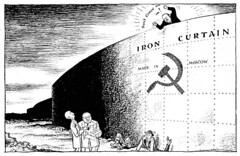 | 17 |
| 10489513613 | Winston Churchill | After World War II he declared, "An iron curtain has been descended across the continent". He called for a partnership between Western democracies to halt the expansion of communism. (p. 563) |  | 18 |
| 10489513614 | George Kennan | Helped formulate Truman's containment policy. Expert on Soviet Affairs, in an influential article he wrote that only "a long-term, patient but firm and vigilant containment of Russian expansive tendencies" would eventually cause the Soviets to back off their Communist ideology of world domination and live in peace with other nations. (p. 563) |  | 19 |
| 10489513615 | Containment | In 1947, President Truman adopted the advice of three top advisers on how to contain Soviet aggression. This policy called for a long-term, firm, and vigilant containment of the Soviet's expansion tendencies. They believed this would eventually cause them to back off their Communist ideology of world domination. (p. 563) |  | 20 |
| 10489513616 | Truman Doctrine | This doctrine was in response to a Communist-led uprising against the government in Greece and Soviet demand for some control of a water route in Turkey. In 1947, President Truman asked Congress for $400 million in economic and military aid to assist Greece and Turkey against totalitarian regimes. (p. 564) |  | 21 |
| 10489513617 | Marshall Plan | A 1947 plan of U.S. economic aid to help European nations revive their economies and strengthen democratic governments, after the devastation of World War II. This plan offered $12 billion in aid to western and southern Europe. The Soviet Union refused to take any of the aid and the result was a deepening rift between non-Communist West and the Communist East. (p. 564) |  | 22 |
| 10489513618 | Berlin airlift | The Soviets cut off all access by land to West Berlin. The United States flew planes in with supplies to help the people. At the same time, the U.S. sent 60 bombers capable of carrying atomic bombs to bases in England. Stalin chose not to challenge the airlift and war was averted. (p. 564) |  | 23 |
| 10489513619 | East Germany | After World War II, this country was the German Democratic Republic, a satellite of the Soviet Union. (p. 564) |  | 24 |
| 10489513620 | West Germany | After World War II, this country was the Federal Republic of Germany, a U.S. ally. (p. 564) |  | 25 |
| 10489513621 | North Atlantic Treaty Organization | A military alliance, commonly known as NATO. It consists of the United States, Canada, and ten European nations. Its purpose was to defend Western Europe against outside attack. (p. 565) |  | 26 |
| 10489513622 | National Security Act | In 1947, this act provided for 1) a centralized Department of Defense to coordinate the operations of the military, 2) creation of the National Security Council (NSC) to coordinate the making of foreign policy in the Cold War, 3) creation of the Central Intelligence Agency (CIA) to employ spies to gather information on foreign governments. (p. 566) |  | 27 |
| 10489513623 | Nuclear arms race | Soviet and American scientists were in an arms race to develop superior weapons systems. From 1945 to 1949 the U.S. was only country to have atomic bombs. In 1949 the Soviets tested their first atomic bomb. President Truman responded by approving the development of a hydrogen bomb which would be 1000 times more powerful than the atomic bomb. (p. 566) |  | 28 |
| 10489513624 | U.S. - Japanese Security Treaty | A 1951 treaty, in which Japan surrendered its claims to Korea and islands in the Pacific and the U.S. ended formal occupation of Japan. U.S troops remained on military bases in Japan to protect it from external enemies. (p. 567) |  | 29 |
| 10489513625 | Douglas MacArthur | Popular general who aggressively directed American forces during the Korean War. He clashed with President Truman, who removed him from command in 1951. (p. 566) |  | 30 |
| 10489513626 | Chinese civil war | The war between Communist Mao Zedong and Nationalist Chiang-Kai Shek. The United States gave $400 million in aid to the Nationalists, but 80 percent of it landed in Communist hands. The Communists took over China and forced the Nationalists to retreat to Taiwan. The U.S. did not recognize the People's Republic of China until 1979. (p. 567) |  | 31 |
| 10489513627 | Mao Zedong | The Communist leader of the People's Republic of China. He overthrew Chiang Kai-shek and the Nationalists. (p. 567) |  | 32 |
| 10489513628 | Korean War | On June 25, 1950 the North Korean army invaded South Korea. General Douglas MacArthur led a United Nations force consisting of mostly U.S. troops to help the South Korean army. By the time a peace agreement was signed in 1953 the north and south border was nearly in the same location, but 2.5 million people, including 54,000 Americans had died. (p. 568) |  | 33 |
| 10489513629 | Kim Il Sung | The Communist leader of North Korea during the Korean War. (p. 568) |  | 34 |
| 10489513630 | Syngman Rhee | The nationalist leader of South Korea during the Korean War. (p. 568) |  | 35 |
| 10489513631 | U.N. police action | The term to describe the Korean War because Congress supported the use of U.S. troops under the U.N. but had never declared war. (p. 568) |  | 36 |
| 10489513632 | 38th parallel | After World War II Japan gave up its former colony Korea and the country was divided along this parallel. The northern area was occupied by the Soviet forces and the south by the U.S. forces. (p. 568) |  | 37 |
| 10489513633 | House Un-American Activities Committee | After World War II, this House of Representative committee investigated Communist influence in the government and within organizations such as the Boy Scouts and Hollywood film industry. Many were called to testify before the committee and some were blacklisted. (p. 570) |  | 38 |
| 10489513634 | Hollywood blacklists | The House Un-American Activities Committee created a list of people who would be denied work in the film industry. (p. 570) |  | 39 |
| 10489513635 | Alger Hiss | He was a state department official who assisted Roosevelt at the Yalta conference. He denied that he was a Communist and had given secret documents to Whittaker Chambers. In 1950, he was convicted of perjury and sent to prison. (p. 571) |  | 40 |
| 10489513636 | Whittaker Chambers | A confessed Communist and witness for the House Un-American Activities Committee. (p. 571) |  | 41 |
| 10489513637 | Julius and Ethel Rosenberg | This couple was charged with running a spy ring for the Soviets in New York. In 1953, they were convicted of treason and executed. (p 571) |  | 42 |
| 10489513638 | Joseph McCarthy | A Republican senator from Wisconsin, who recklessly accused many government officials of being Communists. In December 1954 censured by the Senate which brought an end to his era. (p. 571) |  | 43 |
| 10489513639 | McCarthyism | During the early 1950s, this term was applied to the process of recklessly accusing people in the government and the arts of being Communists. (p. 571) |  | 44 |
Flashcards
Flashcards
Flashcards
Geometry Definitions Flashcards
Definitions through chapter 4. :D
I imported this from a Word document, so tell me if you see any errors ^_^
Terms : Hide Images
| 13508104820 | Inductive reasoning | a type of reasoning that reaches conclusions based on a pattern of specific examples or past events. | 0 | |
| 13508104821 | Conjecture | a conclusion reached by using inductive reasoning. | 1 | |
| 13508104822 | Counterexample | a particular example or instance of the statement that makes the statement false. | 2 | |
| 13508104823 | Space | set of all points. | 3 | |
| 13508104824 | Collinear points | points lie on the same line. |  | 4 |
| 13508104825 | Coplanar | figures in the same plane. | 5 | |
| 13508104826 | Postulate | an accepted statement of fact. | 6 | |
| 13508104827 | Segment | part of a line consisting of two points, called endpoints, and all points between them. |  | 7 |
| 13508104828 | Ray | part of a line consisting of one endpoint and all the points of the line on one side of the endpoint. | 8 | |
| 13508104829 | Opposite rays | collinear rays with the same endpoint. They form a line. |  | 9 |
| 13508104830 | Parallel lines | Two lines lie in the same plane and do not intersect. The symbol || represents this |  | 10 |
| 13508104831 | Skew lines | lines that do not lie in the same plane. |  | 11 |
| 13508104832 | Parallel planes | planes that do not intersect | 12 | |
| 13508104834 | Congruent segments | segments that have the same length. |  | 13 |
| 13508104835 | Midpoint | the point that divides the segment into two congruent segments. |  | 14 |
| 13508104836 | Angle | formed by two rays with the same endpoint. The rays are the sides of the angle and the common endpoint is the vertex of the angle. |  | 15 |
| 13508104838 | Right angle | an angle whose measure is 90. |  | 16 |
| 13508104840 | Straight angle | angle whose measure is 180. |  | 17 |
| 13508104841 | Congruent angles | angles that have the same measure. | 18 | |
| 13508104842 | Construction | geometric figure made with only a straightedge and compass. | 19 | |
| 13508104844 | Compass | a geometric tool used to draw circles and parts of circles, called arcs. | 20 | |
| 13508104845 | Perpendicular lines | lines that intersect to form right angles. The symbol ┴ represents this . |  | 21 |
| 13508104846 | Perpendicular bisector | a line, segment, or ray that is perpendicular to the segment at its midpoint. |  | 22 |
| 13508104847 | Angle bisector | a ray that divides an angle into two congruent angles. |  | 23 |
| 13508104848 | Conditional Statement | an if-then statement. | 24 | |
| 13508104854 | Deductive reasoning | a process of reasoning logically from given facts to a conclusion. | 25 | |
| 13508104857 | Reflexive property | a = a | 26 | |
| 13508104858 | Symmetric property | If a = b, then b = a. | 27 | |
| 13508104859 | Transitive property | If a = b and b = c, then a = c. | 28 | |
| 13508104860 | Vertical angles | two angles whose sides form two pairs of opposite rays. |  | 29 |
| 13508104861 | Adjacent angles | two coplanar angles that have a common side and a common vertex but no common interior points. |  | 30 |
| 13508104862 | Complementary angles | Two angles when the sum of their measures is 90. |  | 31 |
| 13508104863 | Supplementary angles | Two angles when the sum of their measures is 180. |  | 32 |
| 13508104864 | Theorem | conjecture that is proven. | 33 | |
| 13508104866 | Proof | a convincing argument that uses deductive reasoning. A proof can be written in many forms. In a paragraph proof, the statements and reasons are connected in sentences. | 34 | |
| 13508104867 | Transversal | a line that intersects two coplanar lines in two points. | 35 | |
| 13508104868 | Alternate interior angles | are nonadjacent interior angles that lie on opposite sides of the transversal. |  | 36 |
| 13508104869 | Same-side interior angles | (or consecutive interior) angles lie on the same side of the transversal t and between l and m. |  | 37 |
| 13508104870 | Corresponding angles | angles lie on the same side of the transversal t and in corresponding positions relative to l and m. |  | 38 |
| 13508104871 | Two-column proof | The statements and reasons are aligned in columns. | 39 | |
| 13508104872 | Flow proof | Arrows show the logical connections between the statements. |  | 40 |
| 13508104874 | Right triangle | A triangle contains one right angle. | 41 | |
| 13508104876 | Equiangular triangle | a triangle whose angles are all congruent. |  | 42 |
| 13508104877 | Equilateral triangle | a triangle whose sides are all congruent. |  | 43 |
| 13508104878 | Isosceles triangle | a triangle that has at least two congruent sides. |  | 44 |
| 13508104879 | Scalene triangle | triangle has no sides congruent. |  | 45 |
| 13508104880 | Exterior angle of a polygon | an angle formed by a side and an extension of an adjacent side. |  | 46 |
| 13508104881 | Remote interior angles | two nonadjacent interior angles corresponding to each exterior angle of a triangle. |  | 47 |
| 13508104887 | Regular polygon | a polygon that is both equilateral and equiangular. | 48 | |
| 13508104888 | Slope-intercept form | form of a linear equation is y = mx + b, |  | 49 |
| 13508104890 | Point-slope form | The form for a nonvertical line with slope m and through point ( X1, Y1 ) is Y - Y1 = m( X - X1 ). |  | 50 |
| 13508104891 | Congruent polygons | polygons that have corresponding sides congruent and corresponding angles congruent. |  | 51 |
| 13508104892 | CPCTC | "corresponding parts of congruent triangles are congruent." |  | 52 |
| 13508104893 | Legs | The two congruent sides of an isosceles triangle. |  | 53 |
| 13508104896 | Base angles of an isosceles triangle | The other two angles in an isosceles triangle |  | 54 |
| 13508104898 | Hypotenuse | The longest side of a right triangle. Also opposite the right angle. |  | 55 |
| 13508104899 | Legs of a right triangle | The sides that from the right angles of a right triangle |  | 56 |
Flashcards
Flashcards
Pages

Need Help?
We hope your visit has been a productive one. If you're having any problems, or would like to give some feedback, we'd love to hear from you.
For general help, questions, and suggestions, try our dedicated support forums.
If you need to contact the Course-Notes.Org web experience team, please use our contact form.
Need Notes?
While we strive to provide the most comprehensive notes for as many high school textbooks as possible, there are certainly going to be some that we miss. Drop us a note and let us know which textbooks you need. Be sure to include which edition of the textbook you are using! If we see enough demand, we'll do whatever we can to get those notes up on the site for you!
