AP Notes, Outlines, Study Guides, Vocabulary, Practice Exams and more!

AP Language, set 4 Flashcards

Terms : Hide Images
3116776247aberration (n)departure from the norm - in a weird or freakish way - aberrant (adj)0
3116780626boon (n)timely benefit; a blessing1
3116783163churlish (adj)disagreeable or unpleasant; difficult to work with2
3116788149coddle (v)to treat with extreme or excessive care; to pamper3
3116792102deem (v)to consider; to believe; to judge something in a certain manner4
3116794952dissemination (n)dispersion throughout; disseminate (v)5
3116799268dissident (n)one who disagrees with an established belief, politics, religion, etc.6
3116804955docility (n)act of being easily led or managed; docile (adj)7
3116813922exacerbate (v)to worsen or make more severe8
3116816615immutable (adj)not capable of being changed (not for people)9
3116819610impunity (n)exemption from punishment10
3116822487laurels (n)honors11
3116823774mettle (n)vigor or strength of spirit; strong disposition12
3116827908parlance (n)speech; formal debate13
3116829720propensity (n)an intense inclination or preference; a leaning toward14
3116833479purview (n)a range of limits of authority15
3116841107quiescent (adj)causing no trouble; marked by rest16
3116846523quotidian (n)occurring every day; ordinary or common place17
3116849472recalcitrant (adj)difficult to manage; resistant18
3116853081unfettered (adj)free from bindings or obligations that hold one back19
3116857469verity (n)truth; honesty20

AP Literature - Semester 1 Word List (A-G) Flashcards

Terms : Hide Images
4919302311Accentthe stressed portion of a word0
4919302312Allegoryan extended narrative in prose or verse in which characters, events, and settings represent abstract qualities and in which the writer intends a second meaning to be read beneath the surface story; the underlying meaning may be moral, religious, political, social, or satiric1
4919302313Alliterationthe repetition of consonant sounds at the beginning of words that are close to one another2
4919304263Anachronisman event, object, custom, person, or thing that is out of order in time3
4919304264Anecdotea short, simple narrative of an incident4
4919305678Aphorisma short, often witty statement of a principle or a truth about life5
4919305679Apostropheusually in poetry (not grammar, but sometimes in prose) the device of calling out to an imaginary, dead, or absent person, or to a place, thing, or personified abstraction either to begin a poem or to make a dramatic break in thought somewhere within the poem6
4919305680Asidea brief speech or comment that an actor makes to the audience, supposedly without being heard by the other actors on stage; often used for melodramatic or comedic effect7
4919305681Assonancethe repetition of vowel sounds between different consonants8
4919308240Folk Balladone of the earliest forms of literature, this ballad was usually sung and was passed down orally from singer to singer; its author (if a single author) is generally unknown, and its form and melody often changed according to a singer's preference9
4919308241Literary Balladalso called an art ballad, this is a ballad that imitates the form and spirit of the folk ballad, but is more polished and uses a higher level of poetic diction10
4919311327Blank Versepoetry written in unrhymed iambic pentameter; a favorite form used by Shakespeare11
4919311328Cacophonyharsh, awkward, or dissonant sounds used deliberately in poetry or prose12
4919311329Catharsisthe emotional release that an audience member experiences as a result of watching a tragedy13
4919313443Chorusin Greek drama, a group of characters who comments on the action taking place on stage14
4919313444Classicismthe principles and styles admired in the classics of Greek and Roman literature, such as objectivity, sensibility, restraint, and formality15
4919315617Colloquialisma word or phrase used in everyday conversation and informal writing that is sometimes inappropriate in formal writing16
4919320176Conceitan elaborate figure of speech in which two seemingly dissimilar things or situations are compared17
4919325914Consonancethe repetition of identical consonant sounds before and after different vowel sounds18
4919349890Conundruma riddle whose answer is or involves a pun; may also be a paradox or difficult problem19
4919360338Dictionword choice20
4919360339Elegya formal poem focusing on death or mortality, usually beginning with the recent death of a particular person21
4919360340End Rhymea rhyme that comes at the end of lines of poetry22
4919360341Epica long narrative poem about a serious or profound subject in a dignified style; usually featuring heroic characters and deeds important in legends23
4919361768Epigrama concise, witty saying in poetry or prose that either stands alone or is part of a larger work; may also refer to a short poem of this type24
4946019661Euphonya succession of harmonious sounds used in poetry or prose25
4946019662Exempluma brief tale used in medieval times to illustrate a sermon or teach a lesson26
4946020578Expositionthe immediate revelation to the audience of the setting and other background information necessary for understanding the plot27
4946020579Farcea light, dramatic composition characterized by broad satirical comedy and a highly improbable plot28
4946020580Figurative Languagelanguage that contains figures of speech such as similes and metaphors in order to create associations that are imaginative rather than literal29
4946021747Figures of Speechexpressions such as similes, metaphors, and personifications that make imaginative, rather than literal, comparisons or associations30
4946022376Foila character who, by contrast, highlights the characteristics of another character31
4946022377Folkloretraditional stories, songs, dances, and customs that are preserved among a people; folklore usually precedes literature, being passed down orally between generations until recorded by scholars32
4946022378Anapest (foot)two unstressed followed by one stressed syllable33
4946024198Dactyl (foot)one stressed followed by two unstressed syllables34
4946024199Spondee (foot)two successive stressed syllables35
4946025205Trochee (foot)one stressed followed by one unstressed syllable36
4946025206Foreshadowingthe use of a hint or clue to suggest a larger event that occurs later in the work37
4946025207Free Versepoetry that is written without a regular meter, usually without rhyme38
4946025745Genrea type of literary work, such as a novel or poem; there are also subgenres, such as science fiction novel and sonnet, within the larger genres39
4946025746Gothicreferring to a type of novel that emerged in the eighteenth century that uses mystery, suspense, and sensational and supernatural occurrences to evoke terror40

Ap language Flashcards

Terms : Hide Images
4986438329CoalasceTo join, form as a whole0
4986438330DecadenceDecay , a decline1
4986438331ExemplaryWorth of imitation; praiseworthy2
4986438332IncidentalSecondary , occurring as a minor consequence of something more important3
4986438333InsolventWithout money4
4986438334ParsimoniousStingy, too thrifty , miserly5
4986438335ProdigalWasteful and reckless with money6
4986438336WritheTo twist and turn, squirm , in pain or discomfort7
4986438337SurreptitiousDone in a secret or sly way8
4986438338ExuberanceHigh-spirited enthusiasm9

AP Language Week 17 02-15-2016 Flashcards

Terms : Hide Images
3892285989rebuketo scold; to blame0
3892291999nonentitya person or thing of little importance1
3892295046Sang-froidcalmness; composure or cool self-possession2
3892299913desultorywandering from subject to subject3
3892302552hectorto bully; to pester4
3892307556pandemicgeneral; widespread5
3892310613coalesceto blend; to merge6
3892312014beguileto deceive; to charm; to enchant7
3892316140ennuiboredom; a weariness resulting from a lack of interest8
3892319996hiatusa pause or gap9
3892322061lambentsoftly bright or radiant; moving lightly over a surface10
3892323109ergotherefore11
3892324296hubrisexcessive pride or self-confidence12
3892327432pecuniarypertaining to money; financial13
3892329981sibilanta hissing sound14

AP World Chapter 7 Flashcards

Terms : Hide Images
7268576718Ancestral PuebloFormerly known as the Anasazi, this people established a mixed agricultural and gathering/hunting society in the southwestern part of North America0
7268581291ApedemekThe lino god of classical Meroe, his popularity shows a turn away from Egyptian cultural influence1
7268585455AxumClassical-era kingdom of East Africa, in present-day Eritrea and northern Ethiopia, flourished from 100-600 CE. Known for their conversion to Christianity2
7268592666Bantu expansionGradual migration for Bantu-speaking peoples from their homeland in what is now southern Nigeria and the Cameroons into most of eastern and southern Africa, a process that began around 3000 BCE and continued for several millennia. The agricultural techniques and iron-working technology of Bantu-speaking farmers gave them an advantage over the gathering/hunting peoples they encountered3
7268606136BatwaForest-dwelling people of Central Africa who adopted some of the ways of their Bantu neighbors while retaining distinctive features of their own culture; also known as "pygmies"4
7268612393CahokiaThe dominant center of an important Mississippi valley mound-building culture; located near present-day St. Louis, Missouri; flourished from about 900 to 1250 CE5
7268618659Chaco PhenomenonName given to a major process of settlement and societal organization that occurred in the period 860-1130 Ce among the peoples of Chaco canyon, in what is now northwestern New Mexico; the society formed is notable for its settlement in large pueblos and for the building of hundreds of miles of roads6
7268630357ChavinAndean town that was the center of a larger Peruvian religious movement from around 900 to 200 BCE7
7268634042Coptic ChristianityThe Egyptian variety of Christianity. distinctive in its belief that Christ has only a single, divine nature8
7268637786EzanaKing of Axum in the early 4th century Ce who established Christianity in the state.9
7268641359Hopewell CultureNamed from its most important site (in present-day Ohio) this is the most elaborate and widespread of the North American mound-building cultures; flourished from 200 BCE to 400 CE10
7268650198Jenne-jenoLargest and most fully studied of the cities of the Niger Valley civilization11
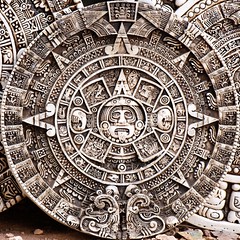
7268717932MayaThe major classical civilization of Mesoamerica; flourished from 250 to 900 CE12
7268720719MeroeCity in southern Nubia that was the center of Nubian civilization between 300 BCE and 100 CE13
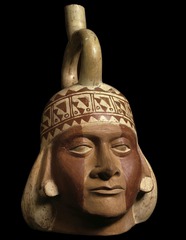
7268723126MocheAn important regional civilization of Peru, governed by warrior-priests; flourished from around 100 to 800 CE14
7268726442Mound Buildersmembers of any of a number of cultures that developed east of the Mississippi River in what is now the United States and that are distinguished by their large earthen mounds, built during the period 2000 BCE and 1250 CE15
7268733980NazcaA civilization of southern coastal Peru, the Nazca became famous for their underground irrigation channels and their gigantic and mysterious lines in the desert in the form of monkeys, birds, spiders and other designs16
7268741039Niger Valley civilizationDistinctive city-based civilization that flourished from about 300 BCE to 900 CE int he floodplain of the middle Niger and that included major cities like Jenne-Jeno; the Niger Valley civilization is particularly noteworthy for its apparent lack of centralized state structures, having been organized instead in clusters of economically specialized settlements.17
7268754917pueblo"Great house" of the Ancestral Pueblo people; a large, apartment building-like structure that could house hundreds of people18
7268759657"semi-sedentary"Term frequently used to describe the peoples of the eastern woodlands of the United States, Central America, the Amazon basin, and the Caribbean islands who combined partial reliance on agriculture and gathering/hunting19
7268766111TeotihuacanThe largest city of pre-Columbian America, with a population between 100,00 and 200,000; seemingly built to a plan in the Valley of Mexico; flourished between 300 and 600 CE during which time it governed or influenced much of the surrounding region; Means "city of the gods"20
7282740188TikalMajor Maya city , with a population of perhaps 50,000 people21
7282749992KhoikhoiA people of South Africa who adopted cattle and sheep heading (as well as iron working) as they came in contact with Bantu-speaking people from West Africa22
7282755439Continuous RevelationA Bantu notion of religious belief in which the people believed in the possibility of constantly receiving new messages from the world beyond23
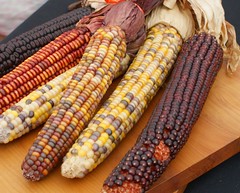
7282762057Mesoamerican AgricultureAgriculture in Central America primarily focused around maize, beans, chili peppers and squash24
7282765342Mesoamerican TradeBack as far as the Olmecs, Central American people traded things like jade, serpentine, obsidian tools,ceramic pottery, shell ornaments, stingray spines, and turtle shells25
7282770734Mayan WritingThe Mayans wrote on stone, bark paper and on deerskin26
7282773840Monte AlbanA major Zapotec city; engaged in diplomacy with Teotihuacan27
7282778634TiwanakuName of the capital city and empire centered on the region near Lake Titicaca in modern Bolivia (375-1000 CE)28
7282786888Pueblo BonitoImportant great house in Chaco canyon; trade networks linked together various pueblos that traded things like buffalo hides, copper, turquoise, seashells, macaw feathers and coiled baskets29

AP Language and Composition Terminology Flashcards

Terms : Hide Images
6985155807AlliterationThe repetition of the same sound or letter at the beginning of consecutive words or syllables. E.g.: Fred's friends fried Fritos for Friday's food.0
6985156938AllusionAn indirect reference, often to another text or an historic event. E.g.: "She acted like a scrooge" (Charles Dickens: A Christmas Carol).1
6985159867AnalogyAn extended comparison between two seemingly dissimilar things. E.g.: "Life is like a box of chocolates - you never know what you're gonna get!"2
6985161234AnaphoraThe repetition of words at the beginning of successive clauses. E.g.: "It was the best of times, it was the worst of times, it was the age of wisdom, it was the age of foolishness..."3
6985162396AnecdoteA short account of an interesting event. E.g.: A grandfather tells his grandchildren a story of his childhood.4
6985163577AnnotationExplanatory or critical notes added to a text.* *Definition of annotation.5
6985164344AntecedentThe noun to which a later pronoun refers. E.g.: When children are happy, they clap to express their pleasure.6
6985165326AntimetaboleThe repetition of words in an inverted order to sharpen a contrast. E.g.: "Eat to live, not live to eat" // "If you fail to plan, you plan to fail"7
6985166897AntithesisParallel structure that juxtaposes contrasting ideas. E.g.: Give every man thy ear, but few thy voice.8
6985167356AphorismA short, astute statement of a general truth. E.g.: The simplest questions are the hardest to answer.9
6985167729AppositiveA word or phrase that renames a nearby noun or pronoun. E.g.: The insect, a cockroach, is crawling across the kitchen table.10
6985168512Archaic dictionThe use of words common to an earlier time period; antiquated language. E.g.: Shakespeare: hath, thy, thou.11
6985168513ArgumentA statement put forth and supported by evidence.12
6985169057Aristotelian triangleA diagram that represents a rhetorical situation as the relationship among the speaker, the subject, and the audience (see rhetorical triangle).13
6985169769AssertionAn emphatic statement; declaration. An assertion supported by evidence becomes an argument.14
6985170504AssumptionA belief or statement taken for granted without proof. Asyndeton: Leaving out conjunctions between words, phrases, clauses.15
6985171369AttitudeThe speaker's position on a subject as revealed through his or her tone.16
6985172355AudienceOne's listener or readership; those to whom a speech or piece of writing is addressed.17
6985172356AuthorityA reliable, respected source—someone with knowledge. E.g.: Professor/Professional in specific area.18
6985173945BiasPrejudice or predisposition toward one side of a subject or issue.19
6985174575CiteIdentifying a part of a piece of writing as being derived from a source.20
6985175740ClaimAn assertion, usually supported by evidence.21
6985176650Close readingA careful reading that is attentive to organization, figurative language, sentence structure, vocabulary, and other literary and structural elements of a text.22
6985177264Colloquial/ismAn informal or conversational use of language.23
6985178816Common groundShared beliefs, values, or positions.24
6985179646Complex sentenceA sentence that includes one independent clause and at least one dependent clause.25
6985180349ConcessionA reluctant acknowledgment or yielding.26
6985181170ConnotationThat which is implied by a word, as opposed to the word's literal meaning (see denotation).27
6985181171ContextWords, events, or circumstances that help determine meaning.28
6985182297CoordinationGrammatical equivalence between parts of a sentence, often through a coordinating conjunction such as and, or but.29
6985183092CounterargumentA challenge to a position; an opposing argument.30
6985183442Cumulative sentenceAn independent clause followed by subordinate clauses or phrases that supply additional detail.31
6985183874Declarative sentenceA sentence that makes a statement.32
6985183875DeductionReasoning from general to specific.33
6985184686DenotationThe literal meaning of a word; its dictionary definition. (E.g.: Aroma = smell)34
6985185797DictionWord choice.35
6985185803DocumentationBibliographic information about the sources used in a piece of writing.36
6985189063ElegiacMournful over what has passed or been lost; often used to describe tone. E.g.: Poems: Sylvia Plath37
6985189798EpigramA brief witty statement. E.g.: "I can resist everything but temptation"38
6985189801EthosA Greek term referring to the character of a person; one of Aristotle's three rhetorical appeals (see logos and pathos). Credibility39
6985190352Figurative languageThe use of tropes or figures of speech; going beyond literal meaning to achieve literary effect.40
6985191193Figure of speechAn expression that strives for literary effect rather than conveying a literal meaning.41
6985191728HyperboleExaggeration for the purpose of emphasis.42
6985192317ImageryVivid use of language that evokes a reader's senses (sight, smell, taste, touch, hearing).43
6985192777Imperative sentenceA sentence that requests or commands.44
6985192780InductionReasoning from specific to general.45
6985193397InversionA sentence in which the verb precedes the subject.46
6985193403IronyA contradiction between what is said and what is meant; incongruity between action and result.47
6985194172JuxtapositionPlacement of two things side by side for emphasis. E.g.: God and Satan // It was the best of times, it was the worst of times...48
6985194748LogosA Greek term that means "word"; an appeal to logic; one of Aristotle's three rhetorical appeals (see ethos and pathos)49
6985194749MetaphorA figure of speech or trope through which one thing is spoken of as though it were something else, thus making an implicit comparison.50
6985195729MetonymyUse of an aspect of something to represent the whole.51
6985196232OccasionAn aspect of context; the cause or reason for writing.52
7059361406OxymoronA figure of speech that combines two contradictory terms.53
7059361407ParadoxA statement that seems contradictory but is actually true. E.g.: I can resist anything but temptation / I know one thing: that I know nothing.54
7059361722ParallelismThe repetition of similar grammatical or syntactical patterns.55
7059362037ParodyA piece that imitates and exaggerates the prominent features of another; used for comic effect or ridicule.56
7059362562PathosA Greek term that refers to suffering but has come to be associated with broader appeals to emotion; one of Aristotle's three rhetorical appeals (see ethos and logos).57
7059362827PersonaThe speaker, voice, or character assumed by the author of a piece of writing.58
7059362828PersonificationAssigning lifelike characteristics to inanimate objects.59
7059364095PolemicAn argument against an idea, usually regarding philosophy, politics, or religion.60
7059364096PolysyndetonThe deliberate use of a series of conjunctions.61
7059364558PremiseMajor, minor Two parts of a syllogism. The concluding sentence of a syllogism takes its predicate from the major premise and its subject from the minor premise.62
7059365609PropagandaA negative term for writing designed to sway opinion rather than present information.63
7059365884PurposeOne's intention or objective in a speech or piece of writing.64
7059365885RefuteTo discredit an argument, particularly a counterargument.65
7059366366RhetoricThe study of effective, persuasive language use; according to Aristotle, use of the "available means of persuasion."66
7059367162Rhetorical modesPatterns of organization developed to achieve a specific purpose; modes include but are not limited to narration, description, comparison and contrast, cause and effect, definition, exemplification, classification and division, process analysis, and argumentation.67
7059367166Rhetorical questionA question asked more to produce an effect than to summon an answer.68
7059367676Rhetorical triangleA diagram that represents a rhetorical situation as the relationship among the speaker, the subject, and the audience (see Aristotelian triangle).69
7059368627SatireAn ironic, sarcastic, or witty composition that claims to argue for something, but actually argues against it.70
7059368628SchemeA pattern of words or sentence construction used for rhetorical effect.71
7059369476Sentence patternsThe arrangement of independent and dependent clauses into known sentence constructions—such as simple, compound, complex, or compound-complex.72
7059369477Sentence varietyUsing a variety of sentence patterns to create a desired effect.73
7059369890SimileA figure of speech that uses "like" or "as" to compare two things.74
7059369891Simple sentenceA statement containing a subject and predicate; an independent clause.75
7059370171SourceA book, article, person, or other resource consulted for information.76
7059370541SpeakerA term used for the author, speaker, or the person whose perspective (real or imagined) is being advanced in a speech or piece of writing.77
7059370542Straw manA logical fallacy that involves the creation of an easily refutable position; misrepresenting, then attacking an opponent's position.78
7059371906StyleThe distinctive quality of speech or writing created by the selection and arrangement of words and figures of speech.79
7059372189SubjectIn rhetoric, the topic addressed in a piece of writing.80
7059372190Subordinate clauseCreated by a subordinating conjunction, a clause that modifies an independent clause.81
7059372433SubordinationThe dependence of one syntactical element on another in a sentence.82
7059372889SyllogismA form of deductive reasoning in which the conclusion is supported by a major and minor premise (see premise; major, and minor).83
7059373649SyntaxSentence structure.84
7059373375SynthesizeCombining or bringing together two or more elements to produce something more complex.85
7059375295ThesisThe central idea in a work to which all parts of the work refer.86
7059375738Thesis statementA statement of the central idea in a work, may be explicit or implicit.87
7059375739ToneThe speaker's attitude toward the subject or audience.88
7059376038Topic sentenceA sentence, most often appearing at the beginning of a paragraph, that announces the paragraph's idea and often unites it with the work's thesis.89
7059376039TropeArtful diction; the use of language in a nonliteral way; also called a figure of speech.90
7059378426UnderstatementLack of emphasis in a statement or point; restraint in language often used for ironic effect.91
7059379110VoiceIn grammar, a term for the relationship between a verb and a noun (active or passive voice). In rhetoric, a distinctive quality in the style and tone of writing.92
7059379727ZeugmaA construction in which one word (usually a verb) modifies or governs—often in different, sometimes incongruent ways—two or more words in a sentence.93

AP Language Vocabulary Set 1 Flashcards

Terms : Hide Images
5449619560ApocryphalOf dubious authenticity or origin; spurious. (Adj)0
5449621570ArcaneUnderstood by only a few; mysterious. (Adj)1
5449621571ConveneTo summon or cause to assemble. (v)2
5449623315ExpedientUseful for some purpose; convenient. Concerned primarily or exclusively with serving one's own interests. (Adj)3
5449623316ExudeTo flow out slowly; to ooze or emit. To give forth; to exhibit in abundance. (v)4
5449623317GesticulateTo motion energetically with the body or limbs. (v)5
5449627027ImperturbableCalm and assured. (Adj)6
5449629228IncrementAn increase, addition or gain, often by regular, consecutive amounts. (n)7
5449629229LevityExcessive frivolity; a lack of seriousness; joking. (n)8
5449629230MortifyTo embarrass or humiliate. (v)9
5449631995PeripheryThe area around the edges; the outermost part. (n)10
5449631996RaconteurOne who tells stories with skill and wit. (n)11
5449635881ReiterateTo say or do over again; to repeat. (v)12
5449635882SubterfugeA deceptive scheme or strategy. (n)13
5449638165VacillateTo move back and forth from lack of balance; waver. To alternate indecisively between opinions or courses of action. (v)14
5449638166Word History: Incrementfrom Latin to Anglo-French to Middle English Latin: incrementum: growth, increase; an addition from stem of increscere: to grow in or upon first attested 1630s.15

AP Composition and Language Vocabulary #3 Flashcards

Terms : Hide Images
4988666264condescendingtreating people as weak or inferious0
4988667784contemptuousfeeling hatred; scornful1
4988669061despoticexercising absolute power; tyrannical2
4988670949dictatorialdomineering; oppressively overbearing3
4988672551disdaincontempt, scorn (noun) to look down (verb)4
4988675240haughtyarrogant; vainly proud5
4988676135imperiousarrogantly domineering or overbearing6
4988678417patronizingtreating in condescending manner7

Pages

Subscribe to CourseNotes RSS

Need Help?

We hope your visit has been a productive one. If you're having any problems, or would like to give some feedback, we'd love to hear from you.

For general help, questions, and suggestions, try our dedicated support forums.

If you need to contact the Course-Notes.Org web experience team, please use our contact form.

Need Notes?

While we strive to provide the most comprehensive notes for as many high school textbooks as possible, there are certainly going to be some that we miss. Drop us a note and let us know which textbooks you need. Be sure to include which edition of the textbook you are using! If we see enough demand, we'll do whatever we can to get those notes up on the site for you!