AP Notes, Outlines, Study Guides, Vocabulary, Practice Exams and more!

AP Literature Terms Flashcards

Terms : Hide Images
4140502088AllegoryA story in which each aspect of the story has a symbolic meaning outside the tale itself.0
4140509096AlliterationThe repetition of initial consonant sounds.1
4140510678AllusionA reference to another work or famous figure2
4140515058AmbiguityAmbiguity is when the meaning of a word, phrase, or sentence is uncertain. There could be more than one meaning.3
4140547897AnachronismAn error of chronology or timeline in a literary piece4
4140551624AnaphoraThe deliberate repetition of the first part of the sentence in order to achieve an artistic effect. Ex: We shall fight on the beaches, we shall fight on the landing grounds, we shall fight in the fields and in the streets, we shall fight in the hills.5
4140563072AntagonistA character who stands in opposition to the protagonist.6
4140567210ProtagonistA protagonist is the central character or leading figure in poetry, narrative, novel or any other story.7
4140575291AnthropomorphismAnthropomorphism is a literary device that can be defined as a technique in which a writer ascribes human traits, ambitions, emotions or entire behavior to animals, non-human beings, natural phenomena or objects. Personification is an act of giving human characteristics to animals or objects to create imagery, while anthropomorphism aims to make an animal or object behave and appear like they are human beings.8
4140584018AntithesisA rhetorical device in which two opposite ideas are put together in a sentence to achieve a contrasting effect.9
4140588069ArchetypeA typical character, an action or a situation that seems to represent such universal patterns of human nature. Ex: the hero, the mentor, the journey, the villian10
4140595117AsideIt is a short comment or speech that a character delivers directly to the audience or to himself, while other actors on the stage cannot listen. Only the audience can realize that an actor has expressed speech for them.11
4146950355AssonanceThe repeated use of vowel sounds, as in "Old king Cole was a merry old soul."12
4146955227ConsonanceThe repetition of consonant sounds within words (rather than at their beginnings, which is alliteration). Ex: A flock of sick, black-checkered ducks.13
4146979275AsyndetonA writing style where conjunctions are omitted in a series of words, phrases, or clauses. It is used to shorten a sentence and focus on its meaning14
4146998899PolysyndetonThe use of several conjunctions in close succession, especially where some could otherwise be omitted15
4147004281BathosWhen an author seems to be trying really, really hard to write about something lofty or noble or elevated, but then descends into the trivial and/or stupid.16
4147033140CacophonyThe use of words with sharp, harsh, hissing and unmelodious sounds17
4147037680EuphonyA harmonious combination of words and sounds.18
4147055337CatharsisThe purification or purgation of the emotions19
4147058590ChiasmusWhen two or more clauses are balanced against each other by the reversal of their structures. Ex: "Never let a Fool Kiss You or a Kiss Fool You."20
4147072157ColloquialismThe use of informal words, phrases or even slang in a piece of writing.21
4147081370Deux ex machinaTo solve a seemingly intractable problem in a plot by adding in an unexpected character, object, or situation. Deus ex machina often has the sense of being quite contrived, as it seems like the author must resort to something that he or she did not set up properly plot-wise22
4147087095Denotation/ConnotationThe denotation of a word is its literal dictionary definition. Its connotation is the emotional strings that come attached to the word23
4147148387DictionThe author's choice of word. Ex: Whether to use wept or cried.24
4147156211Ethos, pathos, logosEthos is an appeal to ethics, and it is a means of convincing someone of the character or credibility of the persuader. Pathos is an appeal to emotion, and is a way of convincing an audience of an argument by creating an emotional response. Logos is an appeal to logic, and is a way of persuading an audience by reason.25
4147166007EuphemismUsing a comparatively milder form of a negative description instead of its original, unsympathetic form. A nice way of saying something not so nice.26
4147183475FarceType of a comedy that makes use of highly exaggerated and funny situations aimed at entertaining the audience.27
4147192986FoilA character that shows qualities that are in contrast with the qualities of another character28
4147196170ForeshadowingWhen a writer gives an advance hint of what is to come later in the story.29
4147200958HubrisThe excessive pride or ambition that leads to the main character's downfall.30
4147216681HyperboleAn extreme exaggeration31
4147220500In media resDescribes a story that starts in the middle of the action32
4147233040IronyA figure of speech in which words are used in such a way that their intended meaning is different from the actual meaning of the words. Ex: "Oh, what great luck I have!!!"33
4147240892JuxtapositionPlacing two or more things side by side for the purpose of developing comparisons and contrasts.34
4147252801LitoteA figure of speech which employs an understatement by using double negatives or, in other words, positive statement is expressed by negating its opposite expressions. Ex: "She is not a beauty queen," means "She is ugly" or saying "I am not as young as I used to be" in order to avoid saying "I am old".35
4147279726Loose sentenceA loose sentence is complete before its end (independent clause is in the beginning of sentence). Ex: Jack loved Diane despite her irritating snorting laugh, her complaining, and her terrible taste in music.36
4147851868MetaphorA metaphor compares two subjects without the use of "like" or "as" Ex: His eyes were burning coals.37
4147860174MetonymyA figure of speech that replaces the name of a thing with the name of something else with which it is closely associated.38
4147863896MoodThe atmosphere of a story; the feeling created in the reader by a literary work39
4147885176MotifAn object or idea with symbolic meaning that repeats itself throughout a literary work.40
4147895618Non sequiturStatements that do not follow logic and reason. Ex: Maria drives a car. She must be a wealthy person.41
4147908447OnomatopoeiaA word which imitates the natural sounds of a thing. Ex: moo, chirp, buzz42
4147912174OxymoronA phrase composed of opposites Ex: jumbo shrimp, a truthful lie43
4147917545ParableA short story with a moral lesson at the end.44
4147925237ParadoxA statement that appears to be self-contradictory or silly but may include a latent truth. Ex: Truth is honey which is bitter, I am nobody45
4147932940ParallelismRepeated syntactical similarities used for effect46
4147936618ParodyThe work that results when a specific work is exaggerated to ridiculousness. An imitation of a writer, artist, subject, or genre in such a way as to make fun of or comment on the original work.47
4147944574Pathetic fallacyThe description of inanimate objects in a manner that endows them with human emotions, thoughts, sensations, and feelings.48
4147953111Periodic sentenceA periodic sentence is not grammatically complete until it has reached its final phrase. Ex: Despite Diane's irritation at Jack's peculiar habit of picking between his toes while watching TV and his terrible haircut, she loved him.49
4150344715PersonaThe person who is understood to be speaking (or thinking or writing) a particular work. The persona is almost always distinct from the author; it is the voice chosen by the author for a particular artistic purpose. The persona may be a character in the work or merely an unnamed narrator; but, insofar as the manner and style of expression in the work exhibit taste, prejudice, emotion, or other characteristics of a human personality, the work may be said to be in the voice of a persona.50
4150431065PersonificationWhen a a thing, an idea or an animal is given human attributes.51
4150435088PunThe usually humorous use of a word in such a way to suggest more meanings.52
4150445052SatireA technique employed by writers to expose and criticize foolishness and corruption of an individual or a society by using humor, irony, exaggeration or ridicule.53
4150468932SimileSimile is an explicit comparison between two unlike things through the use of connecting words, usually "like" or "as.54
4150487357SoliloquyA speech that a character makes in a work of drama only to him or herself.55
4154730810Stock characterStandard or cliched character types: the drunk, the miser, the foolish girl, etc; flat and undimensional56
4154741900Stream of consciousnessA method of narration that describes in words the flow of thoughts in the minds of the characters.57
4154747165SymbolismWhen an object represents an idea58
4154756737SynechdocheA figure of speech in which a part stands for a whole, or vice versa59
4154766242SynesthesiaA figure of speech in which one sense is described using terms from another.60
4154772631Syntaxsentence structure61
4154783472ToneThe author's attitude toward his audience and subject.62
4154795887Tragic flawThe weakness of character in an otherwise good individual that ultimately leads to his demise63
4154880405TropeA figure of speech through which writers intend to express meanings of words differently than their literal meanings.64
4154896314VersimilitudeThe extent to which the literary text is believable, or the extent to which it imitates life.65
4154906513Narrative poemA form of poetry that tells a story, often making use of the voices of a narrator and characters as well66
4154914810Epic poemA long, narrative poem that is usually about heroic deeds and events67
4154920225Lyric poema type of emotional, musical poem68
4154923829SonnetHas 14 fourteen lines; Each line has 10 syllables, and is written in iambic pentameter. It has a specific rhyme scheme and a "volta" or a specific turn (where the poem takes a new direction).69
4155024823SestinaThis poetic form is all about sixes. A sestina consists of six stanzas with—count 'em—six lines each, followed by a three-line stanza at the very end, known as an envoi. For those of you keeping track, that's a grand total of 39 lines. The final word of each line of the first stanza gets repeated in the lines of the subsequent stanzas, but in a different order every time. Each stanza plays off the order of the stanza that came before, so that the first line's end-word in each stanza just so happens to be the end-word of the last line of the previous stanza. Patterns, patterns everywhere.70
4155048546VillanelleA nineteen-line poetic form consisting of five tercets followed by a quatrain.71
4155057376StanzaEquivalent to paragraphs in prose.72
4155061703Heroic CoupletA pair of lines that end in rhyme in iambic pentameter73
4155069842TercetA stanza of 3 lines74
4155076849QuatrainA stanza of 4 lines75
4155080231CinquainA stanza of 5 lines76
4155080232SestetA stanza of 6 lines77
4155081509SeptetA stanza of 7 lines78
4155088710OctaveA stanza of 8 lines79
4155097752FootA measuring unit in poetry, which is made up of stressed and unstressed syllables.80
4155107068IambA metrical foot consisting of an unstressed syllable followed by a stressed one.81
4155177502TrocheeA metrical foot consisting of a stressed syllable followed by an unstressed one82
4155183733SpondeeA metrical foot consisting of two stressed syllables83
4155185712DactylA metrical foot consisting of 3 syllables, one stressed followed by two unstressed84
4155197143AnapestA metrical foot consisting of 3 syllables, two unstressed followed by one stressed85
4155203098PentameterA line of poetry that has five strong metrical feet or beats.86
4155213760TetrameterVerse written in tetrameter has four feet.87
4155217540Blank verseNon-rhyming verse written in iambic pentameter.88
4155235706End-stopped lineAn end-stop occurs when a line of poetry ends with a period or definite punctuation mark, such as a colon.89
4155244459EnjambmentMoving over from one line to another without a terminating punctuation mark90
4155257427CaesuraA pause that occurs in the middle of a line in poetry.91
4155359947AubadeA song or poem about lovers separating at dawn.92
4155363553BalladA simple narrative poem of folk origin, composed in short stanzas and adapted for singing.93
4155372984ElegyA mournful poem, usually written in remembrance of a lost one for a funeral or as a lament.94
4155376415EpigramA rhetorical device that is a memorable, brief, interesting. Often ingenious or witty statements are considered as epigrams such as this quote by Eleanor Roosevelt, "No one can make you feel inferior without your consent."95
4155385113OdeA kind of poem devoted to the praise of a person, animal, or thing. An ode is usually written in an elevated style and often expresses deep feeling.96
4155387851PastoralA poem set in tranquil nature or even more specifically, one about shepherds.97
4155391628ApostropheWhen a speaker talks directly something that is absent.98
4155392993ConceitA kind of metaphor that compares two very unlike things in a surprising and clever way. Often, conceits are extended metaphors that dominate an entire passage or poem.99
4155396018RefrainA line or set of lines repeated several times over a course of a poem.100
4155403916Shiftthe shift introduces a change in the speaker's understanding of what he is narrating, signaling to readers that he has reached an insight.101
4155406425ScansionThe process of analyzing a poem's meter. When you practice scansion—when you scan—you read a line of poetry, counting its feet, finding the stresses102

AP Literature Terms 11 Flashcards

Terms : Hide Images
6758180729malapropismuse of an incorrect word in place of a similar sounding word that results in a nonsensical and humorous expression EX: Cheer up; I predicate (predict) final victory EX: This does not portend (pretend) to be a great work of art0
6758180730nonsequiturliterary devices which include the statements, sayings and conclusions that do not follow the fundamental principles of logic and reason EX: Maria drives a car. She must be a wealthy person. EX: David eats broccoli. David should love to eat meat.1
6758180731archaismsfigure of speech in which a used phrase or word is considered very old fashioned and outdated EX: "cautel doth" / "duller shouldst thou" - Hamlet by Shakespeare EX: "wherefore stopp'st thou me" - The Rime of the Ancient Mariner by S.T Coleridge2
6758180732literary concessionsliterary device used in argumentative writing where one acknowledges a point made by one's opponent EX: "Dad, I know taking a trip to another country is unsafe, but I studied so hard and..." EX: "An individual does have their own right to freedom, but medical evidence proves that second hand smoking is harmful."3
6758180733epigraphliterary device in the form of a poem, quotation or sentence usually placed at the beginning of a document or a simple piece having a few sentences but which belongs to another writer EX: preface of Georges Perec's Life: A User's Manual EX: "Behind every great fortune there is a crime." (quote from Balzac) in The Godfather, by Mario Puzo4
6758180734pastorallifestyle of shepherds herding livestock around open areas of land according to seasons and the changing availability of water and pasture EX: From His Mighty Throne by Gwendolen Song (poem) EX: The Lure of the Moor by Denis Barter (poem)5
6758180735anastropheliterary device where order of the noun and the adjective in the sentence is switched EX: He spoke of times past and future, and dreamt of things to be. EX: The master praises the traditions of old.6
6758180736circumlocutionambiguous or paradoxical way of expressing things, ideas or views EX: Voldemort is called "He-Who-Must-Not-Be-Named" This circumlocution is designed to avoid bringing down Voldemort's curse, which can be caused by speaking his name EX: God is referred to as "Our Father who art in Heaven" in some religions7
6758180737epithetliterary device that describes a place, a thing or a person in such a way that it helps in making it's characteristics more prominent than they actually are EX: "And see the COULOURED counties"- Brendon Hills by A.E Housman --"coloured" is an epithet used to describe the pleasant and beautiful spring season EX: "The earth is crying-sweet" - Beauty and Beauty by Rupert Brooke --enhances description of earth8
6758180738verisimilitudelikeness to the truth (i.e. resemblance of a fictitious work to a real event even if it is a far-fetched one) EX: Mark Twain increases verisimilitude of his characters in Adventures of Huckleberry Finn through the use of vernacular diction form the South. EX: J.K. Rowling increases verisimilitude in the Harry Potter series by creating many parallels between Harry's magical wizarding world and the typical experience of an English boarding school student.9

AP SPAN LANGUAGE 2 Flashcards

Terms : Hide Images
3941147877cifrafigure, number0
3941162628conseguirto obtain1
3941162629contar conto count on/to have2
3941178918cumplir con los objetivosto meet the objectives3
3941599308dar un discursoto give a speech4
3941612838datosdata, piece of information5
3941620580dejar de funcionarstop working6
3941644460desarrollodevelopment7
3941661884destacarto stand out8
3941668254desventajadisadvantage9
3941672467disminuirto diminish/go down10
3941675165eficazeffective11
3941682339elegirto elect12
3941715279empeñarsestrive13
3941726148en realidadactually14
3941728803Espero que se encuentre bienI hope you find yourself well15
3941747249equivocadomistaken16
3941749717escasezscarcity17

AP English Literature Flashcards

Terms : Hide Images
4696151672Abstract languageLanguage describing ideas and qualities rather than observable or specific things, people, or places.0
4696151673Absurdist dramaemerged around 1950 from playwrights who accepted the views of Sartre and Camus about the human conditio1
4696151674AllegoryA literary work in which characters, objects, or actions represent abstractions2
4696151675AlliterationRepetition of consonant sounds3
4696151676AllusionA direct or indirect reference to something which is presumably commonly known, such as an event, book, myth, place, or work of art. Allusions can be historical, literary, religious, topical, or mythical. There are many more possibilities, and a work may simultaneously use multiple layers of allusion.4
4696151677AnachronismSomething out of place in time5
4696151678AnalogyA comparison of two different things that are similar in some way6
4696151679AnaphoraA rhetorical figure of repetition in which the same word or phrase is repeated in (and usually at the beginning of) successive lines, clauses, or sentences.7
4696151680AnecdoteA brief narrative that focuses on a particular incident or event.8
4696151681AntagonistA character or force in conflict with the main character9
4696151682AntecedentThe word, phrase, or clause referred to by a pronoun.10
4696151683AntiheroA protagonist (main character) who is markedly unheroic: morally weak, cowardly, dishonest, or any number of other unsavory qualities.11
4696151684AntithesisDirect opposite12
4696151685AphorismA brief, cleverly worded statement that makes a wise observation about life.13
4696151686ApostropheA figure of speech that directly addresses an absent or imaginary person or a personified abstraction, such as liberty or love.14
4696151687AppositiveA word or phrase that renames a nearby noun or pronoun.15
4696151688ArchetypesIn Jung's theory, the emotionally charged ideas and images that are rich in meaning and symbolism and exist within the collective unconscious.16
4696151689AsideA device in which a character in a drama makes a short speech which is heard by the audience but not by other characters in the play17
4696151690AssonanceRepetition of a vowel sound within two or more words in close proximity18
4696151691AsyndetonA construction in which elements are presented in a series without conjunctions19
4696151692AtmosphereA mixture of gases that surrounds a planet or moon.20
4696151693BalladA narrative poem written in four-line stanzas, characterized by swift action and narrated in a direct style.21
4696151694BildungsromanA coming of age story22
4696151695Blank verseUnrhymed iambic pentameter23
4696151696Byronic heroWhat element of Romantic literature does Mr. Rochester quickly fulfill?24
4696151697caesuraA natural pause or break in a line of poetry, usually near the middle of the line.25
4696151698caricature(n.) a representation (especially in drawing) in which the subject's characteristic features are deliberately exaggerated; (v.) to present someone or something in a deliberately distorted way26
4696151699catharsisEmotional release27
4696151700characterizationA method an author uses to let readers know more about the characters and their personal traits.28
4696151701chiasmusA statement consisting of two parallel parts in which the second part is structurally reversed29
4696151702clichéA worn-out idea or overused expression30
4696151703climaxMost exciting moment of the story; turning point31
4696151704colloquial languageinformal language; language that is "conversational"32
4696151705comedy of mannersA comic drama consisting of five or three acts in which the attitudes and customs of a society are critiqued and satirized according to high standards of intellect and morality33
4696151706conceitA fanciful expression, usually in the form of an extended metaphor or surprising analogy between seemingly dissimilar objects.34
4696151707concrete dictionSpecific words that describe physical qualities or conditions35
4696151708confidant(n.) a person entrusted with secrets (Shortly after we met, she became my chief confidant.)36
4696151709conflictA struggle between opposing forces37
4696151710connotationAll the meanings, associations, or emotions that a word suggests38
4696151711consonanceRepetition of a consonant sound within two or more words in close proximity.39
4696151712cosmic ironyType of irony where it seems that God or fate is manipulating events so as to inspire false hopes, which are inevitably dashed.40
4696151713coupletA pair of rhymed lines that may or may not constitute a separate stanza in a poem.41
4696151714denotationThe dictionary definition of a word42
4696151715denouementan outcome or solution; the unraveling of a plot43
4696151716deus ex machinaIn literature, the use of an artificial device or gimmick to solve a problem.44
4696151717dialectA regional variety of a language distinguished by vocabulary, spelling, and pronunciation.45
4696151718dialogueConversation between characters46
4696151719dictionA writer's or speaker's choice of words47
4696151720didacticInstructive48
4696151721dramatic ironyIrony that occurs when the meaning of the situation is understood by the audience but not by the characters in the play.49
4696151744dynamic characterA character who grows, learns, or changes as a result of the story's action50
4696151745dystopiaimaginary place where living conditions are dreadful51
4696151746epilogueshort speech at conclusion of dramatic work52
4696151747epiphanyA moment of sudden revelation or insight53
4696151748epistolary novelA novel that tells its story through letters written from one character to another.54
4696151749epithetan adjective or descriptive phrase expressing a quality characteristic of the person or thing mentioned.55
4696151750ethosCredibility56
4696151751eulogyspeech in praise of someone57
4696151752euphemismAn indirect, less offensive way of saying something that is considered unpleasant58
4696151753euphonypleasant, harmonious sound59
4696151754existentialismA philosophy based on the idea that people give meaning to their lives through their choices and actions60
4696151755expositionA narrative device, often used at the beginning of a work that provides necessary background information about the characters and their circumstances.61
4696151756extended metaphorA metaphor developed at great length, occurring frequently in or throughout a work.62
4696151757elegya sorrowful poem or speech63
4696151758ellipsisin a sentence, the omission of a word or words replaced by three periods64
4696151759epicA long narrative poem, written in heightened language, which recounts the deeds of a heroic character who embodies the values of a particular society65
4696151760epigramA brief witty poem, often satirical.66
4696151761epigrapha quotation or aphorism at the beginning of a literary work suggestive of the theme.67
4696151762flashbackA method of narration in which present action is temporarily interrupted so that the reader can witness past events68
4696151763flat charactersCharacters who are simple and one dimensional.69
4696151764foil characterA character who is used as a contrast to another character; the contrast emphasizes the differences between the two characters, bringing out the distinctive qualities in each.70
4696151765foreshadowingA narrative device that hints at coming events; often builds suspense or anxiety in the reader.71
4696151766formal dictionthe choice and use of words for serious and/or academic means72
4696151767free versePoetry that does not have a regular meter or rhyme scheme73
4696151768genreA category or type of literature (or of art, music, etc.) characterized by a particular form, style, or content.74
4696151769gothicA style of architecture developed in northern France that spread throughout Europe between the 12th and 16th centuries75
4696151770hamartiatragic flaw76
4696151771hubrisExcessive pride77
4696151772hyperboleA figure of speech that uses exaggeration to express strong emotion, make a point, or evoke humor78
4696151773imageryDescription that appeals to the senses (sight, sound, smell, touch, taste)79
4696151774informal dictionlanguage that is not as lofty or impersonal as formal diction; similar to everyday speech80
4696151775in medias resin the middle of things81
4696151776inversionTurning inward82
4696151777invocationprayer83
4696151778ironyA contrast between expectation and reality84
4696151779jargonnonsensical talk; specialized language85
4696151780juxtapositionPlacement of two things closely together to emphasize comparisons or contrasts86
4696151781litotesA figure of speech consisting of an understatement in which an affirmative is expressed by negating its opposite.87
4696151782logosAppeal to logic88
4696151783magical realismA genre of fiction in which elements of fantasy, myth, or the supernatural are included in a narrative that is otherwise objective and realistic.89
4696151784malapropisma word humorously misused90
4696151785metaphorA comparison that establishes a figurative identity between objects being compared.91
4696151786meterMeasure92
4696151787metonymyA figure of speech in which something is referred to by using the name of something that is associated with it93
4696151788monologueA long speech made by one performer or by one person in a group.94
4696151789moodFeeling or atmosphere that a writer creates for the reader95
4696151790motifA recurring theme, subject or idea96
4696151791mythA traditional story about gods, ancestors, or heroes, told to explain the natural world or the customs and beliefs of a society.97
4696151792narrationwriting that tells a story98
4696151793narratorPerson telling the story99
4696151817naturalismA nineteenth-century literary movement that was an extension of realism and that claimed to portray life exactly as it was.100
4696151818nonfictionwriting that tells about real people, places, and events101
4696151819octave8 line stanza102
4696151820odeA lyric poem usually marked by serious, respectful, and exalted feelings toward the subject.103
4696151821omniscient p.o.v.narrator reports on the thoughts and feelings of all main characters104
4696151822onomatopoeiaA word that imitates the sound it represents.105
4696151823oxymoronA figure of speech that combines opposite or contradictory terms in a brief phrase.106
4696151824parableA simple story used to illustrate a moral or spiritual lesson107
4696151825paradoxA statement or proposition that seems self-contradictory or absurd but in reality expresses a possible truth.108
4696151826parallelismPhrases or sentences of a similar construction/meaning placed side by side, balancing each other109
4696151827parodyA work that closely imitates the style or content of another with the specific aim of comic effect and/or ridicule.110
4696151828pastoralA work of literature dealing with rural life111
4696151829pathetic fallacyfaulty reasoning that inappropriately ascribes human feelings to nature or nonhuman objects112
4696151830pathosAppeal to emotion113
4696151831personaAn individual's characteristic pattern of thinking, feeling, and acting.114
4696151832personificationA figure of speech in which an object or animal is given human feelings, thoughts, or attitudes115
4696151833plotSequence of events in a story116
4696151834point of viewThe perspective from which a story is told117
4696151835polysyndetonDeliberate use of many conjunctions118
4696151836proseAny writing that is not poetry119
4696151837prosodystudy of versification120
4696151838protagonistMain character121
4696151839punA play on words122
4696151840quatrainA four line stanza123
4696151841realismA 19th century artistic movement in which writers and painters sought to show life as it is rather than life as it should be124
4696151842refrainA line or set of lines repeated several times over the course of a poem.125
4696151843repetitionRepeated use of sounds, words, or ideas for effect and emphasis126
4696151844rhetorical questionA question asked merely for rhetorical effect and not requiring an answer127
4696151845rhymeRepetition of sounds at the end of words128
4696151846rhyme schemeA regular pattern of rhyming words in a poem129
4696151847rhythmA regularly recurring sequence of events or actions.130
4696151848rite of passageA ritual marking the symbolic transition from one social position to another131
4696151849romanticism19th century artistic movement that appealed to emotion rather than reason132
4696151850round charactersCharacters who have some or many different traits that form a complex personality.133
4696151851sarcasmthe use of irony to mock or convey contempt134
4696151852satireA literary work that criticizes human misconduct and ridicules vices, stupidities, and follies.135
4696151853scansionAnalysis of verse into metrical patterns136
4696151854scapegoata person or thing carrying the blame for others137
4696151855sestet6 line stanza138
4696151856settingThe context in time and place in which the action of a story occurs.139
4696151857shiftchange position or place; exchange (one thing) for another; change in direction or position; Ex. shift the stolen goods; N. group of workers which takes turns with other groups; working period of such a group140
4696151858simileA comparison using "like" or "as"141
4696151859slant rhymerhyme in which the vowel sounds are nearly, but not exactly the same (i.e. the words "stress" and "kiss"); sometimes called half-rhyme, near rhyme, or partial rhyme142
4696151860soliloquyA long speech expressing the thoughts of a character alone on stage143
4696151861sonnet14 line poem144
4696151862stanzaA group of lines in a poem145
4696151863static characterA character that does not change from the beginning of the story to the end146
4696151864stream of consciousnessa style of writing that portrays the inner (often chaotic) workings of a character's mind.147
4696151865structureDescribed in terms of stanza, form, and meter.148
4696151866styleA basic and distinctive mode of expression.149
4696151898syllepsisa construction in which one word is used in two different senses ("After he threw the ball, he threw a fit.")150
4696151899symbolismA device in literature where an object represents an idea.151
4696151900synecdochea figure of speech in which a part is made to represent the whole or vice versa152
4696151901synesthesiadescribing one kind of sensation in terms of another ("a loud color", "a sweet sound")153
4696151902syntaxSentence structure154
4696151903themeCentral idea of a work of literature155
4696151904third person limited p.o.vnarrator tells the story from only one character's pov156
4696151905third person omniscient p.o.v.Point of view in which an all-knowing narrator who is privy to the thoughts and actions of any or all characters.157
4696151906third person p.o.v.The narrator tells the story using the pronouns, "He," "She," and "It" when referring to a person, place, thing, or idea.158
4696151907toneA writer's attitude toward his or her subject matter revealed through diction, figurative language, and organization on the sentence and global levels.159
4696151908tragedyA serious form of drama dealing with the downfall of a heroic or noble character160
4696151909tragic heroA literary character who makes an error of judgment or has a fatal flaw that, combined with fate and external forces, brings on a tragedy161
4696151910trite(adj.) commonplace; overused, stale162
4696151911understatementthe presentation of something as being smaller, worse, or less important than it actually is.163
4696151912universalityThe ability to be applied to everyone in every situation164
4696151913verisimilitudethe appearance of being true or real165
4696151914vernacularEveryday language of ordinary people166
4696151915villanelleA 19 line form using only two rhymes and repeating two of the lines according to a set pattern167
4696151916voiceIn grammar, a term for the relationship between a verb and a noun (active or passive voice). In rhetoric, a distinctive quality in the style and tone of writing.168
4696151917voltaThe potential difference measured in volts. The amount of work to be done to move a charge from one point to another along an electric circuit.169
4696151918zeugmaA minor device in which two or more elements in a sentence are tied together by the same verb or noun. Zeugmas are especially acute if the noun or verb does not have the exact same meaning in both parts of the sentence. She dashed His hopes and out of his life when she waked through the door.170

Biology: Cell Unit / Transport Flashcards

Terms : Hide Images
3398857545Cell Theory1. All living things are made up of cells 2. Cells are the basic unit of structure and function in living things 3. New cells come from existing cells0
3398857546Cell (Plasma) MembraneRegulates what enters and leaves the cell and provides protection and support Also called a lipid bilayer1
3398857547CytoplasmJelly-like substance within a cell; The portion of the cell outside the nucleus that contains all of the organelles inside the nucleus and where the majority of the cells reactions take place2
3398857548RibosomeWhere proteins are made; they can be either free or attached to the membrane3
3398857549ProkaryoteAn organism whose cells do NOT contain a nucleus. These cells are usually smaller and simpler. The DNA is free floating. Ex. Bacteria4
3398857550Cell WallProvide structure and support to the cell Usually made of cellulose gives the cell rigidity.5
3398857551FlagellaWhip like extension that enables cells to move Only found on a human sperm cells6
3398857552EukaryoteAn organism whose cells contain a nucleus that separates the DNA from the rest of the cell. The cells needs to be larger and more complex. They contain organelles that each have a different function. Ex. Plants and animals7
3398857553NucleusThe control center of the cell contains the cell's DNA (chromosomes)8
3398857554OrganelleA specialized structure that performs a important cellular functions in a eukaryotic cell.9
3398857555CiliaHair like extensions on the outside of cell that help a cell to move as well as collect dust and debris.10
3398857556CytoskeletonA network of protein filaments that helps the cell to maintain its shape and helps with cell movement. Made of microtubules - thicker made of tubulins Microfilaments are threadlike made of actin. Microfilaments + Microtubules = ___________________11
3398857557MicrotubulesMicroscopic cylinders that support the cell and give it shape12
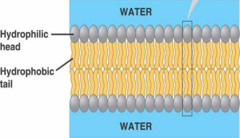
3398857558PhospholipidsSpecial lipids that make up the cell membrane. They have a hydrophilic (water loving) head made of a phosphate group. They have a hydrophobic (water fearing) tail made of fatty acids.13
3398857559Lipid BilayerTwo layers of phospholipids that that form the call membrane are known as the:14
3398857560Rough Endoplasmic ReticulumWhere components of the cell membrane are assembled along with proteins and other cells materials that will leave the cell. Often times referred to as the intracellular highway Rough has ribosomes Rough- makes proteins15
3398857561Smooth Endoplasmic ReticulumWhere components of the cell membrane are assembled along with proteins and other cells materials that will leave the cell. Often times referred to as the intracellular highway Smooth no ribosomes Smooth - involved in cell detox and making lipids and hormones16
3398857562Golgi ApparatusProcesses, modifies, packages and sorts proteins.17
3398857563LysosomeContains digestive enzymes breaks down carbohydrates, lipids and proteins also known as the suicide sacs. They remove other junk and material from the cell. Mostly found in animal cells but can be found in plants18
3398857564MitochondrionConvert chemical energy stored in food into useable energy (ATP) Often times referred to as the powerhouse of the cell.19
3398857565CentriolesStructures made out of microtubules Help with cell division only found in animals cells20
3398857566ChloroplastsUse the energy from the sun to convert it into chemical energy through the process of photosynthesis21
3398857567Central VacuoleStorage for water and other substances Plants have one large central vacuole22
3398857568Nuclear Membrane (Envelope)Controls what enters and leaves the nucleus through the pores23
3398857569NucleolusSmall dense region inside the nucleus Where ribosomes are made24
3398857570Endoplasmic ReticulumWhere components of the cell membrane are assembled along with proteins and other cells materials that will leave the cell. Often times referred to as the intracellular highway Can be smooth or rough.25
3398857571Vacuoles (Vesicles)Storage for water and other substances Animals they are called vesicles26
3398857572PiliExtensions on the outside of cell that enable it to stick to other cells27
3398857573Integral ProteinsA membrane protein that can pass through the membrane28
3398857574Peripheral ProteinsA membrane protein that sits on the surface of the membrane29
33988575751. Transport proteins-Allow substances to move in & out -Carrier proteins -Channel proteins -Membrane proteins 2. Receptor proteins-binding sites for hormones or other chemicals which cause changes in the cell 3. Recognition or marker proteins-identify cells as a certain type (muscle, organ), mark cells as self so that the immune system recognizes them and does not destroy them.The 3 jobs of a membrane protein are:30
3398857576Fluid Mosaic ModelThe cell membrane is described by the __________________. This says that the membrane is fluid and mosaic at the same time. Fluid-phospholipids are in constant motion Mosaic-A few proteins on a background of lipids31
3398857577GlycoproteinProtein with attached carbohydrate chain32
3398857578GlycolipidLipid with carbohydrate chain attached33
3398857579CholesterolThis helps to maintain membrane flexibility. It prevents the membrane from melting and freezing. It is only present in animals.34
33988575801. Boundary of the cell 2. Controls what enters and exits the cell 3. Receptors detect specific molecules found in the environment 4. Provides supportThese are the 4 functions of the cell membrane: 1. 2. 3. 4.35
3398857581-Nucleus in the center of the cell. -More irregular shape -Have small vacuoles called vesicles3 Characteristics of animal cells36
3398857582Centrioles are found only in ___________ cells(Organelles found only in) animal cells37
3398857583Cytoskeleton and cell membrane are found in:Organelle found in both plant and animal cells38
3398857584Cell Walls, Chloroplasts, Large Central Vacuoles found only in ____________ cells.Organelle found only in plant cells39
3398857585-Nucleus pushed off to the side -More geometric shape due to cell wall -Chloroplasts present3 Characteristics of plant cells40
33988575861. Always start with Low Power. Use the Coarse Knob to get the specimen in focus. If you skip this step, you won't be able to find it on the higher powers. 2. Once you've focused on Low Power, switch to Medium Power. Use the Coarse Knob to refocus. Again, if you haven't focused on this level, you will not be able to move to the next level. 3. Now switch to High Power. At this point, ONLY use the Fine Adjustment Knob to focus specimens.The proper procedure for looking at the slide under low power and up to high power in perfect focus is:41
33988575871. Gather a thin slice/peice of whatever your specimen is. 2. Place ONE drop of water directly over the specimen. 3. Place the coverslip at a 45 degree angle (approximately) with one edge touching the water drop and then gently let go. Make sure there are no air bubblesThe proper procedure for preparing a wet mount slide is:42
3398857588Cell to cell recognitionA cell's ability to distinguish one cell from another. Your immune system counts on cell to cell recognition to make sure that your body is not attacking cells that belong to you, but that it is attacking cells like viruses which don't belong in your body.43
3398857589How proteins and carbs are arranged on the cell membrane___________ can be either integral which means that they are between the phospholipids and go through the membrane, or peripheral, which means that they are on the outside of the membrane. ____________ chains are attached to either proteins or phospholipids and face the outside of the cell.44
3398857590SoluteIn a solution, the substance that dissolves in the solvent45
3398857591SolventIn a solution, the substance in which the solute dissolves.46
3398857592SolutionA mixture that forms when one substance dissolves another.47
3398857593Selectively permeableThe idea that membranes will let some molecules into and out of the cell, but not others is called:48
3398857594DiffusionMovement of molecules from an area of higher concentration to an area of lower concentration.49
3398857595OsmosisDiffusion of water through a selectively permeable membrane50
3398857596Facilitated DiffusionAnother type of passive transport, used for molecules that cannot readily diffuse through cell membranes without the help of proteins.51
3398857597Active TransportEnergy-requiring process that moves material across a cell membrane against a concentration difference (High-->Low). Movement of materials through a cell membrane using cellular energy. Needs cell to use it's own energy.52
3398857598Factors that decide whether active or passive transport take placeDepends on the molecule or object being moved53
3398857599Hypotonic solutionA solution with a lower concentration of solutes and a higher concentration of water than inside the cell. Result: Water moves from the solution to inside the cell. The cell swells and bursts open (cytolysis)54
3398857600Hypertonic solutionThe solution has a higher concentration of solutes and a lower concentration of water than the inside of the cell. (high solute; low water) Result: Water moves from inside the cell into the solution. Cell shrinks. (Plasmolysis).55
3398857601Isotonic solutionThe concentration of solutes in the solution is equal to the concentration of solutes inside the cell. Result: Water moves equally in both directions and the cell remains the same size. (Dynamic equilibrium)56
3398857602Concentration Gradient and the importance of one in cell transportA difference in the concentration of the same substance in different areas. In transport molecules are moving from areas of high concentration to low concentration OR from low concentration to high concentration. Without a concentration gradient transport could not occur and equilibrium would not be reached.57
3398857603PinocytosisCell drinking58
3398857604PhagocytosisCell eating59
3398857605EndocytosisTaking bulky material into a cell60
3398857606ExocytosisForces material out of the cell61
3398857616chromatinThe granular material visible within the nucleus; consists of DNA tightly coiled around proteins.62
3398857617chromosomeThe threadlike structure within the nucleus containing the genetic information that is passed from one generation of cells to the next.63
3398857632plastidAny pigment containing organelle within plant cells: chromo-, leuco-, and chloro-.64
3398857634concentrationThe mass of solute in a given volume of solution, or mass/volume.65
3398857648cell specializationseparate roles for each type of cell in multicellular organisms66
3398857656*cilia67
3398857657*ribosomes68
3398857658*mitochondria69
3398857659*Golgi apparatus70
3398857660*smooth ER71
3398857661*rough ER72
3398857662*nucleolus73
3398857663*microvilli74
3398857665*centrioles75
3398857667*lysosome76
3398857669*nuclear envelope77
3398857670*cell membrane78
3398857671*cytoplasm79
3398857672*cytoskeleton80
3398857673*cell wall81
3398857674*chloroplast82
3398857676*vacuole83
3398857677*plastid84

AP Spanish Literature Terms Flashcards

Terms : Hide Images
6752994635vanguardismorefers to people or works that are experimental or innovative, particularly in regard to art , the culture , the politics , philosophy and literature.0
6752994636surrealismoan artistic movement emerged in France from Dadaism , in the early 1920s , around the personality of the poet André Breton.1
6752994637postmodernismoPost-postmodernism is a term applied to a wide range of developments in critical theory , philosophy , architecture , art , the literature and culture emerging from and reacting to the postmodernism . Another recent similar term is metamodernism.2
6752994638neoclasicismoemerged in the eighteenth century to describe such negative movement aesthetic that came to be reflected in the arts , intellectual principles of the Enlightenment , since the mid- eighteenth century had been going on philosophy , and consequently had been transmitted to all areas of culture . However, coinciding with the decline of Napoleon Bonaparte , Neoclassicism was losing favor for the Romanticism .3
6752994639costumbrismothe literary or pictorial interpretation of local everyday life, mannerisms, and customs, primarily in the Hispanic scene, and particularly in the 19th century.4
6752994640culteranismoa stylistic movement of the Baroque period of Spanish history that is also commonly referred to as Gongorismo (after Luis de Góngora). It began in the late 16th century with the writing of Luis de Góngora and lasted through the 17th century.5
6752994641conceptismoa literary movement of the Baroque period of Portuguese and Spanish literature. It began in the late 16th century and lasted through the 17th century. Conceptismo is characterized by a rapid rhythm, directness, simple vocabulary, witty metaphors, and wordplay.6
6752994642retruécanoJuegos de palabras; inversión de los términos de una cláusula o proposición en otra subsiguiente para que esta última choque con la anterior.7
6752994643sinestesiaDescripción de una sensación o imagen por medio de sensaciones percibidas por distintos órganos sensoriales, por ejemplo, vista y olfato.8
6752994644sinécdoqueTipo de metáfora que usa una parte o cualidad de un objeto físico para representar todo el objeto.9
6752994645polisíndetonRepetición de conjunciones para alargar la frase o hacer más `solemne la expresión.10
6752994646paradojaContraposición de dos conceptos contradictorios que expresan una verdad.11
6752994647metonimiaUn tipo de metáfora en la que la imagen se asocia con lo representado, pero no es parte de ello; la metonimia hace que el destinatario del mensaje haga la asociación.12
6752994648epítetoPalabra o frase delante o después del nombre que sirve para caracterizar al personaje13
6752994649cacofoníaUso de palabras que combinan sonidos desagradables, ásperos y cortantes.14
6752994650asíndetonOmisión de conjunciones o palabras para suscitar viveza o energía.15
6752994651ironía dramáticaCircunstancia en la que el lector o espectador sabe algo desconocido por un personaje y sabe o sospecha lo que ocurrirá antes de que lo sepa el personaje.16
6752994652silvaPoema no estrófico que combina versos de siete y once sílabas, entrelazados por rima consonante y versos libres.17
6752994653narrador fidedignoNarrador digno de confianza, cuyo entendimiento de los personajes o las acciones del relato lo acredita para contar los hechos. Se ajusta a las normas que establece el autor implícito.18
6752994654leitmotivRepetición de una palabra, frase, situación o noción. Motivo recurrente en una obra.19
6752994655realismo mágicoMovimiento literario hispanoamericano surgido a mediados del siglo XX, caracterizado por la introducción de elementos fantásticos —sueños, superstición, mitos, magia— inmersos en una narrativa realista. Hay antecedentes importantes en los libros de caballería, como señalan algunos de los escritores de este movimiento.20
6752994656pícaroPersonaje de baja condición, astuto, ingenioso y de mal vivir que protagoniza la novela picaresca21
6752994657novela picarescaGénero literario narrativo en prosa de carácter pseudoautobiográfico muy característico de la literatura española. Nace como parodia de las novelas idealizadoras del Renacimiento y saca la sustancia moral, social y religiosa del contraste cotidiano entre dos estamentos, el de los nobles y el de los siervos. El protagonista, un pícaro de muy bajo rango social y descendiente de padres marginados o delincuentes, pretende mejorar su suerte y para ello recurre a la astucia y el engaño.22
6752994658naturalismoCorriente literaria de mediados del siglo XIX que retrata al ser humano y su circunstancia con una objetividad científica. El ser humano carece de libre albedrío; su existencia está determinada por la herencia genética y el medio en el que vive. En cuanto a temas, abundan los asuntos fuertes y las bajas pasiones.23
6752994659modernismoMovimiento literario hispanoamericano cuyo mayor exponente es Rubén Darío y que funde tres movimientos franceses: parnasianismo, simbolismo y romanticismo. Emplea una rica musicalidad verbal para expresar pasiones, visiones, ritmos y armonías internos.24
6752994660libro de caballeríasGénero literario en prosa muy popular en España a mediados del siglo XVI, que celebra las hazañas de los caballeros andantes y contrapone a la fiereza guerrera un masoquismo amoroso inspirado en el amor cortés.25
6752994661Generación del 98Grupo de novelistas, poetas, ensayistas y filósofos españoles, activos durante y después de la Guerra de Cuba (1898), que restauraron a España a una prominencia intelectual y literaria. Les era de gran importancia definir a España como una entidad cultural e histórica.26
6752994662Edad Media (medieval)Período comprendido entre los siglos V y XV. En España se considera que la se cierra con la llegada de Colón a tierras americanas.27
6752994663boomEn la literatura hispanoamericana, un momento de gran auge de la creación de obras narrativas que inicia en 1940. La producción es muy variada y muchos de sus autores crearon best sellers internacionales y traducidos a múltiples idiomas. Una de las tendencias de esta literatura se corresponde con la denominada literatura del realismo mágico.28
6752994664barrocoMovimiento cultural español (1580-1700) caracterizado por su complejidad y su extravagante ornamentación, cuyo propósito era asombrar e incitar introspección29
6752994665hipérbatonAlteración del orden normal sintáctico de las palabras en una oración.30
6752994666apóstrofeRecurso en que el hablante se dirige a personas presentes o ausentes, a seres animados o a objetos inanimados31
6752994667antítesisYuxtaposición de una palabra, frase o idea a otra de significación contraria32
6752994668anáforaRepetición de palabras en una sucesión de versos o enunciados.33
6752994669teatro del absurdoObra dramática basada en una situación sin sentido, en la que los personajes se enfrentan a situaciones que muestran la insensatez de la vida en un mundo deshumanizado.34
6752994670sonetoPoema de procedencia italiana que consiste en catorce versos endecasílabos repartidos en dos cuartetos y dos tercetos; el esquema más común es ABBA ABBA CDC DCD; otro es ABBA ABBA CDE CDE35

AP Literature Terms Flashcards

Terms : Hide Images
4208618108alliterationrepetition of two or more consonant sounds0
4208619074allusionreference to something assumed to be well known1
4208638252assonancerepetition of two or more vowel sounds2
4208640054cacophonyharsh sound; opposite of euphony3
4208647085colloquial englishcasual/informal, but correct language of ordinary native speakers4
4208649519connotationassociations and emotional overtones that have become attached to a word5
4208656528consonancewords share similar consonant sounds but different vowel sounds; slant rhyme6
4208664940couplettwo line stanza in poetry, usually rhymes and has equal length; usually at the end7
4208667118denotationliteral dictionary definition of a word8
4208668935dictionword choice or vocabulary9
4208670087didactic poetrypoetry that aims for education rather than art10
4208672470dramatic monologuepoem written as a speech/single speaker in a decisive moment11
4208675924end rhymerhyme that occurs at the end of a line12
4208676919epigraphbrief quote preceding a story or literary work13
4208678844euphonyharmonious effect, opposite cacophony14
4208680060exact rhymesounds following initial letters that are identical in sound15
4208682185expressionismdramatic style against realism; dreamlike subjective realm16
4208684393eye rhymespelling of two words looks the same, but they are pronounced differently (cough, though)17
4208690086feminine rhymerhyme of words containing more than one syllable where the rhyme lands on any syllable except the last18
4208693190formmeans by which a literary work conveys meaning19
4208695285formal englishheightened, impersonal language of educated speakers (see diction)20
4208697344general englishordinary language of educated native speakers (see diction)21
4208700013hyperboleexaggeration or overstatement22
4208701143iambunstressed, stressed (meter; type of foot)23
4208702552iambic pentameterfive iambic feet per line (meter)24
4208705030imagereference to a sensory experience in literature25
4208706261imagerycollective set of images in a literary work26
4208707622impressionismwhen a literary work centers on a character's mental life rather than surrounding reality; emphasizes external events rather than impression they leave27
4208711198internal refrainrefrain within a stanza28
4208712090internal rhymerhyme occurs within a line of poetry29
4208713223ironya discrepancy in meaning/ meaning is masked (dramatic, verbal, situational)30
4208716281levels of dictionFormal English (highest) General English Colloquial English Vulgate (lowest)31
4208720109lyricshort poem expressing thoughts, feelings of a single speaker32
4208721750masculine rhymerhyme of one syllable words OR rhyme of stressed final syllable33
4208724171metaphorcomparison by stating that one thing IS another34
4208725952metonymywhen the name of something is substituted in for something similar (i.e White House for President)35
4208729062narrative poempoem that tells a story36
4208730045onomatopoeiaword imitating a sound37
4208731247personificationnon-human object is given human characteristics38
4208732997poetic dictionelevated language/specialized vocabulary39
4208733981quatrainstanza consisting of four lines40
4208735121refrainlines repeated at intervals in a song or poem41
4208737540rhymetwo or more words that contain identical or similar vowel sound42
4208740611rhyme schemerecurrent pattern of rhyme43
4208742492similecomparison of two things using like, as, resembles44
4208743891sonnetpoem of fourteen lines, usually with ten syllables per line45
4208745419synechdochefigure of speech in which a part of something is made to represent the whole, or vice versa46
4208747812terminal refraingroup of repeated lines following a stanza47
4208749016themethe central topic a text writes to; what the work SAYS about the subject48
4208751633toneattitude of a writer towards a subject or audience49
4208753627understatementthe presentation of something as smaller or less important than it actually is50
4208756227vulgatelowest level of diction; common/casual51
4208784012slant rhymealmost rhyme; either assonance or consonance in place of true rhyme52
4208793700stream of consciousnessstyle of writing that portrays the inner workings of a character's mind53
4208796121surrealismallowing subconscious or dream-like imagery to lead the poem54
4208801494symbola person, place, or thing which has meaning for itself but also stands for something more than itself55

AP Language Vocabulary Flashcards

Terms : Hide Images
4814148024AdjunctA thing added to something else as a supplementary rather than an essential part; A word or phrase used to amplify or modify the meaning of another word or words in a sentence; Connected or added to something, typically in an auxiliary way; An associate or assistant of another; An adverb or adverbial phrase.0
4814151451BellwetherThe leading sheep of a flock, with a bell on its neck; An indicator or predictor of something.1
4814152995CaterwaulMake a shrill howling or wailing noise; A shrill howling or wailing noise; To protest or complain noisily.2
4814154669ChimericalExisting only as the product of unchecked imagination; Fantastically visionary or improbable; Given to fantastic schemes.3
4814154670EffeteAffected, overrefined, and ineffectual; No longer capable of effective action; Lacking strength, courage, or spirit; Resembling a woman; No longer fertile; Having lost character, vitality, or strength; Soft or delicate from or as if from a pampered existence.4
4814156034Fait accompliA thing that has already happened or been decided before those affected hear about it, leaving them with no option but to accept; Something that has been done and cannot be changed.5
4814157624HideboundUnwilling or unable to change because of tradition or convention; Not willing to accept new or different ideas; Having a dry skin lacking in pliancy and adhering closely to the underlying flesh.6
4814159474HierarchyA system or organization in which people or groups are ranked one above the other according to status or authority; The upper echelons of a hierarchical system; those in authority; An arrangement or classification of things according to relative importance or inclusiveness; A body of persons in authority; The classification of a group of people according to ability or to economic, social, or professional standing; A graded or ranked series; A division of angels; A ruling body of clergy organized into orders or ranks each subordinate to the one above it.7
4814160527Laissez-faireA policy or attitude of letting things take their own course, without interfering; Abstention by governments from interfering in the workings of the free market.8
4814161733LiturgyA form or formulary according to which public religious worship, especially Christian worship, is conducted; (in ancient Athens) A public office or duty performed voluntarily by a rich Athenian; A customary repertoire of ideas, phrases, or observances; A rite or body of rites prescribed for public worship.9
4814161734MorassAn area of muddy or boggy ground; A complicated or confused situation; An overwhelming or confusing mass or mixture.10
4814163008NoisomeHaving an extremely offensive smell; Disagreeable; Unpleasant; Highly obnoxious or objectionable.11
4814164072ObliviousForgetful; Without remembrance or memory; Not aware of or not concerned about what is happening around one.12
4814164073PoltroonA spiritless coward;13
4814165732ProselyteA new convert (as to a faith or cause).14
4814166904QuasiHaving some resemblance usually by possession of certain attributes; Having a legal status only by operation or construction of law and without reference to intent; Being partly or almost; Seemingly; Apparently, but not really.15
4814168298RailleryFriendly joking about or with somebody; Good-natured ridicule.16
4814169193RibaldReferring to sexual matters in an amusingly rude or irreverent way.; Vulgar or indecent in speech, language, etc.; coarsely mocking, abusive, or irreverent; scurrilous.17
4814169194Supine(of a person) Lying face upward; Failing to act or protest as a result of moral weakness or indolence; A Latin verbal noun used only in the accusative and ablative cases, especially to denote purpose; Willing to be controlled by others.18
4814171074VignetteA small illustration or portrait photograph that fades into its background without a definite border; A brief evocative description, account, or episode; Portray (someone) in the style of a vignette; A short written description; A short scene in a movie or play; A picture or engraving in a book; A running ornament (as of vine leaves, tendrils, and grapes) put on or just before a title page or at the beginning or end of a chapter; A small decorative design or picture so placed; The pictorial part of a postage stamp design as distinguished from the frame and lettering; A short descriptive literary sketch.19
4858870782AegisA shield or breastplate emblematic of majesty that was associated with Zeus and Athena; Protection; Controlling or conditioning influence; Auspices, sponsorship; Control or guidance especially by an individual, group, or system.20
4858873599AppriseTo give information to.21
4858873600BibulousHighly absorbent; Fond of alcoholic beverages; Of, relating to, or marked by the consumption of alcoholic beverages.22
4858875286ClaqueA group hired to applaud at a performance; A group of sycophants.23
4858875287DeracinateTo remove or separate from a native environment or culture; especially : to remove the racial or ethnic characteristics or influences from.24
4858876805ExegesisAn explanation or critical interpretation of a text.25
4858876832IndigenousProduced, growing, living, or occurring naturally in a particular region or environment.26
4858878811LachrymoseGiven to tears or weeping; Tending to cause tears.27
4858878812LexiconA book containing an alphabetical arrangement of the words in a language and their definitions; The vocabulary of a language, an individual speaker or group of speakers, or a subject; The total stock of morphemes in a language.28
4858878813MeleeA confused struggle; especially : a hand-to-hand fight among several people29
4858880573MicrocosmA little world; especially : the human race or human nature seen as an epitome of the world or the universe; A community or other unity that is an epitome of a larger unity.30
4858880574MinusculeA lowercase letter; One of several ancient and medieval writing styles developed from cursive and having simplified and small forms; A letter in this style; Extremely tiny.31
4858882197ObfuscateTo make (something) more difficult to understand.32
4858882198PaternalismA system under which an authority undertakes to supply needs or regulate conduct of those under its control in matters affecting them as individuals as well as in their relations to authority and to each other; A policy or practice based on or characteristics of (word).33
4858883329PolarizeTo cause (people, opinions, etc.) to separate into opposing groups physics; To cause (something, such as light waves) to vibrate in a particular pattern physics; To cause (something) to have positive and negative charges; To give polarity to (something) to break up into opposing factions or groupings.34
4858883330PurviewThe body or enacting part of a statute; The limit, purpose, or scope of a statute; The range or limit of authority, competence, responsibility, concern, or intention; Range of vision, understanding, or cognizance.35
4858885156SanguineConsisting of or relating to blood; Bloodthirsty; Of the complexion : ruddy; Having blood as the predominating bodily humor; also : having the bodily conformation and temperament held characteristic of such predominance and marked by sturdiness, high color, and cheerfulness.36
4858885157SolecismAn ungrammatical combination of words in a sentence; also : a minor blunder in speech; Something deviating from the proper, normal, or accepted order; A breach of etiquette or decorum.37
4858885158VassalA person under the protection of a feudal lord to whom he has vowed homage and fealty : a feudal tenant; One in a subservient or subordinate position.38
4858887079VerisimilitudeThe quality of seeming real.39
4903037571AffinityA feeling of closeness and understanding that someone has for another person because of their similar qualities, ideas, or interests; A liking for or an attraction to something; A quality that makes people or things suited to each other; relationship by marriage; Sympathy marked by community of interest : kinship; An attraction to or liking for something; An attractive force between substances or particles that causes them to enter into and remain in chemical combination; A person especially of the opposite sex having a particular attraction for one; Likeness based on relationship or causal connection; A relation between biological groups involving resemblance in structural plan and indicating a common origin.40
4903037572BiliousHaving or causing a sick feeling in the stomach : feeling or causing nausea; Angry or bad-tempered; Very unpleasant to look at; Of or relating to bile; Marked by or suffering from liver dysfunction and especially excessive secretion of bile; Of or indicative of a peevish ill-natured disposition; Sickeningly unpleasant.41
4903045681CognateOf the same or similar nature; Generically alike; Related by blood; Related on the mother's side; Related by descent from the same ancestral language; Of a word or morpheme : Related by derivation, borrowing, or descent; Of a substantive : Related to a verb usually by derivation and serving as its object to reinforce the meaning.42
4903045682CorollaryA proposition inferred immediately from a proved proposition with little or no additional proof; Something that naturally follows; Something that incidentally or naturally accompanies or parallels.43
4903048570Cul-de-sacA street that is designed to connect to another street only at one end; A blind diverticulum or pouch; A street or passage closed at one end.44
4903050363Derring-doBrave acts; Behavior that requires courage.45
4903052058DivinationThe art or practice that seeks to foresee or foretell future events or discover hidden knowledge usually by the interpretation of omens or by the aid of supernatural powers; Unusual insight; Intuitive perception.46
4903053969ElixirA substance held capable of changing base metals into gold; A substance held capable of prolonging life indefinitely; Cure-all; A medicinal concoction; A sweetened liquid usually containing alcohol that is used in medication either for its medicinal ingredients or as a flavoring; The essential principle.47
4903053970FolderolFoolish language, behavior, or ideas; A useless ornament or accessory.48
4903057022GamutA range or series of related things; The whole series of recognized musical notes; An entire range or series.49
4903059383Hoi polloiOrdinary people : people who are not rich, famous, etc.50
4903061140IneffableToo great, powerful, beautiful, etc., to be described or expressed; Incapable of being expressed in words : indescribable; Unspeakable; Not to be uttered; Taboo.51
4903061221LucubrationLaborious or intensive study;The product of such study —usually used in plural.52
4903063896MnemonicAssisting or intended to assist memory; Of or relating to memory.53
4903066155ObloquyHarsh or critical statements about someone; The condition of someone who lost the respect of other people; A strongly condemnatory utterance; Abusive language; The condition of one that is discredited; Bad repute.54
4903066242ParameterA rule or limit that controls what something is or how something should be done; An arbitrary constant whose value characterizes a member of a system (as a family of curves); A quantity (as a mean or variance) that describes a statistical population; An independent variable used to express the coordinates of a variable point and functions of them; Any of a set of physical properties whose values determine the characteristics or behavior of something; Something represented by a parameter; A characteristic element; Characteristic, element, factor; Limit, boundary —usually used in plural.55
4903068538PunditA person who knows a lot about a particular subject and who expresses ideas and opinions about that subject publicly (such as by speaking on television and radio shows) ;A learned man; A person who gives opinions in an authoritative manner usually through the mass media.56
4903068619RisibleDeserving to be laughed at; Very silly or unreasonable; Capable of laughing; Disposed to laugh; Arousing or provoking laughter; Associated with, relating to, or used in laughter.57
4903071023SymptomaticShowing that a particular disease is present; Relating to or showing (word) of a disease; Showing the existence of a particular problem; Having the characteristics of a particular disease but arising from another cause; Concerned with, affecting, or having (word); Characteristic, indicative.58
4903075375Volte-faceA complete change of attitude or opinion; A reversal in policy.59
4903079597AncillaryProviding something additional to a main part or function; Subordinate, subsidiary; Auxiliary, supplementary.60
4903082444BowdlerizeTo change (a book, play, movie, etc.) by removing parts that could offend people; To expurgate (as a book) by omitting or modifying parts considered vulgar; To modify by abridging, simplifying, or distorting in style or content.61
4903085228CondescendTo show that you believe you are more intelligent or better than other people; To do something that you usually do not do because you believe you are too important to do it; To descend to a less formal or dignified level; Unbend; To waive the privileges of rank; To assume an air of superiority.62
4903087176CozenTo deceive, win over, or induce to do something by artful coaxing and wheedling or shrewd trickery; To gain by (word) someone.63
4903087177EnclaveAn area with people who are different in some way from the people in the areas around it; A distinct territorial, cultural, or social unit enclosed within or as if within foreign territory.64
4903090118ForteThe part of a sword or foil blade that is between the middle and the hilt and that is the strongest part of the blade; One's strong point.65
4903095067GratisUsed to indicate that no money is paid for something; Without charge or recompense.66
4903096850IconA small picture on a computer screen that represents a program or function; A person who is very successful and admired; A widely known symbol; A usually pictorial representation; A conventional religious image typically painted on a small wooden panel and used in the devotions of Eastern Christians; An object of uncritical devotion; Emblem; A sign (as a word or graphic symbol) whose form suggests its meaning: A graphic symbol on a computer display screen that represents an object (as a file) or function (as the command to delete).67
4903096851IntersticeA small space that lies between things; A small break or gap in something; A space that intervenes between things; especially; One between closely spaced things; A gap or break in something generally continuous; A short space of time between events.68
4903099753MacrocosmA large system (such as the entire universe) that contains many smaller systems; The great world : universe; A complex that is a large-scale reproduction of one of its constituents.69
4903103197MountebankA dishonest person; A person who tricks and cheats other people; A person who sells quack medicines from a platform; A boastful unscrupulous pretender.70
4903104731PaeanA song of joy, praise, or victory; A joyous song or hymn of praise, tribute, thanksgiving, or triumph; A work that praises or honors its subject; Encomium, tribute.71
4903104732PersiflageFrivolous bantering talk; Light raillery72
4903108047PlethoraA very large amount or number; An amount that is much greater than what is necessary; A bodily condition characterized by an excess of blood and marked by turgescence and a florid complexion.73
4903108048PragmaticDealing with the problems that exist in a specific situation in a reasonable and logical way instead of depending on ideas and theories; Relating to matters of fact or practical affairs often to the exclusion of intellectual or artistic matters; Practical as opposed to idealistic; Relating to or being in accordance with philosophical (word).74
4903109862QuizzicalShowing that you do not understand something or that you find something strange or amusing; Comically quaint; Mildly teasing or mocking; Expressive of puzzlement, curiosity, or disbelief.75
4903125140Rapacityalways wanting more money, possessions, etc; Wanting more than is needed or deserved; Excessively grasping or covetous; Living on prey; Ravenous.76
4903128595SchismA division among the members of a group that occurs because they disagree on something; Formal division in or separation from a church or religious body; The offense of promoting (word).77
4903131156TherapeuticProducing good effects on your body or mind; Of or relating to the treatment of illness; Of or relating to the treatment of disease or disorders by remedial agents or methods; Providing or assisting in a cure; Curative, medicinal.78
4903132713VirtuosoA person who does something in a very skillful way; especially; A very skillful musician; An experimenter or investigator especially in the arts and sciences; Savant; One skilled in or having a taste for the fine arts; One who excels in the technique of an art; especially; A highly skilled musical performer (as on the violin); A person who has great skill at some endeavor.79

ap language Flashcards

Terms : Hide Images
6492683267ambivalenthaving mixed feelings or contradictory ideas about something0
6492698175analyticalrelating to or analysis or logical reasoning1
6492706355benevolentwell meaning and kindly2
6492711757callousshowing or having an insensitive and cruel disregard for others3
6492724316conciliatoryintended or likely to placate or pacify4
6492737425contemplativeexpressing or involving prolonged thought5
6492750933didacticintended to teach, particularly in having moral instruction as an ulterior moral6
6492785210disdainfulshowing contempt or lack of respect7
6492986360disparagingexpressing the opinion that someone is of little worth8
6492994223ecstaticfeeling or expressing overwhelming happines or joyful9
6493000770elatedmake(someone) ecstatically happy10
6493004857facetioustreating serious issues with deliberately inappropriate humor, flippant11
6493039803frivolousnot having any serious purpose or valve12
6493045520incisive(of a person or mental process) intelligently analytical and clear-thinking13
6493057579nostalgiccharacterized by or exhibiting the feeling of nostalgia14
6493067278poignantevoking a keen sense of sadness or regret15
6493073606wryusing or expressing dry, especially mocking, humor16
6493077906waryfeeling or showing caution about possible dangers or problems17

Pages

Subscribe to CourseNotes RSS

Need Help?

We hope your visit has been a productive one. If you're having any problems, or would like to give some feedback, we'd love to hear from you.

For general help, questions, and suggestions, try our dedicated support forums.

If you need to contact the Course-Notes.Org web experience team, please use our contact form.

Need Notes?

While we strive to provide the most comprehensive notes for as many high school textbooks as possible, there are certainly going to be some that we miss. Drop us a note and let us know which textbooks you need. Be sure to include which edition of the textbook you are using! If we see enough demand, we'll do whatever we can to get those notes up on the site for you!