AP Notes, Outlines, Study Guides, Vocabulary, Practice Exams and more!

AP Bio Chapter 8 - Intro to Metabolism Flashcards

AP Bio Chapter 8 - Intro to Metabolism

Terms : Hide Images
1722673895metabolismthe totality of an organism's chemical reactions0
1722673913catabolic pathwaya metabolic process that breaks down complex molecules into simpler compounds1
1722673914anabolic pathwaya metabolic process that consumes energy to build complicated molecules from simpler ones2
1722673896energythe capacity to cause change3
1722673897kinetic energythe relative motion of an object4
1722673898heat energykinetic energy associated with random movement of atoms or molecules5
1722673899potential energythe energy that matter possesses because of its location or structure when it is at rest; due to arrangement of atoms6
1722673915chemical energythe type of energy that refers to the potential energy available for release in a chemical reaction7
1722673900first law of thermodynamicsa rule that states that the energy of the universe is constant; energy can be transferred and transformed, but it cannot be created or destroyed8
1722673901second law of thermodynamicsa rule that states that every energy transfer or transformation increases the entropy (disorder) of the universe; unstoppable trend toward randomization of the universe as a whole9
1722673902free energythe portion of a system's energy that can perform work when temperature and pressure are uniform throughout the system, as in a living cell; this type of energy is a measure of a system's instability, meaning its tendency to change to a more stable state10
1722673903entropydisorder of the universe11
1722673916exergonicthe type of reaction that proceeds with a net release of free energy; because the chemical mixture loses free energy, Gibbs free energy is negative; it is a spontaneous reaction12
1722673917endergonicthe type of reaction that absorbs free energy from surroundings; because energy is stored in molecules, Gibbs free energy is positive; the reaction is nonspontaneous13
1722673918chemical workthe type of cellular work that includes the pushing of endergonic reactions, which would not occur spontaneously, such as the synthesis of proteins from amino acids14
1722673919transport workthe type of cellular work that includes the pumping of substances across membranes against the direction of spontaneous movement15
1722673920mechanical workthe type of cellular work that includes the beating of cilia, the contraction of muscle cells, and the movement of chromosomes during reproduction16
1722673921energy couplingthe use of an exergonic process to drive an endergonic one; ATP is responsible for mediating this, and it acts as an energy source17
1722673922ATPthis energy molecule for the cell is composed of ribose, adenine, and a chain of three phosphate groups18
1722673923phosphorylatedthe state of a molecule when it receives a phosphate, such as in synthesis of ATP from ADP + inorganic phospate, making it more reactive (less stable) than the original molecule19
1722673924enzymea macromolecule that acts as a catalyst; without this, pathways of metabolism would be congested because reactions would take so long20
1722673904catalysta chemical agent that speeds up a reaction without being consumed by the reaction; enzymes are examples of these21
1722673925activation energythe initial investment of energy for starting a reaction; the energy required to destabilize the reactant molecules so their bonds can break; also, the amount of energy needed to push reactants over a "hill" so that the "downhill" part of the reaction can begin22
1722673926substratethe reactant an enzyme acts on23
1722673905enzyme-substrate complexthe entity that forms when an enzyme bonds to a substrate, in which the enzyme's catalytic reaction converts the substrate to the product of the reaction24
1722673927active sitea pocket or groove on the surface of an enzyme where where the substrate docks up and catalysis occurs25
1722673906ATP --> ADP + P(i)the equation for the hydrolysis of ATP26
1722673907-7.3 kcal/molthe amount of Gibbs free energy that results from the hydrolysis of ATP27
1722673908ADP + P(i) --> ATP + H2Othe equation for the synthesis of ATP28
1722673928cofactorsnonprotein helpers for catalytic reactions; these may be bound tightly to an enzyme as a permanent resident, or may be bound loosely and reversibly along the substrate29
1722673909coenzymecofactors that are organic; examples of these are vitamins30
1722673929competitive inhibitionthis occurs when a molecule that resembles substrate bonds to the active site, thereby blocking the substrate; this occurs with weak bonds; the higher the concentration of the inhibitor, the slower the reaction; not used intentionally31
1722673930noncompetitive inhibitorsthese molecules do not directly compete with substrates--instead, they bind to another part of the enzyme, causing it to change its shape so that the active site becomes less effective32
1722673931allosteric regulationthis occurs when a molecule bonds to some other location on an enzyme, causing a conformational change, which blocks the active site; after the molecule leaves, however, the enzyme returns to its original shape; may result in either inhibition or enhanced activity of an enzyme33
1722673910-Gthe change in G for an exergonic reaction (energy yeilding)34
1722673911+Gthe change in G for an endergonic reaction (energy consuming)35
1722673932feedback inhibitionan occurrence in which a metabolic pathway is switched off by the inhibitory binding of its end product to an enzyme that acts early in the pathway; this prevents the cell from wasting chemical resources; when an end product stops or slows its own production36
1722673912lock-and-keythe model for enzymes that says that enzymes are highly specific, and as a result, there is only one substrate that fits in an enzyme's active site37

Earthquakes Flashcards

Lecture 12: Earthquakes
Three types of earthquakes
Earthquake hazards, especially tsunamis and liquefaction
P-waves and s-waves
Triangulating earthquake positions
"Beachball" diagrams
How and what earthquake waves tell us about the interior of the Earth

Terms : Hide Images
1329831811*Three types of earthquakesA.Product of reverse fault-> A small thrust fault (see arrows) east of Vail, CO. B. A strike-slip fault offset the road after the Landers earthquake in California. C. A normal fault near Challis, Idaho, moved in the 1983 earthquake.1
1329831812Earthquake hazards, especially tsunamis and liquefactionliquefaction= wet soil think of mud slides2
1329831813P-waves and s-wavesP-waves • P-waves are primary waves or pressure waves • Move faster than S-waves • Pass through solids, liquids, and gases. S-waves • Secondary waves, or shear waves • move more slowly than p-waves • Can only pass through solids—that's how we know that the center of the earth is liquid. cooler desner matieral transmit s waves better3
1329831814Triangulating earthquake positionsIf three separate seismometers calculate the distance to an earthquake's epicenter, we can figure out where the epicenter was by triangulation.4
1329831815"Beachball" diagrams "Beachball" diagramsLearn 2 things: EXPAND= AWAY FORM SIZE COMPRESS=TOWARDS (1) The slip motion of the rocks underground (2) the orientation of the fault that the slip occurred on -The beachballs show where compression and expansion occurred, and let us know what kind of earthquake it was.5
1329831816How and what earthquake waves tell us about the interior of the Earth?Sizemameters on opp. ends of earth can only transmit P-waves b/c they can go through Solid, liquid, gases. That's how we know the earth s waves like cold and dense6

Chapter 6: Whiskeys Rebellion Flashcards

Terms : Hide Images
1061916478Thomas JeffersonThe person that Washington chose to lead the state department.0
1061916479Formation of the cabinetWashington's most important precedent1
1061916480Judiciary act of 1789Created a system of 13 federal district courts2
1061916481The reason why southern farmers were against Hamiltons plan for the economyThey did not want to be made to pay taxes to help the northern states3
1061916482XYZ AffairIncreased public sentiment and opposition against france4
1061916483The emergency of a 2 party political system was the effect of what causePolitely debates over the whiskey rebellion, Hamilton's debt plan, and the formation of a national bank5
1061916484The whiskey rebellionOccurred because of a tax that was imposed by the federal government6
1061916485Part of Alexander Hamilton's plan for fixing the nation's debtCreating a strong commercial and industrial economy7
1061916486The rebellion that demonstrated the new federal government's willingness to enforce federal lawWhiskey rebellion8
1061916487One effect of the alien and sedition actsTo silence the democratic republican party's opposition to the federalists9
1061916488The reason why the US signed a treaty with SpainTo guarantee free shopping rights on the Mississippi River10
1061916489The hope that the British had to lit American settlement in the northwest territoryProvide arms and ammunition to native Americans11
1061916490Accurate description of the French RevolutionRepublican uprising against the French monarch and aristocrats became very bloody12
1061916491Virginia and Kentucky resolutions declared whatThe alien and sedition acts unconstitutional and states had the power to nullify such laws13
1061916492Thomas PinckneySecured a treaty with Spain giving the US shipping rights on the Mississippi River14
1061916493The US signed a treaty with Spain to....To ensure a free flow of trade for American goods15
1061916494The reason why the democratic republicans were outraged by the alien and sedition acts during John Adam's presidencyThe belief that the laws violated freedom of speech16
1061916495PrecedentThe first time an action or statement occurs and it becomes a tradition to follow17
1061916496Hamilton proposed moving the nation's capital from New York City to a new site on the Potomac for what?To win southern support for his banking an debt proposals18

American Pageant Chapter 12 Vocab Flashcards

Key terms, people, and events from Chapter 12 of the 13th edition of the American Pageant.

Terms : Hide Images
1142792555NationalismPride in one's country; increases drastically after the War of 1812 and the Battle of New Orleans0
1142792556Monroe DoctrineMessage to European countries to stay out of Western Hemisphere1
1142792557American SystemProposed by Henry Clay, consisted of 3 parts to improve US economy2
1142792558Missouri CompromiseAdmitted Missouri as a slave state, Maine as free state; established the 36˚30' line3
1142792559Treaty of GhentEnded War of 1812, US didn't gain or lose any land4
1142792560Panic of 1819Economic depression caused by land speculation and bank foreclosures of homes5
1142792561Rush-Bagot AgreementAgreement between US and Britain to demilitarize the Great Lakes6
1142792562Land SpeculationPurchasing of land out west in the hopes of selling it at a higher price7
1142792563ArmisticeAgreement to stop fighting8
1142792564Wildcat BanksBanks in the west that were ordered to foreclose on farms and houses9
1142792565Era of Good FeelingsTerm given early 1800s that suggested that times were good because there were not major conflicts involving the United States.10
1142792566Tariff of 1816First tariff ever passed as a protective tariff11
1142792567Cumberland RoadConnected MD to Illinois, first major road constructed by federal government12
1142792568Land Act of 1820Allowed the purchase of 80 acres of land at $1.25 per acre13
1142792569Florida Purchase Act of 1819 (Adams-Onis Treaty)Spain ceded Florida to US in exchange for US giving up claims to Texas14
1142792570Gibbons v. OgdenS.C. case dealing with interstate trade; Congress has sole authority over interstate trade15
1142792571Fletcher v. PeckStates cannot "impair" contracts, S.C. can invalidate state laws16
1142792572McCulloch v. MarylandStates cannot tax federal buildings (bank), federal government is supreme17
1142792573Dartmouth College v. WoodwardIssue over NH trying to change charter of a college, states cannot impair contracts18
1142792574Oliver PerryBuilt a fleet of ships on Lake Erie and captured the British fleet. Boosted the morale of the US military.19
1142792575Andrew JacksonPowerful general during War of 1812, battled Native Americans, future president20
1142792576Henry ClaySpeaker of the House, created The American System which helped stimulate the economy21
1142792577John Quincy AdamsSecretary of State under Madison, future president22
1142792578Daniel WebsterAdvocate for Nationalism, member of the Senate and House of Representatives, fought against Sectionalism and nullification by the South.23

AP Chem (Zumdahl) Ch. 6 Flashcards

Ch. 6 Thermochemistry

Terms : Hide Images
1383345407energythe capacity to do work or to cause heat to flow1
1383345408law of conservation of energyenergy can be converted from one form to another but can be neither created nor destroyed2
1383345409potential energyenergy due to position or composition3
1383345410kinetic energy(1/2mv2) energy due to the motion of an object; dependent on the mass of the object and the square of its velocity4
1383345411heatenergy transferred between two objects due to a temperature difference between them5
1383345412workforce acting over a distance6
1383345413pathwaythe way in which energy transfer is divided between work and heat7
1383345414state function (property)a property that is independent of the pathway8
1383345415system (thermodynamic)that part of the universe on which attention is to be focused9
1383345416surroundingseverything in the universe surrounding a thermodynamic system10
1383345418exothermicrefers to a reaction where energy (as heat) flows out of the system11
1383345420endothermicrefers to a reaction where energy (as heat) flows into the system12
1383345422thermodynamicsthe study of energy and its interconversions13
1383345423first law of thermodynamicsthe energy of the universe is constant; same as the law of conservation of energy14
1383345424internal energya property of a system that can be changed by a flow of work, heat or both; delta E = q + w, where delta E is the change in the internal energy of the system, q is heat, and w is work15
1383345425enthalpya property of a system equal to E + PV, where E is the internal energy of the system, P is the pressure of the system, and V is the volume of the system; at constant pressure the change in enthalpy equals the energy flow as heat16
1383345426calorimeterdevice used experimentally to determine the heat associated with a chemical reaction17
1383345427calorimetrythe science of measuring heat flow18
1383345428heat capacitythe amount of energy required to raise the temperature of an object by one degree Celsius19
1383345429specific heat capacitythe energy required to raise the temperature of one gram of a substance by one degree Celsius20
1383345431molar heat capacitythe energy required to raise the temperature of one mole of a substance by one degree Celsius21
1383345432constant-pressure calorimetrythe measurement of heat using a simple calorimeter to determine the changes in enthalpy (heats of reaction) for reactions occurring in solution; the pressure (atmospheric pressure) remains constant during the process22
1383345433constant-volume calorimetrythe measurement of heat at a constant volume to find the change in internal energy of the system; requires the use of a "bomb" calorimeter23
1383345436Hess's lawin going from a particular set of reactants to a particular set of products, the enthalpy change is the same whether the reaction takes place in one step or in a series of steps; in summary, enthalpy is a state function24
1383345437standard enthalpy of formationthe enthalpy change that accompanies the formation of one mole of a compound at 25 degree Celsius from its elements, with all substances in their standard states at that temperature25
1383345438standard statea reference state for a specific substance defined according to set of conventional definitions26
1383345439fossil fuelscoal, petroleum, or natural gas; consists of carbon-based molecules derived from decomposition of once-living organisms27
1383345440petroleuma thick, dark liquid composed mostly of compounds called hydrocarbons that contain carbon and hydrogen28
1383345441natural gasusually associated with petroleum deposits, consists mostly of methane, but it also contains significant amounts of ethane, propane, and butane29
1383345442coalformed from the remains of plants that were buried and subjected to high pressure and heat over long periods of time30
1383345443greenhouse effecta warming effect exerted by the earth's atmosphere (particularly CO2 and H2O) due to thermal energy retained by absorption of infrared radiation31
1383345444syngassynthetic gas, a mixture of carbon monoxide and hydrogen, obtained by coal gasification32

American History to 1877 Flashcards

American History up to 1877. The roots of European exploration and settlement, the colonization and independence of America, the Revolution and its roots...

Terms : Hide Images
87031366Western HemisphereThe part of the world consisting of North, Central, and South America.0
87031367MesoamericaThe region of Central America where the Maya, the Aztecs and other ancient cultures existed.1
87031368MayasAncient Mesoamerican civilization that thrived from about A. D. 300 to A. D. 900.2
87031369AztecsMesoamerican civilization that thrived in the 14th and 15th Centuries A. D.3
87031370Adena-Hopewell cultureNortheastern culture that thrived from 800 B.C.-A.D. 600 in the Ohio Valley and surrounding areas of the current United States.4
87031371Mississippian cultureMississippian culture of the central Mississippi River Valley of the current United States, which thrived from A. D. 600 to A. D. 1500.5
87031372Anasazi cultureSouthwestern culture that began in the 5th B.C., elements of which continue today in Arizona, New Mexico. Colorado and surrounding areas.6
87031373RenaissancePeriod in European history from 12th C AD through the 16th C AD distinguished by its spirit of inquiry and return to secular learning.7
87031374longitudeNavigational measurement dependant on accurate timepieces, and left to guesswork when sailing across the open sea prior to the 18th C. A. D.8
87031375Christopher ColumbusSelf-taught Italian mariner who in the late 15th C A.D. sailed west across the Atlantic Ocean in search of the Indies.9
87031376Treaty of TordesillasTreaty between Spain and Portugal defining the Spanish claim on exploration and settlement west of the Cape Verde Islands.10
87031377Amerigo VespucciItalian explorer who first suggested that South America was a new continent.11
87031378maizeAlso called 'Indian Corn', maize was one of the staples of the New World.12
87031379Ferdinand MagellanPortuguese seaman, who in the employ of Spain set out to find passage through or around South America, and consequently led the first voyage around the globe.13
87031380Hernando CortesRuthless leader of the conquistadores, Spanish soldiers who invaded and eventually destroyed the Aztec culture.14
87031381encomiendaSystem used by the conquistadores, whereby favored officers became privileged landowners who controlled Indian villages or groups of villages.15
87031382Bartolomeo de Las CasasCatholic missionary and Bishop in Mexico who wrote A Brief Relation of the Destruction of the Indies (1552),16
87031383haciendaA great farm or ranch.17
87031384Spanish borderlandsArea of the southern United States formerly claimed by Spain.18
87031385Juan Ponce de LeonGovernor of Puerto Rico, and first known explorer of Florida.19
87031386St. AugustineA Spanish outpost in Florida, it became the first European town in the present-day United States.20
87031387presidioA fort where soldiers who were sent to protect Spanish missions were housed.21
87031388Juan de OnateFounder of the first Spanish settlement in New Mexico.22
87031389mestizoSons of Spanish Fathers and native mothers.23
87031390Pope (Indian leader)Pueblo leader who organized a rebellion, which resulted in driving the Spaniards out of New Mexico.24
87031391ReformationEuropean religious movement that challenged the Catholic Church and resulted in the beginnings of Protestant Christianity.25
87031392Martin LutherGerman monk who protested abuses in the Catholic church by posing his 'Ninety-five Theses.' Founder of the Lutheran church.26
87031393Ninety-five ThesesMartin Luther's criticisms of the Catholic church arguing against indulgences and for a direct relationship to God.27
87031394CalvinismReligious movement founded by John Calvin, based on the doctrine of predestination.28
87031395Defender of the FaithTitle given by the pope to England's Henry VIII prior to England's break from the Catholic church.29
87031396Church of EnglandThe Anglican church, which unites church and state under the monarchy.30
87031397Francis DrakeEnglish privateer who led British fleet against the Spanish Armada.31
87031398galleonHeavy ship used by the Spanish Armada.32
87031399Sir Walter RaleighSponsor of an ill-fated expedition of colonists, who in 1587 settled Roanoke Island on the Outer Banks of North Carolina, also known as the 'Lost Colony.'33
87036261Great BritainSet off from continental Europe by the English Channel, in the seventeenth century it included the distinct kingdoms of England, Wales, Ireland, and Scotland.34
87036262common lawDeveloped beginning in the twelfth century, English common law was established to check the arbitrary power of local nobles.35
87036263law of primogenitureCommon law that established the birthright of the oldest son to inherit the family estate.36
87036264joint stock companiesAncestors of the modern corporation, in which stockholders shared the risks and profits for single ventures or on a permanent basis. Some of the larger companies managed to get royal charters that entitled them to monopolies in certain areas and even governmental powers in their outposts.37
87036265enclosure movementPolicy of landlords to "enclose" farmland, evicting human tenants in favor of sheep, and thus displacing the peasant population.38
87036266divine rightTheory promoted by James I of England, by which monarchs answered only to God for their actions.39
87036267Oliver CromwellCommander of the army and Lord Protector of Great Britain from 1649 - 1658.40
87036268The RestorationIn 1660 the British monarchy was restored under Charles II.41
87036269Glorious RevolutionIn reaction to James II's attempts to Catholicize Great Britain, Parliament invited James II's daughter Mary and her husband William of Orange to assume the throne jointly and established its freedom from royal control.42
87036270Toleration Act of 1689The Toleration Act of 1689 extended a degree of freedom of worship to all Christians except Catholics and Unitarians, although dissenters from the established church still had few political rights.43
87036271JamestownIntended as the first permanent British colony, settled in 1606 on the banks of the James River in Virginia.44
87036272PowhatanWahunsonacock, called this by the English after the name of his tribe, was the powerful, charismatic chief of numerous Algonquian-speaking towns in eastern Virginia representing over 10,000 Indians.45
87036273John SmithA swashbuckling soldier of fortune with rare powers of leadership and self-promotion, he was appointed to the resident council to manage the Jamestown colony.46
87036274headright policyInaugurated by Sir Edwin Sandys, head of the Virginia Company, the 'headright' policy gave anyone who bought a share in the company and could get to Virginia fifty acres, and fifty more for any additional servants.47
87036275Sir William BerkeleyElitist Governor of Virginia, appointed by Charles I.48
87036276Bacon's RebellionRevolt of common laborers and small farmers against Virginia's wealthiest planters and political leaders.49
87036277proprietary colonyColony owned by an individual, rather than a joint-stock company.50
87036278separatistsAlso known as Pilgrims, these rigorously devout Puritans had severed all ties with the Church of England.51
87036279Mayflower CompactFormal agreement made by 41 Pilgrim leaders prior to landing at Plymouth to abide by laws of their own devising.52
87036280covenantAn agreement, such as that made by the Pilgrims in devising the Mayflower Compact.53
87036281William BradfordLeader of the Mayflower Pilgrims and Governor of the Plymouth colony.54
87036282PuritansLike the Pilgrims, the Puritans who colonized Massachusetts Bay were primarily Congregationalists who sought to form self-governing churches with membership limited to "visible saints"-those who could demonstrate receipt of the gift of God's grace.55
87036283John WinthropPuritan leader and Governor of the Massachusetts Bay Colony.56
87036284Roger WilliamsPuritan who established Providence, the first permanent settlement in Rhode Island. Espoused the idea of the separation of church and state.57
87036285Anne HutchinsonThe articulate, strong-willed, and intelligent wife of a prominent Boston merchant, who espoused her belief in direct divine revelation. She was hauled before the General Court and banished from the colony.58
87036286slash and burnTechnique used by New England Indians to transform densely wooded forests into fields or park-like hunting preserves.59
87036287Pequot WarIn a successful bid to dislodge the Pequot Indians from their lands, this war resulted in the slaughter of Pequot men, women, and children and the dissolution of the Pequot nation.60
87036288RestorationThe Restoration of Charles II to the English throne in 1660.61
87036289Maryland Toleration ActEndorsed by Lord Baltimore, and passed by the Maryland assembly in 1649, this act assured that Puritans would not be molested in their religion.62
87036290matrilineal descentSystem found in Southeastern Indian nations, in which authority and property descended through the maternal line.63
87036291New NetherlandDutch colony conquered by the English to become four new colonies New York, New Jersey, Pennsylvania, and Delaware.64
87036292indentured servantSystem for providing cheap labor in the colonies, indentured servants worked from five to seven years without wages in exchange for passage to the American colonies.65
87036293indentured servantSystem for providing cheap labor in the colonies, indentured servants worked from five to seven years without wages in exchange for passage to the American colonies66
87036294melting potIdea that the early American Frontier stripped away native identities and melded them into homogeneous Americans.67
87036295sex ratioRatio of women to men in the early American colonies, typically 2 or 3 men for every woman.68
87036296naval storesResin from Pine trees, which can be boiled to become tar.69
87036297"invisible" chargesExpenses related to trade between the southern colonies and England, including freight payments to shippers, commissions, storage charges, and interest payments to English merchants, insurance premiums, inspection and customs duties, and outlays to purchase indentured servants and slaves.70
87036298headright systemSystem by which investors could acquire 50 acres of land per new settler.http://quizlet.com/2852222/edit/71
87036299natural increaseAn increase in population due to more births and less mortality.72
87036300staple cropA crop which is well suited for an an area. ex. Virgina's was Tobacco73
87036301balance of tradeA balance of imports versus exports.74
87036302triangular tradeMeans by which exports to one country or colony provided the means for imports from another country or colony.75
87036303promissory notePromissory notes of individuals or colonial treasurers often passed as a crude sort of paper money.76
87036304townshipA town.77
87036305covenant theoryA voluntary union for the common worship of God and for the purposes of government.78
87036306Half-Way CovenantAllowed baptized children of church members to be admitted to a "halfway" membership in the church and secure baptism for their own children in turn, but allowed them neither a vote in the church, nor communion.79
87036307John Peter ZengerPublisher of the New York Weekly Journal. Zenger was imprisoned for ten months and brought to trial in 1735 for publishing criticisms of New York's governor in his newspaper.80
87036308the EnlightenmentRevolution in thought begun in the seventeenth century that emphasized reason and science over the authority of traditional religion.81
87036309heliocentric universeA sun-centered universe postulated by Polish astronomer Nicolaus Copernicus.82
87036310Isaac NewtonAuthor of Principia (Mathematical Principles of Natural Philosophy, 1687), which set forth his theory of gravitation.83
87036311John LockeEnglish philosopher who argued in his Essay on Human Understanding (1690), that humanity is largely the product of the environment, the mind being a blank tablet on which experience is written.84
87036312DeistFollowers of Sir Isaac Newton's idea of natural law, reducing God to the position of a remote Creator.85
87036313Benjamin FranklinBoston-born American who epitomized the Enlightenment. A printer by trade, he went on to become a publisher, inventor, and statesman.86
87036314Great AwakeningFervent religious revival movement in the 1720s through the 40s that was spread throughout the colonies by ministers like New England Congregationalist Jonathan Edwards and English revivalist George Whitefield.87
87036315Jonathan EdwardsNew England Congregationalist minister, who began a religious revival in his Northampton church.88
87036316George WhitefieldSpellbinding English evangelist who toured the American Colonies in 1739 preaching the notion of "new birth" - a sudden, emotional moment of conversion and salvation.89
87036317Privy CouncilA body of some thirty to forty advisers appointed by and responsible solely to the king. The Privy Council became the first agency of colonial supervision.90
87036318mercantilismLimitation and exploitation of colonial trade by an imperial power.91
87036319enumerated goodsCertain specified goods from the Colonies, including tobacco, cotton, sugar, and furs, which were to be shipped only to England or other English colonies.92
87036320Dominion of New EnglandConsolidation into a single colony of the New England colonies-and later New York and New Jersey-by royal governor Edmund Andros in 1686; dominion reverted to individual colonial governments three years later.93
87036321Sir Edmund AndrosRoyal governor of the Dominion of New England.94
87036322Jacob LeislerGerman immigrant who became governor of New York from 1688 to 1691 before being hanged for treason. He was later exonerated of all charges.95
87036323contract theory of governmentIdea that people were endowed with certain natural rights to life, liberty, and property, set forth by John Locke in his Second Treatise.96
87036324writs of assistanceOne of the colonies' main complaints against Britain, the writs allowed unlimited search warrants without cause to look for evidence of smuggling.97
87036325admiralty courtsCourts wherein the cases were decided by judges appointed by the governors, rather than by a colonial jury.98
87036326Board of TradeBritish overseer of all matters pertaining to colonial trade and laws.99
87036327salutary neglectSo-called system by which the Board of Trade became chiefly an agency of political patronage, and lax in its enforcement of trade relations.100
87036328prorogueTo adjourn or recess.101
87036329mestizoPeople of mixed Indian and European ancestry.102
87036330Samuel de ChamplainFrench explorer and governor of New France until his death in 1635.103
87036331AcadiansFrench settlers of the easternmost areas of Canada.104
87036332King William's WarFirst (1689-97) of four colonial wars between England and France.105
87036333asientoContract for supplying Spanish America with 4,800 slaves granted to the British by Spain.106
87036334Albany CongressGathering in Albany, New York of colonial representatives who met from June 19 to July 10, 1754 to develop a treaty with Native Americans and plan the defense of the colonies against France.107
87036335French and Indian WarKnown in Europe as the Seven Years' War, the last (1755-63) of four colonial wars fought between England and France for control of North America east of the Mississippi River.108
87036336annus mirabilisThe miraculous year 1759, during which Great Britain secured an empire "on which the sun never set."109
87036337writs of assistanceOne of the colonies' main complaints against Britain, the writs allowed unlimited search warrants without cause to look for evidence of smuggling.110
87036338James OtisLawyer and political leader who fought the writs of assistance and later became a member of the Massachusetts assembly and founding member of the Sons of Liberty.111
87036339Proclamation of 1763Royal directive issued after the French and Indian War prohibiting settlement, surveys, and land grants west of the Appalachian Mountains; although it was soon overridden by treaties, colonists continued to harbor resentment.112
87036340Sugar Act(Revenue Act of 1764) Parliament's tax on refined sugar and many other colonial products; the first tax designed solely to raise revenue for Britain.113
87036341Stamp Act(1765) Parliament required that revenue stamps be affixed to all colonial printed matter, documents, dice, and playing cards; the Stamp Act Congress met to formulate a response, and the act was repealed the following year.114
87036342Quartering Act(1765) Parliamentary act requiring colonies to house and provision British troops.115
87036343virtual representationDubious opinion espoused by Treasury minister George Grenville, that each member of the British Parliament represented not only the district that elected him, but also the interests of the entire country and empire, including the American colonies.116
87036344nonimportation agreementColonial boycott of the importation of British products.117
87036345external and internal taxesImpression encouraged by the Lord of the Treasury, the Marquis of Rockingham, that a distinction was being made between "external" taxes on trade as opposed to "internal" taxes within the colonies.118
87036346Townshend Acts(1767) Parliamentary measures (named for the Chancellor of the Exchequer) that punished the New York Assembly for failing to house British soldiers, taxed tea and other commodities, and established a Board of Customs Commissioners and colonial vice admiralty courts.119
87036347John DickinsonPhiladelphia lawyer who protested the Townshend Acts in his twelve Letters of a Pennsylvania Farmer, arguing that Parliament might regulate commerce and collect duties incidental to that purpose, but it had no right to levy taxes for revenue, whether they were internal or external.120
87036348Samuel AdamsMassachusetts assembly member, founding organizer of the Sons of Liberty, and distant cousin of John Adams.121
87036349Sons of LibertySecret organizations formed by Samuel Adams, John Hancock, and other radicals in response to the Stamp Act; they impeded British officials and planned such harassments as the Boston Tea Party.122
87036350Boston MassacreClash between British soldiers and a Boston mob, March 5, 1770, in which five colonists were killed.123
87036351Crispus AttucksOne of five colonists killed in the Boston Massacre, Attucks was a runaway slave who its is said led the protest against the Townshend Acts that resulted in the bloody conflict with British soldiers.124
87036352Green Mountain BoysGroup led by Ethan Allen, who fought for the land that became Vermont.125
87036353Paxton BoysVengeful Pennsylvania frontiersmen who in protest of a perceived lack of frontier protection massacred local Indian tribes.126
87036354RegulatorsGroups of backcountry Carolina settlers who protested colonial policies; North Carolina royal governor William Tryon retaliated at the Battle of Alamance on May 17, 1771.127
87036355GaspeeBritish schooner that accidentally ran aground near Providence, Rhode Island. A crowd from the town boarded the ship, removed the crew and burned the vessel. This led to the creation of the (answer) commission which bypassed the courts of Rhode Island.128
87036356Committees of CorrespondenceIn response to the Gaspee commission, committees sprung up around Massachusetts and eventually other colonies as well, mobilizing public opinion and keeping colonial resentments at a simmer.129
87036357Boston Tea PartyOn December 16, 1773, the Sons of Liberty, dressed as Indians, dumped hundreds of chests of tea into Boston harbor to protest the Tea Act of 1773, under which the British exported to the colonies millions of pounds of cheap-but still taxed-tea, thereby undercutting the price of smuggled tea and forcing payment of the tea duty.130
87036358George Robert Twelves HewesOne of the last survivors of the American Revolution. Was the subject of two biographies and much public commemoration.131
87036359Coercive ActsIntolerable Acts (1774) Four parliamentary measures in reaction to the Boston Tea Party that forced payment for the tea, disallowed colonial trials of British soldiers, forced their quartering in private homes, and set up a military government.132
87036360Continental CongressRepresentatives of a loose confederation of colonies met first in Philadelphia in 1774 to formulate actions against British policies; the Second Continental Congress (1775-89) conducted the war and adopted the Declaration of Independence and the Articles of Confederation.133
87036361Lexington and Concord, Battle ofThe first shots fired in the Revolutionary War, on April 19, 1775, near Boston; approximately 100 minutemen and 250 British soldiers were killed.134
87036362Bunker Hill, Battle ofFirst major battle of the Revolutionary War; it actually took place at nearby Breed's Hill, Massachusetts, on June 17, 1775.135
87036363Olive Branch PetitionWritten by John Dickinson, this petition professed continued loyalty to King George III and begged him to restrain further hostilities pending a reconciliation.136
87036364Thomas PaineAuthor of Common Sense (1776). Paine argued for independence, directly attacking allegiance to the monarchy, refocusing the hostility previously vented on Parliament.137
87036365Thomas JeffersonThird President of the United States and drafter of the Declaration of Independence.138
87036366Declaration of IndependenceDocument adopted on July 4, 1776, that made the official break with Britain; drafted by a committee of the Second Continental Congress including principal writer Thomas Jefferson.139
87036367General William HoweCommander-in-Chief of the British army in America at the beginning of the Revolutionary War.140
87036368George WashingtonCommander-in-Chief of the Continental army. First President of the United States.141
87036369The American CrisisPamphlet penned by Common Sense author Thomas Paine, containing the famous line "These are the times that try men's souls."142
87036370HessiansGerman soldiers, most from Hesse-cassel principality (hence the name), paid to fight for the British in the Revolutionary War.143
87036371WhigsAnother name for revolutionary Patriots.144
87036372ToriesTerm used by Patriots to refer to Loyalists, or colonists who supported the Crown after the Declaration of Independence.145
87036373redcoatsNickname for British soldiers, after their red uniform jackets.146
87036374militiaAdult males between the ages of fifteen and sixty were enrolled in their local militia units. They constituted a home guard, defending their own communities, and they also helped augment the Continental army.147
87036375Continental armyArmy authorized by the Continental Congress, 1775-84, to fight the British; commanded by General George Washington.148
87036376Battle of SaratogaMajor defeat of British general John Burgoyne and more than 5,000 British troops in northern New York, on October 17, 1777.149
87036377Henry ClintonCommander-in-Chief of the British army in American replacing General Howe after the Battle of Saratoga.150
87036378Baron von SteubenFrederick William Augustus Henry Ferdinand, a Prussian soldier of fortune who trained and inspired Washington's troops at Valley Forge.151
87036379George Rogers ClarkYoung American General who is credited with having won the West for the new nation.152
87036380Horatio GatesAmerican General whose troops defeated the British forces at Saratoga.153
87036381Lord CornwallisBritish General who surrendered his troops at Yorktown.154
87036382Benedict ArnoldAmerican General who was labeled a traitor when he assisted the British in a failed attempt to take the American fort at West Point.155
87036383John Paul JonesAmerican privateer who helped to disable the British fleet. Credited with the famous words, "I have not yet begun to fight."156
87036384Battle of YorktownLast battle of the Revolutionary War; General Lord Charles Cornwallis along with over 7,000 British troops surrendered at Yorktown, Virginia, on October 17, 1781.157
87036385Peace of ParisSigned on September 3, 1783, the treaty ending the Revolutionary War and recognizing American independence from Britain also established the border between Canada and the United States, fixed the western border at the Mississippi River, and ceded Florida to Spain.158
87036386John TrumbullAmerican artist and painter who painted four panels in the Capitol Rotunda in Washington: The Declaration of Independence, The Surrender of General Burgoyne, Surrender of Lord Cornwallis, and The Resignation of General Washington.159

Campbell Biology: Ninth Edition - Chapter 9: Cellular Respiration and Fermentation Flashcards

Vocabulary: aerobic respiration, anaerobic respiration, fermentation, oxidation, reduction, reducing agent, oxidizing agent, redox reaction, electron transport chain, NAD (nicotinamide adenine dinucleotide), glycolysis, Kreb cycle (citric acid cycle), oxidative phosphorylation, substrate-level phosphorylation, chemiosmosis, ATP synthase, cytochromes, proton-motive force, obligate aerobe, obligate anaerobe, facultative anaerobe, beta oxidation, biosynthesis
Objectives: After attending lectures and studying the chapter, the student should be able to:
1. Define cellular respiration.
a. State which organisms undergo cellular respiration.
b. Distinguish between the site of cellular respiration in prokaryotic cells and in eukaryotic cells.
c. Distinguish between the terms aerobic and anaerobic.
d. Write the general chemical equation for aerobic cellular respiration.
e. Write the general chemical equation for lactic acid fermentation and state which organisms can undergo this process.
f. Write the general chemical equation for alcohol fermentation and state which organisms can undergo this process.
2. Relating to cellular energy:
a. Explain the chemical energy relationship between glucose and ATP.
b. Explain the chemical energy role of ATP in driving cellular reactions.
c. Describe the structure of ATP, ADP, and AMP.
d.Explain why ATP is considered the "energy currency" of the cell and glucose is not.
e. State how many ATPs are produced from 1 glucose molecule during:
* aerobic cellular respiration in prokaryotic cells
* aerobic cellular respiration in eukaryotic cells
* fermentation
3. Describe the making of ATP through substrate-level phosphorylation.
4. Relating to oxidative phosphorylation (electron transport chain + chemiosmosis):
a. Define oxidation and reduction and describe the redox reactions of an electron transport chain.
b.

Terms : Hide Images
1822556920Explain concept 9.1: Catabolic pathways yield energy by oxidizing organic fuelsCatabolic pathways are a set of metabolic pathways that breaks down molecules into smaller units to release energy0
1822556921Compare and contrast aerobic and anaerobic respirationBoth processes include glycolysis, the citric acid cycle, and oxidated phosphorylation. In aerobic respiration the final electron acceptor is molecular oxygen O2; in anaerobic respiration the final electron Accceptor is a different substance.1
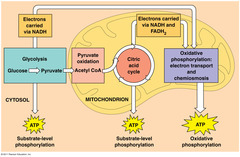
1822556922Describe the difference between the two processes in cellular respiration that produce ATP: oxidative phosphorylation and substrate-level phosphorylationMost of the ATP produced in cellular respiration come from oxidative phosphorylation, in which the energy released from redox reactions in an electron transport chain is used to produce ATP. In substrate level phosphorylation, an enzyme dirctly transfers a phosphate group to ADP fro an intermediate substrate. All ATP production in glycolysis occurs by substrate-level phosphorylation, this form of ATP production also occurs at one step in the citric acid cycle.2
1822557023Explain concept 9.2: Glycolysis harvests chemical energy by oxidizing glucose to pyruvate...3
1822556923During the redox reaction in glycolysis, which molecule acts as the oxidizing agent? Which molecule acts as the reducing agent?NAD+ acts as the oxidizing agent in step 6, accepting electrons from glyceraldehyde 3-phosphate, which thus acts as the reducing agent4
1822556924During the redox reaction in glycolysis, Which molecule acts as the reducing agent?glyceraldehyde 3-phosphate, which acts as the reducing agent5
1822557024What is the source of energy for the formation of ATP and NADH in glycolysis?The oxidation of the three carbon sugar glyceraldehyde 3-phosphate, yields energy. In this oxidation, electrons and H+ are transferred to NAD+, forming NADH, and a phosphate group is attached to the oxidized substrate. ATP is then formed b y substrate level phosphorylation when this phosphate group is transferred to ADP6
1822556925Explain concept 9.3: After pyruvate is oxidized, the citric acid cycle completes the energy yielding oxidation of organic molecules...7
1822557025Name the molecules that conserve most of the energy from the citric acid cycle's redox reactions. How is this energy converted to a form that can be used to make ATP?NADH and FADH2; they will donate electrons to the electron transport chain8
1822556926What processes in your cells produce the CO2 that you exhaleCO2 is released from the pyruvate that is the end product of glycoloysis, and CO2 is also released during the citric acid cycle9
1822556927What molecular products indicate the complete oxidation of glucose during cellular respiration?...10
1822556928Explain concept 9.4: During oxidative phosphorylation, chemiosmosis couples electron transport to ATP synthesis...11
1822557026What effect would an absence of O2 have on the process shown in figure 9.15?...12
1822557027Briefly explain the mechanism by which ATP synthase produces ATP. List three locations in which ATP synthases are found....13
1822557028Explain concept 9.5: Fermentation and anaerobic respiration enable cells to produce ATP without the use of oxygen...14
1822556929Consider the NADH formed during glycolysis. What is the final acceptor for its electrons during fermentation?...15
1822556930Consider the NADH formed during glycolysis. What is the final acceptor for its electrons during aerobic respiration?...16
1822556931Which process yields more ATP, fermentation, or anaerobic respiration?...17
1822556932Explain concept 9.6: Glycolysis and the citric acid cycle connect to many other metabolic pathways...18
1822556933Compare the structure of a fat with that of a carbohydrate, what features of their structure make fat a much better fuel?...19
1822556934Under what circumstances might your body synthesize fat molecules...20
1822556935Describe how catabolic pathways of glycolysis and the citric acid cycle intersect with anabolic pathways in the metabolism of a cell....21
1822556936As it pertains to cellular respiration, state which organisms undergo cellular respiration....22
1822556937As it pertains to cellular respiration, distinguish between the site of cellular respiration in prokaryotic cells and in eukaryotic cells.ATP synthases are found in the inner mitochondrial membranes of eukaryotic cells and in the plasma membranes of prokaryotes.23
1822556938As it pertains to cellular respiration, distinguish between the terms aerobic and anaerobic....24
1822556939As it pertains to cellular respiration, write the general chemical equation for aerobic cellular respiration....25
1822556940As it pertains to cellular respiration, write the general chemical equation for lactic acid fermentation and state which organisms can undergo this process....26
1822556941As it pertains to cellular respiration, write the general chemical equation for alcohol fermentation and state which organisms can undergo this process....27
1822556942Relating to cellular energy: explain the chemical energy relationship between glucose and ATP....28
1822556943Relating to cellular energy: explain the chemical energy role of ATP in driving cellular reactions....29
1822556944Relating to cellular energy: describe the structure of ATP, ADP, and AMP....30
1822556945Relating to cellular energy: explain why ATP is considered the "energy currency" of the cell and glucose is not....31
1822556946Relating to cellular energy: state how many ATPs are produced from 1 glucose molecule during aerobic cellular respiration in prokaryotic cells...32
1822556947Relating to cellular energy: state how many ATPs are produced from 1 glucose molecule during aerobic cellular respiration in eukaryotic cells...33
1822556948Relating to cellular energy: state how many ATPs are produced from 1 glucose molecule during fermentation...34
1822556949Describe the making of ATP through substrate-level phosphorylation....35
1822556950Describe how organic molecules other than glucose (specifically proteins, fats, and nucleic acids) can be a source of energy by being broken down and used during glycolysis, the transition reaction, or the Krebs cycle....36
1822557029Relating to oxidative phosphorylation (electron transport chain + chemiosmosis): define oxidation and reduction and describe the redox reactions of an electron transport chain....37
1822556951Relating to oxidative phosphorylation (electron transport chain + chemiosmosis): relate the redox reactions of an electron transport chain to the active transport of hydrogen ions (H+) across a membrane....38
1822556952Relating to oxidative phosphorylation (electron transport chain + chemiosmosis): relate the active transport of H+ ions across a membrane to the formation of an electrochemical gradient....39
1822557030Relating to oxidative phosphorylation (electron transport chain + chemiosmosis): relate the electrochemical gradient to the facilitated diffusion of H+ ions across a membrane....40
1822557031Relating to oxidative phosphorylation (electron transport chain + chemiosmosis): relate facilitated diffusion of H+ ions through the ATP synthase protein channel to the making of ATP....41
1822556953Relating to aerobic cellular respiration: describe the molecules ATP and NADH and distinguish between the different energy-storing roles of each....42
1822557032Relating to aerobic cellular respiration: describe the process of glycolysis, including the major molecules involved and the energy-storing molecules produced....43
1822556954Relating to aerobic cellular respiration: describe the process of the transition reaction, including the major molecules involved and the energy-storing molecules produced....44
1822557033Relating to aerobic cellular respiration: describe the process of the Krebs cycle, including the major molecules involved and the energy-storing molecules produced, and explain why the Krebs cycle is considered a cycle....45
1822557034Relating to aerobic cellular respiration: describe the roles of NADH, FADH2, and O2 in the electron transport chain part of oxidative phosphorylation...46
1822557035Relating to aerobic cellular respiration: show the relationship between the electron transport chain, active transport, and facilitated diffusion in the oxidative phosphorylation process of making ATP....47
1822556955Relating to aerobic cellular respiration: state the specific locations of glycolysis, the transition reaction, the Krebs cycle, and the oxidative-phosphorylation process in eukaryotic cells....48
1822556956Relating to aerobic cellular respiration: state the specific locations of glycolysis, the transition reaction, the Krebs cycle, and the oxidative-phosphorylation process in prokaryotic cells....49
1822557036Relating to aerobic cellular respiration: state the number of ATPs produced during glycolysis, the transition reaction, the Krebs cycle, and the oxidative-phosphorylation process....50
1822556957Relating to aerobic cellular respiration: explain why aerobic cellular respiration results in 36 ATPs per glucose in eukaryotic cells and 38 ATPs per glucose in prokaryotic cells....51
1822556958Relating to aerobic cellular respiration: relate glycolysis to lactic acid fermentation and alcohol fermentation....52
1822557037FermentationPartial degradation of sugars or other organic fuel that occurs without the use of oxygen53
1822557038Aerobic RespirationCatabolic pathway in which oxygen is consumed as a reactant along with the organic fuel54
1822557039Cellular RespirationIncludes both aerobic and anaerobic processes55
1822557040Redox ReactionsA chemical reaction involving the complete or partial transfer of one or more electrons from one reactant to another; short for reduction-oxidation reaction56
1822557041OxidationThe complete or partial loss of electrons from a substance involved in a redox reaction57
1822557042ReductionThe complete or partial addition of electrons to a substance involved in a redox reaction58
1822557043Reducing AgentThe electron donor in a redox reaction59
1822557044Oxidizing AgentThe electron receptor in a redox reaction60
1822557045NAD+Nicotinamide adenine dinucleotide, a coenzyme that cycles easily between oxidized (NAD+) and reduced (NADH) states, thus acting as an electron carrier.61
1822557046Electron Transport ChainA sequence of electron carrier molecules (membrane proteins) that shuttle electrons down a series of redox reactions that release energy used to make ATP62
1822557047GlycolysisA series of reactions that ultimately splits glucose into pyruvate. Occurs in almost all living cells, serving as the starting point for fermentation or cellular respiration63
1822556959The Citric Acid CycleA chemical cycle involving eight steps taht completes the metabolic breakdown of glucose molecules begun in glycolysis by oxidyzing acetyl CoA (derived from pyruvate) to carbon diozide; occcurs within the mitochondrion in eukaryotic cells and in the cytosol of prokaryotes; together with pyruvate oxidation, the second majoy stage in cellular respiration.64
1822557048Oxidative PhosphorylationThe production of ATP using energy derived from the redox reactions of an electron transport chain; the third major stage of cellular respiration65
1822557049Substrate-level phosphorylationThe enzyme catalyzed formation of ATP by direct transfer of a phosphate group to ADP from an intermediate substrate in catabolism66
1822557050Acetyl CoAAcetyl coenzyme A; the entry compound for the citric acid cycle in cellular respiration, formed from a fragment of pyruvate attached to a coenzyme.67
1822557051CytochromesAn iron-containing protein that is a component of electron transport chains in the mitochondria and chloroplasts of eukaryotic cells and the plasma membranes of prokaryotic cells68
1822557052ATP SynthaseA complex of several membrane proteins that functions in chemiosmosis with adjacent electron transport chains, using the energy of a hydrogen ion (proton) concentration gradient to make ATP. ATP synthases are found in the inner mitochondrial membranes of eukaryotic cells and in the plasma membranes of prokaryotes.69
1822557053ChemiosmosisAn energy coupling mechanism that uses energy stored in the form of a hydrogen ion gradient across a membrane to drive cellular work; such as the synthesis of ATP. Under aerobic conditions, most ATP synthesis in cells occurs by chemiosmosis.70
1822557054Protonmotive ForceThe potential energy stored in the form of a proton electrochemical gradient, generated by the pumping of hydrogen ions (H+) across a biological membrane during chemiosmosis.71
1822557055Alcohol FermentationGlycolysis followed by the reduction pyruvate to ethyl alcohol, regenerating NAD+ and releasing carbon dioxide72
1822557056Lactic Acid FermentationGlycolysis followed by the reduction of pyruvate to lactate, regenerating NAD+ with no release of of carbon dioxide.73
1822557057Obligate AnaerobesAn organism that only carries out fermentation or anaerobic respiration. cannot use oxygen and may be poisoned by it74
1822557058Facultative AnaerobesAn organism that makes ATP by aerobic respiration if oxygen is present but that switches to anaerobic respiration or fermentation if oxygen is not present75
1822557059Beta OxidationA metabolic sequence that breaks fatty acids down to two-carbon fragments that enter the citric acid cycle as acetyl CoA76
1822556960In the cytosolin cellular respiration, where does Glycolysis occur?77
1822557060What is pyruvate?- The end product of glycolysis -The first step in cellular respiration - Stands in the junction between anaerobic and aerobic pathways78
1822556961The Citric Acid Cycle also known as the Krebs cycle serves what purpose?...79
1822556962OIL RIGOxidation is Loss of Electrons (OIL) RIG (Reduction is a Gain of Electrons)80
1822556963Which process or processes return carbon to the atmosphere?Cellular Respiration81
1822556964What are the 4 major steps of cellular respiration?1.Glycolysis- (occurs in the cytosol) 2. Pyruvate Oxidation - Formation of Acetyl Co-enzyme A (occurs in the mitochondrion) 3. TCA/Kreb's Cycle/ Citric Acid Cycle 4. Oxidative phosphorylation - Electron Transport Chain and Chemiosmosis - (occurs in the inner membrane of the mitochondrion)82
1822556965In the Cellular Respiration Process, which coenzymes is an electron carrier?NADH and FADH283
1822556966How many ATP are produced by the citric acid cycle for each molecule of glucose?284
1822556967What is the correct sequence of steps as energy is extracted from glucose during cellular respiration.glycolysis → acetyl CoA → citric acid cycle → electron transport chain85
1822556968What is the correct general equation for cellular respiration?C6H12O6 + 6 O2 → 6 CO2 + 6 H2O + ATP energy86
1822556969What is the correct basic equation for cellular respiration?Glucose + 6 Oxygen leads to 6 Carbon Dioxide +6 Water + 1 ATP87
1822556970Which of the part of the cellular respiration process takes place in the cytosol of a eukaryotic cell?Glycolysis88
1822556971In what organelle would you find acetyl CoA formation, the citric acid cycle, and the electron transport chain?The Mitochondrion89
1822556972How would you describe glycolysis?This process splits glucose in half and produces 2 ATPs for each glucose.90
1822556973How would you describe the citric acid cycleThis process produces some ATP and carbon dioxide in the mitochondrion.91
1822556974How would you describe the electron transport chain?This process uses energy captured from electrons flowing to oxygen to produce most of the ATPs in cellular respiration92
1822556975Which part of a eukaryotic cell is involved in cellular respiration?Mitochondria93
1822556976Glucose and _______ are consumed during cellular respirationOxygen94
1822556977In a eukaryotic cell, most of the ATP derived from glucose during cellular respiration is produced by ...The Electron Transport Chain95
1822556978How much does a single glucose molecule produce in glycoloysis alone?a single glucose molecule in glycolysis produces a total of: 2 molecules of pyruvic acid, 2 molecules of ATP, 2 molecules of NADH and 2 molecules of water96
1822556979The immediate energy source that drives ATP synthesis by ATP synthase during oxidative phosphorylation is theH+ concentration across the membrane holding ATP synthase.97
1822556980Which metabolic pathway is common to both fermentation and cellular respiration of a glucose molecule?glycolysis98
1822556981In mitochondria, exergonic redox reactionsprovide the energy that establishes the proton gradient.99
1822556982The final electron acceptor of the electron transport chain that functions in aerobic oxidative phosphorylation isoxygen.100
1822556983What is the oxidizing agent in the following reaction? Pyruvate + NADH + H+ S Lactate + NAD+pyruvate101
1822556984When electrons flow along the electron transport chains of mitochondria, which of the following changes occurs? ATP synthase pumps protons by active transport. The pH of the matrix increases.The pH of the matrix increases.102
1822556985Most CO2 from catabolism is released duringthe citric acid cycle.103
1822556986A molecule becomes more oxidized when it _Loses an electron. During oxidation, an electron is removed.104
1822556987In the overall process of glycolysis and cellular respiration, _____ is oxidized and _____ is reduced.glucose ... oxygen In cellular respiration, electrons and hydrogen are removed from glucose and added to oxygen.105
1822556988Most of the ATP produced in cellular respiration comes from which of the following processes?...106
1822556989Which of the following is a correct description of the events of cellular respiration and the sequence of events in cellular respiration? (eText Concept 9.1) oxidation of glucose to pyruvate; reduction of pyruvate; TCA cycle; oxidative phosphorylation glycolysis; oxidative phosphorylation; TCA cycle; oxidation of pyruvate. oxidation of glucose to pyruvate; oxidation of pyruvate; oxidation of acetyl-coA; oxidative phosphorylation oxidation of pyruvate; TCA cycle; oxidation of glucose to pyruvate; oxidative phosphorylation glycolysis; reduction of pyruvate; TCA cycle; oxidative phosphorylation1. oxidation of glucose to pyruvate; 2. oxidation of pyruvate; 3. oxidation of acetyl-coA; 4. oxidative phosphorylation107
1822556990Oxygen gas (O2) is one of the strongest oxidizing agents known. The explanation for this is that _____. (eText Concept 9.1) oxygen gas contains a double bond oxygen acts as the final electron acceptor in cellular respiration the oxygen atom is very electronegative oxygen is so abundant in the atmosphere oxygen gas is composed of two atoms of oxygenThe oxygen atom is very electronegative. The high electronegativity of the oxygen atom is the reason that oxygen is such a good oxidizing agent (why it can oxidize so many compounds).108
1822556991The function of cellular respiration is to _____. (eText Concept 9.1) reduce CO2 produce carbohydrates extract CO2 from the atmosphere synthesize macromolecules from monomers extract usable energy from glucoseExtract usable energy from glucose. The most prevalent and efficient catabolic pathway is cellular respiration, in which oxygen is consumed as a reactant, along with the organic fuel (frequently glucose).109
1822556992During the reaction C6H12O6 + 6 O2 → 6 CO2 + 6 H2O, which compound is reduced as a result of the reaction? (eText Concept 9.1) carbon dioxide oxygen water glucose both glucose and carbon dioxideoxygen110
1822556993Each ATP molecule contains about 1% of the amount of chemical energy available from the complete oxidation of a single glucose molecule. Cellular respiration produces about 32 ATP from one glucose molecule. What happens to the rest of the energy in glucose? (eText Concept 9.1) It is converted to starch. It is converted to heat. It is released as carbon dioxide and water It is stored as fat. It is used to make water from hydrogen ions and oxygen.It is converted to heat.111
1822556994A small amount of ATP is made in glycolysis by which of the following processes? (eText Concept 9.1) transfer of electrons and hydrogen atoms to NAD+ transport of electrons through a series of carriers attachment of a free inorganic phosphate (Pi) group to ADP to make ATP transfer of a phosphate group from a fragment of glucose to ADP by substrate-level phosphorylation harnessing energy from the sunTransfer of a phosphate group from a fragment of glucose to ADP by substrate-level phosphorylation112
1822556995Where do the reactions of glycolysis occur in a eukaryotic cell? (eText Concept 9.1) the cytosol across the inner membrane of the mitochondrion the matrix of the mitochondrion in the intermembrane space of the mitochondrion the inner membrane of the mitochondrionGlycolysis occurs in the cytosol.113
1822556996Most of the NADH that delivers electrons to the electron transport chain comes from which of the following processes? (eText Concept 9.3) substrate-level phosphorylation the citric acid cycle glycolysis anabolic pathways oxidative phosphorylationThe citric acid cycle Both NADH and FADH2 are produced during the citric acid cycle.114
1822556997In preparing pyruvate to enter the citric acid cycle, which of the following steps occurs? (eText Concept 9.3) Pyruvate is oxidized and decarboxylated, and the removed electrons are used to reduce an NAD+ to an NADH. Pyruvate is reduced and decarboxylated, and the resulting electrons oxidize an NAD+ to an NADH Pyruvate is oxidized and decarboxylated, and the resulting electrons are donated to NADH to produce NAD+. Pyruvate is reduced to acetyl-coA, which involves the reduction of pyruvate, the addition of a carbon dioxide from the environment, and its reduction by NADH. Pyruvate is ionized directly to acetyl-coA.Pyruvate is oxidized and decarboxylated, and the removed electrons are used to reduce an NAD+ to an NADH.115
1822556998Why is the citric acid cycle called a cycle? (eText Concept 9.3)The four-carbon acid that accepts the acetyl CoA in the first step of the cycle is regenerated by the last step of the cycle.116
1822556999In the citric acid cycle, for each pyruvate that enters the cycle, one ATP, three NADH, and one FADH2 are produced. For each glucose molecule that enters glycolysis, how many ATP, NADH, and FADH2 are produced in the citric acid cycle? (eText Concept 9.3)two ATP, six NADH, two FADH2117
1822557000Where do the reactions of the citric acid cycle occur in eukaryotic cells?The matrix of the mitochondrion The citric acid cycle, which takes place in the mitochondrial matrix, completes the degradation of glucose.118
1822557001How many molecules of ATP are gained by substrate-level phosphorylation from the complete breakdown of a single molecule of glucose in the presence of oxygen? (eText Concept 9.3)Four There is a net gain of two ATP from glycolysis and one per each molecule of acetyl CoA oxidized in the citric acid cycle for a total of four per glucose.119
1822557002What is the major (but not the only) energy accomplishment of the citric acid cycle? (eText Concept 9.3)The formation of NADH and FADH2 Each turn of the citric acid cycle releases carbon dioxide, forms one ATP by oxidative phosphorylation, and passes electrons to three NAD+ and one FAD.120
1822557003After completion of the citric acid cycle, most of the usable energy from the original glucose molecule is in the form of _____.NADH The citric acid cycle produces three NADH per turn of the cycle.121
1822557004Which of the following accompanies the conversion of pyruvate to acetyl CoA before the citric acid cycle? (eText Concept 9.3) regeneration of NAD+ removal of coenzyme A release of CO2 and synthesis of NADH formation of CO2 and synthesis of ATP release of CO2 and release of coenzyme Arelease of CO2 and synthesis of NADH122
1822557005If significant amounts of materials are removed from the citric acid cycle to produce amino acids for protein synthesis, which of the following will result? (eText Concept 9.6) Less ATP will be produced by the cell. Less CO2 will be produced by the cell. The four-carbon compound that combines with acetyl CoA will have to be made by some other process. The first two answers are correct. The first three answers are correct.The first three answers are correct.123
1822557006A gram of fat oxidized by respiration produces approximately twice as much ATP as a gram of carbohydrate. Which of the following best explains this observation? (eText Concept 9.6) Fats are better electron donors to oxygen than are sugars. Fats do not form true macromolecules as sugars do. Fats are closely related to lipid molecules, the basic building blocks of cellular membranes. Fats are less soluble in water than sugars. Fats are produced when cells take in more food than they need.Fats are better electron donors to oxygen than are sugars. Correct. Fats contain more hydrogen and less oxygen than sugars—it is the transfer of electrons from good donors such as hydrogen atoms to good acceptors such as oxygen that provides the energy in respiration.124
1822557007When protein molecules are used as fuel for cellular respiration, _____ are produced as waste. (eText Concept 9.6) ethanol and CO2 molecules of lactate fatty acids amino groups sugar moleculesamino groups The amino group is a residual product of amino acid catabolism.125
1822557008Of the metabolic pathways listed below, which is the only pathway found in all organisms? (eText Concept 9.5) the electron transport chain cellular respiration fermentation the citric acid cycle glycolysisglycolysis Ancient prokaryotes probably used glycolysis to make ATP long before oxygen was present in Earth's atmosphere. Glycolysis is the most widespread metabolic pathway.126
1822557009If muscle cells in the human body consume O2 faster than it can be supplied, which of the following is likely to result? (eText Concept 9.5) The muscle cells will have more trouble making enough ATP to meet their energy requirements. The cells will not be able to carry out oxidative phosphorylation. The cells will consume glucose at an increased rate. Only the first two answers are correct. The first three answers are correct.The first three answers are correct. The muscle cells will have more trouble making enough ATP to meet their energy requirements. The cells will not be able to carry out oxidative phosphorylation. The cells will consume glucose at an increased rate.127
1822557010In brewing beer, maltose (a disaccharide of glucose) is _____.the substrate for alcoholic fermentation128
1822557011In glycolysis in the absence of oxygen, cells need a way to regenerate which compound? (eText Concept 9.5)NAD+129
1822557012Sports physiologists at an Olympic training center wanted to monitor athletes to determine at what point their muscles were functioning anaerobically. They could do this by checking for a buildup of which of the following compounds? (eText Concept 9.5)lactate. In humans, muscle cells switch to lactate fermentation after becoming anaerobic.130
1822557013Fermentation is essentially glycolysis plus an extra step in which pyruvate is reduced to form lactate or alcohol and carbon dioxide. This last step _____. (eText Concept 9.5)enables the cell to recycle the reduced NADH to oxidized NAD+131
1822557014During respiration in eukaryotic cells, the electron transport chain is located in or on the _____. (eText Concept 9.4)inner membrane of the mitochondrion132
1822557015Which of the following is the source of the energy that produces the chemiosmotic gradient in mitochondria? (eText Concept 9.4)Electrons moving down the electron transport chain133
1822557016Which of the following best describes the electron transport chain? (eText Concept 9.4) Acetyl CoA is fully oxidized to CO2. Glucose is broken down to a three-carbon compound in preparation for the citric acid cycle. Electrons are passed from one carrier to another, releasing a little energy at each step. Hydrogen atoms are added to CO2 to make an energy-rich compound. Electrons are pumped across a membrane by active transport.Electrons are passed from one carrier to another, releasing a little energy at each step.134
1822557017During aerobic respiration, molecular oxygen (O2) is used for which of the following purposes? (eText Concept 9.4) at the end of glycolysis to oxidize pyruvate at the end of the electron transport chain to accept electrons and form H2O between glycolysis and the citric acid cycle to split a carbon from pyruvate, producing CO2 as a source of O2 in every reaction that produces CO2 at the end of the citric acid cycle to regenerate citric acidat the end of the electron transport chain to accept electrons and form H2O135
1822557018Word Roots: aero-air (aerobic: chemical reaction using oxygen)136
1822557019Word Roots: an-not (anaerobic: chemical reaction not using oxygen)137
1822557020Word Roots: chemi-chemical (chemiosmosis: the production of ATP using the energy of hydrogen ion gradients across membranes to phosphorylate ADP)138
1822557021Word Roots: glyco-sweet;139
1822557022Word Roots: -lysissplit (glycolysis: the splitting of glucose into pyruvate)140

Campbell Biology - 10th Edition Ch 7: Membrane Structure & Function Flashcards

Terms : Hide Images
1746699206AmphipathicA molecule that has both a hydrophilic region and a hydrophobic region.0
1746699207Selective PermeabilityA property of biological membranes that allows some substances to cross more easily than others.1
1746699208Fluid Mosaic ModelMembrane is a fluid structure with a "mosaic" of various proteins embedded in or attached to a bilayer of phospholipids.2
1746699209Peripheral ProteinsProtein appendages loosely bound to the surface of the membrane and not embedded in the lipid bilayer.3
1746699210Integral ProteinsPenetrate the hydrophobic interior of the lipid bilayer4
1746699211Glycoproteins(Most secretory proteins) proteins that have carbohydrates covalently bonded to them. These carbohydrates are attached by specialized molecules in the ER membrane.5
1746699212GlycolipidsCarbohydrates covalently bonded to lipids Made in Golgi Apparatus6
1746699213Transport ProteinsHelp move hydrophilic substances to pass through bilayer.7
1746699214AquaporinsChannel proteins that facilitate the passage of water8
1746699215Carrier ProteinA type of transport proteins that hold on to passengers and change their shape to shuttle molecules across the membrane9
1746699216DiffusionMovement of solutes from an area of higher concentration to an area of lower concentration to reach equilibrium10
1746699217Concentration GradientAn increase or decrease in the density of a chemical substance in an area. Cells often maintain concentration gradients of ions across their membranes.11
1746699218Passive TransportMovement across the cell membrane that does not require energy from the cell12
1746699219OsmosisThe movement of water High to low concentration Really important to life13
1746699220TonicityDescribes the ability of a solution to cause a cell to gain or lose water14
1746699221Isotonic SolutionA solution with the same concentration of water and solutes as inside a cell, resulting in the cell retaining its normal shape because there is no net movement of water.15
1746699222Hypertonic SolutionA solution in which the concentration of solutes is greater than that of the cell that resides in the solution More water in solution; loose water; die/shrink16
1746699223Hypotonic SolutionA solution in which the concentration of solutes is less than that of the cell that resides in the solution Less water in solution' water will enter cell faster than it leaves; Swell/lyse (burst)17
1746699224OsmoregulationThe control of solute concentration & water balance18
1746699225TurgidHealthy state for most plant cells Cell is very firm19
1746699226FlaccidNo net tendency for water to enter (ex. if a plant's cell and their surroundings are isotonic Cell is limp20
1746699227Facilitated DiffusionA process in which substances are transported across a plasma membrane with the concentration gradient with the aid of carrier (transport) proteins; does not require the use of energy.21
1746699228Active TransportEnergy-requiring process that moves material across a cell membrane against its concentration gradient22
1746699229Sodium Potassium PumpExchanges Na+ for K+ across the plasma membrane of animal cells23
1746699230Membrane PotentialThe difference in electrical charge (voltage) across a cell's plasma membrane due to the differential distribution of ions.24
1746699231Electrochemical GradientThe diffusion gradient of an ion, which is affected by both the concentration difference of the ion across a membrane (a chemical force) and the ion's tendency to move relative to the membrane potential (an electrical force).25
1746699232Proton PumpActively transports protons (hydrogen ions H+) out of the cell Main electrogenic pump of plants, fungi, & bacteria26
1746699233CotransportThe coupling of the "downhill" diffusion of one substance to the "uphill" transport of another against its own concentration gradient.27
1746699234Bulk TransportMechanism for transporting molecules across the plasma membrane where the plasma membrane creates a transport vesicle that carries (then deposits) molecules or particles into (endocytosis) or out (exocytosis) of the cell28
1746699235EndocytosisCells engulf substances into pouch which becomes a vesicle.29
1746699236ExocytosisExpulsion or secretion of materials from a cell.30
1746699237PhagocytosisA cell engulfs a particle by packing it into a food vacuole "Cell-eating"31
1746699238PinocytosisCellular "drinking"; a type of endocytosis in which the cell takes fluid and dissolved solutes into small membranous vesicles32
1746699239Receptor-Mediated EndocytosisA specialized type of pinocytosis that enables the cell to aquire bulk quantities of specific substances, even if substances aren't concentrated in extracellular fluid33

Campbell Biology: Ninth Edition - Chapter 6: A Tour of the Cell Flashcards

Vocabulary: cell, light microscope, electron microscope, magnification, resolution, organelles, plasma membrane, cytosol (cytoplasm), nucleoid, endomembrane system, endoplasmic reticulum (rough and smooth), Golgi apparatus, lysosome, ribosome, mitochondria, cytoskeleton, nucleus, nucleolus, chromosome, chromatin, phagocytosis, vacuoles (food vacuole, contractile vacuole, central vacuole), chloroplast, peroxisome, plastid, thylakoid, granum, stroma, photosynthesis, glyoxysomes, centrioles, pseudopodia, cytoplasmic streaming, extracellular matrix (ECM), collagen, plasmodesmata, tight junctions, desmosomes, gap junctions
Objectives: After attending lectures and studying the chapter, the student should be able to:
1. State the cell theory.
2. State the types of light microscopes and electron microscopes used in the study of cells, and discuss the general advantages and disadvantages of each.
3. Relate cell size to surface-to-volume ratio and to cellular metabolic activity.
4. Describe the major differences between prokaryotic and eukaryotic cells.
5. Give examples of prokaryotic organisms (prokaryotes) and eukaryotic organisms (eukaryotes).
6. Recognize, label, and describe the structure and function of each of the following components of prokaryotic cells: cell wal nucleoid region, plasma membrane, flagellum (flagella)
cytoplasm pilus (pili)
ribosomes capsule
chromosome
7. Distinguish between the 2 components of the cytoplasm: cytosol and organelles.
8. Distinguish between the 2 conditions of the genetic material: chromatin and chromosome.
9. Describe the structural differences between prokaryotic and eukaryotic cells.
10. Give examples of and describe the major differences between animal and plant cells.

Terms : Hide Images
1560651085light microscope (LM)an optical instrument with lenses that refract (bend) visible light to magnify images of specimens1
1560651086organelleany of several membrane-enclosed structures with specialized functions, suspended in the cytosol of eukaryotic cells2
1560651087electron microscope (EM)a microscope that uses magnets to focus an electron beam on or through a spectrum, resulting in a practical resolution of a hundredfold greater than that of a light microscope using standard techniques. A transmission electron microscope (TEM) is used to study the internal structure of thin sections of cells. A scanning electron microscope (SEM) is used to study the fine details of the cell surface.3
1560651088scanning electron microscope (SEM)a microscope that uses an electron beam to scan the surface of the sample, coated with metal atoms, to study details of its topography.4
1560651089transmission electron microscope (TEM)a microscope that passes electron beam through very thin sections stained with metal atoms and is primarily used to study the internal ultrastructure of cells5
1560651090cell fractionationthe disruption of a cell and separation of its parts by centrifugation at successively higher speeds6
1560651091cytosolthe contents of the cell bounded by the plasma membrane; in eukaryotes, the portion exclusive of the nucleus7
1560651092eukaryotic cella type of cell with membrane-enclosed nucleus and membrane-enclosed organelles. Organisms with eukaryotic cells (protists, fungi, and animals) are called eukaryotes8
1560651093prokaryotic cellNo nucleus DNA is in an unbound region called the nucleoid No membrane-bound organelles Cytoplasm bound by the plasma membrane Pr9
1560651094nucleoida non-membrane-bounded region in a prokaryotic cell where the DNA is concentrated10
1560651095cytoplasmthe contents of the cell bounded by the plasma membrane; in eukaryotes, the portion exclusive of the nucleus11
1560651096plasma membranethe membrane at the boundary of every cell that acts as a selective barrier, regulating the cell's chemical composition12
1560651097nucleusan atom's central core, containing protons and neutrons; the organelle of a eukaryotic cell that contains the genetic material in the form of chromosomes, made up of chromatin; a cluster of neutrons13
1560651098nuclear envelopein a eukaryotic cell, the double membrane that surrounds the nucleus, perforated with pores that regulate traffic with the cytoplasm. The outer membrane is continuous with the endoplasmic reticulum14
1560651099nuclear laminaa netlike array of protein filaments that lines the inner surface of the nuclear envelope and helps maintain the shape of the nucleus15
1560651100chromosomea cellular structure carrying genetic material, found in the nucleus of eukaryotic cells. Each chromosome consists of one very long DNA molecule and associated proteins (a bacterial chromosome usually consists of a single circular DNA molecule and associated proteins. It is found in the nucleoid region, which is not membrane bounded.16
1560651101chromatinthe complex of DNA and proteins that makes up eukaryotic chromosomes. When the cell is not dividing, chromatin exists in its dispersed form, as a mass of very long, thin fibers that are not visible with a light microscope17
1560651102nucleolusa specialized structure in the nucleus, consisting of chromosomal regions containing ribosomal RNA (rRNA) genes along with ribosomal proteins imported from the cytoplasm; site of rRNA synthesis and ribosomal subunit assembly18
1560651103ribosomea complex of rRNA and protein molecules that function as a site of protein synthesis in the cytoplasm; consists of a large and small subunit. In eukaryotic cells, each subunit is assembled in the nucleolus19
1560651104endomembrane systemthe collection of membranes inside and surrounding a eukaryotic cell, related either through direct physical contact or by the transfer of membranous vesicles; includes the plasma membrane, the nuclear envelope, the smooth and rough endoplasmic reticulum, the Golgi apparatus, lysosomes, vesicles, and vacuoles20
1560651105vesiclea membranous sac in the cytoplasm of a eukaryotic cell21
1560651106endoplasmic reticulum (ER)an extensive membranous network in eukaryotic cells, continuous with the outer nuclear membrane and composed of ribosome-studded (rough) and ribosome-free (smooth) regions22
1560651107smooth ERthe portion of the ER that is free of ribosomes23
1560651108rough ERthe portion of the ER with ribosomes attached24
1560651109glycoproteina protein with one or more covalently attached carbohydrates25
1560651110transport vesiclea small membranous sac in a eukaryotic cell's cytoplasm carrying molecules produced by the cell26
1560651111Golgi apparatusan organelle in eukaryotic cells consisting of stacks of flat membranous sacs that modify, store, and route products of the ER and synthesize some products, notably noncellular carbohydrates27
1560651112lysosomea membrane-enclosed sac of hydrolytic enzymes found in the cytoplasm of animal cells and some protists. Contains a stockpile of digestive enzymes, important in breaking down nutrients, destroying bacteria, recycling, and development28
1560651113phagocytosisa type of endocytosis in which large particulate substances or small organisms are taken up by a cell. It's carried out by some protists and by certain immune cells of animals (in mammals, mainly macrophages, neutrophilis, and dendritic cells).29
1560651114vacuolea membrane-bounded vesicle whose specialized function varies in different kinds of cells30
1560651115food vacuolea membranous sac fromed by phagocytosis of microorganisms or particles to be used as food by the cell31
1560651116contractile vacuolea membranous sac formed that helps moves excess water out of certain freshwater protists32
1560651117central vacuolein a mature plant cell, a large membranous sac with diverse roles in growth, storage, and sequestration of toxic substances33
1560651118mitochondriaan organelle in eukaryotic cells that serves as the site of cellular respiration; uses oxygen to break down organic molecules and synthesize ATP34
1560651119chloroplastan organelle found in plants and photosynthetic protists that absorbs sunlight and uses it to drive the synthesis of organic compounds from carbon dioxide35
1560651120endosymbiont theorythe theory that mitochondria and plastids, including chloroplasts, originated as prokaryotic cells engulfed by an ancestral eukaryotic cell. The engulfed cell and its host cell then evolved into a single organism36
1560651121cristaean infolding of the inner membrane of a mitochondrion. The inner membrane houses electron transport chains and molecules of the enzyme catalyzing the synthesis of ATP (ATP synthase)37
1560651122mitochondrial matrixthe compartment of the mitochondrion enclosed by the inner membrane and containing enzymes and substrates for the citric acid cycle, as well as ribosomes and DNA38
1560651123thylakoida flattened, membranous sac inside a chloroplast. Often exist in stacks called grana that are interconnected; their membranes contain molecular "machinery" used to convert light energy to chemical energy39
1560651124granuma stack of membrane-bounded thylakoids in the chloroplast. Grana function in the light reactions of photosynthesis40
1560651125stromathe dense fluid within the chloroplast surrounding the thylakoid membrane and containing ribosomes and DNA; involved in the synthesis of organic molecules from carbon dioxide and water41
1560651126plastidone of a family of closely related organelles that includes chloroplasts, chromoplasts, and amlyoplasts. Found in cells of photosynthetic eukaryotes42
1560651127peroxisomean organelle containing enzymes that transfer hydrogen atoms from various substrates to oxygen (O2), producing and then degrading hydrogen peroxide (H2O2)43
1560651128cytoskeletona network of microtubules, microfilaments, and intermediate filaments that extend throughout the cytoplasm and serve a variety of mechanical, transport, and signaling function.44
1560651129motor proteina protein that interacts with cytoskeletal elements and other cell components, producing movement of the whole cell or parts of the cell45
1560651130microtubulesa hollow rod composed of tubulin proteins that makes up part of the cytoskeleton in all eukaryotic cells and is found in cilia and flagella46
1560651131centrosomea structure present in the cytoplasm of animal cells that functions as a microtubule-organizing center and is important during cell division; has 2 centrioles47
1560651132centriolea structure in the centrosome of an animal cell composed of a cylinder of microtubule triplets arranged in a 9+0 pattern48
1560651133flagellaa long cellular appendage apecialized for locomotion. Like motile cilia, eukaryotic flagella have a core with 9 outer doublet microtubules and 2 inner single mictrotubules (the "9+2" arrangement) ensheathed in an extension of the plasma membrane.49
1560651134ciliaa short appendage containing microtubules in eukaryotic cells. A motile cillium is specialized for locomotion or moving fluid past the cell; formed from a core of 9 outer doublet microtubules and 2 inner single microtubules (the "9+2" arrangement) ensheathed in an ectension of the plasma membrane. Primary cillium usually nonmotile and plays sensory and signaling role; lack 2 inner microtubules (the "9+0" structure)50
1560651135basal bodya eukaryotic cell structure consisting of a "9+0" arrangement of microtubule triplets. The basal body may organize the microtubule assembly of a cilium or flagellum and is structurally very similar to a centriole51
1560651136dyneinin cilia and flagella, a large motor protein extending from 1 microtubule doublet to the adjacent doublet. ATP hydrolysis drives changes in its shape that lead to bending of cilia and flagella52
1560651137microfilamenta cable composed of actin proteins in the cytoplasm of almost every eukaryotic cell, making up part of the cytoskelton and acting alone or with myosin to cause cell contraction; aka actin filament53
1560651138actina globular protein that links into chains, 2 of which twist helically about each other, forming microfilaments (actin filaments) in muscle and other kinds of cells54
1560651139cortexouter region of cytoplasm in a eukaryotic cell, lying just under the plasma membrane, that has a more gel-like consistency that the inner regions due to the presence of multiple microfilaments; in plants, ground tissue that is between the vascular tissue and the dermal tissue in a root or eudicot stem55
1560651140myosina type of motor protein that associates into filaments that interact with actin filaments to cause cell contraction56
1560651141pseudopodiaa cellular extension of amoeboid cells used in moving and feeding57
1560651142cytoplasmic streaminga circular flow of cytoplasm, involving interactions of myosin and actin filaments, that speeds the distribution of materials within cells58
1560651143intermediate filamenta component of the cytoskeleton that includes filaments intermediate in size between microtubules and microfilaments59
1560651144cell walla protective layer external to the plasma membrane in the cells of plants, prokaryotes, fungi and some protists. Polysaccharides such as cellulose (in plants and some protists), chitin (in fungi), and peptidoglycan (in bacteria) are important structural components of them60
1560651145primary cell wallthe level of protein structure referring to the specific linear sequence of amino acids61
1560651146middle lamellain plants, a thin layer of adhesive extracellular material, primarily pectins, found between the primary walls of adjacent young cells62
1560651147secondary cell wallregions of repetitive coiling of folding of the polypeptide backbone of a protein due to hydrogen bonding between constituents of the backbone (not the side chains)63
1560651148extracellular matrix (ECM)the meshwork surrounding animal cells, consisting of glycoproteins, polysaccharides and proteoglycans synthesized and secreted by the cells64
1560651149collagena glycoprotein in the extracellular matrix of animal cells that forms strong fibers, found extensively in connective tissue and bone; the most abundant protein in the animal kingdom65
1560651150proteoglycana large molecule consisting of a small core protein with many carbohydrate chains attached, found in the extracellular matrix of animal cells' may consist of up to 95% carbohydrate66
1560651151fibronectinin an angiosperm, the stalk portion of the stamen, the pollen-producing reproductive organ of a flower67
1560651152integrinin animal cells, a transmembrane receptor protein with 2 subunits that interconnects the extracellular matrix and the cytoskelteton68
1560651153plasmodesmataan open channel through the cell wall that connects the cytoplasm of adjacent plant cells, allowing water, small solutes, and some larger molecules to pass between the cells69
1560651154tight junctiona type of intercellular junction between animal cells that prevents the leakage of material through the space between cells70
1560651155desmosomesa type of intercellular junction in animal cells that functions as a rivet, fastening cells together71
1560651156gap junctiona type of intercellular connection in animal cells, consisting of proteins surrounding a pore that allows the passage of materials between cells72
1560651157cell...73
1560651158light microscope...74
1560651159Electron microscope...75
1560651160magnification...76
1560651161resolution...77
1560651162organelles...78
1560651163plasma membrane...79
1560651164cytosal (cytoplasm)...80
1560651165nucleoid...81
1560651166endomembrane system...82
1560651167endoplasmic reticulum rough...83
1560651168Golgi apparatus...84
1560651169Photosynthesis...85
1560651170glyoxysomes...86
1560651171As it pertains to Prokaryotic Cells, which structures, are surface appendages that allow a bacterium to stick to a surface?Fimbriae87
1560651172Concept 6.1: Biologists use microscopes and the tools of biochemistry to study cells...88
1560651173Concept 6.2: Eukaryotic cells have internal membranes that compartmentalize their functions...89
1560651174Concept 6.3: The eukaryotic cell's genetic instructions are housed in the nucleus and carried out by the ribosomes...90
1560651175Concept 6.4: The endomembrane system regulates protein traffic and performs metabolic functions in the cell.Cell membranes are in constant motion. Some of this motion is lateral diffusion, as membrane lipids and proteins move sideways in the bilayer. But certain regions also move by budding out from their surrounding membrane and pinching off into vesicles. These vesicles can move to other regions of the cell, find suitable receptors, and fuse with a different patch of membrane. The illustration shows different types of membranes and compartments indicated by labels. Although each type of structure has different properties and functions, they are interconnected by membrane traffic into an endomembrane system. One of the most common patterns of membrane traffic is the movement of newly synthesized proteins from rough ER to various destinations, for the following purposes: - secretion outside the cell - creating lysosomes - replacing proteins in the plasma membrane. ..91
1560651176Concept 6.5: Mitochondria and chloroplasts change energy from one form to another...92
1560651177Concept 6.6: The cytoskeleton is a network of fibers that organizes structures and activities in the cell...93
1560651178Concept 6.7: Extracellular components and connections between cells help coordinate cellular activities...94
1560651179nucleic acidA polymer (polynucleotide) consisting of many nucleotide monomers; serves as a blueprint for proteins and, through the actions of proteins, for all cellular activities. The two types are DNA and RNA.95
1560651180deoxyribonucleic acid (DNA)A double-stranded, helical nucleic acid molecule capable of replicating and determining the inherited structure of a cell�s proteins.96
1560651181Mitochondrionthe organelle that carries out cellular respiration, the process of converting the chemical energy of sugars and other molecules to chemical energy in the form of ATP.97
1560651182Smooth Endoplasmic Reticulumthe portion of the endomembrane system important in lipid synthesis, detoxification, and calcium storage98

Campbell Biology: Ninth Edition - Chapter 8: An Introduction to Metabolism Flashcards

General College Biology I, Chapter 8, Metabolism: Energy and Enzymes
Vocabulary: metabolism, metabolic pathway, catabolic pathway, anabolic pathway, chemical energy, potential energy, kinetic energy, heat, thermodynamics, entropy, endergonic, exergonic, activation energy, phosphorylation, enzyme, catalyst, substrate, active site, allosteric site, cofactor, coenzyme, competitive inhibitor, noncompetitive inhibitor, allosteric regulation, feedback inhibition
Objectives: After attending lectures and studying the chapter, the student should be able to:
1. Define metabolism.
2. Describe a metabolic (biochemical) pathway and distinguish between anabolic pathways
and catabolic pathways.
3. Explain the role of energy and enzymes in the chemical reactions in the cells of living
things.
4. Define energy.
5. List and describe 5 forms of energy.
6. State the 1st and 2nd Laws of Thermodynamics and relate each to living systems.
7. Distinguish between endergonic and exergonic chemical reactions.
8. Describe the activation energy of a chemical reaction.
9. Describe ATP and its role as a source of chemical energy in cells.
10. Write the general chemical reactions for making ATP and using ATP.
11. State the function of enzymes.
12. Define catalyst and state why an enzyme is a catalyst.
13. Define and describe active site and relate it to the function of enzymes.
14. Relate the shape of enzymes to their function.
15. Define denaturation of proteins and explain how less than optimum temperature and pH
conditions could affect the function of enzymes
16. State the two types of cofactors (and examples of each), and describe their role in the function of some enzymes.
17. Describe the allosteric site found in some enzymes and explain how allosteric effectors (activators or inhibitors) influence the function of some enzymes.
18. Distinguish between competitive and noncompetitive inhibitors.
19. Describe feedback inhibition related to a metabolic pathway

Terms : Hide Images
1794698097Concept 8.1: An organism's metabolism transforms matter and energy, subject to the laws of thermodynamics...0
1794698137MetabolismThe totality of an organism's chemical reactions, consisting of catabolic and anabolic pathways, which manage the material and energy resources of the organism1
1794698138Metabolic pathwayA series of chemical reactions that either builds a complex molecule (anabolic pathway) or breaks down a complex molecule to simpler molecules (catabolic pathway)2
1794698139Catabolic pathwayReleases Energy. A metabolic pathway that releases energy by breaking down complex molecules to simpler molecules3
1794698140Anabolic pathwayConsumes Energy. A metabolic pathway that consumes energy to synthesize a complex molecule from simpler molecules4
1794698141BioenergeticsBioenergetics is the study of how organisms manage their energy resources5
1794698142EnergyThe capacity to cause change, especially to do work (to move matter against an opposing force).6
1794698143Kinetic energyEnergy of motion7
1794698144Heat (thermal) energyKinetic energy associated with random movement of atoms or molecules8
1794698145Potential energyThe energy that matter possesses as a result of its location or spatial arrangement (structure)9
1794698146Chemical energyEnergy available in molecules for release in a chemical reaction; a form of potential energy10
1794698147ThermodynamicsThe study of energy transformations that occur in a collection of matter.11
1794698148First law of thermodynamicsThe principle of conservation of energy; energy can be transferred and transformed, but it cannot be created or destroyed12
1794698149Entropya measure of disorder, or randomness13
1794698150Second law of thermodynamicsEnergy transfer. The principle stating that every energy transfer or transformation increases the entropy of the universe. Usable forms of energy are at least partly converted to heat14
1794698151Spontaneous processWithout Energy. Spontaneous processes occur without energy input; they can happen quickly or slowly15
1794698152What is the second law of thermodynamics?The principle stating that every energy transfer or transformation increases the entropy of the universe.16
1794698153What is the first law of thermodynamics?Energy can be transferred and transformed, but it cannot be created or destroyed17
1794698154How does the second law of thermodynamics help explain the diffusion of a substance across a membrane?The second law is the trend toward randomization, or increasing entropy. When the concentration of a substance on both sides of a membrane are equal, the distribution is more random than when they are unequal. Diffusion of a substance to a region where it is initially less concentrated INCREASES ENTROPY, making it an energetically favorable (SPONTANEOUS) process.18
1794698155Describe the forms of energy found in an apple as it grows on a tree, then falls, then is digested by someone who eats itPotential. Chemical. Kinetic. Thermal. As it sits on the tree, the apple has potential energy because of its position and chemical energy because of its nutrients. As it is falling it has kinetic energy. When eaten and digested, some chemical energy becomes work and the rest is heat.19
1794698098If you place a teaspoon of sugar in the bottom of a glass of water, it will dissolve completely over time. Left longer, crystals will reappear. Explain these observations in terms of entropySugar crystals are less ordered - more entropy as they dissolve. As the water becomes less ordered - more entropy and evaporates, the sugar becomes more ordered- decrease in entropy, becoming crystals20
1794698156Concept 8.2 The free energy change of a reaction tells us whether or not the reaction occurs spontaneously....21
1794698157Free energyThe portion of a biological system's energy that can perform work when temperature and pressure are uniform throughout the system. The change in free energy of a system is calculated by the equation delta G = delta H - T delta S, where delta H is the change in enthalpy (in biological systems, equivalent to total energy), T is the absolute temperature, and delta S is the change in entropy.22
1794698158Exergonic reactionEnergy is released. A reaction is exergonic if more energy is released than supplied. delta G<023
1794698159Endergonic reactionEnergy must be supplied. A reaction is endergonic if more energy is supplied than is released. delta G>024
1794698160Endergonic reactionThe reaction will not occur spontaneously delta G>025
1794698161Cellular respiration uses glucose and oxygen, which have high levels of free energy, and releases CO2 and water, which have low levels of free energy. Is cellular respiration spontaneous or not?Cellular Respiration is SPONTANEOUS!26
1794698162Cellular respiration uses glucose and oxygen, which have high levels of free energy, and releases CO2 and water, which have low levels of free energy. Is it exergonic or endergonic?Cellular Respiration is an EXERGONIC process27
1794698163Cellular respiration uses glucose and oxygen, which have high levels of free energy, and releases CO2 and water, which have low levels of free energy. What happens to the energy released from glucose?The energy released from glucose is used to do work in the cell or is lost as heat28
1794698164As we saw in figure 7.20 on page 137, a key process in metabolism is the transport of hydrogen ions (H+) across a membrane to create a concentration gradient. Other processes can result in an equal concentration of H+ on each side. Which situation allows the H+ to perform work on the system?At equilibrium, the H+ concentration is the same and the Hydrogen ions can no no work. When there is an imbalance, or a gradient Hydrogen ions go to work.29
1794698165As we saw in figure 7.20 on page 137, a key process in metabolism is the transport of hydrogen ions (H+) across a membrane to create a concentration gradient. Other processes can result in an equal concentration of H+ on each side. Which situation allows the H+ to perform work on the system and how is the answer consistent with what is shown in regards to energy in figure 7.20?Figure 7.20 shows that an energy input via ATP hydrolysis is required to establish a concentration gradient that allows the Hydrogen ions to go to work.30
1794698166Glow in the dark necklaces start glowing once activated which usually involves snapping the necklaces in a way that allows two chemicals to react and emit light in the form of chemilluminescence. Is the chemical reaction exergonic or endergonic?The reaction is EXERGONIC because it releases energy in the form of light.31
1794698167Concept 8.3 ATP powers cellular work by coupling exergonic reactions to endergonic reactions...32
1794698168Energy couplingIn cellular metabolism, the use of energy released from an exergonic reaction drives an endergonic reaction33
1794698169ATPAdenosine Triphosphate34
1794698170ATP (adenosine triphosphate)An adenine-containing nucleoside triphosphate that releases free energy when its phosphate bonds are hydrolyzed. This energy is used to drive endergonic reactions in cells.35
1794698171Phosphorylated intermediateA molecule (often a reactant) with a phosphate group covalently bound to it, making it more reactive (less stable) than the unphosphorylated molecule36
1794698099What are the three main types of work that a cell does?Chemical Transport Mechanical37
1794698172How does ATP typically transfer energy from ergonic to endergonic reactions in the cell?By Phosphorylating, adding phosphate groups to, other molecules. Exergonic process phosphorylate ADP to regenerate ATP38
1794698100Which of the following combinations has more free energy: Glutamic acid + ammnia +ATP or Glutamine + ADP + P1? ExplainA set of coupled reactions can transform the first combinations into the second. Since this is an exergonic process overall, Delta G is negative and the first combination must have more energy.39
1794698173Considering what we learned in concepts 7.3 and 7.4 (pages 134-136), does figure 8.10a show passive or active transport?Active Transport - the solute is being transported against its concentration gradient40
1794698174Concept 8.4 Enzymes Speed Up Metabolic Reactions by Lowering Energy Barriers...41
1794698175EnzymeA macromolecule serving as a catalyst in a chemical agent that increases the rate of a reaction without being consumed by the reaction; most are proteins42
1794698176CatalystA chemical agent that selectively increases the rate of a reaction without being consumed by the reaction43
1794698177Activation energyThe amount of energy that reactants must absorb before a chemical reaction will start; also called free energy of activation44
1794698178Substratethe reactant on which an enzyme works.45
1794698179Enzyme-substrate complexa temporary complex formed when an enzyme binds to is substrate molecule(s).46
1794698180Active sitethe specific region of an enzyme that binds the substrate and that forms the pocket in which catalysis occurs47
1794698181Induced fitCaused by entry of the substrate, the change in shape of the active site of an enzyme so that it binds more snuggly to the substrate48
1794698182CofactorAny nonprotein molecule or ion that is required for the proper functioning of of an enzyme; can be permanently bound to the active site or may be loosely bound and reversibly, along with the substrate during catalysis.49
1794698183Coenzymean organic molecule serving as a cofactor; in metabolic reactions, most vitamins function as this.50
1794698184Competitive inhibitora substance that reduces the activity of an enzyme by entering the active site in place of the substrate, whose structure it mimics51
1794698185Noncompetitive inhibitora substance that reduces the activity of an enzyme by binding to a location remote from the active site, changing an enzyme's shape so that the active site no longer effectively catalyses the conversion of substrate to product52
1794698101Many spontaneous reactions occur very slowly. Why don't all spontaneous reactions occur instantly?While spontaneous reactions are exergonic, if they have a high activation energy that is rarely reached, the rate of reaction could be very slow53
1794698102Why do enzymes act only on very specific substrates?Only the specific substrate will fit properly into the active site of an enzyme where the catalysis happens54
1794698103Malonate is an inhibitor of the enzyme succinate dehyrogenase. How would you determine whether malonate is a competitive or noncompetitive inhibitor?With malonate present, increase the amount of the normal substrate and determine if the reaction increases, if it does, then you know that malonate is a competitive inhibitor55
1794698104In nature, what conditions could lead to natural selection favoring bacteria with enzymes that could break down the fucose-containing disaccharide discussed above?If lactose wasn't present in the environment as a source of food and the fucose-containing disaccharide was available, bacteria that could digest the latter would be better able to grow and multiply than those that could not.56
1794698186Concept 8.5 Regulation of Enzyme Activity Helps Control Metabolism...57
1794698187Allosteric regulationThe binding of a regulatory molecule to a protein at one site that affects the function of the protein at a different site58
1794698188CooperativityA kind of allosteric regulation whereby a shape change in one subunit of a protein caused by substrate binding is transmitted to all the other subunits, facilitating binding of additional substrate molecules to those subunits59
1794698189Feedback inhibitionA method of metabolic control in which the end product of a metabolic pathway acts as an inhibitor of an enzyme within that pathway.60
1794698105How do an activator and an inhibitor have different effects on an allosterically regulated enzyme?The activator binds and stabilizes he active form of an enzyme, whereas the inhibitor will stabilize the INACTIVE form61
1794698106You want to design drug that inhibits a particular enzyme, after research you learn that an enzymes active site is simmilar to that of several other enzymes. What would be a good approach to develop your inhibitor drug?An inhibitor that binds to the active site of the enzyme you want to inhibit could also bind to and block the enzymes with similar structures, causing significant side effects. For this reason you would be better off choosing to screen chemical compounds that bind allosterically to the enzyme in question because allosteric regulatory sites are less likely to share similarity with other enzymes.62
1794698107Define MetabolismThe totality of an organism's chemical reactions, consisting of catabolic and anabolic pathways, which manage the material and energy resources of the organism63
1794698108Define EnergyThe capacity to cause change, especially to do work (to move matter against an opposing force).64
1794698109List and describe 5 forms of energyKinetic Potential Chemical Heat/Thermal65
1794698110What is a catalyst?A chemical agent that selectively increases the rate of a reaction without being consumed by the reaction.66
1794698111Distinguish between anabolic and catabolic reactions?Anabolic is building a molecule by consuming energy and catabolic is breaking it down to release energy67
1794698112Word Roots: allo-different (allosteric site: a specific receptor site on some part of an enzyme molecule remote from the active site)68
1794698113Word Roots: ana-up (anabolic pathway: a metabolic pathway that consumes energy to build complex molecules from simpler ones)69
1794698114Word Roots: bio-ife (bioenergetics: the study of how organisms manage their energy resources)70
1794698115Word Roots: cata-down (catabolic pathway: a metabolic pathway that releases energy by breaking down complex molecules into simpler ones)71
1794698116Word Roots: endo-within (endergonic reaction: a reaction that absorbs free energy from its surroundings)72
1794698117Word Roots: ex-out (exergonic reaction: a reaction that proceeds with a net release of free energy)73
1794698118Word Roots: kinet-movement (kinetic energy: the energy of motion)74
1794698119Word Roots: therm-heat (thermodynamics: the study of the energy transformations that occur in a collection of matter)75
1794698120Metabolic pathwayA series of chemical reactions that either builds a complex molecule (anabolic pathway) or breaks down a complex molecule to simpler molecules (catabolic pathway).76
1794698190Define how an enzyme worksAn enzyme serves as a biological catalyst, increasing the rate of a reaction without being changed into a different molecule. An enzyme does not add energy to a reaction; instead, it speeds up a reaction by lowering the energy barrier.77
1794698121MoleculeTwo or more atoms held together by covalent bonds.78
1794698191SubstrateThe reactant on which an enzyme works.79
1794698122Name three factors that affect enzyme actionpH Temperature Substrate Concentration80
1794698123What does it mean when an enzyme is denatured?An enzyme is said to be denatured when it loses its functional shape.81
1794698192What does Gibbs Free Energy Measure?Chemical Energy82
1794698193Give the equation for Gibbs Free EnergyDelta G equals delta H - T delta S83
1794698124Explain the Gibbs Free Energy EquationA change in free energy is equal to a change in heat content minus a change in Temperature times Randomness84
1794698194The process of stabilizing the structure of an enzyme in its active form by the binding of a molecule is an example ofallosteric regulation85
1794698125What is meant by the "induced fit" of an enzyme?The enzyme changes its shape slightly as the substrate binds to it86
1794698126How do enzymes lower activation energy?By locally concentrating the reactants. One of the ways enzymes work is to increase the concentrations of reactants at a single place.87
1794698127What do the sign and magnitude of the ΔG of a reaction tell us about the speed of the reaction?Neither the sign nor the magnitude of ΔG have anything to do with the speed of a reaction.88
1794698128If an enzyme is added to a solution where its substrate and product are in equilibrium, what will occur?Nothing; the reaction will stay at equilibrium.89
1794698129Some bacteria are metabolically active in hot springs becausetheir enzymes have high optimal temperatures.90
1794698130If an enzyme in solution is saturated with substrate, the most effective way to obtain a faster yield of products is toadd more of the enzyme.91
1794698131Which of the following metabolic processes can occur without a net influx of energy from some other process? ADP +(P) i → ATP + H20 or C6H12O6 + 6 O2 → 6 CO2 + 6 H2OC6H12O6 + 6 O2 → 6 CO2 + 6 H2O92
1794698132Most cells cannot harness heat to perform work becausetemperature is usually uniform throughout a cell.93
1794698133Choose the pair of terms that correctly completes this sentence: Catabolism is to anabolism as _______ is to _______.xergonic; endergonic94
1794698134closed systemA system in which energy, but not matter, is exchanged with its surroundings.95
1794698135open systemA system in which both energy and matter are exchanged with the surroundings.96
1794698136kelvinA unit of absolute temperature and symbolized as K. Formerly known as degree Kelvin.97
1794698195allosteric inhibitionThe process in which an enzyme's activity is changed because of binding to the allosteric site., two active sites; one site for inhibitor, changes shape of other active site to become inactive98

Pages

Subscribe to CourseNotes RSS

Need Help?

We hope your visit has been a productive one. If you're having any problems, or would like to give some feedback, we'd love to hear from you.

For general help, questions, and suggestions, try our dedicated support forums.

If you need to contact the Course-Notes.Org web experience team, please use our contact form.

Need Notes?

While we strive to provide the most comprehensive notes for as many high school textbooks as possible, there are certainly going to be some that we miss. Drop us a note and let us know which textbooks you need. Be sure to include which edition of the textbook you are using! If we see enough demand, we'll do whatever we can to get those notes up on the site for you!