AP Notes, Outlines, Study Guides, Vocabulary, Practice Exams and more!

AP World History Review Chapter 23 Flashcards

Terms : Hide Images
9559654633**This is the AP World History exam Chapter 23 for Ways of the World Second Edition** **Do not memorise the answer choices because they are not guranteed to be correct; only the actual phrases are correct****Source for these questions: http://www.lachsa.net/ourpages/auto/2016/3/25/50840165/Chapter%2024%20Practice%20Test.pdf0
9559654634Which of the following factors contributed to economic globalization during the 20 cB) Technological advances that lowered transportation costs dramatically1
9559654635What effect did Bretton Woods system have on globalization after World War II?A) It established rules for commercial and financial dealings among major capitalist countries2
9559654636Which of the following reflects a neo-liberal aproach to economic developmentC) Privatization of state run companies3
9559654637Beginning in the 1960s, which of the following were identified as key issues in western feminism by women of colorD) Ending racism and proverty4
9559654638Which of the following has been a contentious issue between the Global North and Global south since 1945?D) The availability of and terms for foreign aid5
9559654639Which of the following represents a pattern of global migration since 1960?A) The movement of people from developing countries to the industrial world6
9559654640Which of the following describes the effect of economic globalization on wealthy nation like the US?C) A shifting global division of labor resulted in the loss of many manufacturing jobs7
9559654641What do those who speak of an "American Empire" point to in support of their opinion?C) American economic, military and cultural influence around the world8
9559654642In contrast to feminist who fought for = rights, feminists who assumed the task of womens liberation?B) challenged patriarchy through direct action.9
9559654643Which of the following reflects a response of African feminists to western feminism in the 1970s and beyond?D) They criticized western feminism as a form of cultural imperialism10
9559654644Which of the following characterizes the response of religious fundamentalism to global modernity?A) A selective rejection of certain aspect of modernity11
9559654645Which of the following has been a goal of Islamic fundamentalist groups in the Muslim world since the 1970?A) To create a distinctly islamic modernity not dependent on western ideas12
9559654646What factor led Osama bin laden and the leaders of al-qaeda to declare the US as their enemy?B) U.S military presence in Saudi Arabia after the defear of Iraq in 199113
9559654647Which of the following was a more central issue in environmental movements in developing countries than those in the industrial west?B) Securing food supplies14
9559654648Which of the following was a distinctive feature of environmental movements in the global south?D) The involvement of poor people15
9559654649Which of the following highlights the global mobility of capital in the world since 1945?C) Foreign direct investment16
9559654650In the permissive economic climate of the recent decades, transnational corporations frequently relocate their facilities in search of...A) The least restrictive environmental regulations.17
9559654651Which of the following opposed neo-liberal globalization and offered an alternative approach expressed in the slogan "Another world is possible"D) World social forum18
9559654652Refer to map 23.2 in the textbook. The map showing the global distrobution of McDonalds highlights which aspect of the so-called American empire?B) "Soft Power"19
9559654653Which of the following was the original meaning of the phrase "Third world"C) An alternative to western capitalism and soviet communism20
9559654654Which of the following issues was more central to women's movements in the Global South than in the industrial West?A) Economic Survival21
9559654655Which of the following is considered a success of the international women's movement?D) International recognition that womens rights are human rights22
9559654656How have modernity, science, and globalization been affected by the world's religions since 1945?B) Religion offered a means to oppose elements of a secular and global modernity23
9559654657What is a feature of religious fundamentalism?A) Militant piety24
9559654658What represents the use of religion as a basis to fight for social justice human rights and the end of poverty?C) Liberation theology25
9559654659What do the Gulen movement in Turkey and the Amman message issued in Jordan in 2005 share in common?D) Both sought to encourage cross-cultural and inter-religious dialogue26
9559654660Describing the current era since the industrial revolution as the Anthropocentric Era calls attention to theB) Lasting impact of human activity on the plant27
9559654661Which of the following contributed to the environmental changes of twentieth centuryA) The explosive increase in the world population28
9559654662What did ninteenth-century strands of environmentalism share in common?C) None of them had a mass following29
9559654663Which movement in the world today has come to symbolize "One-world" thinking?D) Global environmentalism30

AP US History: Chapter 24 :) Flashcards

Terms : Hide Images
13856180194Pacific Railroad Act, 1862Land grants; commissioned a transcontinental rail line.0
13856180195Union Pacific RailroadThis railroad company was commissioned to build the transcontinental railroad from the east. Insiders of the Credit Mobilier reaped $23 million in profits; Indians attacked while trying to save their land.1
13856180196Central Pacific RailroadBacked by the Big Four, it used Chinese Workers and received the same incentives as the Union Pacific, but it had to drill through the hard rock of Sierra Nevada.2
13856180197The Wedding of the railsRepresenting the completion of transcontinental rail line in 18693
13856180198The Big FourIn California, the Central Pacific Railroad was in charge of extending the railroad eastward, backed the Central Pacific Railroad.4
13856180199James J. HillHe created the railroad: the Great Northern. Was probably the greatest railroad builder of all.5
13856180200The Great NorthernThis railroad ran from Duluth to Seattle, created by genius architect James J. Hill6
13856180201Cornelius VanderbiltLeader of old eastern railroad New York Central.7
13856180202Time zonesInstead of each city having its own time zone, to not confuse railroad operators, four national time zones was created.8
13856180203Stocking wateringA method of cheap moneymaking; railroad companies grossly over-inflated the worth of their stock and sold them at huge profits.9
13856180204Jay GouldMade millions embezzling stocks from the Erie Kansas Pacific, the Union Pacific, and the Texas and Pacific railroad companies.10
13856180205"Pool"A group of supposed competitors who agreed to work together, usually to set prices.11
13856180206Wabash case (Wabash v. Illinois) 1886issued by Supreme Court, stopped the Grange (the Grange's purpose is to stop the railroad monopoly occurred). States could not regulate interstate commerce.12
13856180207Interstate Commerce Act, 1887This act banned rebates and pools; required the railroads to publish their rates openly.13
13856180208Interstate Commerce CommissionIt was set up to enforce Interstate Commerce Act.14
13856180209Alexander Graham Bell, 1876Invented the telephone.15
13856180210Thomas A. Edison, 1879Perfecto of the incandescent light bulb; invented phonograph, moving pictures, mimeograph, etc. Backed by16
13856180211Andrew CarnegieSteel tycoon. Master of "vertical integration." Turned to philanthropy and gave huge sums to libraries and arts in his late years.17
13856180212Vertical IntegrationA business method where a corporation bought out other businesses (though not competitors) along its line of production. Example: Andrew Carnegie18
13856180213Bessemer processA cheaper way to make steel, boost U.S.'s steel industry. Discovered by an American, William Kelly first, but named after a British person.19
13856180214Horizontal integrationA business method where the company bought out its competitors. Example: Rockefeller's Standard Oil20
13856180215John D. RockefellerOil tycoon. Ruthless and merciless, owned Standard Oil Company which eventually controlled at least 90% of American oil. Was a master of "horizontal integration" where he ruthlessly drove others out of business.21
13856180216Standard Oilowned by John D. Rockefeller22
13856180217"Trust"a business that essentially is a monopoly, could drive smaller businesses to the wall.23
13856180218J. P. MorganBanker and financier. Orchestrated several blockbuster deals in railroads, insurance, and banking. Bought Andrew Carnegie's steel operation for $400 million to start the U.S. Steel Company. Greed, power, arrogance, and snobbery of the Gilded Age business.24
13856180219U. S. SteelCompany owned by J.P. Morgan, started from buying Andrew Carnegie's steel operation for $400 million.25
13856180220Gustavus F. Swiftleader of meat industry, trusts which made better products at cheaper prices. (G)26
13856180221Philip Armourleader of meat industry, trusts which made better products at cheaper prices. (P)27
13856180222Gospel of WealthMany of the newly rich had worked from poverty to wealth; thus felt that some people in the world were destined to become rich; help society with their money.28
13856180223Social DarwinismApplied Charles Darwin's survival-of-the-fittest theories to business. Implied the reason that Carnegie was at the top of the steel industry.29
13856180224William Graham SumnerYale professor, survival of the fittest, natural law, etc.30
13856180225Sherman Antitrust Act, 1890This act forbade combinations (trusts, pools, interlocking directorates, holding companies) in restraint of trade. It was ineffective since it couldn't be enforced.31
13856180226James Buchanan Duke and the American Tobacco CompanyHe was one who, when the south remained agrarian despite all the industrial advances, developed a huge cigarette industry, and made donations to a college (it is now named after him).32
13856180227Henry W. Grady and the New SouthEditor of the Atlanta Constitution newspaper, urged the South to industrialize.33
13856180228Southern textile millsIn 1880s, there were only few industries in the South. But by the 1920s, the South had eclipsed New England in terms of yarn and cloth production.34
13856180229Gibson Girlcreated by Charles Dana Gibson, became the romantic ideal of the age: young, athletic, attractive, and outdoorsy.35
13856180230LockoutEmployers could lock their doors against rebellious workers and then starve them into submission.36
13856180231Yellow-dog contractsContracts that the workers had to sign, which banned them from joining unions.37
13856180232National Labor UnionThis union represented a giant boot stride; only lasted 6 years. Excluded Chinese; didn't welcome Blacks or women. Aim for eight-hour workday.38
13856180233Colored National Labor UnionExcluded workers such as Chinese or Blacks established this union.39
13856180234Knights of LaborIt is a labor union similar to National Labor Union, but only bared liquor dealers, professional gamblers, lawyers, bankers, and stockbrokers. Campaigned for economic and social reform.40
13856180235Mother JonesJoined Knights of Labor, was an Irish-born American schoolteacher and dressmaker who became a prominent labor and community organizer. She helped coordinate major strikes and cofounded the Industrial Workers of the World.41
13856180236Terence PowderlyLeader of Knights of Labor; led the Knights won a number of strikes for the eight-hour day; staged a successful strike against Jay Gould's Wabash Railroad in 1885.42
13856180237Haymarket Square bombing, 1886It was an explosion in Chicago during labor disorders, killed several people including police officers.43
13856180238Gov. John P. AltgeldGerman-born Democrat, elected governor of Illinois; pardoned the three survivors after studying the Haymarket Square Bombing extensively.44
13856180239Samuel GompersFounder of AF of L, demanded a fairer share for labor; sought better wages, hours, and working conditions.45
13856180240The American Federation of LaborThe AF of L united many independent small unions and worked out overall strategies. It focused only on skilled labor. Their success was only mild.46
13856180241Railroad Strike of 1877This strike's failure exposed the weakness of the labor movement. Racist and ethnic fissures among workers everywhere fractured labor unity.47
13856180242Labor Day, 1894Was made a legal holiday as the public started to concede the rights of workers.48

Period 2 AP US History Flashcards

AMSCO United States History 2015 Edition, Chapter 2 The Thirteen Colonies and the British Empire, 1607-1754

Terms : Hide Images
14858807054Cecil Calvert, Second Lord BaltimoreIn 1634, Cecil Calvert (Second Lord Baltimore) was the son of George Calvert (First Lord Baltimore). Cecil Calvert set about making his father's dream of a Maryland colony that would be a haven for Catholics in America. (p. 27)0
14858807055Act of TolerationThe first colonial statue granting religious freedom to all Christians, but it called for death of all non-Christians. It was created to provide a safe haven for Catholics. (p.27)1
14858807056Roger WilliamsA respected Puritan minister who believed that the individual's conscience was beyond the control of any civil or church authority. He was banished from the Bay colony for his beliefs. In 1636, he founded the settlement of Providence. (p. 29)2
14858807099ProvidenceThis settlement has founded in 1636 by Roger Williams. (p. 29)3
14858807057Anne HutchinsonThis Puritan believed in antinomianism and was banished from the Bay colony because of her beliefs. In 1638, she founded the colony of Portsmouth. (p. 29)4
14858807058antinomianismThe idea that faith alone, not deeds, is necessary for salvation. (p. 29)5
14858807059Rhode IslandIn 1644, Parliament granted Roger Williams a charter, joining Providence and Portsmouth into a single colony, Rhode Island. (p. 30)6
14858807060Halfway covenantIn the 1660s, people could now take part in church services and activities without making a formal commitment to Christ. It was created because the next generation of colonists were less committed to religious faith, but churches still needed members. (p. 31)7
14858807061QuakersMembers of the Religious Society of Friends who believed in the equality of men and women, nonviolence, and resistance to military service. (p. 34)8
14858807062William PennIn 1861, the royal family paid a large debt by granting his family a large parcel of American land. This Quaker, formed a colony that he named Pennsylvania. (p. 34)9
14858807063Holy ExperimentWilliam Penn put his Quaker beliefs to the test in his colony, Pennsylvania. He wanted the colony to provide a religious refuge for Quakers and other persecuted people, enact liberal ideas in government, and generate income and profits for himself. (p. 34)10
14858807064Charter of LibertiesIn 1701, the Pennsylvania colony created this written constitution which guaranteed freedom of worship for all and unrestricted immigration. (p. 34)11
14858807065rice plantationsThese plantations required a loarge land area and many slaves. (p. 37)12
14858807066tobacco farmsAs Tobacco prices fell, rice and indigo became the most profitable crops. (p. 37)13
14858807100John CabotFirst Englishman to explore lands in North America which England would later settle in the early 1600's. (p. 25)14
14858807101JamestownIn 1607, the first permanent English colony in America was founded at this location. The Virginia Company, was a a joint-stock company chartered by England's King James I. (p. 25)15
14858807102Captain John SmithBecause of his forceful leadership, Jamestown barely survived its first five years. (p. 25)16
14858807103John RolfeHe helped Jamestown develop a new variety of tobacco which became popular in Europe and became a profitable crop. (p. 25)17
14858807104PocahontasShe was the American Indian wife of John Rolfe in early settlement days in Jamestown. (p. 25)18
14858807105PuritansGroup of dissenters that wanted to purify the Church of England. In 1630 they founded the Massachusetts Bay Colony at Boston. (p. 26)19
14858807106SeparatistsRadical dissenters to the Church of England, they were known by this name because they wanted to organized a completely separate church that was independent of royal control. They became known as Pilgrims, because of the travels. (p. 26)20
14858807107PilgrimsThey were radical dissenters to the Church of England. They moved to Holland, then in 1620, they sailed to America on the Mayflower in search of religious freedom. They established a new colony at Plymouth on the Massachusetts coast. (p. 26)21
14858807108MayflowerIn 1620, the boat that the Pilgrims sailed to Plymouth. (p. 26)22
14858807109Plymouth ColonyThis colony was started by the Pilgrims at Plymouth (Massechusetts). In the first winter nearly half of them perished. They were helped by friendly American Indians and celebrated the first Thanksgiving in 1621. (p. 26)23
14858807110John WinthropIn 1630, he led about a thousand Puritans to America and and founded Boston and several other towns. (p. 26)24
14858807111Great MigrationThis movement started because of a civil war in England. Nearly 15,000 settlers came to the Massachusetts Bay Colony. (p. 26)25
14858807112VirginiaSir William Berkeley, the royal governor of Virginia use dictatorial powers to govern on behalf of the large planters. (p. 29)26
14858807067Thomas HookerIn 1636, he led a large group of Boston Puritans dissatisfied with the Massachusetts Bay colony to found Hartford, which is now Connecticut. In 1639 they drew up the first written constitution in American history. (p. 30)27
14858807068John DavenportIn 1637, he founded a settlement south of Hartford, by the name of New Haven. (p. 30)28
14858807069ConnecticutIn 1665, New Haven and Hartford joined to form the colony of Connecticut under a royal charter. (p. 30)29
14858807070New HampshireHoping to increase royal control in the colonies, King Charles II separated New Hampshire from Massachusetts in 1679 and made it a royal colony. (p. 31)30
14858807071The CarolinasIn 1663, King Charles II granted eight nobles the Carolinas. In 1729, the Carolinas were split into two royal colonies. In South Carolina, the economy was based on the fur trade and growing food for the West Indies, which led to many plantations. In North Carolina, there were many small tobacco farms and fewer plantations. (p. 32)31
14858807072New YorkIn 1664, King Charles II granted his brother, the Duke of York (future King James II) the land now known as New York. James took control of the Dutch colony that was located there, but the Dutch were treated fairly. James was unpopular because of his taxes and refusal to institute a representative government. Finally in 1683, he agreed to grant broad civil and political rights to the colony. (p. 33)32
14858807073New JerseyThe territory of New York was split. In 1674, land was granted to Lord John Berkeley and Sir George Carteret. Eventually they sold to the Quakers. In 1702, the two Jerseys were combined into a single royal colony, New Jersey. (p. 33)33
14858807113PennsylvaniaIn 1861, the royal family paid a large debt by granting William Penn's father a large parcel of American land. He then formed a colony from the land. (p. 34)34
14858807074DelawareIn 1702, William Penn granted the lower three colonies of Pennsylvania their own assembly. In effect, Delaware became a separate colony, even though its governor was the same as Pennsylvaniaá until the American revolution. (p. 34)35
14858807075GeorgiaIn 1732, Georgia was formed to provide a buffer between wealthy Georgia and Spanish controlled Florida, and to provide a place for the many debtors of England to begin again. (p. 34)36
14858807076James OglethorpeFounder of Georgia's first settlement, Savannah, in 1733. He acted as governor of Georgia and had strict laws which included a ban on rum and slavery. (p. 35)37
14858807077WampanoagsAn American Indian tribe led by Metacom (His English name was King Philip); they went to war with New England Pilgrims.38
14858807078MetacomThis American Indian chief was known to the colonists as King Philip. He joined together the Native American tribes to fight the colonists in King Philip's War, a war that lasted from 1675 to 1676. (p. 31)39
14858807114King Philip's WarFrom 1675 to 1676, the American Indian chief Metacom (King Philip), waged a vicious war against the English settlers in southern New England. They went to war because they colonists were getting greedy with their land, and the execution of three of Metacom's men put it over the edge.40
14858807115Mayflower CompactIn 1620, while they were sailing to America on the Mayflower, the Pilgrims created this document that pledged them to make decisions by the will of the majority. It was a rudimentary written constitution. (p. 27)41
14858807116Virginia House of BurgessesIn 1619, just 12 years after the founding of Jamestown, Virginia's colonists organized the first representative assembly in America, the Virginia House of Burgesses. (p. 27)42
14858807079Sir William BerkeleyRoyal Governor of Virginia who favored large plantation owners and did not support or protect smaller farms from Indian raids. He put down Bacon's rebellion in 1676. (p. 29)43
14858807080Bacon's RebellionIn 1676, Nathaniel Bacon led a group of army volunteers that raided Native American villages, fought the governor's forces, and set fire to Jamestown. The rebellion lost momentum when Bacon died of dysentery. The rebellion was caused by the Governor's unfair favoritism of large plantation owners and refusal to protect small farms from Native American raids. (p. 29)44
14858807081Fundamental Orders of ConnecticutIn 1639, the Hartford settlers drew up the first written constitution in America. It established a representative government made up of a legislature elected by the people and a governor chosen by the legislature. (p. 30)45
14858807082New England ConfederationIn 1643, Plymouth, Massachusetts Bay, Connecticut, and New Haven colonies formed a military alliance to deal with the threat from the Native Americans. It lasted until 1684. (p. 31)46
14858807083Frame of Government (1682)In 1682-1683, William Penn provided the Pennsylvania colony with a Frame of Government which guaranteed a representative assembly elected by landowners and a written constitution. (p. 34)47
14858807084corporate coloniesColonies operated by joint-stock companies during the early years of the colonies, such as Jamestown. (p. 24)48
14858807085royal coloniesColonies under the direct authority and rule of the king's government, such as Virginia after 1624. (p. 24)49
14858807086proprietary coloniesColonies under the authority of individuals granted charters of ownership by the king, such as Maryland and Massachusetts. (p. 24)50
14858807087Chesapeake ColoniesIn 1632, the area once known as the Virginia colony, has divided into the Virginia and Maryland colony. Maryland became the first proprietary colony. (p. 27)51
14858807117joint-stock companyCorporate colonies, such as Jamestown, were operated by joint-stock companies, at least during the colony's early years. (p. 24)52
14858807118Virginia CompanyEngland's King James I chartered the Virginia Company, a joint-stock company that founded the first permanent English colony in America at Jamestown in 1607. (p. 25)53
14858807088mercantilismAn economic policy in which the colonies were to provide raw materials to the parent country of growth and profit of the parent country. (p. 35)54
14858807089Navigation ActsBetween 1650 and 1673 England passed a series of acts which establish rules for colonial trade. * Trade to and from the colonies could be carried only by English or colonial-built ships, which could be operated only by English or colonial crews. * All goods imported in the colonies, except some perishables, had to pass through the ports in England. * Specified goods from the colonies could be exported only to England. (p. 35)55
14858807090Dominion of New EnglandJames II wanted to increase royal control in the colonies, so he combined them into larger units and abolished their representative assemblies. The Dominion of New England was combined New York, New Jersey, and the other New England colonies into a single unit. (p. 36)56
14858807091Glorious RevolutionIn 1688, King James II was deposed and replaced with William and Mary. This brought the end to the Dominion of New England, and the colonies operated under their previous structure. (p. 37)57
14858807092indentured servantsYoung people from England under contract with a master who paid for their passage. Worked for a specified period for room and board, then they were free. (p. 28)58
14858807093headright systemA method for attracting immigrants, Virginia offered 50 acres of land to each immigrant who paid for passage to America and to any plantation owner who paid for an immigrants passage. (p. 28)59
14858807094slaveryThe first slaves arrived in the colonies in 1619, they were not slaves for life, but worked for a period of time, like an indentured servant. Then discriminatory laws were passed, slaves and their offspring were kept in permanent bondage. (p. 28)60
14858807095triangular tradeMerchants traded colonist rum for African slaves, African slaves for West Indies sugar cane, and sugar cane was brought back to the colonies to make rum. (p. 37)61
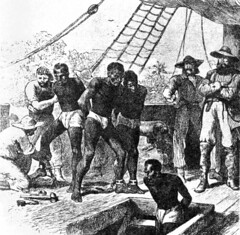
14858807096Middle PassageVoyage from West Africa to the West Indies. It was miserable for the slaves transported and many died. (p. 38)62
14858807119Benjamin FranklinDescendant of the Puritans, wrote Poor Richard's Almanac, Edited the Pennsylvania Gazette (which became very popular), founded a public library, started a fire company, and created the academy which become the University of Pennsylvania.63
14858807120Jonathan EdwardsSparked the first Great Awakening, "Fire and Brimstone," believed everyone in the town he was in was sinning and needed to be cured of the devil. Oversaw some of the first revivals at his church.64
14858807121Restoration ColonyOne of a number of land grants in North America given by King Charles II of England in the later half of the 17th century, ostensibly as a reward to his supporters in the Stuart Restoration. The grants marked the resumption of English colonization of the Americas after a 30-year hiatus.65
14858807122The EnlightenmentIntellectual and philosophical movement in Europe in the 18th century. Emphasized reason, individualism, and skepticism. Superstition and science over blind faith.66
14858807123British/English Civil warA series of wars between the Roundheads (Parliamentarians) and the Cavaliers (Royalists). It was mostly over how England was governing. It ended with Roundhead victory at the Battle of Worcester.67
14858807124Eliza Lucas PickneyDeveloped indigo as one of the most important cash crops.68
14858807125subsistence farmingwhen people grow food and crops to feed themselves rather than buy/trade it from somewhere else.69
14858807126George WhitefieldHuge part of the Great Awakening, he was a traveling preacher who went from town to town spreading religious awakening.70

US AP History Period 1 Flashcards

Terms : Hide Images
13972328645A land bridge from AsiaHow early Americans reached North and South America0
13972328646Nomadic; following food and herdsThe lifestyle that encouraged Indians to cross the land bridge1
13972328647Mayan, Inca and AztecsThe most complex Indian communities living in South America2
13972328648MaizeThis crop transformed nomadic hunter-gatherer societies into settled farm communities3
13972328649Silk, Spices, Oils/PerfumesItems desired from Persia & China4
13972328650God, Gold & Glory3 motives for Spanish Exploration5
13972328651HispaniolaThe area in which Columbus landed6
13972328652Treaty of TordesillasThe agreement settling the dispute between Spain & Portugal for land in the Americas.7
13972328653Semi-permanent settlementsMost people in the Americas lived in this type of settlement by the time of Christopher Columbus.8
13972328654Anasazi; PuebloTribes that settled in the Southwest; had culture based on farming & irrigation systems with permanent buildings9
13972328655Northwest IndiansLived in permanent longhouses that had a rich diet based on hunting & fishing10
13972328656Great Plains IndiansTribe that was nomadic OR farmers/traders; hunted buffalo, raised maize, beans & squash11
13972328657What did the Treaty of Tordesillas say?Divided the trade routes to Asia: Spain gets the route across the Atlantic and Portugal gets the route around Africa. Also, Spain got a lot of land in the New World and Portugal got present-day Brazil.12
13972328658CortesConquered the Aztecs13
13972328659PizzaroConquered the Incas14
13972328660Bartolome de las CasasMan who stood up for the rights on the natives.15
13972328661RenaissanceTime period that allowed for the invention of gunpowder, the compass and advanced shipbuilding and mapmaking16
13972328662Vasco de GamaFirst European to reach India using the route around South Africa's Cape of Good Hope.17
13972328663John CabotFirst explorer sent by England to the New World; explored the North American coast18
13972328664Christopher ColumbusExplorer who won the backing of Queen Isabella & King Ferdinand of Spain to sail west from Europe to the "Indies."19
13972328665Ferdinand MagellanExplorer who is credited with the 1st circumnavigation of the earth20
13972328666Henry HudsonWhile searching for the northwest passage, this explorer sailed up a a broad river to give the Dutch claim21
13972328667Columbian ExchangeExchange of plants, animals, and diseases (beans, corn, potatoes, tomatoes & tobacco) between Old World and New World after the time of Columbus.22
13972328668Corn, beans, squash (3 sister farming)3 crops from the Americas ended up being staple crops in Europe?23
13972328669HorsesAnimal introduced by the Spanish that changed the lifestyle of the Native American24
13972328670Smallpox, malaria, yellow fever, influenzaDiseases from the Old World and went to the New World25
13972328671SyphillisDisease from the New World to the Old World26
13972328672Valladolid DebateThe argument between Bartolome de Las Casas and Juan Gines de Sepulveda over treatment of Indians by the Spanish.27
13972328673EncomiendaA grant of land made by Spain to a settler in the Americas, including the right to use Native Americans as laborers on it; essentially set up slavery for Native Americans28
13972328674Atlantic slave tradeLasted from 16th century until the 19th century. Trade of African peoples from Western Africa to the Americas. 98% of Africans were sent to the Caribbean, South and Central America.29
13972328675IroquoisA later native group to the eastern woodlands. They blended agriculture and hunting living in common villages constructed from the trees and bark of the forests30
13972328676CherokeeAre a Native American people historically settled in the Southeastern United States (principally Georgia, the Carolinas and Eastern Tennessee). Linguistically, they are part of the Iroquoian-language family.31
13972328677InuitA member of a people inhabiting the Arctic (northern Canada or Greenland or Alaska or eastern Siberia)32
13972328678MayaMesoamerican civilization concentrated in Mexico's Yucatan Peninsula and in Guatemala and Honduras but never unified into a single empire. Major contributions were in mathematics, astronomy, and development of the calendar.33
13972328679Aztec(1200-1521) 1300, they settled in the valley of Mexico. Grew corn. Engaged in frequent warfare to conquer others of the region. Worshipped many gods (polytheistic). Believed the sun god needed human blood to continue his journeys across the sky.34
13972328680IncaTheir empire stretched from what is today Ecuador to central Chili in the Andes Mountain region of South America. Called the Children of the Sun.35
13972328681TenochtitlanCapital of the Aztec Empire, located on an island in Lake Texcoco. Its population was about 150,000 on the eve of Spanish conquest. Mexico City was constructed on its ruins.36
13972328682NomadEarly, simplistic man that migrated across the land bridge.37
13972328683Martin LutherBroke away from the Catholic Church because of his 95 problems with the Catholic Church.38
13972328684King Henry VIIIBroke away from the Catholic Church because of his disagreement with his inability to get divorced; which eventually led to civil unrest in his country.39
13972328685New FranceEstablished in Canada and along the Mississippi River, focused on fur trade.40
13972328686AnimismBelief that non-human things possess a spiritual essence41
13972328687MestizoPeople with mixed Indian & European heritage42
13972328688MulattoPeople of mixed white and black ancestry43
13972328689Pope's Rebellion/Pueblo Revolt1680 conflict that lead to death of hundreds of Spanish colonists and destruction of Catholic churches in the area44
13972328690Cultural autonomyConflicts between Natives and Europeans were for the Natives to maintain this45
13972328691MercantilismEconomic system in which the colonies exist to enrich the Mother country; attempt to export to colonies more than they import46

Pages

Subscribe to CourseNotes RSS

Need Help?

We hope your visit has been a productive one. If you're having any problems, or would like to give some feedback, we'd love to hear from you.

For general help, questions, and suggestions, try our dedicated support forums.

If you need to contact the Course-Notes.Org web experience team, please use our contact form.

Need Notes?

While we strive to provide the most comprehensive notes for as many high school textbooks as possible, there are certainly going to be some that we miss. Drop us a note and let us know which textbooks you need. Be sure to include which edition of the textbook you are using! If we see enough demand, we'll do whatever we can to get those notes up on the site for you!