

AP Psychology Unit 7 - Cognition (Thinking and Language) Flashcards
Terms : Hide Images
| 11215324568 | cognition | all the mental activities associated with thinking, knowing, remembering, and communicating. |  | 0 |
| 11215324569 | concept | a mental grouping of similar objects, events, ideas, or people. |  | 1 |
| 11215324570 | prototype | a mental image or best example of a category. |  | 2 |
| 11215324571 | algorithm | a methodical, logical rule or procedure that guarantees solving a particular problem. Contrasts with the usually speedier—but also more error-prone—use of heuristics. |  | 3 |
| 11215324572 | heuristic | a simple thinking strategy that often allows us to make judgments and solve problems efficiently; usually speedier but also more error-prone than algorithms. |  | 4 |
| 11215324573 | insight | a sudden and often novel realization of the solution to a problem; it contrasts with strategy-based solutions. |  | 5 |
| 11215324574 | creativity | the ability to produce novel and valuable ideas. |  | 6 |
| 11215324575 | confirmation bias | a tendency to search for information that supports our preconceptions and to ignore or distort contradictory evidence. |  | 7 |
| 11215324576 | fixation | the inability to see a problem from a new perspective, by employing a different mental set. |  | 8 |
| 11215324577 | mental set | a tendency to approach a problem in one particular way, often a way that has been successful in the past. |  | 9 |
| 11215324578 | functional fixedness | the tendency to think of things only in terms of their usual functions; an impediment to problem solving. |  | 10 |
| 11215324579 | representativeness heuristic | judging the likelihood of things in terms of how well they seem to represent, or match, particular prototypes; may lead us to ignore other relevant information. |  | 11 |
| 11215324580 | availability heuristic | estimating the likelihood of events based on their availability in memory; if instances come readily to mind (perhaps because of their vividness), we presume such events are common. |  | 12 |
| 11215324581 | overconfidence | the tendency to be more confident than correct—to overestimate the accuracy of our beliefs and judgments. |  | 13 |
| 11215324582 | belief perseverance | clinging to one's initial conceptions after the basis on which they were formed has been discredited. |  | 14 |
| 11215324583 | intuition | an effortless, immediate, automatic feeling or thought, as contrasted with explicit, conscious reasoning. |  | 15 |
| 11215324584 | framing | the way an issue is posed; how an issue is framed can significantly affect decisions and judgments. |  | 16 |
| 11215324585 | language | our spoken, written, or signed words and the ways we combine them to communicate meaning. |  | 17 |
| 11215324586 | phoneme | in language, the smallest distinctive sound unit. |  | 18 |
| 11215324587 | morpheme | in a language, the smallest unit that carries meaning; may be a word or a part of a word (such as a prefix). |  | 19 |
| 11215324588 | grammar | in a language, a system of rules that enables us to communicate with and understand others. |  | 20 |
| 11215324589 | semantics | the set of rules by which we derive meaning from morphemes, words, and sentences in a given language; also, the study of meaning. |  | 21 |
| 11215324590 | syntax | the rules for combining words into grammatically sensible sentences in a given language. |  | 22 |
| 11215324591 | babbling stage | babies spontaneously uttering a variety of words, such as ah-goo |  | 23 |
| 11215324592 | holophrastic stage | the stage in which children speak mainly in single words | | 24 |
| 11215324593 | two-word stage | they start uttering two word sentences | | 25 |
| 11215324594 | telegraphic speech | early speech stage in which a child speaks like a telegram—"go car"—using mostly nouns and verbs. |  | 26 |
| 11215324595 | linguistic determinism | Whorf's hypothesis that language determines the way we think. |  | 27 |
| 11215324596 | memory | the persistence of learning over time through the storage and retrieval of information. |  | 28 |
| 11215324597 | encoding | the processing of information into the memory system—for example, by extracting meaning. |  | 29 |
| 11215324598 | storage | the retention of encoded information over time. |  | 30 |
| 11215324599 | retrieval | the process of getting information out of memory storage. | | 31 |
| 11215324600 | sensory memory | the immediate, very brief recording of sensory information in the memory system. | | 32 |
| 11215324601 | short-term memory | activated memory that holds a few items briefly, such as the seven digits of a phone number while dialing, before the information is stored or forgotten. | | 33 |
| 11215324602 | long-term memory | the relatively permanent and limitless storehouse of the memory system. Includes knowledge, skills, and experiences. | | 34 |
| 11215324603 | working memory | a newer understanding of short-term memory that focuses on conscious, active processing of incoming auditory and visual-spatial information, and of information retrieved from long-term memory. | | 35 |
| 11215324604 | parallel processing | the processing of many aspects of a problem simultaneously; the brain's natural mode of information processing for many functions, including vision. Contrasts with the step-by-step (serial) processing of most computers and of conscious problem solving. |  | 36 |
| 11215324605 | automatic processing | unconscious encoding of incidental information, such as space, time, and frequency, and of well-learned information, such as word meanings. |  | 37 |
| 11215324606 | effortful processing | encoding that requires attention and conscious effort. |  | 38 |
| 11215324607 | rehearsal | the conscious repetition of information, either to maintain it in consciousness or to encode it for storage. |  | 39 |
| 11215324608 | spacing effect | the tendency for distributed study or practice to yield better long-term retention than is achieved through massed study or practice. |  | 40 |
| 11215324609 | serial position effect | our tendency to recall best the last and first items in a list. |  | 41 |
| 11215324610 | visual encoding | the encoding of picture images. |  | 42 |
| 11215324611 | acoustic encoding | the encoding of sound, especially the sound of words. |  | 43 |
| 11215324612 | semantic encoding | the encoding of meaning, including the meaning of words. |  | 44 |
| 11215324613 | imagery | mental pictures; a powerful aid to effortful processing, especially when combined with semantic encoding. |  | 45 |
| 11215324614 | mnemonics | memory aids, especially those techniques that use vivid imagery and organizational devices. |  | 46 |
| 11215324615 | chunking | organizing items into familiar, manageable units; often occurs automatically. |  | 47 |
| 11215324616 | iconic memory | a momentary sensory memory of visual stimuli; a photographic or picture-image memory lasting no more than a few tenths of a second. |  | 48 |
| 11215324617 | echoic memory | A momentary sensory memory of auditory stimuli; if attention is elsewhere, sounds and words can still be recalled within 3 or 4 seconds. |  | 49 |
| 11215324618 | long-term potentiation (LTP) | an increase in a synapse's firing potential after brief, rapid stimulation. Believed to be a neural basis for learning and memory. |  | 50 |
| 11215324619 | flashbulb memory | a clear memory of an emotionally significant moment or event. |  | 51 |
| 11215324620 | amnesia | the loss of memory. |  | 52 |
| 11215324621 | implicit memory | retention independent of conscious recollection. (Also called non-declarative or procedural memory.) |  | 53 |
| 11215324622 | explicit memory | memory of facts and experiences that one can consciously know and "declare." (Also called declarative memory.) |  | 54 |
| 11215324623 | hippocampus | a neural center that is located in the limbic system; helps process explicit memories for storage. |  | 55 |
| 11215324624 | recall | a measure of memory in which the person must retrieve information learned earlier, as on a fill-in-the-blank test. |  | 56 |
| 11215324625 | recognition | a measure of memory in which the person need only identify items previously learned, as on a multiple-choice test. |  | 57 |
| 11215324626 | relearning | a measure of memory that assesses the amount of time saved when learning material for a second time. |  | 58 |
| 11215324627 | priming | the activation, often unconsciously, of certain associations, thus predisposing one's perception, memory, or response. |  | 59 |
| 11215324628 | déjà vu | that eerie sense that "I've experienced this before." Cues from the current situation may subconsciously trigger retrieval of an earlier experience. |  | 60 |
| 11215324629 | mood-congruent memory | the tendency to recall experiences that are consistent with one's current good or bad mood. |  | 61 |
| 11215324630 | proactive interference | the disruptive effect of prior learning on the recall of new information. |  | 62 |
| 11215324631 | retroactive interference | the disruptive effect of new learning on the recall of old information. | | 63 |
| 11215324632 | repression | in psychoanalytic theory, the basic defense mechanism that banishes anxiety-arousing thoughts, feelings, and memories from consciousness. |  | 64 |
| 11215324633 | misinformation effect | incorporating misleading information into one's memory of an event. |  | 65 |
| 11215324634 | source amnesia | attributing to the wrong source an event we have experienced, heard about, read about, or imagined. (Also called source misattribution.) Source amnesia, along with the misinformation effect, is at the heart of many false memories. |  | 66 |
| 11215338083 | Broca's area | Controls language expression - an area of the frontal lobe, usually in the left hemisphere, that directs the muscle movements involved in speech. | 67 | |
| 11215346735 | Wernicke's area | controls language reception - a brain area involved in language comprehension and expression; usually in the left temporal lobe | 68 | |
| 11215352629 | Broca's aphasia | condition in which the affected person to be unable to speak fluently, to mispronounce words, and to speak haltingly | 69 | |
| 11215359010 | Wernicke's aphasia | condition in which the affected person to be unable to understand or produce meaningful language | 70 | |
| 11215388421 | overrregularization | part of the language-learning process in which children extend regular grammatical patterns to irregular words | 71 | |
| 11215409600 | language acquisition device (LAD) | Chomsky's term for a hypothesized mental structure that enables humans to learn language, including the basic aspects of grammar, vocabulary, and intonation. | 72 | |
| 11215425861 | Ebbinghaus forgetting curve | the course of forgetting is initially rapid, then levels off with time | 73 | |
| 11215430065 | Ebbinghaus' Retention Curve | as rehearsal increases, relearning time decreases | 74 | |
| 15141098255 | Elizabeth Loftus | Researcher on memory construction and the misinformation effect created doubts about the accuracy of eye-witness testimony | 75 | |
| 15141166346 | Universal Grammar (Chomsky) | A linguistic theory that the ability to learn language is innate, distinctly human and distinct from all other aspects of human cognition. | 76 | |
| 15141173523 | Noam Chomsky | theorist who believed that humans have an inborn or "native" propensity to develop language | 77 | |
| 15141187821 | linguistic relativity hypothesis | the theory that thought processes and concepts are controlled by language | 78 |
Flashcards
Flashcards
Flashcards
Flashcards
2020 APES Biomes Flashcards
Terms : Hide Images
| 14675318474 | Tundra biome | Very low temperatures, very little rainfall, mostly as snow. Very small trees, a few herbs, mosses and lichens. Animals: hare, fox, lemming, caribou, & polar bear. |  | 0 |
| 14675334281 | Boreal Forest (Taiga) | A forest biome made up primarily of coniferous evergreen trees that can tolerate cold winters and short growing seasons. Animals: Moose, beaver, bear, & wolf |  | 1 |
| 14675344464 | Temperate rainforest | A coastal biome typified by moderate temperatures and high precipitation. Coniferous or broadleaf forests that occur in the temperate zone and receive heavy rainfall. |  | 2 |
| 14675353462 | Temperate seasonal forest | A biome with warm summers and cold winters with over 1 m (39 inches) of precipitation annually. Dominated by deciduous trees: oak, maple, beech, hickory, & some coniferous trees. Animals: toad, squirrel, & chipmunk. |  | 3 |
| 14675375361 | Woodland/shrubland (chaparral) | A biome characterized by hot, dry summers and mild, rainy winters. Drought-resistant shrubs: yucca, sagebrush, & scrub oak. Indicator animals: small nocturnal animals. Vegetation composed of broad-leaved evergreen shrubs, bushes, and small trees usually less than 2.5 m (about 8 feet) tall; together they often form dense thickets. |  | 4 |
| 14675398208 | Temperate grassland/cold desert | A biome characterized by cold, harsh winters, and hot, dry summers. Plants: Dominated by grasses & nonwoody flowering plants with few shrubs. Animals: Bison, zebra, rhinoceros, & kangaroo. Also known as prairie in N. America. |  | 5 |
| 14675404323 | Tropical rainforest | Forests near the equator in which rainfall is abundant - more than 200 cm (80 in) per year - and temperatures are warm or hot year-round. High vegetation containing 2/3 of the world's species: cocoa, coffee, cassava, bamboo, & strangler figs. Animals: Great ape, monkey, sloth, and toucan. |  | 6 |
| 14675419294 | Tropical seasonal forest/savanna | A biome marked by warm temperatures and distinct wet and dry seasons. Grassy plain in tropical and subtropical regions, with few trees |  | 7 |
| 14675419670 | Subtropical desert | A biome prevailing at approximately 30° N and 30° S, with hot temperatures, extremely dry conditions, and sparse vegetation. Plant species such as grass, shrubs, and succulents can be found there. Many animals, such as camels, tortoises, birds, foxes, rodents, and lizards |  | 8 |
| 14679220818 | Streams (creeks -small/narrow, rivers - wider) | Flowing freshwater that may originate from underground springs or as runoff from rain or melting snow. Few plants and algae to act as producers. Animals: Insects, crustacean, trout, salmon (high flow/high oxygen area with rapids), and catfish (slow flow/less oxygen) |  | 9 |
| 14679278800 | Lakes and ponds | Standing water that some of which is too deep to support emergent vegetation. | 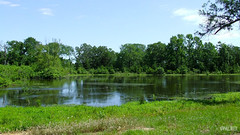 | 10 |
| 14679347419 | Freshwater wetlands | An aquatic biome that is submerged or saturated by water for at least part of each year, but shallow enough to support emergent vegetation. (Swamps, marshes, and bogs) |  | 11 |
| 14686117085 | Salt Marshes | A marsh containing nonwoody emergent vegetation, found along the coast in temperate climates. Very productive biome found in estuaries where the fresh water of rivers mixes with saltwater from the ocean. Nutrients from the river allow for abundancy of life form. |  | 12 |
| 14686182188 | Mangrove Swamps | Swamps found on the coastlines in warm tropical climates. They are dominated by mangrove trees and contain other trees and shrubs that can live partly submerged in the salty environment of coastal swamps. |  | 13 |
| 14686350578 | Intertidal zone | The narrow band of coastline between the levels of high tide and low tide. The wave crashing onto the shore can make it challenging for organisms to hold on. Animals: barnacles, sponges, algae, mussels, crabs, and sea stars. |  | 14 |
| 14686412982 | Coral Reefs | The most diverse marine biome on Earth, found in warm, shallow waters beyond the shoreline. Corals are tiny animals that secrete a layer of limestone (calcium carbonate) to form an external skeleton. Corals provide algae with carbon dioxide for photosynthesis and algae provides sugar for energy. |  | 15 |
| 14686440551 | Open ocean | Deep ocean water, located away from the shoreline where sunlight can no longer reach the ocean bottom. Contain algae suspended in water but generally does not exceed 200m. |  | 16 |
| 14688374437 | Littoral zone | A shallow zone in a freshwater habitat where light reaches the bottom (photic) and nurtures plants. Most photosynthesis occurs in this zone. |  | 17 |
| 14688404975 | Limnetic zone | A zone of open water in lakes and ponds where rooted plants can no longer survive. Floating algae called phytoplankton are the only photosynthetic organisms. |  | 18 |
| 14688613930 | Profundal zone | A region of water where sunlight does not reach (aphotic), below the limnetic zone in very deep lakes. Limited biodiversity due to insufficient dissolved oxygen concentrations. | | 19 |
| 14688636027 | Benthic zone | The muddy bottom of a lake or pond beneath the limnetic and profundal zones. | | 20 |
| 14688649468 | Oligotrophic | Lakes that have low productivity due to low amounts of nutrients such as phosphorus and nitrogen in the water. |  | 21 |
| 14688659144 | Mesotrophic | Describes a lake with a moderate level of productivity |  | 22 |
| 14688661462 | Eutrophic | A process by which nutrients, particularly phosphorus and nitrogen, become highly concentrated in a body of water, leading to increased growth of organisms such as algae or cyanobacteria. |  | 23 |
| 14688664058 | Photic zone | Portion of the marine biome that is shallow enough for sunlight to penetrate. |  | 24 |
| 14688664827 | Aphotic zone | The layer of ocean water that lacks sufficient sunlight for photosynthesis |  | 25 |
| 14688669526 | Chemosynthesis | Process by which some organisms, such as certain bacteria, use chemical energy to produce carbohydrates (sugar for energy). | 26 |
APES Friedland Chapter 7 Flashcards
Terms : Hide Images
| 12394610413 | Demography | the study of human populations and population trends | 0 | |
| 12394610414 | Demographers | scientists in the field of demography | 1 | |
| 12394610415 | Immigration | the movement of people into a country or region, having come from another country or region | 2 | |
| 12394610416 | Emigration | the movement of people out of a country or region, to settle in another country or region | 3 | |
| 12394610417 | Crude Birth Rate | the number of births per 1000 individuals per year | 4 | |
| 12394610418 | Crude Death Rate | the number of deaths per 1000 individuals per year | 5 | |
| 12394610419 | Total Fertility Rate (TFR) | an estimate of the average number of children that each woman in a population will bear throughout her childbearing years | 6 | |
| 12394610420 | Replacement-Level Fertility | the total fertility rate required to offset the average number of deaths in a population in order to maintain the current population size | 7 | |
| 12394610421 | Developed Countries | countries with relatively high levels of industrialization and income | 8 | |
| 12394610422 | Developing Countries | countries with relatively low levels of industrialization and income | 9 | |
| 12394610423 | Life Expectancy | the average number of years that an infant born in a particular year in a particular country can be expected to live, given the current average life span and death rate in that country | 10 | |
| 12394610424 | Infant Mortality Rate | the number of deaths of children under 1 year of age per 1000 live births | 11 | |
| 12394610425 | Child Mortality Rate | the number of deaths of children under age 5 per 1000 live births | 12 | |
| 12394610426 | Age Structure Diagrams | diagrams that show the numbers of individuals within each age category, typically expressed for males and females separately | 13 | |
| 12394610427 | Population Pyramid | an age structure diagram that is widest at the bottom and smallest at the top, typical of developing countries | 14 | |
| 12394610428 | Population Momentum | continued population growth that does not slow in response to growth reduction measures | 15 | |
| 12394610429 | Demographic Transition | the theory that as a country moves from a subsistence economy to industrialization and increased affluence it undergoes a predictable shift in population growth | 16 | |
| 12394610430 | Family Planning | the practice of regulating the number or spacing of offspring through the use of birth control | 17 | |
| 12394610431 | Affluence | the state of having plentiful wealth; the possession of money, goods, or property | 18 | |
| 12394610432 | IPAT Equation | Impact = Population x Affluence x Technology | 19 | |
| 12394610433 | Urban Area | an area that contains more than 385 people per square kilometer (1000 people per square mile) | 20 | |
| 12394610434 | Gross Domestic Product (GDP) | a measure of the value of all products and services produced in a country in a year | 21 | |
| 12394610435 | doubling time | the number of years it takes for a population to double | 22 | |
| 12394610436 | rule of 70 | doubling time in years=70/ growth rate in % | 23 | |
| 12394610437 | net migration rate | the difference between immigration and emigration in a giver year per 1000 people | 24 | |
| 12394610438 | Thomas Malthus | Said that human population was growing exponentially, while the food supply was growing linearly. | 25 | |
| 12394610439 | Drives human population growth | Fertility rates, life expectancy, and migration rates | 26 | |
| 12394610440 | How many people on Earth? | 6.8 billion | 27 | |
| 12394610441 | Phase 1 *Four phases of demographic transition | Slow population growth | 28 | |
| 12394610442 | Phase 2 | Rapid population growth | 29 | |
| 12394610443 | Phase 3 | Stable population growth | 30 | |
| 12394610444 | Phase 4 | Declining population growth | 31 | |
| 12394610445 | Growth rate | (crude birth rate + immigration) - (crude death rate + emigration)/ 10 | 32 | |
| 12394610452 | Demographic Transition |  | 33 | |
| 12394610446 | Most populous | China, India, and USA | 34 | |
| 12394610447 | 2.1 | Replacement level fertility rate in developed countries | 35 | |
| 12394610448 | Baby bomb time period | Added 79 million people | 36 | |
| 12394610449 | Infant mortality rate best indicates | Reflection of level of nutrition and health care | 37 | |
| 12394610450 | Transitional state | High birth rate, low death rate | 38 | |
| 12394610451 | Four types of Gross Domestic Product | Consumer spending, investments, government spending, and exports minus imports | 39 |
Flashcards
Flashcards
Pages

Need Help?
We hope your visit has been a productive one. If you're having any problems, or would like to give some feedback, we'd love to hear from you.
For general help, questions, and suggestions, try our dedicated support forums.
If you need to contact the Course-Notes.Org web experience team, please use our contact form.
Need Notes?
While we strive to provide the most comprehensive notes for as many high school textbooks as possible, there are certainly going to be some that we miss. Drop us a note and let us know which textbooks you need. Be sure to include which edition of the textbook you are using! If we see enough demand, we'll do whatever we can to get those notes up on the site for you!
