AP Notes, Outlines, Study Guides, Vocabulary, Practice Exams and more!

AP World History (The Muslim Empires) Flashcards

The Early Modern Period, 1450-1750: The World Shrinks

Ch. 21 The Muslim Empires

Terms : Hide Images
5876331398Sick man of EuropeThe phrase is used to describe economic poverty in a European country. This term was coined when the Ottoman empire was in decline and increasingly began to lose territory to the Europeans through defeats in battle. (Overstatement).0
5876331399SatiA ritual that required a woman to throw herself on her late husband's funeral pyre or burn herself. This was done gladly and if a woman didn't comply with this she would be disgraced.1
5876331400Safavid DynastyOriginally a Turkic nomadic group; family originated in Sufi mystic group; espoused Shi'ism; conquered territory and established kingdom in region equivalent to modern Iran; lasted until 1722. Disputed with Mughal Dynasty frequently because of Sunni-Shia split.2
5876331401BaburHe founded the Mughal Empire in 1526 when he defeated the Lodi army and the Hindu warrior princes, he encouraged military buildup and arts, contributions: creation of a centralized government with ministries that controlled the provinces and introduction of a policy of religious toleration (unity with the Hindu princes), he introduced a new calendar, helped the poor, made an anti-alcohol campaign, and tried to improve the lives of women, was actually trying to raid in order to get other kingdom back.3
5876331402Mughal EmpireAn Islamic imperial power that ruled a large portion of Indian subcontinent which began in 1526, invaded and ruled most of Hindustan (South Asia) by the late 17th and early 18th centuries, and ended in the mid-19th century. Founded by Babur4
5876331403Ottoman EmpireIslamic state founded by Osman in northwestern Anatolia ca. 1300. After the fall of the Byzantine Empire, was based at Istanbul (formerly Constantinople) from 1453 to 1922. It encompassed lands in the Middle East, North Africa, the Caucasus, and eastern Europe.5
5876331404OsmanThe ruler of the turks who began to build a new empire in the corner of Asia Minor. these turks became known as the Ottoman Turks6
5876331405Mehmed IIAlso called "The Conqueror", Murad's son, conquered Constaninople in 1453 and opened it to new citizens of many religions and backgrounds. The rebuilt city was renamed Istanbul.7
5876331406JanissariesInfantry, originally of slave origin, armed with firearms and constituting the elite of the Ottoman army from the fifteenth century until the corps was abolished in 1826.8
5876331407DhimmisA person of a non-Muslim religion whose right to practice that religion is protected within an Islamic society, People of the Book: Christians, Jews, Zoroastrians9
5876331408VizierOttoman equivalent of the Abbasid wazir; head of the Ottoman bureaucracy; after 15th century often more powerful than sultan10
5876331409SuleymaniyeFamous Ottoman mosque. Obelisks/minarettes. Built 1550's during reign of Suleyman, who also built resthouses, schools, gardens, and coffee houses. Designed by Sinam.11
5876331410SuleymanRuled Ottoman Empire for 46 years and when it was at its height, he was also called "The Magnificent", spread the empire, many cultural interests, expanded military, millet system, devshirme system,12
5876331411Golden HornNickname for Constantinople (capital of Byzantine empire) because it was shaped like a horn and brought in lots of trade (money, gold) because of its access to the Mediterranean, Black, and Aegean seas13
5876331412devshirme'Selection' in Turkish. The system by which boys from Christian communities were taken by the Ottoman state to serve as Janissaries.14
5876331413Battle of LepantoA naval battle fought between a Spanish and Venetian fleet and the German navy. The Spanish won. The battle meant that European navies had finally surpassed the Muslims. The Ottoman Turks could no longer challenge Europeans on international routes.15
5876331414Sail al-DinEarly 14th century Sufi mystic; began campaign to purify Islam; first member of Safavid dynasty.16
5876331415Red HeadsName given to Safavid followers because of their distinctive red headgear.17
5876331416Isma'ilSufi commander who conquered the city of Tabriz in 1501; first Safavid to be proclaimed "shah" or emperor18
5876331417Battle of Chaldiran16th Century. The Safavid vs the Ottomans. Ottomans won, and this symbolized the two greatest world powers at the time clashing together, + religious war (Shiites Vs. Sunnis), determined modern day boundaries (Iran vs. Iraq)19
5876331418Taj MahalMost famous architectural achievement of Mughal India; originally built as a mausoleum for the wife of Shah Jahan, Mumtaz Mahal20
5876331419Abbas the GreatSafavid ruler from 1587 to 1629; extended Safavid domain to greatest extent; created slave regiments based on captured Russians, who monopolized firearms within Safavid armies; incorporated Western military technology.21
5876331420Tahmasp I1534-1576. Won the throne after Isma'il , rebuilt the Safavid dynasty. Brought Turkic chiefs under control. Longest reign in the Safavid dynasty.22
5876331421PadishahSafavid term used for king of kings23
5876331422mullahsLocal mosque officials and prayer leaders within the Safavid Empire; agents of Safavid religious campaign to convert all of population to Shi'ism24
5876331423imamsShi'a religious leaders who traced their descent to Ali's successors.25
5876331424IsfahanSafavid capital under Abbas the Great; planned city exemplifying Safavid architecture.26
5876331425Nadir Khan AfsharSoldier-adventurer following fall of Safavid dynasty in 1722; proclaimed himself shah in 1736; established short-lived dynasty in reduced kingdom.27
5876331426AkbarMost illustrious sultan of the Mughal Empire in India (r. 1556-1605). He expanded the empire and pursued a policy of conciliation with Hindus. , son and successor of Humayan; oversaw building of military and administrative systems that became typical of Mughal rule in India; pursued policy of cooperation with Hindu princes; attempted to create new religion to bind Muslim and Hindu populations of India.28
5876331427HumayanSon and successor of Babur; expelled from India in 1540, but restored Mughal rule by 1556; died shortly thereafter29
5876331428JizyaHead tax paid by all non-believers in Islamic territories, Eliminated by Akbar during his reign, but reinstated by other rulers.30
5876331429Din-i-IlahiReligion initiated by Akbar in Mughal India; blended elements of the many faiths of the subcontinent; key to efforts to reconcile Hindu and Muslims in India, but FAILED.31
5876331430Purdahthe practice among Hindu and Muslim women of covering the face with a veil when outside the home32
5876331431AurangzebMughal emperor in India and great-grandson of Akbar 'the Great', under whom the empire reached its greatest extent, only to collapse after his death, despotic ruler, whose strict laws led to divisions and decentralization of government in the Mughal Empire33
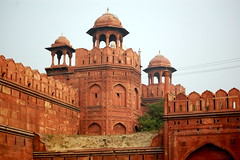
5876331432Red FortThe fortified structure built by the Mughal emperor in Delhi that served as the home of the imperial family of India under Shah Jahan.34
5876331433Shah JahanMughal emperor of India during whose reign the finest monuments of Mogul architecture were built (including the Taj Mahal at Agra)35
5876331434JahangirSon of Akbar he was the "Grasper of the World." He married the Persian princess Nur Jahan, who really controlled the state affairs because he was a weak ruler. He was overthrown by his son Khusrau.36
5876331435Mumtaz MahalShah Jahan's wife who had a building named after her (Taj Mahal) , as he was only passinate about her and beautiful buildings,took an active political role in Mughal court;37
5876331436Nur JahanWife of Jahangir; amassed power in court and created faction of male relatives who dominated Mughal Empire during later years of Jahangir's reign38
5876331437MarattasWestern Indian peoples who rebelled against Mughal control early in the 18th century and contributed to its downfall mainly because of Aurangzeb's draconian religious policies.39
5876331438SikhsSect in northwest India; early leaders tried to bridge gap between Hindus and Muslims, but Mughal persecution led to anti-Muslim feelings40

AP World History Bodies Of Water Flashcards

Terms : Hide Images
4758714785Indian Ocean0
4758716162Black Sea1
4758716928South China Sea2
4758717526Arabian Sea3
4758719115Mediterranean Sea4
4758726351The Straits of Gibraltar5
4758727640The Bering Sea6
4758729502Caribbean Sea7
4758730398Caspian Sea8
4758730815Sea of Japan9
4758731395Atlantic Ocean10
4758731999Pacific Ocean11
4758733504Bosporus12
4758734514Persian Gulf13

AP World History Chapter 17 Flashcards

Terms : Hide Images
6360991376caudillosMilitary strongmen who seized control of a government in nineteenth-century Latin America.0
6360998669lower middle classSocial stratum that developed in Britain in the nineteenth century and that consisted of people employed in the service sector as clerks, salespeople, secretaries, police officers, and the like.1
6361006742Indian Cotton TextilesFor much of the eighteenth century, well-made and inexpensive cotton textiles from India flooded western markets; the competition stimulated the British textile industry to industrialize, which led to the eventual destruction of the Indian textile market both in Europe and in India.2
6361018594Karl MarxThe most influential proponent of socialism; a German expatriate in England who advocated working-class revolution as the key to creating an ideal communist future.3
6361035060Labour PartyBritish working-class political party established in the 1890s and dedicated to reforms and a peaceful transition to socialism, in time providing a viable alternative to the revolutionary emphasis of Marxism.4
6361042526Mexican RevolutionLong and bloody war (1911-1920) in which reformers from the middle class joined with workers and peasants to overthrow the dictator Porfirio Díaz and create a new, much more democratic political order.5
6361052668dependent developmentTerm used to describe Latin America's economic growth in the nineteenth century, which was largely financed by foreign capital and dependent on European and North American prosperity and decisions.6
6361059736LudditesSkilled artisans who banded together between 1811 and 1813 to protest against the machines that threatened the jobs and livelihood of workers in the woolen and cotton industry; also argued for price reductions, minimum wages, and prohibitions on the flooding of their industry by unapprenticed workers.7
6361069289Ellen JohnstonScottish textile worker and single mother (1835-1875) who became a published poet with a modest local reputation.8
6361077075Latin American Export BoomLarge-scale increase in Latin American exports (mostly raw materials and foodstuffs) to industrializing countries in the second half of the nineteenth century, made possible by major improvements in shipping; the boom mostly benefited the upper and middle classes.9
6361084273Middle-Class ValuesBelief system that developed in the nineteenth century that emphasized thrift, hard work, rigid moral behavior, cleanliness, and "respectability."10
6361099940ProgressivesFollowers of an American political movement in the period around 1900 that advocated reform measures to correct the ills of industrialization.11
6361112698Russian Revolution of 1905Spontaneous rebellion that erupted in Russia after the country's defeat at the hands of Japan in 1905; the revolution was suppressed, but it forced the government to make substantial reforms.12
6361125159Socialism in the United StatesFairly minor political movement in the United States; at its height in 1912, it gained 6 percent of the vote for its presidential candidate.13
6361134823Steam EngineMechanical device in which the steam from heated water builds up pressure to drive a piston, rather than relying on human or animal muscle power; the introduction of the steam engine allowed a hitherto unimagined increase in productivity and made the Industrial Revolution possible.14

Chapter 10 AP - World History Flashcards

Terms : Hide Images
5287954822In what respects did Byzantium continue the patterns of the classical Roman Empire? In what ways did it diverge from those patterns?Continuance in Byzantium's roads,military structures, centralized administration, imperial court, laws, and Christian organization. ​•​ also in Byzantium's pursuit of the long-term Roman struggle with the Persian Empire. ​•​diverged in development of a reformed administrative system that gave appointed generals civil authority in the empire's provinces and allowed them to raise armies from the landowning peasants of the region. Also through the new ideas encompassed in caesaropapism that defined the relationship between the state and the Church.0
5287954823How did Eastern Orthodox Christianity differ from Roman Catholicism?Unlike Western Europe, where the Catholic Church maintained some degree of independence from political authorities, in Byzantium the emperor assumed something of the role of both "Caesar," as head of state, and the pope, as head of the Church. Thus the Byzantine emperor appointed the patriarch of the Orthodox Church, sometimes made decisions about doctrine, called church councils into session, and generally treated the Church as a government department. ​•​In the Eastern Orthodox Church, Greek became the language of religious practice instead of the Latin used in the Roman Catholic Church. ​•​More so than in the West, Byzantine thinkers sought to formulate Christian doctrine in terms of Greek philosophical concepts. ​•​The Eastern Orthodox and Roman Catholic churches disagreed on a number of doctrinal issues, including the nature of the Trinity, the relative importance of faith and reason, and the veneration of icons. ​•​Priests in Byzantium allowed their beards to grow long and were permitted to marry, while priests in the West shaved and, after 1050 or so, were supposed to remain celibate. ​•​Orthodox ritual called for using bread leavened with yeast in the mass, but Catholics used unleavened bread. ​•​Eastern Orthodox leaders sharply rejected the growing claims of Roman popes to be the sole and final authority for all Christians everywhere1
5287954824In what ways was the Byzantine Empire linked to a wider world?On a political and military level, Byzantium continued the long-term Roman struggle with the Persian Empire. ​•​Economically, the Byzantine Empire was a central player in the long-distance trade of Eurasia, with commercial links to Western Europe, Russia, Central Asia, the Islamic world, and China. ​•​Culturally, Byzantium preserved much of ancient Greek learning and transmitted this classical heritage to both the Islamic world and the Christian West. ​•​Byzantine religious culture spread widely among2
5287954825How did links to Byzantium transform the new civilization of Kievan Rus?​•​Kievan Rus borrowed Byzantium architectural styles, the Cyrillic alphabet, the extensive use of icons, a monastic tradition stressing prayer and service, and political ideals of imperial control of the Church.3
5287954826How did the historical development of the European West differ from that of Byzantium in the postclassical era?​•​Unlike Byzantium, any semblance of large-scale centralized rule vanished in the West, to be replaced by a series of regional kingdoms. ​•​In addition, urban life diminished sharply, long-distance trade dried up, and literacy lost ground. ​•​In the West, a social system developed based on reciprocal ties between greater and lesser lords among the warrior elites and between lords and serfs. ​•​In the West, the Roman Catholic Church was able to maintain greater independence from political authorities than the Orthodox Church did in Byzantium, although, like its Byzantine counterpart, it did actively work with the political authorities.4
5287954827What replaced the Roman order in Western Europe​•​Politically, the Roman imperial order collapsed, to be replaced by a series of regional kingdoms ruled by Germanic warlords. ​•​But these states maintained some Roman features, including written Roman law and the use of fines and penalties to provide order and justice. ​•​Some of the larger Germanic kingdoms, including the Carolingian Empire and the empire of Otto I of Saxony, also had aspirations to re-create something of the unity of the Roman Empire, although these kingdoms were short-lived and unsuccessful in reviving anything approaching Roman authority. ​•​In the West, a social system developed that was based on reciprocal ties between greater and lesser lords among the warrior elites, which replaced the Roman social structure. ​•​Roman slavery gave way to the practice of serfdom.5
5287954828In what ways was European civilization changing after 1000?The population grew rapidly. ​•​New lands were opened for cultivation. ​•​Long-distance trade was revived and expanded. ​•​The population of towns grew and attracted new professional groupings that introduced a new and more productive division of labor into European society. ​•​Women found substantial new opportunities because of economic growth and urbanization, but by the fifteenth century, many of these opportunities were declining. ​•​Territorial states grew in this period and established more effective institutions of government, commanding the loyalty or at least the obedience of their subjects. ​•​The Roman Catholic Church expanded the area in which Roman Catholicism was practiced into Eastern Europe and Islamic Spain.6
5287954829What was the impact of the Crusades in world history?​•​They marked an expansion of the influence of Western Christendom at the same time that Eastern Christendom and Byzantium were declining. ​•​They stimulated the demand for Asian luxury goods in Europe. ​•​They also allowed Europeans to learn techniques for producing sugar on large plantations using slave labor, which had incalculable consequences in later centuries when Europeans transferred the plantation system to the Americas. ​•​Muslim scholarship, together with the Greek learning that it incorporated, flowed into Europe. ​•​The Crusades hardened cultural barriers between Eastern Orthodoxy and Roman Catholicism. Moreover, Christian anti-Semitism was exacerbated. ​•​European empire building, especially in the Americas, continued the crusading notion that "God wills it." ​•​The Crusades have also on many occasions proved politically or ideologically significant when the worlds of Europe and Islam have collided over the past two centuries.7
5287954830In what ways did borrowing from abroad shape European civilization after 1000?​•​Borrowing from abroad played a critical role in establishing a significant tradition of technological innovation that allowed Europe by 1500 to catch up with, and in some areas perhaps to surpass, China and the Islamic world. ​•​A more efficient horse collar, which probably originated in China or central Asia, contributed to European efforts to plow the heavy soils of northern Europe. ​•​Gunpowder from China, combined with cannons developed in Western Europe, gave Europeans a military edge over other civilizations. ​•​Improvements in shipbuilding and navigational techniques, including the magnetic compass and sternpost rudder from China and adaptations of the Arab lateen sail, enabled Europeans to build advanced ships for oceanic voyages.8
5287954831Why was Europe unable to achieve the kind of political unity that China experienced? What impact did this have on the subsequent history of Europe?​•​Geographic barriers, ethnic and linguistic diversity, and the shifting balances of power among Europe's many states prevented the emergence of a single European empire like that of China. As a result, European nations engaged in many conflicts and Europe was unable to achieve domestic peace for many centuries.9
5287954832In what different ways did classical Greek philosophy and science have an impact in the West, in Byzantium, and in the Islamic​•​In the West after 1000 c.e., a belief in the ability of human reason to penetrate divine mysteries and to grasp the operation of the natural order took shape, and that in turn stimulated a renewed interest in Greek philosophy and science. During this period, European scholars obtained copies of Greek texts from both the Byzantine Empire and the Islamic world. At first this new confidence in human reason was applied primarily to theology, but increasingly it was also applied to the scientific study of nature, known as "natural philosophy," which ultimately became a foundation for the Scientific Revolution. ​•​In the Byzantine Empire, scholars kept the classical tradition alive, but their primary interest lay in the humanities and theology rather than in the natural sciences or medicine. The Orthodox Church had serious reservations about classical Greek learning, sometimes persecuting scholars who were too enamored with the ancients. Those who studied Greek philosophy and science did so in a conservative spirit, concerned to preserve and transmit the classical heritage rather than using it as a springboard for creating new knowledge. ​•​The Islamic world undertook a massive translation project in the ninth and tenth centuries that made many Greek texts available in Arabic. This contributed to a flowering of Arab scholarship, especially in the sciences and natural philosophy, between roughly 800 and 1200 c.e. But it also stimulated debate among Muslim thinkers about faith and reason. Unlike church authorities in Western Europe, learned opinion in the Islamic world did not come to regard natural philosophy as a wholly legitimate enterprise. Because of this, the ideas of Plato and Aristotle, while never completely disappearing, receded from Islamic scholarship after the thirteenth century, and natural philosophy did not become a central concern for Islamic higher education as it did in Western Europe.10
5287954833​How did the histories of the Byzantine Empire and Western Europe differ during the era of third-wave civilizations?​•​Western Europe collapsed politically in the fifth century, never to come together again as a single political entity, whereas Byzantium survived as a single political entity throughout the period. ​•​The Byzantine emperor exerted greater control over the Orthodox Church than political authorities in Western Europe did over the Catholic Church. ​•​The Byzantine Empire maintained a prominent role in the long-distance trade networks of Eurasia throughout the period, whereas Western Europe's role declined precipitously following the collapse of the Roman Empire in the fifth century, only to reengage with those trade networks after 1000. ​•​After 1000, Western Europe's influence in the Mediterranean and in Eastern Europe expanded, while the influence of the Byzantine Empire contracted (especially in the Mediterranean basin) after 600 c.e.11
5287954834​What accounts for the different historical trajectories of these two expressions of Christendom?​•​The survival of a powerful imperial state in the Byzantine Empire resulted in greater state control over the Orthodox Church. ​•​Cultural differences also played a role. For instance, in the Eastern Orthodox Church, Greek became the language of religious practice instead of the Latin used in the Roman Catholic Church. Moreover, more so than in the West, Byzantine thinkers sought to formulate Christian doctrine in terms of Greek philosophical concepts. ​•​The Eastern Orthodox faith expanded into Eastern Europe when the Byzantine Empire was at its height, but it was driven from other regions, particularly in North Africa and the Near East, by the expansion of Islam. After 1000, the Roman Catholic tradition became the more expansive of the two expressions, as its influence spread into Islamic Spain, non-Christian northern Europe, and Orthodox Eastern Europe12
5287954835How did Byzantium and Western Europe interact with each other and with the larger world of the postclassical era?​•​Byzantium and Western Europe interacted frequently; for instance, in the 500s c.e., the Byzantine emperor Justinian succeeded in conquering parts of Western Europe in his effort to reconstitute the Roman Empire. ​•​The two societies were both Christian, which led to frequent interactions, disputes, and ultimately a schism between the two confessions. ​•​The revival of Western Europe after 1000 c.e. brought it into a closer trade relationship with Byzantium. ​•​The crusading movement in Western Europe inspired hundreds of thousands of Western Europeans to travel to the eastern Mediterranean and even led to the sack of Constantinople by Crusaders in 1204 c.e. ​•​In terms of the wider world, Byzantium and Western Europe were both part of the Eurasian long-distance trade network. Byzantium participated actively throughout the period, while Western Europe did so increasingly after 1000 c.e. ​•​Both interacted with the Islamic world through military conflict, trade, and the ​exchange of ideas. ​•​Both had a profound impact on Eastern Europe, especially through their promotion of rival versions of the Christian faith.13
5287954836Was the civilization of the Latin West distinctive and unique, or was it broadly comparable to other third-wave civilizations?​•​The book argues strongly that the Latin West shares many of the same features of other third-wave civilizations, especially in its willingness to borrow and then modify and improve upon ideas, business practices, and technological innovations. Therefore, it is broadly comparable to other third-wave civilizations. ​•​That said, it also makes the point that the Western European experience had distinctive features, including a fragmented political structure, unusually independent towns, and an acceptance of the study of natural philosophy, which ultimately helped to define a distinctive Latin West.14
5287954837How does the history of the Christian world in the postclassical era compare with that of Tang and Song dynasty China?​•​The Western Catholic Christian world was less developed in comparison to Tang and Song dynasty China in that former had smaller cities, weaker political authorities, a fragmented political structure, a less commercialized economy, and inferior technology. It was also a more militarized society, with more privileged cities and a more favorable environment for merchants. By 1500, however, Western Europe had come a long way in catching up and, though it depended more on borrowing than did its Chinese counterpart, deserves comparison to China. ​•​The Orthodox Christian world was more similar to Tang and Song dynasty China in that it possessed comparable cities, a powerful emperor, a unified government, a professional bureaucracy, a commercialized economy, and a technologically advanced society.15

AP World History Review periods 1-4 Flashcards

Terms : Hide Images
6800756078What were early humans like in the Paleolithic Era?Early humans were mobile and creative in adapting to different geographical settings from savanna to desert to Ice Age tundra.0
6800756079When was fire first used? What was it used for?Paleolithic Era; to aid hunting and foraging, to protect against predators, and to adapt to cold environments.1
6800756080Neolithic Revolutiona fundamental change in the way people lived causing a shift from hunting & gathering to agriculture that led to permanent settlements, the establishment of social classes, and the eventual rise of civilizations2
6800756081What are characteristics of early agricultural societies?Agriculturalists had a massive impact on the environment through intensive cultivation of selected plants to the exclusion of others, through the construction of irrigation systems, and through the use of domesticated animals for food and for labor. Populations increased; family groups gave way to village life and, later, to urban life with all its complexity. Patriarchy and forced labor systems developed, giving elite men concentrated power over most of the other people in their societies. Pastoralism emerged in arts of Africa and Eurasia.3
6800756082Characterisitics of PastoralismPastoral peoples domesticated animals and led their herds around grazing ranges. Like agriculturalists, pastoralists tended to be more socially stratified than hunter-foragers. Because pastoralists were mobile, they rarely accumulated large amounts of material possessions, which would have been a hindrance when they changed grazing areas. The pastoralists' mobility allowed them to become an important conduit for technological change as they interacted with settled populations.4
6800756083Which civilizations did the Neolithic Revolution significantly affect first?Agriculture emerged at different times in Mesopotamia, the Nile River Valley and Sub-Saharan Africa, the Indus River Valley, the Yellow River or Huang He Valley, Papua New Guinea, Mesoamerica, and the Ande.5
6800756084How did the Neolithic Revolution lead to the development of social and economic change?Crops were domesticated depending on region; agricultural regions worked together to develop water control systems; These agricultural practices drastically impacted environmental diversity. Pastoralists also affected the environment by grazing large numbers of animals on fragile grasslands, leading to erosion when overgrazed.6
6800756085How did the changing tactics for food production affect populations in the Neolithic Revolution?Surpluses of food and other goods led to specialization of labor, including new classes of artisans and warriors, and the development of elites.7
6800756086Effects of developments in technology during the Neolithic RevolutionTechnological innovations led to improvements in agricultural production, trade, and transportation (Ex: Pottery, Plows, Woven textiles, Metallurgy, Wheels, and wheeled vehicles).8
6800756087Core and foundational civilizations developed in a variety of geographical and environmental settings where agriculture flourished.Mesopotamia in the Tigris and Euphrates River Valleys, Egypt in the Nile River Valley, Mohenjo-Daro and Harappa in the Indus River Valley, Shang in the Yellow River and Huang He Valley, Olmecs in Mesoamerica, Chavín in Andean South America9
6800756088Characteristics of early statesStates were powerful new systems of rule that mobilized surplus labor and resources over large areas. Early states were often led by a ruler whose source of power was believed to be divine or had divine support and/or who was supported by the military. As states grew and competed for land and resources, the more favorably situated had greater access to resources, produced more surplus food, and experienced growing populations. These states were able to undertake territorial expansion and conquer surrounding states.10
6800756089Early regions of state expansion or empire buildingMesopotamia, Babylonia, and the Nile Valley.11
6800756090Technology in early statesCompound Bows, Iron Weapons, Chariots, and Horseback riding12
6800756091Examples of monumental architecture and urban planning in the Neolithic EraZiggurats, Pyramids, Temples, Defensive walls, Streets and Roads, Sewage and Water systems13
6800756092ziggurata multi-storied temple tower from ancient Mesopotamia14
6800756093cuneiforma system of writing first developed by the ancient Sumerians of Mesopotamia c. 3500-3000 BCE.15
6800756094quipurecording devices historically used in the region of Andean South America16
6800756095Code of Hammurabione of the oldest deciphered writings of significant length in the world17
6800756096Zoroastrianismone of the world's oldest religions, "combining a cosmogonic dualism and eschatological monotheism in a manner unique... among the major religions of the world."18
6800756097Epic of Gilgameshan epic poem from ancient Mesopotamia. Dating from the Third Dynasty of Ur (circa 2100 BC), it is often regarded as the first great work of literature19
6800756098Summary of the Foundations (earliest known time in human history) to 600BCE1) Humans left Africa and began using tools and fire. 2) Neolithic Revolution (farming) around the river valleys gave way to civilization. 3)Civilization brought stratification & specialization 4) Civilization brought massive architecture and writing 5) Two early religions begin in this era (Hinduism and Judaism)20
6800756099filial pietya virtue of respect for one's father, elders, and ancestors. Usually associated with Confucianism.21
6800756100Siddhartha Gautamaa Hindu prince who sought out to end suffering. He came up with his own 8-fold Path to Enlightenment and left Hinduism behind when he became... The Buddha ("Enlightened One").22
6800756101Buddhisma philosophy that encompasses a variety of traditions, beliefs and spiritual practices largely based on teachings attributed to Gautama Buddha, commonly known as the Buddha; follows the ideology of the Four Noble Truths and Karma.23
6800756102The Four Noble Truthsthe truth of suffering, the truth of the cause of suffering, the truth of the end of suffering, and the truth of the path that leads to the end of suffering. More simply put, suffering exists; it has a cause; it has an end; and it has a cause to bring about its end.24
6800756103Karmarefers to good or bad actions a person takes during her lifetime25
6800756104Ashokaan Indian emperor of the Maurya Dynasty who ruled almost all of the Indian subcontinent from c. 268 to 232 BCE. Helped to spread Buddhism throughout the world by encouraging merchants and travelers to make aspects of Hindu culture available to the rest of the world.26
6800756105Branches of BuddhismMahayana - emphasizes a common search for universal salvation especially through faith alone; the dominant religion of China and Tibet and Japan Theravada - emphasizes personal salvation through your own efforts; a conservative form of Buddhism that adheres to Pali scriptures and the non-theistic ideal of self purification to nirvana; the dominant religion of Sri Lanka (Ceylon) and Myanmar (Burma) and Thailand and Laos and Cambodia27
6800756106Nirvanaa state in which the mind, enlightened as to the illusory nature of the self, transcends all suffering and attains peace.28
6800756107Christianitybased on core beliefs about the teachings and divinity of Jesus of Nazareth as recorded by his disciples, drew on Judaism, and initially rejected Roman and Hellenistic influences.29
6800756108Jesus of Nazaretha teacher and prophet born in Bethlehem and active in Nazareth; his life and sermons form the basis for Christianity; Son of God30
6800756109Emperor Constantinea Roman Emperor from 306 to 337 AD. The first Roman emperor to claim conversion to Christianity, Constantine played an influential role in the proclamation of the Edict of Milan in 313, which decreed tolerance for Christianity in the empire31
6800756110The Holy Biblea collection of texts sacred in Judaism and Christianity. It is an example of a collection of scriptures written at different times by different authors in different locations.32
6800756111Messiaha saviour or liberator of a group of people, most commonly in the Abrahamic religions.33
6800756112Edict of Milana proclamation that permanently established religious toleration for Christianity within the Roman Empire.34
6800756113SPICE for Roman EmpireS - Roman society had multiple, overlapping social hierarchies based off of relationships; patriarchal rule (Freeborn Roman women were considered citizens throughout the Republic and Empire, but did not vote, hold political office, or serve in the military) P - Empire that was run by a republican oligarchy (made up of a Senate) I - elevated & underground aqueducts; sewage systems; Massive road building projects linked crucial parts of the empires C - Colosseum, Pantheon, Hippodrome, Baths; Tragedy-style plays were popular E - economic dynamism opened up one of the avenues of social mobility in the Roman Empire; Prestige could be obtained through investing one's wealth in ways that advertised it appropriately: grand country estates or townhouses, durable luxury items such as jewels and silverware, public entertainments, funerary monuments for family members or coworkers, and religious dedications such as altars.35
6800756114SPICE for the Han DynastyS - Peasantry fell into poverty; the "yelllow turbans" led Daoist revolts because taxes were too high; peasants were the highest taxed. P - Emperors were inconsistent with their rule of the region; bureaucrats and protesters were executed; generals held a lot of political power; there was a 350 year period without emperors where the generals made themselves the government leaders. I - water conservation and irrigation projects were built and greatly expanded production. Cattle, and iron farm tools were used at large to plough the land, and planting skills were also improved greatly so that one hectare of field could be seeded in a day. C - Confucianism declined due to Buddhism's increasing popularity; Men gained the most power E - Farming was monopolized by the upper class; Silk Road trade collapsed temporarily36
6800756115SPICE for the Mauryan/Gupta EmpireS - Held a large caste system; patriarchy P - various changes in leadership that led to inconsistencies in the diplomatic relations that both empires had I - European migrants moved throughout India for the forests that provided religious value C - There were conflicts between Hindu and Buddhist supporters; both religions held a significant amount of people that followed their beliefs E - The Silk Road stimulated their economy by allowing for widespread trade; used agriculture to move toward industrialization; held a tax system that produced a lot of revenue37
6800756116The Silk Roadan ancient network of trade and cultural transmission routes that were central to cultural interaction through regions of the Asian continent connecting the West and East by merchants, pilgrims, monks, soldiers, nomads, and urban dwellers from China and India to the Mediterranean Sea during various periods of time; Ran from Eastern China to Northern Africa; opened up by the Han Dynasty; fell due to decreased protection of merchants38
6800756117Indian Ocean TradeEurasian merchants reached the eastern coast of Africa through sea lanes in the Indian ocean (India, Persia, Rome, Malay). Bantu migration allowed for the formation of complex societies on the eastern coast and increased trade with Indian Ocean merchants. It eventually led to Roman trade with India; helped to spread Muslim, Buddhist, and Hindu culture39
6800756118Trans-Saharan TradeTrade was primarily located in northern part of Africa. Flourishing cities that developed around the Trans-Saharan trade route resulted in thriving population growth. Popular exchanges had consisted of: spices and iron from Kush and India, tools, ceramics, silk and beads from Europe and Asia. It made camels necessary for transportation of trade goods40
6800756119Effects of MonsoonsThe monsoon had been dealt with by sailors in a way that they crossed the Arabian Sea in winter in all directions. As a result, trade was effected because of the fact that sailors had to adapt to the winds caused by the monsoon, otherwise they would put themselves at risk when traveling.41
6800756120Ibn Battutaan explorer of Berber descent, who is widely recognised as one of the greatest travelers of all time. He is known for his extensive travels, accounts of which were published in the Rihla (lit. "Journey"). Over a period of thirty years, Ibn Battuta visited most of the known Islamic world as well as many non-Muslim lands. His journeys included trips to North Africa, the Horn of Africa, West Africa and Eastern Europe, and to the Middle East, South Asia, Central Asia, Southeast Asia and China.42
6800756121Marco Poloan Italian merchant traveller whose travels are recorded in Livres des merveilles du monde (Book of the Marvels of the World, also known as The Travels of Marco Polo, c. 1300), a book that introduced Europeans to Central Asia and China. He provided a deeper understand on mercantilism in Asia.43
6800756122Xuanzanga Chinese Buddhist monk, scholar, traveller, and translator who described the interaction between China and India in the early Tang dynasty. He became famous for his seventeen-year overland journey to India, which is recorded in detail in the classic Chinese text Great Tang Records on the Western Regions44
6800756123Technological innovations which helped tradeacquisition of iron; rice cultivation; irrigation systems45
6800756124the Plaguecaused by the widespread trade and military conquests which allowed for the epidemic to reach a numerous amount of regions. It ended up decreasing populations significantly, and hurt the amount of food production.46
6800756125Islam in the Post-Classical AgeThis monotheistic religion is centered around the god Allah, and based on the teachings of Muhammad, who was believed to be a prophet of Allah. The religion was founded in Mecca on the Arabian peninsula. The Qaran contains written texts of Muhammad's teachings, and the Hadith is an account of his words. The Sharia contains guidelines on law and behavior. This religion of salvation believed in rewards for good deeds and punishment for wicked ones. Those who followed it believed in a jihad, or struggle against evil and ignorance.They also believed in the Five Pillars of their faith.47
6800756126Muhammedthe Prophet of Islam, is seen by non-believers as its founder, but by almost all Muslims as its last prophet sent by God to mankind to restore Islam, which they believe to be the unaltered original monotheistic faith of Adam, Abraham, Moses, Jesus, and other prophets.48
6800756127Branches of IslamSunni - a denomination of Islam which holds that the Islamic prophet Muhammad's first Caliph was his father-in-law Abu Bakr. Shi'ia - branch that holds Muhammad's son-in-law and cousin Ali ibn Abi Talib, not Abu Bakr, was his first caliph.49
6800756128Sundiata KeitaThe founder of the Mali empire, which included Ghana and other neighboring regions. Also called the lion prince.50
6800756129Gold TradeAs trans-Saharan trade increased,Ghana became the center for gold trade, which was in high demand in the Mediterranean basin and other Islamic regions. The kings strengthened their realm by controlling and taxing the gold trade with Muslims.51
6800756130Confucianisma system of philosophical and "ethical-sociopolitical teachings" sometimes described as a religion; filial piety; Confucianism is perhaps best understood as an all-encompassing humanism that neither denies nor slights heaven52
6800756131ConfuciusChina's most famous teacher, philosopher, and political theorist, whose ideas have influenced the civilization of East Asia; founder of Confucianism53
6800756132rice cultivationintroduction of new strains of rice, along with improved methods of water control and irrigation, that allowed for a larger amount of rice to be produced (helping to increase the population)54
6800756133Mali EmpireThis empire was established during the first half of the 13th century by Sundiata, and encompassed Ghana and other neighboring regions. It greatly benefited from trans-Saharan trade, and controlled and taxed nearly all trade passing through west Africa. It's capital city of Niani attracted gold merchants, and Timbuktu, Gao, and Jenne also became prosperous trading cities. They honored Islam and accommodated Islamic merchants, but did not force it on their people. Mansa Musa ruled this empire during its high point. After his reign, the empire declined due to factions, provinces seceding, and military pressure from other kingdoms and nomads.55
6800756134GhanaThis kingdom was situated between the Senegal and Niger rivers in sub-Saharan Africa. The kings of this kingdom strengthened their realm by controlling and taxing the gold trade with Muslims. Salt was an important commodity that they traded gold for. Koumbi-Saleh became the capital and principle trading site of this kingdom. A large army was financed through taxing trade that passed through the kingdom. The kingdom converted to Islam by the 10th century, which improved relations with Muslim merchants and gained them recognition and support from Muslim states in Northern Africa. The kings and people continued to observe traditional religious customs. Raids from desert nomads weakened this kingdom and led to its collapse.56
6800756135Downfall of Tang/Song dynastiespolitical instability that led to confusion among leadership; peasant revolts; attacks from outside forces57
6800756136feudalisma combination of legal and military customs in medieval Europe that flourished between the 9th and 15th centuries. Broadly defined, it was a way of structuring society around relationships derived from the holding of land in exchange for service or labor.58
6800756137the Columbian Exchangethe widespread transfer of animals, plants, culture, human populations, technology and ideas between the American and Afro-Eurasian hemispheres in the 15th and 16th centuries. (Ex: New World received banana, onion, sugar cane, grapes, etc.; Old World received corn, turkey, squash, pumpkin, cacao bean, etc.)59
6800756138What negative affects did the Columbian Exchange bring to the Old World?Diseases that were strong enough to fight their immune systems, which killed them quickly (Ex: smallpox, measles, and influenza).60
6800756139Renaissancea period in Europe, from the 14th to the 17th century, considered the bridge between the Middle Ages and modern history. It started as a cultural movement in Italy in the Late Medieval period and later spread to the rest of Europe, marking the beginning of the Early Modern Age. It stimulated a significant amount of cultural exchange in the arts.61
6800756140humanisma philosophical and ethical stance that emphasizes the value and agency of human beings, individually and collectively, and generally prefers critical thinking and evidence (rationalism, empiricism) over unthinking acceptance of dogma or superstition.62
6800756141What affect did humanism have on the way that people lived?This new thinking became manifest in art, architecture, politics, science and literature.63
6800756142ReformationThis was the 16th-century religious, political, intellectual and cultural upheaval that splintered Catholic Europe, setting in place the structures and beliefs that would define the continent in the modern era. In northern and central Europe, reformers like Martin Luther, John Calvin and Henry VIII challenged papal authority and questioned the Catholic Church's ability to define Christian practice. They argued for a religious and political redistribution of power into the hands of Bible- and pamphlet-reading pastors and princes. The disruption triggered wars, persecutions and the so-called Counter-Reformation, the Catholic Church's delayed but forceful response to the Protestants.64
6800756143Martin Luthera German friar, priest, professor of theology, and a seminal figure in the Protestant Reformation. He led the Protestant Reformation and wrote "The 95 Theses" which sparked a religious revolt.65
6800756144"The 95 Theses"The disputation protests against clerical abuses, especially nepotism, simony, usury, pluralism, and the sale of indulgences. (This mainly complained about the fact that the Catholic Church held more power than God wanted them to have)66
6800756145John Calvina prominent French theologian during the Protestant Reformation and the father of the theological system known as Calvinism.67
6800756146Calvinismthe theological system associated with the Reformer John Calvin that emphasizes the rule of God over all things as reflected in its understanding of Scripture, God, humanity, salvation, and the church.68
6800756147Counter-ReformationDecrees were issued covering every aspect of Church authority, from the holding of multiple offices, to the chastity of priests, and monastic reform.69
6800756148Roman Inquisitiona system of tribunals developed by the Holy See of the Roman Catholic Church, during the second half of the 16th century, responsible for prosecuting individuals accused of a wide array of crimes relating to religious doctrine or alternate religious doctrine or alternate religious beliefs. (They prosecuted opponents of the church)70
6800756149Byzantine EmpireConstantine and Justinian were the prominent emperors. Justinian used resources and taxes often, and riots were commonly taken down by imperial army. Justinian created Justinian's Code, which consolidated the roman rules. Defended strongly at Constantinople against Islamic and Germanic attacks.71
6800756150The CrusadesThe Crusades were military campaigns sanctioned by the Catholic Church in the Middle Ages. The first of the Crusades began in 1095, when armies of Christians from Western Europe responded to Pope Urban II's plea to go to war against Muslim forces in the Holy Land. After the First Crusade achieved its goal with the capture of Jerusalem in 1099, the invading Christians set up several Latin Christian states, even as Muslims in the region vowed to wage holy war (jihad) to regain control over the region. Deteriorating relations between the Crusaders and their Christian allies in the Byzantine Empire culminated in the sack of Constantinople in 1204 during the Third Crusade. Near the end of the 13th century, the rising Mamluk dynasty in Egypt provided the final reckoning for the Crusaders, toppling the coastal stronghold of Acre and driving the European invaders out of Palestine and Syria in 1291.72
6800756151The Mongol EmpireEstablished by Chinggis Khan, this empire was the largest the world has ever seen. It had a military and political structure based on merit and loyalty, and clans were broken up in order to unite all the tribes. Its capital was later established at Karakorum. The empire's army had outstanding equestrian and bow-and-arrow skills, were very mobile, and understood the psychology of warfare (sparring those who surrendered, slaughtered those who resisted). They led conquests in northern China, Persia (where Chinggis destroyed the conquered lands and massacred hundreds of thousands), Tibet, and the central Asian steepes. At its height, the empire controlled most of China, central Asia, Persia, and the Russian steppes. Chinggis Khan died without establishing a central government (Mongol overlords controlled local administrations and extracted tribute). A struggle for power among Chinggis' relatives caused the empire to be divided up into four realms.73
6800756152Religious tolerance in the Mongol EmpireThey promoted Buddhism and supported Daoists, Muslims, and Christians. Their wide-range of religious values allowed them to respect74
6800756153Mongol effects on tradeThey re-established the Silk Road and did what they could to stimulate as much trade as possible (helping their economy (as well as those of nations that worked with them).75
6800756154How did the Mongols fall from power?After the death of Chingghis Khan, there was no longer a leader that could be as consistent in leading the Mongols. This led to a large power-struggle which eventually made it easy for outside forces to gain control of the empire.76
6800756155Zheng Hean admiral and diplomat who helped to extend Chinese maritime and commercial influence throughout the regions bordering the Indian Ocean.77
6800756156Ottoman Empire SPICES - Where you lived and your occupation decides your class. (merchants, artisans, peasants, ruling elite); Pashas = tax collectors P - Sultan; problem of fratricide - all power rests with him, this power is hereditary causing brothers to kill each other for the throne. Ghazi - political warriors; Devshirme - where they gather up Christian slaves and convert them then either put them in the army or to learn depending on how smart you are. I - Defeated the Byzantines and captured Constantinople using gunpowder & siege warfare C - They were predominantly Muslim but were pretty lenient on other religions within a millet but they have to pay a tax for being a different religion as long as its Christianity or Judaism because they are similar.They also used guns and cannons and had a very well trained cavalry; Invested a lot in the art of architecture E - They had control of the Mediterranean so the Ottomans had a monopoly on the European's market;78
6800756157Safavid Empire SPICES - Warrior nobles were assigned villages, whose peasants were required to supply them and their troops with food and labor. P - Challenged the Ottomans for leadership of the Islamic world; Extensive bureaucracy; fear of succession of rulers led to violence & oppression I - Battle of Chaldiran between Shiite and Sunnis (Ottoman Sunnis won with the use of gunpowder) C - Isfahan (square-like with shops, mosques, government offices, arches, and gardens); styled with vivid ceramic tiles, geometric designs, floral patterns, and versus from the Quran, gardens, and reflecting pools E - Network of roads and guarantees of safety for foreign merchants and travelers; Encouraged trade with India, China, and Portuguese (later Dutch & English)79
6800756158Mughal Empire SPICES - Muslim and Hindu aristocrats were granted peasant villages for their support in return for cavalry and responding to emperor demands. There were also restrictive practices for women (seclusion and veiling). P - Founders were displaced princes in search of a new kingdom I - Babur crushed the last ruler of the Muslim Lodi dynasty of Northern India while severely outnumbered (12,000 to their 100,000). Major overseas destination for Asian products in return for Indian cotton textiles C - Akbar created the divine faith which mixed in different religions then Aurangzeb got rid of it; architecture was valued (the Taj Mahal was built at this time). E - Head taxes on non-believers fell on poor Hindus, who could not afford them & caused resistance. THis was also a major overseas destination for Asian products in return for Indian cotton textiles.80
6800756159Zamendarslocal official, took taxes, and took a cut then sent the rest to the government. If there was a weak Shah the Zamendars would regain control of and split a part from the empire which caused the decline of the empire.81

AP World History - Period 3 Flashcards

The Post-Classical World, 500-1450

Terms : Hide Images
8279390871Bedouinnomadic pastoralists of the Arabian peninsula with a culture based on herding camels and goats0
8279390872MeccaArabian commercial center; dominated by the Quraysh; the home of Muhammad and the future center of Islam1
8279390873Medinatown northeast of Mecca; asked Muhammad to resolve its intergroup differences; Muhammad's flight to Medina, the hijra, in 622 began the Muslim calendar2
8279390874Umayyadclan of the Quraysh that dominated Mecca; later an Islamic dynasty3
8279390875Muhammad(570-632); prophet of Allah; originally a merchant of the Quraysh4
8279390876Qur'anthe word of god as revealed through Muhammad; made into the holy book of Islam5
8279390877Ummacommunity of the faithful within Islam6
8279390878Five Pillarsthe obligatory religious duties for all Muslims; confession of faith, prayer, fasting during Ramadan, zakat, and hajj (pilgrimage to Mecca)7
8279390879Caliphthe successor to Muhammad as head of the Islamic community8
8279390880Alicousin and son-in-law of Muhammad; one of the orthodox caliphs; focus for the development of shi'ism9
8279390881Abu Bakrsucceeded Muhammad as the first caliph10
8279390882JihadIslamic holy war11
8279390883Sunnisfollowers of the majority interpretation within Islam; included the Umayyads12
8279390884Shi'afollowers of Ali's interpretation of Islam13
8279390885Mawalinon-Arab converts to Islam14
8279390886Dhimmis"the people of the book"-- Jews, Christians; later extended to Zoroastrians and Hindus15
8279390887Abbasidsdynasty that succeeded the Umayyads in 750; their capital was at Baghdad16
8279390888Hadiths"traditions" of the prophet Muhammad; added to the Qur'an, form the essential writings of Islam17
8279390889Wazirchief administrative official under the Abbasids18
8279390890DhowsArab sailing vessels; equipped with lateen sails; used by Arab merchants19
8279390891Seljuk Turksnomadic invaders from central Asia; staunch Sunnis; ruled from the 11th c. in the name of the Abbasids20
8279390892Crusadesinvasions of western Christians into Muslim lands, especially Palestine; captured Jerusalem and established Christian kingdoms enduring until 129121
8279390893UlamaIslamic religious scholars; pressed for a more conservative and restrictive theology; opposed to non-Islamic thinking22
8279390894SufisIslamic mystics; spread Islam to many Afro-Asian regions23
8279390895Mongolscentral Asian nomadic peoples; captured Baghdad in 1258 and killed the last Abbasid caliph24
8279390896Chinggis Khan(1162-1227); Mongol ruler; defeated the Turkish Persian kingdoms25
8279390897MamluksRulers of Egypt; descended from Turkish slaves26
8279390898Arabic numeralsIndian numerical notation brought by the Arabs to the West27
8279390899Shrivijayatrading empire based on the Malacca straits; its Buddhist government resisted Muslim missionaries; when it fell, southeastern Asia was opened to Islam28
8279390900Malaccaflourishing trading city in Malaya; established a trading empire after the fall of Shrivijaya29
8279390901Malistate of the Malinke people centered between the Senegal and Niger rivers30
8279390902Mansatitle of the ruler of Mali31
8279390903Ibn BattutaArab traveler throughout the Muslim world32
8279390904Sundiatacreated a unified state that became the Mali empire; died in 126033
8279390905Songhaysuccessor state to Mali; dominated middle reaches of the Niger valley; capital at Gao34
8279390906East African trading portsurbanized commercial centers mixing African and Arab cultures; included Mogadishu, Mombasa, Malindi, Kilwas, Pate, and Zanzibar35
8279390907Great Zimbabwewith massive stone buildings and walls, incorporates the greatest early buildings in sub-Saharan Africa36
8279390908Iconsimages of religious figures venerated by Byzantine Christians37
8279390909Iconoclasmthe breaking of images; religious controversy of the 8th c; Byzantine emperor attempted, but failed, to suppress icon veneration38
8279390910ManzikertSeljuk Turk victory in 1071 over Byzantium; resulted in loss of the empire's rich Anatolian territory39
8279390911Cyril and MethodiusByzantine missionaries sent to convert eastern Europe and Balkans; responsible for creation of Slavic written script called Cyrillic40
8279390912Kievcommercial city in Ukraine established by Scandinavians in 9th c; became the center for a kingdom that flourished until 12th c41
8279390913Vladmir Iruler of Kiev (980-1015); converted kingdom to Orthodox Christianity42
8279390914Russian OrthodoxyRussian form of Christianity brought from Byzantine Empire43
8279390915TatarsMongols who conquered Russian cities during the 13th c; left Russian church and aristocracy intact44
8279390916Middle Agesthe period in western European history between the fall of Roman Empire and the 15th c45
8279390917Gothican architectural style developed during the 13th and 14th c in western Europe; featured pointed arches and flying buttresses as external support on main walls46
8279390918Vikingsseagoing Scandinavian raiders who disrupted coastal areas of Europe from the 8th to 11th c; pushed across the Atlantic to Iceland, Greenland, and North America; formed permanent territories in Normandy and Sicily47
8279390919Manorialismrural system of reciprocal relations between landlords and their peasant laborers during the Middle Ages; peasants exchanged labor for use of land and protection48
8279390920Serfspeasant agricultural laborers within the manorial system49
8279390921Three-field systempractice of dividing land into thirds, rotating between two different crops and pasturage-- an improvement making use of manure50
8279390922ClovisKing of the Franks; converted to Christianity circa 49651
8279390923Carolingiansroyal house of Franks from 8th c to 10th c52
8279390924Charles Martelfirst Carolingian king of the Franks; defeated Muslims at Tours in 73253
8279390925CharlemagneCarolingian monarch who established large empire in France and Germany circa 80054
8279390926Holy Roman Emperorspolitical heirs to Charlemagne's empire in northern Italy and Germany; claimed title of emperor but failed to develop centralized monarchy55
8279390927Feudalismpersonal relationship during the Middle Ages by which greater lords provided land to lesser lords in return for military service56
8279390928Vassalsmembers of the military elite who received land or a benefice from a lord in return for military service and loyalty57
8279390929William the Conquerorinvaded England from Normandy in 1066; established tight feudal system and centralized monarchy in England58
8279390930Magna CartaGreat charter issued by King John of England in 1215; represented principle of mutual limits and obligations between rulers and feudal aristocracy, and the supremacy of law59
8279390931Parliamentsbodies representing privileged groups; institutionalized the principle that kings ruled with the advice and consent of their subjects60
8279390932Hundred Years Warconflict between England and France over territory (1337-1453) Established a slice of Nationalism with each country. Joan of Arc united the French and promoted French patriotism.61
8279390933Pope Urban IIorganized the first Crusade in 1095; appealed to Christians to free the Holy Land from Muslim control62
8279390934Investiturethe practice of appointment of bishops; Pope Gregory attempted to stop lay investiture, leading to a conflict with the Holy Roman Emperor Henry IV63
8279390935Gregory VII11th c pope who attempted to free church from secular control; quarreled with Holy Roman Emperor Henry IV over practice of lay investiture of bishops64
8279390936Thomas Aquinascreator of one of the great syntheses of medieval learning; taught at University of Paris; author of Summas; believed that through reason it was possible to know much about natural order, moral law, and nature of God65
8279390937Scholasticismdominant medieval philosophical approach; so-called because of its base in the schools or universities; based on use of logic to resolve theological problems66
8279390938Hanseatic Leaguean organization of north German and Scandinavian cities for the purpose of establishing a commercial alliance67
8279390939Guildsassociations of workers in the same occupation in a single city; stressed security and mutual control; limited membership, regulated apprenticeships, guaranteed good workmanship; held a privileged place in cities68
8279390940Black Deathbubonic plague that struck Europe in the 14th c; significantly reduced Europe's population; affected social structure; decimated populations in Asia69
8279390941Period of the Six Dynastiesera of continuous warfare (220-589) among the many kingdoms that followed the fall of the Han70
8279390942Jinshititle given students who passed the most difficult examinations; became eligible for high office71
8279390943Mahayana (Pure Land) Buddhismemphasized salvationist aspects of Chinese Buddhism; popular among the masses in East Asia72
8279390944WuzongTang emperor (841-847); persecuted Buddhist monasteries and reduced influence of Buddhism in favor of Confucianism73
8279390945Southern Songsmaller surviving dynasty (1127-1279); presided over one of the greatest cultural reigns in world history. Fell to the Mongols in 1276 and eventually taken over in 1279.74
8279390946Grand Canalgreat canal system begun by Yangdi; joined Yellow River region to the Yangtze basin75
8279390947JunksChinese ships equipped with watertight bulkheads, stern-post rudders, compasses, and bamboo fenders; dominant force in Asian seas east of the Malayan peninsula76
8279390948Flying moneyChinese credit instrument that provided vouchers to merchants to be redeemed at the end of a venture; reduced danger of robbery; an early form of currency77
8279390949Footbindingmale imposed practice to mutilate women's feet in order to reduce size; produced pain and restricted movement; helped to confine women to the household; seen a beautiful to the elite.78
8279390950Taika reformsattempt to remake Japanese monarch into an absolutist Chinese-style emperor; included attempts to create professional bureaucracy and peasant conscript army79
8279390951Bushiregional warrior leaders in Japan; ruled small kingdoms from fortresses; administered the law, supervised public works projects, and collected revenues; built up private armies80
8279390952Samuraimounted troops of the bushi; loyal to local lords, not the emperor81
8279390953Seppukuritual suicide in Japan; also known as hari-kiri; demonstrated courage and was a means to restore family honor82
8279390954Bakufumilitary government established by the Minamoto following Gempei wars; centered at Kamakura; retained emperor, but real power resided in military government and samurai83
8279390955Shogunsmilitary leaders of the bakufu84
8279390956Daimyoswarlord rulers of small states following Onin war and disruption of Ashikaga shogunate; holding consolidated into unified and bounded mini-states85
8279390957Sinificationextensive adaptation of Chinese culture in other regions86
8279390958Yidynasty (1392-1910); succeeded Koryo dynasty after Mongol invasions; restored aristocratic dominance and Chinese influence87
8279390959Khmers and ChamsIndianized Vietnamese peoples defeated by northern government at Hanoi88
8279390960Nguyensouthern Vietnamese dynasty with capital at Hue that challenged northern Trinh dynasty with center at Hanoi89
8279390961Chinggis Khanborn in 1170s; elected supreme Mongol ruler (khagan) in 1206; began the Mongols rise to world power; died 122790
8279390962Shamanistic religionMongol beliefs focused on nature spirits91
8279390963Golden Hordeone of four regional subdivisions of the Mongol Empire after death of Chinggis Khan; conquered and ruled Russua during the 13th and 14th c92
8279390964Ilkhan khanateone of four regional subdivisions of the Mongol empire after the death of Chinggis Khan; eventually included much of Abbasid empire93
8279390965Hulegugrandson of Chinggis Khan and rule of Ilkhan khanate; captured and destroyed Abbasid Baghdad94
8279390966MamluksMuslim slave warriors; established dynasty in Egypt; led by Baibars defeated Mongols in 126095
8279390967Kubilai Khangrandson of Chinggis Khan; conquered China; established Yuan dynasty in 127196
8279390968Ottoman EmpireTurkish empire established in Asia Minor and eventually extending through the Middle East and the Balkans; conquered Constantinople in 1453 and ended Byzantine Empire97
8279390969Ming Dynastyreplaced Mongal Yuan dynasty in China in 1368; lasted until 1644; initially mounted large trade expeditions to southern Asia and Africa; later concentrated on internal development within China98
8279390970Ethnocentrismjudging foreigners by the standards of one's own group; leads to problems in interpreting world history99
8279390972Muhammad's primary historical achievementspread of Islam100
8279390973Silk Road Trade system101
8279390974Kingdom of Mali102
8279390975Inca and Rome both hadextensive road systems103
8279390976Important continuity in social structure of states and empires 600-1450land holding aristocracies, patriarchies, peasant systems still in place104
8279390977Champa Ricetributary gift from Vietnam to China, led to population increase105
8279390978Diasporic communitiesmerchant communities that introduced their own cultures into other areas106
8279390979Trans Saharan tradeDominated my Muslims in 13th century after rise of Islamic caliphates..107
8279390980Effect of Muslim conquestscollapse of other empires, mass conversion108
8279390981Tang Dynastyfollowed Sui, established tributary states in Vietnam and Korea, influence Japan, Established strong Buddhist and Confucian presence109
8279390982Black Deathplague that originated with Mongols, led to mass population decrease in Europe, later weakened faith in Christian church and increased the power of serfs/peasants. Led partly to fall of Feudal structures in Europe.110
8279390983Indian Ocean Maritime Trade111
8279390984Cities that rose during this time due to increased tradeNovgorod, Constantinople, Timbuktu112
8279390985Timbuktutrade center of Mali, cosmopolitan city that saw the blending of many different cultures and people113
8279390986New forms of monetizationChecks, Bills of Exchange114
8279390987Bantu Migrations115
8279390988footbindingbegan during Tang/Song era, demonstrates objectification and oppression of women, abolished during Yuan and brought back during Ming116
8279390989Marco Polotraveler/merchant from Europe who spend 17 years at court of Kublai Khan117

Chapter 6-- AP World History Flashcards

Terms : Hide Images
7500213533OlmecsThe rubber people lived near the Gulf TRaded in jade and obsidian0
7500219312Mayahighlands of Guatemala grew maize, cotton, cacao1
7500227958Terrace farming2
7500232721Tikalmost important Mayan political center3
7500239145Chichen Itzaother major political city smaller than Tikal dampen hostile instincts and established a larger political framework society. Integrated captives rather than kill them4
7500259815Popol VUhcreation myth, god created humans from maize and water5
7500263223Teotihuacanlarge agricultural village sun and moon temples6
7500288505Chavin Cultcomplexity of Andean society devised techniques of producing textiles7
7500296006Mochicaearly Andean states irrigation, trade and military artistic legacy: painting on pottery8
7500303468Lapita SocietyAgricultural villages from New Guinea pottery trade and communication network9

Pages

Subscribe to CourseNotes RSS

Need Help?

We hope your visit has been a productive one. If you're having any problems, or would like to give some feedback, we'd love to hear from you.

For general help, questions, and suggestions, try our dedicated support forums.

If you need to contact the Course-Notes.Org web experience team, please use our contact form.

Need Notes?

While we strive to provide the most comprehensive notes for as many high school textbooks as possible, there are certainly going to be some that we miss. Drop us a note and let us know which textbooks you need. Be sure to include which edition of the textbook you are using! If we see enough demand, we'll do whatever we can to get those notes up on the site for you!