| 3764938076 | What is Marketing? | Marketing = Exchange
* Companies create value
* Customers pay money | | 0 |
| 3764910876 | Marketing Process | |  | 1 |
| 3764942270 | Ways companies create value | Create - new product development, brand building
Enhance - advertising, promotion, market research, warranties
Exchange - sales force, distribution, online stores
Capture - price, buy-back, lease, royalty, consumer credit | | 2 |
| 3764883580 | Marketing Analysis | 5 Cs (Creating Value)
Customer Needs
Company Skills
Competition
Collaborators
Context | | 3 |
| 3764886979 | STP | Segmentation
Target
Positioning | | 4 |
| 3764889100 | Marketing Mix | 4 Ps (Capturing Value)
Product/Service
Place/Channels
Promotion/Communications Strategy
Pricing | | 5 |
| 3764950659 | Sales | (Sustaining Value)
Customer Acquisition
Customer Retention | | 6 |
| 3764894888 | Context | Cultural
Technological
Legal | | 7 |
| 3764896149 | Segmentation | Demographic (i.e. age, income, gender, occupation)
Geographic (i.e. nation, region, urban, rural)
Lifestyle (i.e. hedonistic vs value oriented) | | 8 |
| 3764899788 | Customization | Mass Market
Market Segments
Market Niches
Individuals | | 9 |
| 3764904028 | Customer Behavior | |  | 10 |
| 3764916130 | Rules of the Game | Customer sets by purchase criteria |  | 11 |
| 3764919051 | Positioning Statement | |  | 12 |
| 3764923000 | Total Product Concept | Product Definition - Total package of benefits obtained by the customer | | 13 |
| 3764927611 | Product Line Planning Decisions | Product Line Breadth - how many different lines
Product Line Length - how many items in a line
(different price points)
Product Line Depth - how many types of a give product | | 14 |
| 3764957583 | Formulating Marketing Strategies | |  | 15 |
| 3764962384 | Investment Stance | Market Growth - Vertical Axis
Market Share - Horizontal |  | 16 |
| 3764965997 | Business Plan | |  | 17 |
| 3780252323 | Net Present Value | a technique that generates a decision rule and associated metric for choosing projects based on the total discounted value of their cash flows |  | 18 |
| 3764976795 | Decision Making Unit | individuals in an organization who participate in making purchase decisions
- who is involved?
- what role does each play? | | 19 |
| 3764978618 | Discounted Cash Flow | the process of valuing an investment by discounting its future cash flows | | 20 |
| 3764977571 | Net Present Value | The difference between the discounted cash flows and the investment | | 21 |
| 3764981322 | Types of Promotions | |  | 22 |
| 3764989722 | Pricing | 3Ps (Product, Place (Channel) and Promotion) determines the target customer's perception of the value = willingness to pay (primary guide to pricing the product | | 23 |
| 3764994614 | Skim Pricing | charging a high price for a new product during the introductory stage and lowering the price later | | 24 |
| 3764995471 | Penetration Pricing | Pricing strategy that involves the setting of lower, rather than higher prices in order to achieve a large market share | | 25 |
| 3764997756 | Price Customization | |  | 26 |
| 3765001875 | Price Leadership | must take into account reaction of competitors. Most acute when: |  | 27 |
| 3765009071 | Business Purpose | To create satisfied customers | | 28 |
| 3765010440 | Customer Focused | An organizational stance in which all aspects of a company's production and delivery of goods or services are directed by the best interests of the customers. | | 29 |
| 3765011120 | Marketing Concept | A philosophy in which achieving organizational goals depends on knowing the needs and wants of target markets and delivering the desired satisfactions better than competitors do.
1) Choose group of customers
2) Do a better job of satisfying the customer's needs than the competition | | 30 |
| 3765016543 | Multiple Customers | Different points in channel (i.e. airbags to Ford, prescription drugs) | | 31 |
| 3765017613 | Needs focus | 1/4 inch drill or 1/4 inch hole
Southwest airlines (Dallas, Houston, San Antonio) | | 32 |
| 3765020801 | Market Definition | 1) Customers served
2) Needs Met
3) Technologies Used | | 33 |
| 3765022786 | Effective Positioning has 4 important characteristics | Desire - built around benefits that target a customer's desire
Differentiate - from the product/service of key competitors
Deliver - skills, resources and credibility to deliver on the promises
Defensible - an aggressive competitor cannot quickly act to neutralize | | 34 |
| 3765034608 | Product Life Cycle | introduction, growth, maturity, decline |  | 35 |
| 3765043497 | Search Engine Marketing | a form of internet marketing that seeks to promote websites by increasing their visibility in search engine results pages. (Google Adwords) | | 36 |
| 3765046827 | Google AdWords Metrics | Click-through rate (CTR)
Average cost per click (CPC)
Average Position (on search page) | | 37 |
| 3765047666 | Click-through rate | The number of times Web site visitors click an ad to connect to an advertiser's site | | 38 |
| 3765048957 | Google Analytics | Pages per visit & average time on site
Percent new visits
Bounce rate | | 39 |
| 3765054326 | Bounce rate | the percentage of times a visitor leaves the website almost immediately, such as after viewing only one page | | 40 |
| 3765057984 | Google AdWords Bidding and Pricing | Advertisers selected maximum CPC
Second Price Auction | | 41 |
| 3765056002 | Second Price Auction | Auction in which the price the highest bidder pays for an item is based on the bid of the second highest bidder. This type of auction creates the conditions in which it is in the best interest of people to bid the maximum amount they would for an item. | | 42 |
| 3765094752 | paid search advertising | two types of search results are listed:
1) search algorithm
2) paid advertising | | 43 |
| 3765100595 | PPC pricing | price-per-click pricing with stipulations
1) specific search terms
2) type of device
3) time of day
4) location
etc | | 44 |
| 3765110888 | traditional advertising | direct mail, signage, TV, etc
can create demand by putting the company's message in front of people who have been identified as likely customers but don't realize they want the product | | 45 |
| 3765121933 | paid search advertising metrics | visits, visitors, abandonment (creates a shopping cart but does not buy), CPC, cost per order, cost per customer |  | 46 |
| 3765142975 | customer lifetime value | the value of the entire stream of purchases a customer makes over a lifetime of patronage | | 47 |
| 3765176432 | Purchase Funnel | Think - Awareness - web hits
Feel - walkarounds
Do - test drives |  | 48 |
| 3765199320 | Social Media | Traditional Social Digital
Advertising Media
Control High Low High
(one way) (two way)
Credibility Low High Low
Cost/Reach* High Med/Low Med/Low
(targeted)
*CPM (Cost per 1000 people reached) | | 49 |
| 3765208600 | Social Media ROI narrowly focused | 1) short term - developing meaningful relationships with customers take time
2) ignores qualitative objectives that have no qualitative analogues with traditional media metrics | | 50 |
| 3765232379 | relevant metrics for social media | Think - Brand Awareness
Feel - Brand Engagement
Do - Word of Mouth |  | 51 |
| 3765237510 | Permission Marketing | method of marketing that asks consumers to give their permission to voluntarily accept online advertising and e-mail | | 52 |
| 3765243552 | seven steps to social media success | |  | 53 |
| 3765246956 | Branded Entertainment | Product placement, Integration of brands or brand messages into entertainment media
(mini cooper in Italian Job) | | 54 |
| 3765250543 | Hokey Pokey Ice Cream | Phase 1: "Creations on the Wall" - Influencers could enter the recipes for their creation, name their creation, and post recipes on the wall
Phase 2: "Share your Brownies" - motivated influencers to tweet about their creation to compete for incentives (T-shirts) and intangible benefits (Brownie Points)
40% increase in sales revenue | | 55 |
| 3765291661 | The New York Times Company Background | leading global multimedia news company
106 pulitzer prices (most of any news organization)
subscription and revenues declining
overall newspaper circulation declining | | 56 |
| 3765299080 | digital disruption of newspapers | newspapers - "Bundled"
craigslist = classifieds
monster.com = jobs
major automakers = own websites (advertising) | | 57 |
| 3765305051 | newspaper response | early --> rushed to put content on internet (free)
online advertising rates much lower
limiting circulation to certain days
a few specialized papers (WSJ) instituted paywalls | | 58 |
| 3765310071 | iPad | "lean back" vs "lean forward" experience
99% consumed news on their device
less likely to subscribe to paper | | 59 |
| 3765314443 | early NYT paywall | $35/mo abandoned
$49.95/yr abandoned | | 60 |
| 3765317884 | NYT Leaky Paywall | 20 articles per month free
front page and section front pages (top news) free
all other content behind paywall
through Google, add'l 5 articles per month
linked from social media, unlimited
3 tiered pricing depending on device
$4 average price by month | | 61 |
| 3765330717 | NYT success | Growth - product life cycle
Considered a success?
Two-Sided Market: customer subscriptions & advertising create revenue
non-subscribing customers increase audience size which allows NYT to attract advertisers | | 62 |
| 3765350128 | Abercrombie & Fitch | 2006 - marketing to "cool and popular kids", "cool, good-looking people"... " are we exclusionary? Absolutely!"
2013 went viral on social media | | 63 |
| 3765375007 | Jeffries CEO marketing strategy | Marketing Genius
All-American look
employees "in-store models"
XL & XXL sizes for men only | | 64 |
| 3765380975 | A&F controversy | lawsuits: improper hiring & dismissal, offensive product lines
#FitchTheHomeless - allegedly burned damaged clothing | | 65 |
| 3765400326 | Ford | associated with F-150 & Mustang
Japanese cars (Toyota & Honda) dominate B segment
2008-2009 economic crisis (Ford had not filed for Bankruptcy)
Fiesta a huge success in Europe | | 66 |
| 3765428564 | rule of 72 | The number of years it takes for a certain amount to double in value is equal to 72 divided by its annual rate of interest. | | 67 |
| 3765430458 | Team Detroit | WPP (global communications marketing Company)
advertising, marketing and media | | 68 |
| 4051577200 | Mission Control | Customer facing, advocate to Agents | | 69 |
| 3765455050 | Fiesta Movement | hand over 100 cars to Agents
6-mo all-expenses paid use
social media to share their experience | | 70 |
| 3765458845 | Agents | "vibrancy scale", social media integration, storytellers | | 71 |
| 3765471036 | Missions | Twitter Taxi
Mules for a Day | | 72 |
| 3765472951 | No celebrity endorsements | credibility/organic/authentic
fairness - other agents would feel it was inequitable | | 73 |
| 3765480299 | Pillsbury Cookie Challenge | Mature product line
Volume flat
Household penetration decreasing | | 74 |
| 3765483074 | Pillsbury Options | increase frequency
increase penetration
combination | | 75 |
| 3765487357 | Kisses campaign | US commercial for Canadian market
Appealed to taste not convenience (perceptual map) | | 76 |
| 3765517214 | Position | Convenience
Segment: non-Users |  | 77 |
| 3765519162 | Market Research | Scratch baking dominant
Kids
Frequency of RBG similar to US (appeal to penetration) | | 78 |
| 3765530545 | Rained out TV add | Convenience
Increase Penetration
(Frequency maxed ~USA)
Segment: non-Users | | 79 |
| 4051569120 | How does a company enhance value for its customers by offering warranties? | Product value is enhanced by reducing the perceived risk for the customer. Warranties provide assurance (i.e., the company will take back the product if it does not work as expected), so consumers feel more confident in buying the product. | | 80 |
| 4051571917 | Clarify the distinction between "stars" and "question marks" in a company's portfolio of brands. | Stars are products that enjoy high market share and high market growth, whereas question marks are products that have high market growth but low market share. | | 81 |
| 4051574122 | Why should New York Times design its digital news with a "leaky" paywall? | New York Times newspaper operates in a two-sided market, where it get revenues from two sources: customers' subscriptions and other companies' advertising. By designing a leaky paywall, it attracts non-subscribing customers who contribute to the audience size (more eyeballs), allowing NYT to attract advertisers. | | 82 |
| 4051574860 | In the Fiesta Movement campaign, give two main reasons why Ford company should not select some top-performing agents for TV talk-shows by Jon Stewart or Oprah? | If they selected TV talk shows to publicize agents' work, first, the campaign becomes less organic/authentic. Second, other agents (not featured) feel inequitable, which could hurt the success of the campaign. | | 83 |
| 4051627980 | Positioning | Differentiation: Create differences on key benefits between your brand and competitors
It's about designing products
Positioning: Implant this differentiation in the minds of customers
It's about influencing consumers (via advertising, packaging, etc.)
Mapping: Visualize market structures using customer data
It's about conducting market research and analytics | | 84 |
| 4051629326 | perceptual maps | A systematic approach to incorporate the "voice of the customer" in product design process
Forces you to think about:
(i) competitive landscape
(ii) benefits (i.e. factors) versus features (i.e. attributes)
(iii) white space of possibilities
Understand market structure
proximity implies competition
Identify opportunity gaps
White spaces
Be careful of demand voids | | 85 |
| 4051594196 | Building a perceptual map | Survey customers on Perceptual Attributes (not engineering)
1) Attribute ratings
- your brand or product concept
- competing brands
2) Overall preference
Consider 15-20 attributes, 5-10 brands | | 86 |
| 4051652546 | Factor Analysis | Combines several attributes to create composite factors
- 15-20 attributes 2-3 factors
Number of factors to retain?
Scree plot
E-G-O rule (eigenvalue greater than one)
Factor names?
Use Rotated Component Matrix in SPSS
Most important activity |  | 87 |
| 4051655396 | Preference Regression | Which factors are important?
Overall preference = b0 + b1*F1 + b2*F2
Ideal Vector
angle = Arc Tan (b2/b1) when F1 is more important than F2
F1 = X-axis
F2 = Y-axis | | 88 |
| 4051588987 | construction of the ideal vector | Run Multiple Regression with Stepwise (or backward) variable selection
- DV = Overall Preference, IVs = all factor scores
- Determine important factors (t-values)
- Determine factor names via Rotated Component Matrix
Compute angle of the ideal vector | | 89 |
| 4051675338 | Interpretation | isopreference curve
- perpendicular to ideal vector
- to the left, less preferred
Closest competitors = closest geographically |  | 90 |
| 4051714619 | brand extension | extending an existing brand name to new product categories | | 91 |
| 4051716945 | sub-branding (line extension) | creating a secondary brand within a main brand that can help differentiate a product line to a desired target group (i.e. Toyota vs Lexus vs Scion)
-- Clean Edge (by Paramount) | | 92 |
| 4051719834 | corporate branding | Making the promise of quality products, service, and delivery to customers. The intent is to attract new customers and create loyalty in past customers.
-- Paramount Clean Edge | | 93 |
| 4051711854 | umbrella branding (House of Brands) | same product under different names for example different types of proctor and gamble shampoos - mitigate risk | | 94 |
| 4051766111 | Methods for determining advertising budget | | | 95 |
| 4051667548 | Percentage of Sales Method (Method 1) | setting the promotion budget at a certain percentage of current or forecasted sales or as a percentage of the unit sales price
rear view mirror | | 96 |
| 4051742283 | Competitive Parity (Method 2) | managers establish budget amounts by matching the competition's percentage-of-sales expenditures
side view mirror | | 97 |
| 4051743772 | Inverse Allocation (Method 3) | Ratio of share of voice to market share
- mature brands ~ =1.0 +/- 0.2
- small brands ~ >2-3 | | 98 |
| 4051749741 | Objective and Tasks (Method 4) | firms make objectives and defines tasks to get those objectives which will estimate cost | | 99 |
| 4051751537 | Optimal Budgeting (Method 5) | used in class | | 100 |
| 4051766112 | STP | 3 segments
- Emotional/Involved
- Aesthetic
- Uninvolved
Position
- Niche ($12.99)
- Mainstream ($11.19) |  | 101 |
| 4051854251 | Sales Sources | 1) market expansion (non-users) - Category growth
2) cannibalization
3) competitors - brand switching | | 102 |
| 4051843024 | Cannibalization | Paramount Pro, Avail
Not a problem as long as higher margin | | 103 |
| 4051845807 | Budget | Steering Committee looking to curb excessive spending
- Budget reallocation required | | 104 |
| 4057463592 | Pricing Decision | Traditional Approach
- "Cost Plus"
- Price = Variable costs + O/H + Desirable Margin
Modern approach (Four Cs)
- Customer Value
- Costs
- Context
- Competition | | 105 |
| 4057493140 | Strategic Pricing Gap | difference between value (willingness) to pay and cost |  | 106 |
| 4057496089 | Two ways to get Willingness to Pay | Consumer Surveys
Conjoint Analysis | | 107 |
| 4057500174 | Profit Equation | |  | 108 |
| 4057506783 | Optimal Price | price that maximizes total revenue; abbreviated as P*
Optimal price is the special price that maximizes profit
not sales, not cash flow, not ROI
Optimal price depends on price elasticity
What is price elasticity?
More latitude to increase price when elasticity is small |  | 109 |
| 4057510839 | Can monopolists charge the highest possible price? | No; they would do better by balancing the trade-off between margin and volume | | 110 |
| 4057622033 | Variable & Fixed Costs | |  | 111 |
| 4057492869 | Strategic Pricing Gap | difference between willingness to pay and price | | 112 |
| 4066253028 | Reference Price | To increase demand, you do not have to decrease the actual price (and thereby hurt profit)
Instead change the reference price, pref
---- Create value by stating the "list" prices
---- Order of presentation (Anchor at Higher Price)
---- Extremeness aversion (S, M, L, XL) | | 113 |
| 4066244700 | Prospect Theory | Losses Loom Larger than Gain
Causes Risk-seeking Behavior |  | 114 |
| 4066212393 | Conjoint Analysis | You can determine how much an attribute contributes to a consumer's utility
- Relative importance of attributes
- Worth of a part of an attribute | | 115 |
| 4066219405 | Collect preference data | Several approaches
- Rankings
- Ratings
- Paired comparisons
- Choice-based | | 116 |
| 4066222073 | Analyze the data (hdtv.xls) | Several approaches
- Linear Regression (OLS)
- Monotone regression
- Linear programming
- Maximum likelihood
- Bayesian methods | | 117 |
| 4066226634 | Willingness to Pay | Price savings
$2500-2000 = $500
Price part-worth
4.75
$500 / 4.75 utils
1 util = $105.26
$500/4.75 | | 118 |
| 4066273642 | Consumer Promotions | Price promotions
coupons, rebates
Non-price promotions
gifts, in-pack, warranties
Spectrum:
- cents-off
- samples
- Coupons
- refunds/rebates
- contests/sweepstakes
- bonus packs
- event sponsorship | | 119 |
| 4066277174 | Trade Promotions | To wholesalers
To retailers
To salesforce
All of the above can have price or non-price types
Examples:
- trade allowances
- POP displays
- contests/sweepstakes
- training programs
- trade shows
- co-operative advertising | | 120 |
| 4066287103 | When to use which promotion | |  | 121 |
| 4066291161 | Principle of Synergy | Catalytic Effect:
- Should you spend dollars on an ineffective medium?
- Yes, provided it exhibits synergy with other effective media
e.g., Billboards, In-transit signage, OOH | 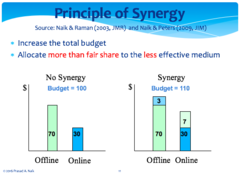 | 122 |
| 4066304888 | a channel | Main Functions
- Financing
--- Convert Goods to Cash to Goods
- Servicing
--- Wholesaler: Lot Size
--- Retailer: Product Assortment |  | 123 |
| 3765357348 | Two-sided market | Network markets comprised of two distinct categories of participant, both of which that are needed to deliver value for the network to work (e.g., video game console owners and developers of video games, credit card companies) |  | 124 |
| 4066315881 | Platform Marketing | Mall
iPhone | | 125 |
| 4066322486 | Types of Analytics | Descriptive
Predictive
Prescriptive |  | 126 |
| 4066328203 | Predictive Analysis | A systematic approach to evaluate the effectiveness of managers' actions on market outcomes
Actions?
- Elements of marketing mix
---- Advertising, Promotion, Price, Distribution, etc.
- Outcomes?
---- Elements of market consequences
Awareness, Sales, Market shares, Earnings, Stock returns, etc. | | 127 |
| 4066332921 | Ad Elasticity | Awareness = past + effort +/- chance | | 128 |
| 4066335705 | Lambda | carryover effect / Loyalty
(1 - lambda)
forgetting rate / churn | | 129 |
| 4066343347 | Optimal Spend | X* = optimal spend, m = margin (assume 8000), rho = discount rate (assume 12% annum = 0.12/52 per week), and effectiveness beta and carryover lambda as estimated via regression analysis. |  | 130 |
| 4066350970 | Swim Lane Marketing | Backward-looking approach that treats advertising touch points as if each works in isolation | | 131 |
| 4066359188 | Optimizing Advertising | |  | 132 |
| 4066365238 | Samsung M-Net | Overinvestment in N. America & Russia
Underinvestment in Europe & China
Overinvestment in Mobile Phones, Vacuums, & ACs | | 133 |
| 4066373469 | Overcoming Resistance to change | Avoid Robot Reallocation
Personally meet with managers
Set lower targets for managers who will be losing funds and vice versa | | 134 |