AP Notes, Outlines, Study Guides, Vocabulary, Practice Exams and more!

AP Literature Study Guide, the Literature Flashcards

Terms : Hide Images
5679339591The IliadAuthor: Homer Genre: an Epic Main Theme: Message:0
5679339592The Epic of GilgameshAuthor: Unknown Genre: Epic Main Theme: Message:1
5679339593Sir Gawain and the Green KnightAuthor: Pearl Poet Genre: Medieval Romanticism Main Theme: Message:2
5679339594The Passionate Shepherd to his LoveAuthor: Christopher Marlowe Genre: Pastoral Main Theme: Message:3
5679339595MichaelAuthor: William Wordsworth Genre: Pastoral Main Theme: Message:4
5679339596Ode to a NightingaleAuthor: John Keats Genre: Main Theme: Message:5
5679339597King LearAuthor: Shakespeare Genre: Main Theme: Message:6
5679339598Kuala KhanAuthor: Samuel Taylor Colerige Genre: Main Theme: Message:7
5679339599Rime of the Ancient MarinerAuthor: Samuel Taylor Colerige Genre: Main Theme: Message:8
5679339600Oedipus RexAuthor: Sophocles Genre: Main Theme: Message:9
5679339601The MetamorphosisAuthor: Franz Kafka Genre: Main Theme: Message:10
5679339602Lines Composed a Few Miles Above Tintern AbbeyAuthor: William Wordsworth Genre: Main Theme: Message:11

HOWIE AP LANGUAGE FINAL EXAM SEMESTER 1REVIEW Flashcards

Terms : Hide Images
3483391489ANALOGYa comparison between two things, typically on the basis of their structure and for the purpose of explanation or clarification0
3483393415GENERALIZATIONa general statement or concept obtained by inference from specific cases1
3483393416ALLUSIONan expression designed to call something to mind without mentioning it explicitly; an indirect or passing reference2
3483395751METAPHORa figure of speech in which a word or phrase is applied to an object or action to which it is not literally applicable3
3483395752TONEthe general character or attitude of a place, piece of writing, situation4
3483516475THESISa statement or theory that is put forward as a premise to be maintained or proved5
3483516476MODIFIERa word, especially an adjective or noun used attributively, that restricts or adds to the sense of a head noun6
3483518933HYPERBOLEexaggerated statements or claims not meant to be taken literally7
3483518934PARALELLISMthe use of successive verbal constructions in poetry or prose that correspond in grammatical structure, sound, meter, meaning, etc.8
3483518950CONTEXTthe circumstances that form the setting for an event, statement, or idea, and in terms of which it can be fully understood and assessed9
3483522092PARADOXa statement or proposition that, despite sound (or apparently sound) reasoning from acceptable premises, leads to a conclusion that seems senseless, logically unacceptable, or self-contradictory10
3483648096IRONYthe expression of one's meaning by using language that normally signifies the opposite, typically for humorous or emphatic effect11
3483648097SATIREthe use of humor, irony, exaggeration, or ridicule to expose and criticize people's stupidity or vices, particularly in the context of contemporary politics and other topical issues.12
3483650880SIMILEa figure of speech involving the comparison of one thing with another thing of a different kind, used to make a description more emphatic or vivid13
3483650881MONOLOGUEa long and typically tedious speech by one person during a conversation14
3483650882DICTIONthe choice and use of words and phrases in speech or writing15
3483653748SYNTAXthe arrangement of words and phrases to create well-formed sentences in a language16
3483680220UNDERSTATEMENTthe presentation of something as being smaller, worse, or less important than it actually is17
3483684377ONOMATOPOEIAthe formation of a word from a sound associated with what is named18
3483684378ALLEGORYa story, poem, or picture that can be interpreted to reveal a hidden meaning, typically a moral or political one19
3483685938FOOTNOTEan ancillary piece of information printed at the bottom of a page20
3483685939SYMBOLISMan artistic and poetic movement or style using symbolic images and indirect suggestion to express mystical ideas, emotions, and states of mind.21
3483685940ANECDOTEa short and amusing or interesting story about a real incident or person22
3483688101ETHOSethical appeal, establishing credibility23
3483688102PATHOSappealing to an audience's emotions24
3483688103LOGOSusing logic and good reason to appeal to the audience25
3483694044EUPHEMISMa mild or indirect word or expression substituted for one considered to be too harsh or blunt when referring to something unpleasant or embarrassing26
3483694045ANAPHORAthe repetition of a word or phrase at the beginning of successive clauses.27
3483806327MORALITYprinciples concerning the distinction between right and wrong or good and bad behavior28
3483806328PRETENTIOUSattempting to impress by affecting greater importance, talent, culture, etc., than is actually possessed29
3483809899SOLEMNITYthe state or quality of being serious and dignified30
3483816131GLIBLYinsincere and shallow31
3483819253EFFUSIVEexpressing feelings of gratitude, pleasure, or approval in an unrestrained or heartfelt manner32
3483819254ALOOFnot friendly or forthcoming; cool and distant33
3483819255CYNICALbelieving that people are motivated by self-interest; distrustful of human sincerity or integrity34
3483823139ECCENTRICITY(of a person or their behavior) unconventional and slightly strange35
3483823140CADENCEa modulation or inflection of the voice36
3483823141TACTadroitness and sensitivity in dealing with others or with difficult issues37
3483828607CIRCUMLOCUTIONSthe use of many words where fewer would do, especially in a deliberate attempt to be vague or evasive38
3483828608STRIDENTloud and harsh; grating39
3483828609PEDANTICdescribing a person who is excessively concerned with minor details and rules or with displaying academic learning.40
3483830818INSULARignorant of or uninterested in cultures, ideas, or peoples outside one's own experience:41
3483832649JUDICIOUShaving, showing, or done with good judgment or sense42
3483834659DOUBLE ENTENDREa word or phrase open to two interpretations, one of which is usually risqué or indecent43
3483834660CONCILIATORYintended or likely to placate or pacify44
3483838455CAPRICIOUSgiven to sudden and unaccountable changes of mood or behavior45
3483838456INTIMATEclosely acquainted; familiar, close46
3483840881INSIDIOUSproceeding in a gradual, subtle way, but with harmful effects47
3483843542IMPORTUNATEask (someone) pressingly and persistently for or to do something48
3483843543REVERENTfeeling or showing deep and solemn respect49
3483843544EVOCATIONbring or recall to the conscious mind50
3483845573POIGNANTevoking a keen sense of sadness or regret51
3483845574FEIGNEDpretend to be affected by (a feeling, state, or injury)52
3483851221IDOLATROUSworshiping idols53
3483855440CONCRETEexisting in a material or physical form; real or solid; not abstract54
3483858801ALLUSIVE(of a remark or reference) working by suggestion rather than explicit mention55
3483858802GENUFLECTIONSlower one's body briefly by bending one knee to the ground, typically in worship or as a sign of respect56
3483862112ACERBIC(especially of a comment or style of speaking) sharp and forthright57
3483865828INIMITABLEso good or unusual as to be impossible to copy; unique58
3483865829ABSTRACTexisting in thought or as an idea but not having a physical or concrete existence:59

AP English Literature Flashcards

Terms : Hide Images
3708567788The irony of this poem is that (U1)the good times mentioned are hard times for the middle class0
3708573108A theme of Lucille Clifton's "good times" is that (U1)life is transient1
3708577800The first 6 lines of the poem are examples of (U1)enjambment2
3708582592What is the tone of "good times"? (U1)sincere enthusiasm3
3708587206Line 2 "and the insurance man is gone" implies that (U1)the family had been behind on their payments the family has caught up on their payments4
3708596532Who is the speaker of this poem? (U1)child5
3708600002The last lines of the poem "oh children think about the good times" implies that (U1)life is ephemeral, containing fleeting moments6
3708608074Lines 4 and 5 "and my uncle Brud had hit for one dollar straight means that (U1)the numbers he used one the lottery, and he made some money from it.7
3708616268The poet uses repetition in this poem to suggest that (U1)one should savor the good times while they're here8
3708621132Stanza 1 (U1)states the causes for celebration9
3708622643Stanza 2 (U1)presents the celebration10
3708691882Which phrase is pessimistic in tone? (U1)"foreign dirt still on our soles" (line 3)11
3708698742America described as "this free country" in the final line is an example of (U1)irony12
3708702308In lines 75-76 Alvarez writes, "One by one I imagined the houses / sinking into their lawns." What does she acknowledge with this? (U1)America is a nation of immigrants.13
3708712273Why is the dialogue between the mother and the neighbor included in the poem? (U1)It shows the mother's good manners.14
3708716053Alvarez uses the image of the police car a number of times in the poem. What does this do for the atmosphere of the poem? ((U1)It illustrates the emotional tension of the time period.15

Multiple Choice Language (AP) Flashcards

Terms : Hide Images
5834401584niveaulevel0
5834401585camionettesminivan1
5834401586sondagessurveys2
5834401587croissanteincreasing3
5834401588seinbreast4
5834401589pâtéblock5
5834401590chiffrerfigure6
5834401591en traductionin translation7
5834401592déréalisationbecoming less of a fact8
5834401593diglossiehaving two languages9
5834401594parmiamong10
5834401595chômageunemployment11
5834401596prestationsloans12
5834401597d'aprèsaccording to13

Chapter 14 - AP WORLD HISTORY Flashcards

Terms : Hide Images
3599469923Where was the Islam & Spice Trade located?At the important commercial city called Malacca0
3599470474What were the Spice Islands called?Moluccas1
3599471621Why was Malacca valuable?Important commercial city connected to China and Islamic worlds2
3599478826Who was the kingdom(of the spice trade) important to?to Islamic expansion in the region3
3599483204What famous admiral lived the Ming Dynasty?Admiral Zheng He4
3599484201What happened to Admiral Zheng He's voyages?Cut off abruptly5
3599490257Motives for early European Exploration?1. Monarchs had authority & resources to expanded/explore 2. Muslim merchants sold goods at outrageous prices (wanted spices, precious metals) 3. Motives: Gold, God, Glory (3 G's)6
3599498873What were advances of technology used during European Expansion?1. Astrolabe - 1532 2. Sextant 3. Mariner's Compass 4. Accurate maps 5. Knowledge of wind patterns7
3599502759Describe the technology of the Caravel?1. Large cargo area 2. Improved rudder to turn easily 3.Triangular sail (Lateen) to SAIL AGAINST THE WIND 4. Canons (recent European technology)8
3599513214Who were the principle navigators of PORTUGAL?1. Prince Henry the Navigator 2. Bartolomeu Dias 3. Vasco de Gama 4. Alfonso de Albuquerque9
3599521823Describe Prince Henry the Navigator?1. In 1419 - Founds navigational school 2. Explored western coast of Africa (established trading posts) looking for gold 3. Brought slaves to Portugal to sell 4. Stone forts on the coast of Africa 5. 1419-146010
3599531032Describe Bartolomeu Dias's accomplishments1. Rounds Cape of Good Hope 2. Round Africa for the first time 3. 1487 - 148811
3599532034Describe Vasco de Gama's accomplishments1. Arrives in Calicut, India (1498) 2. Direct route to India (wanted to destroy Arab shipping and establish a monopoly on spice trade)12
3599536749Describe Alfonso De Albuquerque's accomplishments?1. Set up port facilities at GOA, which became headquarters for Portuguese operations in the region (in 1510) 2. Attacker Malacca (in 1511), killed local Arab populations, provided a way station on the route to Spice Islands13
3599553363Describe Portugal's Expansion?1. Use of naval technology gave them advantage 2. Numerous trading posts, substantial profits, seized control of spice trade 3. Lacked power, population, and desire to colonize Asia14
3599558019Describe Christopher Columbus's voyages?1. Thought to get to Asia by sailing west, not around Africa 2. Financed by Queen Isabella 3. Set sail August1492 and lands October 12, 1492 4. Believed he reached Asia 5. 4 Voyages total15
3599564230Who was Ferdinand Magellan and what did he accomplish?1. Spanish explorer 2.1st known circumnavigation of the world 3. Dies in Philippines 4. Strait named after him (S. America) 5. 1519 - 152216
3599566015What was Treaty of Tordesillas and its significance?1. Divided the New World into two spheres of influence 2. Land west of the Line of Demarcation was reserved for Spanish, and land east of the line for the Portuguese17
3599586131Who was Jacques Cartier?1. French (1534) 2. Looking for route to Pacific through North America (NW Passage) 3. Did NOT find one 4. Named the region CANADA18
3599592179Who was Sir Francis Drake?1. British 2. 2nd expedition to sail around the world 3. 1577-158019
3599594370What does Mesoamerica consist of?Mexico and Central America20
3599594616Who were the Amerindians?Indigenous peoples of the Americas21
3599595825Describe the Mayan civilization1. Influenced by Olmec 2. Date: 300 CE - 800 CE 3. Yucatan Peninsula 4. Temples, pyramids 5. City-states 6. Agriculture 7. Calendars22
3599601430Describe the Aztec civilization1. Origins: Early 1100s 2. Capital: Tenochtitlan (Island) 3. Temples, causeways 4. Aqueduct (15th c) 5. Loose political organization, self-governing territories that paid tribute to Aztec ruler23
3599604061Describe the Inca civilization1. Origins: Late 14th c 2. Influenced by the Chavin 3. Centralized government 4. Road system, bridges 5. Quipu (writing)24
3599606669How were Conquistadors successful?1. Superior military technology 2. Help from Natives 3. Immunity to diseases like smallpox25
3599609625Who was the conquistador of the Aztec?Hernan Cortes26
3599610587Describe the conquest of the Aztecs1. 1519 - 1521 2. 550 men 3. Seized Montezuma 4. Destroyed Aztec temples, leveled pyramids 5. Hernan Cortes27
3599613390Who was the conquistador of the Inca?Francisco Pizarro28
3599614898Describe the conquest of the Inca?1. 1530 -1535 2. 180 Men 3. Seized Atahualpa 4. Captured Cuzco. establish Spanish capital at Lima 5. Francisco Pizarro29
3599616586What was the Columbian Exchange?The transfer of peoples, animals, plants, and diseases between the New and the Old Worlds30
3599617444What did the Columbian Exchange result from?From the European invasions of the 15th and early 16th centuries31
3599619805What are other exchanges similar to the Columbian Exchange?1. The Islamic Exchange 2. The Mongol Exchange32
3599621271How had the Columbian Exchange affect other exchanges.1. Intensified exchange where it was already happening 2. Columbian exchange inaugurated exchange where it did not previously happen33
3599627939What were demographic changes of the Columbian Exchange?1. Disease -1st and most significant -Historians claim anywhere from 0 to 80 percent perished (from 22-50 million to 4.5 million) -Inca: 9 million to 600,000 -SMALLPOX/MEASLES/TYPHUS/INFLUENZA -UNEQUAL IN TERMS OF TRANSMISSION OF DISEASE34
3599610564New World to Old World Exchanges:1. Tobacco 2. Corn 3. Potato 4. Avocado 5. Beans 6. Pumpkin35
3599635266Old World to New World Exchanges:1. Sugar Cane 2. Disease - Smallpox, influenza, typhus, measles, malaria, diphtheria, whooping cough 3. Livestock -cattle, sheep, pig, horse 4. Grains - Wheat, rice, barely, oats36
3599636791What were environmental changes that occurred during the Columbian Exchange?PLANTS 1. Maize: to Old World (more food per acre than wheat 2. Potatoes: -From Peru -Spain, Ireland, Poland, Russia grow potatoes 1st -Balanced nutrition -Does not need to be harvested, stored37
3600253473Who grew potatoes first?Spain, Ireland, Poland, Russia38
3600259946What were the three other environmental changes after Maize and Potatoes? And impact?1. Indigo - make dyes 2. Tobacco - psychological impact 3. Sugar Cane - staple of plantations, reasons for slavery39
3600265694Where did Sugar Cane come from?1. New World brought Sugar Cane to Old World when it became a staple crop - Derived from Indonesia40
3600274584What were the environmental changes concerning animals from the Columbian Exchange?ANIMALS 1. Horses ( by 1700, 50 million wild horses in S. America, N. Mexico, SW USA) 2. Great Plains Native Americans captured and used horses 3. Bison hunting from horseback41
3600278800What is the Conquest and Colonization Cycle?1. Explorers 2. Conquistadores 3. Missionaries 4. Permanent Settlers 5. Official European Colony42
3600285801Who were VICEROYS? and describe.King's representative in the New World -Operated fairly independently43
3600288567What were AUDIENCIAS?Special courts to review the Viceroys' decisions44
3600297470Where were governments set up during colonial administration in South America?In urban areas, large bureaucracies45
3600299695What was the goal of colonial administration in South America?Gold, God, Glory46
3600303504Why did Jesuits arrive during colonial administration in South America?To promote Catholic Reformation47
3600306283What did Franciscans do?Take care of the poor48
3600316017Was setting up missions a goal during colonial administration during South America?Yes49
3600317283What had living in the countryside done to priests/Jesuits?Began to feel sympathetic to Amerindians, eventually protested Spanish exploitation50
3600321425Where was the Spanish's major source for SILVER?Peru and Mexico51
3600326271What was the Encomienda System?Gave encomenderos right to force natives to work in their mines or fields. In return, Spanish look after well being of workers (conversion)52
3600331050Who were ENCOMENDEROS?Spanish settlers53
3600333137When had the Encomienda System been placed in South America?Before colonial administrative system had be developed54
3600337622What had the Spanish settlers claimed about the encomienda system?Would benefit both settlers and Indians55
3600340018What was the PLAN of the encomienda system?1. Spanish settlers protect, car for, and Christianize Indians 2. Indians work a portion of their time for Spanish settlers56
3600341765What was the REALITY of the Encomienda System?1. Spanish settlers force long labor, don't pay Indian workers, fail to protect Indians, and seize Indian lands 2. Indians die from disease and harsh living and working conditions57
3600345217When does the Encomienda System end?After clergy protests and Indians revolt58
3600348200How do abuses from the Spanish settlers continue against Indians after the Encomienda System ends?Under replacement Repartimiento (a colonial forced labor system imposed upon the indigenous population of Spanish America- in replacement of the encomienda system)59
3600356661Who was Father Bartolome de Las Casas? and his significance?1. -Convinced Spanish King to pass new laws in 1542, that Natives are to be considered free -no free labor could be demanded60
3600359102How had the New Laws of 1542 resulted from? And then what happened to these laws?From a civil war in Peru - Spanish king had to water-down laws by 155261
3600366999What was the purpose of the New Laws of 1542?Wanted to weaken the New World elite62
3600519944Who did the encomienda system respond to?The crown, Not hereditary63
3600523835Due to what caused too few workers to functions on colonial plantations in South America?Disease and mines64
3600527383What were HACIENDAS? Describe them. What did they replace?Large landed estates, with workers who earned wages for certain number of weeks of work 1. Replaced plantations65
3600533714What is a REPARTIMIENTO?Where a certain percentage of local population could be subject to labor in mines or in fields if such labor could provide country with essential food/goods66
3600567677Describe the Colonial Class System and the positions.1. Peninsulares - born in Spain and Christian 2. Creoles - Spanish born in New World 3/4.Mestizos - One Spanish parent and One Indigenous parent 3/4.Mulattos - One African parent and One Spanish parent 5. Native Indians & Black Slaves67
3600577055What does the term CASTAS mean? and provide example"Middle level status" 1. An Iberian word meaning "lineage", "breed", or "race" 2. Derived from the older Latin word "castus", "chaste", implying that the lineage has been kept pure . Mestizos and Mulattos68
3600585823When do Casta Paintings dat to?18th century colonial Mexico69
3600588531When was the value of Gold and Silver at its highest?1596 - 160070
3600591833What is another name for the Great Circuit of the Atlantic?The Triangular Trade71
3600593134Describe the Great Circuit of the Atlantic1. Sugar, tobacco, and cotton to Europe 2. Textiles, rum, and manufactured goods to Africa 3. Slaves to the Americas72
3600599150Where had the slaves from Africa, during the Trans - Atlantic Slave Trade, been sent mostly to?The Caribbean and Brazil73
3600602866Did the Slave Trade exist in Africa before the coming of the Europeans?Yes74
3600607274With whom did the Portuguese replace European slaves with?Africans75
3600611744Why had the African slaves been brought to the New World?Sugar cane and for Sugar plantations76
3600613285When was the FIRST boatload of African slaves brought by the Spanish?151877
3600614698How many other enslaved Africans were exported to other countries.275,00078
3600616865How many African slaves were shipped to the Americas, between the 16th and 19th centuries?11 million slaves79
3600618892What is the name of the part of the Triangular Trade where African slaves were sent on to the New World?The Middle Passage80
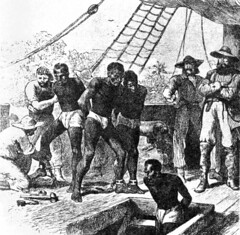
3600625967What was the position slaves were put in below deck?"Coffin Position"81
3600629235WHAT WERE THE IMPACTS OF EUROPEAN EXPLORATION?1. Native populations ravaged by disease 2. Influx of gold, and especially silver, into Europe created an inflationary economic climate -"Price Revolution" 3. New products introduced across the continents - "Columbian Exchange" 4. Deepened colonial rivalries82
3600641886What was the "Price Revolution"?Influx of gold, and especially silver, into Europe creating an inflationary economic climate83
3600646370What were the key colonies of England exploration and when?1. Roanoke (1585) 2. Jamestown (1607) - Tobacco 3. Plymouth (1630) - Pilgrims (Separate from Church of England) 4. Massachusetts (1630) - Puritans seeking religious freedom (purify the Church)84
3600650696What is a Joint Stock Company? and an exampleOrganization created to pool the resources of many merchants, thereby distributing the costs and risks of colonization and reducing the danger for individual investors 1. Jamestown (1607)85
3600658097What part of English society were most Colonists fromMiddle-class86
3600680113Describe different roles/jobs colonists had.Farmers, artisans, indentured servants87
3600682524Who were indentured servants?88
3600684303Describe the type of governments in the New World under England control.Local and independent89
3600686140Describe relationship between English and indigenousInitially friendly, however go worse90
3600690463Describe King Philip's War?1. 1675 - 1676 2. Started by Metacom who attacked colonial villages in Massachusetts 3. Colonists win after 1 year of fighting91
3600709933How were both British and Spanish Settlement the SAME?Women did not escape class/social restrictions, conflict with the indigenous, slavery in the agricultural southern colonies, established for profit92
3600719102How were the British and Spanish settlers differ in their Staple Crops?1. Tobacco was a leading export = for the British 2. Silver, followed by Sugarcane = for the Spanish93
3600723189Compare the BUREAUCRACIES of the British and Spanish1. British: No elaborate bureaucracy, instead they had representative assemblies, taxed themselves -"Salutary neglect" 2. Spanish: Elaborate bureaucracy, viceroys, no representative government94
3600746859Compare Religious Interests in the New World between the British and Spanish1. British: Protestant England not concerned about spreading religion 2. Spanish: sent Missionaries, missions95
3600753055Compare the Population between British and Spanish1. British: Large population, limited intermarriage 2. Spanish: Slower population growth, multiracial society96
3600818209Compare the Purpose of British and Spanish settlers1. British: Puritans, Quakers sought to escape old European society 2. Spanish: Settlers sought to recreate Spanish Society97
3600843731Compare the issues of Rule over the New World Settlements between the British and Spanish1. British: conflict between Catholics and Protestants, rise of a merchant class, emergence of Parliament to check king's power 2. Spanish: Catholic, authoritarian98
3600850403Where had the Dutch explored in the New World? And who explored for the Dutch?1. New York 2. Explored by Henry Hudson in 160999
3600855003What were the names of the Dutch colonies? And who they governed by?1. Colony became "New Netherlands" -Governed from New Amsterdam100
3600864699How were the colonists attracted to the Dutch colony?Slow to attract101
3600865584Describe the Dutch colonyEthically and Religiously diverse102
3600866993When had the Dutch colony been captured?In 1664103
3600869022Describe the East India CompaniesJoint stock companies are given the power to make war, govern conquered people, monopolize trade104
3600874743Who seized Malacca, Indonesia after Portugal had seized it from the Muslims?The Dutch105
3600910163Where had the British established trading settlements?At Calcutta, Bombay, Madras106
3600932679What was the first French colony and when was it colonized?1. Samuel de Champlain 2. Founded in 1608 3. Island founded by Cartier107
3600950498What waterways did France follow to further explore North America?1. St. Lawrence 2. Great Lakes 3. Mississippi108
3600962177Where else did France have territory, not discussing upper North America? And what became France's staple crops there?1. Territory in Caribbean 2. Tobacco and Sugar109
3600966333Who did France have conflict with?The British110
3600968493What occurred in the Seven Years' War and how long did it last?1. 1756 -1763 2. France lost Canada 3.England in control of East coast111
3600983830Compare the French and Spanish's relations with Natives1. France: Respectful relations with Natives, forged alliances with Native Americans who sided with French in Seven Years' War 2. Spanish: Viewed indigenous as savage, needing to be Christianized and controlled112
3600990461Compare France and Spain's Trade/Staple crops1. Fur trade was most lucrative (produce great deal of profit) 2. Silver, followed by Sugarcane113
3601002240How had both France and Spain settlement been similar?Slow population growth, no elaborate bureaucracy, both were subject to crown, home countries were Catholic and authoritarian, had colonies in the Caribbean which relied on slavery114
3601012859Who were Privateers?Acted on behalf of the government, attacked merchant ships sank/robbed them115
3601015987Describe PiratesNot licensed by any government -Blackbeard116

AP World history 19 Flashcards

Terms : Hide Images
4277568657Boxer UprisingRising of chinese militia organizations from 1898-1901 in which large numbers of Europeans0
4277568658Unequal treatiesSeries of 19th century treaties in which China made major concession1
4277568659Taiping uprisingMassive Chinese rebellion that devastated much of the country b/t 1850-1864 based on Hong Xiuquan2
4277568660Young TurksMovement of Turkish military and civilian elites that developed around 1900 eventually bringing down the Ottoman Empire3
4277568661Informal empireTerm commonly used to describe areas that were dominated by west powers in 19th century but retained their own governments and a measure of independence4
4277568662Lin XexuRoyal official charged with ending the opium trade in canton his efforts to destroy opium imports provoked the opium wars5
4277568663TanzimatImportant reform measures undertaken in the Ottoman Empire beginning in 1839 means reorganization6
4278259419Meiji restorationOverthrow of the Tokugawa shogunate of Japan in 1868 restoring power at the long last to emperor Meiji and establishing a new government committed to saving Japan from foreigners7
4278259420Opium warsTwo wars fought b/t western powers and China after China tried to restrict import of goods8
4278259421Tokugawa JapanPeaceful Japan as governed by a shogun from the Tokugawa family9
4279150544Russo-Japanese War1904-05 ending in a Japanese victory this war established Japan as a formidable military competitor in east Asia10
4279163079Self-Strengthening movementChina's program of internal reform in the 1860s and 1870s based on vigorous application of Confucian principles and limited borrowing from the West11
4279176865Chinese Revolution of 1911collapse of China's imperial order officailly at the hands of organized revolutionaries but for most part under the weight of the troubles that had overwhelmed the government for the previous 50 years12
4279193349Edward Blydenprominent West African scholar and political leader who argued that each civilization including that of africa has its own unique contribution to make the world13
4279210222Cash-crop agricultureagriculture production of crops for sale in the market rather than just for consumption by the farmers14
4279225110Indian Rebellionmassive uprising from 1857-58 of much of India against British rule15
4279232490Scramble for Africaname used for the process of the European countries partition of the continent of Africa b/t themselves from 1875-190016
4279242259Colonial tribalisma European tendency epecially in African Tendencies to identify and sometimes invent distinct tribes that had often not existed before17
4279253489European racismnew kind of racism that emerged in the 19th century that increasingly used the prestige and apparatus of science to support European racial prejudices18
4279263215Africaninzation of Christianityoccurred in non Muslim Africa millions who were converted to Christ sought to maintian older traditions19
4279276964Western educated elitemain beneficiaries in asian and african lands colonized by western powers schooled in imperial methods led anticolonial movements20
4279294985Congo free stateLeopold II was king of belgium from 1865-1909 his rule is held up as the worst abuse of europe's 2nd wave of colonization21
4279307823Cultivation systemsystem of forced labor used in the netherlands east indies in the 19th century peasant were forced to cultivate their own land22
4279325734Increasing discontent with rule propelled reformist and revolutionary movementscolonial23
4279332777Intellectuals critiqued the role that played in public life insisiting on the importance ofreligion/reason24

AP Spanish Language - Expresiones Flashcards

Terms : Hide Images
7290946558a partir debeginning with0
7290946559al principioat the beginning1
7290946560como punto de partidaas a starting point2
7290946561en primer lugarin the first place3
7290946562en segundo, tercer lugarin the second, third place4
7290946563para empezar/comenzarto begin5
7290946564primerofirst6
7290946565a causa deon account of, because of7
7290946566a mi parecerin my opinion8
7290946567a pesar de todoin spite of everything9
7290946568actualmentepresently10
7290946569ahora mismoright now11
7290946570al considerarupon considering12
7290946571claroof course13
7290946572comoas in, as much as, since14
7290946573de ninguna maneraby no means15
7290946574de todos modosat any rate16
7290946575en cuanto aregarding, with respect to17
7290946576en la actualidadpresently18
7290946577en realidadactually19
7290946578en vista de queconsidering that20
7290946579es cierto queit is true that, it is certain that21
7290946580es seguro queit is certain that22
7290946581hace pocoa short while ago23
7290946582hasta el momento, hasta la fechauntil now24
7290946583hay que tomar en cuenta queone must realize that25
7290946584hoy díanowadays26
7290946585la verdad es quethe truth is that27
7290946586lo esencialwhat is essential is that28
7290946587lo importantewhat is important is that29
7290946588lo que importa es quewhat matters is that30
7290946589sin dudawithout a doubt31
7290946590sobre todoabove all32
7290946591además (de)furthermore, in addition33
7290946592a la (misma) vezat the same time34
7290946593ademásbesides, furthermore35
7290946594al mismo tiempoat the same time36
7290946595asimismolikewise37
7290946596bastaría poner un ejemplohere is an example38
7290946597con respecto awith respect to39
7290946598conforme aaccording to40
7290946599constar queto make known that, to certify that41
7290946600de aquí (ahora, hoy) en adelantefrom now on42
7290946601de hechoin fact43
7290946602el caso es quethe fact is that44
7290946603el hecho de quethe fact that45
7290946604en otras palabrasin other words46
7290946605entoncesthen47
7290946606es decir (que)that is to say, in other words48
7290946607específicamentespecifically49
7290946608igualmenteequally50
7290946609las razones por las quethe reasons for which51
7290946610mientras tantomeanwhile52
7290946611o seathat is to say, in other words53
7290946612para continuarto continue54
7290946613para ejemplificarto exemplify55
7290946614para ilustrarto illustrate56
7290946615por añadiduraas well, besides, in addition57
7290946616por esotherefore58
7290946617por ejemplofor example59
7290946618principalmentefirstly, especially60
7290946619mientraswhile61
7290946620mientras tantomeanwhile, in the meantime62
7290946621para continuarto continue63
7290946622tambiénalso64
7290946623tampoconeither, nor either65
7290946624al contrario dein contrast to66
7290946625ambosboth67
7290946626a pesar de quein spite of the fact that68
7290946627aunquealthough69
7290946628comosince, given that70
7290946629dado quegiven that, since71
7290946630de la misma manerain the same way72
7290946631de lo contrariootherwise73
7290946632de otro modoon the other hand74
7290946633en cambioon the other hand75
7290946634en vez deinstead of76
7290946635es cada vez másit is increasingly, every time is more77
7290946636igualmentesimilarly78
7290946637no obstantehowever, nevertheless79
7290946638perobut80
7290946639por la mayor partefor the most part81
7290946640por motivo quefor the reason that82
7290946641por otro ladoon the other hand83
7290946642por un ladoon one hand84
7290946643sin embargohowever, nevertheless85
7290946644sinobut86
7290946645sino quebut rather87
7290946646tanto mejorall the better, even better88
7290946647tanto "X" como "Y"jast as "X....", "Y"89
7290946648a causa de (que)because of90
7290946649al considerarupon consideration of91
7290946650al parecerseemingly, apparently92
7290946651ante estoin light of this93
7290946652ante tal hechoconsidering such a fact94
7290946653así quethus, so, therefore95
7290946654comosince, inasmuch as96
7290946655como consecuenciaas a consequence, result97
7290946656como resultado deas a result of98
7290946657debido aowed to, because of99
7290946658de manera queso that100
7290946659después de queafter101
7290946660en todo casoin any case102
7290946661porbecause of103
7290946662por consiguienteaccordingly, consequently104
7290946663por ese motivofor this reason, that's why105
7290946664por lo mismofor the same reason106
7290946665por lo tantotherefore, hence107
7290946666porquebecause108
7290946667puesto quesince109
7290946668resulta queit results that110
7290946669se debe tomar en cuentaone must take into account that111
7290946670sigue queit follows112
7290946671ya quesince, because, seeing that113
7290946672a fin de cuentasin the end, after all114
7290946673al finfinally, at last, in the end115
7290946674al fin y al caboafter all116
7290946675ante todofirst, first of all117
7290946676de lo anterior, se ve quefrom the above, it is clear that118
7290946677de todas formasin any case, anyway119
7290946678de todo esto se deduce quein conclusion120
7290946679de todos modosat any rate121
7290946680en breveshortly, briefly, in short122
7290946681en conclusiónin conclusion123
7290946682en definitivain conclusion, definitely124
7290946683en finfinally, in short125
7290946684en resumenin summary126
7290946685en resumidas cuentasin short127
7290946686en todo casoin any case, anyway128
7290946687finalmentefinally129
7290946688lo esencial es quewhat is essential is that130
7290946689mejor dichorather, indeed131
7290946690para concluirto conclude132
7290946691para resumirto summarize133
7290946692para terminarto end, to close134
7290946693por finfinally135
7290946694por últimolastly136
7290946695por siguienteconsequently, thus137

AP World History Unit 3 Vocabulary Flashcards

Terms : Hide Images
8095554635EnlightenmentAn intellectual and philosophical movement which dominated the world of ideas in Europe during the 18th century0
8095554636John LockeAn English philosopher and physician, widely regarded as one of the most influential of Enlightenment thinkers1
8095555839Baron de MontesquieuA French lawyer and political philosopher who lived during the Age of Enlightenment and promoted the separation of power in government2
8095555840VoltaireA French Enlightenment writer, historian, and philosopher who advocated freedom of religion, freedom of speech, and separation of church and state.3
8095559602Jean-Jacques RousseauA philosopher, writer, and composer of the 18th century. His political philosophy influenced the Enlightenment and the overall development of modern political and educational thought.4
8095559603Thomas JeffersonOne of the Founding Fathers of the United States and the principal author of the Declaration of Independence.5
8095560456The American RevolutionA colonial revolt that took place between 1765 and 1783 between the 13 colonies and GB.6
8095561153Declaration of IndependenceA document drafted by Thomas Jefferson and adopted by the Second Continental Congress stating the 13 colonies independence from GB7
8095561154The French RevolutionA period of social and political upheaval in France that lasted from 1789 until 1799, and brought down the monarchy8
8095562171Estates GeneralA legislative and consultative assembly of the different classes of French subjects, it functioned as an advisory body to the king.9
8095563881Napoleon BonaparteA French statesman and military leader who rose to prominence during the French Revolution and led several successful campaigns during the French Revolutionary Wars.10
8095569027King Louis XVIThe last King of France before the French Revolution11
8095569028Marie-AntoinetteThe last Queen of France before the French Revolution, and the wife of King Louis XVI12
8095570121Maximilien RobespierreA French lawyer and politician, one of the best known and most influential figures associated with the French Revolution13
8095572331Declaration of the Rights of Man and of the CitizenA document passed by France's National Constituent Assembly in August 1789, it says that the rights of man are held to be universal: valid at all times and in every place, pertaining to human nature itself. It became the basis for a nation of free individuals protected equally by the law14
8095572332Haitian RevolutionA successful anti-slavery and anti-colonial insurrection by self-liberated slaves against French colonial rule in Saint-Domingue15
8095573805Jean-Jacques DessalinesJean-Jacques Dessalines was a leader of the Haitian Revolution and the first ruler of an independent Haiti under the 1805 constitution16
8095573806Gens de couleurA French term meaning "people of color". It was commonly used in France's West Indian colonies17
8095576655Grand blancsThe wealthy white upper class of Saint-Domingue18
8095837612Petit blancsThe poor, white underclass of Saint-Domingue, including artisans and laborers19
8095576656Toussaint LouvertureThe best-known leader of the Haitian Revolution.20
8095577627Simon BolivarA Venezuelan military and political leader who played a leading role in the establishment of Venezuela, Bolivia, Colombia, Ecuador, Peru, and Panama as sovereign states, independent of Spanish rule.21
8095578852Jose de San MartinAn Argentine general and the prime leader of the southern part of South America's successful struggle for independence from the Spanish Empire22
8095578853Latin American RevolutionThe revolutions that took place during the late 18th and early 19th centuries and resulted in the creation of a number of independent countries in Latin America.23
8095580081Miguel HidalgoA Mexican Roman Catholic priest and a leader of the Mexican War of Independence.24
8095580082Abolition of SlaveryThe movement to end slavery by Britain and many of the the countries it pressured to also do so25
8095581256NationalismA political, social, and economic system characterized by promoting the interests of a particular nation, particularly with the aim of gaining and maintaining self-governance26
8095581257SuffrageThe right to vote in public, political elections and/or to run for public office27
8095581258Olympe de gougesA French playwright and political activist whose feminist and abolitionist writings reached a large audience28
8095582493Vindication of the Rights of WomenWritten by the 18th-century British proto-feminist Mary Wollstonecraft, it is one of the earliest works of feminist philosophy29
8095583944Abigail Scott DuniwayAn American women's rights advocate, newspaper editor and writer, whose efforts were instrumental in gaining voting rights for women30

AP Literature Unit 19 Vocabulary Flashcards

Terms : Hide Images
5299641982ab ovoLatin "from the egg"; narrative that starts at the beginning of the plot and then moves chronologically through events to the tale's conclusion; opposite of in medias res where earlier events are explained via dialogue, memories, or flashbacks0
5299641983ameliorationsemantic change in which a word gains increasingly favorable connotation (Ex. Middle English word "knight" used to mean servant. The word grew through amelioration to mean "a servant of the king" and later "a minor nobleman.")1
5299641984pejorationsemantic change in which a word gains increasingly negative connotation (Ex. "lewd" originally referred to laymen as opposed to priests. It underwent pejoration to mean "ignorant," then "base" and finally "obscene.")2
5299641985descent into the underworldan archetype or motif in folklore, religion, mythology, or literature in which the protagonist must descend into the realm of the dead (usually located beneath the earth) and then return to the realm of the living, often after rescuing a trapped soul or seeking the advice of the dead (Ex. Dante's Inferno)3
5299641986single effect theoryEdgar Allan Poe's theory about what constituted a good short story. According to Poe, a good short story achieved its unity by achieving a single emotional effect on the reader.4
5299641987spiritual autobiographyautobiography that focuses on an individual's spiritual growth; plot focuses on narrator's inner struggles, move from pre-religious life to a psychological crisis followed by a conversion; often concludes with a call for readers to convert (Ex. Saint Patrick's Confession and Saint Augustine's Confessions.)5
5299641988meditationthoughtful or contemplative essay, sermon, or discussion, especially one that encourages introspection and self-analysis (Ex. In John Donne's "Meditation 17," Donne explores what death means if we truly believe that all human beings are interconnected spiritually.)6
5299641989Renaissance(rebirth) period of cultural and artistic change in Britain during the late 1500s and early 1600s; rediscovering of classical Greco-Roman culture and break with the days of "ignorance" and "superstition" as represented by the medieval period7
5299641990Medieval Period("the in-between age") period of time roughly 1000 years between the fall of the Roman Empire and the Renaissance; marked by the end of Greco-Roman culture, move of Germanic tribes to western Europe, and conversions to Christianity; time of innovative technology, economic growth, and original theology and philosophy; linked with feudalism, monasticism, guilds, castles and knights8
5299641991Utopian literaturefrom Greek ("no" + "place") suggests an ideal society yet an impossible one; presents the reader with a perfect society in the physical world as opposed to a perfect society existing in the afterlife (Ex. Plato's Republic)9

AP Literature Terms Flashcards

Terms : Hide Images
7657571997AlliosisPresenting alternatives: "You can eat well or you can sleep well." While such structure often results in the logical fallacy of the false dichotomy or the either/or fallacy, it can create a cleverly balanced and artistic sentence.0
7657572001AmplificationA rhetorical figure involving a dramatic ordering of words, often emphasizing some sort of expansion or progression, whether conceptual, valuative, poetic, or even with regard to word length. "It's a bird, it's a plane, it's Superman!"1
7657572002AnacoluthonIntentional disruption of syntax to create intensity, excitement, confusion. "Swear here as before that you never shall note that you know aught of me."2
7657572003AnagnorisisThe moment in a drama when the protagonist discovers something that either leads to or explains a reversal of fortune. Basically, the protagonist gains some crucial knowledge that he or she did not have.3
7657572006AnaphoraAn exact repetition of words or phrases at the beginning of successive lines or sentences, a type of parallelism.4
7657572007AnapodotonDeliberately creating a sentence fragment by the omission of a clause: "If only you came with me!" Good writers never use sentence fragments? Ah, but they can. And they do. When appropriate.5
7657572010AntanaclasisThe stylistic scheme of repeating a single word, but with a different meaning each time. From Shakespeare: "for many a thousand widows/ Shall this his mock mock out of their dear husbands; Mock mothers from their sons, mock castles down." Or, "Police police police."6
7657572013AntimetaboleRepetition in reverse order: "One should eat to live, not live to eat." Or, "You like it; it likes you." The witches in Macbeth chant, "Fair is foul and foul is fair."7
7657572015AphorismA concise, pointed, epigrammatic statement that purports to reveal a truth or principle. They can be attributed to a specific person. "All you need is love" (The Beatles). "A rose by any other name would smell as sweet" (William Shakespeare). Once a statement is so widely known that authorship is lost, it is called a proverb. "It takes a village to raise a child." A statement that gives behavioral advice is called a maxim. "The early bird gets the worm."8
7657572029CatachresisA term referring to the incorrect or strained use of a word.9
7657572055EnallageIntentionally misusing grammar to characterize a speaker or to create a memorable phrase. Boxing manager Joe Jacobs, for instance, became immortal with the phrase, "We was robbed!" Or, the editors of Punch magazine might tell their British readers, "You pays your money, and you takes your chances."10
7657572064EpistropheRepetition of a concluding word or endings: "He's learning fast; are you earning fast?" When it focuses on sounds rather than entire words, we normally call it rhyme.11
7657572085HendiadysThe expression of an idea by the use of usually two independent words connected by and (as nice and warm) instead of the usual combination of independent word and its modifier (as nicely warm).12
7657572088Hypallage.Also known as a transferred epithet, is the trope in which a modifier, usually an adjective, is applied to the "wrong" word in the sentence. The word whose modifier is thus displaced can either be actually present in the sentence, or it can be implied logically. The effect often stresses the emotions or feelings of the individual by expanding them on to the environment. Ex: "restless night," "clumsy helmet," "happy morning."13
7657572089HyperbatonA generic term for changing the normal or expected order of words. "One ad does not a survey make." The term comes from the Greek for "overstepping" because one or more words "overstep" their normal position and appear elsewhere. For instance, Milton in Paradise Lost might write, "High on a throne of royal gold . . . Satan exalted sat." In normal, everyday speech, we would expect to find, "High on a throne of royal gold . . . Satan sat exalted."14
7657572104LitotesA trope that involves making an affirmation by negating its opposite. "Not unkind" means "kind." "Not bad" usually means "good."15
7657572116MetonymyThe use of a word or phrase to stand in for something else which it is often physically associated. ie. Hollywood for US cinema, the Crown for UK government, the White House, City Hall.16

Pages

Subscribe to CourseNotes RSS

Need Help?

We hope your visit has been a productive one. If you're having any problems, or would like to give some feedback, we'd love to hear from you.

For general help, questions, and suggestions, try our dedicated support forums.

If you need to contact the Course-Notes.Org web experience team, please use our contact form.

Need Notes?

While we strive to provide the most comprehensive notes for as many high school textbooks as possible, there are certainly going to be some that we miss. Drop us a note and let us know which textbooks you need. Be sure to include which edition of the textbook you are using! If we see enough demand, we'll do whatever we can to get those notes up on the site for you!