AP Notes, Outlines, Study Guides, Vocabulary, Practice Exams and more!

AP US History Chapter 10 -- Launching the New Ship of State Flashcards

1789 -- 1800

Terms : Hide Images
1770927302Bill of Rights (1791)Popular term for the first ten amendments to the US constitution. The amendments secure key rights for individuals and reserve to the states all power s not explicitly delegated or prohibited by the Constitution0
1770927303Judiciary Act of 1789Organized the federal legal system, establishing the Supreme Court, federal district and circuit courts, and the office of the attorney general1
1770927304funding at parPayment of debts, such as government bonds, at face value. In 1790, Alexander Hamilton proposed that the federal government pay its Revolutionary war debts in full in order to bolster the nation's credit2
1770927305assumptionTransfer of debt from one party to another. In order to strengthen the union, the federal government assumed states' Revolutionary War debts in 1790, thereby tying the interests of wealthy lenders with those of the national government.3
1770927306tariffTax levied on imports. Traditionally, manufacturers support tariffs as protective and revenue raising measures, while agricultural interests, dependent on world markets, oppose high tariffs4
1770927307excise taxTax on goods produced domestically. Excise taxes, particularly the 1791 tax on whiskey, were a highly controversial component of Alexander Hamilton's financial program5
1770927308Bank of the United States (1791)Chartered by Congress as part of Alexander Hamilton's financial program, the bank printed paper money and served as a depository for Treasury funds. It drew opposition from Jeffersonian Republicans, who argued that the banks was unconstitutional6
1770927309Whiskey Rebellion (1794)Popular uprising of whiskey distillers in southwestern Pennsylvania in opposition to an excise tax on whiskey. In a show of strength and resolve by the new central government, Washington put down the rebellion with militia drawn from several states7
1770927310Reign of Terror (1793 -- 1794)Ten-month period of brutal repression when some 40,000 individuals were executed as enemies of the French Revolution. While many Jeffersonians maintained their faith in the French Republic, Federalists withdrew their already lukewarm support once the Reign of Terror commenced8
1770927311Neutrality Proclamation (1793)Issued by George Washington, it proclaimed America's formal neutrality in the escalating conflict between England and France, a statement that enraged pro-French Jeffersonians9
1770927312Battle of Fallen Timbers (1794)Decisive battle between the Miami confederacy and the US Army, British forces refused to shelter the routed Indians, forcing the latter to attain a peace settlement with the United States10
1770927313Treaty of Greenville (1795)Under the terms of the treaty, the Miami Confederacy agreed to cede territory in the Old Northwest to the United States in exchange for cash payment, hunting rights, and formal recognition of their sovereign status11
1770927314Jay's Treaty (1794)Negotiated by Chief Justice John Jay in an effort to avoid war with Britain, the treaty included a British promise to evacuate outposts on US soil and pay damages for seized American vessels, in exchange for which Jay bound the US to repay pre-Revolutionary war debts and to abide by Britain's restrictive trading policies toward France12
1770927315Pinckney's Treaty (1795)Signed with Spain which, fearing an Anglo-American alliance, granted Americans free navigation of the Mississippi and the disputed territory of Florida13
1770927316Farewell Address (1796)George Washington's address at the end of his presidency, warning against "permanent alliances" with other nations. Washington did not oppose all alliances, but believed that the young, fledgling nation should forge alliances only on a temporary basis, in extraordinary circumstances14
1770927317XYZ Affair (1797)Diplomatic conflict between France and the United States when American envoys to France were asked to pay a hefty bribe for the privilege of meeting with the French foreign minister. Many in the US called for war against France, while American sailors and privateers waged an undeclared war against French merchants in the Caribbean15
1770927318Convention of 1800Agreement to formally dissolve the United States' treaty with France, originally signed during the Revolutionary War. The difficulties posed by America's peacetime alliance with France contributed to Americans' longstanding opposition to entangling alliances with foreign powers.16
1770927319Alien Laws (1798)Acts passed by a Federalist Congress raising the residency requirement for citizenship to fourteen years and granting the president the power to deport dangerous foreigners in times of peace17
1770927320Sedition Act (1798)Enacted by the Federalist Congress in an effort to clamp down on Jeffersonian opposition, the law made anyone convicted of defaming government officials or interfering with government policies liable to imprisonment and a heavy fine. The act drew heavy criticism from Republicans, who let the act expire in 1801.18
1770927321Virginia and Kentucky Resolutions (1798 - 1799)Statements secretly drafted by Jefferson and Madison for the legislatures of Kentucky and Virginia, Argued that states were the final arbiters of whether the federal government overstepped its boundaries and could therefore nullify, or refuse to accept, national legislation they deemed unconstitutional19
1817072005John AdamsThe second president of the United States, whose Federalist enemies and political weaknesses undermined his administration20
1817072006Alexander HamiltonBrilliant administrator and financial wizard whose career was plagued by doubts about his character and his beliefs concerning popular government21
1817072007Thomas JeffersonWashington's secretary of state and the organizer of a political party opposed to Hamilton's policies22
1817072008James MadisonSkillful politician-scholar who drafted the Bill of Rights and moved it through the First Congress23
1817072009Supreme CourtBody organized by the Judiciary Act of 1789 and first headed by John Jay24
1817072010Funding and assumptionHamilton's aggressive financial policies of paying off all federal bonds and taking on all state debts25
1817072011Bank of the United StatesInstitution created by Hamilton to create a stable currency and bitterly opposed by states' rights advocates26
1817072012Whiskey RebellionA protest by poor western farmers that was firmly suppressed by federal troops27
1817072013FederalistsPolitical party that believed in a strong government run by the wealthy, government aid to business, and a pro-British foreign policy28
1817072014RepublicansPolitical party that believed in the common people, no government aid for business, and a pro-French foreign policy29
1817072015XYZSecret code names for three French agents who attempted to extract bribes from American diplomats in 179730
1817072016Alien and Sedition ActsHarsh and probably unconstitutional laws aimed at radical immigrants and Jeffersonian writers31
1817072017Battle of Fallen TimbersGeneral Anthony Wayne's victory over the Miami Indians that brought Ohio territory under American control32
1817072018Bill of RightsTen constitutional amendments designed to protect American liberties33
1817072019Washington's Farewell AddressMessage telling America that it should avoid unnecessary foreign entanglements--a reflection of the foreign policy of its author34

Chemisty Chapter 4 Flashcards

Terms : Hide Images
962789334ActinideShiny, metallic transition metals with atomic numbers 90 through 103 in which electrons are added to 5f orbitals1
962789335alkali metalGroup 1, 1 electron in outer level, very reactive, soft, silver, shiny, low density; Lithium, Sodium, Potassium, Rubidium, Cesium, Francium2
962789336alkaline earth metalmetallic elements in group 2 of the periodic table which are harder than the alkali metals and are also less reactive3
962789337groupA column on the periodic table4
962789338halogenIn group 17. Contains nonmetals, 7 valence electrons in it's outermost energy level. Very reactive. Combines with many metals and salts5
962789339lanthanideShiny, metallic transition metals with atomic numbers 58-71 in which the electrons are added to 4f orbitals6
962789340main group elementgroups 1,2, 13-187
962789341metalElements that are good conductors of heat and electric current.8
962789342noble gasCompletely nonreactive family of nonmetals; have 8 valence e-; all are gases at room temp9
962789343nonmetalElements that are poor conductors of heat and electric current10
962789344periodA horizontal row of elements in the periodic table11
962789345periodic lawthe principle that chemical properties of the elements are periodic functions of their atomic numbers12
962789346plasmaa fourth state of matter distinct from solid or liquid or gas and present in stars and fusion reactors13
962789347saltA compound made of minerals that, in water, dissolve and form electrolytes14
962789348semiconductorA crystalline material with intermediate electrical conductivity15
962789349transition metalsElements in groups 3-1216
962789350alloy..., A COMBINATION; A MIXTURE OF TWO OR MORE METALS17
962789351conduction band..., a band within which or into which electrons must move to allow electrical conduction and flow18
962789352crystala substance in which the atoms are arranged in orderly, geometric repeating pattern19
962789353bond radius..., half the distance from center to center of two like atoms that are bonded together20
962789354electron affinity..., Energy released when an atom or ion in the gaseous state gains an electron. Increases from left to right and from bottom to top on the Periodic Table.21
962789355electron shielding..., the reduction of the attractive force between a positively charged nucleus and its outermost electrons due to the cancellation of some of the positive charge by the negative charges of the inner electrons22
962789356ionization energy..., The amount of energy required to remove an electron from an atom23
962789357van der waals radius..., half the distance between the nuclei in adjacent nonbonded molecules24
962789358nuclear reaction..., A reaction that involves a change in the nucleus of an atom25
962789359superheavy element..., an element whose atomic number is greater than 10626
962789360transmutation..., A type of nuclear reaction that changes the nucleas of an atom into the nucleas of another one27

Chapter 6: The Duel For North America Flashcards

The Duel For North America
(1608-1763)
(The American Pageant)

Terms : Hide Images
465884967French HuguenotsFrench Protestants of the sixteenth and seventeenth centuries, who were frequently persecuted by the government and by the Roman Catholic Church. For a time, the Edict of Nantes allowed them to practice their religion in certain cities. When the edict was revoked by King Louis XIV in the late seventeenth century, many Huguenots left France.0
465884968QuebecFirst permanent French settlement in North America, founded by Samuel de Champlain1
465884969Samuel de ChamplainFrench explorer in Nova Scotia who established a settlement on the site of modern Quebec (1567-1635)2
465884970Huron IndiansThis tribe asked Champlain to join them in battle against their foes, the Iroquois. They were friendly with the French settlers. Located in the northern region of North America, they sometimes helped out with the fur trade as well.3
465884971Iroquois tribesFormed the Iroquois Confederacy; containing Mohawk, Oneida, Onondaga, Cayuga, Seneca, and Tuscarora nations. a decent force against the Americans and French, when they fought.4
465884972Robert de La SalleFrenchman who followed the Mississippi River all the way to the Gulf of Mexico, claiming the region for France and naming it Louisiana in honor of King Louis XIV5
465884973King William's WarAlso known as the War of the league of Augsburg, it lasted from 1689-1697. It was the third time the major European powers crushed the expansionist plans of King Louis XIV of France.6
465884974Queen Anne's War(1702-1713), second of the four North American wars waged by the British and French between 1689 and 1763. The wars were the result of the worldwide maritime and colonial rivalry between Great Britain and France and their struggle for predominance on the European and North American continents; each of the wars fought in North America corresponded more or less to a war fought between the same powers in Europe.7
465884975Treaty of Utrecht (1713)1713, ended Queen Ann's War, transferred large areas of French territory in North America to English including Nova Scotia and Newfoundland. GB also won limited trade rights that caused smuggling friction (cause Jenkin's ear war)8
465884976AcadiaA French-speaking but British-controlled region near Nova Scotia. The English expelled peaceful Acadian farmers from their homeland during the French and Indian war. Many resettled in Louisiana, becoming Cajuns.9
465884977War of Jenkin's Ear (1739)between Britain and Spain in the South/ Florida area: the key issue was British trading in Florida. Georgia showed that it really was effective; Spanish couldn't penetrate through the buffer10
465884978George Washingtonpulled his small force back into Fort Necessity where he was overwhelmed (1754) by the French. He was the commander of Virginia's frontier troops as a colonel. Left the army in 1758. Also the first President of the United States. Took office (Apr.30, 1789) in New York City.11
465884979Fort DuquesneFrench fort that was site of first major battle of French and Indian War; General Washington led unsuccessful attack on French troops and was then defeated at Fort Necessity, marking beginning of conflict.12
465884980Fort Necessity (1754)British fort hastily created to defended by George Washington that was captured by the french in 175413
465884981French and Indian/Seven Years War (1754-1763)Nine-year war between the British and the French in North America. It resulted in the expulsion of the French from the North American mainland and helped spark the Seven Years' War in Europe.14
465884982Albany Congress (1754)Intercolonial congress summoned by the British government to foster greater colonial unity and assure Iroquois support in the escalating war against the French.15
465884983Gen. Edward Braddockgeneral of the English army that was sent to America; plans campaign to take Ft. Duquesne; fights in European style; builds road in the wilderness for army to march through, giving French time to plan ambush; army forced into retreat; wounded and dies himself16
465884984William PittWilliam Pitt was a British leader from 1757-1758. He was a leader in the London government, and earned himself the name, "Organizer of Victory". He led and won a war against Quebec. Pittsburgh was named after him.17
465884985Louisbourg (1758)A reputedly "impregnable" French fortress located on Cape Breton Island which held command of the St. Lawrence River. This fortress was captured by British recruits from New England, but was given back to France as part of the peace treaty in 1748.18
465884986Gen. James WolfeA British Army officer, known for his victory over the French in Canada. He led a successful attack on Louisbourg, and captured Quebec at the cost of his own life.19
465884987Quebec (1759)/Montreal (1760)On the Atlantic coast, the French focused on the area that Jacques Cartier had explored in the 1530s. They tried to establish permanent bases along the Canadian coast but failed until 1605 when they founded Port Royal. In 1608 Samuel de Chaplain set up a trading post at an interior site that the Iroquois called Standacona, which he renamed. They were sought-after forts during war, vital to victory.20
465884988Peace of Paris (1763)Ended the Seven Year's War, France had to abandon all claim to North America; Great Britain received Canada and the eastern half of the Mississippi Valley, Spain got back the Philippine Islands and Cuba, but had to cede East and West Florida to England21
465884989Chief Pontiac's War (1763)Chief Pontiac (Ottawa) led several tribes from The Great Lakes area in a war against the British, with whom the were dissatisfied for post French/Indian War Policies. Wanted to drive them out of Ohio country22
465884990Daniel Boonefamous early pioneer who cleared Wilderness Road, a new route to the west. Wilderness Road became the main route used to cross the Appalachian Mountains23
465884991Proclamation of 1763A proclamation from the British government which forbade British colonists from settling west of the Appalachian Mountains, and which required any settlers already living west of the mountains to move back east.24

Out of Many Vocabulary Chapter 6 Flashcards

Definitions from the vocabulary of chapter 6 from the "Out of Many" AP United States History textbook

Terms : Hide Images
1672694519Benjamin Franklin's plan of unionplan put forward in 1754 calling for an intercolonial union to manage defense and Indian affairs, the plan was rejected by participants at the Albany Congress0
1672694520french and indian warthe last of the Anglo-French colonial wars (1754-1763) and the first in which fighting began in North America, the war ended with France's defeat1
1672694521treaty of paristhe formal end to British hostilities against France and Spain in february 17632
1672694522royal proclamation of 1763royal proclamation setting the boundary known as the proclamation line3
1672694523whigsthe name used by advocates of colonial resistance to British measures during the 1760s and 1770s4
1672694524republicanisma complex, changing body of ideas, values, and assumptions, closely related to country ideology, that influenced American political behavior during the eighteenth and nineteenth centuries5
1672694525sugar actlaw passed in 1764 to raise revenue in the American colonies, it lowered the duty from 6 pence to 3 pence per gallon on foreign molasses imported into the colonies and increased the restrictions on colonial commerce6
1672694526stamp actlaw passed by Parliament in 1765 to raise revenue in America by requiring taxed, stamped paper for legal documents, publications, and playing cards7
1672694527virtual representationthe notion that parliamentary members represented the interests of the nation as a whole, not those of the particular district that elected them8
1672694528actual representationthe practice whereby elected representatives normally reside in their districts and are directly responsive to local interests9
1672694529nonimportation movementa tactical means of putting economic pressure on Britain by refusing to buy its exports to the colonies10
1672694530declaratory actlaw passed in 1776 to accompany repeal of the Stamp Act that stated that Parliament had the authority to legislate for the colonies in all cases whatsoever11
1672694531Townshend revenue actsacts of Parliament, passed in 1767, imposing duties on colonial tea, lead, paint, paper, and glass12
1672694532sons of libertysecret organizations in the colonies formed to oppose the Stamp Act13
1672694533boston massacreafter months of increasing friction between townspeople and the British troops stationed in the city, on March 5, 1770, British troops fired on American civilians in Boston14
1672694534tea act of 1773act of Parliament that permitted the East India Company to sell through agents in America without paying the duty customarily collected in Britain, thus reducing the retail price15
1672694535boston tea partyincident that occurred on December 16, 1773, in which Bostonians, disguised as Indians, destroyed tea belonging to the British East India Company in order to prevent payment of the duty on it16
1672694536coercive actslegislation passed by Parliament in 1774; included the Boston Port Act, the Massachusetts Government Act, the Administration of Justice Act, and the Quartering Act of 177417
1672694537quartering actActs of Parliament requiring colonial legislatures to provide supplies and quarters for the troops stationed in America18
1672694538quebec actlaw passed by Parliament in 1774 that provided an appointed government for Canada, enlarged the boundaries of Quebec, and confirmed the privileges of the Catholic Church19
1672694539committees of correspondencecommittees formed in Massachusetts and other colonies in the pre-Revolutionary period to keep Americans informed about British measures that would affect the colonies20
1672694540first continental congressmeeting of delegates from most of the colonies held in 1774 in response to the Coercive Acts21
1672694541committee of Observation and safetyany of the extralegal committees that directed the revolutionary movement and carried on the functions of government at the local level22
1672694542minutemenspecial companies of militia formed in Massachusetts and elsewhere beginning in late 174423
1672694543declaration of independencethe document by which the Second Continental Congress announced and justified its decision to renounce the colonies' allegiance to the British government24
1742336678George Washingtonselected by the Second Continental Congress to head the improvised colonial army in Boston; had very little experience, but was of good character and was a Virginian (eased southern colonists minds about creating a big New England army); led the battle at Trenton25
1742336679Second Continental Congressintercolonial assembly that met in Philadelphia on May 10, 1775; all thirteen colonies were represented; still wanted to just get British acts repealed and wrote new appeals to British people and king, but raised money to create an army and navy26
1742336680Patrick Henrycried before the Virginia Assembly, "Give me liberty or give me death!"27
1742336681Thomas Painewrote Common Sense in 1776; helped American public recognize the need to separate from the crown28
1742336682Common Sensepamphlet written by Thomas Paine in 1776; 120,000 copies sold (best seller); taught ideas that Britain should not be governing America because smaller heavenly bodies do not control larger ones; also called not just for independence, but for the creation of a republic, where power flowed from the people themselves, not from a corrupt and despotic monarch; language laced with biblical imagery familiar to common folk29
1742336683The Seven Years WarWhen this conflict ended in 1763, France was no longer a great colonial power, having lost most of its possessions to the British, and many in France became convinced of the need for political reform. End of war restored borders and convinced colonists of their own power.30
1742336684NationalismA strong feeling of pride in and devotion to one's country31
1742336685Proclamation of 1763A proclamation from the British government which forbade British colonists from settling west of the Appalacian Mountains, and which required any settlers already living west of the mountains to move back east.32
1742336686Neolin, Delaware prophetA western Delaware Indian. In 1761 had a vision in which God commanded Indians to resume their ancestral ways. Called for the end of Indian dependence on Anglo-Americans because God was punishing Indians for accepting European ways. The result of this was Pontiac's War.33
1742336687Thomas HutchinsonGovernor of Boston who ordered cargo of tea to be unloaded in Boston despite colonial objection34
1742336688Declaration of ResolvesDebate in the first continental congress in which they asserted that all the colonists sprang from a common tradition and enjoys rights guaranteed by the constitution. Foundation of English liberty, and of all free government, is a right of the people to participate in their legislative council.35
1742336689Olive Branch PetitionAn offer of peace sent by the Second Continental Congress to King George lll36
1742336690King George III(1) King of England from 1760 to 1820, he man exercised a greater hand in the government of the American colonies than had many of his predecessors; colonists felt loyal to him even in the 1770s but grew torn in their loyalty as Parliament carried out more acts & taxes in his name; (2) when he rejected the Olive Branch Petition, many colonists came to see him as a tyrant37
1742336691Albany Congress of 1754Meeting of representatives from seven of the thirteen colonies, discuss better relations with the Indian tribes and common defensive measures against the French.38
1742336692General BraddockBritish commander in the French and Indian War. He was killed and his army defeated in a battle at the intersection of the Ohio, Allegheny, and Monongahela Rivers, known as the Battle of Fallen Timbers. After his death, his colonial second-in-command, Col. George Washington, temporarily lead the British forces.39
1742336693William PittThe Prime Minister of England during the French and Indian War. He increased the British troops and military supplies in the colonies, and this is why England won the war.40
1742336694James Otis Jr.Massachusetts lawyer who claimed that Parliament didn't have the right to tax the colonies since they had no representation there, coined the phrase "No taxation without representation"41
1742336695Prime Minister GrenvilleA British Whig statesman who rose to the position of Prime Minister of Great Britain. His best-known policy was the Stamp Act, an exclusive tax on the colonies in America. In 1765, he was dismissed by George III and replaced by Lord Rockingham.42
1742336696John Dickson's A Letter From A Farmer in PennsylvainiaWritten by Philadelphia lawyer who posed as farmer, who argued that Britain had a right to regulate trade but not to tax goods in order to raise revenue.43
1742336697Samuel AdamsAmerican Revolutionary leader and patriot, Founder of the Sons of Liberty and one of the most vocal patriots for independence; signed the Declaration of Independence44
1742336698Massachusettes Circular Letterencouraged all colonies to support Non-Importation agreements45

Out of Many Vocabulary Chapter 8 Flashcards

Full Vocabulary from chapter 8 of the "Out of Many" AP United States History textbook

Terms : Hide Images
1610995730Shay's rebellionan armed movement of debt-ridden farmers in western Massachusetts in the winter of 1786-1787, the rebellion created a crisis atmosphere0
1610995731nationalistsgroup of leaders in the 1780s who spearheaded the drive to replace the Articles of Confederation with a stronger central government1
1610995732annapolis conventionconference of state delegates at Annapolis, Maryland, that issued a call in September 1786 for a convention to meet at Philadelphia to consider fundamental changes2
1610995733virginia planproposal calling for a national legislature in which the states would be represented according to population3
1610995734new jersey planproposal of the New Jersey delegation for a strengthened national government in which all states would have an equal representation in a unicameral legislature4
1610995735great compromiseplan proposed at the 1787 Constitutional Convention for creating a national bicameral legislature5
1610995736federalistssupporters of the Constitution who favored its ratification6
1610995737anti federalistsopponents of the Constitution in the debate over its ratification7
1610995738judiciary act of 1789act of Congress that implemented the judiciary clause of the Constitution by establishing the Supreme Court and a system of lower federal courts8
1610995739judicial reviewa power implied in the Constitution that gives federal courts the right to review and determine the constitutionality of acts passed by Congress and state legislatures9
1610995740tariff of 1789apart from a few selected industries, this first tariff passed by Congress was intended to raise revenue and not protect American manufacturers from foreign competition10
1610995741intercourse actbasic law passed by Congress in 1790 which stated that the United States would regulate trade and interaction with Indian tribes11
1610995742treaty of greenvilletreaty of 1795 in which Native Americans in the Old Northwest were forced to cede most of the present state of Ohio to the United States12
1610995743jay's treatytreaty with Britain negotiated in 1794 in which the United States made major concessions to avert a war over the British seizure of American ships13
1610995744federalismthe sharing of powers between the national government and the states14
1610995745republicansparty headed by Thomas Jefferson that formed in opposition to the financial and diplomatic policies of the Federalist Party; favored limiting the powers of the national government and placing the interests over those of financial and commercial groups15
1610995746xyz affairdiplomatic incident in 1798 in which Americans were outraged by the demand of the French for a bribe as a condition for negotiating with American diplomats16
1610995747quasi warundeclared naval war of 1797 to 1800 between the United States and France17
1610995748alien and sedition actscollective name given to four acts passed by Congress in 1798 that curtailed freedom of speech and the liberty of foreign residents in the United States18
1610995749states' rightsfavoring the rights of individual states over rights claimed by the national government19
1610995750suffragethe right to vote in a political election20

Out of Many Vocabulary Chapter 7 Flashcards

Vocabulary from chapter 7 of the "Out of Many" AP United States History textbook

Terms : Hide Images
1703805035valley forgearea of Pennsylvania where General George Washington's Continental troops were quartered from December 1777 to June 17780
1703805036patriotsbritish colonists who favored independence from Britain1
1703805037continental armythe regular or professional army authorized by the Second Continental Congress and commanded by General George Washington during the Revolutionary War2
1703805038loyalistsbritish colonists who opposed independence from Britain3
1703805039toriesa derisive term applied to Loyalists in America who supported the king and Parliament just before and during the American Revolution4
1703805040united states constitutionthe written document providing for a new central government of the United States5
1703805041articles of confederationwritten documents setting up the loose confederation of states that comprised the first national government of the United States6
1703805042second continental congressConvened in May 1775, the Congress opposed the drastic move toward complete independence from Britain. In an effort to reach a reconciliation, the Congress offered peace under the conditions that there be a cease-fire in Boston, that the Coercive Acts be repealed, and that negotiations begin immediately. King George III rejected the petition.7
1703805043land ordinance of 1785act passed by Congress under the ARticles of Confederation that created the grid system of surveys by which all subsequent public land was made available for sale8
1703805044northwest ordinance of 1787legislation that prohibited slavery in the Northwest Territories and provided the model for the incorporation of future territories into the union as co-equal states9
1703805045bill of rightsa written summary of inalienable rights and liberties10
1703805046bill for establishing religious freedoma bill authored by Thomas Jefferson establishing religious freedom in Virginia11
1703805047constitutional conventionconvention that met in Philadelphia in 1787 and drafted the Constitution of the United States12
1782185900Intolerable Actspassed by Parliament in 1774 in reaction to the Boston Tea Party. Passed series of measures including shutting down Boston Harbor and the Quartering Act, which allowed British commanders to house soldiers in vacant private homes and other buildings. This resulted in the colonists forming the First Continental Congress and drawing up a declaration of colonial rights.13
1782185901Patrick Henry(1736-1799) A leader of the American Revolution and a famous orator who spoke out against British rule of the American colonies. Famous for "Give me Liberty or Give me Death".14
1782185902Samuel AdamsAmerican Revolutionary leader and patriot, Founder of the Sons of Liberty and one of the most vocal patriots for independence; signed the Declaration of Independence15
1782185903John Adams(1735-1826) John Adams' unequivocal belief in the importance of the rule of law led him to defend the British soldiers involved in the Boston Massacre; his defense demonstrated to the world that the colonists were civilized and could therefore govern themselves16
1782185904John DicksonAmerican politician and lawyer from Pennsylvania. Wrote Letters from a Farmer in Pennsylvania. Was opposed to separation from Britain and worked very hard to maintain the possibly of reconciliation. Responsible for wording the Olive Branch Petition and sustained from voting on and signing the Declaration of Independence. Joined the Constitutional Convention and wrote supporting the Constitution. Was elected Governor of Pennsylvania.17
1782185905John Jay1st chief justice of the supreme court; jays treaty (made the british give up there claim to the forts in the north, promised to reimburse they for the seized cargo); wrote the federalists papers18
1782185906Joesph Galloway...19
1782185907Suffolk ResolvesAgreed to by delegates from Suffolk county, Massachusetts, and approved by the First Continental Congress on October 8, 1774. Nullified the Coercive Acts, closed royal courts, ordered taxes to be paid to colonial governments instead of the royal government, and prepared local militias.Declared that the colonies need not obey the 1773 Coercive Acts, since they infringed upon basic liberties.20
1782185908economic sanctions..., Boycotts, embargoes, and other economic measures that one country uses to pressure another country into changing its policies.21
1782185909Declaration of Rights and Greivances..., ...22
1782185910First Continental Congress1774. All colonies there except Georgia. All perspectives were represented. the goals of the meeting were to enumerate American grievances, to develop a strategy for addressing those grievances, and to formulate a colonial position on the proper relationship between the royal government and the colonial governments. The congress came up with a list of those laws the colonists wanted repealed and agreed to impose a boycott on British goods until their grievances were redressed. The delegates also agreed to form a Continental Association, with towns settling ip committees of observation to enforce the boycott; in time these committees became their towns' de facto governments. The congress formulated a limited set of parameters within which it considered Parliamentary interference in colonial affairs justified; all other spheres, the delegates agreed, should be left to the colonists themselves.23
1782185911Olive Branch PetitionAn offer of peace sent by the Second Continental Congress to King George lll24
1782185912Thomas Jefferson3rd President of the United States, chief drafter of the Declaration of Independence; made the Louisiana Purchase in 1803 and sent out the Lewis and Clark Expedition to explore it (1743-1826); head of the Democratic Republicans; believed in strong state government/power; believed in a strict interpretation of the Constitution.25
1782185913Declaration of Independencethe document recording the proclamation of the second Continental Congress (4 July 1776) asserting the independence of the colonies from Great Britain26
1782185914George Washington1732-1799 led America's Continental Army to victory over Britain in the Revolutionary War and was the first President of the U.S, from 1789-1797. Because of his central role in the founding of the United States, he is often call the "Father of his Country."27
1782185915Paul Revere1735-1818 American silversmith remembered for his midnight ride to warn the colonists in Lexington and Concord that British troops were coming28
1782185916William DawesAmerican patriot who rode with Paul Revere to warn that the British were advancing on Lexington and Concord (1745-1799)29
1782185917Lexington...30
1782185918Concord...31
1782185919Battle of Bunker HillFirst major battle of the Revolutions. It showed that the Americans could hold their own, but the British were also not easy to defeat. Ultimately, the Americans were forced to withdraw after running out of ammunition, and Bunker Hill was in British hands. However, the British suffered more deaths.32
1782185920Battle of Saragtoga1775- that marked the greats up to that point for the american forces and led to the surrender of British general Borgoyne.33
1782185921George Rogers ClarkLeader of a small Patriot force that captured British-controlled Fort Vincennes in the Ohio Valley in 1779., secured the Northwest Territory for America34
1782185922Battle of YorktownLast major battle of the Revolutionary War. Cornwallis and his troops were trapped in the Chesapeake Bay by the French fleet. He was sandwiched between the French navy and the American army. He surrendered October 19, 1781.35
1782185923minutemenMember of a militia during the American Revolution who could be ready to fight in sixty seconds. (Patriots)36
1782185924unicameral legisation...37
1782185925absolute monarch..., A system of government in which the head of state is a hereditary position and the king or queen has almost complete power38
1782185926Prohibitory Act(1775) Declared the colonies in rebellion, and later forbade all trade and shipping between England and the Colonies39
1782185927Treaty of ParisUnder this agreement, the British recognized the United States as an independent nation, the borders of the new nation extended from the Atlantic Ocean to the Mississippi River, and the southern border stopped at Florida, which was returned to Spain. The west of the Mississippi River also went to Spain.40
1782185928Thomas Paine/ Common SenseA British citizen, he wrote Common Sense, published on January 1, 1776, to encourage the colonies to seek independence. It spoke out against the unfair treatment of the colonies by the British government and was instrumental in turning public opinion in favor of the Revolution.41
1782185929ContinentalsPaper bills issued by the Continental Congress to finance the revolution; supposed to be exchanged for silver but the overprinting of bills made them basically worthless.42
1782185930Abigal Adamswife of John Adams at the 2nd Contintal Congress; tried to influence her husband John, to include women's rights in the Declaration43
1782185931Deborah SampsonAt the age of 21, she dressed up as a man in order to fight in the American Revolution; is the first documented woman to impersonate a man to get into the army; was awarded an honorable discharge and pension; and proved that women could be of some use in the war.44
1782185932Mary McCauleyHeroine of the American Revolution who carried water to soldiers during the Battle of Monmouth Court House and took over her husband's gun when he was overcome by heat (1754-1932)45
1782185933Shay's Rebellion1786- Led by Captain Daniel Shays, Revolutionary war veteran. An uprising that flared up in western Massachusetts. Impoverished backcountry farmers, many of them Revolutionary war veterans, were losing their farms through mortgage foreclosures and tax delinquencies. They demanded cheap paper money, lighter taxes, and a suspension of mortgage fore closures. Hundreds of angry agitators attempted to enforce these demands. Massachusetts authorities, supported by wealthy citizens, raised a small army under General Lincoln.46

Out of Many Vocabulary Chapter 6 Flashcards

Definitions from the vocabulary of chapter 6 from the "Out of Many" AP United States History textbook

Terms : Hide Images
1610995467Benjamin Franklin's plan of unionplan put forward in 1754 calling for an intercolonial union to manage defense and Indian affairs, the plan was rejected by participants at the Albany Congress0
1610995468french and indian warthe last of the Anglo-French colonial wars (1754-1763) and the first in which fighting began in North America, the war ended with France's defeat1
1610995469treaty of paristhe formal end to British hostilities against France and Spain in february 17632
1610995470royal proclamation of 1763royal proclamation setting the boundary known as the proclamation line3
1610995471whigsthe name used by advocates of colonial resistance to British measures during the 1760s and 1770s4
1610995472republicanisma complex, changing body of ideas, values, and assumptions, closely related to country ideology, that influenced American political behavior during the eighteenth and nineteenth centuries5
1610995473sugar actlaw passed in 1764 to raise revenue in the American colonies, it lowered the duty from 6 pence to 3 pence per gallon on foreign molasses imported into the colonies and increased the restrictions on colonial commerce6
1610995474stamp actlaw passed by Parliament in 1765 to raise revenue in America by requiring taxed, stamped paper for legal documents, publications, and playing cards7
1610995475virtual representationthe notion that parliamentary members represented the interests of the nation as a whole, not those of the particular district that elected them8
1610995476actual representationthe practice whereby elected representatives normally reside in their districts and are directly responsive to local interests9
1610995477nonimportation movementa tactical means of putting economic pressure on Britain by refusing to buy its exports to the colonies10
1610995478declaratory actlaw passed in 1776 to accompany repeal of the Stamp Act that stated that Parliament had the authority to legislate for the colonies in all cases whatsoever11
1610995479Townshend revenue actsacts of Parliament, passed in 1767, imposing duties on colonial tea, lead, paint, paper, and glass12
1610995480sons of libertysecret organizations in the colonies formed to oppose the Stamp Act13
1610995481boston massacreafter months of increasing friction between townspeople and the British troops stationed in the city, on March 5, 1770, British troops fired on American civilians in Boston14
1610995482tea act of 1773act of Parliament that permitted the East India Company to sell through agents in America without paying the duty customarily collected in Britain, thus reducing the retail price15
1610995483boston tea partyincident that occurred on December 16, 1773, in which Bostonians, disguised as Indians, destroyed tea belonging to the British East India Company in order to prevent payment of the duty on it16
1610995484coercive actslegislation passed by Parliament in 1774; included the Boston Port Act, the Massachusetts Government Act, the Administration of Justice Act, and the Quartering Act of 177417
1610995485quartering actActs of Parliament requiring colonial legislatures to provide supplies and quarters for the troops stationed in America18
1610995486quebec actlaw passed by Parliament in 1774 that provided an appointed government for Canada, enlarged the boundaries of Quebec, and confirmed the privileges of the Catholic Church19
1610995487committees of correspondencecommittees formed in Massachusetts and other colonies in the pre-Revolutionary period to keep Americans informed about British measures that would affect the colonies20
1610995488first continental congressmeeting of delegates from most of the colonies held in 1774 in response to the Coercive Acts21
1610995489committee of safetyany of the extralegal committees that directed the revolutionary movement and carried on the functions of government at the local level22
1610995490minutemenspecial companies of militia formed in Massachusetts and elsewhere beginning in late 174423
1610995491declaration of independencethe document by which the Second Continental Congress announced and justified its decision to renounce the colonies' allegiance to the British government24

Out of Many Vocabulary Chapter 8 Flashcards

Full Vocabulary from chapter 8 of the "Out of Many" AP United States History textbook

Terms : Hide Images
1791044893Shay's rebellionan armed movement of debt-ridden farmers in western Massachusetts in the winter of 1786-1787, the rebellion created a crisis atmosphere0
1791044894nationalistsgroup of leaders in the 1780s who spearheaded the drive to replace the Articles of Confederation with a stronger central government1
1791044895annapolis conventionconference of state delegates at Annapolis, Maryland, that issued a call in September 1786 for a convention to meet at Philadelphia to consider fundamental changes2
1791044896virginia planproposal calling for a national legislature in which the states would be represented according to population3
1791044897new jersey planproposal of the New Jersey delegation for a strengthened national government in which all states would have an equal representation in a unicameral legislature4
1791044898great compromise (CT)plan proposed at the 1787 Constitutional Convention for creating a national bicameral legislature5
1791044899federalistssupporters of the Constitution who favored its ratification6
1791044900anti federalistsopponents of the Constitution in the debate over its ratification7
1791044901judiciary act of 1789act of Congress that implemented the judiciary clause of the Constitution by establishing the Supreme Court and a system of lower federal courts8
1791044902judicial reviewa power implied in the Constitution that gives federal courts the right to review and determine the constitutionality of acts passed by Congress and state legislatures9
1791044903tariff of 1789apart from a few selected industries, this first tariff passed by Congress was intended to raise revenue and not protect American manufacturers from foreign competition10
1791044904intercourse actbasic law passed by Congress in 1790 which stated that the United States would regulate trade and interaction with Indian tribes11
1791044905treaty of greenvilletreaty of 1795 in which Native Americans in the Old Northwest were forced to cede most of the present state of Ohio to the United States12
1791044906jay's treatytreaty with Britain negotiated in 1794 in which the United States made major concessions to avert a war over the British seizure of American ships13
1791044907federalismthe sharing of powers between the national government and the states14
1791044908republicansparty headed by Thomas Jefferson that formed in opposition to the financial and diplomatic policies of the Federalist Party; favored limiting the powers of the national government and placing the interests over those of financial and commercial groups15
1791044909xyz affairdiplomatic incident in 1798 in which Americans were outraged by the demand of the French for a bribe as a condition for negotiating with American diplomats16
1791044910quasi warundeclared naval war of 1797 to 1800 between the United States and France17
1791044911alien and sedition actscollective name given to four acts passed by Congress in 1798 that curtailed freedom of speech and the liberty of foreign residents in the United States18
1791044912states' rightsfavoring the rights of individual states over rights claimed by the national government19
1791044913suffragethe right to vote in a political election20
1791044914Thomas Jeffersonsecretary of state21
1791044915Alexander Hamiltontreasury22
1791044916Henry Knoxwar department23
1791044917Edmund Randolphattorney general24
1791044918John Marshalchief justice25
1791341586Spain-Wished to stop americans from expanding west -Wanted to reinstate their influence in North America -Had control of the Mississippi River until Pinckney's Treaty which gave the US the right of deposit.26
1793711539Whiskey Rebellion-farmers protest the excise tax on the distillation of whiskey -Mingo Creek militia27
1793711540Pinckney's Treaty-gives US the right of deposit -big ships leave goods for smaller ships to take up the mississippi. -Spain tried to tax US every time they used the river→ treaty gets rid of tax28
1793711541Farewell Address-American disinterest in the affairs of Europe -"peace, commerce, and honest friendship with all nations, entangling alliances with none"29
1793768353Griswold(likes slavery) uses his cane to attack Lyon in Massachusetts when arguing over slavery30
1793768354Lyon(dislikes slavery) was attacked with a cane by Griswold in Massachusetts when arguing over slavery.31
1793768355Nullification-legal theory that said Congress can't pass Alien and Sedition Acts --allows states to ignore the A & S Acts -written secretly32
1793768356Revolution of 1800-first time in history to resolve problem w/o shots fired -took gov't and gave opposing party a chance to govern people better33
1793768357Articles of Confederation-first form of government -doesn't give the gov. a lot of power (confederation) -negative connotation of democracy-Greeks34
1793791726Annapolis-convention to consider changing the articles -ended up throwing them out35
1793791727James Madisonfound flaws in past Democracies such as Greece36

Campbell Biology: Ninth Edition - Chapter 9: Cellular Respiration and Fermentation Flashcards

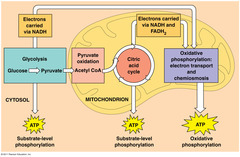
Vocabulary: aerobic respiration, anaerobic respiration, fermentation, oxidation, reduction, reducing agent, oxidizing agent, redox reaction, electron transport chain, NAD (nicotinamide adenine dinucleotide), glycolysis, Kreb cycle (citric acid cycle), oxidative phosphorylation, substrate-level phosphorylation, chemiosmosis, ATP synthase, cytochromes, proton-motive force, obligate aerobe, obligate anaerobe, facultative anaerobe, beta oxidation, biosynthesis
Objectives: After attending lectures and studying the chapter, the student should be able to:
1. Define cellular respiration.
a. State which organisms undergo cellular respiration.
b. Distinguish between the site of cellular respiration in prokaryotic cells and in eukaryotic cells.
c. Distinguish between the terms aerobic and anaerobic.
d. Write the general chemical equation for aerobic cellular respiration.
e. Write the general chemical equation for lactic acid fermentation and state which organisms can undergo this process.
f. Write the general chemical equation for alcohol fermentation and state which organisms can undergo this process.
2. Relating to cellular energy:
a. Explain the chemical energy relationship between glucose and ATP.
b. Explain the chemical energy role of ATP in driving cellular reactions.
c. Describe the structure of ATP, ADP, and AMP.
d.Explain why ATP is considered the "energy currency" of the cell and glucose is not.
e. State how many ATPs are produced from 1 glucose molecule during:
* aerobic cellular respiration in prokaryotic cells
* aerobic cellular respiration in eukaryotic cells
* fermentation
3. Describe the making of ATP through substrate-level phosphorylation.
4. Relating to oxidative phosphorylation (electron transport chain + chemiosmosis):
a. Define oxidation and reduction and describe the redox reactions of an electron transport chain.
b.

Terms : Hide Images
1822754482Explain concept 9.1: Catabolic pathways yield energy by oxidizing organic fuelsCatabolic pathways are a set of metabolic pathways that breaks down molecules into smaller units to release energy0
1822754483Compare and contrast aerobic and anaerobic respirationBoth processes include glycolysis, the citric acid cycle, and oxidated phosphorylation. In aerobic respiration the final electron acceptor is molecular oxygen O2; in anaerobic respiration the final electron Accceptor is a different substance.1
1822754484Describe the difference between the two processes in cellular respiration that produce ATP: oxidative phosphorylation and substrate-level phosphorylationMost of the ATP produced in cellular respiration come from oxidative phosphorylation, in which the energy released from redox reactions in an electron transport chain is used to produce ATP. In substrate level phosphorylation, an enzyme dirctly transfers a phosphate group to ADP fro an intermediate substrate. All ATP production in glycolysis occurs by substrate-level phosphorylation, this form of ATP production also occurs at one step in the citric acid cycle.2
1822754554Explain concept 9.2: Glycolysis harvests chemical energy by oxidizing glucose to pyruvate...3
1822754485During the redox reaction in glycolysis, which molecule acts as the oxidizing agent? Which molecule acts as the reducing agent?NAD+ acts as the oxidizing agent in step 6, accepting electrons from glyceraldehyde 3-phosphate, which thus acts as the reducing agent4
1822754486During the redox reaction in glycolysis, Which molecule acts as the reducing agent?glyceraldehyde 3-phosphate, which acts as the reducing agent5
1822754555What is the source of energy for the formation of ATP and NADH in glycolysis?The oxidation of the three carbon sugar glyceraldehyde 3-phosphate, yields energy. In this oxidation, electrons and H+ are transferred to NAD+, forming NADH, and a phosphate group is attached to the oxidized substrate. ATP is then formed b y substrate level phosphorylation when this phosphate group is transferred to ADP6
1822754487Explain concept 9.3: After pyruvate is oxidized, the citric acid cycle completes the energy yielding oxidation of organic molecules...7
1822754556Name the molecules that conserve most of the energy from the citric acid cycle's redox reactions. How is this energy converted to a form that can be used to make ATP?NADH and FADH2; they will donate electrons to the electron transport chain8
1822754488What processes in your cells produce the CO2 that you exhaleCO2 is released from the pyruvate that is the end product of glycoloysis, and CO2 is also released during the citric acid cycle9
1822754557What effect would an absence of O2 have on the process shown in figure 9.15?...10
1822754558Explain concept 9.5: Fermentation and anaerobic respiration enable cells to produce ATP without the use of oxygen...11
1822754489As it pertains to cellular respiration, distinguish between the site of cellular respiration in prokaryotic cells and in eukaryotic cells.ATP synthases are found in the inner mitochondrial membranes of eukaryotic cells and in the plasma membranes of prokaryotes.12
1822754559Relating to oxidative phosphorylation (electron transport chain + chemiosmosis): relate the electrochemical gradient to the facilitated diffusion of H+ ions across a membrane....13
1822754560Relating to oxidative phosphorylation (electron transport chain + chemiosmosis): relate facilitated diffusion of H+ ions through the ATP synthase protein channel to the making of ATP....14
1822754561Relating to aerobic cellular respiration: describe the process of glycolysis, including the major molecules involved and the energy-storing molecules produced....15
1822754562Relating to aerobic cellular respiration: describe the process of the Krebs cycle, including the major molecules involved and the energy-storing molecules produced, and explain why the Krebs cycle is considered a cycle....16
1822754563Relating to aerobic cellular respiration: describe the roles of NADH, FADH2, and O2 in the electron transport chain part of oxidative phosphorylation...17
1822754564Relating to aerobic cellular respiration: show the relationship between the electron transport chain, active transport, and facilitated diffusion in the oxidative phosphorylation process of making ATP....18
1822754565Relating to aerobic cellular respiration: state the number of ATPs produced during glycolysis, the transition reaction, the Krebs cycle, and the oxidative-phosphorylation process....19
1822754566FermentationPartial degradation of sugars or other organic fuel that occurs without the use of oxygen20
1822754567Aerobic RespirationCatabolic pathway in which oxygen is consumed as a reactant along with the organic fuel21
1822754568Cellular RespirationIncludes both aerobic and anaerobic processes22
1822754569Redox ReactionsA chemical reaction involving the complete or partial transfer of one or more electrons from one reactant to another; short for reduction-oxidation reaction23
1822754570OxidationThe complete or partial loss of electrons from a substance involved in a redox reaction24
1822754571ReductionThe complete or partial addition of electrons to a substance involved in a redox reaction25
1822754572Reducing AgentThe electron donor in a redox reaction26
1822754573Oxidizing AgentThe electron receptor in a redox reaction27
1822754574NAD+Nicotinamide adenine dinucleotide, a coenzyme that cycles easily between oxidized (NAD+) and reduced (NADH) states, thus acting as an electron carrier.28
1822754575Electron Transport ChainA sequence of electron carrier molecules (membrane proteins) that shuttle electrons down a series of redox reactions that release energy used to make ATP29
1822754576GlycolysisA series of reactions that ultimately splits glucose into pyruvate. Occurs in almost all living cells, serving as the starting point for fermentation or cellular respiration30
1822754490The Citric Acid CycleA chemical cycle involving eight steps taht completes the metabolic breakdown of glucose molecules begun in glycolysis by oxidyzing acetyl CoA (derived from pyruvate) to carbon diozide; occcurs within the mitochondrion in eukaryotic cells and in the cytosol of prokaryotes; together with pyruvate oxidation, the second majoy stage in cellular respiration.31
1822754577Oxidative PhosphorylationThe production of ATP using energy derived from the redox reactions of an electron transport chain; the third major stage of cellular respiration32
1822754578Substrate-level phosphorylationThe enzyme catalyzed formation of ATP by direct transfer of a phosphate group to ADP from an intermediate substrate in catabolism33
1822754579Acetyl CoAAcetyl coenzyme A; the entry compound for the citric acid cycle in cellular respiration, formed from a fragment of pyruvate attached to a coenzyme.34
1822754580CytochromesAn iron-containing protein that is a component of electron transport chains in the mitochondria and chloroplasts of eukaryotic cells and the plasma membranes of prokaryotic cells35
1822754581ATP SynthaseA complex of several membrane proteins that functions in chemiosmosis with adjacent electron transport chains, using the energy of a hydrogen ion (proton) concentration gradient to make ATP. ATP synthases are found in the inner mitochondrial membranes of eukaryotic cells and in the plasma membranes of prokaryotes.36
1822754582ChemiosmosisAn energy coupling mechanism that uses energy stored in the form of a hydrogen ion gradient across a membrane to drive cellular work; such as the synthesis of ATP. Under aerobic conditions, most ATP synthesis in cells occurs by chemiosmosis.37
1822754583Protonmotive ForceThe potential energy stored in the form of a proton electrochemical gradient, generated by the pumping of hydrogen ions (H+) across a biological membrane during chemiosmosis.38
1822754584Alcohol FermentationGlycolysis followed by the reduction pyruvate to ethyl alcohol, regenerating NAD+ and releasing carbon dioxide39
1822754585Lactic Acid FermentationGlycolysis followed by the reduction of pyruvate to lactate, regenerating NAD+ with no release of of carbon dioxide.40
1822754586Obligate AnaerobesAn organism that only carries out fermentation or anaerobic respiration. cannot use oxygen and may be poisoned by it41
1822754587Facultative AnaerobesAn organism that makes ATP by aerobic respiration if oxygen is present but that switches to anaerobic respiration or fermentation if oxygen is not present42
1822754588Beta OxidationA metabolic sequence that breaks fatty acids down to two-carbon fragments that enter the citric acid cycle as acetyl CoA43
1822754491In cellular respiration, where does Glycolysis occur?In the cytosol44
1822754589What is pyruvate?- The end product of glycolysis -The first step in cellular respiration - Stands in the junction between anaerobic and aerobic pathways45
1822754492The Citric Acid Cycle also known as the Krebs cycle serves what purpose?...46
1822754493OIL RIGOxidation is Loss of Electrons (OIL) RIG (Reduction is a Gain of Electrons)47
1822754494Which process or processes return carbon to the atmosphere?Cellular Respiration48
1822754495What are the 4 major steps of cellular respiration?1.Glycolysis- (occurs in the cytosol) 2. Pyruvate Oxidation - Formation of Acetyl Co-enzyme A (occurs in the mitochondrion) 3. TCA/Kreb's Cycle/ Citric Acid Cycle 4. Oxidative phosphorylation - Electron Transport Chain and Chemiosmosis - (occurs in the inner membrane of the mitochondrion)49
1822754496In the Cellular Respiration Process, which coenzymes is an electron carrier?NADH and FADH250
1822754497How many ATP are produced by the citric acid cycle for each molecule of glucose?251
1822754498What is the correct sequence of steps as energy is extracted from glucose during cellular respiration.glycolysis → acetyl CoA → citric acid cycle → electron transport chain52
1822754499What is the correct general equation for cellular respiration?C6H12O6 + 6 O2 → 6 CO2 + 6 H2O + ATP energy53
1822754500What is the correct basic equation for cellular respiration?Glucose + 6 Oxygen leads to 6 Carbon Dioxide +6 Water + 1 ATP54
1822754501Which of the part of the cellular respiration process takes place in the cytosol of a eukaryotic cell?Glycolysis55
1822754502In what organelle would you find acetyl CoA formation, the citric acid cycle, and the electron transport chain?The Mitochondrion56
1822754503How would you describe glycolysis?This process splits glucose in half and produces 2 ATPs for each glucose.57
1822754504How would you describe the citric acid cycleThis process produces some ATP and carbon dioxide in the mitochondrion.58
1822754505How would you describe the electron transport chain?This process uses energy captured from electrons flowing to oxygen to produce most of the ATPs in cellular respiration59
1822754506Which part of a eukaryotic cell is involved in cellular respiration?Mitochondria60
1822754507Glucose and _______ are consumed during cellular respirationOxygen61
1822754508In a eukaryotic cell, most of the ATP derived from glucose during cellular respiration is produced by ...The Electron Transport Chain62
1822754509How much does a single glucose molecule produce in glycoloysis alone?a single glucose molecule in glycolysis produces a total of: 2 molecules of pyruvic acid, 2 molecules of ATP, 2 molecules of NADH and 2 molecules of water63
1822754510The immediate energy source that drives ATP synthesis by ATP synthase during oxidative phosphorylation is theH+ concentration across the membrane holding ATP synthase.64
1822754511Which metabolic pathway is common to both fermentation and cellular respiration of a glucose molecule?glycolysis65
1822754512In mitochondria, exergonic redox reactionsprovide the energy that establishes the proton gradient.66
1822754513The final electron acceptor of the electron transport chain that functions in aerobic oxidative phosphorylation isoxygen.67
1822754514What is the oxidizing agent in the following reaction? Pyruvate + NADH + H+ S Lactate + NAD+pyruvate68
1822754515When electrons flow along the electron transport chains of mitochondria, which of the following changes occurs? ATP synthase pumps protons by active transport. The pH of the matrix increases.The pH of the matrix increases.69
1822754516Most CO2 from catabolism is released duringthe citric acid cycle.70
1822754517A molecule becomes more oxidized when it _Loses an electron. During oxidation, an electron is removed.71
1822754518In the overall process of glycolysis and cellular respiration, _____ is oxidized and _____ is reduced.glucose ... oxygen In cellular respiration, electrons and hydrogen are removed from glucose and added to oxygen.72
1822754519Most of the ATP produced in cellular respiration comes from which of the following processes?...73
1822754520Which of the following is a correct description of the events of cellular respiration and the sequence of events in cellular respiration? (eText Concept 9.1) oxidation of glucose to pyruvate; reduction of pyruvate; TCA cycle; oxidative phosphorylation glycolysis; oxidative phosphorylation; TCA cycle; oxidation of pyruvate. oxidation of glucose to pyruvate; oxidation of pyruvate; oxidation of acetyl-coA; oxidative phosphorylation oxidation of pyruvate; TCA cycle; oxidation of glucose to pyruvate; oxidative phosphorylation glycolysis; reduction of pyruvate; TCA cycle; oxidative phosphorylation1. oxidation of glucose to pyruvate; 2. oxidation of pyruvate; 3. oxidation of acetyl-coA; 4. oxidative phosphorylation74
1822754521Oxygen gas (O2) is one of the strongest oxidizing agents known. The explanation for this is that _____. (eText Concept 9.1) oxygen gas contains a double bond oxygen acts as the final electron acceptor in cellular respiration the oxygen atom is very electronegative oxygen is so abundant in the atmosphere oxygen gas is composed of two atoms of oxygenThe oxygen atom is very electronegative. The high electronegativity of the oxygen atom is the reason that oxygen is such a good oxidizing agent (why it can oxidize so many compounds).75
1822754522The function of cellular respiration is to _____. (eText Concept 9.1) reduce CO2 produce carbohydrates extract CO2 from the atmosphere synthesize macromolecules from monomers extract usable energy from glucoseExtract usable energy from glucose. The most prevalent and efficient catabolic pathway is cellular respiration, in which oxygen is consumed as a reactant, along with the organic fuel (frequently glucose).76
1822754523During the reaction C6H12O6 + 6 O2 → 6 CO2 + 6 H2O, which compound is reduced as a result of the reaction? (eText Concept 9.1) carbon dioxide oxygen water glucose both glucose and carbon dioxideoxygen77
1822754524Each ATP molecule contains about 1% of the amount of chemical energy available from the complete oxidation of a single glucose molecule. Cellular respiration produces about 32 ATP from one glucose molecule. What happens to the rest of the energy in glucose? (eText Concept 9.1) It is converted to starch. It is converted to heat. It is released as carbon dioxide and water It is stored as fat. It is used to make water from hydrogen ions and oxygen.It is converted to heat.78
1822754525A small amount of ATP is made in glycolysis by which of the following processes? (eText Concept 9.1) transfer of electrons and hydrogen atoms to NAD+ transport of electrons through a series of carriers attachment of a free inorganic phosphate (Pi) group to ADP to make ATP transfer of a phosphate group from a fragment of glucose to ADP by substrate-level phosphorylation harnessing energy from the sunTransfer of a phosphate group from a fragment of glucose to ADP by substrate-level phosphorylation79
1822754526Where do the reactions of glycolysis occur in a eukaryotic cell? (eText Concept 9.1) the cytosol across the inner membrane of the mitochondrion the matrix of the mitochondrion in the intermembrane space of the mitochondrion the inner membrane of the mitochondrionGlycolysis occurs in the cytosol.80
1822754527Most of the NADH that delivers electrons to the electron transport chain comes from which of the following processes? (eText Concept 9.3) substrate-level phosphorylation the citric acid cycle glycolysis anabolic pathways oxidative phosphorylationThe citric acid cycle Both NADH and FADH2 are produced during the citric acid cycle.81
1822754528In preparing pyruvate to enter the citric acid cycle, which of the following steps occurs? (eText Concept 9.3) Pyruvate is oxidized and decarboxylated, and the removed electrons are used to reduce an NAD+ to an NADH. Pyruvate is reduced and decarboxylated, and the resulting electrons oxidize an NAD+ to an NADH Pyruvate is oxidized and decarboxylated, and the resulting electrons are donated to NADH to produce NAD+. Pyruvate is reduced to acetyl-coA, which involves the reduction of pyruvate, the addition of a carbon dioxide from the environment, and its reduction by NADH. Pyruvate is ionized directly to acetyl-coA.Pyruvate is oxidized and decarboxylated, and the removed electrons are used to reduce an NAD+ to an NADH.82
1822754529Why is the citric acid cycle called a cycle? (eText Concept 9.3)The four-carbon acid that accepts the acetyl CoA in the first step of the cycle is regenerated by the last step of the cycle.83
1822754530In the citric acid cycle, for each pyruvate that enters the cycle, one ATP, three NADH, and one FADH2 are produced. For each glucose molecule that enters glycolysis, how many ATP, NADH, and FADH2 are produced in the citric acid cycle? (eText Concept 9.3)two ATP, six NADH, two FADH284
1822754531Where do the reactions of the citric acid cycle occur in eukaryotic cells?The matrix of the mitochondrion The citric acid cycle, which takes place in the mitochondrial matrix, completes the degradation of glucose.85
1822754532How many molecules of ATP are gained by substrate-level phosphorylation from the complete breakdown of a single molecule of glucose in the presence of oxygen? (eText Concept 9.3)Four There is a net gain of two ATP from glycolysis and one per each molecule of acetyl CoA oxidized in the citric acid cycle for a total of four per glucose.86
1822754533What is the major (but not the only) energy accomplishment of the citric acid cycle? (eText Concept 9.3)The formation of NADH and FADH2 Each turn of the citric acid cycle releases carbon dioxide, forms one ATP by oxidative phosphorylation, and passes electrons to three NAD+ and one FAD.87
1822754534After completion of the citric acid cycle, most of the usable energy from the original glucose molecule is in the form of _____.NADH The citric acid cycle produces three NADH per turn of the cycle.88
1822754535Which of the following accompanies the conversion of pyruvate to acetyl CoA before the citric acid cycle? (eText Concept 9.3) regeneration of NAD+ removal of coenzyme A release of CO2 and synthesis of NADH formation of CO2 and synthesis of ATP release of CO2 and release of coenzyme Arelease of CO2 and synthesis of NADH89
1822754536If significant amounts of materials are removed from the citric acid cycle to produce amino acids for protein synthesis, which of the following will result? (eText Concept 9.6) Less ATP will be produced by the cell. Less CO2 will be produced by the cell. The four-carbon compound that combines with acetyl CoA will have to be made by some other process. The first two answers are correct. The first three answers are correct.The first three answers are correct.90
1822754537A gram of fat oxidized by respiration produces approximately twice as much ATP as a gram of carbohydrate. Which of the following best explains this observation? (eText Concept 9.6) Fats are better electron donors to oxygen than are sugars. Fats do not form true macromolecules as sugars do. Fats are closely related to lipid molecules, the basic building blocks of cellular membranes. Fats are less soluble in water than sugars. Fats are produced when cells take in more food than they need.Fats are better electron donors to oxygen than are sugars. Correct. Fats contain more hydrogen and less oxygen than sugars—it is the transfer of electrons from good donors such as hydrogen atoms to good acceptors such as oxygen that provides the energy in respiration.91
1822754538When protein molecules are used as fuel for cellular respiration, _____ are produced as waste. (eText Concept 9.6) ethanol and CO2 molecules of lactate fatty acids amino groups sugar moleculesamino groups The amino group is a residual product of amino acid catabolism.92
1822754539Of the metabolic pathways listed below, which is the only pathway found in all organisms? (eText Concept 9.5) the electron transport chain cellular respiration fermentation the citric acid cycle glycolysisglycolysis Ancient prokaryotes probably used glycolysis to make ATP long before oxygen was present in Earth's atmosphere. Glycolysis is the most widespread metabolic pathway.93
1822754540If muscle cells in the human body consume O2 faster than it can be supplied, which of the following is likely to result? (eText Concept 9.5) The muscle cells will have more trouble making enough ATP to meet their energy requirements. The cells will not be able to carry out oxidative phosphorylation. The cells will consume glucose at an increased rate. Only the first two answers are correct. The first three answers are correct.The first three answers are correct. The muscle cells will have more trouble making enough ATP to meet their energy requirements. The cells will not be able to carry out oxidative phosphorylation. The cells will consume glucose at an increased rate.94
1822754541In brewing beer, maltose (a disaccharide of glucose) is _____.the substrate for alcoholic fermentation95
1822754542In glycolysis in the absence of oxygen, cells need a way to regenerate which compound? (eText Concept 9.5)NAD+96
1822754543Sports physiologists at an Olympic training center wanted to monitor athletes to determine at what point their muscles were functioning anaerobically. They could do this by checking for a buildup of which of the following compounds? (eText Concept 9.5)lactate. In humans, muscle cells switch to lactate fermentation after becoming anaerobic.97
1822754544Fermentation is essentially glycolysis plus an extra step in which pyruvate is reduced to form lactate or alcohol and carbon dioxide. This last step _____. (eText Concept 9.5)enables the cell to recycle the reduced NADH to oxidized NAD+98
1822754545During respiration in eukaryotic cells, the electron transport chain is located in or on the _____. (eText Concept 9.4)inner membrane of the mitochondrion99
1822754546Which of the following is the source of the energy that produces the chemiosmotic gradient in mitochondria? (eText Concept 9.4)Electrons moving down the electron transport chain100
1822754547Which of the following best describes the electron transport chain? (eText Concept 9.4) Acetyl CoA is fully oxidized to CO2. Glucose is broken down to a three-carbon compound in preparation for the citric acid cycle. Electrons are passed from one carrier to another, releasing a little energy at each step. Hydrogen atoms are added to CO2 to make an energy-rich compound. Electrons are pumped across a membrane by active transport.Electrons are passed from one carrier to another, releasing a little energy at each step.101
1822754548During aerobic respiration, molecular oxygen (O2) is used for which of the following purposes? (eText Concept 9.4) at the end of glycolysis to oxidize pyruvate at the end of the electron transport chain to accept electrons and form H2O between glycolysis and the citric acid cycle to split a carbon from pyruvate, producing CO2 as a source of O2 in every reaction that produces CO2 at the end of the citric acid cycle to regenerate citric acidat the end of the electron transport chain to accept electrons and form H2O102
1822754549Word Roots: aero-air (aerobic: chemical reaction using oxygen)103
1822754550Word Roots: an-not (anaerobic: chemical reaction not using oxygen)104
1822754551Word Roots: chemi-chemical (chemiosmosis: the production of ATP using the energy of hydrogen ion gradients across membranes to phosphorylate ADP)105
1822754552Word Roots: glyco-sweet;106
1822754553Word Roots: -lysissplit (glycolysis: the splitting of glucose into pyruvate)107

Ancient China Review Flashcards

Shang, Zhou, Confucious, and Qin

Terms : Hide Images
734473140What borders China on the side that is southwest?Himalayas1
734473141What borders China to it's north and west sides?Gobi Desert and part of Himilayas2
734473142What borders China to it's east side?Yellow Sea, East China Sea, and South China Sea3
734473143What is the mountain the is the highest in feet in the Himalayas and how tall is it?Mount Everest, 29,0284
734473144Why does the Yellow River have it's name?Rich yellow dirt5
734473145Which group of people, in 10,000 B.C., settled along the Huang He river?The Neolithic people6
734473146What were the houses like in many Yangshao Villages?Partly underground7
734473147What was considered as the first great Chinese dynasty?The Xia dynasty8
734473148Legend tells us that the Xia dynasty ruled for how many years?Nearly 300 years9
734473149When Cheng Tang defeated Jie what dynasty was formed?The Shang10
734473150What classes of people in the Shang dynasty lived within the walls?Rulers, priests, and warriors11
734473151What was the capital of Shang?Anyang12
734473152What was used as money in the Shang dynasty?Cowrie shells13
734473153What was the main important discovery made in the city of Yanshi?How to mix tin and copper.14
734473154What did the early Chinese people believe gods controlled?Sun, moon, and stars15
734473155Who was the supreme god of the early Chinese people?Shang Di16
734473156What was one of the most important things to the Shang? (Hint Not the Gods)Ancestors17
734473157What did the Shang Kings use to consult their ancestors with?Oracle bones18
734473158When Shang leaders died, who did they believed they joined?Their Ancestors19
734473159Around what time did ancient Chinese paintings start looking less like a picture?c.600B.C.20
734473160At what time did ancient Chinese painters start to use brushes?c. A.D. 30021
734473161What dynasty ruled for the longest period of time?The Zhou22
734473162How did Zhou kings spread their rule over China?Feudalism23
734473163In the time of the Zhou dynasty the Chinese language had more than how many written characters?3,00024
734473164Who was thought to be China's greatest leader?Confucius25
734473165What was Confucius's basic idea?People could get along peacefully26
734473166In what dynasty did Confucius live?The Zhou dynasty27
734473167In what year did powerful lords invade the Zhou capital and drive out the rulers?771 B.C.28
734473168When was Confucius born?551 B.C.29
734473169What were Confucius's ideas called?Confucianism30
734473170What were the five basic relationships?Husband and Wife, Father and Son, Older and Younger Brother, Friend and Friend, and Ruler and Subject31
734473171Who was one of the main followers of Confucius?Mencius32
734473172What dynasty took over after the Zhou?The Qin33
734473173Who was the emperor of the Qin dynasty?Zheng or Qin Shihuangdi34
734473174What did Qin Shihuangdi's name mean?first emperor35
734473175How many providences did Shihuandgdi divide the empire into?3636
734473176Who was the Emperor's advisor?Li Si37
734473177what books were burned by Shihuandgdi and Li Si?Confucius's38
734473178What was Shihuandgdi's burning of books an example of?Censorship39

Pages

Subscribe to CourseNotes RSS

Need Help?

We hope your visit has been a productive one. If you're having any problems, or would like to give some feedback, we'd love to hear from you.

For general help, questions, and suggestions, try our dedicated support forums.

If you need to contact the Course-Notes.Org web experience team, please use our contact form.

Need Notes?

While we strive to provide the most comprehensive notes for as many high school textbooks as possible, there are certainly going to be some that we miss. Drop us a note and let us know which textbooks you need. Be sure to include which edition of the textbook you are using! If we see enough demand, we'll do whatever we can to get those notes up on the site for you!