

Flashcards
Unit 3 600-1450 AP World History Flashcards
Terms : Hide Images
| 6825378841 | Silk Roads | the most famous of the trading routes established by pastoral nomads connecting the European, Indian, and Chinese; transmitted goods and ideas among civilizations | 0 | |
| 6825378842 | Black Death | The common name for a major outbreak of plague that spread across Asia, North Africa, and Europe in the mid-fourteenth century, carrying off vast numbers of persons. | 1 | |
| 6825378843 | Indian Ocean trading network | The world's largest sea-based system of comunication and exchange before 1500 C.E., Indian Ocean commerce stretched from southern China to eastern Africa and included not only the exchange of luxury and bulk goods but also the exchange of ideas and crops. |  | 2 |
| 6825378844 | Srivijaya | A Malay kingdom that dominated the Straits of Malacca between 600 and 1075 CE. A state based on the Indonesian island of Sumatra, between the seventh and eleventh centuries C.E. It amassed wealth and power by a combination of selective adaptation of Indian technologies and concepts, and control of trade routes. |  | 3 |
| 6825378845 | Borobrodur | Buddhist temple on the island of Java that is a primary example of Indian ocean trade causing cultural diffusion. | 4 | |
| 6825378846 | Angkor Wat | This place was first a Hindu (dedicated to the god Vishnu), then subsequently a Buddhist, temple complex in Cambodia and the largest religious monument in the world. |  | 5 |
| 6825378847 | Swahili civilization | an East African civilization that emerged in the 8th century ce from a blending of Bantu, Islamic, and other Indian Ocean trade elements |  | 6 |
| 6825378848 | Great Zimbabwe | City, now in ruins (in the modern African country of Zimbabwe), whose many stone structures were built between about 1250 and 1450, when it was a trading center and the capital of a large state. | 7 | |
| 6825378849 | Sand roads | The system of roads that led across the Sahara desert in Africa. |  | 8 |
| 6825378850 | Ghana, Mali, Songhay | Capitalizing on these new saharan trades Ghana mali and Songhay monarchies were established trading gold for salt and slaves |  | 9 |
| 6825378851 | Trans-Saharan slave trade | A fairly small-scale trade that developed in the twelfth century C.E., exporting West African slaves captured in raids across the Sahara for sale mostly as household servants in Islamic North Africa; the difficulty of travel across the desert limited the scope of this trade. | 10 | |
| 6825378852 | American web | A term used to describe the network of trade that linked parts of the pre-Columbian Americas; although less intense and complete than the Afro-Eurasian trade networks, this web nonetheless provided a means of exchange for luxury goods and ideas over large areas. |  | 11 |
| 6825378853 | pochteca | Special merchant class in Aztec society, specialized in long-distance trade in luxury items | 12 | |
| 6825378854 | Sui dynasty | The short dynasty between the Han and the Tang; built the Grand Canal, strengthened the government, and introduced Buddhism to China |  | 13 |
| 6825378855 | Tang dynasty | 618-907 CE. Much like the Han using Confucianism. had the equal field system, a bureaucracy based on merit and a Confuciansim education system. Trained strong armies of almost a million troops to fight off nomadic powers from Asia. Made story cultural influence over Korea and Vietnam. |  | 14 |
| 6825378856 | Song dynasty | During this Chinese dynasty (960 - 1279 AD) China saw many important inventions. There was a magnetic compass; had a navy; traded with india and persia (brought pepper and cotton); paper money, gun powder; landscape black and white paintings |  | 15 |
| 6825378857 | Hangzhou | Capital of later Song dynasty; located near East China Sea; permitted overseas trading; population exceeded 1 million. |  | 16 |
| 6825378858 | economic revolution | Economic development of Song; mass production for trade; equal field system | 17 | |
| 6825378859 | foot binding | Practice in Chinese society to mutilate women's feet in order to make them smaller; produced pain and restricted women's movement; made it easier to confine women to the household. | 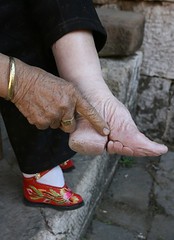 | 18 |
| 6825378860 | tribute system | Chinese method of dealing with foreign lands and people's that assumed the subordination of all non-Chinese authorities and required the payment of tribute --produce of value from their countries--to the Chinese emperor(although the Chines gifts given in return were often much more valuable). | 19 | |
| 6825378861 | Xiongnu | A confederation of nomadic peoples living beyond the northwest frontier of ancient China. Chinese rulers tried a variety of defenses and stratagems to ward off these 'barbarians,' as they called them, and dispersed them in 1st Century. (168) |  | 20 |
| 6825378862 | Silla Dynasty | Korean dynasty that resisted Tang for first time. Respected China, performed kowtow, ritual bow to Chinese emperor. Studied Buddhism/Confucianism | 21 | |
| 6825378863 | hangui | Korean written alphabet | 22 | |
| 6825378864 | chu nom | a style of writing adapted from China to Vietnam. It became the basis for the development of an independent national literature. |  | 23 |
| 6825378865 | Chinese Buddhism | China's only large-scale cultural borrowing before the 20th century. Buddhism entered China from India in the first and second centuries C.E but only became popular between 300-800 C.E through a series of cultural accommodations. At first supported by the state, Buddhism suffered persecution during the 9th century but continued to play a role in Chinese society. | 24 | |
| 6825378866 | Emperor Wendi | a Chinese general, who secured his Emperor position by killing 59 princes of the Zhou royal house, and founded the Sui Dynasty. Presented himself as a Buddhist Cakravartin King, that is, a monarch who uses military force to defend the Buddhist faith. | 25 | |
| 6825378867 | Quran | The holy book of Islam | 26 | |
| 6825378868 | umma | The community of all Muslims. A major innovation against the background of seventh-century Arabia, where traditionally kinship rather than faith had determined membership in a community. | 27 | |
| 6825378869 | Pillars of Islam | The five core practices required of Muslims: a profession of faith, regular prayer, charitable giving, fasting during Ramadan, and a pilgrimage to Mecca (if physically and financially possible). | 28 | |
| 6825378870 | hijra | The Migration of Muhammad from Mecca to Medina in A.D. 622, marking the founding of Islam |  | 29 |
| 6825378871 | sharia | Body of Islamic law that includes interpretation of the Quran and applies Islamic principles to everyday life | 30 | |
| 6825378872 | jizya | tax paid by Christians and Jews who lived in Muslim communities to allow them to continue to practice their own religion | 31 | |
| 6825378873 | ulama | Muslim religious scholars. From the ninth century onward, the primary interpreters of Islamic law and the social core of Muslim urban societies. | 32 | |
| 6825378874 | Umayyad Caliphate | (661-750 CE) The Islamic caliphate that established a capital at Damascus, conquered North Africa, the Iberian Pennisula, Southwest Asia, and Persia, and had a bureaucracy with only Arab Muslims able to be a part of it. |  | 33 |
| 6825378875 | Abbasid Caliphate | (750-1258 CE) The caliphate, after the Umayyads, who focused more on administration than conquering. Had a bureaucracy that any Mulim could be a part of. |  | 34 |
| 6825378876 | Sufism | A branch of Islam, defined by adherents as the inner, mystical dimension of Islam; others contend that it is a perennial philosophy of existence that pre-dates religion, the expression of which flowered within Islam |  | 35 |
| 6825378877 | Ibn Battuta | (1304-1369) Morrocan Muslim scholar, the most widely traveled individual of his time. He wrote a detailed account of his visits to Islamic lands from China to Spain and the western Sudan. His writings gave a glimpse into the world of that time period. |  | 36 |
| 6825378878 | Timbuktu | Mali trading city that became a center of wealth and learning |  | 37 |
| 6825378879 | Mansa Musa | Ruler of Mali (r. 1312-1337). His extravagant pilgrimage through Egypt to Mecca in 1324-1325 established the empire's reputation for wealth in the Mediterranean world. |  | 38 |
| 6825378880 | madrassas | Formal colleges for higher institutions in the teaching of Islam as well as in secular subjects founded throughout the Islamic world in beginning in the 11th century | 39 | |
| 6825378881 | House of Wisdom | Combination library, academy, and translation center in Baghdad established in the 800s. |  | 40 |
| 6825378882 | Ibn Sinna | He was one of the most famous doctors of all times. He read the works of Hippocrates and Galen and improved them, by adding more accurate descriptions. He also created anatomical charts using newly invented surgical tools. His text "Cannon of Medicine" (aka "Code of Laws in Medicine") was reference source for doctors for hundreds of years following his death. | 41 | |
| 6825378883 | Ethiopian Christianity (aka Coptic church) | Rulers of axum had adopted Christianity. Christian island in a Muslim sea protected by its moutanous geography and distance from major centers of islamic power. Also helped muhammad's followers be safe. This isolation made it develop a fascination with judaism and jerusalem. Justified their rule through a connection with Solomon as a descendent of jesus. Tried to create a new jerusalem |  | 42 |
| 6825378884 | Byzantine Empire | (330-1453) The eastern half of the Roman Empire, which survived after the fall of the Western Empire at the end of the 5th century C.E. Its capital was Constantinople, named after the Emperor Constantine. |  | 43 |
| 6825378885 | Constantinople | A large and wealthy city that was the imperial capital of the Byzantine empire and later the Ottoman empire, now known as Istanbul | 44 | |
| 6825378886 | Justinian | Byzantine emperor in the 6th century A.D. who reconquered much of the territory previously ruler by Rome, initiated an ambitious building program , including Hagia Sofia, as well as a new legal code |  | 45 |
| 6825378887 | caesaropapism | a political-religious system where the secular ruler is also the head of the religious establishment (Byzantine Empire) | 46 | |
| 6825378888 | Eastern Orthodox Christianity | Eastern branch of Christianity that evolved following the division of the Roman Empire and the subsequent development of the Byzantine Empire in the east and the medieval European society in the west. The church recognized the primacy of the patriarch of Constantinople | 47 | |
| 6825378889 | icons | A painting of Christ or another holy figure, used as an aid to devotion in the Byzantine and other Eastern Churches. | 48 | |
| 6825378890 | Prince Vladimir of Kiev | converted to Orthodox Christianity, and allowed Byzantine influence in his realm | 49 | |
| 6825378891 | Kievan Rus | A monarchy established in present day Russia in the 6th and 7th centuries. It was ruled through loosely organized alliances with regional aristocrats from. The Scandinavians coined the term "Russia". It was greatly influenced by Byzantine | 50 | |
| 6825378892 | Charlemagne | King of the Franks (r. 768-814); emperor (r. 800-814). Through a series of military conquests he established the Carolingian Empire, which encompassed all of Gaul and parts of Germany and Italy. Illiterate, though started an intellectual revival. | 51 | |
| 6825378893 | Holy Roman Empire | A medieval and early modern central European Germanic empire, which often consisted of hundreds of separate Germanic and Northern Italian states. In reality it was so decentralized that it played a role in perpetuating the fragmentation of central Europe. | 52 | |
| 6825378894 | Roman Catholic church | One of three major branches of Christianity, together with the Eastern Orthodox Church, a second of the three major divisions of Christianity, arose out of the division of the Roman empire into four governmental regions. In 1054 CE Christianity was divided along that same line when the Eastern Orthodox, centered in Constantinople, and the ______ ______ ______, centered in Rome, split. | 53 | |
| 6825378895 | Western Christendom | Western Europe was on the margins of world history for most of the postclassical millennium; It was far removed from the growing world trade routes; European geography made political unity difficult; Coastlines and river systems facilitated internal exchange; | 54 | |
| 6825378896 | Crusades | Armed pilgrimages to the Holy Land by Christians determined to recover Jerusalem from Muslim rule. The Crusades brought an end to western Europe's centuries of intellectual and cultural isolation. |  | 55 |
| 6825378897 | pastoralism | A type of agricultural activity based on nomadic animal husbandry or the raising of livestock to provide food, clothing, and shelter. | 56 | |
| 6825378898 | Modun | leader of the Xiongnu Empires (r. 210-174 BCE) that transformed egalitarian fragmented societies into a more centralized and hierarchical political system with a divinely sanctioned ruler. | 57 | |
| 6825378899 | Turks | 6th-10th centuries C.E. •Pastoral ethnic group that originated in northern Eurasia and spread into Central Asia and the Middle East •Had significant cultural and political interactions with China, Persia, Byzantium •Conversion to Islam 10th-14th centuries •Diffused Islam throughout Middle East, India, Anatolia(Turkey) | 58 | |
| 6825378900 | Temujin | leader of the largest Mongol clans; he unites them all(plans to conquer Asia); and receives title Genghis Khan(universal ruler) | 59 | |
| 6825378901 | the Mongol world | Eurasia, 13th-15th centuries •50-year period of Mongol conquests across Eurasia that created the Mongol empire •Subjected huge populations to Mongol rule •Military strength allowed for rapid conquest •Mongol rule created interactions between diverse groups •Served to diffuse technology, culture, political and economic systems |  | 60 |
| 6825378902 | Yuan Dynasty | (1279-1368 CE) The dynasty with Mongol rule in China; centralized with bureaucracy but structure is different: Mongols on top->Persian bureaucrats->Chinese bureuacrats. | 61 | |
| 6825378903 | Kublai Khan | (1215-1294) Grandson of Genghis Khan and founder of the Mongol Yuan Dynasty in China. | 62 | |
| 6825378904 | Hulegu | Ruler of the Ilkhan khanate; grandson of Chinggis Khan; responsible for capture and destruction of Baghdad in 1257 | 63 | |
| 6825378905 | Paleolithic Persistence | pre-1492 life in much of the Americas (especially North America); characterized by living a simple primitive lifestyle, without entering into large settlements or the iron age | 64 | |
| 6825378906 | Iroquois | A later native group to the eastern woodlands. They blended agriculture and hunting living in common villages constructed from the trees and bark of the forests |  | 65 |
| 6825378907 | Ming Dynasty | Succeeded Mongol Yuan dynasty in China in 1368; lasted until 1644; initially mounted huge trade expeditions to southern Asia and elsewhere, but later concentrated efforts on internal development within China. |  | 66 |
| 6825378908 | European Renaissance | a "rebirth" of classical learning that is most often associated with the cultural blossoming of Italy is the period 1350-1500 and included Greek learning and growing secularism | 67 | |
| 6825378909 | Zheng He | An imperial eunuch and Muslim, entrusted by the Ming emperor Yongle with a series of state voyages that took his gigantic ships through the Indian Ocean, from Southeast Asia to Africa. |  | 68 |
| 6825378910 | Ottoman Empire | Islamic state founded by Osman in northwestern Anatolia. After the fall of the Byzantine Empire, the Ottoman Empire was based at Istanbul (formerly Constantinople) from 1453-1922. It encompassed lands in the Middle East, North Africa, the Caucasus, and eastern Europe. |  | 69 |
| 6825378911 | seizure of Constantinople | Constantinople fell to army of Ottoman sultan Mehmed II "the Conqueror" in 1453, marking end of Christian Byzantium | 70 | |
| 6825378912 | Safavid Empire | Turkish-ruled Iranian kingdom (1502-1722) established by Ismail Safavi, who declared Iran a Shi'ite state. |  | 71 |
| 6825378913 | Songhay Empire | A state located in western Africa. From the early 15th to the late 16th century, it was one of the largest Islamic empires in history. | 72 | |
| 6825378914 | Mughal Empire | Muslim state (1526-1857) exercising dominion over most of India in the sixteenth and seventeenth centuries; a minority of Muslims ruled over a majority of Hindus. | 73 | |
| 6825378915 | Malacca | Port city in the modern Southeast Asian country of Malaysia, founded about 1400 as a trading center on the Strait of Malacca. Also spelled Melaka. |  | 74 |
| 6825378916 | Aztec Empire | 1325-1500 CE. Also known as Mexica, the Aztecs created a powerful empire in central Mexico. Forced defeated people to provide goods and labor as tax. At its best had complex myth and religious traditions and reached amazing architectural and artistic accomplishments. |  | 75 |
| 6825378917 | Inca Empire | (1450-1572 CE), Largest Empire ever built in South America; territory extended 2,500 miles from north to south and embraced almost all of modern Peru, most of Ecuador, much of Bolivia, and parts of Chile and Argentina; maintained effective control from the early 15th century until the coming of Europeans in the early 16th century. As the most powerful people of Andean America, the Inca dominated Andean society until the coming of Europeans; was an extremely diverse culture cause it spanned north and south rather then east and west. |  | 76 |
AP World History - Period 3 Flashcards
The Post-Classical World, 500-1450
Terms : Hide Images
| 9804792052 | Bedouin | nomadic pastoralists of the Arabian peninsula with a culture based on herding camels and goats | 0 | |
| 9804792053 | Mecca | Arabian commercial center; dominated by the Quraysh; the home of Muhammad and the future center of Islam | 1 | |
| 9804792054 | Medina | town northeast of Mecca; asked Muhammad to resolve its intergroup differences; Muhammad's flight to Medina, the hijra, in 622 began the Muslim calendar | 2 | |
| 9804792055 | Umayyad | clan of the Quraysh that dominated Mecca; later an Islamic dynasty | 3 | |
| 9804792056 | Muhammad | (570-632); prophet of Allah; originally a merchant of the Quraysh | 4 | |
| 9804792057 | Qur'an | the word of god as revealed through Muhammad; made into the holy book of Islam | 5 | |
| 9804792058 | Umma | community of the faithful within Islam | 6 | |
| 9804792059 | Five Pillars | the obligatory religious duties for all Muslims; confession of faith, prayer, fasting during Ramadan, zakat, and hajj (pilgrimage to Mecca) | 7 | |
| 9804792060 | Caliph | the successor to Muhammad as head of the Islamic community | 8 | |
| 9804792061 | Ali | cousin and son-in-law of Muhammad; one of the orthodox caliphs; focus for the development of shi'ism | 9 | |
| 9804792062 | Abu Bakr | succeeded Muhammad as the first caliph | 10 | |
| 9804792063 | Jihad | Islamic holy war | 11 | |
| 9804792064 | Sunnis | followers of the majority interpretation within Islam; included the Umayyads | 12 | |
| 9804792065 | Shi'a | followers of Ali's interpretation of Islam | 13 | |
| 9804792066 | Dhimmis | "the people of the book"-- Jews, Christians; later extended to Zoroastrians and Hindus | 14 | |
| 9804792067 | Abbasids | dynasty that succeeded the Umayyads in 750; their capital was at Baghdad | 15 | |
| 9804792068 | Wazir | chief administrative official under the Abbasids | 16 | |
| 9804792069 | Dhows | Arab sailing vessels; equipped with lateen sails; used by Arab merchants | 17 | |
| 9804792070 | Seljuk Turks | nomadic invaders from central Asia; staunch Sunnis; ruled from the 11th c. in the name of the Abbasids | 18 | |
| 9804792071 | Crusades | invasions of western Christians into Muslim lands, especially Palestine; captured Jerusalem and established Christian kingdoms enduring until 1291 | 19 | |
| 9804792072 | Mongols | central Asian nomadic peoples; captured Baghdad in 1258 and killed the last Abbasid caliph | 20 | |
| 9804792073 | Chinggis (Genghis) Khan | (1162-1227); Mongol ruler; defeated the Turkish Persian kingdoms | 21 | |
| 9804792074 | Arabic numerals | Indian numerical notation brought by the Arabs to the West | 22 | |
| 9804792075 | Mali | state of the Malinke people centered between the Senegal and Niger rivers | 23 | |
| 9804792076 | Mansa | title of the ruler of Mali | 24 | |
| 9804792077 | Ibn Battuta | Arab traveler throughout the Muslim world | 25 | |
| 9804792078 | Songhay | successor state to Mali; dominated middle reaches of the Niger valley; capital at Gao | 26 | |
| 9804792079 | Iconoclasm | the breaking of images; religious controversy of the 8th c; Byzantine emperor attempted, but failed, to suppress icon veneration | 27 | |
| 9804792080 | Middle Ages | the period in western European history between the fall of Roman Empire and the 15th c | 28 | |
| 9804792081 | Gothic | an architectural style developed during the 13th and 14th c in western Europe; featured pointed arches and flying buttresses as external support on main walls | 29 | |
| 9804792082 | Vikings | seagoing Scandinavian raiders who disrupted coastal areas of Europe from the 8th to 11th c; pushed across the Atlantic to Iceland, Greenland, and North America; formed permanent territories in Normandy and Sicily | 30 | |
| 9804792083 | Manorialism | rural system of reciprocal relations between landlords and their peasant laborers during the Middle Ages; peasants exchanged labor for use of land and protection | 31 | |
| 9804792084 | Serfs | peasant agricultural laborers within the manorial system | 32 | |
| 9804792085 | Three-field system | practice of dividing land into thirds, rotating between two different crops and pasturage-- an improvement making use of manure | 33 | |
| 9804792086 | Clovis | King of the Franks; converted to Christianity circa 496 | 34 | |
| 9804792087 | Carolingians | royal house of Franks from 8th c to 10th c | 35 | |
| 9804792088 | Charles Martel | first Carolingian king of the Franks; defeated Muslims at Tours in 732 | 36 | |
| 9804792089 | Charlemagne | Carolingian monarch who established large empire in France and Germany circa 800 | 37 | |
| 9804792090 | Holy Roman Emperors | political heirs to Charlemagne's empire in northern Italy and Germany; claimed title of emperor but failed to develop centralized monarchy | 38 | |
| 9804792091 | Feudalism | personal relationship during the Middle Ages by which greater lords provided land to lesser lords in return for military service | 39 | |
| 9804792092 | Vassals | members of the military elite who received land or a benefice from a lord in return for military service and loyalty | 40 | |
| 9804792093 | Magna Carta | Great charter issued by King John of England in 1215; represented principle of mutual limits and obligations between rulers and feudal aristocracy, and the supremacy of law | 41 | |
| 9804792094 | Pope Urban II | organized the first Crusade in 1095; appealed to Christians to free the Holy Land from Muslim control | 42 | |
| 9804792095 | Scholasticism | dominant medieval philosophical approach; so-called because of its base in the schools or universities; based on use of logic to resolve theological problems | 43 | |
| 9804792096 | Guilds | associations of workers in the same occupation in a single city; stressed security and mutual control; limited membership, regulated apprenticeships, guaranteed good workmanship; held a privileged place in cities | 44 | |
| 9804792097 | Black Death | bubonic plague that struck Europe in the 14th c; significantly reduced Europe's population; affected social structure; decimated populations in Asia | 45 | |
| 9804792098 | Mahayana (Pure Land) Buddhism | emphasized salvationist aspects of Chinese Buddhism; popular among the masses in East Asia | 46 | |
| 9804792099 | Grand Canal | great canal system begun by Yangdi; joined Yellow River region to the Yangtze basin | 47 | |
| 9804792100 | Junks | Chinese ships equipped with watertight bulkheads, stern-post rudders, compasses, and bamboo fenders; dominant force in Asian seas east of the Malayan peninsula | 48 | |
| 9804792101 | Flying money | Chinese credit instrument that provided vouchers to merchants to be redeemed at the end of a venture; reduced danger of robbery; an early form of currency | 49 | |
| 9804792102 | Footbinding | male imposed practice to mutilate women's feet in order to reduce size; produced pain and restricted movement; helped to confine women to the household; seen a beautiful to the elite. | 50 | |
| 9804792103 | Fujiwara | mid-9th c Japanese aristocratic family; exercised exceptional influence over imperial affairs; aided in decline of imperial power | 51 | |
| 9804792104 | Samurai | mounted troops of the bushi; loyal to local lords, not the emperor | 52 | |
| 9804792105 | Shoguns | military leaders of the bakufu | 53 | |
| 9804792106 | Daimyos | warlord rulers of small states following Onin war and disruption of Ashikaga shogunate; holding consolidated into unified and bounded mini-states | 54 | |
| 9804792107 | Shamanistic religion | Mongol beliefs focused on nature spirits | 55 | |
| 9804792108 | Batu | grandson of Chinggis Khan and ruler of Golden Horde; invaded Russian in 1236 | 56 | |
| 9804792109 | Golden Horde | one of four regional subdivisions of the Mongol Empire after death of Chinggis Khan; conquered and ruled Russua during the 13th and 14th c | 57 | |
| 9804792110 | Ilkhan khanate | one of four regional subdivisions of the Mongol empire after the death of Chinggis Khan; eventually included much of Abbasid empire | 58 | |
| 9804792111 | Kubilai Khan | grandson of Chinggis Khan; conquered China; established Yuan dynasty in 1271 | 59 | |
| 9804792112 | Ottoman Empire | Turkish empire established in Asia Minor and eventually extending through the Middle East and the Balkans; conquered Constantinople in 1453 and ended Byzantine Empire | 60 | |
| 9804792113 | Ming Dynasty | replaced Mongal Yuan dynasty in China in 1368; lasted until 1644; initially mounted large trade expeditions to southern Asia and Africa; later concentrated on internal development within China | 61 | |
| 9804792114 | Ethnocentrism | judging foreigners by the standards of one's own group; leads to problems in interpreting world history | 62 | |
| 9804792116 | Muhammad's primary historical achievement | spread of Islam | 63 | |
| 9804792130 | Silk Road Trade system |  | 64 | |
| 9804792131 | Kingdom of Mali |  | 65 | |
| 9804792117 | Inca and Rome both had | extensive road systems | 66 | |
| 9804792118 | Champa Rice | tributary gift from Vietnam to China, led to population increase | 67 | |
| 9804792119 | Trans Saharan trade | Dominated my Muslims in 13th century after rise of Islamic caliphates.. |  | 68 |
| 9804792120 | Effect of Muslim conquests | collapse of other empires, mass conversion | 69 | |
| 9804792121 | Tang Dynasty | followed Sui, established tributary states in Vietnam and Korea, influence Japan, Established strong Buddhist and Confucian presence | 70 | |
| 9804792122 | Black Death | plague that originated with Mongols, led to mass population decrease in Europe, later weakened faith in Christian church and increased the power of serfs/peasants. Led partly to fall of Feudal structures in Europe. |  | 71 |
| 9804792132 | Indian Ocean Maritime Trade |  | 72 | |
| 9804792123 | Cities that rose during this time due to increased trade | Novgorod, Constantinople, Timbuktu | 73 | |
| 9804792124 | Timbuktu | trade center of Mali, cosmopolitan city that saw the blending of many different cultures and people | 74 | |
| 9804792125 | New forms of monetization | Checks, Bills of Exchange | 75 | |
| 9804792133 | Bantu Migrations |  | 76 | |
| 9804792126 | footbinding | began during Tang/Song era, demonstrates objectification and oppression of women, abolished during Yuan and brought back during Ming |  | 77 |
| 9804792127 | Marco Polo | traveler/merchant from Europe who spend 17 years at court of Kublai Khan | 78 |
AP World History - Period 3 Flashcards
The Post-Classical World, 500-1450
Terms : Hide Images
| 9096907741 | Dhows | Arab sailing vessels; equipped with lateen sails; used by Arab merchants | 0 | |
| 9096907742 | Seljuk Turks | nomadic invaders from central; staunch Sunnis; ruled in the name of the Abbasids | 1 | |
| 9096907743 | Crusades | invasions of western Christians into Muslim lands, especially Palestine; captured Jerusalem and established Christian kingdoms enduring until 1291 | 2 | |
| 9096907744 | Mongols | central Asian nomadic peoples; captured Baghdad in 1258 and killed the last Abbasid caliph | 3 | |
| 9096907745 | Chinggis Khan | (1162-1227); Mongol ruler; defeated the Turkish Persian kingdoms | 4 | |
| 9096907746 | Arabic numerals | Indian numerical notation brought by the Arabs to the West | 5 | |
| 9096907747 | Malacca | flourishing trading city in Malaya; established a trading empire after the fall of Shrivijaya | 6 | |
| 9096907748 | Mali | state of the Malinke people centered between the Senegal and Niger rivers | 7 | |
| 9096907749 | Mansa | title of the ruler of Mali | 8 | |
| 9096907750 | Ibn Battuta | Arab traveler throughout the Muslim world | 9 | |
| 9096907751 | Sundiata | created a unified state that became the Mali empire; died in 1260 | 10 | |
| 9096907752 | Songhay | successor state to Mali; dominated middle reaches of the Niger valley; capital at Gao | 11 | |
| 9096907753 | East African trading ports | urbanized commercial centers mixing African and Arab cultures; included Mogadishu, Mombasa, , Kilwa | 12 | |
| 9096907754 | Great Zimbabwe | with massive stone buildings and walls, incorporates the greatest early buildings in sub-Saharan Africa | 13 | |
| 9096907755 | Greek Fire | Byzantine weapon consisting of mixture of chemicals that ignited when exposed to water; used to drive back the Arab fleets attacking Constantinople | 14 | |
| 9096907756 | Icons | images of religious figures venerated by Byzantine Christians | 15 | |
| 9096907757 | Iconoclasm | the breaking of images; religious controversy of the 8th c; Byzantine emperor attempted, but failed, to suppress icon veneration | 16 | |
| 9096907758 | Cyril and Methodius | Byzantine missionaries sent to convert eastern Europe and Balkans; responsible for creation of Slavic written script called Cyrillic | 17 | |
| 9096907759 | Kiev | commercial city in Ukraine established by Scandinavians in 9th c; became the center for a kingdom that flourished until 12th c | 18 | |
| 9096907760 | Vladmir I | ruler of Kiev (980-1015); converted kingdom to Orthodox Christianity | 19 | |
| 9096907761 | Russian Orthodoxy | Russian form of Christianity brought from Byzantine Empire | 20 | |
| 9096907762 | Middle Ages | the period in western European history between the fall of Roman Empire and the 15th c | 21 | |
| 9096907763 | Gothic | an architectural style developed during the 13th and 14th c in western Europe; featured pointed arches and flying buttresses as external support on main walls | 22 | |
| 9096907764 | Vikings | seagoing Scandinavian raiders who disrupted coastal areas of Europe from the 8th to 11th c; pushed across the Atlantic to Iceland, Greenland, and North America; formed permanent territories in Normandy and Sicily | 23 | |
| 9096907765 | Manorialism | rural system of reciprocal relations between landlords and their peasant laborers during the Middle Ages; peasants exchanged labor for use of land and protection | 24 | |
| 9096907766 | Serfs | peasant agricultural laborers within the manorial system | 25 | |
| 9096907767 | Three-field system | practice of dividing land into thirds, rotating between two different crops and pasturage-- an improvement making use of manure | 26 | |
| 9096907768 | Clovis | King of the Franks; converted to Christianity circa 496 | 27 | |
| 9096907769 | Carolingians | royal house of Franks from 8th c to 10th c | 28 | |
| 9096907770 | Charles Martel | first Carolingian king of the Franks; defeated Muslims at Tours in 732 | 29 | |
| 9096907771 | Charlemagne | Carolingian monarch who established large empire in France and Germany circa 800 | 30 | |
| 9096907772 | Holy Roman Emperors | political heirs to Charlemagne's empire in northern Italy and Germany; claimed title of emperor but failed to develop centralized monarchy | 31 | |
| 9096907773 | Feudalism | personal relationship during the Middle Ages by which greater lords provided land to lesser lords in return for military service | 32 | |
| 9096907774 | Vassals | members of the military elite who received land or a benefice from a lord in return for military service and loyalty | 33 | |
| 9096907775 | William the Conqueror | invaded England from Normandy in 1066; established tight feudal system and centralized monarchy in England | 34 | |
| 9096907776 | Magna Carta | Great charter issued by King John of England in 1215; represented principle of mutual limits and obligations between rulers and feudal aristocracy, and the supremacy of law | 35 | |
| 9096907777 | Parliaments | bodies representing privileged groups; institutionalized the principle that kings ruled with the advice and consent of their subjects | 36 | |
| 9096907778 | Hundred Years War | conflict between England and France over territory (1337-1453) Established a since of Nationalism with each country. Joan of Arc united the French and promoted French patriotism. | 37 | |
| 9096907779 | Pope Urban II | organized the first Crusade in 1095; appealed to Christians to free the Holy Land from Muslim control | 38 | |
| 9096907780 | Investiture | the practice of appointment of bishops; Pope Gregory attempted to stop lay investiture, leading to a conflict with the Holy Roman Emperor Henry IV | 39 | |
| 9096907781 | Gregory VII | 11th c pope who attempted to free church from secular control; quarreled with Holy Roman Emperor Henry IV over practice of lay investiture of bishops | 40 | |
| 9096907782 | Thomas Aquinas | creator of one of the great syntheses of medieval learning; taught at University of Paris; author of Summas; believed that through reason it was possible to know much about natural order, moral law, and nature of God | 41 | |
| 9096907783 | Scholasticism | dominant medieval philosophical approach; so-called because of its base in the schools or universities; based on use of logic to resolve theological problems | 42 | |
| 9096907784 | Hanseatic League | an organization of north German and Scandinavian cities for the purpose of establishing a commercial alliance | 43 | |
| 9096907785 | Guilds | associations of workers in the same occupation in a single city; stressed security and mutual control; limited membership, regulated apprenticeships, guaranteed good workmanship; held a privileged place in cities | 44 | |
| 9096907786 | Black Death | bubonic plague that struck Europe in the 14th c; significantly reduced Europe's population; affected social structure; decimated populations in Asia | 45 | |
| 9096907787 | Period of the Six Dynasties | era of continuous warfare (220-589) among the many kingdoms that followed the fall of the Han | 46 | |
| 9096907788 | Sinification | extensive adaptation of Chinese culture in other regions | 47 | |
| 9096907789 | Shamanism | Mongol beliefs focused on nature spirits | 48 | |
| 9096907790 | Golden Horde | one of four regional subdivisions of the Mongol Empire after death of Chinggis Khan; conquered and ruled Russua during the 13th and 14th c | 49 | |
| 9096907791 | Ilkhan khanate | one of four regional subdivisions of the Mongol empire after the death of Chinggis Khan; eventually included much of Abbasid empire | 50 | |
| 9096907792 | Kubilai Khan | grandson of Chinggis Khan; conquered China; established Yuan dynasty in 1271 | 51 | |
| 9096907793 | White Lotus Society | secret religious society dedicated to overthrow of Yuan dynasty | 52 | |
| 9096907794 | Ottoman Empire | Turkish empire established in Asia Minor and eventually extending through the Middle East and the Balkans; conquered Constantinople in 1453 and ended Byzantine Empire | 53 | |
| 9096907795 | Ming Dynasty | replaced Mongal Yuan dynasty in China in 1368; lasted until 1644; initially mounted large trade expeditions to southern Asia and Africa; later concentrated on internal development within China | 54 | |
| 9096907796 | Ethnocentrism | judging foreigners by the standards of one's own group; leads to problems in interpreting world history | 55 | |
| 9096907810 | Inca and Rome both had | extensive road systems | 56 | |
| 9096907811 | Important continuity in social structure of states and empires 600-1450 | land holding aristocracies, patriarchies, peasant systems still in place | 57 | |
| 9096907812 | Trans Saharan trade | Dominated my Muslims in 13th century after rise of Islamic caliphates.. | | 58 |
| 9096907813 | Indian Ocean Maritime Trade | | 59 | |
| 9096907814 | Cities that rose during this time due to increased trade | Novgorod, Constantinople, Timbuktu | 60 | |
| 9096907815 | Timbuktu | trade center of Mali, cosmopolitan city that saw the blending of many different cultures and people | 61 | |
| 9096907816 | New forms of monetization | Checks, Bills of Exchange | 62 | |
| 9096907817 | Bantu Migrations | | 63 | |
| 9096907818 | Marco Polo | traveler/merchant from Europe who spend 17 years at court of Kublai Khan | 64 |
Flashcards
AP World History - Period 3 Flashcards
The Post-Classical World, 500-1450
Terms : Hide Images
| 9897984336 | Dhows | Arab sailing vessels; equipped with lateen sails; used by Arab merchants | 0 | |
| 9897984337 | Seljuk Turks | nomadic invaders from central Asia; staunch Sunnis; ruled from the 11th c. in the name of the Abbasids | 1 | |
| 9897984338 | Mongols | central Asian nomadic peoples; captured Baghdad in 1258 and killed the last Abbasid caliph | 2 | |
| 9897984339 | Chinggis Khan | (1162-1227); Mongol ruler; defeated the Turkish Persian kingdoms | 3 | |
| 9897984340 | Kublai Khan | Ruler of the Yuan Dynasty who unsuccessfully attempted to invade Japan twice | 4 | |
| 9897984341 | Shrivijaya | trading empire based on the Malacca straits; its Buddhist government resisted Muslim missionaries; when it fell, southeastern Asia was opened to Islam | 5 | |
| 9897984342 | Malacca | flourishing trading city in Malaya; established a trading empire after the fall of Shrivijaya | 6 | |
| 9897984343 | Mali | A kingdom founded along the Niger River. It grew wealthy from its deposits of gold along with its taxation of trade through the region. Its most important city was Timbuktu | 7 | |
| 9897984344 | Ibn Battuta | Muslim scholar from Morocco who traveled to North Africa, the Horn of Africa, West Africa, Middle East, India, Central Asia, Southeast Asia and China. | 8 | |
| 9897984350 | Mansa Musa | African King who made a pilgrimage to Mecca and caused inflation by passing out gold along his route. He built mosques and spread Islam from his kingcom | 9 | |
| 9897984345 | Songhay | successor state to Mali; dominated middle reaches of the Niger valley; capital at Gao | 10 | |
| 9897984346 | Zimbawe | powerful East AFrican kingdom that grew wealthy from trade with Swahili city-states and Indian Ocean traders. It was known for its large stone wall used for defensive purposes. | 11 | |
| 9897984351 | Swahili | A synchretic language that developed along Africa's East coast from a combination of Arabic and Bantu. | 12 | |
| 9897984352 | Griot | African religious leaders that passed histories down through generations through oral story-telling and songs. | 13 | |
| 9897984347 | Tatars | Mongols who conquered Russian cities during the 13th c; left Russian church and aristocracy intact | 14 | |
| 9897984348 | Trung Sisters | leaders of a rebellion in Vietnam against Chinese rule in 39 CE; demonstrates importance of women in Vietnamese society | 15 | |
| 9897984349 | Golden Horde | one of four regional subdivisions of the Mongol Empire after death of Chinggis Khan; conquered and ruled Russia during the 13th and 14th c | 16 | |
| 9897984360 | Silk Road Trade system | | 17 | |
| 9897984361 | Sand roads | | 18 | |
| 9897984362 | Indian Ocean Maritime Trade | | 19 | |
| 9897984353 | Inca and Rome both had | extensive road systems | 20 | |
| 9897984363 | Bantu Migrations | | 21 | |
| 9897984354 | terraced farming | A similarity in the Tong and Inca empires. Designed to solve the problem of growing food in mountainous regions. | 22 | |
| 9897984355 | Marco Polo | traveler/merchant from Italy who spend 17 years at court of Kublai Khan and wrote an exaggerated account of his journey in his book "Travels." | 23 | |
| 9897984356 | Chinampas | Raised fields constructed in lakes by Aztecs to increase agricultural yields. | 24 | |
| 9897984357 | Quipus | Inca system of record keeping using knots in several strands of strings worn around the waist | 25 | |
| 9897984358 | Chichen Itza | Large Mayan temple complex which included a ceremonial ball court. | 26 | |
| 9897984359 | Pax Mongolica | Allowed for renewed opening of trade routes in Central Asia | 27 | |
| 9897984364 | Dhow |  | 28 | |
| 9897984365 | longship |  | 29 |
AP World History Turning Points Flashcards
Terms : Hide Images
| 6830090477 | 500s BCE | Lifetimes of Confucius, Laozi, Buddha Beginnings of universal belief systems End of First Wave Civilizations Beginning of first classical civ. | 0 | |
| 6830099104 | 476 CE | Collapse of Western Roman Empire End of classical empires, beginning of post-classical era feudalism, Middle ages, Catholic Church, Byzantine Empire | 1 | |
| 6830106968 | 622 CE | Founding of Islam | 2 | |
| 6830110542 | 1347 CE | Black Death Decline of W. Europe social/eco. Recovered during Renaissance in 1400s | 3 | |
| 6830133916 | 1453 CE | Ottoman conquest of Constantinople Ottoman expansion, European exploration for Asia, No Slavic slaves to African slavery, gunpowder nations | 4 | |
| 6830169135 | 1492 CE | Columbus arrives in the Caribbean Start of Euro. colonization, Columbian exchange, decline in Silk, Trans-Saharan, and Mediterranean routes | 5 | |
| 6830186379 | 11776 | American Revolution influenced by Enlightenment ideas, inspired other revs and first wave feminism | 6 | |
| 6830190201 | 1800 | Industrial Revolution MAJOR social and economic changes: urbanization, capitalism, socialism new waves of Western imperialism germ theory | 7 | |
| 6830198625 | 1914 | Start of WWI Gov. plays active role in mobilizing ppl new tech = high casualties Russian Rev triggered by WWI Ends with Treaty of Versailles | 8 | |
| 6830205185 | 1945 | End of WWII Start of Cold War- spread of communism in Eastern Europe, Asia, Lat. Amer. Decolonization in Asia and Africa formation of UN human rights 2nd wave feminism | 9 | |
| 6830213533 | 1990 | End of Cold War communism dies 2nd wave globilization, spread of capitalism, Internet Age | 10 |
Foundational Vocabulary for AP World History Flashcards
Terms : Hide Images
| 7110237782 | Abate | Become less in amount or intensity | 0 | |
| 7110247624 | Absolutism | A political system in which a ruler holds total power | 1 | |
| 7110250789 | Adjacent | near, next to, adjoining | 2 | |
| 7110255520 | Agrarian | Based on Agriculture for survival | 3 | |
| 7110259260 | Agriculture | the practice of farming | 4 | |
| 7110262119 | Anthropomorphic | attributing human characteristics or qualities to objects, animals, or gods | 5 | |
| 7110268716 | Aristocracy | A wealthy ruling class | 6 | |
| 7110279543 | Avarice | extreme greed for wealth or material gain | 7 | |
| 7110280891 | Bias | A particular preference or point of view that is personal, rather than scientific. | 8 | |
| 7110287581 | Buddhism | A religion based on the teachings of the Buddha. | 9 | |
| 7110291024 | Bureaucracy | A system of managing government through departments run by appointed officials | 10 | |
| 7110297797 | Capital | The seat of government for a state or nation | 11 | |
| 7110299392 | Capitalism | An economic system based on private ownership of capital | 12 | |
| 7110305440 | Capitulate | To surrender unconditionally or on stipulated terms | 13 | |
| 7110307339 | Centralized | decisions made at the top; often delegate responsibility without authority | 14 | |
| 7110310507 | Charlatan | a person falsely claiming to have a special knowledge or skill; a fraud | 15 | |
| 7110318935 | Chattel | an item of personal, movable property; slave | 16 | |
| 7110334796 | Chiefdom | A political economy that organizes regional populations through hierarchy of the chiefs | 17 | |
| 7110339003 | Christianity | A religion based on the life and teachings of Jesus | 18 | |
| 7110341119 | City-State | a city that governs itself and its surrounding territory | 19 | |
| 7110345537 | Civilization | A society with cities, a central government, job specialization, and social classes | 20 | |
| 7110429216 | Clergy | Church officials | 21 | |
| 7110431752 | Coerce | To make somebody do something by force or threat | 22 | |
| 7110433176 | Colonialism | the control and exploitation of an area by a political power from another territory. | 23 | |
| 7112524317 | Colony | A territory ruled by another nation | 24 | |
| 7112524318 | Communism | economic system in which all wealth and property are owned by the state | 25 | |
| 7113995049 | Confucianism | a belief system based on the ideas of the Chinese thinker Confucius | 26 | |
| 7113380605 | Copious | abundant; plentiful; wordy, verbose | 27 | |
| 7113381960 | Culture | the collective beliefs, customs, and behaviors of a group | 28 | |
| 7113393716 | Daoism | a Chinese philosophy that emphasizes living in harmony with nature | 29 | |
| 7113977945 | Deforestation | a loss of forest cover in a region | 30 | |
| 7113977946 | Demography | Scientific study of human populations. | 31 | |
| 7113977947 | Derive | To take or receive from a source | 32 | |
| 7113987943 | Diaspora | A dispersion of people from their homeland | 33 | |
| 7113987944 | Divine | to foretell or know by inspiration | 34 | |
| 7113987945 | Dynasty | A series of rulers from the same family | 35 | |
| 7113987946 | Economic | the system in a country that involves making, buying, and selling goods | 36 | |
| 7113987947 | Edict | An official order | 37 | |
| 7113987948 | Egalitarian | promoting equal rights for all people | 38 | |
| 7113987949 | Empire | A group of states or territories controlled by one ruler | 39 | |
| 7113987950 | Encroach | to trespass | 40 | |
| 7113987951 | Epidemic | A widespread outbreak of an infectious disease. | 41 | |
| 7113987952 | Equitable | fair, just, embodying principles of justice | 42 | |
| 7114008829 | Ethnocentrism | Belief in the superiority of one's nation or ethnic group. | 43 | |
| 7114008830 | Feudalism | A system of government based on landowners and tenants | 44 | |
| 7114008831 | Forage | to search for food or provisions | 45 | |
| 7114008832 | Fundamental | an essential part or foundation | 46 | |
| 7114020559 | Genocide | Deliberate extermination of a racial or cultural group | 47 | |
| 7114020560 | Globalization | the increasing interdependence of citizens and nations across the world | 48 | |
| 7114038663 | Hegemony | the domination of one state or group over its allies | 49 | |
| 7114038664 | Hierarchy | A group organized by rank | 50 | |
| 7114038665 | Hinduism | a major religion that developed in ancient India | 51 | |
| 7114038666 | Ideology | System of thought and belief | 52 | |
| 7114038667 | Imperialism | A policy of extending a country's power and influence through diplomacy or military force. | 53 | |
| 7114038668 | Incursion | an invasion or attack, especially a sudden or brief one | 54 | |
| 7114038669 | Indentured Servant | men or women who sold their labor for the cost of a trip from England to the Colonies | 55 | |
| 7114038670 | Indignant | Feeling or showing anger or annoyance at what is perceived as unfair treatment | 56 | |
| 7114038671 | Industrial | economic activity concerned with the processing of raw materials and manufacture of goods in factories | 57 | |
| 7114038672 | Inflation | A general and progressive increase in prices | 58 | |
| 7114038673 | Institution | an organization founded and united for a specific purpose | 59 | |
| 7114038674 | Intermediary | Acting as a go-between; mediator | 60 | |
| 7114050663 | Judaism | the Jewish religion | 61 | |
| 7114050664 | Lambast | To criticize harshly | 62 | |
| 7114057987 | Legitimate | lawful, rightful; reasonable, justifiable | 63 | |
| 7114057988 | Malfeasance | misconduct or wrongdoing, especially by a public official | 64 | |
| 7114057989 | Manufacture | To make something, especially on a large scale using machinery. | 65 | |
| 7114057990 | Maritime | A humid air mass that forms over oceans | 66 | |
| 7114063874 | Matriarchy | A society ruled or controlled by women | 67 | |
| 7114063875 | Medieval | of or relating to the Middle Ages | 68 | |
| 7115679739 | Merchant | A person who makes money by selling goods | 69 | |
| 7115679740 | Monarchy | A government ruled by a king or queen | 70 | |
| 7115679741 | Monotheism | Belief in one God | 71 | |
| 7115679742 | Munificence | generosity in giving | 72 | |
| 7115679743 | Myriad | a countless or extremely great number | 73 | |
| 7115679744 | Nation | a politically organized body of people under a single government | 74 | |
| 7115679745 | Negligible | Unimportant; insignificant | 75 | |
| 7115679746 | Neolithic | "New Stone Age" | 76 | |
| 7115679747 | Nobility | A high-ranking social class | 77 | |
| 7115679748 | Nomadic | wandering from place to place | 78 | |
| 7115679749 | Pagan | a person holding religious beliefs other than those of the main world religions | 79 | |
| 7115679750 | Pandemic | A global outbreak of an infectious disease | 80 | |
| 7115679751 | Papacy | the office or authority of the Pope. | 81 | |
| 7115679752 | Pastoral | A work of literature dealing with rural life | 82 | |
| 7115679753 | Patriarchy | a system of society or government in which the father or eldest male is head of the family and descent is traced through the male line. | 83 | |
| 7115679754 | Periodization | a form or resistance training that may be defined as strategic implementation of specific training phases. | 84 | |
| 7115679755 | Placate | To appease, soothe, pacify | 85 | |
| 7115679756 | Plethora | excess; overabundance | 86 | |
| 7115679757 | Polytheism | Belief in more than one god | 87 | |
| 7115679758 | Prehistoric | before written history | 88 | |
| 7115679759 | Prevalent | Commonly occurring; widely accepted or practiced | 89 | |
| 7115679760 | Primary Source | an original document containing firsthand information about a subject | 90 | |
| 7115679761 | Prolific | Abundantly productive | 91 | |
| 7115679762 | Protestant | a member of a Christian church founded on the principles of the Reformation | 92 | |
| 7115679763 | Prowess | superior skill or ability | 93 | |
| 7115679764 | Rational | reasonable; logical | 94 | |
| 7115679765 | Reform | To bring back to rightness, order, or morality | 95 | |
| 7115708185 | Regime | A government in power | 96 | |
| 7115708186 | Revolution | a forcible overthrow of a government or social order in favor of a new system. | 97 | |
| 7115708187 | Rural | Countryside | 98 | |
| 7115708188 | Scribe | A professional writer | 99 | |
| 7115708189 | Secondary Source | Provides information gathered from or based on other sources | 100 | |
| 7115708190 | Secular | Non-religious | 101 | |
| 7115708191 | Serf | A person who is bound to the land and owned by the feudal lord | 102 | |
| 7115708192 | Shaman | a person believed to have the power to summon spirits and heal the sick | 103 | |
| 7115708193 | Slave | a person who is the legal property of another and is forced to obey them. | 104 | |
| 7115708194 | State | a nation or territory considered as an organized political community under one government. | 105 | |
| 7115708195 | Stratified | arranged in layers | 106 | |
| 7115708196 | Subjective | one-sided | 107 | |
| 7115708197 | Subjugate | to conquer by force, bring under complete control | 108 | |
| 7115708198 | Surplus | more than needed | 109 | |
| 7115708199 | Syncretic | A religion that combines several traditions | 110 | |
| 7115708200 | Textile | A fabric made by weaving, used in making clothing | 111 | |
| 7115708201 | Theocracy | A government controlled by religious leaders | 112 | |
| 7115708202 | Tumultuous | Riotous, violently agitated, marked by disturbance or uproar; noisy, chaotic | 113 | |
| 7115708203 | Ubiquitous | present or existing everywhere | 114 | |
| 7115708204 | Urban | found or living in a city | 115 | |
| 7115708205 | Veneration | great respect; reverence | 116 | |
| 7115708206 | Xenophobic | intense or irrational dislike or fear of people from other countries. | 117 |
AP WORLD HISTORY- Chapter 17 Flashcards
Terms : Hide Images
| 8483753582 | Evliya Celebi | The most famous of Ottoman travelers; his writings contain rich portraits of his own society and the ones he visited in Europe, Iran, Arabia, and North Africa (1610-1683). | 0 | |
| 8483753583 | Janissaries | An elite core of slaves trained as professional soldiers in the Ottoman Military. Janissary soldiers were Christian youths from the Balkans who were pressed into service and forced to convert to Islam. | 1 | |
| 8483753584 | Suleyman | Credited with the development of literature, art, architecture, and law, and for inclusive policies towards religious minorities. Suleyman extended to Ottoman Empire while maintaining economic and political stability (1520-1566) | 2 | |
| 8483753585 | Safavid Empire | Dynasty that established Shi'ite Islam as the state religion in Iran and challenged the powerful Ottoman Empire. The Safavids fell to invaders from Central Asia in the early 18th century(1501-1722). | 3 | |
| 8483753586 | Abbas I | Safavid Ruler who created a long stable reign, beautified the capital city of Isfahan, promoted foreign trade, and repelled a Ottoman invaders (1587-1629) | 4 | |
| 8483753587 | Sufi | A mystical form of Islam in which adherents follow a set of specified practices, often involving meditation and rhythmic movement, in an attempt to be closer to God. Sufis pay great respect to the leaders of their brotherhoods even after death, often erecting shrines which they visited as Saints' Tombs | 5 | |
| 8483753588 | Habsburg Dynasty | Powerful ruling house that expanded from Austria to Spain, the Netherlands, and the Spanish Empire, as well as throughout the German speaking world when Charles V was elected Holy Roman Emperor (1516-1556) | 6 | |
| 8483848881 | Philip II | Son of Charles V and King of Spain. Considering himself a defender of Catholicism, Philip launched attacks on Protestants in England and Netherlands (1556-1598). | 7 | |
| 8483848882 | John Calvin | A Protestant leader who's followers emphasized individual scriptural study and the absolute sovereignty of God (1509-1564). | 8 | |
| 8483848883 | Thirty Yesrs' War | Series of wars fought by various European powers on German-speaking lands. Began as a competition between Catholic and Lutheran rulers and was complicated by the dynastic and strategic of Europe's major powers (1618-1648). | 9 | |
| 8490921934 | Louis XIV | Known as the "Sun King", Louis epitomized royal absolutism and established firm control over the French state. Aggressively pursued military domination of Europe while patronizing French arts from his court at Versailles (1643 - 1715) | 10 | |
| 8490939994 | Puritans | Seventeenth-century reformers of the Church of England who attempted to purge the church of all Catholic influences. They were Calvinists who emphasized Bible reading, simplicity and modesty, and the rejection of priestly authority and elaborate rituals | 11 | |
| 8490953483 | Bill of Rights | In 1689, King William and Queen Mary of England recognized a Bill of Rights that protected subjects against arbitrary seizure of person or property and that required annual meetings of Parliament | 12 | |
| 8490965081 | Peter the Great | Powerful Romanov Tsar who built a new Russian capital at St. Petersburg, emulated Western advances in military technology, and extended the Russian empire further into Asia | 13 | |
| 8490979204 | Ashkenazim | The largest group in the Jewish diaspora, speaking the German-derive language of Yiddish and living in central and eastern Europe | 14 | |
| 8490990514 | Prussia | With its capital at Berlin, Prussia was the rising German power of the eighteenth century, its military prowess set it in competition with Habsburg Austria for influence over the many German-speaking kingdoms and principalities | 15 |
Pages

Need Help?
We hope your visit has been a productive one. If you're having any problems, or would like to give some feedback, we'd love to hear from you.
For general help, questions, and suggestions, try our dedicated support forums.
If you need to contact the Course-Notes.Org web experience team, please use our contact form.
Need Notes?
While we strive to provide the most comprehensive notes for as many high school textbooks as possible, there are certainly going to be some that we miss. Drop us a note and let us know which textbooks you need. Be sure to include which edition of the textbook you are using! If we see enough demand, we'll do whatever we can to get those notes up on the site for you!
