AP Notes, Outlines, Study Guides, Vocabulary, Practice Exams and more!

AP World History: Ancient Egypt (Unit 1) Flashcards

Terms : Hide Images
7013658345What river did people settle around in Egypt? What was the climate like? What did the climate call for?Nile, hot and dry, irrigation channels0
7013663314What are rivers a good source of? What are they subject to?Water, trade, transportation, fertile soil, food Periodic flooding1
7013670531What did Egyptian religion look like? How did we learn from Egypt?Polytheistic (believed in many gods), through the book of the Dead2
7013686806What was mummification?A process where pharaohs or the wealthy were prepared for afterlife3
7013705113What type of government did Egypt have? How so?Theocracy, a mix of politics and government4
7013709647Who created the first dynasty in Egypt?Narmer5
7013713046Who is the most famous Egyptian and what did he do?King Tutankhamen, divided Egypt into districts with governors6
7013731241Who were Ramses I and Ramses II? What did they take control of?Egyptian leaders who took control for centuries Trade of wood, gold, silver, and valuable stones7
7013741345Who was the only female pharaoh?Hatshepsut8
7013753507What Egypt's history divided into? What is the divide marked by?Old kingdom and new kingdom, marked by the loss of territory to Syria and Palestine9
7013766086Who were the Hittites?People of Syria and Palestine who took land away from Egypt and had iron10
7013802027What was the Egyptian writing system?Hieroglyphics- using pictures on papyrus11
7013808830What were four things Egyptians can be credited on being the first?Conducting surgery, constructing pyramids, sphinxes, and obelisks12

Unit 3 600-1450 AP World History Flashcards

Terms : Hide Images
9970689798Silk Roadsthe most famous of the trading routes established by pastoral nomads connecting the European, Indian, and Chinese; transmitted goods and ideas among civilizations0
9970689799Black DeathThe common name for a major outbreak of plague that spread across Asia, North Africa, and Europe in the mid-fourteenth century, carrying off vast numbers of persons.1
9970689800Indian Ocean trading networkThe world's largest sea-based system of comunication and exchange before 1500 C.E., Indian Ocean commerce stretched from southern China to eastern Africa and included not only the exchange of luxury and bulk goods but also the exchange of ideas and crops.2
9970689801SrivijayaA Malay kingdom that dominated the Straits of Malacca between 600 and 1075 CE. A state based on the Indonesian island of Sumatra, between the seventh and eleventh centuries C.E. It amassed wealth and power by a combination of selective adaptation of Indian technologies and concepts, and control of trade routes.3
9970689803Angkor WatThis place was first a Hindu (dedicated to the god Vishnu), then subsequently a Buddhist, temple complex in Cambodia and the largest religious monument in the world.4
9970689804Swahili civilizationan East African civilization that emerged in the 8th century ce from a blending of Bantu, Islamic, and other Indian Ocean trade elements5
9970689805Great ZimbabweCity, now in ruins (in the modern African country of Zimbabwe), whose many stone structures were built between about 1250 and 1450, when it was a trading center and the capital of a large state.6
9970689806Sand roadsThe system of roads that led across the Sahara desert in Africa.7
9970689808Trans-Saharan slave tradeA fairly small-scale trade that developed in the twelfth century C.E., exporting West African slaves captured in raids across the Sahara for sale mostly as household servants in Islamic North Africa; the difficulty of travel across the desert limited the scope of this trade.8
9970689811Sui dynastyThe short dynasty between the Han and the Tang; built the Grand Canal, strengthened the government, and introduced Buddhism to China9
9970689812Tang dynasty618-907 CE. Much like the Han using Confucianism. had the equal field system, a bureaucracy based on merit and a Confuciansim education system. Trained strong armies of almost a million troops to fight off nomadic powers from Asia. Made story cultural influence over Korea and Vietnam.10
9970689813Song dynastyDuring this Chinese dynasty (960 - 1279 AD) China saw many important inventions. There was a magnetic compass; had a navy; traded with india and persia (brought pepper and cotton); paper money, gun powder; landscape black and white paintings11
9970689815economic revolutionEconomic development of Song; mass production for trade; equal field system12
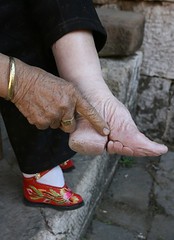
9970689816foot bindingPractice in Chinese society to mutilate women's feet in order to make them smaller; produced pain and restricted women's movement; made it easier to confine women to the household.13
9970689817tribute systemChinese method of dealing with foreign lands and people's that assumed the subordination of all non-Chinese authorities and required the payment of tribute --produce of value from their countries--to the Chinese emperor(although the Chines gifts given in return were often much more valuable).14
9970689820JurchenFounders of Qin kingdom that succeeded the Liao in northern China; annexed most of the Yellow River basin and forced Song to flee to south.15
9970689821Silla DynastyKorean dynasty that resisted Tang for first time. Respected China, performed kowtow, ritual bow to Chinese emperor. Studied Buddhism/Confucianism16
9970689825bushido"the way of the warrior"; Japanese word for the Samurai life ; Samurai moral code was based on loyalty, chivalry, martial arts, and honor until the death17
9970689826Chinese BuddhismChina's only large-scale cultural borrowing before the 20th century. Buddhism entered China from India in the first and second centuries C.E but only became popular between 300-800 C.E through a series of cultural accommodations. At first supported by the state, Buddhism suffered persecution during the 9th century but continued to play a role in Chinese society.18
9970689827Emperor Wendia Chinese general, who secured his Emperor position by killing 59 princes of the Zhou royal house, and founded the Sui Dynasty. Presented himself as a Buddhist Cakravartin King, that is, a monarch who uses military force to defend the Buddhist faith.19
9970689828QuranThe holy book of Islam20
9970689829ummaThe community of all Muslims. A major innovation against the background of seventh-century Arabia, where traditionally kinship rather than faith had determined membership in a community.21
9970689830Pillars of IslamThe five core practices required of Muslims: a profession of faith, regular prayer, charitable giving, fasting during Ramadan, and a pilgrimage to Mecca (if physically and financially possible).22
9970689831hijraThe Migration of Muhammad from Mecca to Medina in A.D. 622, marking the founding of Islam23
9970689832shariaBody of Islamic law that includes interpretation of the Quran and applies Islamic principles to everyday life24
9970689833jizyatax paid by Christians and Jews who lived in Muslim communities to allow them to continue to practice their own religion25
9970689834ulamaMuslim religious scholars. From the ninth century onward, the primary interpreters of Islamic law and the social core of Muslim urban societies.26
9970689835Umayyad Caliphate(661-750 CE) The Islamic caliphate that established a capital at Damascus, conquered North Africa, the Iberian Pennisula, Southwest Asia, and Persia, and had a bureaucracy with only Arab Muslims able to be a part of it.27
9970689836Abbasid Caliphate(750-1258 CE) The caliphate, after the Umayyads, who focused more on administration than conquering. Had a bureaucracy that any Mulim could be a part of.28
9970689837SufismA branch of Islam, defined by adherents as the inner, mystical dimension of Islam; others contend that it is a perennial philosophy of existence that pre-dates religion, the expression of which flowered within Islam29
9970689838al-GhazaliBrilliant Islamic theologian; struggled to fuse Greek and Qur'anic traditions; not entirely accepted by ulama30
9970689839Sikhismthe doctrines of a monotheistic religion founded in northern India in the 16th century by Guru Nanak and combining elements of Hinduism and Islam31
9970689840Ibn Battuta(1304-1369) Morrocan Muslim scholar, the most widely traveled individual of his time. He wrote a detailed account of his visits to Islamic lands from China to Spain and the western Sudan. His writings gave a glimpse into the world of that time period.32
9970689841TimbuktuMali trading city that became a center of wealth and learning33
9970689842Mansa MusaRuler of Mali (r. 1312-1337). His extravagant pilgrimage through Egypt to Mecca in 1324-1325 established the empire's reputation for wealth in the Mediterranean world.34
9970689843al-AnadalusMuslim kingdom in southern Spain, established in 75635
9970689844madrassasFormal colleges for higher institutions in the teaching of Islam as well as in secular subjects founded throughout the Islamic world in beginning in the 11th century36
9970689845House of WisdomCombination library, academy, and translation center in Baghdad established in the 800s.37
9970689846Ibn SinnaHe was one of the most famous doctors of all times. He read the works of Hippocrates and Galen and improved them, by adding more accurate descriptions. He also created anatomical charts using newly invented surgical tools. His text "Cannon of Medicine" (aka "Code of Laws in Medicine") was reference source for doctors for hundreds of years following his death.38
9970689847Nubian ChristianityChristianity was introduced by traders and missionaries. Preserved Christianity for 600 years.39
9970689849Ethiopian Christianity (aka Coptic church)Rulers of axum had adopted Christianity. Christian island in a Muslim sea protected by its moutanous geography and distance from major centers of islamic power. Also helped muhammad's followers be safe. This isolation made it develop a fascination with judaism and jerusalem. Justified their rule through a connection with Solomon as a descendent of jesus. Tried to create a new jerusalem40
9970689850Byzantine Empire(330-1453) The eastern half of the Roman Empire, which survived after the fall of the Western Empire at the end of the 5th century C.E. Its capital was Constantinople, named after the Emperor Constantine.41
9970689851ConstantinopleA large and wealthy city that was the imperial capital of the Byzantine empire and later the Ottoman empire, now known as Istanbul42
9970689852JustinianByzantine emperor in the 6th century A.D. who reconquered much of the territory previously ruler by Rome, initiated an ambitious building program , including Hagia Sofia, as well as a new legal code43
9970689853caesarpapisma political-religious system where the secular ruler is also the head of the religious establishment (Byzantine Empire)44
9970689854Eastern Orthodox ChristianityEastern branch of Christianity that evolved following the division of the Roman Empire and the subsequent development of the Byzantine Empire in the east and the medieval European society in the west. The church recognized the primacy of the patriarch of Constantinople45
9970689855iconsA painting of Christ or another holy figure, used as an aid to devotion in the Byzantine and other Eastern Churches.46
9970689856Prince Vladimir of Kievconverted to Orthodox Christianity, and allowed Byzantine influence in his realm47
9970689857Kievan RusA monarchy established in present day Russia in the 6th and 7th centuries. It was ruled through loosely organized alliances with regional aristocrats from. The Scandinavians coined the term "Russia". It was greatly influenced by Byzantine48
9970689858CharlemagneKing of the Franks (r. 768-814); emperor (r. 800-814). Through a series of military conquests he established the Carolingian Empire, which encompassed all of Gaul and parts of Germany and Italy. Illiterate, though started an intellectual revival.49
9970689859Holy Roman EmpireA medieval and early modern central European Germanic empire, which often consisted of hundreds of separate Germanic and Northern Italian states. In reality it was so decentralized that it played a role in perpetuating the fragmentation of central Europe.50
9970689860Roman Catholic churchOne of three major branches of Christianity, together with the Eastern Orthodox Church, a second of the three major divisions of Christianity, arose out of the division of the Roman empire into four governmental regions. In 1054 CE Christianity was divided along that same line when the Eastern Orthodox, centered in Constantinople, and the ______ ______ ______, centered in Rome, split.51
9970689861Western ChristendomWestern Europe was on the margins of world history for most of the postclassical millennium; It was far removed from the growing world trade routes; European geography made political unity difficult; Coastlines and river systems facilitated internal exchange;52
9970689863CrusadesArmed pilgrimages to the Holy Land by Christians determined to recover Jerusalem from Muslim rule. The Crusades brought an end to western Europe's centuries of intellectual and cultural isolation.53
9970689864pastoralismA type of agricultural activity based on nomadic animal husbandry or the raising of livestock to provide food, clothing, and shelter.54
9970689866Turks6th-10th centuries C.E. •Pastoral ethnic group that originated in northern Eurasia and spread into Central Asia and the Middle East •Had significant cultural and political interactions with China, Persia, Byzantium •Conversion to Islam 10th-14th centuries •Diffused Islam throughout Middle East, India, Anatolia(Turkey)55
9970689868Temujinleader of the largest Mongol clans; he unites them all(plans to conquer Asia); and receives title Genghis Khan(universal ruler)56
9970689869the Mongol worldEurasia, 13th-15th centuries •50-year period of Mongol conquests across Eurasia that created the Mongol empire •Subjected huge populations to Mongol rule •Military strength allowed for rapid conquest •Mongol rule created interactions between diverse groups •Served to diffuse technology, culture, political and economic systems57
9970689870Yuan Dynasty(1279-1368 CE) The dynasty with Mongol rule in China; centralized with bureaucracy but structure is different: Mongols on top->Persian bureaucrats->Chinese bureuacrats.58
9970689871Kublai Khan(1215-1294) Grandson of Genghis Khan and founder of the Mongol Yuan Dynasty in China.59
9970689877IroquoisA later native group to the eastern woodlands. They blended agriculture and hunting living in common villages constructed from the trees and bark of the forests60
9970689878TimurSometimes known as Tamerlane, this was the Central Asian leader of a Mongol tribe who attempted to re-establish the Mongol Empire in the late 1300's. His empire included Persia (Iran) and many surrounding lands. He is the great great grandfather of Babur. who later founds the Mughal Empire in India.61
9970689880Ming DynastySucceeded Mongol Yuan dynasty in China in 1368; lasted until 1644; initially mounted huge trade expeditions to southern Asia and elsewhere, but later concentrated efforts on internal development within China.62
9970689881European Renaissancea "rebirth" of classical learning that is most often associated with the cultural blossoming of Italy is the period 1350-1500 and included Greek learning and growing secularism63
9970689882Zheng HeAn imperial eunuch and Muslim, entrusted by the Ming emperor Yongle with a series of state voyages that took his gigantic ships through the Indian Ocean, from Southeast Asia to Africa.64
9970689883Ottoman EmpireIslamic state founded by Osman in northwestern Anatolia. After the fall of the Byzantine Empire, the Ottoman Empire was based at Istanbul (formerly Constantinople) from 1453-1922. It encompassed lands in the Middle East, North Africa, the Caucasus, and eastern Europe.65
9970689884seizure of ConstantinopleConstantinople fell to army of Ottoman sultan Mehmed II "the Conqueror" in 1453, marking end of Christian Byzantium66
9970689885Safavid EmpireTurkish-ruled Iranian kingdom (1502-1722) established by Ismail Safavi, who declared Iran a Shi'ite state.67
9970689886Songhay EmpireA state located in western Africa. From the early 15th to the late 16th century, it was one of the largest Islamic empires in history.68
9970689887Mughal EmpireMuslim state (1526-1857) exercising dominion over most of India in the sixteenth and seventeenth centuries; a minority of Muslims ruled over a majority of Hindus.69
9970689888MalaccaPort city in the modern Southeast Asian country of Malaysia, founded about 1400 as a trading center on the Strait of Malacca. Also spelled Melaka.70
9970689889Aztec Empire1325-1500 CE. Also known as Mexica, the Aztecs created a powerful empire in central Mexico. Forced defeated people to provide goods and labor as tax. At its best had complex myth and religious traditions and reached amazing architectural and artistic accomplishments.71
9970689890Inca Empire(1450-1572 CE), Largest Empire ever built in South America; territory extended 2,500 miles from north to south and embraced almost all of modern Peru, most of Ecuador, much of Bolivia, and parts of Chile and Argentina; maintained effective control from the early 15th century until the coming of Europeans in the early 16th century. As the most powerful people of Andean America, the Inca dominated Andean society until the coming of Europeans; was an extremely diverse culture cause it spanned north and south rather then east and west.72

Chapter 9 World History AP Flashcards

Terms : Hide Images
7913985266Kermaproduced ugly pottery for the Pharaohs, they valued this very much0
7913985267KushThe Nubians unified into the city-state Kush, kush was a very Egyptian like state1
7913985268Napatacity in kush2
7913985269MeroeAlternate capital/2nd capital of Kush3
7913985270Queen of ShebaBiblical Figure4
7913985271EnzanaFirst Major to Convert to Christianity in Axum5
7913985272Coptic Churcha result of the break between African and European religion6
7913985273Terrace FarmingAreas cut from the side of a mountain7
7913985274Soninkelanguage of Ghana8
7913985275Kumbi Salehcapital of ghana9
7913985276MandeLanguage of mali10
7913985277SundiataFirst Mansa (emperor)11
7913985278Mansaemperor12
7913985279MusaRules Mali after Sundiata13
7913985280Timbuktuhigh trade high intelligence area14
7913985281Gaocapital of Songhay15
7913985282Sunni AliMost powerful leader16
7913985283Askia MuhammadAnother leader of Soghay, helped reform it17
7913985284BantuPopular Coastal Language18
7913985285Swahiliblend of arabic and bantu19
7913985286Kilwaeastern African city/community20
7913985287Zambezi Riverriver south of great zimbabwe21
7913985288ShonaLanguage of Zimbabwe22
7913985289Mutotaruler of Zimbabwe that that uses his army to make the mutapa empire23
7913985290Mutapaempire formed by mutota24

Chapter 20-22 Quiz - AP World History Flashcards

Terms : Hide Images
5813916831Triangular TradeCommerce linking Africa, the New World colonies, and Europe; slaves carried to America for sugar and tobacco transported to Europe0
5813920033Osei TutuMember of Oyoko clan of Akan peoples in Gold Coast region of Africa; responsibile for creating unified Asante Empire in 1701; utilized Western firearms1
5813928164AsanteheneTitle taken by ruler of Asante Empire; supreme civil and religious leader; authority symbolized by golden stool2
5813930505DahomeyKingdom developed among Fon or Aja peoples in 17th century; center at Abomey 70 miles from coast; under King Agaja expanded to control coastline and part of Whydah by 1727; accepted Western firearms and goods in return for African slaves3
5813935184FulaniPastoral people of western Sudan; adopted purifying Sufi variant of Islam; under Usuman Dan Fodio in 1804, launched revolt against Hausa kingdoms, established state centered on Sokoto4
5813941064MfecaneWars of 19th century in southern Africa; created by Zulu expansion under Shaka; revolutionized political organization in southern Africa5
5813944262Great TrekMovement of Boer settlers in Cape Colony of southern Africa to escape influence of British colonial government in 1834; led to settlement of regions north of Orange River and Natal6
5813949553Middle PassageSlave voyage from Africa to the Americas(16th-18th centuries); apparently a traumatic experience for black slaves, although it failed to strip Africans of their culture7
5813954382WilberforceBritish statesman and reformer; leader of abolitionist movement in English parliament that led to end of English slave trade in 18078
5813971502BoersDutch farmers who had crossed the Orange River in search of new lands9
5813972730DiasporaA scattered population whose origin lies within a smaller geographic locale10
5813976493SafavidsOriginally a Turkic nomadic group; family originated in Sufi mystic group; espoused Shi'ism; conquered territory and established kingdom in region equivalent to modern Iran; lasted until 172211
5813981657OttomansTurkic people who advanced from strongholds in Asia Minor during 1350s; conquered large part of Balkons; unified under Mehmed I; captured Constantinople in 1453; established empire from Balkons that included most of Arab world12
5813992131JanissariesOttoman infantry divisions that dominated Ottoman armies; forcibly conscripted as boys in conquered areas of Balkons, legally slaves; translated military service into political influence, particularly after 15th century13
5814014758VizierOttoman equivalent of the Abbasid wazir; head of the Ottoman bureaucracy; after 5th century often more powerful than sultan14
5814018625Abbas the GreatSafavid ruler from 1587 to 1629; extended Safavid domain to greatest extent; created slave regiments based on captured Russians, who monopolized firearms within Safavid armies; incorporated western military technology15
5814030241ImamsAccording to Shi'Ism, ruler who could trace descent from the successors of Ali16
5814048664MullahsLocal mosque officials and prayer leaders within the Safavid empire; agents of Safavid religious campaign to convert all of population to Shi'Ism17
5814080345IsfahanSafavid capital under Abbas the Great; planned city laid out according to Shah's plan; example of Safavid architecture18
5814093432BaburFounder of Mughal dynasty in India; descended from Turkic warriors; first led invasion of India in 1526 and died in 153019
5814096070AkbarSon and successor of Humayan; oversaw building of military and administrative systems that became typical of Mughal rule in India; pursued policy of cooperation with Hindu princes; attempted to create new religion to bind Muslim and Hindu populations of India20
5814101319Taj MahalMost famous architectural achievement of Mughal India; originally built as a new mausoleum for the wife of Shah Jahan, Mumtaz Mahal21
5814105889MughalsEstablished by Babur in India in 1526; the name is taken from the supposed Mongol descent of Babur, but there is little indication of any Mongol influence in the dynasty; became weak after rule of Aurangezeb in first decades of 18th century22
5814111140Asian Sea Trading NetworkPrior to the intervention of Europeans; consisted of three zones: Arab zones based on glass, carpets, and tapestries; India based on cotton textiles; China based on paper, porcelain, and silks23
5814117507HongwuFirst Ming emperor in 1368; originally of peasant lineage; original name was Zhu Yuanzhang; drove out Mongol influence; restored position of scholar-gentry24
5814123385IeyasuVassal of Toyotomi Hideyoski; succeeded him as most powerful military figure in Japan; granted title of shogun in 1603 and established Tokugawa Shogunate; established political unity in Japan25
5814127621EdoFormer name of Tokyo and was the seat of power for the Tokugawa Shogunate26
5814129256Tokugawa ShogunateThe last feudal Japanese military government, which existed between 1603 and 186727
5814132180Ming DynastyThe restoration of ethnic Chinese rule and the reunification of the country28
5814134158Admiral ZhengheA Hui court eunuch, mariner, explorer, diplomat, and fleet admiral during China's early Ming Dynasty29

Vocabulary Ap world History Practice Flashcards

Terms : Hide Images
6705430309Democracya system of government by the whole population or all the eligible members of a state, typically through elected representatives0
6705437128Direct DemocracyDirect democracy (also known as pure democracy) is a form of democracy in which people decide (e.g. vote on, form consensus on) policy initiatives directly.1
6705440551Representative DemocracyRepresentative democracy (also indirect democracy, representative republic, or psephocracy) is a type of democracy founded on the principle of elected officials representing a group of people, as opposed to direct democracy2
6705447111Parliamentary DemocracyParliamentary democracy, democratic form of government in which the party (or a coalition of parties) with the greatest representation in the parliament (legislature) forms the government, its leader becoming prime minister or chancellor.3
6705457147Autocracya system of government by one person with absolute power.4
6705459948Dictatorshipgovernment by a dictator.5
6705466161Totalitarian DictatorshipOf, relating to, being, or imposing a form of government in which the political authority exercises absolute and centralized control over all aspects of life, the individual is subordinated to the state, and opposing political and cultural expression is suppressed:6
6705479090Absolute MonarchyAbsolute monarchy, or despotic monarchy, is a form of monarchy in which one ruler has supreme authority and where that authority is not restricted by any written laws, legislature, or customs. These are often, but not always, hereditary monarchies.7
6705492324Constitutional MonarchyA constitutional monarchy is a form of government in which a monarch acts as head of state within the parameters of a written (i.e., codified), unwritten (i.e., uncodified) or blended constitution.8
6705494599Theocracy. a form of government in which God or a deity is recognized as the supreme civil ruler, the God's or deity's laws being interpreted by the ecclesiastical authorities. 2. a system of government by priests claiming a divine commission.9
6705496295Oligarchya small group of people having control of a country, organization, or institution.10
6705500275Anarchya state of disorder due to absence or nonrecognition of authority11
6705521512Religionthe belief in and worship of a superhuman controlling power, especially a personal God or gods.12
6705525385Abrahamic ReligionAn Abrahamic religion is a religion whose followers believe that the Hebrew patriarch Abraham and his descendants hold an important role in human spiritual development. The best known Abrahamic religions are Judaism, Christianity, and Islam13
6705528314Christianitythe religion based on the person and teachings of Jesus of Nazareth, or its beliefs and practices.14
6705533780Judaismthe monotheistic religion of the Jews.15
6705533781Islamthe religion of the Muslims, a monotheistic faith regarded as revealed through Muhammad as the Prophet of Allah.16
6706970099Buddhisma religion, originated in India by Buddha (Gautama) and later spreading to China, Burma, Japan, Tibet, and parts of southeast Asia, holding that life is full of suffering caused by desire and that the way to end this suffering is through enlightenment that enables one to halt the endless sequence of births and deaths17
6706972385MesopotamiaMesopotamia was a historical region situated within the Tigris-Euphrates river system, in modern days roughly corresponding to most of Iraq plus Kuwait, the eastern parts of Syria, Southeastern Turkey,18
6706987493Ancient Romethe lands and peoples subject to the authority of ancient Rome. the form of government established in ancient Rome in 27 b.c., comprising the Principate or Early Empire19
6706998150Ancient GreeceAncient Greece was a civilization belonging to a period of Greek history from the Greek Dark Ages of the 12th-9th centuries BC to the end of antiquity20
6706998151Han Empireimperial dynasty that ruled China (most of the time from 206 BC to AD 220)21
6707003149Mauryan EmpireMaurya Empire. definition: Indian empire founded by Chandragupta, beginning with his kingdom in northeastern India and spreading to most of northern and central India. significance: unified the Indian subcontinent.22
6707007405Abbasid Empirea member of a dynasty of caliphs ruling at Baghdad, a.d. 750-1258, governing most of the Islamic world and claiming descent from Abbas, uncle of Muhammad. Expand. Also, Abbassid, Abbasid. ... Origin of Abbasid.23
6707226818Hinduisma major religious and cultural tradition of South Asia, developed from Vedic religion24
6783326757Middle Ages400's to 1400's; starts with the fall of Rome in 476; ends with the Renaissance; also called the Dark Ages & the Medieval Time; had a lack of reading, writing, art, innovation, etc; many wars over Europe25
6783334367Christian Crusades1095; war between Christians and Muslims; Byzantine Empire vs the Abbasid Civilization; thought that Christianity contradicts Islam26
6783336489Fall of Han Dynastyfell in 220 CE due to a battle called "The Battle of Red Cliffs"; the Jin Dynasty was next to take over China, they lasted until 580 CE; the Sui Dynasty took over after in 589 CE27
6783337149Golden Age of Chinamore inventions, innovations, and cultural growth was occurring; 3 dynasties: Sui, Tang, and Song28
6783338478Sui Dynasty589 CE to 618 CE; built the Great Wall of China; expanded China's territory; built the Grand Canal for trade; religion was Confucianism; ended due to military retaliation29
6783339899Confucianismcreated by Confucius around 400 CE; valued education, respect, hard work, hierarchy; a way of life; famous Chinese philosopher Xunzi supported spread of Confucianism and led fight against Hindu30
6783341259Tang Dynasty618 CE to 907 CE; allowed female and male rulers; expanded military; supported Buddhism; lost power to their own people; had trade31
6783345534Song Dynasty960 CE to 1279 CE; didn't allow female rulers; put power to the people; supported Daoism; lost power to their own people32
6783520189Feudalismsocial system in Europe during the Middle Ages; monarchy; Christianity was popular; kings, lords, knights, serfs/peasants33
6806289845Indian Ocean Tradeconnected Africa, Asia, Europe, & the Middle East; 800 - 1500's CE; exchanged ivory, gold, iron, cotton, silk, & porcelain goods; took place over the ocean, large cargo ships were built to carry large amounts of goods to sell; many European powers became interested in settling in Africa; ended because Portuguese wanted to take over the Swahili city-states and started many wars34
6806310317Silk Road206 BCE - 1453 CE; connected China, India, the Middle East, & Europe; exchanged Chinese silk, cloth, gold, precious stones, religions (Islam & Buddhism), & gunpowder35
6806313221Trans-Saharan Tradetook place in northern Africa from 600 - 1300 CE; traveled by camels; many great cities became rich from the trade that took place here; exchanged gold, glass, slaves, textiles, ivory, ebony, brass, copper, salt, pepper, dates, horses, african art, and diseases36
6806316069Aztec Empire1345 - 1521; current day Mexico; polytheistic37
6806319318Maya Empire950 - 1524; central Mexico; known for their astronomy and mathematics; polytheistic38
6806322567Inca Empire1400 - 1533; known for their architecture39
6806325827Byzantine Empirelast of the Roman Empire; western Europe; 330 CE - 1453 CE; ended because the Ottoman Empire took over the capital; under Emperor Constantine, religion was Christianity40
6806364171Black Plaguedisease; killed 2/3 of Europe's population & majority of Asia; spread in a couple of years; also known as the Bubonic Plague; spread by rats with infected fleas41
6827454305Control in Medieval EuropeRoman Catholic Church had a lot of control in Europe; almost everyone believed in heaven, hell and God; people must follow what the Church said or go to hell; the Pope was the ultimate leader42
6827461085Economy in Medieval Europethe Church made money by charging a tax; charged for marriages, baptisms, and funerals; the Church used this money to build churches and cathedrals; 90% of Europe were peasants43
6827465017Religion in Medieval EuropeReligion in Medieval Europe important aspect of life; only church they had was the Roman Catholic Church; the Church was a place that was used for weddings, baptisms, and prayers; the Church also served as a safe haven for he people of the village44
6827467652Ottoman Empireat its largest during the 16th-17th century; spanned across Asia, Europe, & Africa; Ottoman Empire controlled all of the trade going through this region; converted many to Islam; capital city is Constantinople45
682747011312th Century Renaissanceartwork was focused on religion; took place during the High Middle Ages; social, political, and economic transformations; churches and schools were built for students to learn Latin and Greek; cathedrals were built with sculptures and mosaics; people of Europe believed that "beauty brought people closer to God"46
682747361415th Century Renaissancealso called the "Italian Renaissance"; artwork was more broad; art didn't focus on religion; art, architecture, literature, music, philosophy, and other arts prospered; included: Michelangelo, Leonardo da Vinci, and Raphael47
6827480376Colonialismacquiring control over another country, occupying it with settlers and exploiting it economically48
6827486098Age of Explorationa period from the 15th to the 17th century; travelers and explorers discovered land while searching for trade routes49
6827491284Expansion of the Ottoman EmpireOttoman Empire's main goal was taking over more territories; they accepted both Christians and Muslims; growth in cultural diversity50
6827495960Sultan Mehmet IIwas the Sultan (leader) from 1451 to 1481; during his rule, all of Turkey (Anatolia) was brought under the Ottomans and the Byzantine Empire was defeated51
6827497975Power of the Ottoman Empireafter the fall of the Byzantine Empire, the Ottomans became the major power in Europe; success due to its inclusion of many cultures and religions; had a powerful military52
6827500745Renaissancea time of rebirth of culture in Europe; this time to be the end of the Middle Ages; revamped: art, innovation, education, scientific discoveries53
6827504310Medici Familygot rich and power in Florence in the 13th century due to success in commerce and banking; had four Popes: Leo X, Clement VII, Pius IV, and Leon XI; Medici Dynasty ended in 1737; family was royalty; supported the Renaissances54
6827507187Imperialismextending a country's power through military force55
6827508842Persian Empireat its largest during the 550 to 300 BCE; before the Romans, they had the majority of rule over Europe and Asia; expanded by colonialism because he was peaceful and wanted to create a buffer around his land for resource; expanded by imperialism because he conquered land, military was important, freed the Jews56
6827510622British Empireat its largest during the early 1900's; controlled more than 500 million people; English and Christianity were taught to many people; expanded by imperialism because they fought people; expanded by colonialism by setting up colonies57
682751370812th Century Artart was religious; included: angels, crosses, halos, gold, silk robes, cathedrals, churches, arches, towers, Jesus, and other religious figures58
682752098215th Century ArtMedici family pais 15th century artists for their creations; included: nature, human form, realistic, marble/ materials, common people, variety of colors, very simple59
6827528104Start of the Ottoman Empire1300 to 1922; leader was Osman; nomadic groups came together and expanded around 1300; created a natural barrier between Islamic civilizations and the Byzantine Empire60
6827530273Empires During Colonialismempires were formed by linking diverse ethnic, national, cultural, and religious components61
6827534304Slave Tradestarted after Colonialism; as Europeans got more wealthy from the Age of Exploration, they needed more manpower to help them62
6827538968PortugalPortugal's government supported their exploration in finding new trade routes to Asia when the Ottoman Empire stopped trade from going through63
6827901024SpainSpain supported Christopher Columbus' exploration to find new trade routes to Asia64
6935505520World War Ialso referred to as the Great War; was a global war which mainly centered in Europe; July 28, 1914 to November 11, 1918; two sides: Allies (Triple Entente) vs. Central Powers; started due to the assassination of Archduke Ferdinand of Austria65
6935508405Militarismthe policy of building up or creating a large military66
6935510781Alliancesan agreement between 2 or more countries to help each other out and defend each other67
6935513564Nationalismpride in one's country68
6935532193Holocaustgenocide; between 1933 to 1938 under the lead of Hitler, Germany built concentration camps for many minorities; widespread use of propaganda was targeting minorities; minorities included: Jews, gypsies, physically disabled, homosexuals, and more69
6935534978Genocidethe international killing of a large group of people70
6935537085Modern Warthe use of technology and new strategies pushes conflict further71
6935539824Trench Warfarea type of warfare where fighting occurs in trenches; France was the first to use this warfare in WW172
6935543492No Man's Landthe space between a trench and another trench of the opposing side73
6935545854Poison Gasthe French created Tear Gas; the Germans created Mustard Gas; both can cause burns, blindness, and difficulty breathing; Mustard Gas was much more superior; gas masks were invented74
6935572749Marshall Planalso called the European Recovery Program; planned by the US Secretary of State, George Marshall, in 1947; a plan to channel $13 billion to help Europe recover from WWII; Soviet Union viewed this plan as a way to intervene their plans of spreading communism; US aid a lot in the UK and France75
6935575317USSR76
6935576793Yalta Conference1945; a decision was made to split the German Empire into 4 sections after WWII. Germany would then belong to the US, Great Britain, France and the Soviet Union77
6935579344Truman DoctrineHarry Truman; 1947; US promises to provide political and military help to all democratic and capitalist nations to fight off communism; specifically trying to protect Greece and Italy78
6935584637Communismfull government control of economics with the assumption to create equality79
6935586849Socialismcontrol of government in some economics to offer more support80
6935588048Capitalismno government involvement in economics; all people make and spend money how they want81
6935594996Iron Curtain1946; official opening of the Cold War; Churchill wanted to establish a strong alliance with the US; he warned the Soviet Union to stop their expansion of both territory and communism; the divide to stop communism82
6935597892Cuban Missile Crisis1959; Cuba becomes communist under Fidel Castro; in October of 1962, USSR had established nuclear-armed missiles in Cuba, US perceived this as a threat; President John F Kennedy announced that the US was ready to fight back; many people were in fear of nuclear war83
6935601331Vietnam War1955 to 1975; Northern Vietnam vs. Southern Vietnam; North was led by the Viet Cong (communist); South was led by the US (capitalist); the US was invested in this war to stop the spread of communism84

WORLD HISTORY REVIEWER SPRING 2018 Flashcards

Terms : Hide Images
8934655455"The only way to erect such a common power, as may be able to defend them from the invasion of foreigners . . . is to confer all their power and strength upon one man, or upon one assembly of men, that may reduce all their wills, by plurality of voices, unto one will . . ."reflects the philosophy of someone who supports: absolute monarchy0
8934655456Beheaded and replaced by a Republic in France at the end of the 18th centuryKing Louis XVI1
8934655457"Prices should be regulated by the laws of supply and demand, or the 'invisible hand' "Adam Smith's book, Wealth of Nations2
8934655458"The people rushed against the place . . . They took all the arms, discharged the prisoners and such of the garrison as were not killed in the first moment of fury, carried the Governor and Lieutenant governor to the Greve, cut off their heads, and set them through the city in triumph to the Palais royal."The event Thomas Jefferson is describing in this passage was the assault on the Bastille.3
8934655459economic philosophies promoted government regulation of the economy, but only when businesses were exploiting workerscommunism4
8934655461"Second Estate" under France's ancien régimethe nobility5
8934655462most likely to support the Reign of Terrorsans-culottes6
8934655463Under the National AssemblyFrance became a constitutional monarchy7
8934655464Napoleon is asserting he is the source of his own authority.8
8934655460Marie Antoinette9
8934655466The invention shown here contributed to a revolution in the textile industry10
8934655467During WWI, the area depicted was of great importance to the Allies as a way to transport supplies to Russia.11
8934858010Charles VAssumed control of the Hapsburg Empire and crowned by the Pope12
8934858011Louis XIV"L'État, c'est moi." ("The state, it is me."). This statement shows the idea of divine right of kings13
8934858012Don Quixotethis work by Miguel de Cervantes showed romantic notions of knighthood and chivalry.14
8934858013Philip IIHe influenced the art of Spain's golden age by financial support to artists.15
8935027437The Glorious Revolutionwas a rejection of ideas Absolute Monarchy like those expressed by James I.16
8935027438a cabinet systemWhich of the following was a chief characteristic of Britain's constitutional government in the 1700s?17
8935027439Thomas Hobbes"The only way to erect such a common power, as may be able to defend them from the invasion of foreigners . . . is to confer all their power and strength upon one man, or upon one assembly of men, that may reduce all their wills, by plurality of voices, unto one will . . ." This quote best reflects the philosophy of18
8935027440Joseph II abolishing serfdom in AustriaAn example of a monarch supporting Enlightenment reform19
8936597442Adam SmithThis quote by a modern economist reflects the ideas of which of the following Enlightenment thinkers? "Manufacturing and commercial monopolies owe their origin not to a tendency [naturally found in a] capitalist economy but to governmental interventionist policy directed against free trade and laissez-faire."—Ludwig Von Mises, Austrian economist20
8936597443popular sovereigntyAll government power ultimately derives from the consent of the people being governed.21
8936597444the nobilityWhich group made up the "Second Estate" under France's ancien régime?22
8936597445sans-coulottesWhich group in France would have been most likely to support the Reign of Terror?23
8936597446Battle of Saratogaa turning point in the American Revolution; It persuaded other nations to ally themselves with the American colonists.24
8936597447National AssemblyTurned France into a constitutional monarchy25
8936597448DirectoryIts weak and corrupt actions ultimately lead to the rise of Napoleon Bonaparte26
8936597449A multi-ethnic diverse empire and constant revoltschallenges the Hapsburgs faced after the Thirty Years' War27
8936597450Liberté, égalité, fraternité( French for "liberty, equality, fraternity")slogan of the French Revolution and the "Declaration of the Rights of Man and the Citizen" upheld similar principles.28
9088516645CHAPTER 3 THE INDUSTRIAL REVOLUTION29
9088516647Industrial Revolutionthe transition to new manufacturing processes in the period from about 1760 to sometime between 1820 and 1840. This transition included going from hand production methods to machines, new chemical manufacturing and iron production processes, the increasing use of steam power, the development of machine tools and the rise of the factory system.30
9088516648Anesthetica drug to prevent pain during surgery31
9088516649Enclosurethe legal process in England of enclosing a number of small landholdings to create one larger farm32
9088516650James Watta Scottish inventor, mechanical engineer, and chemist who improved on Thomas Newcomen's 1712 Newcomen steam engine with his Watt steam engine in 1781, which was fundamental to the changes brought by the Industrial Revolution in both his native Great Britain and the rest of the world33
9088516651Smelta process of applying heat to ore to melt out a base metal34
9088516652Capitalconsists of anything that can enhance a person's power to perform economically useful work. Capital goods, real capital, or capital assets are already-produced, durable goods or any non-financial asset that is used in production of goods or services35
9088516653Enterprisean organization that provides goods and services for human needs.36
9088516654Entrepreneuran owner or manager of a business enterprise who makes money through risk and initiative37
9088516655putting-out systema means of subcontracting work. Historically, it was also known as the workshop system and the domestic system.38
9088516656Eli Whitneyan American inventor best known for inventing the cotton gin. This was one of the key inventions of the Industrial Revolution and shaped the economy of the Antebellum South39
9088516657Turnpikeanother term for a toll road and historically the term for a toll gate or barrier40
9088516658Liverpool and Manchestertwo British cities connected by the world's first major rail line in 183041
91891108453.2 Key Terms42
9189110846Urbanizationpopulation shift from rural to urban areas43
9189110847tenementa multi-occupancy building of any sort44
9189110848labor unionan organization of workers who have come together to achieve common goals; such as protecting the integrity of its trade, improving safety standards, and attaining better wages, benefits (such as vacation, health care, and retirement), and working conditions through the increased bargaining power wielded by the creation of a monopoly of the workers45
9189110849standard of livingthe level of wealth, comfort, material goods, and necessities available to a certain socioeconomic class in a certain geographic area, usually a country.46
9189110850social mobilitythe movement of individuals, families, households, or other categories of people within or between social strata in a society47
9189110851free marketsystem in which the prices for goods and services are determined by the open market and consumers,48
9189110852Thomas Malthusargued that population multiplies geometrically and food arithmetically; therefore, whenever the food supply increases, population will rapidly grow to eliminate the abundance49
9189110853Jeremy BenthamEnglish philosopher, jurist, and social reformer regarded as the founder of modern utilitarianism50
9189110854Utilitarianisman ethical theory which states that the best action is the one that maximizes utility. "Utility" is defined in various ways, usually in terms of the well-being of sentient entities51
9189110855Socialisma range of economic and social systems characterised by social ownership and democratic control of the means of production52
9189110856means of production physical, non-human and non-financial inputs used for the production of economic valueraw materials, the facilities, machinery and tools used in the production of good53
9189110857Robert Owena Welsh textile manufacturer, philanthropic social reformer, and one of the founders of utopian socialism and the cooperative movement54
9189110858Karl Marxhis theories about society, economics and politics—collectively understood as Marxism—hold that human societies develop through class struggle.55
9189110859Communismthe philosophical, social, political and economic ideology and movement whose ultimate goal is the establishment of the communist society, which is a socioeconomic order structured upon the common ownership of the means of production and the absence of social classes, money and the state56
918911086057
91891108613.3 Key Terms58
9189110862Henry Bessemeran English inventor, whose steelmaking process would become the most important technique for making steel in the nineteenth century for almost one century from year 1856 to 19559
9189110863Alfred NobelKnown for inventing dynamite, he bequeathed his fortune to institute the Nobel Prizes.60
9189110864Michael Faradayan English scientist who contributed to the study of electromagnetism and electrochemistry.61
9189110865Dynamoan electrical generator that produces direct current with the use of a commutator.62
9189110866Thomas Edisonan American inventor and businessman, who has been described as America's greatest inventor. He developed many devices that greatly influenced life around the world, including the phonograph, the motion picture camera, and the long-lasting, practical electric light bulb.63
9189110867interchangeable partscrucial to the introduction of the assembly line at the beginning of the 20th century, and has become an important element of some modern manufacturing but is missing from other important industries.64
9189110868Orville and Wilbur Wrightdesigned, built, and flew the first controlled, powered, heavier-than-air airplane on December 17, 190365
9189110869Guglielmo Marconian Italian inventor and electrical engineer. He was a pioneer of long-distance radio transmission66
9189110870Corporationa business firm where each of the partners invest a sum of money in as the capital of the corporation67
9189110871Louis Pasteura French microbiologist and chemist. He and his wife, Marie, are best known for their experiments supporting the germ theory of disease, and he is also known for his vaccinations, most notably the first vaccine against rabies68
9189110872Robert Kochwon the 1905 Nobel Prize in Physiology or Medicine, for studying tuberculosis69
9189110873Florence Nightingalean English nurse. She helped create the modern techniques of nursing. She became a leader of the team of nurses who helped wounded soldiers during the Crimean War70
9189110875cult of domesticitya term used by some historians to describe what they consider to have been a prevailing value system among the upper and middle classes during the nineteenth century in the United States and the United Kingdom. This value system emphasized new ideas of femininity, the woman's role within the home and the dynamics of work and family71
9189110876temperance movementa social movement against the consumption of alcoholic beverages72
9189110877Elizabeth Cady Stantonan American suffragist, social activist, abolitionist, and leading figure of the early women's rights movement73
9189110878Sojourner Truthan African-American abolitionist and women's rights activist74
9189110879Charles DarwinEnglish naturalist, geologist and biologist, best known for his contributions to the science of evolution.75
9189110880social gospela movement in North American Protestantism which applied Christian ethics to social problems, especially issues of social justice such as economic inequality, poverty, alcoholism, crime, racial tensions, slums, unclean environment, child labor, inadequate labor unions, poor schools, and the danger of war76
9189110881romanticism77
9189110882William Wordswortha major English Romantic poet who, with Samuel Taylor Coleridge, helped to launch the Romantic Age in English literature with their joint publication Lyrical Ballads (1798)78
9189110883Victor Hugoa French poet, novelist, and dramatist of the Romantic movement. Hugo is considered to be one of the greatest and best-known French writers. Outside of France, his most famous works are the novels Les Misérables, 1862, and The Hunchback of Notre-Dame, 183179
9189110884Ludwig van Beethovena German composer and pianist. A crucial figure in the transition between the Classical and Romantic eras in Classical music, he remains one of the most famous and influential of all composers80
9189110885realism81
9189110886Charles Dickensan English writer and social critic. He created some of the world's best-known fictional characters and is regarded by many as the greatest novelist of the Victorian era;82
9189110887Louis Daguerrea French artist and photographer, recognized for his invention of the daguerreotype process of photography83
9189110888Impressionism19th-century art movement characterised by relatively small, thin, yet visible brush strokes, open composition, emphasis on accurate depiction of light in its changing qualities (often accentuating the effects of the passage of time), ordinary subject matter, inclusion of movement as a crucial element of human perception and experience, and unusual visual angles84
9189110889Claude Moneta founder of French Impressionist painting, and the most consistent and prolific practitioner of the movement's philosophy of expressing one's perceptions before nature, especially as applied to plein-air landscape painting85
9189110890Vincent van Gogha Dutch Post-Impressionist painter who is among the most famous and influential figures in the history of Western art86

AP World History: China Flashcards

Ch2 Classical Civilization China World history

Terms : Hide Images
52738303411. Describe the stages in Chinese dynastic cycle. (dynasty)family that passed imperial title from generation to generation. When dynasty grew weaker & tax revenues declined>social divisions>internal rebellions &sometimes invasions. As ruling dynasty declined, another emerged, usually from family of a successful general, invader, or peasant rebel & pattern would repeat. Many Chinese view history in terms of cycles, in contrast to Western view of steady progress from past to present.0
52738303422. Describe the political structure of the Zhou dynasty (1029-258 B.C.E.) that displaced the Shang rulers.The Zhou didn't establish a powerful government; ruled through alliances with regional princes /noble families. Rulers couldn't control territories directly>gave regional estates to members of their families & other supporters who were to provide central government with troops & tax revenues. = China's feudal period:rulers depending on network of loyalties & obligations to & from their landlord-vassals.1
52738303433. What caused the decline of the Zhou?regional land-owning aristocrats increased their power base/disre¬garded central govt.2
52738303444. Identify/significance: Middle KingdomZhou extended territory of China- took Yangtze River valley from Huanghe R. to Yangtze R. =China's core— the "Middle Kingdom." >wheat-growing in north, rice-grow¬ing in south>pop. growth. Communication/transport from capital to out-lying regions difficult>>Zhou relied so heavily on loyalty of regional supporters.3
52738303455. Identify/significance: Mandate of Heaven (Sons of Heaven)Zhou rulers claimed direct links to Shang rulers & asserted heaven had transferred its mandate to rule China to Zhou emperors =key justification for Chinese imperial rule from Zhou onward. These "Sons of Heaven" lived in world of awe-inspiring pomp/ceremony.4
52738303466. How did the Zhou provide greater cultural unity in their empire?promoted linguistic unity>> standard spoken language (Mandarin Chinese) in Middle Kingdom =largest single group of people speaking same language in world at this time. Regional dialects/languages remained; educated officials began to rely on Mandarin. Oral epics/stories in Chi¬nese> gradually recorded in written form>development of common culture.5
52738303477. Identify/significance: ConfuciusDuring late 6th/early 5th centuries B.C.E., Confucius wrote statement on political ethics= core of China's distinctive philo¬sophical heritage. Other writers/religious leaders participated in this great period of cultural creativity>>which later =set of central beliefs throughout Middle Kingdom.6
52738303488. Identify/significance: Era of the Warring StatesRegional rulers formed independent armies reduc¬ing emperors to little more than figureheads. Between 402 -201 B.C.E. (Era of the Warring States) the Zhou system disintegrated.7
52738303499. Identify/significance: Shih Huangdi (Qin)regional ruler who deposed last Zhou emperor & made himself ruler of China. He took the title Qin Shi Huangdi, or First Emperor. The dynastic name, Qin >conferred on whole country=China.8
527383035010. Describe the policies and achievements of Shih Huangdi in the Qin Dynasty. (Great Wall)Shi Huangdi =brutal,effective ruler amid internal disorder. China's problem= regional power of aristocrats. He ordered nobles to leave their regions & appear at his court>he took control of their estates. China was organized into large provinces ruled by bureaucrats appointed by emperor Shi Huangdi. He chose officials from nonaristocratic groups so they would owe their power to & not develop independent bases. His power¬ful armies crushed regional resistance. To guard against barbarian invasions, Shi Huangdi built a Great Wall, extending over 3000 miles & wide enough for chariots= largest construction project in human history; built by forced labor from the peasantry.9
527383035111. Describe the innovations in Chinese politics and culture during the Qin dynasty.Shi Huangdi ordered national census= calculation of tax revenues/labor service. Govt. standardized coinage, weights, mea¬sures: length of cart axles regulated to=road planning. Made Chinese written script uniform=basic language for all educated Chinese. Qin sponsored new irrigation pro¬jects; promoted manufacturing, especially silk. Qin burned many books because thinking=subversive to Shi Huangdi's autocratic rule.10
527383035212. Explain why the Qin dynasty ended.Shi Huangdi's attacks on intellectuals, high taxes to support military expansion, construction of Great Wall, made him unpopular. On his death in 210 B.C.E. massive revolts organized by peasants broke out. One peasant leader defeated other opponents; in 202 B.C.E. established the Han dynasty.11
527383035313. Describe the characteristics and achievements of Han Dynasty (202 B.C.E.-202 C.E.)Han rulers kept cen¬tralized administration of Qin but reduced brutal repression. Early Han rulers expanded Chinese territory, pushing into Korea, Indochina, central Asia. Expansion >direct contact with India & contact with Parthian Empire Middle East, through which trade with Roman Empire around Mediterranean was conducted.12
527383035414. Identify/significance: Wu TiHan ruler, Wu Ti (140—87 B.C.E.), enforced peace throughout much of Asia, similar the peace Roman Empire would bring to Mediterranean region a hundred years later, but including even more terri¬tory & far larger population. Peace brought great prosperity to China.13
527383035515. Describe the state bureaucracy and government under the Han Dynasty.state bureaucracy improved & government linked to formal training that emphasized values of Confucian philosophy. Reversing Qin dynasty's policies, Wu Ti urged support for Confucianism= vital supplement to formal measures by government.14
527383035616. Explain why Han rule declined.Han rule declined after two centuries. Central control weakened, invasions from central Asia, led by a nomadic people called the Huns, who had long threatened China's northern borders, overturned dynasty entirely. Between 220-589 C.E., China=state of chaos. Order/stability finally restored, but classical/formative period of Chinese civilization had ended. Well before But, China had established distinctive political structures & cultural values that would allow it to survive three centuries of confusion.15
5273830357II. Political Institutions...16
527383035817. Describe the distinctive and successful kind of government established by the Qin and Han governments.Qin stressed central authority; Han expanded bureaucracy. Structure of this govt.= how vast territory could be ruled ( largest polit¬ical system in classical world). This structure would change after classical period in terms of streamlining/expanding bureaucratic systems but it never required fun¬damental overhaul.17
527383035918. Describe the key elements of the political framework that emerged in China's classical period.One difference between classical civilizations & river-valley civilizations was that in classical civilizations political organizations were more complex, but strong local units never disap¬peared. China relied on tightly knit patriarchal fami¬lies linked to other relatives in extended family networks- brothers, uncles & any living grandparents. In wealthy land-owning groups, family authority enhanced by practice of ancestor worship; it was less common among ordinary peasants. Village authority surpassed family rule; village leaders helped farming families regulate property, coordinate planting/harvesting. During Zhou dynasty(& in later periods when dynasties weakened)regional power of great landlords played an important role at the village level; landed nobles pro¬vided courts of justice & organized military troops18
527383036019. How did Shih Huangdi strengthen central government?Shi Huangdi attacked local rulers & provided single law code & uni¬form tax system. He appointed governors to each district to exercise military & legal powers in name of emperor. They, in turn, named officials responsible for smaller regions=classic model of centralized government that other societies would copy in later times:establishment of centralized codes & appointment of officials directly by a central authority, rather than reliance on many existing local governments. Also appointed ministers to deal with finance, jus¬tice, military affair etc. .19
527383036120. Explain how the Han Dynasty created a strong bureaucracy.Rulers of Han also attacked local warrior-landlords; created large, skilled bureaucracy to carry out duties of state. By end of Han period, China = 130,000 bureaucrats=0.2% of pop. Wu Ti established examinations for bureaucrats=first example of civil service tests=covered classics of Chinese liter¬ature & law> model of scholar-bureaucrat that would later become important element of China's political tradition. Wu Ti established school to train men of tal-ent/ability for national examinations; most drawn from landed upper classes,who alone had time to learn complex system of Chinese characters; individu¬als from lower ranks of society were sometimes recruited under this system> slight check on complete upper-class rule; tended to limit arbitrary power by emperor. Trained /experienced bureaucrats could often control whims of single ruler. Chinese bureaucracy lasted from Han period until 20th century. .20
527383036221. List the functions of government that emerged in the classical period in China.Gov¬t.ran military & judicial systems. Mil¬itary activity fluctuated-China didn't depend on steady expansion. Judi¬cial matters commanded more attention by local government authorities. Govt. organized research in astronomy & mainte¬nance of historical records. Under Han rulers govt. played major role in promoting Confu¬cian philosophy as official statement of Chinese val¬ues & in encouraging worship of Confucius himself. The Han developed a sense of mission as primary keeper of Chinese beliefs. Imperial government also active in economy>directly organized production of iron & salt. Its standardization of currency, weights, measures facilitated trade throughout empire. The government sponsored public works: complex irrigation & canal sys¬tems. Han rulers tried to regulate agricultural supplies by storing grain/rice in good times to control price increases & potential popular unrest when harvests were bad.21
527383036322. Explain how far the power of the Chinese government was able to reach.Its system of courts was backed by strict law code; torture & execution widely used to supplement preaching of obedience & civic virtue. Cen¬tral government taxed its subjects & required annual labor on part of every male peas¬ant in building canals, roads, palaces. No other government had organization/staff to reach ordinary people so directly until modern times, except in much smaller political units such as city-states.22
527383036423. Why was the structure of Chinese government able to endure?power & authority it commanded in eyes of ordi¬nary Chinese people help explain why its structure survived decline, invasion & even rebellion for so many centuries. Invaders like Huns might topple a dynasty, but couldn't devise a better system to run the country, so the system & its bureau¬cratic administrators endured.23
5273830365III. Religion and Culture...24
527383036624. Describe the Chinese way of viewing the world that developed during the classical period.Upper-class cultural values emphasized good life on earth & virtues of obedience to the state, more than speculations about God & mysteries of heaven. Chinese tolerated/ combined various beliefs, so long as they did not contradict basic political loyalties.25
527383036725. What beliefs did the Zhou rulers stress?maintained belief in a god/ gods, but little attentio given to nature of a deity. Leaders stressed a harmonious earthly life, which would maintain balance between earth & heaven.26
527383036826. In what ways did the Chinese upper class seek and express harmony?rituals to unify society & prevent individual excess. Upper class people trained in elaborate exercises & military skills;ceremonies venerating ancestors; use of chopsticks began at end of Zhou dynasty=encouraged politeness at meals. Soon, tea introduced, but most elaborate tea-drinking rituals developed later.27
527383036927. Describe the ideas and teachings of Confucius. (Analects)If people could be taught to emphasize personal virtue (including reverence for tradi¬tion) a solid political life would naturally result. Confucian virtues stressed respect for one's social superiors— fathers/husbands as leaders of family; emphasis on proper hierar¬chy balanced by insistence that society's leaders behave modestly & shun abusive powers & treat people who were in their charge courteousl. Moderation in behavior, veneration of custom/ritual, love of wisdom should characterize leaders of society at all levels."In an age of good government, men in high stations give preference to men of ability and give opportunity to those who are below them..."28
527383037028. According to Confucius, how should rulers and subordinates act?emphasized virtuous behavior by ruler & ruled. Only a man who demonstrated proper family virtues, including respect for parents & compassion for children should be considered for political service. He emphasized personal restraint & socialization of children. Subordinates show obedience & respect; people should know their place, even under bad rulers. He urged political system to make education accessible to all tal¬ented/intelligent people. Rulers should be humble/sincere; people will grow rebellious under hypocrisy/arrogance. He warned against greed in leadership.29
527383037129. Describe Legalism.rejected Confu¬cian virtues in favor of authoritarian state that ruled by force. Human nature =evil & required restraint /discipline. The army should control & people should labor. Legalism never won widespread approval, but it entered political tradi¬tions of China, where a Confucian veneer was often combined with strong-arm tactics.30
527383037230. Explain the effects of Confucianism on peasants.Most peasants needed more than civic virtue to understand/survive their harsh life. During most of the classical period, polytheistic beliefs, focusing on spirits of nature, persisted. Many tried to attract blessing of spirits by creating statues, emblems, household decorations honoring spirits,& holding parades/ family ceremonies. A belief in symbolic power of dragons came from a popular religion= combined fear of these creatures with more playful sense of their activities in its courtship of divine forces of nature. Gradually, ongoing rites among ordinary masses integrated Confucian values urged by upper classes.31
527383037331. Describe Daoism. (Laozi)It embraced tradi¬tional Chinese beliefs in nature's harmony & added sense of nature's mystery=spiritual alternative to Confucianism. Daoism= vital for Chinese civilization but not exported. 5th century B.C.E. Laozi said nature contains divine impulse that directs all life. Human understanding comes in withdrawing from world & contemplating life force. Dao= "the way of nature" Along with secret rituals, Daoism promoted its own set of ethics. Daoist harmony with nature best resulted through humility/frugal living. Political activity& learning were irrelevant to a good life, & general conditions in world=little importance.32
527383037432. Why was Daoism able to co-exist with Confucianism?Daoism would join with strong Bud¬dhist influence from India during chaos that fol¬lowed collapse of Han dynasty; guaranteed China's people would not be united by a single religious or philosophical system. Individuals embraced elements from both Daoism &Confucianism; many emperors favored Daoism& accepted its spread because some found solace in Daoist belief & because its otherworldly emphasis posed no real political threat. Confucian scholars disagreed vigorously with Daoist thinking (myster¬ies/magic), but saw little reason to challenge its influence. Daoism provided many Chinese with ceremonies to promote harmony with mysterious life force. Chinese govt from Han dynasty onward was able to persuade Daoist priests to include expressions of loyalty to emperor in temple services>heightened Daoism's political compatibility with Confucianism33
527383037533. Identify/significance: Five Classicswritten in early Zhou dynasty; edited in time of Confucius= important tradition; used as basis for civil ser¬vice examinations; included historical treatises, speeches, discussion of etiquette/ceremonies. The Classic of Songs =300 poems dealing with love, joy, politics, fam¬ily life. Chinese literary tradition devel¬oped on basis of mastering these early works, plus Confucian writing; each generation of writers found new meanings in the classical literature= expressed new ideas in a familiar framework.34
527383037634. Describe the characteristics of Chinese literature in the classical period.Poetry=particular attention because Chinese language featured melodic speech & vari¬ant pronunciations of the same basic soun. From classical period onward, ability to learn/recite poetry= mark of educated Chinese. Literary tradition in classical China reinforced Confucian emphasis on human life, but subjects included romance& sorrow as well as political values.35
527383037735. Describe the characteristics of Chinese art in the classical period.stressed careful detail/craftsmanship;reflected precision of symbols of Chinese writing. Calligraphy >art form. Artists painted, worked in bronze & pottery, carved jade & ivory & wove silk screens. Classical China=no monumental buildings-except for Great Wall & imperial palaces/tombs- because of absence of a single reli-gion; & entire tone of upper-class Confu¬cianism discouraged notion of temples soaring to heavens.36
527383037836. Describe Chinese achievements in science and math during the classical period.science stressed the practical not theoretical. Astronomers developed accurate calendar by 444 B.C.E., based on a year of 365.5 days. Later astronomers calculated movement Saturn&Jupiter; observed sunspots—more than 1500 years before Europe. Purpose of Chinese astronomy=make celestial events pre-dictable as part of ensuring har¬mony between heaven /earth. Scientists invented seismograph to register earthquakes in Han dynasty. Medical research> anatomical knowledge &studying principles of hygiene. Mathematics stressed practical. Daoism encouraged exploration of orderly processes of nature but more research focused on how things worked. This focus for science and mathematics contrasted with more abstract definition of science in clas¬sical Greece.37
5273830379IV. Economy and Society...38
527383038037. Describe the social structure in classical China.By time of Zhou, main social division was between land-owning gentry (2% of pop.) & peasants, who provided dues/service to these lords while also controlling some of their own land. About the only thing the Chinses nobleman and peasant had in common was dependence on land as the basic economic resource. Chinese peas¬antry depended on intensive cooperation, in southern rice region; property usually owned/regulated by village or extended family. Beneath peasantry social structure included "mean" people who performed unskilled jobs & suffered from lowest status. Social sta¬tus passed from one generation to next through inheritance, but talented person from peasant background might be given access to education & rise in bureaucracy. Officially-3 main social groups:1. landowning aristocracy/educated bureau¬crats 2. laboring masses of peasants/urban artisans=much poorer & condemned to life of hard manual labor, sometimes worked directly on large estates but in other cases had some economic independence. 3. The "mean people"-those without meaningful skills. (Performing artists in this group despite upper classes enjoyment of plays/entertainment). Mean people punished for crime more harshly & required to wear green scarves. Household slaves also in class structure, but relatively few&China did not depend on slaves fo production.39
527383038138. Explain why trade became increasingly important during the Zhou and particularly the Han dynasties.Much trade focused on luxury items for upper class, produced by skilled artisans in cities—silks, jewelry, leather goods, furniture; food exchange between wheat&rice regions. Copper coins facilitated trade; merchants sponsored commercial visits to India. Trade/merchant class didn't =focal points of Chinese society;Confucian emphasis on learning/ political service= scorn for lives devoted to moneymaking. Gap between real importance & wealth of merchants & their officially low prestige= enduring legacy in Confucian China.40
527383038239. Describe Chinese technological advances during the classical period.Agricultural implements improved. Ox-drawn plows introduced 300 B.C.E.>greatly increased productivity. Under Han, new collar >draft animals pull plows/ wagons without chok¬ing (available to other parts of world many centuries later). Chinese iron mining=pulleys/winding gears. Iron tools & lamps widely used. Production methods in textiles&pottery =highly developed. Under Han 1st water-pow¬ered mills > gains in manufacturing. During Han, paper invented= boon to a system of gov¬ernment that emphasized bureaucracy. Classical China= far higher levels of technical expertise than Europe or western Asia in same period, a lead that it would long maintain.41
527383038340. Explain the role of agriculture in classical China.Farming technology> increase size of pop¬. in countryside; smaller land>support more families. China's agricultural base also >expansion of cities/manufacturing. Goods produced by arti¬sans in small shops/homes. Only minority of workforce involved manual methods>>output of tools, porcelain, textiles increased considerably, aided by interest in improving techniques.42
527383038441. Describe the structure of family life in Chinese society.resembled families in other agricultural civi¬lizations = importance of unity/ power of husbands/fathers. Stressed authority to unusual extremes: law courts didn't prosecute parents who injured/killed disobedient son; would severely punish child who scolded/attacked a parent. Emphasis on obedience to parents& wives' obedience to hus¬bands didn't>great friction. Pop¬ular culture stressed control of one's emotions; family seen as center of orderly hierarchy. Family= training ground for principles of author¬ity/restraint applied to larger social/ political world. Women=clearly defined roles&could sometimes gain power through sons & as mothers-in-law of younger women brought into household. Mother of Confucian philosopher, Mencius, said she had exerted considerable influence over him. Hier¬archical order for children: boys superior to girls & oldest son= most enviable position. Inheritance=pri¬mogeniture:oldest male child> inherit property & position.43
5273830385V. How Chinese Civilization Fits Together...44
527383038642. Why did Classical Chinese technology, religion, philosophy, and political structure evolve with very little outside contact?Trade routes led to India & Middle East; most Chinese saw China as island of civilization sur¬rounded by barbarians with nothing to offer except threat of invasion. Proud of cul¬ture & its durability, Chinese had no need /desire to learn from other societies. Spread of Buddhism from India during/after Han decline= notable instance of cultural diffusion that altered China's religious map & artistic styles; but theme of unusual isolation developed in formative period of Chinese civilization>persistent in later world history.45
527383038743. In what ways were the systems of government, belief, economy, and social structure closely meshed in classical China?Centralized government/bureaucracy=clearest unity/focus to Chinese society; Confucianism=vital sup¬plement>> bureaucracy =trained corps with common ideals. Appreciation of distinctive artistic styles, poetry & literary tradition added to common culture. Political stability aided eco. growth & govt.= direct role in encouraging agriculture&industry> strong eco.> tax revenues. Eco. interests related to pragmatic Chinese view of science. Social relationships reinforced all; vision of stable hierar¬chy & tight family structure +strong impulse toward orderly politics instilled virtues of obedience/respect important to larger political system.46
5273830388VI. Global Connections...47
527383038944. Describe the Silk Roads and explain how it connected China and other regions.China's silk >>valued in India, Middle East & Mediterranean. Trade in silk/luxury products> road network through central Asia =Silk Roads. During Han, Chinese govt. encouraged trade. Improved roads in China & Middle East, >>trade. Chinese emissary Zhang Qian traveled to western India. Most trade on Silk Roads carried by nomadic merchants; until well after the classical period no one trav¬eled all way between China & Mediterranean, but trade lively>attention to sea routes in Indian Ocean. Volume of Silk Road trade unknown, but gained attention in upper-class/government circles; it= initial framework on which global trad¬ing patterns would later elaborate.48

AP World History words Flashcards

Terms : Hide Images
4820556764Agrariana person who favors the equal division of landed property and the advancement of agricultural groups.0
4820556765Artisansa person or company that makes a high-quality or distinctive product in small quantities, usually by hand or using traditional methods: our favorite local food artisans.1
4820556766Civilization1.great economic food surplus 2.formal government 3."writing " 4.cities2
4820556767ConduitA conduit is a person or country that links two or more other people or countries. Pakistan became a conduit for drugs produced in Afghanistan.3
4820556768DiffusionAlso called cultural diffusion. the transmission of elements or features of one culture to another.4
4820556769DivineYou use divine to describe something that is provided by or relates to a god or goddess. He suggested that the civil war had been a divine punishment.5
4820556770Egalitarianasserting, resulting from, or characterized by belief in the equality of all people, especially in political, economic, or social life.6
4820556771EmpiresAn empire is a number of individual nations that are all controlled by the government or ruler of one particular country. ...the Roman Empire.7
4820556772Flora/faunathe animals/ plants of a given region or period considered as a whole.8
4820556773GovernanceThe governance of a country is the way in which it is governed9
4820556774Ideogram (ideograph)An ideogram is a sign or symbol that represents a particular idea or thing rather than a word. The writing systems of Japan and China, for example, use ideograms.10
4820556775Interactionsreciprocal action, effect, or influence.11
4820556776Metallurgythe technique or science of working or heating metals so as to give them certain desired shapes or properties.12
4820556777Monotheismthe doctrine or belief that there is only one God.13
4820556778Pastoralismthe practice of herding as the primary economic activity of a society.14
4820556779Peoplingto furnish with people; populate.15
4820556780Polytheismthe doctrine of or belief in more than one god or in many gods.16
4820556781StratifiedA stratified society is one that is divided into different classes or social layers. ...a highly stratified, unequal and class-divided society.17
4820556782Textilesof or relating to textiles or the production of textiles: the textile industry.18
4820556783Ancestor venerationin certain societies) the veneration of ancestors whose spirits are frequently held to possess the power to influence the affairs of the living.19
4820556784Bureaucracyan administrative system operated by a large number of officials.20
4820556785CodificationLaw. the act, process, or result of stating the rules and principles applicable in a given legal order to one or more broad areas of life in this form of a code. the reducing of unwritten customs or case law to statutory form.21
4820556786Cultivationland or crops, you prepare land and grow crops on it. an attitude, image, or skill, you try hard to develop it and make it stronger or better. someone or cultivate a friendship with them, you try hard to develop a friendship with them.22
4820556787Disseminationto distribute information so that it reaches many people or organizations.23
4820556788DomesticatedWhen people domesticate wild animals or plants, they bring them under control and use them to produce food or as pets.24
4820556789Elitethe most powerful, rich, or talented people within a particular group, place, or society25
4820556790Facilitatedto assist the progress of26
4820556791Foragingthe acquisition of food by hunting, fishing, or the gathering of plant matter.27
4820556792HierarchicalA hierarchical system or organization is one in which people have different ranks or positions, depending on how important they are.28
4820556793Innovationsa new thing or a new method of doing something.29
4820556794Kinshipthe relationship between members of the same family.30
4820556795Migrationsa number or body of persons or animals relocating together.31
4820556796Monumentalof historical or enduring significance: a monumental victory.32
4820556797Patriarchalof or relating to a patriarch, the male head of a family, tribe, community, church, order, etc.: my father's conservative, patriarchal ways.33
4820556798Pictogram (pictograph)a record consisting of pictorial symbols, as a prehistoric cave drawing or a graph or chart with symbolic figures representing a certain number of people, cars, fa34
4820556799Social structurethe system or complex of beliefs held by members of a social group. the system of relations between the constituent groups of a society. the relationship between or the interrelated arrangement of the social institutions of a society or culture, as of mores, marriage customs, or family. the pattern of relationships, as of status or friendship, existing among the members of a group or society.35
4820556800Surplusagricultural produce or a quantity of food grown by a nation or area in excess of its needs, especially such a quantity of food purchased and stored by a governmental program of guaranteeing farmers a specific price for certain crops.36
4820556801TransregionalAny activity that covers a region - which may be within a single country of covering several. The Roman Empire was transregional - crossing modern political divisons, straddling continents and crossing oceans.37

AP World History chapter 1 and 2 Flashcards

Terms : Hide Images
75491292800
7548685929Invasions by borderland peoples contributed significantly to the fall of what two empires?1. Western Roman Empire 2. Han Empire1
7548713485Cultural commonalities (music, dance , language)were a major effect on whose migrations?The Bantu Migrations2
7548721143Where did Buddhism spread from?India, into China, Korea, and eventually Japan3
7548739188What two early civilizations shared similar characteristics of Urban centers, growing populations, and writing systems?Mesopotamia and Egypt4
7548760809The biggest technological advancement and the development of iron came in where and when?It came in Central Asia In c. 1500 B.C.E.5
7548777338What is the greatest difference between Middle Eastern Civilizations and those of Latin America?Societies in ancient Latin America did not develop in river valley civilizations6
7548795363What was a major cultural continuity in Western Europe? When?-Despite Christianity's growing popularity forms of pagan practices in Europe still existed. -c. 300 CE7
7548821702Why are myths useful historically?They provide insight into the values and traditions of their societies.8
7548833942What is the practice of sati?When women jump on their husbands funeral pyre.9
7548852798In classical times due to Confucian belief systems in Han China, who was looked down and heavily regulated?the merchants10
7548874287What was a result of agriculture in early societies?population density increased11
7548888238What is a major difference between Western and Eastern Europe by 600 CE?Eastern Europe with the Byzantine Empire continued the ideal of the Roman Empire and had one of the world's largest Urban areas in Constantinople.12
7548921944In early Indian Ocean trade, traders from the Mediterranean highly sought what as a product to sell back in the Roman Empire?pepper13
7548931545What idea is associated with Alexander the Great and Greek culture?Hellenism14
7548941783Why did the Bantu people of Africa begin their migrations? What is it now?Environmental changes in the area which is now the Sahara Desert.15
7548975895Who pushed on the Germanic tribes and forced them into the Western Roman Empire c. 400 CE?The Huns16
7548993816Both Buddhism and Christianity share many characteristics but who only presented himself as being divine?Jesus17
7549026586Why is it least likely that Judaism would have missionary activity?The Jews viewed themselves as God's chosen people.18
7549050916What did Confucius argue about education?That it is essential to becoming a refined gentleman19
7549062431What is St.Paul credited with?Helping spread Christianity around the Eastern Mediterranean in its early years in the first century20
7549079013Why was the Roman Empire more heavily reliant on slavery than the Han Empire?Roman agriculture was heavily reliant on slave labor for things such as wine production and the Han had technology like watermills for grinding grain.21
7549099783What is a major reason for the classical era ending in the year 600 CE?Islam developed in Arabia c/ 610 CE with the teachings of the prophet Muhammad.22
7549136831Why could Monsoon winds in the Indian Ocean facilitate trade?Mariners could use this knowledge to safely sail around the Indian Ocean basin by knowing the wind directions.23
7549156280The large scale construction of roads and bridges helped spur the development of long distance trade in the classical era from when?100-500 CE24
7549166594What is a major reason for the fall of empires in the classical era?Lack of tax revenue that stopped going back to the imperial capitals.25
7549180081What is another reason the year 600 CE is a turning point in World History?By this time the old Western Roman Empire had fallen apart.26
7549197213What are two examples of pathogens that spread around the silk roads thru trade?measles and smallpox27
7549218128Who did the Mesopotamians life influence and how?- Phoenicians and Hebrews - with a tradition of writing that enabled both worship and trade28
7549236759Increased patriarchal forms of gender structure and the high status of males in early civilization correspond with the importance of what?Wealth in a society29
7549246686What 4 terms are associated with religions that have their roots in South Asia?-Karma -Dharma -Nirvana -The eight fold path30
7549257703Who had the worst gender relationships compared to places like Egypt?India31
7549265937Nomadic peoples from Central Asia provided horses for who?Chinese farmers with whom they traded with32
7549281801Human migrations had allowed for established communities in every habitable part of the world by what year?700 CE33
7549290867What made it possible for Polynesian speaking peoples to settle in islands around the Pacific?outrigger canoe34
7549304074In what 3 places were most people rural and engaged in agriculture and the maintenance of an adequate water supply?-Mesopotamia -Egypt -Persia35
7549325772What schools thought that Confucianism and Daoism came out of a time of chaotic disunity known as the warring period?China schools36
7549340744What time period did India go through enormous economic growth in long distance trade by land and sea routes?321 BCE- 550 CE37
7549348556Why did Buddhism appeal to many common people?It downplayed the caste system and emphasized individual freedoms.38
7549358959Daoism emphasizes harmony between what?Humanity and nature39
7549368776What Greek philosopher is associated with the idea of relying on ones seasons and reason to explain reality?Aristotle40
7549380287What empire is most known for its contribution in the field of mathematics. The concept of zero and the decimal point?The Gupta Empire41
7549389255The Roman concept of PATERFAMILIAS is a means to what?Providing order in society most closely resembled the patriarchal structure of Han China42
7549405471During the Pax Roman, the greatest growth was seen in newly founded cities in places such as where?-Britain -Gaul (France) -Spain43
7549422012The most prominent faith of silk road merchants from 200 -700 CE was who?Buddhism44
7549435080What is a key reason for the collapse of the Han Dynasty in 220 CE?Conflicts with peasants over land redistribution45
7549445600Why did Constantinople enjoy a good geographic location?It was situated on a high peninsula, the Golden Horn was a natural harbor, it could control the Bosporus strait and the Black Sea, and it was at the crossroads of Europe and Asia.46
7549471551Who was the Great Byzantine emperor who kept alive the idea of Roman rule thru the use of his famous law code?Justinian47
7549483497Shortly after 600 CE, who returned to dynastic rule with the emergence of the Tang Dynasty?China48

Pages

Subscribe to CourseNotes RSS

Need Help?

We hope your visit has been a productive one. If you're having any problems, or would like to give some feedback, we'd love to hear from you.

For general help, questions, and suggestions, try our dedicated support forums.

If you need to contact the Course-Notes.Org web experience team, please use our contact form.

Need Notes?

While we strive to provide the most comprehensive notes for as many high school textbooks as possible, there are certainly going to be some that we miss. Drop us a note and let us know which textbooks you need. Be sure to include which edition of the textbook you are using! If we see enough demand, we'll do whatever we can to get those notes up on the site for you!