

Biochemistry Flashcards
Terms : Hide Images
| 5248243752 | Inorganic Molecules | doesn't contain carbon but exceptions are carbon dioxide (CO2), calcium carbon (CaCO3) and it an form up to 4 single bonds | 0 | |
| 5248360452 | Organic Molecules | contains carbon like glucose | 1 | |
| 5248393869 | 6 Major Functional Groups | carbonyl (carbs, lipids), carboxyl (carbs, lipids), hydroxyl , amino (proteins), phosphate (nucleic acids), sulfhydryl (proteins) | 2 | |
| 5248431261 | Carboxyl |  | 3 | |
| 5248460971 | Carbonyl |  | 4 | |
| 5248469963 | Hydroxyl |  | 5 | |
| 5248471466 | Amino |  | 6 | |
| 5248473860 | Phosphate |  | 7 | |
| 5248473861 | Sulfhydryl |  | 8 | |
| 5248485910 | Elements in Carbohydrates | Carbon, Hydrogen, Oxygen | 9 | |
| 5248488337 | Elements in Lipids | Carbon, Hydrogen, Oxygen | 10 | |
| 5248489728 | Elements in Proteins | Carbon, Hydrogen, Oxygen, Nitrogen (Sulfur) | 11 | |
| 5248491845 | Elements in Nucleic Acids | Carbon, Hydrogen, Oxygen, Nitrogen, Phosphorus | 12 | |
| 5248494573 | Macromolecules | large molecules (carbs, lipids, proteins, nucleic acids) and if they contain carbon, they are organic | 13 | |
| 5248500212 | Monomers for Carbs | Monosaccharides (simple sugars) | 14 | |
| 5248505579 | Monomers for Lipids | 1 glycerol and 3 fatty acids | 15 | |
| 5248510159 | Monomers for Nucleic Acids | Nucleotides | 16 | |
| 5248514923 | Monomers for Proteins | Amino Acids | 17 | |
| 5248518155 | Polymers for Carbs | Polysaccharides | 18 | |
| 5248519746 | Polymers for Lipids | Triglyceride | 19 | |
| 5248521614 | Polymers for Proteins | Polypeptides | 20 | |
| 5248525580 | Polymers for Nucleic Acids | Polynucleotides | 21 | |
| 5248528739 | Dehydration Synthesis | Remove water in order to build monomers | 22 | |
| 5248529977 | Hydrolysis | Add water to break apart bonds (monomers) | 23 | |
| 5248542836 | Carbs Monosaccharides | Glucose, Fructose, Galactose | 24 | |
| 5248546805 | Carbs Polysaccharides | Sucrose (glucose + fructose), lactose (glucose + galactose), maltose (glucose + glucose) | 25 | |
| 5248556455 | Carbs Disaccharides | Starch, Glycogen, Cellulose, Chitin | 26 | |
| 5248614270 | Carbs Structural Polysaccharides | Cellulose Chitin | 27 | |
| 5248615971 | Carbs Storage Polysaccharides | Starch Glycogen | 28 | |
| 5248622240 | Starch is found in | Plants | 29 | |
| 5248622241 | Glycogen is found in | Animal Liver | 30 | |
| 5248624394 | Cellulose is found in | Plants | 31 | |
| 5248629408 | Chitin is found in | Exoskeletons of Arthropods | 32 | |
| 5248849889 | Protein Folding | Chain of amino acids | 33 | |
| 5248853005 | Protein Folding Diagram |  | 34 | |
| 5248874212 | Primary Protein Folding | AA AA AA AA | 35 | |
| 5248877328 | Secondary Protein Folding |  | 36 | |
| 5248885138 | Tertiary Protein Folding | Additional folding because of the interactions between side chain (variable groups) | 37 | |
| 5248889833 | Quadinary Protein Folding | 2 or more polypeptides | 38 |
Biochemistry Flashcards
Terms : Hide Images
| 5330483702 | Activation energy | The amount of energy that needs to be absorbed for a chemical reaction to start |  | 0 |
| 5330512390 | Catalyst | Substance that decreases activation energy and increases reaction rate in a chemical reaction |  | 1 |
| 5330534161 | Enzymes | Protein that catalyzes chemical reaction for organisms |  | 2 |
| 5330569587 | Adhesion | Attraction between molecules of different substances and the attraction of molecules of the same substances |  | 3 |
| 5330606632 | Cohesion | The attraction of molecules of the same substances | | 4 |
| 5330616262 | Chemical reaction | The braking and forming of chemical bonds |  | 5 |
| 5330642545 | Homeostasis | Regulation and maintenance of internal conditions I'm an organism |  | 6 |
| 5330782017 | Chemical formula | An expression used showing the elements present in a compound and their proportions in a relation to a chemical reaction |  | 7 |
| 5330872597 | Solute | the minor component in a solution, dissolved in the solvent. |  | 8 |
| 5330881889 | Solution | A mixture that's co consistent throughout;also called a homogenous mixture |  | 9 |
| 5330929280 | Solvent | A substance I m which solutes dissolve and is present in greatest, concentration in a solution |  | 10 |
| 5330986742 | Amino acids | Molecules that contain carbon,oxygen,hydrogen,and sometimes sulfur |  | 11 |
| 5331052351 | Carbohydrates | Molecules composed of carbon,hydrogen,oxygen,and starches |  | 12 |
| 5331063061 | Proteins | Molecules composed of amino acids |  | 13 |
| 5331066655 | Lipids | Nonpolar molecules that includes fats,oils and cholesterol |  | 14 |
| 5331078723 | Fats | Large molecules composed of three fatty acid molecules bonded to a glycerol molecule |  | 15 |
| 5331106387 | Polypeptides | Chains of amino acids that form proteins |  | 16 |
| 5331114723 | Nucleic acid | The genetic material of organisms |  | 17 |
| 5331128255 | Energy | Work needed to perform a task |  | 18 |
| 5331138109 | Macromolecules | Large molecules necessary for life,including carbohydrates,nucleic acids and proteins. |  | 19 |
| 5331151096 | Fatty acids | Chains of carbon atoms bonded to hydrogen atoms |  | 20 |
Biochemistry Flashcards
Terms : Hide Images
| 7950975783 | energy | -the ability to do work -unit= calories and joules | 0 | |
| 7950978462 | matter | -anything that takes up space and has mass -unit= g | 1 | |
| 7950986485 | element | -basic form of matter -1-92 -hydrogen - uranium | 2 | |
| 7950996839 | atom | smallest possible unit of an element | 3 | |
| 7951000103 | compound | 2 or more elements that are chemically combined (bonded) in a specific ratio ex. H20, CO2, C6H12O2 | 4 | |
| 7951019825 | molecule | atoms (2 or more) of the same element ex. H2, graphite | 5 | |
| 7951026656 | mixture | 2 or more substances physically combined, can be separated | 6 | |
| 7951031813 | atomic number | number of protons | 7 | |
| 7951042421 | atomic mass | mass of protons + neutrons | 8 | |
| 7951056585 | Pb | lead | 9 | |
| 7951056586 | Na | sodium | 10 | |
| 7951059541 | Hg | mercury | 11 | |
| 7951072292 | isotope | -differs in number of neutrons, naturally occur -some are radioactive | 12 | |
| 7951079091 | electron charge | negative | 13 | |
| 7951079092 | proton charge | positive | 14 | |
| 7951081640 | neutron charge | neutral (no charge) | 15 | |
| 7951083973 | ion | atoms that are charged + or - | 16 | |
| 7951101268 | bonding | when elements chemically combine by sharing electrons | 17 | |
| 7951164514 | covalent bonding | equal sharing of electrons ex. glucose | 18 | |
| 7951168297 | ionic bonding | transfer of electrons (uneven) ex. NaCl | 19 | |
| 7951173931 | molecular/chemical formula | shows number and kind of elements ex. h2o, co2 | 20 | |
| 7951229447 | structural formula of water | number, kind, and arrangement (3D) | 21 | |
| 7951249520 | boiling point | liquid turns to gas (100* C for water) | 22 | |
| 7951253247 | freezing point | liquid to solid (0* C) | 23 | |
| 7951277253 | frozen water | least dense (ice floats) | 24 | |
| 7951281242 | solvent | liquid substance capable of dissolving other substances | 25 | |
| 7951283574 | solute | dissolved into solvent | 26 | |
| 7951286349 | solution | a mixture that forms when one substance dissolves another | 27 | |
| 7951289677 | adhesion | stick to glass or other surface | 28 | |
| 7951294601 | cohesion | stick together | 29 | |
| 7951304322 | why does water have special properties? | water is a polar molecule, it has 4 charges (2 negatives, 2 positives), therefore it can stick to 4 other molecules | 30 | |
| 7951334885 | pH | -water is 7, neutral -base= higher than 7 (7-14), extra OH's -acid= less than 7 (1-7), extra H's | 31 | |
| 7951345214 | water | -universal solvent -lipids can't dissolve | 32 | |
| 7951365649 | organic | must have carbon and hydrogen | 33 | |
| 7951367633 | inorganic | -co/co2, h2o, NaCL, KCL are not organic because they don't have carbon and hydrogen -salts, minerals, water | 34 | |
| 7951400226 | 4 classes of organic compounds (carbon based) | -carbohydrates -proteins -nucleic acids -lipids | 35 | |
| 7951407864 | carbohydrates structure | carbon, hydrogen, oxygen | 36 | |
| 7951422763 | glucose | -simplest carbohydrate -c6h12o6 -1:2:1 ratio of carbon:hydrogen:oxygen -1:1 ratio of carbon:water -monosaccharide -DDUD |  | 37 |
| 7951510016 | monosaccharides | 1 sugar ex. glucose, fructose, galactose | 38 | |
| 7951554282 | isomer | different shape/structure, same molecular formula | 39 | |
| 7951648912 | dehydration synthesis | reaction makes 1 bond, 1 water -for each bond formed, 1 water is released -number of molecules joined - 1 = number of waters | 40 | |
| 7951670874 | chemical equation of dehydration synthesis | c6h12o6 + c6h12o6 --> c12h22o11 + h20 | 41 | |
| 7951705651 | hydrolysis | break down bonds by adding water | 42 | |
| 7951747237 | disaccharide | 2 monosaccharides joined together | 43 | |
| 7951776389 | sucrose | disaccharide glucose + fructose | 44 | |
| 7951779622 | lactose | disaccharide glucose + galactose | 45 | |
| 7951781844 | maltose | disaccharide glucose + glucose | 46 | |
| 7951833005 | polysaccharides | hundreds or even thousands of monosaccharides, build upon the building block or monomer (glucose) to form a large polymer (starch) | 47 | |
| 7951863310 | amylose | plant starch, straight chain of repeating glucose | 48 | |
| 7951877537 | glycogen | animal starch, stored in liver, branched chain of repeating glucose | 49 | |
| 7951963244 | cellulose | cell wall, glucose cross links, can eat but not digest | 50 | |
| 7951966813 | chitin | insect's exoskeleton, slightly modified glucose | 51 | |
| 7951969933 | 100(c6h1206) | 100 individual glucose, not bonded | 52 | |
| 7951976979 | [c6h12o6]100 | 100 bonded glucose | 53 | |
| 7951980690 | protein functions | transport, movement, enzymes, support, hormones, defense, storage | 54 | |
| 7951985159 | transport | hemoglobin carries o2, cell membrane procedures ex. active transport, facilitated diffusion | 55 | |
| 7951991248 | movement | muscle contraction, actin and myosin interlock, contract when activated w ATP | 56 | |
| 7951996173 | enzymes | digestive, pepsin, enzymes in saliva, tears, etc. | 57 | |
| 7952000488 | support | found in tissues, collagen and elastin, ex. skin snaps back | 58 | |
| 7952006177 | hormones | regulation of blood sugar, insulin, and adrenaline, causes more glucose (sugar) to be released into blood | 59 | |
| 7952011828 | defense | antibodies, immunoglobulins, white blood cells make them, stick to invaders | 60 | |
| 7952016886 | storage | egg white, albumin, store amino acids | 61 | |
| 7952020513 | amino acid | building block of protein 20 types end in -ine | 62 | |
| 7952025753 | glycine | simplest amino acid nh2ch2cooh | 63 | |
| 7952036486 | peptide bond | bond between amino acids | 64 | |
| 7952045439 | polypeptide | long chain of amino acids that makes proteins | 65 | |
| 7952047693 | every carbon has | 4 lines attached | 66 | |
| 7952047694 | every nitrogen has | 3 lines attached | 67 | |
| 7952051188 | every oxygen has | 2 lines attached | 68 | |
| 7952054115 | every hydrogen has | 1 line attached | 69 | |
| 7952056899 | lipids | fats, oils, wax, steroids | 70 | |
| 7952059571 | functions of lipids | insulation cushion structure communication energy storage protection | 71 | |
| 7952064939 | insulation | provide warmth ex. aquatic mammals | 72 | |
| 7952067654 | cushion | internal organs | 73 | |
| 7952067655 | structure | phospholipid (cell membrane) | 74 | |
| 7952070544 | communication | steroid hormone | 75 | |
| 7952075984 | energy storage | long term fat/oil storage | 76 | |
| 7952077623 | protection | ex. wax on a leaf, earwax, beeswax | 77 | |
| 7952082340 | building block of lipids | 3 fatty acids, 1 glycerol | 78 | |
| 7952096671 | saturated fat | solid at room temperature animal ex. butter, bacon fat | 79 | |
| 7952348141 | unsaturated fat | liquid at room temperature plant at least 1 double bond ex. olive oil, peanut oil, corn oil | 80 | |
| 7952356702 | ester bond | bond that connects the glycerol and fatty acid in fat molecules | 81 | |
| 7952389021 | triglyceride | a lipid made of three fatty acid molecules and one glycerol molecule | 82 | |
| 7979614504 | nucleic acid functions | hereditary information controls cell self replicate | 83 |
Flashcards
biochemistry Flashcards
Terms : Hide Images
| 5880313041 | biochemistry | focuses on the chemistry and compositions of living things | 0 | |
| 5880320974 | bio-molecules | macromolecules and organic molecules | 1 | |
| 5880327737 | types of bio-molecules (4) | carbohydrates lipids proteins nucleic acid | 2 | |
| 5880334254 | structure of bio-molecules | another word for bio-molecules is polymers, polymers are made up smaller parts called monomers | 3 | |
| 5880344684 | Carbohydrates | major source of energy and includes sugar and starches *made up of carbon hydrogen and oxygen; with a 2;1 ratio to hydrogen to oxygen plants and animals use carbohydrates for maintaining structure within cells | | 4 |
| 5880402674 | proteins | nitrogen containing compounds MADE UP OF CHAINS OF AMINO ACIDS 20 amino acids can combine to form a great variety of protein molecules can compose ENZYMES HORMONES ANTIBODIES AND STRUCTURAL COMPONENTS | | 5 |
| 5880403246 | lipids | water insoluble (fats and oils) made up of carbon hydrogen and oxygen; composed of GLYCEROL and FATTY ACIDS provide insulation STORES ENERGY cushion internal organs |  | 6 |
| 5880404580 | nucleic acid | direct the instruction of proteins genetic information an organism receives from its parents two types of DNA: DNA (deoxyribonucleic acid) RNA (ribonucleic acid) |  | 7 |
| 5880536278 | uses of starches/ carbohydrates (3) | Glycogen Cellulose Glucose | 8 | |
| 5880544207 | Glycogen | starch found in animals | 9 | |
| 5880547027 | Cellulose | starch found in plants that make up the cell wall & provides structural support | 10 | |
| 5880553181 | Glucose | is your body's most important source of energy | 11 | |
| 5881299806 | enzymes | speeds up chemical reations |  | 12 |
Biochemistry Flashcards
Terms : Hide Images
| 8075999973 | Macromolecules | smaller organic molecules join together to form larger molecules | 0 | |
| 8076035016 | 4 major macromolecule classes | carbohydrates, lipids, proteins, nucleic acids | 1 | |
| 8076035017 | Polymers | longer molecules built by linking repeating building blocks in a chain - many monomer | 2 | |
| 8076077881 | Dehydration Synthesis | - joins monomers by "taking" H2O out - one monomer donates OH- - other monomer donates H+ - together these form H2O - Condensation reaction |  | 3 |
| 8076094535 | Digestion/ Hydrolysis | - use H2O to breakdown polymers - revers of dehydration synthesis - cleave off on monomer at a time - H2O is split into H+ and OH attach to ends |  | 4 |
| 8076115912 | Carbohydrates | - carbohydrates are composed of C,H,O | 5 | |
| 8076126300 | Carbohydrates Function | - Energy --> ATP - Energy storage - raw materials - structural materials: cyton, cellulose | 6 | |
| 8076137524 | monomer of Carbohydrates | sugar | 7 | |
| 8076139555 | Sugars | - most end in -ose - classified by number of carbons | 8 | |
| 8076142258 | Monosaccharides | - simple 1 monomer sugars - glucose | 9 | |
| 8076146085 | Disaccharides | - 2 monomer sugars - sucrose | 10 | |
| 8076149122 | Polysaccharides | - polymers of sugar - cost little energy to burn | 11 | |
| 8076165575 | Function of sugars | - energy storage - starch, glycogen | 12 | |
| 8076172399 | Linear polysaccharides | starch - easy to digest | 13 | |
| 8076176545 | Branched polysaccharides | - Glycogen - hard to digest | 14 | |
| 8076192452 | Cellulose | - most abundant organic compound on Earth - herbivores have envolved mechanism to digest i - most carnivores can not digest it | 15 | |
| 8076200136 | Proteins | - structurally and functionally diverse | 16 | |
| 8076217874 | Function of proteins | - enzymes (pepsin, DNA polymerase) - structure (keratin, collagen) - carries and transport (hemoglobin, aquaporin) - defence antibodies - movement - muscle | 17 | |
| 8076243346 | Structure of Protein | - monomer = amino acid - polymer = polypeptide chain = protein - 20 different amino acids - protein can be one or more polypeptide chains folded and bonded together | 18 | |
| 8076279882 | Amino acid | - central carbon + amino group + carboxyl group (acid) + R group (side chain) | 19 | |
| 8076311339 | R chain | Variable group gives it chemical distinction | 20 | |
| 8076320755 | Building proteins | - monomers (amino acids) make up the polymer (protein) - peptide bonds: covalent binds between NH2 (amine) of one amino acid and COOH - Polypeptide chains have directions - N-terminus = NH2 end (amino acid) - top - C-terminus = COOH end - bottom - Repeated sequence (N-C-C) is the polypeptide backbone - Function depends on structure --> 3-D structure --> twisted, folded, coiled into unique shape | 21 | |
| 8076369529 | N-terminus | NH2 end (amino acid) - top | 22 | |
| 8076371411 | C-terminus | COOH end - bottom | 23 | |
| 8076375307 | Primary structure | - order of amino acids in chain - Amino acid sequence determined by gene (DNA) - Slight change in amino acid sequence can affect protein´s structure and its function | 24 | |
| 8076393718 | Secondary folding | - local folding - folding along short sections of polyptide - interactions between adjacent amino acid - forms sections of DNA - alpha helix - beta pleated sheets | 25 | |
| 8076419289 | Tertiary structure | - whole molecule folding - interactions between distant amino acids - the structure of a protein that occurs due to interactions between R groups | 26 | |
| 8076454474 | Quaternary structure | - more than one polypeptide chain bounded together - then does polypeptide become functional protein | 27 | |
| 8076580988 | Denaturation | - unfolding of protein - reasons: temperature, pH, salinity - alters 2 and 3 structure - denatured protein is looser and at a more random state | 28 | |
| 8076591994 | Lipids | - composed of C,H,O | 29 | |
| 8076596428 | Family groups of lipids | fats, phospholipids, steroids | 30 | |
| 8076604931 | Fats | - fatty acid - long HC "tail" with carboxyl (COOH) group "head" formed through dehydration synthesis - long HC chain is non polar (hydrophobic) | 31 | |
| 8076637123 | Function of fats | energy storage - concentrated within HC chain - cushion organs - insulation body | 32 | |
| 8076674722 | saturated fats | - all C binded to H - No C=C double bondsC - long straight chains - most animal fat - solid at room temp. - contributes to cardiovascular diseases |  | 33 |
| 8076776175 | unsaturated fats | - C=C double binds in fatty acids - plant and fish fats - vegetable oils - liquid at room temperature |  | 34 |
| 8076803325 | Phosphor lipids | - structure: glycerol and 2 fatty acids and PO4 - PO4 negatively charged - Fatty acid tails = hydrophobic - PO4 head = hydrophilic . split sides | 35 | |
| 8076831089 | amphipathic | hydrophilic and hydrophobic | 36 | |
| 8076944603 | Phospholipids in water | -hydrophilic heads "attracted to H2O - hydrophobic tails "hide" from H2O -can self-assemble into bubbles - semipermeable membrane | 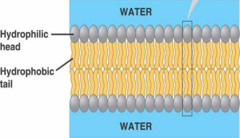 | 37 |
| 8076957697 | Steroids Structure | - 4 fused Carbon rings + something else - different steroids created by attaching different groups to rings - different structure created different function | 38 | |
| 8076978378 | Cholesterol | - important cell component - animal cell membranes - high concentration to cardiovascular disease - more cholesterol the more fluid the cell membrane --> nothing can go through membrane - regulating molecules entering and exiting the cell | 39 | |
| 8077042957 | cell membrane permitted and not | - small lipids can move through - sugar (polar) therefore cannot go through - water, salt is blocked - polar waste is blocked - bilayer is impermeable to polar substances | 40 | |
| 8077105260 | cell membrane channels | - Membranes becomes semi-preambles via protein channels - each channel is very specific - Proteins determine membrane´s specific functions | 41 | |
| 8077135376 | Functions of Membrane of Proteins | - transporters, enzyme activity, cell surface receptors, cell surface identity maker, cell adhesion, attachment to the cytoskeleton | 42 | |
| 8077168373 | Classes of membrane proteins | Peripheral proteins, Integral proteins | 43 | |
| 8077174972 | Peripheral proteins | - loosely bound to surface membrane - Cell surface identity marker - help with transport or communication | 44 | |
| 8077178462 | Integral proteins | - pentrate lipid bilayer usually across whole membrane - transmembrane proteins - transport proteins; channels, permeases (pumps) | 45 | |
| 8077241953 | Diffusion | - 2nd Law of Thermodynamics - concentration gradient | 46 | |
| 8077282985 | Simple diffusion | - move from high to low concentration - diffusion of non polar, hydrophobic molecules - passive transport - no energy needed | 47 | |
| 8077302867 | Facilitated Diffusion | - diffusion through protein channels - channels move specific molecules across membrane - no energy needed - diffusion of polar, hydrophilic molecules | 48 | |
| 8076029479 | 4 major macromolecule classes | carbohydrates, lipids, proteins, nucleic acids | 49 | |
| 8076029480 | Active Transport | - cells may need to move molecules against concentration gradient - protein pump - allosteric change in protein (different shape when engulfing) - requires ATP - against concentration gradient | 50 | |
| 8076024524 | allosteric change | different shape when engulfing | 51 | |
| 8076024525 | Antiport | two molecules are transported to opposite sides | 52 | |
| 8076019787 | Symport | two molecules are transported to the same side | 53 | |
| 8076019788 | Endocytosis (3) | - Phagocytosis: fuse with lysosome for digestion - Pinocytosis: non-specific process - Receptor-mediated endocytosis | 54 | |
| 8076014066 | Phagocytosis | fuse with lysosome for digestion a.Engulfing something large b.Cellular eating c.Specific d.Example: macrophages, neutrophils (immune system) | 55 | |
| 8076011076 | Pinocytosis | non-specific process - cellular drinking | 56 | |
| 8082235156 | Receptor-mediated endocytosis | triggered by molecular signal a.Highly specific b.Lock and key process c.Example: LDL (low density lipids), certain molecules which are needed in the nucleus - signal transduction pathway d.Bind to receptors on membrane e.As a certain number of molecules are attached to receptors the pit deepens | 57 | |
| 8082239826 | Exocytosis | vesicle is leaving the membrane - cellular waste | 58 | |
| 8082242906 | Osmosis | - diffusion of water - following 2nd law of thermodynamics | 59 | |
| 8082250631 | Hypotonic solution | less solute) less concentration of molecules and more concentration of water |  | 60 |
| 8082252949 | Hypertonic solution | (more solute) more concentration of molecules and less concentration of water |  | 61 |
| 8082269572 | Isotonic | concentrations are equal |  | 62 |
| 8082280520 | plant cells osmosis | -normal state is turgid (Hypotonic solution) -Flaccid: not as stable (Isotonic solution) -Plasmolysis: membrane will pull away from wall (Hypertonic solution) | 63 | |
| 8082282237 | animals cells osmosis | -Lysed: cell bursts (Hypotonic solution) -Normal: Isotonic solution -Shrivelled: Hypertonic solution | 64 | |
| 8082290028 | Why are cell so small | -The greater the surface area the more surface for diffusion to go across -The larger the surface area to volume ratio the faster the rate of diffusion into a cell | 65 | |
| 8083978974 | Types of microscopy | -Light microscope -Electron microscope -Scanning electron microscope -Transmission electron microscope | 66 | |
| 8083981779 | cell theory | - cell come from other cells - living things are made from cells | 67 | |
| 8083985586 | Characteristics of life (MRS GREN) | - Communication - Reproduction - Order - Growth and development - Energy processing - Regulation - Response to environment - Evolutionary adaption | 68 | |
| 8084008257 | surface:volume ratio | Smaller cells can diffuse more at a faster rate because of their higher surface to volume ratio | 69 | |
| 8084013251 | Prokaryotic cells | - bacteria and Archea | 70 | |
| 8084013252 | Eukaryotic cells | - smaller and simpler - protists, plant, fungi, animal - membrane enclosed nucleus | 71 | |
| 8084024476 | Similarities between Eukaryotic and Prokaryotic cell | -Cytosol -Chromosomes -Ribosomes -cytoplasm | 72 | |
| 8084028103 | Plant vs Animal cell similarities | -membrane bound organelles such as nucleus, mitochondria, endoplasmic reticulum, goldi apparatus, lysosomes -similar membranes, cytosol and cytoskeleton | 73 | |
| 8084032294 | Plant differences | -larger than animal cells -chloroplasts -Vacuoles -Cell wall | 74 | |
| 8084059784 | Mitochondria | carry out cellular respiration | 75 | |
| 8084061432 | Chloroplast | photosynthesizing organelles of plants and algea | 76 | |
| 8084064654 | Nucleus | contains cell´s genetic instructions encoded in DNA - directing protein synthesis | 77 | |
| 8084069590 | Ribosomes | make proteins | 78 | |
| 8084071314 | endoplasmic reticulum | an internal membrane system in which components of cell membrane and some proteins are constructed | 79 | |
| 8084081159 | Endosymbiotic theory | states that mitochondria and chloroplasts were formerly small prokaryotes that began living within lager cells | 80 | |
| 8084233058 | cytoskeleton | jelly like fluid that fills a cell | 81 | |
| 8084236073 | flagella and cilia | protude cell membrane and make wave like motions | 82 | |
| 8084242157 | flagella | long and few | 83 | |
| 8084243958 | cilia | short and many | 84 | |
| 8084260964 | Extracellular matrix | - hold cell together - made of glycoproteins | 85 | |
| 8084263693 | Glycoproteins | carbon with protein | 86 | |
| 8084267106 | cell junction | -consist of multiprotein complexes -provide contact between neighbouring cells or between a cell and the extracellular matrix | 87 | |
| 8084327876 | Fluid-mosaic model of cell membranes | flexible layer made of lipid molecules is interspersed with large protein molecules that act as channels through which other molecules enter and leave the cell | 88 | |
| 8084342224 | Types of protein in membrane | -Transporter -Enzyme activity -Cell surface receptor -Cell surface identity marker -Cell adhesion -Attachment to the cytoskeleton | 89 | |
| 8084345651 | Transporter protein | allows substances to cross the membrane through a channel in its interior | 90 | |
| 8084347448 | Amphipathic | hydrophilic ("water-loving") or polar end and a hydrophobic ("water-fearing") or nonpolar end | 91 | |
| 8084375005 | What can go through the membrane? | small nonpolar molecules | 92 | |
| 8084439436 | Spontaneous membrane formation | - phospholipids can self assemble into simple molecules - a membrane can enclose a solution that differs from its surrounding - basic requirement of life: plasma membrane that allows cells to regulate their chemical exchanges with the environment | 93 | |
| 8084456265 | Aquaporin | form pores in the membranes of cells and selectively conduct water molecules through the membrane, while preventing the passage of ions | 94 | |
| 8084457999 | Ion channel | -ability to open and close in response to chemical or mechanical signals -open: ions move through channel in single line fashion -ion channels are specific to particular ions | 95 | |
| 8084460551 | Water potential | potential energy in water - how willing is it to move | 96 | |
| 8084463880 | Water potential equation | Water potential = Solution potential + pressure potential | 97 | |
| 8084468292 | Solution Potential | -iCRT | 98 | |
| 8084470758 | Gibbs Free Energy eq | ΔG = ΔH - TΔS | 99 | |
| 8084472346 | Gibbs Free Energy | The energy of a system available to do work | 100 |
Flashcards
Biochemistry Flashcards
Terms : Hide Images
| 5888229021 | Peptide bond | The chemical bond that forms between the carboxyl group of one amino acid and the amino group of another amino acid | 0 | |
| 5888236787 | Phosphodiester linkage | covalent bonds that join adjacent nucleotides between the -OH group of the 3' carbon of one nucleotide and the phosphate on the 5' carbon of the next | 1 | |
| 5888242303 | C, H, N, O, P, S | What are the most abundant elements in biological molecules? | 2 | |
| 5888255841 | Ionic interactions, H bonds, van der Waals | What are the three major types of electrostatic forces that act on biological molecules? | 3 | |
| 5888263786 | van der Waals radii | The optimal packing distance that maximized the attractive van der Waals forces (London dispersion forces) between two non-covalently bonded molecules. (well, the sum of these 2 numbers is the optimal packing distance) | 4 | |
| 5888273006 | hydrophobic effect | The association of a relatively non-polar molecule or group with other non-polar molecules. This is not a bond, this is just the polar water molecules associating with each other and not the non-polar molecule. H-bond of water is disrupted... decreases entropy of the water and this is bad so try and make the smallest surface area of the non-polar thing. | 5 | |
| 5888278719 | amphiphilic | Of or relating to a molecule having a polar, water-soluble group attached to a nonpolar, water-insoluble hydrocarbon chain. | 6 | |
| 5888279700 | amphipathic | A molecule that has both a hydrophilic region and a hydrophobic region. | 7 | |
| 5891680742 | adenine, guanine | Name the two purines | 8 | |
| 5891687121 | uracil, thymine, cytosine | Name the three pyrimidines | 9 | |
| 5891699284 | guanine | Which of the purines has the carbonyl group? | 10 | |
| 5911065745 | thymine has a methyl group on 3' carbon | What is the difference between thymine and uracil? | 11 | |
| 5911081069 | amino group on the 4' carbon (instead of carbonyl group) | How can you recognize a cytosine? | 12 | |
| 5911102091 | idine (cytidine, thymidine, uridine) | pyrimidine (uracil, thymine, cytosine) with a five carbon sugar ends in | 13 | |
| 5911106384 | osine (guanosine, adenosine) | purines (adenine, guanine) with a five carbon sugar end in | 14 | |
| 5911160269 | five and six ring | Purines have (either a six ring or a five and six ring) | 15 | |
| 5911163423 | six ring | Pyrimidines have (either a six ring or a five and six ring) | 16 | |
| 5915475798 | amino group (donor), N-1 (acceptor) | What makes hydrogen bonds in adenine | 17 | |
| 5915488334 | amino group (donor), N-3 (acceptor), C-2 carbonyl (acceptor) | What makes hydrogen bonds in cytosine | 18 | |
| 5915492054 | N-3 (donor), C-2 carbonyl (acceptor), C-4 carbonyl (acceptor) | What makes hydrogen bonds in thymine | 19 | |
| 5915492055 | amino group (donor), C-6 carbonyl (acceptor), N-1 (donor) | What makes hydrogen bonds in guanine | 20 | |
| 5949537854 | hyperchromicity | The capacity of single-stranded DNA to absorb more ultraviolet light at a wavelength of 260 nm than does double-stranded DNA. | 21 | |
| 5949537855 | hypochromicity | Hypo (low) chromicity (absorbance) (like when we go from single stranded DNA to double stranded DNA) | 22 | |
| 5949652868 | stronger base stacking interactions | Why does DNA with a higher GC content have a higher midpoint of melting (Tm)? GC pair have... | 23 | |
| 6006575043 | Asparagine no pKa | Asn, name and pKa | 24 | |
| 6006599839 | Glutamine no pKa | Gln name and pKa | 25 | |
| 6006610033 | Cysteine 8.5 | Cys | 26 | |
| 6006619406 | Histidine 6 | His name and pKa | 27 | |
| 6006778300 | Lysine, 10 | Lys, name and pKa | 28 | |
| 6006820699 | Glutamate 4 | Glu, name and pKa | 29 | |
| 6006823598 | Arginine 12.5 | Arg, name and pKa | 30 | |
| 6006833639 | Aspartate 4 | Asp, name and pKa | 31 | |
| 6006887077 | Isoleucine | Ile | 32 | |
| 6006891309 | Tryptophan | Trp | 33 | |
| 6006910735 | Tyrosine 10.5 | Tyr name and pKa | 34 | |
| 6707156761 | -30 | What is the standard free energy change (delta G) for the hydrolysis of ATP to ADP? in kJ/mol | 35 | |
| 6707275069 | oxidative | catabolism is (reductive or oxidative) | 36 | |
| 6707275070 | reductive | anabolism is (reductive or oxidative) | 37 | |
| 6707386889 | decreased electrostatic repulsion, resonance stabilization, solvation effects | What are three things that make ATP a high energy molecule? All of these things are the result of the phosphoanydride bond | 38 | |
| 6707456467 | phosphoanhydride | What bond in ATP makes it high energy? When it breaks there is relieved electrostatic repulsion, the products have higher resonance stabilization, solvation effects, all that good shit | 39 | |
| 6707733179 | catabolism | What generates reduced cofactors/electron carriers? | 40 | |
| 6708401457 | 10 6 | How many electrons get pumped across the mitochondrial membrane for every NADH? For every FADH? | 41 | |
| 6708433432 | coenzyme Q | moves freely in the membrane and passes e- to complex 3 from complex 1 and 2. Lipid soluble, | 42 | |
| 6708444474 | Flavin mononucleotide (complex I) Iron-sulphur clusters, copper, cytochrome heme | Name the 4 prosthetic groups in the electron transport chain that are reversibly oxidized/reduced and move the electron down the chain | 43 | |
| 6708551756 | succinate fumarate | In complex II ____ is oxidized to ______ | 44 | |
| 6708577813 | Fo | Which is the transmembrane portion of ATP synthase | 45 | |
| 6708579006 | F1 | What portion of ATP synthase catalyzes the formation of ATP? | 46 | |
| 6708604416 | 3 3 2 | About how many H+ are required to make 1 ATP? So how many ATP are made from (about) 1 NADH? FADH? | 47 | |
| 6708947302 | rate of ATP synthesis | What determines proton movement and ultimately oxygen consumption? | 48 | |
| 6708980823 | Availability of P and ADP | What determines the rate of oxidative phosphorylation? | 49 | |
| 6709113533 | hexokinase | The enzymes that catalyzes the phosphorylation of glucose to form glucose-6-phosphate in the first step of glycolysis. This is one of the regulatory steps of this pathway. It is feedback-inhibited by glucose-6-P. Requires ATP | 50 | |
| 6709356934 | Phosphofructokinase-1 (PFK-1) | What is the rate-determining enzyme of Glycolysis? Transfers phosphate from Fructose 6-phosphate to fructose 1,6-bisphosphate. Requires ATP | 51 | |
| 6709479106 | glucose + 2ATP --> 2GAP + 2ADP + 2H+ | sum up the energy investment stage of glycolysis | 52 | |
| 6709541517 | GAP + NAD+ + Pi <--> 1,3-bisphosphoglycerate + NADH + H+ | First step in the energy capture stage of glycolysis (or the 6th step overall) looks like twat? | 53 | |
| 6709573584 | GAPDH | What catalyzes the (oxidation reaction) formation of 1,3-BGP (and NADH) from GAP? | 54 | |
| 6709943932 | 1,3 BPG --> 3-phosphoglycerate Phosphoglycerate kinase | What is the first "energy capture" step in glycolysis? What's the catalyst? | 55 | |
| 6709990948 | phosphoenolpyruvate --> enolpyruvate --> pyruvate pyruvate kinase | What is the second "energy capture" step in glycolysis? What is the catalyst? | 56 | |
| 6710042586 | Glucose + 2ADP + 2NAD+ + 2Pi --> 2ATP + 2pyruvate + 2NADH + 2H2O + 2H+ | What is glycolysis, overall? | 57 | |
| 6710067845 | phosphoenolpyruvate (pep) 1,3 BPG NADH ATP | what are the high energy things made in glycolysis, including the intermediates | 58 | |
| 6710087858 | Substrate availability Alteration of enzyme activity Alteration of amount of enzyme Compartmentation | The rate of flux through metabolic pathways is regulated by four major processes: | 59 | |
| 6710098501 | Hexokinase Phosphofructokinase-1 Pyruvate kinase | Which of the enzymes in glycolysis are regulated? | 60 | |
| 6710125964 | glucose-6-phosphate inhibit | What regulates hexokinase? How does it regulate it? Product inhibition | 61 | |
| 6710221048 | ADP/AMP (+) and PEP (-) fructose-2,6-bisphosphate (+) fructose-6 phosphate (homoallosteric activator) ATP (homoallosteric inhibitor) | What is PKF-1 regulated by? | 62 | |
| 6710287912 | ATP (-) fructose-1,6-bisphosphate (+) Feed forward | What regulates pyruvate kinase? This is what kind of activation? | 63 | |
| 6710451941 | pyruvate dehydrogenase complex (PDC) | Pyruvate is converted to acetyl-CoA via the | 64 | |
| 6710456655 | matrix (of the mitochondria) | Where is pyruvate converted to acetyl-CoA? | 65 | |
| 6710470240 | pyruvate + CoA + NAD --> Acetyl CoA + CO2 + NADH | What is the overall reaction of the conversion of pyruvate of acetyl-CoA? | 66 | |
| 6710513283 | NAD+/NADH ratio Ca++ concentration (+) Acetyl-CoA (-) | The pyruvate dehydrogenase complex is regulated by: | 67 | |
| 6710531237 | off | The pyruvate dehydrogenase complex is switched __ when phosphorylated | 68 | |
| 6710996541 | citrate synthase | couples acetyl-CoA to oxaloacetate and then hydrolyzes the resulting product, forming citrate and CoA-SH. | 69 | |
| 6711121424 | Pyruvate Carboxylase | The formation of oxaloacetate from pyruvate is an important anaplerotic reaction. The reaction is catalyzed by ______ ______. This enzyme is activated by acetyl-CoA and inhibited by ADP | 70 | |
| 6711260492 | uracil |  | 71 | |
| 6711261245 | thymine |  | 72 | |
| 6711263184 | adenine |  | 73 | |
| 6711265664 | guanine |  | 74 | |
| 6711386131 | Aspartate (Asp, -) Glutamate (Glu, -) Lysine (Lys, +) Arginine (Arg, +) | what are the charged amino acids? | 75 |
Lecture 1: Biochemistry Flashcards
Terms : Hide Images
| 5899369074 | Name the 4 major classes of biomolecules | proteins, carbohydrates, nucleic acids, and lipids | 0 | |
| 5899379473 | What is the purpose of the central dogma | to describe the basic principles of biological information transfer | 1 | |
| 5899396494 | Proteins are polymers made from ________ monomers | amino acid | 2 | |
| 5899401603 | What determines the function of a protein | the shape and content of amino acids | 3 | |
| 5899410817 | Name the 5 functions of a protein and give an example | 1) signal molecule: hormone-insulin 2) receptors for molecules - hemoglobin 3) biological catalysts - enzymes 4) structural building blocks - keratin in hair and nails 5) motors - myosin in muscle | 4 | |
| 5899439076 | What are the monomers of carbohydrates | monosaccharides such as glucose, fructose, and galactose | 5 | |
| 5899458049 | What are the 4 major functions of a carbohydrate | 1) fuel - create ATP from glucose 2) store energy - glycogen made up of glucose 3) signal molecule 4) recognition of other cells bc of carbs on cell membranes | 6 | |
| 5899482908 | What are the monomers of nucleic acids | nucleotide | 7 | |
| 5899486910 | What are the components of a nucleotide | phosphate group, pentose sugar, and nitrogenous base | 8 | |
| 5899495304 | What are the components of an amino acid | amino group, central carbon w/a H and a Rgroup, and carboxyl group | 9 | |
| 5899506963 | Name 3 major nucleic acids | DNA, RNA, and ATP | 10 | |
| 5899694910 | Name the 4 functions of nucleic acids | 1) store and transmit genetic information 2) structural 3) signaling 4) energy currency - ATP | 11 | |
| 5899730386 | Which nucleic acid forms a double helix | DNA | 12 | |
| 5899733046 | Which nucleic acid forms a single strand normally but maybe double stranded and form complex structures | RNA | 13 | |
| 5899740004 | What are the components of a DNA molecule - be specific | phosphate group deoxyribose sugar nitrogenous bases: adenine, guanine, cytosine, or thymine | 14 | |
| 5899787892 | What are the components of a RNA molecule - be specific | phosphate group ribose sugar nitrogenous bases: adenine, guanine, cytosine, or uracil | 15 | |
| 5899808040 | What specifies the information content in a nucleic acid | the arrangement of nucleotides | 16 | |
| 5899813212 | What is the function of the central dogma | describes the flow of genetic information | 17 | |
| 5899817643 | Define genome | complete set of genetic information i.e. contains blueprints of an organisms in the form of genes that encode proteins | 18 | |
| 5899828304 | Define replication | process of making DNA from DNA | 19 | |
| 5899831055 | Define transcription | process of making RNA from DNA | 20 | |
| 5899835761 | Define translation | process of making proteins from RNA | 21 | |
| 5899843222 | Describe the flow of genetic information from DNA to Proteins | DNA is TRANSCRIBED into RNA which is TRANSLATED into a protein | 22 | |
| 5899853698 | Which enzyme catalyzes DNA replication | DNA polymerase by joining 2' deoxy nucleotides | 23 | |
| 5899876429 | Which enzyme catalyzes transcription | Since transcription is making RNA the enzyme is RNA polymerase | 24 | |
| 5900046801 | How many different types of RNA are there | Each cell in an organism expresses specific types of RNA | 25 | |
| 5900299441 | Name 3 major functions of a lipid | 1) creates membrane: bi-phosphate layer 2) store energy as fuel: in hydrocarbon chains 3) Signals: lipid derivatives are used as cells to transmit signals | 26 |
Pages

Need Help?
We hope your visit has been a productive one. If you're having any problems, or would like to give some feedback, we'd love to hear from you.
For general help, questions, and suggestions, try our dedicated support forums.
If you need to contact the Course-Notes.Org web experience team, please use our contact form.
Need Notes?
While we strive to provide the most comprehensive notes for as many high school textbooks as possible, there are certainly going to be some that we miss. Drop us a note and let us know which textbooks you need. Be sure to include which edition of the textbook you are using! If we see enough demand, we'll do whatever we can to get those notes up on the site for you!
