AP Notes, Outlines, Study Guides, Vocabulary, Practice Exams and more!

Exploring Psychology- Myers 9th edition Chapter 11 Flashcards

Terms : Hide Images
5384248441stressthe process by which we perceive and respond to certain events, called stressors, that we appraise as threatening or challenging.0
5384248442general adaptation syndrome (GAS)Selye's concept of the body's adaptive response to stress in three phases--alarm, resistance, exhaustion.1
5384248443tend and befriendunder stress, people (especially women) often provide support to others (tend) and bond with and seek support from others (befriend).2
5384248444health psychologya subfield of psychology that provides psychology's contribution to behavioral medicine.3
5384248445psychoneuroimmunologythe study of how psychological, neural, and endocrine processes together affect the immune system and resulting health.4
5384248446coronary heart diseasethe clogging of the vessels that nourish the heart muscle; the leading cause of death in many developed countries.5
5384248447Type AFriedman and Rosenman's term for competitive, hard-driving, impatient, verbally aggressive, and anger-prone people.6
5384248448Type BFriedman and Rosenman's term for easygoing, relaxed people.7
5384248449catharsisin psychology, the idea that "releasing" aggressive energy (through action or fantasy) relieves aggressive urges.8
5384248450copingalleviating stress using emotional, cognitive, or behavioral methods.9
5384248451problem-focused copingattempting to alleviate stress directly--by changing the stressor or the way we interact with that stressor.10
5384248452emotion-focused copingattempting to alleviate stress by avoiding or ignoring a stressor and attending to emotional needs related to one's stress reaction.11
5384248453learned helplessnessthe hopelessness and passive resignation an animal or human learns when unable to avoid repeated aversive events.12
5384248454external locus of controlthe perception that chance or outside forces beyond our personal control determine our fate.13
5384248455internal locus of controlthe perception that you control your own fate.14
5384248456self-controlthe ability to control impulses and delay short-term gratification for greater long-term rewards.15
5384248457aerobic exercisesustained exercise that increases heart and lung fitness; may also alleviate depression and anxiety.16
5384248458feel-good, do-good phenomenonpeople's tendency to be helpful when already in a good mood.17
5384248459positive psychologythe scientific study of optimal human functioning; aims to discover and promote strengths and virtues that enable individuals and communities to flourish.18
5384248460subjective well-beingself-perceived happiness or satisfaction with life. Used along with measures of objective well-being (for example, physical and economic indicators) to evaluate people's quality of life.19
5384248461adaptation-level phenomenonour tendency to form judgments (of sounds, of lights, of income) relative to a neutral level defined by our prior experience.20
5384248462relative deprivationthe perception that one is worse off relative to those with whom one compares oneself.21

Exploring Psychology- Myers 9th edition Chapter 10 Flashcards

Terms : Hide Images
5539432099motivationa need or desire that energizes and directs behavior.0
5539432100instincta complex behavior that is rigidly patterned throughout a species and is unlearned. genes do predispose some species-typical behavior1
5539443485instinct theoryevolutionary perspective focuses on genetically predisposed behaviors2
5539432101drive-reduction theorythe idea that a physiological need creates an aroused tension state (a drive) that motivates an organism to satisfy the need. focuses on how we respond to inner pushes3
5539454409arousal theoryfocuses on finding the right levels of stimulation4
5539460231Maslows hierarchy of needsfocuses on the priority of some needs over others5
5539432102homeostasisa tendency to maintain a balanced or constant internal state; the regulation of any aspect of body chemistry, such as blood glucose, around a particular level.6
5539432103incentivea positive or negative environmental stimulus that motivates behavior.7
5539432104Yerkes-Dodson lawthe principle that performance increases with arousal only up to a point, beyond which performance decreases.8
5539432105hierarchy of needsMaslow's pyramid of human needs, beginning at the base with physiological needs that must first be satisfied before higher-level safety needs and then psychological needs become active.9
5539483858affiliation needthe need to build relationships and to feel part of a group10
5539489976Ostracismthe deliberate exclusion of individuals or groups11
5539497172achievement motivationa desire for significant accomplishment; for mastery of skills or ideas; for control; and for attaining a high standard12
5539514452gritinvolves passion and perseverance in the pursuit of long-term goals13
5539432106glucosethe form of sugar that circulates in the blood and provides the major source of energy for body tissues. When its level is low, we feel hunger.14
5539432107set pointthe point at which your "weight thermostat" is supposedly set. When your body falls below this weight, increased hunger and a lowered metabolic rate may combine to restore the lost weight.15
5539432108basal metabolic ratethe body's resting rate of energy expenditure.16
5539432109achievement motivationa desire for significant accomplishment, for mastery of skills or ideas, for control, and for rapidly attaining a high standard.17
5539524329arcuate nucleusneural arc in the hypothalamus that secretes appetite-suppressing hormones18
5539531806ghrelina hunger arousing hormone secreted by the empty stomach19
5539536425insulinhormone secreted by pancreas; controls blood glucose20
5539539701leptinprotein hormone secreted by fat cells; when abundant, causes brain to increase metabolism and decrease hunger21
5539545709orexinhunger-triggering hormone secreted by hypothalamus22
5539548139PYYdigestive tract hormone; sends "Im not hungry" signals to the brain23
5539554077arousing appetitedoubled snacking when watching an intense action movie24
5539558489friends and foodpresence of others amplifies natural behavior tendencies25
5539561980serving sizeconsumed food is influenced by size of serving26
5539567052selections stimulatefood variety promotes eating27
5539569794nudging nutritionnew practices, such as a school lunch tray making fruits and vegetables more prominent, may improve eating habits28
5539432110emotiona response of the whole organism, involving (1) physiological arousal, (2) expressive behaviors, and (3) conscious experience.29
5539580840bodily arousalheart pounding30
5539584001expressive behaviorsquickened pace31
5539586156conscious experienceboth thoughts and feelings32
5539432111James-Lange theorythe theory that our experience of emotion is our awareness of our physiological responses to emotion-arousing stimuli.33
5539432112Cannon-Bard theorythe theory that an emotion-arousing stimulus simultaneously triggers (1) physiological responses and (2) the subjective experience of emotion.34
5539432113two-factor theorythe Schachter-Singer theory that to experience emotion one must (1) be physically aroused and (2) cognitively label the arousal.35
5539432114polygrapha machine, commonly used in attempts to detect lies, that measures several of the physiological responses (such as perspiration and cardiovascular and breathing changes) accompanying emotion.36
5539432115facial feedback effectthe tendency of facial muscle states to trigger corresponding feelings, such as fear, anger, or happiness.37
5539432116Maslow Physiological NeedsNeed to satisfy hunger and thirst38
5539432117Maslow Safety NeedsNeed to feel the world is organized and predictable, the need to feel safe39
5539432118Maslow Belongingness and love needNeed to love and be loved, to belong and be accepted, need to avoid loneliness and separation.40
5539432119Maslow Esteem NeedsNeed for self-esteem , achievement, competence, and independence; need for recognition and respect from others.41
5539432120Maslow Self-ActualizationNeed to live up to our fullest unique potential. Be all that you can be, The feeling that you have a mission on this earth.42
5539432121Optimum Arousal TheorySometimes we want to increase arousal; curiosity, boredom, sex.43

ap Flashcards

Terms : Hide Images
6708214959mollifyto soften in temper0
6708222840pervasivespreading widely throughout a group of people1
6708235563proprietythe state of being proper and decent2
6708243991punitiveinvolving punishment3
6708248318quaintcharmly old fashioned4
6708250988rifeabondent(alot)5
6708255572rusea trick6
6708259081superfluousextra or unnecessary7
6708266381surreptitioussneaky/undercover8
6708269604sycophantone who flatters for self-gain9
6708273730transientpassing through briefly10
6708279157umbrageoffensive11
6708281347veracitytruthfulness or accuracy12
6708286304waneto decrease in size13

AP Psychology AP Review Flashcards

Terms : Hide Images
6588217683psychologythe study of behavior and mental processes0
6588217684psychology's biggest questionWhich is more important in determining behavior, nature or nurture?1
6588217685psychology's three levels of analysisbiopsychosocial approach (looks at the biological, psychological, and social-cultural approaches together)2
6588217686biological approachgenetics, close-relatives, body functions3
6588217687evolutionary approachspecies - helped with survival (ancestors)4
6588217688psychodynamic approach(Freud) subconscious, repressed feelings, unfulfilled wishes5
6588217689behavioral approachlearning (classical and operant) observed6
6588217690cognitive approachthinking affects behavior7
6588217691humanistic approachbecoming a better human (behavior, acceptance)8
6588217692social-cultural approachcultural, family, environment9
6588217693two reasons of why experiments are importanthindsight bias + overconfidence10
6588217694types of research methodsdescriptive, correlational, and experimental11
6588217695descriptive methodscase study survey naturalistic observation (DON'T SHOW CAUSE/EFFECT)12
6588217696case studystudies one person in depth may not be typical of population13
6588217697surveystudies lots of people not in depth14
6588217698naturalistic observationobserve + write facts without interference15
6588217699correlational methodshows relation, but not cause/effect scatterplots show research16
6588217700correlation coefficient+ 1.0 (both increase) 0 (no correlation - 1.0 (one increases, other decreases)17
6588217701experimental methoddoes show cause and effect18
6588217702populationtype of people who are going to be used in experiment19
6588217703sampleactual people who will be used (randomness reduces bias)20
6588217704random assignmentchance selection between experimental and control groups21
6588217705control groupnot receiving experimental treatment receives placebo22
6588217706experimental groupreceiving treatment/drug23
6588217707independent variabledrug/procedure/treatment24
6588217708dependent variableoutcome of using the drug/treatment25
6588217709confounding variablecan affect dependent variable beyond experiment's control26
6588217710scientific methodtheory hypothesis operational definition revision27
6588217711theorygeneral idea being tested28
6588217712hypothesismeasurable/specific29
6588217713operational definitionprocedures that explain components30
6588217714modeappears the most31
6588217715meanaverage32
6588217716medianmiddle33
6588217717rangehighest - lowest34
6588217718standard deviationhow scores vary around the mean35
6588217719central tendencysingle score that represents the whole36
6588217720bell curve(natural curve)37
6588217721ethics of testing on animalsneed to be treated humanly basically similar to humans38
6588217722ethics of testing on humansconsent debriefing no unnecessary discomfort/pain confidentiality39
6588217723sensory neuronstravel from sensory receptors to brain40
6588217724motor neuronstravel from brain to "motor" workings41
6588217725interneurons(in brain and spinal cord) connecting motor and sensory neurons42
6588217726neuron43
6588217727dendritesreceive messages from other neurons44
6588217728myelin sheathprotects the axon45
6588217729axonwhere charges travel from cell body to axon terminal46
6588217730neurotransmitterschemical messengers47
6588217731reuptakeextra neurotransmitters are taken back48
6588217732excitatory charge"Let's do it!"49
6588217733inhibitory charge"Let's not do it!"50
6588217734central nervous systembrain and spinal cord51
6588217735peripheral nervous systemsomatic nervous system autonomic nervous system52
6588217736somatic nervous systemvoluntary movements53
6588217737autonomic nervous systeminvoluntary movements (sympathetic and parasympathetic nervous systems)54
6588217738sympathetic nervous systemarousing55
6588217739parasympathetic nervous systemcalming56
6588217740neural networksmore connections form with greater use others fall away if not used57
6588217741spinal cordexpressway of information bypasses brain when reflexes involved58
6588217742endocrine systemslow uses hormones in the blood system59
6588217743master glandpituitary gland60
6588217744brainstemextension of the spinal cord responsible for automatic survival61
6588217745reticular formation (if stimulated)sleeping subject wakes up62
6588217746reticular formation (if damaged)coma63
6588217747brainstem (if severed)still move (without purpose)64
6588217748thalamussensory switchboard (does not process smell)65
6588217749hypothalamusbasic behaviors (hunger, thirst, sex, blood chemistry)66
6588217750cerebellumnonverbal memory, judge time, balance emotions, coordinate movements67
6588217751cerebellum (if damaged)difficulty walking and coordinating68
6588217752amygdalaaggression, fear, and memory associated with these emotions69
6588217753amygdala (if lesioned)subject is mellow70
6588217754amygdala (if stimulated)aggressive71
6588217755hippocampusprocess new memory72
6588217756cerebrumtwo large hemispheres perceiving, thinking, and processing73
6588217757cerebral cortexonly in higher life forms74
6588217758association areasintegrate and interpret information75
6588217759glial cellsprovide nutrients to myelin sheath marks intelligence higher proportion of glial cells to neurons76
6588217760frontal lobejudgement, personality, processing (Phineas Gage accident)77
6588217761parietal lobemath and spatial reasoning78
6588217762temporal lobeaudition and recognizing faces79
6588217763occipital lobevision80
6588217764corpus callosumsplit in the brain to stop hyper-communication (eliminate epileptic seizures)81
6588217765Wernicke's areainterprets auditory and hearing82
6588217766Broca's areaspeaking words83
6588217767plasticityability to adapt if damaged84
6588217768sensationwhat our senses tell us85
6588217769bottom-up processingsenses to brain86
6588217770perceptionwhat our brain tells us to do with that information87
6588217771top-down processingbrain to senses88
6588217772inattentional blindnessfail to "gorilla" because attention is elsewhere89
6588217773cocktail party effecteven with tons of stimuli, we are able to pick out our name, etc.90
6588217774change blindnessgiving directions and person is changed and we don't notice91
6588217775choice blindnesswhen defending the choice we make, we fail to notice choice was changed92
6588217776absolute thresholdminimum stimulation needed in order to notice 50% of the time93
6588217777signal detection theorywe notice what is more important to us (rather hear a baby crying)94
6588217778JND (just noticeable difference)(Weber's law) difference between different stimuli noticed in proportion95
6588217779sensory adaptationtired of noticing (Brain says, "Been there, done that. Next?"96
6588217780rodsnight time97
6588217781conescolor98
6588217782parallel processingnotice color, form, depth, movement, etc.99
6588217783Young-Helmholtz trichromatic theory3 corresponding color receptors (RGB)100
6588217784Hering's opponent-process theoryafter image in opposite colors (RG, YB, WB)101
6588217785trichromatic + opponent-processYoung-Helmholtz -> color stimuli Hering -> en route to cortex102
6588217786frequency we hear mosthuman voice103
6588217787Helmoltz (hearing)we hear different pitches in different places in basilar membrane (high pitches)104
6588217788frequency theoryimpulse frequency (low pitches)105
6588217789Helmholtz + frequency theorymiddle pitches106
6588217790Skin feels what?warmth, cold, pressure, pain107
6588217791gate-control theorysmall fibers - pain large fibers - other senses108
6588217792memory of painpeaks and ends109
6588217793smellclose to memory section (not in thalamus)110
6588217794groupingGestalt make sense of pieces create a whole111
6588217795grouping groupsproximity similarity continuity connectedness closure112
6588217796make assumptions of placementhigher - farther smaller - farther blocking - closer, in front113
6588217797perception =mood + motivation114
6588217798consciousnessawareness of ourselves and the environment115
6588217799circadian rhythmdaily biological clock and regular cycle (sleep and awake)116
6588217800circadian rhythm pattern- activated by light - light sensitive retinal proteins signal brains SCN (suprachiasmatic nucleus) - pineal gland decreases melatonin117
6588217801What messes with circadian rhythm?artificial light118
6588217802The whole sleep cycle lasts how long?90 minutes119
6588217803sleep stagesrelaxed stage (alpha waves) stage 1 (early sleep) (hallucinations) stage 2 (sleep spindles - bursts of activity) (sleep talk) stage 3 (transition phase) (delta waves) stage 4 (delta waves) (sleepwalk/talk + wet the bed) stage 5 (REM) (sensory-rich dreams) (paradoxical sleep)120
6588217804purpose of sleep1. recuperation - repair neurons and allow unused neural connections to wither 2. making memories 3. body growth (children sleep more)121
6588217805insomniacan't sleep122
6588217806narcolepsyfall asleep anywhere at anytime123
6588217807sleep apneastop breathing in sleep124
6588217808night terrorsprevalent in children125
6588217809sleepwalking/sleeptalkinghereditary - prevalent in children126
6588217810dreaming (3)1. vivid bizarre intense sensory experiences 2. carry fear/survival issues - vestiges of ancestors' survival ideas 2. replay previous day's experiences/worries127
6588217811purpose of dreaming (5 THEORIES)1. physiological function - develop/preserve neural pathways 2. Freud's wish-fulfillment (manifest/latent content) 3. activation synthesis - make sense of stimulation originating in brain 4. information processing 5. cognitive development - reflective of intelligence128
65882178121. Can hypnosis bring you back in time? 2. Can hypnosis make you do things you wouldn't normally do? 3. Can it alleviate pain? 4. What state are you in during hypnosis? 5. Who is more susceptible?1. cannot take you back in time 2. cannot make you do things you won't do 3. can alleviate pain 4. fully conscious ((IMAGINATIVE PEOPLE MORE SUSCEPTIBLE))129
6588217813depressantsslows neural pathways130
6588217814alcohol((depressant)) disrupts memory formation (REM) lowers inhibition expectancy effect131
6588217815barbituates (tranquilizers)((depressant)) reduce anxiety132
6588217816opiates((depressant)) pleasure reduce anxiety/pain133
6588217817stimulantshypes neural processing134
6588217818methamphetamine((stimulant)) heightens energy euphoria affects dopamine135
6588217819caffeine((stimulant))136
6588217820nicotine((stimulant)) CNS releases neurotransmitters calm anxiety reduce pain affects (nor)epinephrine and dopamine137
6588217821cocaine((stimulant)) euphoria affects dopamine, serotonin, and norepinephrine138
6588217822hallucinogenexcites neural activity139
6588217823ecstasy((hallucinogen)) reuptake is blocked affects dopamine and serotonin140
6588217824LSD((hallucinogen)) affects sensory/emotional "trip" (+/-) affects serotonin141
6588217825marijuana((hallucinogen)) amplify sensory experience disrupts memory formation142
6588217826learningorganism changing behavior due to experience (association of events)143
6588217827types of learningclassical operant observational144
6588217828famous classical psychologistsPavlov and Watson145
6588217829famous operant psychologistSkinner146
6588217830famous observational psychologistsBandura147
6588217831classical conditioningoutside stimulus148
6588217832Pavlov's experimentStep 1: US (food) -> UR (salivation) Step 2: NS (bell) -> US (food) -> UR (salivation) Later... CS (bell) -> CR (salivation)149
6588217833Watson's experimentwhite rat was given to Little Albert Step 1: US (noise) -> UR (cry) Step 2: NS (rat) -> US (noise) -> UR (cry) Later... CS (rat) -> CR (cry)150
6588217834generalizationany small, white fluffy creature will make Albert cry now151
6588217835discriminateany large, white fluffy creature won't make Albert cry152
6588217836extinctionstop "treating" with conditioned response153
6588217837spontaneous recoverybring stimulus back after a while154
6588217838operant conditioningcontrol by organism155
6588217839Skinner's experimentoperant chamber / Skinner box (lead to shaping)156
6588217840shapingget animal closer to doing what you want them to do157
6588217841reinforcerswant to continue behavior (positive reinforcement: give money to do laundry) (negative reinforcement: do to avoid nagging)158
6588217842punishmentswant to stop behavior (positive reinforcement: smack) (negative reinforcement: take away phone)159
6588217843fixed ratiohappens a certain number of times (Starbucks punch card)160
6588217844variable ratiohappens an unpredictable number of times (winning the lottery)161
6588217845organism must do these (2 times)fixed ratio and variable ratio162
6588217846fixed intervalhappens at a certain time (mailman comes to the house at 10:00 AM)163
6588217847variable intervalhappens at any time (receive texts from friends)164
6588217848these things happen regardless (2 times)fixed interval and variable interval165
6588217849Which (fixed/variable) conditions better?variable166
6588217850criticisms of Skinnerdoesn't take into account intrinsic motivation167
6588217851intrinsic motivationdoing something for yourself, not the reward168
6588217852extrinsic motivationdoing something for reward169
6588217853Skinner's legacyuse it personally, at school, and at work170
6588217854famous observational experimentBandura's Bobo doll171
6588217855famous observational psychologistBandura172
6588217856mirror neurons"feel" what is observed happens in higher order animals173
6588217857Bobo doll experiment legacyviolent video games/movies desensitize us see good: do good see evil: do evil174
6588217858observational learningbiological behaviors work best175
6588217859habituationget used to it -> stop reacting176
6588217860examples for observational learninglectures and reading177
6588217861serotonin involved with memoryspeeds the connection between neurons178
6588217862LTP((long-term potentiation)) strengthens potential neural forming (associated with speed)179
6588217863CREBprotein that can switch genes on/off with memory and connection of memories180
6588217864glutamate involved with memoryneurotransmitter that enhances LTP181
6588217865glucose involved with memoryreleased during strong emotions ((signaling important event to be remembered))182
6588217866flashbulb memorytype of memory remembered because it was an important/quick moment183
6588217867amygdala (memory)boosts activity of proteins in memory-forming areas to fight/flight184
6588217868cerebellum (memory)forms and stores implicit memories ((classical conditioning))185
6588217869hippocampus (memory)active during sleep (forming memories) ((information "moves" after 48 hours))186
6588217870memorylearning over time contains information that can be retrieved187
6588217871processing stagesencoding -> storage -> retrieval188
6588217872encodinginformation going in189
6588217873storagekeeping information in190
6588217874retrievaltaking information out191
6588217875How long is sensory memory stored?seconds192
6588217876How long is short-term memory stored?less than a minute193
6588217877How many bits of information is stored in short-term memory?7194
6588217878How many chunks of information is stored in short-term memory?4195
6588217879How many seconds of words is stored in short-term memory?2196
6588217880short term memory goes to ______________working memory197
6588217881working memorymake a connection and process information to mean something198
6588217882working memory goes to _________________long-term memory199
6588217883How much is stored in long-term memory?LIMITLESS200
6588217884implicit memorynaturally do201
6588217885explicit memoryneed to explain202
6588217886automatic processingspace, time, frequency, well-learned information203
6588217887effortful processingprocessing that requires effort204
6588217888spacing effectspread out learning over time205
6588217889serial position effectprimary/recency effect206
6588217890primary effectremember the first things in a list207
6588217891recency effectremember the last things in a list208
6588217892effortful processing (4 things)1. recency effect 2. spacing effect 3. testing effect 4. serial position effect209
6588217893semantic encoding (1) meaning (2) how tomake meaning out of something --- chunk, hierarchy, or connect to you210
6588217894if we can't remember a memory...1. change memory to suit us 2. fill in the blanks with logical story211
6588217895misinformation effectnot correct information212
6588217896imagination inflationimagine or visualize something that isn't real213
6588217897source amnesiawhat is the truth? (is it a dream, story, memory, etc.?)214
6588217898primingassociation (setting you up)215
6588217899contextenvironment helps with memory216
6588217900state-dependencyyou may remember something if you go back to the state you were in (go back to high)217
6588217901mood-congruencyemotion will bring back similar emotional memories218
6588217902forgetting curveforget after 5 days forget after 5 years219
6588217903the forgetting curve was created byEbbinghaus220
6588217904proactive interferenceold information interferes with the new221
6588217905retroactive interferencenew information interferes with the old222
6588217906children can't remember before age __3223
6588217907Loftusconnected to abuse cases/childhood224
6588217908prototypesgeneralize225
6588217909problem-solving (4)trial + error algorithms heuristic (representative + availability) insight - "AHA!"226
6588217910against problem-solvingfixation227
6588217911mental setwhat has worked in the past228
6588217912functional fixednessonly way to do this is with this229
6588217913Chomsky (nature or nurture?)"born with language" (nature)230
6588217914Skinner (nature or nurture?)language is learned (nurture)231
6588217915grammar is _________universal232
6588217916phonemessmallest sound unit233
6588217917morphemessmallest meaning unit234

AP Language Flashcards

Terms : Hide Images
5293747705ignoblenot honorable in character or purpose; of humble origin or social status0
5293761790suppositionan uncertain belief1
5293766792taxingphysically or mentally demanding2
5293768740tremulouscharacterized by trembling, as from fear, nervousness, or weakness; vibratory, shaking, or quivering3
5293793639careenmove swiftly and in an uncontrolled way in a specified direction4
5293796348inexplicableunable to be explained or accounted for5
5293803541chasitythe state or practice of refraining from extramarital, or esp. from all, sexual intercourse6
5293809162nonchalancethe state of being coolly unconcerned, indifferent, or unexcited; casual7
5293814880indeliblemaking marks that cannot be removed8
5293823188pensiveexpressing or revealing thoughtfulness, usually marked by some sadness9
5293827299incessantcontinuing without pause or interruption10
5293831132imperceptibleimpossible to notice11
5293845216petulantchildishly sulky or bad-tempered12
5293846916primevalof or resembling the earliest ages in history of the world13
5293851781languiddisplaying or having a disinclination for physical exertion or effort; slow and relaxed14
5293875692undulatingmoving with a smooth wavelike motion15
5293878198banalitythe fact or condition of being unoriginal16
5293882165cynicaldistrustful of human sincerity or integrity; concerned only with one's own interests and typically disregarding accepted or appropriate standards in order to achieve them17
5293890561repetitionreiteration, retelling18
5293894851ennuia feeling of listlessness and dissatisfaction arising from a lack of occupation or excitemnet19

AP Literature Unit 7 Flashcards

Terms : Hide Images
4013456960Abeyance(n.) a state of being temporarily inactive,suspended, or set aside0
4013461916Ambivalent(adj.) having opposite and conflicting feelings about someone or something1
4013464974Beleaguer(v.) to set upon from all sides; to surround with an army; to trouble, harass2
4013470149Carte blanche(n.) full freedom or authority to act at one's own discretion3
4013474056cataclysm(n.) a sudden, violent, or devastating upheaval; a surging flood, deluge4
4013478548Debauch(v.) to corrupt morally, seduce; to indulge in dissipation; (n.) an act or occasion of dissipation or vice5
4013484640eclat(n.) dazzling or conspicuous success or acclaim; great brilliance (of performance or achievement)6
4022636320Fastidious(adj.) overly demanding or hard to please; excessively careful in regard to details; easily disgusted7
4022642027Gambol(v.) to jump or skip about playfully8
4022644470Imbue(v.) to soak or stain thoroughly; to fill the mind9
4022646836Inchoate(adj.) just beginning; not fully shaped or formed10
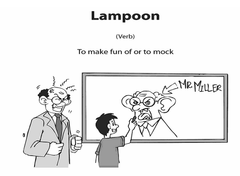
4022648633Lampoon(n.) a malicious satire; (v.) to satirize, ridicule11
4022653525Malleable(adj.) capable of being formed into different shapes; capable of being altered, adapted, or influenced12
4022660304Nemesis(n.) an agent or force inflicting vengeance or punishment; retribution itself; an unbeatable rival13
4022664109Opt(v.) to make a choice or decision14
4022667732Philistine(adj.) lacking in, hostile to, or smugly indifferent to cultural and artistic values or refinements; (n.) such a person15
4022671719Picaresque(adj.) involving or characteristic of clever rogues or adventurers16
4022675718Queasy(adj.) nauseated or uneasy; causing nausea or uneasiness; troubled17
4022679883Refractory(adj.) stubborn; hard or difficult to manage; not responsive to treatment or cure18
4022689170Savoir-faire(n.) the ability to say and do the right thing in any situation social competence19

AP Language Flashcards

Terms : Hide Images
6781201636AllegoryThe device of using character and/or story elements symbolically to represent an abstraction in addition to the literal meaning. In some allegories, for example, an author may intend the characters to personify an abstraction lie hope or freedom. The allegorical meaning usually deals with moral truth or a generalization about human existence. A story, poem, or picture that can be interpreted to reveal a hidden meaning, typically a moral or political one.0
6781201637AlliterationThe repetition of sounds, especially initial consonants in tow or more neighboring words (as in "she sells sea shells). Although the term is not used frequently in the multiple-choice section, you can look for alliteration in any essay passage. The repetition can reinforce meaning, unify ideas, supply a musical sound, and/or echo the sense of the passage.1
6781201638AllusionA direct or indirect reference to something which is presumably commonly known, such as an event, book, myth, place, or work of art. Allusions can be historical, literary, religious, topical, or mythical. There are many more possibilities, and a work may simultaneously use multiple layers of allusion.2
6781201639Ambiguity (am-bi-gyoo-i-tee)The multiple meanings, either intentional or unintentional, of a word, phrase, sentence, or passage.3
6781201640AnalogyA similarity or comparison between two different things or the relationship between them. An analogy can explain something unfamiliar by associating it with or pointing out its similarity to something more familiar. Analogies can also make writing more vivid, imaginative, or intellectually engaging. Ex. He that voluntarily continues ignorance is guilty of all the crimes which ignorance produces, as to him4
6781201641Anaphora (uh-naf-er-uh)One of the devices of repetition, in which the same expression (word or words) is repeated at the beginning of two or more lines, clauses, or sentences.5
6781201642AnecdoteA short narrative detailing particulars of an interesting episode or event. The term most frequently refers to an incident in the life of a person6
6781201643Antecedent (an-tuh-seed-nt)The word, phrase, or clause referred to by a pronoun. The AP Language exam occasionally asks for the antecedent of a given pronoun in a long, complex sentence or in a group of sentences.7
6781201644Antithesis (an-tih-theh-sis)Figure of balance in which two contrasting ideas are intentionally juxtaposed, usually through parallel structure; a contrasting of opposing ideas in adjacent phrases, clauses, or sentences. Antithesis creates a definite and systematic relationship between ideas.8
6781201645AphorismA terse statement of know authorship which expresses a general truth or a moral principle. (If the authorship is unknown, the statement is generally considered to be a folk proverb.) An aphorism can be a memorable summation of the author's point.9
6781201646ApostropheA figure of speech that directly addresses an absent or imaginary person or a personified abstraction, such as liberty or love. It is an address to someone or something that cannot answer. The effect is to give vent to or display intense emotion, which can no longer be held back:10
6781201647Asyndeton (uh-sin-di-tuhn)consists of omitting conjunctions between words, phrases, or clauses. This can give the effect of unpremeditated multiplicity, of an extemporaneous rather than a labored account. Asyndetic lists can be more emphatic than if a final conjunction were used.11
6781201648AtmosphereThe emotional mood created by the entirety of a literary work, established partly by the setting and partly by the author's choice of objects that are described. Even such elements as description of the weather can contribute to the atmosphere. Frequently atmosphere forshadows events. Perhaps it can create a mood.12
6781201649Chiasmus (kahy-az-muhs)(From the Greek word for "criss-cross," a designation baed on the Greek letter "chi," written X). Chiasmus is a figure of speech in which two successive phrases or clauses are parallel in syntax, but reverse the order of the analogous words.13
6781201650Clausea grammatical unit that contains both a subject and a verb. An independent, or main, clause expresses a complete thought and can sand alone as a sentence. A dependent, or subordinate clause cannot stand alone as a sentence and must be accompanied by an independent clause. The point that you want to consider is the question of what or why the author subordinates one element to the other. You should also become aware of making effective use of subordination in your own writing.14
6781201651Colloquial/colloquialism (kuj-loh-kwee-uhl)The use of slang or informalities in speech or writing. Not generally acceptable for formal writing, colloquialisms give a work a conversational, familiar tone. Colloquial expressions in writing include local or regional dialects.15
6781201652CoherenceA principle demanding that the parts of any composition be arranged so that the meaning of the whole may be immediately clear and intelligible. Words, phrases, clauses within the sentence; and sentences, paragraphs, and chpters in larger pieces of writing are the unit that by their progressive and logical arrangement, make for coherence.16
6781201653ConceitA fanciful expression, usually in the form of an extended metaphor or surprising analogy between seemingly dissimilar objects. A conceit displays intellectual cleverness as a result of the unusual comparison being made.17
6781201654Connotation- The nonliteral, associative meaning of a word; the implied, suggested meaning. Connotations may involve ideas, emotions, or attitudes.18
6781201655DenotationThe strict, literal, dictionary definition of a word, devoid of any emotion attitude, or color.19
6781201656Diacoperepetition of a word or phrase after an intervening word or phrase: word/phrase X, . . ., word/phrase X.20
6781201657DictionRelated to style, diction refers to the writer's word choices, especially with regard to their correctness, clearness, or effectiveness. For the AP exam, you should be able to describe an author's diction (for example, formal or informal, ornate or plain) and understand the ways in which diction can complement the author's purpose. Diction, combined with syntax, figurative language, literary devices, etc., creates an author's style.21
6781201658Didactic (dahy-dak-tik)From the Greek, didactic literally means "teaching." Didactic works have the primary aim of teaching or instructing, especially the teaching of moral or ethical principles.22
6781201659EnumeratioFigure of amplification in which a subject is divided into constituent parts or details, and may include a listing of causes, effects, problems, solutions, conditions, and consequences; the listing or detailing of the parts of something.23
6781201660Expletive (ek-spli-tiv)Figure of emphasis in which a single word or short phrase, usually interrupting normal speech, is used to lend emphasis to the words on either side of the expletive.24
6781201661Euphemism (yoo-fuh-miz-uhm)From the Greek for "good speech," euphemisms are a more agreeable or less offensive substitute for a generally unpleasant word or concept. The euphemism may be sued to adhere to standards of social or political correctness or to add humor or ironic understatement.25
6781201662ExpositionIn essays, one of the four chief types of composition, the others being argumentation, description, and narration. The purpose of exposition is to explain something. In drama, the exposition is the introductory material, which creates the tone, gives the setting, and introduces the characters and conflict.26
6781201663Extended metaphorA metaphor developed at great length, occurring frequently in or throughout the work.27
6781201664Figurative language- Writing or speech that is not intended to carry literal meaning and is usually meant to be imaginative and vivid.28
6781201665Figure of speechA device used to produce figurate language. Many compare dissimilar things. Figures of speech include apostrophe, hyperbole, irony, metaphor, metonymy, oxymoron, paradox, personification, simile, synecdoche, and understatement.29
6781201666Generic conventionsThis term describes traditions for each genre. These conventions help to define each genre; for example, they differentiate an essay and journalistic writing or an autobiography and political writing. On the AP language exam, try to distinguish the unique features of a writer's work from those dictated by convention.30
6781201667GenreThe major category into which a literary work fits. The basic divisions of literature are prose, poetry, and drama. However, genre is a flexible term; within these broad boundaries exist many subdivisions that are often called genres themselves. For example, prose can be divided into fiction (novels and short stories) or nonfiction (essays, biographies, autobiographies, etc). Poetry can be divided into lyric, dramatic, narrative, epic, etc. Drama can be divided into tragedy, comedy, melodrama, farce, etc. ON the AP language exam, expect the majority of the passages to be from the following genres: autobiography, biography, diaries, criticism, essays, and journalistic, political, scientific, and nature writing.31
6781201668Homily (hom-uh-lee)This term literally means "sermon," but more informally, it can include any serious talk, speech, or lecture involving moral or spiritual advice.32
6781201669Hyperbole (hahy-pur-buh-lee)A figure of speech using deliberate exaggeration or overstatement. Hyperboles often have a comic effect; however, a serious effect is also possible. Often, hyperbole produces irony.33
6781201670HypophoraFigure of reasoning in which one or more questions is/are asked and then answered, often at length, by one and the same speaker; raising and responding to one's own question(s). A common usage is to ask the question at the beginning of a paragraph and then use the paragraph to answer it. You can use hypophora to raise questions which you think the reader obviously has on his/her mind and would like to see formulated and answered.34
6781201671ImageryThe sensory details or figurative language used to describe, arouse emotion, or represent abstractions. On a physical level, imager y uses terms related to the five senses; we refer to visual, auditory, tactile, gustatory, or olfactory imagery. On a broader and deeper level, however, one image can represent more than one thing. For example, a rose may present visual imagery while also representing the color in a woman's cheeks and/or symbolizing some degree of perfection (It is the highest flower on the Great Chain of Being). An author may use complex imagery while simultaneously employing other figure s of speech, especially metaphor and simile. In addition, this term can apply to the total of all the images in a work. ON the AP exam, pay attention to how an author creates imagery and to the effect of this imagery.35
6781201672Inference/inferTo draw a reasonable conclusion from the information presented. When a multiple-choice question asks for an inference to be drawn from a passage, the most direct, most reasonable inference is the safest answer choice. If an inference is implausible, it's unlikely to be the correct answer. Note that if the answer choice is directly stated, it is not inferred and is wrong. You must be careful to note the connotation - negative or positive - of the choices.36
6781201673Invectivean emotionally violent, verbal denunciation or attach using strong, abusive language.37
6781201674Irony/ironicThe contrast between what is stated explicitly and what is really meant. The difference between what appears to be and what actually is true. In general, there are three major types of irony used in language; (1) In a verbal irony, the words literally state the opposite of the writer's (or speaker's) true meaning. (2) In situational irony, events turn out the opposite of what was expected. What the characters and the readers think ought to happen. (3) In dramatic irony, facts or events are unknown to a character in a play or piece of fiction, but know to the reader, audience, or other characters in the work. Irony is used for many reasons, but frequently, it's used to create poignancy or humor.38
6781201675Juxtaposition (juhk-stuh-puh-zish-uhn)When two words, phrases, images, ideas are placed close together or side by side for comparison or contrast.39
6781201676Litotes (lahy-toh-teez)From the Greek word "simple" or "plain." Litotes is a figure of thought in which a point is affirmed by negating its opposite. It is a special form of understatement, where the surface denial serves, through ironic contrast, to reinforce the underlying assertion.40
6781201677Loose sentencea type of sentence in which the main idea (independent clause) comes first, followed by wdependent grammatical units such as phrases and clauses. If a period were placed at the end of the independent clause, the clause would be a complete sentence. A work containing many loose sentences often seems informal, relaxed, and conversational. Generally loose sentences create loose style.41
6781201678MetaphorA figure of speech using implied comparison of seemingly unlike things or the substitution of one for the other, suggesting some similarity. Metaphorical language makes writing more vivid, imaginative, thought provoking, and meaningful.42
6781201679Metonymy (mi-ton-uh-mee)A term from the Greek meaning "changed label" or "substitute name." Metonymy is a figure of speech in which the name of one object is substituted for that of another closely associated with it. A news release that claims "the White House declared" rather that "the President declared" is using metonymy. The substituted term generally carries a more potent emotional response.43
6781201680MoodMood is how the speaker feels about what is being written or the way the thought is being expressed. The most commonly discussed moods are indicative, imperative, and subjunctive.44
6781201681NarrativeThe telling of a story or an account of an event or series of events.45
6781201682Onomatopoeia (on-uh-mat-uh-pee-uh)A figure of speech in which natural sounds are imitated in the sounds of words. Simple examples include such words as buzz, hiss, hum, crack, whinny, and murmur. If you not eexamples of onomatopoeia in an essay passage, note the effect.46
6781201683OxymoronFrom the Greek for "pointedly foolish," an oxymoron is a figure of speech wherein the author groups apparently contradictory terms to suggest a paradox. Simple examples include "jumbo shrimp" and "cruel kindness." This term does not usually appear in the multiple-choice questions, but there is a chance that you might find it in an essay. Take note of the effect which the author achieves with this term.47
6781201684ParadoxA statement that appears to be self-contradictory or opposed to common sense but upon closer inspection contains some degree of truth or validity.48
6781201685ParallelismAlso referred to as parallel construction or parallel structure, this term comes from Greek roots meaning "beside one another." It refers to the grammatical or rhetorical framing of words, phrases, sentences, or paragraphs to give structural similarity. This can involve, but is not limited to repetition of a grammatical element such as a preposition or verbal phrase. A famous example of parallelism begins Charles Dickens's novel A Tale of Two Cities: "It was the best of times, it was the worst of times, it was the age of wisdom, it was the age of foolishness, it was the epoch of belief, it was the epoch of incredulity . . ." The effects of parallelism are numerous, but frequently they act as an organizing force to attract the reader's attention, add emphasis and organization, or simply provide a musical rhythm.49
6781201686ParodyA work that closely imitates the style or content of another with the specific aim of comic effect and/or ridicule. As comedy, parody distorts or exaggerated distinctive features of the original. As ridicule, it mimics the work by repeating and borrowing words, phrases, or characteristics in order to illuminate weaknesses in the original. Well-written parody offers enlightenment about the original, but poorly written parody offers only ineffectual imitation. Usually an audience must grasp literary allusion and understand the work being parodied in order to fully appreciate the nuances of the newer work. Occasionally, however, parodies take on a life of their own and don't require knowledge of the original50
6781201687Pedantic (puh-dan-tik)An adjective that describes words, phrases, or general tone that is overly scholarly, academic, or bookish.51
6781201688Periodic sentenceA sentence that presents its central meaning in a main clause at the end. This independent clause is preceded by a phrase or clause that cannot stand alone. For example: "Ecstatic with my AP score, I let out a loud, joyful shout!" The effect of a periodic sentence is to add emphasis and structural variety. It is also a much stronger sentence than the loose sentence.52
6781201689PersonificationA figure of speech in which the author presents or describes concepts, animals, or inanimate objects by endowing them with human attributes or emotions. Personification is used to make these abstractions, animal, or objects appear more vivid to the reader.53
6781201690Polysyndeton (paulee-sin-dih-tawn)Figure of addition and emphasis which intentionally employs a series of conjunctions (FANBOYS: for, and, nor, but, or, yet, so) not normally found in successive words, phrases or clauses; the deliberate and excessive use of conjunctions in successive words or clauses. The effect is a feeling of multiplicity, energetic enumeration, and building up - a persistence or intensity.54
6781201691Predicate adjectiveOne type of subject complement is an adjective, group of adjectives, or adjective clause that follows a linking verb. It is an the predicate of the sentence, and modifies, or describes, the subject.55
6781201692Predicate nominativeA second type of subject complement - a noun, group of nouns, or noun clause that names the subject. It, like the predicate adjective, follows a linking verb and is located in the predicate of the sentence.56
6781201693ProseOne of the major divisions of genre, prose refers to fiction and non-fiction, including all its forms. In prose the printer determines the length of the line; in poetry, the poet determines the length of the line57
6781201694RepetitionThe duplication, either exact or approximate, of any element of language, such as a sound, word, phrase, clause, sentence, or grammatical pattern.58
6781201695RhetoricFrom the Greek for "orator," this term describes the principles governing the art of writing effectively, eloquently, and persuasively.59
6781201696Rhetorical modesThis flexible term describes the variety, the conventions, and purposes of the major kinds of writing. The four most common rhetorical modes and their purposes are as follows: (1) The purpose of exposition (or expository writing) is to explain and analyze information by presenting an idea, relevant evidence, and appropriate discussion. The AP language exam essay questions are frequently expository topics. (2) The purpose of argumentation is to prove the validity of an idea, or point of view, by presenting sound reasoning, discussion, and argument that thoroughly convince the reader. Persuasive writing is a type of argumentation having an additional aim of urging some form of action. (3) The purpose of description is to re-create, invent, or visually present a person, place, event or action so that the reader can picture that being described. Sometimes an author engages all five senses in description; good descriptive writing can be sensuous and picturesque. Descriptive writing may be straightforward and objective or highly emotional and subjective. (4) The purpose of narration is to tell a story or narrate an event or series of events. This writing mode frequently uses the tools of descriptive writing. These four modes are sometimes referred to as mode of discourse.60
6781201697Rhetorical Question [erotesis]- differs from hypophora in that it is not answered by the writer because its answer is obvious or obviously desired, and usually just a yes or no answer would suffice. It is used for effect, emphasis, or provocation, or for drawing a conclusionary statement from the fact at hand.61
6781201698SarcasmFrom the Greek meaning "to tear flesh," sarcasm involves bitter, caustic language that is meant to hurt or ridicule someone or something. It may use irony is a device, but not all ironic statements are sarcastic, that is, intended to ridicule. When well done, sarcasm can be witty and insightful; when done poorly, it's simply cruel62
6781201699SatireA work that targets human vices and follies or social institutions and conventions for reform or ridicule. Regardless of whether or not the work aims to reform human behavior, satire is best seen as a style of writing rather than a purpose for writing. It can be recognized by the many devices used effectively the satirist: irony, wit, parody, caricature, hyperbole, understatement, and sarcasm. The effects of satire are varied, depending on the writer's goal, but good satire, often humorous, is thought provoking and insightful about the human condition.63
6781201700SemanticsThe branch of linguistics that studies the meaning of words, their historical and psychological development, their connotations, and their relation to one another64
6781201701StyleThe consideration of style has two purposes: (1) An evaluation of the sum of the choices an author makes in blending diction, syntax, figurative language, and other literary devices. Some authors' styles are so idiosyncratic that we can quickly recognize works by the same author (or a writer emulating that author's style)/ Compare, for example, Jonathan's Swift to George Orwell or William Faulkner to Ernest Hemingway. We can analyze and describe an author's personal style and make judgments on how appropriate it is to the author's purpose. Styles can be called flowery, explicit, succinct, rambling, bombastic, commonplace, incisive, or laconic, to name only a few examples. (2) Classification of authors to a group and comparison of an author to similar authors. By means of such classification and comparison, we can see how an author's style reflects and helps to define a historical period, such as the Renaissance of the Victorian period, or a literary movement, such as the romantic, transcendental or realist movement.65
6781201702Subject complementThe word (with any accompanying phrases) or clauses that follows a linking verb and complements, or completes, the subject of the sentence by either (1) renaming it or (2) describing it. The former is the technically a predicate nominative, the latter a predicate adjective. Multiple-choice questions.66
6781201703Subordinate clauseLike all clauses, this word group contains both a subject and a verb (plus any accompanying phrases or modifiers), but unlike the independent clause, the subordinate clause cannot stand alone; it does not express a complete thought. Also called a dependent clause, the subordinate clause depends on a main clause, sometimes called an independent clause, to complete its meaning. Easily recognized key words and phrases usually begin these clauses 0 for example: although, because, unless, if even though, since, as soon as, while who, when , where, how and that.67
6781201704Syllogism (sil- uh-jiz-uhm)From the Greek for "reckoning together, " a syllogism (or syllogistic-reasoning or syllogistic logic is a deductive system of formal logic that presents two premises (the firs one called "major" and the second, "minor") that inevitably lead to a sound conclusion. A frequently cited example proceeds as follows;68
6781201705Symbol/symbolismGenerally, anything that represents itself and stands for something else. Usually a symbol is something concrete - such as object, action, character, or scene - that represents something more abstract. However, symbols, and symbolism can be much more complex. One system classifies symbols in three categories: (1) Natural symbols are objects and occurrences from nature to represent ideas commonly associated with them (dawn symbolizing hope or a new beginning, a rose symbolizing love, a tree symbolizing knowledge). (2) Conventional symbols are those that have been invested with meaning by a group (religious symbols such as a cross or Star of David; national symbols, such as a flag or an eagle; or group symbols, such as a skull an crossbones for pirates or the scales of justice for lawyers). (3) Literary symbols are sometimes also conventional in the sense that they are found in a variety of works and are generally recognized. However, a work's symbols may be more complicated as is the whale in Moby Dick and the jungle in Heart of Darkness. On the AP exam, try to determine what abstraction an object is a symbol for and to what extent it is successful in representing that abstraction.69
6781201706Synecdoche (si-nek-duh-kee)is a type of metaphor in which the part stands for the whole, the whole for a part, the genus for the species, the species for the genus, the material for the thing made, or in short, any portion , section, or main quality for the whole or the thing itself (or vice versa).70
6781201707SyntaxThe way an author chooses to join words into phrases, clauses, and sentences. Syntax is similar to diction, but you can differentiate them by thinking of syntax as the groups of words, while diction refers to the individual words. In the multiple-choice section, expect to be asked some questions about how an author manipulates syntax. In the essay section, you will need to analyze how syntax produces effects.71
6781201708ThemeThe central idea or message of a work, the insight it offers into life. Usually theme is unstated in fictional works, but in nonfiction, the theme may be directly stated, especially in exposityr or argumentative writing.72
6781201709ThesisIn expository writing, the thesis statement is the sentence or a group of sentences that directly expresses the author's opinion, purpose, meaning, or position. Expository writing is usually judged by analyzing how accurately, effectively, and thoroughly a writer has proved the thesis.73
6781201710ToneSimilar to mood, tone describes the author's attitude toward his material, the audience, or both. Tone is easier to determine in spoken language than in written language. Considering how a work would sound if ti were read aloud can help in identifying an author's tone. Some words describing tone are playful, serious, businesslike, sarcastic, humorous, formal, ornate, sardonic, and somber74
6781201711TransitionA word or phrase that links different ideas. Used especially, although not exclusively, in expository and argumentative writing, transitions effectively signal a shift from one idea to another. A few commonly used transitional words or phrases are furthermore, consequently, nevertheless, for example, in addition, likewise, similarly and on the contrary. More sophisticated writers use more subtle means of transition. We will discuss these methods later.75
6781201712UnderstatementThe ironic minimizing of fact, understatement presents something as less significant than it is. The effect can frequently be humorous and emphatic. Understatement is the opposite of hyperbole.76
6781201713UndertoneAn attitude that may lie under the ostensible tone of the piece. Under a cheery surface, for example, a work may have threatening undertones. William Blake's "The Chimney Sweeper" from the Songs of Innocence has a grim undertone.77
6781201714WitIn modern usage, intellectually amazing language that surprises and delights. A witty statement is humorous, while suggesting the speaker's verbal power in creating ingenious and perceptive remarks. Wit usually uses terse language that makes a pointed statement. Historically, wit originally meant basic understanding. Its meaning evolved to include speed of understanding, and finally (in the early seventeenth century), it grew to mean quick perception including creative fancy and a quick tongue to articulate an answer that demanded the same quick perception.78

Pages

Subscribe to CourseNotes RSS

Need Help?

We hope your visit has been a productive one. If you're having any problems, or would like to give some feedback, we'd love to hear from you.

For general help, questions, and suggestions, try our dedicated support forums.

If you need to contact the Course-Notes.Org web experience team, please use our contact form.

Need Notes?

While we strive to provide the most comprehensive notes for as many high school textbooks as possible, there are certainly going to be some that we miss. Drop us a note and let us know which textbooks you need. Be sure to include which edition of the textbook you are using! If we see enough demand, we'll do whatever we can to get those notes up on the site for you!