AP Notes, Outlines, Study Guides, Vocabulary, Practice Exams and more!

AP US History chapter 4 Flashcards

Terms : Hide Images
10929136523Patrick HenryA lawyer who often spoke moving speeches in the House of Burgesses against British policies0
10929136524Stamp Act CongressA meeting of delegations from many of the colonies, the congress was formed to protest the newly passed Stamp Act It adopted a declaration of rights as well as sent letters of complaints to the king and parliament, and it showed signs of colonial unity and organized resistance.1
10929136525Sons and Daughters of LibertyOrganizations that led protests, helped American soldiers, instated a boycott, and generally resisted the British.2
10929136526John DickensonPhiladelphia lawyer; reacted to "external" duties of Townshend Acts in Letters of a Pennsylvania Farmer with argument that external taxation was legal only when designed to regulate trade, not raise a revenue3
10929136527Samuel AdamsAmerican Revolutionary leader and patriot, Founder of the Sons of Liberty and one of the most vocal patriots for independence4
10929136528James OtisA colonial lawyer who defended (usually for free) colonial merchants who were accused of smuggling. Argued against the writs of assistance and the Stamp Act.5
10929136529Massachusetts Circular LetterA letter written in Boston and circulated through the colonies which urged the colonies not to import goods taxed by the Townshend Acts. Boston, New York, and Philadelphia agreed to non-importation. It was followed by the Virginia Circular Letter6
10929136530Committees of CorrespondenceGroup organized by patriot leader Samuel Adams, was a system of communication between patriot leaders in New England and throughout the colonies. They provided the organization necessary to unite the colonies in opposition to Parliament.7
10929136531Intolerable Actsseries of laws passed in 1774 to punish Boston for the Tea Party8
10929136532Whigsconservatives and popular with pro-Bank people and plantation owners. They mainly came from Federalists. They took their name from the British political party that had opposed King George during the American Revolution. Their policies included support of industry, protective tariffs, and Clay's American System.9
10929136533ParliamentBritain's law-making assembly10
10929136534Salutary NeglectAn English policy of not strictly enforcing laws in its colonies11
10929136535Lord Frederick NorthNew prime minister of Britain, urged Parliment to repeal the Townshend Acts12
10929136536Pontiac's Rebellion1763 - An Indian uprising after the French and Indian War, led by an Ottowa chief named Pontiac. They opposed British expansion into the western Ohio Valley and began destroying British forts in the area. The attacks ended when Pontiac was killed.13
10929136537Proclamation of 1763the British government forbade British colonists from settling west of the Appalacian Mountains, and which required any settlers already living west of the mountains to move back east.14
10929136538Seven Years WarIt was the war between the French and their Indian allies and the English that proved the English to be the more dominant force of what was to be the United States both commercially and in terms of controlled regions.15
10929136539Albany Plan of Unionplan proposed by Benjamin Franklin in 1754 that aimed to unite the 13 colonies for trade, military, and other purposes; the plan was turned down by the colonies and the Crown16
10929136540Edward BraddockA British commander during the French and Indian War. He attempted to capture Fort Duquesne in 1755. He was defeated by the French and the Indians. At this battle, He was mortally wounded.17
10929136541George WashingtonLed Virginia troops in first battle of the French and Indian War18
10929136542Peace of Paris (1763)Ended the Seven Year's War, France had to abandon all claim to North America; Great Britain received Canada and the eastern half of the Mississippi Valley, Spain got back the Philippine Islands and Cuba, but had to cede East and West Florida to England19
10929136543Sugar Act(1764) British deeply in debt after the French & Indian War. English Parliament placed a tariff on sugar, coffee, wines, and molasses20
10929136544Quartering Act1765 - Required the colonials to provide food, lodging, and supplies for the British troops in the colonies.21
10929136545Stamp Act1765; law that taxed printed goods, including: playing cards, documents, newspapers, etc.22
10929136546Declaratory ActAct passed in 1766 after the repeal of the stamp act; stated that Parliament had authority over the the colonies and the right to tax and pass legislation "in all cases whatsoever."23
10929136547Townshend ActsA tax that the British Parliament passed in 1767 that was placed on leads, glass, paint and tea24
10929136548writ of assistancelegal document that enabled officers to search homes and warehouses for goods that might be smuggled25
10929136549Tea Act1773 act which eliminated import tariffs on tea entering England and allowed the British East India Company to sell directly to consumers rather than through merchants. Led to the Boston Tea Party.26
10929136550Coercive Acts1. port act closed the port of boston until the tea was paid for. 2. MA Gov't act reduced the power of the MA legislature while increasing the power of the royal governor. 3. Allowed royal officials accused of crimes to be tried in England instead of the colonies. 4. expanded the quartering act to enable british troops to be quartered in private homes--applied to all colonies.27
10929136551Quebec ActExtended boundaries of Quebec and granted equal rights to Catholics and recognized legality Catholic Church in the territory; colonists feared this meant that a pope would soon oversee the colonies.28
10929136552EnlightenmentA movement in the 18th century that advocated the use of reason in the reappraisal of accepted ideas and social institutions.29
10929136553DeismA popular Enlightenment era belief that there is a God, but that God isn't involved in people's lives or in revealing truths to prophets.30
10929136554RationalismA belief or theory that opinions and actions should be based on reason and knowledge rather than on religious belief or emotional response31
10929136555John Locke17th century English philosopher who opposed the Divine Right of Kings and who asserted that people have a natural right to life, liberty, and property.32
10929136556Jean-Jacques RousseauA French man who believed that Human beings are naturally good & free & can rely on their instincts. Government should exist to protect common good, and be a democracy33

AP US History Chapter 7 Flashcards

Terms : Hide Images
15312538272Judiciary Act of 1789Established a federal district court in each state and 3 circuit courts to hear appeals from the districts, with the Supreme Court having the final say.0
15312538273Bill of RightsFirst 10 amendments to the Constitution, officially ratified in 1791. The amendments safeguard fundamental personal rights, including freedom of speech and religion, and mandate legal procedures, such as trial by jury.1
15312538274Report on the Public CreditAlexander Hamilton's 1790 report recommending that the federal government should assume all state debts and fund the national debt — that is, offer interest on it rather than repaying it — at full value. Hamilton's goal was to make the new country creditworthy, not debt-free.2
15312538275Bank of the United StatesA bank chartered in 1790 and jointly owned by private stockholders and the national government. A. Hamilton argued that the bank would provide stability to the American economy by making loans to merchants, handling government fund, and issuing bills of credit.3
15312538276Report on ManufacturesA proposal by treasury secretary Alexander Hamilton in 1791 calling for the federal government to urge the expansion of American manufacturing while imposing tariffs on foreign imports.4
15312538277Proclamation of NeutralityIssued in 1793 by President Washington, this allowed US citizens to trade with all belligerents of the european war. As neutral carriers, American merchant ships claimed a right to pass through Britain's naval blockade of French ports and American firms quickly took over the lucrative sugar trade between France and its West Indian Islands.5
15312538278Whiskey RebellionA protest caused by tax on liquor; it tested the will of the government; Washington's quick response showed the government's strength and mercy (led an army to put down the rebellion)6
15312538279Jay's TreatyA 1795 treaty between the US and Britain that accepted Britain right to stop neutral ships. In return, Americans were allowed to submit claims for illegal seizures. Britain withdrew form the Northwest Territory.7
15312538280XYZ AffairA 1797 incident which American negotiators in France were rebuffed for refusing to pay a substantial bribe. the incident led to an undeclared war that curtailed American trade with the French West Indies.8
15312538281Naturalization, Alien, and Sedition ActsThree laws passed in 1798: The Naturalization Act lengthened the residency requirement for citizenship, The Alien Act authorized the deportation of foreigners, and The Sedition prohibited the publication of insults or malicious attacks on the president or Congress.9
15312538282Virginia and Kentucky ResolutionsResolutions of 1798 condemning the Alien and Sedition Acts that were submitted to the federal government by the Virginia and Kentucky state legislatures. The resolutions tested the idea that state legislatures could judge the constitutionality of federal laws and nullify them.10
15312538283Treaty of GreenvilleA 1795 treaty between the United States and various Indian tribes in Ohio. American negotiators acknowledged Indian ownership of the land, and, in return for various payments, the Western Confederacy ceded most of Ohio to the United States.11
15312538284Marbury vs. MadisonA Supreme Court case that established the concept of judicial review in finding that parts of the Judiciary Act of 1789 were in conflict with the Constitution.12
15312538285Louisiana Purchase1803 - The U.S. purchased the land from the Mississippi River to the Rocky Mountains from Napoleon for $15 million. Jefferson was interested in the territory because it would give the U.S. the Mississippi River and New Orleans (both were valuable for trade and shipping) and also room to expand. Napoleon wanted to sell because he needed money for his European campaigns and because a rebellion against the French in Haiti had soured him on the idea of New World colonies. The Constitution did not give the federal government the power to buy land, so Jefferson used loose construction to justify the purchase.13
15312538286Embargo Act of 1807An act of Congress that prohibited U.S. ships from traveling to foreign ports and effectively banned overseas trade in an attempt to deter Britain from halting U.S. ships at sea. The embargo caused grave hardships for Americans engaged in overseas commerce.14
15312538287Battle of TippecanoeBattle between Americans and Native Americans. Tecumseh and the Prophet attempted to oppress white settlement in the West, but defeated by William Henry Harrison. Led to talk of Canadian invasion and served as a cause to the War of 1812.15
15312538288Treaty of GhentDecember 24, 1814 - Ended the War of 1812 and restored the status quo. For the most part, territory captured in the war was returned to the original owner. It also set up a commission to determine the disputed Canada/U.S. border.16
15312538289McCulloch vs. Maryland1819 Supreme Court decision that established the supremacy of the national government over state governments; in deciding this case, Chief Justice John Marshall and his colleagues held that Congress had certain implied powers in addition to enumerated powers found in the Constitution17
15312538290Adams-Onis TreatySettled border disputes with Spain, US got Florida, US gave up claims to what is now northern Texas, clarified boundary of Louisiana Territory18
15312538291Monroe DoctrineA declaration by the President in 1823 that warned European powers to keep out of the Western Hemisphere and pledged that the United States would not intervene in the internal affairs of Europe.19
15312755766French RevolutionA 1789 revolution in France that was initially welcomed by most Americans because it abolished gradualism and established a constitutional monarchy, but eventually came to seem too radical for many...created controversy over the First French Republic20
15312755767JacobinsA political faction in the French Revolution...many Americans embraced the democratic ideology of the radical Jacobins and, like them, formed political clubs and began to address one another as "citizen'21
15312755768Haitian RevolutionThe 1791 conflict involving diverse Haitian participants and armies from three European countries. At its end, Haiti became a free, independent nation in which former slaves were citizens.22

AP Microeconomics Flashcards

AP Microeconomics vocab from 5 Steps to a 5 Book

Terms : Hide Images
13429986650EconomicsThe study of how people, firms, and societies use their scarce productive resources to best satisfy their unlimited material wants.0
13429986651ResourcesFactors of production, 4 categories: labor, physical capital, land/natural resources, and entrepreneurial ability1
13429986652ScarcityThe imbalance between limited productive resources and unlimited human wants2
13429986653Opportunity CostThe most desirable alternative given up as the result of a decision3
13429986654Marginal Benefit (MB)The additional benefit received from the consumption of the next unit of a good or service4
13429986655Marginal Cost (MC)The additional cost incurred from the consumption of the next unit of a good or a service5
13429986656Marginal AnalysisThe rational decision maker chooses an action if MB ≥ MC6
13429986657Law of Increasing CostsThe more of a good that is produced, the greater the opportunity cost of producing the next unit of that good7
13429986658Absolute AdvantageExists if a producer can produce more of a good than all other producers8
13429986659Comparative AdvantageExists if a producer can produce a good at lower opportunity cost than all other producers9
13429986660SpecializationWhen firms focus their resources on production of goods for which they have comparative advantage10
13429986661Productive EfficiencyProduction of maximum output for a given level of technology and resources. All points on the PPF are productively efficient11
13429986662Allocative EfficiencyProduction of the combination of goods and services that provides the most net benefit to society. The optimal quantity of a good is achieved when the MB = MC of the next unit and only occurs at one point on the PPF12
13429986663Economic GrowthOccurs when an economy's production possibilities increase. This can be a result of more resources, better resources, or improvements in technology.13
13429986664Market Economy (Capitalism)An economic system based upon the fundamentals of private property, freedom, self-interest, and prices14
13429986665Law of DemandHolding all else equal, when the price of a good rises, consumers decrease their quantity demanded for that good15
13429986666Absolute pricesThe price of a good measured in units of currency16
13429986667Relative PricesThe number of units of any other good Y that must be sacrificed to acquire good X. Only relative prices matter17
13429986668Substitution EffectThe change in quantity demanded resulting from a change in the price of one good relative to other goods18
13429986669Income EffectThe change in quantity demanded that results from a change in the consumer's purchasing power (or real income)19
13429986670Determinants of DemandConsumer income, prices of substitute and complementary goods, consumer tastes and preferences, consumer speculation, and number of buyers in the market all influence demand20
13429986671Normal GoodsA good for which higher income increases demand21
13429986672Inferior GoodsA good for which higher income decreases demand22
13429986673Substitute GoodsTwo goods are consumer substitutes if they provide essentially the same utility to consumers23
13429986674Complementary GoodsTwo goods are consumer complements if they provide more utility when consumed together than when consumed separately24
13429986675Law of SupplyHolding all else equal, when the price of a good rises, suppliers increase their quantity supplied for that good25
13429986676Determinants of SupplyCosts of inputs, technology and productivity, taxes/subsidies, producer speculation, price of other goods that could be produced, and number of sellers all influence supply26
13429986677Market EquilibriumExists at the point where the quantity supplied equals the quantity demanded27
13429986678ShortageExcess demand; a shortage exists at a market price when the quantity demanded exceeds the quantity supplied28
13429986679SurplusExcess supply; exists at a market price when the quantity supplied exceeds the quantity demanded.29
13429986680Total WelfareThe sum of consumer surplus and producer surplus30
13429986681Consumer surplusThe difference between your willingness to pay and the price you actually pay. It is the area below the demand curve and above the price31
13429986682Producer surplusThe difference between the price received and the marginal cost of producing the good. It is the area above the supply curve and under the price32
13429986683Price elasticityEd = (%dQd)/(%dP). Ignore negative sign33
13429986684Price elastic demandEd > 1, meaning consumers are price sensitive34
13429986685Price inelastic demandEd < 135
13429986686Unit elastic demandEd = 136
13429986687Perfectly inelasticEd = 0, no response to price change37
13429986688Perfectly elasticEd = ∞, infinite change in demand to price change38
13429986689Determinants of elasticitySubstitutes, cost as percentage of income, and time to adjust to price changes all influence price elasticity39
13429986690Total RevenueTR = P * Qd40
13429986691Total Revenue TestTotal revenue rises with a price increase if demand is price inelastic and falls with a price increase if demand is price elastic41
13429986692Income ElasticityEi = (%dQd good X)/(%d Income)42
13429986693LuxuryEi > 143
13429986694Necessity0 < Ei < 144
13429986695Cross-Price Elasticity of DemandEx,y = (%dQd good X) / (%d Price Y). If Ex,y > 0, goods X and Y are substitutes. If Ex,y < 0, goods X and Y are complementary45
13429986696Price Elasticity of SupplyEs = (%dQs) / (%dPrice)46
13429986697Excise TaxA per unit tax on production results in a vertical shift in the supply curve by the amount of the tax47
13429986698Incidence of TaxThe proportion of the tax paid by the consumers in the form of a higher price for the taxed good is greater if demand for the good is inelastic and supply is elastic48
13429986699Dead Weight LossThe lost net benefit to society caused by a movement away from the competitive market equilibrium49
13429986700SubsidyHas opposite effect of an excise tax, as it lowers the marginal cost of production, forcing the supply curve down50
13429986701Price floorA legal minimum price below which the product cannot be sold. If a floor is installed at some level above the equilibrium price, it creates a permanent surplus51
13429986702Price CeilingA legal maximum price above which the product cannot be sold. If a floor is installed at some level above the equilibrium price, it creates a permanent shortage52
13429986703Law of Diminishing Marginal UtilityThe marginal utility from consumption of more and more of that item falls over time53
13429986704Constrained Utility MaximizationFor one good, constrained by prices and income, a consumer stops consuming a good when the price paid for the next unit is equal to the marginal benefit received54
13429986705Utility Maximizing RuleMUx / Px = MUy/Py or MUx/MUy = Px/Py55
13429986706Accounting ProfitThe difference between total revenue and total explicit costs56
13429986707Economic ProfitThe difference between total revenue and total explicit and implicit costs57
13429986708Explicit costsDirect, purchased, out-of-pocket costs paid to resource suppliers provided by the entrepreneur58
13429986709Implicit costsIndirect, non-purchased, or opportunity costs of resources provided by the entrepreneur59
13429986710Short runA period of time too short to change the size of the plant, but many other, more variable resources can be changed to meet demand60
13429986711Long RunA period of time long enough to alter the plant size. New firms can enter the industry and existing firms can liquidate and exit61
13429986712Production functionThe mechanism for combining production resources, with existing technology, into finished goods and services62
13429986713Fixed inputsProduction inputs that cannot be changed in the short run. Usually this is the plant size or capital63
13429986714Variable inputsProduction inputs that the firm can adjust in the short run to meet changes in demand for their output. Often this is labor and/or raw materials64
13429986715Total Product of Labor (TPL)The total quantity, or total output of a good produced at each quantity of labor employed65
13429986716Marginal Product of Labor (MPL)The change in total product resulting from a change in the labor input. MPL = dTPL/dL, or the slope of total product66
13429986717Average Product of Labor (APL)Total product divided by labor employed. APL = TPL/L67
13429986718Total Fixed Costs (TFC)Costs that do not vary with changes in short-run output. They must be paid even when output is zero.68
13429986719Total variable costs (TVC)Costs that change with the level of output. If output is zero, so are TVCs.69
13429986720Average Fixed Cost (AFC)AFC = TFC/Q70
13429986721Average Variable Cost (AVC)AVC = TVC/Q71
13429986722Average Total Cost (ATC)ATC = TC/Q = AFC + AVC72
13429986723Economies of ScaleThe downward part of the LRAC curve where LRAC falls as plan size increases. This is the result of specialization, lower cost of inputs, or other efficiencies of larger scale.73
13429986724Constant Returns to ScaleOccurs when LRAC is constant over a variety of plant sizes74
13429986725Diseconomies of ScaleThe upward part of the LRAC curve where LRAC rises as plant size increases. This is usually the result of the increased difficulty of managing larger firms, which results in lost efficiency and rising per unit costs.75
13429986726Perfect competitionCharacterized by many small price-taking firms producing a standardized product in an industry in which there are no barriers to entry or exit76
13429986727Profit Maximizing RuleAll firms maximize profit by producing where MR = MC77
13429986728Break-even PointThe output where ATC is minimized and economic profit is zero78
13429986729Shutdown PointThe output where AVC is minimized. If the price falls below this point, the firm chooses to shut down or produce zero units in the short run79
13429986730Perfectly competitive long-run equilibriumOccurs when there is no more incentive for firms to enter or exit. P=MR=MC=ATC and profit = 080
13429986731Normal ProfitAnother way of saying that firms are earning zero economic profits or a fair rate of return on invested resources81
13429986732Constant cost industryEntry (or exit) of firms does not shift the cost curves of firms in the industry82
13429986733Increasing Cost IndustryEntry of new firms shifts the cost curves for all firms upward83
13429986734Decreasing Cost industryEntry of new firms shifts the cost curves for all firms downward84
13429986735MonopolyThe least competitive market structure, characterized by a single producer, with no close substitutes, barriers to entry, and price making power85
13429986736Market powerThe ability to set the price above the perfectly competitive level86
13429986737Natural MonopolyThe case where economies of scale are so extensive that it is less costly for one firm to supply the entire range of demand87
13429986738Monopoly long-run equilibriumPm > MR = MC, which is not allocatively efficient and dead weight loss exists. Pm > ATC, which is not productively efficient. Profit > 0 so consumer surplus is transferred to the monopolist as profit88
13429986739Price discriminationThe practice of selling essentially the same good to different groups of consumers at different prices89
13429986740Monopolistic competitionA market structure characterized by a few small firms producing a differentiated product with easy entry into the market90
13429986741Monopolistic competition long-run equilibriumPmc < MR = MC and Pmc > minimum ATC so outcome is not efficient, but profit = 0.91
13429986742Excess CapacityThe difference between the monopolistic competition output Qmc and the output at minimum ATC. Excess capacity is underused plant and equipment92
13429986743OligopolyA very diverse market structure characterized by a small number of interdependent large firms, producing a standardized or differentiated product in a market with a barrier to entry93
13429986744Four-firm concentration ratioA measure of industry market power. Sum the market share of the four largest firms and a ratio above 40% is a good indicator of oligopoly94
13429986745Non-collusive oligopolyModels where firms are competitive rivals seeking to gain at the expense of their rivals95
13429986746Collusive oligopolyModels where firms agree to mutually improve their situation96
13429986747CartelA group of firms that agree not to compete with each other on the basis of price, production, or other competitive dimensions. Cartel members operate as a monopolist to maximize their joint profits97
13429986748Marginal Revenue Product (MRP)Measures the value of what the next unit of a resource (e.g., labor) brings to the firm. MRPL = MR x MPL. In a perfectly competitive product market, MRPL = P x MPL. In a monopoly product market, MR < P so MRPm < MRPc.98
13429986749Marginal Resource Cost (MRC)Measures the cost the firm incurs from using an additional unit of input. In a perfectly competitive labor market, MRC = Wage. In a monopsony labor market, the MRC > Wage99
13429986750Profit Maximizing Resource EmploymentThe firm hires the profit maximizing amount of a resource at the point where MRP = MRC100
13429986751Demand for LaborLabor demand for the firm is MRPL curve. The labor demanded for the entire market DL = ∑MRPL of all firms101
13429986752Derived DemandDemand for a resource like labor is derived from the demand for the goods produced by the resource102
13429986753Determinants of Labor DemandProduct demand, productivity, prices of other resources, and complementary resources103
13429986754Least-Cost RuleThe combination of labor and capital that minimizes total costs for a given production rate. Hire L and K so that MPL / PL = MPK / PK or MPL/MPK = PL/PK104
13429986755MonopsonistA firm that has market power in the factor market (a wage-setter)105
13429986756Private goodsGoods that are both rival and excludable. Only one person can consume the good at a time and consumers who do not pay for the good are excluded from consumption106
13429986757Public goodsGoods that are both nonrival and nonexcludable. One person's consumption does not prevent another from also consuming that good and if it is provided to some, it is necessarily provided to all, even if they do not pay for that good107
13429986758Free-Rider ProblemIn the case of a public good, some members of the community know that they can consume the public good while others provide for it. This results in a lack of private funding and forces the government to provide it108
13429986759Spillover benefitsAdditional benefits to society not captured by the market demand curve from the production of a good, result in a price that is too high and a market quantity that is too low. Resources are underallocated to the production of this good109
13429986760Positive externalityExists when the production of a good creates utility for third parties not directly involved in the consumption of production of the good110
13429986761Spillover costsAdditional costs to society not captured by the market supply curve from the production of a good, result in a price that is too low and a market quantity that is too high. Resources are overallocated to the production of this good111
13429986762Negative externalityExists when the production of a good imposes disutility upon third parties not directly involved in the consumption or production of the good112
13429986763Marginal Productivity TheoryThe philosophy that a citizen should receive a share of economic resources proportional to the marginal revenue product of his or her productivity113
13429986764Marginal tax rateThe rate paid on the last dollar earned. This is found by taking the ratio of the change in taxes divided by the change in income114

AP Art History Rome Flashcards

Terms : Hide Images
1219072857975-50 BCE Marble Museo Torlonia, Rome Extremely realistic, full of experience and wisdom.Head of Roman Patrician0
12190728580500-29 BCE Many of the most important buildings were located near the Forum. Temple of Jupiter Basilica In Pompeii, Italy Where business was conducted in ancient Rome.Aerial View of the Forum1
12190728581In the House of the Vettii (2nd century - 1st century BCE) Stone and Fresco Pompeii, Italy Open to sky so it gets natural light.Atrium2
12190728582Characterized by painted rectangles. Goal was to imitate marble panels.First Pompeian Wall Painting Style3
12190728583Characterized by large mythological scenes and/or landscapes. Goal was to create an illusionary 3-D world.Second Pompeian Wall Painting Style4
12190728584Characterized by small scenes set in a field of color and framed by delicate columns of tracery.Third Pompeian Wall Painting Style5
12190728585Painted Marble of the First Style at the base. Large Scenes of the Second Style. Small Scenes of the Third Style.Fourth Pompeian Wall Painting Style6
1219072858670-79 CE 1' 11" X 1' 8.5" Museo Nazionale, Naples Depicts them both as Educated. He holds a scroll and she holds a writing utensil.Portrait of a Husband and Wife7
1219072858762-79 CE Fourth Style 1' 2" X 1' 1.5" From Herculaneum, Italy At Museo Nazionale, Naples Showed the illusionary effect that artists tried to create.Still Life with Peaches8
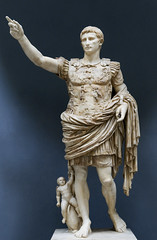
1219072858820 BCE 6' 8" Had a bronze original. Vatican Museums, Rome From Primaporta, Italy Breastplate depicted a victory in battle. Copies are marblePortrait of Augustus as General9
1219072858990 CE From Rome, Italy 2' 1" high Marble Museo Capitolino, Rome Projects idealized beauty.Portrait of a Flavian Woman10
1219072859013-9 BCE Panel from the East Facade of the Ara Pacis Augustae Rome, Italy Marble 5' 3"Female Personification (Tellus?)11
1219072859113-9 BCE Detail of the south Frieze of the Ara Pacis Augustae Rome, Italy Marble 5' 3"Procession of the Imperial Family12
12190728592Built under Augustus 16 BCE Nimes, France An aqueduct Bridge used to carry water from the mountains to cities on the Tiber River.Pont-du-Gard13
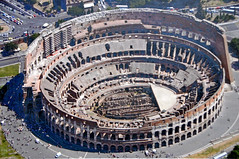
1219072859370-80 CE "Flavian Amphitheater" Rome, Italy Built under Vespasian Titus completed it Barrel Vaults and Groin VaultsArial view of the Colosseum14
12190728594After 81 CE Rome, Italy Composite Style (Mix of Ionic and Corinthian Styles) "Triumphal Arch"Arch of Titus15
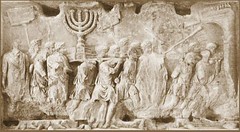
12190728595After 81 CE Rome, Italy Marble 7' 10" Depicts Roman soldiers taking spoils from the Temple of Jerusalem.Spoils of Jerusalem16
12190728596112 CE Rome, Italy Contained: Temple of Trajan, Column of Trajan, Libraries, Basilica Ulpia, Equestrian statue of Trajan. Extremely large Forum dedicated by Trajan Architect was Apollodorus of DamascusForum of Trajan17
12190728597112 CE Forum of Trajan Rome, Italy 128' high Used to be topped with a nude Trajan Now it is Saint Peter A spiral frieze wraps up the entire column, depicting various scenes with Trajan.Column of Trajan18
12190728598118-125 CE Rome, Italy Built under Hadrian Dome's top is 142 feet high Oculus was 30 feet wide at the top of the dome. Coffers were used to maintain the structural integrity of the dome.Pantheon19
12190728599Oculus is the only light source Coffers were spaced throughout the inside of the dome.Interior of the Pantheon20
12190728600175 CE Rome, Italy originally Bronze 11' 6" high Musei Capotolini, RomeEquestrian Statue of Marcus Aurelius21
12190728601211-217 CE Marble 1' 2" Metropolitan Museum of Art, New York Accurately depicted the ruthlessness of CaracallaPortrait of Caracalla22
12190728602305 CE From Constantinople Porphyry 4' 3" Saint Mark's, VenicePortraits of the Four Tetrarchs23
12190728603312-315 CE Built under Constantine Took inspiration from Trajan, Hadrian, and Marcus Aurelius Rome, ItalyArch of Constantine24

AP Literature - Test Vocabulary Flashcards

Terms : Hide Images
13870322664lamenta passionate expression of grief or sorrow.0
13870322665contentiouscausing or likely to cause an argument; controversial.1
13870322666celestialbelonging or relating to heaven or space2
13870322667incongruousnot in harmony or keeping with the surroundings or other aspects of something.3
13870322668opulencegreat wealth or luxuriousness.4
13870322669fecundproducing or capable of producing an abundance of offspring or new growth; fertile.5
13870322670austeresevere or strict in manner, attitude, or appearance.6
13870322671sublimeof such excellence, grandeur, or beauty as to inspire great admiration or awe; Romantic period authors were obsessed with it.7
13870322672idyllicextremely happy, peaceful, or picturesque.8
13870322673pastoral(especially of land or a farm) used for or related to the keeping or grazing of sheep or cattle.9
13870322674aversiona strong dislike or disinclination.10
13870322675ruminationa deep or considered thought about something.11
13870322676approbationapproval or praise.12
13870322677ferventhaving or displaying a passionate intensity.13
13870322678acquiescencethe reluctant acceptance of something without protest.14
13870322679reprievecancel or postpone the punishment of (someone, especially someone condemned to death).15
13870322680obduratestubbornly refusing to change one's opinion or course of action.16
13870322681callousshowing or having an insensitive and cruel disregard for others.17
13870322682stoica person who can endure pain or hardship without showing their feelings or complaining.18
13870322683aloofnot friendly or forthcoming; cool and distant.19
13870322684erstwhileformer.20
13870322685penitentfeeling or showing sorrow and regret for having done wrong; repentant.21
13870322686benevolentwell meaning and kindly.22
13870322687fatuoussilly and pointless.23
13870322688illicitforbidden by law, rules, or custom.24
13870322689elicitevoke or draw out (a response, answer, or fact) from someone in reaction to one's own actions or questions.25
13870322690ficklechanging frequently, especially as regards one's loyalties, interests, or affection.26
13870322691imperiousassuming power or authority without justification; arrogant and domineering.27
13870322692vacillatingalternate or waver between different opinions or actions; be indecisive.28
13870322693succumbfail to resist (pressure, temptation, or some other negative force).29
13870322694patronizingtreat with an apparent kindness that betrays a feeling of superiority.30
13870322695onerous(of a task, duty, or responsibility) involving an amount of effort and difficulty that is oppressively burdensome.31
13870322696illustriouswell known, respected, and admired for past achievements.32
13870322697pernicioushaving a harmful effect, especially in a gradual or subtle way.33
13870322698homagespecial honor or respect shown publicly.34
13870322699ignoblenot honorable in character or purpose.35
13870322700palla cloth spread over a coffin, hearse, or tomb.36
13870322701luminositythe intrinsic brightness of a celestial object (as distinct from its apparent brightness diminished by distance).37
13870322702pensiveengaged in, involving, or reflecting deep or serious thought.38
13870322703jocularfond of or characterized by joking; humorous or playful.39
13870322704morosesullen and ill-tempered.40
13870322705bemusingpuzzle, confuse, or bewilder (someone).41
13870322706enigmaticdifficult to interpret or understand; mysterious.42
13870322707misanthropea person who dislikes humankind and avoids human society.43
13870322708estranged(of a person) no longer close or affectionate to someone; alienated.44
13870322709nostalgiaa sentimental longing or wistful affection for the past, typically for a period or place with happy personal associations.45
13870322710artificialfake46
13870322711nonchalant(of a person or manner) feeling or appearing casually calm and relaxed; not displaying anxiety, interest, or enthusiasm.47
13870322712congenial(of a person) pleasant because of a personality, qualities, or interests that are similar to one's own48
13870322713fastidiousvery attentive to and concerned about accuracy and detail.49
13870322714inconspicuousnot clearly visible or attracting attention50
13870322715unrequited(of a feeling, especially love) not returned or rewarded.51
13870322716adversaryone's opponent in a contest, conflict, or dispute.52
13870322717fictitiousnot real or true, being imaginary or having been fabricated.53
13870322718ephemerallasting for a very short time.54
13870322719mercurial(of a person) subject to sudden or unpredictable changes of mood or mind.55
13870322720beguilecharm or enchant (someone), sometimes in a deceptive way.56
13870322721reprovereprimand or censure (someone).57
13870322722gaunt(of a person) lean and haggard, especially because of suffering, hunger, or age.58
13870322723antagonismactive hostility or opposition.59
13870322724jiltsuddenly reject or abandon (a lover).60
13870322725facetioustreating serious issues with deliberately inappropriate humor; flippant.61
13870322726self-effacingnot claiming attention for oneself; retiring and modest.62
13870322727apatheticshowing or feeling no interest, enthusiasm, or concern.63
13870322728ludicrousso foolish, unreasonable, or out of place as to be amusing; ridiculous.64
13870322729incredulous(of a person or their manner) unwilling or unable to believe something.65
13870322730remisslacking care or attention to duty; negligent.66
13870322731sardonicgrimly mocking or cynical.67
13870322732chastiseto scold68
13870322733allaydiminish or put at rest (fear, suspicion, or worry).69
13870322734lionizegive a lot of public attention and approval to (someone); treat as a celebrity.70
13870322735impassionedfilled with or showing great emotion.71
13870322736subversiveseeking or intended to subvert an established system or institution.72
13870322737aberrantdeparting from an accepted standard.73
13870322738maxima short, pithy statement expressing a general truth or rule of conduct.74
13870322739pronouncementa formal or authoritative announcement or declaration.75
13870322740affluentrich76
13870322741ostentatiousshowy77
13870322742didacticintended to teach, particularly in having moral instruction as an ulterior motive.78
13870322743dispassionatenot influenced by strong emotion, and so able to be rational and impartial.79
13870322744inexorableimpossible to stop or prevent.80
13870322745monotonylack of variety and interest; tedious repetition and routine.81
13870322746nativitythe occasion of a person's birth.82
13870322747vitalitythe state of being strong and active; energy.83
13870322748eruditehaving or showing great knowledge or learning.84
13870322749malevolenthaving or showing a wish to do evil to others.85
13870322750reticentnot revealing one's thoughts or feelings readily.86
13870322751minutiaethe small, precise, or trivial details of something.87
13870322752repudiaterefuse to accept or be associated with.88
13870322753ambivalenthaving mixed feelings or contradictory ideas about something or someone.89
13870322754tumultconfusion or disorder.90
13870322755improprietya failure to observe standards or show due honesty or modesty; improper language, behavior, or character.91

AMSCO AP US History Chapter 7 Flashcards

AMSCO United States History 2015 Edition, Chapter 7 The Age of Jefferson, 1800-1816

Terms : Hide Images
11436245527Thomas JeffersonHe was George Washington's first secretary of state. A Democrat-Republican, he was the nation's third president from 1801 to 1809. He stressed the basic principles of constitutional government and limited central government. He appeased the Federalists by maintaining the national bank and debt repayment plan of Hamilton, and carried on the neutrality policies of Washington and Adams. He reduced the size of the military, eliminated some federal jobs, repealed excise taxes, and lowered the national debt. In 1803, he made the Louisiana Purchase from France. (p. 131)0
11436245528Louisiana PurchaseIn 1803, President Thomas Jefferson purchased the Louisiana territory from France for $15 million. The purchase more that doubled the size of the United States, removed a European presence from the nation's borders, and extended the western frontier well beyond the Mississippi River. (p. 133)1
11436245529war hawksThe 1810 congressional election brought a group of young Democratic-Republicans to Congress. Led by Henry Clay and John C. Calhoun they gained influence in the House of Representatives. They argued that war with Britain was the only way to defend American honor, gain Canada, and destroy American Indian resistance on the frontier. (p. 139)2
11436245530Henry ClayIn 1810, he was a Kentucky member of the House of Representatives. He was a war hawk who argued for war with Britain. (p. 139)3
11436245531John C. CalhounIn 1810, he was a South Carolina member of the House of Representatives. He was a war hawk who argued for war with Britain. (p. 139)4
11436245532TecumsehThis Shawnee warrior, who along with his brother, attempted to unite all American Indian tribes east of the Mississippi River. (p. 138)5
11436245566ProphetThis Shawnee religious leader, who along with his brother, attempted to unite all American Indian tribes east of the Mississippi River. (p. 138)6
11436245533William Henry HarrisonIn 1811, this governor of the Indiana Territory, destroyed Shanee headquarters and put an end to Tecumseh's efforts to form an American Indian confederacy. (p. 138)7
11436245534Battle of TippecanoeAn 1811 battle, where U.S. troops led by William Henry Harrison did battle against American Indians led by Tecumseh. (p. 138)8
11436245535strict interpretation of ConstitutionPresident Thomas Jefferson was committed to a strict interpretation of the Constitution and rejected Alexander Hamilton's argument that certain powers were implied. When Jefferson made the Louisiana Purchase he was troubled because the Constitution did not state explicitly that a president could purchase foreign land. He finally argued that the president's powers to make treaties allowed for the purchase. (p. 133)9
11436245536John MarshallThis Federalist Chief Justice of the Supreme Court served in the position for 34 years. His decisions in landmark cases generally strengthened the federal government, often at the expense of states rights. (p. 134)10
11436245537judicial reviewIn 1803, Marbury v. Madison case, the Marshall court established the doctrine of judicial review by ruling that a law passed by Congress was unconstitutional. From this point on, the Supreme Court could overrule the legislative or executive branches if they believed a law was unconstituional. (p. 134)11
11436245567Marbury v. MadisonA Supreme Court case in 1803 where Chief Justice John Marshall ruled that a law passed by Congress was unconstitutional. This established the doctrine of judicial review, where the Supreme Court could overrule actions taken by the legislative and executive branches of the government. (p. 134)12
11436245538Aaron BurrHe was Thomas Jefferson's vice president from 1801 to 1804. A new vice president was chosen for Jefferson's second term. He then organised a failed conspiracy, attempting to unite New England states and secede from the United States. He killed Alexander Hamilton in a duel. In 1806 was tried for treason because of a plan to capture Mexico and possibly unite it with Louisiana. He was acquitted of the charge. (p. 135)13
11436245539QuidsIn 1812, they were "Old" Democratic-Republicans who criticized the War of 1812 because it violated the classic Democratic-Republican commitment to limited federal power and the maintenance of peace. (p. 140)14
11436245540Hartford Convention (1814)In December 1814, a special convention was held in Hartford, Connecticut. Bitterly opposed to the the War of 1812, some radical Federalist in the Northeast wanted to secede from the United States, but it was rejected. However, to limit the power of the Democratic-Republicans they adopted a proposal that a two-thirds vote of both houses would be required for any future declaration of war. (p. 141)15
11436245541Napoleon BonaparteIn the War of 1812 the United States based their hope for victory on them successfully fighting the British in Europe. However, in the spring of 1814, their losses enabled the British to increase their forces in North America. (p. 141)16
11436245542Toussaint I'OuvertureHe led a rebellion against French rule on the island of Santo Domingo which resulted in heavy French losses. (p. 132)17
11436245543Barbary piratesThe United States had been paying the on the North African coast in exchange for safe passage of U.S. ships in the Mediterranean. President Jefferson stopped paying the tribute, and the U.S. fought the from 1801 to 1805. There was no decisive victory but it did offer some protection to U.S. ships in the region. (p. 136)18
11436245544neutralityAround 1804, the Napoleonic wars dominated Europe. Britain was seizing U.S. ships, confiscating the cargo and forcing sailors to join the British navy. This made it difficult for President Jefferson to maintain a position of not taking sides in the conflict. (p. 136)19
11436245545impressmentThe British practice of taking American sailors from American ships and forcing them to serve in the British navy. (p. 136)20
11436245546Chesapeake-Leopard affairIn 1807, the British warship Leopard attacked the American warship Chesapeake. Three U.S. sailors were killed and four were taken captive. Many Americans demanded war but Jefferson used diplomacy and economic pressure in response. (p. 136)21
11436245547Embargo Act (1807)In 1807, this act prohibited American trading ships from sailing to any foreign port. It was meant to force Britain and France to change their policies towards neutral vessels, by depriving them of American trade. The embargo backfired and brought greater economic hardship to the United States than Britain. In 1809 it was repealed. (p 136)22
11436245548James MadisonThe fourth President of the United States from 1809 to 1817. A Democrat-Republican and a close friend of Thomas Jefferson. A member of the Continental Congress and the Constitutional Convention, he strongly supported ratification of the Constitution. He was a contributor to The Federalist Papers. His presidency was marked by the War of 1812. (p. 137)23
11436245549Nonintercourse Act (1809)In 1809, this act provided that America could now trade with all nations except Britain and France. (p. 137)24
11436245550Macon's Bill No. 2 (1810)When economic hardships continued into 1810, Nathaniel Macon, a member of Congress, introduced a bill that restored U.S. trade with both Britain & France. It also provided that if either France or Britain formally agreed to respect neutral rights at sea, then the U.S. would prohibit trade with the foe of that nation. (p. 138)25
11436245551War of 1812A war between the United States and Great Britain caused by American outrage over the impressment of American sailors by the British and British aid to the Indians attacking the Americans on the western frontier. The War Hawks (young westerners led by Henry Clay and John C. Calhoun) argued for war in Congress. American troops attempted an invasion of Canada, but it was repulsed by British defenders. Numerous naval battles occurred and at one point the British marched through Washington, D.C. and burned the White House. In December 1814 the Treaty of Ghent was reached and territory was returned to the pre-war status. Two weeks later, Andrew Jackson's troops defeated the British at the Battle of New Orleans, not knowing that a peace treaty had already been signed. (p. 138)26
11436245552Old IronsidesThe nickname for the U.S. warship, Constitution. In 1812, it raised American morale by sinking a British ship off the coast of Nova Scotia. (p. 140)27
11436245553Battle of Lake ErieProbably the most important U.S. naval victory in the War of 1812. Captain Oliver Hazard Perry led the U.S. to victory against the British. (p. 140)28
11436245554Oliver Hazard PerryThis naval captain won the Battle of Lake Erie in the War of 1812. His famous quote was, "We have met the enemy, and they are ours." (p. 140)29
11436245555Battle of the Thames RiverThis naval battle, near Detroit, was led by General William Henry Harrison. The U.S. defeated the British, and the American Indian Tecumseh was killed. (p. 140)30
11436245556Thomas MacdonoughIn 1814, this U.S. naval commander defeated a British fleet on Lake Champlain. As a result the British had to retreat and abandon their plan to invade New York and New England. (p. 140)31
11436245557Battle of Lake ChamplainA battle where the British fleet was defeated and was forced to retreat and to abandon their plans to invade New York and New England. (p. 140)32
11436245558Andrew JacksonIn the War of 1812 this U.S. general defeated the Creek nation at the Battle of Horseshoe Bend. The British were trying to control the Mississippi River and he defeated them at the Battle of New Orleans. He would later become the seventh president of the United States. (p. 141)33
11436245559Battle of Horseshoe BendIn March 1814, General Andrew Jackson defeated the Creek nation, an important British ally. The battle was fought in present-day Alabama and ended American Indian resistance in that area. (p. 141)34
11436245560Creek NationThis American Indian tribe was an important British ally in the War of 1812 until being defeated by Andrew Jackson. (p. 141)35
11436245561Battle of New OrleansOn January 8, 1815, General Andrew Jackson led U.S. troops that defeated the British at New Orleans. At that time communications were much slower and the armies did not know that the Treaty of Ghent had ended the war two weeks earlier. (p. 141)36
11436245562Treaty of Ghent (1814)The peace treaty that ended the War of 1812. The terms halted fighting, returned all conquered territory to the prewar claimant, and recognized the pre war boundary between Canada and the United States. (p. 141)37
11436245563Lewis and Clark ExpeditionIn 1804, Captain Meriwether Lewis and Lieutenant William Clark left St. Louis, Missouri on an expedition to the Pacific coast. They travelled up the Missouri River to the Great Divide, and then down the Columbia River to the Pacific Ocean. the expedition provided greater scientific knowledge of the region, stronger claims to the Oregon Territory, better relationships with the American Indians, and more accurate maps. (p. 134)38

Pages

Subscribe to CourseNotes RSS

Need Help?

We hope your visit has been a productive one. If you're having any problems, or would like to give some feedback, we'd love to hear from you.

For general help, questions, and suggestions, try our dedicated support forums.

If you need to contact the Course-Notes.Org web experience team, please use our contact form.

Need Notes?

While we strive to provide the most comprehensive notes for as many high school textbooks as possible, there are certainly going to be some that we miss. Drop us a note and let us know which textbooks you need. Be sure to include which edition of the textbook you are using! If we see enough demand, we'll do whatever we can to get those notes up on the site for you!