AP Notes, Outlines, Study Guides, Vocabulary, Practice Exams and more!

AMSCO AP US History Chapter 26 Flashcards

AMSCO United States History 2015 Edition, Chapter 26 Truman and the Cold War 1945-1952

Terms : Hide Images
9035328214Servicemen's Readjustment Act of 1944 (GI Bill)Signed into law by President Franklin D. Roosevelt on June 22, 1944, it was also known as the GI Bill. It provided veterans of the Second World War with funds for college education, unemployment insurance, and housing. (p. 557)0
9035328215early marriagesOne sign of confidence in post World War II era was an explosion of marriages at a younger age and new births. (p. 558)1
9035328216baby boomBetween 1945 and 1960, 50 million babies were born. This generation would profoundly affect the nation's social institutions and economic life. (p. 558)2
9035328217suburban growthLow interest rates on mortgages that were government-insured and tax deductible made the move from the city to the suburb affordable for almost any family. In a single generation the majority of middle-class Americans became suburbanites. (p. 558)3
9035328218LevittownWilliam Levitt used mass production techniques to build 17,000 inexpensive homes on Long Island, New York. It became a symbol of the movement to the suburbs in the years after World War II. (p. 558)4
9035328219SunbeltAfter World War II, many Americans moved to southern states. They were attracted by a warmer climate, lower taxes, and defense-related industry jobs. (p. 558)5
9035328220Harry TrumanA moderate Democrat, he became president when Franklin Roosevelt died. He was a decisive, honest and unpretentious leader. (p. 558)6
9035328221Employment Act of 1946President Truman's act included progressive measures such as increased minimum wage and efforts to maintain full employment. (p. 559)7
9035328222Council of Economic AdvisersEstablished by Truman's Employment Act of 1946, they counseled the president and Congress on promoting national economic welfare. (p. 559)8
9035328223inflation and labor unionsRelaxed controls on the Office of Price Administration resulted in an inflation rate of about 25 percent during the first year and a half after World War II. Workers and unions wanted wages to increase after years of wage controls during World War II. (p. 559)9
9035328224Committee on Civil RightsIn 1946, President Truman used his executive powers to create this committee to challenge racial discrimination. (p. 559)10
9035328225racial integration of militaryIn 1948, President Truman ordered the end of racial discrimination throughout the federal government including the armed forces. The end of segregation changed life on military bases, many of which were in the South. (p. 559)11
903532822622nd AmendmentIn response to Franklin Roosevelt's four elections, Congress passed this constitutional amendment, which limited a president to a maximum of two full terms in office. (p. 560)12
9035328227Taft-Hartley ActIn 1947, President Truman called it a "slave labor" bill and vetoed it, but Congress overrode his veto. It established limits on unions by outlawing the closed shop, permitting states to pass "right to work" laws, outlawing secondary boycotts, and giving the president the power to invoke an 80-day cooling off period for some strikes. (p. 560)13
9035328228Progressive PartyIn 1948, liberal Democrats who thought President Truman's aggressive foreign policy threatened world peace, formed this new party. (p. 560)14
9035328229Henry WallaceIn 1948, this former vice president was nominated as the Progressive party's presidential candidate. (p. 560)15
9035328230States-Rights party (Dixiecrats)In 1948, Southern Democrats formed this new party in reaction the President Truman's support of civil rights. (p. 560)16
9035328231J. Strom ThurmondThe South Carolina Governor, who the States-Rights party (Dixiecrats) chose as their 1948 presidential nominee. (p. 560)17
9035328232Thomas DeweyThis Republican New York governor started the 1948 presidential election as the expected winner. He lost to Harry Truman after running a cautious and unexciting campaign. (p. 560)18
9035328233Fair DealPresident Truman's attempt at extending the New Deal with national health insurance, federal aid to education, civil rights legislation, public housing, and a new farm program. Most of the Fair Deal was defeated because of Truman's political conflicts with Congress and the pressing foreign policy concerns of the Cold War. (p. 561)19
9035328234Cold WarFrom the late 1940's to 1991, it dominated international relations. The Communist empire of the Soviet Union against the Western democracy of the United States. It was fought mainly through diplomacy rather than armed conflict, but brought the world dangerously close to a nuclear war. (p. 561)20
9035328235Soviet UnionA Communist nation, consisting of Russia and 14 other states, that existed from 1922 to 1991. (p. 561)21
9035328236Joseph StalinThe leader of the Soviet Union during World War II. In the Nonaggression Pact of 1939, he and Hitler agreed to divide up Eastern Europe. The Soviets later fought Hitler in World War II. They were unhappy when the British and Americans waited until 1944 to open a second battle front in France. (p. 562)22
9035328237United NationsIn the fall of 1945, this worldwide organization was founded and allowed membership of all countries. It had a 15-member Security Council that was to maintain international security and authorize peacekeeping missions. It is often referred to as the U.N. (p. 562)23
9035328238Security CouncilWithin the United Nations, this council consisted of 15 members. There were five permanent members that had veto power: United States, Great Britain, France, China, and the Soviet Union. (p. 562)24
9035328239World BankCreated at the Bretton Woods Conference in 1944. The bank's initial purpose was to fund rebuilding after World War II. Also know as International Bank for Reconstruction and Development. The Soviets declined to join because they saw the bank as an instrument of capitalism. (p. 562)25
9035328240Communist satellitesCentral and Eastern European nations ruled by Communist dictators, most of them loyal to the Soviet Union. They included: Poland, Romania, Bulgaria, Albania, Hungary, and Czechoslovakia, and others. (p. 562)26
9035328241Occupation zonesAt the end of World War II, Germany was divided into four regions controlled by the Soviets, United States, Britain, and France. These areas were supposed to be temporary but the Soviets maintained control of the eastern area. (p. 563)27
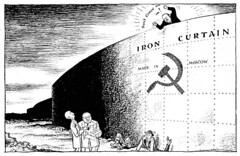
9035328242Iron CurtainThe term popularized by British Prime Minister Winston Churchill to describe the Soviet Union's policy of isolating and controlling the Soviet satellite states of Eastern Europe. (p. 563)28
9035328243Winston ChurchillAfter World War II he declared, "An iron curtain has been descended across the continent". He called for a partnership between Western democracies to halt the expansion of communism. (p. 563)29
9035328244historians: traditionalists vs. revisionistsTraditional historians believe the Cold War was started by the Soviet government subjugating the countries of Eastern Europe in the late 1940s. In the 1960s, revisionist historians began to argue that the United States contributed to starting the Cold War. (p. 572)30
9035328245George KennanHelped formulate Truman's containment policy. Expert on Soviet Affairs, in an influential article he wrote that only "a long-term, patient but firm and vigilant containment of Russian expansive tendencies" would eventually cause the Soviets to back off their Communist ideology of world domination and live in peace with other nations. (p. 563)31
9035328246Dean Achesonundersecretary of state who helped formulate Truman's containment policy (p.32
9035328247containment policyIn 1947, President Truman adopted the advice of three top advisers on how to contain Soviet aggression. This policy called for a long-term, firm, and vigilant containment of the Soviet's expansion tendencies. They believed this would eventually cause them to back off their Communist ideology of world domination. (p. 563)33
9035328248Truman DoctrineThis doctrine was in response to a Communist-led uprising against the government in Greece and Soviet demand for some control of a water route in Turkey. In 1947, President Truman asked Congress for $400 million in economic and military aid to assist Greece and Turkey against totalitarian regimes. (p. 564)34
9035328249Marshall PlanA 1947 plan of U.S. economic aid to help European nations revive their economies and strengthen democratic governments, after the devastation of World War II. This plan offered $12 billion in aid to western and southern Europe. The Soviet Union refused to take any of the aid and the result was a deepening rift between non-Communist West and the Communist East. (p. 564)35
9035328250Berlin airliftThe Soviets cut off all access by land to West Berlin. The United States flew planes in with supplies to help the people. At the same time, the U.S. sent 60 bombers capable of carrying atomic bombs to bases in England. Stalin chose not to challenge the airlift and war was averted. (p. 564)36
9035328251East GermanyAfter World War II, this country was the German Democratic Republic, a satellite of the Soviet Union. (p. 564)37
9035328252West GermanyAfter World War II, this country was the Federal Republic of Germany, a U.S. ally. (p. 564)38
9035328253North Atlantic Treaty OrganizationA military alliance, commonly known as NATO. It consists of the United States, Canada, and ten European nations. Its purpose was to defend Western Europe against outside attack. (p. 565)39
9035328254National Security ActIn 1947, this act provided for 1) a centralized Department of Defense to coordinate the operations of the military, 2) creation of the National Security Council (NSC) to coordinate the making of foreign policy in the Cold War, 3) creation of the Central Intelligence Agency (CIA) to employ spies to gather information on foreign governments. (p. 566)40
9035328255Nuclear arms raceSoviet and American scientists were in an arms race to develop superior weapons systems. From 1945 to 1949 the U.S. was only country to have atomic bombs. In 1949 the Soviets tested their first atomic bomb. President Truman responded by approving the development of a hydrogen bomb which would be 1000 times more powerful than the atomic bomb. (p. 566)41
9035328256NSC-68A 1950 secret report in which the National Security Council that U.S must fight the Cold War by: 1) quadruple U.S. defense spending to 20% of GNP 2) form alliances with non-Communist countries 3) convince Americans that a costly arms build up was necessary for defense (p. 566)42
9035328257U.S. - Japanese Security TreatyA 1951 treaty, in which Japan surrendered its claims to Korea and islands in the Pacific and the U.S. ended formal occupation of Japan. U.S troops remained on military bases in Japan to protect it from external enemies. (p. 567)43
9035328258Douglas MacArthurPopular general who aggressively directed American forces during the Korean War. He clashed with President Truman, who removed him from command in 1951. (p. 566)44
9035328259Chinese civil warThe war between Communist Mao Zedong and Nationalist Chiang-Kai Shek. The United States gave $400 million in aid to the Nationalists, but 80 percent of it landed in Communist hands. The Communists took over China and forced the Nationalists to retreat to Taiwan. The U.S. did not recognize the People's Republic of China until 1979. (p. 567)45
9035328260Chiang Kai-shekNationalist leader of China, forced out of China by the Communists. He retreated to Taiwan, where the U.S. continued to support him. (p. 567)46
9035328261TaiwanWhen the Communists took control of the China mainland, the Nationalists led by Chiang Kai-shek were forced to retreat to this island. (p. 567)47
9035328262Mao ZedongThe Communist leader of the People's Republic of China. He overthrew Chiang Kai-shek and the Nationalists. (p. 567)48
9035328263People's Republic of ChinaCommonly known as China, it is the largest country in East Asia. A socialist republic ruled by the Communist Party of China under a single-party system. (p. 567)49
9035328264Korean WarOn June 25, 1950 the North Korean army invaded South Korea. General Douglas MacArthur led a United Nations force consisting of mostly U.S. troops to help the South Korean army. By the time a peace agreement was signed in 1953 the north and south border was nearly in the same location, but 2.5 million people, including 54,000 Americans had died. (p. 568)50
9035328265Kim Il SungThe Communist leader of North Korea during the Korean War. (p. 568)51
9035328266Syngman RheeThe nationalist leader of South Korea during the Korean War. (p. 568)52
9035328267U.N. police actionThe term to describe the Korean War because Congress supported the use of U.S. troops under the U.N. but had never declared war. (p. 568)53
903532826838th parallelAfter World War II Japan gave up its former colony Korea and the country was divided along this parallel. The northern area was occupied by the Soviet forces and the south by the U.S. forces. (p. 568)54
9035328269soft on communismThe Republican's term to describe the Democrats after China adopted Communism and the Korean War stalemate. (p. 569)55
9035328270Loyalty Review BoardIn 1947 under pressure from the Republicans this board was established to investigate the background of more than 3 million employees. (p. 570)56
9035328271Smith ActIn 1940, this act made it illegal to advocate or teach the overthrow of the government by force or belong to an organization with this objective. (p. 570)57
9035328272Dennis et al. v. United StatesIn 1951, the Supreme Court upheld the constitutionality of the Smith Act. (p. 570)58
9035328273McCarran Internal Security ActIn 1950, Congress passed this act over Truman's veto which did the following: 1) Made it unlawful to advocate or support the establishment of a totalitarian government. 2) Restrict the employment and travel of those joining Communist -front organizations. 3) Authorized the creation of detention camps for subversives. (p. 570)59
9035328274House Un-American Activities CommitteeAfter World War II, this House of Representative committee investigated Communist influence in the government and within organizations such as the Boy Scouts and Hollywood film industry. Many were called to testify before the committee and some were blacklisted. (p. 570)60
9035328275Hollywood blacklistsThe House Un-American Activities Committee created a list of people who would be denied work in the film industry. (p. 570)61
9035328276freedom of expression in artsThe Second Red Scare, the search for Communists, had a chilling effect on freedom of expression. (p. 570)62
9035328277Alger HissHe was a state department official who assisted Roosevelt at the Yalta conference. He denied that he was a Communist and had given secret documents to Whittaker Chambers. In 1950, he was convicted of perjury and sent to prison. (p. 571)63
9035328278Whittaker ChambersA confessed Communist and witness for the House Un-American Activities Committee. (p. 571)64
9035328279Rosenberg caseThis couple, Julius and Ethel, were charged with running a spy ring for the Soviets in New York. In 1953, they were convicted of treason and executed. (p 571)65
9035328280Joseph McCarthyA Republican senator from Wisconsin, who recklessly accused many government officials of being Communists. In December 1954 censured by the Senate which brought an end to his era. (p. 571)66
9035328281McCarthyismDuring the early 1950s, this term was applied to the process of recklessly accusing people in the government and the arts of being Communists. (p. 571)67

AP US History - US Presidents Flashcards

Terms : Hide Images
9100819360George Washington1789-1797 Federalist Whiskey Rebellion; Judiciary Act; Farewell Address0
9100819361John Adams1797-1801 Federalist XYZ Affair; Alien and Sedition Acts1
9100819362Thomas Jefferson1801-1809 Democratic-Republican Marbury v. Madison; Louisiana Purchase; Embargo of 18072
9100819363James Madison1809-1817 Democratic-Republican War of 1812; First Protective Tariff3
9100819364James Monroe1817-1825 Democratic-Republican Missouri Compromise of 1820; Monroe Doctrine4
9100819365John Quincy Adams1825-1829 Democratic-Republican "Corrupt Bargain"; "Tariff of Abominations"5
9100819366Andrew Jackson1829-1837 Democrat Nullification Crisis; Bank War; Indian Removal Act6
9100819367Martin Van Buren1837-1841 Democrat Trail of Tears; Specie Circular; Panic of 18377
9100819368William Henry Harrison1841 Whig "Tippecanoe and Tyler too!"; First Whig President8
9100819369John Tyler1841-1845 Whig "His Accidency"; Webster-Ashburton Treaty9
9100819370James Polk1845-1849 Democrat Texas annexation; Mexican War10
9100819371Zachary Taylor1849-1850 Whig Mexican War hero and staunch Unionist11
9100819372Millard Fillmore1850-1853 Whig Compromise of 185012
9100819373Franklin Pierce1853-1857 Democrat Kansas-Nebraska Act; Gadsden Purchase13
9100819374James Buchanan1857-1861 Democrat Dred Scott decision; Harpers Ferry raid14
9100819375Abraham Lincoln1861-1865 Republican Secession and Civil War; Emancipation Proclamation15
9100819376Andrew Johnson1865-1869 Democrat 13th and 14th amendments; Radical Reconstruction; Impeachment16
9100819377Ulysses Grant1869-1877 Republican 15th amendment; Panic of 187317
9100819378Rutherford Hayes1877-1881 Republican Compromise of 1877; labor unions and strikes18
9100819379James Garfield1881, Republican Brief resurgence of presidential authority; Increase in American naval power; Purge corruption in the Post Office19
9100819380Chester Arthur1881-1885 Republican Standard Oil trust created Edison lights up New York City20
9100819381Grover Cleveland1885-1889 (1st term), 1893-1897 (2nd term) Democrat Interstate Commerce Act; Dawes Act; Panic of 1893; Pullman Strike21
9100819382Benjamin Harrison1889-1893 Republican Sherman Anti-Trust Act; Closure of the frontier22
9100819383William McKinley1897-1901 Republican Spanish-American War; Open Door policy23
9100819384Theodore Roosevelt1901-1909 Republican Progressivism; Square Deal; Big Stick Diplomacy24
9100819385William Howard Taft1909-1913 Republican Dollar diplomacy NAACP founded25
9100819386Woodrow Wilson1913-1921 Democrat WWI; League of Nations; 18th and 19th amendments; Segregation of federal offices; First Red Scare26
9100819387Warren Harding1921-1923 Republican "Return to normalcy", return to isolationism; Tea Pot Dome scandal; Prohibition27
9100819388Calvin Coolidge1923-1929 Republican Small-government (laissez-faire) conservative28
9100819389Herbert Hoover1929-1933 Republican "American individualism"; Stock Market Crash; Dust Bowl; Hawley-Smoot Tariff29
9100819390Franklin Delano Roosevelt1933-1945 Democrat New Deal; WWII; Japanese Internment; "Fireside Chats"30
9100819391Harry Truman1945-1953 Democrat A-bomb; Marshall Plan; Korean War; United Nations31
9100819392Dwight Eisenhower1953-1961 Republican Brown v. Board of Education; Second Red Scare; Highway Act and suburbanization ("white flight"); Farewell Address warning of the military industrial complex32
9100819393John Kennedy1961-1963 Democrat Camelot; Bay of Pigs; Cuban Missile Crisis; Space program; Peace Corps33
9100819394Lyndon Johnson1963-1969 Democrat Civil and Voting Rights acts; Gulf of Tonkin Resolution; Great Society34
9100819395Richard Nixon1969-1974 Republican Environmental Protection Act; China visit; Moon Landing; Watergate35
9100819396Gerald Ford1974-1977 Republican Pardoning of Nixon; OPEC crisis36
9100819397Jimmy Carter1977-1981 Democrat stagflation / energy crisis; Iran hostage crisis; Camp David Accords37
9100819398Ronald Reagan1981-1989 Republican Conservative revolution; Iran-Contra scandal38
9100819399George H. W. Bush1989-1993 Republican Persian Gulf War39
9100819400Bill Clinton1993-2001 Democrat NAFTA; Lewinsky scandal and impreachment40
9100819401George W. Bush2001-2008 Republican War on terrorism; Patriot Act; Tax cuts; "No Child Left Behind"41
9100819402Barack Obama2008-2017 Democrat Affordable Care Act42
9100819403Donald Trump2017-? Republican "Make America Great Again"43

AMSCO AP US History Chapter 4 Flashcards

AMSCO United States History 2015 Edition, Chapter 4 Imperial Wars and Colonial Protest, 1754-1774

Terms : Hide Images
9841079528Patrick HenryYoung Virginian lawyer who coined the phrase "No taxation without representation" in his speech to the House of Burgesses. (p. 73)0
9841079529Stamp Act CongressRepresentatives from nine colonies met in New York in 1765 and decided that only their own elected representatives had the power to approve taxes. (p. 73)1
9841079530Sons and Daughters of LibertySecret society organized to intimidated tax agents. Sometimes they destroyed revenue stamps and tarred and feathered tax collectors. (p. 73)2
9841079531John Dickinson; Letters from a Farmer in PennsylvaniaIn 1767 and 1768, he argued that the idea of no taxation without representation, was an essential principle of English law. (p. 74)3
9841079532Samuel AdamsIn 1768, he was one of the authors of the the Massachusetts Circular Letter which urged colonies to petition Parliament to repeal the Townshend Acts. (p. 74)4
9841079563James OtisIn 1768, he was one of the authors of the the Massachusetts Circular Letter which urged colonies to petition Parliament to repeal the Townshend Acts. (p. 74)5
9841079564Massachusetts Circular LetterIn 1768, this document was distributed to every colonial legislature. It urged the colonies to petition Parliament to repeal the Townshend Acts. (p. 74)6
9841079533Committees of CorrespondenceInitiated by Samuel Adams in 1772, these letters spread news of suspicious or threatening acts by the British throughout the colonies. (p. 74)7
9841079534Intolerable ActsColonist name for the Coercive Acts of 1774, a series of acts created to punish the colonists for the Boston Tea Party. (p. 75)8
9841079535George IIIIn the 1760s, he was the King of England. (p. 71)9
9841079536WhigsIn the 1760s, this was the dominant political party in Parliament that wanted the American colonies to bear more of the cost of maintaining the British empire. (p. 71)10
9841079537ParliamentThe legislative house of Great Britain. (p. 71)11
9841079538salutary neglectGreat Britain had exercised little direct control over the colonies and did not enforce its navigation laws. This changed after the French and Indian War, as the British adopted more forceful policies for taking control of the colonies. (p. 71)12
9841079539Lord Frederick NorthNew prime minister of Britain who convinced Parliament to repeal the Townshend Acts in 1770. (p. 74)13
9841079540Pontiac's RebellionIn 1763, American Indian chief Pontiac led a major attack against the colonial settlements on the western frontier. The British did not rely on colonial forces, but instead sent their army to deal with the rebellion. This led to the creation of the Proclamation of 1763. (p. 72)14
9841079541Proclamation Act of 1763This proclamation prohibited colonists from settling west of the Appalachian Mountains. The British hoped it would prevent violence between Native Americans and colonists. The colonists were angry and disobeyed the law, moving to the west of the imaginary boundary in large numbers. (p. 72)15
9841079542Seven Years' War (French and Indian War)War fought in the colonies from 1754 to 1763 between the English and the French for possession of the Ohio River Valley area. The English won the war and the Peace of Paris was negotiated in 1763. (p. 70)16
9841079543Albany Plan of UnionThe British government called for representatives from several colonies to meet in Albany, New York in 1754, to provide for an inter-colonial government to recruit troops and collect taxes. Each colony was too jealous of its own taxation powers to accept the plan. (p. 70)17
9841079544Edward BraddockIn 1755, this general led an army from colonial Virginia, to attack the French near Ft. Duquesne. More than 2,000 of his British and colonial troops were defeated by a smaller force of French and American Indians. (p. 70)18
9841079545George WashingtonHe led a small militia from the Virginia colony, to halt the completion of the French fort in the Ohio River Valley, Fort Duquesne. In July 1974, he was forced to surrender to a superior force of Frenchmen and their American Indian allies. This was the beginning of the French and Indian War. (p. 70)19
9841079546Peace of ParisPeace treaty signed to end the French and Indian War (The Seven Years' War) in 1763. Great Britain gained French Canada and Spanish Florida. France gave Spain its western territory. (p. 71)20
9841079547Sugar ActA 1764 British act which placed duties on foreign sugar and other luxuries. Its primary purpose was to raise money for the English Crown. (p. 72)21
9841079565Quartering ACTThis 1765 act required the colonists to provide food and living quarters for British soldiers. (p. 72)22
9841079548Stamp ActThis 1765 act required that revenue stamps be placed on almost all printed paper, such as legal documents, newspapers, and pamphlets. This was the first tax paid directly by the colonists, rather than merchants. Boycotts were effective in repealing this act. (p. 72)23
9841079549Declaratory ActIn 1766, Parliament declared that it had the right to tax and make laws for the colonies in all cases whatsoever. (p. 73)24
9841079550Townshend ActsIn 1767, Parliament enacted new taxes to be collected on imports of tea, glass, and paper. It also created the writs of assistance, which was a general license to search for smuggled goods anywhere. (p. 73)25
9841079566Writs of AssistanceA general license to search anywhere. (p. 73)26
9841079551Tea ActIn 1773, Parliament passed this act which taxed imported tea. The result was that British tea was even cheaper than smuggled Dutch tea. (p. 75)27
9841079567Coercive ActsIn 1774, after the Boston Tea Party, Great Britain created four Coercive Acts to punish the people of Boston and Massachusetts. (p. 75)28
9841079552Port ActOne of the Coercive Acts, which closed the port of Boston, prohibiting trade in and out of the harbor until the destroyed tea was paid for. (p. 75)29
9841079553Massachusetts Government ActOne of the Coercive Acts, which reduced the power of the Massachusetts legislature while increasing the power of the royal governor. (p. 75)30
9841079554Administration of Justice ActOne of the Coercive Acts, which allowed royal officials accused of crimes to be tried in England instead of the colonies. (p. 75)31
9841079555Quebec ActIn 1774, this act organized the Canadian lands gained from France (Quebec). It established Roman Catholicism as the official religion, set up a government without a representative assembly, and set the Quebec border further south, at the Ohio River. (p. 75)32
9841079556EnlightenmentA European movement in literature and philosophy; used human reasoning to solve problems. (p. 76)33
9841079557DeismBelieve that God established natural laws in creating the universe, but that the role of divine intervention in human affairs was minimal. (p. 77)34
9841079558RationalismTrusted human reason to solve the many problems of life and society; emphasized reason, science, and respect for humanity. (p. 77)35
9841079559John LockeEnglish philosopher who said that all people have rights, simply because they are human and that people have a right and a responsibility to revolt against any government that failed to protect their rights. (p. 77)36
9841079560Jean-Jacques RousseauFrench philosopher who had a profound influence on educated Americans in the 1760s and 1770s. (p. 77)37

AP US History Terms (951 - 1000) Flashcards

Terms : Hide Images
5768058002951. Rough Riders, San Juan Hill1898 - Theodore Roosevelt formed the Rough Riders (volunteers) to fight in the Spanish- American War in Cuba. They charged up San Juan Hill during the battle of Santiago. It made Roosevelt popular.0
5768058004952. Treaty of ParisApproved by the Senate on February 6, 1898, it ended the Spanish-American War. The U.S. gained Guam, Cuba, Puerto Rico and the Philippines.1
5768058006953. American Anti-Imperialist LeagueA league containing anti-imperialist groups; it was never strong due to differences on domestic issues. Isolationists.2
5768058008954. Philippines, Guam, Puerto Rico, CubaThe U.S. acquired these territories from Spain through the Treaty of Paris (1898), which ended the Spanish-American War.3
5768058010955. Walter ReedDiscovered that the mosquito transmitted yellow fever and developed a cure. Yellow fever was the leading cause of death of American troops in the Spanish-American War.4
5768058012956. Insular casesDetermined that inhabitants of U.S. territories had some, but not all, of the rights of U.S. citizens.5
5768058014957. Teller AmendmentApril 1896 - U.S. declared Cuba free from Spain, but the Teller Amendment disclaimed any American intention to annex Cuba.6
5768058016958. Platt AmendmentA rider to the Army Appropriations Bill of 1901, it specified the conditions under which the U.S. could intervene in Cuba's internal affairs, and provided that Cuba could not make a treaty with another nation that might impair its independence. Its provisions were later incorporated into the Cuban Constitution.7
5768058018959. ProtectorateA weak country under the control and protection of a stronger country. Puerto Rico, Cuba, etc. were protectorates of the U.S.8
5768058020960. Aguinaldo, Philippine InsurrectionEmilio Aguinaldo (1869-1964) led a Filipino insurrection against the Spanish in 1896 and assisted the U.S. invasion. He served as leader of the provisional government but was removed by the U.S. because he wanted to make the Philippines independent before the U.S. felt it was ready for independence.9
5768058022961. Secretary of State John Hay, Open Door notesSeptember, 1899 - Hay sent imperialist nations a note asking them to offer assurance that they would respect the principle of equal trade opportunities, specifically in the China market.10
5768058024962. Spheres of influenceRegion in which political and economic control is exerted by on European nation to the exclusion of all others. Spheres of influence appeared primarily in the East, and also in Africa.11
5768058026963. Boxer Rebellion1900 - a secret Chinese society called the Boxers because their symbol was a fist revolted against foreigners in their midst and laid siege to foreign legislations in Beijing.12
5768058028964. ExtraterritorialityIn the 1920's, China wated an end to the exemption of foreigners accused of crimes from China's legal jurisdiction.13
5768058030965. Most Favored Nation ClausePart of RTA Act in 1834, allowed a nation to make a special agreement with another nation and give them a preferential low tariff rate.14
5768058032966. Election of 1896: candidates, issuesRepublican, William McKinley defeated Democrat, William Bryan. The issue was imperialism.15
5768058034967. Roosevelt's Big Stick DiplomacyRoosevelt said, "walk softly and carry a big stick." In international affairs, ask first but bring along a big army to help convince them. Threaten to use force, act as international policemen. It was his foreign policy in Latin America.16
5768058036968. U.S.S. OregonWarship involved in Spanish-American blockade in Cuba in 1898. Went from Cuba to the Philippines by going around the Southern tip of South America. Showed that we need a better route between the Atlantic and the Pacific.17
5768058038969. Clayton-Bulwer Treaty1850 - Treaty between U.S. and Great Britain agreeing that neither country would try to obtain exclusive rights to a canal across the Isthmus of Panama. Abrogated by the U.S. in 1881.18
5768058040970. Hay-Pauncefote Treaty1901 - Great Britain recognized U.S. Sphere of Influence over the Panama canal zone provided the canal itself remained neutral. U.S. given full control over construction and management of the canal.19
5768058042971. Hay-Herran TreatyKept the purchase price of the canal strip in Panama the same but enlarged the area from 6 to 10 miles.20
5768058044972. Hay-Bunau-Varilla Treaty1903 - U.S. guaranteed the independence of the newly-created Republic of Panama.21
5768058046973. Panama RevolutionThe Isthmus of Panama had been part of Columbia. U.S. tried to negotiate with Columbia to build the Panama Canal. Columbia refused, so U.S. encouraged Panama to revolt. Example of Big Stick diplomacy.22
5768058048974. Panama CanalBuilt to make passage between Atlantic and Pacific oceans easier and faster.23
5768058050975. Goethals and Gorgas1906 - Army colonels who supervised the construction of the Panama Canal.24
5768058052976. Venezuelan Crisis1902 - England, Germany and Italy had blockaded Venezuelan ports because Latin American countries failed to make payments on debts owed to foreign banks. U.S. invoked the Monroe Doctrine and pressured the European powers to back off.25
5768058054977. Drago DoctrineArgentine jurist, Luis Drago, proposed that European countries could not use force to collect debts owed by countries in the Americas. They could not blockade South American ports. Adopted as part of the Hague Convention in 1907.26
5768058056978. Roosevelt CorollaryU.S. would act as international policemen. An addition to the Monroe Doctrine.27
5768058058979. "Colossus of the North"1906 - Relations between U.S. and Canada including a reciprocal trade agreement. Tight relations made the U.S. and Canada a "Colossus."28
5768058060980. Dominican RepublicIn 1905, the U.S. imposed financial restrictions upon this Caribbean nation. Part of making sure Latin America traded with the U.S. and not Europe.29
5768058062981. Russo-Japanese War, Treaty of PortsmouthJapan had attacked the Russian Pacific fleet over Russia's refusal to withdraw its troops from Manchuria after the Boxer Rebellion (1904-1905) War fought mainly in Korea. Japan victorious, the U.S. mediated the end of the war. Negotiating the treaty in the U.S. increased U.S. prestige. Roosevelt received a Nobel Peace Prize for the mediation.30
5768058064982. San Francisco School Board Incident1906 - Racist schools segregated Chinese, Korean and Japanese students because of anti-oriental sentiment in California.31
5768058066983. Elihu RootSecretary of War under Roosevelt, he reorganized and modernized the U.S. Army. Later served as ambassador for the U.S. and won the 1912 Nobel Peace Prize.32
5768058068984. Gentlemen's AgreementIn 1907 Theodore Roosevelt arranged with Japan that Japan would voluntarily restrict the emigration of its nationals to the U.S.33
5768058070985. Great White Fleet1907-1909 - Roosevelt sent the Navy on a world tour to show the world the U.S. naval power. Also to pressure Japan into the "Gentlemen's Agreement."34
5768058072986. Root-Takahira Agreement1908 - Japan / U.S. agreement in which both nations agreed to respect each other's territories in the Pacific and to uphold the Open Door policy in China.35
5768058074987. Lansing-Ishii Agreement, 1917Lessened the tension in the feuds between the U.S. and Japan by recognizing Japan's sphere of influence in China in exchange for Japan's continued recognition of the Open Door policy in China.36
5768058076988. Democracy, efficiency, pragmatismThree characteristics that the U.S. felt made them superior to other countries. Many U.S. cities in the 1900 to 1920 instituted modern "scientific" political systems, such as the use of professional city managers, to replace inefficient traditional machine politics. The U.S. tried to spread their ideas abroad.37
5768058078989. "Muckrakers"Journalists who searched for and publicized real or alleged acts of corruption of public officials, businessmen, etc. Name coined by Teddy Roosevelt in 1906.38
5768058080990. Henry Demarest Lloyd (1847-1903), Wealth Against CommonwealthAmerican writer, he won fame for revealing illegal business practices in the U.S. in the late 1800's. Said many corporations put their interest above the good of the workers. Muckraker novel.39
5768058082991. Thorstien Velben, The Theory of the Leisure ClassAn economist, he believed that society was always evolving, but not that the wealthiest members of society were the "fittest." Attacked the behavior of the wealthy. Muckraker novel.40
5768058084992. Jacob Riis, How the Other Half LivesEarly 1900's writer who exposed social and political evils in the U.S. Muckraker novel.41
5768058086993. Lincoln Steffens (1866-1936), The Shame of the CitiesA muckraker novel concerning the poor living conditions in the cities.42
5768058088994. Frank Norris (1870-1902), The OctopusA leader of the naturalism movement in literature, he believed that a novel should serve a moral purpose. Wrote The Octopus in 1901 about how railroads controlled the lives of a group of California farmers. A muckraker novel.43
5768058090995. Ida Tarbell (1857-1944), History of the Standard Oil CompanyThis 1904 book exposed the monpolistic practices of the Standard Oil Company. Strengthened the movement for outlawing monopolies. A muckraker novel.44
5768058092996. John Spargo, The Bitter Cry of the ChildrenJournalist and novelist, he wrote of the unfair treatment of children used as child labor. Stressed better education, better schools and teachers. A muckraker novel.45
5768058094997. David Graham Phillips, The Treason of the SenateA muckraker novel, it publicized corruption in the Senate after doing research on government leaders.46
5768058096998. Charlotte Perkins Gilman (1860-1935), Women and EconomicsShe urged women to work outside the home to gain economic independence. Attacked the traditional role of homemaker for women.47
5768058098999. John Dewey (1859-1952): the school and society, "progressive education", "learning by doing"American philosopher and educator, he led the philosophical movement called Pragmatism. Influenced by evolution, he believed that only reason and knowledge could be used to solve problems. Wanted educational reforms.48
57680581001000. Oliver Wendel Holmes, Jr.A famous justice of the Supreme Court during the early 1900s. Called the "Great Dissenter" because he spoke out against the imposition of national regulations and standards, and supported the states' rights to experiment with social legislation.49

AMSCO AP US History Chapter 11 Flashcards

AMSCO United States History 2015 Edition, Chapter 11 Society, Culture, and Reform, 1820-1860

Terms : Hide Images
9854828176utopian communitiesOver one hundred of these experimental communities were started in the 1820s to 1860s period. (p. 210)0
9854828177ShakersThis early religious communal movement held property in common and separated men and women. (p. 210)1
9854828240Amana ColoniesA German religious communal movement in Ohio which emphasized simple living. (p. 210)2
9854828241Robert OwenA Welsh industrialist and reformer who founded the New Harmony community. (p. 210)3
9854828242New HarmonyNonreligious experimental socialist community founded to solve problems of inequity and alienation caused by the Industrial Revolution. (p. 210)4
9854828243Joseph Humphrey NoyesHe started a cooperative community in Oneida, New York. (p. 210)5
9854828178Oneida communityThis community, started in 1848, was dedicated to social and economic equality. They shared property and spouses, and prospered by manufacturing silverware. (p. 210)6
9854828179Charles FourierIn the 1840s, this French socialist, advocated that people share working and living arrangements in communities. He wanted to solve problems of competitive society, but Americans were too individualistic. (p. 210)7
9854828180Horace MannHe was the leading advocate of the public school movement. (p. 213)8
9854828181temperanceReformers targeted alcohol as the cause of social ills. The movement started by using moral exhortation, then shifted to political action. Business leaders and politicians supported it because it improved productivity of industrial workers. (p. 212)9
9854828182American Temperance SocietyFounded in 1826, by Protestant ministers and others, they encouraged total alcohol abstinence. (p. 212)10
9854828183WashingtoniansA temperance movement which argued that alcoholism was a disease that need practical helpful treatment. (p. 212)11
9854828184Women's Christian Temperance UnionIn the late 1870s, this women's organization was part of the temperance movement. (p. 212)12
9854828185asylum movementIn the 1820s and 1830s, this movement sought to improve the conditions for criminals, emotionally disturbed people, and paupers. They proposed setting up state-supported prisons, mental hospitals, and poorhouses. (p. 212)13
9854828186Dorothea DixA reformer who was responsible for improving conditions in jails, poorhouses and insane asylums throughout the U.S. and Canada. She succeeded in persuading many states to assume responsibility for the care of the mentally ill. (p. 212)14
9854828187Thomas GallaudetHe started a school for the deaf. (p. 213)15
9854828188Samuel Gridley HoweHe started a school for the blind. (p. 213)16
9854828189penitentiariesThese institutions took the place of crude jails. They believed that structure and discipline would bring about moral reform. (p. 213)17
9854828190Auburn systemA prison system in New York which enforced rigid rules of discipline, while also providing moral instruction and work programs. (p. 213)18
9854828191public school movementIn the 1840s, this movement to provide free education for all children spread rapidly throughout the nation. (p. 213)19
9854828192McGuffey readersElementary school textbooks that encouraged hard work, punctuality, and sobriety. (p. 213)20
9854828193American Peace SocietyFounded in 1828, this society want to abolish war. (p. 216)21
9854828194American Colonization SocietyFounded in 1817, this organization transported free black people to an African colony. This appealed to moderates, racists, and politicians. However, only 12,000 people were actually settled in Africa. (p. 215)22
9854828195American Antislavery SocietyThe organization was founded in 1833 by William Lloyd Garrison and others. They advocated the immediate abolition of all slavery in every state. (p. 215)23
9854828196abolitionism William Lloyd Garrison; The LiberatorIn 1831, he started the radical abolitionist movement with the "The Liberator" newspaper. He advocated the immediate abolition of all slavery in every state. (p. 215)24
9854828197Liberty partyIn 1840, this political party was formed in reaction to the radical abolitionists. They pledged to bring an end to slavery by political and legal means. (p. 215)25
9854828198Frederick Douglass; The North StarIn 1847, this former slave started the antislavery journal, "The North Star". (p. 215)26
9854828199Harriet TubmanFamous abolitionist, born a slave, she assisted fugitive slaves to escape to free territory. (p. 215)27
9854828200David RugglesAn African American leader who assisted fugitive slaves to escape to free territory. (p. 215)28
9854828201Sojourner TruthA United States abolitionist and feminist who was freed from slavery and became a leading advocate for the abolition of slavery and the rights of women. (p. 215)29
9854828202William StillAn African American leader, who assisted fugitive slaves to escape to free territory. (p. 215)30
9854828203David WalkerAn African American who advocated the most radical solution to the slavery question. He argued, that slaves should take action themselves by rising up in revolt against their owners. (p. 215)31
9854828204Henry Highland GarnetAn African American, who advocated the most radical solution to the slavery question. He argued that slaves should take action themselves by rising up in revolt against their owners. (p. 215)32
9854828205Nat TurnerIn 1831, he led the largest slave rebellion in which 55 whites were killed. (p. 215)33
9854828206antebellum periodThe period before the Civil War started in 1861. (p. 207)34
9854828207romantic movementIn early 19th century Europe, art and literature emphasized intuition and feelings, individual acts of heroism, and the study of nature. In America, similar themes were expressed by the transcendentalists. (p. 209)35
9854828208transcendentalistsThey questioned the doctrines of established churches and business practices of the merchant class. They encouraged a mystical and intuitive way of thinking to discover the inner self and look for essence of God in nature. Artistic expression was more important than pursuit of wealth. They valued individualism and supported the antislavery movement. (p. 209)36
9854828209Ralph Waldo Emerson, "The American Scholar"The best known transcendentalist, his essays and lectures expressed the individualistic and nationalistic spirit of Americans. He urged self-reliance, and independent thinking. (p. 209)37
9854828210Henry David Thoreau, "Walden", "On Civil Disobedience"A pioneer ecologist and conservationist. He was an advocate of nonviolent protest against unjust laws. (p. 209)38
9854828211Brook FarmAn attempted communal experiment in Massachusetts to achieve a more natural union between intellectual and manual labor. (p. 207)39
9854828244George RipleyThis Protestant minister started a communal experiment at Brook Farm in Massachusetts to live out the transcendentalist ideals. (p. 207)40
9854828212feministsThe term for advocates of women's rights. (p. 214)41
9854828213Margaret FullerA feminist, writer, and editor in the women's movement. (p. 210)42
9854828214Theodore ParkerA theologian and radical reformer. (p. 210)43
9854828215George Caleb BinghamAn American realist artist, whose paintings depicted life on the frontier. (p. 211)44
9854828216William S. MountContemporary of the Hudson River school. He began as a painter of history but moved to depicting scenes from everyday life. (p. 211)45
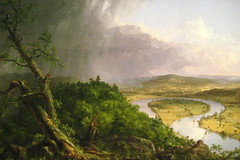
9854828217Thomas ColeFounder of the Hudson River school, famous for his landscape paintings. (p. 211)46
9854828218Frederick ChurchCentral figure in the Hudson River School and pupil of Thomas Cole. He is known for his landscapes and for painting colossal views of exotic places. (p. 211)47
9854828219Hudson River schoolIn the 1830s, this genre of painting founded in the Hudson River area, portrayed everyday life of ordinary people in the natural world. (p. 211)48
9854828220Washington IrvingThis author wrote fiction using American settings. (p. 211)49
9854828221James Fenimore CooperThis author wrote novels that glorified the frontiersman as nature's nobleman. (p. 211)50
9854828222Nathaniel HawthorneAuthor of "The Scarlet Letter", which questioned the intolerance and conformity in American life. (p. 211)51
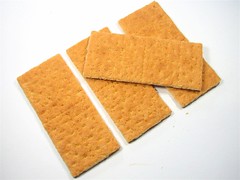
9854828223Sylvester GrahamAn American dietary reformer who advocated whole wheat bread and graham crackers to promote good digestion. (p. 216)52
9854828224Amelia BloomerShe urged women to wear pantalettes instead of long skirts. (p. 216)53
9854828225Second Great AwakeningA religious movement that occurred during the antebellum period. It was a reaction against rationalism (belief in human reason). It offered the opportunity of salvation to all. (p. 207)54
9854828226Timothy DwightPresident of Yale College, he helped initiate the Second Great Awakening. His campus revivals inspired many young men to become evangelical preachers. (p. 207)55
9854828227revivalism; revival camp meetingsIn the early 1800s, this movement was a reaction against the rationalism of the Enlightenment. Successful preachers were audience-centered and easily understood by the uneducated. (p. 207)56
9854828228millennialismIn the early 1800s, this popular belief, that the world was about to end with the second coming of Jesus Christ. (p. 208)57
9854828229Church of Jesus Christ of Latter-Day Saints; MormonsFounded by Joseph Smith in 1830. It was based on the Book of Mormon which traced a connection between the American Indians and the lost tribes of Israel. After Joseph Smith was murdered, Brigham Young led the religious group to establish the New Zion on the Great Salt Lake in Utah. (p. 208)58
9854828245Joseph SmithFounded the Church of Jesus Christ of the Latter-Day Saints in New York in 1830. The church moved to Ohio, Missouri, Illinois, then finally to Utah. (p. 208)59
9854828230Brigham YoungAfter Joseph Smith was killed, he led the Mormon followers to Utah. (p. 208)60
9854828231New ZionThis was the religious community established by the Mormons on the banks of the Great Salt Lake in Utah. (p. 208)61
9854828232women's rights movementWomen started this movement because they resented the way men relegated them to secondary roles in the reform movements. (p. 214)62
9854828233cult of domesticityAfter industrialization occurred women became the moral leaders in the home and educators of children. Men were responsible for economic and political affairs. (p. 214)63
9854828234Sarah Grimke, Angelina GrimkeTwo sisters, born in South Carolina, they objected to male opposition to their antislavery activities. (p. 214)64
9854828235Letter of the Condition of Women and the Equality of the SexesWritten by Angelina and Sarah Grimke, it protested males opposition to their abolitionist work. (p. 214)65
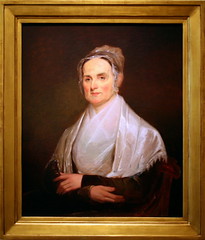
9854828236Lucretia MottA women's rights reformer who was not allowed to speak at an antislavery convention. (p. 214)66
9854828237Elizabeth Cady StantonA women's rights reformer who was not allowed to speak at an antislavery convention. (p. 214)67
9854828238Seneca Falls ConventionIn 1848, this was the first women's rights convention in U.S. history. They wrote a "Declaration of Sentiments", modeled after the Declaration of Independence, which declared all men and women equal and listed grievances. (p. 214)68
9854828239Susan B. AnthonySocial reformer who campaigned for womens rights, the temperance, and was an abolitionist. She helped form the National Woman Suffrage Association. (p. 214)69

AP US History Terms (451 - 500) Flashcards

Terms : Hide Images
5038785767Edgar Allen Poe (1809-1849)Author who wrote many poems and short stories including "The Raven," "The Bells," "The Tell-Tale Heart," and "The Gold Bug." He was the originator of the detective story and had a major influence on symbolism and surrealism. Best known for macabre stories.0
5038785770Washington Irving (1783-1859)Author, diplomat. Wrote The Sketch Book, which included "Rip Van Winkle" and "The Legend of Sleepy Hollow." He was the first American to be recognized in England (and elsewhere) as a writer.1
5038785773Henry Wadsworth Longfellow (1807-1882)Internationally recognized poet. Emphasized the value of tradition and the impact of the past on the present.2
5038785776Walt Whitman (1819-1892), Leaves of GrassLeaves of Grass (1855) was his first volume of poetry. He broke away from the traditional forms and content of New England poetry by describing the life of working Americans and using words like "I reckon", "duds", and "folks". He loved people and expressed the new democracy of a nation finding itself. He had radical ideas and abolitionist views - Leaves of Grass was considered immoral. Patriotic.3
5038785779Hudson River School of ArtIn about 1825, a group of American painters, led by Thomas Cole, used their talents to do landscapes, which were not highly regarded. They painted many scenes of New York's Hudson River. Mystical overtones.4
5038785782Alexis de Tocqueville, Democracy in AmericaDe Tocqueville came from France to America in 1831. He observed democracy in government and society. His book (written in two parts in 1835 and 1840) discusses the advantages of democracy and consequences of the majority's unlimited power. First to raise topics of American practicality over theory, the industrial aristocracy, and the conflict between the masses and individuals.5
5038785785Millennialism, MilleritesMillerites were Seventh-Day Adventists who followed William Miller. They sold their possessions because they believed the Second Coming would be in 1843 or 1844, and waited for the world to end. The Millennial Dawnists, another sect of the Seventh-Day Adventists, believed the world was under Satan's rule and felt it their obligation to announce the Second Coming of Christ and the battle of Armageddon.6
5038785788"The Burned-Over District"Term applied to the region of western New York along the Erie Canal, and refers to the religious fervor of its inhabitants. In the 1800's, farmers there were susceptible to revivalist and tent rallies by the pentecostals (religious groups).7
5038785791Charles G. Finney (1792-1875)An immensely successful revivalist of the 1800's. He helped establish the "Oberlin Theology". His emphasis on "disinterested benevolence" helped shape the main charitable enterprises of the time.8
5038785794Mormons: Joseph Smith (1805-1844)Founded Mormonism in New York in 1830 with the guidance of an angel. In 1843, Smith's announcement that God sanctioned polygamy split the Mormons and let to an uprising against Mormons in 1844. He translated the Book of Mormon and died a martyr.9
5038785797Brigham Young, Great Salt Lake, Utah1847 - Brigham Young let the Mormons to the Great Salt Lake Valley in Utah, where they founded the Mormon republic of Deseret. Believed in polygamy and strong social order. Others feared that the Mormons would act as a block, politically and economically.10
5038785800Brook FarmAn experiment in Utopian socialism, it lasted for six years (1841-1847) in New Roxbury, Massachusetts.11
5038785803New HarmonyA utopian settlement in Indiana lasting from 1825 to 1827. It had 1,000 settlers, but a lack of authority caused it to break up.12
5038785806Oneida CommunityA group of socio-religious perfectionists who lived in New York. Practiced polygamy, communal property, and communal raising of children.13
5038785809ShakersA millennial group who believed in both Jesus and a mystic named Ann Lee. Since they were celibate and could only increase their numbers through recruitment and conversion, they eventually ceased to exist.14
5038785812Amana CommunityA German religious sect set up this community with communist overtones. Still in existence.15
5038785815Lyceum MovementDeveloped in the 1800's in response to growing interest in higher education. Associations were formed in nearly every state to give lectures, concerts, debates, scientific demonstrations, and entertainment. This movement was directly responsible for the increase in the number of institutions of higher learning.16
5038785818Some reforms successful, some not, why?In the 1800's, it was usually because the general public either didn't vocally support the reform or was opposed it. Not all people wanted change. In general, reforms failed if they were too far out on the political spectrum.17
5038785821Dorothea Dix, treatment of the insaneA reformer and pioneer in the movement to treat the insane as mentally ill, beginning in the 1820's, she was responsible for improving conditions in jails, poorhouses and insane asylums throughout the U.S. and Canada. She succeeded in persuading many states to assume responsibility for the care of the mentally ill. She served as the Superintendant of Nurses for the Union Army during the Civil War.18
5038785824Rise of labor leadersDuring the 1800's, labor unions became more and more common. Their leaders sought to achieve the unions' goals through political actions. Their goals included reduction in the length of the workday, universal education, free land for settlers, and abolition of monopolies. Labor unions were the result of the growth of factories.19
5038785827National Trade UnionUnions formed by groups of skilled craftsmen.20
5038785830Commonwealth v. Hunt1842 - Case heard by the Massachusetts supreme court. The case was the first judgement in the U.S. that recognized that the conspiracy law is inapplicable to unions and that strikes for a closed shop are legal. Also decided that unions are not responsible for the illegal acts of their members.21
5038785833Criminal Conspiracy Laws and early unionsFor a time in the 1700's and 1800's, these laws were directed at early labor unions. The organized stoppage of work by a group of employees in a strike could be judged a criminal restraint of trade. This approach largely ended after Commonwealth v. Hunt.22
5038785836Oberlin, 1833; Mt. Holyoke, 1836Oberlin: founded by a New England Congregationalist at Oberlin, Ohio. First coed facility at the college level. The first to enroll Blacks in 1835. Mt. Holyoke: founded in 1837 in South Hadley, Massachusetts. Became the model for later liberal arts institutions of higher education for women. Liberal colleges.23
5038785840Public education, Horace MannSecretary of the newly formed Massachusetts Board of Education, he created a public school system in Massachusetts that became the model for the nation. Started the first American public schools, using European schools (Prussian military schools) as models.24
5038785843American Temperance UnionThe flagship of the temperance movement in the 1800's. Opposed alcohol.25
5038785846"Ten Nights in a Bar-Room," Timothy Shay ArthurA melodramatic story, published in 1856, which became a favorite text for temperance lecturers. In it, a traveller visits the town of Cedarville occasionally for ten years, notes the changing fortunes of the citizens and blames the saloon.26
5038785849Maine Law, Neal DowIn 1838, Dow founded the Maine Temperance Union. As mayor of Portland, Maine, Dow secured in 1851 the state's passage the Maine Law, which forbade the sale or manufacture of liquor.27
5038785852Irish, German immigrationIrish: arriving in immense waves in the 1800's, they were extremely poor peasants who later became the manpower for canal and railroad construction. German: also came because of economic distress, German immigration had a large impact on America, shaping many of its morals. Both groups of immigrants were heavy drinkers and supplied the labor force for the early industrial era.28
5038785855NativismAn anti-foreign feeling that arose in the 1840's and 1850's in response to the influx of Irish and German Catholics.29
5038785858Samuel F.B. Morse, Imminent Dangers to the Free Institutions of the U.S. Through Foreign Immigration, and the Present State of the Naturalization LawsHe was briefly involved in Nativism and anti-Catholic movements, asserting that foreign immigration posed a threat to the free institutions of the U.S., as immigrants took jobs from Americans and brought dangerous new ideas.30
5038785861Women, their rights, areas of discriminationIn the 1800's women were not allowed to be involved in politics or own property, had little legal status and rarely held jobs.31
5038785865Lucretia Mott (1803-1880)An early feminist, she worked constantly with her husband in liberal causes, particularly slavery abolition and women's suffrage. Her home was a station on the underground railroad. With Elizabeth Cady Stanton, she helped organize the first women's rights convention, held in Seneca Falls, New York in 1848.32
5038785868Elizabeth Cady StantonA pioneer in the women's suffrage movement, she helped organize the first women's rights convention in Seneca Falls, New York in 1848. She later helped edit the militant feminist magazine Revolution from 1868 - 1870.33
5038785871Seneca FallsJuly, 1848 - Site of the first modern women's right convention. At the gathering, Elizabeth Cady Staton read a Declaration of Sentiment listing the many discriminations against women, and adopted eleven resolutions, one of which called for women's suffrage.34
5038785874Emma Willard (1787-1870)Early supporter of women's education, in 1818 she published Plan for Improving Female Education, which became the basis for public education of women in New York. In 1821, she opened her own girls' school, the Troy Female Seminary, designed to prepare women for college.35
5038785877Catherine Beecher (1800-1878)A writer and lecturer, she worked on behalf of household arts and education of the young. She established two schools for women and emphasized better teacher training. She opposed women's suffrage.36
5038785880"Cult of True Womanhood": piety, domesticity, purity and submissivenessWhile many women were in favor of the women's movement, some were not. Some of these believed in preserving the values of "true womanhood": piety, domesticity, purity and submissiveness. These opponents of the women's movement referred to their ideas as the "Cult of True Womanhood."37
5038785883Women's movement, like others, overshadowed by anti-slavery movementIn the 1800's, the women's movement was often overshadowed by the anti-slavery movement. Many men who had been working on behalf of the women's movement worked for the abolition of slavery once it became a major issue.38
5038785886American Peace SocietyFounded in 1828 by William Laddit. Formally condemned all wars, though it supported the U.S. government during the Civil War, WWI, and WWII. It was dissolved after the United Nations was formed in 1945.39
5038785889Prison reform: Auburn system, Pennsylvania systemPrison reform in the U.S. began with the Pennsylvania system in 1790, based on the concept that solitary confinement would induce meditation and moral reform. However, this led to many mental breakdowns. The Auburn system, adopted in 1816, allowed the congregation of prisoners during the day.40
5038785892Supreme Court: Marbury v. Madison1803 - The case arose out of Jefferson's refusal to deliver the commissions to the judges appointed by Adams' Midnight Appointments. One of the appointees, Marbury, sued the Sect. of State, Madison, to obtain his commission. The Supreme Court held that Madison need not deliver the commissions because the Congressional act that had created the new judgships violated the judiciary provisions of the Constitution, and was therefore unconstitutional and void. This case established the Supreme Court's right to judicial review. Chief Justice John Marshall presided.41
5038785895Supreme Court: Fletcher v. Peck1810 - A state had tried to revoke a land grant on the grounds that it had been obtained by corruption. The Court ruled that a state cannot arbitrarily interfere with a person's property rights. Since the land grant wass a legal contract, it could not be repealed, even if corruption was involved.42
5038785898Supreme Court: Martin v. Hunters Lessee1816 - This case upheld the right of the Supreme Court to review the decisions of state courts.43
5038785901Supreme Court: Dartmouth College v. Woodward1819 - This decision declared private corporation charters to be contracts and immune form impairment by states' legislative action. It freed corporations from the states which created them.44
5038785904Supreme Court: McCulloch v. Maryland1819 - This decision upheld the power of Congress to charter a bank as a government agency, and denied the state the power to tax that agency.45
5038785907Supreme Court: Cohens v. Virginia1821 - This case upheld the Supreme Court's jurisdiction to review a state court's decision where the case involved breaking federal laws.46
5038785910Supreme Court: Gibbons v. Ogden1824 - This case ruled that only the federal government has authority over interstate commerce.47
5038785913Supreme Court: Cherokee Nation v. Georgia1831 - Supreme Court refused to hear a suit filed by the Cherokee Nation against a Georgia law abolishing tribal legislature. Court said Indians were not foreign nations, and U.S. had broad powers over tribes but a responsibility for their welfare.48
5038785916Supreme Court: Worchester v. Georgia1832 - Expanded tribal authority by declaring tribes sovereign entities, like states, with exclusive authority within their own boundaries. President Jackson and the state of Georgia ignored the ruling.49

AMSCO AP US History Chapter 13 Flashcards

AMSCO United States History 2015 Edition, Chapter 13 The Union in Peril, 1848-1861

Terms : Hide Images
9871954986free-soil movementThis movement did not oppose slavery in the South, but they did not want the Western states to allow slavery. (p. 247)0
9871955020Free-Soil partyIn 1848, Northerns organized this party to advocate that the new Western states not allow slavery and provide free homesteads. Their slogan was, "free soil, free labor, free men". (p. 248)1
9871954987conscience WhigsWhigs that opposed slavery. (p. 248)2
9871954988barnburnersAntislavery Democrats, whose defection threatened to destroy the the Democratic party. (p 248)3
9871954989New England Emigrant Aid CompanyNorthern abolitionist and Free-Soilers set up this company to pay for the transportation of antislavery settlers to the Kansas Territory. They did this to shift the balance of power against slavery in this new territory. (p. 253)4
9871954990bleeding KansasAfter 1854, the conflicts between antislavery and proslavery forces exploded in the Kansas Territory. (p. 252)5
9871954991Pottawatomie CreekIn 1856, abolitionist John Brown and his sons attacked this proslavery farm settlement and killed five settlers. (p. 253)6
9871954992Lecompton constitutionIn 1857, President James Buchanan asked that Congress accept this document and admit Kansas as a slave state. Congress did not accept it. (p. 255)7
9871954993popular sovereigntyAround 1850, this term referred to the idea that each new territory could determine by vote whether or not to allow slavery would be allowed in that region. (p. 248)8
9871954994Lewis CassThis Democratic senator from Michigan, proposed popular sovereignty as the solution to the slavery question in the territories. (p. 248)9
9871955021Henry ClayHe proposed the Compromise of 1850. (p. 249)10
9871954995Zachary TaylorThe twelfth president of the United States from 1849 to 1850. He was a general and hero in the Mexican War. He was elected to the presidency in 1848, representing the Whig party. He died suddenly in 1850 and Millard Fillmore became the president. (p 248, 249)11
9871954996Compromise of 1850Henry Clay proposed and it was signed into law by President Millard Fillmore. It proposed: * Admit California to the Union as a free state * Divide the remainder of the Mexican Cession into New Mexico and Utah (popular sovereignty) * Give land in dispute between Texas and New Mexico to federal government in return for paying Texas' public debt of 10 million * Ban slave trade in D. C., but permit slaveholding * New Fugitive Slave Law to be enforced (p. 249)12
9871954997Stephen A. DouglasIn 1854, he devised the Kansas-Nebraska Act, which in effect overturned the Missouri Compromise, and allowed the South the opportunity to expand slavery. In 1858, he debated Abraham Lincoln in a famous series of seven debates in the campaign for the Illinois senate seat. He won the campaign for reelection to the Senate, but he alienated Southern Democrats. In 1860, he won the Democratic presidential nomination, but Southern Democrats nominated their own candidate, John Breckinridge. He was easily defeated by Abraham Lincoln in the presidential election that year. (p. 252, 256, 258)13
9871954998Millard FillmoreThe thirteenth president of the United States, serving from 1850 until 1853, and the last member of the Whig Party to hold that office. He was the second Vice President to become president upon the death of a sitting President, when he succeeded Zachary Taylor. As vice president he helped pass the Compromise of 1850. (p. 249, 255)14
9871954999Kansas-Nebraska ActThis 1854 act, sponsored by Senator Stephen A Douglas, would build a transcontinental railroad through the central United States. In order gain approval in the South, it would divide the Nebraska territory into Nebraska and Kansas and allow voting to decide whether to allow slavery. This increased regional tensions because it effectively repealed the Missouri Compromise, which had already determined that this area would not allow slavery. (p. 252)15
9871955000Crittenden compromiseIn the winter of 1860-1861, Senator John Crittenden proposed a constitutional amendment to appease the South. He proposed that slavery would be allowed in all areas south of the 36 30 line. The Republicans rejected the proposal because it would allow extension of slavery into the new territories. (p. 260)16
9871955001Franklin PierceThe fourteenth President of the United States from 1853 to 1857. A Democrat from New Hampshire, he was acceptable to Southern Democrats because he supported the Fugitive Slave Law. (p. 252)17
9871955002Know-Nothing partyThis political party started in the mid-1850s. Also known as the American party, they were mostly native-born Protestant Americans. Their core issue was opposition to Catholics and immigrants who were entering Northern cities in large numbers. (p. 254)18
9871955003Republican partyThis political party formed in 1854, in response to the passage of the Kansas-Nebraska Act. It was composed of a coalition of Free-Soilers, antislavery Whigs, and Democrats. Although not abolitionist, it sought to block the spread of slavery in the territories. (p. 254)19
9871955004John C. FremontIn the presidential election of 1856, this California senator was the Republican nominee. The Republican platform called for no expansion of slavery, free homesteads, and a probusiness protective tariff. He lost the election to James Buchanan, but won 11 of the 16 free states, which foreshadowed the emergence of a powerful Republican party. (p. 255)20
9871955005James BuchananThe fifteenth President of the United States from 1857 to 1861. He tried to maintain a balance between proslavery and antislavery factions, but his moderate views angered radicals in both North and South, and he was unable to forestall the secession of South Carolina to December 20, 1860. During his term: "Bleeding Kansas" (1856), Caning of Senator Sumner (1856), Lecompton Constitution (1857), Dred Scott case (1857) (p. 255)21
9871955006election of 1860In this presidential election, the Republican candidate, Abraham Lincoln won. Lincoln won all the northern states, while John C. Breckinridge, a South Democrat, won all the southern states. The South felt like it no longer had a voice in national politics and a number of states soon seceded from the Union. (p. 258)22
9871955022secessionThe election of Abraham Lincoln was the final event that caused the southern states to leave the Union. In December 1860, South Carolina voted unanimously to secede. Within the next six weeks Georgia, Florida, Alabama, Mississippi, Louisiana, and Texas had all seceded. In February 1861, representatives of seven states met in Montgomery, Alabama to create the Confederate States of America. (p. 259)23
9871955007Fugitive Slave LawCongress passed a second version of this law in 1850. The law's chief purpose was to track down runaway slaves who had escaped to a Northern state, capture them, and return them to their Southern owners. Enforcement of the law in the North was sometimes opposed even though there were penalties for hiding a runaway slave or obstructing enforcement of the law. (p. 250)24
9871955008Underground RailroadA network of people who helped thousands of enslaved people escape to the North by providing transportation and hiding places. (p. 250)25
9871955009Harriet TubmanBorn a slave, she escaped to the North and became the most renowned conductor on the Underground Railroad, leading more than 300 slaves to freedom. (p. 250)26
9871955010Dred Scott v. SandfordAn 1857 Supreme Court case, in which Chief Justice Roger Taney ruled that African Americans (free or slave), were not citizens of the United States, that Congress could not exclude slavery from any federal territory, and that the Missouri Compromise was unconstitutional. The ruling delighted Southern Democrats and infuriated Northern Republicans. (p. 255)27
9871955023Roger TaneyHe was a Southern Democrat and chief justice of the Supreme Court during the Dred Scott v. Sandford case. (p. 255)28
9871955024Abraham LincolnHe was elected president of the United States in 1860. He was a Republican, who ran on a platform that appealed to those in the North and the West. It called for the exclusion of slavery in the new territories, a protective tariff for industry, free land for homesteaders, and a railroad to the Pacific. (p. 258)29
9871955011Lincoln-Douglas debatesIn 1858, Stephen Douglas and Abraham Lincoln had seven debates in the campaign for the Illinois senate seat. Lincoln was not an abolitionist, but he attacked Douglas's seeming indifference to slavery as a moral issue. Although Lincoln lost the election to Douglas, he emerged as a national figure and leading contender for the Republican nomination for president. (p. 256)30
9871955012house-divided speechThe speech given by Abraham Lincoln when accepting the Republican nomination for the Illinois senate seat. He said, "This government cannot endure permanently half slave and half free". (p. 256)31
9871955013Freeport DoctrineDoctrine developed by Stephen Douglas that said slavery could not exist in a community if the local citizens did not pass laws (slave codes) maintaining it. This angered Southern Democrats. (p. 257)32
9871955014Sumner-Brooks incidentThis incident took place in 1856, when Congressman Preston Brooks severely beat Massachusetts Senator Charles Sumner. The attack occurred in the Senate chamber, after Sumner gave a vitriolic speech, "The Crime Against Kansas". (p. 254)33
9871955025John BrownHe led his four sons and some former slaves, in an attack on the federal arsenal, called the Harpers Ferry raid. (p. 257)34
9871955015Harpers Ferry raidIn October 1859, John Brown led his four sons and some former slaves, in an attack on the federal arsenal at Harpers Ferry. His impractical plan was to obtain guns to arm Virginia's slaves, whom he hoped would rise up in a general revolt. He and six of his followers were captured and hanged. Southern whites saw the raid as proof of the north's true intentions - to use slave revolts to destroy the South. (p. 257)35
9871955016Harriet Beecher Stowe, Uncle Tom's CabinIn 1852, she wrote this influential book about the conflict between a slave named Tom, and a brutal white slave owner, Simon Legree. It caused a generation of Northerners and many Europeans to regard all slave owners as cruel and inhuman. Southerners believed it to be proof of Northern prejudice against the Southern way of life. (p. 250)36
9871955017Hinton R. Helper, Impending Crisis of the SouthIn 1857, he wrote this nonfiction book, that attacked slavery using statistics to demonstrate to fellow Southerners that slavery weakened the South's economy. Southern states banned the book, but it was widely read in the North. (p. 250)37
9871955018George Fitzhugh, Sociology of the SouthIn 1854, he wrote this proslavery book which argued that slavery was a positive good for slave and master alike. He was the boldest and most well known of proslavery authors. He questioned the principle of equal rights for unequal men and attacked the capitalist wage system as worse than slavery. (p. 251)38

AP US History Flashcards

Terms : Hide Images
104216505961607Jamestown founded0
104216523551619First Africans arrive1
104216532461730s and 40sFirst Great awakening2
104216540511763French and Indian War ends colonial period3
104216562961775-1783American Revolution4
104216567611776Declaration of Independence5
104216766971783Treaty of Paris (Britain recognizes independence)6
104216790551787Continental Convention7
104216805151789Federal Government Begins8
104216824311803Marbury vs Madison9
104216861201808Slave importation illegal10
104216894211820Missouri Compromise11
104216931501823Monroe Doctrine12
104216946141830Second Great Awakening13
104216990231846-1848War with Mexico14
104216997011848Seneca Falls Convention15
104217035091849California Gold Rush16
104217048171860Election of Lincoln17
104217053541861-1865Civil War18
104217067071863Emancipation Proclamation19
104217090721877End of Reconstruction20
104217099161877End of Reconstruction21
104217105441890Wounded Knee22
104217141021914-1918World War I23
104217147061919Treaty of Versailles24
10421718829192019th Amendment25
104217192141929Stock Market Crash26
104217214951929-1941Great Depression27
104217225541939-1945World War II28
104217255841950-1953Korean War29
104217261291954Brown v Board of Education30
104217279171961-1975Vietnam War31
104217293071963March on Washington32
104217299291968Tet Offensive and Turmoil33
104217313101974Resignation of Nixon34

AP US History: Chapter 15 Reconstruction Flashcards

Terms : Hide Images
5762248696Ten Percent PlanLincoln's plan that allowed a Southern state to form its own government afetr ten percent of its voters swore an oath of loyalty to the United States0
5762248697Wade-Davis Billan 1864 plan for Reconstruction that denied the right to vote or hold office for anyone who had fought for the Confederacy...Lincoln refused to sign this bill thinking it was too harsh.1
5762248698Black CodesLaws denying most legal rights to newly freed slaves; passed by southern states following the Civil War2
5762248699Freedmen's Bureaucreated by Congress to provide clothing, shelter, education, food, and medicine to former slaves (vetoed by Johnson and overrode by Congress)3
5762248700Civil Rights Act of 1866A federal law that authorized federal action against segregation in public accommodations, public facilities, and employment. (vetoed by Johnson and overrode by Congress)4
5762248701Fourteenth Amendmentguarantees equal protection of the law and rights of citizenship to all people born or naturalized in the USA, including former slaves.5
5762248702Reconstruction Act of 1867Act passed by Congress that abolished previous state governments and set up 5 temporary military districts run by Union generals.6
5762248703Fifteenth Amendmentguaranteed voting rights regardless of race or previous condition of servitude7
5762248704American Woman Suffrage Associationorganization led by Lucy Stone, Henry Blackwell, and others who remained loyal to the Republican party, despite its failure to include women's voting rights in the 15th Amendment8
5762248705National Woman Suffrage Associationled by Susan B. Anthony, and Elizabeth Cady Stanton in response to the split within the American Equal Right Association over support of the 15th amendment. Anthony and Stanton thought that they shouldn't support the 15th amendment unless it included the vote for women.9
5762248707sharecroppingA system used on southern farms after the Civil War in which farmers worked land owned by someone else in return for a small portion of the crops.10
5762248708Union Leaguethe black political organization that promoted self-help and defense of political rights11
5762248709scalawagsA derogatory term for Southerners who were working with the North to buy up land from desperate Southerners12
5762248710carpetbaggersA derogatory term applied to Northerners who migrated south during the Reconstruction to take advantage of opportunities to advance their own fortunes13
5762248711convict leasingNotorious system, begun during reconstruction, whereby southern state officials allowed private companies to hire out prisoners to labor under brutal conditions in mines and other industries14
5762248712Civil Rights Act of 1875A federal law that authorized federal action against segregation in public accommodations, public facilities, and employment.15
5762248713Freedman's Savings and Trust Companya private bank founded in 1865 to aid displaced blacks and other war refugees16
5762248714classical liberalisma political ideology that values the freedom of individuals — including the freedom of religion, speech, press, assembly, and markets — as well as limited government.17
5762248715laissez faireIdea that government should play as small a role as possible in economic affairs18
5762248716Crédit Mobiliera joint-stock company organized in 1863 and reorganized in 1867 to build the Union Pacific Railroad. It was involved in a scandal in 1872 in which high government officials were accused of accepting bribes.19
5762248717"Redemption"Southern Democratic term for the end of Reconstruction and the return of white southern Democratic rule to the South.20
5762248718Ku Klux KlanA secret society created by white southerners in 1866 that used terror and violence to keep African Americans from obtaining their civil rights.21
5762248719Enforcement Lawsaimed at the KKK, protected the freedman's rights under the 14th and 15th amendments, authorized military action to suppress terrorist movements22
5762248720Slaughter-House CasesA group of decisions begun in 1873 in which the Court began to undercut the power of the Fourteenth Amendment to protect African American rights.23
5762248721U.S. v. CruikshankSupreme Court decides the federal government cannot punish whites for oppressing blacks24
5762248722Civil Rights CasesSupreme Court decision in 1883 that said the Fourteenth Amendment only made discrimination by government illegal; private citizens could do as they pleased.25
5762248723Andrew JohnsonUnited States President during Reconstruction; he was impeached by Congress for not agreeing with their plan to reconstruct the South.26
5762248724Charles Sumnerthe Republican idealist who pushed for black suffrage during Reconstruction as a principle of black freedom and racial equality27
5762248725Thaddeus StevensA Radical Republican who believed in harsh punishments for the South. Leader of the Radical Republicans in Congress.28
5762248726Ulysses S. GrantPresident who used his authority to fight against the KKK and secure rights for freed slaves; scandals and public opinion slowed his effectiveness29
5762248727Elizabeth Cady StantonAn American social activist, abolitionist, and leading figure of the early woman's movement30
5762248728Robert SmallsSlave who worked for the Confederates as a planter pilot. Stole a vessel and loaded it with family and took it to the Union. Important politician and established a Republican party in South Carolina.31
5762248729Blanche K. BruceU.S. politician who represented Mississippi as a Republican in the U.S. Senate from 1875 to 1881; of mixed race, he was the first elected black senator to serve a full term32
5762248730Nathan Bedford ForrestConfederate cavalry leader who later became a founder of the Ku Klux Klan33

AP US History- Chapter 11 (16th edition) Flashcards

Terms : Hide Images
75731935931. Embargo Act1807-was a law passed by Congress forbidding all exportation of goods from the United States. Britain and France had been continuously harassing the U.S. and seizing U.S. ships and men. The U.S. was not prepared to fight in a war, so Pres. Jefferson hoped to weaken Britain and France by stopping trade. It ended up hurting our economy more than theirs. It was repealed in 1809. It helped to revive the Federalists. It caused New England's industry to grow. It eventually led to the War of 1812.0
75731935942. Louisiana PurchaseIn 1803 Thomas Jefferson purchased 828,000 square miles of land for 15 million dollars from Napoleon the leader of France. The land mass stretched from the Gulf of Mexico all to the Rocky Mountains and Canada. The purchase of this land sprouted national pride and ensured expansion.1
75731935953. Non-Intercourse ActFormally reopened trade with all nations except England and France on March 1, 1809. A replacement of the Embargo Act. Made by the Republican Congress in an attempt to make England and France stop harassing the American ships and recognize the neutrality of America.2
75731935964. Midnight JudgesThis is a nick name given to group of judges that was appointed by John Adams the night before he left office. He appointed them to go to the federal courts to have a long term federalist influence, because judges serve for life instead of limited terms3
75731935975. The Judiciary Act of 1801This act of 1801 was passed by the Federalist congress where the old capital was located. It was one of the last laws passed by the federalist congress. This law allowed the president, then President Adams, would stay up until midnight signing in new federal judges across the nation. It allowed the Federalists to still maintain power in the nation after they were a minority party in congress. This act brought bitterness between the two parties. These judges that were passed during the last day of President Adams were called "midnight Judges".4
75731935986. Orders in CouncilThiswas a law passed by the English Parliament in 1793. It was when the British were fighting the French. The British closed off all port vessels that France went through so they couldn't get supplies. American ships were seized also and Americans were impressed into the British navy. This lead to the War of 1812.5
75731935997. The Chesapeake IncidentAn incident that happened on June 22, 1807. The Chesapeake, a US frigate, was boarded by a British ship, the Leopard. The Chesapeake was not fully armed. The British seized four alleged deserters (the commander of the Chesapeake was later court marshaled for not taking any action). This is the most famous example of impressment, in which the British seized American sailors and forced them to serve on British ships. Impressment was one of the major factors leading to the War of 1812.6
75731936008. Marbury V. MadisonSec. of State James Madison held up one of John Adams' "Midnight Judges" appointments. The appointment was for a Justice of the Peace position for William Marbury. Marbury sued. Fellow Hamiltonian and Chief Justice John Marshall dismissed Marbury's suit, avoiding a political showdown and magnifying the power of the Court. This case cleared up controversy over who had final say in interpreting the Constitution: the states did not, the Supreme Court did. This is judicial review.7
75731936019. Meriwether LewisPart of the Lewis and Clark Expedition. The expedition was one of the main explorations of the West. The area explored was: The Missouri River through the Rockie Mountains.8
757319360210. PatronageThis is like the "spoils system." When an elected official fills appointed positions with friends that helped him/her get elected, it is considered patronage. Thomas Jefferson did not change many of the appointed positions in the government when he was elected in 1801.9
757319360311. Judicial ReviewUntil 1803, the case of Marbury vs. Madison took place this year, there was controversy over who had the final say in determining the meaning of the Constitution, whether loose or strict interpretation should be used and who would decide. Jefferson tried to give the rights to the states in the Kentucky resolutions, but his cousin, John Marshall of the Supreme Court, proposed this which gave the Supreme Court the power to decide if a law is or is not constitutional. It was accepted as a result of the famous case of Marbury vs.10
757319360412. ImpeachmentThis is to accuse a public official of misconduct in office. The Jeffersonians were angry about a ruling made by Chief Justice John Marshall. The House of Representatives attempted to impeach the unpopular Supreme Court Justice, Samuel Chase. Although there were enough votes in the House of Representatives, the Senate did not have enough. Since this attempt in 1804, there has been no serious attempt to impeach members of the Supreme Court.11
757319360513. Impressmentthe forcible enlistment of soldiers. This was a rude form of conscription that the British have employed for over four hundred years. At this time the London authorities claimed the right to impress only British subjects on their own soil, harbor, or merchant ships. However, many Americans were mistaken for Englishmen and between 1808 and 1811 alone some six thousand United States citizens were impressed by the "piratical manstealers" of England. This was one of the major causes of the war of 1812.12
757319360614. Economic CoercionThe English navy stole American sailors from 1806 until 1811 angering Jefferson and the country. Jefferson, however, did not wish to engage in war with England because of the countries weak navy and army. So he came up with the idea of using economic coercion to force Britain to come to Jefferson, and agree to his terms. He came up with the Embargo Act which cut off all trade with England and everyone else. Jefferson hoped this would force the English to come to his terms and stop stealing American sailors. This, however, did not work and greatly hurt American trade.13
757319360715. Samuel ChaseHe was a strong supporter of the American Revolution, a signer of the Declaration of Independence, an ardent Federalist, and the only Supreme Court Justice ever to be impeached. A lawyer by profession, in 1796 he was appointed to the U.S. Supreme Court by president Washington. This was after he served as Chief Justice of the General Court of Maryland in 1791. In 1804, for alleged prejudice against the Jeffersonians in treason and sedition trials.14
757319360816. John MarshallAppointed by John Adams (1801) as Chief Justice of the Supreme Court- was a Virginia Federalist who was disliked by the state's rights Jeffersonians. (Served 30 days under Federalist administration and 34 years under the Jeffersonians and their successors) The Federalists died out but he continued to hand down Federalist decisions. IMPORTANT ACT- Although he dismissed the Marbury suit ( 1801) to avoid direct political showdown, he said that part of the Judiciary Act of 1789, on which Marbury tried to base his appeal was unconstitutional.15
757319360917. Aaron BurrHe was a running mate with Thomas Jefferson. They tied for the presidency. Jefferson won the run off. Burr killed Alexander Hamilton in a famous duel. He was tried and acquitted for treason involving a plan to separate the US and combine with Spain.16
757319361018. William Marbury (1801)President Adams named him a justice of the peace for the District of Columbia. He sued James Madison when he learned his appointment would never take place. (Marbury vs. Madison)17
757319361119. Toussaint L' OvertureHe skillfully led a group of angry ex-slaves against French troops in Santo Domingo. The French were unable to reconquer this valuable island and hence, had no use for Louisiana to serve as a granary for Santo Domingo. The inability of the French to regain possession of the island caused Napoleon to cede the Louisiana territory to the United States for 15 million dollars. Thus, his military vigor indirectly provoked Napoleon's decision to sell Louisiana to the Americans.18
757319361220. James MonroeHe was sent to Paris in 1803 to buy New Orleans and as much land as possible to the east for a maximum of ten million dollars. Monroe and Robert Livingston arranged the of all of Louisiana for fifteen million dollars. Monroe later became James Madison's Secretary of State.19
757319361321. William ClarkExplorer along with Merriwether Lewis sent out to explore the recently purchased Louisiana Territory. He served as the artist and cartographer. Their exploring lasted from 1804-1806. They traveled up the Missouri River, through the Rockies, and to the mouth of the Columbia River. This exploration bolstered America's claim to western lands as well as opening the west to Indian trade and further exploration.20
757319361422. Albert Gallatin--He was the secretary of the treasury under Thomas Jefferson. He was called the "Watchdog of theTreasury," and proved to be as able as Alexander Hamilton. He agreed with Jefferson that anational debt was a bane rather than a blessing. Using strict controls of the economy, he succeeded in reducing the debt, and he balanced the budget.21
757319361523. Robert LivingstonHe bought New Orleans and all the French territory west of the Mississippi River from Napoleon for 15 million dollars. He was only supposed to negotiate for a small part of New Orleans for 10 million so Jefferson was upset when he heard about Livingston's deal.22
757319361624. Zebulon M. PikeA pioneer who explored the Louisiana territory between 1805 - 1807. He explored Colorado, New Mexico, & Mississippi. He was a leader of the new land. He has set up the portal to allow people to migrate toward west. (A paragon - First example to move into the Louisiana territory) P.18823
757319361725. Thomas JeffersonHe was a Republican who believed that the future of the U.S. would lie in the hands of farmers. "Long Tom" Jefferson was inaugurated to the presidency in the swampy village of Washington on March 4, 1801. While Jefferson was president, the Louisiana Purchase was made, Lewis and Clark were sent to explore the newly acquired land, the Barbary Pirate threat was silenced, and the Embargo Act was passed. While all of Jefferson's presidential acts were not always successful, he always put the country ahead of himself. His patriotism and loyalty to the U.S.24
757319361826. Revolution of 1800Electoral victory of Democratic Republicans over the Federalists, who lost their congressional majority and the presidency. The peaceful transfer of power between rival parties solidified faith in America's political system.25
757319361927. Tripolitan War (1801-1805)Four-year conflict between the American navy and the North African nation of Tripoli over piracy in the Mediterranean. Jefferson, a staunch noninterventionist, reluctantly deployed American forces, eventually securing a peace treaty with Tripoli.26
757319362028. Haitian Revolution (1791-1804)War incited by a slave uprising in French-controlled Saint Domingue, resulting in the creation of the first independent black republic in the Americas.27
757319362129. Corps of Discovery (1804-1806)Team of adventurers, led by Merriweather Lewis and William Clark, sent by Thomas Jefferson to explore Louisiana Territory and find a water route to the Pacific. Lewis and Clark brought back detailed accounts of the West's flora, fauna, and native populations, and their voyage demonstrated the ability of overland travel to the West.28
757319362230. Macon's Bill No. 2Aimed at resuming peaceful trade with Britain and France, the act stipulated that if either Britain or France repealed its trade restrictions, the United States would reinstate the embargo against the nonrepealing nation. When Napoleon offered to lift his restrictions on British ports, the United States was forced to declare an embargo on Britain, thereby pushing the two nations closer to war.29
757319362331. War hawksDemocratic-Republican congressmen who pressed James Madison to declare war on Britain. Largely drawn from the South and West, they resented British constraints on American trade and accused the British of supporting Indian attacks against American settlements on the frontier.30
757319362432. Battle of TippecanoeResulted in the defeat of Shawnee chief Tenskwatawa, "the Prophet," at the hands of William Henry Harrison in the Indiana wilderness. After the battle, the Prophet's brother, Tecumseh, forged an alliance with the British against the United States.31
757319362533. Sally HenningsOne of Thomas Jefferson's slaves on his plantation in Monticello. DNA testing confirms that Thomas Jefferson fathered Sally Hennings's children.32
757319362634. James WilkinsonMilitary governor of Louisiana territory who conspired with Aaron Burr to separate from the United States and ally with Spanish-controlled areas of the Americas.33
757319362735. James MadisonPrincipal author of the Constitution, co-author of The Federalist, and fourth president of the United States. A leading advocate of a strong national government in the 1780s, Madison later joined Thomas Jefferson and the Democratic-Republicans in advocating a more limited role for the federal state.34
757319362836. TecumsehAccomplished Shawnee warrior, he sought to establish a confederacy of Indian tribes east of the Mississippi. He opposed individual tribes selling land to the United States, arguing that the land belonged to all the native peoples. After 1811, Tecumseh allied with the British, fighting fiercely against the United States until his death in 1813.35
757319362937. Tenskwatawa ("The Prophet")Shawnee religious leader who led a spiritual revival, emphasizing Inidian unity and cultural renewal and urging Indians to limit contact with Americans. he lost his following in 1811 after he and a small army of followers were defeated by William Henry Harrison and the Battle of Tippecanoe.36
757319363038. Napoleon BonaparteFrench emperor who waged a series of wars against his neighbors on the European continent from 1800 until his final defeat at Waterloo in 1815. In 1803, having failed to put down the Haitian rebellion, herelinquished France's remaining North American possessions by selling the Louisiana Territory in 1808.37
757319363139. SacajaweaShoshone guide who led Meriwether Lewis and William Clark on their exploration of the American World.38

Pages

Subscribe to CourseNotes RSS

Need Help?

We hope your visit has been a productive one. If you're having any problems, or would like to give some feedback, we'd love to hear from you.

For general help, questions, and suggestions, try our dedicated support forums.

If you need to contact the Course-Notes.Org web experience team, please use our contact form.

Need Notes?

While we strive to provide the most comprehensive notes for as many high school textbooks as possible, there are certainly going to be some that we miss. Drop us a note and let us know which textbooks you need. Be sure to include which edition of the textbook you are using! If we see enough demand, we'll do whatever we can to get those notes up on the site for you!