| 7641584922 | GENRE: | The major category into which a literary work fits. The basic divisions of literature are prose, poetry, and drama. However, genre is a flexible term. Within these broad boundaries exist many subdivisions that are often called genres too. For example, prose can be divided into fiction and nonfiction. Poetry can be divided into lyric, dramatic, narrative, etc. Drama can be divided in tragedy, comedy, farce, etc. |  | 0 |
| 7641584923 | GENERIC CONVENTIONS: | This term describes traditions for each genre. These conventions help to define each genre; for example, they differentiate between an essay and journalistic writing or an autobiography and political writing. It is important to try to distinguish the unique features of a writer's work from those dictated by convention. | | 1 |
| 7641584924 | PROSE: | One of the major divisions of genre, prose refers to fiction and nonfiction, including all its forms, because they are written in ordinary language and most closely resemble everyday speech. Technically, anything that isn't poetry or drama is prose. Of course, prose writers often borrow poetic and dramatic elements. |  | 2 |
| 7641584925 | NONFICTION: | Prose writing about real people, places, things, events, and ideas. |  | 3 |
| 7641584926 | ARGUMENTATION: | Writing meant to prove the validity of an idea or point of view by presenting sound reasoning, discussion, and argument that thoroughly convince the reader. Persuasive writing is a type of argumentation having an additional aim of urging some form of action. |  | 4 |
| 7641584927 | DESCRIPTION: | Writing meant to re-create, invent, or visually present a person, place, event, or action so that the reader can picture what is being described. Sometimes an author engages all five senses in description; good descriptive writing can be sensuous and picturesque. Descriptive writing may be straightforward and objective or highly emotional and subjective. |  | 5 |
| 7641584928 | EXPOSITION: | Writing meant to explain and analyze information by presenting an idea, relevant evidence, and appropriate discussion. | | 6 |
| 7641584929 | NARRATION: | Writing meant to tell a story or recount an event or series of events. This writing mode frequently uses the tools of descriptive writing. |  | 7 |
| 7641584930 | RHETORICAL STRATEGIES: | Strategies used to develop the modes of discourse. The types of strategies include example, comparison/contrast, definition, cause/effect, process analysis, and division/classification. |  | 8 |
| 7641584931 | ANECDOTE: | A brief account of an event, usually intended to entertain, to explain an idea, and to reveal personality through a person's actions. | | 9 |
| 7641584932 | ANNOTATION: | Notes added to a text that explain, name sources, summarize, or evaluate the text. |  | 10 |
| 7641584933 | APHORISM: | A terse statement of known authorship that expresses a general truth or a moral principal. (If the authorship is unknown, the statement is generally considered to be a folk proverb.) An aphorism can be a memorable summation of the author's point. |  | 11 |
| 7641584934 | AUTOBIOGRAPHY: | The story of a person's life written by that person. |  | 12 |
| 7641584935 | BIOGRAPHY: | The story of a person's life written by someone other than the subject. |  | 13 |
| 7641584936 | EPIGRAPH: | A motto or quotation at the beginning of a literary work that sets forth the theme. |  | 14 |
| 7641584937 | ESSAY: | A short nonfiction work that deals with one subject and has the purpose of communicating an idea or opinion. |  | 15 |
| 7641584938 | EXPLICATION: | The interpretation or analysis of a text. |  | 16 |
| 7641584939 | MAXIM: | A succinct formulation of a fundamental principle or general truth. | | 17 |
| 7641584940 | MYTH: | A story that explains how something connected to humans or nature came to be. |  | 18 |
| 7641584941 | PARABLE: | A story that operates on more than one level and usually teaches a moral lesson. |  | 19 |
| 7641584942 | PARODY: | A work that closely imitates the style or content of another with the specific aim of comic effect and/or ridicule. As comedy, parody distorts or exaggerates distinctive features of the original. As ridicule, it mimics the work by repeating and borrowing words, phrases, or characteristics in order to illuminate weaknesses in the original. Well-written parody offers only ineffectual imitation. Usually, an audience must grasp literary allusion and understand the work being parodied in order to fully appreciate the nuances of the newer work. Occasionally, however, parodies take on a life of their own and don't require knowledge of the original. |  | 20 |
| 7641584943 | PROPAGANDA: | Biased, one-sided communication meant to influence the thoughts and actions of an audience. |  | 21 |
| 7641584944 | SATIRE: | A work that targets human vices and follies or social institutions and conventions for reform or ridicule. Regardless of whether or not the work aims to reform humans or their society, satire is best seen as a style of writing rather than a purpose for writing. It can be recognized by the many devices used effectively by the satirist, such as irony, wit, parody, caricature, hyperbole, understatement, and sarcasm. The effects of satire are varied, depending on the writer's goal, but good satire, often humorous, is thought provoking and insightful about the human condition. | | 22 |
| 7641584945 | DICTION: | Related to style, diction refers to the writer's word choices, especially regarding correctness, clearness, or effectiveness. It is important to be able to describe an author's diction (e.g., formal or informal, ornate or plain, elevated or colloquial) and understand the ways in which diction can complement the author's purpose. Diction combined with syntax, figurative language, literary devices, etc. create an author's style. |  | 23 |
| 7641584946 | ABSTRACT TERMS (or generalities): | As opposed to concrete terms, abstract terms represent ideas or thoughts. | | 24 |
| 7641584947 | COLLOQUIAL/COLLOQUIALISM: | The use of slang or informalities in speech or writing. Not generally acceptable for formal writing, colloquialisms give a work a conversational, familiar tone. Colloquial expressions in writing include local or regional dialects. |  | 25 |
| 7641584948 | DIALECT: | The particular variety of a language spoken in one geographical area by a certain group of people. |  | 26 |
| 7641584949 | CONCRETE TERMS: | As opposed to abstract terms, concrete terms refer to things that have actual existence that can be seen or known. | | 27 |
| 7641584950 | CONNOTATION: | The nonliteral, associative meaning of a word; the implied, suggested meaning. Connotations may involve ideas, emotions or attitudes. |  | 28 |
| 7641584951 | DENOTATION: | The strict, literal dictionary definition of a word, devoid of any emotion, attitude or color. |  | 29 |
| 7641584952 | DIDACTIC: | From Greek, didactic literally means "teaching." Didactic works have the primary aim of teaching or instructing, especially for the teaching of moral or ethical principals. |  | 30 |
| 7641584953 | EUPHEMISM: | From Greek for "good speech," euphemisms are a more agreeable or less offensive substitute for a generally unpleasant word or concept. A euphemism may be used to adhere to standards of social or political correctness or to add humor or ironic understatement. Saying "earthly remains" rather than "corpse" is an example of euphemism. |  | 31 |
| 7641584954 | EXAGGERATION: | An overstatement or a statement in which a description of a person, event, or idea is magnified or overemphasized to an extreme degree. | | 32 |
| 7641584955 | INVECTIVE: | An emotionally violent, verbal denunciation or attack using strong, abusive language. |  | 33 |
| 7641584956 | LITERAL LANGUAGE: | Denotes that words mean what they actually mean. |  | 34 |
| 7641584957 | PEDANTIC: | An adjective that describes words, phrases, or a general tone that is overly scholarly, academic, or bookish. |  | 35 |
| 7641584958 | PUN: | A humorous play on words, using similar-sounding or identical words to suggest different meanings. |  | 36 |
| 7641584959 | WIT: | In modern usage, intellectually amusing language that surprises and delights. A witty statement is humorous, while suggesting the speaker's verbal power in creating ingenious and perceptive remarks. Wit usually uses terse language that makes a pointed statement. Historically, wit originally meant basic understanding. | | 37 |
| 7641584960 | SYNTAX: | The way an author chooses to join words into phrases, clauses, and sentences. Syntax is similar to diction, but you can differentiate them by thinking of syntax as the groups of words, while diction refers to the individual words. |  | 38 |
| 7641584961 | ANTECEDENT: | The word, phrase, or clause to which a pronoun refers. |  | 39 |
| 7641584962 | ASYNDETON: | The omission of conjunctions between words, phrases, or clauses. "I came, I saw, I conquered" is an example of asyndeton. |  | 40 |
| 7641584963 | SIMPLE SENTENCE: | A sentence with one independent clause and no dependent clauses that is used to express a single idea. Simple sentence |  | 41 |
| 7641584964 | COMPOUND SENTENCE: | A sentence composed of two or more independent clauses, but no dependent clauses, that is used to combine complete thoughts that have a close relationship. The independent clauses are joined by semicolons, coordinating conjunctions (e.g. and, or, but) or conjunctive adverbs (i.e. therefore, however, also, then). |  | 42 |
| 7641584965 | COMPLEX SENTENCE: | A sentence that contains one independent clause and at least one dependent clause that is used to show a dependent relationship between ideas. |  | 43 |
| 7641584966 | COMPOUND-COMPLEX SENTENCE: | A sentence that contains two or more independent clauses and at least one dependent clause that is used when there are several ideas that have a close relationship, some coordinate and some dependent. |  | 44 |
| 7641584967 | DECLARATIVE: | A sentence that makes a statement. | | 45 |
| 7641584968 | IMPERATIVE: | A sentence that gives a command or makes a request. |  | 46 |
| 7641584969 | INTERROGATIVE: | A sentence that asks a question. |  | 47 |
| 7641584970 | EXCLAMATORY: | A sentence that expresses strong feeling. |  | 48 |
| 7641584971 | CLAUSE: | A grammatical unit that contains both a subject and a verb. An independent, or main, clause expresses a complete thought and can stand alone as a sentence. A dependent, or subordinate, clause cannot stand alone as a sentence and must be accompanied by an independent clause. In this sample sentence, "Because I practiced hard, my AP scores were high," "my AP scores were high" is an independent clause and "Because I practiced hard" is a dependent clause. |  | 49 |
| 7641584972 | SUBORDINATE CLAUSE (or dependent clause): | Like all clauses, this word group contains both a subject and a verb (plus any accompanying phrases or modifiers), but unlike the independent clause, the subordinate cannot stand alone; it does not express a complete thought and depends on the independent clause to complete its meaning. Easily recognized keywords and phrases usually begin these clauses: although, because, unless, if, even though, since, as soon as, while, who, when, where, how, and that. |  | 50 |
| 7641584973 | LOOSE SENTENCE: | A type of sentence in which the main idea (independent clause) comes first, followed by dependent grammatical units such as phrases and clauses. If a period were placed at the end of the independent clause, the clause would be a complete sentence. A work containing many loose sentences often seems informal, relaxed, and conversational. |  | 51 |
| 7641584974 | PARALLELISM (or parallel construction, parallel structure): | This term comes from Greek roots meaning "beside one another." It refers to the grammatical or rhetorical framing of words, phrases, sentences, or paragraphs to give structural similarity. This can involve, but is not limited to, repetition of a grammatical element such as a preposition or verbal phrase. The effects of parallelism are numerous, but frequently, they act as an organizing force to attract the reader's attention, add emphasis and organization, or simply provide a musical rhythm. | | 52 |
| 7641584975 | PERIODIC SENTENCE: | A sentence that presents its central meaning in a main clause at the end. This independent clause is preceded by a phrase or clause that cannot stand alone, for example, "Ecstatic with my AP scores, I let out a shout of joy!" The effect of a periodic sentence is to add emphasis and structural variety. | | 53 |
| 7641584976 | POLYSYNDETON: | The use of a conjunction between each clause. "The horizon narrowed and widened and dipped and rose" is an example of polysyndeton. |  | 54 |
| 7641584977 | PUNCTUATION: | Punctuation is used to reinforce meaning, construct effect, and express voice. Understanding (1) the connection between the length of punctuation pauses and the intended effect and (2) the effect of three key bits of punctuation—the semicolon, the colon, and the dash—will help you make purposeful punctuation choices. Remember: punctuation marks are there for a reason, not just because some grammar book says to put them there. | | 55 |
| 7641584978 | SEMICOLON: | The semicolon gives equal weight to two or more independent clauses in a sentence. The resulting syntactical balance reinforces parallel ideas and imparts equal importance to both (or all) of the clauses. | | 56 |
| 7641584979 | COLON: | The colon directs the reader's attention to the words that follow. It is also used between independent clauses if the second summarizes, explains, or contrasts the first. A colon sets the expectation that important, closely related information will follow, with stress placed on the words after the colon. | | 57 |
| 7641584980 | DASH: | Dashes add emphasis, marking a sudden change in thought or tone. Information that is separated with a dash or dashes draws attention to itself, screaming, "This is the only information that really matters." The dash is traditionally more casual in tone than the colon. | | 58 |
| 7641584981 | PUNCTUATION HIERARCHY: | The key thing to notice about the following table is that punctuation marks are shown in relation to each other, in hierarchy. As you move up the scale, you create more separation between statements and more emphasis on the word or words just before the punctuation mark. (Note that the dash and the colon are about equal, but they serve somewhat different purposes.) | | 59 |
| 7641584982 | RHETORICAL QUESTION: | A question that does not expect an explicit answer. It is used to pose an idea to be considered by the speaker or audience. |  | 60 |
| 7641584983 | SUBJECT COMPLEMENT: | The word (with any accompanying phrases) or clause that follows a linking verb and complements, or completes, the subject of the sentence by either describing it (predicate adjective) or renaming it (predicate nominative). | | 61 |
| 7641584984 | PREDICATE ADJECTIVE: | One type of subject complement—an adjective, group of adjectives, or adjective clause that follows a linking verb. It is in the predicate of the sentence, and modifies, or describes, the subject. For example, in the sentence "My boyfriend is tall, dark, and handsome," the group of predicate adjectives ("tall, dark, and handsome") describes "boyfriend." | | 62 |
| 7641584985 | PREDICATE NOMINATIVE: | A second type of subject complement—a noun, group of nouns, or noun clause that renames the subject. It, like the predicate adjective, follows a linking verb and is located in the predicate of the sentence. For example, in the sentence "Abe Lincoln was a man of integrity," the predicate nominative ("man of integrity") renames Abe Lincoln. | | 63 |
| 7641584986 | LOGIC: | The rules of formal reasoning. |  | 64 |
| 7641584987 | DEDUCTION: | The process of moving from a general rule to a specific example. |  | 65 |
| 7641584988 | SYLLOGISM: | From Greek for "reckoning together," a syllogism (or syllogistic reasoning) is a deductive system of formal logic that presents two premises (the first one called "major" and the second "minor") that inevitably lead to a sound conclusion. A syllogism's conclusion is valid only if each of the two premises is valid. Syllogisms may also present the specific idea first ("Socrates") and the general second ("All men"). |  | 66 |
| 7641584989 | INDUCTION: | The process of moving from a given series of specifics to a generalization. | | 67 |
| 7641584990 | INFER/INFERENCE: | To draw a reasonable conclusion from the information presented. When inferring information from a passage, it is important to give most credence to the most direct, most reasonable inference rather than an implausible one. It is also important to note that information that is directly stated is not inferred. |  | 68 |
| 7641584991 | LOGICAL FALLACIES: | Mistakes in reasoning. | | 69 |
| 7641584992 | AD HOMINEM ARGUMENT: | This phrase means to "argue against the man." This technique attacks the person rather than dealing with the issue under discussion. Example: "We all know Sam has several tickets on his record. How can we trust him to vote for us on the issue of a trade agreement with Europe?" | | 70 |
| 7641584993 | BEGGING THE QUESTION: | This is a mistake in which writers assume in their assertions, premises, or theses something that really remains to be proved. Example: Geometry is a waste of time. High school students should not be required to take this course. |  | 71 |
| 7641584994 | CIRCULAR REASONING: | This mistake in logic restates the premise rather than giving a reason for holding that premise. Example: She likes to eat out because she enjoys different foods and restaurants. |  | 72 |
| 7641584995 | EITHER/OR ARGUMENT: | With this fallacy, the writer asserts that there are only two possibilities when, in reality, there are more. Example: Tomorrow is April 15; therefore, I must mail in my tax return, or I will be arrested. |  | 73 |
| 7641584996 | HASTY GENERALIZATION: | This is a mistake in which a person makes a conclusion about an entire group based on insufficient evidence. Example: The veterinarian discovered a viral infection in five beagles; thus, all beagles must be infected with it. | | 74 |
| 7641584997 | NON SEQUITUR ARGUMENT: | This Latin phrase means "does not follow." This is an argument with a conclusion that does not follow from the premise. Example: Diane graduated from Vassar. She'll make a great lawyer. | 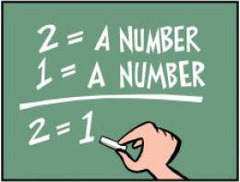 | 75 |
| 7641584998 | OVERGENERALIZATION: | This is also called stereotyping. Here, the speaker or writer draws a conclusion about a large number of people, ideas, things, etc. based on very limited evidence. Example: All members of group A are not to be trusted. Words such as all, never,always, and every are usually indicative of overgeneralization. It's best to use and to look for qualifiers such as some, seem, often, perhaps, and frequently, which indicate that the speaker or writer has an awareness of the complexities of the topic or group under discussion. | | 76 |
| 7641584999 | PATHETIC FALLACY: | A fallacy of attributing human feelings to inanimate objects. In literature, this is a device wherein something nonhuman found in nature—animal, plant, stream, natural force, etc.—performs as though from human feeling or motivation. Example: The friendly sun smiled down on me. | | 77 |
| 7641585000 | POST HOC ARGUMENT: | This fallacy cites an unrelated event that occurred earlier as the cause of a current situation. Example: I saw a black cat run across the street in front of my car five minutes before I was hit by a foul ball at the ball park. Therefore, the black cat is the cause of my bruised arm. |  | 78 |
| 7641585001 | STRAW-MAN ARGUMENT: | This is a technique in which the speaker or writer attributes false or exaggerated characteristics or behaviors to the opponent and makes attackes based on those falsehoods or exaggerations. Example: You say you support allowing people under 18 to drive alone. I'll never be able to understand why weak-willed drivers like you are willing to risk your life and the lives of all other drivers with these crazy teenagers on the road. | | 79 |
| 7641585002 | AMBIGUITY: | The multiple meanings, either intentional or unintentional, of a word, phrase, sentence, or passage. This lack of clarity in the work is often used as a phase of the author's view of the world or characters and reflects the vagueness of life. |  | 80 |
| 7641585003 | ANALOGY: | A comparison made between two things to show how one is like the other. | | 81 |
| 7641585004 | ANTITHESIS: | The presentation of two contrasting images. The ideas are balanced by a word, a phrase, a clause, or paragraphs. Examples include "To be or not to be . . . " and "Ask not what your country can do for you, ask what you can do for your country." |  | 82 |
| 7641585005 | CONTRAST: | A stylistic technique in which one element is shown in opposition to another. | | 83 |
| 7641585006 | IDIOM: | A common phrase or expression that has a meaning different from the literal meaning of its individual words. For example, "We're up against a brick wall" means "There's nothing more we can do." |  | 84 |
| 7641585007 | MIXED METAPHOR: | An expression combining metaphors that are inharmonious or inappropriate. | | 85 |
| 7641585008 | PURPLE PATCH: | A passage in a piece of writing that is overly elaborate and ornate. | | 86 |
| 7641585009 | RED HERRING: | Something intended to divert attention from the issue at hand. |  | 87 |
| 7641585010 | REPETITION: | The duplication, either exact or approximate, of any element of language, such as a sound, word, phrase, clause, sentence, or grammatical pattern. When repetition is poorly done, it bores, but when it's well done, it links and emphasizes ideas while allowing the reader the comfort of recognizing something familiar. | | 88 |
| 7641585011 | ANAPHORA: | Repetition of beginnings. Example: "Mad world! Mad kings! Mad composition!" |  | 89 |
| 7641585012 | CHIASMUS: | A general term referring to repetition in opposite order; the order in the second half of an expression reverses the order of the first half of the expression. The repetition can be of words, ideas, or grammatical structures and can appear at the level of the sentence, passage, or entire work. Example: "I wasted time, and now doth time waste me." |  | 90 |
| 7641585013 | DIACOPE: | Repetition with only a word or two in between. Example: "Villain, smiling, damned villain." |  | 91 |
| 7641585014 | EPIPHORA (or epistrophe): | Repetition of ends. Example: "When I was a child, I spake as a child, I understood as a child, I thought as a child." |  | 92 |
| 7641585015 | ISOCOLON: | Repetition of grammatical forms. Example: "The bigger they are, the harder they fall." |  | 93 |
| 7641585016 | POLYPTOTON: | Repetition of the same word or root in different grammatical functions or forms. Example: "Few men speak humbly of humility." | | 94 |
| 7641585017 | SARCASM: | From Greek meaning "to tear flesh," sarcasm involves bitter, caustic language that is meant to hurt or ridicule someone or something. It may use irony as a device, but not all ironic statements are sarcastic, that is intending to ridicule. When well done, sarcasm can be witty and insightful; when poorly done, it's simply cruel. | | 95 |
| 7641585018 | THESIS: | In expository writing, the thesis statement is the sentence or group of sentences that directly expresses the author's opinion, purpose, meaning, or proposition. Expository writing is usually judged by analyzing how accurately, effectively, and thoroughly a writer has proven the thesis. | | 96 |
| 7641585019 | TONE: | Tone describes the author's attitude toward the material, the audience, or both. The tone is the characteristic emotion that pervades a work or part of a work—the spirit or character that is a work's emotional essence. Tone is easier to determine in spoken language than in written language. Considering how a work would sound if it were read aloud can help in identifying an author's tone. Some words describing tone are playful, serious, sarcastic, humorous, formal, and somber. | | 97 |
| 7641585020 | VOICE: | In literature, the real or assumed personality used by a writer or speaker. In grammar, active voice and passive voice refer to verbs. A verb is in the active voice when it expresses an action performed by its subjects as in "The crew raked the leaves." A verb is in the passive voice when it expresses an action performed upon its subject or when the subject is the result of the action as in "The leaves were raked by the crew." Stylistically, the active voice makes for more economical and vigorous writing. | | 98 |
| 7641585021 | PROSODY: | The principles of verse structure, including meter, rhyme and other sound effects, and stanzaic patterns. | | 99 |
| 7641585022 | SOUND DEVICES: | Rhyme and other sound effects. | | 100 |
| 7641585023 | PERFECT RHYME (or exact rhyme, true rhyme): | A rhyme that meets each of the following requirements: An exact correspondence in the vowel sound and, in words ending in consonants, the sound of the final consonant, A difference in the consonant sound preceding the vowel, and A similarity of accent on the rhyming syllable. | | 101 |
| 7641585024 | HALF-RHYME (or slant rhyme, off-rhyme): | A rhyme in which the sounds are similar but not exact; most half-rhymes are types of consonance. | | 102 |
| 7641585025 | EYE-RHYME: | Rhyme that appears perfect from the spelling but is half-rhyme from the pronunciation. | | 103 |
| 7641585026 | END RHYME: | Rhyme that occurs at the end of a line of poetry. | | 104 |
| 7641585027 | INTERNAL RHYME: | Rhyme that occurs within a line of poetry instead of at the end. |  | 105 |
| 7641585028 | MASCULINE RHYME: | Rhyme that falls on the stressed and concluding syllables of the rhyme-words. |  | 106 |
| 7641585029 | FEMININE RHYME (or double rhyme): | A rhyme of two syllables, one stressed and one unstressed. |  | 107 |
| 7641585030 | ALLITERATION: | The repetition of identical or similar consonant sounds at the beginning of words. |  | 108 |
| 7641585031 | ASSONANCE: | A rhyme of two syllables, one stressed and one unstressed. |  | 109 |
| 7641585032 | CONSONANCE: | The repetition of similar consonant sounds. |  | 110 |
| 7641585033 | EUPHONY: | The use of harmonious sounds to produce a pleasing effect to the ear. | | 111 |
| 7641585034 | CACOPHONY: | Juxtaposing jarring, harsh sounds; the opposite of euphony. |  | 112 |
| 7641585035 | ONOMATOPOEIA: | The use of words whose sounds suggest their meanings. |  | 113 |
| 7641585036 | FIGURATIVE LANGUAGE: | Writing or speech that is not intended to carry literal meaning and is usually meant to be imaginative and vivid. In the AP English Language and Composition Exam, the term "figurative language" comprises figures of speech, poetic devices, and sound devices. | | 114 |
| 7641585037 | FIGURE OF SPEECH: | A device used to produce figurative language. Many compare dissimilar things. | | 115 |
| 7641585038 | TROPE: | Words used with a decided change or extension in their literal meaning. Also, the use of a word in a figurative sense. | | 116 |
| 7641585039 | METAPHOR: | A figure of speech that makes a comparison between two unlike objects, identifying one object with another and assigning to the first object the qualities of the second object. |  | 117 |
| 7641585040 | SIMILE: | A metaphor that is directly expressed, using like, as, or than. |  | 118 |
| 7641585041 | CONCEIT: | A lengthy or extended metaphor. | | 119 |
| 7641585042 | METONYMY: | A figure of speech substituting one noun for another with which it is closely associated. | | 120 |
| 7641585043 | SYNECDOCHE: | A figure of speech in which a part of something stands for the whole. | | 121 |
| 7641585044 | PERSONIFICATION: | A figure of speech in which human characteristics are attributed to objects or animals. This differs from "pathetic fallacy" | | 122 |
| 7641585045 | APOSTROPHE: | A figure of speech in which an absent person or personified object is addressed by the speaker. | | 123 |
| 7641585046 | SYNAESTHESIA: | A figure of speech in which an attribute associated with one of the five senses is applied to a term associated with a different sense. |  | 124 |
| 7641585047 | IMAGERY: | The use of concrete and sensuous words to represent things, actions, or ideas. Often the term refers to words that appeal to the five senses: sight, sound, touch, taste, and smell. | | 125 |
| 7641585048 | SYMBOL: | An image that stands for or represents something else. Symbols often transfer the ideas embodied in the image without stating them directly. In Robert Frost's poem "The Road Not Taken," the fork in the road represents a major decision in life, each road a separate way of life. |  | 126 |
| 7641585049 | ALLUSION: | An implied or indirect reference to something assumed to be known, such as a historical event or person, a well-known quote, or famous work of art. In Western literature, the most common allusions are to the Bible and Greek and Roman mythology. |  | 127 |
| 7641585050 | IRONY: | A broad term referring to the recognition of a reality different from the appearance. |  | 128 |
| 7641585051 | SITUATIONAL IRONY: | The contrast between what is expected to happen and what actually does happen. | | 129 |
| 7641585052 | VERBAL IRONY: | Stating one thing but meaning another. | | 130 |
| 7641585053 | DRAMATIC IRONY: | A contradiction between what a character thinks and what the reader or audience knows to be true. |  | 131 |
| 7641585054 | HYPERBOLE: | A bold, deliberate overstatement used to emphasize the truth of a statement. |  | 132 |
| 7641585055 | UNDERSTATEMENT: | The ironic minimalizing of fact. Understatement presents something as less significant than it is. The effect can frequently be humorous and emphatic. Understatement is the opposite of hyperbole. | | 133 |
| 7641585056 | LITOTES: | An understatement in which an affirmative is expressed by the denial of the contrary. In litotes, more is understood than is said, for example, we say "He is not the wisest man in the world" when we mean "He is a fool." | | 134 |
| 7641585057 | PARADOX: | A statement that appears to contradict itself but actually suggests an important truth. |  | 135 |
| 7641585058 | OXYMORON: | A paradox consisting of two words. |  | 136 |
| 7641585059 | Visual Rhetoric | The use of images as argument, the arrangement of all elements on a page for rhetorical effect; how visual images communicate. | | 137 |
| 7641585060 | Visible Literacy | The ability to recognize and understand ideas conveyed through visible actions or images (as pictures). | | 138 |
| 7641585061 | Typography | The style, arrangement, or appearance of printed matter. | | 139 |
| 7641585062 | Serif | Any of the short lines stemming from and at an angle to the upper and lower ends of the strokes of a letter. | | 140 |
| 7641585063 | Sans serif | A letter or typeface with no serifs. | | 141 |
| 7641585064 | Script Fonts | Novelty, ornamental, or decorative fonts that stand out for their unique shapes and personalities. | | 142 |