

AP literature chapter 4 Flashcards
Terms : Hide Images
| 8347472110 | affinity | A natural attractuon to a person, thing, or activity; a relationship, connection | 0 | |
| 8347472111 | Bilious | Peevish or irritable; sickeningly unpleasant | 1 | |
| 8347472112 | Cognate | Closely related in origin, essential nature, or function; such a person or thing | 2 | |
| 8347472113 | Corollary | A proposition that follows from one already proven; a natural consequence or result; resultant or consequent | 3 | |
| 8347472114 | Cup-de-sac | A blind alley or dead-end street; any situation in which further progress is impossible; an impasse | 4 | |
| 8347472115 | Derring-do | Valor or heroism; daring deeds or exploits (often used to poke fun at false heroics) | 5 | |
| 8347472116 | Divination | The art or act of predicting the future or discovering hidden knowledge | 6 | |
| 8347472117 | Elixir | A potion once thought capable of curing all ills and maintaining life indefinitely; a panacea; a sweet liquid used as a vehicle in medicines | 7 | |
| 8347472118 | Folderol | Foolish talk, ideas, or procedures; nonsense; a trifle | 8 | |
| 8347472119 | Gamut | An entire range or series | 9 | |
| 8347472120 | hoi polloi | the common people; the masses | 10 | |
| 8347472121 | ineffable | not expressible in words; too great or too sacred to be uttered | 11 | |
| 8347472122 | lucubration | laborious study or thought, especially at night; the result of such work | 12 | |
| 8347472123 | Mnemonic | Relating to or designed to assist the memory; a device to aid the memory | 13 | |
| 8347472124 | obloquy | public abuse indicating strong disapproval or censure; the disgrace resulting from such treatment | 14 | |
| 8347472125 | Parameter | A determining or characteristic element; a factor that shapes the total outcome; a limit, boundary | 15 | |
| 8347472126 | Pundit | A learned person; one who gives authoritative opinions | 16 | |
| 8347472127 | Risible | Pertaining to laughter; able or inclined to laugh; laughable | 17 | |
| 8347472128 | Symptomatic | Typical or characteristic; being or concerned with a symptom of a disease | 18 | |
| 8347472129 | Volte-face | An about-face; a complete reversal | 19 |
Campbell Biology- Chapter 2 Flashcards
Terms : Hide Images
| 7553236031 | Atom | The basic unit of an element that retains the properties of the element. |  | 0 |
| 7553236032 | Proton | Positively charged subatomic particle found in the nucleus of an atom; equal to the number of electrons in an electrically neutral atom. |  | 1 |
| 7553236033 | Neutron | A neutrally charged subatomic particle found in the nucleus of an atom. |  | 2 |
| 7553236034 | Electron | A negatively charged subatomic particle found orbiting the nucleus of an atom; equal to the number of protons in an electrically neutral atom. | | 3 |
| 7553236035 | Atomic Weight | Measured in daltons, and consists of the weight of protons and neutrons together, each of which weighs about one dalton. |  | 4 |
| 7553236036 | Atomic Nucleus | The portion of an atom which contains protons and neutrons. |  | 5 |
| 7553236037 | Orbital | The volume of space an electron occupies. |  | 6 |
| 7553236038 | Energy Shells | Represent the state of potential energy of an electron. Those closer to the nucleus have the least amount of energy. |  | 7 |
| 7553236039 | Valence Shell | The outermost shell of an atom which has the most potential energy. |  | 8 |
| 7553236040 | Valence electrons | Electrons in the valence, or outermost, energy shell of an atom, which have the most potential energy and which can form bonds with other atoms. |  | 9 |
| 7553236041 | Isotopes | Varying atomic forms of an element which vary from an electrically neutral atom in the number of neutrons, causing the atomic weight to vary. Radioactive isotopes have medical imaging and other applications. |  | 10 |
| 7553236042 | Chemical Bonds | Attractions between atoms resulting from a sharing of valence electrons or the presence of opposite charges on the atoms. The bonded atoms gain complete valence shells. |  | 11 |
| 7553236043 | Covalent Bond | The sharing of a pair of valence electrons by two atoms. |  | 12 |
| 7553236044 | Molecule | Two or more atoms held together by covalent bonds. |  | 13 |
| 7553236045 | Single Bond | One pair of shared electrons. Example: hydrogen. |  | 14 |
| 7553236046 | Double Bond | Two pairs of shared electrons. Example: Oxygen has 6 electrons in its valence shell, which can hold 8. Each atom shares 2 electrons for a total of 4. | 15 | |
| 7553236047 | Valence | An atom's bonding capacity, or the number of covalent bonds the atom can form to give the atom a full complement of electrons in the valence shell. Usually equals the number of unpaired electrons required to complete the valence shell. |  | 16 |
| 7553236048 | Electronegativity | The attraction of a particular atom for the electrons of a covalent bond. Atoms in a molecule attract shared bonding electrons to varying degrees. This degree is _________. |  | 17 |
| 7553236049 | Nonpolar Covalent Bond | A covalent bond between 2 atoms of the same element in which the electrons are shared equally because the two atoms have the same electronegativity. |  | 18 |
| 7553236050 | Polar Covalent Bond | An atom bonded to a more electronegative atom. |  | 19 |
| 7553236051 | Ionic Bonds | Bonds between two atoms so unequal in their attraction for valence electrons that the more electronegative atom strips an electron completely away from its partner. |  | 20 |
| 7553236052 | Ion | One of two charged atoms resulting from an ionic bond. |  | 21 |
| 7553236053 | Cation | A positively charged ion |  | 22 |
| 7553236054 | Anion | A negatively charged ion |  | 23 |
| 7553236055 | Ionic compounds | Compounds formed by ionic bonds. |  | 24 |
| 7553236056 | Salts | Another name for ionic compounds; formed by ionic bonds. |  | 25 |
| 7553236057 | Stable or Inert Atom | An atom with a full valence shell |  | 26 |
| 7553236058 | Hydrogen Bonds | Relatively weak bonds formed due to the mutual attraction of two electronegative atoms to hydrogen. |  | 27 |
| 7553236059 | Compound | A substance consisting of two or more elements in a fixed ratio. |  | 28 |
| 7553236060 | Element | A substance that cannot be broken down into other substances by chemical reactions. |  | 29 |
| 7553236061 | Trace Elements | Elements required by organisms but only in minute quantities. |  | 30 |
| 7553236062 | Radioactive Isotopes | An unstable isotope with a nucleus that decays spontaneously, emitting particles and energy. Have many applications in biological research, including fossil dating (Carbon-14 or 14C), tracing atoms through metabolic processes, and diagnosing medical disorders. |  | 31 |
| 7553236063 | Electron configuration influences the ______ of an atom. | Chemical behavior |  | 32 |
| 7553236064 | Atoms are mostly _________. | Empty space. |  | 33 |
| 7553236065 | Atoms with the same number of ____________ have similar chemical behaviors. | Valence electrons |  | 34 |
| 7553236066 | Each orbital can hold a maximum ____ electrons. | 2 |  | 35 |
| 7553236067 | The reactivity of atoms arises from the presence _______ _____________ in one or more orbitals of their valence shells. | Unpaired electrons |  | 36 |
| 7553236068 | Electrons occupy ________ _________ within the valence shell until forced to share orbitals. | Separate orbitals |  | 37 |
| 7553236069 | The strongest chemical bonds are _______ bonds and _________ bonds. | Chemical and ionic |  | 38 |
| 7553236070 | Two or more atoms held together by a covalent bond consistute a _________. | Molecule |  | 39 |
| 7553236071 | True or False: Covalent bonds can form between atoms of the same element ONLY. | False. |  | 40 |
| 7553236072 | _____ chemical bonds play important roles in the chemistry of life. | Weak |  | 41 |
| 7553236073 | Octet Rule | An atom with more than 1 energy shell is most biologically stable with 8 electrons in the valence shell. |  | 42 |
| 7553236074 | Structural Formula | Uses bond symbols to show shared electrons between atoms. Example: H-H shows a hydrogen molecule sharing one pair of valence electrons. O=O shows two oxygen atoms sharing two pairs of valence electrons. |  | 43 |
| 7553236075 | Molecular Formula | A formula showing the type of element and number of atoms only. Example: H2O |  | 44 |
| 7553236076 | Cellular Respiration Equation | CR= C6H12O6 + 6O2 ---> 6CO2 + 6H2O + 30 - 32ATP |  | 45 |
| 7553236077 | Photosynthesis Equation | Photo = 6CO2 + 6H2O ---> C6H12O6 + 6O2 |  | 46 |
| 7553236078 | Enzymes | Proteins that catalyze chemical reactions |  | 47 |
| 7553236079 | Metabolic Pathways | Series of metabolic reactions that occur in specific sequences | 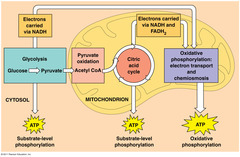 | 48 |
| 7553236080 | Anabolism | Conversion of small organic molecules by forming chemical bonds between the smaller molecules. |  | 49 |
| 7553236081 | Catabolism | Conversion of large molecules into smaller components. |  | 50 |
| 7553236082 | Metabolism | All the chemical conversions that occur within a cell. |  | 51 |
| 7553236083 | van der Waals interactions | Weak attractions between molecules or parts of molecules that result from transient local partial charges. |  | 52 |
| 7553236084 | Molecular shape is determined by the position of the atoms' _________. | Orbitals |  | 53 |
| 7553236085 | Biological molecules often bind temporarily to each other by forming weak bonds, but only if their _________ are complementary. | Shapes |  | 54 |
| 7553236086 | Chemical Reactions | The making and breaking of chemical bonds, leading to changes in the composition of matter. |  | 55 |
| 7553236087 | Reactants | The starting materials in a chemical reaction. |  | 56 |
| 7553236088 | Products | The ending materials in a chemical reaction. |  | 57 |
| 7553236089 | Reactions cannot create or destroy matter but can only _________ ____ _________ among them. | Rearrange the electrons |  | 58 |
| 7553236090 | True or False: All chemical reactions are reversible. | True |  | 59 |
| 7553236091 | Chemical Equilibrium | The point at which chemical reactions offset one another and the forward and reverse reaction rates are equal. |  | 60 |
Flashcards
Flashcards
Flashcards
the nitrogen cycle Flashcards
Terms : Hide Images
| 6430933480 | Of the 5 essential elements in important biological molecules, which are readily available and which are often the limiting nutrients in plant growth? | Readily available: => hydrogen => oxygen => carbon Often limiting nutrients => nitrogen => phosphorous | 0 | |
| 6430933481 | How plants are dependent on microbes | Microbes play an enormous role in the cycling of these elements, making them available in forms that can be used by plants. Plants capture minerals and transform them into organic forms, making them available to animals. | 1 | |
| 6430933482 | inorganic forms of nitrogen | dinitrogen (N2 gas) **the most abundant yet the least biologically active (most inert) ammonia (NH3) Nitrate (NO3-) Nitrite (NO2-) | 2 | |
| 6430933483 | organic forms of nitrogen | amino acids nucleic acids urea **organic nitrogen may be in the form of living organisms, soil organic matter, or in the intermediate products of organic matter decomposition | 3 | |
| 6430933484 | Nitrogen gas | nitrogen gas comprises about 80% of earth's atmosphere but organisms cannot use it unless it has been reduced to ammonia | 4 | |
| 6430933485 | Ammonia is produced by (3 ways) | 1) Nitrogen fixation => soil microbes like Rhizobium or aquatic microbes like cyanobacterium Anabaena => process requires a lot of energy (will study more about this process later) 2) Ammonification aka Mineralization (decomposition) 3) Nonbiological nitrogen fixation => A small, insignificant amount of nitrogen fixation occurs by lightning, volcanic eruptions, and ultraviolet light as well as from man-made processes like internal combustion engines. |  | 5 |
| 6430933486 | Mineralization (aka ammonificatioin) Cycle of death, decay, mineralization, and assimilation into new living tissue. | Mineralization is the process of converting complex organic material into inorganic forms (i.e. ammonia). Microorganisms (aerobic and anaerobic bacteria and fungi) do this to plants and animals when they die. **It is the microbial decomposition of organic material, producing ammonia. **Microbial action causes the hydrolysis of proteins and nucleic acids, releasing amino acids and nucleotides, which are then further metabolized by microorganisms into ammonia. And in this way, the cycle makes its rounds. The microbes convert the inorganic material into usable forms by plants. Plants then converts it into organic material. Animals eat it. And so on. microbes => plants => animals => animals/plants dye => microbes => plants => animals | 6 | |
| 6430933487 | You have ammonia. Now what? Two pathways for the use of ammonia | 1) Assimilation of ammonia => The ammonia in soil can be directly absorbed MOSTLY BY MICROORGANISMS (very little by plant roots) and assimilated into cell material => once assimilated into proteins and nucleic acids, the assimilated nitrogen travels through the food chain 2) Nitrification - Oxidation of ammonia to nitrate => Strictly aerobic bacteria can oxidize ammonia to nitrite and then further to nitrate => The resulting nitrate is a preliminary source of nitrogen for most plants **Since an inorganic compound is the source of electrons, these bacteria are considered to be chemolithotrophic |  | 7 |
| 6430933488 | Plant's nitrogen source | Plants cannot readily absorb dinitrogen, ammonia, or organic nitrogen. **They require nitrate or urea in the soil as their source of nitrogen. | 8 | |
| 6430933489 | Whether it is absorbed directly, modified before use by plants, or converted into a form unusable by plants, nitrate must be reduced. Three pathways for nitrate reduction: | 1) Nitrate assimilation (NO3- => NH3) => for plants, the most efficient uptake of nitrogen is in the form of nitrate => once absorbed by plants, the nitrogen in nitrate is reduced to ammonia in order to be incorporated into nucleotides and amino acids => this assimilated nitrogen serves as a source of nitrogen for consumers further along the food chain 2) Assimilatory nitrate reduction (NO3- => NO2- => NH3) 3) Dissimilatory nitrate reduction aka denitrification => Anaerobic respiration using nitrate or nitrite as terminal electron acceptor => Nitrate reduction (NO3- => NO2-) => Denitrification (NO2- => N2) | 9 | |
| 6430933490 | Nitrification | Nitrification (oxidation of ammonia into nitrate): NH3 => NO3- Nitrate assimilation (reduction of nitrate into ammonia): NO3- => NH3 Assimilitary nitrate reduction: NO3- => NO2- => NH3 Denitrification aka dissimilatory nitrate reduction: -Nitrate reduction NO3- => NO2- -Denitrification NO2- => N2 | 10 | |
| 6430933491 | Animals nitrogen source | Organisms cannot use N2 unless it has been reduced to ammonia (NH3). really? | 11 | |
| 6430933492 | Nitrogen cycle (pathways involving the conversion of different forms of nitrogen) has: Assimilatory pathways Dissimilatory pathways | Assimilatory pathways: when products can be directly or indirectly assimilated by living things Dissimililatory pathways: when products cannot be assimilated without significant modification | 12 | |
| 6430933493 | ammonium + bacteria = ? | nitrate (nitrification) | 13 | |
| 6430933494 | nitrification | ammonium -> nitrite -> nitrate changing ammonium to nitrate through oxidation | 14 | |
| 6430933495 | denitrification | microbes removing nitrates ammonium + bacteria = nitrate (nitrification) | 15 | |
| 6430933496 | runoff | nitrogen from fertilizers and ammonium is moved in water from land to water | 16 | |
| 6430933497 | volcanoes as well as electrical storms can cause... | ammonium to form in soil | 17 | |
| 6430933498 | nitrogen fixation | nitrogen -> ammonium (this is caused by nitrogen fixation and high energy processes) | 18 | |
| 6430933499 | ammonification | organic nitrogen compounds to NH3 | 19 | |
| 6430933500 | assimilation | NH3 -> NO3- -> biological tissues (aka it puts NH3 and NO3- into biological tissues) | 20 | |
| 6430933501 | steps of the nitrogen cycle | - ammonification - nitrification - nitrogen uptake by plants - nitrogen fixation (released into atmosphere) OR... eaten by animals (decomposition) - denitrification | 21 | |
| 6430933502 | STEP ONE | ammonification - there is ammonium | 22 | |
| 6430933503 | STEP TWO | nitrification - ammonium to nitrates | 23 | |
| 6430933504 | STEP THREE | nitrogen is absorbed by plants | 24 | |
| 6430933505 | STEP FOUR | nitrogen fixation (released to atmosphere) OR... plants are eaten by animals (then decomposition) | 25 | |
| 6430933506 | STEP FIVE | denitrification | 26 |
Flashcards
AP world history vocab 1914/1900-present Flashcards
Terms : Hide Images
| 6798574903 | anti imperialism | any belief or practice which opposes imperialism | 0 | |
| 6798591785 | anti semitism | hostility to or prejudice against Jews | 1 | |
| 6798594552 | apartheid | (in South Africa) a policy or system of segregation or discrimination on grounds of race / segregation on grounds other than race | 2 | |
| 6798605615 | appeasement | The action or process of appeasing / pacify or placate (someone) by acceding to their demands | 3 | |
| 6798613463 | fundamentalist movements | A movement in 20th century protestantism emphasizing the literally interpreted Bible as fundamental to Christian life and teaching. Applied to politics like no abortion and gay marriage | 4 | |
| 6798626240 | liberation theology | movement in Christian theology, developed mainly by Latin American Roman Catholics, that emphasizes liberation from social, political, and economic depression as an anticipation of ultimate salvation | 5 | |
| 6798630937 | authoritarian regime | favoring or enforcing strict obedience to authority, especially that of the government, at the expense of personal freedom / A government that concentrates political power in an authority not responsible to the people | 6 | |
| 6798639134 | bedouin | a nomadic arab of the desert | 7 | |
| 6798649454 | biafra secessionis movement | A secessionist movement with the aim of securing the resurgence of the defunct state of biafra from Nigeria | 8 | |
| 6798656254 | chemically and genetically enhanced forms of agriculture | ex. the green revolution | 9 | |
| 6798659620 | Cold war | The ideological struggle between communism (USSR) and capitalism (US) for world influence. the USSR and the US came to the brink of war during the Cuban missile crisis but never attacked one another. ended when USSR dissolved in 1991 | 10 | |
| 6798672064 | collectivization | policy adopted by the Soviet government, pursued most intensively between 1929 and 1933, to transform traditional agriculture in the Soviet union and to reduce the economic power of the kulaks ( prosperous peasants) | 11 | |
| 6798681549 | communism | A political theory derived from Karl Marx, advocating class war and leading to a society in which all property is publicly owned and each person works and is paid according to their abilities and needs | 12 | |
| 6798687168 | consumerism | The protection or promotion of the interests of consumers / A social and economic order and ideology that encourages the acquisition of goods and services in ever-increasing amounts | 13 | |
| 6798694322 | containment | The action or policy of preventing the expansion of a hostile country or influence / keeping communism w/in its limits, a method the US used during the cold war | 14 | |
| 6798697401 | cultural convergence | The tendency for cultures to become more alike as they increasingly share technology and organizational structures in a modern world united by improved transportation and communication | 15 | |
| 6798699946 | cultural identities | The identity or feeling of belonging to a group / it is part of a persons self conception and self perception and is related to nationality, ethnicity, religion, social class, generation, locality, or any kind of social group that has its own distinct culture | 16 | |
| 6798707525 | decolonization | defined as the act of getting rid of colonization, or freeing a country from being dependent on another country | 17 | |
| 6798709757 | deforestation | The action of clearing a wide area of trees | 18 | |
| 6798712366 | desertification | The process by which fertile land becomes desert, typically as a result of drought, deforestation, or inappropriate agriculture | 19 | |
| 6798715281 | dissolution | The closing down or dismissal of an assembly, partnership, or official body | 20 | |
| 6798718647 | domestic | A person who is paid to help with menial tasks such as cleaning | 21 | |
| 6798719582 | draft | compulsory recruitment for military service | 22 | |
| 6798720837 | economic liberalization | the lessening of government regulations and restrictions in an economy in exchange for greater participation by private entities; the doctrine is associated with classical liberalism | 23 | |
| 6798724495 | exclusionary reactions | xenophobia, race riots, citizenship restrictions | 24 | |
| 6798731880 | fascism | an authoritarian and nationalistic right wing system of government and social organization / A governmental system led by a dictator having complete power | 25 | |
| 6798736792 | feminism | The advocacy of women's rights on the basis of the equality of the sexes | 26 | |
| 6798739107 | five-year plans | (especially in the former Soviet union) a government plan for economic development over five years. The first such plan in the Soviet union was inaugurated in 1928 / plans that joseph stalin introduced to industrialize the soviet union | 27 | |
| 6798744179 | free-market economics/policies | an economic system in which prices are determined by unrestricted competition between privately owned businesses | 28 | |
| 6798745515 | free-trade | International trade left to its natural course without tariffs, quotas, or other restrictions | 29 | |
| 6798747139 | genocide | The deliberate killing of a large group of people, especially those of a particular ethnic group or nation | 30 | |
| 6798749146 | glasnost | (in the former Soviet Union) the policy or practice of more open consultative government and wider dissemination of information, initiated by leader Mikhail Gorbachev from 1985 | 31 | |
| 6798755647 | Global warming | A gradual increase in the overall temperature of the earths atmosphere generally attributed to the greenhouse effect caused by increased levels of carbon dioxide, chlorofluorocarbons, and other pollutants | 32 | |
| 6798758731 | Government intervention in the economy | New deal, fascist corporatist economy, economic development, export oriented economies | 33 | |
| 6798761298 | Great depression | The economic crisis and period of low business activity in the US and other countries, roughly beginning with the stock market crash in October, 1929, and continuing through most of the 1930s | 34 | |
| 6798765621 | Green/environmental movements | Greenpeace: largest independent direct environmental organization in the world/ green belt in Kenya: an indigenous grassroots non-governmental organization based in Nairobi, Kenya/ Earth Day / began in the 1970s | 35 | |
| 6798767075 | Green revolution | A large increase in crop production in developing countries achieved by the use of fertilizers, pesticides, and high yield crop varieties | 36 | |
| 6798770029 | greenhouse gases | A gas that contributes to the greenhouse effect by absorbing infrared radiation ( carbon dioxide and chlorofluorocarbons ) | 37 | |
| 6798774029 | holocaust | The killing of millions of Jews and other people by the Nazis during World War II / The mass murder of Jews under the German Nazi regime during the period 1941 to 1945. More than 6 million European Jews, as well as members of other persecuted groups, were murdered at concentration camps such as Auschwitz | 38 | |
| 6798783338 | Home countries | The country in which a person was born and usually raised, regardless of the present country of residence and citizenship | 39 | |
| 6798785204 | human rights | a right that is believed to belong justifiably to every person (UN Universal declaration of human rights, women's rights, end of the white Australia policy) | 40 | |
| 6798791981 | Imperial metropoles | The homeland or central territory of a colonial empire. The term was mainly used in the scope of the British, French, and Portuguese empires to designate their European territories, as opposed to their colonial or overseas territories | 41 | |
| 6798797883 | Indian national Congress intensified conflict | a movement and political party founded in 1885 to demand greater Indian participation in government / military dictatorship, New World order, military industrial complex, arms trading | 42 | |
| 6798798842 | League of Nations | an international organization established after World War I in 1919 under the provisions of the treaty of versailles. The league, the forerunner of the United Nations, brought about much international cooperation on health, labor problems, refugee affairs, and the like | 43 | |
| 6799405688 | mandates | an official order or commission to do something / The authority to carry out a policy or course of action, regarded as given by the electorate to a candidate or party that is victorious in an election | 44 | |
| 6799411267 | medical innovations | polio vaccine, antibiotics, artificial heart | 45 | |
| 6799413253 | militarized states | A condition in which territory is under the effective control of a for an armed force | 46 | |
| 6799417127 | mobilization of a states resources | gurkha, ANZAC, military conscription | 47 | |
| 6799417782 | movements who challenged the war | anti-nuclear movement, self immolation | 48 | |
| 6799418764 | mujahideen/taliban | guerrilla fighters in Islamic countries, especially those who are fighting against non-Muslim forces / A fundamentalist Muslim movement who's militia took control of much of Afghanistan from early 1995, and in 1996 took Kabul and set up an Islamic state | 49 | |
| 6799422888 | multinational/transnational corporations | has facilities and other assets in at least one country other than its home country (Royal Dutch Shell, Coca-Cola, Sony) | 50 | |
| 6799425158 | NATO | The North Atlantic Treaty Organization is an intergovernmental military alliance between several North American and European states based on the North Atlantic Treaty which was signed on April 4, 1949 | 51 | |
| 6799429010 | New economic institutions | International monetary fund, World Bank, world trade organization | 52 | |
| 6799431705 | New forms of spirituality | Hare Krishna: western hinduism, Falun Gong: darma practice | 53 | |
| 6799432821 | nonviolence | using peaceful means rather than force, especially to bring about political or social change (non-aligned movement, anti-apartheid movement) | 54 | |
| 6799436328 | nuclear weaponry | A bomb or missile that uses nuclear energy to cause an explosion | 55 | |
| 6799437563 | OPEC | The organization of petroleum exporting countries is a group consisting of 12 of the worlds major oil exporting nations / was founded in 1960 to coordinate the petroleum policies of its members, and to provide member states with technical and economic aid / A union of oil producing countries that regulate the amount of oil each country is able to produce | 56 | |
| 6799465250 | Pacific rim | A geographic area surrounding the edges of the pacific ocean | 57 | |
| 6799467439 | perestroika | (in the former Soviet union) the policy or practice of restructuring the economic and political system. First proposed by Leonid Brezhnev in 1979 and actively promoted by Mikhail Gorbachev, perestroika originally referred to increased automation and labor efficiency, but came to entail greater awareness of economic markets and the ending of central planning | 58 | |
| 6799472255 | popular culture | culture based on the taste of ordinary people rather than an educated elite (dada, socialist realism) | 59 | |
| 6799475702 | population resettlements/ partition | The movement of a large group of people from one region to another, often a form of forced migration imposed by state policy or international authority and most frequently on the basis of ethnicity or religion but also due to economic development | 60 | |
| 6799480729 | propaganda | information, especially of a biased or misleading nature, used to promote or publicize a particular political cause or point of view | 61 | |
| 6799482669 | proxy wars | A war instigated by a major power that does not itself become involved | 62 | |
| 6799486159 | Québécois separatist movement | The Quebec sovereignty movement is a political movement as well as an ideology of values, concepts, and ideas that advocates independence for the Canadian province of Quebec /in the 1960s | 63 | |
| 6799489956 | redistribute land and resources | The distribution of something in a different way, typically to achieve greater social equality | 64 | |
| 6799492328 | refugee | A person who has been forced to leave their country in order to escape war, persecution, or natural disaster | 65 | |
| 6799494748 | regional trade agreements | when a group of states within a specific region focus on trade negotiations and reforms (European Union, NAFTA, ASEAN) | 66 | |
| 6799499395 | religious fundamentalism | refers to the belief of an individual or a group of individuals in the absolute authority of a sacred religious text or teachings of a particular religious leader | 67 | |
| 6799504563 | Scientific paradigms | A human beings mental model of the world, which may or may not conform to that of others but is often stereotypical / in the philosophy of science, a general conception of the nature of scientific operation within which a particular scientific activity is undertaken (theory of relativity, quantum mechanics, big bang theory, psychology) | 68 | |
| 6799510122 | segregation | The action or state of settling someone or something apart from other people or things or being set apart / The enforced separation of different racial groups in a country, community, or establishment | 69 | |
| 6799511776 | self determination | The process by which a country determines its own statehood and forms its own allegiances and government / The process by which a person controls their own life | 70 | |
| 6799515316 | soviets | an elected local, district, or national council in the former Soviet union | 71 | |
| 6799516995 | superpowers | A very powerful and influential nation (used especially with reference to the US and the former Soviet union when these were perceived as the two most powerful nations in the world) | 72 | |
| 6799518396 | tactics | an action or strategy carefully planned to achieve a specific end/ the art of disposing armed forces in order of battle and of organizing operations, especially during contact with an enemy (trench warfare, firebombing) | 73 | |
| 6799521709 | technological stagnation | A prolonged period of little or no growth in an economy | 74 | |
| 6799524745 | terrorism | The unlawful use of violence and intimidation, especially against civilians, in the pursuit of political aims | 75 | |
| 6799526270 | third World/developing world | arose during the cold war to define countries that remained nonaligned with either NATO, or the communist bloc | 76 | |
| 6799532354 | World wars | A war involving many large nations in all different parts of the world | 77 | |
| 6799534575 | totalitarianism | A system of government that is centralized andy dictatorial and requires complete subservience to the state / the ruler is an absolute dictator | 78 | |
| 6799537519 | United Nations | an international organization formed in 1945 to increase political and economic cooperation among member countries / was founded to promote peace, security, and economic development | 79 | |
| 6799540706 | Warsaw Pact | A military alliance of communist nations in Eastern Europe. Organized in 1955 in answer to NATO, the Warsaw Pact included Bulgaria, Czechoslovakia, east Germany, Hungary, Poland, Romania, and the Soviet Union | 80 | |
| 6799545855 | women's emancipation/suffrage | The right of women to vote and to stand for electoral office. Limited voting rights were gained by women in Sweden, Finland, and some western US states in the late 19th century. National and international organizations formed to coordinate efforts to gain voting rights, especially the international woman suffrage alliance (1904) | 81 |
Flashcards
Pages

Need Help?
We hope your visit has been a productive one. If you're having any problems, or would like to give some feedback, we'd love to hear from you.
For general help, questions, and suggestions, try our dedicated support forums.
If you need to contact the Course-Notes.Org web experience team, please use our contact form.
Need Notes?
While we strive to provide the most comprehensive notes for as many high school textbooks as possible, there are certainly going to be some that we miss. Drop us a note and let us know which textbooks you need. Be sure to include which edition of the textbook you are using! If we see enough demand, we'll do whatever we can to get those notes up on the site for you!
