AP Notes, Outlines, Study Guides, Vocabulary, Practice Exams and more!

biochemistry Flashcards

Terms : Hide Images
11308645121metabchange0
11308650245aerthe air1
11308654318anwithout, not2
11308657841periaround3
11308662053stalsisa construction, compression4
11308666463thermheat5
11308669359endoinside6
11308669360exooutside7
11308676849gestcarried8
11308676850catadown, downward9
11308681272lys lysisloosen10
11308681273phag/vorto eat11

biochemistry Flashcards

Terms : Hide Images
78949819472 Reasons Atoms Bond1) To gain a full valence shell 2) To cancel out charges0
7894992647Proton ChargePositive1
7894992648Neutron ChargeNeutral2
7894995363Electron ChargeNegative3
7895662512IsotopeAtom of the same element with a different number of neutrons4
7895832673IonA charged particle(element)5
78958372232 Types of BondIonic, Covalent6
7895840930Covalent BondBond where 2 atoms share 1 or more pairs of electrons7
7895857177Ionic BondBonds that form between charged particles to neutralize charges8
7895863161What is strongestCovalent9
7895877788Metals bondIonic10
7895882733What bonds does H formBoth11
7895882734moleculeTwo or more atoms bonded in covalent bonds(Can not be split)12
7895891210compoundOne or more atoms bonded by ionic bonds(can be split)13
7895894792Organic MoleculesMolecules that contain H,C, usually O14
78958977924 Main Atoms for LifeC, H, O, N15
7895900576Macromolecules"Big molecules"16
78959287394 Types of MacromoleculeProteins, Lipids, Nucleic Acids, Carbohydrates17
7895941468InertDoes not form bonds18
7895951643atomsmallest particle of an element that still has the the properties of the element19
78959555363 Subatomic particleselectron, neutron, proton20
7895962468MatterAnything that has mass and takes up space21
7895962470elementsbuilding blocks of matter22
7895965064AMUAtomic Mass Unit23
7895967587Location of subatomicProtons: nucleus Neutrons: Nucleus Electron: outside nucleus inside electron cloud24
7895970726Chemical ReactionConversion of reactants into products, anything that breaks and/or forms bonds between atoms or molecules, change properties of reactants25
7895980913bondshold atoms together26
7903810887weight of electronno mass27
7903810888weight of proton1 AMU28
7903810889weight of neutron1 AMU29
7903811996Noble GassesElements on the far right that don't bond with any because they already have a full valence shell30
7903815178Why is all life carbon basedCarbon forms 4 bonds, so it is a stable building block for life31
7903817447Carbohydrates elemental compositionMade of C, H, O, in a ratio 1:2:1, 3 carbon atoms with a hydroxyl chain bonded to an O32
7903821845Monomer unit of carbsMonosaccharides33
7903822773Examples of MonosaccharidesFructose, Glucose34
7903823260Examples of DisaccharidesSucrose, Lactose35
7903823710Examples of PolysaccharidesCellulose, starch, glycogen, chitin36
7903824135CelluloseA carbohydrate that is the most abundant organic chemical compound. It makes up the structure of plant cell walls, AKA Fiber37
7903825718StarchPlant sugar storage38
7903826415GlycogenAnimal sugar storage39
7903826416Chitinused for exoskeletons of arthropods40
7903826928Carbs food sourcesMost grains, Potatoes, Beans, Legumes, Dairy41
79038312433 Functions of carbsProvide energy and regulate glucose, Structure of cells and organisms, Used as antibodies to recognize the cells42
7903834047GlucoseSugar that helps regulate glucose43
7903835139Reactions of carbsDehydration synthesis builds carbs, hydrolysis reactions break up carbs44
7903836199Dehydration synthesisBonds atoms and produces a water as a byproduct45
7903836826HydrolysisUses water to break down molecules46
7903852289Protein elemental compMade up of sets of amino acids with elements C,H,O,N47
7903855252Simple proteinsMade of only amino acids, such as eggs, albumin, globulin48
7903856170Conjugateinclude non amino acids, such as lipoprotein49
7903857782ConformationShape of the protein, form affects the function50
7903858403Protein monomer unitsAmino Acids(some are hydrophobic/hydrophilic)51
7903859453FunctionsForms skin pigments, enzymes to speed up chem rxn, hormones(insulin), antibodies, muscle contraction, transports materials, hemoglobin transport oxygen in red blood cells, moves things in/out of cells52
7903860999EnzymesBiological catalysts, speed up chemical reactions and reduce energy needed for them53
7903867445ATPAdenosine Triphosphate, a modified nucleotide that functions as the currency of energy for life54
7912573929Composition of ATPRibose(simple sugar), Adenine, 3 Phosphate groups55
7912582779ATP Generates EnergyEnzyme causes it to lose one phosphate which generates energy56
7912613950RNA vs DNARNA is Single stranded, while DNA is double stranded, RNA uses ribose as its sugar while DNA uses deoxyribose, and DNA = A,T,G,C while RNA = A, U, G, C57
7912631007Function of nucleic acidsStore genetic info, make proteins, regulate genes, central dogma58
7912684723Composition of Nucleic AcidsSugar, Phosphate, nitrogenous base, CHONP59
7912689929Monomer units of nucleic acidsNucleotides60
7912698132Function of proteinPigments, Enzymes, Hormones, Antibodies, Muscle contraction, Transport(through body, hemoglobin, in/out cell)61

Biochemistry Flashcards

Terms : Hide Images
11814855845Structure and Function of Bio-moleculesMost are organic molecules Extremely large Complex 3D shapes Function depends on 3D shape Stereochemistry0
11866699446D-IsomerRight handed forms1
11866705609L-IsomerLeft handed forms2
11866716356MonomersBuilding blocks3
11866720431PolymersGroups of monomers that bond together4
11866735540When putting monomers together, you lose H2ODehydration Synthesis5
11866750011Can be reversed by adding water to break molecules downHydrolysis6
11866761751CarbohydratesPolar Water soluble Have lots of -OH Can either be a ketone or aldehyde Carbonyl Three types: monosaccharides, oligosaccharides, polysaccharides7
11866796895MonosaccharidesMade of monomers Simplest form Simple sugars/carbs8
11866812585Oligosaccharides2-20 monosaccharides 2 mono = disaccharide 3 mono = trisaccharide9
11866836125Polysaccharides>20 monosaccharides Complex sugars10
11866847458Classification of monosaccharides1. Type of carbonyl group Aldehyde - aldose sugar Ketone - ketone sugar 2. Number of carbon atoms 3 C = triose sugar 4 C = tetrose sugar 5 C = pentose sugar 6 C = hexose sugar11
11866914094Monosaccharides to knowGlucose - aldohexose sugar Galactose - aldohexose sugar Fructose - keothexose sugar Ribose - aldopentose sugar12
11866961799Glycosidic BondBond that bonds two monosaccharides together13
11866974253DisaccharidesSucrose (table sugar) Glucose + Fructose Lactose (milk sugar) Galactose + Glucose Maltose (malt sugar) 2 Glucose bound together14
11866997128GlucansOnly building block is glucose15
11867004335Three types of glucansStarch, glycogen, and cellulose16
11867011740StarchStorage form of glucose in plants Amylose - continuous chain of glucose Amylopectin - has branches of glucose ever 24-3017
11867034105GlycogenStorage form of glucose in animals Structure same as amylopectin, branches every 8-10 Found in liver and skeletal muscle18
11867045782CelluloseFiber Main structural feature of plant cell walls19
11867053270Function of CarbohydratesEnergy (glucose) Structure (cellulose) Information carriers20
11867070032LipidsDiverse group of molecules Nonpolar molecules Water insoluble21
11867083701Fatty Acids (FA)Long chain of carboxylic acids > 16 C atoms Even # of C atoms Saturated (C-C) or Unsaturated (C=C)22
11867103435MUFAMonounsaturated fatty acid23
11867109836PUFAPolyunsaturated fatty acid24
11867121599C=C ClassificationC numbering starting at carboxyl end Omega numbering starting at methyl end25
11867146254Delta SystemUses C numbering and indicates position of C=C26
11867177493Omega (w) SystemUses omega numbering and indicates position of 1st C=C27
11867187552Fatty Acid FunctionMakes energy (2nd behind glucose) More energy dense Brain and RBC dont use FA, they use glucose Makes other lipids Structure (membranes) Every double bond kinks the chain.28
11867246760Fatty acid state at room tempSaturated - solids Unsaturated - liquids/oils29
11867251970Wax functionsIs protective Waterproofing/Buoyancy30
11867277390Triglycerides functionsEnergy storage - adipose tissue Insulation Protection31
11867298907Phospholipids32
11867307371SteroidsCholesterol 1. used for structure in cell membrane Adds rigidity 2. Makes bile salts Bile acids leave through poo and are made in the liver Stored in gallbladder 3. Can make steroid hormones33
11867343390Steroid Hormones FunctionCarries information34
11867373907Progestin (progesterone)Made in ovary and all steroid synthesizing cells Menstruation Pregnancy35
11867395099Mineralocorticoids (aldosterone)Regulates fluid and electrolyte balance Increases blood pressure Adrenal gland Kidneys36
11867429828Glucocorticoids (cortisol)Controls general body physiology Regulates energy production, immune response, and inflammation Stress hormones Adrenal gland37
11867473811Androgens (testosterone)Made in testes/ovary Male sex hormones Anabolic molecule (growth of muscle and bone) Estrogens E1, E2, E3 In ovary Female sex hormones38
11867507844Eicosanoidslipids derived from arachidonic acid 20 C - 20 C FA39
11867521512ProstaglandinsStimulates fever Pain stimulation Inflammation Physiology of eye Male and female reproduction40
11867541911ThromboxanesCoagulation41
11867552363LeukotrienesRespiratory physiology Bronco constrictors (asthma)42
11867615190enzyme-catalyzed reaction43
11867649934KmMeasure of binding strength44
11867657129VmaxHow fast reaction occurs45
11867663059Protein functions"Proteins are life" They do everything They form structure (cell, organelles, tissue, organs) They transport Moves things across membranes Information carriers (hormones) Function as enzymes46
11867705569primary structure of proteinsequence of amino acids (not random) every protein has its own primary and unique 1 structure Only thing necessary is peptide bonds47
11867719770secondary structure of proteinDiscrete 3D shapes that from in certain parts of proteins Each protein has ts own unique number of 2 structures Hydrogen bonds formed between side chains48
11867769925tertiary structure of proteinoverall 3D shape of whole proteins 2 major types of 3D shapes: globular proteins and fibrous proteins Hydrogen bonds/Hydrophobic force/Disulfide bond Some proteins stop at this level of structure and are functional, some are not ready49
11867809097quaternary structure of a protein2 or mroe polypeptides associating together to create a functional protein Hydrogen bonds/Disulfide bonds50
11867826597EnzymesBiological catalyst Speeds reactions without being used up 99.9% catalyzed by enzymes Delta G = favorable reaction51
11867861030Affect Enzyme ActivityTemperature, pH, inhibitors52
11867877934Competitive inhibitorsCompetes with substrate, increases Km value53
11867890931Noncompetitive inhibitorsdecreases Vmax, blocks ability to form product54
11867902265Irreversible inhibitorspermanent inhibitor, decreases Vmax55
11867913289Nucleic Acids2 major types DNA- Deoxyribonucleic Acid RNA- Ribonucleic Acid56
11867934679Nucleotidesbuilding blocks Made up of 3 components: sugar, nitrogenous base, and a phosphate group57
11867981952SugarsDNA- Deoxyribose (aldopentose with one missing -OH) RNA- Ribose (aldopentose sugar)58
11867998108Nitrogenous Base2 main types: Purines and Purimidines59
11868009687PurinesAdenine and Guanine60
11868018986Pyrimidinescytosine, thymine, uracil61
11868030218NucleosidesSugar + Base62
11868048364ATPPrimary energy molecule in all living organisms63
11868106296Nucleic acid functionsStorage and transmission of genetic information64
11868114370Central Dogma of Biology65
11868124349DNAStorage of genetic information66
11868124487RNATransmitter of genetic information67
11868137470ProteinsGenetic information in action; is realized68
11868172502ReplicationHappens in nucleus Mitosis/Meiosis69
11868204234Messenger RNA (mRNA)Info making proteins70
11868208463Transfer RNA (tRNA)Deliver amino acids to ribosomes71
11868215440Ribosomal RNA (rRNA)Structure of ribosomes72

Biochemistry Flashcards

Terms : Hide Images
10797641799CovalentA chemical bond that involves sharing a pair of electrons between atoms in a molecule0
10797641800Hydrogen bondA type of weak chemical bond formed when the slightly positive hydrogen atom of a polar covalent bond in one molecule is attracted to the slightly negative atom of a polar covalent bond in another molecule1
10797641801PolarMolecule with partial charges2
10797641802ElectronegativeThe attraction of a given atom for the electrons of a covalent bond3
10797641803DipoleA molecule or a part of a molecule that contains both positively and negatively charged regions4
10797641804CohesionAttraction between molecules of the same substance5
10797641805Surface tensionAn inward force that tends to minimize the surface area of a liquid; it causes the surface to behave as if it were a thin skin6
10797641806AdhesionAn attraction between molecules of different substances7
10797641807Capillary ActionA process powered by adhesion that causes water molecules to move upward through a narrow tube such as the stem of a plant8
10797641808TranspirationEvaporation of water from the leaves and stem of a plant9
10797641809Specific heat capacitythe amount of heat energy required to raise the temperature of one gram of substance by one degree celcius10
10797641810Latent heat of vaporizationThe quantity of heat absorbed by a substance at the point at which it changes from a liquid to a vapor11
10797641811DenatureA change in the shape of a protein (such as an enzyme) that can be caused by changes in temperature or pH. Hydrophilic Having an affinity for water12
10797641812HydrophobicRepelled by water13
10797641813MonosaccharideA single sugar molecule such as glucose or fructose, the simplest type of sugar14
10797641814CellulosePolysaccharide found in plants that gives structure to cell walls15
10797641815GlycogenAn extensively branched glucose storage polysaccharide found in the liver and muscle of animals; the animal equivalent of starch16
10797641816CondensationType of anabolic reaction that builds polysaccharides and disaccharides from monosaccharides17
10797641817HydrolysisType of catabolic reaction that breaks down polysaccharides and disaccharides into monosaccharides18
10797641818TrigylcerideLipid molecule formed by a condensation reaction between glycerol and 3 fatty acids19
10797641819Amino acidsBuilding blocks of polypeptides20
10797641820Peptide bondBond that forms between amino acids21
10797641821enzymeA globular protein that catalyses a specific chemical reaction22
10797641822chemical reactionA process where bonds between atoms are broken and/or formed therefore modifying a substance substrate the reactant of a chemical reaction that is modified by an enzyme23
10797641823active sitethe region on the surface of an enzyme that makes contact with the substrate. The shape of the active size must exactly match the shape of the substrate24
10797641824enzyme specificityrefers to the fact that each enzyme can catalyse only one reaction25
10797641825lock and key modela model used to represent enzyme specificity. The lock represents the enzyme and the key represents the substrate. One one specific key can fit into the lock.26
10797641826activation energythe energy required for a reaction to occur (i.e. how fast the substrates are moving when they collide with each other). Enzymes lower the activation energy of reactions.27

Unit 3 600-1450 AP World History Flashcards

Terms : Hide Images
11906494565Silk Roadsthe most famous of the trading routes established by pastoral nomads connecting the European, Indian, and Chinese; transmitted goods and ideas among civilizations0
11906494566Black DeathThe common name for a major outbreak of plague that spread across Asia, North Africa, and Europe in the mid-fourteenth century, carrying off vast numbers of persons.1
11906494567Indian Ocean trading networkThe world's largest sea-based system of comunication and exchange before 1500 C.E., Indian Ocean commerce stretched from southern China to eastern Africa and included not only the exchange of luxury and bulk goods but also the exchange of ideas and crops.2
11906494568SrivijayaA Malay kingdom that dominated the Straits of Malacca between 600 and 1075 CE. A state based on the Indonesian island of Sumatra, between the seventh and eleventh centuries C.E. It amassed wealth and power by a combination of selective adaptation of Indian technologies and concepts, and control of trade routes.3
11906494571Swahili civilizationan East African civilization that emerged in the 8th century ce from a blending of Bantu, Islamic, and other Indian Ocean trade elements4
11906494572Great ZimbabweCity, now in ruins (in the modern African country of Zimbabwe), whose many stone structures were built between about 1250 and 1450, when it was a trading center and the capital of a large state.5
11906494573Sand roadsThe system of roads that led across the Sahara desert in Africa.6
11906494574Ghana, Mali, SonghayCapitalizing on these new saharan trades Ghana mali and Songhay monarchies were established trading gold for salt and slaves7
11906494575Trans-Saharan slave tradeA fairly small-scale trade that developed in the twelfth century C.E., exporting West African slaves captured in raids across the Sahara for sale mostly as household servants in Islamic North Africa; the difficulty of travel across the desert limited the scope of this trade.8
11906494576American webA term used to describe the network of trade that linked parts of the pre-Columbian Americas; although less intense and complete than the Afro-Eurasian trade networks, this web nonetheless provided a means of exchange for luxury goods and ideas over large areas.9
11906494577pochtecaSpecial merchant class in Aztec society, specialized in long-distance trade in luxury items10
11906494578Sui dynastyThe short dynasty between the Han and the Tang; built the Grand Canal, strengthened the government, and introduced Buddhism to China11
11906494579Tang dynasty618-907 CE. Much like the Han using Confucianism. had the equal field system, a bureaucracy based on merit and a Confuciansim education system. Trained strong armies of almost a million troops to fight off nomadic powers from Asia. Made story cultural influence over Korea and Vietnam.12
11906494580Song dynastyDuring this Chinese dynasty (960 - 1279 AD) China saw many important inventions. There was a magnetic compass; had a navy; traded with india and persia (brought pepper and cotton); paper money, gun powder; landscape black and white paintings13
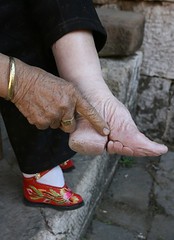
11906494583foot bindingPractice in Chinese society to mutilate women's feet in order to make them smaller; produced pain and restricted women's movement; made it easier to confine women to the household.14
11906494584tribute systemChinese method of dealing with foreign lands and people's that assumed the subordination of all non-Chinese authorities and required the payment of tribute --produce of value from their countries--to the Chinese emperor(although the Chines gifts given in return were often much more valuable).15
11906494589Chinese BuddhismChina's only large-scale cultural borrowing before the 20th century. Buddhism entered China from India in the first and second centuries C.E but only became popular between 300-800 C.E through a series of cultural accommodations. At first supported by the state, Buddhism suffered persecution during the 9th century but continued to play a role in Chinese society.16
11906494591QuranThe holy book of Islam17
11906494592ummaThe community of all Muslims. A major innovation against the background of seventh-century Arabia, where traditionally kinship rather than faith had determined membership in a community.18
11906494593Pillars of IslamThe five core practices required of Muslims: a profession of faith, regular prayer, charitable giving, fasting during Ramadan, and a pilgrimage to Mecca (if physically and financially possible).19
11906494594hijraThe Migration of Muhammad from Mecca to Medina in A.D. 622, marking the founding of Islam20
11906494595shariaBody of Islamic law that includes interpretation of the Quran and applies Islamic principles to everyday life21
11906494596jizyatax paid by Christians and Jews who lived in Muslim communities to allow them to continue to practice their own religion22
11906494597ulamaMuslim religious scholars. From the ninth century onward, the primary interpreters of Islamic law and the social core of Muslim urban societies.23
11906494598Umayyad Caliphate(661-750 CE) The Islamic caliphate that established a capital at Damascus, conquered North Africa, the Iberian Pennisula, Southwest Asia, and Persia, and had a bureaucracy with only Arab Muslims able to be a part of it.24
11906494599Abbasid Caliphate(750-1258 CE) The caliphate, after the Umayyads, who focused more on administration than conquering. Had a bureaucracy that any Mulim could be a part of.25
11906494600SufismA branch of Islam, defined by adherents as the inner, mystical dimension of Islam; others contend that it is a perennial philosophy of existence that pre-dates religion, the expression of which flowered within Islam26
11906494601Ibn Battuta(1304-1369) Morrocan Muslim scholar, the most widely traveled individual of his time. He wrote a detailed account of his visits to Islamic lands from China to Spain and the western Sudan. His writings gave a glimpse into the world of that time period.27
11906494602TimbuktuMali trading city that became a center of wealth and learning28
11906494603Mansa MusaRuler of Mali (r. 1312-1337). His extravagant pilgrimage through Egypt to Mecca in 1324-1325 established the empire's reputation for wealth in the Mediterranean world.29
11906494604madrassasFormal colleges for higher institutions in the teaching of Islam as well as in secular subjects founded throughout the Islamic world in beginning in the 11th century30
11906494605House of WisdomCombination library, academy, and translation center in Baghdad established in the 800s.31
11906494607Ethiopian Christianity (aka Coptic church)Rulers of axum had adopted Christianity. Christian island in a Muslim sea protected by its moutanous geography and distance from major centers of islamic power. Also helped muhammad's followers be safe. This isolation made it develop a fascination with judaism and jerusalem. Justified their rule through a connection with Solomon as a descendent of jesus. Tried to create a new jerusalem32
11906494608Byzantine Empire(330-1453) The eastern half of the Roman Empire, which survived after the fall of the Western Empire at the end of the 5th century C.E. Its capital was Constantinople, named after the Emperor Constantine.33
11906494609ConstantinopleA large and wealthy city that was the imperial capital of the Byzantine empire and later the Ottoman empire, now known as Istanbul34
11906494610JustinianByzantine emperor in the 6th century A.D. who reconquered much of the territory previously ruler by Rome, initiated an ambitious building program , including Hagia Sofia, as well as a new legal code35
11906494611caesaropapisma political-religious system where the secular ruler is also the head of the religious establishment (Byzantine Empire)36
11906494612Eastern Orthodox ChristianityEastern branch of Christianity that evolved following the division of the Roman Empire and the subsequent development of the Byzantine Empire in the east and the medieval European society in the west. The church recognized the primacy of the patriarch of Constantinople37
11906494617Holy Roman EmpireA medieval and early modern central European Germanic empire, which often consisted of hundreds of separate Germanic and Northern Italian states. In reality it was so decentralized that it played a role in perpetuating the fragmentation of central Europe.38
11906494618Roman Catholic churchOne of three major branches of Christianity, together with the Eastern Orthodox Church, a second of the three major divisions of Christianity, arose out of the division of the Roman empire into four governmental regions. In 1054 CE Christianity was divided along that same line when the Eastern Orthodox, centered in Constantinople, and the ______ ______ ______, centered in Rome, split.39
11906494619Western ChristendomWestern Europe was on the margins of world history for most of the postclassical millennium; It was far removed from the growing world trade routes; European geography made political unity difficult; Coastlines and river systems facilitated internal exchange;40
11906494620CrusadesArmed pilgrimages to the Holy Land by Christians determined to recover Jerusalem from Muslim rule. The Crusades brought an end to western Europe's centuries of intellectual and cultural isolation.41
11906494621pastoralismA type of agricultural activity based on nomadic animal husbandry or the raising of livestock to provide food, clothing, and shelter.42
11906494623Turks6th-10th centuries C.E. •Pastoral ethnic group that originated in northern Eurasia and spread into Central Asia and the Middle East •Had significant cultural and political interactions with China, Persia, Byzantium •Conversion to Islam 10th-14th centuries •Diffused Islam throughout Middle East, India, Anatolia(Turkey)43
11906494624Temujinleader of the largest Mongol clans; he unites them all(plans to conquer Asia); and receives title Genghis Khan(universal ruler)44
11906494625the Mongol worldEurasia, 13th-15th centuries •50-year period of Mongol conquests across Eurasia that created the Mongol empire •Subjected huge populations to Mongol rule •Military strength allowed for rapid conquest •Mongol rule created interactions between diverse groups •Served to diffuse technology, culture, political and economic systems45
11906494626Yuan Dynasty(1279-1368 CE) The dynasty with Mongol rule in China; centralized with bureaucracy but structure is different: Mongols on top->Persian bureaucrats->Chinese bureuacrats.46
11906494627Kublai Khan(1215-1294) Grandson of Genghis Khan and founder of the Mongol Yuan Dynasty in China.47
11906494629Paleolithic Persistencepre-1492 life in much of the Americas (especially North America); characterized by living a simple primitive lifestyle, without entering into large settlements or the iron age48
11906494631Ming DynastySucceeded Mongol Yuan dynasty in China in 1368; lasted until 1644; initially mounted huge trade expeditions to southern Asia and elsewhere, but later concentrated efforts on internal development within China.49
11906494632European Renaissancea "rebirth" of classical learning that is most often associated with the cultural blossoming of Italy is the period 1350-1500 and included Greek learning and growing secularism50
11906494633Zheng HeAn imperial eunuch and Muslim, entrusted by the Ming emperor Yongle with a series of state voyages that took his gigantic ships through the Indian Ocean, from Southeast Asia to Africa.51
11906494634Ottoman EmpireIslamic state founded by Osman in northwestern Anatolia. After the fall of the Byzantine Empire, the Ottoman Empire was based at Istanbul (formerly Constantinople) from 1453-1922. It encompassed lands in the Middle East, North Africa, the Caucasus, and eastern Europe.52
11906494635seizure of ConstantinopleConstantinople fell to army of Ottoman sultan Mehmed II "the Conqueror" in 1453, marking end of Christian Byzantium53
11906494636Safavid EmpireTurkish-ruled Iranian kingdom (1502-1722) established by Ismail Safavi, who declared Iran a Shi'ite state.54
11906494637Songhay EmpireA state located in western Africa. From the early 15th to the late 16th century, it was one of the largest Islamic empires in history.55
11906494638Mughal EmpireMuslim state (1526-1857) exercising dominion over most of India in the sixteenth and seventeenth centuries; a minority of Muslims ruled over a majority of Hindus.56
11906494639MalaccaPort city in the modern Southeast Asian country of Malaysia, founded about 1400 as a trading center on the Strait of Malacca. Also spelled Melaka.57
11906494640Aztec Empire1325-1500 CE. Also known as Mexica, the Aztecs created a powerful empire in central Mexico. Forced defeated people to provide goods and labor as tax. At its best had complex myth and religious traditions and reached amazing architectural and artistic accomplishments.58
11906494641Inca Empire(1450-1572 CE), Largest Empire ever built in South America; territory extended 2,500 miles from north to south and embraced almost all of modern Peru, most of Ecuador, much of Bolivia, and parts of Chile and Argentina; maintained effective control from the early 15th century until the coming of Europeans in the early 16th century. As the most powerful people of Andean America, the Inca dominated Andean society until the coming of Europeans; was an extremely diverse culture cause it spanned north and south rather then east and west.59

AP World History - Strayer - Chapter 1 Flashcards

Terms : Hide Images
12335996007Venus FigurinesPaleolithic carvings of the female form, often with exaggerated breasts, buttocks, hips, and stomachs, which may have had religious significance0
12335996008DreamtimeA complex worldview of Australia's Aboriginal peopel that held that current humans live in an echo of ancestral happenings1
12335996009Clovis CultureThe earliest widespread and distinctive culture of North America; named from the Clovis point, a particular kind of projectile point2
12335996010Megafaunal ExtinctionThe dying-out of a number of large animal species, including the mammoth and several species of horses and camels; occured around 11,000-10,000 years ago at the end of the Ice Age. The extinction may have been caused by excessive hunting or by the changing of climate of the era3
12335996011Austronesian MigrationsThe last phase of the great human migration that established a human presence in every habitable region of the earth. Austronesian-speaking people settled the Pacific island and Madagascar in a series of seaborne migrations that began around 3,500 years ago4
12335996012shamansIn many early societies, a person believed to have the ability to act as a leasion between living humans and supernatural forces, often by means of trances induced by psychoactive drugs5
12335996013trance danceIn San culture, a nightlong ritual held to activate a human being's innter spiritual potency [n/um] to counteract the evil influences of gods and ancestors. The practice was apparently common to the Khoisan people, of whom the Jo/'hoansi are a surviving remnant6
12335996014Paleolithic settling downThe process by which some Paleolithic peoples moved toward permanent settlement in the wake of the last Ice Age. Settlement was marked by increasing storage of food and accumulation of goods, as well as growing inequalities in society7
12335996015Gobekli Tepeoldest religious structure. made by hunter gathers. Indicates that religion came before organization of labor, settlement and agriculture8
12335996016Fertile CrescentA geographical area of fertile land in the Middle East stretching in a broad semicircle from the Nile to the Tigris and Euphrates9
12335996017Teosintea wild grass found in the highlands of Mexico, is the wild ancestor of maize10
12335996018DiffusionIs the process by which a characterictic spreads11
12335996019Bantu Migrations(1500BCE to 500CE) As the Bantu people migrated, they spread the Bantu family of languages and culture. The Bantu also spread the use of iron, which improved farming techniques and agricultural efficiency, the greater food supply sparked economic development and population growth. The changes instigated by the Bantu migration increased the vitality of sub-Saharan Africa.12
12335996020IshiThe last the Yali people found in northern California in 1951. He is a good example of how the growth of agricultural societies led to the collapse of gathering and hunting communities.13
12335996021"secondary products revolution"A term used to describe the series of technological changes that began c.a. 4000 B.C.E., as people began to develop new uses for their domesticated animals, exploiting a revolutionary new source of power. Examples: milk, transportation, wool, hunting help, glue, muscle power, eggs, blood, feathers, bones, ivory, manure/fertilizer, and hides/fur.14
12335996022Pastoral SocietiesBased on the domestication of animals and use their products as main source of food. Groups move where there is foods but they are more settlers than nomads. Independent and warlike.15
12335996023CatalhuyukGood example of agricultural village society. Social structure, buried dead, many people, well built houses, specialization.16
12335996024ChiefdomsA society that is led by a ruler of decent, but seldom used force to lead their people. They relied on generosity, charisma, and leadership to rule.17
12335996025Paleolithic Rock ArtThe hundreds of Paleolithic painting discovered in Spain and France, dating to about 20,000 years ago; these paintings depict a range of animals, although human figures and abstract designs are also found.18
12335996026NeanderthalsHomo sapiens neanderthalensis, a European varient of Homo sapiens that died out about 25,000 years ago19

Pages

Subscribe to CourseNotes RSS

Need Help?

We hope your visit has been a productive one. If you're having any problems, or would like to give some feedback, we'd love to hear from you.

For general help, questions, and suggestions, try our dedicated support forums.

If you need to contact the Course-Notes.Org web experience team, please use our contact form.

Need Notes?

While we strive to provide the most comprehensive notes for as many high school textbooks as possible, there are certainly going to be some that we miss. Drop us a note and let us know which textbooks you need. Be sure to include which edition of the textbook you are using! If we see enough demand, we'll do whatever we can to get those notes up on the site for you!