

AP World History Period 2 Flashcards
Terms : Hide Images
| 12131344675 | Alexander the Great | Leader of Macedon (356-323 B.C.E.), who conquered Persia and Egypt, creating an empire that merged several cultures. |  | 0 |
| 12131344676 | Ashoka | The most famous ruler of the Mauryan Empire (r. 268-232 B.C.E.), who promoted Buddhism and practiced religious tolerance. |  | 1 |
| 12131344677 | Chandragupta Mauyra | Founder of the Mauryan dynasty. Began centralization of power in S. Asia. | 2 | |
| 12131344678 | Caesar Augustus | The great-nephew and adopted son of Julius Caesar who emerged as sole ruler of the Roman state at the end of an extended period of civil war (r. 31 B.C.E.-14 C.E.). |  | 3 |
| 12131344679 | Constantine | Roman emperor of the 4th century CE who legalized Christianity. | 4 | |
| 12131344680 | Cyrus (the Great) | Founder of the Achaemenid Empire (r. 557-530 B.C.E.); a ruler noted for his conquests, religious tolerance, and political moderation. |  | 5 |
| 12131344681 | Darius I | Achaemenid king (r. 522-486 B.C.E.) who expanded the Persian empire through military conquest and undertook building campaigns in Susa and Parsargaade. |  | 6 |
| 12131344682 | Gupta | Empire that promoted Hinduism and under which India entered a "golden age" of culture. | 7 | |
| 12131344764 | Mauryan Empire |  | 8 | |
| 12131344683 | Han dynasty | Chinese dynasty that restored unity in China, pacified the xiongnu, and set up the civil service exams to create competent bureaucrats to administer the empire. |  | 9 |
| 12131344684 | Hellenistic | The spread of Greek culture throughout Afro-Eurasia from 323 to 30 B.C.E by Alexander the Great and hsi political successors. |  | 10 |
| 12131344685 | Ptolemaic Empire | Dynasty of Egypt founded by descendants of Macedonian generals. They promoted science, greek learning, and trade. | 11 | |
| 12131344686 | Mandate of Heaven | The ideological underpinning of Chinese emperors, this was the belief that a ruler held authority by command of divine force as long as he ruled morally and benevolently. |  | 12 |
| 12131344687 | Patricians | Wealthy, privileged Romans who dominated early Roman society. | 13 | |
| 12131344688 | plebians | Members of the general citizenry of ancient Rome. It included all citizens not connected to one of Rome's privileged families. They had little real power. | 14 | |
| 12131344689 | Pax Romana | The "Roman peace," a term typically used to denote the stability and prosperity of the early Roman Empire, especially in the first and second centuries C.E. |  | 15 |
| 12131344690 | Peloponnesian War | Great war between Athens (and allies) and Sparta (and allies), lasting from 431 to 404 B.C.E. The conflict ended in the defeat of Athens and the closing of Athens's Golden Age. |  | 16 |
| 12131344691 | Persepolis | The capital and greatest palace-city of the Persian Empire, destroyed by Alexander the Great. |  | 17 |
| 12131344692 | Pataliputra | Located at the confluence of the Ganges and Son Rivers in northeastern India. It was the capital city of the Mauryan and Gupta empires. | 18 | |
| 12131344693 | Alexandria | An important center of the Hellenistic civilization best known for the Lighthouse and largest library in the ancient world | 19 | |
| 12131344694 | Appian Way (Via Appia) | One of the earliest and strategically most important Roman roads of the ancient republic | 20 | |
| 12131344695 | Samarkand | Important trading city that benefited from it's position along the silk roads. | 21 | |
| 12131344696 | Qin Dynasty | A short-lived (221-206 B.C.E.) but highly influential Chinese dynasty that succeeded in reuniting China at the end of the Warring States period. used Legalism as its base of belief. |  | 22 |
| 12131344697 | Qin Shihuangdi | Literally "first emperor" (r. 221-210 B.C.E.) forcibly united China and established a strong and repressive state. | 23 | |
| 12131344698 | Wudi | Han emperor (r. 141-86 B.C.E.) who began the Chinese civil service system by establishing an academy to train imperial bureaucrats. | 24 | |
| 12131344699 | Han Fei | Founder of legalism, a system justifying rule by a strong authority | 25 | |
| 12131344700 | Kong Fuzi | Chinese philosopher who promoted a system of social and political ethics emphasizing order, moderation, and reciprocity between superiors and subordinates. The Analects contains a collection of his sayings and dialogues compiled by disciples after his death. | 26 | |
| 12131344701 | Socrates | The first great Greek philosopher to turn rationalism toward questions of human existence (469-399 B.C.E.). | 27 | |
| 12131344702 | Aristotle | A Greek philosopher (384-322 B.C.E.) who stressed the importance of using empirical evidence to explain the natural world | 28 | |
| 12131344703 | Solon | Athenian statesman and lawmaker (fl. 594-560 B.C.E.) whose reforms led the Athenians toward democracy. | 29 | |
| 12131344704 | Plato | Philosopher who believed the wisest men should rule. He introduced the idea that human misery due to their not engaging properly with a class of entities he called forms, chief examples of which were Justice, Beauty, and Equality. | 30 | |
| 12131344705 | Bhagavad Gita | A great Hindu epic text, part of the much larger Mahabharata, which affirms the performance of caste duties as a path to religious liberation. | 31 | |
| 12131344706 | Brahmins | The priestly caste of India. | 32 | |
| 12131344707 | Buddhism | The cultural/religious tradition first enunciated by Siddhartha Gautama | 33 | |
| 12131344708 | Daoism | A Chinese philosophy/popular religion that advocates simplicity and understanding of the world of nature, founded by the legendary figure Laozi. | 34 | |
| 12131344709 | Filial piety | The honoring of one's ancestors and parents, a key element of Confucianism. | 35 | |
| 12131344710 | Hinduism | A word derived from outsiders to describe the vast diversity of indigenous Indian religious traditions. | 36 | |
| 12131344711 | Hippocrates | A very influential Greek medical theorist (ca. 460-ca. 370 B.C.E.); regarded as the father of medicine. | 37 | |
| 12131344712 | Jesus of Nazareth | The prophet/god of Christianity(ca. 4 B.C.E.-ca. 30 C.E.). | 38 | |
| 12131344713 | Paul | Follower of Jesus who helped spread Christianity by preaching to both Jews and non-Jews and speaking to large audiences throughout the Roman Empire. | 39 | |
| 12131344714 | Peter | One of the 12 Apostles who made Rome the center of Christianity and is known as the first pope. | 40 | |
| 12131344715 | Karma | In Hinduism, the determining factor of the level at which the individual is reincarnated, based on purity of action and fulfillment of duty in the prior existence. |  | 41 |
| 12131344716 | Laozi | A legendary Chinese philosopher of the sixth century B.C.E.; regarded as the founder of Daoism. | 42 | |
| 12131344717 | Legalism | A Chinese philosophy distinguished by an adherence to clear laws with vigorous punishments. | 43 | |
| 12131344718 | Nirvana | The end goal of Buddhism, in which individual identity is "extinguished" into a state of serenity and great compassion. | 44 | |
| 12131344719 | Siddhartha Gautama (the Buddha) | The Indian prince turned ascetic (ca. 566-ca. 486 B.C.E.) who founded Buddhism. | 45 | |
| 12131344720 | Theravada | "The Teaching of the Elders," the early form of Buddhism according to which the Buddha as a wise teacher but not divine and which emphasizes withdrawal from earthly pleasures in order to achieve nirvana | 46 | |
| 12131344721 | Mahayana | A form of Buddhism popular in East Asia that | 47 | |
| 12131344722 | Upanishads | Indian mystical and philosophical works, written between 800 and 400 B.C.E. | 48 | |
| 12131344723 | Vedas | The earliest religious texts of India, a collection of ancient poems, hymns, and rituals that were transmitted orally before being written down ca. 600 B.C.E. | 49 | |
| 12131344724 | Yin and Yang | Expression of the Chinese belief in the unity of opposites. | 50 | |
| 12131344725 | Zarathustra | A Persian prophet, traditionally dated to the sixth or seventh century B.C.E. (but perhaps much older), who founded Zoroastrianism. | 51 | |
| 12131344726 | Manichaeism | a syncretic religious system founded by a Persian claiming to be a prophet. It combined Gnostic Christianity, Buddhism, Zoroastrianism, and various other elements, which included doctrines of light and darkness:; the need for an ascetic life to purify the soul; and the need for personal salvation from the divine force of goodness. | 52 | |
| 12131344727 | jati | social distinctions based on occupation, which became the main cell of social life in India. | 53 | |
| 12131344728 | Zoroastrianism | Persian monotheistic religion founded by the prophet Zarathustra. | 54 | |
| 12131344729 | helots | The dependent, semi-enslaved class of ancient Sparta whose social discontent prompted the militarization of Spartan society. | 55 | |
| 12131344730 | Pericles | A prominent and influential statesman of ancient Athens (ca. 495-429 B.C.E.); presided over Athens's Golden Age. | 56 | |
| 12131344731 | Sudra | Originally the lowest Indian social class of varna; regarded as servants of their social betters; eventually included peasant farmers | 57 | |
| 12131344732 | Untouchables | An Indian social class that emerged below the Sudras and whose members performed the most unclean and polluting work. | 58 | |
| 12131344733 | Vaisya | The Indian social class that was originally defined as farmers but eventually comprised merchants. | 59 | |
| 12131344734 | Silk Road | Trade route stretching from China into Europe. | 60 | |
| 12131344735 | Yellow Turban uprising | Chinese peasant uprising that weakened the Han Empire. | 61 | |
| 12131344736 | Spartacus Rebellion | One of the largest slave revolts in history. It was led by a Roman slave who was backed by thousands of other slaves. It demonstrates the weakness of having a labor system increasingly dependent on slavery. | 62 | |
| 12131344737 | Parthian | Empire in modern Iraq, Iran, and Afghanistan. originally made of nomadic peoples from Central Asia . They were able to defend the region from the Romans. | 63 | |
| 12131344738 | Visigoths | Tribe who sacked Rome in the 5th century CE | 64 | |
| 12131344739 | Xiongnu | Central Asian tribe who harassed the early Chinese empires until they were occupied and pacified by the Han. | 65 | |
| 12131344740 | Diaspora | the dispersion of the Jews outside Israel | 66 | |
| 12131344741 | Reincarnation | In Hinduism and Buddhism, the process by which a soul is reborn continuously until it achieves perfect understanding | 67 | |
| 12131344742 | Caste System (Varnas) | a set of rigid social categories that determined not only a person's occupation and economic potential, but also his or her position in society | 68 | |
| 12131344743 | Monotheism | belief in only one god | 69 | |
| 12131344744 | Polytheism | belief in more than one god | 70 | |
| 12131344745 | Filial Piety | In Confucian thought, one of the virtues to be cultivated, a love and respect for one's parents and ancestors. | 71 | |
| 12131344746 | Universal truths (dealing with belief systems) | truths common to all people and at the heart of the identity of all people | 72 | |
| 12131344747 | Monasticism | Living in a religious community apart from secular society and adhering to a rule stipulating chastity, obedience, and poverty. | 73 | |
| 12131344748 | Shamanism | The practice of identifying special individuals (shamans) who will interact with spirits for the benefit of the community. Characteristic of the Korean kingdoms of the early medieval period and of early societies of Central Asia. (p. 292) | 74 | |
| 12131344749 | Animism | Belief that objects, such as plants and stones, or natural events, like thunderstorms and earthquakes, have a discrete spirit and conscious life. | 75 | |
| 12131344750 | Ancestor Veneration | The practice of praying to your ancestors. Found especially in China. | 76 | |
| 12131344751 | Han Dynasty | imperial dynasty that ruled China (most of the time) from 206 BC to 221 and expanded its boundaries and developed its bureaucracy |  | 77 |
| 12131344752 | Zhou Dynasty | the longest lasting Chinese dynasty, during which the use of iron was introduced. | 78 | |
| 12131344753 | Hellenistic Era | the age of Alexander the Great; period when the Greek language and ideas were carried to the non-Greek world | | 79 |
| 12131344754 | Roman Empire | Existed from 27 BCE to about 400 CE. Conquiered entire Mediterranean coast and most of Europe. Ruled by an emperor. Eventually oversaw the rise and spread of Christianity. |  | 80 |
| 12131344755 | Syncretism | a blending of beliefs and practices from different religions into one faith | 81 | |
| 12131344756 | society | the aggregate of people living together in a more or less ordered community. | 82 | |
| 12131344757 | Stoicism | An ancient Greek philosophy that became popular among many notable Romans. Emphasis on ethics. They considered destructive emotions to be the result of errors in judgment, and that a wise person would repress emotions, especially negative ones and that "virtue is sufficient for happiness." They were also concerned with the conflict between free will and determinism. They were also non-dualists and naturalists. | 83 | |
| 12131344758 | Cicero | Rome's greatest public speaker; he argued against dictators and called for a representative government with limited powers | 84 | |
| 12131344759 | doctrine | (n.) a belief, principle, or teaching; a system of such beliefs or principles; a formulation of such beliefs or principles | 85 | |
| 12131344760 | Salvation | deliverance from ruin, acceptance into heaven, fulfillment of the principles of a religion | 86 | |
| 12131344761 | Asceticism | severe self-discipline and avoidance of all forms of indulgence, typically for religious reasons. | 87 | |
| 12131344762 | Oracle Bones | one of the animal bones or tortoise shells used by ancient Chinese priests to communicate with the gods, Shang dynasty | 88 | |
| 12131344763 | Diasporic communities | Widely dispersed community as a result of natural disaster, politics or other reasons. Many communities have become diasporic throughout time starting with the Jews of Babylon in ancient history | 89 |
AP World History - 2018 - Chapter 3 Notes Flashcards
Terms : Hide Images
| 10509680912 | Iron Age | Time which iron dominated bronze because of its strength and ability to maintain sharper edges | 0 | |
| 10509681812 | Cosmopolitan | Having widely shared cultures and lifestyles, such as states in the Middle East | 1 | |
| 10509683266 | Kassites | People who moved from Zagreb mountains into southern Mesopotamia, ruled Babylon, yet did not pursue territorial conquest | 2 | |
| 10509690061 | Assyrian Kingdom | Located in Mesopotamia, anchored a busy trade route, and expanded its power by conquering kingdoms | 3 | |
| 10509691899 | Hittites | Most powerful state in Mesopotamia, Adoped the horse drawn chariot, and developed methods for making iron | 4 | |
| 10509692983 | Akkadian | Language which government diplomats would communicate with | 5 | |
| 10509693526 | Hyksos | Ruled Egypt between middle and new kingdom and had advanced military technology | 6 | |
| 10509695381 | The New Kingdom | Aggressively expanded the state, gaining access to important materials and participating in the diplomatic and commercial networks in Asia | 7 | |
| 10509696826 | Hatshepsut | Commanded the New kingdom after husband died | 8 | |
| 10509697251 | Akhenaten | Untraditional ruler in Egypt, closing temples and challenging the supremacy of Amon. | 9 | |
| 10509699167 | Rameses II | ruler after Akhenaten, living into his 90 and correcting Akhenaten's mistakes | 10 | |
| 10509704010 | Minoan | Civilization of Crete, first European civilization to have complex social structures and technologies, and has undelivered writing | 11 | |
| 10509705726 | Crete | Island of Minoan civilization, off Greece in Mediterranean Sea | 12 | |
| 10509708152 | Cnossus | Only palace not destroyed by the Greeks | 13 | |
| 10509708750 | Mycenae | Created first greek culture, and stayed farmers and Shepards long past other civilization's switch. Changed from Minoan influences | 14 | |
| 10509709798 | Shaft Graves | Graves in Greece containing bodies and rare minerals | 15 | |
| 10509711552 | Linear B | Script which uses pectoral signs to represent symbols, an early form of greek | 16 | |
| 10509712991 | Philistines | Invaded and occupied the coast of Palestine, lead to the collapse of egypt | 17 | |
| 10509714384 | Dark Age | Occurred after the collapse of the Mycenean civilization, caused the Middle East to fall into century long period of poverty, isolation, and loss of knowledge | 18 | |
| 10509715404 | Neo-Assyrian empire | Conquered by Assyrians in northern Mesopotamia, using force and terror, and was most powerful civilization after the dark age | 19 | |
| 10509717764 | Mass Deportation | Forced moving of communities to prevent rebellion used by the Assyrians | 20 | |
| 10509718305 | Library of Ashurbanipal | Contained official documents, literature, and scientific text in Assyria | 21 | |
| 10509720219 | Israel | Small land linking Anatolia, Egypt, Arabia, and Mesopotamia, although lacking natural resources | 22 | |
| 10509723102 | Hebrew Bible | Compilation of several collections of materials from different group, described Abraham and his descendants | 23 | |
| 10509723977 | Abraham | Religious figure in the Hebrew Bible who left Ur and migrated to Israel with the help of god Yahweh | 24 | |
| 10509725107 | Exodus | Story of how Israelites were led out of captivity by Moses | 25 | |
| 10509725448 | Chosen People | Israelites who promised their god to worship him exclusively, and proposed the 10 commandments | 26 | |
| 10509726496 | David | Shepard who oversaw Israel's change from tribal confederacy to unified monarchy, and brought the ark to Jerusalem | 27 | |
| 10509727709 | First Temple | Central shrine to strengthen link between religion and authority | 28 | |
| 10509728674 | Monotheism | Belief in only one god, founded by Israelites | 29 | |
| 10509729330 | Diaspora | The dispersion of jews from their homeland, caused by Israelites leaving Babylon | 30 | |
| 10509730264 | Phoenicians | People living on the coast of Lebanon and Syria | 31 | |
| 10509735356 | Byblos | Most important city state in Babylon, was a distribution center for cedar and papyrus | 32 | |
| 10509736885 | Tyre | King who took control of Sidon and dominated Mediterranean coastal trade | 33 | |
| 10509737713 | Phoenician Triangle | String of settlements in west Mediterranean, controlling the passage between the Mediterranean and Atlantic | 34 | |
| 10509739169 | Carthage | Phoenician colony at war with other Phoenician communities | 35 | |
| 10509740194 | Neo-Babylon Kingdom | Dominated Assyria and had a cultural renaissance | 36 |
AP World History: Chapter 7 Flashcards
Terms : Hide Images
| 12168578123 | American web | A term used to describe the network of trade that linked parts of the pre-Columbian Americas; although less intense and complete than the Afro-Eurasian trade networks, this web nonetheless provided a means of exchange for luxury goods and ideas over large areas | 0 | |
| 12168578124 | Angkor Wat | The largest religious structure in the premodern world, construction began on this temple located in modern Cambodia in the early 1100s C.E. It was built to express a Hindu understanding of the cosmos, centered on a mythical Mt Meru, the home of the gods in Hindu tradition | 1 | |
| 12168578125 | Black Death | The name given to the massive epidemic that swept Eurasia in the fourteenth century C.E.; it may have been bubonic plague, anthrax, or a collection of epidemic diseases | 2 | |
| 12168578126 | Borobudur | The largest Buddhist monument ever built, Borobudur is a mountainous ten-level monument with an elaborate carving program, probably built in the ninth century C.E. by the Sailendras rulers of central Java; it is an outstanding example of cultural exchange and syncretism | 3 | |
| 12168578127 | Bubonic plague | A highly fatal disease transmitted by fleas; it devastated the Mediterranean world between 534 and 750 C.E. and again in the period 1346-1350 C.E. (see Black Death) | 4 | |
| 12168578128 | Ghana, Mali, Songhay | A series of important states that developed in western and central Sudan in the period 500-1600 C.E. in response to the economic opportunities of trans -Saharan trade (especially control of gold production) | 5 | |
| 12168578129 | Great Zimbabwe | A powerful state in the African interior that apparently emerged from the growing trade in gold to the East African coast; flourished between 1250 and 1350 C.E. | 6 | |
| 12168578130 | Ibn Battuta | A famous Muslim traveler who visited much of the Islamic world in the fourteenth century and wrote a major account of what he saw | 7 | |
| 12168578131 | Indian Ocean trading network | The world's largest sea-based system of communication and exchange before 1500 C.E., Indian Ocean commerce stretched from southern China to eastern Africa and included not only the exchange of luxury and bulk goods but also the exchange of ideas and crops | 8 | |
| 12168578132 | Jie people | A nomadic people who controlled much of northern China in the third and fourth centuries; many converted to Buddhism | 9 | |
| 12168578133 | Malaysians | Speakers of Austronesian languages from what is now Indonesia who became major traders in Southeast Asia and Madagascar | 10 | |
| 12168578134 | Monsoons | Alternating wind currents that blew eastward across the Indian Ocean in the summer and westward in the winter, facilitating trade | 11 | |
| 12168578135 | Oasis cities of Central Asia | Cities such as Merv, Samarkand, Khotan, and Dunhuang that became centers of trans-Eurasian trade | 12 | |
| 12168578136 | Pochteca | Professional merchants among the Aztecs | 13 | |
| 12168578137 | Sailendras | A kingdom of central Java that flourished from the eighth century to the tenth century C.E.; noted for being deeply influenced by Indian culture | 14 | |
| 12168578138 | Sand Roads | A term used to describe the routes of the trans -Sahara trade in Africa | 15 | |
| 12168578139 | Silk Roads | Land-based trade routes that linked Eurasia | 16 | |
| 12168578140 | Srivijaya | A Malay kingdom that dominated the Straits of Malacca between 670 and 1025 C.E.; noted for its creation of a native/Indian hybrid culture | 17 | |
| 12168578141 | Sudan | From the Arabic term for "land of black people," a large region of West Africa that became part of a major exchange circuit | 18 | |
| 12168578142 | Swahili civilization | An East African civilization that emerged in the eighth century C.E. from a blending of Bantu, Islamic, and other Indian Ocean trade elements | 19 | |
| 12168578143 | Third-wave civilizations | Civilizations that emerged between 500 and 1500 C.E. and were typified by intensifying trade networks | 20 | |
| 12168578144 | Thorfinn Karlsfeni | A well-born, wealthy merchant and seaman of Norwegian Viking background, Karlsfeni led an unscuccessful expedition to establish a colony on the coast of what is now Newfoundland, Canada, in the early eleventh century C.E. | 21 | |
| 12168578145 | Trans-Saharan slave trade | A fairly small-scale trade that developed in the twelfth century C.E., exporting West African slaves captured in raids across the Sahara for sale mostly as household servants in Islamic North Africa; the difficulty of travel across the desert limited the scope of this trade | 22 |
AP World History: Unit Flashcards
Terms : Hide Images
| 12221342785 | Trans-Oceanic Trade | global trading system in the Caribbean and the Americans trade networks extended to all corners of Atlantic Ocean | 0 | |
| 12221342786 | Columbian Exchange | An exchange of goods, ideas and skills from the Old World (Europe, Asia and Africa) to the New World (North and South America) and vice versa. |  | 1 |
| 12221342787 | Mercantilism | An economic policy under which nations sought to increase their wealth and power by obtaining large amounts of gold and silver and by selling more goods than they bought | 2 | |
| 12221342788 | Triangular Trade | Trading System between Europe, Africa, and the colonies; European purchased slaves in Africa and sold them to colonies, new materials from colonies went to Europe while European finished products were sold in the colonies. |  | 3 |
| 12221342789 | Middle Passage | A voyage that brought enslaved Africans across the Atlantic Ocean to North America and the West Indies | 4 | |
| 12221342790 | Caravel | A small, highly maneuverable three-masted ship used by the Portuguese and Spanish in the exploration of the Atlantic. | 5 | |
| 12221342791 | Cartography | the science or the art of making maps | 6 | |
| 12221342792 | Joint-stock companies | businesses formed by groups of people who jointly make an investment and share in the profits and losses | 7 | |
| 12221342793 | East India Companies | British, French, and Dutch trading companies that obtained government monopolies of trade to India and Asia; acted independently in their regions. | 8 | |
| 12221342794 | Royal African Company | a mercantile company set up by the Stuart family and London merchants to trade along the west coast of Africa | 9 | |
| 12221342795 | Vodun | African religious ideas and practices among descendants of African slaves in Haiti. | 10 | |
| 12221342796 | Italian Renaissance | rebirth of Classical (Greece/Rome) art/architecture - humanistic focus - patrons - families like Medici and the Catholic Church - blended natural world w/ religion - transition away from religion | 11 | |
| 12221342797 | The Medici | The Medici family was a family of bankers that started out as middle class & then loaned money to a guy that became the pope & then they became the wealthiest family in Florence. They sponsored many artists/architects like Brunesllshci & made lots of money off them. | 12 | |
| 12221342798 | Humanism | A Renaissance intellectual movement in which thinkers studied classical texts and focused on human potential and achievements | 13 | |
| 12221342799 | Protestant Reformation | A religious movement of the 16th century that began as an attempt to reform the Roman Catholic Church and resulted in the creation of Protestant churches. | 14 | |
| 12221342800 | Martin Luther | A German monk who became one of the most famous critics of the Roman Catholic Chruch. In 1517, he wrote 95 theses, or statements of belief attacking the church practices. He led the Protestant Reformation. | 15 | |
| 12221342801 | 95 Theses | Martin Luther's ideas that he posted on the church door at Wittenburg which questioned the Roman Catholic Church. This act began the Reformation | 16 | |
| 12221342802 | Anglicanism | A Protestant denomination of the Christian faith founded by Henry VIII in England | 17 | |
| 12221342803 | Catholic Reformation | Religious reform movement within the Latin Christian Church, begun in response to the Protestant Reformation. It clarified Catholic theology and reformed clerical training and discipline. | 18 | |
| 12221342804 | Jesuits | Members of the Society of Jesus, a Roman Catholic order founded by Ignatius Loyola in 1534. They played an important part in the Catholic Reformation and helped create conduits of trade and knowledge between Asia and Europe. | 19 | |
| 12221342805 | Scientific Revolution | A major change in European thought, starting in the mid-1500s, in which the study of the natural world began to be characterized by careful observation and the questioning of accepted beliefs. | 20 | |
| 12221342806 | Copernicus | Devised a model of the universe with the Sun at the center, and not earth. | 21 | |
| 12221342807 | Descartes | French philosopher, discovered analytical geometry. Saw Algebra and Geometry have a direct relationship. Reduced everything to spiritual or physical. | 22 | |
| 12221342808 | Newton | This physicist developed the law of universal gravitation and further caused the decline of the old system of science | 23 | |
| 12221342809 | Galileo | He was the first person to use a telescope to observe objects in space. He discovered that planets and moons are physical bodies because of his studies of the night skies. | 24 | |
| 12221342810 | John Locke | 17th century English philosopher who opposed the Divine Right of Kings and who asserted that people have a natural right to life, liberty, and property. | 25 | |
| 12221342811 | Columbus | Italian navigator who discovered the New World in the service of Spain while looking for a route to China (1451-1506) | 26 | |
| 12221342812 | Magellan | Portuguese explorer who sailed around the Southern end of South America and eventually reached the Philippines, but was killed in a local war there | 27 | |
| 12221342813 | Vasco da Gama | the first European to reach India by sea sailing around the tip of Africa. | 28 | |
| 12221342814 | Zheng He | An imperial eunuch and Muslim, entrusted by the Ming emperor Yongle with a series of state voyages that took his gigantic ships through the Indian Ocean, from Southeast Asia to Africa. | 29 | |
| 12221342815 | Little Ice Age | Temporary but significant cooling period between the fourteenth and the nineteenth centuries; accompanied by wide temperature fluctuations, droughts, and storms, causing famines and dislocation. | 30 | |
| 12221342816 | Chattel Slavery | Absolute legal ownership of another person, including the right to buy or sell that person. | 31 | |
| 12221342817 | El Mina | Most important of early Portuguese trading factories in forest zone of Africa | 32 | |
| 12221342818 | Plantation Economy | This referred to the inefficient, slave-centered economy of the South where all land was used to grow large amounts of cash crops for export. | 33 | |
| 12221342819 | Indentured servitude | A worker bound by a voluntary agreement to work for a specified period of years often in return for free passage to an overseas destination. Before 1800 most were Europeans; after 1800 most indentured laborers were Asians. | 34 | |
| 12221342820 | Encomienda System | Spaniards received grants of a number of Indians, from whom they could exact "tribute" in the form of gold or labor | 35 | |
| 12221342821 | Hacienda System | landed estates granted to conquistadors | 36 | |
| 12221342822 | Mita System | The system recruiting workers for particularly difficult and dangerous chores that free laborers would not accept. | 37 | |
| 12221342823 | Devshirme | Christian boys, taken from the Balkan provinces, converted to Islam, and recruited by force to serve the Ottoman government. The boys must passed through a series of examinations to determine their intelligence and capabilities. | 38 | |
| 12221342824 | Jannisaries | a member of the Turkish infantry forming the Sultan's guard | 39 | |
| 12221342825 | Zamindars | a landowner, especially one who leases his land to tenant farmers. | 40 | |
| 12221342826 | Daimyo | (in feudal Japan) one of the great lords who were vassals of the shogun | 41 | |
| 12221342827 | Peninsulare | a Spanish-born Spaniard residing in the New World or the Spanish East Indies | 42 | |
| 12221342828 | Creoles | a person of mixed European and black descent, especially in the Caribbean | 43 | |
| 12221342829 | Mestizos | A person of mixed Native American and European ancestry | 44 | |
| 12221342830 | Mulattos | Persons of mixed European and African ancestry | 45 | |
| 12221342831 | Sociedad de castas | Caste system based on racial origins | 46 | |
| 12221342832 | Cape Colony | a former province of southern South Africa that was settled by the Dutch in 1652 and ceded to Great Britain in 1814 | 47 | |
| 12221342833 | Commercial Revolution | A dramatic change in the economy of Europe at the end of the Middle Ages. It is characterized by an increase in towns and trade, the use of banks and credit, and the establishment of guilds to regulate quality and price. | 48 | |
| 12221342834 | Potosi | a city in S Bolivia: formerly a rich silver-mining center | 49 | |
| 12221342835 | Absolutism | the acceptance of or belief in absolute principles in political, philosophical, ethical, or theological matters | 50 | |
| 12221342836 | *Louis XIV | (1638-1715) Known as the Sun King, he was an absolute monarch that completely controlled France. One of his greatest accomplishments was the building of the palace at Versailles. | 51 | |
| 12221342837 | *Phillip II | King of Spain, 1556 - 1598; married to Queen Mary I of England;he was the most powerful monarch in Europe until 1588; controlled Spain, the Netherlands, the Spanish colonies in the New World, Portugal, Brazil, parts of Africa, parts of India, and the East Indies. He was also father to Alexander the Great. | 52 | |
| 12221342838 | *Ivan III | "Ivan the Great"; ruled as great prince and first ruler of the independent state called Russia. Prince of Moscow who ended Mongol rule in 1480 and adopted the title of tsar. | 53 | |
| 12221342839 | *Ivan IV | the Terrible, beat the Mongols, Tartars, and the Poles, forced nobles into service, first ruler to take the title tsar | 54 | |
| 12221342840 | *Peter the Great | (1672-1725) Russian tsar. He enthusiastically introduced Western languages and technologies to the Russian elite, moving the capital from Moscow to the new city of St. Petersburg. | 55 | |
| 12221342841 | *Parliamentary monarchy | A government with a king or queen whose power is limited by the power of a parliament | 56 | |
| 12221342842 | Divine Rights | A belief of kings and monarchs that they have a God-given right to rule and that rebellion against them is a sin. | 57 | |
| 12221342843 | Versailles | A palace built for Louis XIV near the town of Versailles, southwest of Paris. It was built around a chateau belonging to Louis XIII, which was transformed by additions in the grand French classical style | 58 | |
| 12221342844 | Absolutism | the acceptance of or belief in absolute principles in political, philosophical, ethical, or theological matters | 59 | |
| 12221342845 | Ottomans (Suleiman) | Gun powder empire | 60 | |
| 12221342846 | Safavids (Abbas) | Gun powder empire | 61 | |
| 12221342847 | Mughals (Akbar, Aurangzeb) | Gunpowder empire | 62 | |
| 12221342848 | Maroon | escaped slave in the Americas | 63 | |
| 12221342849 | European Empires in the Americans | Great Britain, France, Spain, Netherlands, Denmark | 64 | |
| 12221342850 | Aztecs | a nomadic tribe in northern Mexico, arrived in Mesoamerica around the beginning of the 13th century. From their magnificent capital city, Tenochtitlan, the Aztecs emerged as the dominant force in central Mexico, developing an intricate social, political, religious and commercial organization that brought many of the region's city-states under their control by the 15th century | 65 | |
| 12221342851 | Incas | A Native American people who built a notable civilization in western South America in the fifteenth and sixteenth centuries. The center of their empire was in present-day Peru. Francisco Pizarro of Spain conquered the empire. | 66 | |
| 12221342852 | Ming-Dynasty - China | The Ming dynasty was the ruling dynasty of China—then known as the Empire of the Great Ming—for 276 years following the collapse of the Mongol-led Yuan dynasty. | 67 | |
| 12221342853 | Tokugawa Shogunate | Unified daimyo (lords) to keep peace from 1600 to 1867 in Japan | 68 | |
| 12221342854 | Conquistadors | Early-sixteenth-century Spanish adventurers who conquered Mexico, Central America, and Peru. (Examples Cortez, Pizarro, Francisco.) | 69 | |
| 12221342855 | Thirty Year War | a series of wars in Central Europe between 1618 and 1648. It was one of the longest and most destructive conflicts in European history, as well as the deadliest European religious war, resulting in eight million casualties. | 70 | |
| 12221342856 | Treaty of Westphalia | Ended Thirty Years War in 1648; granted right to individual rulers within the Holy Roman Empire to choose their own religion-either Protestant or Catholic. | 71 | |
| 12221342857 | Edict of Nantes | document that granted religious freedom to the Huguenots | 72 | |
| 12221342858 | English Civil War | a series of armed conflicts and political machinations between Parliamentarians and Royalists over, principally, the manner of England's government | 73 | |
| 12221342859 | Glorious Revolution | A reference to the political events of 1688-1689, when James II abdicated his throne and was replaced by his daughter Mary and her husband, Prince William of Orange. | 74 | |
| 12221342860 | *John Locke | 17th century English philosopher who opposed the Divine Right of Kings and who asserted that people have a natural right to life, liberty, and property. | 75 |
Chapter 9: Ap World History (Ethel Wood) Flashcards
Terms : Hide Images
| 7941781714 | monsoons (227) | alternating winds that cause climate changes | 0 | |
| 7941781715 | stateless society (228) | no hierarchy of government officials (relies on kinship relationships) | 1 | |
| 7941781716 | Ghana (229) | African trading state | 2 | |
| 7941781717 | Mali (229) | 1rst replacement of Ghana | 3 | |
| 7941781718 | Songhay (229 & 232) | Followed Mali | 4 | |
| 7941781719 | Hausa (229) | powerful during the 15th century | 5 | |
| 7941781720 | Sundiata (230) | "Lion King" conquered all other regional leaders and founded Mali | 6 | |
| 7941781721 | groits (230) | master storytellers | 7 | |
| 7941781722 | Mansa Musa (232) | huge caravan of stuff on his pilgrimage to Mecca (ruled during Mali's height of trade) | 8 | |
| 7941781723 | Swahili Coast (233) | East coast of Africa (trade centers and Islamization) | 9 | |
| 7941781724 | Great Zimbabwe (234) | yielded great quantities of gold | 10 | |
| 7941781725 | Delhi Sultanate (235) | 1rst Islamic empire established in India | 11 | |
| 7941781726 | Diasporic Communities (237) | introduced their own cultural traditions into the indigenous culture | 12 | |
| 7941781727 | Marco Polo (238) | traveled to China and recorded his travels (Italian) | 13 | |
| 7941781728 | Ibn Battuta (238) | visited many areas in the tropics and kept an account of his travels | 14 |
AP World History Chapter One Vocabulary Terms Flashcards
Terms : Hide Images
| 10733887683 | Bronze Age | the period of ancient human culture characterized by the use of bronze that began between 4000 and 3000 b.c. and ended with the advent of the Iron Age |  | 0 |
| 10733903136 | Çatalhüyük | an important Neolithic site in what is now Turkey (pron. cha-TAHL-hoo-YOOK) |  | 1 |
| 10748069619 | Clan | a group of people tracing descent from a common ancestor; extended family |  | 2 |
| 10748086805 | Chiefdom | a societal grouping governed by a chief who typically relies on generosity, ritual status, or charisma rather than force to win obedience from the people |  | 3 |
| 10748098381 | Domestication | to adapt (an animal or plant) over time from a wild or natural state especially by selective breeding to life in close association with and to the benefit of humans |  | 4 |
| 10748106603 | Egalitarian | a belief in human equality especially with respect to social, political, and economic affairs |  | 5 |
| 10748113966 | Homo Sapiens | the primate species to which modern humans belong; humans regarded as a species; believed to have originated about 250,000 years ago |  | 6 |
| 10748124080 | Hunting and Gathering (Hunter Forager) | group that supports itself by hunting and fishing and by gathering wild fruits and vegetables; usually nomadic |  | 7 |
| 10748140267 | Jericho | city of ancient Palestine near the site of modern Jericho... sometimes said to be the oldest city |  | 8 |
| 10748146051 | Neolithic Revolution | In the Neolithic period farm animals were first domesticated and agriculture was introduced: it began in the Near East by the 8th millennium BC and spread to northern Europe by the 4th millennium BC. |  | 9 |
| 10748167381 | Paleolithic Age | also called Old Stone Age, ancient cultural stage, or level, of human development, characterized by the use of rudimentary chipped stone tools; 2.5 million years ago to 12,000 years ago |  | 10 |
| 10760200503 | Pastoralism | a human society that relies on domesticated animals rather than plants as the main source of food; pastoral nomads lead their animals to seasonal grazing grounds rather than settling permanently in a single location |  | 11 |
| 10760205767 | Patriarchy | a social organization marked by the supremacy of the father in the clan or family, the legal dependence of wives and children, and the reckoning of descent and inheritance in the male line; broadly : control by men of a disproportionately large share of power |  | 12 |
| 10760212935 | Specialization of Labor | ...it was no longer necessary for one individual to learn how to do every kind of work. Instead, one person could specialize in making pottery, while another could specialize in weaving cloth. As a result of this specialization, men and women were able to hone their skills. The quality of their pottery, cloth, or other products became increasingly better... |  | 13 |
| 10760217916 | Tribe | a social group comprising numerous families, clans, or generations together with slaves, dependents, or adopted strangers |  | 14 |
| 10760221475 | Austronesian Migration | the last phase of the great human migration that established a human presence in every habitable region of the earth.Austronesian-speaking people settled the Pacific islands and Madagascar in a series of seaborne migrations that began around 3,500 years ago |  | 15 |
| 10760226938 | Bantu Migration | the spread of Bantu-speaking peoples from their homeland in what is now southern Nigeria or Cameroon to most of Africa, in a process that started ca. 3000 B.C.E. and continued for several millennia |  | 16 |
| 10760231830 | Fertile Crescent | a region sometimes known as Southwest Asia that includes the modern states of Iraq, Syria, Israel/Palestine, and southern Turkey; the earliest home of agriculture |  | 17 |
| 10760237715 | Evolution | changes that allow an organism to better adapt to its environment will help it survive and have more offspring |  | 18 |
| 10760241925 | Venus Figurines | paleolithic carvings of the female form, often with exaggerated breasts, buttocks, hips, and stomachs, which may have had religious significance |  | 19 |
AP World History Period 4 Global Interactions Flashcards
Terms : Hide Images
| 8555868180 | Describe the degree of global 'interconnection' after 1500 CE compared to before 1500. | Global interconnection increased and there were more prominence of ideas being diffused and technological innovations being constantly advanced. This was also a way for the regions to get connected to trade routes. Where as before they were isolated. | 0 | |
| 8555868181 | What were the overall effects of this change in global interconnectedness? | The connectedness of Europe and Asia and including Africa and Eventually the Americas. Throughout, trade facilitated and so did the diffusion of innovations and culture. | 1 | |
| 8555868182 | How did the global trade network after 1500 CE affect the pre-existing regional trade networks? (Indian Ocean, Mediterranean, trans-Saharan, Silk Routes) | Europeans were no influential when it came to new and pre existing trade routes. They merely advanced the technology and without them being involved in trade before, did little to stop the other regions from trading | 2 | |
| 8555868183 | What technical developments made transoceanic European travel & trade possible? | Some were the astrolabe from China and also the compass which helped them navigate. Also the invention of the Lateen/triangular sail which enabled sailors to sail into the wind more effectively and reach their destination efficiently | 3 | |
| 8555868184 | Where did those developments originate? | Most developed in East Asia-China and were diffused through Muslim traders which eventually tied the Europeans into the worldwide trading. | 4 | |
| 8555868185 | What were the major notable transoceanic voyages between 1450-1750 CE? | In 1492, Christopher Columbus discovered the Carribbean with the help of Spanish rulers Francisco and Isabel Also, Vasco De Gama sailed around Africa and into the Indian Ocean | 5 | |
| 8555868186 | Where did Zheng He and the Chinese Treasure Fleets travel? | They traveled in the Indian Ocean and reached the Arabian peninsula and also parts of Africa and obviously Asia. | 6 | |
| 8555868187 | Why did Portugal begin longer maritime voyages ca. 1430 CE? | Portugal wanted to be included in the Indian Ocean and were looking for other trade routes. Their geographic characteristics helped them begin longer seafaring expeditions. | 7 | |
| 8555868188 | What effect did Columbus' travels have on Europeans? | It started the Columbian exchange due to discovering the Americas which was long lasting | 8 | |
| 8555868189 | What originally motivated Europeans to travel across the northern Atlantic? | They wanted to find an efficient access to the Indian Ocean trade | 9 | |
| 8555868190 | What new financial and monetary means made new scale(s) of trade possible? | Creation of stock companies enabled the people to invest and was less risky. Thus helping people trade and more people could invest; large-scale trade and exploration grew at a faster rate | 10 | |
| 8555868191 | What previously established scale(s) of trade continued? | Trade and also the silk Road continued | 11 | |
| 8555868192 | Describe European merchants overall role in world trade c. 1450-1750. | Since Europeans were lacking in gaining resources which other countries produced easily, they spent a lot of money to get what they wanted; which inevitably made their economy more unstable. Thus, they started to colonize in different parts of the world in hopes of gaining those resources and being an active part of the Indian ocean trade | 12 | |
| 8555868193 | What role did silver play in facilitating a truly global scale of trade? | Silver was obtained by the Spanish who traded it to China who also used silver as their currency. Therefore, silver facilitated the global trade network. | 13 | |
| 8555868194 | What new mercantilist financial means developed to facilitate global trade? | Stock companies made it easy for small investors to get capital for less risk, which in turn facilitated trade | 14 | |
| 8555868195 | What were the economic and social effects of the Atlantic trading system? | Economic: cheap labor and more markets in the new formed colonies. | 15 | |
| 8555868196 | What were the unintentional biological effects of Columbian Exchange? | Many invasive species of plants and animals came into the New World,many diseases, which the Native Americans were not immune to, Thus, Native Americans died. Native Americans spread syphilis to Europeans as well. | 16 | |
| 8555868197 | What foods were transferred to new geographic regions as part of the Columbian Exchange, and what labor systems made this transfer possible? | Americas: potatoes, beans, squash and maize to Europeans. Europeans: wheat, rice, bananas, and grapes. Africa: coffee. Asia: sugar cane became cash crops in Latin America. | 17 | |
| 8555868198 | What plants/animals were transferred across the Atlantic as part of the Columbian Exchange? | Europeans brought many animals from to the Americas in order to make their lives easier. They were: horses, cattle, pigs, sheep, goats, and chickens. Animals brought to the Old World from America include turkeys, llamas, alpacas, guinea pigs. | 18 | |
| 8555868199 | What effects did American food crops have on the diet of Afro-Eurasians? | Plants were used more widely. The population increased when Europeans brought potatoes and maize due to enriched diet. | 19 | |
| 8555868200 | How did settlers' action affect the Americas environmentally? | Began large scale agriculture more than the Native Americans. Less ecological stability and erosion of land. Brought many diseases which the Native Americans were not immune to, and as a result wiped out large amounts of the population. Settlers also forced the Native Americans in land, and they became more dependent on a nomadic lifestyle and hunting. | 20 | |
| 8555868201 | How did the Columbian Exchange affect the spread of religions? | Three intentions: Gold, God and Glory. They spread Christianity to Native Americans and did not adapt Native American beliefs. The Columbian Exchange's main effect on the spread of religion was that it brought Christianity to the New World and introduced new crops. | 21 | |
| 8555868202 | Where did the "universal" religions of Buddhism, Christianity & Islam spread? | The spread during the Silk road era. Islam continued to spread to parts of the world, but its main expansion occurred during the post Classical era. Christianity spread through the Columbian exchange and through trade and imperialism | 22 | |
| 8555868203 | How did the practice of religions develop in this era? | They developed as ideas diffused and through trading and merchants. Other emperors also sent missionaries to impose those religions to the areas they had conquered or expanded their territories to. | 23 | |
| 8555868204 | How did the arts fare during this period? | They were well and spread even more than before. | 24 | |
| 8555868205 | How did public literacy as well as literary and artistic forms of expression develop during this period? | Literacy increased because of more schools for the work force. Artistic came about through religions and culture. | 25 | |
| 8555868206 | How did agriculture's role change between 1450-1750? | Barely any contact between the new world and Eurasia and Africa. Once Columbus made contact with North and South America the exchange of crops, slaves, and diseases began, known as the Columbian exchange. Agriculture exploited underdeveloped nations. Europe used the raw materials of the America's to make themselves wealthier. Before, agriculture was used as a food source for populations. Later, agriculture was also used for global trade. | 26 | |
| 8555868207 | What pre-requisite conditions made these changes possible? | -Advancements in maritime technology -Discovery of the Americas -Initial monetary investments in plantations/exploration -Source of labor -The want to get raw materials through expansion | 27 | |
| 8555868208 | How did labor systems develop between 1450-1750? | Europe began to exploit what they thought of as the "inferior" races due to increase in agriculture and productions. Forced labor included natives and African Americans. | 28 | |
| 8555868209 | How was peasant labor affected between 1450-1750 | Peasant labor went to industries. In the Americas, indentured servants began to decrease as more slaves were shipped across the Atlantic. Europe had a change in the control of peasant labor. Tighter control and less freedom for the laborers came about. | 29 | |
| 8555868210 | How did slavery within Africa compare to the pre-1450 era? | Slavery within Africa increased to match demands of the slave trade. Cities also grew in Africa. These towns became hubs of the slave trade. Slavery became a source of income for Africa. | 30 | |
| 8555868211 | What caused the Atlantic slave trade to expand so dramatically? | The sense of prosperity, greed, and Europeans wanting to forcibly take them and or giving them other resources in return for them. | 31 | |
| 8555868212 | How did labor systems develop in the colonial Americas? | There was a need for labor force in the New World to work the tobacco and sugar cane plantations. Indentured servants were sent there and servants were promised of a certain time length service. Indentured servants became more risky because they were most likely to rebel. As a greater need for labor arose, slaves also were forced to migrate from Africa to the Americas. | 32 | |
| 8555868213 | How did the post-1450 economic order restructure the social, economic, and political elites? | It directly benefited the merchant class due to the increase in trade. The division between the powerful elite (plantation owners) and the servants and slaves deepened and as the rich became richer but the lower class did not change their spot. | 33 | |
| 8555868214 | How did pre-existing political and economic elites react to these changes? | Due to the rise of aristocracy, power shifted from the important members of social groups to smaller family units who were wealthy and well-connected. Important people lost their social standing. | 34 | |
| 8555868215 | How were gender and family structures affected to these changes? | There was an increase in women rulers during the 16th century. These women were often more respected rulers during these times; however, women were still seen as their husbands property. Since aristocracy became increasingly favored by society, the family unit became more prominent. Rulers like ones in the Islamic empire, did listen and get advised by their wives or daughters. | 35 | |
| 8555868216 | How did societies in the Americas reflect the post-1450 economic order? | Due to the arrival of slaves and immigrants, new societies and social standings developed in the Americas according to race. Native American societies cowered because of European elites who kept conquering their land and exploiting their natural resources. At the same time, European conquest enabled new leaders to arise in the Americas, such as powerful Native Americans. | 36 | |
| 8555868217 | How did empires attempt to administer the new widespread nature of their territories? | European powers would assign officials in the areas that they ruled who were of European descent. They would be favored more. | 37 | |
| 8555868218 | How did the role of Africa, the Americas, Asia, and Europe develop in this new world-wide political order? | Americas: became the site of new colonies of the Spanish and British Empires Asia: Chinese and Japanese citizens participated in the growing opportunities as colonists. Site of European trading empires. This was during the 17th century Europe: Great Britain and Spanish civilizations had empires. Portugal and the Netherlands had more of a trading empire in Southeast Asia. | 38 | |
| 8555868219 | How did the people of various empires react to their government's methods? | These people either accepted the new rulers or they resisted the new rule. Some colonies attempted to remain neutral as well. | 39 | |
| 8555868220 | How did political rulers legitimize and consolidate their rule? | They appointed officials that were of their own race, hired translators in order to negotiate with the locals, and attempted to impose their culture on the locals. | 40 | |
| 8555868221 | What role did religion play in legitimizing political rule? | Religion became a way for empires to show a reason for their actions. Religion was part of a greater group of cultural influence on the natives. | 41 | |
| 8555868222 | How were ethnic and religious minorities treated in various empires? | Africans were considered inferior in the Americas as they were slaves. They had less rights and were used as labors. Native Americans were considered to be savages by the Europeans, which led to conflicts between the two. There were cults in Christianity. Missionaries attempted to convert the cults through peaceful ways which succeeded rarely. | 42 | |
| 8555868223 | How did rulers make sure that their governments were well run? | Empires appointed rulers of their own descent to run the colonies. When empires felt that their power being threatened, they used violence. | 43 | |
| 8555868224 | How did rulers finance their territorial expansion? | Joint-stock company: the costs were divided amongst shareholders -examples: British East India Company/VOC -Paid by government | 44 | |
| 8555868225 | What was the relationship between imperialism and military technology? | As military technology increased imperialism as a result increased and also vice-versa. For instance, gun powder and weapons helped impose authority. | 45 | |
| 8555868226 | How did Europeans go about creating new global empires and trade networks? | Maritime trade routes Technological advancements Creation of joint-stock companies which we used to finance such explorations/Commerce/Supply and Demand | 46 | |
| 8555868227 | How did pre-existing land-based empires and new empires during this era compare to previous era's empires? | New land empires became hubs for global trade. Connection between empires. Technology, culture, religion, art, and political ideas were easily spread and shared across great distances. Along with more diversity in animal and plant life across the globe because of the new connections made during imperialism. | 47 | |
| 8555868228 | What obstacles to empire-building did empires confront, and how did they respond to these challenges? | -hostile natives- usually dealt with by force -changes in climates/geography -epidemic diseases-natural selection -competing empires-attempted to find more natural resources and grow more cash crops and also conflicts | 48 |
ap world history midterm Flashcards
Terms : Hide Images
| 12156808312 | characteristics of the paleolithic era | small nomadic groups, migration from east africa, clothing, fire, language, adaptation to different climates, tool making/early metallurgy, gender equity | 0 | |
| 12156858660 | early metallurgy | stone, bone, wood, and copper were utilized | 1 | |
| 12156871837 | fire | sterilized food, brought people together, protected against pretadors, and eased the digestion process (led to brain development) | 2 | |
| 12156901398 | characteristics of the neolithic era | irrigation, domestication (taming wild animals so they can live with humans), job specialization (craftsmen, artisans, merchants, warriors, priests, farmers), gender inequality (development of a patriarichal society), technology (pottery, wheels, copper and bronze metallurgy, plows, textiles), independent agricultural discoveries, social classes, cultural diffusion (belief that the gods control the harvest), development of militaries (to guard farms) | 3 | |
| 12157293811 | mesopotamia | part of tigris and euphrates river valley, first civilization (sumer), epic of gilgamesh (1st story written), hammurabi's code ("lex talionis"), ziggurats (religious practice, education, and military function), cuneiform | 4 | |
| 12173709362 | indus river valley | harappa and mohenjo-daro were major cities (known for sewage systems), architecturally advanced | 5 | |
| 12173388963 | hittites | known for warfare, iron technology, hattusa (capital city) | 6 | |
| 12173633252 | phoenecians | created 22 letter alphabet (only upper class men learned it), used maritime trade, located around mediterranean | 7 | |
| 12173680981 | characteristics of a civilization | writing, rise of cities, complex institutions, specialized workers, technology | 8 | |
| 12173890832 | mandate of heaven | created by the zhou dynasty. there can only be 1 ruler of china at a time, and this ruler had to be blessed by the gods. resulted in constant rebellion and overthrowing of the ruler | 9 | |
| 12175048389 | judaism | 1st monotheistic faith, 10 commandments, torah | 10 | |
| 12175261577 | hammurabi's code | legal code in mesopotamia. created by babylonians. supported inequality because different punishments were given to different people | 11 | |
| 12175971330 | greek political structure | localized central government. decentralized as a whole, but centralized within city-states. sparta: oligarchy, athens: direct democracy | 12 | |
| 12177641444 | roman law | twelve tables (relieved tension between the upper and lower class). twelve tables enforced innocent until guilty, equality under the law, and burden of proof with accuser | 13 | |
| 12177914645 | athens vs. sparta | art (literature, science, philosophy, athletics) vs. military | 14 | |
| 12177953933 | hellenism | the principles and ideals associated with classical greek civilization | 15 | |
| 12178153975 | who roman power was held by | patricians (people who could trace back to romulus and remus were considered patricians) | 16 | |
| 12178343488 | christianity | code of justinian fused christianity with roman law, constantine converted to christianity and issued the edict of milan (religious tolerance) | 17 | |
| 12178208932 | appeal of christianity | embraced all people, promised eternal life, gave hope | 18 | |
| 12178238937 | daoism | valued nature, harmony, balance, order | 19 | |
| 12178264831 | confucianism | china, valued filial piety, relationships, respect, responsibility, order, harmony, civil service exams | 20 | |
| 12178273078 | qin dynasty | practiced legalism, clerical script, great wall of china | 21 | |
| 12178292590 | buddhism | east asia, four noble truths, 8 fold path, five precepts, ashoka (buddhist missionary) | 22 | |
| 12178332209 | india's maritime trading pattern | trade patterns depended on the monsoon seasons | 23 | |
| 12178366072 | pater familias | the male head of a household had complete authority | 24 | |
| 12178370588 | legalism | the belief that punishment brings order | 25 | |
| 12178377225 | monasticism | deciding to live as a monk (dedicating your life to religious practices and spiritual work) | 26 | |
| 12178400355 | reasons for fall of rome | political corruption, migration of the huns, borders were too big, spread of disease | 27 | |
| 12178428325 | 5 pillars of faith | profession of faith, prayer, almsgiving (providing for needy), fasting, pilgrimage | 28 | |
| 12178438824 | sunni vs. shiite | believed that muslim rulers should follow muhammad's example vs. believe the ruler should be descended from muhammad | 29 | |
| 12178451636 | islam | began by merchants, shar'ia law, 5 pillars of faith | 30 | |
| 12178458485 | foot binding | breaking the bones in women's feet in order to shape the feet differently. advanced patriarchy because women needed to rely more on men | 31 | |
| 12178486407 | silk road | connected china, india, and the middle east. bubonic plague spread by this trade route. | 32 | |
| 12178507089 | bantu | provided sub-sahara africa with language, iron technology, and agricultural production | 33 | |
| 12178524684 | mongols | conquered areas in russia and eurasia through conquest and trade | 34 | |
| 12178540800 | inca quipu | collection of colored strings knotted differently to represent numbers. incan record system | 35 | |
| 12178544325 | feudalism | nobles are granted lands that legally belong to their king in exchange for their loyalty, military service, and protection of the people who live on the land | 36 | |
| 12178555834 | cyrus the great | founder of the persian empire | 37 | |
| 12179248451 | crusades | a long series of wars between christians and muslims over the holy land (jerusalem) | 38 |
AP World History Chapter 2 Vocabulary Notes Flashcards
Terms : Hide Images
| 10930794548 | Axum | Aksum was the name of a city and a kingdom which is essentially modern-day northern Ethiopia (Tigray province) and Eritrea. Research shows that Aksum was a major naval and trading power from the 1st to the 7th centuries C.E. As a civilization it had a profound impact upon the people of Egypt, southern Arabia, Europe and Asia, all of whom were visitors to its shores, and in some cases were residents. |  | 0 |
| 10930809636 | City-States | a city that with its surrounding territory forms an independent state |  | 1 |
| 10930805581 | Code of Hammurabi | A series of laws published at the order of King Hammurabi of Babylon (d.1750 B.C.E.). Not actually a code, but a number of laws that proclaim the king's commitment to social order. |  | 2 |
| 10930833512 | Cuneiform | denoting or relating to the wedge-shaped characters used in the ancient writing systems of Mesopotamia, Persia, and Ugarit, surviving mainly impressed on clay tablets | 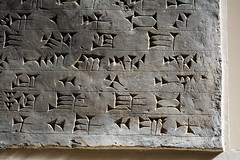 | 3 |
| 10947453411 | Desertification | the process by which fertile land becomes desert, typically as a result of drought, deforestation, or inappropriate agriculture |  | 4 |
| 10947468796 | Division of Labor | the assignment of different parts of a manufacturing process or task to different people in order to improve efficiency |  | 5 |
| 10947535649 | Epic of Gilgamesh | The most famous extant literary work from ancient Mesopotamia, it tells the story of one man's quest for immortality. |  | 6 |
| 10947542570 | Egypt (The Gift of the Nile) | Egypt is often known as "the gift of the Nile" because the region would not have been able to support a significant human population without the Nile's annual inundation, which provided rich silt deposits and made agriculture possible. |  | 7 |
| 10947552086 | Fertile Crescent | historical crescent-shaped region in the Middle East, extending from the E end of the Mediterranean Sea to the Tigris & Euphrates rivers: significant as the birthplace of several ancient civilizations | | 8 |
| 10947560287 | Mandate of Heaven | Also known as Heaven's Mandate, was the divine source of authority and the right to rule of China's early kings and emperors. The ancient god or divine force known as Heaven or Sky had selected this particular individual to rule on its behalf on earth. An important element of the mandate was that although the ruler had been given great power he also had a moral obligation to use it for the good of his people, if he did not then his state would suffer terrible disasters and he would lose the right to govern. |  | 9 |
| 10947568760 | Mesoamerica | the area extending approximately from central Mexico to Honduras and Nicaragua in which diverse pre-Columbian civilizations flourished. |  | 10 |
| 10947578338 | Mesopotamia | An ancient region of southwest Asia between the Tigris and Euphrates Rivers in modern-day Iraq. Probably settled before 5000 bc, the area was the home of numerous early civilizations, including Sumer, Akkad, Babylonia, and Assyria. This region is a portion of the larger Fertile Crescent. |  | 11 |
| 10947589039 | Mohenjo Daro/Harappa | Major cities of the Indus Valley civilization; both of which flourished around 2000 B.C.E. (pron. moehen-joe DAHR-oh) (pron. hah-RAHP-uh) |  | 12 |
| 10947598457 | Nubia | A civilization to the south of Egypt in the Nile Valley, noted for development of an alphabetic writing system and a major iron-working industry by 500 B.C.E. |  | 13 |
| 10947607292 | Pharaoh | A king of Egypt. The term literally means "the palace" and only came into use in the New Kingdom, but it is generally employed in reference to all ancient Egyptian rulers. |  | 14 |
| 10947615626 | Sanskrit | An ancient Indic language that is the language of Hinduism and the Vedas and is the classical literary language of India. Like Latin in Europe and elsewhere, Sanskrit has been used by the educated classes in India for literary and religious purposes for over two thousand years. |  | 15 |
| 10947624547 | Scribe | a person who copies documents, esp a person who made handwritten copies before the invention of printing |  | 16 |
| 10947631046 | Shang Dynasty | The Shang Dynasty is the earliest ruling dynasty of China to be established in recorded history, though other dynasties predated it. The Shang ruled from 1700 to 1027 B.C. and were known for their advances in math, astronomy, artwork and military technology. |  | 17 |
| 10947637678 | Sumer/Sumerians | An ancient country of southern Mesopotamia in present-day southern Iraq. Archaeological evidence dates the beginnings of Sumer to the fifth millennium BC. By 3000 a flourishing civilization existed, which gradually exerted power over the surrounding area and culminated in the Akkadian dynasty, founded c. 2300 by Sargon I. Sumer declined after 2000 and was later absorbed by Babylonia and Assyria. The Sumerians are believed to have invented the cuneiform system of writing. |  | 18 |
| 10947650779 | Theocracy | a form of government in which God or a deity is recognized as the supreme ruler |  | 19 |
| 10947660054 | Vedic Age | The Vedic Period (or Vedic Age) (c. 1500 - c. 500 B.C.E.) is the period in the history of India during which the Vedas, the oldest sacred texts of Hinduism, were being composed. |  | 20 |
| 10947668105 | Ziggurat | (in ancient Mesopotamia) a rectangular stepped tower, sometimes surmounted by a temple. Ziggurats are first attested in the late 3rd millennium BC and probably inspired the biblical story of the Tower of Babel | | 21 |
| 10947673932 | Bronze Age | The Bronze Age is a period characterized by the use of bronze, proto-writing, and other early features of urban civilization. 3500 BCE - 1300 BCE. Bronze is made through mixing copper with an alloy such as tin. It is stronger and more durable than copper. | | 22 |
| 10947683946 | Iron Age | The start of the Iron Age proper is considered by many to fall between around 1200 BCE to 600 BCE, depending on the region. In most parts of the world, its end is defined by the widespread adoption of writing, and therefore marks the transition from prehistory to history. |  | 23 |
| 10947690178 | Assyrians | a major Mesopotamian East Semitic-speaking kingdom and empire of the ancient Middle East, existed as an independent state from perhaps as early as the 2600 BCE, until its collapse between 612 BCE and 599 BCE |  | 24 |
| 10947699828 | Akkadians | was the first ancient Semitic-speaking empire of Mesopotamia, centered in the city of Akkad and its surrounding region, also called Akkad in ancient Mesopotamia. The Akkadian Empire reached its political peak between the 24th and 22nd centuries BC, following the conquests by its founder Sargon of Akkad (2334-2279 BCE). Under Sargon and his successors, the Akkadian language was briefly imposed on neighboring conquered states. |  | 25 |
Pages

Need Help?
We hope your visit has been a productive one. If you're having any problems, or would like to give some feedback, we'd love to hear from you.
For general help, questions, and suggestions, try our dedicated support forums.
If you need to contact the Course-Notes.Org web experience team, please use our contact form.
Need Notes?
While we strive to provide the most comprehensive notes for as many high school textbooks as possible, there are certainly going to be some that we miss. Drop us a note and let us know which textbooks you need. Be sure to include which edition of the textbook you are using! If we see enough demand, we'll do whatever we can to get those notes up on the site for you!
