

Flashcards
Flashcards
ESBR AP Gov - Elections Flashcards
Terms : Hide Images
| 5979469963 | Coattails | Effect a popular president or presidential candidate can have in helping down ballot candidates of their party. | 0 | |
| 5979474295 | Open seat / race | An election in which an incumbent is not running. | 1 | |
| 5979477812 | Franking privilege | Free mail that incumbent Senators and Representatives can send their constituents. | 2 | |
| 5979481875 | Buckley v. Valeo | Court case that held that campaign spending was a form of speech and self-financed candidates could spend as much as they wanted on their own campaigns. | 3 | |
| 5979492824 | Citizens United v. FEC | This case struck down part of the McCain Feingold law banning independent spending by outside groups, paving the way for Super PACs. | 4 | |
| 5979501394 | Soft money | Donations that were given to parties to engage in "party building" efforts. This was a loophole closed by the 2002 McCain-Feingold Act. | 5 | |
| 5979506425 | 527's | Outside groups that spend money on behalf of campaigns and issues without directly coordinating with the candidate. | 6 | |
| 5979515004 | Incumbent | The current person who holds an elected position. | 7 | |
| 5979520022 | Challenger | A candidate who is trying to defeat an incumbent in an election. | 8 | |
| 5979525845 | Position issue | A question in which the two parties or two candidates take differing, opposing views (such as gun control v. gun rights, or pro/anti-abortion). | 9 | |
| 5979533132 | Valence issue | A question in which the parties or candidates agree but offer differing plans or approaches (eg. to combat terrorism, reduce unemployment). | 10 | |
| 5979540717 | Prospective voting | Voting based on a candidate's promises regarding what they will do. | 11 | |
| 5979542946 | Retrospective voting | Voting based on what an official accomplished, particularly with regard to Presidents running for re-election, who are often judged on the health of the economy. | 12 | |
| 5979556286 | Caucus | A way of selecting delegates in Presidential nominating conventions that features public voting at party meetings. | 13 | |
| 5979560153 | Primary | A way of selecting nominees for both Presidential races and for all other types of offices, by secret ballot in a manner similar to a general election. | 14 | |
| 5979564442 | Super Tuesday | A day, usually in March, in the Presidential election year on which many states hold primaries or caucuses. This day often determines who will win a party's presidential nomination. | 15 | |
| 5979571827 | Front Loading | The competition among states to set the date of their primary or caucus early in a presidential election year so they have more influence over who each party's nominee will be. | 16 | |
| 5979576284 | New Hampshire | The state that hosts the first presidential primary. | 17 | |
| 5979577797 | Iowa | The state that hosts the first presidential caucus and helps determine which candidates drop out first. | 18 | |
| 5979585103 | Federal Election Campaign Act of 1974 | This law placed limits on how much money individuals could donate to parties, candidates and political action committees. | 19 | |
| 5979588350 | Political Action Committees | These groups help to pool campaign donations, usually from executives or shareholders of a company, or members of a labor union. | 20 | |
| 5979593831 | Super PACs | These groups were created by the Citizens United decision and can spend unlimited amounts of money on campaign ads, but can not directly coordinate with candidates or parties. | 21 | |
| 5979640255 | Redistricting | The process of redrawing lines for State Legislatures and the US House of Representatives, which usually happens after each census every ten years. | 22 | |
| 5979646672 | Reapportionment | The process of determining which states gain or lose members of the House, decided by the US Census bureau after every ten year census. | 23 | |
| 5979652172 | Gerrymandering | Redrawing lines to make it easier for one political party to win more seats in the House and in state legislatures. This is usually done by state legislatures. | 24 | |
| 5979670676 | Packing | A gerrymandering technique in which one tries to put all of the other party's voters in one or a few districts. | 25 | |
| 5979673922 | Cracking | A gerrymandering technique in which one tries to divide and dilute the influence of the other party's voters by dividing them into multiple districts in which they are a minority. | 26 | |
| 5979678189 | Kidnapping | A gerrymandering technique involving putting two incumbents of the opposite party in the same district, forcing them to battle each other in a primary. | 27 | |
| 5979685523 | Momentum | Presidential candidates who win early contests often gain this, involving increased media attention and campaign funding. | 28 | |
| 5979696988 | Democratic National Convention | A meeting held every 4 years to determine who the Democratic nominee for President will be. | 29 | |
| 5979699380 | Republican National Convention | A meeting held every 4 years to determine who the Republican nominee for President will be. | 30 |
The Classical Era - AP World History Flashcards
Terms : Hide Images
| 11894725240 | Buddhism | Belief system that started in India in the 500s BCE. Happiness can be achieved through removal of one's desires. Believers seek enlightenment and the overcoming of suffering. A path of practice and spiritual development leading to Insight into the true nature of reality. |  | 0 |
| 11894725241 | 600 BCE - 600 CE | Classical Era Time Period | 1 | |
| 11894725242 | Hinduism | Most prevalent religion in India, that integrates spiritual beliefs with daily practices and official institutions such as the caste system. |  | 2 |
| 11894725243 | Confucianism | Emphasized education, family, peace, and justice |  | 3 |
| 11894725244 | Daoism (Taoism) | Philosophy based on the ideas of the Chinese thinker Laozi, Who taught that people should be guided by a universal force called the Dao. |  | 4 |
| 11894725245 | Zoroastrianism | A religion originating in ancient Iran. It centered on a single benevolent deity-Ahura Mazda, Emphasizing truth-telling, purity, and reverence for nature, the religion demanded that humans choose sides between good and evil |  | 5 |
| 11894725246 | Siddhartha Gautama | The founder of Buddhism |  | 6 |
| 11894725247 | Vedas | Religious texts that were passed down from generation to generation of Aryans in the form of hymns, songs, prayers and rituals honoring the Aryan gods | 7 | |
| 11894725248 | Reincarnation | The rebirth of a soul after the body dies | 8 | |
| 11894725249 | Nirvana | Union with the universal spirit; can be reached through the four noble truths and eightfold paths | 9 | |
| 11894725250 | Pax Romana | the period of peace that existed between nationalities within the Roman Empire | 10 | |
| 11894725251 | Law of Twelve Tables | the earliest code of Roman civil, criminal, and religious law |  | 11 |
| 11894725252 | Punic wars | a series of three wars fought between Rome and Carthage from 264 BC to 146 BC. At the time, they were probably the largest wars that had ever taken place. | 12 | |
| 11894725253 | Constantine | was Roman Emperor from 377 - 306BC, he was the first emperor to profess Christianity and turned Rome in a Christian State | 13 | |
| 11894725254 | Diaspora | Scattering of Hebrews because of conquerers that spread them to other parts of the earth | 14 | |
| 11894725255 | Karma | A destiny that has been shaped by years of cause and effect, that is outwardly revealed by and individuals caste or station life | 15 | |
| 11894725256 | Eightfold path | Composed of eight steps that must be mastered one at a time |  | 16 |
| 11894725257 | Dharma | Set of duties that the individual must fulfill | 17 | |
| 11894725258 | Great Wall of China | Wall began in the Qin Dynasty | 18 | |
| 11894725259 | Brahmin | Priests who compiled the Vedas | 19 | |
| 11894725260 | Kshatriya | warriors and officials (caste system) | 20 | |
| 11894725261 | Vaishya | merchants, artisans, and landowners (caste system) | 21 | |
| 11894725262 | Shudra | peasants and laborers (caste system) | 22 | |
| 11894725263 | Vedic Age | Lasted from 1500 to 500 BCE, time period after the collapse of the Indus River Valley Civilization, contained the Vedas, which are religious texts | 23 | |
| 11894725264 | Mauryan Empire | (321-184BC) The first united Indian state, founded by Chandragupta Maurya in 324 BCE, after Alexander's defeat of weakened India; it lasted for more than 100 years, before it declined, and fell in 183 BCE. |  | 24 |
| 11894725265 | Gupta Empire | 320BC-550CE, located in northern India |  | 25 |
| 11894725266 | Persian Empire | Indo-Europeans who settled in present-day Iran. Defeated the Babylonians and created the largest empire in the world up to 500 BC. It stretched across Africa, the Mediterranean, Turkey, Greece, and Afghanistan. Persia was later conquered by Alexander the Great. |  | 26 |
| 11894725267 | Qin Dynasty | Iron weapons helped army defeat other states until it controlled China, King declared himself "First Emperor" or Shi Huangdi (ruled 221 - 210 BCE. The dynasty didn't last long but is significant in regard to the development of the Chinese state, and developed bureaucracy (it also made the Great Wall of China) | 27 | |
| 11894725268 | Han Dynasty | Dynasty that lasted from 206-220BC and began the official establishment of the Silk Road. | 28 | |
| 11894725269 | Byzantine Empire | The eastern half of the Roman Empire, which survived after the fall of the Western Empire at the end of the 5th century C.E. Its capital was Constantinople, named after the Emperor Constantine. | 29 | |
| 11894725270 | Hellenistic Synthesis | Hellenistic culture mixed with other cultures, creating cosmopolitan societies connected by trade and Greek culture | 30 | |
| 11894725271 | Athens and Sparta | two main city-states of Greek Empire | 31 | |
| 11894725272 | Legalism | Chinese philosophy developed by Han Feizi; taught that humans are naturally evil and therefore need to be ruled by harsh laws. | 32 | |
| 11894725273 | Mandate of Heaven | Ancient Chinese belief/theory and philosophical idea that tiān (heaven) granted emperors the right to rule based on their ability to govern well, appropriately and fairly. | 33 | |
| 11894725274 | Aristotle | A Greek philosopher and scientist who was interested in practically every field of human endeavor. | 34 | |
| 11894725275 | Socrates | First philosopher to focus on ethical questions and truth-seeking regarding human nature, understandings and relationships | 35 | |
| 11894725276 | Marathon | Battle in 490 BCE Greeks defeat Persia | 36 | |
| 11894725277 | Peloponnesian war | 431-404 BCE) between Athens and Sparta. With Sparta winning, both were still majorly weakened, they were conquered by Macedonia | 37 | |
| 11894725278 | Triumvirate | Rule of three men holding power (in ancient Rome) Ex: the unofficial coalition of Julius Caesar, Pompey, and Crassus in 60 BC | 38 | |
| 11894725279 | Four noble truths | ・all of life is suffering ・all suffering is caused by desire for things that ultimately won't fulfill us ・desire can only be overcome by ending all desire ・desire can only be ended by following the eighthfold path | 39 | |
| 11894725280 | Alexander The Great | Between 334 and 323 B.C.E. he conquered the Persian Empire, reached the Indus Valley, founded many Greek-style cities, and spread Greek culture across the Middle East. | 40 | |
| 11894725281 | Bureaucracy | A system of government in which most of the important decisions are made by state officials rather than by elected representatives | 41 | |
| 11894725282 | Ashoka | Leader of the Mauryan dynasty of India who conquered most of India but eventually gave up violence and converted to Buddhism | 42 | |
| 11894725283 | Chandragupta Maurya | Founder of the Mauryan Empire, first emperor to unify most of India | 43 | |
| 11894725284 | Chandra Gupta | Founder of the Gupta Empire |  | 44 |
| 11894725285 | Caste System | A Hindu social class system that controlled every aspect of daily life | 45 | |
| 11894725286 | Athens | A democratic Greek polis who accomplished many cultural achievements, and who were constantly at war with Sparta. |  | 46 |
| 11894725287 | Sparta | A powerful Greek military polis that was often at war with Athens. Used slaves known as helots to provide agricultural labor. | 47 | |
| 11894725288 | Shi Huangdi | Founder of the short-lived Qin dynasty and creator of the Chinese Empire (r. 221-210 B.C.E.). He is remembered for his ruthless conquests of rival states and standardization. |  | 48 |
| 11894725289 | Analects | Collection of moral and social teachings of Confucius, including the concept of the Five Relationships. | 49 | |
| 11894725290 | Confucius | (551-479 BCE?) Chinese philosopher and writer of The Analects, a collection of moral and social teachings, including the concept of the Five Relationships. Also known as Kong Fu Zi. |  | 50 |
| 11894725291 | Zoroaster | Founder of Zoroastrianism, a religion unique to Persia. | 51 | |
| 11894725292 | Royal Road | Created by King Darius, a system of roads in the Persian empire stretching over 1,600 miles. It connected the vast empire and helped with communication and transportation | 52 | |
| 11894725293 | Cyrus the Great | Extended territory from India to the Mediterranean Sea, Reached its height under Darius I (into Egypt and Macedonia) and established law code based on earlier Mesopotamian codes. | 53 | |
| 11894848157 | Warring States Period | the period from 475 BC until the unification of China under the Qin dynasty, characterized by lack of centralized government in China. It followed the Zhou dynasty. | 54 | |
| 11895007549 | Qin | Chinese dynasty in 200s BCE. Lasted 15 years. Unified Chinese kingdoms, built the Great Wall and its emperor was the legalistic Shi Huangdi. | 55 | |
| 11895007550 | Han | A term used to designate (1) the ethnic Chinese people who originated in the Yellow River Valley and spread throughout regions of China suitable for agriculture and (2) the dynasty of emperors who ruled from 206 B.C.E. to 220 C.E. | 56 | |
| 11895007551 | Legalism (China) | a philosophy emphasizing strict obedience to the law system. | 57 | |
| 11895007552 | Filial Piety | In Confucian thought, one of the virtues to be cultivated, a love and respect for one's parents and ancestors. | 58 | |
| 11895007553 | Qin Shihuangdi | (r.221-210 BCE) The first emperor of the Qin Dynasty who believed strongly in Legalism and sought to strengthen the centralized China through public works. | 59 | |
| 11895007554 | Civil Service Exam | In Imperial China starting in the Han dynasty, it was an exam based on Confucian teachings that was used to select people for various government service jobs in the nationwide administrative bureaucracy. | 60 | |
| 11895007555 | Yellow Turban Uprising | A massive Chinese peasant uprising inspired by Daoist teachings that began in 184 C.E. with the goal of establishing a new golden age of equality and harmony. | 61 | |
| 11895007556 | Aksum | A kingdom along the Red Sea today known as Ethiopia and Eritrea which grew wealthy from trade. | 62 | |
| 11895007557 | Bantu Migration | The movement of the Bantu peoples southward throughout Africa, spreading their language and culture, from around 500 b.c. to around A.D 1000 | 63 | |
| 11895007558 | Sub-Saharan Africa | Portion of the African continent lying south of the Sahara. | 64 | |
| 11895007559 | Pastoralism | A type of agricultural activity based on nomadic animal husbandry or the raising of livestock to provide food, clothing, and shelter. | 65 | |
| 11895007560 | Huns | All three of the classical empires (Romans, Han, and Gupta) faced the threat of invasion by this central Asian pastoral nomadic group. | 66 | |
| 11895007561 | Desertification | Degradation of land, especially in semiarid areas, primarily because of human actions like excessive crop planting, animal grazing, and tree cutting. | 67 | |
| 11895007562 | cultural diffusion | The spread of ideas, customs, and technologies from one people to another | 68 | |
| 11895007563 | Feudalism | A political system in which nobles are granted the use of lands that legally belong to their king, in exchange for their loyalty, military service, and protection of the people who live on the land | 69 | |
| 11895007564 | Steppes | Treeless plains, especially the high, flat expanses of northern Eurasia, which usually have little rain and are covered with coarse grass. They are good lands for nomads and their herds. Good for breeding horses: essential to Mongol military. | 70 |
Flashcards
AP World History Unit 2 Terms Flashcards
Terms : Hide Images
| 4203646090 | Paleolithic Age | The period of the Stone Age associated with the evolution of humans. It predates the Neolithic period. | 0 | |
| 10807651876 | hunting and gathering | the use of simple tools to hunt animals and gather vegetation for food | 1 | |
| 10807658815 | civilization | A complex, highly organized social order | 2 | |
| 10807665216 | Urbanization | Movement of people from rural areas to cities | 3 | |
| 10807668542 | Cuneiform | A form of writing developed by the Sumerians using a wedge shaped stylus and clay tablets. | 4 | |
| 10807671904 | Nomads | people who wander from place to place | 5 | |
| 10807679135 | Tigris and Euphrates Rivers | the two rivers that surround Mesopotamia. These rivers would flood and provide silt that made the soil fertile. | 6 | |
| 10807682725 | Mesopotamia | (land between the rivers) T he region between the Tigris and Euphrates rivers; birthplace of the Sumerian and Babylonian Civilizations. |  | 7 |
| 10807694000 | Sumerians | The people who dominated southern Mesopotamia through the end of the third millennium B.C.E. They were responsible for the creation of many fundamental elements of Mesopotamian culture-such as irrigation technology, cuneiform, and religious conceptions. | 8 | |
| 10807700240 | City-States | a city that with its surrounding territory forms an independent state. | 9 | |
| 10807715595 | Babylonians | A group of people who conquered the Sumerians. They had a very famous king named Hammurabi. Hammurabi created nearly 300 laws known as Hammurabi's Code of Laws, the old known legal system based on the concept of "an eye for an eye, a tooth for a tooth". | 10 | |
| 10807729498 | Egyptians | Most prominent of early African societies. Agricultural society relied on Nile R. Built Pyramids including the pyramid of Khufu. |  | 11 |
| 10807830728 | Indus River Valley | A valley and early civilization along the Indus River, one of the longest rivers in the world. | 12 | |
| 10807844314 | Harappa | a large ancient city of the Indus civilization, created in present-day Pakistan | 13 | |
| 10807855759 | Polytheism/Monotheism | Worship of many gods/belief in a single god | 14 | |
| 10807894464 | Classical Period | 500 B.C.E. to 500 C.E. Goverment systems, social structure, religion, and cultural traditions expand and become more complex, from Period 1. Centralized imperial governments are established like the Achaemid, Selucid, Parthian and Sassanid empires of Persia, the Qin and Han dynasties in China, the Maurya and Gupta dynasties in India, and the Greek poleis and Roman Empire in Mesopotamia. | 15 | |
| 10808049682 | Traditional Chinese Medicine | a system of ancient Chinese medicinal treatments including acupuncture, diet, herbal therapy, meditation, physical exercise, and massage to prevent, diagnose, and treat disease. Focus on mental and emotional healing and maintaining balance. Has 5 elements concept. More natural and holistic than modern western medicine. | 16 | |
| 10808080708 | Shi Huangdi (Qin Dynasty) | "first emperor," title the Qin ruler gave himself when he unified. Led by force and his punishments for crimes very severe. Killed Confucianists and Daoists and burned many of their books. Seized and destroyed weapons and divided China into 36 districts which were controlled by officials who were loyal to him. Standardized China's laws, writing, coins, weights, and measures. Had the Great Wall built to protect China from invaders. Died in 210 BC built life size terracotta army in his tomb. | 17 | |
| 10808142263 | Qin Dynasty | (221-207 BCE) The first centralized dynasty of China that used Legalism as its base of belief. collapse after Qin Shaungdi died and his succesors conscripted too many people which led to rebellion. | 18 | |
| 10808183321 | Han Dynasty | (202 BC - 220 AD) dynasty started by Liu Bang; a great and long-lasting rule, it discarded the harsh policies of the Qin dynasty and adopted Confucian principles; Han rulers chose officials who passed the civil service exams rather than birth | 19 | |
| 10808213078 | Daoism | A religion in China which emphasizes the removal from society and to become one with nature. | 20 | |
| 10808232523 | Confucius | (551-479 BCE) A Chinese philosopher known also as Kong Fuzi established Confucianism | 21 | |
| 10808247143 | Confucianism | The system of ethics, education, and statesmanship taught by Confucius and his disciples, stressing love for humanity, ancestor worship, reverence for parents, and harmony in thought and conduct. | 22 | |
| 10808280908 | Silk Roads | Land-based trade routes that linked Eurasia. | 23 | |
| 10808290970 | Himalayas | The highest mountains in the world, which stretch along northern India, separating it from the rest of Asia. | 24 | |
| 10808295281 | Sanskrit | an ancient language of India (the language of the Vedas and of Hinduism) | 25 | |
| 10808312254 | Vedas | Ancient Sanskrit writings that are the earliest sacred texts of Hinduism. 4 Vedas including Rig Veda | 26 | |
| 10808351964 | Ayurvedic medicine | traditional Hindu system of medicine, emphasizing a holistic approach to preventive treatment through hygiene, exercise, herbal preparations, and yoga and the treatment of illnesses with herbal medicines, physiotherapy, and diet | 27 | |
| 10808355519 | Varnas | Hindu castes, Brahman, Kshatriya, Vaishya, and Shudra. | 28 | |
| 10808359920 | Chandragupta Maurya | founder of Maurya dynasty; established first empire in Indian subcontinent; first centralized government since Harappan civilization | 29 | |
| 10808375926 | Mauryan Dynasty | The first united Indian state, founded by Chandragupta in 324 BC, after Alexander's defeat of weakened India; it lasted for more than 100 years, before it declined, and fell in 183 BC | 30 | |
| 10808390205 | Ashoka | Third ruler of the Mauryan Empire in India (r. 270-232 B.C.E.). He converted to Buddhism and broadcast his precepts on inscribed stones and pillars, the earliest surviving Indian writing. His capital city = Pataliputra | 31 | |
| 10808413083 | Dharma | In Hindu belief, a person's religious and moral duties | 32 | |
| 10808421110 | Gupta Empire | (320-550 CE) The decentralized empire that emerged after the Mauryan Empire, and whose founder is Chandra Gupta. | 33 | |
| 10808432557 | Hinduism | A religion and philosophy developed in ancient India, characterized by a belief in reincarnation and a supreme being who takes many forms. Had epics Mahabharata and Ramayana which featured the god Vishnu. | 34 | |
| 10808472503 | Reincarnation | In Hinduism and Buddhism, the process by which a soul is reborn continuously until it achieves perfect understanding | 35 | |
| 10808475476 | Buddha | Means "Enlightened One." Siddartha Guatama. He is said to have renounced his worldly possessions and taught of a way to overcome suffering while sitting under a Bodh Goya tree. First announced his doctrine at Deer Park of Sarnath. | 36 | |
| 10808512885 | Nirvana | The state of englightenment for Buddhists. | 37 | |
| 10808518660 | Diffusion | The process of spread of a feature or trend from one place to another over time | 38 | |
| 10808546622 | Persian Empire | Mesopotamian empire that conquered the existing Median, Lydian, and Babylonian empires, as well as Egypt and many others. Also known as the Achaemenid Empire. | 39 | |
| 10808564259 | Pericles | Athenian leader noted for advancing democracy in Athens and for ordering the construction of the Parthenon. | 40 | |
| 10808569852 | Pelopponesian War | War between Athens and Sparta, lasted 27 years. Sparta became allies with Persia - Sparta won. | 41 | |
| 10808582654 | Alexander the Great | son of Philip II; received military training in Macedonian army and was a student of Aristotle; great leader; conquered much land in Asia Minor, Syria, Egypt, and Mesopotamia. | 42 | |
| 10808594840 | Macedonia | Area between the Greek and Slavic regions; conquered Greece and Mesopotamia under the leadership of Philip II and Alexander the Great | 43 | |
| 10808602920 | Hellenisitic Era | After the death of Alexander the Persian empire split into three, (from small to biggest) The Antigonid Empire, the Ptolemaic Empire, and the Selucid empire. | 44 | |
| 10808674226 | poleis | Ancient Greek city-states including Sparta and Athens. | 45 | |
| 10808693470 | Direct Democracy | A form of government in which citizens rule directly and not through representatives. Athens were a democracy. | 46 | |
| 10808736911 | Aristotle | Greek philosopher. A pupil of Plato, the tutor of Alexander the Great, and the author of works on logic, metaphysics, ethics, natural sciences, politics, and poetics, he profoundly influenced Western thought. | 47 | |
| 10808747440 | Stoicism | An ancient Greek philosophy that became popular amongst many notable Romans. Emphasis on ethics. They considered destructive emotions to be the result of errors in judgment, and that a wise person would repress emotions, especially negative ones and that "virtue is sufficient for happiness." universal family, do your duty. | 48 | |
| 10808784963 | Plato | (430-347 BCE) Was a disciple of Socrates whose cornerstone of thought was his theory of Forms, in which there was another world of perfection. | 49 | |
| 10808790463 | Roman Republic | The period from 507 to 31 B.C.E., during which Rome was largely governed by the aristocratic Roman Senate. This establishment consisted of the Senate with two consuls who were elected by an assembly dominated by hereditary aristocrats known as patricians. | 50 | |
| 10808798573 | Roman Senate | a council of wealthy and powerful citizens who advised Rome's leaders | 51 | |
| 10808805624 | Punic Wars | A series of three wars between Rome and Carthage (264-146 B.C.); resulted in the destruction of Carthage and Rome's dominance over the western Mediterranean. Hannibal led Carthage army. | 52 | |
| 10808823520 | Julius Caesar | Part of the first triumvirate who eventually became "emperor for life". Attacked Gaul. Chose not to conquer Germany. Was assassinated by fellow senators in 44 B.C.E. | 53 | |
| 10808848886 | Roman Empire | Existed from 27 BCE to about 400 CE. Conquered entire Mediterranean coast and most of Europe. Ruled by an emperor. Eventually oversaw the rise and spread of Christianity. | 54 | |
| 10808876148 | Augustus Caesar | Name given to Octavian following his defeat of Mark Anthony and Cleopatra; first emperor of Rome. | 55 | |
| 10808890838 | Constantine | (274 CE - 337 CE) Roman Emperor between 306 CE and 337 CE. He issued the Edict of Milan which outlawed the persecution of Christians. He also founded the city of Constantinople, the future capital of the Byzantine Empire. | 56 | |
| 10808898788 | Christianity | the religion based on the person and teachings of Jesus of Nazareth, or its beliefs and practices. Spread throughout Roman Empire. At first they were persecuted but was established as the religion of the Roman Empire later on. | 57 | |
| 10808954315 | Kushan Empire | ruled central Asia to northern India, important in spreading Buddhism to Chinese, took control of the trade route that connected India. | 58 | |
| 10808972063 | Ethiopia | East African highland nation lying east of the Nile River. | 59 | |
| 10808981005 | Shintoism | Religion located in Japan and related to Buddhism. Shintoism focuses particularly on nature and ancestor worship. | 60 | |
| 10808993173 | Olmec Culture | featured irrigated agriculture, urbanism, elaborate religion; beginnings of calendrical and writing systems | 61 | |
| 10808998709 | Maya | Mesoamerican civilization concentrated in Mexico's Yucatan Peninsula and in Guatemala and Honduras but never unified into a single empire. Major contributions were in mathematics, astronomy, and development of the calendar. | 62 | |
| 10809004873 | Incas | Ancient civilization (1200-1500AD) that was located in the Andes in Peru | 63 | |
| 10809013572 | Polynesia | Islands contained in a rough triangle whose points lie in Hawaii, New Zealand, and Easter Island | 64 | |
| 10809017088 | Rajputs | Members of a mainly Hindu warrior caste from northwest India. The Mughal emperors drew most of their Hindu officials from this caste, and Akbar I married a Rajput princess. | 65 | |
| 10809033349 | Byzantine Empire | (330-1453) The eastern half of the Roman Empire, which survived after the fall of the Western Empire at the end of the 5th century C.E. Its capital was Constantinople, named after the Emperor Constantine. | 66 | |
| 10809036694 | Augustine | (Roman Catholic Church) one of the great fathers of the early Christian church | 67 | |
| 10809047282 | Coptic church | A branch of African Christianity | 68 | |
| 10809060249 | Mahayana Buddhism | Also known as popular Buddhism, is allows people more ways to reach enlightenment and boddhisatvas can help you reach enlightenment. | 69 | |
| 10809071574 | Pope | Head of the Roman Catholic Church | 70 | |
| 10809075463 | Animism | Belief that objects, such as plants and stones, or natural events, like thunderstorms and earthquakes, have a discrete spirit and conscious life. | 71 | |
| 10809092977 | The Philosophy of Confucius... | formed a thoroughly practical and secular approach to life | 72 | |
| 10809101401 | What were Junzi? | were Confucian "superior individuals" who took an active role in public affairs. | 73 | |
| 10809134826 | The most learned man of the Period of The Warring States, who served as the chief spokesman for Confucius philosophy was.... | Menicus | 74 | |
| 10809148274 | Chinese philosophers often spoke of the following term, which means "the way." | dao | 75 | |
| 10809170816 | What was the Chinese Political Philosophy that called for clear and strict laws? | Legalism | 76 | |
| 10809178930 | The man who first declared himself emperor of a unified China was | Qin Shihaungdi | 77 | |
| 10809191925 | The Chinese emperor who was notorious for his hatred of Confucianism and for his burning of books was | Qin Shihaungdi | 78 | |
| 10809211778 | The dividing line between the Former Han and the Later Han is marked by | the brief rule of an usurper | 79 | |
| 10809221841 | In 124 B.C.E., Han Wudi transformed China by | establishing an imperial university | 80 | |
| 10809231637 | The Yellow Turban uprising resulted from problems stemming from | poverty and land distribution | 81 | |
| 10809245764 | Ashoka Maurya did what..... | He succesfully fought the advance of Alexander the Great. | 82 | |
| 10809298093 | During the third century C.E. much of northern India and central Asia was ruled by | the Kushan Empire | 83 | |
| 10809324829 | The Gupta dynasty ended with the invasion by the nomadic | White Huns | 84 | |
| 10809341420 | The Mahabharata and Ramayana were both | examples of early Indian literature | 85 | |
| 10809365920 | One common aspect of Vardhamana Mahavira and Siddartha Guatama was that they | challenged the religous doctrine of the brahmin priests. | 86 | |
| 10809394816 | The "Four Noble Truths" are considered the core of which religion? | Buddhism | 87 | |
| 10809424710 | Which factor most likely made Buddhism particularly appealing to merchants, artisans, and other of low rank in India. | Buddhism tended to disregard social classes | 88 | |
| 10809446146 | Mahayana Buddhism differed from earlier Theravada Buddhism in that it.. | allowed a greater number of people to acheive salvation hence its name "the greater vehicle" | 89 | |
| 10809493322 | Hindu ethics would eventually recognize four valid, principal aims of human life: dharma, kama, moksha, artha represented | The pursuit of economic well being and honest prosperity | 90 | |
| 10809515507 | By the second millenium, which religion had overtaken Buddhism as the most popular in India? | Hinduism | 91 | |
| 10809547391 | After Alexanders death, Egypt became known as the | Ptolemaic Empire | 92 | |
| 10809556039 | Sappho was best known for her | poetry | 93 | |
| 10809573476 | The Athenian who would become known as the "father of western philosophy" | Socrates | 94 | |
| 10809609667 | Which Greek religious movement eventually shifted its rituals to the polis and utilized dramatic plays as an medium? | The cult of Dionysus | 95 | |
| 10809631134 | What did the Epicureans, the Skeptics, and the stoics have in common? | They were all part of popular philosophical movements | 96 | |
| 10809652943 | The term Pax Romana refers to | the period of relative peace across the Roman Empire from the first to third centuries C.E. | 97 | |
| 10809688213 | Historical evidence shows that Roman military or trade vessels reached out what places | the Nile, Byzantium, the Red Sea, and the British Isles. | 98 | |
| 10809703706 | Spartacus is best known for | leading an army of seventy thousand rebellious slaves | 99 | |
| 10809737267 | Which of the following accurately represents a key difference between the cults of Mithras and Isis | Mithras was only for women | 100 | |
| 10809751020 | Paul of Tarsus is most associated with | recruiting converts from the Roman Empire into Christianity | 101 |
AP Psych - Learning Flashcards
Terms : Hide Images
| 8111909671 | Learning | Relatively permanent change in an organisms behavior due to experience |  | 0 |
| 8111909672 | Associative Learning | Defined: learn by putting together two events Example: Expect to hear thunder after viewing lightening |  | 1 |
| 8111909673 | Habituation | Defined: An organisms decreasing response to a stimulus with repeated exposure to it Example: Your parents yell at you a lot and eventually you tune out their yelling |  | 2 |
| 8111909674 | Pavlov, Ivan | Contribution: developed the theory of "classical conditioning" while working with dogs Significance: Father of Classical Conditioning |  | 3 |
| 8111909675 | Watson, John B | Contribution: applies Classical Conditioning to Humans through the "Little Albert" Experiment Significance: Creates "Behaviorism" Theory |  | 4 |
| 8111909677 | Skinner, B.F. | Contributions: Invented the Operant chamber, aka his ________ box, to use in his research of animal learning. Significance: Father & Developer of Operant Conditioing |  | 5 |
| 8111909678 | Bandura, Albert | Contribution: Studied how children mimic others behaviors and repeat that same behavior Significance: Creates "Observational Learning" Theory |  | 6 |
| 8111909679 | Thorndike, Edward | Contribution: studied cats in puzzle boxes and recorded their behaviors Significance: Creates "Law of Effect" theory |  | 7 |
| 8111909680 | Garcia, John | Contribution: Demonstrated the significance of biological processes in classical conditioning Significance: Creates "Taste Aversions" theory |  | 8 |
| 8111909682 | Tolman, Edward | Contribution: demonstrated the significance of cognitive processes in operant conditioning by studying rats in mazes Significance: Creates the "Latent Learning" theory |  | 9 |
| 8111909683 | Pavlov's Dogs | First experiment that created and demonstrate the theory of classical conditioning |  | 10 |
| 8111909684 | Little Albert | First experiment to demonstrate how emotions can be classically conditioned in humans Provides a foundation for the "Behaviorism Theory" | 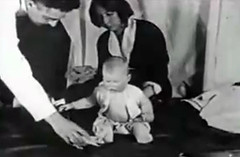 | 11 |
| 8111909685 | Classical Conditioning | Learning that takes place when two or more stimuli are paired together UCS = UCR; NS + UCS = UCR; & CS = CR |  | 12 |
| 8111909686 | Behaviorism | Psychologist: John B. Watson Defined: a theory that made psychology an objective science by making it based on observable (and only observable) events, not the unconscious or conscious mind. |  | 13 |
| 8111909687 | Unconditioned Stimulus | Part of Classical Conditioning It is the stimulus that triggers a natural reflexive response. Pavlov's Dogs: "Meat" Little Albert: "Loud noise" |  | 14 |
| 8111909688 | Unconditioned Response | Part of Classical Conditioning It is the unlearned, naturally occurring response to the stimulus Pavlov's Dogs: It was the "Salivating to the Meat" Little Albert: "Screaming at the Loud Noise" |  | 15 |
| 8111909689 | Conditioned Stimulus | Part of Classical Conditioning It initially has no effect but after conditioning, it triggers a natural reflexive response. Pavlov's Dogs: It was the "Bell" Little Albert: "White Mouse" |  | 16 |
| 8111909690 | Conditioned Response | Part of Classical Conditioning Occurs after conditioning when the conditioned stimulus (CS) triggers an innate response Pavlov's Dogs: It was the "Salivating to the Bell" Little Albert: "Screaming/Crying" | | 17 |
| 8111909691 | Neutral Stimulus | does not caused an unconditioned response but eventually becomes the CS | | 18 |
| 8111909692 | Acquisition of Classical Conditioning | Frequency: the more often the CS and the US are paired together Timing: the CS is presented a half a second before the US |  | 19 |
| 8111909693 | Extinction | Classical Conditioning: The disappearance of a behavior because CS no longer paired with the UCS Operant Conditioning: The disappearance of a behavior because it is no longer reinforced or punished |  | 20 |
| 8111909694 | Spontaneous Recovery | Classical Conditioning: When a previous CR returns after it has been extinguished Operant Conditioning: Occurs when a response begins again after extinction | 21 | |
| 8111909695 | Stimulus Generalization | Classical Conditioning: When the NS and the CS are different. (Example: Little Albert being afraid of any thing that is white and furry) Operant Conditioning: When a reinforced/punished behavior occurs in a setting/situation where it was NOT learned (Example: Not cursing at home or at school) |  | 22 |
| 8111909696 | Stimulus Discrimination | Classical Conditioning: When the NS and the CS are the same (Example: Little Albert being afraid of a white mouse) Operant Conditioning: When a reinforced/punished behavior occurs in a setting/situation where it was learned (Example: Cursing only at home because it is acceptable but not at school) |  | 23 |
| 8111909697 | Higher Order Conditioning | When the first CS is paired with a second CS The second CS is presented briefly before the first CS |  | 24 |
| 8111909698 | Taste Aversions | Psychologist: Garcia Defined: If you ingest an unusual food or drink and then become nauseous, you will probably develop an aversion to the food or drink. Significance: Violates the acquisition principles of classical conditioning |  | 25 |
| 8111909699 | Learned Helplessness | Defined: Exposure to inescapable and uncontrollable aversive (bad) events produces passive behavior Study: Seligman delivering shocks to dogs Example: If a student consistently fails math, they may start to give up or a sports team that consistently loses may start to belive they can't win |  | 26 |
| 8111909700 | Biological Preparedness | Defined: humans and animals have predisposed fears that help us survive Examples; Phobia of heights keeps us away from danger | 27 | |
| 8111909701 | Operant conditioning | Defined: Learning is based on the association of one's behavior and its consequences. Consequences are reinforced or punished Example: You choose to break curfew based on the consequences |  | 28 |
| 8111909702 | Law of Effect | Psychologist: Edward Thorndike Defined: if a behavior results in a satisfying consequence, it will likely be repeated whereas; if a behavior results in a unsatisfying consequence, it will NOT likely be repeated Example: If you complement your mother and she lets you stay out past curfew, you will complement her again |  | 29 |
| 8111909703 | Skinner Box | Also known as: Operant Chamber Description: A chamber containing a bar or key that an animal (rat or pigeon) can manipulate in order to obtain a reward |  | 30 |
| 8111909704 | Positive Reinforcement | Part of Operant Conditioning Adding something to increase the likelihood of a behavior occuring again Example: Receiving $5 for every "A" in high school |  | 31 |
| 8111909705 | Negative Reinforcement | Part of Operant Conditioning Increasing the likelihood of a behavior occurring again by removing a negative stimuli Example: Taking aspirin to relieve a headache |  | 32 |
| 8111909706 | Primary Reinforcers | Reinforcers that are rewarding such as food, water, rest, whose natural properties are reinforcing. |  | 33 |
| 8111909707 | Secondary Reinforcers | Defined: Reinforcers that are rewarding because we learned that are reinforcing. Example: praise, money, the chance to play video games. |  | 34 |
| 8111909708 | Immediate Reinforcer | Defined: when you are immediately rewarded for a behavior (it's all about the short run) Example: skipping school and enjoying time with friends | 35 | |
| 8111909709 | Delayed Reinforcer | Defined: when you complete a behavior but not awarded immediately (it's all about the long run) Example: getting good grades in school and attending class in order to get a good job in the future | 36 | |
| 8111909710 | Positive Punishment | Part of Operant Conditioning Adding something to decrease the likelihood of a behavior occurring again Example: Spanking and yelling |  | 37 |
| 8111909711 | Negative Punishment | Part of Operant Conditioning Removing something to decrease the likelihood of a behavior occurring again Example: Grounding |  | 38 |
| 8111909712 | Concerns regarding Punishment | It does not teach the learner appropriate behavior and can also increase violent behavior in the learner Example: If your psychology teacher taught you everything you didn't need to know for the AP Psych Exam | 39 | |
| 8111909713 | Shaping | Part of Operant Conditioning Positively reinforcing closer and closer approximations of a desird behavior to teach a new behavior |  | 40 |
| 8111909714 | Discriminative Stimulus | Defined: the stimulus that elicits a response after association with reinforcement Example: Calling your friend one name but not using that same name with your parents | 41 | |
| 8111909715 | Superstitious Behavior | Defined: if a random reinforcement follows an event, the event will likely be repeated. Example: a lucky shirt, shoes, etc. | 42 | |
| 8111909716 | Continuous Reinforcement Schedule | Defined: When every behavior is reinforced Example: a multiple choice test Significance: best for "establishing" a behavior | 43 | |
| 8111909717 | Partial Reinforcement Schedule | Defined: When a random behavior is reinforced Example: Fixed Ratio, Variable Ratio, Fixed Interval, Variable Interval Significance: best for "maintaining" a behavior | 44 | |
| 8111909718 | Fixed-Ratio Schedule | Defined: schedule of reinforcement after a set number of responses. Example: Being paid for every 10 pizzas made |  | 45 |
| 8111909719 | Variable-Ratio Schedule | Defined: schedule of reinforcement after a varying number of responses. Example: playing a slot machine |  | 46 |
| 8111909720 | Fixed-Interval Schedule | Defined: schedule of reinforcement after a fixed amount of time has passed Example: cramming for an exam |  | 47 |
| 8111909721 | Variable-Interval Schedule | Defined: schedule of reinforcement after varying amounts of time Example: pop (surprise) quizzes in class |  | 48 |
| 8111909722 | Latent Learning | Defined: Learning that occurs but is not apparent until there is an incentive to demonstrate it Example: Tolman's rats would only complete the maze if there was cheese for them at the end of the maze |  | 49 |
| 8111909723 | Cognitive Maps | Defined: having the ability or know how to accomplish a particular task Example: Tolman's rats knew how to complete the maze |  | 50 |
| 8111909724 | Instinctive Drift | Defined: when animals revert to instinctive behaviors rather than the operantly conditioned behaviors Examples: Rats will not walk backward, chickens won't hit a ball and run to first base, and pigs won't put wooden dollars into a piggy bank | 51 | |
| 8111909725 | Insight Learning | Defined: suddenly knowing the solution to the problem Example: When taking a test and the previous answer comes to you without effort |  | 52 |
| 8111909726 | Intrinsic Motivation | Defined: the desire to perform a behavior effectively and for its own sake—rewards can carry hidden costs. Example: reading books because you find them rewarding and not for a prize. |  | 53 |
| 8111909727 | Extrinsic Motivation | Defined: the desire to perform a behavior to receive external rewards or avoid threatened punishment. Example: reading a book because you need to get a good grade in your English class | | 54 |
| 8111909728 | Observational Learning | Defined: learn by watching others Example: BoBo Doll Study |  | 55 |
| 8111909729 | BoBo Doll Study | Psychologist: Bandura Description: Children watched (through a one way glass)a confederate play with the BoBo doll and then played with the BoBo doll in the same way as the confederate Significance: used to develop "observational learning" |  | 56 |
| 8111909730 | Mirror Neurons | Defined: frontal lobe neurons that fire when performing certain actions or when observing another doing so Example: explains why yawning is contagious | 57 | |
| 8111909731 | Densensitization | Defined: after viewing a similar act/behavior, you become less emotionally responsive (indifferent or unaware) to the stimulus Example: The first murder on TV is shocking but becomes less shocking as you watch violent television | 58 | |
| 8111909732 | Pro-Social Modeling | Defined: People who show nonviolent, helpful behavior prompt similar behavior in others Significance: When parents help their grandparents, the children will likely do the same |  | 59 |
| 8111909733 | Anti-Social Modeling | Defined: People show violent, selfish behavior prompts similar behaviors in others Significance: Watching violent TV prompts similar behaviors in others (pro-wrestling, etc.) | 60 |
Honors/AP Flashcards
Terms : Hide Images
| 11192227921 | Je suis allé | (passé, masc) |  | 0 |
| 11192233617 | Je suis allée | (passé, fem) | | 1 |
| 11192241585 | des noces |  | 2 | |
| 11192246090 | avant |  | 3 | |
| 11192504060 | après |  | 4 | |
| 11192509984 | lancer |  | 5 | |
| 11192512733 | écossais |  | 6 | |
| 11192517736 | une alliance |  | 7 | |
| 11192523411 | assister |  | 8 | |
| 11192529622 | Ils s'embrassent |  | 9 | |
| 11192534659 | la coiffure |  | 10 | |
| 11192538018 | la mairie | le bâtiment au centre d'une ville où on fait des choses juridiques |  | 11 |
| 11192544667 | la laïcité | le principe de séparation de la société civile et de la société religieuse |  | 12 |
| 11192565025 | une église | C'est où tu assistes aux services religieux. |  | 13 |
| 11192578614 | fier/fière | très content de soi |  | 14 |
| 11192584950 | croyant/croyante |  | 15 | |
| 11192594116 | une frontière | la limite du territoire d'un pays, d'un Etat. |  | 16 |
| 11192600853 | la lune de miel | le voyage de noces |  | 17 |
| 11192606267 | faire de l'équitation | faire du cheval |  | 18 |
| 11192609445 | gratuit | qui ne coûte rien |  | 19 |
| 11192613809 | punir |  | 20 | |
| 11192617002 | un prix |  | 21 | |
| 11192623666 | tricher | ne suivre pas des règles |  | 22 |
| 11192629058 | je m'en fiche | ça m'est égal |  | 23 |
| 11192633196 | un collant |  | 24 | |
| 11192637205 | un arbitre/une arbitre | juge d'une compétition |  | 25 |
| 11192645575 | ancien/ancienne |  | 26 | |
| 11192653489 | des fesses |  | 27 | |
| 11192658555 | un code vestimentaire | les règles de vêtements acceptables |  | 28 |
| 11192660536 | un manteau |  | 29 | |
| 11192665700 | interdit |  | 30 | |
| 11192671009 | un feu d'artifice | ce qu'on fait sur le quatre juillet dans le ciel |  | 31 |
| 11192674255 | un parapluie | pour arrêter la pluie |  | 32 |
| 11192678785 | un dindon | glou glou |  | 33 |
| 11192683816 | injuste | qui n'est pas juste, qui n'est pas équitable |  | 34 |
AP Literature Flashcards
Terms : Hide Images
| 11850617962 | Allegory | A narrative or description having a second or symbolic meaning beneath the surface one. | 0 | |
| 11850664543 | Allusion | A reference, explicit or implicit, to something in previous literature or history. | 1 | |
| 11850691751 | Anecdote | A short account of an interesting or humorous incident. | 2 | |
| 11850709620 | Artistic Unity | That condition of a successful literary work whereby all its elements work together for the achievement of its central purpose. | 3 | |
| 11850795012 | Cacophony | A harsh, discordant, unpleasant-sounding choice and arrangement of sounds. | 4 | |
| 11850807714 | Euphony | A smooth, pleasant-sounding choice and arrangement of sounds. | 5 | |
| 11854269623 | Genre | A type or class, as poetry, drama, etc. | 6 | |
| 11854282936 | Imagery | The representation through language of a sensory experience. | 7 | |
| 11854293189 | Mood | The pervading impression of a work. | 8 | |
| 11854300093 | Moral | A rule of conduct or maxim for living expressed or implied as the "point" of a literary work. Compare Theme. | 9 | |
| 11854311498 | Prose | Non-metrical language; the opposite of verse. | 10 | |
| 11854314039 | Theme | The main idea, or message, of a literary work. Themes often explore timeless and universal ideas and may be implied rather than stated explicitly. | 11 | |
| 11854330206 | Tone | The writer's or speaker's attitude toward the subject, the audience, or herself or himself; the emotional coloring, or emotional meaning, of a work. | 12 | |
| 11854362571 | Topic | The subject matter or area of a literary work. Not to be confused with theme. | 13 | |
| 11854368439 | Setting | The context in time and place in which the action of a story occurs. | 14 | |
| 11854378049 | Symbol (Literary) | Something that means more than what it is; an object, person, situation, or action that in addition to its literal meaning suggests other meanings as well, a figure of speech which may be read both literally and figuratively. | 15 | |
| 11854389933 | Verse | Metrical language; the opposite of prose. | 16 | |
| 11854394585 | Voice | The distinctive style or manner of expression of an author or a character in a book. | 17 | |
| 11854418194 | Antagonist | Character in a story or poem who opposes the main character (protagonist). Sometimes the antagonist is an animal, an idea, or a thing. | 18 | |
| 11854439138 | Character | (1) Any of the persons involved in a story or play [sense 1] (2) The distinguishing moral qualities and personal traits of a character [sense 2]. | 19 | |
| 11854464404 | Characterization | The process of conveying information about characters. | 20 | |
| 11854476904 | Deuteragonist | The second most important character, after the protagonist, often a foil or eventual antagonist. | 21 | |
| 11854488025 | Direct Presentation of Character | A method of characterization in which the author, by exposition or analysis, tells us directly what a character is like, or has someone else in the story do so. | 22 | |
| 11854496908 | Dynamic Character | A character (sense 1) who during the course of a story undergoes a permanent change in some aspect of character (sense 2) or outlook. | 23 | |
| 11854613352 | Flat Character | A character (sense 1) whose character (sense 2) is summed up in one or two traits. | 24 | |
| 11854623324 | Foil | A character who contrasts with another character (usually the protagonist) in order to highlight particular qualities of the other character's personality, throwing these characteristics into sharper focus. | 25 | |
| 11854648524 | Hero | A man (OR WOMAN) who is endowed with great courage and strength, celebrated for bold exploits, and favored by the gods | 26 | |
| 11854660389 | Hubris | Overbearing and excessive pride. | 27 | |
| 11854670860 | Indirect Presentation of Character | That method of characterization in which the author shows us a character in action, compelling us to infer what the character is like from what is said or done by the character. | 28 | |
| 11854678927 | Protagonist | The main character of a novel, play, or film. | 29 |
Pages

Need Help?
We hope your visit has been a productive one. If you're having any problems, or would like to give some feedback, we'd love to hear from you.
For general help, questions, and suggestions, try our dedicated support forums.
If you need to contact the Course-Notes.Org web experience team, please use our contact form.
Need Notes?
While we strive to provide the most comprehensive notes for as many high school textbooks as possible, there are certainly going to be some that we miss. Drop us a note and let us know which textbooks you need. Be sure to include which edition of the textbook you are using! If we see enough demand, we'll do whatever we can to get those notes up on the site for you!
