AP Notes, Outlines, Study Guides, Vocabulary, Practice Exams and more!

Unit 3 600-1450 AP World History(Chapters 7, 8, 9) Flashcards

Terms : Hide Images
11024530699Silk Roadsthe most famous of the trading routes established by pastoral nomads connecting the European, Indian, and Chinese; transmitted goods and ideas among civilizations0
11024530700Black DeathThe common name for a major outbreak of plague that spread across Asia, North Africa, and Europe in the mid-fourteenth century, carrying off vast numbers of persons.1
11024530701Indian Ocean trading networkThe world's largest sea-based system of comunication and exchange before 1500 C.E., Indian Ocean commerce stretched from southern China to eastern Africa and included not only the exchange of luxury and bulk goods but also the exchange of ideas and crops.2
11024530702SrivijayaA Malay kingdom that dominated the Straits of Malacca between 600 and 1075 CE. A state based on the Indonesian island of Sumatra, between the seventh and eleventh centuries C.E. It amassed wealth and power by a combination of selective adaptation of Indian technologies and concepts, and control of trade routes.3
11024530703BorobrodurBuddhist temple on the island of Java that is a primary example of Indian ocean trade causing cultural diffusion.4
11024530704Angkor WatThis place was first a Hindu (dedicated to the god Vishnu), then subsequently a Buddhist, temple complex in Cambodia and the largest religious monument in the world.5
11024530705Swahili civilizationan East African civilization that emerged in the 8th century ce from a blending of Bantu, Islamic, and other Indian Ocean trade elements6
11024530706Great ZimbabweCity, now in ruins (in the modern African country of Zimbabwe), whose many stone structures were built between about 1250 and 1450, when it was a trading center and the capital of a large state.7
11024530707Sand roadsThe system of roads that led across the Sahara desert in Africa.8
11024530708Ghana, Mali, SonghayCapitalizing on these new saharan trades Ghana mali and Songhay monarchies were established trading gold for salt and slaves9
11024530709Trans-Saharan slave tradeA fairly small-scale trade that developed in the twelfth century C.E., exporting West African slaves captured in raids across the Sahara for sale mostly as household servants in Islamic North Africa; the difficulty of travel across the desert limited the scope of this trade.10
11024530712Sui dynastyThe short dynasty between the Han and the Tang; built the Grand Canal, strengthened the government, and introduced Buddhism to China11
11024530713Tang dynasty618-907 CE. Much like the Han using Confucianism. had the equal field system, a bureaucracy based on merit and a Confuciansim education system. Trained strong armies of almost a million troops to fight off nomadic powers from Asia. Made story cultural influence over Korea and Vietnam.12
11024530714Song dynastyDuring this Chinese dynasty (960 - 1279 AD) China saw many important inventions. There was a magnetic compass; had a navy; traded with india and persia (brought pepper and cotton); paper money, gun powder; landscape black and white paintings13
11024530715HangzhouCapital of later Song dynasty; located near East China Sea; permitted overseas trading; population exceeded 1 million.14
11024530716economic revolutionEconomic development of Song; mass production for trade; equal field system15
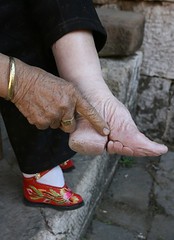
11024530717foot bindingPractice in Chinese society to mutilate women's feet in order to make them smaller; produced pain and restricted women's movement; made it easier to confine women to the household.16
11024530718tribute systemChinese method of dealing with foreign lands and people's that assumed the subordination of all non-Chinese authorities and required the payment of tribute --produce of value from their countries--to the Chinese emperor(although the Chines gifts given in return were often much more valuable).17
11024530719XiongnuA confederation of nomadic peoples living beyond the northwest frontier of ancient China. Chinese rulers tried a variety of defenses and stratagems to ward off these 'barbarians,' as they called them, and dispersed them in 1st Century. (168)18
11024530720KhitanNomadic peoples of Manchuria; militarily superior to Song dynasty China but influenced by Chinese culture; forced humiliating treaties on Song China in 11th century19
11024530721JurchenFounders of Qin kingdom that succeeded the Liao in northern China; annexed most of the Yellow River basin and forced Song to flee to south.20
11024530722Silla DynastyKorean dynasty that resisted Tang for first time. Respected China, performed kowtow, ritual bow to Chinese emperor. Studied Buddhism/Confucianism21
11024530723hanguiKorean written alphabet22
11024530724chu noma style of writing adapted from China to Vietnam. It became the basis for the development of an independent national literature.23
11024530725Shotoku TaishiWho: Prince of Japan. What: Borrowed heavily from China: writing and art (kana and ink on silk), architecture (pagoda), well-field system, etc. Also wrote the 17 point constitution. When: 573-621. Where: Japan. Why: Made changes that greatly influenced Japan and were around for centuries.24
11024530726bushido"the way of the warrior"; Japanese word for the Samurai life ; Samurai moral code was based on loyalty, chivalry, martial arts, and honor until the death25
11024530727Chinese BuddhismChina's only large-scale cultural borrowing before the 20th century. Buddhism entered China from India in the first and second centuries C.E but only became popular between 300-800 C.E through a series of cultural accommodations. At first supported by the state, Buddhism suffered persecution during the 9th century but continued to play a role in Chinese society.26
11024530728Emperor Wendia Chinese general, who secured his Emperor position by killing 59 princes of the Zhou royal house, and founded the Sui Dynasty. Presented himself as a Buddhist Cakravartin King, that is, a monarch who uses military force to defend the Buddhist faith.27
11024530729QuranThe holy book of Islam28
11024530730ummaThe community of all Muslims. A major innovation against the background of seventh-century Arabia, where traditionally kinship rather than faith had determined membership in a community.29
11024530731Pillars of IslamThe five core practices required of Muslims: a profession of faith, regular prayer, charitable giving, fasting during Ramadan, and a pilgrimage to Mecca (if physically and financially possible).30
11024530732hijraThe Migration of Muhammad from Mecca to Medina in A.D. 622, marking the founding of Islam31
11024530733shariaBody of Islamic law that includes interpretation of the Quran and applies Islamic principles to everyday life32
11024530734jizyatax paid by Christians and Jews who lived in Muslim communities to allow them to continue to practice their own religion33
11024530735ulamaMuslim religious scholars. From the ninth century onward, the primary interpreters of Islamic law and the social core of Muslim urban societies.34
11024530736Umayyad Caliphate(661-750 CE) The Islamic caliphate that established a capital at Damascus, conquered North Africa, the Iberian Pennisula, Southwest Asia, and Persia, and had a bureaucracy with only Arab Muslims able to be a part of it.35
11024530737Abbasid Caliphate(750-1258 CE) The caliphate, after the Umayyads, who focused more on administration than conquering. Had a bureaucracy that any Mulim could be a part of.36
11024530738SufismA branch of Islam, defined by adherents as the inner, mystical dimension of Islam; others contend that it is a perennial philosophy of existence that pre-dates religion, the expression of which flowered within Islam37
11024530739al-GhazaliBrilliant Islamic theologian; struggled to fuse Greek and Qur'anic traditions; not entirely accepted by ulama38
11024530740Sikhismthe doctrines of a monotheistic religion founded in northern India in the 16th century by Guru Nanak and combining elements of Hinduism and Islam39
11024530741Ibn Battuta(1304-1369) Morrocan Muslim scholar, the most widely traveled individual of his time. He wrote a detailed account of his visits to Islamic lands from China to Spain and the western Sudan. His writings gave a glimpse into the world of that time period.40
11024530742TimbuktuMali trading city that became a center of wealth and learning41
11024530743Mansa MusaRuler of Mali (r. 1312-1337). His extravagant pilgrimage through Egypt to Mecca in 1324-1325 established the empire's reputation for wealth in the Mediterranean world.42
11024530744al-AnadalusMuslim kingdom in southern Spain, established in 75643
11024530745madrassasFormal colleges for higher institutions in the teaching of Islam as well as in secular subjects founded throughout the Islamic world in beginning in the 11th century44
11024530746House of WisdomCombination library, academy, and translation center in Baghdad established in the 800s.45
11024530747Ibn SinnaHe was one of the most famous doctors of all times. He read the works of Hippocrates and Galen and improved them, by adding more accurate descriptions. He also created anatomical charts using newly invented surgical tools. His text "Cannon of Medicine" (aka "Code of Laws in Medicine") was reference source for doctors for hundreds of years following his death.46
11024530748Nubian ChristianityChristianity was introduced by traders and missionaries. Preserved Christianity for 600 years.47
11024530749NestorianTheological position of Nestorius, who allegedly taught that there are two complete natures and thus two persons, human and divine, in Jesus Christ; rejected by the Council of Ephesus (431), which taught that human nature and divine nature are united in the one person of Christ.48
11024530750Ethiopian Christianity (aka Coptic church)Rulers of axum had adopted Christianity. Christian island in a Muslim sea protected by its moutanous geography and distance from major centers of islamic power. Also helped muhammad's followers be safe. This isolation made it develop a fascination with judaism and jerusalem. Justified their rule through a connection with Solomon as a descendent of jesus. Tried to create a new jerusalem49
11024530789MalaccaPort city in the modern Southeast Asian country of Malaysia, founded about 1400 as a trading center on the Strait of Malacca. Also spelled Melaka.50

AP EUROPEAN - AGE OF ANXIETY Flashcards

Terms : Hide Images
6486891548German Philosopher Friedrich Nietzshe (1844-1900):-Untimely Mediations (1873) • argued that ever since classical Athens, the west had overemphasized rationality and stifled the authentic passions and animal instincts that drive human activity and true creativity. -On the Genealogy of Morals (1887) • claimed that Christianity embodied a "slave morality" that glorified weakness, envy, and mediocrity. "God is dead" metaphorically murdered by lackadaisical modern Christians who no longer really believed in him. -He believed that reason, progress, and respectability were outworn social and psychological constructs that suffocated self-realization and excellence. -He warned that W. society was entering a period of nihilism - the philosophical idea that human life is entirely without meaning, truth, or purpose. -The only hope for the individual was to accept the meaninglessness of human existence and then make that very meaninglessness a source of self-defined personal integrity and hence liberation. -rise of existentialism in 1920s0
6486891549French Philosophy Professor Henri Berson (1859-1941):-Argued that immediate experience and intuition were as important as rational and scientific thinking for understanding reality.1
6486891550Sigmund Freud:-human behavior in turn was the result of rational calculation - of "thinking" -he concluded that human behavior was basically irrational, governed by the unconscious, a sort of mental reservoir that contained vital instinctual drives and powerful memories. Though the unconscious profoundly influenced people's behavior, it was unknowable to the conscious mind, leaving people unaware of the source of meaning of their actions. -id, ego, and superego -neurosis, or mental illness, resulted when the three structures were out of balance -"talking cure" in which neurotic patients lay back on a couch and shared their inter most thoughts with the psychoanalyst was an attempt to resolve such unconscious tensions and resort the rational ego to its predominant role -Civilization and Its Discontents (1930) • argued that civilization was possible only when individuals renounced their irrational instincts in order to live peaceably in groups.2
6486891551Einstein's theory of relativity:-Albert Einstein's theory that time and space are relative to the observer and that only the speed of light remains constant. -Analogy: if a woman in the middle of a moving car got up and walked forward to the door, she had gone, relative to the train, half car length. But relative to an observer on the embankment she had gone farther. To Einstein this meant that time and distance were not natural universals but depended on the position and motion of the observer3
6486891552Max Planck (1858-1947):-showed in the 1900 that sub atomic energy is admitted and in even little spurts, which Planck called quanta, and not in a steady stream, as previously believed. Planks discovery called into question the old sharp distinction between matter and energy: the implication was that matter and energy might be different forms of the same thing. The view of atoms as the stable basic building blocks of nature, with a different kind of unbreakable atom for each of the ninety-two chemical elements, was badly shaken4
6486891553Marie and Pierre Curie:-Polish born physicist and French her husband, discovered that radium constantly emits subatomic particles and thus does not have a constant atomic weight.5
6486891554Claude Monet:-colorful and atmospheric painting of farmland haystacks - a French painter who used a impressionism called "super-realism," capture overall impression of the thing they were painting -impressionists looked to the world around them for subject matter, turning their backs on traditional themes such as battles, religious scenes and wealthy elites. -capturing a fleeting moment of color and light, in often blurry and quickly painted images, was far more important than making a heavily detailed, precise rendering of an actual object.6
6486891555Edgar Degas:-pastel drawings of ballerinas exemplified the way impressionists moved toward abstraction -impressionists looked to the world around them for subject matter, turning their backs on traditional themes such as battles, religious scenes and wealthy elites. -capturing a fleeting moment of color and light, in often blurry and quickly painted images, was far more important than making a heavily detailed, precise rendering of an actual object.7
6486891556Pablo Picasso (1881-1973):-established cubism - a highly analytical approach to art concentrated on a complex geometry of zigzagging lines and sharply angled overlapping planes that exemplified the ongoing trend toward abstract, nonrepresentational art.8
6486891557Vincent Van Gogh:-built on impressionist motifs of color and light but added a deep psychological element to their pictures, reflecting the attempt to search within the self and reveal (or "express") deep inner feelings on the canvas. - Dutch post impressionist artist. Painted "the starry night" 1889. Mentally ill in later life. Cut off his own ear. Influential in the world of painting, very famous9
6486891558John Maynard Keynes:-many brits agreed with the analysis of the French economic who eloquently denounced the treaty of Versailles and his book the Economic Consequences of the Peace 1919. According to him astronomical reparations and harsh economic measures would impoverished Germany, encourage Bolshevism, and increase economic hardships in all countries. Only a complete revision of the treaty could save Germany - and Europe. His attack and gendered much public discussion and became very influential. It created sympathy for Germany in the English - speaking world, which often paralyzed English and American leaders in their relations with Germany over the next two decades.10
6486891559Popular Front Policies in France:-in 1921 France signed a mutual defense pact with Poland and associated itself closely with the so-called little entente, and allegiance that Czechoslovakia, Romania, and Yugoslavia against defeated and bitter Hungary. -Popular Front was a short-lived New Deal-inspired alliance in France led by Leon Blum that encouraged the union movement and launched a far-reaching program of social reform -Frightened by the growing strength of the Fascists at home and abroad, the Communists, Socialists, and Radicals formed an alliance, the Popular Front, for the national elections of Many 1936 -In the next few months, Blum's Popular Front government made the first and only real attempt to deal with the social and economic problems of the 1930s in France -Inspired by Roosevelt's New Deal, it encouraged the union movement and launched a far-reaching program of social reform, complete with paid vacations and a forty-hour workweek; supported by workers and the lower middle-class, these measures were quickly sabotaged by rapid inflation and accusations of revolution from Fascists and frightened conservatives -wealthy people sneaked their money out of the country, labor unrest grew, and France entered a severe financial crisis; Blum was forced to announce a "breathing spell" in social reform11
6486891560National Government in Britain:-the British we're willing to accept a moratorium, but the French were not. Led By their tough minded prime minister, Raymond Poincare (1860-1934), they decided they had to either call Germany's Bluff or see the entire peace settlement dissolved to France's great disadvantage. If the Germans refused to pay reparations, France would use occupation to paralyze Germany and force it to accept the Treaty of Versailles. So, despite strong British protests, in early January 1923 French and Belgian armies moved out of the Rhineland and began to occupy the Ruhr district, the heartland of industrial Germany, Creating the most serious international crisis of the 1920s. The state provided unemployment benefits and supplemented the payments with subsidizing housing, medical aid, and increased old-age pensions; these and other measures kept living standards from seriously declining, helped moderate class tensions, and pointed the way toward the welfare state Britain would establish after World War II -Relative social harmony was accompanied by the rise of the Labour Party as a determined champion of the working class and of greater social equality; committed to the kind of moderate revisionist socialism that had emerged before World War I, the Labour Party replaced the Liberal Party as the main opposition to the Conservatives; this shift reflected the decline of old liberal ideals of competitive capitalism, limited government control, and individual responsibility -in 1924 and from 1929 to 1931, the Labour Party under Ramsay MacDonald governed the country with the support of the smaller Liberal Party; yet Labour moved toward socialism gradually and democratically, so as not to antagonize the middle classes -The British Conservatives showed the same compromising spirit on social issues -in 1922 Britain granted southern, Catholic, Ireland full autonomy after a bitter guerrilla war, thereby removing a key source of prewar friction -Developments in both international relations and the domestic policies of the leading democracies across western Europe gave cause for optimism in the late 1920s -In Britain, MacDonald's Labour government and then, after 1931, the Conservative-dominated coalition government followed orthodox economic theory -The budget was balanced, spending was tightly controlled, and unemployed workers received barely enough welfare to live; nevertheless, the economy recovered considerably after 1932; by 1937 total production was about 20 percent higher than in 1929; in fact, for Britain the years after 1932 were actually somewhat better than the 1920s had been, the opposite of the situation in the US and France -After going off the gold standard in 1931 and establishing protective tariffs in 1932, Britain concentrated increasingly on the national, rather than the international, market -The old export industries, such as automobiles and electrical appliances, grew in response to British home demands; moreover, low interest rates encouraged a housing boom -by the end of the decade, there were highly visible differences between the old, depressed industrial areas of the north and the new, growing areas of the south.12
6486891561Popular Fronts in France and Spain:-Popular Front was a short-lived New Deal-inspired alliance in France led by Leon Blum that encouraged the union movement and launched a far-reaching program of social reform -Frightened by the growing strength of the Fascists at home and abroad, the Communists, Socialists, and Radicals formed an alliance, the Popular Front, for the national elections of Many 1936 -Their clear victory reflected the trend toward polarization; the number of Communists in the parliament jumped drastically from 10 to 72, while the Socialists, led by Blum, became the strongest party in France, with 146 seats; the Radicals, who were actually quite moderate, slipped badly, and the conservatives lost ground to the far right -Reform measures frightened the wealthy, conservatives, and Fascists, who sneaked their money out of the country, and France entered a severe financial crisis -Political dissension in France was encouraged by the Spanish Civil War (1936-1939), during which authoritarian Fascist rebels overthrew the democratically elected republic government; French Communists demanded that the government support the Spanish republicans, while many French conservatives would gladly have joined Hitler and -Mussolini in aiding the Spanish Fascists; extremism grew, and France itself was within sight of civil war Blum was forced to resign in June 1937, and the Popular front quickly collapsed13
6486891562Werner Heisenberg:-1927 formulated the "uncertain principle" which postulates that nature itself is ultimately unknowable and unpredictable. -Everything was "relative" that is, deponent on the observers frame of reference.14
6486891563Dadaism:-an artistic movement of the 1920s and 1930s that attacked all accepted standards of art and behavior and delighted in outrageous conduct. -the war had showed once and for all that life was meaningless, the Dadaists argued, so art should be meaningless as well. -tried to shock their audiences with what they called "anti-art" works and public performances that were insulting and entirely nonsensical. -Leonardo da Vinci's Mona Lisa with a mustache -"art in its execution and direction is dependent on the time in which it lives, and artists are creatures of their epoch"15
6486891564Bauhaus:-a German interdisciplinary school of fine and applied arts that brought together many leading modern architects, designers, and theatrical innovators.16
6486891565Modernism:-a label given to the artistic and cultural movements of the late nineteenth and early twentieth centuries, which were typified by radical experimentation that challenged traditional form of artistic expression.17
6486891566The Compositions of Igor Stravinsky:-the ballet The right of spring by Russian composer practically caused a riot when it was first performed in Paris in 1913. The combination of pulsating rhythms and dissonant sounds from the orchestra pit with earthly representations of love making by the strangely dressed dancers on the stage shock audiences accustomed to traditional ballet.18
6486891567The Compositions of Arnold Schoenberg:-the music notes in a given piece were no longer united and organized by key, instead they were independent and unrelated. His twelve-tone music of the 1920s arranged all 12 notes of the scale in an abstract mathematical pattern or "tone row". This pattern sounded like no pattern at all to the ordinary listener and could be detected only by a highly trained eye studying the musical score. Accustomed to the harmonies of classical and romantic music, audience is generally resisted atonal music. Only after world war two did it begin to win acceptance.19
6486891568Franz Kafka 1883-1924:the Czech writer portrayed an incomprehensible, alienated world. His novels The Trail 1925 and the castle 1926 are stories about helpless individuals crushed by inexplicable hostile forces, as is his first novella the metamorphosis 1915, in which the main character turns into a giant insect. -The German-Jewish man died young, For 41, and was spared the horror of seeing the world of his nightmares materialize in the Nazi State. In these and other works authors between the wars used new literary techniques and dark imagery to capture the anxiety of the age.20
6486891569James Joyce 1882-1941:-the most famous and perhaps most experimental stream of consciousness novel is Ulysses (1922) by Irish novelist. Into an account of a single day in the life of an ordinary man, He weaves an extended ironic parallel between the aimless wanderings of his hero through the streets and pubs of Dublin and the adventures of Homer's hero Ulysses on his way home from Troy. Ulysses was surely one of the most disturbing novels of its generation. -Abandoning any sense of a conventional plot; breaking the rules of grammar; and blending foreign words, puns, bits of knowledge, And scraps of memory together and be well during confusion, Ulysses is intended to mirror modern life: A gigantic little impossible to unravel. Since he included frank descriptions of the main characters sexual thoughts and encounters, the novel was considered obscene in great Britain and the United States and was banned there until the 1930s.21
6486891570Virginia Woolf:-created a novel made up of a series of such monologues in which she tried to capture the inner voice in prose. In this and other stories, Wolf for trade characters whose ideas and emotions from different periods of their lives bubble up as randomly as from a patient on that psychoanalyst's couch -Jacobs Room (1922) -novelist that used the stream of consciousness technique, relying on inter monologues to explore the human psyche.22
6486891571Jean-Paul Sartre:-"existence precedes essence" -there are no god given, timeless truth outside or independent of individual existence. Only after they are born do people struggle to define their essence, entirely on their own. -"man is condemned to be free" -because life is meaningless, existentialists believe that individuals are forced to create their own meaning and define themselves through their actions . -to escape is to live in "bad faith" -to live authentically, individuals must become "engaged" and choose their own actions in full awareness of their responsibility for their own behavior -"being in the world"23
6486891572Radio:-like film, radio became a full-blown mass medium in the 1920s; experimental radio sets were first available in the 1880s; the work of Italian inventor Guglielmo Marconi (1874-1937) around 1900 and the development of the vacuum tube in 1904 made possible primitive transmissions of speech and music; but the first major public broadcasts of news and special events occurred only in 1920, in Great Britain and the United States -Every major country quickly established national broadcasting networks; in the United States such networks were privately owned and were financed by advertising, but in Europe the typical pattern was direct control by the government; in Great Britain, Parliament set up an independent public corporation, the British Broadcasting Corporation (BBC), supported by licensing fees -Whatever the institutional framework, radio enjoyed a meteoric growth in popularity; by the late 1930s more than three out of every four households in both democratic Great Britain and dictatorial Germany had at least one radio -Like the movies, radio was well suited for political propaganda and manipulation; dictators such as Hitler and Italy's Benito Mussolini controlled the airwaves and could reach enormous national audiences with their dramatic speeches; in democratic countries, politicians such as American presidents Franklin Roosevelt and British prime minister Stanley Baldwin effectively used informal "fireside chats" to bolster their popularity24
6486891573Logical Positivism:-a philosophy that sees meaning in only those beliefs that can be empirically proven, and that therefore rejects most of the concerns of traditional philosophy from the existence of god to the meaning of happiness, as nonsense.25
6486891574Existentialism:-a philosophy that stresses the meaninglessness of existence and the importance of the individual in searching for moral values in an uncertain world.26
6486891575Leni Riefenstahl:-In Nazi Germany, a young and immensely talented woman filmed marker directed a masterpiece of documentary propagandas, Triumph of the will, based on the 19334 Nazi Party rally at Nuremberg. She combined stunning aerial photography with mass processions of young Nazi fanatics and images of joyful crowds welcoming Adolf Hitler. Her film, released in 1935, was a brilliant yet chilling documentary of the rise of Nazism.27
6486891576The Little Entente:-Since 1890 France had looked to Russia as a powerful ally against Germany. But with Russia hostile and communist, and with Britain and the United States unwilling to make any firm commitments, France turned to the newly formed states of central Europe for diplomatic support -In 1921 France signed a mutual defense pact with Poland and associated itself closely with the so-called Little Entente, an alliance that joined Czechoslovakia, Romania, and Yugoslavia against defeated and bitter Hungary28
6486891577The Ruhr occupation-The French were unwilling to accept a German moratorium; led by tough minded prime minister Raymond Poincare, they decided they had to either call Germany's bluff or see the entire peace settlement dissolve to France's great disadvantage. So, despite strong British protests, in early January 1923 French and Belgian armies moved out of the Rhineland and began to occupy the Ruhr district, the heartland of industrial Germany, creating the most serious international crisis of the 1920s. -Strengthened by a wave of German patriotism, the German government ordered the people of the Ruhr to stop working and offer passive resistance to the occupation. The coal mines and steel mills of the Ruhr fell silent, leaving 10 percent of Germany's population out of work. The French responding by sealing off the Ruhr and the Rhineland from the rest of Germany, letting in only enough food to prevent starvation -German opinion was incensed when the french sent over 40,000 troops from North and West Africa to control the territory. German propaganda labeled these troops the "black shame," warning that African soldiers were savages, eager to brutalize civilians and assault German women -By the summer of 1923 France and Germany were engaged in a test of wills. French armies could not collect reparations from striking workers at gunpoint, but the occupation was paralyzing Germany and its economy. To support the striking workers and their employers, the German government began to print money to pay its bills, causing runaway inflation. Prices soared as German money rapidly lost all value. -In August 1923, Gustav Stresemann assumed leadership of the German government. He called off passive resistance in the Ruhr and in October agreed in principle to pay reparations, but asked for a re-examination of Germany's ability to pay; Poincare accepted29
6486891578Gustav Stresemann (1878-1929):-assumed leadership of the government -he tried compromise. He called off passive resistance in the Ruhr and in October agreed in principle to pay reparations but asked for a re-examination of Germany's ability to pay. Poincare accepted. His hardline had become unpopular in France, and it was hated in Britain and in the United States.30
6486891579The Dawes Plan 1924:- was accepted by France, Germany, And Britain. -Germany's yearly reparations were reduced and linked to the level of German economic output. Germany would also receive large loans from the United states in order to pay reparations to France and Britain, thus enabling those countries to repay the large war debts they owed the United States31
6486891580The Locarno Pact-A political settlement accompanied the economic accords. In 1925 the leaders or Europe signed a number of agreements at Locarno, Switzerland. Germany and France solemnly pledged to accept their common border, and both Britain and Italy agreed to fight either France or Germany if one invaded the other. Stresemann reluctantly agreed to settle boundary disputes with Poland and Czechoslovakia by peaceful means, although he did not agree on permanent borders to Germany's east. In response France reaffirmed its pledge of military aid to those countries if Germany attacked them. The refusal to settle Germany's eastern borders angered the Poles, and though the "spirit of Locarno" lent some open to those seeking international stability, political tensions deepened in central Europe.32
6486891581Kellogg-Briand Pact:-signed in 1928 by 15 countries -Initiated by French prime minister Aristide Briand and Us secretary of state Frank B. Kellogg. The signing states agreed to "renounce war as an instrument of international policy" and to settle international disputes peacefully. The pact made no provisions for action in case war actually occurred and could not prevent the arrival of the second world war in 1939. In the late 1920s, however it fostered a cautious optimism and encouraged the hope that the United States would accept its responsibilities as a great world power by contributing to European stability.33
6486891582The Labour Party under Ramsay MacDonald:-Relative social harmony was accompanied by the rise of the Labour Party as a determined champion of the working class and of greater social equality; committed to the kind of moderate revisionist socialism that had emerged before World War I, the Labour Party replaced the Liberal Party as the main opposition to the Conservatives; this shift reflected the decline of old liberal ideals of competitive capitalism, limited government control, and individual responsibility -in 1924 and from 1929 to 1931, the Labour Party under Ramsay MacDonald governed the country with the support of the smaller Liberal Party; yet Labour moved toward socialism gradually and democratically, so as not to antagonize the middle classes34
6486891583The Great Depression:-a worldwide economic depression from 1929 through 1939, unique in its severity and duration and with slow and uneven recovery. -Germany owed 33 billion dollars to the allies because of the treaty of Versailles. However, their economy was awful and there was no way for them to get France the money. They called for the Dawes Plan a war reparations agreement that reduced Germany's yearly payments, made payment dependent on economic prosperity, and granted large U.S. loans to promote recovery. Britain accepted however France did not. Because Germany did not have the money they began to print more paper money to pay them back but the over production made the value of the German currency literally nothing. There was a hyperinflation and so much money on the streets that children played with it and mothers used it for fires. -Just like Woodrow Wilson said at the Treaty of Versailles the huge amount of money that Germany was forced to pay was ridiculous and would never be met. Ultimately the crash of Germany's economy spread to the crash of the world economy.35
6486891584The New Deal:-When the full force of the financial crisis struck Europe in the summer of 1931 and boomeranged back to the United States, people's worst fears were realized. Banks failed; unemployment soared. Industrial production fell by around 50 percent. In these dire circumstances, Franklin Delano Roosevelt won a landslide presidential victory in 1932 with grand but vague promises of a "New Deal for the forgotten man." Roosevelt's goal was to reform capitalism in order to preserve it. Though he rejected socialism and government ownership of industry, he advocated forceful government intervention in the economy an instituted a broad range of government-supported social programs designed to stimulate the economy and provide jobs -Innovative federal programs promoted agricultural recovery. Roosevelt took the US off the gold standard and devalued the dollar in an effort to raise American prices and rescue farmers. The Agricultural Adjustment Act of 1933 also aimed at raising prices-and thus farm income-by limiting production. -The most ambitious attempt to control and plan the economy was the National Recovery Administration (NRA). Intended to reduce competition among industries by setting minimum and prices, the NRA broke with the cherished American tradition of free competition. Though participation was voluntary, the NRA aroused conflicts among business people, consumers, and bureaucrats and never worked well. The program was abandoned when declared unconstitutional by the Supreme Court in 1935. -Roosevelt and his advisors then attacked the key problem of mass unemployment. The federal government accepted the responsibility of employing as many people as financially possible. New agencies like the Works Progress Administration were created to undertake a vast range of projects, such as constructing public buildings, bridges, and highways. The WPA was enormously popular. -In 1935 the US government also established a national social security system w9th old-age pensions and unemployment benefits. The National Labor Relations Act of 1935 gave union organizers the green light by declaring collective bargaining to be the policy of the United States. -Programs like the WPA were part of the New Deal's fundamental commitment to use the federal government to provide relief for all Americans, which marked a profound shift from the traditional stress on family support and community responsibility. -The New Deal was only partly successful in responding to the Great Depression. At the height of the recovery in May 1937, 7 million workers were still unemployed. The New Deal never pulled the United States out of the depression; it took WWII to do that.36
6486891585Leon Blum:-frightened by the growing strength of the Fascists at home and abroad, the communists, socialists, and Radicals formed an alliance the Popular Front - for the national elections of May 1936. Their clear victory reflected the trend toward polarization. The number of Communists in the parliament jumped dramatically from 10 to 72, while the Socialists, led by Leon Blum, became the strongest party in France, with 146 seats. The Radicals - who were actually quite moderate - slipped badly, and the conservatives lost ground to the far right. -In the next few months, Blum's Popular Front government made the first and only real attempt to deal with social and economic problems of the 1930s in France. Inspired by Roosevelt's New Deal, it encouraged the union movement and launched a far-reaching program of social reform, complete with paid vacations and forty-hour workweek. Supported by workers and the lower middle class, these measures were quickly sabotaged by rapid inflation and accusations of retaliation from Fascists and frightened conservatives. Wealthy people sneaked their money out of the country, labor unrest grew, and France entered a severe financial crisis. Blum was forced to announce "breathing spell" in social reform.37
6486891586The Spanish Civil War:-Political dissension in France was encouraged, during which authoritarian Fascist rebels overthrew the democratically elected republican government. French Communists demanded that the government support the Spanish republicans, while many French conservatives would gladly have joined Hitler and Mussolini in aiding the Spanish fascists. Extremism grew, and France itself was within sight of civil war. Blum was forced to resign in June 1937, and the Popular Front quickly collapsed. An anxious and divided France drifted aimlessly once again, preoccupied by Hitler and German rearmament.38

AP World History Stearns Chapter 21 Terms Flashcards

Terms : Hide Images
6057998861AurangzebMughal emperor in India and great-grandson of Akbar 'the Great', scolded daughter for appearing in garments showing too muich body, under whom the empire reached its greatest extent, only to collapse after his death0
6057998862HumayanSon and successor of Babur, good soldier; expelled from India in 1540 by being forced to flee to Persia, but restored Mughal rule by 1556; died by falling down stairs and hitting his head1
6057998864Taj Mahalbeautiful mausoleum at Agra built by the Mogul emperor Shah Jahan (completed in 1649) in memory of his favorite wife, major symbol of India2
6057998865Suleyman The Magnificantreign began 1520; led attacks on Europe, ruler who presided over the height of Ottoman dominance and cultural influence3
6057998867Mumtaz MahalShah Jahan's wife who had a building named after her (Taj Mahal) , as he was only passinate about her and beautiful buildings4
6057998868Nadir Khan AfsharSoldier-adventurer following the fall of the Safavid dynasty in 1722; proclaimed himself shah in 1736; established short-lived dynasty in reduced kingdom, victorious from these blood struggles5
6057998869OttomansTurks who had come to Anatolia in the same wave of migrations as the Seljuks.6
6057998870PadishahSafavid term used for king of kings.7
6057998871Red HeadsSafavid followers , called this because of distinctive head gear, preached shi'a doctrines8
6057998873Shah Abbas the Great(ruled 1588-1629)He encouraged trade with other nations, and increased the use of gunpowder weapons. He revitalized the Safavid empire. Made great source of youths who were captured and then converted to Islam.9
6057998874Shi'athe branch of Islam whose members acknowledge Ali and his descendants as the rightful successors of Muhammad10
6057998875Vizierthe highest office in the governmental hierarchy, had more real power than the sultan (a sort of prime minister.)11
6057998877AkbarMost illustrious sultan of the Mughal Empire in India (r. 1556-1605). He expanded the empire and pursued a policy of conciliation with Hindus, 13 years old, carried out social reforms and invented his own universalistic religion, illiterate learned from father reading to him12
6057998878SunniA branch of Islam whose members acknowledge the first four caliphs as the rightful successors of Muhammad13
6057998879Nur JahanWife of Jahangir; amassed power in court and created faction of male relatives who dominated Mughal Empire during later years of Jahangir's reign, died giving birth to her 19th child14
6057998880Golden Hornnickname for Constantinople (capital of Byzantine empire) because it was shaped like a horn and brought in lots of trade (money, gold) because of its access to the Mediterranean, Black, and Aegean seas15
6057998881Shah JahanMogul emperor of India during whose reign the finest monuments of Mogul architecture were built (including the Taj Mahal at Agra) (1592-1666)16
6057998882MarattasWestern Indian peoples who rebelled against Mughal control early in the 18th century and contributed to its downfall mainly because of Aurangzeb's draconian religious policies.17
6057998883Jizyatax paid by Christians and Jews who lived in Muslim communities to allow them to continue to practice their own religion18
6057998884Mehmed IIOttoman sultan also calle Mehmed the Conqueror, Murad's son, conquered Constaninople in 1453 and opened it to new citizens of many religions and backgrounds. The rebuilt city was renamed Instanbul.19
6057998886Isma'ilknown as religious tyrant who killed any citizen who didn't convert, captured city of Tabriz, where he was proclaimed shah/emperor. Later conqured most of Persia.20
6057998887Gunpowder EmpiresMuslim empires of the Ottomans, Safavids, and the Mughals that employed cannonry and gunpowder to advance their military causes.21
6057998888Imamsspiritual leaders of Shi'ah Islam, said to be direct descendents of Muhammad, successors of Ali22
6057998889Shahtitle for the former hereditary monarch of Iran23
6057998890Safavid Dynastyfounded by a Turkic nomad family with Shi'a Islamic beliefs; established a kingdom in Iran and ruled until 1722.24
6057998891Baburbrilliant general who laid the foundation for the Mughal Empire, first Mughal emperor India, good military strategist, better conqueror than adminstrator25
6057998892Battle of LepantoTurkish sea power was destroyed in 1571 by a league of Christian nations organized by the Pope26
6057998893Din-i-IlahiReligion initiated by Akbar in Mughal India; blended elements of the many faiths of the subcontinent; key to efforts to reconcile Hindu and Muslims in India, but failed.27
6057998895IsfahanSafavid capital under Abbas the Great; planned city laid out according to shah's plan; example of Safavid architecture.28
6057998897SikhsNonviolent religous group that blended Buddhism, Hinduism and Sufism29
6057998898Purdahseculsion of women in their homes from men or strangers30
6057998899JanissariesChristian boys taken from families, converted to Islam, and then rigorously trained to serve the sultan, coercive labor example, vital to Ottoman success in warfare31
6057998900Abbas IIKhedive of Egypt 1892-1914 Nationalist, anti-British, clashed with Lord Cromer, Safavid emperor, 17th C. A.D.; converted people to Shiism32
6057998901ChaldiranImportant battle between the Safavids and Ottomans/ Sunni and Shi'a in 1514; Ottoman victory demonstrated the importance of firearms and checked the western advance of their Shi'a state.33
6057998902Tahmasp I1534-1576. Won the throne after Isma'il , rebuilt the Safavid dynasty. Brought Turkic chiefs under control. Longest reign in the Safavid dynasty.34
6057998903MullahsLocal mosque officials and prayer leaders within the Safavid Empire; agents of Safavid religious campaign to convert all of population to Shi'ism, given some support from state35
6057998904Sail al-DinEarly 14th century Sufi mystic; began campaign to purify/reform Islam; first member of Safavid dynasty.36
6057998905Mughal Dynastyestablished by Babur in India in 1526; the name is taken from the supposed Mongol descent of Babur, but there is little indication of any Mongol influence in the dynasty; became weak after rule of Aurangzeb in first decades of 18th century.37
6070271812satiburning of high caste Hindu women on their husbands' funeral pyres.38
6070346830JahangirSon of Akbar he was the "Grasper of the World." He married the Persian princess Nur Jahan, who really controlled the state affairs because he was a weak ruler. He was overthrown by his son Khusrau.39

Ap World History Chapter 1-3 Flashcards

Terms : Hide Images
7246634039civilizationa society in an advanced state of social development (e.g., with complex legal and political and religious organizations)0
7246634040culturethe enduring behaviors, ideas, attitudes, and traditions shared by a large group of people and transmitted from one generation to the next1
7246634041historystudy of past events and changes in the development, transmission, and transformation of cultural practices.2
7246634042stone age(archeology) the earliest known period of human culture, characterized by the use of stone implements3
7246634043paleolithicsecond part of the Stone Age beginning about 750,00 to 500,000 years BC and lasting until the end of the last ice age about 8,500 years BC4
7246634044neolithiclatest part of the Stone Age beginning about 10,000 BC in the middle east (but later elsewhere)5
7246634045hunter gatherspeople who support themselves by hunting wild animals and gathering wild edible plants and insects6
7246634046first agricultural revolutionthe change from food gathering to food productions that occurred between ca. 8000 and 2000 B.C.E. Also known as the Neolithic Revolution.7
7246634047megalithmemorial consisting of a very large stone forming part of a prehistoric structure (especially in western Europe)8
7246634048sumeriansPeople who dominated Southern Mesopotamia through the end of the 3rd Millennium BCE. Responsible for the creation of irrigation technology, cunieform, and religious conceptions.9
7246634049semiticfamily of related langugages long spoken across parts of western asia and northern africa. in intiquity these languages included hebrew, aramaic, and phoenician. The most widespead modern member of the semitic family is arabic.10
7246634050city-statesmall independent state consisting of an urban center and the surrounding agricultural territory. a characteristic political form in early mesopotamia, archaic and classical greece, phoenicia, and early italy.11
7246634051hammurabiAmorite ruler of Babylon (r. 1792-1750 B.C.E.). He conquered many city-states in southern and northern Mesopotamia and is best known for a code of laws, inscribed on a black stone pillar, illustrating the principles to be used in legal cases. (p. 34)12
7246634052scribein the governments of many ancient societies, a professinal position reserved for men who had undergone the lengthy training required to be able to read and write uniting cuneiforms, hieroglyphics, and other early, cumbersome writing systems.13
7246634054cuneiforman ancient wedge-shaped script used in Mesopotamia and Persia14
7246634055pharoahEgyptian ruler who was believed to be the son of Re, the sun god, in human form. He had total authority over people and land.15
7246634056pyramida massive memorial with a square base and four triangular sides16
7246634057hieroglyphicsan ancient Egyptian writing system in which pictures were used to represent ideas and sounds17
7246634058papyrusancient paper made from stem of papyrus plant18
7246634059mummyThe dead body of a human or animal that has been embalmed and prepared for burial, as according to the practices of the ancient Egyptians.19
7246634060harappaSite of one of the great cities of the Indus Valley civilization of the third millennium B.C.E. It was located on the northwest frontier of the zone of cultivation , and may have been a center for the acquisition of raw materials. (p. 48)20
7246634061monhenjo-darolargest of the cities of the indus valley civilization. it was centrally located in the extensive flood plain of the indus river in contemporary pakistan. little is known about the political institutions of indus calley communities, but the large-scale of construction at mohenjo-daro, the orderly grid of streets, and the standardization of building materials are evidence of central plamning.21
7246634062Iron Agethe period following the Bronze Age; characterized by rapid spread of iron tools and weapons22
7246634064Mass deportationRemoval of entire peoples used as terror tactic by Assyrian and Persian Empires. (95)23
7246634065Israelan ancient kingdom of the Hebrew tribes at the southeastern end of the Mediterranean Sea24
7246634066First TempleA monumental sanctuary built in Jerusalem by King Solomon in the tenth century B.C.E. to be the religious center for the Israelite god Yahweh. The Temple priesthood conducted sacrifices, received a tithe or percentage of agricultural revenues. (102)25
7246634067monotheismbelief in a single God26
7246634068Diasporathe dispersion or spreading of something that was originally localized (as a people or language or culture)27
7246634069PhoeniciansSemitic-speaking Canaanites living on the coast of modern Lebanon and Syria in the first millennium B.C.E. From major cities such as Tyre and Sidon, Phoenician merchants and sailors explored the Mediterranean, and engaged in widespread commerce. (103)28
7246634071Loessa fine-grained unstratified accumulation of clay and silt deposited by the wind29
7246634072ShangThe dominant people in the earliest Chinese dynasty for which we have written records (ca. 1750-1027 B.C.E.). Ancestor worship, divination by means of oracle bones, and the use of bronze vessels for ritual purposes were major elements of Shang culture.30
7246634073Divinationa prediction uttered under divine inspiration31
7246634074ZhouThe people and dynasty that took over the dominant position in north China from the Shang and created the concept of the Mandate of Heaven to justify their rule. Remembered as prosperous era in Chinese History. (p. 61)32
7246634075Mandate of heavena political theory of ancient China in which those in power were given the right to rule from a divine source33
7246634076Legalismstrict conformity to the letter of the law rather than its spirit34
7246634077Confuciuschinese philospher and teacher; his belifs,known as confusoinism greatly influenced chinese life35
7246634078Daoismphilosophical system developed by of Lao-tzu and Chuang-tzu advocating a simple honest life and noninterference with the course of natural events36
7246634079yin yangthe representations of balance and harmony, symbol of Taoists; YIN=feminine, dark, cold, negativity YANG=masculine, light, heat, motivation37
7246634080KushAn African state that developed along the upper reaches of the Nile c. 100 B.C.E.; conquered Egypt and ruled it for several centuries.38
7246634081Meroecenter of the kush dynasty from about 250 B.C. to A.D. 150; known for its manufacture of iron weapons and tools.39
7246634084Llamawild or domesticated South American cud-chewing animal related to camels but smaller and lacking a hump40
7246752915cultural diffusionspread of cultural beliefs and social activities from one group to another41
7246773891technological diffusionDiffusion of innovations is a theory that seeks to explain how, why, and at what rate new ideas and technology spread42
7246778950biological diffusionthe wide spread of different organisms43
7246862250chiefdoms44
7246881146pastoral societies45

AP World History "-Isms" Flashcards

Terms : Hide Images
9888793496Absolutisma form of government in which the ruler is an absolute dictator (not restricted by a constitution or laws or opposition etc.)0
9888793497Anarchisma political theory favoring the abolition of governments1
9888793498Anti-Semitismpolicies, views, or actions that harm or discriminate against Jews2
9888793544Colonialism-The practice of having and running colonies.3
9888793500New ImperialismHistorians' term for the late-nineteenth- and early-twentieth-century wave of conquests by European powers and the United States, which were followed by the development and exploitation of the newly conquered territories.4
9888793502Pan-SlavismA movement to promote the independence of Slav people. Roughly started with the Congress in Prague; supported by Russia. Led to the Russo-Turkish War of 1877.5
9888793504Communisma theory or system of social organization based on the holding of all property in common, actual ownership being ascribed to the community as a whole or to the state.6
9888793505Conservatisma political or theological orientation advocating the preservation of the best in society and opposing radical changes7
9888793506Racismdiscriminatory or abusive behavior towards members of another race8
9888793508RealismThis was the new style of literature that focused on the daily lives and adventures of a common person. This style was a response to Romanticism's supernaturalism and over-emphasis on emotion9
9888793514Social DarwinismThe application of ideas about evolution and "survival of the fittest" to human societies - particularly as a justification for their imperialist expansion.10
9888793515Socialisma theory or system of social organization that advocates the vesting of the ownership and control of the means of production and distribution, of capital, land, etc., in the community as a whole.11
9888793517ZionismA worldwide movement, originating in the 19th century that sought to establish and develop a Jewish nation in Palestine. Since 1948, its function has been to support the state of Israel.12
9888793519FascismA system of government characterized by strict social and economic control and a strong, centralized government usually headed by a dictator. First found in Italy by Mussolini.13
9888793520Feminismthe belief that women should possess the same political and economic rights as men14
9888793522Humanisman intellectual movement at the heart of the Renaissance that focused on education and the classics15
9888793523ImperialismA policy in which a strong nation seeks to dominate other countries poitically, socially, and economically.16
9888793547Isolationisma policy of non-involvement in foreign affairs17
9888793526LiberalismA political ideology that emphasizes the civil rights of citizens, representative government, and the protection of private property. This ideology, derived from the Enlightenment, was especially popular among the property-owning middle classes.18
9888793528Marxismthe economic and political theories of ______ __________and Friedrich Engels that hold that human actions and institutions are economically determined and that class struggle is needed to create historical change and that capitalism will untimately be superseded19
9888793529Mercantilisman economic system (Europe in 18th C) to increase a nation's wealth by government regulation of all of the nation's commercial interests20
9888793530Militarisma political orientation of a people or a government to maintain a strong military force and to be prepared to use it aggresively to defend or promote national interests21
9888793532Nationalismlove of country and willingness to sacrifice for it22
9888793533Nazisma form of socialism featuring racism and expansionism, The doctrines of nationalism, racial purity, anti-Communism, and the all-powerful role of the State. The National Socialist German Workers Party encouraged this and it was advocated by Adolf Hitler in Germany.23
9888793534DaoismChinese philosophy based on the teachings of Laozi; taught that people should turn to nature and give up their worldly concerns24
9888793535Confucianismthe system of ethics, education, and statesmanship taught by Confucius and his disciples, stressing love for humanity, ancestor worship, reverence for parents, and harmony in thought and conduct25
9888793536LegalismIn China, a political philosophy that emphasized the unruliness of human nature and justified state coercion and control. The Qin ruling class invoked it to validate the authoritarian nature of their regime26
9888793537AnimismBelief that objects, such as plants and stones, or natural events, like thunderstorms and earthquakes, have a discrete spirit and conscious life.27
9888793538ZoroastrianismA religion originating in ancient Iran. It centered on a single benevolent deity-Ahuramazda, Emphasizing truth-telling, purity, and reverence for nature, the religion demanded that humans choose sides between good and evil28
9888793539FederalismA system of government in which a written constitution divides power between a central, or national, government and several regional governments29
9888793540Centralismdenotes the concentration of a government's power into a centralized government. This takes away some of the powers of the states and puts more power into the hands of the executive leader30
9888793541FeudalismA political system in which nobles are granted the use of lands that legally belong to their king, in exchange for their loyalty, military service, and protection of the people who live on the land31
9888793548Protectionism-government policy of insulating domestic industries from the world market through import tariffs and taxes.32
9888793543Radicalisma political philosophy that emphasizes the need to find and eliminate the basic injustices of society; seek what they consider the roots of the economic, political, and social wrongs of society and demand immediate and sweeping changes to wipe them out; a belief that rapid, dramatic changes need to be made to existing society, usually think current system cannot be saved and must be overturned33
9888793549Protestantism- religions born of protests to the practices of Catholicism34

AP World History Hinduism & Buddhism Flashcards

Terms : Hide Images
8084703005ArthaOne of the 4 major goals of Hinduism Entails wealth0
8084703006MokshaOne of the 4 major goals of Hinduism The perfect state of communion with Brahma1
8084703007DharmaOne of the 4 major goals of Hinduism Strict adherence to your caste/ the caste system2
8084703008KamaOne of the 4 major goals of Hinduism Details love and sex3
8084703009Puranas500 B.C.E- 500 C.E A collection of folk tales/legends from early times Contains the genealogy of rulers before even humans Most of the most important deities/gods are used The goddesses help to balance the suppression for women in Aryan society4
8084703010AtmanHindi word for the "soul" Your atman consists of the same substance as the rest of the world This means that everything is interconnected through this "substance" Each atman will eventually be reunited with Brahma5
8084703011Aryan PeoplesThe first people to assimilate into the Harappan peoples Fused Harappan religion with their own to create Hinduism Created the idea of the caste system Brought Sanskrit to the people of Indus Valley6
8084703012VishnuThe deity for life/preservation7
8084703013ShivaThe deity for destruction/death8
8084703014BrahmaThe main God/Deity of Hinduism, known as the creator and source of everything9
8084703015KrishnaOne of the Incarnations of Vishnu The deity for helping to fulfill Dharma10
8084703016GaneshShiva's son The deity for luck/fortune HAS A FREAKIN ELEPHANT HEAD11
8084703017BrahmanasA collection of Sanskrit literature made for Brahmins (900-500 B.C.E) Contains procedures for rituals/worship Also holds etiologies of rituals and myths12
8084703018SamsaraHindi word for "resurrection" One must go through samsara multiple to reach Moksha Each time someone goes through samsara, their species and caste is decided13
8084703019Upanishads800-500 B.C.E. Devoted to the speculation and proclaims the oneness of the individual and universe. INTRODUCES SEVERAL KEY CONCEPTS: Dharma Karma Moksha Life cycle- Brahmacharya, Gruhasta, Vanaprastha, and Sannyasin14
8084703020Rig Veda1500-1200 B.C.E Composed by early Aryan brahmins A collection of 1028 verses of SANSKRIT poetry The first book of 4 in the collection of Vedas Details many early gods Speculates on the creation of the world and significance of life15
8084703021SanskritThe written language introduced to late Harappan peoples by the Aryans16
8084703022MahabharataLongest single poem in the entire world Details the civil war between two branches of the Bharats Teaches about the daily lives of Hindus Presents moral conflicts including the dilemma of taking sides, and the necessity of acting decisively17
8084703023RamayanaDetails the fight between the God-king Rama, and Ravana, the demon ruler of Sri Lanka Ravana had kidnapped Rama's wife, Sita18
8084703024Bhagavad-GitaDetails the final battle between the two branches of the Bharata family Arjuna, leader of one branch, is in a dilemma of whether to fight or not. He asks his chariot driver, Lord Krishna, and Krishna responds with since he is a warrior by caste, he must fight Summarizes many key doctrines of Hinduism: People who do their duty will be pointed to spiritual fulfillment Bhakti19
8084703025BrahmacharyaOne of the stages of life The period of youth, studying, and celibacy20
8084703026GruhastaOne of the stages of life The householder stage for raising a family21
8084703027VanaprasthaOne of the stages of life The time for reflection of ones past life22
8084703028SannyasinOne of the stages of life A period of immersion with meditation, in preparation for death or possibly moksha23
8084703029Origins of HinduismAryan invaders assimilated into Harappan culture This led into the intermingling of Gods, with some Aryan Gods being transformed into the modern day Hindu Gods.24
80847030304 Life Goals of HinduismArtha Kama Dharma Moksha25
8084703031KarmaThe effect of your actions on your soul Good karma begets more good karma and vice versa Good karma are activities that support Dharma Your karma is one of the factors that determine your next caste after samsara26
8084703032Sacred TextsThe Vedas Upanishads Mahabharata Ramayana Bhagavad-Gita Brahmanas Puranas27
8084703033Principles of Hinduism1. One supreme being (Brahma) 2. Belief in the divinity of the 4 Vedas 3. The universe goes in a cycle- creation, preservation, and finally destruction 4. Karma- You can create your own destiny 5. Reincarnation 6. All life is sacred 7. All paths lead to the same result 8. Values- truth, honesty, non-violence, cleanliness, and perseverance28
8084703034Impact of HinduismNo strong organizational structure, result in the lack of a unified system of belief Hinduism is not only a religion, but also a social system Still kinda remains in India today (Most of the caste system is gone)29
8084703035OMMMMMMMThe sacred symbol Hinduism Believed to be the basis of the universe The universe is created by vibrations, and the sound of these vibrations are "OM" Chanting "OM" elevates life and meditation30
8084703036Siddartha Gautama563-483 B.C.E Lived in Nepal An ex-Hindu price Rejected wealth and went on a journey for the meaning of human suffering Sat under a tree called the Bodh Gaya for extensive meditation Here he became enlightened, becoming the Buddha31
8084703037BodhisattvaA person who has also become enlightened, but has returned to Earth.32
8084703038BuddhaThe enlightened form of Prince Siddartha33
80847030394 Noble Truths1. All life is suffering 2. Suffering is caused by desire 3. One can be freed from desire 4. Desire is freed through the 8 fold path34
8084703040NirvanaThe state of perfect peace and harmony It takes many reincarnations to reach nirvana Anyone regardless of social status, can reach Nirvana35
8084703041Eightfold PathThe path leading to enlightenment To follow it, you must have the right: views aspirations speech conduct livelihood endeavor mindfulness meditation36
8084703042Theraveda BuddhismOne of 2 large branches of Buddhism Emphasizes meditation & simplicity37
8084703043Mahayana BuddhismOne of 2 large branches of Buddhism Contains more rituals than Buddha believed Relies on monks & scripture Deified Buddha, raising him to god-like status Includes bodhisattvas38
8084703044Impacts of BuddhismAppealed to members of low social class Not attached to any social structure Spread rapidly throughout all of Asia Buddhism was reabsorbed into Hinduism Still continues to thrive in China, Japan, and SE Asia39
8084703045Symbol of BuddhismEach spoke on the wheel is one of the eight fold paths40
8084703046MayaHindi word for "Illusion" or "attachment to the physical world" Basically means materialism41
8084703047Caste SystemCreated by Aryans Separates people through occupation and social status Determines your education and food People of different castes should not eat or marry together Many variations of the caste, over tens of thousands throughout India Each caste is different, dependent on local beliefs.42
8084703048BhaktiThe mystical devotion to God If one has a loyal sense of bhakti, they will reach Moksha43
8084703049Pilgrimage SitesUnited countries with religion Serve as primary ritual/worship places Helps spread religion to other countries44
8084703050Relationship Between Brahmins and GovernmentRulers supported priests In return, priests validated rulers The act of priests validating rulers gave public morale and confidence In return, kings gave brahmins land and wealth45
8084703051Principles of Jainism1. Rejects the caste and brahmins, believing there to be no God 2. Humans have souls they can purify 3. Souls can be purified through beneficial actions, especially practicing non-violence 4. If one follows ethical treatment, then they will reach nirvana 5. To reach nirvana, it takes many reincarnations46
8084703052Buddhism on the Silk RoadBuddhism spread to China through the Silk Road Monks had traveled across the Silk Road, building monasteries as "rest stops" along the journey. Infused into Chinese culture, creating Mahayana Buddhism47
8084703053Buddhism in ChinaSoon after 200 C.E. Buddhism was very appealing to early Daoists, whom believed that Lao Zi was a bodhisattva. Buddhism was quickly adopted into Chinese culture, even spreading to Japan Came into conflicts with Confucianism, as Confucianism taught very rigid structures, while Buddhism was very flexible. Buddhism also taught celibacy, while Confucianism respected the aspect of family.48
8084703054Buddhism in the Tang DynastyBuddhism flourished and thrived, growing into 8 different sects The most popular and renowned was Chan Buddhism- taught the importance of meditation Invented the woodblock press to print sacred texts49
8084703055Decline of Buddhism in ChinaMainly fell due to political and military defeats Chinese were defeated by the Muslims in the Battle of the Talas River(751 C.E.) Islam became the dominant religion in China50
8084703056ShintoismDefined as "the way of the Kami" The belief in Kami, who could be called upon to help in times of need Shrines and temples were built all over Japan, dedicated to the Kami51
8084703057KamiPowers and spirits inherent in nature The main Kami was the sun god- Amaterasu52
8084703058Infusion of Buddhism in JapanChan Buddhism reached Japan and infused with Shintoism, creating Zen buddhism Some Kami were then believed to be bodhisattvas Buddhism was seen as a force for performing miracles, for example healing Became a pillar for unity53
8084703059Compare and Contrast Buddhism and HinduismBoth: Different sects and variations of the religion Shrines, monasteries, and pilgrimage sites Sacred calendars and life cycles Sacred languges Priests/monks & deities A profound belief in achieving lively goals Practice forms of nonviolence/peace Different: Origins In Buddhism, there are no Gods In Hinduism, there is a caste system54
8084703060Emperor Wu502-549 C.E. Ruler of the southern state of Liang Declared Buddhism the official state religion Built temples, sponsored Buddhist assemblies, and wrote Buddhist commentaries55
8084703061Empress Wu690-705 C.E. A female ruler in the Tang Dynasty Patronized Buddha to legitimatize her rule Built temples in every province of China Expanded the Tang Dyansty to its farthest extent- Xinjiang and Tibet56
8084703062Emperor Wuzong840-846 C.E A ruler in the Tang Dynasty A devout Daoist, biased against Buddhism Attacked Buddhist monasteries due to them growing too influential Burned sacred texts Defrocked monks and nuns, forcing them to leave temples/shrines In the end, only 49 monasteries and 800 monks remained in China57
8084703063Prince Shotoku TaishiThe regent to the ruler of the Yamato Plain Built many temples, including the Horyuji Temple in the capital of Nara Sent missions to China to learn more about Buddhism Created a form of Constitution, promoting Confucian principles and reverencing the Buddha, Law, and Monastic orders58

Pages

Subscribe to CourseNotes RSS

Need Help?

We hope your visit has been a productive one. If you're having any problems, or would like to give some feedback, we'd love to hear from you.

For general help, questions, and suggestions, try our dedicated support forums.

If you need to contact the Course-Notes.Org web experience team, please use our contact form.

Need Notes?

While we strive to provide the most comprehensive notes for as many high school textbooks as possible, there are certainly going to be some that we miss. Drop us a note and let us know which textbooks you need. Be sure to include which edition of the textbook you are using! If we see enough demand, we'll do whatever we can to get those notes up on the site for you!