| 7848963532 | Carbohydrate Examples | glucose, fructose, sucrose, starch, glycogen, cellulose, monosaccharides, disaccharides, polysaccharides | | 0 |
| 7848963533 | Disaccharide | |  | 1 |
| 7848963534 | Monosaccharide | |  | 2 |
| 7848963535 | Polysaccharide | |  | 3 |
| 7848963536 | Glycosidic Linkage | |  | 4 |
| 7848963537 | Starch | |  | 5 |
| 7848963538 | Cellulose | |  | 6 |
| 7848963539 | Lipid Examples | fatty acids, fats, saturated fats, unsaturated fats, steroids, phospholipids, cholesterol, triglycerides | | 7 |
| 7848963540 | Ester Linkage | |  | 8 |
| 7848963541 | Unsaturated Fat | |  | 9 |
| 7848963542 | Saturated Fat | |  | 10 |
| 7848963543 | Steroid | |  | 11 |
| 7848963544 | Phospholipid | |  | 12 |
| 7848963545 | Nucleotide | |  | 13 |
| 7848963546 | Nucleic Acid Examples | DNA, RNA, (ATP and ADP are modified nucleic acids) | | 14 |
| 7848963547 | DNA | |  | 15 |
| 7848963548 | RNA | |  | 16 |
| 7848963549 | Protein Examples | amino acids, primary, secondary, tertiary, quaternary structures, collagen, hemoglobin, enzymes | | 17 |
| 7848963550 | Triglyceride | |  | 18 |
| 7848963551 | Amino Acid Examples | glutamine, proline, cysteine, lycine, ... | | 19 |
| 7848963552 | Amino Acid | |  | 20 |
| 7848963553 | Primary Structure of a Protein | |  | 21 |
| 7848963554 | Secondary Structure of a Protein | |  | 22 |
| 7848963555 | alpha helix (secondary) | |  | 23 |
| 7848963556 | beta-pleated sheet (secondary) | |  | 24 |
| 7848963557 | Tertiary Structure of a Protein | |  | 25 |
| 7848963558 | Quaternary Structure of a Protein | |  | 26 |
| 7848963559 | Disulfide Bridge | |  | 27 |
| 7848963560 | Hydrogen Bonds | |  | 28 |
| 7848963561 | Hydrophobic Interaction | |  | 29 |
| 7848963563 | *nucleic acid | *kind of macromolecule that stores, transfers, and expresses genetic information |  | 30 |
| 7848963564 | Carbon, Hydrogen, Oxygen, Phosphorus, Nitrogen (CHOPN) | elements that make up a nucleic acid | | 31 |
| 7848963565 | *the hydrogen bonds between the purines and pyrimidines | *why is DNA more stable than RNA? | | 32 |
| 7848963566 | *nucleotide | *the monomer of a nucleic acid | | 33 |
| 7848963567 | *a phosphate group, a five-carbon sugar, and a nitrogen base | *structure of a nucleotide | | 34 |
| 7848963568 | *dehydration synthesis between nucleotides | *a kind of condensation reaction in which water is removed in order to join together nucleotides | | 35 |
| 7848963569 | phosphodiester bond | linkage that results from dehydration synthesis of the phosphate group of the first nucleotide to 3' carbon of the five-carbon sugar of the next nucleotide |  | 36 |
| 7848963574 | *DNA | *deoxyribonucleic acid; a polymer of nucleotides that stores and transmits genetic information in the order of its nitrogen bases |  | 37 |
| 7848963575 | double helix | term used to describe the arrangement of a DNA strand |  | 38 |
| 7848963576 | *RNA | *ribonucleic acid; a polymer of nucleotides that transfers genetic information | | 39 |
| 7848963577 | *how RNA differs from DNA | *the sugar in RNA is ribose; Uracil bonds with Adenine; RNA is single-stranded | | 40 |
| 7848963578 | *how DNA differs from RNA | *the sugar in DNA is deoxyribose; Thymine bonds with Adenine; DNA is double-stranded | | 41 |
| 7848963580 | anti-parallel | term meaning that the two strands of a DNA molecule run in opposite direction of each other; one is upside-down to the other |  | 42 |
| 7848963581 | *hydrogen bond in nucleic acids | *a weak bond that holds the nitrogen bases to each other | | 43 |
| 7848963585 | James Watson and Francis Crick | scientists who discovered the structure DNA | | 44 |
| 7848963586 | DNA replication | process used to make a copy of a DNA strand | | 45 |
| 7848963590 | *proteins | *a macromolecule made chains of amino acids | | 46 |
| 7848963591 | *Carbon, Hydrogen, Oxygen, Nitrogen (CHON) | *elements that make up a protein | | 47 |
| 7848963593 | *enzymes | *proteins that speed up chemical reactions (reduce the activation energy required) | | 48 |
| 7848963594 | *amino acid | *building block (monomer) of proteins, composed of an amino group and a carboxyl group, a hydrogen atom, and an R-group |  | 49 |
| 7848963595 | *a carboxyl group, an amino group, a central Carbon, a Hydrogen, and an R-group | *structure of an amino acid | | 50 |
| 7848963596 | *20 | *the number of different amino acids that occur extensively in all living organisms | | 51 |
| 7848963597 | disulfide bridge | covalent bond formed between two cysteine amino acids when their SH groups become oxidized; this helps determine how a protein folds | | 52 |
| 7848963598 | *dehydration synthesis between amino acids | *process that bond an amino acid to another amino acids (forms peptide bond) | | 53 |
| 7848963599 | *peptide bond | *covalent bond formed between amino acids |  | 54 |
| 7848963600 | *from amino group to carboxyl group (N-C-C+N-C-C) | *order that the amino acids join together | | 55 |
| 7848963601 | *polypeptide chain | *a long line of amino acids bonded together by peptide bonds |  | 56 |
| 7848963602 | *R-group | *stands for the rest of the compound, different for each kind of amino acid, giving the amino acid its properties |  | 57 |
| 7848963603 | *properties the R-group may give the amino acid | *hydrophilic or hydrophobic, polar or nonpolar, acidic or basic | | 58 |
| 7848963604 | side chain | another name for the R-group |  | 59 |
| 7848963605 | four levels of a proteins structure | primary structure, secondary structure, tertiary structure, quaternary structure | | 60 |
| 7848963606 | *primary structure | *the order of amino acids in a peptide chain that makes up a protein | | 61 |
| 7848963607 | *secondary structure | *three-dimensional shape that occurs from the hydrogen bonding between the amino and carboxyl groups (the backbone) of nearby amino acids; may be shaped as an alpha helix or a beta pleated sheet |  | 62 |
| 7848963609 | *tertiary structure | *additional three dimensional shaping to a secondary structure due to interactions of the R-groups | | 63 |
| 7848963610 | *quaternary structure | *a protein that is assembled from two or more peptide chains; hemoglobin consists of four peptide chains that are held together by hydrogen bonding and interactions among R-groups | | 64 |
| 7848963612 | *denatured | *a change in the shape of a protein due to chemical treatments, temperature, change of pH, or high concentrations of polar or nonpolar substances; may or may not be irreversible |  | 65 |
| 7848963613 | *hydrogen bonds in proteins | *bond that occurs between R-groups that stabilize folds in proteins | | 66 |
| 7848963614 | *hydrophobic R-groups | *move together to the interior of a protein, away from water | | 67 |
| 7848963618 | *lipids | *macromolecule made of carbon, hydrogen and oxygen (CHO) that is mostly nonpolar not soluble in water; | | 68 |
| 7848963619 | Carbon, Hydrogen, Oxygen (CHO) | *elements that makeup both Carbohydrates and Lipids | | 69 |
| 7848963620 | fats, oils, steroids, phospholipids | the most important lipids | | 70 |
| 7848963622 | *fatty acid | *monomer of a lipid made of a hydrocarbon chain and a carboxyl group |  | 71 |
| 7848963624 | lots of energy | how much energy a hydrocarbon chain stores | | 72 |
| 7848963625 | *dehydration synthesis in lipids | *the removal of a water molecule to join fatty acids to other molecules (like glycerol) |  | 73 |
| 7848963626 | *triglyceride | *lipid made of three fatty acids attached to a glycerol | | 74 |
| 7848963627 | glycerol | a carbon alcohol that is hydrophilic |  | 75 |
| 7848963628 | *functions of lipids | *long-term energy storage, insulation, part of the cell membrane, chemical messenger, waterproofing | | 76 |
| 7848963629 | *saturated fatty acid | *fatty acid that consists of all single-covalent bonds between each pair of carbon atoms; each carbon has two hydrogens bonded to it (saturated with hydrogens); | | 77 |
| 7848963631 | unsaturated fatty acids | fatty acid that has one or more double covalent bonds between each pair of carbon atoms; | | 78 |
| 7848963632 | food made of unsaturated fatty acids | plant & fish fats, vegetable oils; good fats | | 79 |
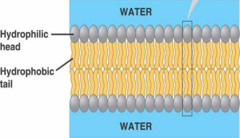
| 7848963635 | *phospholipid | *amphipathic lipid made of two hydrocarbon chains, glycerol, and a phosphate group |  | 80 |
| 7848963636 | hydrophobic tail | another name for the hydrocarbon chain in a phospholipid |  | 81 |
| 7848963637 | hydrophobic head | another name for the phosphate group in a phospholipid | | 82 |
| 7848963638 | *the reason a phospholipid is amphipathic | *the hydrocarbon chains (tails) are nonpolar, while the glycerol and phosphate group (head) is polar | | 83 |
| 7848963642 | *steroid | *lipid made of four linked carbon rings attached to different functional groups (look like chicken wire fencing) |  | 84 |
| 7848963643 | examples of steroids | cholesterol, sex hormones | | 85 |
| 7848963645 | cholesterol | the most common steroid; is a component of the cell membrane as well as the precursor to all other steroids | | 86 |
| 7848963647 | many biologically important molecules are NOT soluble in a lipid, so cell membranes can be selectively permeable | why are lipids good barriers in living organisms? | | 87 |
| 7848963649 | carbohydrate | macromolecule made of Carbon, Hydrogen, and Oxygen that is soluble in water due to the hydroxyl groups | | 88 |
| 7848963650 | *monosaccharide | *the simplest kind of carbohydrate | | 89 |
| 7848963651 | *simple sugar | *another name for a monosaccharide | | 90 |
| 7848963652 | -ose | suffix carbohydrates usually end in (gluc-ose, fruct-ose) | | 91 |
| 7848963653 | *examples of monossaccharides | *glucose, fructose, galactose | | 92 |
| 7848963654 | formula for sugar molecules | (CH₂O)n where n is any number from 3 to 8 | | 93 |
| 7848963655 | *1:2:1 | *the ration of Carbon to Hydrogen to Oxygen in a carbohydrate | | 94 |
| 7848963665 | *disaccharide | *two monosaccharides joined together by a glycosidic linkage |  | 95 |
| 7848963666 | *dehydration synthesis between monosaccharides | *process used to combine monosaccarides into disaccharides and polysaccharides |  | 96 |
| 7848963667 | *glycosidic linkage | *covalent bond that forms between a monosaccharide and another molecule (like another monosaccharide) |  | 97 |
| 7848963668 | *the reason why the formula of a disaccharide of glucose is C₁₂H₂₂O₁₁ and not C₁₂H₂₄O₁₂ | *one water molecule is lost when the condensation reaction joins together the two monosaccharides | | 98 |
| 7848963671 | *polysaccharide | *three or more monosaccharides | | 99 |
| 7848963672 | starch | a polymer of α-glucose molecules that store energy in a plant cell | | 100 |
| 7848963673 | glycogen | a polymer of α-glucose molecules that stores energy in animal cells; stored in the liver and muscles | | 101 |
| 7848963674 | the reason why starch and glycogen have a large amount of branching | plants and animals can quickly add to their energy supply when energy is plentiful, or break it down the storage molecules when energy is in short supply |  | 102 |
| 7848963675 | cellulose | a very stable polymer of β-glucose molecules that serves as a structural molecule in the walls of plant cells; major component of wood; the most abundant biological molecule on earth. Humans cannot digest it. | | 103 |
| 7848963677 | organic molecules | molecules that contain carbon | | 104 |
| 7848963678 | macromolecules | large organic molecules | | 105 |
| 7848963680 | organic chemistry | the study of carbon compounds | | 106 |
| 7848963681 | the reason carbon is important to life | carbon can form four strong covalent bonds with different elements; carbon is the main component of organic molecules; all organic molecules contain carbon (carbohydrates, lipids, proteins, nucleic acids) | | 107 |
| 7848963683 | hydrocarbons | carbon and hydrogen atoms that are covalently bonded that make them stable and nonpolar |  | 108 |
| 7848963684 | nonpolar | not soluable in water | | 109 |
| 7848963685 | polar | soluable in water | | 110 |
| 7848963687 | polymer | molecules that consist of many repeated monomers | | 111 |
| 7848963688 | monomer | molecules that consist of a single unit | | 112 |
| 7848963689 | condensation reaction | the process of removing a small molecule to join together monomers to make a polymer | | 113 |
| 7848963690 | dehydration synthesis | a kind of condensation reaction | | 114 |
| 7848963691 | hydrolysis | the process of adding a water molecule to break a polymer into monomers |  | 115 |
| 7848963692 | functional groups | parts of organic molecules that are involved in chemical reactions | | 116 |
| 7848963694 | charge of the oxygen atom in a water molecule | slightly negative | | 117 |
| 7848963695 | charge of the hydrogen atoms in a water molecule | slightly positive | | 118 |
| 7848963696 | hydrogen bond in water | weak bond formed between water molecules |  | 119 |
| 7848963698 | hydrophillic | Term for substances that dissolve in water. | | 120 |
| 7848963699 | hydrophobic | Term for substances that do not dissolve in water. | | 121 |
| 7848963704 | high specific heat | property of water in which water changes temperature very slowly with changes in heat due to hydrogen bonding |  | 122 |
| 7848963705 | evaporative cooling | water carries the heat it absorbs away in sweat due to its high specific heat | | 123 |
| 7848963706 | heat of fusion | the energy required to change water from a solid to a liquid | | 124 |
| 7848963707 | heat of vaporization | the energy required to change water from a liquid to a gas | | 125 |
| 7848963708 | the reason why water has a high specific heat | it takes a large amount of energy to break the hydrogen bonds that hold water molecules together | | 126 |
| 7848963710 | the reason ice floats in liquid water | less dense as a solid; hydrogen bonds form crystalline structure that keeps the water molecules separate |  | 127 |
| 7848963711 | reasons why ice floating is important to life | floating ice keeps the water below it from freezing; if ice would sink, it would remain frozen eventually freezing the entire body of water | | 128 |
| 7848963712 | cohesion | the attraction of like substances; water molecules are attracted to other water molecules; this is due to the hydrogen bonding between water molecules |  | 129 |
| 7848963713 | the reason insects can walk on the surface of water | surface tension caused by the cohesion of water molecules |  | 130 |
| 7848963714 | adhesion | the attraction of unlike molecules; water molecules are attracted to other polar surfaces |  | 131 |
| 7848963730 | *functional group | *groups of atoms that are responsible for the chemical properties of organic compounds | | 132 |
| 7848963733 | *ionic bond | *Bond that forms when one or more electrons are transferred from one atom to another. | | 133 |
| 7848963734 | *covalent bond | *Bond that forms when electrons between atoms are shared. | | 134 |
| 7848963740 | *hydrogen bond | *A weak bond formed between molecules. | | 135 |
| 7848963746 | CHO | elements that make up carbohydrate - Carbon, Hydrogen, Oxygen | | 136 |
| 7848963747 | CHO | elements that make up lipids, Carbon, Hydrogen, Oxygen | | 137 |
| 7848963748 | CHON | elements that make up proteins, Carbon, Hydrogen, Oxygen, Nitrogen | | 138 |
| 7848963749 | CHOPN | elements that make up nucleic acids, Carbon, Hydrogen, Oxygen, Nitrogen, Phosphorus | | 139 |
| 7848963750 | HONC | Hydrogen makes 1 covalent bond, Oxygen makes 2 covalent bonds, Nitrogen makes 3 covalent bonds, Carbon makes 4 covalent bonds | | 140 |