AP Notes, Outlines, Study Guides, Vocabulary, Practice Exams and more!

AP Biology: Big Idea 1 Flashcards

1.A.1, 1.A.2, 1.A.3, 1.A.4

Terms : Hide Images
7913393289natural selectionA population can change over time if individuals with more fit traits leave more offspring than less fit individuals.0
7913393290evolutionary adaptationAn accumulation of inherited characteristics that enhance organisms' ability to survive and reproduce in specific environments.1
7913393291artificial selectionHumans modifying species for desired traits through selective breeding.2
7913393292fitnessbetter chance of surviving in a given environment and will leave more offspring.3
7913393293homologous structuresSame structure, different function. Comes from common ancestor.4
7913393294analogous structuresDifferent structure, same function. Comes from common environmental challenges, NOT common ancestor.5
7913393295vestigial structuresAre little or no importance to organism, but remain from an ancestor.6
7913393296populationGroup of individuals of the same species living in the same area.7
7913393297gene poolAll the genes in a given population at a given time.8
7913393298allele frequencyProportion of an allele in a gene pool.9
7913393299Hardy-Weinberg TheoremHelps measure changes in allele frequencies over time . Provides an "ideal" population to use as a basis of comparison.10
7913393300mutationChanges in nucleotide sequence in DNA.11
7913393301genetic driftChange in allele frequencies due to chance, not natural selection.12
7913393302bottleneck effectWhen a population has been dramatically reduced, and the gene pool is no longer reflective of the original population's.13
7913393303founder effectWhen a small number of individuals colonize a new area; new gene pool not reflective of original population.14
7913393304gene flowWhen a population gains or loses alleles, movement of alleles into or out of a population due to the migration of individuals to or from the population.15
7913393305genetic variationHeritable variations in a population.16
7913393306heterozygous advantageMaintains recessive alleles in a population. (example: sickle cell anemia resistance to malaria)17
7913393307sexual selectionNatural selection for mating success.18
7913393308directional selectionNatural selection in which individuals at one end of the phenotypic range survive or reproduce more successfully than do other individuals.19
7913393309stabilizing selectionNatural selection that favors intermediate variants by acting against extreme phenotypes.20
7913393310disruptive selectionNatural selection that favors individuals with either extreme of a trait and may lead to speciation.21
7913393311cladogramShows patterns of shared characteristics.22
7913393312speciationOrigin of new species and the source of biological diversity.23
7913393313biological species conceptSpecies is a group of populations whose members have the potential to produce fertile offspring.24
7913393314reproductive isolationBarriers that impede members of two different species from producing fertile offspring. examples: prezygotic, temporal, habitat, behavioral, mechanical, gametic, postzygotic, reduced hybrid viability/sterility25
7913393315allopatric speciationThe formation of new species caused by separation by geography26
7913393316sympatric speciationspeciation without a divided population.27
79133933175 Conditions of Hardy Weinberg(1) No natural selection (2) Large population (3) Random mating (4) No gene flow (5) No mutations28
7913393318convergent evolutionEvolution that occurs when unrelated species occupy the same environment and are subjected to similar selective pressures and show similar adaptations (known as analogous structures).29
7913393319divergent evolutionEvolution that occurs when related species evolve in different patterns due to different selective pressures and show differing adaptations (known as homologous structures)30
7913393320Miller-Urey ExperimentChemical experiment that shows that it is possible to form complex organic molecules form inorganic molecules in the absence of life. (primordial soup hypothesis)31
7913393321RNA world hypothesisRNA could have been the earliest genetic material32

AP Biology Concept 2: Cells Flashcards

Terms : Hide Images
6679956476active transportthe movement of materials using ATP energy either as bulk transport or as solute pumping against a concentration gradient0
6679956477apoptosisprogrammed cell death1
6679956478aquaporinchannel protein for water in every cell membrane; facilitated diffusion2
6679956479axonlong extension of the neuron to sends action potentials away from the cell body to a different neuron3
6679956480carrier proteina protein that changes shape as it moves specific polar chemicals across the cell membrane in facilitated diffusion4
6679956481cell walla structural layer outside of the cell membrane of plants, fungi and bacteria; it is made of cellulose in plants5
6679956482centriolesstructures used in the movement of chromosomes during cell reproduction in animal cells6
6679956483channel proteina protein that allows specific polar chemicals to cross the cell membrane without changing its shape; it may or may not have a gate7
6679956484chloroplastan organelle that converts light energy to chemical energy; it contains its own form of DNA because it descended from photosynthetic bacteria (endosymbiont theory)8
6679956485concentration gradientthe difference in concentrations of one ion or molecule on either side of a cell membrane9
6679956486cytoplasmthe fluid & material inside of the cell membrane, but outside of the nucleus10
6679956487cytoskeletonprotein filaments that provide anchors for transport of organelles and control the shape of the cells11
6679956488dendritesextensions of the cell membrane of a neuron that receive incoming action potentials from other neurons12
6679956489depolarizationthe movement of sodium (Na+) ions into a neuron that increase the membrane potential of a neuron briefly13
6679956490diffusionthe movement of particles from an area of high concentration to an area of low concentration14
6679956491endocytosisthe movement of materials into a cell through a form of active transport called bulk transport15
6679956492endoplasmic reticulummembranes inside of a eukaryotic cell that serve as a surface for chemical reactions like protein synthesis and lipid synthesis16
6679956493Golgi apparatusmembranes inside of a eukaryotic cell that package proteins for transport17
6679956494hypertonica solution that contains a higher concentration of solutes than the inside of a cell; water moves out of a cell in this type of solution18
6679956495hypotonica solution that contains a lower concentration of solutes than the inside of a cell; water moves into a cell in this type of solution19
6679956496isotonica solution that contains the same concentration of solutes as the inside of a cell; water moves both into and out of a cell in this type of solution20
6679956497liganda chemical that binds to a receptor like neurotransmitters bind to receptors on dendrites and open sodium (Na+) gated protein channels21
6679956498lysosomea membranous sac inside of eukaryotic cells that contains digestive enzymes used to destroy old organelles and bacteria22
6679956499membranea material present in all cells (both prokaryotic and eukaryotic) made from phospholipids either on the border of the cell or composing the ER and Golgi23
6679956500mitochondrionan organelle that converts chemical energy in glucose to usable chemical energy in ATP; it contains its own form of DNA because it descended from aerobic bacteria (endosymbiont theory)24
6679956501neurona nerve cell that transmits action potentials as electrochemical messages25
6679956502neurotransmittera ligand that binds to receptors on the dendrites of neurons to open gated sodium channels and pass on action potentials from one neuron to another neuron26
6679956503nuclear envelopethe membrane that surrounds the nucleus of a cell27
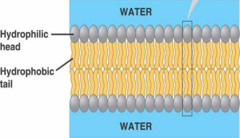
6679956504phospholipida macromolecule that is amphipathic, with a polar head that contains phosphate and two nonpolar tails28
6679956505plasma membranea structure present in all cells (both prokaryotic and eukaryotic) made from phospholipids that controls what enters and exits the cell29
6679956506plasmolysisthe process in which cells lose water when they are in a hypertonic solution30
6679956507polarizationprocesses that lead to ions having different concentrations on different sides of a membrane31
6679956508prokaryotic cella cell that predates nuclei; bacteria are an example32
6679956509repolarizationthe movement of potassium (K+) ions out of a neuron to restore the electrochemical gradient so the inside of the cell returns to a negative potential33
6679956510ribosomeorganelles present in both prokaryotic & eukaryotic cells that assemble proteins from mRNA recipes34
6679956511rough ERa form of membranous organelle that acts as a surface for chemical reactions, especially protein synthesis because it is studded with ribosomes35
6679956512selectively permeablethe quality of a membrane that allows the membrane to control which particles enter or exit the cell36
6679956513smooth ERa form of membranous organelle that acts as a surface for chemical reactions, especially lipid synthesis because it lacks ribosomes37
6679956514synapsethe space between two different neurons through which action potentials spread by ligands called neurotransmitters traveling across the space38
6679956515exocytosisthe movement of materials out of a cell through a form of active transport called bulk transport39
6679956516eukaryotic cella cell that contains a true nucleus; fungi, protists, animal, and plant cells are examples40
6679956517facilitated diffusionthe movement of particles that cannot normally cross a cell membrane from high concentration to low concentration by the use of carrier proteins or protein channels41
6679956518flagellaan extension of the cytoskeleton and plasma membrane that allows prokaryote and some animal cells to move42
6679956519fluid mosaic modela description of the plasma membrane that describes how the phospholipids and embedded proteins flow within the membrane43
6679956520nucleusthe control center of the cell that contains the DNA44
6679956521organelles"little organs" of the cell that each have specific tasks they do to keep the cell alive, fed, and able to reproduce45
6679956522osmosisthe diffusion of water across a cell membrane through aquaporins from area of low solute concentration to high solute concentration; "water follows solutes"46
6679956523passive transportthe movement of materials without the input of ATP energy; facilitated diffusion, osmosis, and simple diffusion are all examples of this47
6679956524phagocytosisthe movement of one large particle like a bacterium into a cell through bulk transport, which is a form of active transport48
6679956525surface area:volume ratioa comparison of the amount of plasma membrane a cell has to the amount of cytoplasm a cell has; as a cell grows, this comparison decreases and this triggers cells to begin cell division49
6679956526transmembrane proteina carrier protein or protein channel that crosses the entire plasma membrane from the intracellular space to the extracellular space50
6679956527vacuolea membranous sac that contains materials for the cell to use51
6679961123amphipathichaving both a hydrophilic region and a hydrophobic region52

AP Biology Pre-Assessment Flashcards

Terms : Hide Images
4735625854Hydrophobic compoundssubstances that do not have an affinity for water and are often non-polar0
4735630678Organic compoundsCompounds containing carbon1
4735632444Adenosine triphosphatemolecule storing potential "free energy" for the cell2
4735635438Carbohydratescompounds that serve as fuel and building material for the cell3
4735639788Lipidsa group of hydrophobic molecules with much diversity in their function4
4735640837ProteinsVery diverse group of compounds composed of amino acid monomers5
4735640838DNA --> RNA ----> ProteinCentral idea to biology: Protein Synthesis6
4735647329Nucleotidemonomer of nucleic acids composed of a sugar, phosphate group and nitrogenous base7
4735649931Eukaryotecomplex cell with most of the DNA concentrated in a nucleus8
4735653553Organellessub-cellular structures which are membrane-enclosed compartments that serve a particular function for the cell9
4735655288Mitochondriondouble- membrane organelle that carries out cellular respiration for the cell10
4735662684Chloroplastdouble-membrane organelle that carries out photosynthesis for the cell11
4735662685Osmosisthe diffusion of water across a selectively permeable membrane in order to balance water concentration12
4735668239Metabolismthe sum total of an organism's chemical reactions13
4735669688Enzymeproteins that speed up chemical reactions14
4735673731Glucoseeventual product of photosynthesis15
4735676612Mitotic cell divisionresults in genetically identical daughter cells16
4735680767Meiotic cell divisionreduces the number of chromosomes sets to half17
4735682244Allelesalternative versions of a gene18
4735683414Phenotypean organism's appearance or observable traits19
4735687256Codona triplet of mRNA bases20
4735688134Plasmida small, circular DNA molecule carrying genes of interest21
4735689773Restriction enzymesenzymes useful for cutting DNA at specific sequence sites22
4735691546Selective breedingwhen humans choose organisms with desirable traits to breed and modify over generations23
4735695037Natural selectionthe proposed mechanism that explains the observable patterns of evolution24
7245171484Prokaryotesingle cell organism with no nucleus or membrane bound organelles25

AP Biology - Chapter 10 (photosynthesis), AP Biology Chapter 10 Photosynthesis Flashcards

Photosynthesis

Terms : Hide Images
5409481296photosynthesis (definition)process of harnessing light energy to build carbohydrates in autotrophs (ex. plants, cyanobacteria)0
5409481297photosynthesis (equation)6 CO2 + 6 H2O + light energy --> C6H12O6 + 6 O21
5409481298autotrophorganism that CAN capture energy from sunlight or chemicals and use it to produce its own food (producer)2
5409481299heterotrophorganism that CANNOT produce its own food and therefore obtains it by consuming other living things (consumer)3
5409481302light-dependent reactions1st step of photosynthesis during which light energy is captured and used to synthesize ATP and NADPH4
5409481303light-independent reactions2nd step of photosynthesis during which CO2 is incorporated into a sugar molecule using ATP and NADPH produced during the first step5
5409481304thylakoid membranes of chloroplastslocation of light-dependent reactions6
5409481305stroma of chloroplastslocation of light-independent reactions7
5409481306G3Pcarbon product of the light-independent reactions8
5409481307photon(1) quantum (discrete quantity) of electromagnetic radiation (light energy) with both wave and particle properties9
5409481308inverseWhat is the relationship between wavelength and energy?10
5409481309reflected, transmitted, or absorbedWhen a photon strikes a substance it can be _____________________11
5409481310pigmentssubstances that can absorb, reflect, or transmit light12
5409481311absorption spectrumgraph of a pigment's ability to absorb various wavelengths of light13
5409481312action spectrumgraph of a plant's photosynthesis rate at different wavelengths of light14
5409481313violet, blue and redWhich wavelengths of the visible light spectrum do chlorophylls ABSORB?15
5409481314green and yellowWhich wavelengths of the visible light spectrum do chlorophylls REFLECT?16
5409481315carotenoidsaccessory pigments in chloroplasts that broaden the spectrum of colors used in photosynthesis (absorb green/blue but reflect red/yellow/orange)17
5409481316mesophyll(C) ground tissue of a leaf, sandwiched between upper and lower epidermis that specializes in photosynthesis18
5409481317chlorophyll bpigment, green/olive, in chloroplast19
5409481318chlorophyll apigment, blue/green, in chloroplast20
5409481319excited state(7) when absorbed photon energy causes electron to move away from nucleus21
5409481320photosystems(6) photosynthetic pigments embedded with protein complexes in the thylakoid membrane22
5409481321parts of photosystems(3+4) reaction-center complex and light harvesting complex23
5409481322reaction-center complex(4) centrally located proteins associated with a special pair of chlorophyll a molecules and a primary electron acceptor24
5409481323light harvesting complex(3) proteins associated with pigment molecules that capture light energy and transfers it to center of a photosystem25
5409481324photosystem II (PS II)1st of two light harvesting units in thylakoid membrane that passes excited electrons to reaction-center chlorophyll26
5409481325primary electron acceptor(2) electrons from the reaction-center in thylakoid membranes are transferred to this molecule27
5409481326watersplitting this molecule replaces electrons which are excited and passed to primary electron acceptor in PSII28
5409481327O2released as a byproduct of splitting water29
5409481328photosystem I (PS I)2nd of two light-capturing units in thylakoid membranes that replaces its electrons by those from the 1st complex and results in production of NADPH30
5409481329proton-motive forcecreated by pumping hydrogen ions from stroma to thylakoid space during electron transport chain between PS II and PS I31
5409481330ATP synthaseenzyme that synthesies ATP by utilizing a proton-motive force32
5409481331Calvin cycle, dark reactions, and carbon fixationother names for light independent reactions33
54094813323 steps of light independent reaction1. carbon fixation 2. reduction 3. regeneration of RuBP34
5409481333reductionstep in Calvin cycle that produces sugar G3P35
5409481334carbon dioxidemolecule reduced in Calvin cycle to produce sugar36
5409481335thylakoids(C) flattened membranous sacs inside chloroplasts that contain systems which convert light energy to chemical energy37
5409481336absorbedenergy is ____________ in photosynthesis38
5409481337releasedenergy is _____________ in cellular respiration39
5409481338glucose and oxygenreactants of cellular respiration40
5409481339carbon dioxide and waterreactants of photosynthesis41
5409481340glucosesource of electrons used in ETC of cellular respiration42
5409481341intermembrane spacesite of proton gradient built up in cellular respiration43
5409481342thylakoid spacesite of proton gradient built up in photosynthesis44
5409481343NAD+ and FADhigh energy electron carrier(s) before reduction in cellular respiration (after they drop off electrons at ETC)45
5409481344NADH and FADH2high energy electron carrier(s) after reduction in cellular respiration (after they pick up electrons from Kreb's cycle)46
5409481345NADP+high energy electron carrier(s ) before reduction in photosynthesis (after they drop off electrons for Calvin cycle)47
5409481346NADPHhigh energy electron carrier(s ) after reduction in photosynthesis (after they pick up electrons from ETC)48
5409481347ATPenergy product(s) from ETC in cellular respiration49
5409481348ATP and NADPHenergy product(s) from ETC in photosynthesis50
5409481349glucose, NADH and FADH2reactant(s) oxidized in cellular respiration51
5409481350H2Oreactant(s) oxidized in photosynthesis (source of electrons)52
5409481351cyclic electron flowlight dependent reactions using only photosystem I to pump protons and generate excess ATP (not NADPH)53
5409481352linear electron flowlight dependent reactions involving both photosystems; electrons from H2O are used to reduce NADP to NADPH54
5409481353rubiscoenzyme with affinity for both CO2 and O2 that catalyzes first step of Calvin cycle by adding CO2 to ribulose bisphosphate (RuBP)55
5409481354PEP carboxylaseenzyme with great affinity for CO2 (gas) adds it to phosphoenolpyruvate (PEP) to form oxaloacetate (4-carbon solid) prior to photosynthesis56
5409481355stomatapore-like openings on underside of leaves that allow gases (CO2 and O2) and water to diffuse in and out57
5409481356bundle-sheath cellstightly packed around the veins of a leaf (site of Calvin cycle in C4 plants)58
5409481357photorespirationoccurs on hot, dry days when stomata close, O2 accumulates and Rubisco fixes O2 rather than CO2, using up ATP, O2 and sugars59
5409481358C3 plantsdo not separately fix CO2 and use Rubisco in Calvin Cycle60
5409481359C4 plantsspatially separate carbon fixation (mesophyll cells) from Calvin Cycle (bundle-sheath cells); use PEP carboxylase instead of Rubisco to fix CO261
5409481360CAM plantstemporally separate carbon fixation (day) and Calvin Cycle (night); use PEP carboxylase instead of Rubisco to fix CO262
5409481361autotrophorganism capable of synthesizing its own food from CO₂ and other inorganic raw materials. The producers.63
5409481362heterotrophan organism that depends on other's complex organic substances for nutrition.64
5409481363photoautotrophplants that use energy from sunlight to convert carbon dioxide and water to carbon compounds.65
5409481364chlorophyllthe green pigment located within chloroplasts. It absorbs light energy to drive the synthesis of food molecules in the chloroplast.66
5409481365mesophyllthe tissue in the interior of the leaf, contains 30-40 chloroplasts67
5409481366stomatamicroscopic pores, help CO₂ enter the cell and O₂ exit.68
5409481367stromathick fluid contained in the inner membrane of a chloroplast, surrounding thylakoids membranes.69
5409481368photosynthesisprocess by which plants and some other organisms use light energy to convert water and carbon dioxide into oxygen and high-energy carbohydrates such as sugars and starches 6CO₂ + 12H₂O + Light Energy → C₆H₁₂O₆ + 6O₂ + 6H₂O70
5409481369splitting of waterhydrolysis that occurs inside the thylakoid space, splits H₂O to produce H+ and O₂.71
5409481370pigmenta molecule that absorbs certain wavelengths of light72
5409481371light reactionsthe steps of photosynthesis that convert solar energy to chemical energy. Light absorbed by chlorophyll drives a transfer of electrons and hydrogen from water to an acceptor, called NADP⁺. give off O₂. Happen in thylakoid or in chloroplast in eukaryotic cells.73
5409481372NADP⁺nicotinamide adenine dinucleotide phosphate, temporarily stores the energized electrons74
5409481373photophosphorylationThe process of generating ATP from ADP and phosphate by means of a proton-motive force generated by the thylakoid membrane of the chloroplast during the light reactions of photosynthesis.75
5409481374Calvin cyclecarbon fixation using energy from ATP and NADPH from the light reactions to produce a three carbon sugar, happens in stroma.76
5409481375carbon fixationincorporating CO₂ from the atmosphere into organic molecules from the chloroplast77
5409481376rubiscoRibulose biphosphate carboxylase, an enzyme that fixes CO₂ together with RuBP.78
5409481377RuBPribulose biphosphate79
5409481378wavelengththe distance between the crests of electromagnetic waves, range from less than a nanometer to more than a kilometer80
5409481379electromagnetic spectrumthe entire range of radiation81
5409481380visible light380-750nm82
5409481381spectrometera machine that measures the ability of a pigment to absorb various wavelengths of light83
5409481382absorption spectruma graph plotting a pigments light absorption versus wavelength. (a) shows the absorption of each chlorophyll84
5409481383chlorophyll afirst type of pigment in chloroplasts, participate directly in light reactions; works best with blue and red light, blue-green85
5409481384chlorophyll baccessory pigment; almost identical to chlorophyll a, but slightly different absorption spectra, yellow-green86
5409481385action spectrumprofiles the relative performance of different wavelengths87
5409481386carotenoidssecond accessory pigment, hydrocarbons that are various shades of yellow and orange, may broaden the spectrum of colors that can drive photosynthesis88
5409481387photosystemshas a light-gathering antenna complex consisting of a cluster of a fer hundred chlorophyll a, a chlorophyll b, and carotenoid molecules89
5409481388reaction centerwhere the first light-driven chemical reaction of photosynthesis occurs, e⁻ goes in, gets excited and jumps up, grabbed by PEA90
5409481389primary electron acceptorgrabs the e⁻ when it gets excited and dumps it into ETC91
5409481390photosystem IIfirst photosystem, center is p680, takes in H₂O, splits and leaves out 1/2 O₂ and takes 2 e⁻, excites electrons and sends to primary acceptor92
5409481391photolysistakes the H₂O, splits, releasing 2 H⁺ and 1/2 O₂, sending 2 e⁻ to photosystem93
5409481392photosystem Itakes e⁻ from ETC and excites them (uses light), gives them to primary acceptor in noncyclic, go down ETC again94
5409481393noncyclic electron flowA route of electron flow during the light reactions of photosynthesis that involves both photosystems and produces ATP, NADPH, and oxygen. The net electron flow is from water to NADP+.95
5409481394noncyclic photophosphorylationATP synthesis during noncyclic electron flow96
5409481395cyclic electron flowuses photosystem I but not photosystem II, no production of NADPH and no release of oxygen, but does generate ATP97
5409481396cyclic photophosphorylationATP synthesis in cyclic electron flow98
5409481397G3Pglyceraldehyde-3-phosphate, the threecarbon sugar formed in the Calvin cycle99
5409481398C₃ plantsproduce less food when their stomata close on hot/dry days.100
5409481399photorespirationA metabolic pathway that consumes oxygen, releases carbon dioxide, generates no ATP, and decreases photosynthetic output; generally occurs on hot, dry, bright days, when stomata close and the oxygen concentration in the leaf exceeds that of carbon dioxide.101
5409481400C₄ plantscorn, sugarcane, grass. forms a four carbon sugar, contains bundle sheath and mesophyll cells. spacial separation of steps102
5409481401bundle-sheath cellarranged into tightly packed sheaths around the veins of the leaf. CO₂ is released and enters the calvin cycle103
5409481402mesophyll cellmore loosely arranged between bundle-sheath and leaf surface. takes in CO₂, fixed by PEP carboxylase104
5409481403PEP carboxylaseadds CO₂ to PEP, higher affinity to CO₂ than rubisco105
5409481404CAM plants(crassulacean acid metabolism) temporal adaptation, open stomata during the night, closed during day. store organic acids made during night in vacuoles106

AP Biology Chapter 2 and 3 Flashcards

Terms : Hide Images
6109379904Matter- Anything that takes up space and has mass - Composes organisms - Made up of elements0
6109379905Element- A substance that cannot be broken down to other substances by chemical reactions - 92 naturally occurring elements1
6109379906Compound- A substance consisting of two or more different elements combined in a fixed ratio - Has chemical and physical characteristics different from those of its elements - Ex. Water (H20) is a compound that has a 2:1 ratio2
6109379907Essential Elements- Elements that an organism needs to live a healthy life and reproduce3
6109379908Trace Elements- Elements that are required by an organism in small quantities. - Ex. in vertebrates iodine is an essential ingredient of a hormone produced by the thyroid gland.4
6109379909Toxic Elements- Some naturally occurring elements are toxic to organisms. - Some species have adapted to environments containing elements that are usually toxic. - Ex. Sunflowers can absorb lead, zinc and other heavy metals in concentrations that would kill other organisms.5
6109379910Atom- The smallest unit of matter that still retains the properties of an element. - Each element consists of a certain type of atom that is different from the atoms of any other element. - Most empty space6
6109379911Subatomic particles- Compose atoms. - Three relevant kinds: neutrons, protons and elections7
6109379912Proton- Charge: positive - Location: nucleus - Mass: 1 dalton8
6109379913Electron- Charge: negative - Location: orbits around the nucleus - Mass: so small that electrons are insignificant when computing the total mass of an atom9
6109379914Neutron- Charge: electrically neutral - Location: nucleus - Mass: 1 dalton10
6109379915Atomic Nucleus- The center of an atom - Has a positive charge due to the protons inside of it11
6109379916Atomic Number- Number of protons. - All atoms of a particular element have the same atomic number. - If an atom is neutral, the # of protons= # electrons12
6109379917Mass Number- Sum of the protons and neutrons in the nucleus of an atom.13
6109379918Atomic Mass- An approximation of the total mass of an atom. - Same number as the Mass Number.14
6109379919Isotope- Different atomic forms of the same element. - Same number of protons, different number of neutrons. - Behave identically in chemical reactions.15
6109379920Radioactive Isotope- Isotope where the nucleus decays spontaneously giving off particles and energy. - Decay will lead to a change in the number of protons, and the atom transforms to an atom of a different element.16
6109379921Energy- The capacity to cause change by doing work.17
6109379922Potential Energy- Energy that matter possesses because of its location or structure - Matter has a natural tendency to move to the lowest possible state of potential energy.18
6109379923Electrons & Potential Energy- The electrons of an atom have potential energy because of how they are arranged in relation to the nucleus. - Because negative electrons attract to the positive nucleus, it takes work to move an electron father away from the nucleus. - The farther away an electron is from the nucleus, the greater its potential energy. - An electron's potential energy is determined by its energy level.19
6109379924Electron Shells- Places of high probability of finding an electron. - First shell- lowest potential energy, and so forth - An electron can change its shell by absorbing/ loosing energy. - 1st shell holds 2 electrons, 2nd shell holds 8 electrons20
6109379925Electron Distribution & Chemical Properties- The chemical behavior of an atom is determined by the distribution of electrons in the atom's electron shells.21
6109379926Valence Electrons- The outermost electrons. - Chemical behavior depends mostly on valence electrons. - Atoms with the same number of electrons in their valence shells exhibit similar chemical behavior.22
6109379927Valence Shell- The outermost electron shell. - An atom with a completed valence shell is unreactive because it is stable (inert).23
6109379928Chemical Bonds- Bonds between atoms when they either share or transfer valence electrons. - The strongest kinds of chemical bonds are covalent and ionic bonds. - When bonds form, they make fill the atoms valence shell24
6109379929Covalent Bond- The sharing of a pair of valence electrons by two atoms.25
6109379930Molecule- Composed of 2 or more atoms held together by covalent bonds.26
6109379931Single Bond- A pair of shared electrons. - Represented by a single line27
6109379932Double bond- 2 shared pairs of valence electrons. - Represented by 2 lines28
6109379933Valence- Bonding capacity of an atom - Usually equals the number of electrons required to complete the atom;s outermost (valence shell)29
6109379934Electronegativity- The attraction of a particular atom for the electrons of a covalent bond. - The more electronegative an atom is, the more strongly it pulls shared electrons towards itself.30
6109379935Nonpolar covalent bond- A bond where the electrons are shared equally because the two atoms have the same electronegativity. - Ex. H2 is nonpolar31
6109379936Polar covalent bond- Bond where an atom is bonded to a more electronegative atom. - Electrons are not shared equally.32
6109379937Ionic Bond- Formed by the attraction of cations and anions. - Electrons are transfered. - Environment affects the strength of ionic bonds. - Dry salt crystal- bonds are very strong. - Salt crystal dissolved in water- bonds are waker because each ion is partially shielded by its interactions with water molecules.33
6109379938Ion- A charged atom (or molecule). - Electrons have either been lost or gained.34
6109379939Cation- Positively charged atom. - An electron has been lost.35
6109379940Anion- Negatively charged atom. - An electron has been gained.36
6109379941Ionic compounds/salts- Compounds formed by ionic bonds. - Does not consist of molecules, only elements.37
6109379942Advantages of weak chemical bonds- Two molecules can adhere temporarily by weak bonds. - Two molecules can come together, respond to one another in some way and then separate.38
6109379943Hydrogen bonds- Partial positive charge of a hydrogen atom that is covalently bonded to an electronegative atom allows the hydrogen to be attracted to a different electronegative atom nearby. - A hydrogen bond is the nonequivalent attraction between a hydrogen and an electronegative atom.39
6109379944Van deer Walls Interactions- Individually weak bonds that occur only when atoms and molecules are very close together. - Ex. Geckos can climb up walls because their toes have tiny hairs and there are van der Waals interactions between the hair tip molecules and the molecules of the wall's surface. Because they are so numerous they can support the Gecko's body.40
6109379945Molecular Shape- Determines how biological molecules recognize and respond to one another with specific. - Complementary molecules bind to each other. - Ex. Because opiates have similar shapes to endorphins, they bind to endorphin receptors in the brain.41
6109379946Chemical reactions- The making and breaking of chemical bonds, leading to changes in the composition of matter. - Matter is neither created nor destroyed, only rearranged. - Reactions are reversible.42
6109379947Reactants- Starting materials in a chemical reaction43
6109379948Products- The elements or compounds produced by a chemical reaction.44
6109379949Chemical equilibrium- The point at which the reactions offset one another exactly. - This is dynamic: reactions still occur, but with no effect on the concentrations of reactants and products. - Concentrations are stabilized at a ratio.45
6109379950Water's polarity- Unequal sharing of electrons and water's V- like shape make it a polar molecule. - The oxygen region has a partial negative charge. - Each hydrogen has a partial positive charge - Because of this, the hydrogen of one molecule is attracted to the oxygen of another molecule, forming a hydrogen bond.46
6109379951Cohesion of Water- Result of the hydrogen bonds that hold water together. - Contributes to the transport of water & dissolved nutrients.47
6109379952Adhesion- The clinging of one substance to another.48
6109379953Surface tension- A measure of how difficult it is to stretch or break the surface of a liquid. - Hydrogen bonds in water give it a very high surface tension.49
6109379954Moderation of temperature by water- Water moderates air temperature by absorbing heat from air that is warmer and releasing the stored heat to air that is cooler. - Water can absorb/release heat with a small change in temperature.50
6109379955Kinetic energy- Energy of motion.51
6109379956Thermal energy- The kinetic energy associated with the random movement of atoms or molecules. - Total thermal energy of matter depends on volume.52
6109379957Temperature- The average kinetic energy of molecules, regardless of volume.53
6109379958Heat- Thermal energy in transfer from one body of matter to another.54
6109379959Calorie- The amount of heat it takes to raise the temperature of 1 g of water by 1degree C.55
6109379960kilocalorie- (1,000 cal) is the quantity of heat required to raise the temperature of 1 kilogram of water by 1 degree C.56
6109379961Specific Heat- The amount of heat that must be absorbed or lost for 1 g of that substance to change its temperature of 1 degree C. - Aka how well a substance resists changing its temperature when it absorbs/releases heat. - Water has a unusually high specific heat (heat must be absorbed to break hydrogen bonds and released when they form)57
6109379962Evaporation/ Vaporization- Transformation from a liquid to a gas. - Even at low temperatures, fast molecules can escape (some move faster than others and temperature is an average).58
6109379963Heat of vaporization- The quantity of heat a liquid must absorb for 1g of it to be converted from the liquid to the gaseous state. - Water has a high heat of vaporization, because hydrogen bonds need to be broken.59
6109379964Evaporative Cooling- As a liquid evaporates, the surface of the liquid that remains behind cools down. - "Hottest" molecules leave as gas first. - Contributes to the stability of temperature in bodies of water and keeps organisms from overheating.60
6109379965Frozen Water- Water is less dense as a solid than as a liquid. - Water freezes because more and more of its molecules are moving too slowly to break hydrogen bonds. - 0 degree C, molecules are locked into a crystalline lattice, and hydrogen bonds keep them far away. - Floating ice is important so that lakes do not freeze solid.61
6109379966Solution- A liquid that is a completely homogeneous mixture of 2 or more substances.62
6109379967Solvent- The dissolving agent of a solution.63
6109379968Solute- The substance that is dissolved.64
6109379969Aqueous solution- Solution where water is the solvent.65
6109379970Hydration Shell- The sphere of water molecules around a dissolved ion. - Water molecules pull appart compounds by surrounding each ion and separating and shielding them from one another. - To be dissolved by water you must have ionic and polar regions.66
6109379971Hydrophilic- A substance that has an affinity for water. - Substances can be hydrophilic without actually dissolving (cotton).67
6109379972Hydrophobic- Substances that repel water. - They are nonionic and nonpolar or otherwise cannot form hydrogen bonds.68
6109379973Molecular mass- The sum of the masses of all the atoms in a molecule.69
6109379974Mole- Represents an exact number of objects - 6.02 * 10^23 - A mole of one substance has exactly the same number of molecules as a mole of any other substance.70
6109379975Dissociation of Water- A hydrogen atom leaves its electron behind and a hydrogen ion (H+) is transferred - The water molecule that lost a proton is now a hydroxide ion (OH-) and has a charge of 1- - The proton binds to the other water molecule making it a Hydronium ion (H30+)71
6109379976Acid- Substance that increases the hydrogen ion concentration of a solution. - When acids dissolve in water, they donate an additional H+ to the solution.72
6109379977Base- Substances that reduce the hydrogen ion concentration of a solution. - Some directly accept hydrogen ions (Ammonia) - Some dissociate to form hydroxide ions which combine with hydrogen ions and form water. - Basic solutions have a higher concentration of OH- than H+73
6109379978Strong Acid/Strong Base- Compounds that completely dissociate when mixed with water. - Hydrochloric acid is a strong acid. - Sodium hydroxide is a strong base.74
6109379979pH- The pH of a solution is the negative logarithm (base 10) of the hydrogen ion concentration.75
6109379980pH scale- pH declines as H+ concentration increases. - pH less than 7- acidic - pH above 7- basic - When the pH of a solution changes slightly, the actual concentrations of H+ and OH- in the solution change substantially (logs)76
6109379981Buffer- A substance that minimizes changes in the concentrations of H+ and OH- in a solution. - Accepts hydrogen ions when they are in excess, and donates them when they have been depleted. - Ex. carbonic acid and bicarbonate buffering system77
6109379982Acidification- Burning fossil fuels releases CO2 into the air, and when CO2 dissolves in seawater, it reacts with water to form carbonic acid which lowers ocean pH. - As seawater acidifies the extra hydrogen ions combine with carbonate ions to form bicarbonate ions and reduces the carbonate ion concentration. - This is bad, because carbonate ions are required for calcification by many marine organisms (reef-building corals and animals with shells).78

AP Biology Functional Groups Flashcards

Terms : Hide Images
7443639766Phosphate Groupconsists of a phosphorus atom bonded to four oxygen atoms. It is usually ionized and attached to the carbon skeleton by one of its oxygen atoms. ATP, DNA, & RNA component0
7443639767Amino Groupcomposed of a nitrogen bonded to two hydrogen atoms and the carbon skeleton. It acts as a base by picking up H+ from a solution. Organic compounds with an amino group are called amines. Amino acids, the building blocks of proteins, contain a carboxyl and an amino group.1
7443639768Carbonyl Groupa carbon atom is linked by a double bond to an oxygen atom. If the carbon of the carbonyl group is at the end of a carbon skeleton, the compound is called an aldehyde; if it is within the chain, the compound is called a ketone.2
7443639769Hydroxyl Groupconsists of a hydrogen atom bonded to an oxygen atom, which in turn is bonded to the carbon skeleton. Ethanol and other organic compounds containing hydroxyl groups are called alcohols.3
7443639770Sulfhydrylconsists of a sulfur atom bonded to an atom of hydrogen. These groups can cross link and help to fold proteins, when present.4
7443639771Carboxyl Group-COOH. These are a source of H. Considered an acids & polar.5
7443639772Methylconsists of a carbon bonded to three hydrogens. Compounds with these groups are called methylated compounds. When combined with DNA or RNA, they affect DNA function and gene expression6

AP Biology Metabolism Chapter 8 Flashcards

Terms : Hide Images
7706699049Metabolismthe totality of an organisms chemical reactions that result from interactions between molecules within the cell0
7706699050metabolic pathwaya sequence of chemical reactions undergone by a compound in a living organism, start with substrate end with product1
7706699051catabolic pathwaybreaking a complex molecule down into its simpler parts, releasing energy. ie. cellular respiration2
7706699052anabolic pathwayusing energy to build complex molecules from simpler molecules. ie. protein synthesis3
7706699053Bioenergeticsthe study of how organisms manage their energy resources4
7706699054energycapacity to cause change, do work5
7706699055kinetic energyenergy of motion6
7706699056heat(thermal energy)kinetic energy associated with random movement of molecules7
7706699057potential energyenergy of position8
7706699058chemical energypotential energy available for release in a chemical reaction, energy within bonds9
7706699059thermodynamicsstudy of energy transformations10
7706699060closed systemisolated from surroundings, no energy transfer, cant work at equilibrium bc its exhausted its ability to do work. free energy at a min11
7706699061open systemnot isolated, energy and matter can be transferred between system and surroundings, ie. cells12
77066990621st law of thermodynamicsenergy of the universe is constant, cannot be created or destroyed, can only be transferred or transformed, conservation of energy13
77066990632nd law of thermodynamicsduring every energy transfer, some energy is unusable and often lost, every energy transfer or transformation increases the total entropy of the universe14
7706699064entropydisorder, randomness15
7706699065free energydelta G, energy that can do work when temperature and pressure are constant, related to change in enthalpy(delta H), change in entropy(delta S) and temperature in Kelvin(T). delta G = delta H - T delta S16
7706699066exergonic reactiona reaction with a net release of free energy, negative free energy, spontaneous17
7706699067endergonic reactiona reaction that absorbs free energy from its surroundings, non-spontaneous, positive free energy18
7706699068coupled reactionsthe use of exergonic processes to drive endergonic ones, the energy given off from the exergonic is absorbed by the endergonic19
7706699069ATPadenosine triphosphate, composed of ribose (5 carbon sugar), adenine (nitrogenous base), and 3 phosphate groups. Phosphate tail can be broken through hydrolysis to produce energy, ADP, and an inorganic phosphate20
7706699070phosphorylationhow ATP drives endergonic reactions, covalently bonding a phosphate with another molecule, such as as reactant21
7706699071catalysta chemical agent that speeds up chemical reactions without being consumed by the reaction22
7706699072enzymesa catalytic protein, speeds up metabolic reactions by lowering activation energy, very specific, reusable, unchanged by reaction23
7706699073activation energyinitial energy needed to start a chemical reaction, free energy for activating reaction, given off by heat24
7706699074induced fitbrings the chemical groups of the active site into positions that enhance their ability to catalyze the reaction, makes the enzyme more effective25
7706699075cooperativityanother type of allosteric activation, binds to one active site but locks ALL active sites open, allowing products to be constantly produced26
7706699076Substratethe REACTANT that an enzyme acts on27
7706699077Enzyme-Substrate Complexenzyme and substrate28
7706699078Active Siteregion on the enzyme where substrate binds29
7706699079Hydrogen and Ionic Bondssubstrate held in active site by WEAK interactions30
7706699080Lock and Keyactive site on enzyme fits substrate exactly31
7706699081Ways enzymes lower activation energycan do this by having a favorable environment, straining substrate molecules, orienting substrates correctly32
7706699082hydrolysishappens when phosphate leaves ATP to give energy to something else. This causes ATP to become ADP, produces water33
7706699083cofactorsnon-protein enzyme helpers ex. zinc, iron, copper34
7706699084coenzymesorganic enzyme helpers ex. vitamins35
7706699085Denatureabove a certain temperature, activity declines, protein changes shape36
7706699086Gene Regulationcell switches on or off the genes that code for specific enzymes37
7706699087negative feedback inhibitionaccumulation of end product slows the reaction to stop production38
7706699088positive feedbackend product speeds up production (less common)39
7706699089Allosteric Regulationcan accelerate or inhibit production and enzyme activity by attaching to another part of the protein. this changes the shape of the active site which inhibits substrates from bonding and producing more products40
7706699090Activatorone of the allosteric regulators, stabilizes and keeps active site open for production41
7706699091Inhiibitorone of the allosteric regulators, changes shape of the active site so the substrate can't bind42
7706699092Competitive Inhibitorinhibitor that mimics original substrate and blocks the active site43
7706699093Noncompetetitive Inhibitorbind to another part of enzyme to change shape and block substrate from producing44
7706699094ways enzymes are affectedpH, temperature, salinity, substrate concentration, enzyme concentration45
7706699095exergonicreaction is spontaneous (-G), releases energy46
7706699096endergonicreaction is not spontaneous (positive G), absorbs energy47

AP BIOLOGY - Chapter 8 (energy) Flashcards

Terms : Hide Images
8165102828metabolismall of an organism's chemical reactions0
8165102829metabolic pathwaystep-wise conversion of precursors to products using specific enzymes to catalyze each step1
8165102830catabolic pathwaybreak down of complex molecules into simple ones (releases energy)2
8165102831anabolic pathwaybuilding of complex molecules from simple ones (requires energy)3
8165102832drivesEnergy from catabolism __________ anabolism.4
8165102833kinetic energybased on an object's motion5
8165102834potential energybased on an object's location or structure6
8165102835thermodynamicsstudy of energy transformations in a collection of matter7
8165102836open systemboth energy and matter are exchanged with the surroundings8
8165102837closed systemenergy, but not matter, is exchanged with its surroundings9
8165102838openOrganisms are ________ systems.10
8165102839First Law of thermodynamicsenergy cannot be created or destroyed, only transferred or transformed.11
8165102840increaseEnergy transformations ________ entropy of the universe.12
8165102841entropymeasure of disorder or randomness of a system (S)13
8165102842Second Law of thermodynamicsevery energy transformation increases entropy of the universe14
8165102843spontaneous reactions-∆G; release energy; occur in nature by themselves (can be very slow)15
8165102844free energyportion of a system's energy that can perform work when temperature and pressure are uniform throughout the system (as in a living cell)16
8165102845Negative, less____ ∆G... _____ free energy in products... MORE stable at the end17
8165102846Positive, more____ ∆G... _____ free energy in products... LESS stable at the end18
8165102847exergonic reactionreleases free energy, ∆G is negative (spontaneous)19
8165102848endergonic reactionabsorbs free energy from surroundings, ∆G is positive (nonspontaneous)20
8165102849reversible reactionsoccur in both directions till reach equilibrium; exergonic one way and endergonic the other (ex. cellular respiration)21
8165102850equilibriumReactions in a closed system eventually reach a state of balance called ____.22
8165102851types of cellular workchemical (synthesizing polymers from monomers), mechanical (beating cilia, contracting muscle cells), transport (moving substances across a membrane)23
8165102852ATPenergy currency of the cell24
8165102853phosphorylationtransfer of a phosphate group25
8165102854enzymesspeed up metabolic reactions by lowering activation energies which are not consumed (catalysts)26
8165102855activation energyinitial energy required to start a reaction; lowered by enzymes (bumps in figures)27
8165102856substratereactant(s) an enzyme acts on28
8165102857enzyme-substrate complexenzyme bound to substrate29
8165102858active siteregion where substrate binds to enzyme30
8165102859induced fitwhen enzyme changes shape slightly because of interactions between substrate and active site31
8165102860concentrationSubstrate _______ affects rate of reaction.32
8165102861temperature and pHChanging ______ can affect the rate of enzymatic reactions.33
8165102862cofactorsnonprotein molecules or ions required for proper functioning of some enzymes (minerals)34
8165102863coenzymesorganic molecules necessary for some enzymatic reactions (vitamins)35
8165102864competitive inhibitorschemical other than the substrate that binds to the active site and blocks it36
8165102865noncompetitive inhibitorschemical other than the substrate that binds somewhere other than the active site and changes the site's shape so substrate can no longer bind37
8165102867allosteric regulationbinding of regulatory molecule at one site that affects function at a different site; similar to noncompetitive inhibitors but reversible (can inhibit or activate).38
8165102868cooperativitywhen enzyme becomes more receptive to additional substrate molecules after one substrate molecule binds39
8165102869feedback inhibitionend product shuts down initial steps of metabolic pathway40

AP Biology Anatomy & Physiology Flashcards

Terms : Hide Images
6313727902anatomystudy of the biological form of an organism0
6313727903physiologystudy of the biological functions an organism performs1
6313727904levels of organization1. cell 2. tissue 3. organ 4. organ system2
6313727906organone functional unit of tissues3
6313727907organ systemorgans working together to perform a specific function4
6313727908tissuea group of related cells5
6313727913epithelial tissuetissue that covers outside of the body and lines organs and cavities; tightly bound to form a protective layer; highly regenerative6
6313727919glanda group of specialized epithelial cells that are capable of producing secretions7
6313727920connective tissuetissue that provides support for the body and connects all its parts; has an extracellular matrix (secreted by fibroblasts) made of collagen, elastin and reticulin8
6313727921loose connective tissueless packed connective tissue which makes it loose and flexible, includes adipose9
6313727922adiposefat reserve cells10
6313727923dense connective tissuehave large amounts of either collagen fibers (making them strong) or elastic fibers, or both, includes tendons and ligaments11
6313727924tendonconnects muscle to bone12
6313727925ligamentconnects bone to bone13
6313727926chondrocytecartilage, connects and cushions joints14
6313727927osteocytebone, calcified cells that provide sturdy support15
6313727928plasmaliquid part of blood16
6313727929erythrocytered blood cell17
6313727930leukocytewhite blood cell18
6313727931thrombocyteplatelet19
6313727932muscular tissuetissue that moves the body and its parts; striated muscles contain actin and myosin filaments for contraction20
6313727933smooth muscleinvoluntary, in walls of blood vessels and viscera, one nucleus21
6313727934skeletal musclevoluntary, attached to bones, multinucleated, striated22
6313727935cardiac muscleinvoluntary, single nucleated, striated, have gap junctions to link adjacent cells and help the heart perform as one unit (intercalated disks)23
6313727936nervous tissuetissue that senses stimuli, integrates and analyzes them, and controls the body's response24
6313727937neuronmain cell of the nervous system25
6313727938neurogliacells that support neurons (ex: Schwann cells)26
6313727939cell bodycontains nucleus of the neuron27
6313727940dendritereceive stimuli; highly branched extensions28
6313727941axonconduct and propagate impulses29
6313727942Schwann cellsupport and insulates axons using a myelin sheath30
6313727943node of Ranviergap between myelin sheaths that expose the axon, help accelerate impulses31
6313727944saltatory conductionrapid jumping of an impulse from node to node32
6313727945motor neuronsends impulses to muscles to create movement33
6313727946sensory neuronpick up stimuli from the environment and send to the brain34
6313727947interneuronneurons in the CNS that communicate internally and connect sensory to motor neurons; are responsible for reflexes35
6313727948nervous systemsystem that is responsible for body intercommunication, picking up and responding to stimuli, and stimulating movement36
6313727949endocrine systemsystem that is responsible for sending out hormones that regulate homeostasis in the body37
6313727950muscular systemsystem that is responsible for carrying out voluntary movement38
6313727951skeletal systemsystem that is responsible for creating a rigid framework39
6313727952digestive ssytemsystem that is responsible for food breakdown and nutrient absorption40
6313727953circulatory systemsystem that responsible fordistributing nutrients, oxygen and other vital materials throughout the body41
6313727954respiratory systemsystem that is responsible for gas exchange42
6313727955urinary systemsystem that is responsible for waste elimination43
6313727956integumentary systemsystem that is responsible for protecting the outer body44
6313727957immune systemsystem that is responsible for protecting the inner body from pathogens45
6313727958reproductive systemsystem that is responsible for producing gametes and reproducing46
6313727959homeostasistendency to maintain a balanced or constant internal state47
6313727960stimuluschange or signal in the environment that can make an organism react48
6313727961negative feedbackprocess that reduces stimuli to return organism to homeostasis49
6313727962positive feedbackprocess that amplifies stimuli away from homeostasis50
6313727963effectororgan or cell that acts in response to a stimulus51
6313727964integratororgan that evaluates condition change52
6313727965thermoregulationprocess of maintaining an internal temperature within a tolerable range; adaptations for this include: - insulation (fur, blubber, feathers) - countercurrent circulation - sweating - behavioral responses (shivering) - adjustig metabolic hear production (antifreeze)53
6313727966endothermorganism that is internally warmed by generating heat through metabolic processes54
6313727967ectothermorganism that is externally warmed by behaviors55
6313743119LHThe pituitary hormone that stimulates the interstitial cells to secrete testosterone is56
6313745914FSHan anterior pituitary hormone that stimulates the follicles in females and the function of the seminiferous tubules in males57
6313749135TSHincreases release of thyroid hormone58
6313752061Growth Hormonehormone secreted by anterior pituitary gland that stimulates growth of bones59
6313768242Adrenalinehormone responsible for the fight or flight response; increased heart rate and breathing60
6313768243epinephrineAdrenaline61
6313770035acetylcholineA neurotransmitter that enables learning and memory and also triggers muscle contraction62

AP Biology Chapter 19 Vocabulary Flashcards

Viruses

Terms : Hide Images
6818707812VirusAn infectious particle incapable of replicating outside of a cell, consisting of an RNA or DNA genome surrounded by a protein coat (capsid) and, for some viruses, a membranous envelope.0
6818707813CapsidThe protein shell that encloses a viral genome. It may be rod-shaped (helical), polyhedral(icosahedral), or more complex in shape.1
6818707816Bacteriophage (Phage)-viruses that infect bacteria -capsids w/ elongated icosahedral heads w/ DNA -protein tail piece w/ fibers by which phages attach to bacterium attached to head2
6818707817Host Rangelimited number of species whose cells can be infected by a particular virus3
6818707819Lytic cycleA type of phage replicative cycle resulting in the release of new phages by lysis (and death) of the host cell.4
6818707821Virulent Phagea phage that replicates only by a lytic cycle5
6818707822Restriction EnzymesAn endonuclease (type of enzyme) that recognizes and cuts DNA molecules foreign to a bacterium (such as phage genomes). The enzyme cuts at specific nucleotide sequences (restriction sites).6
6818707823Lysogenic cycleAllows replication of the phage genome without destroying the host7
6818707825Temperate Phagephage capable of using both modes of reproduction in bacteria through replication via the lytic or lysogenic cycle.8
6818707826Prophagephage genome that has been inserted into a specific site on a bacterial chromosome.9
6818707828RetrovirusAn RNA virus that replicates by transcribing its RNA into DNA and then inserting the DNA into a cellular chromosome; an important class of cancer-causing viruses.10
6818707829Reverse TranscriptaseAn enzyme encoded by certain viruses (retroviruses) that uses RNA as a template for DNA synthesis.11
6818707830HIVThe infectious agent that causes AIDS. HIV is a retrovirus.12
6818707831AIDSThe symptoms and signs present during the late stages of HIV infection, defined by a specified reduction in the number of T cells and the appearance of characteristic secondary infections.13
6818707833ProvirusA viral genome that is permanently inserted into a host genome14
6818727613Viral envelopeA membrane that cloaks the capsid that in turn encloses a viral genome.15

Pages

Subscribe to CourseNotes RSS

Need Help?

We hope your visit has been a productive one. If you're having any problems, or would like to give some feedback, we'd love to hear from you.

For general help, questions, and suggestions, try our dedicated support forums.

If you need to contact the Course-Notes.Org web experience team, please use our contact form.

Need Notes?

While we strive to provide the most comprehensive notes for as many high school textbooks as possible, there are certainly going to be some that we miss. Drop us a note and let us know which textbooks you need. Be sure to include which edition of the textbook you are using! If we see enough demand, we'll do whatever we can to get those notes up on the site for you!