AP Notes, Outlines, Study Guides, Vocabulary, Practice Exams and more!

AP US History Chapter 2 Flashcards

AMSCO United States History 2015 Edition, Chapter 2 The Thirteen Colonies and the British Empire, 1607-1754

Terms : Hide Images
7367814223Cecil Calvert, Second Lord BaltimoreIn 1634, Cecil Calvert (Second Lord Baltimore) was the son of George Calvert (First Lord Baltimore). Cecil Calvert set about making his father's dream of a Maryland colony that would be a haven for Catholics in America. (p. 27)0
7367814224Act of TolerationThe first colonial statue granting religious freedom to all Christians, but it called for death of all non-Christians. It was created to provide a safe haven for Catholics. (p.27)1
7367814225Roger WilliamsA respected Puritan minister who believed that the individual's conscience was beyond the control of any civil or church authority. He was banished from the Bay colony for his beliefs. In 1636, he founded the settlement of Providence. (p. 29)2
7367814226ProvidenceThis settlement has founded in 1636 by Roger Williams. (p. 29)3
7367814227Anne HutchinsonThis Puritan believed in antinomianism and was banished from the Bay colony because of her beliefs. In 1638, she founded the colony of Portsmouth. (p. 29)4
7367814228antinomianismThe idea that faith alone, not deeds, is necessary for salvation. (p. 29)5
7367814229Rhode IslandIn 1644, Parliament granted Roger Williams a charter, joining Providence and Portsmouth into a single colony, Rhode Island. (p. 30)6
7367814230Halfway covenantIn the 1660s, people could now take part in church services and activities without making a formal commitment to Christ. It was created because the next generation of colonists were less committed to religious faith, but churches still needed members. (p. 31)7
7367814231QuakersMembers of the Religious Society of Friends who believed in the equality of men and women, nonviolence, and resistance to military service. (p. 34)8
7367814232William PennIn 1861, the royal family paid a large debt by granting his family a large parcel of American land. This Quaker, formed a colony that he named Pennsylvania. (p. 34)9
7367814233Holy ExperimentWilliam Penn put his Quaker beliefs to the test in his colony, Pennsylvania. He wanted the colony to provide a religious refuge for Quakers and other persecuted people, enact liberal ideas in government, and generate income and profits for himself. (p. 34)10
7367814234Charter of LibertiesIn 1701, the Pennsylvania colony created this written constitution which guaranteed freedom of worship for all and unrestricted immigration. (p. 34)11
7367814235rice plantationsThese plantations required a loarge land area and many slaves. (p. 37)12
7367814236tobacco farmsAs Tobacco prices fell, rice and indigo became the most profitable crops. (p. 37)13
7367814237John CabotFirst Englishman to explore lands in North America which England would later settle in the early 1600's. (p. 25)14
7367814238JamestownIn 1607, the first permanent English colony in America was founded at this location. The Virginia Company, was a a joint-stock company chartered by England's King James I. (p. 25)15
7367814239Captain John SmithBecause of his forceful leadership, Jamestown barely survived its first five years. (p. 25)16
7367814240John RolfeHe helped Jamestown develop a new variety of tobacco which became popular in Europe and became a profitable crop. (p. 25)17
7367814241PocahontasShe was the American Indian wife of John Rolfe in early settlement days in Jamestown. (p. 25)18
7367814242PuritansGroup of dissenters that wanted to purify the Church of England. In 1630 they founded the Massachusetts Bay Colony at Boston. (p. 26)19
7367814243SeparatistsRadical dissenters to the Church of England, they were known by this name because they wanted to organized a completely separate church that was independent of royal control. They became known as Pilgrims, because of the travels. (p. 26)20
7367814244PilgrimsThey were radical dissenters to the Church of England. They moved to Holland, then in 1620, they sailed to America on the Mayflower in search of religious freedom. They established a new colony at Plymouth on the Massachusetts coast. (p. 26)21
7367814245MayflowerIn 1620, the boat that the Pilgrims sailed to Plymouth. (p. 26)22
7367814246Plymouth ColonyThis colony was started by the Pilgrims at Plymouth (Massechusetts). In the first winter nearly half of them perished. They were helped by friendly American Indians and celebrated the first Thanksgiving in 1621. (p. 26)23
7367814247John WinthropIn 1630, he led about a thousand Puritans to America and and founded Boston and several other towns. (p. 26)24
7367814248Great MigrationThis movement started because of a civil war in England. Nearly 15,000 settlers came to the Massachusetts Bay Colony. (p. 26)25
7367814249VirginiaSir William Berkeley, the royal governor of Virginia use dictatorial powers to govern on behalf of the large planters. (p. 29)26
7367814250Thomas HookerIn 1636, he led a large group of Boston Puritans dissatisfied with the Massachusetts Bay colony to found Hartford, which is now Connecticut. In 1639 they drew up the first written constitution in American history. (p. 30)27
7367814251John DavenportIn 1637, he founded a settlement south of Hartford, by the name of New Haven. (p. 30)28
7367814252ConnecticutIn 1665, New Haven and Hartford joined to form the colony of Connecticut under a royal charter. (p. 30)29
7367814253New HampshireHoping to increase royal control in the colonies, King Charles II separated New Hampshire from Massachusetts in 1679 and made it a royal colony. (p. 31)30
7367814254The CarolinasIn 1663, King Charles II granted eight nobles the Carolinas. In 1729, the Carolinas were split into two royal colonies. In South Carolina, the economy was based on the fur trade and growing food for the West Indies, which led to many plantations. In North Carolina, there were many small tobacco farms and fewer plantations. (p. 32)31
7367814255New YorkIn 1664, King Charles II granted his brother, the Duke of York (future King James II) the land now known as New York. James took control of the Dutch colony that was located there, but the Dutch were treated fairly. James was unpopular because of his taxes and refusal to institute a representative government. Finally in 1683, he agreed to grant broad civil and political rights to the colony. (p. 33)32
7367814256New JerseyThe territory of New York was split. In 1674, land was granted to Lord John Berkeley and Sir George Carteret. Eventually they sold to the Quakers. In 1702, the two Jerseys were combined into a single royal colony, New Jersey. (p. 33)33
7367814257PennsylvaniaIn 1861, the royal family paid a large debt by granting William Penn's father a large parcel of American land. He then formed a colony from the land. (p. 34)34
7367814258DelawareIn 1702, William Penn granted the lower three colonies of Pennsylvania their own assembly. In effect, Delaware became a separate colony, even though its governor was the same as Pennsylvaniaá until the American revolution. (p. 34)35
7367814259GeorgiaIn 1732, Georgia was formed to provide a buffer between wealthy Georgia and Spanish controlled Florida, and to provide a place for the many debtors of England to begin again. (p. 34)36
7367814260James OglethorpeFounder of Georgia's first settlement, Savannah, in 1733. He acted as governor of Georgia and had strict laws which included a ban on rum and slavery. (p. 35)37
7367814261WampanoagsAn American Indian tribe led by Metacom. (p. 31)38
7367814262MetacomThis American Indian chief was known to the colonists as King Philip. He joined together the Native American tribes to fight the colonists in King Philip's War, a war that lasted from 1675 to 1676. (p. 31)39
7367814263King Philip's WarFrom 1675 to 1676, the American Indian chief Metacom (King Philip), waged a vicious war against the English settlers in southern New England. (p. 31)40
7367814264Mayflower CompactIn 1620, while they were sailing to America on the Mayflower, the Pilgrims created this document that pledged them to make decisions by the will of the majority. It was a rudimentary written constitution. (p. 27)41
7367814265Virginia House of BurgessesIn 1619, just 12 years after the founding of Jamestown, Virginia's colonists organized the first representative assembly in America, the Virginia House of Burgesses. (p. 27)42
7367814266Sir William BerkeleyRoyal Governor of Virginia who favored large plantation owners and did not support or protect smaller farms from Indian raids. He put down Bacon's rebellion in 1676. (p. 29)43
7367814267Bacon's RebellionIn 1676, Nathaniel Bacon led a group of army volunteers that raided Native American villages, fought the governor's forces, and set fire to Jamestown. The rebellion lost momentum when Bacon died of dysentery. The rebellion was caused by the Governor's unfair favoritism of large plantation owners and refusal to protect small farms from Native American raids. (p. 29)44
7367814268Fundamental Orders of ConnecticutIn 1639, the Hartford settlers drew up the first written constitution in America. It established a representative government made up of a legislature elected by the people and a governor chosen by the legislature. (p. 30)45
7367814269New England ConfederationIn 1643, Plymouth, Massachusetts Bay, Connecticut, and New Haven colonies formed a military alliance to deal with the threat from the Native Americans. It lasted until 1684. (p. 31)46
7367814270Frame of Government (1682)In 1682-1683, William Penn provided the Pennsylvania colony with a Frame of Government which guaranteed a representative assembly elected by landowners and a written constitution. (p. 34)47
7367814271corporate coloniesColonies operated by joint-stock companies during the early years of the colonies, such as Jamestown. (p. 24)48
7367814272royal coloniesColonies under the direct authority and rule of the king's government, such as Virginia after 1624. (p. 24)49
7367814273proprietary coloniesColonies under the authority of individuals granted charters of ownership by the king, such as Maryland and Massachusetts. (p. 24)50
7367814274Chesapeake ColoniesIn 1632, the area once known as the Virginia colony, has divided into the Virginia and Maryland colony. Maryland became the first proprietary colony. (p. 27)51
7367814275joint-stock companyCorporate colonies, such as Jamestown, were operated by joint-stock companies, at least during the colony's early years. (p. 24)52
7367814276Virginia CompanyEngland's King James I chartered the Virginia Company, a joint-stock company that founded the first permanent English colony in America at Jamestown in 1607. (p. 25)53
7367814277mercantilismAn economic policy in which the colonies were to provide raw materials to the parent country of growth and profit of the parent country. (p. 35)54
7367814278Navigation ActsBetween 1650 and 1673 England passed a series of acts which establish rules for colonial trade. * Trade to and from the colonies could be carried only by English or colonial-built ships, which could be operated only by English or colonial crews. * All goods imported in the colonies, except some perishables, had to pass through the ports in England. * Specified goods from the colonies could be exported only to England. (p. 35)55
7367814279Dominion of New EnglandJames II wanted to increase royal control in the colonies, so he combined them into larger units and abolished their representative assemblies. The Dominion of New England was combined New York, New Jersey, and the other New England colonies into a single unit. (p. 36)56
7367814280Sir Edmund AndrosIn 1686, King James II combined New York, New Jersey, and additional New England colonies into a single unit called the Dominion of New England. He was sent England to govern the dominion. he was very unpopular by levying new taxes, limiting town meetings, and revoking land titles. (p. 36)57
7367814281Glorious RevolutionIn 1688, King James II was deposed and replaced with William and Mary. This brought the end to the Dominion of New England, and the colonies operated under their previous structure. (p. 37)58
7367814282indentured servantsYoung people from England under contract with a master who paid for their passage. Worked for a specified period for room and board, then they were free. (p. 28)59
7367814283headright systemA method for attracting immigrants, Virginia offered 50 acres of land to each immigrant who paid for passage to America and to any plantation owner who paid for an immigrants passage. (p. 28)60
7367814284slaveryThe first slaves arrived in the colonies in 1619, they were not slaves for life, but worked for a period of time, like an indentured servant. Then discriminatory laws were passed, slaves and their offspring were kept in permanent bondage. (p. 28)61
7367814285triangular tradeMerchants traded colonist rum for African slaves, African slaves for West Indies sugar cane, and sugar cane was brought back to the colonies to make rum. (p. 37)62
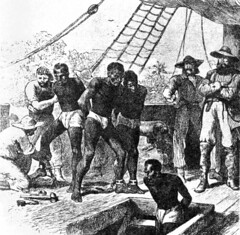
7367814286Middle PassageVoyage from West Africa to the West Indies. It was miserable for the slaves transported and many died. (p. 38)63

AP US History Period 3, 1754-1800 Flashcards

Terms : Hide Images
5318527202Seven Years' (French and Indian) Warfought between the colonies of British America and New France, with both sides supported by military units from their parent countries of Great Britain and France, as well as Native American allies0
5318527203"No Taxation Without Representation."a phrase, generally attributed to James Otis about 1761, that reflected the resentment of American colonists at being taxed by a British Parliament to which they elected no representatives and became an anti-British slogan before the American Revolution; in full, "Taxation without representation is tyranny.".1
5318527204Enlightenmenta philosophical movement which dominated the world of ideas in Europe in the 18th century. The Enlightenment included a range of ideas centered on reason as the primary source of authority andlegitimacy, and came to advance ideals such as liberty, progress, tolerance, fraternity, constitutional governmentand ending the perceived abuses of the church and state2
5318527205Benjamin FranklinOne of the founding fathers, famous for presence in the American Enlightenment. earned the title of "The First American" for his early and indefatigable campaigning for colonial unity, initially as an author and spokesman in London for several colonies.3
5318527206The Patriot MovementMovement or push toward independence in the colonies. Those that supported colonial independence were referred to as "Patriots" while those that were loyal to the British crown were called "Loyalists."4
5318527207Colonial MilitiasGroups of able-bodied colonialist men without proper military training that banded together to revolt against British tyrannny.5
5318527208The Continental Armyformed by the Second Continental Congress after the outbreak of the American Revolutionary War by the colonies, created to coordinate the military efforts of the Thirteen Colonies in their revolt against the rule of Great Britain. Commanded by General George Washington (Commander-in-Chief)6
5318527209George WashingtonGeneral, Commander-in-Chief of the Continental Army during the American Revolution. Later named the first President of the United States.7
5318527210Thomas Paine's Common SensePublished in 1776. Pamphlet that challenged the authority of the British government and the royal monarchy. Used "Common Sense" and plain language to appeal to the average colonist. First work to ask for independence outright.8
5318527211The Declaration of Independencethe statement adopted by the Second Continental Congress meeting atPhiladelphia, Pennsylvania on July 4, 1776, which announced that the thirteen American colonies,[2] then at war with the Kingdom of Great Britain, regarded themselves as thirteen newly independent sovereign states, and no longer under British rule.9
5318527212Republican MotherhoodPredominant conception of women's roles before, during and after the American Revolution: the "Republican Mother" was considered a custodian of civic virtue responsible for upholding the morality of her husband and children. Though this idea emphasized the separation of women's and men's roles, it did weight heavily the influence of the mother on the family and advocated for this influence to be taken seriously.10
5318527213Legislative BranchThe branch of government tasked with writing laws.11
5318527214Judicial BranchThe branch of government tasked with interpreting laws.12
5318527215Executive BranchThe branch of government tasked with enforcing laws.13
5318527216The Articles of ConfederationAn agreement among all thirteen original states in the United States of America that served as its first constitution. Drafted by a committee appointed by the Second Continental Congress, ratified in late 1777. Later replaced by the Constitution of the United States of America.14
5318527217Constitutional Conventiontook place from May 25 to September 17, 1787, in Philadelphia, Pennsylvania. Although the Convention was intended to revise the Articles of Confederation, the intention from the outset of many of its proponents, chief among them James Madison and Alexander Hamilton, was to create a new government rather than fix the existing one. The delegates elected George Washington to preside over the Convention. The result of the Convention was the creation of the United States Constitution, placing the Convention among the most significant events in the history of the United States.15
5318527218Federalisma system of government in which entities such as states or provinces share power with a national government.16
5318527219Separation of PowersInspired by Montesquieu in The Spirit of the Laws, the idea of a constitutional government with three separate branches of government. Each of the three branches would have defined abilities to check the powers of the other branches.17
5318527220The Federalist Papersa collection of 85 articles and essays written by Alexander Hamilton, James Madison, and John Jay promoting the ratification of the United States Constitution.18
5318527221Alexander HamiltonFounder of the Federalist Party, Co-author of The Federalist Papers, First Secretary of the Treasury19
5318527222James MadisonCo-Author of the Federalist Papers, hailed as "the Father of the Constitution," Fourth President of the United States20
5318527223Bill of Rightsthe collective name for the first ten amendments to the United States Constitution. These amendments add to the Constitution specific guarantees of personal freedoms and rights, clear limitations on the government's power in judicial and other proceedings, and explicit declarations that all powers not specifically delegated to Congress by the Constitution are reserved for the states or the people.21
5318527224Democratic-Republican Partyformed by Thomas Jefferson and others who believed in an agrarian-based, decentralized,democratic government. The party was established to oppose the Federalists who had supported and pushed through the ratification of the US Constitution.22
5318527225National Identityone's identity or sense of belonging to one state or to one nation. It is the sense of a nation as a cohesive whole, as represented by distinctive traditions, culture, language and politics.23
5318527226The Northwest Ordinancecreated the Northwest Territory, the first organized territory of the United States, from lands beyond the Appalachian Mountains, between British North America and the Great Lakes to the north and the Ohio River to the south.established the precedent by which the Federal government would be sovereign and expand westward with the admission of new states, rather than with the expansion of existing states and their established sovereignty under the Articles of Confederation.24
5318527227French Revolutiona period of far-reaching social and political upheaval in France that lasted from 1789 until 1799, and was partially carried forward by Napoleon during the later expansion of the French Empire. The Revolution overthrew the monarchy, established a republic, experienced violent periods of political turmoil, and finally culminated in a dictatorship under Napoleon that rapidly brought many of its principles to Western Europe and beyond.25
5318527228Popular Sovereigntythe principle that the authority of a state and its government is created and sustained by the consent of its people, through their elected representatives (Rule by the People), who are the source of all political power.26
5318527229Public VirtueSacrificing one's self-interest for the public good.27
5318527230insurrectionRebellion against political authority.28
5318527231mercantilismThe economic theory that all parts of an economy should be coordinated for the good of the whole state; hence, that colonial economics should be subordinated for the benefit of an empire.29
5318527232depreciateTo decrease in value, as in the decline of the purchasing power of money.30
5318527233protective tariffsTaxes places on imported goods, often to raise prices and thus protect domestic producers.31
5318527234admiralty courtsIn British law, special administrative courts designed to handle maritime cases without a jury.32
5318527235virtual representationThe political theory that a class of persons is represented in a lawmaking body without direct vote.33
5318527236nonimportation agreementA pledge to boycott, or decline to purchase, certain goods from abroad.34
5318527237dutyA customs tax on the export or import of goods.35
5318527238propagandaA systematic program or particular materials designed to spread certain ideas; sometimes but not always the term implies the use of manipulative or deceptive means.36
5318527239boycottAn organized refusal to deal with some person, organization, or product.37
5318527240inflationAn increase in the supply of currency relative to the goods available, leading to a decline in the purchasing power of money.38
5318527241mercenaryA professional soldier who serves in a foreign army for pay.39
5318527242indictmentA formal written accusation charging someone with a crime.40
5318527243dictatorshipA form of government characterized by absolute state power and the unlimited authority of the ruler.41
5318527244neutralA nation or person not taking sides in a war.42
5318527245civilianA citizen not in military service.43
5318527246confiscateTo seize private property for public use, often as a penalty.44
5318527247envoyA messenger or agent sent by a government on official business.45
5318527248rabbleA mass of disorderly and crude common people.46
5318527249isolationistConcerning the belief that a country should take little or no part in foreign affairs, especially through alliances or wars.47
5318527250hereditaryPassed down from generation to generation.48
5318527251blockadeThe isolation of a place by hostile ships or troops.49
5318527252privateerA private vessel temporarily authorized to capture or plunder enemy ships in wartime.50
5318527253disestablishTo separate an official state church from its connection with the government.51
5318527254emancipationSetting free from servitude or slavery52
5318527255abolitionistfavoring the end of slavery53
5318527256ratificationThe confirmation or validation of an act (such as the constitution) by authoritative approval.54
5318527257aliensForeigners; also, persons resident in but not citizens of a country.55
5318527258townshipin America, a surveyed territory six miles square; the term also refers to a unit of social government, smaller than a country that is often based on these survey units.56
5318527259territoryIn America, government an organized political entity not yet enjoying full equal terms of a state.57
5318527260annexTo make a smaller territory or political unit part of a larger one.58
5318527261quorumThe minimum number of persons who must be present in a group before it can conduct valid business.59
5318527262anarchyThe theory that formal government is unnecessary and wrong in principle; the term is also used generally for lawlessness or anti-governmental disorder.60
5318527263bicameralReferring to a legislative body with two houses61
5318527264censusAn official count of population; in the United States, the federal census occurs every ten years.62
5318527265public debtThe debt of a government or nation to individual creditors, also called the national debt.63
5318527266cabinetThe body of official advisers to the head of a government; in the United States, it consists of the heads of the major executive departments.64
5318527267fiscalConcerning public finances-expenditures and revenues.65
5318527268exciseA tax on the manufacture, sale, or consumption of certain products.66
5318527269stockThe shares of capital ownership gained from investing in a corporate enterprise; the term also refers to the certificates representing such shares.67
5318527270despotismArbitrary or tyrannical rule.68
5318527271impressmentTo force people or property into public service without choice.69
5318527272assimilationThe merging of diverse cultures or peoples into one.70
5318527273witch-huntAn investigation carried on with much publicity, supposedly to uncover dangerous activity but actually intended to weaken the political opposition.71
5318527274compactAn agreement or covenant between states to perform some legal act.72
5318527275nullificationIn American politics, the assertion that a state may legally invalidate a federal act deemed inconsistent with its rights or sovereignty.73

AP US History - US Presidents Flashcards

Terms : Hide Images
6774020984George Washington1789-1797 Federalist Whiskey Rebellion; Judiciary Act; Farewell Address0
6774020985John Adams1797-1801 Federalist XYZ Affair; Alien and Sedition Acts1
6774020986Thomas Jefferson1801-1809 Democratic-Republican Marbury v. Madison; Louisiana Purchase; Embargo of 18072
6774020987James Madison1809-1817 Democratic-Republican War of 1812; First Protective Tariff3
6774020988James Monroe1817-1825 Democratic-Republican Missouri Compromise of 1820; Monroe Doctrine4
6774020989John Quincy Adams1825-1829 Democratic-Republican "Corrupt Bargain"; "Tariff of Abominations"5
6774020990Andrew Jackson1829-1837 Democrat Nullification Crisis; Bank War; Indian Removal Act6
6774020991Martin Van Buren1837-1841 Democrat Trail of Tears; Specie Circular; Panic of 18377
6774020992William Henry Harrison1841 Whig "Tippecanoe and Tyler too!"; First Whig President8
6774020993John Tyler1841-1845 Whig "His Accidency"; Webster-Ashburton Treaty9
6774020994James Polk1845-1849 Democrat Texas annexation; Mexican War10
6774020995Zachary Taylor1849-1850 Whig Mexican War hero and staunch Unionist11
6774020996Millard Fillmore1850-1853 Whig Compromise of 185012
6774020997Franklin Pierce1853-1857 Democrat Kansas-Nebraska Act; Gadsden Purchase13
6774020998James Buchanan1857-1861 Democrat Dred Scott decision; Harpers Ferry raid14
6774020999Abraham Lincoln1861-1865 Republican Secession and Civil War; Emancipation Proclamation15
6774021000Andrew Johnson1865-1869 Democrat 13th and 14th amendments; Radical Reconstruction; Impeachment16
6774021001Ulysses Grant1869-1877 Republican 15th amendment; Panic of 187317
6774021002Rutherford Hayes1877-1881 Republican Compromise of 1877; labor unions and strikes18
6774021003James Garfield1881, Republican Brief resurgence of presidential authority; Increase in American naval power; Purge corruption in the Post Office19
6774021004Chester Arthur1881-1885 Republican Standard Oil trust created Edison lights up New York City20
6774021005Grover Cleveland1885-1889 (1st term), 1893-1897 (2nd term) Democrat Interstate Commerce Act; Dawes Act; Panic of 1893; Pullman Strike21
6774021006Benjamin Harrison1889-1893 Republican Sherman Anti-Trust Act; Closure of the frontier22
6774021007William McKinley1897-1901 Republican Spanish-American War; Open Door policy23
6774021008Theodore Roosevelt1901-1909 Republican Progressivism; Square Deal; Big Stick Diplomacy24
6774021009William Howard Taft1909-1913 Republican Dollar diplomacy NAACP founded25
6774021010Woodrow Wilson1913-1921 Democrat WWI; League of Nations; 18th and 19th amendments; Segregation of federal offices; First Red Scare26
6774021011Warren Harding1921-1923 Republican "Return to normalcy", return to isolationism; Tea Pot Dome scandal; Prohibition27
6774021012Calvin Coolidge1923-1929 Republican Small-government (laissez-faire) conservative28
6774021013Herbert Hoover1929-1933 Republican "American individualism"; Stock Market Crash; Dust Bowl; Hawley-Smoot Tariff29
6774021014Franklin Delano Roosevelt1933-1945 Democrat New Deal; WWII; Japanese Internment; "Fireside Chats"30
6774021015Harry Truman1945-1953 Democrat A-bomb; Marshall Plan; Korean War; United Nations31
6774021016Dwight Eisenhower1953-1961 Republican Brown v. Board of Education; Second Red Scare; Highway Act and suburbanization ("white flight"); Farewell Address warning of the military industrial complex32
6774021017John Kennedy1961-1963 Democrat Camelot; Bay of Pigs; Cuban Missile Crisis; Space program; Peace Corps33
6774021018Lyndon Johnson1963-1969 Democrat Civil and Voting Rights acts; Gulf of Tonkin Resolution; Great Society34
6774021019Richard Nixon1969-1974 Republican Environmental Protection Act; China visit; Moon Landing; Watergate35
6774021020Gerald Ford1974-1977 Republican Pardoning of Nixon; OPEC crisis36
6774021021Jimmy Carter1977-1981 Democrat stagflation / energy crisis; Iran hostage crisis; Camp David Accords37
6774021022Ronald Reagan1981-1989 Republican Conservative revolution; Iran-Contra scandal38
6774021023George H. W. Bush1989-1993 Republican Persian Gulf War39
6774021024Bill Clinton1993-2001 Democrat NAFTA; Lewinsky scandal and impreachment40
6774021025George W. Bush2001-2008 Republican War on terrorism; Patriot Act; Tax cuts; "No Child Left Behind"41
6774021026Barack Obama2008-2017 Democrat Affordable Care Act42
6774021027Donald Trump2017-? Republican "Make America Great Again"43

AMSCO AP US History Chapter 18 Flashcards

AMSCO United States History 2015 Edition, Chapter 18 The Growth of Cities and American Culture, 1865-1900

Terms : Hide Images
5991664258old immigrantsThrough the 1880s, they came to the United States from northern and western Europe. They were mostly Protestant and had a high-level of literacy.0
5991664259new immigrantsFrom the 1890s to 1914, they came to the United States from southern and eastern Europe. Mostly non-Protestant, poor and illiterate.1
5991664260Chinese Exclusion Act of 1882It was the first bill regarding immigration. It placed a ban on all new immigrants from China.2
5991664261Immigration Act of 1882In 1882, this act placed restrictions on the immigration of undesirable persons, such as paupers, criminals, convicts, and mentally incompetent.3
5991664262Alien Contract Labor Act of 1885Restricted the immigration of temporary workers, to protect American workers.4
5991664263Ellis IslandAn immigration center opened in 1892 in New York Harbor.5
5991664264melting pot vs. cultural diversityThe historian's term, melting pot, refers to immigrants leaving their old-world characteristics and adopting the United States characteristics. Other historians argue that first-generation immigrants maintained their cultural identity and only the second and third generations were assimilated in the U.S. society.6
5991664265political machines, bossPolitical parties in major cities came under the control of tightly organized groups of politicians, known as political machines. Each machine had its boss, the top politician who gave orders and doled out government jobs.7
5991664266Tammany HallA political machine in New York City, which developed into a power center.8
5991664267Jane AddamsIn 1889, she started Hull House in Chicago, which was a settlement house which provide help to immigrants.9
5991664268settlement housesThey provide social services to new immigrants.10
5991664269Dwight MoodyHe founded Moody Bible Institute, in 1889. It helped generations of urban evangelists to adapt traditional Christianity to city life.11
5991664270Salvation ArmyImported from England in 1879, this charity provided the basic necessities of life for the homeless and the poor while also preaching Christian Gospel.12
5991664271Susan B. AnthonyOne of the founders of the National American Womens Suffrage Association or NAWSA (1890), which worked to secure voting rights for women.13
5991664272Francis Willard, WCTULeader of the Women's Christian Temperance Union (WCTU) which advocated total abstinence from alcohol.14
5991664273Antisaloon LeagueIn 1893, this organization became a powerful political force and by 1916 had persuaded twenty one states to close down all saloons and bars.15
5991664274Clarence DarrowA famous lawyer, he argued that criminal behavior could be caused by an environment of poverty, neglect, and abuse.16
5991664275W.E.B. Du BoisA leading black intellectual, he advocated for equality for blacks, integrated schools, and equal access to higher education.17
5991664276Mark TwainThe first great realist author, he is famous for his classic "The Adventures of Huckleberry Finn".18
5991664277Frank Lloyd WrightThe most famous architect of the 20th century, he developed an organic style that made his buildings fit in with their natural surroundings.19
5991664278jazz, blues, ragtimeA form of music that combined African rhythms and western-style instruments and mixed improvisation with a structured band format.20
5991664279Joseph PulitzerHe established the first newspaper to exceed over one million in circulation by filling it with sensational stories of crime and disaster.21

AP US History Period 2 (1607-1754) Flashcards

Important vocabulary of the colonization of North America in the 17th century.

Terms : Hide Images
7480056270Jamestown1st permanent English settlement in North America in 1607.0
7480056271John SmithA captain famous for world travel. As a young man, he took control in Jamestown. He organized the colony and saved many people from death the next winter and coined the phrase "he who shall not work, shall not eat". He also initiated attacks on Natives.1
7480056272John RolfeHe was one of the English settlers at Jamestown (and he married Pocahontas). He discovered how to successfully grow tobacco in Virginia and cure it for export, which made Virginia an economically successful colony. Eventually, he was killed in a Pequot attack.2
7480056273PocohontasAn American Indian princess who saved the life of John Smith and helped form more peaceful relations with the Powhatan when she married John Rolfe but died of smallpox in England on a visit to Rolfe's family. Her remains are still there as the English government refuses to send her remains back to North America.3
7480056274Mayflower Compact1620 - The first agreement for self-government in America. It was signed by the 41 men on the Mayflower and set up a government for the Plymouth colony4
7480056275John WinthropAs governor of Massachusetts Bay Colony, Winthrop (1588-1649) was instrumental in forming the colony's government and shaping its legislative policy. He envisioned the colony, centered in present-day Boston, as a "city upon a hill" from which Puritans would spread religious righteousness throughout the world.5
7480056276PuritansA religious group who wanted to purify the Church of England. They came to America for religious freedom and settled Massachusetts Bay.6
7480056277PilgrimsEnglish Puritans who founded Plymouth colony in 16207
7480056278Massachusetts CharterAllowed Puritans to take a charter with them and establish their own government in the New World.8
7480056279Loss of Massachusetts CharterRevoking of Mass. Charter by King George II due to the colonists refusal to obey by the Navigation Acts leading to anti-British feeling in the New England region.9
7480056280New AmsterdamA settlement established by the Dutch near the mouth of Hudson River and the southern end of Manhattan Island as a trade port for the Dutch trade empire.10
7480056281New YorkIt was founded by the Dutch for trade and furs and became an English Colony in 1664, when the English were determined to end Dutch trade dominance, and took over the colony by invading New Amsterdam without having to fire a shot.11
7480056282Peter StuyvesantThe governor of the Dutch colony of New Amsterdam, hated by the colonists. They surrendered the colony to the English on Sept. 8, 1664.12
7480056283House of Burgesses1619 - The Virginia House of Burgesses formed, the first legislative body in colonial America. It was made up of two representatives from teach town voted on by men who owned property. Later other colonies would adopt the Houses of Burgesses concept creating self-governing bodies in the colonies.13
7480056284Headright systemHeadrights were parcels of land consisting of about 50 acres which were given to colonists who brought indentured servants into America. They were used by the Virginia Company to attract more colonists.14
7480056285Indentured servantsColonists who received free passage to North America in exchange for working without pay for a certain number of years15
7480056286Bacon's Rebellion1676 - Nathaniel Bacon and other western Virginia settlers were angry at Virginia Governor Berkley for trying to appease the Doeg Indians after the Doegs attacked the western settlements. The frontiersmen formed an army, with Bacon as its leader, which defeated the Indians and then marched on Jamestown and burned the city. The rebellion ended suddenly when Bacon died of an illness.16
7480056287King Phillip's WarUnder the leadership of Metacom, or King Phillip, the Wampanoag destroyed colonial towns, the colonists destroyed native farms, leading to the most deadly of Indian Wars. The war was disastrous for the natives leading to few surviving the war, and those that did left New England.17
7480056288royal colonyA colony ruled by governors appointed by a king18
7480056289proprietary colonyEnglish colony in which the king gave land to proprietors in exchange for a yearly payment19
7480056290town meetingsA purely democratic form of government common in the colonies, and the most prevalent form of local government in New England. In general, the town's voting population would meet once a year to elect officers, levy taxes, and pass laws.20
7480056291Salem Witch Trials1629 outbreak of witchcraft accusations in a Puritan village marked by an atmosphere of fear, hysteria, and unfounded accusations in courts with Puritan ministers who served as judges. 19 women were executed.21
7480056292Roger WilliamsA dissenter who clashed with the Massachusetts Puritans over separation of church and state and was banished in 1636, after which he founded the colony of Rhode Island to the south.22
7480056293IntolerantNot willing to accept ways of thinking different from one's own. The expansion of colonies in New England was a direct result of Puritan intolerance as dissenters were exiled and created new settlements.23
7480056294Anne HutchesonOne of the dissenters in Puritan Massachusetts held bible studies at her house and believed in a personal relationship with god. She moved to New Hampshire where she died along with her children from an Indian attack.24
7480056295Sir William BerkeleyThe royal governor of Virginia. Adopted policies that favored large planters and neglected the needs of recent settlers in the "backcountry." One reason was that he had fur trade deals with the natives in the region. His shortcomings led to Bacon's Rebellion25
7480056296William PennEstablished the colony of Pennsylvania as a "holy experiment". Freemen had the right to vote, provided leadership for self- government based on personal virtues and Quaker religious beliefs. His colony was religiously tolerant leading to diversity in the region.26
7480056297James OglethorpeFounded colony of Georgia as a chance for poor immigrants who were in debt to have a second chance at a comfortable life27
7480056298Lord Baltimore1694- He was the founder of Maryland, a colony which offered religious freedom, and a refuge for the persecuted Roman Catholics.28
7480056299Halfway CovenantA Puritan church document; In 1662, the Halfway Covenant allowed partial membership rights to persons not yet converted into the Puritan church; It lessened the difference between the "elect" members of the church from the regular members; Women soon made up a larger portion of Puritan congregations.29
7480056300Dominion of New England1686 - The British government combined the colonies of Massachusetts, Rhode Island, New Hampshire, and Connecticut into a single province headed by a royal governor (Edmund Andros). The Dominion ended in 1692, when the colonists revolted and drove out Governor Andros.30
7480056301Acts of Trade and NavigationThree acts that regulated colonial trade: 1st act: closed the colonies to all trade except that from English ships, and required the colonists to export certain goods, such as tobacco, to only English territories, 2nd act: (1663) demanded that everything being shipped from Europe to the colonies had to pass through England so they could tax the goods. 3rd act: 1673, was a reaction to the general disregard of the first two laws; it forced duties on the coastal trade among the colonies and supplied customs officials to enforce the Navigation Acts.31
7480056302MercantilismAn economic policy under which nations sought to increase their wealth and power by obtaining large amounts of gold and silver and by selling more goods than they bought.32
7480056303Triangular Slave TradeA practice, primarily during the eighteenth century, in which European ships transported slaves from Africa to Caribbean islands, molasses from the Caribbean to Europe, and trade goods from Europe to Africa.33
7480056304Middle PassageA voyage that brought enslaved Africans across the Atlantic Ocean to North America and the West Indies. The conditions on the ships from Africa to the west led to the loss of hundreds of thousands of lives.34
7480056305Social mobilityMovement of individuals or groups from one position in a society's stratification system to another35
7480056306Ben FranklinA colonial businessman and scientist who was an example of American social mobility and individualism. He was a delegate from Pennsylvania in colonial meetings, and proposed the "Albany Plan of the Union" as a way to strengthen the colonies in the French and Indian War. He was a leading figure in the movement toward revolution, and as a diplomat to France to get help during the American Revolution36
7480056307Great Awakening(1730s and 1740s) Religious movement characterized by emotional preaching (Jonathan Edwards & George Whitefield). It established American religious precedents such as camp meetings, revivals, and a "born again" philosophy. The first cultural movement to unite the thirteen colonies. It was associated with the democratization of religion, and a challenge to existing authorities and was an influence leading to the American Revolution.37
7480056308Jonathan EdwardsA leading minister during the Great Awakening, he delivered the famous sermon "Sinners in the Hands of an Angry God" promising that evildoers would pay a price on judgement day.38
7480056309African American CultureSlave communities were rich with music, dance, basket-weaving, and pottery-making. Enslaved Africans brought them the arts and crafts skills of their various tribes.39
7480056311George WhitfieldEnglish preacher who led the Great Awakening by traveling through the colonies40

Period 1: 1491-1607 AP US History Flashcards

Terms : Hide Images
4999852162Bering StraitPlace where Siberian tribes crossed into present-day Alaska and the Americas approximately 20,000 years ago0
4999852163Three-sister farmingmaize, squash, and beans1
4999852166CahokiaLarge settlement in the Mississippi Valley; Site of sedentary agriculture cultivators2
4999852164PuebloSpanish for "village"; Indians in the Southwest who built fortified settlements3
4999852167Iroquois ConfederacyFive Indian tribes form an alliance and control trade east of the Great Lakes4
7067604991Algonquian IndiansMajor native group distributed in the Northeast and along the Atlantic seaboard who cultivated three sisters. Notably included the Powhatan Confederacy of the Chesapeake Bay and Wampanoag of New England, both of which clashed with English settlers).5
4999865192Sioux IndiansGreat Plains Indians; Hunter-gatherers; Buffalo hunters6
7068102505Shoshone IndiansSocieties in the Northwest and present-day California who supported themselves by hunting and gathering, and in some areas developed settled communities supported by the vast resources of the ocean.7
4999879308Catholic ChurchThe most powerful organization in history; Controlled mostly all of Europe during the Middle Ages8
4999852168caravelnaval technology developed by the Purtuguese and used by Henry the Navigator along the African Coast, Vasco de Gama to India, and Christopher Columbus to the New World9
4999872674capitalismPrivate property; Market prices; Investment in ventures10
4999874495Renaissance"Rebirth"; Humanism11
4999875129Protestant ReformationMartin Luther's demand that the Catholic Church reform. When the church refused, he started a competing church, the Protestant (Reformed) church.12
4999868557Ferdinand and Isabella"The Catholic Monarchs"; United Spain, reconquered Spain (Reconquista), and commissioned Columbus13
4999852169ReconquistaFerdinand and Isabella's successful campaign to expel Muslim Moors (and Jews) from the Iberian Peninsula and unify Spain Under the Spanish crown and Catholic religion.14
4999852170Doctrine of Discovery (1493)A.K.A. Inter caetera; Papal Bull that declared all non-Christian land "discoverable" by Christian powers.15
4999852171Treaty of Tordesillas (1494)Divides America between Portugal and Spain for exploration16
4999881170Colombian ExchangeThe trade of biological elements, ideas, and goods; Transformed mostly all of the world as a result.17
4999884932Middle PassageThe route in the Triangular Trade where slaves passed from West Africa to the New World18
4999852172conquistadoresHernan Cortez and Francisco Pizarro, for example; agents of both the Reconquista and the conquest of the New World19
4999852173EncomiendaSpanish labor system; included a caste system with Peninsulares at the top20
7068106336casta systemThe Spanish developed a caste system that incorporated, and carefully defined the status of, the diverse population of Europeans, Africans, and Native Americans in their empire.21
4999888930MestizosMixed blood Spanish and Indian; Result of lack of Spanish ladies in the New World22
4999890690San Diego (Est. 1769)First and southernmost Spanish mission in California; Established to "civilize" the Indians and create a buffer between New Spain and competing colonial powers.23
7068207280San Francisco (Est. 1776)Last and northernmost Spanish mission in California; Established to "civilize" the Indians and create a buffer between New Spain and competing colonial powers.24
7068211484Spanish missionEstablished in the New World, especially in California, to "civilize" the Indians and create a buffer between New Spain and competing colonial powers.25
4999852174Bartolome de Las CasasIndian apologist who preached against the cruel treatment of the Indians; His writings and activities led to the "Black Legend"26
4999852175Juan Gines de SepulvedaSaw the Indians as uncivilized and barbaric27
4999852177"Black Legend"The (historically debatable) reputation that the Spanish destroyed the Indians through slavery and disease28
4999852178St. Augustine (Est. 1565)First enduring European settlement in North America; Established by the Spanish in modern-day Florida.29
4999893568Pueblo Revolt (1680)Rebellion of Pueblo Indians against Spanish rule in New Mexico; Led by the Indian Popé.30

AP US History - Period 1 Flashcards

Targeted must-know terms to master for Period 1 of APUSH.

Get more help and information at: https://apprend.io/apush/

Terms : Hide Images
8001244581Prince Henry the NavigatorHenry (1394-1460) - a Portuguese prince who was the first monarch to invest heavily in naval exploration. He funded exploratory trips—primarily of the Western coast of Africa—and collected a 20% tax on all profits made. With Henry's financial and political backing, the Portuguese were able to make many naval technological advances, allowing ships to sail farther and faster distances than ever before. Other monarchs followed Henry's model leading to an era of European exploration. This included Ferdinand and Isabella of Spain who funded Christopher Columbus's trip that resulted in European discovery of the Americas.0
8001244582Columbian ExchangeThe transfer of animals, plants, technology, and disease between Europeans and the native populations in the Americas. Catalyzed by Christopher Columbus's discovery of the New World, this transfer—both intentional and unintentional—of living things between hemispheres led to one of the most dramatic ecological changes in history. Items introduced to the Americas from Europe include: Horses, donkeys, pigs, sheep, oranges, bananas, coffee, guns, wheat, barley, rice, and, most notably, European diseases like smallpox. Items introduced to Europe from the Americas include: beans, tobacco, potatoes, tomatoes, maize, and various squashes.1
8001244583Northwest PassageA theoretical waterway passage that connected the Pacific Ocean with the Atlantic Ocean through North America. After Columbus's voyage, explorers were eager to find a western route from Europe to Asia. French and British explorers (among others) focused primarily on a northern passage through present : day Canada. The hope of a Northwest Passage catalyzed European exploration of North American waterways, such as the Great Lakes, the Hudson Bay, and the Mississippi River. Although a clear passage from the Atlantic to the Pacific was never found, the exploration for a Northwest Passage provided Europeans with an understanding of North America land.2
8001244584Encomienda SystemA paternalistic system instituted by the Spanish to control and regulate the American Indian populations. With the early emphasis on finding precious metals, Spanish conquistadores committed acts of extreme abuse to extort labor from the Native Indians. To try to reduce the abuse, the king of Spain granted a number of Indians to each Spanish representatives (such as conquistadors), who then could extract a tribute of gold or labor from the American Indians. In exchange, the encomenderos (holders of the encomienda) were required to protect and Christianize the native populations under their watch. In reality, encomenderos used the system to seize control of native land and enslave the native Indians.3
8001244585Hacienda SystemA social and property system instituted by Spain granting large tracts of land to individuals. Disease, forced labor and abuse led to a massive decline in the native population in Spanish-held territories. Also, as the Spanish economy in the New World shifted from mining to agriculture, the encomienda system did not make sense. It was replaced by the hacienda system in which large areas of land were granted to Spanish representatives. The workers on the estate were technically free wage workers, but the landowners used oppressive financial restrictions to tie them to the land. This created a feudal system in the Spanish colonies that lasted throughout the colonial period.4
8001244586Joint-stock CompanyA company in which individuals could buy a share, or a percentage of the company. Investors were entitled to a percentage of the company's profit equal to the percentage of the company they owned. However, there was also great risk: if the company failed, they lost their money. The modern joint-stock company began in England in 1533.The invention of the joint-stock company allowed business ventures to raise capital more easily and more quickly than ever before. This was particularly useful in expensive exploration or colonization expeditions. Many of the early British colonies, like Jamestown in 1607, were founded by joint-stock companies.5
8001244587Roanoke IslandThe first attempt by England to establish a colony in North America. In 1585 Sir Walter Raleigh established Roanoke Colony, made up of 120 men, women and children, on a small island off the coast of North Carolina. The colony was home to the first English child born in North America- Virginia Dare. After struggling for several years to feed themselves and the colony's governor, John White left Roanoke in late 1587 to get supplies and support from England. Upon his return in 1590 he found the colony had vanished, with only the word "Croatoan" carved into a fence post around the village.6
8001244588MayasA pre-Columbian empire in modern-day Mexico and Central America extending from 750 BCE to 900 AD (although the civilization can be traced from around 1000 BCE to 1697). The Mayan civilization was composed of multiple city-states, interlinked into a loose empire. It was incredibly sophisticated including monumental architecture and temples, a highly developed system of trade, a complex agricultural system which fed a large population, calendrical systems, astronomical understanding, and one of the world's first systems of writing. The decline of the civilization was rapid, and the causes are still essentially unknown. At the time of the arrival of the Spanish, while many of the cities were still thriving, the empire had dissipated into distinct and warring small kingdoms and cities. The Spanish were able to quickly and easily conquer them.7
8001244589AztecsA pre-Columbian empire in the Valley of Mexico between the 14th and 16th centuries. In 1428, the city-states of Tenochtitlan, Texcoco and Tlacopan formed a triple alliance to rule the valley. Together, they built an empire that covered most of central Mexico. The empire's strength was based primarily on military might: the alliance conquered other cities by force. However, administration of the empire was loose. Local leaders were allowed to maintain power as long as they paid an annual tribute to the alliance, contributed soldiers to other conquests and formally worshiped the imperial God Huitzilopochtli alongside their local gods. The Aztec Empire was conquered by Hernan Cortes in 1521 after two years of conflict and a massive smallpox epidemic.8
8001244590IncasThe largest pre-Columbian empire, covering almost all of western South America from southern Columbia to northwestern Argentina. It lasted from the early 13th century to the destruction of the final stronghold in 1572. The highly centralized empire was organized around the capital of Cusco in modern-day Peru. The empire was ruled by a single king, viewed as a descendent of the sun god. After an initial period of expansion, most of the Incan conquest was done peacefully as resistance was rare. Conquered areas were required to pay tribute to Cusco and were connected by a complex system of trade. Many conquered areas maintained their local customs and practices. Thanks to smallpox and internal feuding in the empire, Francisco Pizarro easily captured Cusco in 1532.9
8001244591Bartolome de Las CasasA Franciscan friar who openly opposed enslavement and mistreatment of the native population. One of the first Spanish settlers in the New World, Las Casas became an outspoken critic of Spanish abuse of Native peoples. He gave up his encomienda and became a Franciscan friar. He actively advocated with the crown for better treatment of the natives and an end to the practice of slavery in the Spanish colonies. While he was ultimately unsuccessful in this effort, his work did lead to the revision of Spanish law with regards to American Indians. His writings also provide important insight into the relationship between Spanish colonists and the native populations they encountered.10
8001244592Sir Walter RaleighA British explorer received the first charter from Queen Elizabeth to explore and conquer the New World. He traveled twice to South America to find "El Dorado", the city of gold, writing a highly exaggerated book which created a lasting myth around this fictional place. He also organized the Roanoke colony (although he did not travel there himself). Raleigh was Great Britain's first major explorer of the New World and laid the groundwork for the eventual British settlement of the eastern coast of North America.11
8001244593Christopher ColumbusAn Italian navigator who led a trans-Atlantic voyage that resulted in European discovery of the Americas. Columbus was one of many explorers in the 15th century trying to find a better sea-route to Asia. Based on inaccurate calculations about the size of the Earth, Columbus believed a western route would be possible and faster. He convinced Ferdinand and Isabella of Spain to sponsor his trip, and left in 1492 with three ships. Instead of reaching India as planned, however, he landed on Hispaniola. He later led three more voyages to the Caribbean, and opened the door to lasting contact between Europe and the Americas.12
8001244594ChinookThe language of groups of American Indians in the Pacific Northwest. Because there were no formal tribes like in other areas, Europeans grouped American Indians of the Northwest by language. The Chinook-speaking people, like others in the area, relied on fishing and plants and animals caught in the dense fir forests. They had a highly stratified society composed of several castes, including slaves. The Chinook lived in longhouses which held the members of the house. They had little conflict over land with other native groups, and had limited interaction with Europeans until they were encountered by the Lewis and Clark Expedition in 1805. The Chinook were displaced when American settlers flooded Oregon in the 1840s.13
8001244595IroquoisThe largest political organization in pre-contact North America. The Iroquois Confederacy was a loose league of five tribes: Mohawk, Oneida, Onondaga, Cayuga and Seneca formed in the 1400s or 1500s. The confederacy's primary purpose was to promote peace among the member tribes by organizing a complex compensation system for murder. The confederacy, however, was very aggressive with tribes outside of the alliance, focusing on raids to gain more land and people, rather than conquest. The Iroquois Confederacy traded fur with the French, but this quickly turned into a decades-long conflict over control of access to game called the Beaver Wars. Because of their animosity towards the French, the Iroquois became a sometimes-ally to the British, fighting with them in the French and Indian War.14
8001244596AlgonquiansA widespread American Indian language group ranging across most of modern-day Canada and pockets in the Northeast and northern parts of the Midwest in the modern-day United States. The greatest concentration of Algonquian-speaking people was along the Atlantic Coast, the St. Lawrence River and around the Great Lakes. Most Algonquian groups hunted and fished, supported by three-sisters farming. They built temporary and mobile villages, that could follow the game and consisting of a few hundred people. The Algonquian people were often at war with the Iroquois Confederacy. This led to a greater openness to alliance with Europeans. Longer than most tribes, Algonquians managed to hold off extensive loss of land through treaties with France, Britain and the United States.15
8001244597John CabotFirst European explorer of North America after the Vikings. In 1497, Cabot, an Italian explorer, sailed from Bristol England in search of a western route to China along northern latitudes where the distance would be shorter. Instead of an open route, he came upon modern-day Newfoundland in Canada. Cabot went on shore only to claim the land for England, did some brief exploration and then returned to England. He took a second voyage in 1499, but it is unclear if he returned or if he even ever reached Newfoundland. Cabot's voyage revealed the extent of the New World and opened up colonization possibilities for countries besides Spain.16
8001244598Francis DrakeEnglish sea captain and privateer known for his circumnavigation of the globe and defeat of the Spanish Armada. During Drake's circumnavigation of the globe from 1577 to 1580, he captured several Spanish ships and stole their cargo, earning him a reputation as a daring seaman. In trying to hold off a Spanish invasion, Queen Elizabeth ordered Drake to attack Spanish colonies in the Atlantic and in the New World in 1585. Two years later, Drake destroyed ships in two of Spain's biggest ports, holding the invasion off once again. When Spain finally did attack in 1588, Drake was vice-admiral and led English ships in the defeat of the Spanish Armada. This signified a significant power shift in Europe. Spain was no longer the most powerful nation, and the English navy was established as the best in the world.17
8001244599ConquistadorsSpanish leaders of conquest in the New World. In Spain, only first-born sons inherited the family's wealth. This created a class of men in search of their own fortune. The discovery of the New World, and Spain's desire to profit from it, opened up new opportunities. The crown offered to fund the cost of expeditions whose purpose was to find new land, claim it for Spain, and convert the natives to Christianity. In exchange, the conqueror received a large share of whatever wealth they found. These professional warriors, called conquistadors, led expeditions throughout South and Central America driven by "God, gold and glory." The desire for wealth and fame led to high levels of violence and oppression of American Indians.18
8001244600Treaty of TordesillasTreaty between Spain and Portugal dividing the New World—and all future discovered lands in it--between them. In 1493, Pope Alexander VI (Spanish-born) issued papal bulls, or orders, establishing a demarcation line 320 miles west of the Cape Verde Islands. All lands to the east, which included only a few Atlantic islands, were given to Portugal. All lands to the west (all of the Americas) were given to Spain. In 1494, Portugal demanded a renegotiation with Spain. The resulting Treaty of Tordesillas, moved the line 850 miles west, giving about half of modern-day Brazil to Portugal. While the treaty was eventually sanctioned by the pope, the other European powers never recognized it. Portugal did use it to gain a foothold in South America, which they extended through settlement to control most of the interior of the continent.19
8001244601Valladolid DebateThe first moral debate about colonization in European history. In 1550, scholars and theologians gathered at Valladolid in Spain to debate the colonization of the Americas and the relationship between the colonizers and the colonized. The two most prominent views were expressed by friar Bartolome de las Casas (an outspoken opponent to Spanish practices in South America) and Juan Ginés de Sepúlveda, a humanist scholar. De las Casas argued that the American Indians should be treated the same as Spanish colonizers. Sepúlveda disagreed, saying practices like human sacrifice were absolute moral wrongs that should be ended at any cost, including war and conquest. While there was no clear winner, it articulated Spain's internal struggle over the abuses of colonization and established de las Casas as the defender of the native people.20

AP US History Chapter 13 Flashcards

Terms : Hide Images
6836238142Manifest DestinyA term coined by John L. O'Sullivan in 1845 to express the idea that Euro-Americans were fated by God to settle the North American continent from the Atlantic to the Pacific Ocean.0
6836238143CaliforniosThe elite Mexican ranchers in the province of California.1
6836238144"Fifty-four forty or fight"Democratic candidate James K. Polk's slogan in the election of 1844 calling for the opening up of lands for American settlement in Texas and sovereignty over the entire Oregon Country.2
6836238145conscience WhigsWhig politicians who opposed the Mexican War (1846-1848) on moral grounds, maintaining the the purpose of the war was to expand and perpetuate slavery. They feared that the addition of more slave states would ensure the South's control of the national government.3
6836238146Wilmot Proviso1846 proposal that outlawed slavery in any territory gained from the War with Mexico4
6836238147free-soil movementA political movement that opposed the expansion of slavery. In 1848 the free-soilers organized the Free-Soil Party, which depicted slavery as a threat to republicanism and to the Jeffersonian ideal of a freeholder society, arguments that won broad support among aspiring white farmers.5
6836238148squatter sovereigntyA plan promoted by Democratic candidate Senator Lewis Cass under which Congress would allow settlers in each territory to determine its status as free or slave.6
6836238149forty-ninersThe more than 80,000 settlers who arrived in California in 1849 as part of that territory's gold rush.7
6836238150"slavery follows the flag"The assertion by John C. Calhoun that planters could by right take their slave property into new territories.8
6836238151Compromise of 1850Laws passed in 1850 that were meant to resolve the dispute over the status of slavery in the territories. Key elements include the admission of California as a free state and the Fugitive Slave Act.9
6836238152personal-liberty lawsLaws enacted in many northern states that guaranteed to all residents, including alleged fugitives, the right to a jury trial.10
6836238153Gadsden PurchaseA small slice of land (now part of Arizona and New Mexico) purchased by President Franklin Pierce in 1853 for the purpose of building a transcontinental rail line from New Orleans to Los Angeles.11
6836238154Kansas-Nebraska Act1854 - Created Nebraska and Kansas as states and gave the people in those territories the right to chose to be a free or slave state through popular sovereignty.12
6836238155American, or Know-Nothing PartyA political party formed in 1851 that drew on the anti-immigrant and anti-Catholic movements of the 1840s. In 1854, the party gained control of the state governments of Massachusetts and Pennsylvania.13
6836238156"Bleeding Kansas"Term for the bloody struggle between proslavery and antislavery factions in Kansas following its organization as a territory in the fall of 1854.14
6836238157Dred Scott v. SandfordThe 1857 Supreme Court Decision that ruled the Missouri Compromise unconstitutional. The Court ruled against salve Dred Scott who claimed that travels with his master into free states and territories made him and his family free. The decision also denied the federal government the right to exclude slavery from the territories and declared that African Americans were not citizens.15
6836238158Freeport DoctrineDoctrine developed by Stephen Douglas that said the exclusion of slavery in a territory could be determined by the refusal of the voters to enact any laws that would protect slave property.16
6836238159James K PolkGovernor of Tennessee, slave owner, President, "Young Hickory", supported "re-occupation of Oregon and re-annexation of Texas"17
6836238160Frederick DouglassOne of the most prominent African American figures in the abolitionist movement; escaped from slavery; advocated freedom from slavery & full citizenship rights for all blacks.18
6836238161Zachary Taylor"Old Rough and Ready", (1849-1850), Whig president who was a Southern slave holder, and war hero (Mexican-American War). Won the 1848 election. Surprisingly did not address the issue of slavery at all on his platform. He died during his term and his Vice President was Millard Fillmore.19
6836238162Lewis CassDemocratic senator who proposed popular sovereignty to settle the slavery question in the territories; he lost the presidential election in 1848 against Zachary Taylor but continued to advocate his solution to the slavery issue throughout the 1850s.20
6836238163Stephen DouglasA moderate, who introduced the Kansas-Nebraska Act in 1854 and popularized the idea of popular sovereignty.21
6836238164Harriet Beecher Stowe(1811-1896) American author and daughter of Lyman Beecher, she was an abolitionist and author of the famous antislavery novel, Uncle Tom's Cabin.22
6836238165John BrownWell-known abolitionist who led the Pottawatamie Massacre (Bleeding Kansas) and the raid on the arsenal at Harper's Ferry where he was captured, tried and hanged.23
6836238166Abraham Lincoln16th president of the United States; helped preserve the United States by leading the defeat of the secessionist Confederacy; an outspoken opponent of the expansion of slavery.24
6836238167John O'Sullivancoined the term "manifest destiny"25
6836238168Ostend ManifestoAn 1854 manifesto that urged President Franklin Pierce to seize the slave-owning province of Cuba from Spain. Northern Democrats denounced this aggressive initiative, and the plan was scuttled.26
6836238169Winfield ScottUS general in the Mexican War; led the capture of Mexico City27
6836238170John Sloatnaval commander who landed in California28
6836238171John C. Fremontan American military officer, explorer29
6836238172John Tyler10th president; proslavery; called for the annexation of Texas30
6836238173Thomas Oliver LarkinMerchant in. Monterey, CA, did NOT assimilate into Mexican culture white working with Mexican politicians and landowners.31
6836238174Ulysses S. Grantyoung officer under General Zachary Taylor during the War with Mexico32
6836238175John SutterOwner of the mill where gold was discovered that helped start the California Gold Rush33

Pages

Subscribe to CourseNotes RSS

Need Help?

We hope your visit has been a productive one. If you're having any problems, or would like to give some feedback, we'd love to hear from you.

For general help, questions, and suggestions, try our dedicated support forums.

If you need to contact the Course-Notes.Org web experience team, please use our contact form.

Need Notes?

While we strive to provide the most comprehensive notes for as many high school textbooks as possible, there are certainly going to be some that we miss. Drop us a note and let us know which textbooks you need. Be sure to include which edition of the textbook you are using! If we see enough demand, we'll do whatever we can to get those notes up on the site for you!