AP Notes, Outlines, Study Guides, Vocabulary, Practice Exams and more!

AP U.S. History - APStudent.com Notecards 101-150: The French & Indian War, Beginning Colonial Unrest Flashcards

Advanced Placement United States History notecards 101-150 from www.APStudent.com.

Terms : Hide Images
449232395John Peter Zenger trialZenger published articles critical of British governor William Cosby. He was taken to trial, but found not guilty. The trial set a precedent for freedom of the press in the colonies.0
449232396Glorious Revolution, 1688King James II's policies, such as converting to catholicism, conducting a series of repressive trials known as the "Bloody Assizes," and maintianing a standing army, so outraged the people of England that Parliament asked him to resign and invited King William of the Netherlands (who became known as William II in England), to take over the throne. King James II left peacefully (after his troops deserted him) and King William II and his wife Queen Mary II took the throne without any war or bloodshed, hence the revolution was termed "glorious."1
449232397John Locke (1632-1704), his theoriesLocke was an English political philosopher whose ideas inspired the American revolution. He wrote that all human beings have a right to life, liberty, and property, and that governments exist to protect those rights. He believed that government was based upon an unwritten "social contract" between the rulers and their people, and if the government failed to uphold its end of the contract, the people had a right to rebel and institute a new government.2
451693504A democratic society or not?The Founding Fathers were not sure that democracy was the right form of government for America. They feared anarchy and the rise of factions whose policies would not represent the true will of the people. Hence, the government which they designed contains many aspects of a republic; that is, an indirect democracy in which the people do not vote directly on the laws, but instead elect representatives who vote for them.3
451693505Land claims and squabbles in North AmericaThe British controlled the colonies on the east coast, and the French held the land around the Mississippi and west of it. Both the British and the French laid claim to Canada and the Ohio Valley region.4
451693506Differences between French and British colonizationThe British settled mainly along the coast, where they started farms, towns, and governments. As a general rule, whole families emigrated. The British colonies had little interaction with the local Indians (aside from occasional fighting). The French colonized the interior, where they controlled the fur trade. Most of the French immigrants were single men, and there were few towns and only loose governmental authority. The French lived closely with the Indians, trading with them for furs and sometimes taking Indian wives.5
451693507Queen Anne's War, 1702-1713The second of the four wars known generally as the French and Indian Wars, it arose out of issues left unresolved by King Williams' War (1689-1697) and was part of a larger European conflict known as the War of the Spanish Succession. Britain, allied with the Netherlands, defeated France and Spain to gain territory in Canada, even though the British had suffered defeats in most of their military operations in North America.6
451693508Peace of Utrecht, 1713Ended Queen Anne's War. Undermined France's power in North America by giving Britain the Hudson Bay, Newfoundland, and Nova Scotia.7
451693509War of Jenkin's Ear (1739-1743)Land squabble between Britain and Spain over Georgia and trading rights. Battles took place in the Caribbean and on the Florida/Georgia border. The name comes from a British captain named Jenkin, whose ear was cut off by the Spanish.8
451693510King George's War (1744-1748)Land squabble between France and Britain. France tried to retake Nova Scotia (which it had lost to Britain in Queen Anne's War). The war ended with a treaty restoring the status quo, so that Britain kept Nova Scotia).9
451693511French and Indian War (1756-1763)Part of the Seven Years' War in Europe. Britain and France fought for control of the Ohio Valley and Canada. The Algonquins, who feared British expansion into the Ohio Valley, allied with the French. The Mohawks also fought for the French while the rest of the Iroquois Nation allied with the British. The colonies fought under British commanders. Britain eventually won, and gained control of all of the remaining French possessions in Canada, as well as India. Spain, which had allied with France, ceeded Florida to Britain, but received Louisana in return.10
451693512Francis Parkman (1823-1893)An historian who wrote about the struggle between France and Britain for North America.11
451693513Albany Plan of Union, Benjamin FranklinDuring the French and Indian War, Franklin wrote this proposal for a unified colonial government, which would operate under the authority of the British government.12
451693514General BraddockBritish commander in the French and Indian War. He was killed and his army defeated in a battle at the intersection of the Ohio, Allegheny, and Monongahela Rivers, known as the Battle of Fallen Timbers. After his death, his colonial second-in-command, Col. George Washington, temporarily lead the British forces.13
451693515William Pitt (1708-1778)British secretary of state during the French and Indian War. He brought the British/colonial army under tight British control and started drafting colonists, which led to riots.14
451693516Fort Pitt, Fort DuquesneFort Duquesne became one of the principal French outposts in the northern Ohio Valley, and, in 1754 the French troops in Fort Dusquesne destroyed nearby British Fort Necessity, after Washington and the colonial army surrendered it to them. The British rebuilt Fort Necessity as Fort Pitt in 1758.15
451693517Wolfe, Montcalm, Quebec1759 - British general James Wolfe led an attack on Quebec. The French, under Marquis de Montcalm, fought off the initial attack, but the British recovered and took Quebec in a surprise night attack in September, 1759.16
451693518Treaty of Paris, 1763Treaty between Britain, France, and Spain, which ended the Seven Years War (and the French and Indian War). France lost Canada, the land east of the Mississippi, some Caribbean islands and India to Britain. France also gave New Orleans and the land west of the Mississippi to Spain, to compensate it for ceeding Florida to the British.17
451693519Pontiac's Rebellion1763 - An Indian uprising after the French and Indian War, led by an Ottowa chief named Pontiac. They opposed British expansion into the western Ohio Valley and began destroying British forts in the area. The attacks ended when Pontiac was killed.18
451693520Proclamation of 1763A proclamation from the British government which forbade British colonists from settling west of the Appalacian Mountains, and which required any settlers already living west of the mountains to move back east.19
451693521Writs of AssistanceSearch warrants issued by the British government. They allowed officials to search houses and ships for smuggled goods, and to enlist colonials to help them search. The writs could be used anywhere, anytime, as often as desired. The officials did not need to prove that there was reasonable cause to believe that the person subject to the search had committed a crime or might have possession of contraband before getting a writ or searching a house. The writs were protested by the colonies.20
451693522James OtisA colonial lawyer who defended (usually for free) colonial merchants who were accused of smuggling. Argued against the writs of assistance and the Stamp Act.21
451693523Paxton BoysA mob of Pennsylvania frontiersmen led by the Paxtons who massacred a group of non-hostile Indians.22
451693524Navigation ActsA series of British regulations which taxed goods imported by the colonies from places other than Britain, or otherwise sought to control and regulate colonial trade. Increased British-colonial trade and tax revenues. The Navigation Acts were reinstated after the French and Indian War because Britain needed to pay off debts incurred during the war, and to pay the costs of maintaining a standing army in the colonies.23
451693525Grenville's ProgramAs Prime Minister, he passed the Sugar Act in 1764 and the Stamp Act in 1765 to help finance the cost of maintaining a standing force of British troops in the colonies. He believed in reducing the financial burden on the British by enacting new taxes in the colonies.24
451693526Sugar Act, 1764Part of Prime Minister Grenville's revenue program, the act replaced the Molasses Act of 1733, and actually lowered the tax on sugar and molasses (which the New England colonies imported to make rum as part of the triangular trade) from 6 cents to 3 cents a barrel, but for the first time adopted provisions that would insure that the tax was strictly enforced; created the vice-admiralty courts; and made it illegal for the colonies to buy goods from non-British Caribbean colonies.25
451693527Molasses Act, 1733British legislation which had taxed all molasses, rum, and sugar which the colonies imported from countries other than Britain and her colonies. The act angered the New England colonies, which imported a lot of molasses from the Caribbean as part of the Triangular Trade. The British had difficulty enforcing the tax; most colonial merchants did not pay it.26
451693528Currency Act, 1764British legislation which banned the production of paper money in the colonies in an effort to combat the inflation caused by Virginia's decision to get itself out of debt by issuing more paper money.27
451693529Vice-admiralty courtsIn these courts, British judges tried colonials in trials with no juries.28
451693530Non-importationA movement under which the colonies agreed to stop importing goods from Britain in order to protest the Stamp Act.29
451693531Virtual, actual representationVirtual representation means that a representative is not elected by his constituents, but he resembles them in his political beliefs and goals. Actual representation mean that a representative is elected by his constituents. The colonies only had virtual representation in the British government.30
451693532Stamp ActMarch 22, 1765 - British legislation passed as part of Prime Minister Grenville's revenue measures which required that all legal or official documents used in the colonies, such as wills, deeds and contracts, had to be written on special, stamped British paper. It was so unpopular in the colonies that it caused riots, and most of the stamped paper sent to the colonies from Britain was burned by angry mobs. Because of this opposition, and the decline in British imports caused by the non- importation movement, London merchants convinced Parliament to repeal the Stamp Act in 1766.31
451693533Virginia ResolvesMay 30, 1765 - Patrick Henry's speech which condemned the British government for its taxes and other policies. He proposed 7 "resolves" to show Virginia's resisitence to the British policies, 5 of which were adopted by the Virginia legislature. 8 other colonies followed suit and had adopted similar resolves by the end of 1765.32
451693534Stamp Act Congress, 176527 delegates from 9 colonies met from October 7-24, 1765, and drew up a list of declarations and petitions against the new taxes imposed on the colonies.33
451693535Patrick Henry (1736-1799)An American orator and member of the Virginia House of Burgesses who gave speeches against the British government and its policies urging the colonies to fight for independence. In connection with a petition to declare a "state of defense" in virginia in 1775, he gave his most famous speech which ends with the words, "Give me liberty or give me death." Henry served as Governor of Virginia from 1776-1779 and 1784-1786, and was instrumental in causing the Bill of Rights to be adopted as part of the U.S. Constitution.34
451693536Sons of LibertyA radical political organization for colonial independence which formed in 1765 after the passage of the Stamp Act. They incited riots and burned the customs houses where the stamped British paper was kept. After the repeal of the Stamp Act, many of the local chapters formed the Committees of Correspondence which continued to promote opposition to British policies towards the colonies. The Sons leaders included Samuel Adams and Paul Revere.35
451693537Internal taxesTaxes which arose out of activities that occurred "internally" within the colonies. The Stamp Act was considered an internal tax, because it taxed the colonists on legal transactions they undertook locally. Many colonists and Englishmen felt that Parliament did not have the authority to levy internal taxes on the colonies.36
451693538External taxesTaxes arose out of activities that originated outside of the colonies, such as cusotms duties. The Sugar Act was considered an external tax, because it only operated on goods imported into the colonies from overseas. Many colonists who objected to Parliament's "internal" taxes on the colonies felt that Parliament had the authority to levy external taxes on imported goods.37
451693539Declatory Act, 1766Passed at the same time that the Stamp Act was repealed, the Act declared that Parliament had the power to tax the colonies both internally and externally, and had absolute power over the colonial legislatures.38
451693540Quartering ActMarch 24, 1765 - Required the colonials to provide food, lodging, and supplies for the British troops in the colonies.39
451693541Townshend Acts, reactionAnother series of revenue measures, passed by Townshend as Chancellor of the Exchequer in 1767, they taxed quasi-luxury items imported into the colonies, including paper, lead, tea, and paint. The colonial reaction was outrage and they instutited another movement to stop importing British goods.40
451693542John DickinsonDrafted a declaration of colonial rights and grievances, and also wrote the series of "Letters from a Farmer in Pennsylvania" in 1767 to protest the Townshend Acts. Although an outspoken critic of British policies towards the colonies, Dickinson opposed the Revolution, and, as a delegate to the Continental Congress in 1776, refused to sign the Declaration of Independence.41
451693543Massachusetts Circular LetterA letter written in Boston and circulated through the colonies in February, 1768, which urged the colonies not to import goods taxed by the Townshend Acts. Boston, New York, and Philadelphia agreed to non-importation. It was followed by the Virginia Circular Letter in May, 1768. Parliament ordered all colonial legislatures which did not rescind the circular letters dissolved.42
451693544Sam Adams (1722-1803)A Massachusetts politician who was a radical fighter for colonial independence. Helped organize the Sons of Liberty and the Non-Importation Commission, which protested the Townshend Acts, and is believed to have lead the Boston Tea Party. He served in the Continental Congress throughout the Revolution, and served as Governor of Massachusetts from 1794-1797.43
451693545The AssociationA military organization formed by Benjamin Franklin which formed fighting units in Pennsylvania and erected two batteries on the Delaware River.44
451693546Repeal of the Townshend Acts, except tax on tea1770 - Prime Minister Lord North repealed the Townshend Acts, except for the tax on tea.45
451693547Boston Massacre, 1770The colonials hated the British soldiers in the colonies because the worked for very low wages and took jobs away from colonists. On March 4, 1770, a group of colonials started throwing rocks and snowballs at some British soldiers; the soldiers panicked and fired their muskets, killing a few colonials. This outraged the colonies and increased anti-British sentiment.46
451693548Crispus Attucks (1723-1770)He was one of the colonials involved in the Boston Massacre, and when the shooting started, he was the first to die. He became a martyr.47
451693549John AdamsA Massachusetts attorney and politician who was a strong believer in colonial independence. He argued against the Stamp Act and was involved in various patriot groups. As a delegate from Massachusetts, he urged the Second Continental Congress to declare independence. He helped draft and pass the Declaration of Independence. Adams later served as the second President of the United States.48
451693550Carolina RegulatorsWestern frontiersmen who in 1768 rebelled in protest against the high taxes imposed by the Eastern colonial government of North Carolina, and whose organization was crushed by military force by Governor Tryon in 1771. In South Carolina, groups of vigilantes who organized to fignt outlaw bands along the Western frontier in 1767-1769, and who disbanded when regular courts were established in those areas.49

AP Bio Chapter 4: Carbon Flashcards

Terms : Hide Images
1918052326MillerConcluded that complex organic molecules could arise spontaneously under conditions thought to have existed on early Earth.0
1918052327SkeletonsFormed by carbon chains in organic molecules. Vary in length and may be straight, branched, or arranged in close rings.1
1918052328HydrocarbonsOrganic molecules consisting of only carbon and hydrogen2
1918052329IsomersCompounds that have the same numbers of atoms of the same elements but different structures and hence different properties3
1918052330Structural isomersSame molecular formula, different covalent arrangements of their atoms.4
1918052331Cis-trans isomers (geometric isomers)Same molecular formula and covalent bonds between atoms but different spatial arrangements of their atoms due to the inflexibility of double bonds. This subtle difference in shape can dramatically affect the biological activities of organic molecules.5
1918052332EnatiomerOne of two compounds that are mirror images of each other and that differ in shape due to the presence of an asymmetric carbon (one that is attached to four different atoms or groups of atoms). Important in the pharmaceutical industry because two versions of a drug might not be equally effective (i.e. ibuprofen and albuterol)6
1918052333Functional groupsChemical groups that participate in chemical reactions in a characteristic way. Affect molecular function.7
1918052334Hydroxyl-OH8
1918052335HydroxylHydrogen atom is bonded to an oxygen atom, which in turn is bonded to the carbon skeleton of the organic molecule. Is polar and can form hydrogen bonds with water molecules (hydrophilic).9
1918052336AlcoholName of compound with a hydroxyl group10
1918052337CarbonylConsists of a carbon atom joined to an oxygen atom by a double bond11
1918052338Carbonyl>CO12
1918052339Ketones, aldehydesTwo types of compounds with a carbonyl group (structural isomers)13
1918052340KetoneCompound where the carbonyl group is within a carbon skeleton14
1918052341AldehydeCompound where the carbonyl group is at the end of the carbon skeleton (H-C-R)15
1918052342Carboxyl-COOH16
1918052343CarboxylWhen an oxygen atom is double-bonded to a carbon atom that is also bonded to an -OH group17
1918052344Organic acidCompound formed by carboxyl groups18
1918052345CarboxylActs as an acid; can donate H+ because the covalent bond between oxygen and hydrogen is so polar. Charge of 1-.19
1918052346MethylOnly hydrophobic functional group (decreases the solubility of organic compounds in water).20
1918052347Amino-NH₂21
1918052348AminoConsists of a nitrogen atom bonded to 2 hydrogen atoms and to the carbon skeleton22
1918052349AminesCompound formed by amino groups23
1918052350Sulfhydryl-SH24
1918052351SulfhydrlConsists of a sulfur atom bonded to an atom of hydrogen. Resembles a hydroxyl group in shape.25
1918052352ThiolCompound formed by sulfhydrl groups26
1918052353SulfhydrlTwo of these groups can react to form a covalent bond. This "cross-linking" helps stabilize protein structures and can maintain the curliness or straightness of hair.27
1918052354Phosphate-OPO₃²⁻28
1918052355PhosphateA phosphorous atom is bonded to 4 oxygen atoms. One oxygen is bonded to the carbon skeletons. Two oxygens carry negative charges.29
1918052356Organic phosphatesCompound formed by phosphate group30
1918052357PhosphateContributes negative charge to the molecule of which it is a part. Have the potential to react with water, releasing energy.31
1918052358AminoActs as a base. Has a charge of +1.32
1918052359Methyl-CH₃33
1918052360MethylConsists of a carbon bonded to 3 hydrogen atoms. The carbon may be attached to another carbon or a different atom.34
1918052361MethylatedCompound formed by methyl groups35
1918052362MethylAdditional of this group to DNA affects gene expression. Arrangement of this group affects the shape and function of sex hormones.36
1922577774ZwitterionDouble ion (+ and - on the same molecule)--most common form of an amino acid.37

AP Bio Chapter 7 Flashcards

Terms : Hide Images
443315343diffusionwhen a substance moves from an area of higher concentration to an area of lower concentration; caused by entrapy because nature wants stability0
443315344osmosisthe diffusion of water through a selectively permeable membrane1
443315345dialysisthe diffusion of small solutes through a selectively permeable membrane2
443315346passive transportdiffusion or osmosis; the way a cell gets materials or excretes them by having them go from a high concentration to a low concentration; no ATP is necessary, energy comes from normal collisions; slow over large distances3
443315347active transportwhen a cell gets materials or excretes them by using its own energy, usually through ATP; going against natural tendencies4
443315348hypertonicdescribes a solution that has a greater concentration of total solute5
443315349hypotonicdescribes a solution that has a lesser concentration of total solute6
443315350isotonicdescribes solutions that have an equal concentration of total solutes7
443315351turgor pressurethe pressure inside of a cell as a cell pushes itself against the cell wall8
443315352plasmolysisthis happens when a cell shrinks inside its cell wall while the cell wall remains intact; concentration of water decreases, while solute concentration increases9
443315353flaccidthis happens when water moves, but the amount within the cell is constant; no pressure builds10
443315354crenationthis happens when a cell shrinks and shrivels; can result in cell death if severe11
443315355water potentialthis states that water will always move from an area with high water potential to an area with low water potential12
443315356solute potentialthis measurement has a maximum value of 0; it decreases as the concentration of a solute increases13
443315357pressure potentialthis measurement has a minimum value of 0 (when the solution is open to the environment); it increases as pressure increases14
443315358selective permeabilitya property of a plasma membrane that allows some substances to cross more easily than others15
443315359amphipathicmolecules are said to be this when it has regions that are both hydrophilic and hydrophobic16
443315360fluid mosaic modelthe currently accepted arrangement of membranes; it is a fluid structure with a "mosaic" of various proteins embedded in or attached to a double layer of phospholipids; proposed by Singer and Nicolson in 197217
443315361integral proteinsthe proteins of a membrane that penetrate the hydrophobic core of the lipid bilayer; hydrophobic regions consist of nonpolar amino acids, while hydrophilic regions are exposed to aqueous solution on either side of membrane18
443315362transmembrane proteinsthe proteins of a membrane that span the entire membrane19
443315363peripheral proteinsthe proteins of a membrane that are not embedded in the lipid bilayer; they are appendages loosely bound to the surface of the membrane, often exposed to parts of the integral proteins; attached by cytoskeleton on cytoplasmic side, and by fibers of ECM on extracellular side20
443315364transportthe function of membrane proteins that allows travel through a hydrophilic channel, or by transport proteins, which shuttle molecules across the membrane by changing shape with the help of hydrolyzing ATP21
443315365enzymatic activitythe function of membrane proteins that uses the exposure of proteins' active sites to adjacent solutions; metabolic processes progress to help substances pass22
443315366signal transductionthe function of membrane proteins that allow proteins to have binding sites with specific shapes that fit chemical messengers; external messengers may cause a shape change in protein that relays a message to the inside of the cell, usually by binding to a cytoplasmic protein23
443315367cell-cell recognitionthe function of membrane proteins in which some glycoproteins serve as ID tags that are recognized by membrane proteins of other cells24
443315368intercellular joiningthe function of membrane proteins in which membrane proteins of adjacent cells hook together, as in gap junctions or tight junctions25
443315369attachment to cytoskeleton and extracellular matrixthe function of membrane proteins in which microfilaments bond noncovalently to membrane proteins, maintaining cell shape and protein location; proteins bound to extracellular matrix molecules can coordinate extracellular and intracellular changes26
443315370glycolipidsmembrane carbohydrates that are covalently bonded to lipids27
443315371glycoproteinsmembrane carbohydrates that are covalently bonded to proteins28
443315372transport proteina membrane protein that is responsible for moving hydrophilic substances from one side to the other29
443315373channel proteina membrane protein, specifically a transport protein, that has a hydrophilic channel that certain molecules or atomic ions use as a tunnel30
443315374aquaporina membrane protein, specifically a transport protein, that facilitates the passage of water through channel proteins31
443315375carrier proteina membrane protein, specifically a transport protein, that holds onto molecules and changes their shapes in a way that shuttles them across the membrane32
443315376concentration gradientthe region along which the density of a substance decreases33
443315377upwhen a substance diffuses from an area of lower concentration to an area of higher concentration, it is moving ______ its concentration gradient34
443315378downwhen a substance diffuses from an area of higher concentration to an area of lower concentration, it is moving ________ its concentration gradient35
443315379tonicitythe ability of a solution to cause a cell to gain or lose water; depends partly on concentration of nonpenetrating solutes relative to inside of cell36
443315380osmoregulationthe control of water balance37
443315381turgida cell with a cell wall that has a reasonable amount of pressure but is healthy38
443315382flaccida cell with a cell wall that is in an isotonic solution that allows for a steady volume39
443315383facilitated diffusionpassive diffusion that is aided by transport proteins, but that does not require cellular energy40
443315384membrane potentialthe voltage of a plasma membrane; ranges from -50 mV to -200 mV; the (-) signifies in which direction the substances move--(-) = outside of cell41
443315385membrane potentialfavors the passive transport of cations into the cell and anions out of the cell42
443315386electrochemical gradientthe combination of forces that acts on membrane potential43
443315387nonpolarwhen ____________ entities hit the membrane, they dissolve through it and pass through the membrane and into the cell44
443315388ionicwhen ____________ entities hit the membrane, they accompany a protein in order to be dissolved, regardless of size45
443315389small nonpolarwhen ____________ entities hit the membrane, they pass through the membrane alone46
443315390large polarwhen ____________ entities hit the membrane, they are completely blocked from entering47
443315391gated channela highly selective tunnel on a plasma membrane that can open or close depending on conformational changes; they are changed due to electrical disturbances, bonding of a specific ligand; allows a substance to diffuse48
443315392electrogenic pumpa transport protein that generates voltage across a membrane, causing a net separation in charge49
443315393proton pumpan electrogenic pump that works largely with H+ ions in plants, fungi, and bacteria50
443315394cotransporta mechanism through which a single ATP-powered pump that transports a specific solute can indirectly drive the active transport of several other solutes; substances that have been pumped across membrane can do work as they move back across the membrane by diffusion51
443315395exocytosisoccurs when a cell secretes certain biological molecules by the fusion of vesicles with the plasma membrane52
443315396endocytosisoccurs when a cell takes in biological molecules and particulate matter by forming new vesicles from the plasma membrane53
443315397phagocytosisa type of endocytosis in which the cell engulfs a particle by wrapping pseudopodia around it and packaging it within a membrane-enclosed sac that can be large enough to be considered a vacuole; particle is digested after vacuole fuses with lysosome54
443315398pinocytosisa type of endocytosis in which the cell "gulps" droplets of fluid into tiny vesicles; molecules dissolved in liquid are necessary for cell; nonspecific in substances it transports55
443315399receptor-mediateda type of endocytosis in which the cell acquires bulk quantities of specific substances, even though they may not be very concentrated in the extracellular fluid; receptor proteins are already clustered in regions of membrane called coated pits, which are lined on cytoplasmic side by fuzzy layer of coat proteins; when ligands bond to receptors, coated pits form a vesicle that contains ligand molecules56
443315400ligandany molecule that bonds specifically to a receptor site of another molecule57

E.) AP Bio chapter 6 Flashcards

AP bio chapter 6 vocab
A tour of the Cell
Seekonk High School

Terms : Hide Images
1165966444prokaryotic cellA type of cell lacking a membrane-enclosed nucleus and membrane-enclosed organelles; found only in the domains Bacteria and Archaea.0
1165966445nucleoidA dense region of DNA in a prokaryotic cell.1
1165966446eukaryotic cell, A type of cell with a membrane-enclosed nucleus and membrane-enclosed organelles. Examples of organisms with these cells are protists, plants, fungi, and animals.2
1165966447cytoplasmA jellylike fluid inside the cell in which the organelles are suspended3
1165966448plasma membraneA selectively-permeable phospholipid bilayer forming the boundary of the cells4
1165966449nuclear envelopeencloses the nucleus5
1165966450nuclear laminanetlike array of protein filaments that maintains the shape of the nucleus by mechanically supporting the nuclear envelope6
1165966451chromosomesdiscrete units of organized DNA7
1165966452chomatincomplex of proteins and DNA8
1165966453nucleolusA specialized structure in the nucleus, formed from various chromosomes and active in the synthesis of ribosomes9
1165966454ribosomesparticles made of ribosomal RNA and protein, are the organelles that carry out protein synthesis10
1165966455endomembrane systemA network of membranes inside and around a eukaryotic cell, related either through direct physical contact or by the transfer of membranous vesicles.11
1165966456vesiclesA membranous sac in the cytoplasm of a eukaryotic cell.12
1165966457endoplasmic reticulumA cell structure that forms a maze of passageways in which proteins and other materials are carried from one part of the cell to another.13
1165966458smooth ERIs ER that does not have ribosomes attached. It is a major site of lipid synthesis.14
1165966459rough ERCovered in ribosomes and is responsible for the synthesis and transport of proteins and glycoproteins.15
1165966460glycoproteinsA protein with one or more covalently attached carbohydrates.16
1165966461transport vesiclesvesicles in transit from one part of the cell to another17
1165966462Golgi apparatusInvolved in packaging and transport of proteins in the cell; refines proteins that have been manufactured by ribosomes, it sorts the proteins and prepares them for transport or to the cell membrane for secretion. Works Hand in Hand with the ER.18
1165966463lysosomesAn organelle containing digestive enzymes19
1165966464phagocytosisprocess in which phagocytes engulf and digest microorganisms and cellular debris20
1165966465food vacuolesformed by phacogytosis; pinches off of the plasma membrane and encloses a food particle21
1165966466contractile vacuolesOrganelles that remove water22
1165966467central vacuoleA membranous sac in a mature plant cell with diverse roles in reproduction, growth, and development.23
1165966468tonoplastA membrane that encloses the central vacuole in a plant cell, separating the cytosol from the cell sap24
1165966469mitochondriaAn organelle found in large numbers in most cells, in which the biochemical processes of respiration and energy production occur.25
1165966470chloroplastsFound in plants and algae, are the sites of photosynthesis26
1165966471cristaeInfoldings of the inner membrane of a mitochondrion that houses the electron transport chain and the enzyme catalyzing the synthesis of ATP.27
1165966472mitochondrial matrixenclosed by the inner membrane, this matrix contains many different enzymes as well as the mitochondrial DNA and ribosomes28
1165966473plastidsOne of a family of closely related plant organelles, including chloroplasts, chromoplasts, and amyloplasts (leucoplasts).29
1165966474thylakoidsA flattened membrane sac inside the chloroplast, used to convert light energy to chemical energy.30
1165966475granumA stack of thylakoids in a chloroplast31
1165966476stromaIn plants, the solution that surrounds the thylakoids in a chloroplast.32
1165966477cytoskeletonA network of fibers that holds the cell together, helps the cell to keep its shape, and aids in movement33
1165966478motor proteinsA protein that is usually required to interact with the cytoskeleton in cell motility.34
1165966479microtubulesConsist of hollow tubes which provide support for the cell, thickest35
1165966480microfiliamentssmallest components, maintain shape, support changes; also called actin filaments; thinnest36
1165966481intermediate filamentsThreadlike proteins in the cell's cytoskeleton that are roughly twice as thick as microfilaments37
1165966482three types of fibers that make up the cytoskeleton?microtubules,microfilaments, intermediate filaments38
1165966483centrosomeregion located near the nucleus that is considered to be a microtuble organizing center39
1165966484centriolesCell organelle that aids in cell division in animal cells only40
1165966485flagellaspecialized arrangement of microtubules that are responsible for locomotion by whiplike appendage in some cells41
1165966486ciliaHairlike projections that extend from the plasma membrane and are used for locomotion42
1165966487basal bodyA structure resembling a centriole that produces a cilium or flagellum and anchors this structure within the plasma membrane.43
1165966488dyneinA large contractile protein forming the side-arms of microtubule doublets in cilia and flagella.44
1165966489actinA globular protein45
1165966490pseudopodiaA cellular extension of amoeboid cells used in moving and feeding.46
1165966491cytoplasmic streamingA circular flow of cytoplasm, involving myosin and actin filaments, that speeds the distribution of materials within cells.47
1165966492primary cell wallIn plants, a relatively thin and flexible layer first secreted by a young cell.48
1165966493middle lamellaThe thin film between the cell walls of adjacent plant cells49
1165966494secondary cell wallA cell wall that is added between the plasma membrane and the primary walls by plants to strengthen its wall.50
1165966495extracellular matrix (ECM)The meshwork surrounding animal cells; consists of glyoproteins and polysaccharides.51
1165966496collagenmost abundant glycoprotein found in animal cells which forms strong fibers outside the cells52
1165980219protoeoglycanscollagen fibers are embedded in a network of these glycoproteins, which can be 95% carbohydrate53
1165980220fibronectinA glycoprotein that helps cells attach to the extracellular matrix.54
1165980221integrinsA receptor protein built into the plasma membrane that interconnects the extracellular matrix and the cytoskeleton55
1165980222plasmodesmataOpen channels in the cell wall of a plant through which strands of cytosol connect from an adjacent cell.56

AP Biology Chapter 5: Macromolecules Flashcards

ap bio chapter 5 review

Terms : Hide Images
356026997macromoleculesgiant molecules formed by the joining of smaller molecules, usually by a condensation reaction; polysaccharides, proteins, and nucleic acids are considered these0
356026998polymera long molecule consisting of many similar or identical building blocks linked by covalent bonds, much as a train consists of a train of cars; carbohydrates, nucleic acids, and proteins are examples of these1
356026999monomersrepeating units that serve as building blocks of a polymer; smaller molecules; some also have functions on their own2
356027000condensation reactionwhen two monomers connect to each other by a reaction in which two molecules are covalently bonded to each other through a loss of a molecule3
356027001dehydration reactionwhen two monomers connect to each other by a reaction in which a hydroxyl group covalently bonds to a hydrogen atom, which causes the loss of a water molecule in the process4
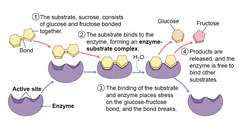
356027002enzymesspecialized macromolecules that speed up chemical reactions in cells; considered proteins5
356027003hydrolysisa process that occurs when the bonds between two monomers are broken by the addition of water molecules, with a hydrogen from the water attaching to one monomer and a hydroxyl group attaching to the adjacent monomer6
356027004carbohydratesa sugar (monosaccharide) or one of its dimers (disaccharides) or polymers (polysaccharides)7
356027005monosaccharidesmolecules with a general formula of some multiple of the unit CH2O; these are major nutrients as carbon skeletons serve as raw material for synthesis of other organic molecules8
356027006disaccharidemolecule that consists of two monosaccharides joined by a glycosidic linkage9
356027007glycosidic linkagea covalent bond formed between two monosaccharides by a dehydration reaction; the most common type of this in nature is a "1-4"10
356027008polysaccharidesmacromolecules; polymers with a few hundred to a few thousand monosaccharides joined by glycosidic linkages; serve as storage material, hydrolyzed as needed to provide sugar for cells; building material for structures that protect a cell or an organism; architecture and function are determined by sugar monomers and by positions of glycosidic linkages11
356027009starcha polymer of glucose monomers; synthesizing this allows for the storage of glucose, and thus, stored energy; this molecule is helical in shape12
356027010glycogena polymer of glucose that is like amylopectin (a complex starch that is a branched polymer with 1-6 linkages at branch points) but more extensively branched; animals store this13
356027011cellulosea polysaccharide that is a major component of the tough walls that enclose plant cells; most abundant organic compound on Earth; polymer of glucose14
356027012chitinan important structural polysaccharide used by arthropods to build their exoskeletons; pure forms of this are leathery and flexible, but they harden when encased within calcium carbonate15
356027013lipidone of a group of compounds, including fats, phospholipids, and steroids, THAT MIX POORLY, IF AT ALL, WITH WATER; they are not composed of true polymers, so they are generally not large enough to be considered macromolecules; they are hydrophobic because they contain few polar bonds and many hydrocarbon regions; they vary in form and function16
356027014fata large molecule constructed by two smaller molecules, glycerol and a fatty acid, through dehydration reaction; major function is energy storage17
356027015glycerolan alcohol with three carbons, each having a hydroxyl group18
356027016fatty acida molecule with a long carbon skeleton (usually 16 or 18 in length) and a carboxyl group at the end of the molecule (hence the acid); these are hydrophobic19
356027017triacylglycerola fat that consists of three fatty acids linked to one glycerol molecule; linkages that bond hydroxyl to carboxyl are called ester linkages20
356027018saturated fatty acida fatty acid that has no double-bonded carbon atoms so that as many hydrogen atoms as possible are bonded to the carbon skeleton21
356027019unsaturated fatty acida fatty acid that has one or more double-bonded carbon atoms formed by the removal of hydrogen atoms from the carbon skeleton; there will be a kink in the hydrocarbon chain wherever a -cis double-bond occurs (causes bending)22
356027020saturated fata fat made from saturated fatty acid; animal fats are solid at room temperature because they lack double-bonds, thus flexibility enables molecules to pack together tightly23
356027021unsaturated fata fat made from unsaturated fatty acids; they are liquid at room temperature (oils) because kinks in -cis bonding prevent molecules from packing together to solidify24
356027022trans fatthe fat that results when unsaturated fats are synthetically converted to saturated fats to prevent the separation of lipids (margarine and peanut butter are examples); this process produces saturated fats and unsaturated fats with trans double bonds25
356027023phospholipidscells need these in order to exist because they make up cell membranes; has 2 fatty acids attached to glycerol instead of traditional 3 (triacylglycerol); always assemble into a double-layer aggregate because of hydrophilic head and hydrophobic tail26
356027024steroidslipids characterized by a carbon skeleton consisting of four fused rings27
356027025cholesterola common component of animal cell membranes, and a foundation from which other steroids are synthesized; crucial molecule in animals, but can be dangerous when in high amounts28
356027026catalystschemical agents that selectively speed up chemical reactions without being consumed by the reaction; can be seen as workhorses that keep cells running by carrying out processes of life29
356027027polypeptidespolymers of all amino acids30
356027028proteinsmacromolecules that are constructed from one or more polypeptides, each folded and coiled into a specific three-dimensional structure; all made from same 20 amino acids; most structurally sophisticated molecule known31
356027029amino acidsorganic molecules possessing both carboxyl and amino groups32
356027030peptide bonda covalent bond that results when two amino acids join through dehydration reaction33
356027031enzymatic proteinprotein that functions in selective acceleration of chemical reactions Example: digestive enzymes catalyze the hydrolysis of the polymers in food34
356027032structural proteinthe type of protein that supports an organism; example: insects and spiders use silk fibers for cocoons and webs, collagen and elastin provide fibrous framework in animal connective tissues; keratin is protein of hair, horns, feathers, etc.35
356027033storage proteinthe type of protein that stores amino acids; example: ovalbumin is the protein of egg white, used as an amino acid source for developing embryos36
356027034transport proteinthe type of protein that transports other substances; example: hemoglobin, the iron-containing protein of vertebrate blood, transports oxygen from lungs to other parts of the body37
356027035hormonal proteinthe type of protein that coordinates an organism's activities; example: insulin, a hormone secreted by the pancreas, helps regulate the concentration of sugar in the blood of vertebrates38
356027036receptor proteinthe type of protein that helps a cell respond to chemical stimuli; example: receptors built into the membrane of a nerve cell detect chemical signals released by other nerve cells39
356027037contractile and motor proteinthe type of protein that controls movement; example: actin and myosin are responsible for the contraction of muscles; other proteins are responsible for the undulations of cilia and flagella40
356027038defensive proteinthe type of protein that protects against disease; example: antibodies combat bacteria and viruses41
356027039globularthe shape of proteins that are roughly spherical42
356027040fibrousthe shape of proteins that are long and fiber-like43
356027041primary structurethe unique structure of amino acids; example: a polypeptide composed of 127 amino acids has 20^127 different ways it can be organized44
356027042secondary structurethe collection of coils and folds that result from hydrogen bonds between repeating constituents of the polypeptide backbone (not the amino acid sides)45
356027043alpha helixa secondary structure that is a delicate coil held together by hydrogen bonding between every fourth amino acid46
356027044beta pleated sheeta secondary structure in which two or more regions of the polypeptide chain lying side by side are connected by hydrogen bonds between parts of two parallel polypeptide backbones; it makes up the core of globular proteins47
356027045tertiary structurethe overall shape of a polypeptide that results from interactions between side chains of various amino acids48
356027046hydrophobic interactionan interaction that contributes to tertiary structure; as a polypeptide folds into functional shape, amino acids with hydrophobic side chains usually end up in clusters at the core of the protein, away from water49
356027047disulfide bridgeslinks that form where two cysteine monomers are brought together by folding of protein; covalent bonds reinforce structure50
356027048quaternary structurethe overall protein structure that results from the gathering of polypeptide subunits; some proteins consist of 2 or more polypeptide chains combined into one macromolecule51
356027049sickle-cell diseasean inherited blood disorder that is caused by a substitution of one amino acid (valine) for the normal amino acid (glutamic acid) at a particular position in the primary structure of hemoglobin, the protein that carries oxygen in red blood cells52
356027050denaturationthe unraveling and loss of a protein's native shape due to alterations of its environment, such as pH, salt concentration, and temperature; this causes a protein to become biologically inactive53
356027051chaperoninsprotein molecules that assist in the proper folding of other proteins; they do not specify the final structure of a protein, instead they keep the new polypeptide separated from "bad influences" in the cytoplasmic environment while it folds54
356027052x-ray crystallographythe method used to determine 3-D structures of proteins; developed in 195955
356027053genea discrete unit of hereditary information consisting of a specific nucleotide sequence in DNA (or RNA, in some viruses)56
356027054nucleic acida polymer (polynucleotide) consisting of many nucleotide monomers; serves as a blueprint for proteins, and through the actions of proteins, for all cellular activities; two types are DNA and RNA57
356027055deoxyribonucleic acida double-stranded, helical nucleic acid molecule consisting of nucleotide monomers with a deoxyribose sugar and the nitrogenous bases adenine, guanine, cytosine, and thymine; it is capable of replicating and determining the inherited structure of a cell's proteins58
356027056ribonucleic acida type of nucleic acid consisting of nucleotide monomers with a ribose sugar and nitrogenous bases adenine, cytosine, guanine, and uracil; usually single-stranded; functions in protein synthesis, gene regulation, and as the genome of some viruses59
356027057messenger RNAa nucleic acid that directs the production of polypeptides; this is found in the cells' ribosomes60
356027058nucleotidethe monomer of nucleic acids that has three parts: 1) a nitrogenous base (A, C, G, T, U); 2) a give-carbon sugar (a pentose); 3) a phosphate group61
356027059pyrimidinesthe family of smaller nitrogenous bases in which its members have six-membered rings of carbon and nitrogen atoms; members include cytosine (C), thymine (T), and uracil (U)62
356027060purinesthe family of larger nitrogenous bases in which its members have a six-membered ring fused to a five-membered ring; members are adenine (A) and guanine (G)63
356027061ribosethe sugar connected to RNA; has one more oxygen atom than the other sugar associated with nucleicacids64
356027062deoxyribosethe sugar connected to DNA; has one less oxygen atom than the other sugar associated with nucleic acids65
356027063double helixthe shape that cellular DNA molecules take as a result of spiraling around an imaginary axis; this was proposed by James Watson and Francis Crick in 1953 at Cambridge University66
356027064antiparallelthe pattern that describes the formation of DNA; the two sugar-phosphate backbones run in opposite 5' >> 3' directions from each other, somewhat like a divided highway67
356027065starch: "a" glucose monomers; cellulose: "b" glucose monomersdifference between starch and cellulose68
356027066C3H6O3Write the formula for a monosaccharide that has three carbons69
356027067C12H22O11A dehydration reaction joins two glucose molecules to form maltose. The formula for glucose is C6H12O6. What is the formula for maltose?70
356027068Because they dissolve poorly, if at all, with waterWhy are human sex hormones considered lipids?71

APUSH Chapters 1-5 Key Terms/People Flashcards

Words in bold and important people to know for the first 5 chapters.

Terms : Hide Images
1649884913Canadian ShieldThe first part of North America that went above sea level, in the Northeastern part of the continent.0
1649884914IncasA tribe of Indigenous people in Peru, who were one of the most developed civilizations in the Americas. Their agricultural techniques (including terrace farming) were how they managed to make a big society in the harsh Andes Mountains. They were eventually conquered by Spanish forces in 1532.1
1649884915AztecsA Native American empire in Mexico, one of the biggest and most advanced empires in the Americas. Eventually conquered by Hernán Cortés in 1521.2
1649884916Nation-statesa country (under a unified government) where the people share a sense of national identity like culture and language3
1649884917CahokiaA huge settlement in Mississippi that housed up to 25k people.4
16498849183-sister farmingCultivating maize, squash, and beans together-beans on the cornstalk trellis, and squash over the planting mounds (which kept moisture in).5
1649884919MiddlemenDealers who work between original goods-producers and the merchants who do the final sail. Muslim Middlemen's heavy tolls were part of why Europeans really wanted a direct passage to Asia.6
1649884920CaravelA Portuguese type of ship that could sail closely into the wind, which helped them sail south along West Africa.7
1649884921PlantationBig agricultural location that grows crops for commercial use. Almost always uses indentured servants or slaves.8
1649884922Columbian exchangeThe intermingling and trading of living things (crops, food, animals, diseases) between the "old" and the "new" world upon Columbus's encounter with them.9
1649884923Treaty of TordesillasA treaty shared by Spain and Portugal, where they split up the lands of the New World. Mostly to Spain, but Portugal "got" some Africa, some Asia, and Brazil.10
1649884924ConquistadoresSpanish explorers who came to the Americas looking for money and adventure (G-d, Gold, Glory). They eventually conquered the Incas, Aztecs and other tribes.11
1649884925CapitalismAn economic system that uses private property and a free market, that some scholars believe was fueled by the increase in prices in Europe after the Columbian Exchange.12
1649884926EncomiendaBasically slavery, but with the intent that the Indians being enslaved were being converted to Christianity.13
1649884927Noche Triste(Sad Night), a night when the Aztecs attacked Cortés and his people (June 30, 1520) after the Spaniards had exhausted their welcome.14
1649884928MestizosPeople who were of mixed European and Indian heritage, who created a new mix of culture.15
1649884929Battle of AcomaA battle between the Spaniards and the Pueblo people (in New Mexico), where the Spaniards took off one foot of each Pueblo survivor.16
1649884930Popé's RebellionAn uprising in 1680, where the Pueblo people destroyed all the Catholic churches in New Mexico, killed priests and settlers, and then built religious chambers on the sites of those churches.17
1649884931Black LegendThe stories of the bad things that the Spaniards did in the Americas-encomienda, forced conversion, massacres, spread of diseases, etc.18
1649884932Ferdinand of AragonMarried Isabella of Castile, and united Spain, a catalyst for Columbus's adventure.19
1649884933Isabella of CastileMarried Ferdinand of Aragon, and united Spain, a catalyst for Columbus's adventure.20
1649884934Christopher ColumbusAn Italian explorer, known for being the leader of the first Europeans to arrive at the Americas who would eventually settle it.21
1649884935Francisco CoronadoA Spanish soldier and commander who in 1540 led people north from Mexico into Arizona. He wanted to find the Seven Cities of Gold, but only found Adobe pueblos.22
1649884936Francisco PizarroThe conquistadore responsible for destroying the Incas in Peru.23
1649884937Bartolemé de Las Casasa Spanish priest who wanted to defend the Natives and make their lives better, he disapproved of the ways the Spaniards were attacking them.24
1649884938Hernán CortésHe conquered the Aztecs, who were at first welcoming to him but eventually grew tired of him.25
1649884939Malinche (Doña Marina)Hernán Cortés's translator, a Native American woman who helped him defeat them. Her name now means "traitor" in Spanish.26
1649884940MoctezumaThe king of the Aztecs, who was initially hospitable to Cortés. Still was eventually killed when Cortés attacked.27
1649884941Giovanni Caboto (John Cabot)Italian explorer, one of the first explorers sent by the English to the Americas. He went to North America, not South like most Spaniards did.28
1649884942Robert de La SalleFrench explorer, who had gone to the Mississippi river and claimed Louisiana for the French.29
1649884943Father Junipero SerraSpanish Catholic Priest, who founded 21 missions in California from San Diego to Sonoma. Christianized them, but also meant that they lost contact w/native cultures.30
1650914424Protestant Reformation (England)King Henry wanted to divorce his wife, but the Catholic church wouldn't let him, so he split from the church and created his own Church of England.31
1650914425Roanoke IslandFirst settlement by the English in America, mysteriously disappeared and nobody raelly knows why.32
1650914426PrimogenitureLaws saying that only eldest sons are eligible to inherit land.33
1650914427Spanish ArmadaThe very large and powerful Spanish navy, which was defeated by the much weaker British navy in 1588. This defeat marked the end of the Spanish dominance in the New World.34
1650914428Joint-Stock companySimilar to modern corporations, many adventurers would share their money to make a bigger company.35
1650914429CharterA grant of (written) authority for the king, these governed the royal colonies.36
1650914430JamestownThe first successful settlement the English had in America, in Virginia.37
1650914431First Anglo-Powhatan WarWar using "irish tactics" against the Powhatans from 1610-1614, ended when Pocahontas married John Rolfe.38
1650914432Second Anglo-Powhatan WarFinal effort of the Indians to move the Virginians out, but it failed and ended in their banishment from white settlements-origins of reservation system.39
1650914433Act of TolerationMaryland religious statute, granted religious tolerance to all Xians but death penalty for non-Xians (atheists and Jews).40
1650914434Barbados Slave CodeCode that denied all rights to slaves and gave masters all those rights. This became the forerunner for much of American slavery.41
1650914435SquattersPeople who lived on/worked a land with no legal right to it.42
1650914436Tuscarora WarNorth Carolinian war against the Tuscarora Indians, selling many into slavery and leaving the rest to become part of the Iroquois confederacy.43
1650914437Yamasee IndiansA tribe of Indians who were eventually defeated by the South Carolinians.44
1650914438BufferIn this case, Georgia, which protected the valuable southern colonies from Spain in Florida.45
1650914439Iroquois Confederacya powerful group of Native Americans in the Northeast part of the United States made up of five nations: the Mohawk, Seneca, Cayuga, Onondoga, and Oneida.46
1650914440Henry VIIIKing of England who split away from the Catholic Church and created Church of England, causing a huge rift b/w Catholics and Protestants for future generations.47
1650914441Elizabeth IQueen of England, Henry VIII's daughter via his second wife, who really took control of the country after the rifts created between different Christian denominations and sent the first English attempts at settlement.48
1650914442Sir Francis DrakeSort-of pirate, supported by the English crown, who stole from the Spanish and gave a lot of money to his investors, including Queen Elizabeth.49
1650914443Sir Walter RaleighOrganizer of Roanoke Island, a settlement attempt which mysteriously vanished.50
1650914444James IElizabeth's nephew, king during the first settlement of Jamestown (hence the name)51
1650914445Captain John SmithFirst real leader of Jamestown, got the colonists to work, and began a small alliance between Powhatan's people and the colonists.52
1650914446PowhatanChieftain of an Indian tribe near Jamestown, father of Pocahontas. For a while tried to make peace w/settlers but eventually it turned into wars.53
1650914447PocahontasDaughter of Powhatan, she eventually married John Rolfe to cause a peace treaty and went back to England, where she died.54
1650914448Lord De La WarrLater governor of Jamestown, who was much harsher towards the Indians around him as well as towards the settlers.55
1650914449John RolfeEnglish settler, married Pocahontas. Fater of the Tobacco industry.56
1650914450Lord BaltimoreFounder of Maryland, Catholic, wanted religious tolerance.57
1650914451Oliver CromwellPuritan Soldier, defeated King Charles and ruled England for almost 10 years.58
1650914452James OglethorpeOne of the original founders of Georgia, a political activist who esp advocated for prison reform.59
1650914453HiawathaMohawk leader who helped form the Iroquois confederacy.60
1650914454CalvinismReligious teachings based on the teachings of John Calvin, based on Martin Luther's ideas but elaborated. Included predestination and the need to live a good life.61
1650914455PredestinationThe idea that the saved have already been saved and the not-saved have no chance of going to heaven.62
1650914456ConversionShowing that you're one of the elect people who are predestined for heaven.63
1650914457PuritansPeople who believed that the Church of England should be entirely reformed to go back to Christianity that they believed in, hated catholicism and liked calvinism.64
1650914458SeparatistsWanted to cut all ties with Church of England.65
1650914459Mayflower CompactContract signed by Pilgrim leaders, ended up being a forerunner to later constitutions. Agreed to follow majority will w/regulations.66
1650914460Massachusetts Bay ColonyA group of much more moderate puritans, who wanted to make a colony in Massachusetts. Many believed they had a covenant w/G-d.67
1650914461Great MigrationA time in the 1630s when many refugees left England. Most went to West Indies, but some went to Chesapeake and others to New England.68
1650914462AntinomianismThe idea that those who were saved didn't need to obey any laws. (Greek meaning: against the law)69
1650914463Fundamental OrdersEssentially a modern constitution, founded by the settlers of the Connecticut River colony. Democratic law controlled by the "substantial" citizens.70
1650914464Pequot WarWar between Connecticut Puritans and Pequot Indians, that ended in a slaughter/siege of a Pequot village and almost complete destruction of the Pequots.71
1650914465King Philip's WarWar between Metacom and New England, lead to many deaths. Eventually slowed English settlement expansion, but left bad defeat on the Indians and afterwards they posed very little threat.72
1650914466English Civil WarCivil War in England during Charles I's reign between those who liked Parliament and those who were Royalists.73
1650914467Dominion of New EnglandGrouping made by London, tried to defend the colonies from wars but also make them more submissive to the English government.74
1650914468Navigation LawsLaws that tried to make American trade almost exclusively with England and English territories.75
1650914469Glorious (or Bloodless) RevolutionWhen the English dethroned James II and replaced him with Protestant William and Mary.76
1650914470Salutary NeglectWhen William/Mary came into power, they rarely enforced the Navigation Laws.77
1650914471PatroonshipsBig estates on the front of the Hudson River, granted to Dutch settlers who would settle 50+ people on them.78
1650914472Blue LawsPennsylvania laws that prevented things like plays, cards, dice, games, and too much fun.79
1650914473Martin LutherFounder of the Protestant Reformation, criticized Church and then broke from it and started his own church.80
1650914474John CalvinTook Luther's ideas a step further, created Calvinism. He believed in predestination.81
1650914475William BradfordPilgrim who was the second governor of Plymouth.82
1650914476John WinthropThe first governor of Massachusetts Bay Colony who served on and off for over 19 years. Religious Puritan, disliked total democracy but was willing to compromise many aspects.83
1650914477Anne HutchinsonA woman who believed in antinomianism, and was eventually tried for her preachings. She claimed G-d was speaking to her, and this led to her being exiled heresy.84
1650914478Roger WilliamsDisagreed with MBC about separation between church and state, and was eventually exiled. He went on to found the colony of Rhode Island.85
1650914479MassasoitWampanoag chief who met with the Pilgrims at first and managed to maintain relatively peaceful relations until his death.86
1650914480Metacom (King Philip)Massasoit's son, who did not want English expansion, and led a war against the English. He was killed along with many others and his wife/child were enslaved, but it did slow English expansion.87
1650914481Charles IISon of Charles I, brought back after Oliver Cromwell. He intended to be active governing the colonies, and disliked the MBC. He eventually gave Connecticut a charter and then revoked the MBC charter.88
1650914482Sir Edmund AndrosGovernor of the Dominion of New England, he was extremely unpopular, and was eventually kicked out of office and sent back to England.89
1650914483WIlliam IIIKing after Charles II, also King of the Netherlands. Was much more relaxed towards the colonies.90
1650914484Mary IIWilliam III's wife, daughter of of King James II.91
1650914485Henry HudsonEnglish explorer who represented the Dutch and sailed into the Hudson River, giving the Dutch claim to New York.92
1650914486Peter StuyvesantDirector of New York colony, attacked the Swedish settlements near Delaware but was eventually defeated by the English.93
1650914487Duke of YorkCharles II's brother, who had been granted the rights to NY by Charles. Is the reason for New York's name.94
1650914488William PennQuaker who was in search of religious tolerance and eventually founded Pennsylvania due to a grant of land from the king.95
1651034984Indentured servantsPeople who volunteered to come work for exchange of passage to America for periods of time (generally 4-7 years) and who would eventually be granted freedom. Sort of predecessors to slaves, often treated very harshley.96
1651034985Headright systemIf you paid for a worker to the colony, you got 50 acres of land in Maryland and Virginia.97
1651034986Bacon's RebellionLots of ex-indentured servants and others who couldn't get jobs were angry with governor William Berkeley and rebelled against him, attacking Indians, and torching Jamestown. Led by Nathaniel Bacon.98
1651034987Royal African CompanyBritish company that originally had a monopoly (but lost it eventually) on carrying slaves to the colonies.99
1651034988Middle PassageThe transitional period between the west coast of Africa and the east coast of America, a brutal voyage for slaves.100
1651034989New York Slave Revolt1712 slave revolt, cost lives of 9 white people and execution of 21 black people.101
1651034990South Carolina Slave RevoltMore than 50 slaves tried to march to Florida along the Stono river, but were stopped by local armies.102
1651034991Congregational ChurchPuritan churches with democratically run proceedings, which led to political democracy as well.103
1651034992JeremiadSermons that talked about the impending doom of humanity and lack of salvation.104
1651034993Half-Way CovenantAn option to try to get more church members, where children of baptized members could be baptized but not have communion whether or not they themselves were turly "elect"105
1651034994Salem Witch TrialsSeries of trials in Salem, Mass where many girls acted "crazily" and blamed other women (generally those from economically advantaged families) of causing the crazy and making them witches. Led to many deaths and lots of paranoia.106
1651034995Leisler's RebellionA rebellion caused by dislike between landholders and wannabe merchants, a 2 year bloody revolt.107
1651034996William BerkeleyGovernor of Virginia during Bacon's Rebellion, eventually sent back to England.108
1651034997Nathaniel BaconA planter who led a rebellion with one thousand other Virginians in 1676; the rebels were frontiersmen forced toward the backcountry in search of fertile land who disliked Berkeley's policy towards the Indians.109
1651034998Anthony JohnsonBlack former servant who was freed and lived as a regular middle-class man for some time.110
1651034999Paxton BoysScots-Irish group of marchers who were protesting the leniency of Quaker policy towards Indians111
1651035000Regulator MovementScots-irish movement that did not like when the East of the state dominated the state's laws and taxes.112
1651035001Triangular TradeA three way system of trade during 1600-1800s Africa sent slaves to America, America sent Raw Materials to Europe, and Europe sent Guns and Rum to Africa113
1651035002Molasses ActLaw passed by Parliament, wanted to make sure America could only trade with the British west indies (not the French). American merchants basically just broke the law to keep trading the same way.114
1651035003ArminianismThe belief that doing good deeds was all that needs to be done to create salvation.115
1651035004Great AwakeningA return to more religious preaching, led by Jonathan Edwards and George Whitefield, that returned to the idea of predestination.116
1651035005Old LightsOrthodox clergy who disliked the theatrics of the Great Awakening.117
1651035006New LightsClergy who liked how the Great Awakening brought up American religion again.118
1651035007Poor Richard's AlmanackBenjamin Franklin's book, with many important sayings. One of the most widely printed books in the Americas for a while.119
1651035008Zenger TrialLed by Alexander Hamilton, Zenger printed a not-nice but true statement and was charged for libel. Hamilton persuaded the court that since it was true, it could not be libel.120
1651035009Royal ColoniesColonies where the governor was appointed by the King.121
1651035010Proprietary ColoniesColonies where a proprietor appointed the governor.122
1651035011Michel-Guilliame Jean de CrèvecourFrench-American writer who tried to get other Frenchmen to come to the Americas, talked frequently about how America was a big melting pot.123
1651035012Jacobus ArminiusFounder of Arminianism as opposed to Calvinism.124
1651035013Jonathan EdwardsOne of the first preachers of the Great Awakening.125
1651035014George WhitefieldA very verbally eloquent preacher of the Great Awakening, believed in predestination and lots of faith.126
1651035015John TrumbullAmerican painter who was sent to England in order to keep working on his art.127
1651035016John Singleton CopleyAnother gifted painter who had to go to England in order to make his art.128
1651035017Phillis WheatleyAn enslaved girl who had no formal education but still became a talented poet at the age of 20.129
1651035018John Peter ZengerThe man who wrote "libelous" statements about the governor. His trial and acquittal made way for our current laws about libel.130

AP US chapter 1-5 test Flashcards

Terms : Hide Images
1651713267the dominion of new englandThe Dominion of New England occurred in the time period of the 1670's & 1680's. King James II attempts to consolidate all of the New England colonies (that includes: Massachusetts, Connecticut, Rhode Island and New Hampshire) into one large colony. By doing so, he's taking away the rights of the people in those colonies, because they no longer have much say in their government. He wants to expand it eventually to include New York, Pennsylvania, and New Jersey and make them under one rule. King James II tries to tighten his control over the colonies and curve the rights of the people. The significance of this is that the Glorious Revolution puts the end to the Dominion of New England and restores the rights of the people.0
1651713268Treaty of Tordesillas (1494)An agreement between Portugal and Spain which declared that newly discovered lands to the west of an imaginary line in the Atlantic Ocean would belong to Spain and newly discovered lands to the east of the line would belong to Portugal.1
1651713269Edict of Nantes 1598,gave limited toleration to French Protestants; allowed France to become united and start turning its eyes outward (towards the New World)2
1651713270The Fundamental Orders of Connecticut (1639)the first written constitution in American history written by Hartford settlers. It established a representative government consisting of legislature elected by popular vote and governor chosen by legislature.3
1651713271Sir Edmund AndrosEnglish military man affiliation with Church of England laid heavy restrictons on the courts the press, and the schools, and revoked all land titles he tried to escape wearing women clothing when boston mob tries to catch him he was sent back to england4
1651713272Puritan coloniesPuritan colonies were self-governed, with each town having its own government which led the people in strict accordance with Puritan beliefs. Only those members of the congregation who had achieved grace and were full church members (called the "elect," or "saints") could vote and hold public office. Other colonies had different styles of government and were more open to different beliefs.5
1651713273Roger Williams ((1603-1683) English theologian, a notable proponent of religious toleration and the separation of church and state, and an advocate for fair dealings with Native Americans. In 1644, he received a charter creating the colony of Rhode Island, named for the principal island in Narragansett Bay. He is credited for originating either the first or second Baptist church established in America.6
1651713274trade and navigation actsthe were a series of laws which limited foreign trade in the colonies as well as the use of foreign ships starting in 1651.7
1651713275John Peter ZengerJournalist who questioned the policies of the governor of New York in the 1700's. He was jailed; he sued, and this court case was the basis for our freedom of speech and press. He was found not guilty.8
1651713276preceding acts of revolutionfrench and indian war, sugar act, stamp act, quartering act, boycotts....9
1651713277sons of libertyAn angry band of citizens who burned piles of stamps because of the hated "Stamp Act"10
1651713278anne hutchinsontaught puritan things, people were pissed bc shes a woman, had a trail... fighting religious freedom11
1651713279Old Deluder Act:was passed in 1647 in Massachusetts by the Puritans. It established the first public schools in America to teach children to read the Bible and thus defeat Satan12
1651713280john winthropwealthy english puritan and one of the leading figures in the founding of the massachusett's bay colony13
1651713281Jeremy Bentham5 February 1748 - 6 June 1832) was a British philosopher, jurist, and social reformer. He is regarded as the founder of modern utilitarianism. Bentham became a leading theorist in Anglo-American philosophy of law, and a political radical whose ideas influenced the development of welfarism. He advocated individual and economic freedom, the separation of church and state, freedom of expression, equal rights for women, the right to divorce, and the decriminalising of homosexual acts.[1] He called for the abolition of slavery, the abolition of the death penalty, and the abolition of physical punishment,14
1651713282Nathaniel bacon's rebellion1676, angr mob burn down jamestown and indian settlements bc they didnt get protection from the government, good for ending racism bc both black and whites were in the mob15
1651713283Essex JuntoA group of lawyers and merchants who tried to break New England off from the US. Failed to get support from Alexander Hamilton, but got support from Aaron Burr. This further discredits the Federalists when Burr loses in a run in NYC for mayor/some position.16
1653352081Half-way CovenantThe Half-way Covenant applied to those members of the Puritan colonies who were the children of church members, but who hadn't achieved grace themselves. The covenant allowed them to participate in some church affairs.17
1653352082Stono RebellionThe most serious slave rebellion in the the colonial period which occurred in 1739 in South Carolina. 100 African Americans rose up, got weapons and killed several whites then tried to escape to S. Florida. The uprising was crushed and the participants executed. The main form of rebellion was running away, though there was no where to go.18
1653352083utopian socialismPhilosophy introduced by the Frenchman Charles Fourier in the early nineteenth century. Utopian socialists hoped to create humane alternatives to industrial capitalism by building self-sustaining communities whose inhabitants would work cooperatively19
1653352084Paxton Boys 1763Scots-Irish farmers who were upset by disputes over western land; In western pennsylvania leads to the paxton boys killing 20 peaceful indians. When the quaker government tried to try and punish them, mobs marched on philadelphia and Ben Franklin has to stop it. Feeling of racial hatred/resentment arise; first conflict of western expansion20
1653352085proclamation of 1763issued of October 7, 1763 and was created to alleviate relations with natives after the French and Indian War and started that Americans were not permitted to passed the Appalachian Mountains21
1653352086King Philip's War 1675 -A series of battles in New Hampshire between the colonists and the Wompanoags, led by Metacom, a chief also known as King Philip. The war was started when the Massachusetts government tried to assert court jurisdiction over the local Indians. The colonists won with the help of the Mohawks, and this victory opened up additional Indian lands for expansion.22

AP US History Chap 1-5 Flashcards

Terms : Hide Images
448711434Aztecsearly native tribe in Mexico who had sophisticated government; advanced agricultural practices (mainly based on corn); made astronomical observations; sought favor of their gods (through human sacrifice)0
448711435Pueblo Indiansearly tribe in the Rio Grande valley who made intricate irrigation systems to water their cornfields; dwelled in villages of multistoried buildings (pueblo=village)1
448711436Mound Buildersearly tribe in Ohio River Valley who incorporated corn planting into their daily lives2
448711437Anasaziearly desert-dwelling tribe of the Southwest who incorporated corn-planting into their daily lives; built elaborate pueblo at Chaco Canyon in New Mexico; possibly mysteriously fell due to drought3
448711438CahokiaMississippian settlement near present day St. Louis that at one time had a huge population of 25,0004
448711439three-sister farmingAgricultural system employed by North American Indians as early as 1000 A.D.; maize, beans and squash were grown together to maximize yields.5
449453357HiawathaIroquois leader who helped found the Iroquois Confederacy in the late 1500's6
449453358Iroquois Confederacya powerful group of Native Americans in the eastern part of the United States made up of five nations: the Mohawk, Seneca, Cayuga, Onondoga, and Oneida7
449453359Marco Poloan Italian adventurer whou soujourned in China for 22 years and was an indirect discoverer of the New World8
449453360Bartholomeu DiasPortuguese explorer who in 1488 was the first European to get round the Cape of Good Hope (thus establishing a sea route from the Atlantic to Asia) (1450-1500)9
449453361Vasco de GamaPortuguese explorer who reached India from sea-route; returned to Europe with a small cargo of jewels and spices10
449453362Ferdinand of AragonHe married Isabella of Castile to form a union for Spain (though they were never politically united). He and Isabella worked together to form a strong infantry army in Spain.11
449453363Isabella of Castilemarried Ferdinand of Aragon in the first step toward a unified Spain, first "Catholic monarch."12
449453364Christopher ColumbusItalian seafarer who persuaded the Spanish monarchy to provide him with 3 ships in13
451208241Treaty of Tordesillastreaty that established a boundary line in 1494 to define Spanish and Portuguese possessions in the Americas. (spain=west, portugal=east)14
451208242conquistadoresSpanish 'conqueror' or soldier in the New World. They were searching for the 3-G's: gold, God, and glory.15
451208243Vasco BalboaSpanish explorer who became the first European to see the Pacific Ocean in 1510 while exploring Panama16
451208244Ferdinand MagellanPortuguese explorer who found a sea route to the Philippines by sailing around the American continent. His crew was the first to circumnavigate the world.17
451208245Ponce de LeonSpanish explorer who explored Florida in search of gold18
451208246Francisco CoronadoSpanish explorer who was in search of golden cities but instead found drab Indian villages - wandered through parts of Arizona, New Mexico, Texas, Oklahoma, and Kansas; discovered the Grand Canyon and herds of buffalo19
451208247Hernando de SotoSpanish explorer in search of gold who explored parts of Florida & westward; discovered and crossed Mississippi River; brutally mistreated Indians20
451208248Francisco PizarroSpanish explorer who conquered the Incas in what is now Peru and founded the city of Lima21
451208249capitalisman economic system based on open competition in a free market, in which individuals and companies own the means of production and operate for profit22
451208250encomiendatechnique that allowed government to give Indians to certain colonists in return for Christianizing them ( = slavery)23
451208251Bartolome de Las CasasSpanish missionary appalled by the encomienda system in Hispaniola (Haiti & D.R.) and regarded it as a moral pestilence24
451208252Hernan CortesSpanish explorer who defeated the Aztecs and conquered Mexico, with the help of captured Indians who spoke native language25
451208253TenochtitlanAztec capital where much gold and wealth was stored26
451208254MoctezumaAztec chieftain who encountered Cortes and his army and favored them at first believing they were Gods; eventually was defeated and conquered by Spanish27
451208255QuetzalcoatlAztec God who lived in the sea28
451208256Mestizospeople of mixed Indian and European heritage29
451208257malinchistaMexican word for traitor; named after Malinche who helped Cortes in defeated the Aztecs30
451208258Dia de la RazaColumbus Day in Mexico - celebrated for the birthday of a wholly new race of people31
451208259MoorsNorth African Muslims known as the "Black Ones" in Spanish32
451208260John CabotItalian-born navigator explored the coast of New England, Nova Scotia, and Newfoundland. Gave England a claim in North America.33
451208261Giovanni da VerrazanoFlorentine navigator who explored the eastern coast of North America (circa 1485-1528); explored New York Harbor and searched for Northwest Passage34
451378877Jacques CartierFrench explorer who explored the St. Lawrence river and laid claim to the region for France (1491-1557)35
451378878St. Augustine FLSpanish set up a fortress here to block French ambitions and protect sea lanes to the Carribbean; oldest continually inhabited European settlement in US36
451378879Juan de OnateSpanish explorer and conquistador. He claimed New Mexico for Spain in 1598 and served as its governor until 1607.37
451378880Pope's RebellionAn Indian uprising in 1680 where pueblo rebels in an attempt to resist catholicism and Europeans all together destroyed every catholic church in the province and killed scores of priests and hundreds of spanish settlers.38
451378881kivaceremonial religious chamber39
451378882Robert de La SalleFrenchman who followed the Mississippi River all the way to the Gulf of Mexico, claiming the region for France and naming it Louisiana in honor of King Louis XIV40
451378883Juan Rodriguez CabrilloA Spaniard who explored the coast of California in 1542. However, he failed to discover the San Francisco Bay or anythine else of interest to the Spanish.41
451378884Junipero SerraThe leader of a group of Spanish missionaries who founded a chain of 21 missions at San Diego and stretching north of the San Francisco Bay. These missions gathered nomadic Indians into missions and taught them the values of Christianity.42
451378885sea dogsname given English buccaneers, these semi-pirates seized Spanish treasure ships43
451378886Sante Fe, NMprimitive outpost of Spanish in 161044
451378887Quebec, CANADAprimitive outpost of French in 160845
451378888Jamestown, VAprimitive outpost of English in 160746
451378889Protestantismthe theological system of any of the churches of western Christendom that separated from the Roman Catholic Church during the Reformation47
451378890Elizabeth IReestablished Protestantism as the state religion of England and she led the defeat of the Spanish Armada.48
451378891Protestant Reformationa religious movement of the 16th century that began as an attempt to reform the Roman Catholic Church and resulted in the creation of Protestant churches49
451378892Francis DrakeEnglish explorer who was a "sea dog", the 2nd person to circumnavigate the world, defended England from Spain in Spanish Armada, helped start the slave trade.50
451378893Humphrey GilbertEnglish navigator who in 1583 established in Newfoundland the first English colony in North America (1539-1583)51
451378894Walter RaleighHalf brother of Humphrey Gilbert; set up a failed colony at Roanoke, Virginia 1585 (named for Queen Elizabeth).52
451378895Roanoke Island"Lost colony" discovered by Raleigh53
451378896Philip II of SpainSpanish Catholic king who started the success of Spain's foreign colonies; used imperial gains to amass the Spanish Armada on England54
451378897Spanish Armadathe Spanish fleet that attempted to invade England, ending in disaster, due to the raging storm in the English Channel as well as the smaller and better English navy led by Francis Drake. This is viewed as the decline of Spains Golden Age, and the rise of England as a world naval power.55
451378898Richard HakluytMain promoter of colonization by England in the New World. Reasons included surplus of English labor and thwarting Spain.56
451378899primogeniturelaws that decreed only that only eldest sons were eligible to inherit landed estates -- hence younger sons got involved with colonization57
451378900imperialismA policy in which a strong nation seeks to dominate other countries poitically, socially, and economically.58
451378901Mungo ParkScottish explorer in Africa who explored the Niger River59
451378902Amerigo VespucciThe Italian sailor who corrected Columbus's mistake, acknowledging the coasts of america as a new world. America is named after him60
451378903Sepulvedaargued that biblical text stated that natives were inferior and destined to slavery in the New World61
451378904mercantilisman economic system to increase a nation's wealth by government regulation of all of the nation's commercial interests; country should sell more goods to other countries than it buys62
451378905Prince Henry the NavigatorThis was the Portuguese Prince that gave steadfast financial and moral support to the navigators believing a shortcut around Africa to Asia could be found63
451378906HuguenotsFrench Protestants; many fled to America after Edict of Nantes was revoked64
451378907Columbian exchangeThe exchange of plants, animals, diseases, and technologies between the Americas and the rest of the world following Columbus's voyages.65
451378908Olauda EquianoKidnapped by slavetraders when he was 11; trained to be a clerk by a Philadelphia merchant; earned his freedom; published an autobiography66
451378909Coureurs de BoisItinerant, unlicensed fur traders of NEW FRANCE known as "wood-runners" to the English on Hudson Bay and "bush-lopers"67
451378910sovereigntygovernment free from external control68
451378911joint-stock companyA company in which investors buy stock in the company in return for a share of its future profits and debts69
451378912James IKing of England during start of colonization; reluctant to give colonists their own government, preferred to appoint royal governors70
451378913Chesapeake Regionwooded area, mosquito infested and unhealthful; easy to defend; took awhile to settle and develop the area; Maryland and Virginia71
451378914John SmithHelped found and govern Jamestown. His leadership and strict discipline helped the Virginia colony get through the difficult first winter; saved by Pocahontas72
451378915PowhatanIndian chieftain in Chesapeake Region who kidnapped John Smith and challenged colonists in early Jamestown; daughter was Pocahontas73
451378916Pocahontasdaughter of Indian chieftain Powhatan; saved John Smith from being murdered ; married John Rolfe (first interracial union in Virginia)74
451378917Lord De La WarrNew governor of Jamestown who arrived in 1610, immediately imposing a military regime in Jamestown and declaring war against the Powhatan Confederacy. Employed "Irish tactics" in which his troops burned houses and cornfields.75
451486278Powhatan's Confederacyseveral tribes around Jamestown area over which Powhatan asserted supremacy76
451486279Virginia CompanyJoint-Stock Company in London that received a charter for land in the New World. Charter guarantees new colonists same rights as people back in England.77
451486280First Anglo-Powhatan Wardeclared by Lord De La Warr when he took over Jamestown; marriage of Pocahontas and John Rolfe (first interracial union in Virginia) ended war in 161478
451486281John RolfeHe was one of the English settlers at Jamestown (and he married Pocahontas). He discovered how to successfully grow tobacco in Virginia and cure it for export, which made Virginia an economically successful colony.79
451486282Second Anglo-Powhatan WarIndians last effort to dislodge Virginians, they were defeated. Peace treaty of 1646 banished Indians from their native lands80
451486283House of Burgessesthe first elected legislative assembly in the New World established in the Colony of Virginia in 1619, representative colony set up by England to make laws and levy taxes but England could veto its legistlative acts.81
451486284Lord BaltimoreFounded the colony of Maryland and offered religious freedom to all Christian colonists. He did so because he knew that members of his own religion (Catholicism) would be a minority in the colony.82
451486285indentured servantscolonists who received free passage to North America in exchange for working without pay for a certain number of years83
451486286Maryland Act of TolerationOrdered by Lord Baltimore after a Protestant was made governor of Maryland at the demand of the colony's large Protestant population. The act guaranteed religious freedom to all Christians.84
451486287royal charterRoyal document granting a specified group the right to form a colony and guaranteeing settlers their rights as English citizens85
451486288proprietary colonya colony owned and ruled by one person who was chosen by a king or queen86
451486289slave codeslaws that controlled the lives of enslaved african americans and denied them basic rights87
451486290Charles IKing of England, Scotland, and Ireland (1625-1649). His power struggles with Parliament resulted in the English Civil War (1642-1648) in which he was defeated. He was tried for treason and beheaded in 164988
451486291Oliver CromwellEnglish military, political, and religious figure who led the Parliamentarian victory in the English Civil War (1642-1649) and called for the execution of Charles I. As lord protector of England (1653-1658) he ruled as a virtual dictator.89
451486292Charles IIson of decapitated Charles I, restored to throne after Cromwell; King of England, Scotland, and Ireland (1660-1685) who reigned during the Restoration, a period of expanding trade and colonization as well as strong opposition to Catholicism90
451486293William PennA Quaker that founded Pennsylvania to establish a place where his people and others could live in peace and be free from persecution.91
451486294Scrooby congregationA congregation of Separatists from Scrooby, England who began quietly emigrating from England in 1608, although it was illegal to leave England without the consent of the king. Important because some of these people who immigrated to Leiden, Holland eventually boarded the Mayflower and sailed to Plymouth and are known as the Pilgrims who founded Plymouth Plantation.92
451486295demographystudy of populations93
451486296Handsome LakeA Seneca Iroquois prophet. Preached against alcoholism by appealing to religious traditions. Had Quaker missionaries teach agricultural methods to the Iroquois men.94
451486297James Oglethorpefounder of Georgia in 1733; soldier, statesman , philanthropist. Started Georgia as a haven for people in debt because of his intrest in prison reform. Almost single-handedly kept Georgia afloat.95
451505074John WesleyEnglish clergyman and founder of Methodism (1703-1791); visited Georgia as a missionary to work with debtors and Indians96
451505075William BerkeleyGovernor of Virginia; greedy and corrupt; led to Bacon's Rebellion97
451505076yeomanman or farmer owning small estate; middle-class farmer98
451505077starving timeThe winter of 1609 to 1610 was known as the "starving time" to the colonists of Jamestown, Virginia. Only sixty members of the original four-hundred colonists survived. The rest died of starvation because they did not possess the skills that were necessary to obtain food in the new world.99
451618879Martin LutherGerman theologian and leader of the Reformation. He opposed the wealth and corruption of the papacy and believed the Bible and faith alone were the source of God's word and salvation; established the Lutheran Church.100
451618880John CalvinFrench theologian elaborated Luther's ideas. Developed the Christian theology known as Calvinism. Attracted Protestant followers with his teachings.101
451618881Calvinismthe belief that God is all-knowing, all-powerful, and all-good; humans are weak and wicked because of original sin102
451618882the "elect"people who were predestined by God for eternal bliss of for eternal torment103
451618883Henry VIIIEnglish King that left the RCC and started the Church of England104
451618884PuritansA religious group who wanted to purify the Church of England from its Catholic ways. They came to America for religious freedom and settled Massachusetts Bay.105
451618885predestinationthe belief that God has already chosen those who will have eternal bliss and those who will have eternal torment; one's predestination could not be changed106
451618886"visible saints"people who felt the stirrings of grace in their souls and could demonstrate its presence to their fellow Puritans107
451618887Separatistssub-group of the Puritans who vowed to break completely with the Church of England; most were Pilgrims who came on the Mayflower108
451618888Pilgrimsa group of Puritans who fled from England to Holland, and from there took the Mayflower over to Plymouth in order to flee royal wrath and seek religious freedom109
451618889Miles Standish"Captain Shrimp"; English colonist and army captain at Plymouth who helped defend the Pilgrim colony against Indians110
451618890Mayflowerthe ship in which the Pilgrim Fathers sailed from England to Plymouth, Massachusetts in 1620111
451618891Plymouth BayWhere the Pilgrims mistakenly sailed to from the Netherlands in 1620 and ended up settling there; outside of Virginia Company domain- had no legal rights to settle and claim land there112
451618892Mayflower Contractagreement to form a crude government and to submit to the will of the majority under regulations agreed upon113
451618893William BradfordA Pilgrim, the second governor of the Plymouth colony, 1621-1657. Self-taught scholar. He developed private land ownership and helped colonists get out of debt. He helped the colony survive droughts, crop failures, and Indian attacks.114
451618894Massachusetts Bay Companyjoint-stock company chartered by Charles I in 1629. It was controlled by Non-Separatists who took the charter with them to New England and, in effect, converted it into a written constitution for the colony115
451618895Massachusetts Bay ColonyOne of the first settlements in New England; established in 1630 and became a major Puritan colony. Became the state of Massachusetts, originally where Boston is located. It was a major trading center, and absorbed the Plymouth community; established political freedom and representative government,116
451618896commonwealtha political system in which the supreme power lies in a body of citizens who can elect people to represent them117
451618897"Great Migration"in the 1630's when thousands of refugees left England for New England and the West Indies118
451618898John WinthropAs first governor of Massachusetts Bay Colony, Winthrop was instrumental in forming the colony's government and shaping its legislative policy. He envisioned the colony, centered in present-day Boston, as a "city upon a hill" from which Puritans would spread religious righteousness throughout the world.119
451618899"city upon a hill"Winthrop regards to Boston as this; a beacon to humanity120
451618900covenantan agreement -- Puritan bay colonists believed they had an agreement with God to build a holy society that would be a model for humankind; purpose of govt was to enforce God's laws121
451618901freemenadult males who belonged to Puritan congregations (Congregational Church); granted right to vote122
451618902Congregational ChurchA church grown out of the Puritan church, was established in all New England colonies but Rhode Island. It was based on the belief that individual churches should govern themselves123
451618903John CottonCriticized the Church of England, fled to Massachusetts Bay Colony, defended government's duty to enforce religious rules124
451618904franchisea statutory right or privilege granted to a person or group by a government (especially the rights of citizenship and the right to vote)125
451618905Church of EnglandThe Anglican church, which unites church and state under the monarchy; , Church created in England as a result of a political dispute between Henry VIII and the Pope, Pope would not let Henry divorce his wife126
451618906BibleThe book that contains the writings or scriptures that Christians recognize as the written word of God.127
451618907Quakers (Society of Friends)English dissenters who broke from Church of England, preache a doctrine of pacificism, inner divinity, and social equity, under William Penn they founded Pennsylvania128
451618908Anne Hutchinsona dissenter who held unorthodox views that challenged authority of clergy and integrity of Puritan experiment in the Bay Colony; antinomianism129
451618909antinomianismbelief that holy life was no sure sign of salvation and that the truly saved need not bother to obey the law or God or man; high heresy by Anne Hutchinson130
451618910Roger WilliamsHe founded Rhode Island for separation of Church and State. He believed that the Puritans were too powerful and was ordered to leave the Massachusetts Bay Colony for his religious beliefs.131
451618911Thomas HookerA Puritan minister who led about 100 settlers out of Massachusetts Bay to Hartford, Connecticut because he believed that the governor and other officials had too much power. He wanted to set up a colony in Connecticut with strict limits on government.132
451618912Fundamental OrdersThe constitution of the Connecticut River colony drawn up in 1639, it established a government controlled in democratic style by the "substantial" citizens.133
451618913Protestant Ethicway of life based on Biblical teaching that God expects all men to work and all work is a noble duty to be performed toward God134
451618914Ferdinando GorgesThe Propritor of Maine, until it became part of the Massachusetts Bay Colony135
451618915Wampanoag IndiansThe Native American Tribe that helped the Pilgrims settle in Plymouth136
451618916SquantoNative American who helped the English colonists in Massachusetts develop agricultural techniques and served as an interpreter between the colonists and the Wampanoag.137
451618917MassasoitWampanoag chieftain who befriended the pilgrims and signed a peace treaty with them in 1621138
451618918Pequot War1637- war between the colonists and the Pequot tribe in Connecticut Mystic River area- ended in destruction of the tribe and uneasy peace139
451618919Metacom / King PhilipIndian (Massasoit's son) who united the Indian tribes and defeated 52 Puritan towns in New England140
451618920New England ConfederationNew England colonists formed the New England Confederation in 1643 as a defense against local Native American tribes and encroaching Dutch. The colonists formed the alliance without the English crown's authorization.141
451618921Dominion of New England1686-The British government combined the colonies of Massachusetts, Rhode Island, New Hampshire, and Connecticut into a single province headed by a royal governor (Andros). Ended in 1692, when the colonists revolted and drove out Governor Andros142
451618922Sir Edmund AndrosGovernor of the Dominion of New England from 1686 until 1692, when the colonists rebelled and forced him to return to England143
451618923Navigation LawsPromoted English shipping and control colonial trade; made Americans ship all non-British items to England before going to America144
451618924William and MaryProtestant rulers of the Netherlands who after the Glorious Revolution dethroned James II and became joint rulers of England145
451618925salutary neglectAn English policy of not strictly enforcing laws in its colonies146
451618926Henry HudsonDiscovered what today is known as the Hudson River. Sailed for the Dutch even though he was originally from England. He was looking for a northwest passage through North America.147
451618927New Amsterdama 17th-century Dutch colonial settlement that served as the capital of New Netherland. It later became the city now known as New York City.148
451618928patroonshipsvast feudal estates fronting the Hudson River that were granted to promoters who agreed to settles 50 people on them149
451618929Peter StuyvesantThe governor of the Dutch colony of New Amsterdam, hated by the colonists. They surrendered the colony to the English on Sept. 8, 1664; "Father Wooden Leg"150
452574639headright systemsystem in which parcels of land consisting of about 50 acres which were given to colonists who brought indentured servants into America. They were used by the Virginia Company to attract more colonists.151
452574640William BerkeleyA Governor of Virginia appointed by King Charles I, he was governor from 1641-1652 and 1660-1677. Berkeley enacted friendly policies towards the Indians that led to Bacon's Rebellion in 1676 (hanged 20 rebellions).152
452574641Nathaniel BaconPlanter who led a rebellion in 1676 against the governor of the Virginia Colony153
452574642Bacon's RebellionA rebellion lead by Nathaniel Bacon with backcountry farmers to attack Native Americans in an attempt to gain more land and to protest against Governor Berkeley154
452574643Royal African CompanyEnglish company that lost its monopoly on the slave trade in 1698; many colonies sprang rushed to join in on the now open slave trade155
452574644Middle Passagethe route in between the western ports of Africa to the Caribbean and southern U.S. that carried the slave trade156
452574645Gullahcombination of English and West African languages spoken by African Americans in the South Carolina colony157
452574646ringshoutAfrican American religious dance that contributed to the development of jazz158
452574647Stono RebellionThe most serious slave rebellion in the the colonial period which occurred in 1739 in South Carolina. 100 African Americans rose up, got weapons and killed several whites then tried to escape to S. Florida. The uprising was crushed and the participants executed. The main form of rebellion was running away, though there was no where to go.159
452574648FFVsExtremely wealthy tobacco planters in Virginia. FFV stands for first families of Virginia, an elite group of wealthy planters that are the aristocrats of Virginia society. The FFVs are highly influential in Virginia.160
452574649Nathaniel Hawthorneauthor of the Scarlet Letter; book portrayed what it was like to commit adultery in New England in17th century161
452574650Harvard Collegethe first American college, established in 1636 by Puritan theologians who wanted to create a training center for ministers.162
452648216Half Way CovenantA Puritan church document that allowed partial membership rights to people not yet converted into the Puritan church; lessened difference between the "elect" members of the church from the regular members; Women soon made up a larger portion of Puritan congregations.163
452648217witch huntingSearches and accusations by Puritans for witches or witchcraft, often involving moral panic, mass hysteria, and lynching; irrational urge to find a scapegoat for social resentments164
452648218Leisler's RebellionJacob Leisler seized control of lower New York from 1689 to 1691. The uprising, which occurred in the midst of Britain's "Glorious Revolution," reflected colonial resentment against the policies of King James II. Royal authority was restored in 1691 by British troop165
452648219Cotton MatherPuritan theologian, who urged the inoculation against smallpox, played a role in Salem Witch Trials166
452648220seasoningAn often difficult period of adjustment to new climates, disease environments, and work routines, such as that experienced by slaves newly arrived in the Americas. (p. 504)167
452648221New England PrimerSchoolbook used by the New England Colonists to teach reading and writing168
452648222William BradfordUnited States printer (born in England) whose press produced the first American prayer book and the New York City's first newspaper169
452852862melting potthe mixing of cultures, ideas, and peoples that has changed the American nation. The United States, with its history of immigration, has often been called a melting pot.170
452852863Scots-Irishgroup of restless people who fled Scotland in the 1600s to escape poverty and religious oppression. Relocated to Ireland and then to America in the 1700s. Left their mark on the backcountry of Virginia, the Carolinas, and Georgia. These areas are home to many Presbyterian churches established by the Scots-Irish. Many people in these areas are still very independent like their ancestors.171
452852864Presbyteriana protestant christian religion characterized by governance by a group of elders and traditionally Calvinistic in doctrine172
452852865Paxton Boysgroup of Scots-Irish men living in the Appalachian hills that wanted protection from Indian attacks. They made an armed march on Philadelphia in 1764. They protested the lenient way that the Quakers treated the Indians; ideas started the Regulator Movement in North Carolina.173
452852866Regulator Movementmovement during the 1760's by western North Carolinians, mainly Scots-Irish, that resented the way that the Eastern part of the state dominated political affairs. believed that the tax money was being unevenly distributed. Many of its members joined the American Revolutionists.174
452852867de Crevecoeurwas the first to begin writing and constructing concepts of the "American Dream"175
452852868praying townsNew England settlements where Indians from various tribes were gathered to be Christianized176
452852869triangular tradethree-way system of trade during the eighteenth century, in which European ships transported slaves from Africa to Caribbean islands, molasses from the Caribbean to Europe, and trade goods from Europe to Africa.177
452852870naval storesMaterials used to build and maintain ships, such as tar, pitch, rosin, and turpentine178
452852871Molasses Act of 1733British legislation taxed all molasses, rum, and sugar which the colonies imported from countries other than Britain and her colonies. The British had difficulty enforcing the tax; most colonial merchants did not pay it.179
452852872Benjamin FranklinPrinter, author, inventor, diplomat, statesman, and Founding Father. One of the few Americans who was highly respected in Europe, primarily due to his discoveries in the field of electricity; launched UPenn (first college free from religious control)180
452852873AnglicanPeople that practice the faith, doctrine, system, and practice of the Anglican Church (Church of England)181
452852874Congregational Churchgrew out of Puritan Church; more extreme religion182
452852875Jacobus ArminiusDutch Protestant theologian who founded Arminianism which opposed the absolute predestinarianism of John Calvin (1559-1609); free will determined fate not divine decree183
452852876Great AwakeningReligious revival in the American colonies of the eighteenth century during which a number of new Protestant churches were established.184
452852877Jonathan EdwardsAmerican theologian whose sermons and writings stimulated a period of renewed interest in religion in America; folly in believing in salvation through good works- need complete dependence on God; explained the torments of hell185
452852878George WhitefieldOne of the preachers of the great awakening (key figure of "New Light"); known for his talented voice inflection and ability to bring many a person to their knees.186
452852879Old Lights/ New LightsOld Lights= orthodox clergymen who were skeptical of emotionalism and theatrical antics of revivalists New Lights= defended Awakening in its role in reviving American religion187
452852880BaptistsDissenters of the Church of England; focused on the power of local churches; stresses following in example; each person interprets the Bible the way the Holy Spirit tells them how; emphasis on New Testament; no Church creeds. It was very simple and appealed to rural people188
452852881Poor Richards AlmanackWas written by Ben Franklin. It emphasized homespun virtues; thrift, morality, industry, common sense189
452852882John Trumbullpainter from Connecticut who was forced to pursue his talent in London; famous for Revolutionary War paintings190
452852883Charles Willson Pealebest know for his portraits of George Washington, also ran a museum, stuffed birds, and practiced dentistry in addition to his art.191
452852884Benjamin WestAn Anglo-American self-taught painter of historical scenes around and after the time of the American Revolution, West also painted the royal family of King George III192
452852885John Singleton CopleyAmerican painter who did portraits of Paul Revere and John Hancock before fleeing to England to avoid the American Revolution; loyalist193
452852886Enlightenmentmovement during the 1700's that spread the idea that knowledge, reason, and science could improve society194
452852887Phillis Wheatleya slave girl who became a poet. At age eight, she was brought to Boston. Although she had no formal education, she was taken to England at age twenty and published a book of poetry195
452852888John Peter ZengerJournalist who questioned the policies of the governor of New York in the 1700's. He was jailed; he sued, and this court case was the basis for our freedom of speech and press. He was found not guilty.196
452852889Andrew Hamiltonformer indentured servant who became a distinguished Philadelphia lawyer; aided Zenger in his case197

AP Biology: Chapter 2 Flashcards

Vocabulary words from the AP Edition of Campbell Biology, Chapter 2.

Terms : Hide Images
217088653matteranything that takes up space and has mass0
217088654elementa substance that cannot be broken down to other substances by chemical reactions1
217088655compounda substance consisting of two or more different elements combined in a fixed ratio2
217088656essential elementselements that an organism needs to live a healthy life and reproduce3
217088657trace elementselements required by an organism in only minute quantities4
217088658atomsmalles unit of matter that still retains the properties of an element5
217088659neutronsa particle with a neutral charge6
217088660protonspositively charged particle7
217088661electronnegatively charged particle8
217088662atomic nucleusa dense core of tightly packed protons and neutrons9
217088663daltonmeasure of mass for atoms and subatomic particles, same as amu10
217088664atomic numbernumber of protons in an element11
217088665mass numbersum of neutrons and protons in an atom's nucleus12
217088666atomic masstotal mass of the protons and neutrons in an atom13
217088667isotopesdifferent atomic forms of the same element (different number of neutrons)14
217088668radioactive isotopenucleus of the isotope can spontaneously decay15
217088669energythe capacity to cause change16
217088670potential energyenergy that matter possesses because of its location or structure17
217088671electron shellsan energy level representing the distance of an electron from the nucleus of an atom.18
217088672valence electronselectrons in the outermost electron shell of an atom19
217088673valence shelloutermost electron shell of an atom20
217088674orbitalthree-dimensional space where an electron is found 90% of the time21
217088675chemical bondsattractive forces that hold atoms together22
217088676covalent bondtwo atoms shares a pair of valence electrons23
217088677moleculetwo or more atoms held together by covalent bonds24
217088678single bondone pair of shared electrons25
217088679double bondtwo pairs of shared electrons26
217088680valencethe bonding capacity of an atom, usually equal to the number of unpaired electrons required to complete the atoms' valence shell27
217088681electronegativityattraction of a particular atom for the electrons of a covalent bond28
217088682nonpolar covalent bondcovalent bond where electrons are shared equally29
217088683polar covalent bonda covalent bond in which electrons are not shared equally30
217088684iona charged atom or molecule31
217088685cationa positively charged ion32
217088686aniona negatively charged ion33
217088687ionic bondthe attraction of anions and cations to each other34
217088688ionic compoundscompounds formed by ionic bonds35
217088689saltscompounds formed by ionic bonds36
217088690hydrogen bondnoncovalent attraction between a hydrogen and an electronegative atom37
217088691van der Waals interactionsweak attractions between molecules or parts of molecules, brought about by localized charge fluctuations38
217088692reactantsstarting materials of a reaction39
217088693productsending materials of a reaction40
217088694chemical equilibriumpoint at which reactions offset one another exactly41

AP Biology Enzymes Quiz Study Guide Flashcards

Terms : Hide Images
2843822884What is an enzyme?A protein that changes the rate of a chemical reaction.0
2843822885How do enzymes speed up the rate of a reaction?They speed metabolic reactions by LOWERING the activation energy to get that reaction going.1
2843823589Why is shape so important for enzymes? What happens when an enzyme becomes denatured?each enzyme needs to be the right shape for the job denature protein = unfold = lose shape2
2843823590What is activation energy?the minimum amount of energy needed to start a reaction3
2843824986What is a substrate?molecule the enzymes work on4
2843825986What is an active site?part of enzyme that substrate molecule fits into5
2843825987What is the enzyme substrate complex?when a substrate molecule interacts with the active site of an enzyme6
2843826955How many different types of enzymes can act on one type of substrate? Why?One type. Enzymes are not changed by the reaction, they are used only temporarily and are re-used again for the same reaction with different molecules.7
2843827580Catalytic cycle of an enzymeA millisecond long cycle in which enzymes function by lowering activation energy and thereby speeding up reaction sand are not being used up in the process8
2843827581What is the effect of temperature and pH on enzyme activity?Temperature - protein will denature (enzyme must be in the right shape. pH - Protein will denature; affects enzyme's proper shape9
2843828518What is the optimal temperature for a typical human enzyme? Why does this temperature allow this enzyme to function?37°C This temperature allows for greatest number of collisions between enzyme & substrate10
2843828519What is the optimal pH for pepsin? What about trypsin? Why is there a difference?pepsin (stomach) = pH 3 trypsin (small intestines) = pH 8 Difference b/c it depends where in the body11
2843829490What are enzyme inhibitors?Inhibitors are chemicals that reduce the rate of enzymatic reactions They block the enzyme but they do not usually destroy it Many drugs and poisons are inhibitors of enzymes in the nervous system12
2843829995Compare and contrast competitive inhibitors and noncompetitive inhibitors.Competitive inhibitors bind to the active site of an enzyme, competing with the substrate Noncompetitive inhibitors bind to another part of an enzyme, changing the function13
2843829996What is allosteric inhibition?Changes active site to unreactive form; stops reaction14
2843831256What is feedback inhibition? How does this work? Why would we not want an enzyme working in a pathway non-stop (unregulated)? Be familiar with the isoleucine pathway example from your text (page 132 figure 6.19)When the product of a reaction near the end of a chain of reactions inhibits the function of an enzyme in an earlier reaction of the chain. The end products are controlling their own rate of production There is no build up of intermediates (B, C, D and E)15

Pages

Subscribe to CourseNotes RSS

Need Help?

We hope your visit has been a productive one. If you're having any problems, or would like to give some feedback, we'd love to hear from you.

For general help, questions, and suggestions, try our dedicated support forums.

If you need to contact the Course-Notes.Org web experience team, please use our contact form.

Need Notes?

While we strive to provide the most comprehensive notes for as many high school textbooks as possible, there are certainly going to be some that we miss. Drop us a note and let us know which textbooks you need. Be sure to include which edition of the textbook you are using! If we see enough demand, we'll do whatever we can to get those notes up on the site for you!