AP Notes, Outlines, Study Guides, Vocabulary, Practice Exams and more!

AP Biology Unit 2 - Chapter 7 Membranes Flashcards

Terms : Hide Images
8185159733plasma membraneseperates the living cell from its surroundings. Contros traffic in and out of the cell. Is selectively permeable.0
8185159734selectively permeableallows some substances to cross more easily than others.1
8185159735phospholipidsmost abundant lipids2
8185159736lipids and proteinsmain macromolecules in membranes3
8185159737amphipatic moleculeshave hydrophobic and hydrophilic regions4
8185159738fluid mosaic modelThe arrangement of phospholipids and proteins in biological membranes is described by the...5
8185159740transmembrane proteinsthe integral protein completely spans the membrane as...6
8185159741integral proteinsproteins that penetrate the hydrophobic interior of the lipid bilayer7
8185159742peripheral proteinsproteins that are not embedded in the lipid bilayer8
8185159743cell-cell recognitionthe ability of a cell to disitnguish one type of neighboring cell from another.9
8185159745transport proteinsproteins that span the membrane.10
8185159746channel proteinstransport proteins that have a hydrophilic channel that certain molecules or ions use as a tunnel though the membrane.11
8185159747aquaporinschannel proteins that facilitate the passage of water12
8185159748carrier proteinstransport proteins that bind to molecules and change shape to shuttle them across the membrane.13
8185159749diffusionmovement of molecules of any substance to spread out in available space14
8185159750concentration gradientthe region along which the density of a chemical substance increases or decreases.15
8185159751passive transporttransport that requires no energy from the cell to make it happen16
8185159752osmosisthe diffusion of water across a selectively permeable membrane17
8185159753tonicitythe ability of a surrounding solution to cause a cell to gain or lose water.18
8185159754isotonic (animal cell)if a cell with no cell wall is immersed in an enviroment where there is no net movement of water across the plasma membrane. Stays the same.19
8185159755hypertonic (animal cell)when the cell is immersed in a solution where it loses water to its environment, shrivels and probably dies.20
8185159756hypotonic (animal cell)when a cell is immersed in a solution, water enters the cell faster than it leaves, it swells and lyses (explodes) like an overfilled water balloon.21
8185159759turgidwhen the plant cell is very firm, which is a healthy state for most plant cells.22
8185159760hypotonic (plant cell)when a plant cell is immersed in a __________ solution the cell contents swell due to osmosis until the elastic cell wall exerts turgor pressure on the cell that opposes further water outake.23
8185159761isotonic (plant cell)when a plant cell is immersed in a _______ solution; there is no net movement. The cell becomes flaccid and the plant may wilt.24
8185159762flaccidlimp, not firm or strong (If a plant is not watered enough, its leaves become droopy and flaccid.)25
8185159763hypertonic (plant cells)the plant cell loses water, its volume shrinks. The plasma membrane pulls away from the wall, this is plasmolysis. It is lethal to the cell.26
8185159764plasmolysisThis happens when a cell shrinks inside its cell wall while the cell wall remains intact. The plasma membrane pulls away from the wall.27
8185159765facilitated diffusionthe passive movement of molecules down their concentration gradient with the help of transport proteins.28
8185159766ion channels (gated channels)Channels that open or close depending on the presence or abscence of an electrical, chemical, or physical stimulus.29
8185159768active transporttransport that requires the cell to expend metabolic energy and enables a cell to maintain internal concentrations of small molecules. Requires energy.30
8185159769ATPsupplies energy for most active transport31
8185159770sodium-potassium pumptransport protein that, translocating the bound solute across the membrane. Exchanges sodium ions (Na) for potassium ions (K) across the plasma membrane of animal cells.32
8185159774sodium-potassium pumpmajor electrogenic pump in animals. Restores the electrochemical gradient by setting up a concentration gradient. It pumps 2 K ions for every 3 Na ions that it moves out, it generates a voltage.33
8185159777exocytosistransport vesicle budded from the Golgi apparatus is moved by the cytoskeleton to the plasma membrane. When the 2 membranes come in contact, the bilayers fuse spill the contents.34
8185159778endocytosisa cell brings in biological molecules and particulate matter by forming new vesicles from the plasma membrane. 3 types: phagocytosis, pinocytosis and receptor-mediated endocytosis.35
8185159779phagocytosisa cell engulfs a particle in a vacuole. The vacuole fuses with a lysosome to digest the particle.36
8185159780pinocytosismolecules are taken up when extracellular fluid is "gulped" into tiny vesicles.37
8185159781receptor-mediated endocytosisendocytosis that enables a cell to acquire bulk quantities of specific materials that may be in low concentrations in the environment.38
8185159782lipoproteinscomplexes of proteins and lipids. Cholesterol travels in low density _______39
8185159783ligandsA molecule that binds specifically to a receptor site of another molecule.40

AP Biology: Chapter 7 Flashcards

Terms : Hide Images
7987176738Active TransportThe movement of a substance across a biological membrane against its concentration or electrochemical gradient0
7987176739Amphipathic MoleculeA molecule that has both a hydrophilic region and a hydrophobic region1
7987176740AquaporinsA transport protein in the plasma membrane of a plant or animal cell that specifically facilitates the diffusion of water across a membrane2
7987176741Concentration GradientAn increase or decrease in the number of particles per volume of a chemical substance in an area3
7987176742CotransportThe coupling of the "downhill" diffusion of one substance with the "uphill" transport against its own concentration gradient4
7987176743Diffusionthe process by which molecules move from an area of higher concentration to an area of lower concentration5
7987176744Electrochemical GradientThe diffusion gradient of an ion, which is affected by both the concentration difference of the ion across a membrane (a chemical force) and the ion's tendency to move relative to the membrane potential (an electrical force).6
7987176745Electrogenic PumpAn active transport protein that generates voltage across a membrane while pumping ions.7
7987176746Endocytosisthe process by which a cell membrane surrounds a particle and encloses the particle in a vesicle to bring the particle into the cell8
7987176747Exocytosisthe process by which a substance is released from the cell through a vesicle that transports the substance to the cell surface and then fuses with the membrane to let the substance out9
7987176748Facilitated Diffusionthe transport of substances through a cell membrane along a concentration gradient with the aid of carrier proteins10
7987176749FlaccidLimp. Lacking in stiffness or firmness, as in a plant cell in surroundings where there is no tendency for water to enter the cell.11
7987176750Fluid Mosaic ModelThe currently accepted model of cell membrane structure, which envisions the membrane as a mosaic of individually inserted protein molecules drifting laterally in a fluid bilayer of phospholipids.12
7987176751Gated ChannelsA protein channel in a cell membrane that opens or closes in response to a particular stimulus.13
7987176752HypertonicWhen comparing two solutions, the solution with the greater concentration of solutes14
7987176753HypotonicWhen comparing two solutions, the solution with the lesser concentration of solutes15
7987176754Ion ChannelsA transmembrane protein channel that allows a specific ion to flow across the membrane down its concentration gradient16
7987176755IsotonicWhen comparing two solutions, both have a solute concentration equal to that of the other solution17
7987176757Membrane PotentialThe charge difference between a cell's cytoplasm and the extracellular fluid, due to the differential distribution of ions.18
7987176758OsmoregulationThe control of water balance in organisms living in hypertonic, hypotonic, or terrestrial environments.19
7987176759Osmosisdiffusion of molecules through a semipermeable membrane from a place of higher concentration to a place of lower concentration until the concentration on both sides is equal20
7987176760Passive TransportThe movement of substances across a cell membrane without the use of energy by the cell.21
7987176761PlasmolysisWhen a cell is in a hypertonic environment, the cell will lose water to its surroundings, shrink, and its plasma membrane will pull away from the wall22
7987176762Proton PumpAn active transport mechanism in cell membranes that consumes ATP to force hydrogen ions (H+) out of a cell and, in the process, generates a membrane potential23
7987176763Selective PermeabilityA property of biological membranes that allows some substances to cross more easily than others.24
7987176764Sodium-potassium pumpA special transport protein in the plasma membrane of animal cells that transports sodium out of the cell and potassium into the cell against their concentration gradients.25
7987176765TonicityThe ability of a solution to cause a cell within it to gain or lose water.26
7987176766Transport ProteinsProtein molecules that help to transport substances throughout the body and across cell membranes27
7987176767TurgidFirm. Walled cells become turgid as a result of the entry of water from a hypotonic environment.28
7987176768Extracellular MatrixA collection of extracellular molecules secreted by cells that provides structural and biochemical support to the surrounding cells.29
7987176769Carbohydrate chainMade up of sugar molecules and can be joined to protein for cell communication and identification.30
7987176770GlycoproteinProteins that have carbohydrates covalently bonded to them.31
7987176771CholesterolSteroid present in the plasma membranes of animal cells. A large amount of this in a phospholipid bilayer at High Temperatures reduces membrane fluidity, but at Lower Temperatures prevents the membrane from solidifying.32
7987176772Microfilaments of cytoskeletonProvide structure and support to the cell, allow for movement and stabilization of organelles.33
7987176773Peripheral proteinBound to the surface of the membrane and integral proteins, but not embedded in the lipid bilayer.34
7987176774GlycolipidFatty acids with linked sugar groups that are key structural elements in cell membranes and precursors of other biologically active molecules important in cell signaling35
7987176775Integral proteinExtend entirely through the membrane with both hydrophobic and hydrophilic ends (imbedded)36

AP Biology Photosynthesis and Cell Resp. Flashcards

Terms : Hide Images
8347352789PhotosynthesisMaking food for a plant, takes place in chloroplast0
8347352790Photosynthesis Formula(in the presence of sunlight) water + carbon dioxide ----> oxygen + glucose1
8347352791GlucoseSugar (food) made during photosynthesis2
8347352796Cellular RespirationBreaking down glucose (food) in the presence of oxygen to make ATP3
8347352797Cellular Respiration LocationCytoplasm/Mitochondria4
8347352798Cellular Respiration FormulaOxygen + Glucose -----> Carbon dioxide + Water and producing ATP5
8347352799Process uses waterPhotosynthesis6
8347352800Process gives off waterCellular respiration7
8347352805Location of PhotosynthesisChloroplast stroma and thylakoid8
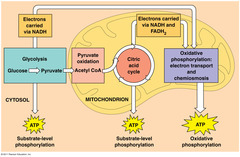
8347352810Glycolysis, Kreb Cycle, and Electron Transport ChainThe 3 steps of Cell Respiration9
8347352811Light Dependent Reaction and Calvin CycleThe 2 Steps of Photosynthesis10
8347352812endergonicA chemical reaction that requires the input of energy in order to proceed.11
8347352813exergonicEnergy stored in the chemical bonds released12
8347352814metabolismAll of the chemical reactions that occur within an organism13
8347352815activation energyEnergy needed to get a reaction started14
8347352816ATP(adenosine triphosphate) main energy source that cells use for most of their work15
8347352817cellular respirationProcess that releases energy by breaking down glucose and other food molecules in the presence of oxygen16
8347352818mitochondrial matrixThe compartment of the mitochondrion enclosed by the inner membrane and containing enzymes and substrates for the citric acid cycle.17
8347352819cristaeInfoldings of the inner membrane of a mitochondrion that houses the electon transport chain and the enzyme catalyzing the synthesis of ATP.18
8347352820glycolysisA metabolic process that breaks down carbohydrates and sugars through a series of reactions to either pyruvic acid or lactic acid and release energy for the body in the form of ATP19
8347352821link reactionCO2 is removed from pyruvate and NADH is produced to make Acetyl-CoA20
8347352822pyruvateOrganic compound with a backbone of three carbon atoms. Two molecules form as end products of glycolysis21
8347352823Krebs cyclesecond stage of cellular respiration, in which pyruvic acid is broken down into carbon dioxide in a series of energy-extracting reactions22
8347352824electron transport chainA sequence of electron carrier molecules (membrane proteins) that shuttle electrons during the redox reactions that move protons (H+) across the membrane.23
8347352825ATP synthaseLarge protein that uses energy from H+ ions to bind ADP and a phosphate group together to produce ATP24
8347352826FADH2Electron carrier produced during the Krebs cycle.25
8347352827NADHAn energy-carrying coenzyme produced by glycolysis and the Krebs cycle. NADH carries energy to the electron transport chain.26
8347352828photosynthesisConversion of light energy from the sun into chemical energy.27
8347352829stomataSmall openings on the underside of a leaf through which oxygen and carbon dioxide can move28
8347352830guard cellPairs of cells that surround stomata and control their opening and closing.29
8347352831xylemThe vascular tissue through which water and nutrients move in plants30
8347352832phloemThe vascular tissue through which sugars move in plants31
8347352833chloroplast(in green plant cells) a plastid that contains chlorophyll and in which photosynthesis takes place.32
8347352834chlorophyllGreen pigment in plants that absorbs light energy used to carry out photosynthesis33
8347352835Calvin cyclereactions of photosynthesis in which energy from ATP and NADPH is used to build high-energy compounds such as sugars34

AP Biology - Chapter 10 (photosynthesis) Flashcards

Photosynthesis

Terms : Hide Images
5475827898photosynthesis (definition)process of harnessing light energy to build carbohydrates in autotrophs (ex. plants, cyanobacteria)0
5475827899photosynthesis (equation)6 CO2 + 6 H2O + light energy --> C6H12O6 + 6 O21
5475827900autotrophorganism that CAN capture energy from sunlight or chemicals and use it to produce its own food (producer)2
5475827901heterotrophorganism that CANNOT produce its own food and therefore obtains it by consuming other living things (consumer)3
5475827902anabolicWhat kind of a process is photosynthesis?4
5475827903catabolicWhat kind of a process is cellular respiration?5
5475827904light-dependent reactions1st step of photosynthesis during which light energy is captured and used to synthesize ATP and NADPH6
5475827905light-independent reactions2nd step of photosynthesis during which CO2 is incorporated into a sugar molecule using ATP and NADPH produced during the first step7
5475827906thylakoid membranes of chloroplastslocation of light-dependent reactions8
5475827907stroma of chloroplastslocation of light-independent reactions9
5475827908G3Pcarbon product of the light-independent reactions10
5475827909photon(1) quantum (discrete quantity) of electromagnetic radiation (light energy) with both wave and particle properties11
5475827910inverseWhat is the relationship between wavelength and energy?12
5475827912pigmentssubstances that can absorb, reflect, or transmit light13
5475827913absorption spectrumgraph of a pigment's ability to absorb various wavelengths of light14
5475827915violet, blue and redWhich wavelengths of the visible light spectrum do chlorophylls ABSORB?15
5475827916green and yellowWhich wavelengths of the visible light spectrum do chlorophylls REFLECT?16
5475827917carotenoidsaccessory pigments in chloroplasts that broaden the spectrum of colors used in photosynthesis (absorb green/blue but reflect red/yellow/orange)17
5475827918mesophyll(C) ground tissue of a leaf, sandwiched between upper and lower epidermis that specializes in photosynthesis18
5475827919chlorophyll bpigment, green/olive, in chloroplast19
5475827920chlorophyll apigment, blue/green, in chloroplast20
5475827921excited state(7) when absorbed photon energy causes electron to move away from nucleus21
5475827922photosystems(6) photosynthetic pigments embedded with protein complexes in the thylakoid membrane22
5475827928watersplitting this molecule replaces electrons which are excited and passed to primary electron acceptor in PSII23
5475827929O2released as a byproduct of splitting water24
5475827931proton-motive forcecreated by pumping hydrogen ions from stroma to thylakoid space during electron transport chain between PS II and PS I25
5475827932ATP synthaseenzyme that synthesies ATP by utilizing a proton-motive force26
5475827933Calvin cycle, dark reactions, and carbon fixationother names for light independent reactions27
54758279343 steps of light independent reaction1. carbon fixation 2. reduction 3. regeneration of RuBP28
5475827935reductionstep in Calvin cycle that produces sugar G3P29
5475827936carbon dioxidemolecule reduced in Calvin cycle to produce sugar30
5475827937thylakoids(C) flattened membranous sacs inside chloroplasts that contain systems which convert light energy to chemical energy31
5475827938absorbedenergy is ____________ in photosynthesis32
5475827939releasedenergy is _____________ in cellular respiration33
5475827940glucose and oxygenreactants of cellular respiration34
5475827941carbon dioxide and waterreactants of photosynthesis35
5475827942glucosesource of electrons used in ETC of cellular respiration36
5475827943intermembrane spacesite of proton gradient built up in cellular respiration37
5475827944thylakoid spacesite of proton gradient built up in photosynthesis38
5475827945NAD+ and FADhigh energy electron carrier(s) before reduction in cellular respiration (after they drop off electrons at ETC)39
5475827946NADH and FADH2high energy electron carrier(s) after reduction in cellular respiration (after they pick up electrons from Kreb's cycle)40
5475827947NADP+high energy electron carrier(s ) before reduction in photosynthesis (after they drop off electrons for Calvin cycle)41
5475827948NADPHhigh energy electron carrier(s ) after reduction in photosynthesis (after they pick up electrons from ETC)42
5475827949ATPenergy product(s) from ETC in cellular respiration43
5475827950ATP and NADPHenergy product(s) from ETC in photosynthesis44
5475827951glucose, NADH and FADH2reactant(s) oxidized in cellular respiration45
5475827952H2Oreactant(s) oxidized in photosynthesis (source of electrons)46
5475827953cyclic electron flowlight dependent reactions using only photosystem I to pump protons and generate excess ATP (not NADPH)47
5475827954linear electron flowlight dependent reactions involving both photosystems; electrons from H2O are used to reduce NADP to NADPH48
5475827955rubiscoenzyme with affinity for both CO2 and O2 that catalyzes first step of Calvin cycle by adding CO2 to ribulose bisphosphate (RuBP)49
5475827957stomatapore-like openings on underside of leaves that allow gases (CO2 and O2) and water to diffuse in and out50
5475827958bundle-sheath cellstightly packed around the veins of a leaf (site of Calvin cycle in C4 plants)51
5475827959photorespirationoccurs on hot, dry days when stomata close, O2 accumulates and Rubisco fixes O2 rather than CO2, using up ATP, O2 and sugars52
5475827960C3 plantsdo not separately fix CO2 and use Rubisco in Calvin Cycle53
5475827961C4 plantsspatially separate carbon fixation (mesophyll cells) from Calvin Cycle (bundle-sheath cells); use PEP carboxylase instead of Rubisco to fix CO254
5475827962CAM plantstemporally separate carbon fixation (day) and Calvin Cycle (night); use PEP carboxylase instead of Rubisco to fix CO255

AP Biology - Nervous System MHS Flashcards

Terms : Hide Images
7835532568neuronnerve cells0
7835532569nervebundle of neurons1
7835532570dendritesreceive chemical signals and converts to electrical single2
7835532571axonone end has receptor, other has axon terminals3
7835532572synapseaxon terminals: connects to neurons or muscles4
7835532573schwann cellform myelin sheath5
7835532574myelin sheathfatty tissue: make action potential faster as it jumps from node to node6
7835532575saltatory conductionin a myleinated axon, ions of nerve impulse jump from node (of Ranvier) to node7
7835532576pathway of signal in nervous systemstimulus-> sensory receptor -> sensory neurons -> interneurons (control center) -> motor neurons -> muscle8
7835532577central nervous systembrain, spinal cord: analyzing, interpreting info9
7835532578peripheral nervous systemnerves entering into & extending from the CNS10
7835532579somaticPNS: consciously controlled: to/from skeletal muscles, skin11
7835532580autonomicPNS: function w/out your control: smooth muscles, cardiac muscles, glands12
7835532581sensory neurongets info from surroundings: sense neurons -> CNC (afferent)13
7835532582motor neuronrelays commands from CNC to skeletal muscles/glands (Efferent)14
7835532583sympatheticbranch of autonomic nervous system: excites (stress), "fight or flight" response; norepinephrine15
7835532584parasympatheticbranch of autonomic nervous system: promotes relaxed state, "rest & digest"; acetylcholine16
7835532585reflex arc or pathwayautonomic response to stimuli w/out thought: excite sensory receptors -> spinal cord -> motor neuron17
7835532586resting potentialmembrane of -70mv: channels shut off, not letting homeostasis sodium external (more positive) potassium internal (less positive) Na+/K+ pumps maintain potential18
7835532587Na+/K+ pumpsuse ATP to maintain potential; pumps two K+ in & three Na+ out19
7835532588Action Potentialreversal of voltage difference across membrane: +30mv sodium channels open, Na+ in sodium channels close while K+ channels open K+ flow out of neuron20
7835532589depolarizationNa+ Channels open, K+ are closed: change in polarity of membrane potential, from -70mv to +40mv21
7835532590repolarizationdecrease in membrane potential: K+ channels open, Na+ channels are closed22
7835532591sodium & potassium channelvoltage-gated ion channel23
7835532592refractory periodK+ channels close slower, can't send another signal for a moment24
7835532593thresholdaround -40mv; stimulus must be strong enough; "all or nothing" principal25
7835532594axon terminalthe end of an axon; where a synapse occurs26
7835532595neurotransmittersChemical messengers that cross the synaptic gaps between neurons: held in vesicles27
7835532596synaptic cleftspace between nerons, nerotransmitters float here28
7835532597exocytosisneurotransmitter vesicles bind to pre-synaptic membrane and expel neurotransmitters into synaptic cleft29
7835532598EPSP (excitatory post-synaptic potential)open Na+ gates on post-synaptic membrane; continues action potential30
7835532599IPSP (inhibitory post-synaptic potential)opens K+ gates on post-synaptic membrane; stops action potential31
7835532600synaptic integrationsum of excitory/inhibitory: amplify, dampen, cancel signal32
7835532601medulla oblongatacontrols breathing, heart rate, digestive system33
7835532602ponsaccessory portion, controls breathing34
7835532603cerebellumcontrols movement, balance and coordination35
7835532604cerebrumpart of forebrain: regulates conscious functions of the body such as thought and reasoning and perception of stimuli36
7835532605cerebral cortexmemory37
7835532606hypothalamusregulates body temperature, hunger, thirst: homeostasis38
7835532607interneuronswith highly-branched dendrites found within the CNS; convey messages between parts of the CNS39
7835532608hyperpolarization (overshoot or undershoot)more K+ have moved out of the cell than is actually necessary to establish the resting potential.40
7835532609Steps of an Action Potential1. Resting Potential 2. Depolarization 3. Repolarization 4 Refractory Period41
7835532610Nodes of Ranviergaps in the mylein sheath; space between schwann cells42
7835532611examples of neurotransmittersacetylcholine, epinephrine, norepinephrine, dopamine, seratonin, GABA,43

AP Biology Chapter 2 Flashcards

The Chemical Context of Life

Terms : Hide Images
7241162560Van Der Waals InteractionsWeak attractions between molecules. Also called london dispersion forces0
7241162561ProductsMaterial resulting from a chemical reaction.1
7241162562Chemical EquilibriumState in which the rate of the forward reaction equals the rate of the reverse reaction.2
7241162563ReactantsStarting material in a chemical reaction.3
7241162564Hydrogen bondWeak chemical bond. Consist of a covalent bond4
7241162565Ionic CompoundCompound resulting from the formation of an ionic bond. Also called a salt.5
7241162566Ionic BondChemical bond resulting from the attraction between oppositely charged ions.6
7241162567AnionNegatively charged ion. Loses an electron.7
7241162568CationPositively charged ion. Gains an electron.8
7241162569IonAn atom or group of atoms that has gained or lost one or more electrons. Acquiring a charge.9
7241162570Polar Covalent BondShared electrons are pulled closer to the more electronegative atom, making it slightly negative and the other atom positive.10
7241162571Non-polar Covalent BondCovalent bond where electrons are shard equally between two atoms of similar electronegativity.11
7241162572ElectronegativityAttraction of a given atom for the electrons of a covalent bond.12
7241162573Double BondDouble covalent bond; sharing of two pairs of valence electrons by two atoms.13
7241162574Single BondSingle covalent bond; sharing of one pair of valence electrons.14
7241162575Covalent BondStrong chemical bond in which two atoms share one or more pairs of valence electrons.15
7241162576Chemical BondAttraction between two atoms, resulting from a sharing of outer shell electrons.16
7241162577OrbitalWhere an electron is found 90% of the time.17
7241162578Potential EnergyEnergy that matter possesses as a result of its location.18
7241162579EnergyCapacity to cause change, especially to do work.19
7241162580Radioactive IsotopeNucleus decays spontaneously, giving off detectable particles and energy also called unstable isotope.20
7241162581IsotopesSame number of protons but a different number of neutrons.21
7241162582Atomic MassTotal mass of an atom22
7241162583Mass NumberSum of the number of protons and neutrons in an atom's nucleus.23
7241162584Atomic NumberNumber of protons in the nucleus of an atom, unique for each element.24
7241162585Atomic NucleusAn atom's dense central core, containing protons and neutrons.25
7241162586ElectronsA subatomic particle with a single negative electrical charge.26
7241162587NeutronsA subatomic particle having no electrical charge (electrically neutral). Found in the nucleus of an atom.27
7241162588ProtonsA subatomic particle with a single positive electrical charge. Found in the nucleus of an atom.28
7241162589AtomSmallest unit of matter that retains the properties of an element.29
7241162590Trace ElementsAn element indispensable for life but required in extremely minute amounts.30
7241162591Essential ElementsA chemical element required for an organism to survive, grow, and reproduce.31
7241162592CompoundA substance consisting of two or more different elements combined in a fixed ratio.32
7241162593ElementAny substance that cannot be broken down to any other substance by chemical reactions.33
7241162594MatterAnything that takes up space and has mass.34

GWHS AP Biology - Chapter 20: Biotechnology Flashcards

Terms : Hide Images
8275342783recombinant DNAA DNA molecule made in vitro with segments from different sources.0
8275342784genetic engineeringThe direct manipulation of genes for practical purposes.1
8275342785biotechnologyThe manipulation of living organisms or their components to produce useful products.2
8275342786plasmidA small ring of DNA that carries accessory genes separate from those of a bacterial chromosome; also found in some eukaryotes, such as yeast.3
8275342787gene cloningThe production of multiple copies of a gene.4
8275342788restriction enzymesA degradative enzyme that recognizes and cuts up DNA (including that of certain phages) that is foreign to a bacterium; an important tool in biotechnology5
8275342789restriction sitesA specific sequence on a DNA strand that is recognized as a cut site by a restriction enzyme.6
8275342790sticky endA single-stranded end of a double-stranded DNA restriction fragment.7
8275342791DNA ligaseA linking enzyme essential for DNA replication; catalyzes the covalent bonding of the 3' end of a new DNA fragment to the 5' end of a growing chain; useful in forming recombinant DNA8
8275342792cloning vectorAn agent used to transfer DNA in genetic engineering. A plasmid that moves recombinant DNA from a test tube back into a cell is an example of a cloning vector, as is a virus that transfers recombinant DNA by infection.9
8275342793complementary DNAA DNA molecule made in vitro using mRNA as a template and the enzyme reverse transcriptase. this DNA molecule therefore corresponds to a gene, but lacks the introns present in the DNA of the genome.10
8275342794nucleic acid probeIn DNA technology, a labeled single-stranded nucleic acid molecule used to tag a specific nucleotide sequence in a nucleic acid sample. Molecules of the probe hydrogen-bond to the complementary sequence wherever it occurs; radioactive or other labeling of the probe allows its location to be detected.11
8275342795nucleic acid hybridizationBase pairing between a gene and a complementary sequence on another nucleic acid molecule.12
8275342796electroporationA technique to introduce recombinant DNA into cells by applying a brief electrical pulse to a solution containing cells. The electricity creates temporary holes in the cells' plasma membranes, through which DNA can enter.13
8275342797polymerase chain reaction (PCR)A technique for amplifying DNA in vitro by incubating with special primers, taq polymerase molecules, and nucleotides.14
8275342798gel electrophoresisThe separation of nucleic acids on the basis of their size and electrical charge, due to their different rate of movement through an electrical field in a gel.15
8275342799restriction fragment length polymorphism (RFLP)Differences in DNA sequence on homologous chromosomes that result in different patterns of restriction fragment lengths (DNA segments resulting from treatment with restriction enzymes); .16
8275342800Southern BlottingA hybridization technique that enables researchers to determine the presence of certain nucleotide sequences in a sample of DNA.17
8275342801dideoxy chain termination methoda DNA sequencing method in which target DNA is denatured and annealed to an oligonucleotide primer, which is then extended by DNA polymerase using a mixture of deoxynucleotide triphosphates (normal dNTPs) and chain-terminating dideoxynucleotide triphosphates (ddNTPs)18
8275342802reverse transcriptase-polymerase chain reaction (RT-PCR)a variant of polymerase chain reaction (PCR), is a technique commonly used in molecular biology to detect mRNA expression; useful for studying gene expression during development19
8275342803northern blottingan adaptation of the Southern blot procedure used to detect specific sequences of RNA by hybridization with complementary DNA.20
8275342804DNA microarray assayA method to detect and measure the expression of thousands of genes at one time. Tiny amounts of a large number of single-stranded DNA fragments representing different genes are fixed to a glass slide. These fragments, ideally representing all the genes of an organism, are tested for hybridization with various samples of cDNA molecules.21
8275342805in vitro mutagenesisThe creation of mutations in genes; used to knock out genes and then determine their function22
8275342806RNA interferenceA technique to silence the expression of selected genes in nonmammalian organisms. The method uses synthetic double-stranded RNA molecules matching the sequence of a particular gene to trigger the breakdown of the gene's messenger RNA or block its translation;useful for determining gene function23
8275342807single-nucleotide polymorphism (SNP)One base-pair variation in the genome sequence; useful as markers for diseases in the human population24
8275342808reverse transcriptaseAn enzyme encoded by some certain viruses (retroviruses) that uses RNA as a template for DNA synthesis.25
8275342809CRISPR-cas 9a system used by bacteria to defend against bacteriophage infections; used in genetic engineering to target and disable genes and thereby determine their function26
8275342810totipotenta cell that can give rise to all specialized cell types; in animals that includes the placenta27
8275342811pluripotentembryonic stem cells from the blastocyst that can give rise to all specialized cell types but not the placenta28
8275342812induced pluripotent cellsiPS differentiated cells that are reprogrammed to become pluripotent that can be used to study and treat disease29
8275342813somatic cell nuclear transferused in organismal cloning; nucleus of a somatic cell replaces the nucleus of an enucleated egg30
8275342814epigenetic changesmethylation of DNA and histones and other types of chromatin modification that need to be reversed in reprogramming of a differentiated cell for organismal cloning to be successful31

Campbell AP Biology--CHAPTER 1 Flashcards

Terms and Concepts

Terms : Hide Images
7300413933Biology is...the study of life0
7300413934Properties of Life (7)Order Evolutionary Adaption Response to the environment Regulation Energy processing Growth and Development Reproduction1
7300413935Levels of Biological Organization (10)Biosphere Ecosystems Communities Populations Organisms Organs and organ systems Tissues Cells Organelles Molecules2
7300413936Biospheremost regions of land, bodies of water, and atmosphere to an altitude of several kilometers3
7300413937EcosystemsAll living things in a particular area along with all the nonliving components such as soil, water, atmospheric gases and light4
7300413938Communitiesmany kinds of trees, plants, animals, fungi/mushrooms. "species"5
7300413939Populationsall individuals of a species living within the bounds of a specified area6
7300413940OrganismsIndividual living things7
7300413941Organsa system of tissues; these can coordinate together to make a bigger system with a particular function.8
7300413942TissuesA group of cells tissues make up organs9
7300413943Cellsfundamental unit of structure and function.10
7300413944OrganellesEx) Chloroplasts are organelles of plants. Photosynthesis11
7300413945Moleculesa chemical structure consisting of two of more small chemical units called atoms.12
7300413946Producersplants and other photosynthetic organisms that convert light energy to chemical energy13
7300413947Consumersorganisms that feed on producers and other consumers14
7300413948deoxyribonucleic acid (DNA)the substance for genes, the units of inheritance that transmit information from the parents to the offspring.15
7300413949DNAtwo long chains arranged into a double helix each link of the chain is made up of 4 chemical building blocks called nucleotides16
7300413950proteinsgenes are instructions for making __17
7300413951Genomethe entire "library" of genetic instructions that an organism inherits18
7300413952prokaryotic CellsBacteria and Archaea DNA is not separated from the rest of the cell No nucleus19
7300413953eukaryotic CellsPlants and animals Nucleus and Cytoplasm20
7300413954Human Genome Projectsequenced many genomes.21
7300413955negative feedbackaccumulation of an end product of a process slows the process the cell's breakdown of sugar generates ATP. an excess amount would trigger an enzyme to slow it down22
7300413956Classification order (smallest to largest)Species Genus Family Order Class Phylum Kingdom Domain23
7300413957Taxonomythe branch of biology that names and classifies species, formalizes this ordering of species into a series of groups of increasing breadth.24
7300413958DomainThe 3 ___ of life: Bacteria, Archaea Eukarya25
7300413959Domain Bacteria and Archaeaprokaryotes unicellular and microscopic26
7300413960Domain Eukaryamicroorganisms (protozoans) includes kingdoms: plantae, fungi, and animalia27
7300413961Charles DarwinOn the Origin of Species by Natural Selection Descent with modification and Natural Selection Galapagos studying finches28
7300413962natural selectionthe natural environment "selects" for the propagation of certain traits,29
7300413964inquirya search for information and explanations, often focusing on specific questions.30
7300413965Dataitems of information on which scientific inquiry is based. Qualitative and Quantitative31
7300413966Inductive reasoningderive generalizations based on a large number of specific observations32
7300413967hypothesisa tentative answer to a well-framed question (explanation on trial) "if...then..." statements must be falsifiable and testable33
7300413968deductive reasoningfrom the general to the specific.34
7300413969experimental groupthe group that is being manipulated. the group being experimented on35
7300413970control groupthe group that stays the same as a reference.36
7300413971theorya broader scope than a hypothesis able to spin off specific hypotheses supported by a much more massive body of evidence37
7300413972Themes of BiologyThe Cell Heritable information Emergent properties of biological systems regulation Interaction with Environment Energy and life Unity and Diversity Evolution Structure and Function Scientific Inquiry Science, Technology, and Society38

AP Biology - Chapter 9 Cellular Respiration Flashcards

Cellular Respiration and Fermentation

Terms : Hide Images
7725867042fermentationanaerobic process that produces little ATP, includes glycolysis, and restores NAD+0
7725867043aerobic respirationcatabolic pathway which requires oxygen and occurs in cytoplasm and mitochondria1
7725867044anaerobic respirationcatabolic pathway which does not require oxygen and occurs only in cytoplasm2
7725867045oxidationloss of electrons from atoms of a substance3
7725867046reductionaddition of electrons to atoms of a substance4
7725867047reducing agentelectron donor in a redox reaction5
7725867048oxidizing agentelectron acceptor in a redox reaction6
7725867049NAD+electron carrier used in cellular respiration to transfer electrons from Kreb's cycle to ETC7
7725867050electron transport chain (ETC)(1) transfer of electrons from glucose via NADH/FADH2 to transmembrane proteins and subsequently using their high energy to pump protons to intermembrane space in mitochondria or thylakoid space in chloroplasts8
7725867051citric acid (Kreb's) cycle(B) 2nd step of cellular respiration that breaks down AcetylCoA to 2 carbon dioxide, 1 ATP, 3NADH, and 1 FADH2 molecules in mitochondrial matrix (aerobic)9
7725867052glycolysis(A) 1st step of cellular respiration that splits glucose into 2 molecules of pyruvic acid and 2 ATPs (anaerobic, catabolic/exergonic)10
7725867053Pi (not π)inorganic phosphate11
7725867054oxidative phosphorylation(3) synthesis of ATP from ADP and Pi at ATP synthase using energy from glucose electrons which are ultimately transferred to oxygen (final electron acceptor) using ETC in mitochondrial cristae (aerobic)12
7725867055substrate level phosphorylationsynthesis of ATP by transferring a phosphate group directly to ADP using an enzyme13
7725867056chemiosmosis(3) movement of protons down their concentration gradient coupled to ATP synthesis14
7725867057proton motive forcepotential energy stored in form of an electrochemical gradient generated by pumping hydrogen ions across membranes during ETC15
7725867058alcohol fermentationconversion of pyruvate to carbon dioxide and 2-carbon compound in absence of oxygen to regenerate NAD+ needed for glycolysis (in yeast)16
7725867059lactic acid fermentationconversion of pyruvate to 3-carbon compound in absence of oxygen to regenerate NAD+ needed for glycolysis (in our muscles)17
7725867060obligate anaerobesorganisms that can only survive WITHOUT oxygen18
7725867061beta oxidationmetabolic pathway that breaks down fatty acids into two-carbon fragments which enter Krebs cycle as acetyl CoA19
7725867062redoxelectron transfer reactions that occur together and in which one chemical is oxidized and the other reduced20
7725867063formation of acetyl CoAmetabolic link between glycolysis and aerobic respiration21
7725867064cellular respirationexergonic process that includes 3 steps and releases energy (ATP) by breaking down glucose and other molecules in presence of oxygen22
7725867065cytochromesiron-containing proteins that play key role in electron transport chains in mitochondria, chloroplasts, and cell membranes of prokaryotes23
7725867066ATP synthaseenzyme in mitochondrial cristae and chloroplast thylakoids that uses energy of proton gradient to add a phosphate group to ADP and so form ATP24
7725867067facultative anaerobesorganisms that can survive with OR without oxygen25
7725867068dehydrogenasesenzymes that transfer hydrogen atoms26
7725867069isomerases/mutasesenzymes that move atoms within a molecule27
7725867070kinases/phosphatasesenzymes that transfer phosphate groups28
7725867071adolasesenzymes that cut molecules29
7725867072enolasesenzymes that add double bonds to molecules30

AP Biology - Chapter 10 (photosynthesis) Flashcards

Photosynthesis

Terms : Hide Images
6212395447photosynthesis (definition)process of harnessing light energy to build carbohydrates in autotrophs (ex. plants, cyanobacteria)0
6212395448photosynthesis (equation)6 CO2 + 6 H2O + light energy --> C6H12O6 + 6 O21
6212395449autotrophorganism that CAN capture energy from sunlight or chemicals and use it to produce its own food (producer)2
6212395450heterotrophorganism that CANNOT produce its own food and therefore obtains it by consuming other living things (consumer)3
6212395451light-dependent reactions1st step of photosynthesis during which light energy is captured and used to synthesize ATP and NADPH4
6212395452light-independent reactions2nd step of photosynthesis during which CO2 is incorporated into a sugar molecule using ATP and NADPH produced during the first step5
6212395453thylakoid membranes of chloroplastslocation of light-dependent reactions6
6212395454stroma of chloroplastslocation of light-independent reactions7
6212395455G3Pcarbon product of the light-independent reactions8
6212395456photon(1) quantum (discrete quantity) of electromagnetic radiation (light energy) with both wave and particle properties9
6212395457inverseWhat is the relationship between wavelength and energy?10
6212395458reflected, transmitted, or absorbedWhen a photon strikes a substance it can be _____________________11
6212395459pigmentssubstances that can absorb, reflect, or transmit light12
6212395460absorption spectrumgraph of a pigment's ability to absorb various wavelengths of light13
6212395461action spectrumgraph of a plant's photosynthesis rate at different wavelengths of light14
6212395462violet, blue and redWhich wavelengths of the visible light spectrum do chlorophylls ABSORB?15
6212395463green and yellowWhich wavelengths of the visible light spectrum do chlorophylls REFLECT?16
6212395464carotenoidsaccessory pigments in chloroplasts that broaden the spectrum of colors used in photosynthesis (absorb green/blue but reflect red/yellow/orange)17
6212395465mesophyll(C) ground tissue of a leaf, sandwiched between upper and lower epidermis that specializes in photosynthesis18
6212395466chlorophyll bpigment, green/olive, in chloroplast19
6212395467chlorophyll apigment, blue/green, in chloroplast20
6212395468excited state(7) when absorbed photon energy causes electron to move away from nucleus21
6212395469photosystems(6) photosynthetic pigments embedded with protein complexes in the thylakoid membrane22
6212395470parts of photosystems(3+4) reaction-center complex and light harvesting complex23
6212395471reaction-center complex(4) centrally located proteins associated with a special pair of chlorophyll a molecules and a primary electron acceptor24
6212395472light harvesting complex(3) proteins associated with pigment molecules that capture light energy and transfers it to center of a photosystem25
6212395473photosystem II (PS II)1st of two light harvesting units in thylakoid membrane that passes excited electrons to reaction-center chlorophyll26
6212395474primary electron acceptor(2) electrons from the reaction-center in thylakoid membranes are transferred to this molecule27
6212395475watersplitting this molecule replaces electrons which are excited and passed to primary electron acceptor in PSII28
6212395476O2released as a byproduct of splitting water29
6212395477photosystem I (PS I)2nd of two light-capturing units in thylakoid membranes that replaces its electrons by those from the 1st complex and results in production of NADPH30
6212395478proton-motive forcecreated by pumping hydrogen ions from stroma to thylakoid space during electron transport chain between PS II and PS I31
6212395479ATP synthaseenzyme that synthesies ATP by utilizing a proton-motive force32
6212395480Calvin cycle, dark reactions, and carbon fixationother names for light independent reactions33
62123954813 steps of light independent reaction1. carbon fixation 2. reduction 3. regeneration of RuBP34
6212395482reductionstep in Calvin cycle that produces sugar G3P35
6212395483carbon dioxidemolecule reduced in Calvin cycle to produce sugar36
6212395484thylakoids(C) flattened membranous sacs inside chloroplasts that contain systems which convert light energy to chemical energy37
6212395485absorbedenergy is ____________ in photosynthesis38
6212395486releasedenergy is _____________ in cellular respiration39
6212395487glucose and oxygenreactants of cellular respiration40
6212395488carbon dioxide and waterreactants of photosynthesis41
6212395489glucosesource of electrons used in ETC of cellular respiration42
6212395490intermembrane spacesite of proton gradient built up in cellular respiration43
6212395491thylakoid spacesite of proton gradient built up in photosynthesis44
6212395492NAD+ and FADhigh energy electron carrier(s) before reduction in cellular respiration (after they drop off electrons at ETC)45
6212395493NADH and FADH2high energy electron carrier(s) after reduction in cellular respiration (after they pick up electrons from Kreb's cycle)46
6212395494NADP+high energy electron carrier(s ) before reduction in photosynthesis (after they drop off electrons for Calvin cycle)47
6212395495NADPHhigh energy electron carrier(s ) after reduction in photosynthesis (after they pick up electrons from ETC)48
6212395496ATPenergy product(s) from ETC in cellular respiration49
6212395497ATP and NADPHenergy product(s) from ETC in photosynthesis50
6212395498glucose, NADH and FADH2reactant(s) oxidized in cellular respiration51
6212395499H2Oreactant(s) oxidized in photosynthesis (source of electrons)52
6212395500cyclic electron flowlight dependent reactions using only photosystem I to pump protons and generate excess ATP (not NADPH)53
6212395501linear electron flowlight dependent reactions involving both photosystems; electrons from H2O are used to reduce NADP to NADPH54
6212395502rubiscoenzyme with affinity for both CO2 and O2 that catalyzes first step of Calvin cycle by adding CO2 to ribulose bisphosphate (RuBP)55
6212395503PEP carboxylaseenzyme with great affinity for CO2 (gas) adds it to phosphoenolpyruvate (PEP) to form oxaloacetate (4-carbon solid) prior to photosynthesis56
6212395504stomatapore-like openings on underside of leaves that allow gases (CO2 and O2) and water to diffuse in and out57
6212395505bundle-sheath cellstightly packed around the veins of a leaf (site of Calvin cycle in C4 plants)58
6212395506photorespirationoccurs on hot, dry days when stomata close, O2 accumulates and Rubisco fixes O2 rather than CO2, using up ATP, O2 and sugars59
6212395507C3 plantsdo not separately fix CO2 and use Rubisco in Calvin Cycle60
6212395508C4 plantsspatially separate carbon fixation (mesophyll cells) from Calvin Cycle (bundle-sheath cells); use PEP carboxylase instead of Rubisco to fix CO261
6212395509CAM plantstemporally separate carbon fixation (day) and Calvin Cycle (night); use PEP carboxylase instead of Rubisco to fix CO262
6212395510autotrophorganism capable of synthesizing its own food from CO₂ and other inorganic raw materials. The producers.63
6212395511heterotrophan organism that depends on other's complex organic substances for nutrition.64
6212395512photoautotrophplants that use energy from sunlight to convert carbon dioxide and water to carbon compounds.65
6212395513chlorophyllthe green pigment located within chloroplasts. It absorbs light energy to drive the synthesis of food molecules in the chloroplast.66
6212395514mesophyllthe tissue in the interior of the leaf, contains 30-40 chloroplasts67
6212395515stomatamicroscopic pores, help CO₂ enter the cell and O₂ exit.68
6212395516stromathick fluid contained in the inner membrane of a chloroplast, surrounding thylakoids membranes.69
6212395517photosynthesisprocess by which plants and some other organisms use light energy to convert water and carbon dioxide into oxygen and high-energy carbohydrates such as sugars and starches 6CO₂ + 12H₂O + Light Energy → C₆H₁₂O₆ + 6O₂ + 6H₂O70
6212395518splitting of waterhydrolysis that occurs inside the thylakoid space, splits H₂O to produce H+ and O₂.71
6212395519pigmenta molecule that absorbs certain wavelengths of light72
6212395520light reactionsthe steps of photosynthesis that convert solar energy to chemical energy. Light absorbed by chlorophyll drives a transfer of electrons and hydrogen from water to an acceptor, called NADP⁺. give off O₂. Happen in thylakoid or in chloroplast in eukaryotic cells.73
6212395521NADP⁺nicotinamide adenine dinucleotide phosphate, temporarily stores the energized electrons74
6212395522photophosphorylationThe process of generating ATP from ADP and phosphate by means of a proton-motive force generated by the thylakoid membrane of the chloroplast during the light reactions of photosynthesis.75
6212395523Calvin cyclecarbon fixation using energy from ATP and NADPH from the light reactions to produce a three carbon sugar, happens in stroma.76
6212395524carbon fixationincorporating CO₂ from the atmosphere into organic molecules from the chloroplast77
6212395525rubiscoRibulose biphosphate carboxylase, an enzyme that fixes CO₂ together with RuBP.78
6212395526RuBPribulose biphosphate79
6212395527wavelengththe distance between the crests of electromagnetic waves, range from less than a nanometer to more than a kilometer80
6212395528electromagnetic spectrumthe entire range of radiation81
6212395529visible light380-750nm82
6212395530spectrometera machine that measures the ability of a pigment to absorb various wavelengths of light83
6212395531absorption spectruma graph plotting a pigments light absorption versus wavelength. (a) shows the absorption of each chlorophyll84
6212395532chlorophyll afirst type of pigment in chloroplasts, participate directly in light reactions; works best with blue and red light, blue-green85
6212395533chlorophyll baccessory pigment; almost identical to chlorophyll a, but slightly different absorption spectra, yellow-green86
6212395534action spectrumprofiles the relative performance of different wavelengths87
6212395535carotenoidssecond accessory pigment, hydrocarbons that are various shades of yellow and orange, may broaden the spectrum of colors that can drive photosynthesis88
6212395536photosystemshas a light-gathering antenna complex consisting of a cluster of a fer hundred chlorophyll a, a chlorophyll b, and carotenoid molecules89
6212395537reaction centerwhere the first light-driven chemical reaction of photosynthesis occurs, e⁻ goes in, gets excited and jumps up, grabbed by PEA90
6212395538primary electron acceptorgrabs the e⁻ when it gets excited and dumps it into ETC91
6212395539photosystem IIfirst photosystem, center is p680, takes in H₂O, splits and leaves out 1/2 O₂ and takes 2 e⁻, excites electrons and sends to primary acceptor92
6212395540photolysistakes the H₂O, splits, releasing 2 H⁺ and 1/2 O₂, sending 2 e⁻ to photosystem93
6212395541photosystem Itakes e⁻ from ETC and excites them (uses light), gives them to primary acceptor in noncyclic, go down ETC again94
6212395542noncyclic electron flowA route of electron flow during the light reactions of photosynthesis that involves both photosystems and produces ATP, NADPH, and oxygen. The net electron flow is from water to NADP+.95
6212395543noncyclic photophosphorylationATP synthesis during noncyclic electron flow96
6212395544cyclic electron flowuses photosystem I but not photosystem II, no production of NADPH and no release of oxygen, but does generate ATP97
6212395545cyclic photophosphorylationATP synthesis in cyclic electron flow98
6212395546G3Pglyceraldehyde-3-phosphate, the threecarbon sugar formed in the Calvin cycle99
6212395547C₃ plantsproduce less food when their stomata close on hot/dry days.100
6212395548photorespirationA metabolic pathway that consumes oxygen, releases carbon dioxide, generates no ATP, and decreases photosynthetic output; generally occurs on hot, dry, bright days, when stomata close and the oxygen concentration in the leaf exceeds that of carbon dioxide.101
6212395549C₄ plantscorn, sugarcane, grass. forms a four carbon sugar, contains bundle sheath and mesophyll cells. spacial separation of steps102
6212395550bundle-sheath cellarranged into tightly packed sheaths around the veins of the leaf. CO₂ is released and enters the calvin cycle103
6212395551mesophyll cellmore loosely arranged between bundle-sheath and leaf surface. takes in CO₂, fixed by PEP carboxylase104
6212395552PEP carboxylaseadds CO₂ to PEP, higher affinity to CO₂ than rubisco105
6212395553CAM plants(crassulacean acid metabolism) temporal adaptation, open stomata during the night, closed during day. store organic acids made during night in vacuoles106

Pages

Subscribe to CourseNotes RSS

Need Help?

We hope your visit has been a productive one. If you're having any problems, or would like to give some feedback, we'd love to hear from you.

For general help, questions, and suggestions, try our dedicated support forums.

If you need to contact the Course-Notes.Org web experience team, please use our contact form.

Need Notes?

While we strive to provide the most comprehensive notes for as many high school textbooks as possible, there are certainly going to be some that we miss. Drop us a note and let us know which textbooks you need. Be sure to include which edition of the textbook you are using! If we see enough demand, we'll do whatever we can to get those notes up on the site for you!