AP Notes, Outlines, Study Guides, Vocabulary, Practice Exams and more!

AP Biology, Campbell, Ch. 11 Flashcards

Key Concepts:

• External signals are converted to responses within the cell.
• Reception: A signaling molecule binds to a receptor protein, causing it to change shape.
• Transduction: Cascades of molecular interactions relay signals from receptors to target molecules in the cell.
• Response: Cells signaling leads to regulation of transportation or cytoplasmic activities.
• Apoptosis integrates multiple cell-signaling pathways.

Terms : Hide Images
8090404568Adenylyl Cyclasean enzyme that converts ATP to cyclic AMP in response to an extracellular signal0
8090404569Apoptosisa type of programmed cell death, which is brought about by activation of enzymes that break down many chemical components in the cell1
8090404570Astera radial array of short microtubules that extends from each centrosome toward the plasma membrane in an animal cell undergoing mitosis2
8090404571Autosomea chromosome that is not directly involved in determining sex; not a sex chromosome3
8090404572Cyclic AMP (cAMP)cyclic adenosine monophosphate, a ring-shaped molecule made from ATP that is a common intracellular signaling molecule (second messenger) in eukaryotic cells; it is also a regulator of some bacterial operons4
8090404573Diacylglycerol (DAG)second messenger produced by the cleavage of the phospholipid PIP2 in the plasma membrane5
8090404574Diploid Cella cell containing two sets of chromosomes (2n), one set inherited from each parent6
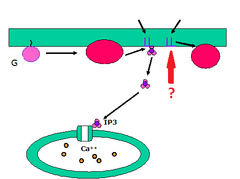
8090404575G Proteina GTP-binding protein that relays signals from a plasma membrane signal receptor, known as a G protein-coupled receptor, to other signal transduction proteins inside the cell7
8090404576G Protein-Coupled Receptor (GPCR)a signal receptor protein in the plasma membrane that responds to the binding of a signaling molecule by activating a G protein; also called a G protein-linked receptor8
8090404577Hormonein multicellular organisms, one of many types of secreted chemicals that are formed in specialized cells, travel in body fluids, and act on specific target cells in other parts of the organism, changing the target cells' functioning9
8090404578Inositol Trisphosphate (IP3)a second messenger that functions as an intermediate between certain signaling molecules and a subsequent second messenger, Ca2+, by causing a rise in cytoplasmic Ca2+ concentration10
8090404579Liganda molecule that binds specifically to another molecule, usually a larger one11
8090404580Ligand-Gated Ion Channela transmembrane protein containing a pore that opens or closes as it changes shape in response to a signaling molecule (ligand), allowing or blocking the flow of specific ions; also called an ionotropic receptor12
8090404581Protein Kinasean enzyme that transfers phosphate groups from ATP to a protein, thus phosphorylating the protein13
8090404582Protein Phosphatasean enzyme that removes phosphate groups from (dephosphorylates) proteins, often functioning to reverse the effect of a protein kinase14
8090404583Receptionin cellular communication, the first step of a signaling pathway in which a signaling molecule is detected by a receptor molecule on or in the cell15
8090404584Receptor Tyrosine Kinase (RTK)a receptor protein spanning the plasma membrane, the cytoplasmic (intracellular) part of which can catalyze the transfer of a phosphate group from ATP to a tyrosine on another protein; receptor tyrosine kinases often respond to the binding of a signaling molecule by dimerizing and then phosphorylating a tyrosine on the cytoplasmic portion of the other receptor in the dimer16
8090404585Response(1) in cellular communication, the change in a specific cellular activity brought about by a transduced signal from outside the cell; (2) in feedback regulation, a physiological activity triggered by a change in a variable17
8090404586Scaffolding Proteina type of large relay protein to which several other relay proteins are simultaneously attached, increasing the efficiency of signal transduction18
8090404587Second Messengera small, nonprotein, water-soluble molecule or ion, such as a calcium ion (Ca2+) or cyclic AMP, that relays a signal to a cell's interior in response to a signaling molecule bound by a signal receptor protein19
8090404588Signal Transduction Pathwaya series of steps linking a mechanical, chemical, or electrical stimulus to a specific cellular response20

AP Biology: Big Idea 3 Flashcards

Terms : Hide Images
6716250187Hershey-Chase ExperimentExperiment that showed that only the DNA enters a bacterial cell during infection, not protein by using radioactive S and P.0
6716250188Frederick GriffithThis person discovered transformation during an experiment that involved injecting mice with smooth S cells, rough R cells, heat-killed S cells, and heat-killed S cells with living R cells.1
6716250189Erwin ChargaffDiscovered that DNA composition varies, but the amount of adenine is always the same as thymine and the amount of cytosine is always the same as guanine.2
6716250190Avery, MacLeod, McCartyDetermined that DNA was Griffith's "Transforming Factor."3
6716250191Rosalind FranklinUsed X-ray diffraction to discover the double-helical structure of DNA.4
6716250192Watson and CrickDeveloped the double helix model of DNA.5
6716250193nucleic acidAn organic compound, either RNA or DNA, whose molecules are made up of one or two chains of nucleotides and carry genetic information.6
6716250194nucleotideMonomer of nucleic acids made up of a sugar, phosphate, base7
6716250195purinesNitrogenous bases that have a double ring structure (AG)8
6716250196pyrimidinesNitrogenous bases that have a single ring structure (CT)9
6716250197antiparallelThe opposite arrangement of the sugar-phosphate backbones in a DNA double helix.10
6716250198phosphodiester bondStrong covalent bond linking the sugar in one nucleotide to the phosphate of another. (BACKBONE SEALER!)11
6716250199DNA replicationThe process whereby DNA makes a copy of itself prior to cell division.12
6716250200semiconservative modelType of DNA replication in which the replicated double helix consists of one old strand, derived from the old molecule, and one newly made strand.13
6716250201DNA polymeraseDNA replication enzyme that adds nucleotides in the 5 to 3 (as it reads in the 3 to 5)14
6716250202transcriptionSynthesis of an RNA molecule from a DNA template.15
6716250203lagging strandA discontinuously synthesized DNA strand that elongates by means of Okazaki fragments, each synthesized in a 5' to 3' direction away from the replication fork.16
6716250204leading strandThe new continuous complementary DNA strand synthesized along the template strand in the mandatory 5' to 3' direction.17
6716250205primaseAn enzyme that joins RNA nucleotides to make the primer using the parental DNA strand as a template.18
6716250206messenger RNA (mRNA)Carries genetic message from the DNA to he protein-synthesizing machinery of the cell.19
6716250207Okazaki fragmentsSmall fragments of DNA produced on the lagging strand during DNA replication, joined later by DNA ligase to form a complete strand.20
6716250208DNA helicaseAn enzyme that untwists the double helix at the replication forks, separating the two parental strands and making them available as template strands.21
6716250209translationThe synthesis of a polypeptide, which occurs under the direction of mRNA.22
6716250210RNA editingThe modification of mRNA before it leaves the nucleus that is unique to eukaryotes.23
6716250211codonsmRNA base triplets.24
6716250212RNA polymeraseEnzyme that links together the growing chain of ribonucleotides during transcription.25
6716250213promoterA specific nucleotide sequence in DNA that binds RNA polymerase and indicates where to start transcribing mRNA.26
6716250214TATA boxCrucial promoter DNA sequence.27
6716250215RNA splicingProcess by which the introns are removed from RNA transcripts and the remaining exons are joined together.28
6716250216intronsNoncoding segments of nucleic acid that lie between coding sequences.29
6716250217exonsCoding segments of eukaryotic DNA.30
6716250218transfer RNA (tRNA)Interpreter of a series of codons along a mRNA molecule.31
6716250219ribosomal RNA (rRNA)RNA molecules that construct ribosomal subunits.32
6716250220ribosomal P siteSite that holds tRNA carrying the growing polypeptide chain. (PEPTIDE)33
6716250221ribosomal A siteSite that holds the tRNA carrying the next amino acid to be added to the chain. (ADD)34
6716250222ribosomal E siteSite where discharged tRNAs leave the ribosome. (EXIT)35
6716250223transformationA change in genotype and phenotype due to the assimilation of external DNA by a cell.36
6716250224gene expressionConversion of the information encoded in a gene first into messenger RNA and then to a protein.37
6716250225recombinant DNAA DNA molecule made in vitro with segments from different sources.38
6716250226restriction enzymeA degradative enzyme that recognizes and cuts up DNA (including that of certain phages) that is foreign to a bacterium.39
6716250227DNA ligaseA linking enzyme essential for DNA replication; catalyzes the covalent bonding of the 3' end of a new DNA fragment to the 5' end of a growing chain.40
6716250228denaturationIn proteins, a process in which a protein unravels and loses its native conformation, thereby becoming biologically inactive. In DNA, the separation of the two strands of the double helix.41
6716250229polymerase chain reaction (PCR)A technique for amplifying DNA in vitro by incubating with special primers, DNA polymerase molecules, and nucleotides.42
6716250230gel electrophoresisThe separation of nucleic acids or proteins, on the basis of their size and electrical charge, by measuring their rate of movement through an electrical field in a gel.43
6716250231plasmidSmall extra-chromosomal, double-stranded circular DNA molecules.44
6716250232RNA primerShort segment of RNA used to initiate synthesis of a new strand of DNA during replication.45
6716250233reverse transcriptaseA polymerase that catalyzes the formation of DNA using RNA as a template.46
6716250234somatic cellAny of the cells of a plant or animal except the reproductive cells.47
6716250235centromereThe region of the chromosome that holds the two sister chromatids together during mitosis.48
6716250236mitosisCell division in which the nucleus divides into nuclei containing the same number of chromosomes.49
6716250237interphasePeriod of the cell cycle between cell divisions.50
6716250238S phaseThe synthesis phase of the cell cycle; the portion of interphase during which DNA is replicated.51
6716250239cancerDisease that results from disruptions of cell cycle control.52
6716250240kinetochore microtubulesConnects the centrosome with the kinetochore in the centromere region of the chromosome.53
6716250241growth factorsRegulatory proteins that ensure that the events of cell division occur in the proper sequence and at the correct rate.54
6716250242alleleOne of the alternative forms of a gene that governs a characteristic, such as hair color.55
6716250243crossing overNonsister chromatids exchanging DNA segments.56
6716250244diploid cellHas two sets of chromosomes.57
6716250245fertilizationUnion of gametes.58
6716250246gametesA haploid cell such as an egg or sperm that unite during sexual reproduction to produce a diploid zygote.59
6716250247genesUnits of heredity made up of DNA.60
6716250248haploidOne set of chromosomes.61
6716250249homologous chromosomesPair of chromosomes that are the same size, same appearance and same genes.62
6716250250zygoteFertilized egg; carries one set of chromosomes from each parent.63
6716250251law of independent assortmentThe random distribution of the pairs of genes on different chromosomes to the gametes.64
6716250252law of segregationAllele pairs separate or segregate during gamete formation, and randomly unite at fertilization. Due to separation of homologous chromosomes in Meiosis I.65
6716250253true-breedingOrganisms that, when reproducing, create offspring of all the same variety.66
6716250254hybridizationThe crossing of two different true-breeding parents.67
6716250255dominant alleleAn allele whose trait always shows up in the organism when the allele is present.68
6716250256recessive alleleAn allele that is masked when a dominant allele is present69
6716250257homozygousAn organism having a pair of identical alleles for a character, either dominant or recessive.70
6716250258phenotypeAn organism's traits.71
6716250259genotypeAn organism's genetic makeup.72
6716250260codominanceWhen which the phenotypes of both alleles are exhibited in the heterozygote.73
6716250261incomplete dominanceCreates a blended phenotype; one allele is not completely dominant over the other.74
6716250262nondisjunctionA failure of paired homologous chromosomes to separate during meiosis which results in an abnormal chromosome number.75
6716250263linked genesGenes located on the same chromosome that tend to be inherited together in genetic crosses.76
6716250264sex linked genesGenes located on the sex chromosomes.77
6716250265operonA unit of genetic function common in bacteria and phages, consisting of coordinately regulated clusters of genes with related functions.78
6716250266operatorRegion of DNA that controls RNA polymerase's access to a set of genes with related functions.79
6716250267repressorA protein that suppresses the transcription of a gene.80
6716250268Trp operonAn example of a repressible operon.81
6716250269Lac operonAn example of an inducible operon.82
6716250270transcription factorsProteins that bind to specific DNA sequences or other regulatory proteins that promote or block RNA polymerase.83
6716250271hormonesCirculating chemical signals that are formed in specialized cells, travel in body fluids, and act on specific target cells.84
6716250272ligandA molecule that specifically binds to another molecule, often a larger one.85
6716250273protein kinaseThe enzyme that transfers phosphate groups from ATP to protein.86
6716250274receptionThe target cell's detection of a signal molecule coming from outside the cell.87
6716250275transductionThe binding of the signal molecule changes the receptor protein in some way.88
6716250276responseThe transduced signal finally triggers a specific cellular response.89
6716250277endocrine signalingType of cell signalling where signals released by one cell type can travel long distances to target cells of another cell type.90
6716250278cell body (soma)Contains most of a neuron's organelles and its nucleus.91
6716250279dendriteshighly branched extensions that receive signals from other neurons92
6716250280axonLong nerve fiber that conducts away from the cell body of the neuron.93
6716250281synapseThe junction between two neurons or between a neuron and a muscle.94
6716250282neurotransmittersChemical messengers that cross the synaptic gaps between neurons.95
6716250283membrane potentialThe voltage across a cell's plasma membrane.96
6716250284resting potentialThe membrane potential of a neuron that is at rest.97
6716250285depolarizationThe process during the action potential when sodium is rushing into the cell causing the interior to become more positive.98
6716250286voltage-gated ion channelsChannels that open or close in response to a change in the membrane potential.99
6716250287action potentialA neural impulse; a brief electrical charge that travels down an axon.100
6716250288repolarizationReturn of the cell to resting state, caused by reentry of potassium into the cell while sodium exits the cell.101
6716250289thresholdThe minimum membrane potential that must be reached in order for an action potential to be generated.102
6716250290myelin sheathA layer of electrical insulation that surrounds the axon.103
6716250291sodium-potassium pumpa carrier protein that uses ATP to actively transport sodium ions out of a cell and potassium ions into the cell.104
6716250292point mutationA mutation that affects a single nucleotide, usually by substituting one nucleotide for another.105
6716250293frameshift mutationMutation that shifts the "reading frame" of the genetic message by the insertion or deletion of a nucleotide.106
6716250294bacteriophageA virus that infects and replicates within bacteria.107
6716250295lytic cycleViral life cycle in which the viral DNA exists as a separate molecule within the bacterial cell. Results in the destruction of the infected cell.108
6716250296lysogenic cycleViral life cycle characterized by integration of the viral nucleic acid into the host bacterium's genome. The viral genetic material can be transmitted to daughter cells.109

Biology in Focus (AP) Chapter 37 Flashcards

Terms : Hide Images
9752175177neuronA nerve cell; the fundamental unit of the nervous system, having structure and properties that allow it to conduct signals by taking advantage of the electrical charge across its plasma membrane.0
9752175178brainOrgan of the central nervous system where information is processed and integrated.1
9752175179ganglionA cluster (functional group) of nerve cell bodies in a centralized nervous system.2
9752175180cell bodyThe part of a neuron that houses the nucleus and most other organelles.3
9752175181dendriteOne of usually numerous, short, highly branched extensions of a neuron that receive signals from other neurons.4
9752175182axonA typically long extension, or process, of a neuron that carries nerve impulses away from the cell body toward target cells.5
9752175183axon hillockThe cone-shaped base of an axon, where signals that travel down the axon are generated.6
9752175184synapseThe junction where a neuron communicates with another cell across a narrow gap via a neurotransmitter or an electrical coupling.7
9752175185synaptic terminalThe part of each axon branch that forms a synapse.8
9752175186neurotransmitterA molecule that is released from the synaptic terminal of a neuron at a chemical synapse, diffuses across the synaptic cleft, and binds to the postsynaptic cell, triggering a response.9
9752175187presynaptic neuronThe neuron that transmits a signal to another cell.10
9752175188postsynaptic cellThe neuron, muscle, or gland cell that receives a signal from a neuron.11
9752175189gliaCells of the nervous system that support, regulate, and augment the functions of neurons.12
9752175190sensory neuronA nerve cell that receives information from the internal or external environment and transmits signals to the central nervous system.13
9752175191interneuronAn association neuron; a nerve cell within the central nervous system that forms synapses with sensory and/or motor neurons and integrates sensory input and motor output.14
9752175192motor neuronA nerve cell that transmits signals from the brain or spinal cord to muscles or glands.15
9752175193central nervous systemThe portion of the nervous system where signal integration occurs, in vertebrate animals, the brain and spinal cord.16
9752175194peripheral nervous systemThe sensory and motor neurons that connect to the central nervous system.17
9752175195nerveA fiber composed primarily of the bundled axons of neurons.18
9752175196membrane potentialThe difference in electrical charge (voltage) across a cell's plasma membrane due to the differential distribution of ions.19
9752175197resting potentialThe membrane potential characteristic of a nonconducting excitable cell, with the inside of the cell more negative than the outside.20
9752175198sodium-potassium pumpA transport protein in the plasma membrane of animal cells that actively transports sodium out of the cell and potassium into the cell.21
9752175199ion channelA transmembrane protein channel that allows a specific ion to diffuse across the membrane down its concentration or electrochemical gradient.22
9752175200selective permeabilityProperty of ion channels that allows only certain ions to pass through to the other side of the membrane.23
9752175201equilibrium potentialThe magnitude of a cell's membrane voltage at equilibrium, calculated using the Nernst equation.24
9752175202gated ion channelA gated channel for a specific ion. The opening or closing of such channels may alter a cell's membrane potential.25
9752175203hyperpolarizationA change in a cell's membrane potential such that the inside of the membrane becomes more negative relative to the outside. Reduces the chance that a neuron will transmit a nerve impulse.26
9752175204depolarizationA change in a cell's membrane potential such that the inside of the membrane is made less negative relative to the outside.27
9752175205graded potentialIn a neuron, a shift in the membrane potential that has an amplitude proportional to signal strength and that decays as it spreads.28
9752175206action potentialAn electrical signal that propagates (travels) along the membrane of a neuron or other excitable cell as a nongraded (all-or-none) depolarization.29
9752175207voltage-gated ion channelA specialized ion channel that opens or closes in response to changes in membrane potential.30
9752175208thresholdThe potential that an excitable cell membrane must reach for an action potential to be initiated.31
9752175209refractory periodThe short time immediately after an action potential in which the neuron cannot respond to another stimulus, owing to the inactivation of voltage-gated sodium channels.32
9752175210myelin sheathWrapped around the axon of a neuron, an insulating coat of cell membranes from Schwann cells or oligodendrocytes. It is interrupted by nodes of Ranvier, where action potentials are generated.33
9752175211oligodendrocyteA type of glial cell that forms insulating myelin sheaths around the axons of neurons in the central nervous system.34
9752175212Schwann cellA type of glial cell that forms insulating myelin sheaths around the axons of neurons in the peripheral nervous system.35
9752175213node of RanvierGap in the myelin sheath of certain axons where an action potential may be generated.36
9752175214saltatory conductionRapid transmission of a nerve impulse along an axon, resulting from the action potential jumping from one node of Ranvier to another, skipping the myelin-sheathed regions of membrane.37
9752175215synaptic vesicleMembrane-enclosed compartment at the terminal of a presynaptic neuron that contains neurotransmitter.38
9752175216synaptic cleftThe gap that separates the presynaptic neuron from the postsynaptic cell.39
9752175217ligand-gated ion channelA transmembrane protein containing a pore that opens or closes as it changes shape in response to a signaling molecule (ligand), allowing or blocking the flow of specific ions.40
9752175218ionotropic receptorA ligand-gated ion channel..41
9752175219postsynaptic potentialA graded potential in a postsynaptic cell.42
9752175220excitatory postsynaptic potentialAn electrical change (depolarization) in the membrane of a postsynaptic cell caused by the binding of an excitatory neurotransmitter from a presynaptic cell to a postsynaptic receptor; makes it more likely for a postsynaptic cell to generate an action potential.43
9752175221inhibitory postsynaptic potentialAn electrical change (usually hyperpolarization) in the membrane of a postsynaptic neuron caused by the binding of an inhibitory neurotransmitter from a presynaptic cell to a postsynaptic receptor; makes it more difficult for a postsynaptic neuron to generate an action potential.44
9752175222temporal summationA phenomenon of neural integration in which the membrane potential of the postsynaptic cell in a chemical synapse is determined by the combined effect of EPSPs or IPSPs produced in rapid succession.45
9752175223spatial summationA phenomenon of neural integration in which the membrane potential of the postsynaptic cell is determined by the combined effect of EPSPs or IPSPs produced nearly simultaneously by different synapses.46
9752175224metabotropic receptorBinds a neurotransmitter and activates a signal transduction pathway that opens or closes an ion channel after one or more metabolic steps.47
9752175225acetylcholineOne of the most common neurotransmitters; functions by binding to receptors and altering the permeability of the postsynaptic membrane to specific ions, either depolarizing or hyperpolarizing the membrane.48
9752175226neuromuscular junctionThe site where a motor neuron forms a synapse with a skeletal muscle cell.49
9752175227glutamateAn amino acid that functions as a neurotransmitter in the central nervous system and has a role in long term memory.50
9752175228GABAAn amino acid that functions as a neurotransmitter in the central nervous system of vertebrates where it is found at most inhibitory synapses in the brain.51
9752175229biogenic aminesA neurotransmitter derived from an amino acid.52
9752175230norepinephrineA catecholamine that is chemically and functionally similar to epinephrine and that acts as a hormone or neurotransmitter; also known as noradrenaline.53
9752175231dopamineA neurotransmitter that is a catecholamine, like epinephrine and norepinephrine.54
9752175232serotoninA neurotransmitter, synthesized from the amino acid tryptophan, that functions in the central nervous system.55
9752175233neuropeptideA relatively short chain of amino acids that serves as a neurotransmitter.56
9752175234endorphinAny of several hormones produced in the brain and anterior pituitary that inhibit pain perception.57

Biology in Focus (AP) Chapter 19 Flashcards

Adapted from:
Urry, L., Cain, M., Wasserman, S., Minorsky, P., Jackson, R., & Reece, J. (2014). Campbell biology in focus. Boston: Pearson Education, Inc. (ISBN# 0321813804)

Terms : Hide Images
7931942477AdaptationInherited characteristic of an organism that enhances its survival and reproduction in specific environments.0
7931942478AnalogousHaving characteristics that are similar because of convergent evolution, not homology.1
7931942479Artificial selectionThe selective breeding of domesticated plants and animals to encourage the occurrence of desirable traits.2
7931942480BiogeographyThe study of the past and present distribution of species.3
7931942481CatastrophismThe principle that events in the past occurred suddenly and were caused by different mechanisms than those operating today. See uniformitarianism.4
7931942482Convergent evolutionThe evolution of similar features in independent evolutionary lineages.5
7931942483EndemicReferring to a species that is confined to a specific, relatively small geographic area.6
7931942484EvolutionDescent with modification; the idea that living species are descendants of ancestral species that were different from the present-day ones; also defined more narrowly as the change in the genetic composition of a population from generation to generation.7
7931942485Evolutionary treeA branching diagram that reflects a hypothesis about evolutionary relationships among groups of organisms.8
7931942486FossilA preserved remnant or impression of an organism that lived in the past.9
7931942487Homologous structuresStructures in different species that are similar because of common ancestry.10
7931942488HomologySimilarity in characteristics resulting from a shared ancestry.11
7931942489Natural selectionA process in which organisms with certain inherited characteristics are more likely to survive and reproduce than are organisms with other characteristics.12
7931942490PaleontologyThe scientific study of fossils.13
7931942491PangaeaThe supercontinent that formed near the end of the Paleozoic era, when plate movements brought all the landmasses of Earth together.14
7931942492StratumA rock layer formed when new layers of sediment cover older ones and compress them.15
7931942493Vestigial structureA structure of marginal, if any, importance to an organism. Vestigial structures are historical remnants of structures that had important functions in ancestors.16
7931942494Lamarcktheory of disuse and use; inheritance of acquired characteristics (1744-1829)17
7931942495Theory of use and disuseif a body part is used, that body part becomes larger and stronger, if it is not used, it deteriorates18
7931942496HuttonGradualism: believed that major changes such as earth today were shaped by slow and continuous processes. Gave clues to scientists that earth was much older than previously thought. (1795)19
7931942497Lyellbelieved that geologic processes were operating at the same rate as in the past20
7931942498Cuviercatastrophism: believed that the extinction of species was caused by catastrophic events such as floods21
7931942499Aristotlebelieved species were fixed and unchanging bc they were perfectly created by god. He organized them on a scale of increasing complexity "scala naturae"22
7931942500Linnaeusbinomial nomenclature- introduced the classification of species into increasingly general groups23
7931942501Scala NaturaeScale of nature that organized living things in order of complexity by Aristotle24
79319425025 observations and 3 inferences of evolutionobeservations: 1) limited resources 2) pops tend to be stable in size (only seasonal fluctuations) 3)population sizes inc exponentially if all individ bron reprod successfully 4) members of a pop vary in characterstics 5) variation is inheritable Inferences 1)overreproduction = struggle for existence = fraction of offspring exist 2) survival depends on inherited traits, adv traits = more likely to survive & reprod than other individ 3) gradual change in pop with more advanced charcteristics25
7931942503Thomas Malthusa population has the potential to increase faster than its resources and food supplies26

AP Biology Unit 4.6 - Meiosis Flashcards

Terms : Hide Images
9450659531Haploida cell that has only a single copy of each chromosome (n)0
9450659532Diploida cell that contains two copies of each chromosome (2n)1
9450659533Somatic CellsAny cells in the body other than reproductive cells; body cells2
9450659534Gametessex (= germ) cells (sperm and egg)3
9450659535Homologous Chromosomespairs of chromosomes that have the same size and same sets of genes; one of each pair comes from each parent4
9450659536FertilizationFusion of an egg and sperm cell to form a zygote.5
9450659537ZygoteDiploid cell formed when a sperm fertilizes an egg.6
9450659538MitosisA process in which cells are divided to produce two identical diploid cells7
9450659539MeiosisA reduction-division process in which a single diploid cell produces four haploid gametes8
9450659540Meiosis IStage of meiosis in which homologous chromosomes separate9
9450659541Meiosis IIStage of meiosis in which sister chromatids separate; results in formation of 4 haploid sex cells.10
9450659542GametogenesisThe production of gametes; forms 4 sperm in males, 1 egg and 3 polar bodies in females.11
9450659543SpermHaploid male gamete12
9450659544EggHaploid female gamete.13
9450659545Polar Bodies3 cells produced during female gametogenesis that have little more than DNA that are eventually broken down; do not become eggs.14
9450659546Crossing OverExchange/swapping of genetic material between homologous chromosomes during meiosis I15
9450670068TetradEach pair of homologous chromosomes that come together during Prophase I of Meiosis16
9450672253SynapsisThe side by side pairing of homologous maternal and paternal chromosomes at the start of meiosis; forming of tetrads.17
9450675329ChiasmataPoints where chromatids cross-over during meiosis18
9450677494Independent AssortmentThe law stating that pairs of genes separate independently of one another in meiosis.19

AP Biology--CHAPTER 5 Flashcards

Terms : Hide Images
7300452328MacromoleculesCarbohydrates, proteins, lipids, and nucleic acids0
7300452333HydrolysisPocess that is the reverse of dehydration synthesis. In __________, or water breakage, the bond between monomers is broken by the addition of a water molecule.1
7300452334Dehydration synthesisReaction in which two molecules are covalently bonded, with the loss of a water molecule2
7300452336PolymersLong molecules consisting of many similar or identical building blocks linked by covalent bonds.3
7300452337Glycosidic linkageIn carbohydrates, monosaccharides are joined together in a covalent bond called __________ _______.4
7300452338MonosaccharidesCarbohydrates polysaccharides are made up of _______________.5
7300452339MonosaccharideEX: monomer Glucose6
7300452340DisaccharideTwo monosaccharides covalently bonded form a ____________. EX: Sucrose7
7300452341PolysaccharideThree or more monosaccharides linked together form a ______________.8
7300452343Celluloseexample of a structural carbohydrates9
7300452345GlycogenStored carbohydrate/polysaccharide in animals10
7300452346starchstored carbohydrate/polysaccharide in plants11
7300452348LipidsCushioning of organs, insulation, and energy storage are three functions of ___________.12
7300452350Unsaturated fatsFats with one or more double covalent bonds, which is less likely to solidify and more flexible.13
7300452351PhospholipidBasic structural component of cell membranes, with a polar/hydrophilic head region and a nonpolar/hydrophobic tail region, giving membranes their selective permeability.14
7300452352SteroidLipid characterized by a carbon skeleton consisting of hydrogen-fused rings.15
7300452353HDLGood cholesterol is called ___ ____________. HINT: Keep your ____ HIGH :-)16
7300452354LDLThe bad cholesterol, which can harden in arteries. HINT: Keep your ____ LOW :-)17
7300452356Amino acidThe monomer in a protein is a(n) _____ ____.18
7300452357Amino; carboxyl; RAmino acids are formed of a(n) _____ group with a(n) ________ group and a(n) _ group side chain.19
730045235820# different amino acids which can assemble according to genetic code to make different proteins.20
7300452360PolypeptideThe polymer in a protein is a(n) ___________.21
73004523613D structureThe amino acid sequence ultimately determine the __ _________ of proteins.22
7300452362StructureA protein's _________ determines its function.23
7300452363PrimaryAt the _______ level of protein structure, a linear sequence of amino acids is joined by peptide bonds to form a polypeptide.24
7300452364SecondaryAt the _________ level of protein structure, hydrogen bonds form between the partial positive hydrogen atom of amine groups and the partial negative oxygen atom of carboxyl groups.25
7300452365β Pleated Sheet__ ___________ ______________ are a secondary structure found in proteins.26
7300452366α Helix___ ___________ are a secondary structure found in proteins.27
7300452367TertiaryAt the ________ level of protein structure, various chemical associations in precise regions of a polypeptide cause it to fold into a 3D shape that will determine its function.28
7300452368QuaternaryAt the __________ level of protein structure, 2 to 4 completely formed polypeptides combine.29
7300452369Sickle cell anemiaIn this disease, one amino acid at the primary level (valine) replaces glutamic acid and the result is a distorted shape at the subsequent levels.30
7300452371Receptor________ proteins are embedded in all membranes and allow cells to interact with molecules and other cells.31
7300452375DenaturationExcessive heat can cause ____________, in which a protein unravels and loses its native shape.32
7300452376ChaperoninsAssist in the proper folding of the protein by keeping the polypeptide segregated from disruptive chemical conditions in the cytoplasmic and create a hydrophilic environment for folding polypeptides33
7300452377NucleotidesNucleic acids are composed of ___________.34
7300452378PolynucleotideThe polymer in a nucleic acid is a(n) ______________.35

AP Biology (Campbell) Chapter 6 Flashcards

Vocabulary words from the AP Edition of Campbell Biology, Chapter 6.

Terms : Hide Images
5463452260organellesmembrane-enclosed structures within a eukaryotic cell0
5463452261cytosola jellylike substance where organelles and other components are found1
5463452262eukaryotic cellCell with a nucleus and membrane bound organelles2
5463452263prokaryotic cellCell with no nucleus nor membrane bound organelles3
5463452264nucleoid regiona non-membrane-enclosed region of the cell where prokaryotic DNA is found4
5463452265cytoplasmthe region in a cell between the cell membrane and nucleus; it contains the cell structures and oganelles5
5463452266plasma membraneThe selective barrier that surrounds a cell; it controls what enters and leaves the cell6
5463452267nucleuschromosome-containing part of a eukaryotic cell7
5463452268nuclear envelopeencloses the nucleus to separate its contents from the cytoplasm8
5463452270chromosomestightly coiled structures that carry the genetic information (can be seen during nuclear division)9
5463452271chromatinloosly coiled genetic material that makes up chromosomes, a complex of proteins and DNA10
5463452272nucleoluslocated in the nucleus, makes, synthesizes, and partially assembles ribosomes11
5463452273ribosomesmade of ribosomal RNA and protein, synthesize proteins12
5463452274endomembrane systemmembranes that divide the cell into organelles such as the nuclear membrane, the endoplasmic reticulum, the Golgi apparatus, lysosomes, vesicles, and the cell membrane.13
5463452275endoplasmic reticulum (ER)accounts for more than half of total membrane in many eukaryotic cells, continuous with the nuclear envelope14
5463452276smooth ERportion of the endoplasmic reticulum free of ribosomes, synthesize lipids, detoxifies the cell, and regulates calcium levels15
5463452277rough ERportion of the endoplasmic reticulum studded with ribosomes, produce and transport membrane and secretory proteins16
5463452279transport vesiclesvesicles in transit from one part of the cell to another17
5463452280Golgi apparatusstack of membranes that modifies, sorts, and packages proteins from the endoplasmic reticulum18
5463452281lysosomemembranous sac of hydrolytic enzymes, which the cell uses to digest unwanted materials19
5463452282phagocytosisthe process by which a cell engulfs a solid particle20
5463452285contractile vacuolespump excess water out of the cell to maintain a suitable concentration of ions and molecules in the cell21
5463452286central vacuolethe largest organelle in a plant cell. It is surrounded by the tonoplast and functions to hold materials and wastes. It also functions to maintain the proper pressure within plant cells22
5463452287mitochondriachemically convert chemical (food) energy into usable ATP energy through cellular respiration23
5463452288chloroplastscontain chlorophyll which help absorb solar energy in order to convert carbon dioxide and water into sugars during photosynthesis24
5463452291plastidsmanufacture and store important chemical compounds used by the cell such as pigments, oils, and starches25
5463452295cytoskeletona network of fibers bracing the cytoplasm26
5463452296microtubuleshollow rods of protein, support the cell and moves organelles within the cell27
5463452297centrosomea region located near the nucleus where micro-tubules grow from; important in cell division28
5463452298centriolescylindrical organelle near the nucleus in animal cells, occurring in pairs and involved in the development of spindle fibers in cell division29
5463452299flagellaa long tail-like structure that aids in cell movement30
5463452300ciliaa short hair-like structures that enable movement of cells or movement of materials outside a cell, utilizes a back-and-forth motion31
5463452301microfilamentsthe thinnest part of the cytoskeleton, are used to give shape to the cell and support all of its internal parts32
5463452303pseudopodiacellular extensions that enable a cell to crawl along a surface33
5463452304cytoplasmic streamingthe circular flow of cytoplasm within cells34
5463452305intermediate filamentsdiverse class of cytoskeletal elements that bear tension like microfilaments35
5463452306cell wallextracellular structure specific to plant cells, protects the cell, maintains its shape, and prevents excessive water uptake36
5463452310extracellular matrixwhere animal tissue cells are embedded, consists of protein and polysaccharides37
5463452311collagenmost common glycoprotein in the ECM, forms strong fibers outside the cells38
5463452312plasmodesmatachannels that perforate cell walls, allow for connections between cells in plants39
5463452313tight junctionsintercellular junction in animal tissues where plasma membranes of neighboring cells are very tightly pressed against each other, bound by specific proteins40
5463452314desmosomesintercellular junction in animal tissues that function like rivets, fastening cells together into strong sheets41
5463452315gap junctionsintercellular junction in animal tissues that provide cytoplasmic channels from one cell to an adjacent cell, similar to plasmodesmata in plants42

AP Biology Unit 1: Endocrine system Flashcards

Terms : Hide Images
7523137776HormonesChemical messengers that have a regulatory effect on certain cells and organs. They send important information from one set of cells to another. Hormones are very specific and will only affect cells that are programmed to receive that specific hormone.0
7523137777EndocrineSecrete hormones directly into bloodstream. Ductless.1
7523137778ExocrineSecrete substance through a duct Sweat, salivary, lacrimal, mammary, ceruminous .2
7523137779Both exocrine and endocrinePancreas Exocrine - pancreatic juice — into the gastrointestinal tract through a series of ducts Endocrine - secrete insulin or glucagon directly into the bloodstream3
7523137780NEUROENDOCRINE EFFECTThe endocrine system operates in conjunction with the nervous system to maintain homeostasis and ensure that bodily functions are carried out efficiently.4
7523137781Nervous System vs. Endocrine System5
7523137782Target cellsHormones can be transported in the circulatory system to the target cells.These cells respond to specific hormone messages.6
7523137783Functions1.The endocrine system is in charge of processes that happen slowly, such as the growth of cells. 2. Influence almost every cell and organ in the body. 3.Homeostasis -- a stable internal environment (nutrition, metabolism, excretion, water and salt balances).7
7523137785HypothalamusPart of the brain, attached to the posterior pituitary gland. Function - 1.Synchronize the information from the brain and the secretions of hormones. 2.Neuronal to POSTERIOR PITUITARY Endocrine to ANTERIOR PITUITARY8
7523137786Neurosecretory cellsSpecialized neurons that synthesize & secrete hormones9
7523137787Positive feedbackenhance response away from normal conditions10
7523137788GlandsGroups of cells that produce chemical products for our body to use.11
7523137789Glands of endocrine system12
7523137790PituitaryLocated at the base of the brain and is no larger than the size of a pea. Considered the most important part of the endocrine system and is often called the "master gland". Divided into anterior and posterior sections13
7523137791Functions Of Pituitary Gland1.Controls many other endocrine system glands 2.Control body and tissue growth. 3.Also secretes endorphin's, chemicals that reduce sensitivity to pain.14
7523137792Anterior PituitaryThe " master gland" because its secretions regulate many other glands.15
7523137793Hormones of Anterior Pituitary16
75231377941. Adrenocorticotropic hormone (ACTH)Stimulates release of chemicals from the adrenal cortex17
75231377952. Thyroid stimulating hormone (TSH)Stimulates the thyroid to release thyroxin18
75231377963. Growth hormone (GH)Stimulate cell growth19
75231377974. Follicle stimulating hormone (FSH) and Luteinizing Hormone (LH)Regulate production of estrogen and progesterone.20
75231377985. Melanocyte stimulating hormone (MSH)Increases production of the skin pigment melanin21
75231377996. ProlactinStimulates production of milk in nursing mothers22
7523137800Posterior PituitarySecretes two hormones Oxytocin Anti-diuretic hormone (ADH)23
7523137801Oxytocin1. Stimulates contractions of the uterus during childbirth 2. Allows the milk to be released from the breast tissue24
7523137802Anti-diuretic hormone (ADH)Stimulates the kidneys to reabsorb more water from the collecting ducts in the kidneys so there is more water in the blood25
7523137803Pineal1. Secretes melatonin, which regulates our internal clocks and any rhythmic activities 2. It plays a large role in our sleep and wake cycles26
7523137804Thyroid1. Wraps around the trachea at the base of the neck. 2. Secretes a hormone called thyroxine. 3. Thyroxine regulates the metabolic rates of almost all the cells in the body 4. As the thyroxine levels in the blood increase so does the rate of cellular respiration 5. The thyroid gland needs iodine to create thyroxine, that is why salt is iodized now27
7523137805ParathyroidThese four little glands are embedded in the thyroid gland They secrete parathyroid hormone (PTH) which regulates the amount of calcium in the blood and its absorption by bones28
7523137806ThymusLocated below the thyroid between the right and left lung. Secretes thymosin which stimulates T cell (that is a type of white blood cell) production in children. This gland shrinks with age as we are exposed to more germs and build up our stores of antibodies29
7523137807Adrenal1.There are two located on top of the kidneys 2.Medulla secretes epinephrine (adrenaline) and nor epinephrine which regulate our fight or flight response at times of extreme stress 3.Cortex secretes aldosterone which regulates reabsorption of nutrients from the kidney 4.It also secretes cortisol which controls the rate of metabolism of carbohydrates, fats, and proteins30
7523137808OvariesSecrete estrogen and progesterone which regulate the female menstrual cycle31
7523137809Testicles1. Secretes male steroid hormones such as testosterone 2. Testosterone controls development of male characteristics such as formation of male sex organs in the womb, sperm development, and secondary sex characteristics at puberty (deep voice, facial hair, chest and armpit hair, etc)32
7523137810PancreasLocated behind the right side of the stomach Secretes insulin which tells the liver and muscles to remove sugar from the blood and store it as fat Also secretes glucagon which tells the liver to break down fat stores and release sugar back into the blood33
7523137811ENDOCRINE SYSTEM DISORDERSHyper = secretion of too much hormone Hypo = secretion of insufficient hormone Target cell insensitivity produces symptoms similar to hyposecretion.34
7523293780autocrinesecretion acts in the cell it was produced in35
7523299094paracrinesecretion acts on neighboring cells36
7523324483hormone/endocrinesecretion acts on distant cells37

Biology in Focus (AP) Chapter 4 Flashcards

Adapted from:
Urry, L., Cain, M., Wasserman, S., Minorsky, P., Jackson, R., & Reece, J. (2014). Campbell biology in focus. Boston: Pearson Education, Inc. (ISBN# 0321813804)

Terms : Hide Images
4929162440Central vacuoleA membranous sac in a mature plant cell with diverse roles in reproduction, growth, and development0
4929162441CentrosomeStructure present in the cytoplasm of animal cells, important during cell division; functions as a microtubule-organizing center; has two centrioles.1
4929162442ChloroplastAn organelle found in plants and photosynthetic protists that absorbs sunlight and uses it to drive the synthesis of organic compounds from carbon dioxide and water.2
4929162443ChromatinThe complex of DNA and proteins that makes up a eukaryotic chromosome.3
4929162444ChromosomeA cellular structure carrying genetic material, found in the nucleus of eukaryotic cells.4
4929162445Contractile vacuoleA membranous sac that helps move excess water out of certain freshwater protists.5
4929162446CytoplasmThe contents of the cell, exclusive of the nucleus and bounded by the plasma membrane.6
4929162447CytoskeletonA network of microtubules, microfilaments, and intermediate filaments that branch throughout the cytoplasm and serve a variety of mechanical, transport, and signaling functions.7
4929162448Endomembrane systemThe collection of membranes inside and around a eukaryotic cell, related either through direct physical contact or by the transfer of membranous vesicles; includes the smooth and rough endoplasmic reticulum, the Golgi apparatus, lysosomes, and vacuoles.8
4929162449Endoplasmic reticulumAn extensive membranous network in eukaryotic cells, continuous with the outer nuclear membrane and composed of ribosome-studded (rough) and ribosome-free (smooth) regions.9
4929162450FlagellumA long cellular appendage specialized for locomotion.10
4929162451Golgi apparatusAn organelle in eukaryotic cells consisting of stacks of flat membranous sacs that modify, store, and route products of the endoplasmic reticulum and synthesize some products, notably noncellulose carbohydrates.11
4929162452LysosomeA membrane-enclosed sac of hydrolytic enzymes found in the cytoplasm of animal cells and some protists.12
4929162453MicrofilamentA cable composed of actin proteins in the cytoplasm of almost every eukaryotic cell, making up part of the cytoskeleton and acting alone or with myosin to cause cell contraction; also known as an actin filament.13
4929162454MicrotubuleA hollow rod composed of tubulin proteins that makes up part of the cytoskeleton in all eukaryotic cells and is found in cilia and flagella.14
4929162455MitochondrionAn organelle in eukaryotic cells that serves as the site of cellular respiration; uses oxygen to break down organic molecules and synthesize ATP.15
4929162456Nuclear envelopeThe double membrane in a eukaryotic cell that encloses the nucleus, separating it from the cytoplasm.16
4929162457NucleoidA non-membrane-bounded region in a prokaryotic cell where the DNA is concentrated.17
4929162458NucleolusA specialized structure in the nucleus, consisting of chromatin regions containing ribosomal RNA genes along with ribosomal proteins imported from the cytoplasmic site of rRNA synthesis and ribosomal subunit assembly. See also ribosome.18
4929162459NucleusThe chromosome-containing organelle of a eukaryotic cell.19
4929162460PeroxisomeAn organelle containing enzymes that transfer hydrogen (H2) from various substrates to oxygen (O2), producing and then degrading hydrogen peroxide (H2O2).20
4929162461Plasma membraneThe membrane at the boundary of every cell that acts as a selective barrier, regulating the cell's chemical composition.21
4929162462RibosomeA complex of rRNA and protein molecules that functions as a site of protein synthesis in the cytoplasm.22
4929162463Rough ERThat portion of the endoplasmic reticulum studded with ribosomes. A network of interconnected membranous sacs in a eukaryotic cell's cytoplasm; covered with ribosomes that make membrane proteins and secretory proteins.23
4929162464Smooth ERThat portion of the endoplasmic reticulum that is free of ribosomes. Detoxifies and builds lipids. Is ER that does not have ribosomes attached. It is a major site of lipid synthesis.24
4929162465Transport vesicleA tiny membranous sac in a cell's cytoplasm carrying molecules produced by the cell.25
4929162466cell walla rigid layer of polysaccharides lying outside the plasma membrane of the cells of plants, fungi, and bacteria. In the algae and higher plants, it consists mainly of cellulose.26
4929162467ciliaHairlike projections that extend from the plasma membrane and are used for locomotion27
4929162468flagellaA long, whip-like filament that helps in cell motility. Many bacteria are flagellated, and sperm are flagellated.28

AP Biology Unit 3.4 - Cell Communication Flashcards

Terms : Hide Images
8737922898Cell CommunicationProcess through which cells can detect and respond to signals in their environment.0
8737922899Juxtacrine InteractionType of cell signaling in which cells are in direct contact with one another.1
8737922900Gap JunctionsType of juxtacrine interaction in animals where membrane channels of adjacent plasma membranes adhere to each other and allow materials to pass directly from cell to cell.2
8737922901Intercalated DiscsSpecialized connections between cardiac muscle cells that contain gap junctions; allow ions to pass directly from cell to cell to synchronize contraction.3
8737922902PlasmodesmataChannels through cell walls that connect the cytoplasms of adjacent plant cells; type of juxtacrine interaction.4
8737922903Paracrine InteractionCellular signaling in which secreted signaling molecules act on other nearby cells.5
8737922904Paracrine FactorSignaling molecule (= chemical messenger) secreted by one cell that travels short distances to other cells.6
8737922905Neuromuscular JunctionPoint of contact between a motor neuron and a skeletal muscle cell.7
8737922906NeurotransmitterChemical messengers that cross the synapse between neurons and target cells; examples include acetylcholine, serotonin, dopamine.8
8737922907AcetylcholineA neurotransmitter that triggers skeletal muscle contraction9
8737922908Axon TerminalThe terminal end of a neuron where neurotransmitters are stored and released into a synapse.10
8737922909Voltage Gated ChannelCell membrane ion channels opened or closed by changes in electrical charge across a membrane.11
8737922910Ligand Gated ChannelMembrane ion channels operated by the binding of specific molecules to channel proteins.12
8737922911AcetylcholinesteraseAn enzyme that breaks down the neurotransmitter acetylcholine.13
8737922912Botulinum ToxinToxin that paralyzes muscles by inhibiting ACh release from axon terminals; derived from a bacterium that causes food poisoning.14
8737922913LatrotoxinBlack widow spider venom; initially enhances release of ACh from nerve terminals causing sustained muscle contractions.15
8737922914Cobra VenomToxin that blocks acetylcholine receptors on muscle fiber membrane; thus paralyzing muscles.16
8737922915SarinOrganophosphate nerve gas that inhibits acetylcholinesterase; causes sustained, tetanic contractions of muscles by preventing removal of ACh from the synapse.17
8737922916Endocrine InteractionType of cell signaling in which hormones are secreted directly into the bloodstream; can signal over long distances.18
8737922917Endocrine FactorAnother name for hormones; signaling molecule in endocrine interactions.19
8737922918HormoneChemicals produced by your glands that regulate the activities of different body cells.20
8737922919Adrenalin/EpinephrineA hormone released by the body in times of stress (Fight or flight); causes increased heart rate, increased breathing rate, breakdown of glycogen into glucose, etc.21
8737922920InducerCell that produces an inductive signal that causes a response in another cell.22
8737922921ResponderCell that is induced to respond to a particular signal.23
8737922922InductionProcess in which one cell induces a specific response from another cell.24
8737922923CompetenceThe ability of a cell to respond to an inductive signal from another cell.25
8737922924Transcription FactorA regulatory protein that binds to DNA and affects transcription of specific genes.26
8737922925Signal TransductionProcess in which a signal on a cell's surface is converted to a specific cellular response in a series of steps.27
8737922926LigandA molecule that binds specifically to a receptor protein on another cell's membrane.28
8737922927ReceptionThe target cell's detection of a signal molecule coming from outside the cell; typically involves binding of a ligand to a receptor protein.29
8737922928TransductionSeries of steps by which reception of a signal from another cell is converted into a response in a target cell.30
8737922929Protein KinaseAn enzyme that transfers phosphate groups from ATP to a protein, thus phosphorylating the protein; typically activates inactive proteins.31
8737922930PhosphorylationThe addition of a phosphate group to a molecule32
8737922931PhosphataseAn enzyme that catalyzes the removal of a phosphate group from a protein.33
8737922932Secondary MessengerNon-protein messenger that may be present in a signal transduction cascade; examples include cAMP and calcium ions.34
8737922933Cyclic AMP (cAMP)Along with calcium ions, this is one of the most widely used second messengers in transduction cascades.35
8737922934TranscriptionProcess whereby the DNA sequence in a gene is copied into mRNA.36
8737922935G-Protein Linked ReceptorMembrane receptor that can add GTP to G-Proteins, thereby activating them.37
8737922936G-ProteinAn intracellular protein that binds GTP and GDP and participates in intracellular signaling pathways.38
8737922937Sonic HedgehogSignaling molecule that inhibits Pax 6 in the center of the developing face, thereby causing two eyes to form; inactivation causes cyclopia.39
8737922938Pax6Signaling molecule that is involved in initiating eye development; inhibited by sonic hedgehog in the center of the developing face; mutations can cause aniridia.40
8737922939ApoptosisProcess of programmed cell death.41

Pages

Subscribe to CourseNotes RSS

Need Help?

We hope your visit has been a productive one. If you're having any problems, or would like to give some feedback, we'd love to hear from you.

For general help, questions, and suggestions, try our dedicated support forums.

If you need to contact the Course-Notes.Org web experience team, please use our contact form.

Need Notes?

While we strive to provide the most comprehensive notes for as many high school textbooks as possible, there are certainly going to be some that we miss. Drop us a note and let us know which textbooks you need. Be sure to include which edition of the textbook you are using! If we see enough demand, we'll do whatever we can to get those notes up on the site for you!