AP Notes, Outlines, Study Guides, Vocabulary, Practice Exams and more!

AP Language: Tone Words Set 2 Flashcards

Terms : Hide Images
7955318064accusatorycharging of wrong doing0
7955318065acerbicbitter, sharp in taste or temper1
7955318066admiringregarding with approval or respect2
7955318067aggressiveassertive, vigorously active, quick to attack; hostile3
7955318068ambivalentUncertain; unable to decide, or wanting to do two contradictory things at once4
7955318069amusedpleasurably entertained5
7955318070animatedlively; spirited6
7955318071apatheticFeeling or showing little emotion; indifferent7
7955318072apologeticsorry; showing regret8
7955318073appreciativeexpressing or feeling thankfulness9
7955318074ardentEnthusiastic or passionate10
7955318075arroganthaughty, too convinced of one's own importance11
7955318076assertiveActing with confidence and force; sure of one's self12
7955318077belligerentHostile and aggressive13
7955318078benevolentKind14

AP World History Flashcards

Terms : Hide Images
6828924636Mughal Empire0
6828924637SyncretismMixing of some religion's beliefs and systems with another religion1
6828931488Ottoman EmpireMuslim empire that had a very strong military, central government, and active trading2
6828936091IndustrializationBegan in western Europe, 18th century, factories and machines became very popular. Effects: - Much bigger economies - Women can work - A lot more people in cities3
6828949810Capitalism자본주의 - You work harder, you get more money - Factory owners become very rich while workers are poor - Money earned is used to invest more4
6828960618EnlightenmentIdeas: - Freedom of speech - Everyone should participate in the government - Freedom of religion5
6828967044Marxism (communism)- Everyone should have the same amount of money - No rich no poor people - The government should be in charge of all companies - No private property - Opposite of capitalism6
6828983345NationalismIdea that one's own country should be #1 and fuk other countries7
6828996060Age of RevolutionsInspired by Enlightenment - People realized they deserve rights so they were pissed at the king and overthrew them - Happened in France and in Latin America8
6829009117ImperialismBelief that best political system is to colonize as many countries as possible9
6829016131Social darwinismIdea that stronger people are better - European countries thought they were better than Asians and Africans because they conquered10
6829025032Meiji RestorationJapan tried to become more like the Western powers politically and socially so they can become more powerful - Made the government more centralized and ended feudalism11
682905347719th Century MigrationBecause of industrialization, a lot of poor people in Europe and Asia moved to America so they become richer12
6829055281Indentured servitudePoor people in Asia went to Caribbean and America to work for "x" amount of years in exchange for free ship ride13
6829089527Open Door PolicyChina used to block all trading activities, but the US forced them to open up for trade14
6829102658"Second" Industrial RevolutionNow cars, airplanes, electricity, telephone, chemical, and steel become popular15
6829123294The World Wars16
6829147111The Great DepressionAfter World War 1 ended, America no longer sold weapons to Europe = no money. 2. Stock market crashes. Result = a lot of people lose their jobs, become homeless. The international economy also suffers.17
6829195788AuthoritarianismAfter World War 1, a lot of European countries like Germany and Italy became 1-man government18
6829217087DecolonizationStopped colonizing and a lot of colonizes gained their independence - Result: These countries struggle a lot19
6829228776PartitionWhen India got its independence, it divided into two countries: India (Hindus) and Pakistan (Muslims)20
6829264110Cold WarUS vs Soviet Union - US was symbol of democracy and Soviet Union was symbol of communism - It wasn't actually a fight - Built a lot of nuclear weapons, tried send people to space first, etc.21
6829273929MAD (Mutually Assured Destruction)If country A and country B both have nuclear weapons, then they will stop each other from using it22
6829281798Multinational, Transnational CorporationAfter World War 2, a lot of companies became so big that they have businesses in many countries23
6829300820Pacific RimAll the Asian countries that became economically strong after World War 2 - Korea - Japan - China - Singapore24
6829318082Chinese Revolution (cultural revolution)Mao Zedong turned China into communism and closed off to other countries. Made social revolutions -- everyone had to be loyal to Mao, and nationalism.25
6829335649ApartheidIn Africa, whites were the minority but they controlled and discriminated blacks.26
6829353906FeminismFighting for women's rights27
6829358231Globalization글로벌화시대28
6829361980HistoriographyAnalyzing the past29

AP World History Chapter 12 Notes Flashcards

Terms : Hide Images
5392811601Australian PaleolithicHunter gather people Not connected for a long time and did not adopt farming of New Guinea. They deliberately set fires to get rid of underbrush so that they could hunt more easily and would encourage the growth of certain plants and attract certain kinds of animals.0
5392840163Northwestern American PeoplesInclude Chinookan, Talaip, Skagit Had a lot of edible animal species - so no need for agriculture Had large sturdy houses and permanent villages Had slavery, powerful clan leaders, storage of food, ranked societies and economic specialization.1
5392877539IgboEast of Niger River in West Africa Hunter/gather and agricultural No kings or central state - stateless society balanced power between kinship groups, wealthy men, and women's associations. Still trading with surround and long distance areas.2
5392929608Iroquois - speaking peoples and five nationsAdopted the maize and bean planting of meso-america around 1300. This increased their population As they become more agricultural the men became war-faring - leading to increased conflict amongst peoples. 15th century formed the Five Nations confederation of Mohawk, Oneida, Onondaga, Cayuga, and Seneca peoples. Had a council of clan leaders who would adjudicate dispute and set reparations and stopped the internal conflicts.3
5392976028Women's roles in IroquoisHad a more opportunity. They selected the leaders. Owned the agricultural and land. Matrilineal society and lived with wife's family.4
5393059632TimurTurkic nomadic warrior, like Chinggis Khan, who conquered Persia, Russia, and India. Died in 1405 trying to invade China. Last of nomadic invasions. Culture combined Turkic and Persian elements, Poets, traders, craftsmen.5
5393098731FulbePastoral peoples in West Africa of the western fringe of the Sahara. Migrated eastward and formed a relationship with the agricultural peoples where they would pay fees to agricultural peoples (farming hosts). Resented the farming hosts Adopted Islam and became religious leaders. Center of jihadist uprisings and religious leaders of expanding Islam.6
5393208458Ming Dynasty1368-1644 Return to Chinese cultural ideas and rejection of Mongol ways, dress, and culture. Relocated capital to Beijing, built the Forbidden City and Temple of Heaven. Wrote instructions for female behavior returning to old Chinese norms. Central Chinese state that had examination system. Emperor was the central ruler with scholar eunuchs to assist. Return to agricultural society with rebuilding of canals and reservoirs.7
5393291513Chinese maritime expedition and Zheng HeSet out in 1405 by order of Emperor Yongle - 28 year expedition. Sent important high ranking eunuchs, physicians, government officials, etc out to set up trading and tribute to China. Did not expand empire or create new settlements. Stopped abruptly in 1433 when Yongle died. China was independent "middle kingdom" that not need input other countries. Trade continue without government support.8
5393360297Europe in 15th CenturyNo one large central state - but instead fragmented states that included Spain, France, England, etc that developed their own cultures and language. Always at war with each other - very competitive states.9
5393405971Renaissance1350-1500 Renewed interest in Greco-Roman traditions Based around a wealthy elite males who patronized the arts and literature and science. Not based around christianity, but more non-religious. A truthful view of humanity not determined by religious ideals.10
5393530435Christine de PizanDaughter of Venetian official living in Paris who wrote City of Ladies and spoke of women's rights to education and their ability to be active members of society.11
5393553103European Maritime1492 Columbus sailed to new world for Spain looking east Asia. 1497 Vasco da Gama sailed around tip of Africa to East Africa, India and Indian Ocean for Portugal.12
5393655669Comparison of Chinese Maritime to European MaritimeChinese fleet were huge - many thousands of sailors, European fleet was small Chinese had no intention of expanding empire or converting to Chinese culture. Europeans wanted to convert to Christianity and expand Empire to control the wealth and goods of the other areas. Chinese had no major threats and European had threat of Islam. As China withdrew it led the way for European expansion of Indian Ocean.13
5415870902Ottoman EmpireTurkic warriors and their empire stretched from Anatolian peninsula, SE Europe, coastal North Africa, middle east. Dominant group of Islam - claimed legacy of caliph (successor of the Prophet), claimed legacy of Abbasid Empire, and protector of faith "strong sword of Islam." Terror of the Turk - aggression from Ottoman into Europe and Byzantium. Conquered Constantinople 1453. Attacked Vienna in 1529.14
5415906447Safavid EmpireAlso Turkic background, but Shia in religion. Occupied Persia (now Iran). Emerged from Sufi religious order founded by Safi al-Din. Had Shia Islam as official religion. Strongly opposed Sunni Islam of Ottoman Empire.15
5415927452Songhay EmpireIslamic empire located West African savannas in a central area of trans-Saharan trade routes. Had a lot of wealth. Islam centered mainly in urban centers, which allowed the king, Sonni Ali, to have both practices of Islam and native culture (magical/mystical).16
5415958351Mughal EmpireIn India. Similar to Songhai in that the leaders were Islamic and ruled over a primarily non-muslim people.17
5415974025Islam in SE AsiaIslam spread in the 15th century after the retreat of Mongols and the plague. Islam spread as a result of trading networks not through conquest. (similar to Songhai in that respect). Malacca was a very diverse trading city. Here Islam was a blend of Hindu and Buddhism and other local beliefs.18
5416010391Mexica and Aztec EmpireA semi-nomadic people from Northern Mexico. They established themselves on an island in Lake Texaco (which is now where Mexico City is located). They build Teonchtitlan, and made alliances that allowed them to expand their empire and grow it into the Aztec empire. Unstable and loosely structured government that had frequent rebellions. Required conquered peoples to tribute large quantities of rubber balls, jewelry, food, textiles and other goods. Pochteca were merchants who were commoners but wealthier than novels and could become magnates of land. Human sacrifice was an essential element of Aztec culture.19
5416084422Aztec human sacrificeBelieved the Sun god was always battling darkness. Needed life energy from human blood in the form of human sacrifice. This allowed the roles of priests and leaders to merge. Conquered peoples provided the people needed for sacrifice. Warfare often resulted in capture rather than immediate death to help supply the need for human sacrifice.20
5425541415Inca Empire and GovernmentLargest empire of the Americas, spanning 2,500 miles over the Andean mountains. Inca's expanded their empire through conquering and military force. They moved the people into separate regions to aid in assimilation. They were run by governors. The people were grouped into hierarchal units of 10, 50, 100, 500, 1000, 5000, and 10,000 people. Kept census data on knotted cords called quipus. Incas required conquered to acknowledge their dieties but also were allowed to carry on their own religious traditions. In places where government already existed, Incas would assimilate with government intact.21
5425587180Inca Empire State ControlIncas controlled all aspects of land, resources, and economics. Required all citizens to perform Mita, a labor service that may include state farms, "sun farms", herding, mining, military service, construction projects, and skilled labor. Women may be "chosen women" who made corn beer and cloth and later would become the wives of distinguished men or served as priestesses.22
5425618936Gender parallelismObserved in both Inca and Aztec societies. women and men operate in two separate but equivalent spheres, each gender enjoying autonomy in its own sphere. Gender roles of women, like sweeping, wasn't considered inferior to those practices of men. It had religious meaning and was considered sacred. Men worshipped the Sun while women worshipped the moon. They had similar hierarchy of Gods.23
5425691246Webs of ConnectedDuring the fifteenth century the peoples were not living an entirely self-contained life. The religious groups, Christians, Muslims, and Buddhist, were made up of very different groups of people that were tied together by a common religious belief. However, difference in those religious beliefs did create great strife amongst some groups, such as a the Sunni and Shia. Also these groups were commonly bound by the vast trade networks of the Indian Ocean and the Silk Road.24
5425732708A look ahead to the Modern EraBefore, communication and ties between Afro-euroasia and the Americas and Pacific Ocean peoples was nonexistent. However, after the voyage of Columbus, things changed dramatically. Also changing the face of the world cultures was the industrialization of first Europe and followed by the rest of the world. This was also accompanied by a huge growth in human population. This industrialization created a larger urban society that was more commercialized. They began to replace the agricultural societies and peoples and created a factory working class that replaced the peasants and artisans. States became more intrusive in everyday life. Europeans become the dominate force in the world.25

AP World History Vocab Flashcards

Terms : Hide Images
2915527114Abrahamthe first of the great Biblical patriarchs, father of Isaac, and traditional founder of the ancient Hebrew nation: considered by Muslims an ancestor of the Arab peoples through his son Ishmael. a male given name: from a Hebrew word meaning "father of many."0
2915527115AnalecctsCollection of short literary or philosophical extracts1
2915527116Book of the deadAncient Egyptian funerary2
2915527117BureaucracyGoverment where all important decisions are made by state officials3
2915527118CasteHereditary classes of Hindu society4
2915527119ConfucianismPhilosophical and ethical teachings founded by confucious and Developed by mencius5
2915527120CovenantAn agreement6
2915527121CuneiformWriting system in Mesopotamia7
2915527122DaosimChinese philosphy based on the writings of Lao advocating humility relesiois piety8
2915527123DharmaTeaching or religion of the Buddha9
2915527124DivinationPractice of seeking knowledge of the future or unknown by super natural means10
2915527125DynastyFamilies who inherit the power or "royal" of China11
2915527126Harrapan societyEarliest roots in cutlets. 2 greatest cities monenjo-Dao and Horappa12
2915527127FeudalismA social system.13
2915527128Hammurabi's codeEye for an eye theory14
2915527129Hatshepsut5th Pharaon. Came to throne in 1478 BC15
2915527130HieroglyphicsWriting consists of hieroglyphs16
2915527131IrrigationWatering of land to get land ready for agriculture17
2915527132Jaguar...18
2915527133JatiHindu caste it distinctive social group of which thousands throughout India19
2915527134KaThe supposed spiritual part of an individual human being : or God which survived (with the soul) after death and could reside in a statue of the person see also ba20
2915527135LegalisimExcessive adherence to law it formula. Dependence on moral law rather than on personal religious faith21
2915527136Mandate of heavenChinese belief and philosophical idea that tian (heaven) granted emperors the right to rule based on their ability to govern well and fairly22
2915527137Moksha...Realease from the cycle of rebirth impelled by the law of karma23
2915527138MonotheisticBelief in one god24
2915527139MosesProphet in Abrahamic religious. Former Egyptian Prince who later in life became religious leader and lawgiver, to whom the authorship of the Torah is traditionally attributed25
2915527140MummificationMake a dead body into a mummy26
2915527141NileNile rivers27
2915527142OraclesA priest or priests acting as a medium through whom advice or prophecy was sought from gods in classical antiquity28
2915527143PapyrusA material used for writing or painting. And also for making rope sandals and boats. Native to central Africa and the Nile Valley29
2915527144PharaohRuler30
2915527145PolytheisticBelief in many gods31
2915527146Public worksThe work of building such things as roads, schools, and reservoirs carried out by the goverment for the community.32
2915527147ReincarnationRebirth of a soul in a new body or animal33
2915527148Shi HuangdiThe emperor that unified all of China34
2915527149Stone headsThe Olney colossal heads are at least seventeen monumental stone representations of human heads sculpted from large basalt boulders35
2915527150TheocracySystem of goverment which priest rule in the name of God or gods36
2915527151TorahLaw of God ad revealed to Moses and recorded the 1st 5 books of Hebrew scriptures37
2915527152VarnaEach of the 4 Hindu castes, Brahama Kshatriya, Vanishya, and Shudra.38
2915527153Advanced citiesAn advanced state of human society. In which a high level of culture science, industry, and government has been reached.39
2915527154Specialised workersSomeone trained or developed for a particular purpose or area of knowledge40
2915527155Complex institutionsAn organization establishment, foundations, society, or the liek devoted to the promotion of a particular cause or program, especially one of a public, educational, or charitable character.41
2915527156Record keepingSomeone who keeps documents42
2915527157Advanced technologyUpdated technology to help the way of living43
2922576049IsraelMiddle east44
2922576050Olmec & ChavinLatin America45
2922576051MesopotamiaMiddle east46
2922576052ChinaEast Asia47
2922576053EgyptNorth Africa /Middle east48

AP WORLD HISTORY DATES Flashcards

Terms : Hide Images
44388926328000 bc.Beginning of agriculture0
44388926333000 bc.Beginning of Bronze Age-early civilization1
44388926341300 bc.Iron age2
44388926356th centuryLife of Buddha, Confucius, laozi.3
44388926365th centuryGreek golden age philosophers4
4438892637403-221 bc.(Chinas) era of warring states5
4438892638323 bc.Alexander the Great dies6
4438892639221 bc.Qin dynasty unified china7
4438892640184 bc.Fall of Mauryan dynasty8
443889264132 ce.Beginning of Christianity9
4438892642180End of Pax Romana10
4438892643220End of Han dynasty11
4438892644312Constantine converts to Christianity12
4438892645333Roman capital moved to Constantinople13
44388926464th centuryBeginning of trans Saharan trade routes14
4438892647476Fall of rome15
4438892648527Justinian rule of Byzantine empire16
4438892649550Fall of Gupta dynasty/empire17
4438892650622Founding of Islam18
4438892651c. 730Printing invented in China19
4438892652732Battle of Tours20
4438892653c. 900Decline of Classical Maya21
44388926541054Great Schism in Christian Church22
44388926551066Norman Conquest of England23
44388926561071Battle of Manzikert24
44388926571095Crusade I25
44388926581206Chinggis Khan begins Mongol conquest26
44388926591258Mongols sack Baghdad, end of Abbasid caliphate27
44388926601271-1295Marco Polo's travels28
44388926611279-1368Yuan (Mongol) dynasty in China29
44388926621324Mansa Musa's Hajj30
44388926631325-1349Travels of Ibn Battuta31
44388926641347-1348Bubonic Plague in Europe32
44388926651368-1644Ming Dynasty33
44388926661405-1433Zheng He's Voyages34
44388926671438Rise of the Inca empire35
44388926681453Ottomans capture Constantinople36
44388926691450'sPrinting Press in Europe (Gutenberg)37
4438892670c. 1480'sHeight of Aztec Empire38
44388926711488Dias rounds Cape of Good Hope39
44388926721492Columbus/ Reconquista of Spain40
443889267315021st African Slaves to Americas41
44388926741517Martin Luther/ Prot Reformation42
44388926751521Cortez conquered the Aztecs43
443889267615291st unsuccessful Ottoman siege of Vienna (under Suleiman)44
44388926771533Pizarro toppled the Inca45
44388926781545Discovery of silver at Potosi46
44388926791571Battle of Lepanto (Ottoman naval defeat)47
443889268015711st Manila Galleon (global trade)48
44388926811588Spanish armada49
44388926821600Battle of Sekigahara (beg of Tokugawa Shogunate)50
44388926831607Foundation of Jamestown51
44388926841618-164830 Years War52
44388926851644End of Ming/ beg of Qing Dynasty53
44388926861653Cape Town colony founded (Dutch)54
443889268716832nd unsuccessful Ottoman siege of Vienna (Mehmet IV)55
44388926881689Glorious Revolution/ English Bill of Rights56
44388926891756-17637 Years War (French and Indian War)57
44388926901767Invention of the Spinning Jenny (using machines to manufacture)58
44388926911776Decl. of Independence (American Rev)59
44388926921776Smith writes Wealth of Nations60
44388926931789French Revolution begins61
44388926941796Jenner's smallpox vaccine62
44388926951804Haitian Independence63
44388926961807British abolish Trans-Atlantic slave trade64
44388926971807-1808Janissary Revolt65
44388926981815Congress of Vienna66
44388926991820sIndependence in Latin America67
443889270018391st Opium War in China68
44388927011839-1878Tanzimat Reforms69
44388927021848Marx & Engles' The Communist Manifesto70
44388927031848-1849European revolutions71
44388927041853Commodore Perry opens Japan72
44388927051857Sepoy Mutiny73
44388927061861end of Russian serfdom74
44388927071861-1865U.S. Civil War75
44388927081861-1870Italian unification76
44388927091863U.s. Emancipation Proclamation77
44388927101871German unification78
44388927111885Berlin Conference division of Africa (begins "Scramble for Africa")79
44388927121893New Zealand grants woman suffrage80
44388927131896Battle of Adowa (Ethiopians defeat Italians)81
44388927141898Spanish-American War (US acquires Philippines, Cuba, Guam, & Puerto Rico)82
44388927151899-1902Boer War (British in control of S Africa)83
44388927161905Russo-Japanese war84
44388927171910-1920Mexican Revolution (Diaz overthrown)85
44388927181911Chinese Revolution (end of Qing)86
44388927191914-1918World War I87
44388927201917 MarchRussian Revolution (Czar Abdicates)88
44388927211917 Oct/NovRussian Revolution (Communist/Bolshevik)89
44388927221918 NovArmistice (end of WWI fighting)90
44388927231919Treaty of Versailles91
44388927241928Kellogg-Briand Pact (outlawing war)92
44388927251929Stock market crash93
44388927261931Japanese invasion of Manchuria94
44388927271935Italian invasion of Ethiopia95
44388927281939German blitzkrieg in Poland96
44388927291937Japanese invasion of (rest of) China (rape of Nanking)97
44388927301941Pearl Harbor, entry of US into WWII98
44388927311945 FebYalta Conference (beg of Cold War?)99
44388927321945 AugHiroshima/Nagasaki100
44388927331945 SeptEnd of WWII (Japan surrenders)101
44388927341947 AugIndependence & partition of India102
44388927351947 JuneTruman Doctrine ("official" decl of Cold War)103
44388927361948Birth of Israel104
44388927371948-1949Berlin Blockade/Airlift105
44388927381949 AprNATO founded106
44388927391949 OctChinese Communist Revolution107
44388927401950-1953Korean War108
44388927411954Vietnamese expels France (Dien Bien Phu)109
44388927421955Bandung Conf (Non-Aligned Nations)110
44388927431956 FebKhrushchev begins de-Stalinization111
44388927441956 FallNationalization of Suez Canal112
44388927451957Sputnik113
44388927461959Cuban Revolution (Fidel Castro)114
44388927471961-1989 NovBerlin Wall115
44388927481962Cuban Missile Crisis116
44388927491966-1976Chinese Cultural Revolution117
443889275019676-Days War118
44388927511973Yom Kippur war (OPEC Oil Embargo)119
44388927521979Iranian Revolution120
44388927531979China begins "Socialist Market Economy" reforms (Deng Xiaoping)121
443889275419871st Palestinian Intifada122
44388927551989 JuneTiananmen Square123
44388927561990Namibia gains independence (last African colony)124
44388927571991 Jan1st Persian Gulf War125
44388927581991 DecUSSR disbands126
44388927591994 Apr-JulyGenocide in Rwanda127
44388927601994 Apr1st all race elections in S. Africa128
443889276120019/11 Attacks129
44388927622003US invades Iraq ("Enduring Freedom")130
44388927632004Facebook founded131
44388927642007Global "Great Recession" begins132
44388927652011Wikileaks, "Arab Spring" democracy133

AP World History Strayer Chapter 18 Vocabulary Flashcards

Terms : Hide Images
7026942935European Racism*Definition:* Sense of European supremacy that was sparked by earlier movements of Social Darwinism. *Significance:* Europeans used this belief that they were better to take advantage of non-white peoples.0
7026948924Scramble for Africa*Definition:* Sudden wave of conquests of Africa by European Powers (the 1880s - 1890s). *Significance:* Split resources between Europeans while also splitting Africans and later creating states and conflicts.1
7026967422Indian Rebellion*Definition:* Indian mutiny sparked by cultural conflicts between British and highly contrasting Indian Hindus. *Significance:* Sepoy Mutiny angered British causing a direct and oppressive rule to be cast over India.2
7026971955Congo Free State/Leopold II*Definition:* Leopold II King of Belgium (1865 - 1909) the private owner of Congo Free State. *Significance:* A period known as the worst abuse of Europe's 2nd wave of colonization. Europeans forced natives to harvest wild rubber.3
7026985993Cultivation System*Definition:* System of forced labor used in Netherlands East Indies (19th-century). *Significance:* 20% ot the products from lowly farmers were sold to the government officals so they could heavily mark-up prices for optional profit (caused conflict).4
7026993075Cash-Crop Agriculture*Definition:* Agricultural production (large-scale) for sale in markets rather than consumption by farmers. *Significance:* Caused famines, conflicts, environmental issues. It benefited Europeans not colonies.5
7027000269Western-educated Elites*Definition:* Main beneficiaries of African/Asian lands colonized by Western powers. *Significance:* Educated people led anticolonial movements as they grew discouraged in their inability to win equal status.6
7027005341Wanjiko*Definition:* Lives were heavily affected by encroaching European powers evidenced by church service and her wedding ring. *Significance:* Women who survived Mau Mau Rebellion and saw Kenya become Independent shows their strength.7
7027013432Africanization of Christianity*Definition:* Process that occurred in non-Muslim Africa where millions converted to Christianity. *Significance:* Maintaining older traditions with new Christian ideas making almost a new "religion".8
7027017475Swami Vivekananda*Definition:* Leading religious figure of 19th-century India. *Significance:* Advocate of a revived Hinduism and its mission to reach out to spiritually impoverished West.9
7027020251Edward Blyden*Definition:* Prominent West African scholar and political leader (1832 - 1912). *Significance:* He argued for each civilization (including Africa) that they had their own unique contribution to make to the world.10

AP World History Strayer Chapter 19 Vocabulary Flashcards

Terms : Hide Images
9227287344Taiping Uprising*Definition:* Massive Rebellion in China during the Qing dynasty. *Significance:* War resulted in over 20 million deaths and showed rising discontent in the way China handled matters and change.0
9227287345Opium Wars*Definition:* Wars between Britain and China, when Britain wouldn't stop opium exports. *Significance:* Resulted in 4 new ports opening in China and Opium legalized with British control.1
9227287346Unequal treaties*Definition:* Treaties between China and Western powers after Opium war. *Significance:* Favored Western Powers and weakened China.2
9227287347Self-Strengthening Movement*Definition:* A time of institutional reforms in China during the late Qing dynasty. *Significance:* China adopted Western military technology and maintained traditional Confucian values.3
9227287348Boxer Uprising*Definition:* Militant uprising in China against the spread of Western and Japanese influence. *Significance:* Showed increasing resentment of Western countries and influence in China.4
9227287349Commissioner Lin*Definition:* Commander in China sent to destroy opium (dumped and burned opium). *Significance:* Provoked Opium War, eventually led to more British Control over China.5
9227287350Chinese Revolution of 1911*Definition:* Collapse of China's imperial order. *Significance:* It was officially at the hands of organized revolutionaries but really under the weight of troubles that had overwhelmed the government for the previous century.6
9227287351"Sick man of Europe"*Definition:* Term used to describe European country in time of difficulty (1st one- Ottomans). *Significance:* Showed diminishing power of a once powerful Ottoman Empire.7
9227287352Tanzimat*Definition:* Period of Reformation in Ottoman Empire. *Significance:* Showed the Ottoman Empire's need to adopt from and copy other nations in order to stay alive and keep up with Western countries.8
9227287353Young Turks*Definition:* Members of a revolutionary party in Ottoman Empire. *Significance:* Carried out a revolution in 1908 and advocated for reforms and change.9
9227287354Sultan Abd al-Hamid II*Definition:* Ottoman sultan who accepted a reform constitution but quickly suppressed it. *Significance:* Reactionary ruler (autocrat). He was the last to exert effective autocratic control over the Ottoman Empire.10
9227287355Young Ottomans*Definition:* Movement of young scholars to institute liberal reforms and build the feeling of national identity. *Significance:* Helped build nationalism inside the Ottoman Empire.11
9227287356Informal Empires*Definition:* Area dominated by Western powers but retained own government and measure of independence. *Significance:* Allowed people to be independent but also be helpful and useful to European powers (similar climate areas).12
9227287357Tokugawa Japan*Definition:* Time known as great PEACE. *Significance:* Hostage system: Shoguns retained power. Spouses and children of important families kept at the capital (4 social classes).13
9227287358Meiji Restoration*Definition:* Series of Events that restored imperial rule in Japan under Emperor Meiji (1868). *Significance:* Marked Japan's opening to the West and establishment of strong centralized government.14
9227287359Russo-Japanese War*Definition:* War fueled by Japanese and Russian imperialism *Significance:* Showed how powerful the Japanese were and how weak the Russians were. Japan won and forced Russia to change and industrialize.15

AP World History Dates Flashcards

Terms : Hide Images
5597177876Beginnings of Agriculture8000 BCE0
5597181718Beginnings of Bronze Age-early civ's3000 BCE1
5597181719Iron Age1300 BCE2
5597218358Life of Buddha, Confucius, Laozi5th C BCE3
5597227352Beginnings of Confucianism, Buddhism, Daoism5th C BCE4
5597232608China's Era of Warring States403-221 BCE5
5597235845Alexander the Great dies323 BCE6
5597235846Qin Dynasty unified China221 BCE7
5597239711Fall of Mauryan Dynasty184 BCE8
5597242466Beginnings of Christianity32 CE9
5597246175End of Pax Romana180 CE10
5597258195End of Han dynasty220 CE11
5597260907Emperor Constantine converts to Christianity312 CE12
5597266672Roman capital moved to Constantinople333 CE13
5597269904Beginning of Trans-Saharan Trade Routes4th C CE14
5597273270"Fall" of Rome476 CE15
5597277662Justinian rule of Byzantine Empire527 CE16
5597277663Fall of Gupta Dynasty/Empire550 CE17
5597281903Founding of Islam622 CE18
5597281904Printing invented in Chinac. 730 CE19
5597294629Battle of Tours732 CE20
5597298735End of Muslim move into France732 CE21
5597304897Decline of classical Mayac. 900 CE22
5597309785Great Schism in Christian Church (Roman Catholic & Eastern Orthodox1054 CE23
5597315601Norman conquest of England1066 CE24
5597320011Battle of Manzikert1071 CE25
5597325885Seljuk Turks defeat Byzantine army1071 CE26
55973291521st Crusade1095 CE27
5597336809Chinggis (Ghengis) Khan begins Mongol conquests1206 CE28
5597343080Mongols sack Baghdad, end of Abbasid caliphate1258 CE29
5597343081Marco Polo's travels1271-1295 CE30
5597346675Yuan (Mongol) Dynasty in China1279-1368 CE31
5597356546Mansa Musa's pilgrimage/hajj1324 CE32
5597359878travels of Ibn Battuta1325-1349 CE33
5597364413Bubonic plague in Europe1347-1348 CE34
5597366929Ming Dynasty1368-1644 CE35
5597369959Zheng He's voyages1405-1433 CE36
5597374273Rise of Inca Empire1438 CE37
5597386095Ottomans capture Constantinople1453 CE38
5597397550Printing Press in Europe (Gutenberg)1450s39
5597400797Height of Aztec Empirec. 1480s40
5597406466Dias rounds Cape of Good Hope1488 CE41
5597412120Columbus/Reconquista of Spain1492 CE42
55974144591st African Slaves to Americas1502 CE43
5597418626Martin Luther/Protestant Reformation1517 CE44
5597427188Cortez conquered the Aztecs1521 CE45
55974326571st unsuccessful Ottoman siege of Vienna (under Suleiman)1529 CE46
5597435842Pizarro toppled the Inca1533 CE47
5597441531Discovery of silver at Potosí1545 CE48
5597455989Battle of Lepanto1571 CE49
5597455990Ottoman naval defeat1571 CE50
55974623071st Manila Galleon (Global Trade)1571 CE51
5597472130Spanish Armada1588 CE52
5597485581Battle of Sekigahara1600 CE53
5597490716Beginning of Tokugawa Shogunate1600 CE54
5597490717Foundation of jamestown1607 CE55
559749523930 Years War1618-1648 CE56
5597505504End of Ming/Beginning of Qing Dynasty1644 CE57
5597514050Cape Town colony founded (Dutch)1653 CE58
55975187772nd unsuccessful Ottoman siege of Vienna (Mehmet IV)1683 CE59
5597520723Glorious Revolution/English Bill of Rights1689 CE60

Unit 3 600-1450 AP World History Flashcards

Terms : Hide Images
8487101060Silk Roadsthe most famous of the trading routes established by pastoral nomads connecting the European, Indian, and Chinese; transmitted goods and ideas among civilizations0
8487101061Black DeathThe common name for a major outbreak of plague that spread across Asia, North Africa, and Europe in the mid-fourteenth century, carrying off vast numbers of persons.1
8487101062Indian Ocean trading networkThe world's largest sea-based system of comunication and exchange before 1500 C.E., Indian Ocean commerce stretched from southern China to eastern Africa and included not only the exchange of luxury and bulk goods but also the exchange of ideas and crops.2
8487101063SrivijayaA Malay kingdom that dominated the Straits of Malacca between 600 and 1075 CE. A state based on the Indonesian island of Sumatra, between the seventh and eleventh centuries C.E. It amassed wealth and power by a combination of selective adaptation of Indian technologies and concepts, and control of trade routes.3
8487101064BorobrodurBuddhist temple on the island of Java that is a primary example of Indian ocean trade causing cultural diffusion.4
8487101065Angkor WatThis place was first a Hindu (dedicated to the god Vishnu), then subsequently a Buddhist, temple complex in Cambodia and the largest religious monument in the world.5
8487101066Swahili civilizationan East African civilization that emerged in the 8th century ce from a blending of Bantu, Islamic, and other Indian Ocean trade elements6
8487101067Great ZimbabweCity, now in ruins (in the modern African country of Zimbabwe), whose many stone structures were built between about 1250 and 1450, when it was a trading center and the capital of a large state.7
8487101068Sand roadsThe system of roads that led across the Sahara desert in Africa.8
8487101069Ghana, Mali, SonghayCapitalizing on these new saharan trades Ghana mali and Songhay monarchies were established trading gold for salt and slaves9
8487101070Trans-Saharan slave tradeA fairly small-scale trade that developed in the twelfth century C.E., exporting West African slaves captured in raids across the Sahara for sale mostly as household servants in Islamic North Africa; the difficulty of travel across the desert limited the scope of this trade.10
8487101071American webA term used to describe the network of trade that linked parts of the pre-Columbian Americas; although less intense and complete than the Afro-Eurasian trade networks, this web nonetheless provided a means of exchange for luxury goods and ideas over large areas.11
8487101072pochtecaSpecial merchant class in Aztec society, specialized in long-distance trade in luxury items12
8487101073Sui dynastyThe short dynasty between the Han and the Tang; built the Grand Canal, strengthened the government, and introduced Buddhism to China13
8487101074Tang dynasty618-907 CE. Much like the Han using Confucianism. had the equal field system, a bureaucracy based on merit and a Confuciansim education system. Trained strong armies of almost a million troops to fight off nomadic powers from Asia. Made story cultural influence over Korea and Vietnam.14
8487101075Song dynastyDuring this Chinese dynasty (960 - 1279 AD) China saw many important inventions. There was a magnetic compass; had a navy; traded with india and persia (brought pepper and cotton); paper money, gun powder; landscape black and white paintings15
8487101076HangzhouCapital of later Song dynasty; located near East China Sea; permitted overseas trading; population exceeded 1 million.16
8487101077economic revolutionEconomic development of Song; mass production for trade; equal field system17
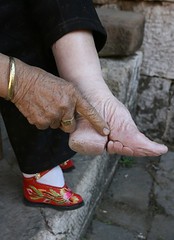
8487101078foot bindingPractice in Chinese society to mutilate women's feet in order to make them smaller; produced pain and restricted women's movement; made it easier to confine women to the household.18
8487101079tribute systemChinese method of dealing with foreign lands and people's that assumed the subordination of all non-Chinese authorities and required the payment of tribute --produce of value from their countries--to the Chinese emperor(although the Chines gifts given in return were often much more valuable).19
8487101080XiongnuA confederation of nomadic peoples living beyond the northwest frontier of ancient China. Chinese rulers tried a variety of defenses and stratagems to ward off these 'barbarians,' as they called them, and dispersed them in 1st Century. (168)20
8487101081KhitanNomadic peoples of Manchuria; militarily superior to Song dynasty China but influenced by Chinese culture; forced humiliating treaties on Song China in 11th century21
8487101082JurchenFounders of Qin kingdom that succeeded the Liao in northern China; annexed most of the Yellow River basin and forced Song to flee to south.22
8487101083Silla DynastyKorean dynasty that resisted Tang for first time. Respected China, performed kowtow, ritual bow to Chinese emperor. Studied Buddhism/Confucianism23
8487101084hanguiKorean written alphabet24
8487101085chu noma style of writing adapted from China to Vietnam. It became the basis for the development of an independent national literature.25
8487101086Shotoku TaishiWho: Prince of Japan. What: Borrowed heavily from China: writing and art (kana and ink on silk), architecture (pagoda), well-field system, etc. Also wrote the 17 point constitution. When: 573-621. Where: Japan. Why: Made changes that greatly influenced Japan and were around for centuries.26
8487101087bushido"the way of the warrior"; Japanese word for the Samurai life ; Samurai moral code was based on loyalty, chivalry, martial arts, and honor until the death27
8487101088Chinese BuddhismChina's only large-scale cultural borrowing before the 20th century. Buddhism entered China from India in the first and second centuries C.E but only became popular between 300-800 C.E through a series of cultural accommodations. At first supported by the state, Buddhism suffered persecution during the 9th century but continued to play a role in Chinese society.28
8487101089Emperor Wendia Chinese general, who secured his Emperor position by killing 59 princes of the Zhou royal house, and founded the Sui Dynasty. Presented himself as a Buddhist Cakravartin King, that is, a monarch who uses military force to defend the Buddhist faith.29
8487101090QuranThe holy book of Islam30
8487101091ummaThe community of all Muslims. A major innovation against the background of seventh-century Arabia, where traditionally kinship rather than faith had determined membership in a community.31
8487101092Pillars of IslamThe five core practices required of Muslims: a profession of faith, regular prayer, charitable giving, fasting during Ramadan, and a pilgrimage to Mecca (if physically and financially possible).32
8487101093hijraThe Migration of Muhammad from Mecca to Medina in A.D. 622, marking the founding of Islam33
8487101094shariaBody of Islamic law that includes interpretation of the Quran and applies Islamic principles to everyday life34
8487101095jizyatax paid by Christians and Jews who lived in Muslim communities to allow them to continue to practice their own religion35
8487101096ulamaMuslim religious scholars. From the ninth century onward, the primary interpreters of Islamic law and the social core of Muslim urban societies.36
8487101097Umayyad Caliphate(661-750 CE) The Islamic caliphate that established a capital at Damascus, conquered North Africa, the Iberian Pennisula, Southwest Asia, and Persia, and had a bureaucracy with only Arab Muslims able to be a part of it.37
8487101098Abbasid Caliphate(750-1258 CE) The caliphate, after the Umayyads, who focused more on administration than conquering. Had a bureaucracy that any Mulim could be a part of.38
8487101099SufismA branch of Islam, defined by adherents as the inner, mystical dimension of Islam; others contend that it is a perennial philosophy of existence that pre-dates religion, the expression of which flowered within Islam39
8487101100al-GhazaliBrilliant Islamic theologian; struggled to fuse Greek and Qur'anic traditions; not entirely accepted by ulama40
8487101101Sikhismthe doctrines of a monotheistic religion founded in northern India in the 16th century by Guru Nanak and combining elements of Hinduism and Islam41
8487101102Ibn Battuta(1304-1369) Morrocan Muslim scholar, the most widely traveled individual of his time. He wrote a detailed account of his visits to Islamic lands from China to Spain and the western Sudan. His writings gave a glimpse into the world of that time period.42
8487101103TimbuktuMali trading city that became a center of wealth and learning43
8487101104Mansa MusaRuler of Mali (r. 1312-1337). His extravagant pilgrimage through Egypt to Mecca in 1324-1325 established the empire's reputation for wealth in the Mediterranean world.44
8487101105al-AnadalusMuslim kingdom in southern Spain, established in 75645
8487101106madrassasFormal colleges for higher institutions in the teaching of Islam as well as in secular subjects founded throughout the Islamic world in beginning in the 11th century46
8487101107House of WisdomCombination library, academy, and translation center in Baghdad established in the 800s.47
8487101108Ibn SinnaHe was one of the most famous doctors of all times. He read the works of Hippocrates and Galen and improved them, by adding more accurate descriptions. He also created anatomical charts using newly invented surgical tools. His text "Cannon of Medicine" (aka "Code of Laws in Medicine") was reference source for doctors for hundreds of years following his death.48
8487101109Nubian ChristianityChristianity was introduced by traders and missionaries. Preserved Christianity for 600 years.49
8487101110NestorianTheological position of Nestorius, who allegedly taught that there are two complete natures and thus two persons, human and divine, in Jesus Christ; rejected by the Council of Ephesus (431), which taught that human nature and divine nature are united in the one person of Christ.50
8487101111Ethiopian Christianity (aka Coptic church)Rulers of axum had adopted Christianity. Christian island in a Muslim sea protected by its moutanous geography and distance from major centers of islamic power. Also helped muhammad's followers be safe. This isolation made it develop a fascination with judaism and jerusalem. Justified their rule through a connection with Solomon as a descendent of jesus. Tried to create a new jerusalem51
8487101112Byzantine Empire(330-1453) The eastern half of the Roman Empire, which survived after the fall of the Western Empire at the end of the 5th century C.E. Its capital was Constantinople, named after the Emperor Constantine.52
8487101113ConstantinopleA large and wealthy city that was the imperial capital of the Byzantine empire and later the Ottoman empire, now known as Istanbul53
8487101114JustinianByzantine emperor in the 6th century A.D. who reconquered much of the territory previously ruler by Rome, initiated an ambitious building program , including Hagia Sofia, as well as a new legal code54
8487101115caesarpapisma political-religious system where the secular ruler is also the head of the religious establishment (Byzantine Empire)55
8487101116Eastern Orthodox ChristianityEastern branch of Christianity that evolved following the division of the Roman Empire and the subsequent development of the Byzantine Empire in the east and the medieval European society in the west. The church recognized the primacy of the patriarch of Constantinople56
8487101117iconsA painting of Christ or another holy figure, used as an aid to devotion in the Byzantine and other Eastern Churches.57
8487101118Prince Vladimir of Kievconverted to Orthodox Christianity, and allowed Byzantine influence in his realm58
8487101119Kievan RusA monarchy established in present day Russia in the 6th and 7th centuries. It was ruled through loosely organized alliances with regional aristocrats from. The Scandinavians coined the term "Russia". It was greatly influenced by Byzantine59
8487101120CharlemagneKing of the Franks (r. 768-814); emperor (r. 800-814). Through a series of military conquests he established the Carolingian Empire, which encompassed all of Gaul and parts of Germany and Italy. Illiterate, though started an intellectual revival.60
8487101121Holy Roman EmpireA medieval and early modern central European Germanic empire, which often consisted of hundreds of separate Germanic and Northern Italian states. In reality it was so decentralized that it played a role in perpetuating the fragmentation of central Europe.61
8487101122Roman Catholic churchOne of three major branches of Christianity, together with the Eastern Orthodox Church, a second of the three major divisions of Christianity, arose out of the division of the Roman empire into four governmental regions. In 1054 CE Christianity was divided along that same line when the Eastern Orthodox, centered in Constantinople, and the ______ ______ ______, centered in Rome, split.62
8487101123Western ChristendomWestern Europe was on the margins of world history for most of the postclassical millennium; It was far removed from the growing world trade routes; European geography made political unity difficult; Coastlines and river systems facilitated internal exchange;63
8487101124Cecilia PenifaderThe book "A Medieval Life" by Judith Bennett is written about her. She lived from 1295-1344. Cecilia was a peasant, and her actions were exceptionally well documented in the courts of Brigstock. She amassed a substantial amount of wealth and land. Unmarried and childless, she lived as a singlewoman in Brigstock and remained close to her brothers and sisters throughout her life.64
8487101125CrusadesArmed pilgrimages to the Holy Land by Christians determined to recover Jerusalem from Muslim rule. The Crusades brought an end to western Europe's centuries of intellectual and cultural isolation.65
8487101126pastoralismA type of agricultural activity based on nomadic animal husbandry or the raising of livestock to provide food, clothing, and shelter.66
8487101127Modunleader of the Xiongnu Empires (r. 210-174 BCE) that transformed egalitarian fragmented societies into a more centralized and hierarchical political system with a divinely sanctioned ruler.67
8487101128Turks6th-10th centuries C.E. •Pastoral ethnic group that originated in northern Eurasia and spread into Central Asia and the Middle East •Had significant cultural and political interactions with China, Persia, Byzantium •Conversion to Islam 10th-14th centuries •Diffused Islam throughout Middle East, India, Anatolia(Turkey)68
8487101129Almoravid EmpireFounded in the 11th century by Muslim reformers. Its members came from a Berber group living in the western Sahara in what is today Mauritania. The movement began after devout Berber Muslims made a hajj.69
8487101130Temujinleader of the largest Mongol clans; he unites them all(plans to conquer Asia); and receives title Genghis Khan(universal ruler)70
8487101131the Mongol worldEurasia, 13th-15th centuries •50-year period of Mongol conquests across Eurasia that created the Mongol empire •Subjected huge populations to Mongol rule •Military strength allowed for rapid conquest •Mongol rule created interactions between diverse groups •Served to diffuse technology, culture, political and economic systems71
8487101132Yuan Dynasty(1279-1368 CE) The dynasty with Mongol rule in China; centralized with bureaucracy but structure is different: Mongols on top->Persian bureaucrats->Chinese bureuacrats.72
8487101133Kublai Khan(1215-1294) Grandson of Genghis Khan and founder of the Mongol Yuan Dynasty in China.73
8487101134HuleguRuler of the Ilkhan khanate; grandson of Chinggis Khan; responsible for capture and destruction of Baghdad in 125774
8487101135Khutulunmost famous daughter of Kaidu and the niece of Kublai Khan. Her father was most pleased by her abilities, and she accompanied him on military campaigns. Never married because no man could defeat her. wrestler princes75
8487101136Kipchak KhanateName given to Russia by the Mongols after they conquered it and incorporated it into the Mongol Empire in the mid-thirteenth century; known to Russians as the "Khanate of the Golden Horde."76
8487101137Paleolithic Persistencepre-1492 life in much of the Americas(especially North America); characterized by living a simple primitive lifestyle, without entering into large settlements or the iron age77
8487101138IgboNigeria's third largest group who are mostly Christian. They are located in the southeast part of Nigeria. This group has many conflicts with the Yoruba and at one point they tried to become a independent nation.78
8487101139IroquoisA later native group to the eastern woodlands. They blended agriculture and hunting living in common villages constructed from the trees and bark of the forests79
8487101140TimurSometimes known as Tamerlane, this was the Central Asian leader of a Mongol tribe who attempted to re-establish the Mongol Empire in the late 1300's. His empire included Persia (Iran) and many surrounding lands. He is the great great grandfather of Babur. who later founds the Mughal Empire in India.80
8487101141FulbeWest Africa's largest pastoral society, whose members gradually adopted Islam and took on a religious leadership role that lead to the creation of a number of new states.81
8487101142Ming DynastySucceeded Mongol Yuan dynasty in China in 1368; lasted until 1644; initially mounted huge trade expeditions to southern Asia and elsewhere, but later concentrated efforts on internal development within China.82
8487101143European Renaissancea "rebirth" of classical learning that is most often associated with the cultural blossoming of Italy is the period 1350-1500 and included Greek learning and growing secularism83
8487101144Zheng HeAn imperial eunuch and Muslim, entrusted by the Ming emperor Yongle with a series of state voyages that took his gigantic ships through the Indian Ocean, from Southeast Asia to Africa.84
8487101145Ottoman EmpireIslamic state founded by Osman in northwestern Anatolia. After the fall of the Byzantine Empire, the Ottoman Empire was based at Istanbul (formerly Constantinople) from 1453-1922. It encompassed lands in the Middle East, North Africa, the Caucasus, and eastern Europe.85
8487101146seizure of ConstantinopleConstantinople fell to army of Ottoman sultan Mehmed II "the Conqueror" in 1453, marking end of Christian Byzantium86
8487101147Safavid EmpireTurkish-ruled Iranian kingdom (1502-1722) established by Ismail Safavi, who declared Iran a Shi'ite state.87
8487101148Songhay EmpireA state located in western Africa. From the early 15th to the late 16th century, it was one of the largest Islamic empires in history.88
8487101149Mughal EmpireMuslim state (1526-1857) exercising dominion over most of India in the sixteenth and seventeenth centuries; a minority of Muslims ruled over a majority of Hindus.89
8487101150MalaccaPort city in the modern Southeast Asian country of Malaysia, founded about 1400 as a trading center on the Strait of Malacca. Also spelled Melaka.90
8487101151Aztec Empire1325-1500 CE. Also known as Mexica, the Aztecs created a powerful empire in central Mexico. Forced defeated people to provide goods and labor as tax. At its best had complex myth and religious traditions and reached amazing architectural and artistic accomplishments.91
8487101152Inca Empire(1450-1572 CE), Largest Empire ever built in South America; territory extended 2,500 miles from north to south and embraced almost all of modern Peru, most of Ecuador, much of Bolivia, and parts of Chile and Argentina; maintained effective control from the early 15th century until the coming of Europeans in the early 16th century. As the most powerful people of Andean America, the Inca dominated Andean society until the coming of Europeans; was an extremely diverse culture cause it spanned north and south rather then east and west.92

Pages

Subscribe to CourseNotes RSS

Need Help?

We hope your visit has been a productive one. If you're having any problems, or would like to give some feedback, we'd love to hear from you.

For general help, questions, and suggestions, try our dedicated support forums.

If you need to contact the Course-Notes.Org web experience team, please use our contact form.

Need Notes?

While we strive to provide the most comprehensive notes for as many high school textbooks as possible, there are certainly going to be some that we miss. Drop us a note and let us know which textbooks you need. Be sure to include which edition of the textbook you are using! If we see enough demand, we'll do whatever we can to get those notes up on the site for you!