AP Notes, Outlines, Study Guides, Vocabulary, Practice Exams and more!

Psychology: Themes and Variations Chapter 10 Vocab Flashcards

Motivation and Emotion
on pages 374 to 415

Terms : Hide Images
1147523082MotivationGoal-directed behavior.0
1147523083HomeostasisA state of psychological equilibrium or stability.1
1147523084DriveAn internal state of tension that motivates an organism to engage in activities that should reduce this tension.2
1147523085IncentiveAn external goal that has the capacity to motivate behavior.3
1147523086GlucoseA simple sugar that is an important source of energy.4
1147523087GlucostatsNeurons sensitive to glucose in the surrounding fluid.5
1147523088ObesityThe condition of being overweight.6
1147523089Body mass index (BMI)Weight (in kilograms) divided by height (in meters) squared (kg/m^2).7
1147523090Setpoint theoryThe body monitors fat cell levels to keep them (and weight) fairly stable.8
1147523091Setting-point theoryWeight tends to drift around the level at which the constellation of factors that determine food consumption and energy expenditure achieve equilibrium.9
1147523092EstrogensThe principle class of gonadal hormones in females.10
1147523093AndrogensThe principle class of gonadal hormones in males.11
1147523094Parental investmentWhat each sex has to invest - in terms of time, energy, survival risk, and forgone opportunities - to produce and nurture offspring.12
1147523095Sexual orientationA person's preference for emotional and sexual relationships with individuals of the same sex, the other sex, or either sex.13
1147523096HeterosexualsThose who seek emotional-sexual relationships with members of the other sex.14
1147523097BisexualsThose who seek emotional-sexual relationships with members of either sex.15
1147523098HomosexualsThose who seek emotional-sexual relationships with members of the same sex.16
1147523099VasocongestionThe engorgement of blood vessels.17
1147523100Refractory periodA time following orgasm during which males are largely unresponsive to further stimulation.18
1147523101Achievement motiveThe need to master difficult challenges, to outperform others, and to meet high standards of excellence.19
1147523102Emotion(1) a subjective conscious experience (the cognitive component) accompanied by (2) bodily arousal (the physiological component) and by (3) characteristic overt expressions (the behavioral component).20
1147523103Galvanic skin response (GSR)An increase in the electrical conductivity of the skin that occurs when sweat glands increase their activity.21
1147523104PolygraphA device that records autonomic fluctuations while a subject is questioned.22
1147523105Lie detectorsA device that records autonomic fluctuations while a subject is questioned.23
1147523106Display rulesNorms that regulate the appropriate expression of emotions.24
1147523107Subjective well-beingIndividuals' perceptions of their overall personal perceptions of their overall happiness and life satisfaction.25
1147523108Hedonic adaptionWhen the mental scale that people use to judge pleasantness-unpleasantness of their experiences shifts so that their neutral point, or baseline for comparison, changes.26
1147523109ArgumentOne or more premises that are used to provide support for a conclusion.27
1147523110PremisesThe reasons that are presented to persuade someone that a conclusion is true or probably true.28
1147523111AssumptionsPremises for which no proof or evidence is offered.29

Biology: Concepts and Connections, 7th Edition, Chapter 8 Flashcards

Biology: Concepts and Connections, 7th Edition
Chapter 8: The Cellular Basis of Reproduction and Inheritance.

Terms : Hide Images
1081397503Cell divisionReproduction at the cellular level, requires the duplication of chromosomes, and sorts new sets of chromosomes into the resulting pair of daughter cells.0
1081397504ChromosomesThe structures that contain most of the cells DNA1
1081397505Asexual reproductionCreation of genetically identical offspring by a single parent. (ex. Sea star species). Lone parent and each offspring have have identical genes.2
1081397506Sexual ReproductionRequires fertilization of an egg by a sperm. Testes and ovaries. Takes half of the genes from both parents.Not Identical.3
1081397507MitosisA process, The type of cell division responsible for asexual reproduction and for the growth and maintenance of multicellular organisms.4
1081397508MeiosisThe production of egg and sperm cells involves a special type of cell division. Produces haploid gametes in diploid organisms5
1081397509What function does cell division play in an amoeba? In your body?Reproduction; Growth, development, and repair.6
1081397510Prokaryotes reproduce by a cell division calledBinary Fission7
1081535248ChromatinDNA in its loose state. DNA in one cell would exceed my own height.8
1081535249As a cell prepares to divide its chromatinCoils up9
1081535250Sister ChromatidsEach chromosome that consist of two copies of DNA molecules, Creating daughter cells.10
1081535251In humans, 46 chromosomes is equal to how many chromatids?92 chromatids11
1081535252When does a chromosome consist of two identical chromatids?When the cell is preparing to divide and has duplicated its chromosomes but before the duplicates actually separate.12
1081535253What cycle multiplies cells?The cell cycle13
1081535254The process of cell division is a key component of theCell cycle14
1081535255Cell cycleAn ordered sequence of events that extends from the time a cell is first formed from a dividing parent cell until its own division into two cells15
1081535256The cell cycle consist of two main stages.A growing stage (interphase) and the actual cell division (mitotic phase)16
1081535257Interphase stagewhen the cell roughly doubles everything in its cytoplasm and precisely replicates its chromosomal DNA17
1081535258Most of the cell cycle is spent in what stage?Interphase, or growing stage about 90% of the time18
1081535259The time when a cell's metabolic activity is very high and the cell performs its various functions with the organism.Interphase, or growing stage19
1081535260Interphase can be divided into three sub phases.G1 phase (First gap), S phase, G2 phase (second gap)20
1081535261What happens in all three sub phases of the interphase stage?The cell grows.21
1081535262Chromosomes duplicate in which sub phase?S phase22
1081535263The S in S phase stands for what?Synthesis of DNA, or DNA replication23
1081535264Mitotic phaseM phase, The part of the cell cycle when the cell actually divides. Accounts for 10% of the total time required for the cell cycle.24
1081535265What phase is divided into two overlapping stages? What are the stages?Mitotic phase. Mitosis and Cytokinesis25
1081535266In mitosis, the nucleus and its contents divide and are evenly distributed formingtwo daughter nuclei26
1081535267CytokinesisBegins before mitosis ends, the cytoplasm is divided into two. Occurs along with Telophase.27
1081693350The five stages of mitosisProphase, prometaphase, metaphase, anaphase, telophase28
1081693351ProphaseWithin the nucleus, chromatin fibers become tightly coiled and folded. Cytoplasm, the mitotic spindle begins to form as microtubules rapidly grow out from the centrosomes, they begin to move away from each other29
1081693352PrometaphaseThe nuclear envelope breaks into fragments and disappears. Microtubules are now highly condensed. Centromere region, each sister chromatid have protein structure called a kinetochores.30
1081693353MetaphaseThe mitotic spindle is fully formed, poles at opposite ends. Chromosomes convene on the metaphase plate, an imaginary plane equidistant between the two poles of the spindle.31
1081693354AnaphaseBegins when the two centromeres of each chromosome come apart, separating the sister chomatids. Chromatids consider full fledged daughter chromosome.32
1081693355TelophaseThe cell elongation that started in the anaphase continues. Daughter nuclei appear at the two poles of the cell as nuclear envelopes from around the chromosomes. The reverse of prophase33
1081693356Mitotic SpindleA football-shaped structure of microtubules that guides the separation of the two sets of daughter chromosomes34
1081693357The spindle microtubules emerge from twoCentrosomes35
1081693358CentrosomesClouds of cytoplasmic material that in animal cells contain pairs of centrioles. (Microtubule-organizing centers)36
1081840520In animal cells, cytokinesis occurs by a process known asCleavage37
1081840521The first sign of cleavage is the appearance ofCleavage furrow38
1081840522Cleavage furrowa shallow indentation in the cell surface39
1081840523These proteins responsible of muscle contraction areActin and Myosin40
1081840524Cell plateDuring telophase, in plant cells, membranous vehicles containing cell wall material collect at the middle of the parent cell. The vesicles fuse forming a membranous disk.41
1081840525The cell plate growsOutward42
1081840526What factors affect cell division?Anchorage, cell density, and chemical growth43
1081840527Cells in the human liver do not divide unless the liver isDamaged44
1081840528Growth factorA protein secreted by certain body cell that stimulates other cells to divide45
1081840529Researchers have discovered how many different types of growth factors that can trigger cell division?5046
1081840530Platelet-derived growth factorThis protein promotes the rapid growth of connective tissue cells that help seal the wound47
1081840531Vascular endothelial growth factor (VEGF)Stimulates the growth of new blood vessels during fetal development and after injury48
1081840532Density-dependent inhibitionA phenomenon in which crowded cells stop dividing.49
1081840533Most animal cells exhibit _____ _____; they must be in contact with a solid surface. Ex inside of a culture dish or the extracellular matrix of a tissue to divide.Anchorage Dependence50
1081963478In a living animal, most cells are anchored in a _____ position.Fixed51
1081963479The Cell Cycle Control SystemA cyclically operating set of molecules in the cell that both triggers and coordinates key events in the cell cycle.52
1081963480At which one of the three checkpoints do the chromosomes exist as duplicated sister chromatids?G2 and M checkpoints53
1082044102Tumoran abnormally growing mass of body cells54
1082044103Benign TumorA lump of abnormal cells that remain at the original site. Can be removed by surgery.55
1082044104Malignant TumorCan spread into neighboring tissues and other parts of the body, displacing normal tissue and interrupting organ function as it goes56
1082044105An individual with a malignant tumor is said to haveCancer57
1082044106MetastasisThe spread of cancer cells beyond their original site58
1082044107How are cancers named?According to the organ or tissue in which they originate.59
1082044108Based on site of origin, cancers are grouped into four categories.Carcinomas, Sarcomas, Leukemias, and Lymphomas60
1082044109CarcinomasCancers that originate in the external or internal coverings of the body (skin, lining of the intestine)61
1082044110Sarcomasarise in tissues that support the body (bone, muscle)62
1082044111Leukemias and LymphomasCancers of blood-forming tissues (bone marrow, spleen, lymph nodes63
1082044112HydraA tiny multicellular animal that reproduces by either sexual or asexual means64
1082044113How are chromosomes matched?In homologous pairs65
1082044114Somatic cellIn humans, a typical body cell that has 46 chromosomes66
1082044115A human in what phase contains 23 sets of duplicated chromosomes.Metaphase67
1082773867In metaphase of mitosis, each chromosome contains how many chromatids?2 sister chromatids68
1082773868A human cell at metaphase contains how many sets of duplicated chromosomes?23, they occur in matched pairs69
1082773869Homologous ChromosomesChromosomes that have twins resembling its length and centromere position. Two chromosomes of matching pairs both carrying genes controlling the same inherited characteristics.70
1082773870Locus(plural- loci) A particular place on the chromosome71
1082773871What type of chromosome pairs have different versions of the same gene?Homologous72
1082773872Sex ChromosomesDetermines an individual's sex73
1082773873AutosomesThe 22 remaining pairs of chromosomes found in males and females.74
1082773874What gender has fully homologous chromosomes?Females (XX)75
1082773875Life cycleThe sequence of stages leading from the adults of one generation to the adults of the next.76
1082773876DiploidHumans, animals, many plants are considered this because all body cells contain pairs of homologous chromosomes.77
1082773877The total number of chromosomes is calledThe diploid number (2n)78
1082773878For humans the diploid number is46, 2n=4679
1082773879GametesThe sperm and egg cells80
1082773880Each _____ has a single set of chromosomes, 22 autosomes plus a sex chromosome. (X or Y)Gamete81
1082773881HaploidA cell with a single chromosome set; has only one member of each homologous pair.82
1082773882The haploid number for humans is23, n=2383
1082891635_____ are made by a special sort of cell division called _____, which occurs only in reproductive organs.Gametes, Meiosis84
1082891636_____ produce daughter cells with the same number of chromosomes as the parent cells, _____ reduces the chromosome number by half.Mitosis, meiosis.85
1082891637_____ reduces the chromosome number from diploid to haploid.Meiosis86
1082891638_____ prevents each generation from having twice as much genetic material as the generation beforeMeiosis87
1082891639All events unique to meiosis happens inMeiosis I88
1082891640TetradsSets of four chromatids, with each pair of sister chromatids joined at the centromeres89
1082891641Duplicated homologous chromosomes pair to form tetrads in what phase?Prophase I90
1082891642Tetrads are aligned at the metaphase plate in what phase?Metaphase I91
1082891643Pairs of homologous chromosomes separate, sister chromatids of each chromosome stay together in what phase?Anaphase I92
1082891644At the end of meiosis I, There are _____ cells, with each chromosome still having two _____ _____.Two, sister chromatids93
1082891645Meiosis II is virtually identical to _____ because the separate sister chromatidsMitosis94
1082891646Each daughter cell produced by meiosis II has only one ______ set of chromosomes.Haploid95
1083480570All the chromosome pairs orient independently at what phase?Metaphase I96
1083480571Chromosomes X and Y behave as a homologous pair inMeiosis97
1083480572The total number of combinations of chromosomes that meiosis can package into gametes for any species is2^n, n=haploid number98
1083480573Crossing overAn exchange of corresponding segments between nonsister chromatids of homologous chromosomes99
1083480574Chiasma(greek for cross) The sites of crossing over appear as X-shaped regions. A place where two homologous (non sister) chromatids are attached to each other.100
1083480575Crossing over begins very early in what phase of meiosis?Prophase I101
1083480576Genetic RecombinantThe production of gene combinations different from those carried by the original parental chromosomes.102
1083480577In meiosis, how many crossover events occur per chromosome pair?one to three103
1083480578Three sources of genetic variability in sexually reproducing organismsIndependent orientation of chromosomes at metaphase I, random fertilization, and crossing over during prophase I or meiosis.104
1083480579Whats ultimately responsible for genetic diversity in living organisms?Mutations105
1083650911KaryotypeA photographic inventory of an individual's chromosomes arranged in pairs. Shows them condensed and doubled as appeared in metaphase of mitosis106
1083650912What type of blood cell is used to prepare a karyotype?Lymphocytes107
1083650913Trisomy 21The basis of Down syndrome108
1083650914NondisjunctionAn occasional mishap in which the members of a chromosome pair fail to separate.109
1083650915Alterations of chromosome structure can causeBirth defects and cancer110
1083650916If a fragment of a chromosome is lost or removed, the remaining chromosome will then have a ______.Deletion111
1083650917If a fragment from one chromosome joins to a sister chromatid or homologous chromosome, it will produce a ______Duplication112
1083650918If a fragment reattaches to the original chromosome but in the reverse orientation.Inversion113
1083650919TranslocationThe attachment of a chromosomal fragment to a non homologous chromosome. May be reciprocal: two non homologous chromosomes may exchange segments114
1101680579With the exception of identical twins, siblings who have the same two biological parents are likely to look similar, but not identical, to each other because they havea similar but not identical combination of genes.115
1101680580Strictly speaking, the phrase "like begets like" refers toasexual reproduction only116
1101680581Within one chromosome, what is the relationship between the sequence of bases in DNA of one sister chromatid compared to the other?The sequences are identical.117
1101680582When animal cells are grown in a petri dish, they typically stop dividing once they have formed a single, unbroken layer on the bottom of the dish. This arrest of division is an example ofdensity-dependent inhibition.118
1101680583f a chromosome fragment breaks off and then reattaches to the original chromosome, but in the reverse direction, the resulting chromosomal abnormality is called a(n)Inversion119
1101680584Which of the following statements regarding genetic diversity is false?Genetic diversity is enhanced by mitosis.120
1101680585Which of the following statements regarding the differences between mitosis and meiosis is false?Crossing over is a phenomenon that creates genetic diversity during mitosis.121
1101680586Which of the following statements regarding prokaryotes is false?Prokaryotic chromosomes are more complex than those of eukaryotes122
1101680587Homologous chromosomes migrate to opposite poles during _____.Anaphase I123
1101680588During _____ chromosomes align single file along the equator of a haploid cell.Metaphase II124
1101680589At the end of _____ and cytokinesis, haploid cells contain chromosomes that each consist of two sister chromatids.Telophase I125
1101680590During _____ a spindle forms in a haploid cell.prophase I126
1102562755What are the three major checkpoints in a cell cycle?G1, G2, M127
1102562756When does the abnormal behavior of a cancer cell begin?When a normal cell is converted into a cancer cell128
1102562757When the cell cycle operates normally, mitosis produces genetically identical cells forgrowth, replacement of damaged and lost cells, and asexual reproduction.129
1103522345Because in meiosis, one duplication of chromosomes is followed by two divisions, each of the four daughter cells producedhas a haploid set of chromosomes and are not genetically identical130
1103522346Nonsister chromatids exchange genetic material in a processCrossing over131
1103522347Homologous chromosomes come together as pairs in a processSynapsis, In prophase I132
1103522348Tetrads align at the cell equator in which phase?Metaphase I133
1103522349, there is no chromosome duplication between the end of meiosis I and the beginning of meiosis II. T/F?True134
1103522350Genetic variation in gametes results fromIndependent orientation at metaphase I and random fertilization.135
1103522351The site of attachment and crossing over.Chiasma, Nonsister chromosomes join here136
1103522352The sources of genetic variability therefore includeCrossing over, Independent orientation of chromosomes, and Random fertilization137
1103522353Karyotypesare often produced from dividing cells arrested at metaphase of mitosis138
1103522354Nondisjunction can happen ifmeiosis I, if both members of a homologous pair go to one pole or meiosis II if both sister chromatids go to one pole.139
1103522355Klinefelter syndromeDenoted as XXY, Have a extra X chromosome, Individuals are males, but testes are abnormally small and individuals are sterile. Often includes breast enlargement, and other female body characteristics140
1103522356Turner syndromeDenoted as XO, Lacking one X chromosome, Are females and sterile because their sex organs are underdeveloped. Individuals usually have a short statue and a web of skin between the neck and shoulders141
1103522357XXXMost are normal females with an extra X chromosome142
1103522358XYYMost are normal males with an extra Y chromosome (although they tend to be taller than average)143
1103522359Chronic myelogenous leukemia (CML)is one of the most common leukemias,affects cells that give rise to white blood cells (leukocytes), and results from part of chromosome 22 switching places with a small fragment from a tip of chromosome 9.144

Biology Chapter 8: The Cellular Basis of Reproduction and Inheritance Flashcards

Biology Concepts and Connections 7e - Chapter 8: The Cellular Basis of Reproduction and Inheritance Vocabulary

Terms : Hide Images
1893692310cell divisionThe reproduction of a cell through duplication of the genome and division of the cytoplasm.0
1893692311chromosomeA threadlike, gene-carrying structure found in the nucleus of a eukaryotic cell and most visible during mitosis and meiosis. It consists of one very long piece of chromatin.1
1893692312asexual reproductionThe creation of genetically identical offspring by a single parent, without the participation of sperm and egg.2
1893692313sexual reproductionThe creation of genetically unique offspring by the fusion of two haploid sex cells (gametes), forming a diploid zygote.3
1893692314binary fissionA means of asexual reproduction in which a parent organism, often a single cell, divides into two genetically identical individuals of about equal size.4
1893692315chromatinThe combination of DNA and proteins that constitutes eukaryotic chromosomes.5
1893692316sister chromatidsTwo identical parts of a duplicated chromosome in a eukaryotic cell. Prior to mitosis, these remain attached to each other at the centromere.6
1893692317centromereThe region of a duplicated chromosome where two sister chromatids are joined and where spindle microtubules attach during mitosis and meiosis.7
1893692318cell cycleAn ordered sequence of events that extends from the time a eukaryotic cell is first formed from a dividing parent cell until its own division into two cells.8
1893692319interprhaseThe period in the eukaryotic cell cycle when the cell is not actually dividing. It constitutes the majority of the time spent in the cell cycle.9
1893692320mitotic phase (M phase)The part of the cell cycle when the nucleus divides, its chromosomes are distributed to the daughter nuclei, and the cytoplasm divides, producing two other cells.10
1893692321mitosisThe division of a single nucleus into two genetically identical nuclei. This division and cytokinesis make up the mitotic (M) phase of the cell cycle.11
1893692322cytokinesisthe division of the cytoplasm to form two seperate daughter cells. This division and mitosis make up the mitotic (M) phase of the cell cycle.12
1893692323prophaseThe first stage of mitosis, during which the chromatin condenses to form structures visible with a light microscope and the mitotic spindle begins to form, but the nucleus is still intact.13
1893692324prometaphaseThe second stage of mitosis, during which the nuclear envelope fragments and the spindle microtubuls attach to the kinetochores of the sister chromatids.14
1893692325metaphaseThe third stage of mitosis, during which all the cell's duplicated chromosomes are lined up at an imaginary plane equidistant between the poles of the mitotic spindle.15
1893692326anaphaseThe fourth stage of mitosis, beginning when sister chromatids separate from each other and ending when a complete set of daughter chromosomes arrives at each of two poles of the cell.16
1893692327telophaseThe fourth stage of mitosis, during which daughter nuclei form at the two poles of a cell. Telophase usually occurs together with cytokinesis.17
1893692328mitotic spindleA football-shaped structure formed of microtubules and associated proteins that is involved in the movement of chromosomes during mitosis and meiosis.18
1893692329centrosomeMaterial in the cytoplasm of a eukaryotic cell that gives rise to microtubules.19
1893692330cleavage furrowThe first sign of cytokinesis during cell division in an animal cell, a shallow groove in the cell surface near the old metaphase plate.20
1893692331cell plateA double membrane across the midline of a dividing plant cell, between which the new cell wall forms during cytokinesis.21
1893692332growth factora protein secreted by certain body cells that stimulates other cells to divide.22
1893692333density-dependent inhibitionThe ceasing of cell division that occurs when cells touch one another.23
1893692334anchorage dependenceThe requirement that to divide, a cell must be attached to a solid surface.24
1893692335cell cycle control systemA cyclically operating set of proteins that triggers and coordinates events in the eukaryotic cell cycle.25
1893692336tumorAn abnormal mass of rapidly growing cells that forms within otherwise normal tissue.26
1893692337benign tumorAn abnormal mass of cells that remains at its original site in the body.27
1893692338malignant tumorAn abnormal tissue mass that can spread into neighboring tissue and to other parts of the body; a cancerous tumor.28
1893692339metastasisThe spread of cancer cells beyond their original site.29
1893692340carcinomasCancer that originates in the coverings of the body, such as skin or the lining of the intestinal tract.30
1893692341sarcomasCancer of the supportive tissues, such as bone, cartilage, and muscle.31
1893692342leukemiasA type of cancer of the blood-forming tissues, characterized by an excessive production of white blood cells and an abnormally high number of them in the blood; cancer of the bone marrow calls that produce leukocytes.32
1893692343lymphomasCancer of the tissues that form white blood cells.33
1893692344somatic cellAny cell in a multicellular organism except a sperm or egg cell or a cell that develops into a sperm or egg.34
1893692345homologous chromosomesThe two chromosomes that make up a matched pair in a diploid cell. They are of the same length, centromere position, and staining pattern and posses genes for the same characteristics at corresponding loci.35
1893692346locusThe particular site where a gene is found on a chromosome. Homologous chromosomes have corresponding gene loci.36
1893692347sex chromosomesA chromosome that determines whether an individual is male or female.37
1893692348autosomesA chromosome not directly involved in determining the sex of an organism; in mammals for example, any chromosome other than X or Y.38
1893692349life cycleThe entire sequence of stages in the life of an organism, from the adults of one generation to the adults of the next.39
1893692350diploidIn an organism that reproduces sexually, a cell containing two homologous sets of chromosomes, one set inherited from each parent; a 2n cell.40
1893692351gametesA sex cell; a haploid egg or sperm. The union of these two of oppsoite sex produces a zygote.41
1893692352haploidIn the life cycle of an organism that reproduces sexually, a cell containing a single set of chromosomes; an n cell.42
1893692353fertilizationThe union of the nucleus of a sperm cell with the nucleus of an egg cell, producing a zygote.43
1893692354zygoteThe diploid fertilized egg, which results from union of a sperm cell nucleus and an egg cell nucleus.44
1893692355meiosisIn a sexually reproducing organism, the division of a single diploid nucleus into four haploid daughter nuclei. Meiosis and cytokineses produce haploid gametes from diploid cells in the reproductive organs of the parents.45
1893692356tetradsA paired set of homologous chromosomes, each composed of two sister chromatids. These form during prophase I of meiosis, when crossing over may occur.46
1893692357crossing overThe exchange of segments between chromatids of homologous chromosomes during the synapsis in prophase I of meiosis; also the exchange of segments between DNA molecules in prokaryotes.47
1893692358chiasmaThe microscopically visible site where crossing over has occurred between chromatids of homologous chromosomes during prophase I of meiosis.48
1893692359genetic recombinationThe producton, by crossing over and/or independent assortment of chromosomes during meiosis, of offspring with allele combinations different from those in the parents.49
1893692360karyotypesA display of micrographs of the metaphase chromosomes of a cell, arranged by size and centromere positionn. These may be used to identify certain chromosomal abnormalities.50
1893692361trisomy 21Down syndrome.51
1893692362Down syndromeA human genetic disorder resulting from the presence of an extra chromosome 21; characterized by hear and respiratory defects and varying degrees of mental retardation.52
1893692363nondisjunctionAn accident of meiosis or mitosis in which a pair of homologous chromosomes or a pair of sister chromatids fail to separate at anaphase.53
1893692364deletionThe loss of one or more nucleotides from a gene by mutation; the loss of a fragment of a chromosome.54
1893692365duplicationRepetition of part of a chromosome resulting from fusion with a fragment from a homologous chromosome; can result from an error in meiosis or from mutagenesis.55
1893692366translocationThe attachment of a chromosomal fragment to a nonhomologous chromosome.56
1893692367During which stage of the cell cycle is DNA copiedS phase57
1893692368Two new daughter cells are haploid and not genetically identicalTelophase & Cytokinesis I58
1893692369Daughter cells are not genetically identical to mother cell. Meiosis or Mitosis?Meiosis59
1893692370Homologous chromosomes pair up and form a tetrad.Prophase I60
1893692371Chromatin condenses into chromosomesProphase61
1893692372Crossing over may occurProphase I62
1893692373Four new daughter cells are haploid and not genetically identicalTelophase & Cytokinesis II63
1893692374Which kind of cll undergoes mitosis LEAST often?a neuron64
1893692375What limits how large a cell can grow?the ratio of its surface area to its volume65
1893692376The number of functional sperm cells produced in spermatogenesisFOUR66
1893692377How is a benign tumor different from a malignant tumor?Benign tumors do not spread; cells in a malignant tumor break away and spread to other parts of the body.67
1893692378Produces daughter cells that are diploid mitosis or meiosisMITOSIS68
1893692379Chromosomes line up on the equatorial planeMetaphase69
1893692380Daughter cells are genetically identical to mother cell mitosis or meiosisMitosis70
1893692381Nuclear envelope breaks down, centrioles separate and spindle formsProphase71
1893692382This type of division occurs in oogenesis Asymmetrical or SymmetricalAsymmetrical72
1893692383Cell plate forms in plant cellsTelophase & Cytokinesis73
1893692384Cell process where chromosome number is halved mitosis or meiosisMeiosis74
1893692385Sister chromatids are separated and pulled in opposite polesANAPHASE75
1893692386Homologous chromosomes align on the equatorial planeMetaphase I76
1893692387Nuclear membrane and 2 new nuclei begin to formTelophase & Cytokinesis77
1893692388Homologous chromosomes are separated and pulled to opposite polesAnaphase I78
18936923892 new daughter cells are diploid and genetically identicalTelophase & Cytokinesis79
1893692390How many egg cells form from a female germ cell?ONE80
1893692391This type of division occurs in spermatogenesis Asymmetrical or SymmetricalAsymmetrical81
1893692392DNADouble stranded helix that contains the genetic code82
1893692393RNARibose nucleic acid83
1893692394MitosisSomatic cell division84
1893692395MeiosisDivision of gametes85
1893692396TelomereRepeating nucleotide at the ends of DNA86
1893692397InterphaseNormal cell activity87
1893692398cell cycleRegular pattern of growth, DNA replication, and cell division88
1893692399CytokinesisCytoplasmic division89
1893692400HaploidHaving one chromosome from every pair90
1893692401DiploidTwo homologous pairs of genes91
1893692402CentromereThe point of attachment for spindle fibers92
1893692403ChromatinThe loose combination of DNA and proteins93
1893692404HistoneProtein that organized chromosomes around which DNA wraps94
1893692405ChromatidOne half of a duplicated chromosome95
1893692406ChromosomeOne long continuous thread of DNA that consists of numerous genes96
1893692407AutosomesContain genes for characteristics not directly related to sex of organism97
1893692408TetradOccurs when homologous chromosomes line up in pairs98
1893692409SynapsisExchange of genetic material99
1893692410Homologous Chromosomes2 pairs of chromosomes that have same length and general appearance100
1893692411KaryotypeIllustration of a cell's chromosomes arranged according to size101
1893692412What is the human diploid number44102
1893692413What is the human haploid number22103
1893692414Type of cell dividedMitosis = Somatic Meiosis = Gametes104
1893692415haploid or diploid???Mitosis = diploid meiosis = haploid105
1893692416# of daughter cells????mitosis= Somatic= diploid = 2n = 2 identical daughter cells meiosis = gametes = haploid = n= 4 unique daughter cells106
1893692417Genetically identical????mitosis = Yes, genetically identical meiosis = No, not genetically identical107

honors biology chapter 9: patterns of inheritance Flashcards

Terms : Hide Images
2318949196what is the theory that states: particles called pangenes travel from each part of an organism's body to the eggs or sperm and then are passed to the next generation; moreover, changes that occur in the body during an organism's life are passed on in this way.pangenesis0
2318949197"Father of genetics"Gregor Mendel1
2318949198the transmission of traits from one generation to the nextheredity2
2318949199the scientific study of hereditygenetics3
2318949200what did Mendel experiment withpeas4
2318949201why did Mendel experiment with peas?they had short generation times, produced large numbers of offspring from each mating, and came in many readily distinguishable varieties5
2318949202A heritable feature that varies among individuals, such as flower color is called a(n)character6
2318949203Each variant for a character, such as purple or white flowers, is called a(n)trait7
2318949204the most important advantage of pea plants as an experimental model wasthat Mendel could strictly control matings8
2318949205The offspring of two different varieties are calledhybrids9
2318949206The truebreeding parental plants are called the ___________, and their hybrid offspring are called the ___________.P generation (P for parental) / F1 generation (F for filial, from the Latin word for "son"10
2318949207When F1 plants self-fertilize or fertilize each other, their offspring are the __________.F2 generation11
2318949208varieties for which self-fertilization produced offspring all identical to the parenttrue-breeding varieties12
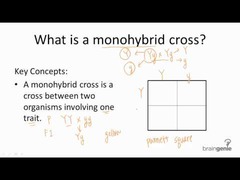
2319058398cross in which the P generation differ in only one charactermonohybrid cross13
2319102345Mendel's 4 hypotheses1. There are alternative versions of genes that account for variations in inherited characters. 2. For each character, an organism inherits two alleles, one from each parent. 3. If the two alleles of an inherited pair differ, then one determines the organism's appearance and is called the dominant allele; the other has no noticeable effect on the organism's appearance and is called the recessive allele. 4. A sperm or egg carries only one allele for each inherited character because allele pairs separate (segregate) from each other during the production of gametes.14
2319108167The alternative versions of a gene are calledalleles15
2319109762An organism that has two identical alleles for a gene is said to beHOMOZYGOUS for that gene (and is a "homozygote" for that trait).16
2319111888An organism that has two different alleles for a gene is said to beHETEROZYGOUS for that gene (and is a "heterozygote").17
2319116918Pairs of alleles segregate (separate) during gamete formation. The fusion of gametes at fertilization creates allele pairs once again.law of segregation18
2319130403physical traitsphenotype19
2319131326genetic makeupgenotype20
23191381971 PP:2 Pp:1 pp is an example of a __________ ratiogenotypic21
23191399553:1 is an example of a ___________ ratiophenotypic22
2319148976How can two plants with different genotypes for a particular inherited character be identical in phenotype?One could be homozygous for the dominant allele and the other heterozygous23
2319162537Alleles (alternative versions) of a genereside at the same locus on homologous chromosomes24
2319239851the F2 ratio for a monohybrid cross3:125
2319253055the F2 ratio for a dihybrid cross9:3:3:126
2319245972the inheritance of one character has no effect on the inheritance of anotherMendel's law of independent assortment27
2319260550Geneticists can use the ________ to determine unknown genotypestestcross28
2319269659The probability scale ranges from0 to 1.29
2319272134An event that is certain to occur has a probability of _, whereas an event that is certain not to occur has a probability of _.1;030
2319276463the probabilities of all possible outcomes for an event to occur must always add up to _131
2319280249The probability of such a compound event is the product of the probabilities of each independent eventrule of multiplication32
2319289474The probability that an event can occur in two or more alternative ways is the sum of the separate probabilities of the different ways33
2320213084traits prevailing in naturewild-type traits34
2320258179Is albinism dominant or recessiverecessive35
2320259134Is cystic fibrosis dominant or recessiverecessive36
2320260594Is achondroplasia dominant or recessivedominant37
2320266899Is galactosemia dominant or recessive38
2320267935Is Alzheimer's dominant or recessivedominant39
2320269615Is huntington's disease dominant or recessivedominant40
2320271637Is Phenylketonuria (PKU) dominant or recessiverecessive41
2320275516Is sickle-cell disease dominant or recessiverecessive42
2320277644Is hypercholesterolemia dominant or recessivedominant43
2320281122Is Tay-Sachs disease dominant or recessiverecessive44
2320285930The most common life-threatening genetic disease in the United Statescystic fibrosis45
2320322079the dominant allele has the same phenotypic effect whether present in one or two copies.complete dominance (PP looks the same as Pp)46
2320324424the appearance of F1 hybrids falls between the phenotypes of the two parental varietiesincomplete dominance47
2324980387an important tool of geneticists for determining genotypes.testcross48
2324983206individual who does not have a specific disease but has the ability to pass it on to their offspring, they are phenotypically normalcarrier49
2324986867what genetic disorder is most common in CaucasiansCystic fibrosis50
2324988068what genetic disorder is characterized by excess mucus in the lungs, digestive tract, liver; increased susceptibility to infections; death in early childhood unless untreatedcystic fibrosis51
2324992803what genetic disorder is characterized by lack of pigment in the skin, hair, and eyes, & prone to skin canceralbinism52
2324993132what genetic disorder is characterized by accumulation of galactose in tissues; mental retardation; eye and liver damagegalactosemia53
2324995018what genetic disorder is characterized by accumulation of phenylalanine in blood; lack of normal skin pigment; mental retardationPhenylketonuria (PKU)54
2324997359where is PKU common?US and Europe55
2325000869what genetic disorder is characterized by sickled (moon shaped) red blood cells; damage to many tissuessickle cell disease56
2325002221in what race is sickle cell disease the most common?African-Americans57
2325004085what genetic disorder is characterized by lipid accumulation in brain cells; mental deficiency; blindness; death in childhoodTay-Sachs disease58
2325018706in what race is Tay-Sachs disease most common?Jews from Central Europe59
2325019763What type of Alzheimer's is inheritedFamilial60
2325021405what genetic disorder usually strikes late in lifeAlzheimer's61
2325021999what genetic disorder strikes in middle ageHuntingson's disease62
2325023306What specific area in the US is cystic fibrosis commonMartha's Vineyard63
2325026770between what weeks of gestation can an amniocentesis be performed?14 and 2064
2325028481through which fetal DNA a test can you receive results the fastest, and amniocentesis or CVS?CVS65
2325032291at what week can you perform a CVSas early as the 8th week of pregnancy66
2325042002uses sound waves to produce a picture of the fetusultrasound imaging67
2325051481Incomplete dominance results inintermediate phenotypes68
2325054941most common example of incomplete dominancesnapdragon color69
2325068327example of incomplete dominance in humanshypercholesterolemia70
2325073226people who are heterozygous for _____________ are prone to atherosclerosishypercholesterolemia71
2325081324what does LDL stand forlow-density lipoprotein72
2325089158genes can be found in populations in more than two versions, known asmultiple alleles73
2325095372four phenotypes in bloodA, B, AB, O74
2325100531A person with blood phenotype A can have a genotype ofIAIA or IAi75
2325102253A person with blood phenotype B can have a genotype ofIBIB or IBi76
2325104129A person with blood phenotype AB can have a genotype ofIAIB77
2325107594A person with blood phenotype O can have a genotype ofii78
2325115762Both alleles are expressed in heterozygous individuals (IAIB), who have type AB blood, an example ofcodominance79
2325119116The A blood group has what antibodiesanti-B80
2325119955The B blood group has what antibodiesanti-A81
2325120286The AB blood group has what antibodiesnone82
2325122181The O blood group has what antibodiesanti-A and anti-B83
2325126017what blood group is the "universal donor"O84
2325126791what blood group is the "universal recipient"AB85
2325130084Maria has type O blood, and her sister has type AB blood. The girls know that both of their maternal grandparents are type A. What are the genotypes of the girls' parents?Their mother is IAi and their father is IBi86
2325141210one gene influences multiple characters, a property calledpleiotropy87
2325143191An example of pleiotropy in humans issickle-cell disease88
2325150593people with sickle-cell disease are resistant tomalaria89
2325165313the additive effects of two or more genes on a single phenotypic characterpolygenic inheritance90
2325166165the opposite of pleiotropypolygenic inheritance91
2325196397states that genes occupy specific loci (positions) on chromosomes, and it is the chromosomes that undergo segregation and independent assortment during meiosis.chromosome theory of inheritance92
2325204424Genes on the same chromosome....tend to be inherited together93
2326431812multiple alleles example in humansABO blood groups94
2324902260law of segregation occurs duringmeiosis95
2327979961example of polygenic inheritance in humansskin color96
2328154777what two human conditions can be influenced by the environmentsusceptibility to alcoholism and schizophrenia97
2328160199what did Mendel call genes?heritable factors98
2328176339genes that tend to be inherited together are calledlinked genes99
2328179556Linked genes generally do not follow Mendel's law ofindependent assortment100
2328185460Why do linked genes tend to be inherited together?Because they are located close together on the same chromosome101
2328200021The percentage of recombinants is called therecombination frequency102
2328203072what breaks linkages between genescrossing over in prophase I of meiosis103
2328226851Geneticists can use crossover data tomap genes104
2328228664a diagram of relative gene locations is called alinkage map105
2328234249determine an individual's sexsex chromosomes106
2328249816gene on the Y chromosome that plays a crucial role in gender determinationSRY gene107
2328259253A gene located on either sex chromosome is called asex-linked gene108
2328266431Human sex-linked disorders affect mostly males or females?males109
2328268629Are sex-linked genes typically on the X or Y chromosomeX110
2328270849is hemophilia a sex-linked disorder?yes111
2328275869is red-green colorblindness a sex-linked disorder?yes112
2328277143is Duchenne muscular dystrophy a sex-linked disorder?yes113
2328278756condition characterized by a progressive weakening of the muscles and loss of coordinationDuchenne muscular dystrophy114
2328282368The Y chromosome is useful in tracing ancestry becauseit is passed on virtually unchanged115

Campbell Biology 7th Edition: Chapter 9 - Patterns of Inheritance Flashcards

Terms : Hide Images
1087083141HeredityThe biological process whereby genetic factors are transmitted from one generation to the next0
1087083142GeneticsScientific study of heredity1
1087083143Gregor Mendel"Father of Genetics"2
1087083144CharacterA heritable feature that varies among individuals3
1087083145TraitEach variant of a character4
1087083146HybridsThe offspring of crosses between parents with different traits5
1087083147Genetic CrossCross-fertilization of two different varieties of an organism or two different species; hybridization6
1087083148P generationParental generation, the first two individuals that mate in a genetic cross7
1087083149F1 generationThe first generation of offspring obtained from an experimental cross of two organisms8
1087083150F2 generationAfter the self-pollenization of the F1 generation, this is produced.9
1087083151Self fertilizationFertilization in which both egg and pollen come from the same plant10
1087083152Cross-fertalizationFertilization of one plant by pollen from a different plant11
1087083153True-breedingTerm used to describe organisms that produce offspring identical to themselves if allowed to self-pollinate12
1087083154Monohybrid crossMating of two organisms that differ in only one character13
1087083155AllelesDifferent forms of a gene14
1087083156HomozygousAn organism that has two identical alleles for the same trait or gene15
1087083157HeterozygousAn organism that has two different alleles for the same trait or gene16
1087083158Dominant alleleAn allele whose trait always shows up in the organism when the allele is present17
1087083159Recessive alleleAn allele that is masked when a dominant allele is present18
1087083160Law of segregationDuring gamete formation the alleles for each gene separate from each other so that each gamete only carries one allele for each gene19
1087083161Punnett squareA chart that shows all the possible combinations of alleles that can result from a genetic cross20
1087083162PhenotypeAn organism's physical appearance, or visible traits.21
1087083163GenotypeAn organism's genetic makeup22
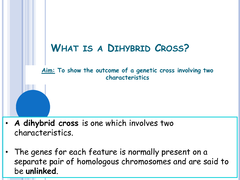
1087083164Dihybrid crossA cross between two individuals, concentrating on two definable traits23
1087126717Law of independent assortmentGenes for different characters (and on different chromosomes) are inherited independently of one another24
1087126718TestcrossBreeding an organism of unknown genotype with a recessive homozygote25
1087126719Rule of multiplicationA statistical rule stating that the probability of two independent events occuring together is the product of their individual probabilities.26
1087126720Rule of additionA statistical rule stating that the probability of either of two indpendent (and mutually exclusive) events ocuring is the sum of their individual probabilities minus the probability of them both occuring together.27
1087126721Wild-type traitsTraits prevailing in nature28
1087126722PedigreeA chart or "family tree" that tracks which members of a family have a particular trait29
1087126723Cystic FibrosisA genetic disorder that occurs in people with two copies of a certain recessive allele; characterized by an excessive secretion of mucus and consequent vulnerability to infection; fatal if untreated.30
1087126724InbreedingMatings between close blood relatives31
1087126725AchondroplasiaA form of dwarfism in which the head and torso develop normally, but the arms and legs are short32
1087126726Huntington's diseaseA human genetic disease caused by a dominant allele; characterized by uncontrollable body movements and degeneration of the nervous system; usually fatal 10 to 20 years after the onset of symptoms.33
1087126727AmniocentesisA technicque by which a small amount of the fluid that surrounds a developing baby is removed; the fluid is annalyzed to determine wheather the baby will have a genetic disorder.34
1087126728Chorionic villus sampling (CVS)Test in which a sample of placental tissue is taken from a woman's abdomen and placental tissue is aspirated thru a needle; the tissue, formed from the zygote reflects the genetic makeup of the fetus35
1087126729Ultrasound imagingA technique for examining a fetus in the uterus. High-frequency sound waves echoing off the fetus are used to produce an image of the fetus.36
1087126730Complete dominanceA relationship in which one allele is completely dominant over another37
1087126731Incomplete dominanceA pattern of inheritance in which two alleles, inherited from the parents, are neither dominant nor recessive. The resulting offspring have a phenotype that is a blending of the parental traits.38
1087126732ABO blood group3 alleles of a single gene that produce the 4 different blood types39
1087126733CodominantA heterozygote in which both alleles are fully expressed40
1087126734PleiotropyA single gene having multiple effects on an individuals phenotype41
1087126735Sickle-cell diseaseA human genetic disease caused by a recessive allele that results in the substitution of a single amino acid in the hemoglobin protein; characterized by deformed red blood cells that can lead to numerous symptoms.42
1087126736Polygenic inheritanceAn additive effect of two or more genes on a single phenotypic character.43
1087126737Chromosome theory of inheritanceGeneralization that genes are located on chromosomes and that the behavior of chromosomes during meiosis and fertilization accounts for inheritance patterns44
1088487480Linked genesGenes located close together on the same chromosomes; tend to be inherited together. Typically don't follow Mendel's law of independent assortment45
1088487481Recombination frequencyThe percentage of recombinants.46
1088487482Linkage mapGenetic map that shows the location of genes on a chromosome47
1088487483Sex chromosomesChromosomes that determine the sex of an individual; YX = Male and XX = Female48
1088487484Sex-linked geneA gene located on a sex chromosome49
1088487485HemophiliaA human genetic disease caused by a sex-linked recessive allele, characterized by excessive bleeding following injury.50
1088487486Red-green colorblindnessA sex-linked recessive allele, not able to distinguish red from green color51
1088487487Duchenne muscular dystrophyA human genetic disease caused by a sex-linked recessive allele; characterized by progressive weakening and a loss of muscle tissue.52

Campbell Biology: Ninth Edition - Chapter 14&15 Mendel and the Gene Idea Flashcards

Genetics
Vocabulary (Chapter 14): character, trait, true-breeding, homozygous, heterozygous, hybridization, Law of Segregation, alleles, dominant, recessive, Punnett square, phenotype, genotype, testcross, monohybrid cross, dihybrid cross, Law of Independent Assortment, complete dominance, incomplete dominance, codominance, Tay-Sachs disease, pleiotropy, epistasis, multiple alleles, polygenic inheritance, quantitative characters, multifactorial characters, pedigree, carriers, albinism, cystic fibrosis, sickle-cell disease, Huntington's disease, achondroplasia, amniocentesis, chorionic villus sampling (CVS)
Objectives:
After attending lectures and studying the chapter, the student should be able to:
1. Define diploid and state which cells in your body are diploid.
2. State the number of chromosomes in your diploid cells and state how many of those
chromosomes came from your father and how many came from your mother.
3. Distinguish between autosomes and sex chromosomes, state how many of each are in
your diploid cells, and state the sex-chromosome combinations that are in human males
and human females.
4. Describe an individual's karyotype.
5. Explain the relationship between genes and chromosomes.
6. Explain the relationship between genes and alleles.
7. Describe linked genes.
8. State the number of alleles you have for each gene in your diploid cells and state how
many of those alleles came from your father and how many came from your mother.
9. Distinguish between an individual's phenotype and genotype.
10. Distinguish between autosomal traits and sex-linked traits.
11. Distinguish between complete dominance, incomplete dominance, and codominance.
12. Describe the multiple allele inheritance pattern of the human ABO blood type.
13. Describe and give an example of polygenic inheritance.
14. Describe and give an example of epistasis.
15. Describe and give an example of pleiotropy.
16.

Terms : Hide Images
1812210920Concept 14.1 Mendel used the scientific approach to identify two laws of InheritanceThe Law of Segregation The Law of Independent Assortment0
1812210998CharacterAn observable heritable feature that may vary among individuals.1
1812210921TraitOne of two or more detectable variants in a genetic character.2
1812210922True-BreedingReferring to organisms that produce offspring of the same variety over many generations of self-pollination.3
1812210923hybridizationIn genetics, the mating, or crossing, of two true-breeding varieties.4
1812210924P GenerationThe true-breeding (homozygous) parent individuals from which F1 hybrid offspring are derived in studies of inheritance; P stands for "parental."5
1812210925F1 generationThe first filial, hybrid (heterozygous) offspring arising from a parental (P generation) cross.6
1812210926F2 generationThe offspring resulting from interbreeding (or self-pollination) of the hybrid FF1 generation.7
1812210999The Law of segregationMendel's first law, stating that the two alleles in a pair segregate (separate from each other) into different gametes during gamete formation.8
1812211000AlleleAny of the alternative versions of a gene that may produce distinguishable phenotypic effects.9
1812210927Dominant AlleleAn allele that is fully expressed in the phenotype of a heterozygote.10
1812210928Recessive AlleleAn allele whose phenotypic effect is not observed in a heterozygote.11
1812211001GenotypeThe genetic makeup, or set of alleles, of an organism.12
1812211002PhenotypeThe EXPRESSED/observable physical and physiological traits of an organism, which are determined by its genetic makeup.13
1812210929The Law of SegregationMendel's first law, stating that the two alleles in a pair segregate (separate from each other) into different gametes during gamete formation.14
1812211003Punnett SquareA diagram used in the study of inheritance to show the predicted genotypic results of random fertilization in genetic crosses between individuals of known genotype.15
1812211004HomozygousHaving two identical alleles for a given gene.16
1812211005HeterozygousHaving two different alleles for a given gene.17
1812211006PhenotypeExpressed. The observable physical and physiological traits of an organism, which are determined by its genetic makeup.18
1812211007GenotypeThe genetic makeup, or set of alleles, of an organism.19
1812211008TestcrossBreeding an organism of unknown genotype with a homozygous recessive individual to determine the unknown genotype. The ratio of phenotypes in the offspring reveals the unknown genotype.20
1812210930The Law of Independent AssortmentMendel's second law, stating that each pair of alleles segregates, or assorts, independently of each other pair during gamete formation; applies when genes for two characters are located on different pairs of homologous chromosomes or when they are far enough apart on the same chromosome to behave as though they are on different chromosomes.21
1812211009MonohybridsAn organism that is heterozygous with respect to a single gene of interest. All the offspring from a cross between parents homozygous for different alleles are monohybrids. For example, parents of genotypes AA and aa produce a monohybrid of genotype Aa.22
1812211010Monohybrid CrossA cross between two organisms that are heterozygous for the character being followed (or the self-pollination of a heterozygous plant).23
1812211011DihybridsAn organism that is heterozygous with respect to two genes of interest. All the offspring from a cross between parents doubly homozygous for different alleles are dihybrids. For example, parents of genotypes AABB and aabb produce a dihybrid of genotype AaBb.24
1812211012Dihybrid CrossA cross between two organisms that are each heterozygous for both of the characters being followed (or the self-pollination of a plant that is heterozygous for both characters).25
1812211013What is Mendel's Second Law?The Law of Independent Assortment. Mendel's second law, stating that each pair of alleles segregates, or assorts, independently of each other pair during gamete formation; applies when genes for two characters are located on different pairs of homologous chromosomes or when they are far enough apart on the same chromosome to behave as though they are on different chromosomes.26
1812210931Concept Check 14.1 Draw It. Pea Plants heterozygous for flower position and stem length (AaTt) are allowed to self pollinate, and 400 of the resulting seeds are planted. Draw a Punnett square for this cross. How many offspring would be predicted to have terminal flowers and be dwarf? (See Table 14.1)refer to diagram27
1812210932Concept Check 14.1 What if? List all gametes that could be made by a pea plant heterozygous for seed color, seed shape, and pod shape (YyRrIi; see Table 14.1). How large a Punnett square would you need to draw to predict the offspring of a self-pollination of this trihybrid?See table28
1812210933Concept Check 14.1 Make Connections. In some pea plant crosses, the plants are self-pollinated. Refer back to Concept 13.1 (pp. 248-249) and explain whether self-pollination is considered asexual or sexual reproduction.Asexual29
1812210934Which choice below is a basic difference between Mendel's particulate hypothesis and the hypothesis of blending inheritance? (eText Concept 14.1) The blending inheritance hypothesis, but not the particulate hypothesis, maintained that mutation is the major source of new gene combinations. The blending inheritance hypothesis, but not the particulate hypothesis, maintained that the two alleles at any given locus are always different. The blending inheritance hypothesis, but not the particulate hypothesis, maintained that the traits governed by genes in the egg are different from the traits governed by genes in the sperm. The blending inheritance hypothesis, but not the particulate hypothesis, maintained that after a mating, the genetic material provided by each of the two parents is mixed in the offspring, losing its individual identity. All of the listed responses are correct.The blending inheritance hypothesis, but not the particulate hypothesis, maintained that after a mating, the genetic material provided by each of the two parents is mixed in the offspring, losing its individual identity. The blending hypothesis maintained that the genetic material contributed by the two parents mixes in a manner analogous to the way blue and yellow paints blend to make green.30
1812210935If a plant variety is true-breeding for a dominant trait, then _____. (eText Concept 14.1) if the plant were allowed to self-pollinate, the dominant and recessive traits would consistently appear in a 3:1 ratio among the progeny the plant is heterozygous for the trait if the plant were crossed with a heterozygote, one-half of the progeny would show the dominant trait, and one-half would show the recessive trait if the plant were allowed to self-pollinate, all of the progeny would have the dominant trait the variety is unable to mutateif the plant were allowed to self-pollinate, all of the progeny would have the dominant trait31
1812210936A = big apples; R = red apples; a = small apples; r = yellow apples. You have one tree that produces big yellow apples and another tree that produces small red apples. When the two are crossed, you find that half of the new trees produce big red apples and half produce big yellow apples. What are the genotypes of the parents? (eText Concept 14.1) AArr and aaRr Aarr and aaRr AARr and Aarr AaRr and AaRr AaRr and aarrAArr and aaRr32
1812210937Assume tall (T) is completely dominant to dwarf (t) in a certain species of plant. If a homozygous dominant individual is crossed with a homozygous dwarf, the offspring will _____. (eText Concept 14.1) all be intermediate in height all be tall be 1/2 tall and 1/2 dwarf be 3/4 tall and 1/4 dwarf all be shortall be tall33
1812210938The F1 generation differed from the F2 in Mendel's experiments in that _____. (eText Concept 14.1) all of the F1 showed the dominant phenotype, whereas only half of the F2 did all of the F1 showed the dominant phenotype, but only three-fourths of the F2 did all of the F1 showed the dominant phenotype, and all of the F2 showed the recessive phenotype one-half of the F1 showed the dominant phenotype, and three-fourths of the F2 did none of the F1 showed the dominant phenotype, but one-half of the F2 didall of the F1 showed the dominant phenotype, but only three-fourths of the F2 did34
1812210939Physically, what are different alleles? (eText Concept 14.1) Different alleles are different DNA sequences found at the same locus on sister chromatids. Different alleles are different particles found in gametes. Different alleles are different phenotypes for a particular character. Different alleles are different DNA sequences found at the same locus on homologous chromosomes. None of the listed responses is correct.Different alleles are different DNA sequences found at the same locus on homologous chromosomes.35
1812210940In a certain plant, the alleles A, B, and C are completely dominant to the alleles a, b, and c. A plant with the genotype AABbcc will have the same phenotype as a plant with the genotype _____. (eText Concept 14.1) Aabbcc aabbcc AaBBcc AABBCc None of the listed responses is correct.AaBBcc36
1812210941Pea plants are tall if they have the genotype TT or Tt, and they are short if they have genotype tt. A tall plant is mated with a short plant. Which outcome below would indicate that the tall parent plant was heterozygous? (eText Concept 14.1) All of the offspring are short. All of the offspring are tall. The ratio of tall offspring to short offspring is 3:1. The ratio of tall offspring to short offspring is 1:1. There is not enough information to answer the question.The ratio of tall offspring to short offspring is 1:1.37
1812210942What is indicated when a single-character testcross yields offspring that all have the dominant phenotype? (eText Concept 14.1) The parent with the dominant phenotype was homozygous. The parent with the dominant phenotype was heterozygous. Epistasis has occurred. The alleles are codominant. Both parents are heterozygous.The parent with the dominant phenotype was homozygous.38
1812210943If an organism that is homozygous dominant is crossed with a heterozygote for that trait, the offspring will be _____. (eText Concept 14.1) all of the dominant phenotype 1/4 of the recessive phenotype all homozygous dominant all homozygous recessive present in a 9:3:3:1 ratioAll of the dominant phenotype39
1812210944In Mendel's monohybrid cross of purple-flowered and white-flowered peas, all members of the F1 generation had the _____ phenotype because their genotype was _____ at the flower-color locus. (eText Concept 14.1) white-flowered ... homozygous recessive white-flowered ... heterozygous purple-flowered ... homozygous recessive purple-flowered ... homozygous dominant purple-flowered ... heterozygouspurple-flowered ... heterozygous40
1812210945If the two traits that Mendel looked at in his dihybrid cross of smooth yellow peas with wrinkled green peas had been controlled by genes that were located near each other on the same chromosome, then the F2 generation _____. (eText Concept 14.1) would have contained four phenotypes in a 9:3:3:1 ratio would have contained only individuals that were heterozygous at both loci would have deviated from the 9:3:3:1 phenotypic ratio that is predicted by the law of independent assortment would have contained no individuals that were heterozygous at both loci None of the listed responses is correct.Would have deviated from the 9:3:3:1 phenotypic ratio that is predicted by the law of independent assortment If the two characters are located on the same chromosome, they will not segregate independently.41
1812210946In carrying out his breeding studies, Mendel examined characters that had which of the following properties? (eText Concept 14.1) They were controlled by loci that were (or behaved as if they were) on different chromosomes. It was possible to isolate true-breeding varieties for each trait. The traits varied in an either-or fashion. The characters each were controlled by a single gene. All of the listed responses are correct.All of the listed responses are correct.42
1812210947The law of independent assortment _____. (eText Concept 14.1) states that the alleles at different loci segregate independently from one another during a dihybrid cross can account for a 9:3:3:1 ratio seen in the F2 generation applies only to genes that are present on different chromosomes (or behave as if they were) The first and second answers are correct. The first, second, and third answers are correct.The first, second, and third answers are correct.43
1812210948Homologous pairs of chromosomes often _____. (eText Concept 14.1) carry different genes for different traits differ in length contain different alleles are not both present in diploid somatic cells are paired up in the G2 phase of the cell cyclecontain different alleles44
1812210949Concept 14.2 The laws of probability govern Mendelian Inheritance...45
1812210950The multiplication ruleA rule of probability stating that the probability of two or more independent events occurring together can be determined by multiplying their individual probabilities.46
1812210951The addition ruleA rule of probability stating that the probability of any one of two or more mutually exclusive events occurring can be determined by adding their individual probabilities.47
1812210952Concept 14.3 Inheritance Patterns are often more complex than predicted by simple Mendelian Genetics...48
1812210953Complete dominanceThe situation in which the phenotypes of the heterozygote and dominant homozygote are indistinguishable.49
1812211014Incomplete dominanceThe situation in which the phenotype of heterozygotes is intermediate between the phenotypes of individuals homozygous for either allele.50
1812210954CodominanceThe situation in which the phenotypes of both alleles are exhibited in the heterozygote because both alleles affect the phenotype in separate, distinguishable ways.51
1812210955Tay-Sachs DiseaseA human genetic disease caused by a recessive allele for a dysfunctional enzyme, leading to accumulation of certain lipids in the brain. Seizures, blindness, and degeneration of motor and mental performance usually become manifest a few months after birth, followed by death within a few years.52
1812210956PleiotropyThe ability of a single gene to have multiple effects.53
1812210957EpistasisA type of gene interaction in which the phenotypic expression of one gene alters that of another independently inherited gene.54
1812210958Quantitative CharactersA heritable feature that varies continuously over a range rather than in an either-or fashion.55
1812210959Polygenic InheritanceAn additive effect of two or more genes on a single phenotypic character.56
1812210960Norm of ReactionThe range of phenotypes produced by a single genotype, due to environmental influences.57
1812210961MultifactorialReferring to a phenotypic character that is influenced by multiple genes and environmental factors58
1812210962Concept 14.4 Many Human Traits Follow Mendelian Patterns of Inheritance...59
1812210963PedigreeA diagram of a family tree with conventional symbols, showing the occurrence of heritable characters in parents and offspring over multiple generations.60
1812210964CarriersIn genetics, an individual who is heterozygous at a given genetic locus for a recessively inherited disorder. The heterozygote is generally phenotypically normal for the disorder but can pass on the recessive allele to offspring.61
1812210965Cystic FibrosisA human genetic disorder caused by a recessive allele for a chloride channel protein; characterized by an excessive secretion of mucus and consequent vulnerability to infection; fatal if untreated.62
1812210966Sickle Cell DiseaseA recessively inherited human blood disorder in which a single nucleotide change in the β-globin gene causes hemoglobin to aggregate, changing red blood cell shape and causing multiple symptoms in afflicted individuals.63
1812210967Huntington's DiseaseA human genetic disease caused by a dominant allele, characterized by uncontrollable body movements and degeneration of the nervous system; usually fatal 10 to 20 years after the onset of symptoms.64
1812211015AmniocentesisA technique associated with prenatal diagnosis in which amniotic fluid is obtained by aspiration from a needle inserted into the uterus. The fluid and the fetal cells it contains are analyzed to detect certain genetic and congenital defects in the fetus.65
1812211016Chorionic Villus Sampling (CVS)A technique associated with prenatal diagnosis in which a small sample of the fetal portion of the placenta is removed for analysis to detect certain genetic and congenital defects in the fetus.66
1812210968Concept 15.1 Mendelian Inheritance has its physical basis in the behavior of chromosomes...67
1812210969Chromosome Theory of InheritanceA basic principle in biology stating that genes are located at specific positions (loci) on chromosomes and that the behavior of chromosomes during meiosis accounts for inheritance patterns.68
1812210970Wild TypeThe phenotype most commonly observed in natural populations; also refers to the individual with that phenotype.69
1812210971Concept 15.2 Sex-Linked Genes Exhibit Unique Patterns of Inheritance...70
1812210972Sex-Linked GeneA gene located on either sex chromosome. Most sex-linked genes are on the X chromosome and show distinctive patterns of inheritance; there are very few genes on the Y chromosome.71
1812210973X-Linked GenesA gene located on the X chromosome; such genes show a distinctive pattern of inheritance.72
1812210974Duchenne Muscular DystrophyA human genetic disease caused by a sex-linked recessive allele; characterized by progressive weakening and a loss of muscle tissue.73
1812210975HemophiliaA human genetic disease caused by a sex-linked recessive allele resulting in the absence of one or more blood-clotting proteins; characterized by excessive bleeding following injury.74
1812210976Barr BodyA dense object lying along the inside of the nuclear envelope in cells of female mammals, representing a highly condensed, inactivated X chromosome.75
1812210977Concept 15.3 Linked Genes Tend to be Inherited Together because they are Located near Each Other on the Same Chromosome....76
1812210978Genetic RecombinationGeneral term for the production of offspring with combinations of traits that differ from those found in either parent.77
1812210979Parental TypesAn offsprring with a phenotyp that matches one of the true-breeding parental (P generation) phenotypes; also refers to the phenotype itself.78
1812210980Recombinant Types/RecombinantsAn offspring whose phenotype differs from that of the true-breeding P generation parents; also refers to the phenotype itself.79
1812210981Crossing OverThe reciprocal exchange of genetic material between nonsister chromatids during prophase I of meiosis.80
1812210982Genetic MapAn ordered list of genetic loci (genes or other genetic markers) along a chromosome.81
1812210983Linkage mapA genetic map based on the frequencies of recombination between markers during crossing over of homologous chromosomes.82
1812210984Map UnitsA unit of measurement of the distance between genes. One map unit is equivalent to a 1% recombination frequency.83
1812210985Concept 15.4 Alterations of Chromosome Number or Structure Cause Some Genetic Disorders...84
1812210986NondisjunctionAn error in meiosis or mitosis in which members of a pair of homologous chromosomes or a pair of sister chromatids fail to separate properly from each other.85
1812210987AneuploidyA chromosomal aberration in which one or more chromosomes are present in extra copies or are deficient in number.86
1812210988MonosomicReferring to a diploid cell that has only one copy of a particular chromosome instead of the normal two.87
1812210989TrisomicReferring to a diploid cell that has three copies of a particular chromosome instead of the normal two.88
1812210990PolyploidyA chromosomal alteration in which the organism possesses more than two complete chromosome sets. It is the result of an accident of cell division.89
1812210991Deletion(1) A deficiency in a chromosome resulting from the loss of a fragment through breakage. (2) A mutational loss of one or more nucleotide pairs from a gene.90
1812210992DuplicationAn aberration in chromosome structure due to fusion with a fragment from a homologous chromosome, such taht a portion of a chromosome is duplicated.91
1812210993InversionAn aberration in chromosome structure resulting from reattachment of a chromosomal fragment in a reverse orientation to the chromosome from which it originated.92
1812210994Translocation(1) An aberration in chromosome structure resulting from attachment of a chromosomal fragment to a nonhomologous chromosome. (2) During protein synthesis, the third stage in the elongation cycle, when the RNA carrying the growing polypeptide moves from the A site to the P site on the ribosome. (3) The transport of organic nutrients in the phloem of vascular plants.93
1812210995Down SyndromeA humaan genetic disease usually caused by the presence of an extra chromosome 21; characterized by developmental delays and heart and other defects that are generally treatable or non-life threatening.94
1812210996Concept 15.5 Some Inheritance Patterns are exceptions to Standard Mendelian Inheritance...95
1812210997Genomic ImprintingA phenomenon in which expression of an allele in offspring depends on whether the allele is inherited from the male or female parent.96

Campbell's Biology, 9e (Reece et al.) Chapter 16 The Molecular Basis of Inheritance Flashcards

Because most of the new material in textbook Chapter 16 is found in Concept 16.2, most of the Test Bank questions are found in this concept section as well.

Terms : Hide Images
2479261655B) Mixing a heat-killed pathogenic strain of bacteria with a living nonpathogenic strain can convert some of the living cells into the pathogenic form.In his transformation experiments, what did Griffith observe? A) Mutant mice were resistant to bacterial infections. B) Mixing a heat-killed pathogenic strain of bacteria with a living nonpathogenic strain can convert some of the living cells into the pathogenic form. C) Mixing a heat-killed nonpathogenic strain of bacteria with a living pathogenic strain makes the pathogenic strain nonpathogenic. D) Infecting mice with nonpathogenic strains of bacteria makes them resistant to pathogenic strains. E) Mice infected with a pathogenic strain of bacteria can spread the infection to other mice.0
2479261656E) assimilation of external DNA into a cellHow do we describe transformation in bacteria? A) the creation of a strand of DNA from an RNA molecule B) the creation of a strand of RNA from a DNA molecule C) the infection of cells by a phage DNA molecule D) the type of semiconservative replication shown by DNA E) assimilation of external DNA into a cell1
2479261657D) Descendants of the living cells are also phosphorescent.DAfter mixing a heat-killed, phosphorescent strain of bacteria with a living nonphosphorescent strain, you discover that some of the living cells are now phosphorescent. Which observations would provide the best evidence that the ability to fluoresce is a heritable trait? A) DNA passed from the heat-killed strain to the living strain. B) Protein passed from the heat-killed strain to the living strain. C) The phosphorescence in the living strain is especially bright. D) Descendants of the living cells are also phosphorescent. E) Both DNA and protein passed from the heat-killed strain to the living strain.2
2479261658B) DNA contains phosphorus, whereas protein does not.In trying to determine whether DNA or protein is the genetic material, Hershey and Chase made use of which of the following facts? A) DNA contains sulfur, whereas protein does not. B) DNA contains phosphorus, whereas protein does not. C) DNA contains nitrogen, whereas protein does not. D) DNA contains purines, whereas protein includes pyrimidines. E) RNA includes ribose, whereas DNA includes deoxyribose sugars.3
2479261659D) Erwin ChargaffWhich of the following investigators was/were responsible for the following discovery? In DNA from any species, the amount of adenine equals the amount of thymine, and the amount of guanine equals the amount of cytosine. A) Frederick Griffith B) Alfred Hershey and Martha Chase C) Oswald Avery, Maclyn McCarty, and Colin MacLeod D) Erwin Chargaff E) Matthew Meselson and Franklin Stahl4
2479261660A) 8%Cytosine makes up 42% of the nucleotides in a sample of DNA from an organism. Approximately what percentage of the nucleotides in this sample will be thymine? A) 8% B) 16% C) 31% D) 42% E) It cannot be determined from the information provided.5
2479261661A) the diameter of the helixWhich of the following can be determined directly from X-ray diffraction photographs of crystallized DNA? A) the diameter of the helix B) the rate of replication C) the sequence of nucleotides D) the bond angles of the subunits E) the frequency of A vs. T nucleotides6
2479261662A) sequence of basesIt became apparent to Watson and Crick after completion of their model that the DNA molecule could carry a vast amount of hereditary information in which of the following? A) sequence of bases B) phosphate-sugar backbones C) complementary pairing of bases D) side groups of nitrogenous bases E) different five-carbon sugars7
2479261663C) A + C = G + TIn an analysis of the nucleotide composition of DNA, which of the following will be found? A) A = C B) A = G and C = T C) A + C = G + T D) G + C = T + A8
2479261664B) Prokaryotic chromosomes have a single origin of replication, whereas eukaryotic chromosomes have many.Replication in prokaryotes differs from replication in eukaryotes for which of the following reasons? A) Prokaryotic chromosomes have histones, whereas eukaryotic chromosomes do not. B) Prokaryotic chromosomes have a single origin of replication, whereas eukaryotic chromosomes have many. C) The rate of elongation during DNA replication is slower in prokaryotes than in eukaryotes. D) Prokaryotes produce Okazaki fragments during DNA replication, but eukaryotes do not. E) Prokaryotes have telomeres, and eukaryotes do not.9
2479261665B) The 5' to 3' direction of one strand runs counter to the 5' to 3' direction of the other strand.What is meant by the description "antiparallel" regarding the strands that make up DNA? A) The twisting nature of DNA creates nonparallel strands. B) The 5' to 3' direction of one strand runs counter to the 5' to 3' direction of the other strand. C) Base pairings create unequal spacing between the two DNA strands. D) One strand is positively charged and the other is negatively charged. E) One strand contains only purines and the other contains only pyrimidines.10
2479261666E) DNA in both daughter cells would be radioactive.Suppose you are provided with an actively dividing culture of E. coli bacteria to which radioactive thymine has been added. What would happen if a cell replicates once in the presence of this radioactive base? A) One of the daughter cells, but not the other, would have radioactive DNA. B) Neither of the two daughter cells would be radioactive. C) All four bases of the DNA would be radioactive. D) Radioactive thymine would pair with nonradioactive guanine. E) DNA in both daughter cells would be radioactive.11
2479261667C) 5' RNA nucleotides, DNA nucleotides 3'An Okazaki fragment has which of the following arrangements? A) primase, polymerase, ligase B) 3' RNA nucleotides, DNA nucleotides 5' C) 5' RNA nucleotides, DNA nucleotides 3' D) DNA polymerase I, DNA polymerase III E) 5' DNA to 3'12
2479261668B) No replication fork will be formed.In E. coli, there is a mutation in a gene called dnaB that alters the helicase that normally acts at the origin. Which of the following would you expect as a result of this mutation? A) No proofreading will occur. B) No replication fork will be formed. C) The DNA will supercoil. D) Replication will occur via RNA polymerase alone. E) Replication will require a DNA template from another source.13
2479261669C) DNA polymerase IIIWhich enzyme catalyzes the elongation of a DNA strand in the 5' → 3' direction? A) primase B) DNA ligase C) DNA polymerase III D) topoisomerase E) helicase14
2479261670C) gaps left at the 5' end of the lagging strandEukaryotic telomeres replicate differently than the rest of the chromosome. This is a consequence of which of the following? A) the evolution of telomerase enzyme B) DNA polymerase that cannot replicate the leading strand template to its 5' end C) gaps left at the 5' end of the lagging strand D) gaps left at the 3' end of the lagging strand because of the need for a primer E) the "no ends" of a circular chromosome15
2479261671D) adding numerous short DNA sequences such as TTAGGG, which form a hairpin turnThe enzyme telomerase solves the problem of replication at the ends of linear chromosomes by which method? A) adding a single 5' cap structure that resists degradation by nucleases B) causing specific double-strand DNA breaks that result in blunt ends on both strands C) causing linear ends of the newly replicated DNA to circularize D) adding numerous short DNA sequences such as TTAGGG, which form a hairpin turn E) adding numerous GC pairs which resist hydrolysis and maintain chromosome integrity16
2479261672E) that the critical function of telomeres must be maintainedThe DNA of telomeres has been found to be highly conserved throughout the evolution of eukaryotes. What does this most probably reflect? A) the inactivity of this DNA B) the low frequency of mutations occurring in this DNA C) that new evolution of telomeres continues D) that mutations in telomeres are relatively advantageous E) that the critical function of telomeres must be maintained17
2479261673D) 5' A C G U U A G G 3'At a specific area of a chromosome, the sequence of nucleotides below is present where the chain opens to form a replication fork: 3' C C T A G G C T G C A A T C C 5' An RNA primer is formed starting at the underlined T (T) of the template. Which of the following represents the primer sequence? A) 5' G C C T A G G 3' B) 3' G C C T A G G 5' C) 5' A C G T T A G G 3' D) 5' A C G U U A G G 3' E) 5' G C C U A G G 3'18
2479261674B) replication without separationPolytene chromosomes of Drosophila salivary glands each consist of multiple identical DNA strands that are aligned in parallel arrays. How could these arise? A) replication followed by mitosis B) replication without separation C) meiosis followed by mitosis D) fertilization by multiple sperm E) special association with histone proteins19
2479261675E) endonuclease, DNA polymerase I, DNA ligaseTo repair a thymine dimer by nucleotide excision repair, in which order do the necessary enzymes act? A) exonuclease, DNA polymerase III, RNA primase B) helicase, DNA polymerase I, DNA ligase C) DNA ligase, nuclease, helicase D) DNA polymerase I, DNA polymerase III, DNA ligase E) endonuclease, DNA polymerase I, DNA ligase20
2479261676C) to add nucleotides to the 3' end of a growing DNA strandWhat is the function of DNA polymerase III? A) to unwind the DNA helix during replication B) to seal together the broken ends of DNA strands C) to add nucleotides to the 3' end of a growing DNA strand D) to degrade damaged DNA molecules E) to rejoin the two DNA strands (one new and one old) after replication21
2479261677A) the nucleoside triphosphates have the sugar deoxyribose; ATP has the sugar ribose.The difference between ATP and the nucleoside triphosphates used during DNA synthesis is that A) the nucleoside triphosphates have the sugar deoxyribose; ATP has the sugar ribose. B) the nucleoside triphosphates have two phosphate groups; ATP has three phosphate groups. C) ATP contains three high-energy bonds; the nucleoside triphosphates have two. D) ATP is found only in human cells; the nucleoside triphosphates are found in all animal and plant cells. E) triphosphate monomers are active in the nucleoside triphosphates, but not in ATP.22
2479261678A) the leading strand is synthesized in the same direction as the movement of the replication fork, and the lagging strand is synthesized in the opposite direction.The leading and the lagging strands differ in that A) the leading strand is synthesized in the same direction as the movement of the replication fork, and the lagging strand is synthesized in the opposite direction. B) the leading strand is synthesized by adding nucleotides to the 3' end of the growing strand, and the lagging strand is synthesized by adding nucleotides to the 5' end. C) the lagging strand is synthesized continuously, whereas the leading strand is synthesized in short fragments that are ultimately stitched together. D) the leading strand is synthesized at twice the rate of the lagging strand.23
2479261679E) DNA polymerase can only add nucleotides to the free 3' end.A new DNA strand elongates only in the 5' to 3' direction because A) DNA polymerase begins adding nucleotides at the 5' end of the template. B) Okazaki fragments prevent elongation in the 3' to 5' direction. C) the polarity of the DNA molecule prevents addition of nucleotides at the 3' end. D) replication must progress toward the replication fork. E) DNA polymerase can only add nucleotides to the free 3' end.24
2479261680A) relieving strain in the DNA ahead of the replication forkWhat is the function of topoisomerase? A) relieving strain in the DNA ahead of the replication fork B) elongating new DNA at a replication fork by adding nucleotides to the existing chain C) adding methyl groups to bases of DNA D) unwinding of the double helix E) stabilizing single-stranded DNA at the replication fork25
2479261681C) It joins Okazaki fragments together.What is the role of DNA ligase in the elongation of the lagging strand during DNA replication? A) It synthesizes RNA nucleotides to make a primer. B) It catalyzes the lengthening of telomeres. C) It joins Okazaki fragments together. D) It unwinds the parental double helix. E) It stabilizes the unwound parental DNA.26
2479261682D) single-strand binding proteinsWhich of the following help(s) to hold the DNA strands apart while they are being replicated? A) primase B) ligase C) DNA polymerase D) single-strand binding proteins E) exonuclease27
2479261683D) They cannot repair thymine dimers.Individuals with the disorder xeroderma pigmentosum are hypersensitive to sunlight. This occurs because their cells are impaired in what way? A) They cannot replicate DNA. B) They cannot undergo mitosis. C) They cannot exchange DNA with other cells. D) They cannot repair thymine dimers. E) They do not recombine homologous chromosomes during meiosis.28
2479261684D) a reduction in chromosome length in gametesWhich of the following would you expect of a eukaryote lacking telomerase? A) a high probability of somatic cells becoming cancerous B) production of Okazaki fragments C) inability to repair thymine dimers D) a reduction in chromosome length in gametes E) high sensitivity to sunlight29
2479261685D) IV. DNA polymerase IWhich of the enzymes removes the RNA nucleotides from the primer and adds equivalent DNA nucleotides to the 3' end of Okazaki fragments? A) I. helicase B) II. DNA polymerase III C) III. ligase D) IV. DNA polymerase I E) V. primase30
2479261686A) I. helicaseWhich of the enzymes separates the DNA strands during replication? A) I. helicase B) II. DNA polymerase III C) III. ligase D) IV. DNA polymerase I E) V. primase31
2479261687C) III. ligaseWhich of the enzymes covalently connects segments of DNA? A) I. helicase B) II. DNA polymerase III C) III. ligase D) IV. DNA polymerase I E) V. primase32
2479261688E) V. primaseWhich of the enzymes synthesizes short segments of RNA? A) I. helicase B) II. DNA polymerase III C) III. ligase D) IV. DNA polymerase I E) V. primase33
2479261689A) double-stranded DNA, four kinds of dNTPs, primers, originsWhich of the following sets of materials are required by both eukaryotes and prokaryotes for replication? A) double-stranded DNA, four kinds of dNTPs, primers, origins B) topoisomerases, telomerases, polymerases C) G-C rich regions, polymerases, chromosome nicks D) nucleosome loosening, four dNTPs, four rNTPs E) ligase, primers, nucleases34
2479261690B) The two types of tetramers associate to form an octamer.Studies of nucleosomes have shown that histones (except H1) exist in each nucleosome as two kinds of tetramers: one of 2 H2A molecules and 2 H2B molecules, and the other as 2 H3 and 2 H4 molecules. Which of the following is supported by this data? A) DNA can wind itself around either of the two kinds of tetramers. B) The two types of tetramers associate to form an octamer. C) DNA has to associate with individual histones before they form tetramers. D) Only H2A can form associations with DNA molecules. E) The structure of H3 and H4 molecules is not basic like that of the other histones.35
2479261691D) the 30-nm chromatin fiberIn a linear eukaryotic chromatin sample, which of the following strands is looped into domains by scaffolding? A) DNA without attached histones B) DNA with H1 only C) the 10-nm chromatin fiber D) the 30-nm chromatin fiber E) the metaphase chromosome36
2479261692D) It consists of a single linear molecule of double-stranded DNA plus proteins.Which of the following statements describes the eukaryotic chromosome? A) It is composed of DNA alone. B) The nucleosome is its most basic functional subunit. C) The number of genes on each chromosome is different in different cell types of an organism. D) It consists of a single linear molecule of double-stranded DNA plus proteins. E) Active transcription occurs on heterochromatin but not euchromatin.37
2479261693B) The cell's DNA couldn't be packed into its nucleus.If a cell were unable to produce histone proteins, which of the following would be a likely effect? A) There would be an increase in the amount of "satellite" DNA produced during centrifugation. B) The cell's DNA couldn't be packed into its nucleus. C) Spindle fibers would not form during prophase. D) Amplification of other genes would compensate for the lack of histones. E) Pseudogenes would be transcribed to compensate for the decreased protein in the cell.38
2479261694B) Histone H1 is not present in the nucleosome bead; instead, it draws the nucleosomes together.Which of the following statements is true of histones? A) Each nucleosome consists of two molecules of histone H1. B) Histone H1 is not present in the nucleosome bead; instead, it draws the nucleosomes together. C) The carboxyl end of each histone extends outward from the nucleosome and is called a "histone tail." D) Histones are found in mammals, but not in other animals or in plants or fungi. E) The mass of histone in chromatin is approximately nine times the mass of DNA.39
2479261695A) Histones are positively charged, and DNA is negatively charged.Why do histones bind tightly to DNA? A) Histones are positively charged, and DNA is negatively charged. B) Histones are negatively charged, and DNA is positively charged. C) Both histones and DNA are strongly hydrophobic. D) Histones are covalently linked to the DNA. E) Histones are highly hydrophobic, and DNA is hydrophilic.40
2479261696A) nucleosome, 30-nm chromatin fiber, looped domainWhich of the following represents the order of increasingly higher levels of organization of chromatin? A) nucleosome, 30-nm chromatin fiber, looped domain B) looped domain, 30-nm chromatin fiber, nucleosome C) looped domain, nucleosome, 30-nm chromatin fiber D) nucleosome, looped domain, 30-nm chromatin fiber E) 30-nm chromatin fiber, nucleosome, looped domain41
2479261697C) Heterochromatin is highly condensed, whereas euchromatin is less compact.Which of the following statements describes chromatin? A) Heterochromatin is composed of DNA, whereas euchromatin is made of DNA and RNA. B) Both heterochromatin and euchromatin are found in the cytoplasm. C) Heterochromatin is highly condensed, whereas euchromatin is less compact. D) Euchromatin is not transcribed, whereas heterochromatin is transcribed. E) Only euchromatin is visible under the light microscope.42
2479261698D) DIn the late 1950s, Meselson and Stahl grew bacteria in a medium containing "heavy" nitrogen (15N) and then transferred them to a medium containing 14N. Which of the results in the figure above would be expected after one round of DNA replication in the presence of 14N? A) A B) B C) C D) D E) E43
2479261699B) BA space probe returns with a culture of a microorganism found on a distant planet. Analysis shows that it is a carbon-based life-form that has DNA. You grow the cells in 15N medium for several generations and then transfer them to 14N medium. Which pattern in the figure above would you expect if the DNA was replicated in a conservative manner? A) A B) B C) C D) D E) E44
2479261700D) Replication is not conservative.Once the pattern found after one round of replication was observed, Meselson and Stahl could be confident of which of the following conclusions? A) Replication is semi-conservative. B) Replication is not dispersive. C) Replication is not semi-conservative. D) Replication is not conservative. E) Replication is neither dispersive nor conservative.45
2479261701A) There are two replication forks going in opposite directions.In an experiment, DNA is allowed to replicate in an environment with all necessary enzymes, dATP, dCTP, dGTP, and radioactively labeled dTTP (3H thymidine) for several minutes and then switched to nonradioactive medium. It is then viewed by electron microscopy and autoradiography. The figure above represents the results. Which of the following is the most likely interpretation? A) There are two replication forks going in opposite directions. B) Thymidine is only being added where the DNA strands are furthest apart. C) Thymidine is only added at the very beginning of replication. D) Replication proceeds in one direction only.46
2479261702E) Amino acids (and thus proteins) also have nitrogen atoms; thus, the radioactivity would not distinguish between DNA and proteins.For a science fair project, two students decided to repeat the Hershey and Chase experiment, with modifications. They decided to label the nitrogen of the DNA, rather than the phosphate. They reasoned that each nucleotide has only one phosphate and two to five nitrogens. Thus, labeling the nitrogens would provide a stronger signal than labeling the phosphates. Why won't this experiment work? A) There is no radioactive isotope of nitrogen. B) Radioactive nitrogen has a half-life of 100,000 years, and the material would be too dangerous for too long. C) Avery et al. have already concluded that this experiment showed inconclusive results. D) Although there are more nitrogens in a nucleotide, labeled phosphates actually have 16 extra neutrons; therefore, they are more radioactive. E) Amino acids (and thus proteins) also have nitrogen atoms; thus, the radioactivity would not distinguish between DNA and proteins.47
2479261703A) leading strands and Okazaki fragments.You briefly expose bacteria undergoing DNA replication to radioactively labeled nucleotides. When you centrifuge the DNA isolated from the bacteria, the DNA separates into two classes. One class of labeled DNA includes very large molecules (thousands or even millions of nucleotides long), and the other includes short stretches of DNA (several hundred to a few thousand nucleotides in length). These two classes of DNA probably represent A) leading strands and Okazaki fragments. B) lagging strands and Okazaki fragments. C) Okazaki fragments and RNA primers. D) leading strands and RNA primers. E) RNA primers and mitochondrial DNA.48
2479261704C) some substance from pathogenic cells was transferred to nonpathogenic cells, making them pathogenic.In his work with pneumonia-causing bacteria and mice, Griffith found that A) the protein coat from pathogenic cells was able to transform nonpathogenic cells. B) heat-killed pathogenic cells caused pneumonia. C) some substance from pathogenic cells was transferred to nonpathogenic cells, making them pathogenic. D) the polysaccharide coat of bacteria caused pneumonia. E) bacteriophages injected DNA into bacteria.49
2479261705C) DNA polymerase can join new nucleotides only to the 3' end of a growing strand.What is the basis for the difference in how the leading and lagging strands of DNA molecules are synthesized? A) The origins of replication occur only at the 5' end. B) Helicases and single-strand binding proteins work at the 5' end. C) DNA polymerase can join new nucleotides only to the 3' end of a growing strand. D) DNA ligase works only in the 3' → 5' direction. E) Polymerase can work on only one strand at a time.50
2479261706B) A + G = C + TIn analyzing the number of different bases in a DNA sample, which result would be consistent with the base-pairing rules? A) A = G B) A + G = C + T C) A + T = G + T D) A = C E) G = T51
2479261707D) depends on the action of DNA polymerase.The elongation of the leading strand during DNA synthesis A) progresses away from the replication fork. B) occurs in the 3' → 5' direction. C) produces Okazaki fragments. D) depends on the action of DNA polymerase. E) does not require a template strand.52
2479261708C) histones.In a nucleosome, the DNA is wrapped around A) polymerase molecules. B) ribosomes. C) histones. D) a thymine dimer. E) satellite DNA.53
2479261709D) one low-density and one intermediate-density bandE. coli cells grown on 15N medium are transferred to 14N medium and allowed to grow for two more generations (two rounds of DNA replication). DNA extracted from these cells is centrifuged. What density distribution of DNA would you expect in this experiment? A) one high-density and one low-density band B) one intermediate-density band C) one high-density and one intermediate-density band D) one low-density and one intermediate-density band E) one low-density band54
2479261710B) DNA ligaseA biochemist isolates, purifies, and combines in a test tube a variety of molecules needed for DNA replication. When she adds some DNA to the mixture, replication occurs, but each DNA molecule consists of a normal strand paired with numerous segments of DNA a few hundred nucleotides long. What has she probably left out of the mixture? A) DNA polymerase B) DNA ligase C) nucleotides D) Okazaki fragments E) primase55
2479261711A) nuclease, DNA polymerase, DNA ligaseThe spontaneous loss of amino groups from adenine in DNA results in hypoxanthine, an uncommon base, opposite thymine. What combination of proteins could repair such damage? A) nuclease, DNA polymerase, DNA ligase B) telomerase, primase, DNA polymerase C) telomerase, helicase, single-strand binding protein D) DNA ligase, replication fork proteins, adenylyl cyclase E) nuclease, telomerase, primase56

Biology Chapter 8: The Cellular Basis of Reproduction and Inheritance Flashcards

Biology Concepts and Connections 7e - Chapter 8: The Cellular Basis of Reproduction and Inheritance Vocabulary

Terms : Hide Images
695073615cell divisionThe reproduction of a cell through duplication of the genome and division of the cytoplasm.0
695073616chromosomeA threadlike, gene-carrying structure found in the nucleus of a eukaryotic cell and most visible during mitosis and meiosis. It consists of one very long piece of chromatin.1
695073617asexual reproductionThe creation of genetically identical offspring by a single parent, without the participation of sperm and egg.2
695073618sexual reproductionThe creation of genetically unique offspring by the fusion of two haploid sex cells (gametes), forming a diploid zygote.3
695073619binary fissionA means of asexual reproduction in which a parent organism, often a single cell, divides into two genetically identical individuals of about equal size.4
695073620chromatinThe combination of DNA and proteins that constitutes eukaryotic chromosomes.5
695073621sister chromatidsTwo identical parts of a duplicated chromosome in a eukaryotic cell. Prior to mitosis, these remain attached to each other at the centromere.6
695073622centromereThe region of a duplicated chromosome where two sister chromatids are joined and where spindle microtubules attach during mitosis and meiosis.7
695073623cell cycleAn ordered sequence of events that extends from the time a eukaryotic cell is first formed from a dividing parent cell until its own division into two cells.8
695073624interprhaseThe period in the eukaryotic cell cycle when the cell is not actually dividing. It constitutes the majority of the time spent in the cell cycle.9
695073625mitotic phase (M phase)The part of the cell cycle when the nucleus divides, its chromosomes are distributed to the daughter nuclei, and the cytoplasm divides, producing two other cells.10
695073626mitosisThe division of a single nucleus into two genetically identical nuclei. This division and cytokinesis make up the mitotic (M) phase of the cell cycle.11
695073627cytokinesisthe division of the cytoplasm to form two seperate daughter cells. This division and mitosis make up the mitotic (M) phase of the cell cycle.12
695073628prophaseThe first stage of mitosis, during which the chromatin condenses to form structures visible with a light microscope and the mitotic spindle begins to form, but the nucleus is still intact.13
695073629prometaphaseThe second stage of mitosis, during which the nuclear envelope fragments and the spindle microtubuls attach to the kinetochores of the sister chromatids.14
695073630metaphaseThe third stage of mitosis, during which all the cell's duplicated chromosomes are lined up at an imaginary plane equidistant between the poles of the mitotic spindle.15
695073631anaphaseThe fourth stage of mitosis, beginning when sister chromatids separate from each other and ending when a complete set of daughter chromosomes arrives at each of two poles of the cell.16
695073632telophaseThe fourth stage of mitosis, during which daughter nuclei form at the two poles of a cell. Telophase usually occurs together with cytokinesis.17
695073633mitotic spindleA football-shaped structure formed of microtubules and associated proteins that is involved in the movement of chromosomes during mitosis and meiosis.18
695073634centrosomeMaterial in the cytoplasm of a eukaryotic cell that gives rise to microtubules.19
695073635cleavage furrowThe first sign of cytokinesis during cell division in an animal cell, a shallow groove in the cell surface near the old metaphase plate.20
695073636cell plateA double membrane across the midline of a dividing plant cell, between which the new cell wall forms during cytokinesis.21
695073637growth factora protein secreted by certain body cells that stimulates other cells to divide.22
695073638density-dependent inhibitionThe ceasing of cell division that occurs when cells touch one another.23
695073639anchorage dependenceThe requirement that to divide, a cell must be attached to a solid surface.24
695073640cell cycle control systemA cyclically operating set of proteins that triggers and coordinates events in the eukaryotic cell cycle.25
695073641tumorAn abnormal mass of rapidly growing cells that forms within otherwise normal tissue.26
696862390benign tumorAn abnormal mass of cells that remains at its original site in the body.27
696862391malignant tumorAn abnormal tissue mass that can spread into neighboring tissue and to other parts of the body; a cancerous tumor.28
696862392metastasisThe spread of cancer cells beyond their original site.29
696862393carcinomasCancer that originates in the coverings of the body, such as skin or the lining of the intestinal tract.30
696862394sarcomasCancer of the supportive tissues, such as bone, cartilage, and muscle.31
696862395leukemiasA type of cancer of the blood-forming tissues, characterized by an excessive production of white blood cells and an abnormally high number of them in the blood; cancer of the bone marrow calls that produce leukocytes.32
696862396lymphomasCancer of the tissues that form white blood cells.33
696862397somatic cellAny cell in a multicellular organism except a sperm or egg cell or a cell that develops into a sperm or egg.34
696862398homologous chromosomesThe two chromosomes that make up a matched pair in a diploid cell. They are of the same length, centromere position, and staining pattern and posses genes for the same characteristics at corresponding loci.35
696862399locusThe particular site where a gene is found on a chromosome. Homologous chromosomes have corresponding gene loci.36
696862400sex chromosomesA chromosome that determines whether an individual is male or female.37
696862401autosomesA chromosome not directly involved in determining the sex of an organism; in mammals for example, any chromosome other than X or Y.38
696862402life cycleThe entire sequence of stages in the life of an organism, from the adults of one generation to the adults of the next.39
696862403diploidIn an organism that reproduces sexually, a cell containing two homologous sets of chromosomes, one set inherited from each parent; a 2n cell.40
696862404gametesA sex cell; a haploid egg or sperm. The union of these two of oppsoite sex produces a zygote.41
696862405haploidIn the life cycle of an organism that reproduces sexually, a cell containing a single set of chromosomes; an n cell.42
696862406fertilizationThe union of the nucleus of a sperm cell with the nucleus of an egg cell, producing a zygote.43
696862407zygoteThe diploid fertilized egg, which results from union of a sperm cell nucleus and an egg cell nucleus.44
696862408meiosisIn a sexually reproducing organism, the division of a single diploid nucleus into four haploid daughter nuclei. Meiosis and cytokineses produce haploid gametes from diploid cells in the reproductive organs of the parents.45
696862409tetradsA paired set of homologous chromosomes, each composed of two sister chromatids. These form during prophase I of meiosis, when crossing over may occur.46
696862410crossing overThe exchange of segments between chromatids of homologous chromosomes during the synapsis in prophase I of meiosis; also the exchange of segments between DNA molecules in prokaryotes.47
696862411chiasmaThe microscopically visible site where crossing over has occurred between chromatids of homologous chromosomes during prophase I of meiosis.48
696862412genetic recombinationThe producton, by crossing over and/or independent assortment of chromosomes during meiosis, of offspring with allele combinations different from those in the parents.49
696862413karyotypesA display of micrographs of the metaphase chromosomes of a cell, arranged by size and centromere positionn. These may be used to identify certain chromosomal abnormalities.50
696862414trisomy 21Down syndrome.51
696862415Down syndromeA human genetic disorder resulting from the presence of an extra chromosome 21; characterized by hear and respiratory defects and varying degrees of mental retardation.52
696862416nondisjunctionAn accident of meiosis or mitosis in which a pair of homologous chromosomes or a pair of sister chromatids fail to separate at anaphase.53
696862417deletionThe loss of one or more nucleotides from a gene by mutation; the loss of a fragment of a chromosome.54
696862418duplicationRepetition of part of a chromosome resulting from fusion with a fragment from a homologous chromosome; can result from an error in meiosis or from mutagenesis.55
696862419translocationThe attachment of a chromosomal fragment to a nonhomologous chromosome.56

Campbell Biology 10th Edition Chapters 8 & 9 - Exam IIB Flashcards

Terms : Hide Images
2720522465C6H12O6 + 6O2 ---> 6CO2 + 6H2O + 30->32 ATPThe equation for cellular respiration0
2720522466C6H12O6The molecular formula for glucose as it appears in the equation for CR1
27205224676O2The molecular formula for oxygen as it appears in the equation for CR2
27205224686CO2The molecular formula for carbon dioxide as it appears in the equation for CR3
27205224696H2OThe molecular formula for water as it appears in the equation for CR4
2720522470CytosolGlycolysis occurs in the _______.5
2720522471AnaerobicGlycolysis is an (anaerobic/aerobic) reaction.6
2720522472PyruvateIn glycolysis, glucose splits in half to form two molecules of ________.7
2720522473Acetyl CoAIn the second stage of CR, which occurs in the mitochondrial matrix, pyruvate is oxidized, losing an electron and converted to ______ ___.8
2720522474Mitochondrial matrixThe Citric Acid Cycle occurs in the _____________ _______.9
2720522475Substrate level phosphorylationThe enzymatic addition of a phosphate to ADP to make ATP, which occurs during CR stages 1 and 3, is called _________ _____ _______________.10
2720522476Oxidative phosphorylationThe production of ATP using energy derived from the redox reactions of an Electron Transport Chain is called __________ _______________.11
2720522477OxidationThe loss of an electron is called _________.12
2720522478ReductionThe gain of an electron is called _________.13
2720522479Redox reactionsThe gain and loss of electrons in a series of reactions is called _____ _________.14
2720522480ExergonicThe flow of energy in the ETC is (exergonic/endergonic)?15
2720522481OxidationDecarboxylation is a form of _________.16
2720522482NADHNAD+ is a stored coenzyme. Hydrogen from glucose bonds with it to form ____ in oxidation.17
2720522483OxidizedIn CR, C6H12O6 is ________ to form 6CO2.18
2720522484ReducedIn CR, 6O2 is _______ to form 6H2O.19
2720522485Electron carriersNAD+ and FAD are ________ ________ which pick up hydrogens and transport them to the ETC.20
27205224862The net gain of ATP in Glycolysis is _.21
27205224870The net gain of ATP in Oxidation of Pyruvate is _.22
27205224882The net gain of ATP in the Citric Acid Cycle is _.23
272052248926-28The net gain of ATP in the Electron Transport Chain is __.24
2720522490GlucoseThe initial substrate in glycolysis, which will be catabolized in a series of reactions in the pathway, is _______.25
2720522491ATP___ stored in cells is used to initiate glycolysis.26
2720522492Hydrolysis and phosphorylationGlycolysis - and all of CR - begins with ATP ___________ ___ _______________.27
2720522493PhosphateWhen ATP is hydrolyzed, glucose receives a _________ from stored ADP to form Glucose 6 - Phosphate.28
2720522494Carbon 6Phosphorylation takes place on ______ _.29
2720522495Kinases_______ are the enzymes that function in phosphorylation30
2720522496Dehydrogenases_____________ are the enzymes that remove hydrogen during CR.31
2720522497NAD+In steps 5 and 6 of glycolysis, glucose intermediates are oxidized and stored and ____ is reduced to NADH by accepting an electron.32
2720522498NADH, Pyruvate, and 2 ATPThe three main products of glycolysis are: ____, ________, and _ ___.33
2720522499Acetyl CoAOxidation of pyruvate is primarily concerned with making ______ ___.34
2720522500Transport proteinsIn the second stage of CR, O2 activates _________ ________ in the mitochondrial membrane to bring pyruvate into the mitochondrial matrix.35
2720522501DecarboxylationIn stage 2, pyruvate goes through _______________ with the removal of ---COOH.36
2720522502CO2During the decarboxylation of pyruvate, ---COO is given off as ___.37
2720522503NADHDuring the decarboxylation of pyruvate, the e- from H bonds with stored NAD+ to form ____.38
2720522504Acetyl CoAPost-decarboxylation and reduction of NAD+ to NADH, the 2-Carbon fragments remaining bind with coenzyme A (a molecule in the mitochondria) to form ______ ___.39
2720522505CO2, NADH, and Acetyl CoAThe main products of stage two are ___, ____, and ______ ___.40
2720522506CitrateThe citric acid cycle (CAC) begins when acetate, a 2 carbon compound from acetyl CoA, combines with oxaloacetate, a 4 carbon compound from the cyclic series of the reaction, to form _______.41
2720522507CO2Cycles 2 through 4 are when ___ is released through decarboxylation.42
2720522508Succinyl CoAIn the CAC, phosphate from ________ ___ goes through a series of reactions before binding with stored ADP to make ATP in substrate level phosphorylation.43
2720522509Succinyl CoAThe substrate in substrate level phosphorylation that occurs in the CAC is ________ ___.44
2720522510CO2, NADH, FADH2, and 2 ATP.The 4 main products of the CAC are ___, ____, _____, and _ ___.45
2720522511Transport proteinIn the CR, ATP synthase acts as both an enzyme and a _________ _______.46
2720522512ATPAs an enzyme, ATP synthases catalyzes the production of ___.47
2720522513H+ ionsAs a transport protein, ATP synthase moves __ ____ from the inter-membrane space into the mitochondrial matrix.48
2720522514Oxidative phosphorylationIn the ETC, ATP is produced by _________ _______________.49
2720522515ChemiosmosisA term used to depict an energy coupling process50
2720522516Proton pumpsThe energy from the exergonic flow of electrons down the ETC (redox reactions) is used to move H+ ions against their concentration gradient from the matrix to the intermembrane space via the activation of ______ _____.51
2720522517NADH and FADH2The input substrates of the ETC are ____ and _____.52
2720522518OxidizedIn the ETC, NADH and FADH2 are ________ and release H that dissociates into H+ and e- in the matrix.53
2720522519IncreasesElectronegativity _________ as the e- from dissociated NADH and FADH2 move down the ETC.54
2720522520ReleasedAs e- move down the ETC, energy is ________.55
2720522521H+ ionsA protein complex (proton pump) absorbs energy from the flow of e- down the ETC to push __ ____ from the matrix to the intermembrane space against the concentration gradient.56
2720522522Potential energyA collection of H+ ions in the intermembrane space creates a H+ ion gradient. This electrochemical gradient stores a lot of _________ ______.57
2720522523ATP synthaseH+ ions move down their concentration gradient from intermembrane space to matrix via ___ ________ as a transport protein.58
2720522524ADP and PiReleased energy is absorbed by ATP synthase which stimulates the active site of the enzyme for binding of stored ___ and __ to produce ATP.59
2720522525Enzymatic membrane proteinThe role of ATP in the final part of the ETC is as an _________ ________ _______.60
2720522526ExergonicCatabolism (such as cellular respiration) is an _________ reaction (refers to whether energy is released or absorbed/required).61
2720522527EndergonicAnabolism (such as photosynthesis) is an __________ reaction (refers to whether energy is released or absorbed/required).62
2720522528- Delta GIn an exergonic reaction, such as cellular respiration, there is what kind of net change in energy?63
2720522529+ Delta GIn an endergonic reaction, such as photosynthesis, there is what kind of net change in energy?64
2720522530HydrolysisWhen a water molecule is used to break apart chemical bonds (catabolism).65
2720522531Dehydration synthesisWhen a chemical bond is formed between a monomer and another monomer, creating water (anabolism).66
2720522532Metabolic pathwayThe sequence of conversions in the metabolic process67
2720522533Low qualityEnergy naturally flows from high quality to ___ _______.68
2720522534IncreasesAs energy decreases, entropy _________.69
2720522535RandomHeat is energy in its most ______ form.70
2720522536IsothermicTo use heat as energy you must be able to transfer it to another (cooler) object (think of dropping cold eggs into boiling water; the water stops boiling for a moment while it transfers heat to the eggs). Cells cannot use this type of transferred heat because they are __________.71
2720522537Free energyThe fourth type of energy, what is available for cellular work heat has been factored out from the system's total energy, is ____ ______.72
2720522538HydrolysisATP works in cellular respiration through two processes. The first, in which ATP is catabolized into ADP and Pi (inorganic phosphate), is __________.73
2720522539PhosphorylationATP works in cellular respiration through two processes. The second, in which a phosphate is added to stored ADP, is called _______________.74
2720522540Enzyme Substrate ComplexWhen an enzyme and substrate come together at the active site, that is called the ______ _________ _______.75
2720522541Induced fit modelThe _______ ___ _____ for creating the enzyme substrate complex is different from the lock and key model in that it means the enzyme itself conforms slightly to fit the substrate.76
2720522542Competitive inhibitorA ___________ _________ resembles the normal substrate in structure and reduces the productivity of enzymes by competing for the active site.77
2720522543Non-competitive inhibitorA _______________ _________ does not directly compete with substrates but binds to an allosteric site, distorting the shape of an enzyme and thereby affecting its function.78
2720522544AllostericIn the negative feedback mechanism of enzyme activity, a product binds to an __________ site in the first enzyme of a biological pathway.79
2720522545Co-factorInorganic, non-protein helper molecule that activates binding mechanism and is required for the protein's activity. It assists in biochemical reactions and is associated with the active site.80
2720522546Co-enzymeOrganic non-protein compounds required by certain enzymes to active the binding mechanism, which binds to the active site and participate in catalysis.81
2720522547DenatureExtreme environmental conditions (such as temperature and pH) can ________ enzymes, changing their shape and affecting function.82

Campbell Biology; Tenth Edition; Chapter 8; An Introduction to Metabolism Flashcards

Key Concepts:

• An organism's metabolism transforms matter and energy, subject to the laws of thermodynamics.
• The free-energy change of a reaction tells us whether or not the reaction occurs spontaneously.
• ATP powers cellular work by coupling exergonic reactions to endergonic reactions.
• Enzymes speed up metabolic reactions by lowering energy barriers.
• Regulation of enzyme activity helps control metabolism.

Terms : Hide Images
1783889182Activation Energythe amount of energy that reactants must absorb before a chemical reaction will start; also called free energy of activation0
1783889183Active Sitethe specific region of an enzyme that binds the substrate and that forms the pocket in which catalysis occurs1
1785813099Adenosine Triphosphatesee ATP2
1785813100Allosteric Regulationthe binding of a regulatory molecule to a protein at one site that affects the function of the protein at a different site3
1785813101Anabolic Pathwaya metabolic pathway that consumes energy to synthesize a complex molecule from simpler molecules4
1785813102ATP (Adenosine Triphosphate)an adenine-containing nucleoside triphosphate that releases free energy when its phosphate bonds are hydrolyzed; this energy is used to drive endergonic reactions in cells5
1785813103Catabolic Pathwaya metabolic pathway that releases energy by breaking down complex molecules to simpler molecules6
1785813104Catalysta chemical agent that selectively increases the rate of a reaction without being consumed by the reaction7
1785813105Chemical Energyenergy available in molecules for release in a chemical reaction; a form of potential energy8
1785813106Coenzymean organic molecule serving as a cofactor; most vitamins function as coenzymes in metabolic reactions9
1785813107Cofactorany nonprotein molecule or ion that is required for the proper functioning of an enzyme; cofactors can be permanently bound to the active site or may bind loosely and reversibly, along with the substrate, during catalysis10
1785813108Competitive Inhibitora substance that reduces the activity of an enzyme by entering the active site in place of the substrate, whose structure it mimics11
1785813109Cooperativitya kind of allosteric regulation whereby a shape change in one subunit of a protein caused by substrate binding is transmitted to all the other subunits, facilitating binding of additional substrate molecules to those subunits12
1785813110Endergonic Reactiona nonspontaneous chemical reaction in which free energy is absorbed from the surroundings13
1785813111Energythe capacity to cause change, especially to do work (to move matter against an opposing force)14
1785813112Energy Couplingin cellular metabolism, the use of energy released from an exergonic reaction to drive an endergonic reaction15
1785813113Entropya measure of disorder, or randomness16
1785813114Enzymea macromolecule serving as a catalyst, a chemical agent that increases the rate of a reaction without being consumed by the reaction; most enzymes are proteins17
1785813115Exergonic Reactiona spontaneous chemical reaction in which there is a net release of free energy18
1785813116Feedback Inhibitiona method of metabolic control in which the end product of a metabolic pathway acts as an inhibitor of an enzyme within that pathway19
1785813117First Law of Thermodynamicsthe principle of conservation of energy: energy can be transferred and transformed, but it cannot be created or destroyed20
1785813118Free Energythe portion of a biological system's energy that can perform work when temperature and pressure are uniform throughout the system; the change in free energy of a system (ΔG) is calculated by the equation ΔG = ΔH − TΔS, where ΔH is the change in enthalpy (in biological systems, equivalent to total energy), ΔT is the absolute temperature, and ΔS is the change in entropy21
1785813119Heatthermal energy in transfer from one body of matter to another22
1785813120Induced Fitcaused by entry of the substrate, the change in shape of the active site of an enzyme so that it binds more snugly to the substrate23
1785813121Kinetic Energythe energy associated with the relative motion of objects; moving matter can perform work by imparting motion to other matter24
1785813122Metabolic Pathwaya series of chemical reactions that either builds a complex molecule (anabolic pathway) or breaks down a complex molecule to simpler molecules (catabolic pathway)25
1785813123Metabolismthe totality of an organism's chemical reactions, consisting of catabolic and anabolic pathways, which manage the material and energy resources of the organism26
1785813124Noncompetitive Inhibitora substance that reduces the activity of an enzyme by binding to a location remote from the active site, changing the enzyme's shape so that the active site no longer effectively catalyzes the conversion of substrate to product27
1785813125Phosphorylated Intermediatea molecule (often a reactant) with a phosphate group covalently bound to it, making it more reactive (less stable) than the unphosphorylated molecule28
1785813126Potential Energythe energy that matter possesses as a result of its location or spatial arrangement (structure)29
1785813127Second Law of Thermodynamicsthe principle stating that every energy transfer or transformation increases the entropy of the universe; usable forms of energy are at least partly converted to heat30
1785813128Spontaneous Processa process that occurs without an overall input of energy; a process that is energetically favorable31
1785813129Substratethe reactant on which an enzyme works32
1785813130Thermal Energykinetic energy due to the random motion of atoms and molecules; energy in its most random form; also see heat33
1785813131Thermodynamicsthe study of energy transformations that occur in a collection of matter; see also first law of thermodynamics and second law of thermodynamics34
1788421972Which of the following correctly states the relationship between anabolic and catabolic pathways? a. Energy derived from catabolic pathways is used to drive the breakdown of organic molecules in anabolic pathways b. Anabolic pathways synthesize more complex organic molecules using the energy derived from catabolic pathways c. The flow of energy between catabolic and anabolic pathways is reversible d. Catabolic pathways produce usable cellular energy by synthesizing more complex organic molecules e. Degradation of organic molecules by anabolic pathways provides the energy to drive catabolic pathwaysAnabolic pathways synthesize more complex organic molecules using the energy derived from catabolic pathways The synthesis of complex molecules in anabolic pathways requires an input of energy from catabolic pathways.35
1788421973Organisms are described as thermodynamically open systems. Which of the following statements is consistent with this description? a. The metabolism of an organism is isolated from its surroundings b. Heat produced by the organism is conserved in the organism and not lost to the environment c. Organisms acquire energy from, and lose energy to, their surroundings d. Because energy must be conserved, organisms constantly recycle energy and thus need no input of energy e. All of the listed responses are correct.Organisms acquire energy from, and lose energy to, their surroundings Open systems are those in which energy and materials can be exchanged between the system and its surroundings.36
1788421974Consider the growth of a farmer's crop over a season. Which of the following correctly states a limitation imposed by the first or second law of thermodynamics? a. The process of photosynthesis produces energy that the plant uses to grow b. Growth of the crops must occur spontaneously c. The entropy of the universe must decrease to account for the increased entropy associated with plant growth d. To obey the first law, the crops must represent an open system e. All of the listed responses are correctTo obey the first law, the crops must represent an open system The first law states that energy cannot be created. The growth of plants stores much energy in the body of the plant. That energy must have been obtained from the plant's environment; thus, the plant must be an open system.37
1788421975Which of the following states the relevance of the first law of thermodynamics to biology? a. Energy is destroyed as glucose is broken down during cellular respiration b. Photosynthetic organisms produce energy in sugars from sunlight c. Living organisms must increase the entropy of their surroundings d. Energy can be freely transformed among different forms as long as the total energy is conserved e. Because living things consume energy, the total energy of the universe is constantly decreasingEnergy can be freely transformed among different forms as long as the total energy is conserved The first law of thermodynamics states that energy can be transformed but can be neither created nor destroyed.38
1788421976Which of the following is an example of the second law of thermodynamics as it applies to biological reactions? a. The aerobic respiration of one molecule of glucose produces six molecules each of carbon dioxide and water b. All types of cellular respiration produce ATP c. Cellular respiration releases some energy as heat d. The first and second choices are correct e. The first, second, and third choices are correctThe aerobic respiration of one molecule of glucose produces six molecules each of carbon dioxide and water The second law of thermodynamics states that every energy transformation makes the universe more disordered—carbon dioxide and water are more disordered than glucose.39
1788421977According to the second law of thermodynamics, which of the following is true? a. The decrease in entropy associated with life must be compensated for by increased entropy in the environment in which life exists b. The entropy of the universe is constantly decreasing c. All reactions produce some heat d. Energy conversions increase the order in the universe e. The total amount of energy in the universe is constantThe decrease in entropy associated with life must be compensated for by increased entropy in the environment in which life exists The second law of thermodynamics demands that total entropy increase with any reaction.40
1788421978If the entropy of a living organism is decreasing, which of the following is most likely to be occurring simultaneously? a. The entropy of the organism's environment must also be decreasing b. The first law of thermodynamics is being violated c. In this situation, the second law of thermodynamics must not apply d. Heat is being used by the organism as a source of energy e. Energy input into the organism must be occurring to drive the decrease in entropyEnergy input into the organism must be occurring to drive the decrease in entropy If the entropy is decreasing, this would tend to make the free energy change associated with this positive. Thus, an input of energy would be required to make this decrease in entropy occur.41
1788421979Which of the following has the most free energy per molecule? a. a cholesterol molecule b. a fatty acid molecule c. a sugar molecule d. an amino acid molecule e. a starch moleculea starch molecule Starch is a large polymer of sugar and thus contains many covalent bonds.42
1788421980Which part of the equation ΔG = ΔH - TΔS tells you if a process is spontaneous? a. ΔS b. TΔS c. ΔH d. ΔG e. All of these values reveal the direction in which a reaction will goΔG In any spontaneous process, the free energy of a system decreases. The change in free energy equals the change in total energy minus the change in entropy times the temperature.43
1788421981If, during a process, the system becomes more ordered, then __________. a. ΔG is positive b. ΔG is negative c. ΔH is negative d. ΔS is negative e. ΔH is positiveΔS is negative In an endergonic reaction, in which order is increased, the change in entropy, symbolized by ΔS, is negative.44
1788421982When one molecule is broken down into six component molecules, which of the following will always be true? a. ΔS is negative b. ΔS is positive c. ΔG is positive d. An input of free energy is needed e. ΔH is negativeΔS is positive The large increase in disorder associated with this reaction means that entropy (ΔS) increases.45
1788421983From the equation ΔG = ΔH - TΔS it is clear that __________. a. a decrease in the system's total energy will increase the probability of spontaneous change b. increasing the entropy of a system will increase the probability of spontaneous change c. increasing the temperature of a system will increase the probability of spontaneous change d. a decrease in the system's total energy will increase the probability of spontaneous change, and increasing the entropy of a system will increase the probability of spontaneous change e. a decrease in the system's total energy will increase the probability of spontaneous change, increasing the entropy of a system will increase the probability of spontaneous change, and increasing the temperature of a system will increase the probability of spontaneous changea decrease in the system's total energy will increase the probability of spontaneous change, increasing the entropy of a system will increase the probability of spontaneous change, and increasing the temperature of a system will increase the probability of spontaneous change This is the best response.46
1788421984An exergonic (spontaneous) reaction is a chemical reaction that __________. a. occurs only when an enzyme or other catalyst is present b. cannot occur outside of a living cell c. releases energy when proceeding in the forward direction d. is common in anabolic pathways e. leads to a decrease in the entropy of the universereleases energy when proceeding in the forward direction Exergonic reactions proceed with a net release of free energy, and they occur spontaneously.47
1788421985Which of the following reactions would be endergonic? a. HCl → H+ + Cl- b. glucose + fructose → sucrose c. ATP → ADP + Pi d. C6H12O6 + 6 O2 → 6 CO2 + 6 H2O e. All of the listed responses are correctglucose + fructose → sucrose In this case, the product is more complex (lower entropy) than the reactants, and like many anabolic reactions, this one requires an input of energy.48
1788421986Molecules A and B contain 110 kcal/mol of free energy, and molecules B and C contain 150 kcal/mol of energy. A and B are converted to C and D. What can be concluded? a. A and B will be converted to C and D with a net release of energy b. The conversion of A and B to C and D is spontaneous c. The reaction that proceeds to convert A and B to C and D is endergonic; the products are more organized than the reactants d. The entropy in the products, C and D, is higher than in the reactants, A and B e. The conversion of A and B to C and D is exergonic; the products are less organized than the reactantsThe reaction that proceeds to convert A and B to C and D is endergonic; the products are more organized than the reactants49
1788421987Which of the following determines the sign of ΔG for a reaction? a. the free energy of the products b. the enzyme catalyzing the reaction's having a high affinity (strength of binding) for the reactants c. the free energy of the reactants d. the enzyme catalyzing the reaction's having a low affinity for the products e. the free energy of the reactants and the free energy of the productsthe free energy of the reactants and the free energy of the products By subtracting the free energy of the reactants from the free energy of the products, the ΔG can be calculated and the difference in these values determines the sign of the difference.50
1788421988Metabolic pathways in cells are typically far from equilibrium. Which of the following processes tend(s) to keep these pathways away from equilibrium? a. the continuous removal of the products of a pathway to be used in other reactions b. an input of free energy from outside the pathway c. an input of heat from the environment d. The first and second listed responses are correct e. The first, second, and third listed responses are correctThe first and second listed responses are correct Pathways can be displaced from equilibrium either by adding free energy or by removal of the products of the pathway by other reactions.51
1788421989The free energy derived from the hydrolysis of ATP can be used to perform many kinds of cellular work. Which of the following is an example of the cellular work involved in the production of electrochemical gradients? a. the beating of cilia b. proton movement against a gradient of protons c. facilitated diffusion d. the chemical synthesis of ATP e. chromosome movement on microtubulesproton movement against a gradient of protons Protein pumps that hydrolyze ATP can generate electrochemical gradients.52
1788421990In general, the hydrolysis of ATP drives cellular work by __________. a. acting as a catalyst b. releasing heat c. changing to ADP and phosphate d. lowering the activation energy of the reaction e. releasing free energy that can be coupled to other reactionsreleasing free energy that can be coupled to other reactions With the help of specific enzymes, the cell can couple the energy of ATP hydrolysis directly to endergonic processes.53
1788421991Which of the following statements correctly describes some aspect of ATP hydrolysis being used to drive the active transport of an ion into the cell AGAINST the ion's concentration gradient? a. This is an example of energy coupling b. Both ATP hydrolysis and active transport are spontaneous because they result in an increase in entropy of the system c. The hydrolysis of ATP is endergonic, and the active transport is exergonic d. Neither ATP hydrolysis nor active transport is spontaneous e. ATP is acting as a transport protein to facilitate the movement of the ion across the plasma membraneThis is an example of energy coupling The free energy released from the hydrolysis of ATP is coupled to the energy-requiring active transport of the ion across a membrane.54
1788421992Much of the suitability of ATP as an energy intermediary is related to the instability of the bonds between the phosphate groups. These bonds are unstable because __________. a. the bonds between the phosphate groups are unusually strong and breaking them releases free energy b. the valence electrons in the phosphorus atom have less energy on average than those of other atoms c. they are hydrogen bonds, which are only about 10% as strong as covalent bonds d. the negatively charged phosphate groups vigorously repel one another and the terminal phosphate group is more stable in water than it is in ATP e. the phosphate groups are polar and are attracted to the water in the cell's interiorthe negatively charged phosphate groups vigorously repel one another and the terminal phosphate group is more stable in water than it is in ATP Negative charges repel each other. Loss of the terminal phosphate removes some of the repulsion.55
1788421993When 1 mole of ATP is hydrolyzed in a test tube without an enzyme, about twice as much heat is given off as when 1 mole of ATP is hydrolyzed in a cell. Which of the following best explains these observations? a. Cells are less efficient at energy metabolism than reactions that are optimized in a test tube b. In the cell, the hydrolysis of ATP is coupled to other endergonic reactions c. Cells have the ability to store heat; this cannot happen in a test tube d. The amount of heat released by a reaction has nothing to do with the free energy change of the reaction e. In cells, ATP is hydrolyzed to ADP and Pi, but in the test tube it is hydrolyzed to carbon dioxide and waterIn the cell, the hydrolysis of ATP is coupled to other endergonic reactions The coupling of ATP to other endergonic processes in cells means that less of the free energy is released as heat. When ATP is hydrolyzed without this coupling, all of the energy is released as heat.56
1788421994Which of the following best characterizes the role of ATP in cellular metabolism? a. The charge on the phosphate group of ATP tends to make the molecule very water-soluble b. The ΔG associated with its hydrolysis is positive c. The free energy released by ATP hydrolysis may be coupled to an endergonic process via the formation of a phosphorylated intermediate d. The release of free energy during the hydrolysis of ATP heats the surrounding environment e. It is catabolized to carbon dioxide and waterThe free energy released by ATP hydrolysis may be coupled to an endergonic process via the formation of a phosphorylated intermediate This is one way a cell can use an exergonic reaction to drive an endergonic reaction.57
1788421995The formation of glucose-6-phosphate from glucose is an endergonic reaction and is coupled to which of the following reactions or pathways? a. the conversion of glucose + fructose to make sucrose b. the hydrolysis of ATP c. the active transport of a phosphate ion into the cell d. the contraction of a muscle cell e. the formation of ATP from ADP + Pithe hydrolysis of ATP With the help of specific enzymes, the cell is able to couple the energy of ATP hydrolysis directly to endergonic processes by transferring a phosphate group from ATP to some other molecule, such as glucose.58
1788421996A chemical reaction is designated as exergonic rather than endergonic when __________. a. activation energy is required b. the products are less complex than the reactants c. it absorbs more energy d. the potential energy of the products is less than the potential energy of the reactants e. activation energy exceeds net energy releasethe potential energy of the products is less than the potential energy of the reactants If a reaction is exergonic, the formation of new bonds releases more energy than was invested in breaking the old bonds.59
1788421997What do the sign and magnitude of the ΔG of a reaction tell us about the speed of the reaction? a. The sign determines whether the reaction is spontaneous, and the magnitude determines the speed b. Neither the sign nor the magnitude of ΔG has anything to do with the speed of a reaction c. The more negative the ΔG, the faster the reaction is d. The sign does not matter, but the larger the magnitude of ΔG, the faster the reaction e. The sign does not matter, but the smaller the magnitude of ΔG, the faster the reactionNeither the sign nor the magnitude of ΔG has anything to do with the speed of a reaction The speed of a reaction is determined by the activation energy barrier of the reaction and the temperature (which determines how many reactants have the energy to overcome the barrier).60
1788421998How do enzymes lower activation energy? a. by increasing reactivity of products b. by locally concentrating the reactants c. by harnessing heat energy to drive the breakage of bonds between atoms d. The first two responses are correct e. The second and third choices are correctby locally concentrating the reactants One of the ways enzymes work is to increase the concentrations of reactants at a single place.61
1788421999Which of the following statements about enzymes is/are true? a. Enzymes react with their substrate (form chemical bonds), forming an enzyme-substrate complex, which irreversibly alters the enzyme b. Enzymes increase the rate of a reaction by raising the activation energy for reactions c. The more heat that is added to a reaction, the faster the enzymes will function d. Enzymes speed up the rate of the reaction without changing the ΔG for the reaction e. All of the listed responses are correctEnzymes speed up the rate of the reaction without changing the ΔG for the reaction Enzymes speed up reactions by lowering the activation energy barrier for the reaction. Enzymes cannot change the DG for the reaction.62
1788422000Which of the following statements about enzyme function is correct? a. Enzymes can greatly speed up reactions, but they cannot change the net energy output because they cannot change the activation energy b. Enzymes can greatly speed up reactions, but they cannot change the activation energy because they cannot change the net energy output c. Enzymes can change the equilibrium point of reactions, but they cannot speed up reactions because they cannot change the net energy output d. Enzymes can lower the activation energy of reactions, but they cannot change the equilibrium point because they cannot change the net energy output e. None of the listed responses is correctEnzymes can lower the activation energy of reactions, but they cannot change the equilibrium point because they cannot change the net energy output Enzymes lower the activation energy barrier of a reaction but do not change the free energy of the products.63
1788422001A plot of reaction rate (velocity) against temperature for an enzyme indicates little activity at 10°C and 45°C, with peak activity at 35°C. The most reasonable explanation for the low velocity at 10°C is that __________. a. the enzyme was denatured b. the cofactors required by the enzyme system lack the thermal energy required to activate the enzyme c. the substrate becomes a competitive inhibitor at lower temperature d. there is too little activation energy available e. the hydrogen bonds that define the structure of the enzyme's active site are unstablethere is too little activation energy available The environment usually supplies activation energy in the form of heat. The lower the temperature, the less energy that is available to overcome the activation energy barrier.64
1788422002Which of the following statements about enzymes is INCORRECT? a. An enzyme lowers the activation energy of a chemical reaction b. Enzymes can be used to accelerate both anabolic and catabolic reactions c. An enzyme is consumed during the reaction it catalyzes d. An enzyme is very specific in terms of the substrate to which it binds e. Most enzymes are proteinsAn enzyme is consumed during the reaction it catalyzes If enzymes were consumed during the reaction they catalyzed, they would not be able to act as a catalyst. This statement is incorrect.65
1788422003Which of the following statements about the active site of an enzyme is correct? a. The active site may resemble a groove or pocket in the surface of a protein into which the substrate fits b. The active site allows the reaction to occur under the same environmental conditions as the reaction without the enzyme c. The active site has a fixed structure (shape) d. The structure of the active site is not affected by changes in temperature e. Coenzymes are rarely found in the active site of an enzymeThe active site may resemble a groove or pocket in the surface of a protein into which the substrate fits Only a restricted region of an enzyme molecule (the active site) binds to the substrate. Usually, the active site is formed by only a few of the amino acids, with the rest of the protein molecule providing a framework that reinforces the configuration of the active site.66
1788422004What is meant by the "induced fit" of an enzyme? a. The presence of the substrate in solution induces the enzyme to slightly change its structure b. The shape of the active site is nearly perfect for specifically binding the enzyme's substrate or substrates c. The substrate can be altered so that it is induced to fit into the enzyme's active site d. The enzyme changes its shape slightly as the substrate binds to it e. The enzyme structure is altered so that it can be induced to fit many different types of substrateThe enzyme changes its shape slightly as the substrate binds to it The enzyme changes slightly to bind to the substrate and catalyze the reaction.67
1788422005Which of the following statements correctly describe(s) the role or roles of heat in biological reactions? a. Heat from the environment is necessary for substrates to get over the activation energy barrier b. The kinetic energy of the substrates is increased as the amount of heat in the system is increased c. Increasing the amount of heat in a system will always increase the rate of enzyme-catalyzed reactions d. The first and second choices are correct e. The second and third choices are correctThe first and second choices are correct As the heat energy in a system increases, so does the kinetic energy of the reactants. As the kinetic energy of the reactants increases, the reactants are more likely to interact (with each other directly, or with the active site of an enzyme). Subsequently, the reaction rate would increase.68
1788422006Above a certain substrate concentration, the rate of an enzyme-catalyzed reaction drops as the enzymes become saturated. Which of the following would lead to a faster conversion of substrate into product under these saturated conditions? a. an increase in concentration of enzyme b. increasing the temperature by a few degrees c. increasing the substrate concentration d. The first and second listed responses are correct e. The first, second, and third listed responses are correctThe first and second listed responses are correct Either increasing the enzyme concentration or slightly increasing the temperature will increase the rate of product formation.69
1788422007Which of the following environments or actions would NOT affect the rate of an enzyme reaction? a. cooling the enzyme b. substrate concentration c. heating the enzyme d. pH e. None of the listed responses is correctNone of the listed responses is correct Changes in temperature, substrate concentration, and pH are all likely to affect enzyme activity.70
1788422008Enzyme activity is affected by pH because __________. a. most substrates do not function well at high or low pH b. low pH will denature all enzymes c. changes in pH can cause loss of cofactors from the enzyme d. the binding of hydrogen ions to the enzyme absorbs energy and thus there may not be enough energy to overcome the activation energy barrier e. high or low pH may disrupt hydrogen bonding or ionic interactions and thus change the shape of the active sitehigh or low pH may disrupt hydrogen bonding or ionic interactions and thus change the shape of the active site Each enzyme has an optimal pH at which it is most active, and variations in pH can alter the enzyme's structure, changing activity.71
1788422009Which of these statements about enzyme inhibitors is true? a. When the product of an enzyme or an enzyme sequence acts as its inhibitor, this is known as positive feedback b. A competitive inhibitor binds to the enzyme at a place that is separate from the active site c. The action of competitive inhibitors may be reversible or irreversible d. Inhibition of enzyme function by compounds that are not substrates is something that only occurs under controlled conditions in the laboratory e. A noncompetitive inhibitor does not change the shape of the active siteThe action of competitive inhibitors may be reversible or irreversible Competitive inhibitors that bind covalently to the enzyme would be irreversible, and those that bind weakly would be reversible.72
1788422010Succinylcholine is structurally almost identical to acetylcholine. If succinylcholine is added to a mixture that contains acetylcholine and the enzyme that hydrolyzes acetylcholine (but not succinylcholine), the rate of acetylcholine hydrolysis is decreased. Subsequent addition of more acetylcholine restores the original rate of acetylcholine hydrolysis. Which of the following correctly explains this observation? a. The active site must have the wrong configuration to permit succinylcholine binding b. The presence of succinylcholine changes the conditions in the solution, resulting in a denaturation of the enzyme c. Succinylcholine must be an allosteric regulator for this enzyme d. Succinylcholine must be a noncompetitive inhibitor e. Succinylcholine must be a competitive inhibitor with acetylcholineSuccinylcholine must be a competitive inhibitor with acetylcholine Competitive inhibition occurs when a molecule mimics the substrate by competing with it at the active site.73
1788422011The process of stabilizing the structure of an enzyme in its active form by the binding of a molecule outside the active site is an example of __________. a. allosteric activation b. competitive inhibition c. feedback inhibition d. cooperativity e. noncompetitive inhibitionallosteric activation The molecule in this example would be termed an allosteric activator.74
1788422012Which of the following statements about allosteric proteins is/are true? a. They are acted on by inhibitors b. They exist in active and inactive conformations c. They are sensitive to environmental conditions d. All of the first three listed responses are correct e. None of the first three listed responses is correctAll of the first three listed responses are correct75
1788422013The binding of an allosteric inhibitor to an enzyme causes the rate of product formation by the enzyme to decrease. Which of the following best explains why this decrease occurs? a. The allosteric inhibitor lowers the temperature of the active site b. The allosteric inhibitor binds to the substrate and prevents it from binding at the active site c. The allosteric inhibitor causes a structural change in the enzyme that prevents the substrate from binding at the active site d. The allosteric inhibitor binds to the active site, preventing the substrate from binding e. The allosteric inhibitor causes free energy change of the reaction to increaseThe allosteric inhibitor causes a structural change in the enzyme that prevents the substrate from binding at the active site In general, any allosteric regulator functions by changing the structure of the enzyme to change the ability of the active site to bind the substrate.76
1788422014Under most conditions, the supply of energy by catabolic pathways is regulated by the demand for energy by anabolic pathways. Considering the role of ATP formation and hydrolysis in energy coupling of anabolic and catabolic pathways, which of the following statements is most likely to be true? a. High levels of ADP result in allosteric inhibition of anabolic pathways b. High levels of ATP result in allosteric activation of anabolic pathways c. High levels of ADP result in allosteric inhibition of catabolic pathways d. High levels of ATP result in allosteric activation of catabolic pathways e. High levels of ADP result in allosteric activation of catabolic pathwaysHigh levels of ATP result in allosteric activation of catabolic pathways77
1788422015Choose the pair of terms that correctly completes this sentence. Catabolism is to anabolism as _____ is to _____. a. exergonic; endergonic b. work; energy c. exergonic; spontaneous d. entropy; enthalpy e. free energy; entropyexergonic; endergonic78
1788422016Most cells cannot harness heat to perform work because a. heat is not a form of energy b. heat must remain constant during work c. cells do not have much heat; they are relatively cool d. heat can never be used to do work e. temperature is usually uniform throughout a celltemperature is usually uniform throughout a cell79
1788422017Which of the following metabolic processes can occur without a net influx of energy from some other process? a. C6H12O6 + 6 O2 → 6 CO2 + 6 H2O b. 6 CO2 + 6 H2O → C6H12O6 + 6 O2 c. amino acids → protein d. ADP + i → ATP + H2O e. glucose + fructose → sucroseC6H12O6 + 6 O2 → 6 CO2 + 6 H2O80
1788422018If an enzyme in solution is saturated with substrate, the most effective way to obtain a faster yield of products is to a. add a noncompetitive inhibitor b. add an allosteric inhibitor c. add more substrate d. add more of the enzyme e. heat the solution to 90°Cadd more of the enzyme81
1788422019Some bacteria are metabolically active in hot springs because a. they are able to maintain a lower internal temperature b. their enzymes are completely insensitive to temperature c. high temperatures make catalysis unnecessary d. they use molecules other than proteins or RNAs as their main catalysts e. their enzymes have high optimal temperaturestheir enzymes have high optimal temperatures82
1788422020If an enzyme is added to a solution where its substrate and product are in equilibrium, what will occur? a. Additional product will be formed b. Additional substrate will be formed c. The free energy of the system will change d. Nothing; the reaction will stay at equilibrium e. The reaction will change from endergonic to exergonicNothing; the reaction will stay at equilibrium83
1788422021Which of the following is changed by the presence of an enzyme in a reaction? a. the G value for the products b. the magnitude of ΔG c. the sign of ΔG d. the activation energy e. the G value for the reactantsthe activation energy84
1788422022It is possible to transform kinetic energy into potential energy and visa versa. a. True b. FalseTrue85
1788422023The study of energy flow through a living organism defines... a. metabolism b. catabolism c. anabolism d. bioernergetics e. none of the above are correctbioernergetics86
1788422024Living organisms would be examples of isolated systems. a. True b. FalseFalse87
1788422025Glucose molecules provide energy to power the swimming motion of sperm. In this example, the sperm are changing... a. chemical energy into kinetic energy b. chemical energy into potential energy c. kinetic energy into potential energy d. kinetic energy into chemical energy e. None of the choices are correctchemical energy into kinetic energy88
1788422026Which of the following is an example of potential rather than kinetic energy? a. a boy mowing grass b. water rushing over Niagara Falls c. a firefly using light flashes to attract a mate d. a food molecule made up of energy-rich macromolecules e. an insect foraging for fooda food molecule made up of energy-rich macromolecules89
1788422027Which of the following is (are) true for anabolic pathways? a. They do not depend on enzymes b. They are usually highly spontaneous chemical reactions c. They consume energy to build up polymers from monomers d. They release energy as they degrade polymers to monomersThey consume energy to build up polymers from monomers90
1788422044Which curve represents the behavior of an enzyme taken from a bacterium that lives in hot springs at temperatures of 70°C or higher? a. curve 1 b. curve 2 c. curve 3 d. curve 4 e. curve 5curve 391
1788422028How can one increase the rate of a chemical reaction? a. Increase the activation energy needed b. Cool the reactants c. Decrease the concentration of the reactants d. Add a catalyst e. Increase the entropy of the reactantsAdd a catalyst92
1788422029Increasing the substrate concentration in an enzymatic reaction could overcome which of the following? a. denaturization of the enzyme b. allosteric inhibition c. competitive inhibition d. saturation of the enzyme activity e. insufficient cofactorscompetitive inhibition93
1788422045Which curve was most likely generated from analysis of an enzyme from a human stomach where conditions are strongly acid? a. curve 1 b. curve 2 c. curve 3 d. curve 4 e. curve 5curve 494
1788422030Bacterial production of the enzymes needed for the synthesis of the amino acid tryptophan declines with increasing levels of tryptophan and increases as tryptophan levels decline. This is an example of ... a. competitive inhibition b. noncompetitive inhibition c. feedback inhibition d. positive feedback e. irreversible inhibitionfeedback inhibition95
1788422031If an enzyme is added to a solution where its substrate and product are in equilibrium, what would occur? a. Additional product would be formed b. Additional substrate would be formed c. The reaction would change from endergonic to exergonic d. The free energy of the system would change e. Nothing; the reaction would stay at equilibriumNothing; the reaction would stay at equilibrium96
1788422046Which of the following is the most correct interpretation of the figure? a. Inorganic phosphate is created from organic phosphate b. Energy from catabolism can be used directly for performing cellular work c. ADP + Pi are a set of molecules that store energy for catabolism d. ATP is a molecule that acts as an intermediary to store energy for cellular work e. Pi acts as a shuttle molecule to move energy from ATP to ADPATP is a molecule that acts as an intermediary to store energy for cellular work97
1788422032Some bacteria are metabolically active in hot springs because a. they are able to maintain a cooler internal temperature b. high temperatures make catalysis unnecessary c. their enzymes have high optimal temperatures d. their enzymes are completely insensitive to temperature e. they use molecules other than proteins or RNAs as their main catalyststheir enzymes have high optimal temperatures98
1788422033If an enzyme solution is saturated with substrate, the most effective way to obtain a faster yield of products is to a. add more of the enzyme b. heat the solution to 90°C c. add more substrate d. add an allosteric inhibitor e. add a noncompetitive inhibitoradd more of the enzyme99
1788422034An exergonic (spontaneous) reaction is a chemical reaction that _____. a. occurs only when an enzyme or other catalyst is present b. cannot occur outside of a living cell c. releases energy when proceeding in the forward direction d. is common in anabolic pathways e. leads to a decrease in the entropy of the universereleases energy when proceeding in the forward direction100
1788422035Which of the following is an example of the cellular work accomplished with the free energy derived from the hydrolysis of ATP? a. mechanical work, such as the beating of cilia b. transport work, such as the active transport of an ion into a cell c. chemical work, such as the synthesis of new protein d. all of the above e. none of the aboveall of the above101
1788422036Which of the following environments or actions affect(s) the rate of an enzyme reaction? a. heating the enzyme b. cooling the enzyme c. substrate concentration d. pH e. all of the aboveall of the above102
1788422037The process of stabilizing the structure of an enzyme in its active form by the binding of a molecule is an example of ___. a. feedback inhibition b. competitive inhibition c. allosteric regulation d. non-competitive inhibition e. cooperativityallosteric regulation103
1788422038Enzyme activity is affected by pH because ___. a. most substrates don't function well at high or low pH b. high or low pH may disrupt hydrogen bonding or ionic interactions and thus change the shape of the active site c. low pH will denature all enzymes d. changes in pH can cause loss of cofactors from the enzyme e. the binding of hydrogen ions to the enzyme absorbs energy and thus there may not be enough energy to overcome the activation energy barrierhigh or low pH may disrupt hydrogen bonding or ionic interactions and thus change the shape of the active site104
1788422039Organisms are described as thermodynamically open systems. Which of the following statements is consistent with this description?( a. The metabolism of an organism is isolated from its surroundings b. Because energy must be conserved, organisms constantly recycle energy and thus need no input of energy c. Organisms acquire energy from their surroundings d. Heat produced by the organism is conserved in the organism and not lost to the environment e. all of the aboveOrganisms acquire energy from their surroundings.105
1788422040Which of the following statements about enzymes is correct? a. Most enzymes are proteins b. An enzyme is not consumed by the catalytic process c. An enzyme is very specific in terms of which substrate it binds to d. An enzyme lowers the activation energy of a chemical reaction e. all of the aboveall of the above106
1788422041The mechanism of enzyme action is _____ . a. providing energy to speed up the rate of the reaction b. lowering the energy of activation for a reaction c. changing the direction of thermodynamic equilibrium d. changing endergonic into exergonic reactions e. lowering the free energy change of a reactionlowering the energy of activation for a reaction107
1788422042Which of the following reactions would be endergonic? a. HCl » H+ + Cl- b. C6H12O6 + 6 O2 » 6 CO2 + 6 H2O c. ATP » ADP + Pi d. glucose + fructose » sucrose e. all of the aboveglucose + fructose » sucrose108
1788422043Which is the most abundant form of energy in a cell? a. chemical and electrical gradients b. mechanical energy c. heat d. kinetic energy e. chemical energychemical energy109

Pages

Subscribe to CourseNotes RSS

Need Help?

We hope your visit has been a productive one. If you're having any problems, or would like to give some feedback, we'd love to hear from you.

For general help, questions, and suggestions, try our dedicated support forums.

If you need to contact the Course-Notes.Org web experience team, please use our contact form.

Need Notes?

While we strive to provide the most comprehensive notes for as many high school textbooks as possible, there are certainly going to be some that we miss. Drop us a note and let us know which textbooks you need. Be sure to include which edition of the textbook you are using! If we see enough demand, we'll do whatever we can to get those notes up on the site for you!