AP Notes, Outlines, Study Guides, Vocabulary, Practice Exams and more!

AP US History Chapter 18-19 Flashcards

Terms : Hide Images
8590506120How was California populated before 1840? In 1840?Poorly populated Only 400 Americans lived there.0
8590512030Who agreed to co-claim Oregon? When?G.B and U.S 18271
8590521799Which treaty with whom'st'd've increased the size of Maine?The Webster-Ashburton Treaty2
8590532080How was the reaction from the Mexican War?Controversial3
8590535816What were the reasons for the Mexican War?a.) Mexico owned the U.S $2 million b.) Bad feelings lingered from the Texas Revolution c.) Mexican gov't was unstable d.) Polk was an expansionist who wanted CA e.) Boundary dispute over the Rio Grande4
8590559845What did Polk offer to Mexico? What number event was this? What year?$25 million for New Mexico and CA #1 18455
8590569388What did Polk order against Mexico? What number event was this? What year?Ordered U.S troops to disputed boundary #2 18466
8590584449What did Polk declare before the Congress did? What number event was this?War! #37
8590591153Why did the U.S win the Mexican War?a.) Better artillery b.) Better organization c.) Better planning and leadership8
8590599682Many future ___________________ fought in the Mexican-American War. Like _____________.Civil War officers Lee, Jackson, Grant9
8590606563Who were some important generals in the Mexican-American War?a.) Zachary Taylor b.) Winfield Scott c.) John C. Fremont d.) Franklin Pierce10
8590620142Who was the most successful military man between 1810-1850?General Winfield Scott11
8590935381What did the Treaty of Guadalupe Hidalgo do?The U.S acquired Mexican Cession. The U.S paid Mexico $15 million.12
8590960661What did the Compromise of 1850 do?a.) California was given statehood b.) New Mexico and Utah were added as territories c.) Slavery was to be determined by popular sovereignty d.) A stronger Fugitive Slave Law was created e.) Abolition of slave trade13
8590981189What compromises did Henry Clay work on?a.) Missouri Compromise b.) Compromise of 1833 c.) Compromise of 185014
8590994487Which two new parties arose in the 1850's?a.) Republican Party b.) The American Party/Know Nothing Party15
8591002709Describe the Republican party.a.) Most were anti-slavery b.) Pro-temperance c.) Anti-catholic16
8591009404Who proposed the Kansas-Nebraska Act?Stephen Douglas17
8591013503Who was Dred Scott and what did he do?He was a slave who sued for his freedom and lost.18

AMSCO AP US History Chapter 26 Flashcards

AMSCO United States History 2015 Edition, Chapter 26 Truman and the Cold War 1945-1952

Terms : Hide Images
6209037691George KennanHelped formulate Truman's containment policy. Expert on Soviet Affairs, in an influential article he wrote that only "a long-term, patient but firm and vigilant containment of Russian expansive tendencies" would eventually cause the Soviets to back off their Communist ideology of world domination and live in peace with other nations. (p. 563)0
6209037692Dean Achesonundersecretary of state who helped formulate Truman's containment policy (p.1
6209037693containment policyIn 1947, President Truman adopted the advice of three top advisers on how to contain Soviet aggression. This policy called for a long-term, firm, and vigilant containment of the Soviet's expansion tendencies. They believed this would eventually cause them to back off their Communist ideology of world domination. (p. 563)2
6209037694Truman DoctrineThis doctrine was in response to a Communist-led uprising against the government in Greece and Soviet demand for some control of a water route in Turkey. In 1947, President Truman asked Congress for $400 million in economic and military aid to assist Greece and Turkey against totalitarian regimes. (p. 564)3
6209037695Marshall PlanA 1947 plan of U.S. economic aid to help European nations revive their economies and strengthen democratic governments, after the devastation of World War II. This plan offered $12 billion in aid to western and southern Europe. The Soviet Union refused to take any of the aid and the result was a deepening rift between non-Communist West and the Communist East. (p. 564)4
6209037696Berlin airliftThe Soviets cut off all access by land to West Berlin. The United States flew planes in with supplies to help the people. At the same time, the U.S. sent 60 bombers capable of carrying atomic bombs to bases in England. Stalin chose not to challenge the airlift and war was averted. (p. 564)5
6209037697East GermanyAfter World War II, this country was the German Democratic Republic, a satellite of the Soviet Union. (p. 564)6
6209037698West GermanyAfter World War II, this country was the Federal Republic of Germany, a U.S. ally. (p. 564)7
6209037699North Atlantic Treaty OrganizationA military alliance, commonly known as NATO. It consists of the United States, Canada, and ten European nations. Its purpose was to defend Western Europe against outside attack. (p. 565)8
6209037700National Security ActIn 1947, this act provided for 1) a centralized Department of Defense to coordinate the operations of the military, 2) creation of the National Security Council (NSC) to coordinate the making of foreign policy in the Cold War, 3) creation of the Central Intelligence Agency (CIA) to employ spies to gather information on foreign governments. (p. 566)9
6209037701Nuclear arms raceSoviet and American scientists were in an arms race to develop superior weapons systems. From 1945 to 1949 the U.S. was only country to have atomic bombs. In 1949 the Soviets tested their first atomic bomb. President Truman responded by approving the development of a hydrogen bomb which would be 1000 times more powerful than the atomic bomb. (p. 566)10
6209037702NSC-68A 1950 secret report in which the National Security Council that U.S must fight the Cold War by: 1) quadruple U.S. defense spending to 20% of GNP 2) form alliances with non-Communist countries 3) convince Americans that a costly arms build up was necessary for defense (p. 566)11
6209037703U.S. - Japanese Security TreatyA 1951 treaty, in which Japan surrendered its claims to Korea and islands in the Pacific and the U.S. ended formal occupation of Japan. U.S troops remained on military bases in Japan to protect it from external enemies. (p. 567)12
6209037704Douglas MacArthurPopular general who aggressively directed American forces during the Korean War. He clashed with President Truman, who removed him from command in 1951. (p. 566)13
6209037705Chinese civil warThe war between Communist Mao Zedong and Nationalist Chiang-Kai Shek. The United States gave $400 million in aid to the Nationalists, but 80 percent of it landed in Communist hands. The Communists took over China and forced the Nationalists to retreat to Taiwan. The U.S. did not recognize the People's Republic of China until 1979. (p. 567)14
6209037706Chiang Kai-shekNationalist leader of China, forced out of China by the Communists. He retreated to Taiwan, where the U.S. continued to support him. (p. 567)15
6209037707TaiwanWhen the Communists took control of the China mainland, the Nationalists led by Chiang Kai-shek were forced to retreat to this island. (p. 567)16
6209037708Mao ZedongThe Communist leader of the People's Republic of China. He overthrew Chiang Kai-shek and the Nationalists. (p. 567)17
6209037709People's Republic of ChinaCommonly known as China, it is the largest country in East Asia. A socialist republic ruled by the Communist Party of China under a single-party system. (p. 567)18
6209037710Korean WarOn June 25, 1950 the North Korean army invaded South Korea. General Douglas MacArthur led a United Nations force consisting of mostly U.S. troops to help the South Korean army. By the time a peace agreement was signed in 1953 the north and south border was nearly in the same location, but 2.5 million people, including 54,000 Americans had died. (p. 568)19
6209037711Kim Il SungThe Communist leader of North Korea during the Korean War. (p. 568)20
6209037712Syngman RheeThe nationalist leader of South Korea during the Korean War. (p. 568)21
6209037713U.N. police actionThe term to describe the Korean War because Congress supported the use of U.S. troops under the U.N. but had never declared war. (p. 568)22
620903771438th parallelAfter World War II Japan gave up its former colony Korea and the country was divided along this parallel. The northern area was occupied by the Soviet forces and the south by the U.S. forces. (p. 568)23
6209037715soft on communismThe Republican's term to describe the Democrats after China adopted Communism and the Korean War stalemate. (p. 569)24
6209037716Loyalty Review BoardIn 1947 under pressure from the Republicans this board was established to investigate the background of more than 3 million employees. (p. 570)25
6209037717Smith ActIn 1940, this act made it illegal to advocate or teach the overthrow of the government by force or belong to an organization with this objective. (p. 570)26
6209037718Dennis et al. v. United StatesIn 1951, the Supreme Court upheld the constitutionality of the Smith Act. (p. 570)27
6209037719McCarran Internal Security ActIn 1950, Congress passed this act over Truman's veto which did the following: 1) Made it unlawful to advocate or support the establishment of a totalitarian government. 2) Restrict the employment and travel of those joining Communist -front organizations. 3) Authorized the creation of detention camps for subversives. (p. 570)28
6209037720House Un-American Activities CommitteeAfter World War II, this House of Representative committee investigated Communist influence in the government and within organizations such as the Boy Scouts and Hollywood film industry. Many were called to testify before the committee and some were blacklisted. (p. 570)29
6209037721Hollywood blacklistsThe House Un-American Activities Committee created a list of people who would be denied work in the film industry. (p. 570)30
6209037722freedom of expression in artsThe Second Red Scare, the search for Communists, had a chilling effect on freedom of expression. (p. 570)31
6209037723Alger HissHe was a state department official who assisted Roosevelt at the Yalta conference. He denied that he was a Communist and had given secret documents to Whittaker Chambers. In 1950, he was convicted of perjury and sent to prison. (p. 571)32
6209037724Whittaker ChambersA confessed Communist and witness for the House Un-American Activities Committee. (p. 571)33
6209037725Rosenberg caseThis couple, Julius and Ethel, were charged with running a spy ring for the Soviets in New York. In 1953, they were convicted of treason and executed. (p 571)34
6209037726Joseph McCarthyA Republican senator from Wisconsin, who recklessly accused many government officials of being Communists. In December 1954 censured by the Senate which brought an end to his era. (p. 571)35
6209037727McCarthyismDuring the early 1950s, this term was applied to the process of recklessly accusing people in the government and the arts of being Communists. (p. 571)36

AP US History Presidents Flashcards

Just the numbers of the Presidents and dates of presidency! (no middle names except for JQA!)

Terms : Hide Images
5800106395#1 (1788-1792) (1792-1796), None, Farewell AddressGeorge Washington0
5800106396#2 (1796-1800), Federalist, XYZ AffairJohn Adams1
5800106397#3 (1800-1804) (1804-1808), Dem-Rep, Louisiana PurchaseThomas Jefferson2
5800106398#4 (1808-1812) (1812-1816), Dem-Rep, War of 1812James Madison3
5800106399#5 (1816-1820) (1820-1824),Dem-Rep, Monroe DoctrineJames Monroe4
5800106400#6 (1824-1828), De-Rep, Corrupt BargainJohn Quincy Adams5
5800106401#7 (1828-1832) (1832-1836), Democrat, Indian removalAndrew Jackson6
5800106402#8 (1836-1840), Democrat, Blamed for Panic of 1837Martin Van Buren7
5800106403#9 (1840-1841), Whig, First Whig PresidentWilliam Henry Harrison8
5800106404#10 (1841-1844), Whig, "His Accidency"John Tyler9
5800106405#11 (1844-1848), Democrat, Mexican-American warJames Polk10
5800106406#12 (1848-1850), Whig, Gold RushZachary Taylor11
5800106407#13 (1850-1852), Whig, Bloody KansasMillard Fillmore12
5800106408#14 (1852-1856), Democrat, Kansas-Nebraska ActFranklin Pierce13
5800106409#15 (1856-1860), Democrat, Raid on Harpers FerryJames Buchanan14
5800106410#16 (1860-1864), Republican, Emancipation ProclamationAbraham Lincoln15
5800106411#17 (1865-1868), Democrat, ImpeachedAndrew Johnson16
5800106412#18 (1868-1872) (1872-1876), Republican, 15th amendmentUlysses Grant17
5800106413#19 (1876-1880), Republican, End of ReconstructionRutherford B Hayes18
5800106414#20 believed in racial equality, assassinated by Charles GuiteauJames Garfield, Republican (1881-1881)19
5800106415#21 Pendleton Civil Service Act of 1883, Washington MonumentChester Arthur, Republican (1881-1885)20
5800106416#22 Haymarket Square Riot, AFLGrover Cleveland, Democrat (1885-1889)21
5800106417#23 McKinley Tariff, Morrill Land GrantBenjamin Harrison, Republican (1889-1893)22
5800106418#24 Plessy v Ferguson, Atlanta Exposition, Eugene Debs' socialistsGrover Cleveland, Democrat (1893-1897)23
5800106419#25 Spanish-American War, Open Door Policy, maintained gold standard, assassinatedWIlliam McKinley, Republican (1897-1901)24
5800106420#26 Progressive, Square Deal (Conservation, Control of businesses, Consumer Protection), trust busterTheodore Roosevelt, Republican (1901-1909)25
5800106421#27 trust busting, strict constitutionalist, 16th amendment, obstructionistWilliam Taft, Republican (1909-1913)26
5800106422#28 reformer, "he kept us out of war," WWI, League of Nations & 14 pointsWoodrow Wilson, Democrat (1913-1921)27
5800106423#29 Teapot Dome Scandal, Ohio Gang, Fordney-McCumber TariffWarren Harding, Republican (1921-1923)28
5800106424#30 laissez-faire economy, Immigration Act of 1924 (adds country quotas)Calvin Coolidge, Republican (1923-1929)29
5800106425#31 Bonus Army, The Great Depression, Stock Market CrashHerbert Hoover, Republican (1929-1933)30
5800106426#32 New Deal legislation, Brain Trust, WWII, Pearl HarborFranklin Roosevelt, Democrat (1933-1945)31
5800106427#33 Yalta Conference, Korean War, "Fair Deal"Harry S. Truman, Democrat (1945-1953)32
5800106428#34 Dulles, CIA, McCarthy, Little Rock 9, SputnikDwight Eisenhower, Republican (1953-1961)33
5800106429#35 Bay of Pigs Invasion, Camelot, Cuban Missile Crisis, Berlin Wall goes upJohn Kennedy, Democrat (1961-1963)34
5800106430#36 Vietnam War, Great Society, SNCC, Civill Rights Act of 1964, Gulf of TonkinLyndon Johnson, Democrat (1963-1969)35
5800106431#37 Kissinger, Detente, Watergate, jaunissement, impeachedRichard Nixon, Republican (1969-1974)36
5800106432#38 Mayaguez Incident, pardons Nixon, inflation, ERA for womenGerald Ford, Republican (1974-1977)37
5800106433#39 stagflation, outsider, Iran Hostage Crisis, fuel shortages, SALT II, Camp David AccordsJimmy Carter, Democrat (1977-1981)38
5800106434#40 Iran-Contra Scandal, trickle down (supply side) economics, SDIRonald Reagan, Republican (1981-1989)39
5800106435#41 Berlin Wall falls, war on drugs, Operation Desert Storm (First Gulf War)George Bush Sr, Republican (1989-1993)40
5800106436#42 DOMA, moderate Democrat, impeached for lying under oathBill Clinton, Democrat (1993-2001)41
5800106437#43 war on terror, Great Recession, tax cutsGeorge Bush Jr, Republican (2001-2009)42
5800106438#44 stimulus package, Obamacare, support of gay marriageBarack Obama, Democrat (2009-incumbent)43

AP US History Presidents Flashcards

Just the numbers of the Presidents and dates of presidency! (no middle names except for JQA!)

Terms : Hide Images
5798128789#1George Washington0
5798128790#2John Adams1
5798128791#3Thomas Jefferson2
5798128792#4James Madison3
5798128793#5James Monroe4
5798128794#6John Quincy Adams5
5798128795#7Andrew Jackson6
5798128796#8Martin Van Buren7
5798128797#9William Henry Harrison8
5798128798#10John Tyler9
5798128799#11James Polk10
5798128800#12Zachary Taylor11
5798128801#13Millard Fillmore12
5798128802#14Franklin Pierce13
5798128803#15James Buchanan14
5798128804#16Abraham Lincoln15
5798128805#17Andrew Johnson16
5798128806#18Ulysses Grant17
5798128807#19Rutherford Hayes18
5798128808#20James Garfield19
5798128809#21Chester Arthur20
5798128810#22Grover Cleveland21
5798128811#23Benjamin Harrison22
5798128812#24Grover Cleveland23
5798128813#25WIlliam McKinley24
5798128814#26Theodore Roosevelt25
5798128815#27William Taft26
5798128816#28Woodrow Wilson27
5798128817#29Warren Harding28
5798128818#30Calvin Coolidge29
5798128819#31Herbert Hoover30
5798128820#32Franklin Roosevelt31
5798128821#33Harry S. Truman32
5798128822#34Dwight Eisenhower33
5798128823#35John Kennedy34
5798128824#36Lyndon Johnson35
5798128825#37Richard Nixon36
5798128826#38Gerald Ford37
5798128827#39Jimmy Carter38
5798128828#40Ronald Reagan39
5798128829#41George Bush Sr40
5798128830#42Bill Clinton41
5798128831#43George Bush Jr42
5798128832#44Barack Obama43
5798129483#45Donald Trump44

AMSCO AP US History Chapter 2 Flashcards

AMSCO United States History 2015 Edition, Chapter 2 The Thirteen Colonies and the British Empire, 1607-1754

Terms : Hide Images
7500274336Cecil Calvert, Second Lord BaltimoreIn 1634, Cecil Calvert (Second Lord Baltimore) was the son of George Calvert (First Lord Baltimore). Cecil Calvert set about making his father's dream of a Maryland colony that would be a haven for Catholics in America. (p. 27)0
7500274337Act of TolerationThe first colonial statue granting religious freedom to all Christians, but it called for death of all non-Christians. It was created to provide a safe haven for Catholics. (p.27)1
7500274338Roger WilliamsA respected Puritan minister who believed that the individual's conscience was beyond the control of any civil or church authority. He was banished from the Bay colony for his beliefs. In 1636, he founded the settlement of Providence. (p. 29)2
7500274339ProvidenceThis settlement has founded in 1636 by Roger Williams. (p. 29)3
7500274340Anne HutchinsonThis Puritan believed in antinomianism and was banished from the Bay colony because of her beliefs. In 1638, she founded the colony of Portsmouth. (p. 29)4
7500274341antinomianismThe idea that faith alone, not deeds, is necessary for salvation. (p. 29)5
7500274342Rhode IslandIn 1644, Parliament granted Roger Williams a charter, joining Providence and Portsmouth into a single colony, Rhode Island. (p. 30)6
7500274343Halfway covenantIn the 1660s, people could now take part in church services and activities without making a formal commitment to Christ. It was created because the next generation of colonists were less committed to religious faith, but churches still needed members. (p. 31)7
7500274344QuakersMembers of the Religious Society of Friends who believed in the equality of men and women, nonviolence, and resistance to military service. (p. 34)8
7500274345William PennIn 1861, the royal family paid a large debt by granting his family a large parcel of American land. This Quaker, formed a colony that he named Pennsylvania. (p. 34)9
7500274346Holy ExperimentWilliam Penn put his Quaker beliefs to the test in his colony, Pennsylvania. He wanted the colony to provide a religious refuge for Quakers and other persecuted people, enact liberal ideas in government, and generate income and profits for himself. (p. 34)10
7500274347Charter of LibertiesIn 1701, the Pennsylvania colony created this written constitution which guaranteed freedom of worship for all and unrestricted immigration. (p. 34)11
7500274348rice plantationsThese plantations required a loarge land area and many slaves. (p. 37)12
7500274349tobacco farmsAs Tobacco prices fell, rice and indigo became the most profitable crops. (p. 37)13
7500274350John CabotFirst Englishman to explore lands in North America which England would later settle in the early 1600's. (p. 25)14
7500274351JamestownIn 1607, the first permanent English colony in America was founded at this location. The Virginia Company, was a a joint-stock company chartered by England's King James I. (p. 25)15
7500274352Captain John SmithBecause of his forceful leadership, Jamestown barely survived its first five years. (p. 25)16
7500274353John RolfeHe helped Jamestown develop a new variety of tobacco which became popular in Europe and became a profitable crop. (p. 25)17
7500274354PocahontasShe was the American Indian wife of John Rolfe in early settlement days in Jamestown. (p. 25)18
7500274355PuritansGroup of dissenters that wanted to purify the Church of England. In 1630 they founded the Massachusetts Bay Colony at Boston. (p. 26)19
7500274356SeparatistsRadical dissenters to the Church of England, they were known by this name because they wanted to organized a completely separate church that was independent of royal control. They became known as Pilgrims, because of the travels. (p. 26)20
7500274357PilgrimsThey were radical dissenters to the Church of England. They moved to Holland, then in 1620, they sailed to America on the Mayflower in search of religious freedom. They established a new colony at Plymouth on the Massachusetts coast. (p. 26)21
7500274358MayflowerIn 1620, the boat that the Pilgrims sailed to Plymouth. (p. 26)22
7500274359Plymouth ColonyThis colony was started by the Pilgrims at Plymouth (Massechusetts). In the first winter nearly half of them perished. They were helped by friendly American Indians and celebrated the first Thanksgiving in 1621. (p. 26)23
7500274360John WinthropIn 1630, he led about a thousand Puritans to America and and founded Boston and several other towns. (p. 26)24
7500274361Great MigrationThis movement started because of a civil war in England. Nearly 15,000 settlers came to the Massachusetts Bay Colony. (p. 26)25
7500274362VirginiaSir William Berkeley, the royal governor of Virginia use dictatorial powers to govern on behalf of the large planters. (p. 29)26
7500274363Thomas HookerIn 1636, he led a large group of Boston Puritans dissatisfied with the Massachusetts Bay colony to found Hartford, which is now Connecticut. In 1639 they drew up the first written constitution in American history. (p. 30)27
7500274364John DavenportIn 1637, he founded a settlement south of Hartford, by the name of New Haven. (p. 30)28
7500274365ConnecticutIn 1665, New Haven and Hartford joined to form the colony of Connecticut under a royal charter. (p. 30)29
7500274366New HampshireHoping to increase royal control in the colonies, King Charles II separated New Hampshire from Massachusetts in 1679 and made it a royal colony. (p. 31)30
7500274367The CarolinasIn 1663, King Charles II granted eight nobles the Carolinas. In 1729, the Carolinas were split into two royal colonies. In South Carolina, the economy was based on the fur trade and growing food for the West Indies, which led to many plantations. In North Carolina, there were many small tobacco farms and fewer plantations. (p. 32)31
7500274368New YorkIn 1664, King Charles II granted his brother, the Duke of York (future King James II) the land now known as New York. James took control of the Dutch colony that was located there, but the Dutch were treated fairly. James was unpopular because of his taxes and refusal to institute a representative government. Finally in 1683, he agreed to grant broad civil and political rights to the colony. (p. 33)32
7500274369New JerseyThe territory of New York was split. In 1674, land was granted to Lord John Berkeley and Sir George Carteret. Eventually they sold to the Quakers. In 1702, the two Jerseys were combined into a single royal colony, New Jersey. (p. 33)33
7500274370PennsylvaniaIn 1861, the royal family paid a large debt by granting William Penn's father a large parcel of American land. He then formed a colony from the land. (p. 34)34
7500274371DelawareIn 1702, William Penn granted the lower three colonies of Pennsylvania their own assembly. In effect, Delaware became a separate colony, even though its governor was the same as Pennsylvaniaá until the American revolution. (p. 34)35
7500274372GeorgiaIn 1732, Georgia was formed to provide a buffer between wealthy Georgia and Spanish controlled Florida, and to provide a place for the many debtors of England to begin again. (p. 34)36
7500274373James OglethorpeFounder of Georgia's first settlement, Savannah, in 1733. He acted as governor of Georgia and had strict laws which included a ban on rum and slavery. (p. 35)37
7500274374WampanoagsAn American Indian tribe led by Metacom. (p. 31)38
7500274375MetacomThis American Indian chief was known to the colonists as King Philip. He joined together the Native American tribes to fight the colonists in King Philip's War, a war that lasted from 1675 to 1676. (p. 31)39
7500274376King Philip's WarFrom 1675 to 1676, the American Indian chief Metacom (King Philip), waged a vicious war against the English settlers in southern New England. (p. 31)40
7500274377Mayflower CompactIn 1620, while they were sailing to America on the Mayflower, the Pilgrims created this document that pledged them to make decisions by the will of the majority. It was a rudimentary written constitution. (p. 27)41
7500274378Virginia House of BurgessesIn 1619, just 12 years after the founding of Jamestown, Virginia's colonists organized the first representative assembly in America, the Virginia House of Burgesses. (p. 27)42
7500274379Sir William BerkeleyRoyal Governor of Virginia who favored large plantation owners and did not support or protect smaller farms from Indian raids. He put down Bacon's rebellion in 1676. (p. 29)43
7500274380Bacon's RebellionIn 1676, Nathaniel Bacon led a group of army volunteers that raided Native American villages, fought the governor's forces, and set fire to Jamestown. The rebellion lost momentum when Bacon died of dysentery. The rebellion was caused by the Governor's unfair favoritism of large plantation owners and refusal to protect small farms from Native American raids. (p. 29)44
7500274381Fundamental Orders of ConnecticutIn 1639, the Hartford settlers drew up the first written constitution in America. It established a representative government made up of a legislature elected by the people and a governor chosen by the legislature. (p. 30)45
7500274382New England ConfederationIn 1643, Plymouth, Massachusetts Bay, Connecticut, and New Haven colonies formed a military alliance to deal with the threat from the Native Americans. It lasted until 1684. (p. 31)46
7500274383Frame of Government (1682)In 1682-1683, William Penn provided the Pennsylvania colony with a Frame of Government which guaranteed a representative assembly elected by landowners and a written constitution. (p. 34)47
7500274384corporate coloniesColonies operated by joint-stock companies during the early years of the colonies, such as Jamestown. (p. 24)48
7500274385royal coloniesColonies under the direct authority and rule of the king's government, such as Virginia after 1624. (p. 24)49
7500274386proprietary coloniesColonies under the authority of individuals granted charters of ownership by the king, such as Maryland and Massachusetts. (p. 24)50
7500274387Chesapeake ColoniesIn 1632, the area once known as the Virginia colony, has divided into the Virginia and Maryland colony. Maryland became the first proprietary colony. (p. 27)51
7500274388joint-stock companyCorporate colonies, such as Jamestown, were operated by joint-stock companies, at least during the colony's early years. (p. 24)52
7500274389Virginia CompanyEngland's King James I chartered the Virginia Company, a joint-stock company that founded the first permanent English colony in America at Jamestown in 1607. (p. 25)53
7500274390mercantilismAn economic policy in which the colonies were to provide raw materials to the parent country of growth and profit of the parent country. (p. 35)54
7500274391Navigation ActsBetween 1650 and 1673 England passed a series of acts which establish rules for colonial trade. * Trade to and from the colonies could be carried only by English or colonial-built ships, which could be operated only by English or colonial crews. * All goods imported in the colonies, except some perishables, had to pass through the ports in England. * Specified goods from the colonies could be exported only to England. (p. 35)55
7500274392Dominion of New EnglandJames II wanted to increase royal control in the colonies, so he combined them into larger units and abolished their representative assemblies. The Dominion of New England was combined New York, New Jersey, and the other New England colonies into a single unit. (p. 36)56
7500274393Sir Edmund AndrosIn 1686, King James II combined New York, New Jersey, and additional New England colonies into a single unit called the Dominion of New England. He was sent England to govern the dominion. he was very unpopular by levying new taxes, limiting town meetings, and revoking land titles. (p. 36)57
7500274394Glorious RevolutionIn 1688, King James II was deposed and replaced with William and Mary. This brought the end to the Dominion of New England, and the colonies operated under their previous structure. (p. 37)58
7500274395indentured servantsYoung people from England under contract with a master who paid for their passage. Worked for a specified period for room and board, then they were free. (p. 28)59
7500274396headright systemA method for attracting immigrants, Virginia offered 50 acres of land to each immigrant who paid for passage to America and to any plantation owner who paid for an immigrants passage. (p. 28)60
7500274397slaveryThe first slaves arrived in the colonies in 1619, they were not slaves for life, but worked for a period of time, like an indentured servant. Then discriminatory laws were passed, slaves and their offspring were kept in permanent bondage. (p. 28)61
7500274398triangular tradeMerchants traded colonist rum for African slaves, African slaves for West Indies sugar cane, and sugar cane was brought back to the colonies to make rum. (p. 37)62
7500274399Middle PassageVoyage from West Africa to the West Indies. It was miserable for the slaves transported and many died. (p. 38)63

AMSCO AP US History Chapter 1 Flashcards

AMSCO United States History 2015 Edition, Chapter 1 A New World of Many Cultures, 1491-1607

Terms : Hide Images
7292003733cornThe Mayas and the Incas cultivated it as an important stable food supply. (p. 2)0
7292003734horsesIt was not until the 17th century that the American Indians acquired these animals from the Spanish. (p. 4)1
7292003735diseaseWhen Europeans came to America they brought smallpox and measles to which the natives had no resistance. Millions of American Indians died from these diseases. (p. 8)2
7292003736encomienda systemKing of Spain gave grants of land and natives (as slaves) to individual Spaniards. (p. 8)3
7292003737asiento systemThis system required that a tax be paid to the King of Spain, for slaves that were imported to the Americas. (p. 8)4
7292003738slaveryAs far back as the 1500s the Spanish brought captured Africans to America to provide free labor. (p. 11)5
7292003739land bridgeSome time between 10,000 and 40,000 years ago, people migrated from Asia to the Americas, across this area that connected Siberia and Alaska. (p. 2)6
7292003740Adena-HopewellThis American Indian culture centered in Ohio created large earthen mounds as tall as 300 feet. (p. 4)7
7292003741Hokokam, Anasazi, and PueblosThese American Indians were located in the New Mexico and Arizona region. They developed farming using irrigation systems. (p. 4)8
7292003742Woodland mound buildersAmerican Indian tribe east of the Mississippi that prospered because of a rich food supply. (p. 4)9
7292003743Lakota SiouxAmerican Indian tribe that started using horses in the 17th century. This allowed them to change from farming to nomadic buffalo hunting. (p. 4)10
7292003744MayasFrom A.D. 300 to 800, this highly developed civilization built large cities in what is today's southern Mexico and Guatemala. (p. 2)11
7292003745IncasThis highly developed civilization developed a vast South American empire based in Peru. (p. 2)12
7292003746AztecsStarting about 1300, this civilization flourished in central Mexico. (p. 2)13
7292003747conquistadoresThese Spanish explorers and conquerors of the Americas sent ships loaded with gold and silver back to Spain making it the richest and most powerful nation in Europe. (p. 8)14
7292003748Hernan CortesHe conquered the Aztecs in Mexico. (p. 8)15
7292003749Native AmericansThe first people to settle North America arrived as many as 40,000 years ago. They came from Asia and may have crossed by a land bridge connecting Siberia and Alaska. (p. 1)16
7292003750Francisco PizarroHe conquered the Incas in Peru. (p. 8)17
7292003751New Laws of 1542Bartolome de Las Casas convinced the King of Spain to institute these laws, which ended American Indian slavery, ended forced Indian labor, and began the process of ending the encomienda systems. (p. 11)18
7292003752Roanoke IslandIn 1587, Sir Walter Raleigh attempted to establish a settlement here, but it failed. (p. 9)19
7292003753compassOne aspect of the Renaissance was a gradual increase in scientific knowledge and technological change. Europeans made improvements in the inventions of others. this invention was used in sailing. (p. 5)20
7292003754printing pressThis invention in the 1450s spread knowledge across Europe. (p 5)21
7292003755Ferdinand and IsabellaThey united Spain, defeated and drove out the Moors. In 1492, they funded Christopher Columbus's voyage to America. (p. 5)22
7292003756Protestant ReformationIn the early 1500s, certain Christians in Germany, England, France, Holland, and other northern European countries revolted against the authority of the pope in Rome. (p. 6)23
7292003757Henry the NavigatorThe monarch of Portugal. (p. 7)24
7292003758Christopher ColumbusHe spent 8 years seeking financial support for his plan to sail west from Europe to the "Indies". In 1492, he sailed from the Canary Islands to an island in the Bahamas. His success in discovering lands on the other side of the ocean brought him a burst of glory in Spain. (p. 7)25
7292003759Treaty of Tordesillas (1494)In 1494, this treaty between Spain and Portugal, moved the line of demarcation that the pope had established a few degrees to the west. (p. 8)26
7292003760slave tradeSince ancient times people in Europe, Africa, and Asia had enslaved pepoe captured in wars. In the 15 century the Portuguese began trading for slaves from West Africa. They used slaves to work in sugar plantation off the coast of Africa. Using slaves was so profitable that when the Europeans settled in the Americas, they instituted the slave system there. (p, 6)27
7292003761nation-stateIn the 15th century, small kingdoms and multiethnic empires were being replaced by nation-states. Nation-states were countries in which the majority of people shared a common culture and common loyalty toward a central government. (p. 6)28
7292003762AlgonquianThe American Indians had 20 language families and 400 distinct languages. This tribe in the Northeast was one of the largest. (p. 4)29
7292003763SiouanThe American Indians had 20 language families and 400 distinct languages. This tribe from the Great Plains was one of the largest. (p. 4)30
7292003764Iroquois ConfederationA political union of five independent American Indian tribes in the Mohawk Valley of New York. (p. 5)31
7292003765longhousesAmerican Indians along the Pacific Coast lived in the these plank houses. (p. 4)32
7292003766John CabotAn Italian sea captain who sailed under contract to England's King Henry VII. He explored the coast of Newfoundland in 1497. (p. 9)33
7292003767Jacques CartierIn the period for 1534 to 1542, he explored the St. Lawrence River. (p. 10)34
7292003768Samuel de ChamplainHe established the first permanent French settlement at Quebec, a fortified village on the St. Lawrence River. (p., 10)35
7292003769Henry HudsonThis English sailer was hired by the Dutch government to seek a westward passage to Asia through North America. In 1609, while searching for the passage, he sailed up a broad river that would later be named the Hudson River. (p 10)36
7292003770Bartolome de Las CasaA Spanish priest who was an advocate for better treatment of Indians. (p. 11)37
7292003771Valladolid DebateIn 1550-1551, in Valladolid, Spain, a formal debate concerning the role of American Indians in the Spanish colonies. (p. 11)38
7292003772Juan Gines de SepulvedaIn the Valladolid Debate, this Spaniard argued that the American Indians were less than human. (p. 11)39

AMSCO AP US History Chapter 2 Flashcards

AMSCO United States History 2015 Edition, Chapter 2 The Thirteen Colonies and the British Empire, 1607-1754

Terms : Hide Images
7292006525Cecil Calvert, Second Lord BaltimoreIn 1634, Cecil Calvert (Second Lord Baltimore) was the son of George Calvert (First Lord Baltimore). Cecil Calvert set about making his father's dream of a Maryland colony that would be a haven for Catholics in America. (p. 27)0
7292006526Act of TolerationThe first colonial statue granting religious freedom to all Christians, but it called for death of all non-Christians. It was created to provide a safe haven for Catholics. (p.27)1
7292006527Roger WilliamsA respected Puritan minister who believed that the individual's conscience was beyond the control of any civil or church authority. He was banished from the Bay colony for his beliefs. In 1636, he founded the settlement of Providence. (p. 29)2
7292006528ProvidenceThis settlement has founded in 1636 by Roger Williams. (p. 29)3
7292006529Anne HutchinsonThis Puritan believed in antinomianism and was banished from the Bay colony because of her beliefs. In 1638, she founded the colony of Portsmouth. (p. 29)4
7292006530antinomianismThe idea that faith alone, not deeds, is necessary for salvation. (p. 29)5
7292006531Rhode IslandIn 1644, Parliament granted Roger Williams a charter, joining Providence and Portsmouth into a single colony, Rhode Island. (p. 30)6
7292006532Halfway covenantIn the 1660s, people could now take part in church services and activities without making a formal commitment to Christ. It was created because the next generation of colonists were less committed to religious faith, but churches still needed members. (p. 31)7
7292006533QuakersMembers of the Religious Society of Friends who believed in the equality of men and women, nonviolence, and resistance to military service. (p. 34)8
7292006534William PennIn 1861, the royal family paid a large debt by granting his family a large parcel of American land. This Quaker, formed a colony that he named Pennsylvania. (p. 34)9
7292006535Holy ExperimentWilliam Penn put his Quaker beliefs to the test in his colony, Pennsylvania. He wanted the colony to provide a religious refuge for Quakers and other persecuted people, enact liberal ideas in government, and generate income and profits for himself. (p. 34)10
7292006536Charter of LibertiesIn 1701, the Pennsylvania colony created this written constitution which guaranteed freedom of worship for all and unrestricted immigration. (p. 34)11
7292006537rice plantationsThese plantations required a large land area and many slaves. (p. 37)12
7292006538tobacco farmsAs Tobacco prices fell, rice and indigo became the most profitable crops. (p. 37)13
7292006539John CabotFirst Englishman to explore lands in North America which England would later settle in the early 1600's. (p. 25)14
7292006540JamestownIn 1607, the first permanent English colony in America was founded at this location. The Virginia Company, was a a joint-stock company chartered by England's King James I. (p. 25)15
7292006541Captain John SmithBecause of his forceful leadership, Jamestown barely survived its first five years. (p. 25)16
7292006542John RolfeHe helped Jamestown develop a new variety of tobacco which became popular in Europe and became a profitable crop. (p. 25)17
7292006543PocahontasShe was the American Indian wife of John Rolfe in early settlement days in Jamestown. (p. 25)18
7292006544PuritansGroup of dissenters that wanted to purify the Church of England. In 1630 they founded the Massachusetts Bay Colony at Boston. (p. 26)19
7292006545SeparatistsRadical dissenters to the Church of England, they were known by this name because they wanted to organized a completely separate church that was independent of royal control. They became known as Pilgrims, because of the travels. (p. 26)20
7292006546PilgrimsThey were radical dissenters to the Church of England. They moved to Holland, then in 1620, they sailed to America on the Mayflower in search of religious freedom. They established a new colony at Plymouth on the Massachusetts coast. (p. 26)21
7292006547MayflowerIn 1620, the boat that the Pilgrims sailed to Plymouth. (p. 26)22
7292006548Plymouth ColonyThis colony was started by the Pilgrims at Plymouth (Massechusetts). In the first winter nearly half of them perished. They were helped by friendly American Indians and celebrated the first Thanksgiving in 1621. (p. 26)23
7292006549John WinthropIn 1630, he led about a thousand Puritans to America and and founded Boston and several other towns. (p. 26)24
7292006550Great MigrationThis movement started because of a civil war in England. Nearly 15,000 settlers came to the Massachusetts Bay Colony. (p. 26)25
7292006551VirginiaSir William Berkeley, the royal governor of Virginia use dictatorial powers to govern on behalf of the large planters. (p. 29)26
7292006552Thomas HookerIn 1636, he led a large group of Boston Puritans dissatisfied with the Massachusetts Bay colony to found Hartford, which is now Connecticut. In 1639 they drew up the first written constitution in American history. (p. 30)27
7292006553John DavenportIn 1637, he founded a settlement south of Hartford, by the name of New Haven. (p. 30)28
7292006554ConnecticutIn 1665, New Haven and Hartford joined to form the colony of Connecticut under a royal charter. (p. 30)29
7292006555New HampshireHoping to increase royal control in the colonies, King Charles II separated New Hampshire from Massachusetts in 1679 and made it a royal colony. (p. 31)30
7292006556The CarolinasIn 1663, King Charles II granted eight nobles the Carolinas. In 1729, the Carolinas were split into two royal colonies. In South Carolina, the economy was based on the fur trade and growing food for the West Indies, which led to many plantations. In North Carolina, there were many small tobacco farms and fewer plantations. (p. 32)31
7292006557New YorkIn 1664, King Charles II granted his brother, the Duke of York (future King James II) the land now known as New York. James took control of the Dutch colony that was located there, but the Dutch were treated fairly. James was unpopular because of his taxes and refusal to institute a representative government. Finally in 1683, he agreed to grant broad civil and political rights to the colony. (p. 33)32
7292006558New JerseyThe territory of New York was split. In 1674, land was granted to Lord John Berkeley and Sir George Carteret. Eventually they sold to the Quakers. In 1702, the two Jerseys were combined into a single royal colony, New Jersey. (p. 33)33
7292006559PennsylvaniaIn 1861, the royal family paid a large debt by granting William Penn's father a large parcel of American land. He then formed a colony from the land. (p. 34)34
7292006560DelawareIn 1702, William Penn granted the lower three colonies of Pennsylvania their own assembly. In effect, Delaware became a separate colony, even though its governor was the same as Pennsylvaniaá until the American revolution. (p. 34)35
7292006561GeorgiaIn 1732, Georgia was formed to provide a buffer between wealthy Georgia and Spanish controlled Florida, and to provide a place for the many debtors of England to begin again. (p. 34)36
7292006562James OglethorpeFounder of Georgia's first settlement, Savannah, in 1733. He acted as governor of Georgia and had strict laws which included a ban on rum and slavery. (p. 35)37
7292006563WampanoagsAn American Indian tribe led by Metacom. (p. 31)38
7292006564MetacomThis American Indian chief was known to the colonists as King Philip. He joined together the Native American tribes to fight the colonists in King Philip's War, a war that lasted from 1675 to 1676. (p. 31)39
7292006565King Philip's WarFrom 1675 to 1676, the American Indian chief Metacom (King Philip), waged a vicious war against the English settlers in southern New England. (p. 31)40
7292006566Mayflower CompactIn 1620, while they were sailing to America on the Mayflower, the Pilgrims created this document that pledged them to make decisions by the will of the majority. It was a rudimentary written constitution. (p. 27)41
7292006567Virginia House of BurgessesIn 1619, just 12 years after the founding of Jamestown, Virginia's colonists organized the first representative assembly in America, the Virginia House of Burgesses. (p. 27)42
7292006568Sir William BerkeleyRoyal Governor of Virginia who favored large plantation owners and did not support or protect smaller farms from Indian raids. He put down Bacon's rebellion in 1676. (p. 29)43
7292006569Bacon's RebellionIn 1676, Nathaniel Bacon led a group of army volunteers that raided Native American villages, fought the governor's forces, and set fire to Jamestown. The rebellion lost momentum when Bacon died of dysentery. The rebellion was caused by the Governor's unfair favoritism of large plantation owners and refusal to protect small farms from Native American raids. (p. 29)44
7292006570Fundamental Orders of ConnecticutIn 1639, the Hartford settlers drew up the first written constitution in America. It established a representative government made up of a legislature elected by the people and a governor chosen by the legislature. (p. 30)45
7292006571New England ConfederationIn 1643, Plymouth, Massachusetts Bay, Connecticut, and New Haven colonies formed a military alliance to deal with the threat from the Native Americans. It lasted until 1684. (p. 31)46
7292006572Frame of Government (1682)In 1682-1683, William Penn provided the Pennsylvania colony with a Frame of Government which guaranteed a representative assembly elected by landowners and a written constitution. (p. 34)47
7292006573corporate coloniesColonies operated by joint-stock companies during the early years of the colonies, such as Jamestown. (p. 24)48
7292006574royal coloniesColonies under the direct authority and rule of the king's government, such as Virginia after 1624. (p. 24)49
7292006575proprietary coloniesColonies under the authority of individuals granted charters of ownership by the king, such as Maryland and Massachusetts. (p. 24)50
7292006576Chesapeake ColoniesIn 1632, the area once known as the Virginia colony, has divided into the Virginia and Maryland colony. Maryland became the first proprietary colony. (p. 27)51
7292006577joint-stock companyCorporate colonies, such as Jamestown, were operated by joint-stock companies, at least during the colony's early years. (p. 24)52
7292006578Virginia CompanyEngland's King James I chartered the Virginia Company, a joint-stock company that founded the first permanent English colony in America at Jamestown in 1607. (p. 25)53
7292006579mercantilismAn economic policy in which the colonies were to provide raw materials to the parent country of growth and profit of the parent country. (p. 35)54
7292006580Navigation ActsBetween 1650 and 1673 England passed a series of acts which establish rules for colonial trade. * Trade to and from the colonies could be carried only by English or colonial-built ships, which could be operated only by English or colonial crews. * All goods imported in the colonies, except some perishables, had to pass through the ports in England. * Specified goods from the colonies could be exported only to England. (p. 35)55
7292006581Dominion of New EnglandJames II wanted to increase royal control in the colonies, so he combined them into larger units and abolished their representative assemblies. The Dominion of New England was combined New York, New Jersey, and the other New England colonies into a single unit. (p. 36)56
7292006582Sir Edmund AndrosIn 1686, King James II combined New York, New Jersey, and additional New England colonies into a single unit called the Dominion of New England. He was sent England to govern the dominion. he was very unpopular by levying new taxes, limiting town meetings, and revoking land titles. (p. 36)57
7292006583Glorious RevolutionIn 1688, King James II was deposed and replaced with William and Mary. This brought the end to the Dominion of New England, and the colonies operated under their previous structure. (p. 37)58
7292006584indentured servantsYoung people from England under contract with a master who paid for their passage. Worked for a specified period for room and board, then they were free. (p. 28)59
7292006585headright systemA method for attracting immigrants, Virginia offered 50 acres of land to each immigrant who paid for passage to America and to any plantation owner who paid for an immigrants passage. (p. 28)60
7292006586slaveryThe first slaves arrived in the colonies in 1619, they were not slaves for life, but worked for a period of time, like an indentured servant. Then discriminatory laws were passed, slaves and their offspring were kept in permanent bondage. (p. 28)61
7292006587triangular tradeMerchants traded colonist rum for African slaves, African slaves for West Indies sugar cane, and sugar cane was brought back to the colonies to make rum. (p. 37)62
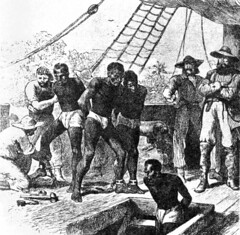
7292006588Middle PassageVoyage from West Africa to the West Indies. It was miserable for the slaves transported and many died. (p. 38)63

AP US History: Imperialism Flashcards

Terms : Hide Images
7694830405Alfred T. MahanUnited States Navy officer; his ideas on the importance of sea power influenced navies around the world, and helped prompt naval buildups before World War I; wrote The Influence of Sea Power Upon History0
7694830406Valeriano "Butcher" WeylerHe was a Spanish General referred to as the "Butcher." He undertook to crush the Cuban rebellion by herding many civilians into barbed-wire reconcentration camps, where they could not give assistance to the armed insurrectionists. The civilians died in deadly pestholes. "Butcher" was removed in 1897.1
7694830407Dupuy de LómeHe was a Spanish minister in Washington who wrote a private letter to a friend concerning President McKinley (called him basically usless and indecisive) The discovery of his letter strained Spanish-American relations, which helped initiate the Spanish-American War.2
7694830408Theodore Roosevelt26th president, known for: conservationism, trust-busting, Hepburn Act, safe food regulations, "Square Deal," Panama Canal, Great White Fleet, Nobel Peace Prize for negotiation of peace in Russo-Japanese War.3
7694830409George DeweyA United States naval officer remembered for his victory at Manila Bay in the Spanish-American War, U.S. naval commander who led the American attack on the Philippines.4
7694830410Emilio AguinaldoLeader of the Filipino independence movement against Spain (1895-1898). He proclaimed the independence of the Philippines in 1899, but his movement was crushed and he was captured by the United States Army in 1901.5
7694830411William Howard Taft(1908-1912), was endorsed by Roosevelt because he pledged to carry on progressive program, then he didn't appoint any Progressives to the Cabinet, actively pursued anti-trust law suits, ran for re-election in 1912 but lost to Wilson.6
7694830412Reconcentration campsCuban civilians were moved to these during the Cuban Revolt to help the Spanish pacify the rebellion; poorly run, death rates inside them were high7
7694830413ImperialismA policy in which a strong nation seeks to dominate other countries poitically, socially, and economically.8
7694830414Spheres of InfluenceAreas in which countries have some political and economic control but do not govern directly; China was carved into several of these by the late 19th century9
7694830415Teller AmendmentLegislation that promised the US would not annex Cuba after winning the Spanish-American war.10
7694830416Treaty of ParisSigned by the United States and Spain in December 1898, this treaty ended the Spanish-American War.11
7694830417Anti-Imperialist LeagueGroup objected to the annexation of the Philippines and the building of an American empire. Idealism, self-interest, racism, constitutionalism, and other reasons motivated them, but they failed to make their case; the Philippines were annexed in 1900.12
7694830418Boxer Rebellion1899 rebellion in Beijing, China started by a secret society of Chinese who opposed the "foreign devils". The rebellion was ended by British troops.13
7694830419"Rough Riders"volunteer Calvary, a mixure of Ivy League athletes and western frontiermen, volunteered to fight in the Spanish-American War. Enlisted by Theodore Roosevelt14
7694830420Big-stick Diplomacy-roosevelts foreign policy was agressive and imperialistic and would use military force if necessary15
7694830421Roosevelt CorollaryRoosevelt's 1904 extension of the Monroe Doctrine, stating that the United States has the right to protect its economic interests in South And Central America by using military force.16
7694830422Mckinley Tariffraised duties on Hawaiian sugar and set off renewed efforts to secure the annexation of Hawaii to the USA17
7694830423USS Maineamerican battleship dispatched to keep a "friendly" watch over cuba in early 1898 it mysteriously blew up havana harbor on feb. 2 1898 w/260 sailors dead, explosion was accidental, USA thought it was spanish submarine fault and was ready for war18
7694830424Insular CasesThese Supreme Court cases decided that the Constitution did not always follow the flag, thus denying the rights of a citizen to Puerto Ricans and Filipinos.19
7694830425Platt AmendmentUS forced into Cuban Constitution. Cuba could not make treaties with other nations; US had right to intervene in Cuba; US naval bases on Cuban land; Cuba cant borrow money from other countries20
7694830426Open Door Notesent by John Hay to Germany, Russia, Great Britain, France, Italy & Japan asking the countries not to interfere with US trading rights in China.21
7694830427Hay-Bunau-Varilla Treatyagreement in which the U.S would receive exclusive rights to construct and control a canal in Panama as well as the zone around the canal; signed between the US and Panama22
7694830428Root-Takahira Agreement1908 - Japan / U.S. agreement in which both nations agreed to respect each other's territories in the Pacific and to uphold the Open Door policy in China.23
7694830429Josiah StrongHe believed it was the duty of American Christians to share their knowledge, accomplishments and religion worldwide; wrote Our Country: Its Possible Future and Present Crisis24
7694830430James G BlaineSecretary of State under three presidents; his only major accomplishment was "Pan-Americanism"25
7694830431Queen Liliuokalaniqueen of Hawaii that highly didnt agree w the US control of Hawaii and wanted to keep the islands mainly native, reducing the power of merchants from foreign nations.26
7694830432John HaySecretary of State under McKinley and Roosevelt who pioneered the "open-door" policy and Panama canal27
7694830433Yellow PressJournalist who wrote to influence american public opinion about the Spanish/American War ( influenced americans to think they needed to go to war with Spain)28
7694830434HawaiiKnow where it is located on the map. Also know facts about Hawaii (Queen Liliuokalani, Cleveland didn't want to annex Hawaii, Mckinley did. )29
7694830435AlaskaPurchased from Russia in 1867; nicknamed "Seward's Folly"30
7694830436"Gentlemen's Agreement"informal and secret arrangement b/w TR and Japan in which California discrimination laws were relaxed in exchange for limits on Japanese immigration to the US31
7694830437"Great White Fleet"nickname for the circumnavigation of the globe of 16 modernized US warships undertaken to train US sailors and demonstrate US military strength32
7694830438Sanford B. Dolechief among the American planters in Hawaii who staged a coup against Queen Lili and requested US military support and annexation of the territory33
7694830439International Darwinismphilosophy that the fittest nations were those which exerted their military and economic influence over lesser nations; advocated strongly by Senator Henry Cabot Lodge34
7694830440Anglo-Saxonismbelief in the superiority of white, Christian civilization and culture which motivated missionaries and imperialists to seize territories around the globe35

AP US History Review Flashcards

Terms : Hide Images
9893699854Columbian Exchangea series of interactions and adaptations among societies across the Atlantic, including plants, animals, disease, people, etc.0
9893699859mestizois a term traditionally used in Spain and Spanish-speaking America to mean a person of combined European and Native American descent1
9893699860encomienda systemIn the economies of the Spanish colonies, Indian labor, used in the _______________ to support plantation-based agriculture and extract precious metals and other resources. EX: sugar, silver2
9893699865How did Europeans justify the subjugation of Africans and Natives?White racial superiority, Bible, view of groups as "savages"3
9893699867European exploration and conquest were fueled by...(Three G'sa desire for new sources of wealth, increased power and status, and converts to Christianity. (god, glory, gold)4
9893699868New crops from the Americas stimulated...European population growth (particularly from corn and potatoes)5
9893699869New sources of mineral wealth from the Americas facilitated the European shift from...feudalism to capitalism.6
9893699870Christopher ColumbusItalian explorer who "discovers America" in 1492 when searching for a sea route to the Far East .7
9893699871capitalisman economic and political system in which a country's trade and industry are controlled by private owners for profit, rather than by the state or hereditary noble class8
9893699876African American religion in the colonial periodAfrican slaves mixed African beliefs and practices with Catholic rituals and theology, in Haiti (referred to as "voodoo"), Santeria in Cuba,9
9893699877Why 1607 - 1754 was chosen as the dates for period 21607 = 1st English permanent settlement in Jamestown; 1754 = start of the 7 Years War (AKA "French and Indian War")10
9893699878The EnlightenmentPhilosophy focused on reason and promoting new forms of government (Locke, Montesquieu); influenced the American Revolution11
9893699879MercantilismEconomic policy that focuses on making $ for the mother country. It favors a positive balance of trade for the mother country and the accumulation of gold and silver12
9893699888indentured servitudeSystem of labor in which a company or individual paid a person's passage to America in return for a contract of repayment through servitude (usually seven years).13
9893699890middle passagethe brutal journey of slaves in bondage across the Atlantic to America.14
9893699896New York Conspiracy, 1741A plot by slaves and poor whites to burn New York. Over 170 people were arrested for participating in the plot. Most were hanged, burnt, or deported.15
9893699898New England coloniesPlymouth (later absorbed into Massachussetts), Massachussetts Bay Colony, New Hamphire, Connecticut, Rhode Island16
9893699900PuritansEnglish Protestants who wanted to create a "community of saints" or "city upon a hill" that would serve as a model of Christianity. Often seen as the beginning of "American Exceptionalism" - the idea that America has a unique story, or God-given destiny17
9893699905William PennPenn established Pennsylvania as a haven for Quakers, guaranteeing liberty of conscience and granting freemen the right to alter the government. Founded by William Penn, 1681 who received a colonial charter from King Charles II in payment of a debt owed to Penn's father.18
9893699906QuakersReligious group that settled Pennsylvania. Often known as the "Society of Friends," Quakers believed in an "Inner Light" that would guide them toward religious truth and were pacifists (opposed violence) who had good relations with Native Americans19
9893699909BarbadosBritish West Indies colony whose plantation system and harsh slave codes became the model for Southern colonies in North America20
9893699915smugglingAs a way of ignoring British restrictions on colonial trade, colonists engaged in widespread smuggling. Smugglers who got caught were often often freed by sympathetic American juries.21
9893699917King Phillip's WarThe last significant effort by the Indians of southern New England to drive away English settlers. The Indians were led by Metacom, the Pokunoket chief whom English setters called "King Philip."22
9893699919How did the Spanish and English differ in their views of Native American culture?Spanish colonizing efforts in North American, particularly after the Pueblo Revolt, saw an accommodation with some aspects of American Indian culture; by contrast, conflict with American Indians tended to reinforce English colonists' worldview on land and gender roles.23
9893699920Casta systemA system in colonial Spain of determining a person's social importance according to different racial categories.24
9893699921MulattoA person who had one parent who was white and another parent who was black. If mulattos were born into slavery in a Spanish colony (i.e., their mother was a slave), they would be slaves also, but if their mother was free, they were free.25
9893699922mestizo (AKA Métis)A person of mixed race who had one white parent and another parent who was American Indian.26
9893699923triangular tradeA system of trade between Africa, Europe, and American colonies that involved slaves, cash crops, and manufactured goods.27
9893699925House of Burgesses, 1619The first elected lawmaking body in North America, established by the Virginia Company to allow representative government in Virginia.28
9893699926Navigation ActsAttempt by England to assert its control over American trade by passing a series of laws that regulated colonial trade to England's benefit.29
9893699929First Great Awakening, 1730s-1760sEvangelical religious revival that swept through Britain's North American colonies. The Great Awakening strengthened beliefs in religious freedom and challenged the status of established churches.30
9893699930George WhitefieldChristian preacher whose tour of the English colonies attracted big crowds and sparked the First Great Awakening.31
9893699933French and Indian War, 1754-63Part of the 7 Years' War, Great Britain & France fought for control of the Ohio Valley & Canada. The colonies fought under British commanders and won; resulted in France being pushed out of N. America and massive British war debt32
9893699934Impact of 7 Years' WarFrance removed from North America; Great Britain in massive debt, began to consolidate control over colonies - taxes; many colonists resisted33
9893699935Common SensePamphlet written by T-Paine, and Enlightenment thinker. Urged that it was "Common Sense" that colonies should break away from Great Britain34
9893699937Northwest Land OrdinancePassed under Articles - banned slavery in NW territory (OH, MI, IN, etc.); created a process for admitting new states (60,000 inhabitants)35
9893699938White-Indian Conflicts after 7 Years' WarDue to encroachment on Native lands; Pontiac's Rebellion led to the Proclamation Line of 176336
9893699941Boston Tea Party, 1773American colonists calling themselves the Sons of Liberty, disguised as Mohawk Native Americans, boarded three British ships and dumped British tea into the Boston harbor.37
9893699942First Continental Congress, 1774Convention of delegates from the colonies called in to discuss their response to the passage of the Intolerable Acts (38
9893699943Lexington and Concord, 1775First battle in the Revolutionary War, (AKA "shot heard round the world") fought in Massachusetts on April 19, 1775.39
9893699944Second Continental Congress, 1775a convention of delegates from the 13 Colonies, managed the colonial war effort, sent The Olive Branch Petition,moved incrementally towards independence, adopted the Declaration of Independence, acted as the de facto national government.40
9893699945John LockeEnglish Enlightenment philosopher and political thinker who believed in government based upon natural rights of the people (life, liberty, and property) the will of the governed.41
9893699948Battle of Yorktown, 1781last major battle of Revolution. French navy and ground troops were crucial to victory.42
9893699951Northwest Ordinances of 17871787, the NW Ordinance dissolved the Ordinances of 1784-85; created a process for statehood with freedom of religion, trial by jury, and no slavery., raised money for gov't via the sale of public land43
9893699952Shay's Rebellion, 1786This MA conflict caused criticism of the Articles of Confederation; weak govt; increased calls for a Constitutional Convention to revise the Articles44
9893699953Constitutional Convention in Philadelphia, 17871787 Philadelphia convention that produced the present Constitution of the United States, drafted largely by James Madison.45
9893699955ConstitutionReplaced the Articles - series of compromises (Great, 3/5, Slave Trade); provided limits on federal power (separation of powers); did not address problems of slavery46
9893699958Bill of Rights, 1791The Bill of Rights is the collective name for the first ten amendments to the United States Constitution. Proposed to assuage the fears of Anti-Federalists47
9893699959Cotton Gin, 1793a machine invented by Eli Whitney; revolutionized cotton production by greatly speeding up the process of removing seeds from cotton fiber.48
9893699960Washington's Proclamation of NeutralityWashington declares United States neutrality in the face of emerging European conflicts leading to a strong sense of isolationism kept the US from being drawn into constant European wars that might threaten the existence of the young fragile nation49
9893699961Whiskey Rebellion, 1794Small farmers of the back country distilled (and consumed) whiskey, which was easier to transport and sell than the grain that was its source.50
9893699962Republican MotherhoodExpectation that women would instill Republican values in children and be active in families; helped increase education for women51
9893699963Washington's Farewell Address, 1796Urged Americans to avoid excessive political party spirit and geographical distinctions. In foreign affairs, warned against long-term alliances with other nations -52
9893699965Kentucky and Virginia Resolutions, 1798-99Written by Jefferson and Madison, in response to the Alien and Sedition Acts; argued states had the power to declare federal acts unconstitutional.53
9893699966Why 1800 - 1848 was chosen as the dates for period 4Beginning with Jefferson's presidency (Revolution of 1800), ending with the Seneca Falls Convention and Mexican American War54
9893699967FederalistsPolitical Party led by Hamilton - pro-British; supported by the wealthy; pro-merchants and trade; Favored the National Bank (BUS); loose interpretation55
9893699968Democratic-RepublicansPolitical Party led by Jefferson - pro-French; supported by middle-class and farmers; pro-agriculture; against the BUS; strict interpretation56
9893699970Midnight judges, 1801The Judiciary Act of 1801 created 16 new federal judgeships and other judicial offices. Federalists attempt to secure the Federalists a position of power in the new government after losing the congressional and presidential election of 180057
9893699971Marbury v. Madison, 1803SCOTUS decision; established the right of the courts to determine the constitutionality of the actions of the other two branches of government (Marshall Court)58
9893699974The Embargo Act, 1807Attempt by President Thomas Jefferson and the U.S. Congress to punish Britain and France for interfering with American trade while the two major European powers were at war59
9893699975War of 1812, 1812-1815US v Britain:fought over trade restrictions caused by British-French war; the impressment of American sailors, British support of American Indian tribes against American expansion,60
9893699978The American System, 1815Policies devised by the Whig Party and leading politician Henry Clay: national bank, high tariffs, and internal improvements61
9893699979Era of Good Feelings, 1815-24Period of strong nationalism, economic growth, territorial expansion under the presidency of James Monroe. Only one major political party at the time (Republican)62
9893699980McCulloch v. Maryland, 1819SCOTUS ruling based on Supremacy Clause; no state can tax institutions created by Congress - MD attempted to tax 2nd BUS63
9893699982DemocratsParty led by Jackson - "Common Man"; pro states' rights; against the BUS64
9893699983WhigsPolitical Party led by Henry Clay! Favored the BUS and the American System; strong legislative branch; against "King Andrew I"65
9893699984Marshall CourtAsserted federal power over states (McCulloch v. Maryland, Gibbons v. Ogden, Cohens v Virginia); judicial branch determined the meaning of Constitution (Marbury v. Madison)66
9893699985Second Great AwakeningInspired many to achieve perfection on earth; helped influence reform movements (abolitionism, women's rights, temperance, etc.)67
9893699989Lowell factoriesUtopian society for young women; hired girls from 15-25; expected to work 1-3 years, earned their own wages, encouraged by education. Criticisms included: long hrs , poor working conditions68
9893699990Monroe Doctrine, 1823US foreign policy regarding Latin American countries stated that further efforts by European nations to colonize land or interfere with states in North or South America would be viewed as acts of aggression, requiring U.S. intervention.69
9893699991Election of 1824John Quincy Adams elected President on February 9, 1825, after the election was decided by the House of Representatives in what was termed the Corrupt Bargain.70
9893699993Nat Turner's revolt, 1831slave rebellion that took place in Virginia, led by Nat Turner. Rebel slaves killed anywhere from 55-65 people, the highest number by any slave uprising in the South.71
9893699995Second Bank of the United States, 1833-36Bank whose renewal was vetoed by Andrew Jackson Andrew Jackson d because he saw it as a tool of eastern financial elites against the interests of democracy and the common man.72
9893699996Panic of 1837US financial crisis touching off a major recession thru the mid-1840s. caused by speculative lending practices in western states, a sharp decline in cotton prices, a collapsing land speculation bubble, international specie (gold) flows73
9893699997Trail of Tears, 1838Andrew Jackson favored pushing all Amerindians west of the MS River. The Indian Removal Act of 1830 provided for federal enforcement of this policy, Jackson defied the Supreme Court in the case of Worcester v. Georgia in 1832, which would allow Indians to stay.74
9893699998Election of 1840Martin Van Buren vs. William Henry Harrison MVB hurt by Panic of 1837. Significance: massive voter turnout & use of slogans: "Tippecanoe and Tyler Too", "Log cabin and hard cider" Created second national two-party system75
9893700000Nativist MovementDiscrimination against immigrants (notably Irish and Germans), heavily anti-Catholic, sought to limit power of immigrants (Know-Nothing Party)76
9893700002Annexation of Texas, 1845Texas was annexed to the U.S, in 1845, it was this action that caused the Mexican War. It was the 28th state and came in as slave state.77
9893700009Compromise of 1850"North: California admitted as free state, Texas gave up claims to disputed lands in New Mexico, Slave trade in DC was banned, but slavery was legal. South: Popular sovereignty in Mexican Cession lands, Texas was paid $10 million for land lost, stricter fugitive slave law."78
9893700010AbolitionistsMinority in the north; used fierce arguments (Garrison's Liberator), helping slaves escape (Underground RR), and violence (Nat Turner, John Brown at Harpers Ferry)79
9893700012Republican PartyEmerged as a sectional party in the North and Midwest; sought to keep slavery from expanding (free-soil) - as seen in Lincoln's election in 186080
989370003013th AmendmentAbolished slavery; led to the rise of sharecropping in the south81
9893700031Radical RepublicansMost fervent abolitionists; Sought to change racial and cultural attitudes of the South; strongest advocates of African American rights in Congress82
989370003615th AmendmentProvided suffrage for all adult MALES; divided the Women's Rights Movement83
9893700044Gilded AgeCoin termed by Mark Twain; period from 1870s - 1890s, businesses grew at a rapid rate and many problems lied below perceived prosperity84
9893700045Social DarwinismCharles Darwin's ideas applied to humans, "survival of the fittest." Used by wealthy to justify their position in life85
9893700046Labor UnionsKnights of Labor - skilled and unskilled; AFL - skilled labor only; sought to improve working conditions and increase pay86
9893700057New SouthIdea that the south should industrialize after the Civil War. Despite calls for industrialization, sharecropping and tenant farming persisted in the South87
9893700058SharecroppingPersisted in the South (especially for African Americans.) They had to give a share of their crops to plantation owners. Way for southerners to get around the 13th amendment.88
9893700060People's (Populist) PartyCreated in response to the growth of corporate power; called for political reform (election of senators, secret ballot) and increased government involvement in economy89
9893700064Social GospelProtestant Church Movement that sought to improve the conditions of cities90
9893700065Assimilation of Native AmericansProcess of making Natives "America"; Dawes Act - assimilated through cutting hair, changing tribal identities, providing individual land plots91
9893700068Sherman Anti-Trust Act, 1890First federal action against monopolies, it was signed into law by President Benjamin Harrison and was later extensively used by Theodore Roosevelt for trust-busting. However, it was first misused AGAINST labor unions92
9893700069Wounded Knee massacre, 1890US army killed 200 in order to suppress the Ghost Dance movement, a religious movement that was the last effort of Indians to resist US invasion. Ended Native American resistance in the Great Plains93
9893700070Ellis Island opened, 1892An immigration center in New York in the shadow of the Statue of Liberty for all incoming immigrants from the Atlantic. Opened to conduct more rigorous tests on incoming immigrants in order to restrict immigration.94
9893700072Panic of 1893Serious economic depression beginning in 1893. Began due to railroad companies over-extending themselves, causing bank failures. Was the worst economic collapse in the history of the country until that point, some say as bad as the Great Depression of the 1930s.95
9893700077Closing of the FrontierFrederick Jackson Turner's Frontier Thesis argued the frontier was "closed." Led many Americans to call for overseas expansion96
9893700087Progressive Era1890 - 1920, Progressives tended to be women, middle class, and live in urban areas. Progressives sought to use government influence to solve societal problems.97
9893700088Transition from Rural to Urban SocietyUS society adjusted as more people moved to cities - 1920 census - more people live in cities than rural areas98
989370009417th Amendment, 1913Established that senators were to be elected directly by voters (instead of by state legislatures as under the Constitution originally). This law was part of the Progressive Era effort to curb the power of political parties and open up the government with more democracy to the people.99
9893700099WWI, 1917British-owned ocean liner Lusitania was torpedoed by German U-boats, killing 1,201 passengers, including 128 Americans. Foreign Minister Alfred Zimmerman sent a message to Mexico and Japan to provoke them into attacking the U.S., but it was decoded by the British. Germany resumes UNRESTRICTED SUBMARINE WARFARE to sink US ships bringing supplies to British/French, hoping to take out Britain/France before the US can enter war. This gamble failed as US entry into the war in 1917 helped secure victory.100
9893700105Harlem RenaissanceCelebration of African American culture through music, poetry, and writing. Key people - Langston Hughes, Claude Monet, Zora Neale Hurston101
9893700106World War IUS entrance in 1917. US played a relatively minor role in the war, but large role in postwar negotiations.102
9893700107Treaty of Versailles and League of NationsTreaty that ended WWI; League led to debates over the role of the US in the world; ultimately, the US did NOT join the League103
9893700108Great MigrationMass movement of African Americans from the South to the North during WWI for economic opportunities104
9893700109Red ScareFear of Communism after WWI, caused by: Russian Revolution, labor strikes post WWI, nativism; led to a crackdown on immigrants and radicals (suppression of rights)105
9893700110Restrictive Immigration Quotas1921 and 1924 acts that severely limited immigration from Southern and Eastern Europe ("New immigrants")106
9893700112Teapot Dome Scandal, 1923-24Scandal surrounding the illegal leasing of federal oil reserves by the secretary of the interior, Albert Fall to private businesses in return cash and no interest loans. Harding died before the full extent of the crimes had been determined. Scandal revealed the corruption of his cabinet, which was involved in other crimes as well.107
9893700121Great DepressionWorst financial crisis in US history, led to calls for the creation of a stronger financial regulatory system108
9893700123First New Deal, 1933FDR's policies to help ease the Great Depression during the 1st two years of his presidency. Much of it passed in the 1st 100 Days, in an unprecedented flurry of laws. It aimed for the three R's: relief, recovery, reform. Included Bank Holiday, Glass-Steagal (SEC), CCC, AAA, TVA, NIRA, FDIC, FERA109
9893700124New DealDrew on ideas from the Progressive Era, sought to address causes of the Depression; faced opposition by the left and right; left a legacy of reforms that are still around today110
9893700127Dust Bowl, 1935a period of severe dust storms that greatly damaged the ecology and agriculture of the US prairies during the 1930s; severe drought and a failure to apply dryland farming methods to prevent wind erosion caused the phenomenon.111
9893700130Social Security Act, 1935Provided old-age pension (retirement), and a program of unemployment insurance (temporary aid to help people who lose jobs to find a new job), and federal welfare program (aid for very poor). Most famous and important legacy of New Deal. Has resulted (along with Medicare) with drastic reduction in poverty among elderly in the US112
9893700135Lend-Lease Act, 1940US supplied Great Britain, the USSR, Free France, the Republic of China, and other Allied nations with weapons and other necessary materials to fight Axis powers between 1941 and August 1945. US became the "arsenal of democracy"113
9893700137Pearl Harbor, 1941The Japanese wanted to continue their expansion within Asia in the late 1930s and early 40s but the US had placed an extremely restrictive embargo on Japan in the hopes of curbing Japan's aggression. The Japanese decided to launch a surprise attack against the United States at Pearl Harbor, Hawaii on Dec. 7, 1941 (a "day that will live in infamy" according to the famous words of FDR). The United States abandoned its policy of isolationism and entered WWII by declaring war on Japan the following day.114
9893700138World War IIUS remained neutral until Pearl Harbor; US and Allies won due to: political and military cooperation, industrial production, and scientific advancements; US emerged as a world power115
9893700141G.I. Bill, 1944The G. I. Bill of Rights or Servicemen's Readjustment Act of 1944 provided for college or vocational education for returning World War II veterans (commonly referred to as GIs or G. I.s) as well as one-year of unemployment compensation. It also provided loans for returning veterans to buy homes and start businesses. Considered an extremely successful government program to both help veterans and boost the US economy.116
9893700142Yalta Conference, 1945FDR, Churchill and Stalin met at Yalta. Russia agreed to declare war on Japan after the surrender of Germany and in return FDR and Churchill promised the USSR concession in Manchuria and the territories that it had lost in the Russo-Japanese War117
9893700143Potsdam Conference, 1945The final wartime meeting of the leaders of the United States, Britain, and the Soviet Union was held at Potsdamn, outside Berlin, in July, 1945. Truman, Churchill, and Stalin discussed the future of Europe but their failure to reach meaningful agreements soon led to the onset of the Cold War.118
9893700144Decision to drop the atomic bombs on JapanMany reasons - save American lives, end the war quickly, etc.; raised questions about American values119
9893700147ContainmentCoined by George Kennan; urged the US to keep communism from spreading (Contain communism)120
9893700150Marshall Plan, 1947A plan that the US came up with to revive war-torn economies of Europe. This plan offered $13 billion in aid to western and Southern Europe on condition they wouldn't go communist. Helped contain communism in Europe and helped our economy as Europe bought from US businesses to rebuild.121
9893700157Korean WarExample of Containment; US sided with South Korea against communist North Korea; some minor domestic opposition to the war122
9893700159Baby BoomPost WWII drastic increase in births in the US (1946 - 1964); led to future issues with Social Security123
9893700160SuburbanizationMore and more Americans moved to suburbs after WWII (cars, Interstate Highway System, Levittown)124
9893700168Civil Rights ActivistsUsed various techniques (sit-ins, legal challenges, etc.); post-1965, debates emerged over the proper role of activists125
9893700169Brown v. Board of Education1954 Supreme Court Case that ruled separate facilities based on race inherently unequal. Reversed Plessy v. Ferguson126
9893700181John F. Kennedy assassinated, 1963In 1963 in Dallas, riding in a parade to drum up support for the upcoming presidential election in 1964, JFK was shot twice by ex-Marine Lee Harvey Oswald and pronounced dead at Parkland hospital. JFK's Vice President LBJ was immediately sworn into office. Oswald was later killed by Jack Ruby before he could stand trial.127
9893700183Civil Rights Act of 1964a landmark piece of civil rights legislation in the United States that outlawed discrimination based on race, color, religion, sex, or national origin. It ended unequal application of voter registration requirements and racial segregation in schools, at the workplace and by facilities that served the general public (known as "public accommodations").128
9893700184Gulf of Tonkin Resolution, 1964The Gulf of Tonkin Resolution was a joint resolution of the U.S. Congress passed on August 7, 1964 in direct response to a minor naval engagement known as the Gulf of Tonkin Incident. It is of historical significance because it gave U.S. President Lyndon B. Johnson authorization, without a formal declaration of war by Congress, for the use of military force in Southeast Asia. Led to massive escalation of Vietnam War.129
9893700185Great SocietyLBJ's platform; increased the size and involvement of the government in society. Extension of New Deal programs and Civil Rights (24th amendment, Civil Rights Act of 1964.)130
9893700187Vietnam WarUS aided the South (non-communist); led to sizeable, passionate, and sometimes violent protests, especially as the war went on131
9893700189DétenteEasing of Cold War tensions between the US and Soviet Union (Examples include: SALT I and Salt II)132
9893700190Environmental ProblemsBrought to the attention of the public by Rachel Carson and Silent Spring; helped lead to the creation of the EPA and Clean Air Act133
9893700198Martin Luther King, Jr. assassinated, 1968On April, 4th 1968 MLK was assassinated in Mephis, Tennesse. This caused an outrage in the black community and riots across the nation.134
9893700204Vietnamization, 1969The US policy of withdrawing its troops and transferring the responsibility and direction of the war effort to the government of South Vietnam. It is important because it would bring the end of the Vietnam war in 1973.135
9893700206Kent State, 1970Students protesting against the expansion of the Vietnam War into Cambodia by Nixon; the national guard opens fire, killing to 4 students. The impact of the shootings was dramatic. The event triggered a nationwide student strike that forced hundreds of colleges and universities to close. Added to antiwar mood that would soon force end of war.136
9893700207Pentagon Papers, 1971Secret document papers, leaded by Daniel Ellsberg, published by the New York Times in 1971, showed the blunders and deceptions that led the United States that led to the Vietnam war. Revealed the government misleading the people of its involvement in Vietnam, both about the intentions and the outcomes of the conflict.137
9893700208Nixon visited China, 1972Nixon, who was a leading anti-communist, was the 1st US president to visit China since its 1949 communist revolution. He took advantage of growing conflicts between China and the USSR over the "true" form communism, and drove a further wedge between them by improving US-China relations. "Only Nixon could go to China" has become a political metaphor that means the ability of a politician with an unassailable reputation among his supporters for defending their values to take actions that would draw their criticism if taken by someone without those credentials.138
9893700211Roe v. Wade, 1973(Burger) Certain state criminal abortion laws violate the Due Process clause of the 14th Amendment, which protects against state action the (implied) right to privacy in the Bill of Rights (9th amendment). Abortion cannot be banned in the 1st trimester (1st 3 months), states can regulate the 2nd trimester, 3rd trimester - abortion is illegal except to save the life of the mother139
9893700213Nixon resigned, 1974The Watergate scandal led to the discovery of multiple abuses of power by the Nixon administration, articles of impeachment, and the resignation of Republican Richard Nixon, the President of the United States, on August 9, 1974—the only resignation of a U.S. president to date.140
9893700219Foreign Policy "failures"Helped lead to public distrust in government; example is Iran Hostage Crisis141
9893700222Reagan AdministrationElected in 1980, focused on denouncing "Big Government", decreasing taxes, increased military spending142
9893700223Reaganomicsrefers to the economic policies promoted by President Reagan in the 1980s and is supported by most conservatives today. The policies are similar to laisezz-faire policies, trickle down economics143
9893700225Mikhail GorbachevSoviet leader that saw improved relations with Reagan, instituted glasnost and perestroika which helped lead to the downfall of the Soviet Union144
9893700229INF Treaty, 1988The Intermediate-Range Nuclear Forces Treaty (INF) is a 1987 agreement between the United States and the Soviet Union. The treaty eliminated nuclear and conventional ground-launched ballistic and cruise missiles with intermediate ranges, defined as between 500-5,500 km (300-3,400 miles). The treaty was signed in Washington, D.C. by U.S. President Ronald Reagan and General Secretary Mikhail Gorbachev on December 8, 1987, it was ratified by the United States Senate on May 27, 1988 and came into force on June 1 of that year.145
9893700232Soviet Union dissolved, 1991The Revolutions of 1989 that started in Eastern Europe ended with the fall of the Soviet Union in 1991 and the end of Cold War. 1989 saw the Soviet people making a democratic choice for the first time since 1917 when they elected the new Congress of People's Deputies, and Boris Yeltsin as president. Gorbachev, the last Soviet leader, abandoned the oppressive, expensive Brezhnev Doctrine(preservation of Soviet satellite states) and decided not to use force to maintain the Soviet empire, which broke up into 15 different countries.146
9893700237War on terrorismResponse to 9/11, US would actively fight terrorism throughout the world147
9893700238Free Trade AgreementsGoal is to increase trade among countries by reducing tariffs (NAFTA - no tariffs between US, Canada, and Mexico)148

AMSCO AP US History Chapter 22 Flashcards

AMSCO United States History 2015 Edition, Chapter 22 World War I and its Aftermath, 1914-1920

Terms : Hide Images
9061442692Allied PowersIn World War I, Great Britain, France, and Russia were known by this name. (p. 455)0
9061442693Central PowersIn World War I, Germany, Austria-Hungary, and Ottoman Empire were known by this name. (p. 455)1
9061442695submarine warfareGermany's greatest hope against British sea power was this new type of warfare. (p. 455)2
9061442696LusitaniaOn May 7, 1915 a British passenger ship was sunk by German torpedoes and 128 American passengers died. The sinking greatly turned American opinion against the Germans, and moved the country towards war. (p. 455).3
9061442697Sussex PledgeIn March 1916 an unarmed merchant ship, the Sussex, was sunk by the Germans. Germany made a pledge that they would not sink anymore merchant ships without warning. This kept the U.S. out of the war for a little while longer. (p. 456)4
9061442698propagandaBritain controlled the daily war news that was cabled to the United States. They supplied the American press with many stories of German soldier committing atrocities. (p. 457)5
9061442701election of 1916Election between Woodrow Wilson (Democrat) and Charles Evans Hughes (Republican). Wilson won the election, his slogan was: "He kept us out of war". (p. 458)6
9061442705Zimmermann telegramIn March 1917 the U.S. newspapers carried the story that Britain had intercepted a telegram from the German government to the Mexican government offering German support if Mexico declared war against the U.S. (p. 459)7
9061442706Russian RevolutionThe revolution against the autocratic tsarist government which led to the abdication of Nicholas II and the creation of a republic in March 1917. (p. 459)8
9061442708war industry boardsFactories that produced Guns, Bullets, Artillery.9
9061442709Food AdministrationThis government agency was headed by Herbert Hoover and was established to increase the production of food for overseas shipment to the troops. (p. 460)10
9061442711National War Labor BoardFormer president William Howard Taft lead this organization which arbitrated disputes between workers and employers. (p. 461)11
9061442713Selective Service ActIn 1917 this law provided for the registration of all American men between the ages of 21 and 30 for a military draft. Men were chosen by lottery. Eventually, 2.8 million were called by lottery, in addition to the nearly 2 million who volunteered. (p. 462)12
9061442715Committee on Public InformationA propaganda organization that created numerous posters, short films, and pamphlets explaining the war to Americans and encouraging them to purchase war bonds to gain support for World War I. (p. 461)13
9061442716George CreelHead of the Committee on Public Information. He persuaded the nation's artists and advertising agencies to create thousands of paintings, posters, cartoons, and sculptures promoting the war. (p. 461)14
9061442718Espionage ActIn 1917 this law imposed sentences of up to twenty years on anyone found guilty of aiding the enemy, obstructing recruitment of soldiers, or encouraging disloyalty. (p. 461)15
9061442719Sedition ActIn 1918 this law made it a crime to criticize the government or government officials. Opponents claimed that it violated citizens' rights to freedom of speech and freedom of the press, guaranteed by the First Amendment. About 1000 people were jailed because of the law, one of them was Eugene Debs. (p. 461)16
9061442720Eugene Debs1855-1926. American union leader, one of the founders of the International Labor Union and the Industrial Workers of the World, and five-time Socialist Party of America Presidential Candidate.17
9061442721Schenck v. United StatesA 1919 Supreme Court case in which the constitutionality of the Espionage Act was upheld in a case of a man who was imprisoned for distributing pamphlets against the draft. Justice Oliver Wendell Holmes said the right to free speech could be limited when it represented a "clear and present danger" to public safety. (p. 461)18
9061442724migration of blacks and HispanicsDuring World War I many Mexicans crossed the border to take jobs in agriculture and mining. African Americans moved to the North for new job opportunities. (p. 462)19
9061442725Bolsheviks withdrawA second revolution in Russia by Bolsheviks (Communists) took it out of World War I. (p. 463)20
9061442726American Expeditionary ForceIN the summer of 1918 hundreds of thousands of American troops went to France as members of this force under General John J. Pershing. (p. 463)21
9061442730peace without victoryIn January 1917, before the U.S. had entered the war, Woodrow Wilson said the the United States would insist on this term. (p. 464)22
9061442731Fourteen PointsAfter the end of World War I, President Woodrow Wilson outlined a plan for achieving a lasting peace. It called for self-determination, freedom of the seas, free trade, end to secret agreements, reduction of arms, and a general association of nations. (p. 464)23
9061442733Big FourThe term for the the four most important leaders (on the Allied side) during Word War I and at the Paris Peace Conference. They were Woodrow Wilson - United States, David Lloyd George - Great Britain, George Clemenceau - France, and Vittorio Orlando - Italy. (p. 465)24
9061442734Treaty of VersaillesThe World War I peace conference which included the victorious Allied Powers (United States, Great Britain, and France). The defeated Germany agreed to the following terms: 1) Germany had to disarm. 2) Germany had to pay war reparations. 3) Germany had to acknowledge guilt for causing the war. 4) Germany could not manufacture any weapons. 5) Germany had to accept French occupation of the Rhineland for 15 years. 6) Territories taken from Germany: Austria-Hungary, and Russia were given their independence (Estonia, Latvia, Lithuania, Finland, Poland, Czechoslovakia, and Yugoslavia) 7) Signers joined the League of Nations which includes Article X; that each member nation would stand ready to protect the independence and territorial integrity of the other nations. (p. 465)25
9061442735League of NationsInternational organization founded in 1919 to promote world peace and cooperation but greatly weakened by the refusal of the United States to join. (p. 466)26
9061442736Article XThis part of the Versailles Treaty morally bound the U. S. to aid any member of the League of Nations that experienced any external aggression.27
9061442738Henry Cabot LodgeLed a group of senators during Woodrow Wilson's presidency known as the "reservationists" during the 1919 debate over the League of Nations. (p. 466)28
9061442739IrreconcilablesSenators who voted against the Treaty of Versailles because it required the United States to join the League of Nations. (p. 466)29
9061442740ReservationistsSenators who pledged to vote in favor of the Treaty of Versailles if certain changes were made. They were led by Henry Cabot Lodge. (p. 466)30
9061442745Red ScareAfter World War I had ended anti-communist hysteria caused this phenomenon. (p. 467)31
9061442747Palmer raidsPrompted by a series of unexplained bombings, in 1920 this operation was coordinated by Attorney General Mitchell Palmer. Federal marshals raided the homes of suspected radicals and the headquarters of radical organizations in many cities. (p. 467)32
9061442748xenophobiaIntense or irrational dislike of foreign peoples. (p. 467)33
9061442749strikes of 1919Major strike in Seattle where 60,000 unionists held a peaceful strike for higher pay. Boston police went on strike to protest firing of police officers who tried to unionize and Governor Calvin Coolidge sent in National Guard. U.S. Steel Corporation had a strike that was ended after federal troops were brought in there was violence. (p. 467)34
9061442750Boston police strikeOfficers went on strike to protest the firing of a few officers because they tried to unionize. (p. 467)35
9061442751race riotsThe migration of African Americans to the north led to rioting in East St. Louis and Chicago, where 40 people were killed. (p. 467)36

Pages

Subscribe to CourseNotes RSS

Need Help?

We hope your visit has been a productive one. If you're having any problems, or would like to give some feedback, we'd love to hear from you.

For general help, questions, and suggestions, try our dedicated support forums.

If you need to contact the Course-Notes.Org web experience team, please use our contact form.

Need Notes?

While we strive to provide the most comprehensive notes for as many high school textbooks as possible, there are certainly going to be some that we miss. Drop us a note and let us know which textbooks you need. Be sure to include which edition of the textbook you are using! If we see enough demand, we'll do whatever we can to get those notes up on the site for you!