AP Notes, Outlines, Study Guides, Vocabulary, Practice Exams and more!

AP biology Chapter 7 membranes and transport Flashcards

Terms : Hide Images
7599605219plasma membraneseperates the living cell from its surroundings. Contros traffic in and out of the cell. Is selectively permeable.0
7599605220selectively permeableallows some substances to cross more easily than others.1
7599605221phospholipidsmost abundant lipids2
7599605222lipids and proteinsmain macromolecules in membranes3
7599605223amphipatic moleculeshave hydrophobic and hydrophilic regions4
7599605224fluid mosaic modelThe arrangement of phospholipids and proteins in biological membranes is described by the...5
7599605225freeze-fracturepreparation technique that splits a membrane along the middle of the phospholipid bilayer6
7599605226transmembrane proteinsthe integral protein completely spans the membrane as...7
7599605227integral proteinsproteins that penetrate the hydrophobic interior of the lipid bilayer8
7599605228peripheral proteinsproteins that are not embedded in the lipid bilayer9
7599605229cell-cell recognitionthe ability of a cell to disitnguish one type of neighboring cell from another.10
7599605230supramolecular structuremany molecules ordered into a higher level of organization with emergent properties than those of the individual molecules.11
7599605231transport proteinsproteins that span the membrane.12
7599605232channel proteinstransport proteins that have a hydrophilic channel that certain molecules or ions use as a tunnel though the membrane.13
7599605233aquaporinschannel proteins that facilitate the passage of water14
7599605234carrier proteinstransport proteins that bind to molecules and change shape to shuttle them across the membrane.15
7599605235diffusionmovement of molecules of any substance to spread out in available space16
7599605236concentration gradientthe region along which the density of a chemical substance increases or decreases.17
7599605237passive transporttransport that requires no energy from the cell to make it happen18
7599605238osmosisthe diffusion of water across a selectively permeable membrane19
7599605239tonicitythe ability of a surrounding solution to cause a cell to gain or lose water.20
7599605240isotonic (animal cell)if a cell with no cell wall is immersed in an enviroment where there is no net movement of water across the plasma membrane. Stays the same.21
7599605241hypertonic (animal cell)when the cell is immersed in a solution where it loses water to its environment, shrivels and probably dies.22
7599605242hypotonic (animal cell)when a cell is immersed in a solution, water enters the cell faster than it leaves, it swells and lyses (explodes) like an overfilled water balloon.23
7599605243osmoregulationthe control of water balance24
7599605244Parameciumis a protist that is hypertonic to the pond water in which it lives.25
7599605245turgidwhen the plant cell is very firm, which is a healthy state for most plant cells.26
7599605246hypotonic (plant cell)when a plant cell is immersed in a __________ solution the cell contents swell due to osmosis until the elastic cell wall exerts turgor pressure on the cell that opposes further water outake.27
7599605247isotonic (plant cell)when a plant cell is immersed in a _______ solution; there is no net movement. The cell becomes flaccid and the plant may wilt.28
7599605248flaccidlimp, not firm or strong (If a plant is not watered enough, its leaves become droopy and flaccid.)29
7599605249hypertonic (plant cells)the plant cell loses water, its volume shrinks. The plasma membrane pulls away from the wall, this is plasmolysis. It is lethal to the cell.30
7599605250plasmolysisThis happens when a cell shrinks inside its cell wall while the cell wall remains intact. The plasma membrane pulls away from the wall.31
7599605251facilitated diffusionthe passive movement of molecules down their concentration gradient with the help of transport proteins.32
7599605252ion channels (gated channels)Channels that open or close depending on the presence or abscence of an electrical, chemical, or physical stimulus.33
7599605253cystinuriahuman disease characterized by the absence of a carrier protein that transports cysteine and other amino acids across the membranes of kidney cells.34
7599605254active transporttransport that requires the cell to expend metabolic energy and enables a cell to maintain internal concentrations of small molecules. Requires energy.35
7599605255ATPsupplies energy for most active transport36
7599605256sodium-potassium pumptransport protein that, translocating the bound solute across the membrane. Exchanges sodium ions (Na) for potassium ions (K) across the plasma membrane of animal cells.37
7599605257membrane potentialvoltage across a membrane. Ranges form -50 to -200 millivolts. The inside of the cell is negative to the outside.38
7599605258electrochemical gradient2 combined forces drive the diffusion of ions across the membrane.39
7599605259electrogenic pumpsspecial transport proteins that generate the voltage gradient across a membrane. Ex. sodium potassium pump and proton pumps.40
7599605260sodium-potassium pumpmajor electrogenic pump in animals. Restores the electrochemical gradient by setting up a concentration gradient. It pumps 2 K ions for every 3 Na ions that it moves out, it generates a voltage.41
7599605261proton pumpsthe major electrogenic pump. Transports protons out of the cell and transfers positive charge form the cytoplasm to the extracellular solution.42
7599605262cotransportsingle ATP-powered pump that transports a specific solute can indirectly drive the active transport of several other solutes in a mechanism.43
7599605263exocytosistransport vesicle budded from the Golgi apparatus is moved by the cytoskeleton to the plasma membrane. When the 2 membranes come in contact, the bilayers fuse spill the contents.44
7599605264endocytosisa cell brings in biological molecules and particulate matter by forming new vesicles from the plasma membrane. 3 types: phagocytosis, pinocytosis and receptor-mediated endocytosis.45
7599605265phagocytosisa cell engulfs a particle in a vacuole. The vacuole fuses with a lysosome to digest the particle.46
7599605266pinocytosismolecules are taken up when extracellular fluid is "gulped" into tiny vesicles.47
7599605267receptor-mediated endocytosisendocytosis that enables a cell to acquire bulk quantities of specific materials that may be in low concentrations in the environment.48
7599605268lipoproteinscomplexes of proteins and lipids. Cholesterol travels in low density _______49
7599605269ligandsA molecule that binds specifically to a receptor site of another molecule.50
7599605270dialysismovement of particles in a solution through permeable membranes. The diffusion of small solutes through a selectively permeable membrane.51

AP Biology Chapters 2 - 5 Study Guide Flashcards

Terms : Hide Images
5527554927Covalent bondBond where valence electrons are shared by two atoms0
5527554928Ionic bondBond where valence electrons are transferred allowing for a bond to form because of two ions of opposite charges1
5527561384The atomic number and the number of electronsThe number of protons equals what two things?2
5527572147The number of protons and neutronsWhat is the mass number equal to?3
5527625149DenaturationWhen a protein unravels and loses its shape4
5527628942Changes in pH, salt concentration and temperatureCauses of denaturation include...5
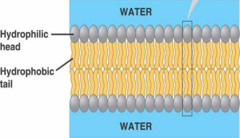
5527640121Phospholipid bilayer6
5527651474The heads are hydrophilic and the tails are hydrophobic. The heads want to be by the water in and surrounding the cell and the tails want to be protectedWhy do phospholipid bilayers form the way they do?7
5527655895Cis isomerWhen the atom/group of atoms attached to the double bonded carbon are on the same side8
5527668322Trans isomerWhen the atom/group of atoms attached to the double bonded carbon are on opposite sides9
5527672804They are both geometric isomers whose carbons have covalent bonds to the same atomsSimilarities between cis and trans isomers include...10
5527678152Asymmetrical carbonA carbon that is attached to four different atoms or groups of atoms11
5527682713Adhesion, cohesion, high specific heat, solvent of life, less dense as a solidThe properties of water include...12
5527687854The presence of unpaired electrons in the valence shellWhat causes the reactivity of atoms?13
5527687855HydrolysisProcess in which polymers are broken apart by adding water molecules14
5527690117DehydrationProcess in which monomers are bonded together by removing a water molecule15
5527693772Purines16
5527697494Pyrimidines17
5527706955A nitrogenous base, a five carbon sugar and a phosphate groupWhat makes up a nucleotide?18
5527709247MonosaccharideA single, simple sugar19
5527709248DisaccharideConsists of two monosaccharides joined together20
5527714348DeoxyriboseWhat is the sugar in DNA?21
5527714349RiboseWhat is the sugar in RNA?22
5527724354Sugars and phosphatesThese things make up the "backbone" of a DNA molecule...23
5527799691Three fatty acids and a glycerolWhat makes up a triglyceride?24
5527802886Lipids, Carbohydrates, Proteins and Nucleic AcidsWhat are the four major macromolecules?25
5527824162CelluloseIn a glucose ring, if the OH attached to the #1 carbon is in the beta position then it is...26
5527824163StarchIn a glucose ring, if the OH attached to the #1 carbon is in the alpha position then it is...27
5527916542Variations in length, branched or unbranched, double bond position and the presence of ringsThe different variations of carbon skeletons can include:28
5527995971Levo and DextroWhat does the L and D stand for in enantiomers?29
5528010921Only that particular form can bind to specific molecules in an organismWhy is only one version of an isomer usually biologically active when it comes to L and D isomers?30
55280165430 - 14What is the range of the pH scale?31
552801983610Each step on the pH scale is a factor of...32
5528022153Hydrogen bondThe noncovalent attraction between a hydrogen atom and an electronegative atom (usually oxygen)33
5528022154Polar covalent bondWhen one atom is bonded to a more electronegative atom and the electrons are not shared equally34
5528026002Nonpolar covalent bondThe bond between two atoms of the same element where electrons are shared equally because of the same electronegativity35
5528643396The amount of these are measured and the total of the two always will equal 10^-14 with the H+ number indicating the pHWhat role do H+ and OH- play in the pH scale?36
5528643398SolutionA homogeneous mixture of two or more substances37
5528643399SoluteThe substance that is dissolved in a solution38
5528645548SolventThe dissolving agent in a solution39
5528645549Aqueous solutionA solution in which water is the solvent40
5528648476ColloidA mixture that is formed when large water loving substances may not dissolve, but become suspended in an aqueous solution41
5528648477ValenceThe bonding capacity; the number of unpaired electrons in its valence shell42
55286532042; 8; 18How many electrons are found in the first 3 valence shells?43
5528655498Proton, Neutron and ElectronThe subatomic particles include...44
5528659802Carbon, Hydrogen, Nitrogen, Oxygen, Calcium, Phosphorus, Potassium, SulfurThe elements that are essential to life include...45
5528659803Trace elementElements that are required by organisms but only in very small amounts46
5528662114BufferAny substance that works to minimize the changes in concentration of H+ and OH- ions in a solution47
5528667972These are polar and the water molecules surround them and dissolve them from the outside layer in.How do salt and sucrose dissolve so easily?48
5528667990VitalismThe belief that chemical and physical laws do not play role in controlling natural phenomena49
5528667991MechanismThe belief that chemical and physical laws govern all natural phenomena including life processes50
5528670339GeneA unit of inheritance51
5528670340Saturated fatsThese are fats that contain the full amount of hydrogen possible, have no double bonds, are solid at room temperature and generally come from animals52
5528672253Unsaturated fatsThese are fats that have double bonds, do not contain all the hydrogen it possibly can, is liquid at room temperature and is found mainly in plants53
5528894047Primary structureThis structure of a protein is made up of an amino acid sequence54
5528894048Secondary structureThis structure of a protein will include coils and folds55
5528897887Tertiary structureThis structure of a protein is a result of the interactions of the side chains (R groups); has a 3D shape to it56
5528908210Quarternary structureThis structure is the result of more then one polypeptide chain coming together57
5528934980Energy storage, protection, cell membrane formationFunctions of fats include...58
5528942713Enzymes, storage, hormonal, contractile and motor, defensive, transport, act as receptors, structuralThe different functions of proteins include...59

AP Biology: Chapter 17 (gene to protein) Flashcards

From Gene to Protein

Terms : Hide Images
8525523406Gene Expressionprocess by which DNA directs synthesis of proteins0
8525523407Transcription-synthesis of RNA under direction of DNA -DNA serves as template for assembling complementary RNA molecule -resulting RNA molecule faithful transcript of gene's protein-building instructions -occurs in nucleus1
8525523408Messenger RNA (mRNA)RNA molecule that carries genetic message from DNA to protein synthesizing machinery of cell2
8525523409Translation-synthesis of polypeptide -occurs under direction of mRNA -change in language-cell must translate base sequence of mRnA molecule into amino acid sequence of polypeptide -occurs in cytoplasm3
8525523410Ribosomes-sites of translation -complex particles that facilitate orderly linking of amino acids into polypeptide chains4
8525523411Primary Transcriptinitial RNA transcript from any gene, including those coding for RNA that is not translated into protein5
8525523412Triplet Codegenetic instructions for polypeptide chain written in DNA as series of non-overlapping, 3 nucleotide words6
8525523413Template StrandDNA strand that provides pattern/template for sequence of nucleotides in RNA transcript7
8525523414CodonsmRNA base triplets written 5'-3' direction8
8525523415Reading Framegrapings w/ symbols w/ message that needs to be translated to written language9
8525523416RNA Polymerase-pries 2 strands of DNA apart -joins RNA nucleotides as they base pair along DNA template -assemble polynucleotides 5' -> 3' -can start chain from scratch-no primer needed10
8525523417PromoterDNA sequence where RNA polymerase attaches and initiates transcription11
8525523418Terminatorsequence that signals end of transcription in bacteria12
8525523419Transcription Unitstretch of DNA transcribed into RNA molecule13
8525523420Transcription Factorsproteins that mediate binding of RNA polymerase and initiation of transcription14
8525523421Transcription Initiation Complexcomplex of transcription factors and RNA polymerase II bound to promoter15
8525523422TATA Boxcrucial promoter DNA sequence16
8525523423RNA Processingenzymes in eukaryotic nucleus modify pre-mRNA in specific ways before genetic messages dispatched to cytoplasm17
85255234245' Capmodified form of guanine added onto 5' end after transcription 1. facilitates export of mature mRNA from nucleus 2. helps protect mRNA from degradation by hydrolytic enzymes 3. helps ribosomes attach to 5' end of mRNA once mRNA reaches cytoplasm18
8525523425poly-A Tail-50-250 more A nucleotides added to 3' end by enzyme 1. facilitates export of mature mRNA from nucleus 2. helps protect mRNA from degradation by hydrolytic enzymes 3. helps ribosomes attach to 5' end of mRNA once mRNA reaches cytoplasm19
8525523426RNA splicingremoval of large portions of RNA molecule initially synthesized20
8525523427Intronsnoncoding segments of nucleic acid that lie between coding regions21
8525523428Exonsnucleotide regions that are expressed, usually translated into amino acid sequences22
8525523429Spliceosomeinteracts w/ certain sites along introns, releasing intron and joining together 2 exons that flanked intron23
8525523430RibozymesRNA molecules that function as enzymes, can b/c: 1. RNA single stranded, region of RNA molecule may base-pair w/ complementary region elsewhere in same molecule-gives molecule particular 3D structure-essential to catalytic function of ribozymes, just like in enzymatic proteins 2. some RNA bases have functional groups that may participate in catalysis 3. ability of RNA to hydrogen bond w/ other nucleic acid molecules-adds specificity to catalytic activity24
8525523431Alternative RNA Splicingmany genes can give rise to 2+ polypeptides, depending on which segments are treated as exons during RNA processing -# different protein products > # genes25
8525523432Domainsfunctional regions part of protein architecture26
8525523433Transfer RNA (tRNA)transfer amino acids from cytoplasmic pool of AA to ribosome27
8525523434Anticodonnucleotide triplet that base pairs of complementary codon of mRNA28
8525523435Aminoacyl tRNA Synthetases-able to bind to different tRNAs that code for specific amino acid -catalyzes covalent attachment to tRNA -> aminoacyl tRNA released from enzyme -available to deliver AA to growing polypeptide chain of ribosome29
8525523436Wobbleflexible base pairing at codon position30
8525523437Ribosomal RNA (rRNA)made in nucleolus, make up ribosomal subunits31
8525523438P Site (peptidyl-tRNA site)holds tRNA carrying growing polypeptide chain32
8525523439A Site (aminoacyl-tRNA site)holds tRNA carrying next AA to be added in chain33
8525523440E Site (exit site)where discharged tRNAs leave ribosome34
8525523441Release Factorprotein that binds to stop codon @ A site35
8525523442Polyribosomes-strings of ribosomes trailing along mRNA -enables cells to make many copies of polypeptide quickly36
8525523443Signal Peptide-targets protein to ER -marks if polypeptide of proteins destined for endomembrane system or for secretion37
8525523444Signal Recognition Particle (SRP)brings ribosome to receptor protein into ER membrane38
8525523445Signal Mechanism for Targeting Proteins to ER1. polypeptide synthesis begins on free ribosome in cytosol 2. SRP binds to signal peptide, halting synthesis momentarily 3. SRP binds to receptor proteins in ER membrane (receptor is part of protein complex w/ membrane and signal cleaving enzyme) 4. SRP leaves, and polypeptide synthesis resumes w/ simultaneous translocation across membrane (signal peptide stays attached to translocation complex) 5. signal cleaving enzyme cuts off signal peptide 6. rest of complexed polypeptide leaves ribosome and folds into final conformation39
8525523446Mutations-change into genetic information of cell -responsible for huge diversity of genes found along organisms40
8525523447Point Mutations-chemical changes in a single base pair of a gene -if occurs in a gamete, can be transmitted to offspring and future generations41
8525523448Base Pair Substitutionsreplacement of one nucleotide and its partner w/ another pair of nucleotides42
8525523449Missense Mutations-change one amino acid to another -new amino acid may have properties similar to replaced amino acid, or may be in region where exact sequence of amino acids not essential to proteins functions43
8525523450Nonsense Mutation-change codon for amino acid into stop codon -causes translation to be terminated prematurely -resulting polypeptide shorter than polypeptide encoded by normal gene44
8525523451Insertionsadditions of nucleotide pairs in gene45
8525523452Deletionlosses of nucleotide pairs in gene46
8525523453Frameshift Mutations-# nucleotides inserted/deleted NOT multiple of 3 -may alter reading frame of genetic message47
8525523454Mutagenphysical and chemical agents that interact w/ DNA that cause mutations48
8525523455rRNAmakes up 60% of the ribosome; site of protein synthesis49
8525523456geneequals one RNA molecule50
8525523457snRNAsmall nuclear RNA51
8525523458srpRNAsignal recognition particle that binds to signal peptides52
8525523459RNAiInterference RNA53
8525523460ribozymeRNA molecule that functions as an enzyme54

AP Biology - Chapter 11 Flashcards

Terms : Hide Images
5126772613signal transduction pathwaya series of steps linking a mechanical or chemical stimulus to a specific cellular response0
5126772614local regulatorsa secreted molecule that influences cells near where it is secreted (the red stuff)1
5126772615cell junctionsallows molecules to pass readily between adjacent cells without crossing plasma membranes2
5126772616cell-cell recognitiontwo cells in an animal may communicate by interaction between molecules protruding from their surfaces3
5126772617paracrine signaling(local) a secreting cell acts on nearby target cells by discharging molecules of a local regulator4
5126772618synaptic signaling(local) a nerve cell releases neurotransmitter molecules into a synapse, stimulating the target cell5
5126772619hormonal signalingspecialized endocrine cells secrete hormones into body fluids, often the blood6
5126772620hormonesin multicellular organisms, one of many types of secreted chemicals that are formed in specialized cells, travel in body fluids, and act on specific target cells in other parts of the body to change their functioning7
5126772621reception8
5126772622transduction9
5126772623response10
5126772624liganda molecule that binds specifically to another molecule, usually a larger one11
5126772625g protein-coupled receptora signal receptor protein in the plasma membrane that responds to the binding of a signaling molecule by activating a G protein12
5126772626g protein-coupled receptor13
5126772627g proteina GTP-binding protein that relays signals from a plasma membrane signal receptor, known as a G protein-coupled receptor, to other signal transduction proteins inside the cell14
5126772628receptor tyrosine kinasesa receptor protein in the plasma membrane, the intracellular part of which can catalyze the transfer of a phosphate group from ATP to a tyrosine on another protein15
5126772629receptor tyrosine kinasesoften respond to the binding of a signaling molecule by dimerizing and then phosphorylating a tyrosine on the cytoplasmic portion of the other receptor in the dimer; phosphorylated tyrosines on the receptors then activate other signal transduction proteins within the cell16
5126772630receptor tyrosine kinases17
5126772631ligand-gated ion channela protein pore in cellular membranes that opens or closes in response to a signaling chemical (its ligand), allowing or blocking the flow of specific ions18
5126772632ligand-gated ion channel19
5126772633steroid hormone interacting with an intracellular receptor20
5126772634protein kinasean enzyme that transfers phosphate groups from ATP to a protein, thus phosphorylating the protein21
5126772635protein phosphatasesan enzyme that removes phosphate groups from (dephosphorylates) proteins, often functioning to reverse the effect of a protein kinase22
5126772636phosphorylation cascade23
5126772637second messengersa small, nonprotein, water-soluble molecule or ion, such as a calcium ion (Ca2+) or cyclic AMP, that relays a signal to a cell's interior in response to a signaling molecule bound by a signal receptor protein24
5126772638cyclic ampcyclic adenosine monophosphate, a ring-shaped molecule made from ATP that is a common intracellular signaling molecule (second messenger) in eukaryotic cells; also a regulator of some bacterial operons25
5126772639adenylyl cyclasean enzyme that converts ATP to cyclic AMP in response to a signal26
5126772640cAMP as a second messenger in a G-protein signaling pathway27
5126772641calcium ionsmany signaling molecules in animals, including neurotransmitters, growth factors, and some hormones, induce responses in their target cells via signal transduction pathways that increase the cytosolic concentration of28
5126772642morecalcium is (more/less) widely used than cAMP as a second messenger29
5126772643the maintenance of calcium ion concentrations in an animal cell30
5126772644IP3 (inositol triphosphate)a second messenger that functions as an intermediate between certain nonsteroid hormones and a third messenger, a rise in cytoplasmic calcium ion concentration31
5126772645DAG (diacyglycerol)a second messenger produced by the cleavage of a certain kind of phospholipid in the plasma membrane32
5126772646calcium and IP3 in signaling pathways33
5126772647the specificity of cell signaling34
5126772648scaffolding proteinsa type of large relay protein to which several other relay proteins are simultaneously attached, increasing the efficiency of signal transduction35
5126772649apoptosisa program of controlled cell suicide, which is brought about by signals that trigger the activation of a cascade of suicide proteins in the cell destined to die36
5126772650apoptosis37

AP Biology Cell Membrane CH 7 Flashcards

Cell membrane structure and functions

Terms : Hide Images
7296787736Selective PermeabilityAllows some substances to cross more easily than others0
7296787737phospholipid bilayera double layer of phospholipids that makes up plasma membranes1
7296787738Integral ProteinsProteins that extend through the phospholipid bilayer.2
7296787739Peripheral ProteinsA protein loosely attached to the surface of a membrane3
7296787740Glycoproteinsproteins with carbohydrates covalently bonded to them for identification (self/nonself)4
7296787741cholesterolsteroid present in the plasma membranes of animal cells. A large amount of this in a phospholipid bilayer at High Temperatures reduces membrane fluidity, but at Lower Temperature prevents the membrane from solidifying.5
7296787742Concentration Gradienta difference in the concentration of a substance across a space6
7296787743Diffusionthe movement of molecules from an area of higher concentration to an area of lower concentration, so that they spread out evenly reaching equilibrium7
7296787744OsmosisThe diffusion of water across a selectively permeable membrane8
7296787745Transport Proteinsproteins that help to transport substances across cell membranes9
7296787746AquaporinsChannel proteins that help massive amount of water pass through the membrane; a lot in our kidneys10
7296787747Passive Transportmovement of materials through a cell membrane without using energy11
7296787748Isotonica solution whose solute concentration equals that inside a cell; the cell will not change12
7296787749Hypertonicthe solution with the greater concentration of solutes13
7296787750Hypotonicthe solution with the lower concentration of solutes14
7296787751OsmoregulationThe control of water balance15
7296787752TurgidVery firm (healthy state), especially for plant cells16
7296787753PlasmolysisAs a plant cell shrivels its plasma membrane pulls away from the wall17
7296787754Facilitated Diffusionpassive transport of ions or polar molecules across a plasma membrane by transport proteins18
7296787755Active Transporttransport of a substance through a cell membrane against the concentration gradient; requires energy19
7296787756Sodium-Potassium Pumpa carrier protein that uses ATP to actively transport sodium ions out of a cell and potassium ions into the cell20
7296787757Exocytosisprocess by which a cell releases large amounts of material by vesicles21
7296787758Endocytosisthe movement of a substance into a cell by a vesicle22
7296787759Phagocytosisa type of endocytosis in which microbes are taken in by immune cells of animals (mainly by macrophages)23
7296787760Pinocytosiscellular drinking24
7296787761Receptor-mediated endocytosisTaking in large amount of specific substances by binding to receptors, which form vesicles and are then taken in by the cell25
7296787762osmotic pressureThe force required to resist the movement of water by osmosis. Osmotic pressure is a measure of the concentration of a solution. A solution that is highly concentrated has a strong tendency to draw water into itself, so the pressure required to resist that movement would be high. Thus, highly concentrated solutions are said to have high osmotic pressures.26
7296803781A cell will swell up when placed into this solutionhypotonic27
7296805796A cell will lose water and shrink when placed into this solutionhypertonic28
7296807478This lowers water potentiala more concentrated solution29
7296809939This raises water potentiala less concentrated solution30
7296827869contractile vacuoleUnicellular Freshwater organisms structure for osmoregulation31

AP Biology--Cell Structure Flashcards

Terms : Hide Images
5266652710nucleuscontains DNA, surrounded by selectively permeable nuclear membrane (envelope)0
5266652711nuclear membranecontains pores to allow for transport of molecules such as RNA1
5266652712nucleolussynthesis of ribosomes2
5266652713ribosomessynthesis of proteins3
5266652714Smooth ER3 functions: assists in synthesis of lipids, connects rough ER to Golgi, Carries out various detoxification processes4
5266652715Rough ERsite of protein synthesis (attached ribosomes)5
5266652716Golgi Body/Apparatussurrounded by vesicles, packages substances produced in rough ER: secrete them to other parts of cell for export6
5266652717lysosomessacs of hydrolytic (digestive) enzymes—site of intracellular digestion, assists in apoptosis (programmed destruction of cells)7
5266652718cytoplasmthick liquid between membrane, holds organelles, most cellular activites occur here, ex: glycolysis8
5266652719Vacuolesstructures for storage9
5266652720Vesciclestransport things10
5266652721mitochondriasite of cellular respiration—have an outder double membrane, inner series of membranes called cristae. contain own DNA11
5266652722chloroplastssite of photosynthesis, have inner membrane that forms series of structures called grana (stack of thylakoids), found in the stroma. Contain own DNA12
5266652723cytoskeletoncomplex network of protein filaments—gives cell its shape, enables it to move, anchors organelles to plasma membrane. includes microtubules and microfilaments.13
5266652726tubulin (microtubule)hollow tubes made of protein tubulin that make up cilia, flagella, and spindle fibers14
5266652727cell membraneprotects/encloses cell—allows some substances to travel out of/into cell. isolates cell's contents, regulates movement of substances into/out of cell, communicates with other cells—made of fluid mosaic phopholipid bilayer15
5266652728cell wallmade of cellulose, found in plants, algae. cell walls of fungi made of chitin. primary cell wall-immediately outside plasma membrane. secondary cell wall—second series outside of primary layer. during cytokinesis, middle lamella or cell plate forms.16
5266652729Differences between plant/animal cellsa. plants have cell wall b. plants have chloroplasts c. animals have centrioles17
52666527303 functions of cell membranei.Isolate cell's contents from external environment ii.Regulate mvmt of substances into and out of cell iii.Communicate with other cells18
5266652732Surface area/volume ratioThe surface area: volume ratio decreases as cells grow bigger. As the diameter of sphere grows bigger, the surface area grows smaller. This allows less room for substances to diffuse into/out of cell and makes the diffusion distance (from center of cell to membrane) bigger.19

AP Biology Chapter 3 Vocabulary Flashcards

Terms : Hide Images
7406141651Covalent bondA type of strong chemical bond in which two atoms share one or more pairs of valence electrons.0
7406141652Organic Chemistrythe chemistry of carbon compounds (other than simple salts such as carbonates, oxides, and carbides).1
7406141653Functional groupA specific configuration of atoms commonly attached to the carbon skeletons of organic molecules and involved in chemical reactions.2
7406141654Nucleic acidA polymer (polynucleotide) consisting of many nucleotide monomers; serves as a blueprint for proteins and, through the actions of proteins, for all cellular activities. The two types are DNA and RNA.3
7406141655MacromoleculeA giant molecule formed by the joining of smaller molecules, usually by a dehydration reaction. Polysaccharides, proteins, and nucleic acids are macromolecules.4
7406141656CarbohydratesA sugar (monosaccharide) or one of its dimers (disaccharides) or polymers (polysaccharides).5
7406141657Trioseany of a group of monosaccharide sugars whose molecules contain three carbon atoms.6
7406141658Pentoseany of the class of simple sugars whose molecules contain five carbon atoms, such as ribose and xylose.7
7406141659Hexoseany of the class of simple sugars whose molecules contain six carbon atoms, such as glucose and fructose.8
7406141660CatalystA process by which a chemical agent called a catalyst selectively increases the rate of a reaction without being consumed by the reaction.9
7406141661HydrocarbonsAn organic molecule consisting of only carbon and hydrogen.10
7406141662IsomersOne of two or more compounds that have the same numbers of atoms of the same elements but different structures and hence different properties.11
7406141663Structural isomersOne of two or more compounds that have the same molecular formula but differ in the covalent arrangements of their atoms.12
7406141664Cis-trans isomersa term used in organic chemistry to refer to the stereoisomerism engendered in the relative orientation of functional groups within a molecule.13
7406141665EnantiomersOne of two compounds that are mirror images of each other and that differ in shape due to the presence of an asymmetric carbon.14
7406141666Adenosine triphosphateAdenosine triphosphate is a nucleoside triphosphate, a small but surprising molecule used in cells as a coenzyme often called the "molecular unit of currency" of intracellular energy transfer.15
7406141667Adenosine diphosphateAdenosine diphosphate is an important organic compound in metabolism and is essential to the flow of energy in living cells.16
7406141668PolymerA long molecule consisting of many similar or identical monomers linked together by covalent bonds.17
7406141669MonomersThe subunit that serves as the building block of a polymer.18
7406141670EnzymesA macromolecule serving as a catalyst, a chemical agent that increases the rate of a reaction without being consumed by the reaction. Most enzymes are proteins.19
7406141671Dehydration reactionsA chemical reaction in which two molecules become covalently bonded to each other with the removal of a water molecule.20
7406141672HydrolysisA chemical reaction that breaks bonds between two molecules by the addition of water; functions in disassembly of polymers to monomers.21
7406141673MonosaccharidesThe simplest carbohydrate, active alone or serving as a monomer for disaccharides and polysaccharides. Also known as simple sugars, monosaccharides have molecular formulas that are generally some multiple of CH2O.22
7406141674DisaccharidesA double sugar, consisting of two monosaccharides joined by a glycosidic linkage formed by a dehydration reaction.23
7406141675Glycosidic linkagesA covalent bond formed between two monosaccharides by a dehydration reaction.24
7406141676PolysaccharidesA polymer of many monosaccharides, formed by dehydration reactions.25
7406141677StarchA storage polysaccharide in plants, consisting entirely of glucose monomers joined by α glycosidic linkages.26
7406141678GlycogenAn extensively branched glucose storage polysaccharide found in the liver and muscle of animals; the animal equivalent of starch.27
7406141679CelluloseA structural polysaccharide of plant cell walls, consisting of glucose monomers joined by β glycosidic linkages.28
7406141680ChitinA structural polysaccharide, consisting of amino sugar monomers, found in many fungal cell walls and in the exoskeletons of all arthropods.29
7406141681LipidsAny of a group of large biological molecules, including fats, phospholipids, and steroids, that mix poorly, if at all, with water.30
7406141682Fatty acidA carboxylic acid with a long carbon chain. Fatty acids vary in length and in the number and location of double bonds; three fatty acids linked to a glycerol molecule form a fat molecule, also known as a triacylglycerol or triglyceride.31
7406141683TriglycerideA triglyceride is an ester derived from glycerol and three fatty acids. Triglycerides are the main constituents of body fat in humans and animals, as well as vegetable fat.32
7406141684Saturated fatty acidA fatty acid in which all carbons in the hydrocarbon tail are connected by single bonds, thus maximizing the number of hydrogen atoms attached to the carbon skeleton.33
7406141685Unsaturated fatty acidA fatty acid that has one or more double bonds between carbons in the hydrocarbon tail. Such bonding reduces the number of hydrogen atoms attached to the carbon skeleton.34
7406141686Trans fatunsaturated fatty acid of a type occurring in margarines and manufactured cooking oils as a result of the hydrogenation process, having a trans arrangement of the carbon atoms adjacent to its double bonds. Consumption of such acids is thought to increase the risk of atherosclerosis.35
7406141687PhospholipidsA lipid made up of glycerol joined to two fatty acids and a phosphate group. The hydrocarbon chains of the fatty acids act as nonpolar, hydrophobic tails, while the rest of the molecule acts as a polar, hydrophilic head. Phospholipids form bilayers that function as biological membranes.36
7406141688SteroidsA type of lipid characterized by a carbon skeleton consisting of four fused rings with various chemical groups attached.37
7406141689CholesterolA steroid that forms an essential component of animal cell membranes and acts as a precursor molecule for the synthesis of other biologically important steroids, such as many hormones.38
7406141690HydrocarbonsAn organic molecule consisting of only carbon and hydrogen.39

ap biology - immune system Flashcards

Terms : Hide Images
5500040205Innate ImmunityA form of defense common to all animals that is active immediately upon exposure to pathogens and that is the same whether or not the pathogen has been encountered previously.0
5500040206Specific (adapted) ImmunityA vertebrate-specific defense that is mediated by B lymphocytes (B cells) and T lymphocytes (T cells). It exhibits specificity, memory, and self-nonself recognition.1
5500040207LysozymeAn enzyme that destroys bacterial cells walls; in mammals, found in sweat, tears, and saliva.2
5500040208PhagocytosisA type of endocytosis in which large particulate substances are taken up by a cell. It is carried out by some protists and by certain immune cells of animals (in mammals, mainly macrophages, neutrophils, and dendritic cells).3
5500040209PathogensAn organism or virus that causes disease.4
5500040210Toll-like receptorA membrane receptor on a phagocytic white blood cell that recognizes fragments of molecules common to a set of pathogens, but uncommon in animals.(part of the innate response)5
5500040212MacrophagesA phagocytic cell present in many tissues that functions in innate immunity by destroying microbes and in acquired immunity as an antigen-presenting cell.6
5500040217Inflammation ResponseAn innate immune defense triggered by physical injury or infection of tissue involving the release of substances that promote swelling, enhance the infiltration of white blood cells, and aid in tissue repair and destruction of invading pathogens.7
5500040218HistamineA substance released by mast cells that causes blood vessels to dilate and become more permeable to inflammatory and allergic responses.8
5500040219Mast CellsA vertebrate body cell that produces histamine and other molecules that trigger inflammation in response to infection and in allergic reactions.9
5500040220Natural Killer (NK) Cells AND cytotoxic T cellsA type of white blood cell that can kill tumor cells and virus-infected cells as part of innate or specific immunity.10
5500040221LymphocyteA type of white blood cell that mediates acquired immunity. The two main classes are B cells and T cells.11
5500040222ThymusA small organ in the thoracic cavity of vertebrates where maturation of T cells is completed.12
5500040223T CellsThe class of lymphocytes that mature in the thymus and that includes both effector cells for the cell-mediated immune response and helper cells required for both branches of adaptive immunity.13
5500040224B CellsThe lymphocytes that complete their development in the bone marrow and become effector cells for the humoral immune response.14
5500040225AntigenA macromolecule on surface of a pathogen that elicits and immune response by binding to receptors of B cells or T cells.15
5500040226Antigen ReceptorsThe general term for a surface protein, located on B cells and T cells, that binds to antigens, initiating acquired immune responses. Those on B cells are called B cell receptors, and those on T cells are called T cell receptors.16
5500040229Heavy Chain(long) One of the two types of polypeptide chains that make up an antibody molecule and B cell receptor; consists of a variable region, which contributes to the antigen-binding site, and a constant region.17
5500040230Light Chain(short) One of the two types of polypeptide chains that make up an antibody molecule and B cell receptor; consists of a variable region, which contributes to the antigen-binding cite, and a constant region.18
5500040232AntibodyA protein secreted by plasma cells (differentiated B Cells) that binds to a particular antigen; also called immunoglobulin (Ig). All of these molecules have the same Y-shaped structure and in their monomer form consist of two identical heavy chains and two identical light chains.19
5500040235Antigen PresentationThe process by which an intracellular protein antigen is carried to the cell surface, where it is displayed and can be recognized by a T Cell.20
5500040236Helper T CellA type of T cell that, when activated, secreted cytokines that promote the response of B cells (humoral response) and cytotoxic T cells (cell-mediated response) to antigens.21
5500040238Cytotoxic T CellsA type of lymphocyte that, when activated, kills infected cells as well as certain cancer cells and transplanted cells.22
5500040240Memory CellOne of a clone of long-lived lymphocytes, formed during the primary immune response, that remains in a lymphoid organ until activated by exposure to the same antigen. These activate the secondary immune response.23
5500040241Clonal SelectionThe process by which an antigen activates only those lymphocytes bearing receptors specific for the antigen. The selected lymphocytes divide and differentiate into a clone of "effector cells" and a clone of memory cells specific for the stimulating antigen.24
5500040242Primary Immune ResponseThe initial acquired immune response to an antigen, which appears after a lag of about 10 to 17 days.25
5500040243Plasma CellsThe antibody-secreting cell of humoral immunity; arises from antigen-stimulated B cells.26
5500040244Secondary Immune ResponseThe acquired immune response elicited on second or subsequent exposures to a particular antigen. The secondary immune response is more rapid, of greater magnitude, and of longer duration that the primary immune response.27
5500040245Humoral Immune ResponseThe branch of acquired immunity that involves the activation of B cells and that leads to the production of antibodies, which defend against bacteria and viruses in body fluids.28
5500040246Cell-Mediated Immune ResponseThe branch of acquired immunity that involves the activation of cytotoxic T cells, which defend against infected cells.29
5500040251VaccinationWhen an inactive or weakened form of a pathogen is administered, inducing B and T cell responses and immunological memory.30
5500040252Active ImmunityLong lasting immunity conferred by the action of B cells and T cells and the resulting B and T memory cells specific for a pathogen. Active immunity can develop as a result of natural infection or immunization.31
5500040253Passive ImmunityShort-term immunity conferred by the transfer of antibodies, as occurs in the transfer of maternal antibodies to a fetus or nursing infant.32
5500040254AllergensA nonparasitic antigen capable of stimulating a type-I hypersensitivity reaction in atopic individuals.33
5500040255ImmunodeficiencyA disorder in which the ability of an immune system to protect against pathogens is defective or absent.34
5500040256Autoimmune DiseaseAn immunological disorder in which the immune system turns against itself.35
5500040257AIDS (Acquired Immunodeficiency Syndrome)The symptoms and signs present during the late stages of HIV infection, defined by a specified reduction in the number of T cells and the appearance of characteristic secondary infections.36
5500040258CytokineAny of a group of substances secreted by a number of cell types, including macrophages and helper T cells, that regulate the function of lymphocytes and other cells of the immune system.37

AP Biology: Intro to Ecology and Bioshpere Chapter 52 Flashcards

Terms : Hide Images
7629513258EcologyScientific study of the interactions between organisms and the environment. These interactions determine the distribution of organisms and their abundance.0
7629513259Global EcologyThis examines the influence of energy and materials on organisms across the biosphere, which is the global ecosystem, the sum of all the planet's ecosystem.1
7629513260Landscape EcologyA landscape (or seascape) is a mosaic of connected ecosystems. Landscape Ecology focusses on the exchanges of energy, materials, and organisms across multiple ecosystems.2
7629513261Ecosystem EcologyAn ecosystem is the community of organisms in an area and the physical factors with which they interact. Ecosystem Ecology emphasizes energy flow and chemical cycling among the various biotic and abiotic components.3
7629513262Community EcologyA community is a group of populations of different species in an area. Community Ecology examines the effect of interspecific interactions on community structure and organization.4
7629513263Population EcologyA population is a group of individuals of the same species living in an area. Populations ecology focuses on factors affecting population size over time.5
7629513264Organismal EcologyStudies how an organism's structure, physiology, and (for animals) behavior meet environmental challenges. Includes physiological, evolutionary, and behavioral ecology.6
7629513265ClimateLong term weather conditions in a given area. One of the biggest factors that determines where organisms live. Each climate will contain many microclimates, such as a community of organisms underneath a fallen log. Climate is largely determined by the amount of solar energy an area receives.7
7629513266BiomesMajor life zones characterized by vegetation type (terrestrial biomes) or physical environment (aquatic biomes). Climate is very important in determining why terrestrial biomes are found in certain areas. (Concept 52.2: The structure and distribution of terrestrial biomes are controlled by climate and disturbance.)8
7629513267ClimographPlots the annual mean temperature and precipitation in a region. (Concept 52.2: The structure and distribution of terrestrial biomes are controlled by climate and disturbance.)9
7629513268EcotoneArea of intergradation between terrestrial biomes, it can be wide or narrow. (Concept 52.2: The structure and distribution of terrestrial biomes are controlled by climate and disturbance.)10
7629513269Vertical LayeringLayers of a biome, such as an upper canopy, low-tree layer, shrub understory, ground layer of herbaceous plants, forest floor, and root layer in a forest. (Concept 52.2: The structure and distribution of terrestrial biomes are controlled by climate and disturbance.)11
7629513270DisturbanceEvent such as a storm, fire, or human activity that changes a community. (Concept 52.2: The structure and distribution of terrestrial biomes are controlled by climate and disturbance.)12
7629513271See Climograph Definition for Biome ChartSee Climograph Definition for Biome Chart13
7629513272Aquatic BiomesThey show less latitudinal variation than terrestrial biomes. Marine biomes have salt concentrations of about 3%. Freshwater biomes have salt concentrations of less than 0.1%, and are closely linked to soils and biotic components. The largest marine biome is made up of oceans which cover about 75% of Earth's surface and have an enormous impact on the biosphere. (Concept 52.3: Aquatic biomes are diverse and dynamic systems that cover most of Earth.)14
7629513273Photic ZoneHas sufficient light for photosynthesis. (upper level) Both the photic and aphotic zones together make up the pelagic zone. (Concept 52.3: Aquatic biomes are diverse and dynamic systems that cover most of Earth.)15
7629513274Aphotic ZoneReceives little light. (lower level) Both the photic and aphotic zones together make up the pelagic zone. Deep in this zone lies the abyssal zone. (Concept 52.3: Aquatic biomes are diverse and dynamic systems that cover most of Earth.)16
7629513275Benthic ZoneOrganic and inorganic sediment at the bottom of all aquatic zones. Invertebrates live here. Communities of organisms that live in this zone are called the Benthos. Dead organic matter known as Detritus, falls from the surface water and is an important source of food.(Concept 52.3: Aquatic biomes are diverse and dynamic systems that cover most of Earth.)17
7629513276ThermoclineTemperature boundary that separates the warm upper layer from the cold deeper water. Many lakes go through a semiannual mixing of their water called Turnover. This mixes oxygenated water from the surface with the nutrient-rich water from the bottom. (Concept 52.3: Aquatic biomes are diverse and dynamic systems that cover most of Earth.)18
7629513277Oligotrophic LakesNutrient-poor and generally oxygen-rich. Rooted and floating aquatic plants live in the shallow and well-lighted Littoral Zone close to shore. Water in the Limnetic Zone is too deep to support such plants, so small drifting animals called zooplankton graze on phytoplankton. STUDY TIP: Think Oligotrophic starts in O, and so does Oxygen. Oligotrophic = Oxygen-rich(Concept 52.3: Aquatic biomes are diverse and dynamic systems that cover most of Earth.)19
7629513278Eutrophic LakesNutrient-rich and often depleted in oxygen in deep zones or throughout the lake if covered in ice in winter. (Concept 52.3: Aquatic biomes are diverse and dynamic systems that cover most of Earth.)20
7629513279WetlandHabitat that is inundated by water at least some of the time and that supports plants adapted to water-saturated soil. Have high organic production and decomposition and have low dissolved oxygen. Among the most productive biomes on Earth, but humans have destroyed up to 90% of wetlands; wetlands purify water and reduce flooding. (Concept 52.3: Aquatic biomes are diverse and dynamic systems that cover most of Earth.)21
7629513280Streams and RiversMost prominent physical characteristic is current: Headwaters are generally cold, clear, turbulent, swift, and oxygen-rich; often narrow and rocky. May be rich in phytoplankton or rooted aquatic plants. Downstream waters form rivers and are generally warmer, more turbid, and well oxygenated; they are often wide, meandering, and have silty bottoms. (Concept 52.3: Aquatic biomes are diverse and dynamic systems that cover most of Earth.)22
7629513281EstuaryTransition between river and sea. Salinity varies with the rise and fall of tides, but they are nutrient-rich and highly productive. (Concept 52.3: Aquatic biomes are diverse and dynamic systems that cover most of Earth.)23
7629513282Intertidal ZonePeriodically submerged and exposed by the tides. Oxygen and nutrient levels are high. Animals include sponges, sea anemones, echinoderms, and small fishes. (Concept 52.3: Aquatic biomes are diverse and dynamic systems that cover most of Earth.)24
7629513283Oceanic Pelagic ZoneConstantly mixed by wind driven oceanic currents. Oxygen levels are high. This biome covers approximately 70% of Earth's surface. Phytoplankton and zooplankton are the dominant organisms in this biome; also found are free-swimming animals. (Concept 52.3: Aquatic biomes are diverse and dynamic systems that cover most of Earth.)25
7629513284Coral ReefsFormed from calcium carbonate skeletons of corals. Shallowing reef-building corals live in photic zone in warm, clear water; deep-sea corals live at depths of 200-1,500 m. Require high oxygen concentrations. (Concept 52.3: Aquatic biomes are diverse and dynamic systems that cover most of Earth.)26
7629513285Marine Benthic ZoneSeafloor below surface waters of the coastal, or neritic, zone and the offshore pelagic zone. Organisms in the very deep benthic zone are adapted to continuous cold and extremely high water pressure. (Concept 52.3: Aquatic biomes are diverse and dynamic systems that cover most of Earth.)27
7629513286Deep-Sea Hydrothermal VentsOf volcanic origin on mid-ocean ridges, they are surrounded by unique chemoautotrophic prokaryotes, (makes own food). (Concept 52.3: Aquatic biomes are diverse and dynamic systems that cover most of Earth.)28
7629513287Ecological TimeMinute-to-minute time frame of interactions between organisms and the environment. Events in this can lead to evolution. (Concept 52.4: Interactions between organisms and the environment limit the distribution of species.)29
7629513288Evolutionary TimeSpans many generations and captures adaptation through natural selection. (Concept 52.4: Interactions between organisms and the environment limit the distribution of species.)30
7629513289DispersalMovement of individuals or gametes away from centers of high population density or from their area of origin. This contributes to the global distribution of organisms. (Concept 52.4: Interactions between organisms and the environment limit the distribution of species.)31
7629513290Species TransplantsOrganisms that are intentionally or accidentally relocated from their original distribution. If a transplant is successful, then the potential range of the species is larger than it's actual range. (Concept 52.4: Interactions between organisms and the environment limit the distribution of species.)32
7629513291What are the five biotic factors that affect distribution?Predation, Herbivory, Competition, Mutualism, and Parasitism. (Concept 52.4: Interactions between organisms and the environment limit the distribution of species.)33
7629513292What are the six abiotic factors that affect distribution?Temperature, Water, Oxygen, Salinity, Sunlight, and Soil. Oxygen diffuses slowly in water, so water affects the oxygen factor. (Concept 52.4: Interactions between organisms and the environment limit the distribution of species.)34

AP Biology Chapter 12 Flashcards

Terms : Hide Images
8348250425anaphasefourth stage of mitosis, in which the chromatids of each chromosome have separated and the daughter chromosomes are moving to the poles of the cell0
8348250426anchorage dependencethe requirement that to divide, a cell must be attached to the substratum1
8348250427benign tumora mass of abnormal cells that remains at the site of origin2
8348250428binary fissionthe type of cell division by which prokaryotes reproduce; each dividing daughter cell receives a copy of the single parental chromosome3
8348250429cell cyclean ordered sequence of events in the life of a eukaryotic cell, from its origin in the division of a parent cell until its own division into two; composed of M, G1, S, G24
8348250430cell cycle control systema cyclically operating set of molecules in the cell that triggers and coordinates key events in the cell cycle5
8348250431cell divisionreproduction of a cell6
8348250432cell platea double membrane across the midline of a dividing plant cell, between which the new cell wall form during cytokinesis7
8348250433centromerethe centralized region joining two chromatids8
8348250434centrosomematerial present in the cytoplasm of all eukaryotic cells, important during cell division; the microtubule organizing center9
8348250435checkpointa critical control point in the cell cycle where stop and go-ahead signals regulate the cycle10
8348250436chromatincomplex of DNA and proteins that makes up a eukaryotic chromosome; when a cell is not diving chromatin exists as a mass of very long, thin fibers that are not visible with a light microscope11
8348250437chromosomea threadlike, gene-carrying structure found in the nucleus; each chromosome consists of one very long DNA molecule and associated proteins12
8348250438cleavage furrowthe first sign of cleavage in an animal cell;a shallow groove in the cell surface near the old metaphase plate13
8348250439cyclina regulatory protein whose concentration fluctuates cyclically14
8348250440cytokinesisthe division of the cytoplasm to form two separate daughter cells immediately following mitosis15
8348250441density-dependent inhibitionthe phenomenon observed in normal animal cells that causes them to stop dividing when they come into contact with one another16
8348250442G0 phasea nondividing state in which a cell has left the cell cycle17
8348250443G1 phaseThe first gap, or growth phase, of the cell cycle, consisting of the portion of interphase before DNA synthesis begins.18
8348250444G2 phasethe second growth phase of the cell cycle, consisting of the portion of interphase after DNA synthesis occur19
8348250445gametea haploid cell, such as an egg or sperm. Gametes unite during sexual reproduction to form a diploid cell20
8348250446genomethe complete set of genes or genetic material present in a cell or organism.21
8348250447interphasethe period in the cell cycle when the cell is not dividing. During interphase, cellular metabolic activity is high, chromosomes and organelles are duplicated, and cell size may increase. 90% of the cell cycle22
8348250448M phasemitotic phase; the phase of the cell cycle that includes mitosis and cytokinesis23
8348250449malignant tumora cancerous tumor that is invasive enough to impair the functions of one or more organs24
8348250450metaphasethe third stage of mitosis, in which the spindle is complete and the chromosomes, attached to the microtubules at their kinetochores, are all aligned at the metaphase plate25
8348250451metastasisthe spread of cancer cells to locations distant from their original site26
8348250452mitosisa process of nuclear division in eukaryotic cells conventionally divided into 5 stages; prophase, prometaphase, metaphase, anaphase, and telophase. Mitosis conserves chromosome number by equally allocating replicated chromosomes to each of the daughter nuclei27
8348250453mitotic (M) phasethe phase of the cell cycle that includes mitosis and cytokinesis28
8348250454mitotic spindlean assemblage of microtubules and associated proteins that is involved in the movements of chromosomes during mitosis29
8348250455MPFmaturation-promoting factor (M-phase promoting factor); a protein complex required for a cell to progress from late interphase to mitosis. The active form consists of cyclin and a protein kinase30
8348250456prophasethe first stage of mitosis, in which the chromatin is condensing and the mitotic spindle begin to form, but the nucleu and nucleolus are still intact31
8348250457S phasethe synthesis phase of the cell cycle; the portion of interphase during which DNA is replicated32
8348250458sister chromatidsreplicated forms of chromosomes joined together by the centromere and eventually separating during mitosis or meiosis II33
8348250459somatic cellany cell in multicellular organisms except a sperm or egg cell34
8348250460telophasethe fifth and final stage of mitosis, in which daughter cells are forming and cytokinesis has typically begun35

Pages

Subscribe to CourseNotes RSS

Need Help?

We hope your visit has been a productive one. If you're having any problems, or would like to give some feedback, we'd love to hear from you.

For general help, questions, and suggestions, try our dedicated support forums.

If you need to contact the Course-Notes.Org web experience team, please use our contact form.

Need Notes?

While we strive to provide the most comprehensive notes for as many high school textbooks as possible, there are certainly going to be some that we miss. Drop us a note and let us know which textbooks you need. Be sure to include which edition of the textbook you are using! If we see enough demand, we'll do whatever we can to get those notes up on the site for you!