AP Notes, Outlines, Study Guides, Vocabulary, Practice Exams and more!

ap biology chapter 28 Flashcards

Terms : Hide Images
5916838857Protistsmostly, unicellular, very complex, most nutritionally diverse eukaryotes that are not plants, animals or fungi0
5916838858mixotrophscombining photosynthesis and heterotrophic nutrition1
5916838859Three groups of protistsAlgal protists, ingestive protoxoans, and absorptive fungus like protists2
5916838860secondary endosymbiosisthey were ingested in the food vauole of a heterotrophic eukaryote and became endosymbionts themselves; red/green algae underwent this3
5916847104Excavata (clade)"excavated" feeding groove on one side of the cell body. excavates include the diplomonads, the parabasalids, and the euglenozoans. mixtotrophs4
5916838861Diplomonads and parabasalidsare found in anaerobic environments. These protists lack plastids and have modified mitochondria. mixotrophs5
5916838862Diplomonadsphyum metamonads ○ Mitosomes (modified mitochondria) lack functional electron transport chains ○ The diplomonads obtain energy from anaerobic biochemical pathways such as glycolysis. Diplomonads have two equal-sized nuclei and multiple flagella. mixotrophs6
5916838863parabasalidsPhylum Metamonada reduced mitochondria called hydrogenosomes that generate energy anaerobically, releasing hydrogen gas as a by-product. include trichomonads, ex- trichomonas vaginalis mixtrophs7
5916838864Phylum Euglenozoakinetoplastids and euglenids; distinguished by the presence of a spiral, or crystalline rod inside their flagella mixotrophs8
5916838865Kinetoplastidsbelong to euglenozoa; have a single, large mitochondrion that contains and organized mass of DNA called a kintoplast; symbiotic and include pathogenic parasites moist environments9
5916838866Euglenidsbelong to euglenozoa; have one to three flagella at their apical (leading)end. no cellulose wall,they have thin, protein strips called pellicles that wrap over their cell membranes. They can become heterotrophic in the absence of light. Some have an eyespot that permits phototaxis, the ability to move in response to light.10
5916838867alveolataa clade whose members have alveol under the plasma mebrane; include flagellated protists-Dinoflagellates, parasites Apicomplexans and Ciliates11
5916838868alveolismall membrane-bound cavities12
5916838869Dinoflagellatesspecies characterized by cells that are reinforced by internal plates of cellulose. Two flagella sit in perpendicular grooves in this "armor" and produce a spinning movement. can cause red tides mixotrophic13
5916838870Apicomplexanspart of alveolata; are parasites of animals; can cause human disease ex-plasmodium (malaria); They are characterized by an apical complex, a complex of organelles located at an end (apex) of the cell. have intricate life cycles with both sexual/asexual stages with spores as method of motility no motility14
5916838871Sporozoitesparasites spread throught heir host as tiny infectious cells15
5916838872Ciliatespart of alveolata, a diverse group of protists named for their use of cilia to move and feed; has two types of nuclei, one large micronuclei (handles day to day functions), and tiny micronuclei (handles reproductions) reproduce asexually by binary fission or by conjugation paramecium16
5916838873apicoplasta nonphotosynthetic plasmid that carries out vital functions including the synthesis of fatty acids; part of the apicomplexan17
5916838874conjugationconjugation, a sexual phenomenon in which Paramecia of compatible mating types fuse temporarily and exchange genetic material. During conjugation, the micronuclei of each conjugant divide by meiosis and the haploid gametes pass from one cell to the other. The gametes of each organism then fuse to form diploid micronuclei. The old macronuclei are destroyed, and new ones are developed from the new micronuclei. no tube and differs from bacterial conjugation occurs due to environmental stresses18
5916838875stramenopila(Stramen, straw; and pilos, hair) a clade that include both hterotrophic and phtosynthetic protists; refers to flagellum with numerous fine, hairlike projections19
5916838876Oomycetesbelong to stramenopila; cellulose walls , The filaments of Oomycota lack septa, Because they lack septa, they are coenocytic, containing many nuclei within a single filament water molds, downy mildews, and whiterusts have multinucleate filaments that resemble fungal hyphae; diploid dominant; flagellate spores, asexual and sexual; no plastids; decomposers;20
5916838877zoosporea motile, flagellated spore21
5916838878diatomsbelong to stramenopila; are unicellular algae unique glasslike walls composed of hydrated silica embedded in an organic matrix;22
5916838879Golden Algae (phylum)Chrysophytes (chrysos, golden) belong to stramenopiles; are named for their yellow and brown carotenoids; cells are biflagellated; most are unicellular;23
5916838880brown algae (phylum)Phaeophytes (phaios, dusky brown); that largest and most complex protists known, all are multicellular, and most are marine; they owe their color to carotenoids in their plastids;24
5916838881seaweedlargest marine algae, includes brown, red, and green algae; have a complex multicellular anatomy; they are analogous to plants25
5916838882thallus(thallos, sprout) a seaweed bod that is plantlike but lacks true roots, stems and leaves26
5916838883holdfasta rootlike structure that anchors a seaweed27
5916838884stipea stemlike structure of a seaweed28
5916838885bladesa leafe like structure of a seaweed that provides most of the surface area for phtosynthesis29
5916838886alternation of generationsthe alternation of multicellular haploid and diploid forms, had a convergent evolution in the life cycle of plants; some algae still produce like this30
5916838887Sporophytediploid individual produces haploid spores (zoospores) by meiosis31
5916838888gametophytethe haploid individual produces gametes by mitosis that fuse to form a diploid zygote32
5916838889heteromorphicthe sporophyte and gametophyte are structurally different in laminaria33
5916838890isomorphicwhich the sporophytes and gametophytes look similar to each other, although they differ in chromosome number, occurs in other algal life cycles34
5916838891Cercozoaa new clade taht contains the amoebas, and those that belong here are distinguished by their thread like pseudopodia; include the Chloraachniophytes and foraminiferans and related to radiolarians35
5916838892Amoebarefer to protists that move and feed by means of pseudopodia, not a monophyletic group;36
5916838893pseudopodiacellular extensions that bulge from the cell surface; when an amoeba moves it extens a pseudopodium and anchors the tip; cytoplasm then streams into the pseudopodium37
5916838894Foraminiferans (phylum)belong to cercozoa; named for their porous shells or tests; have multichambered tests hardenedwith calcium carbonate; Pseudopodia extend through the pores for swimming, test formation, and feeding.38
5916838895radiolarians (phylum)part of the cercozoa; mostly marine protists whose silica skeletons are fused into one delicate piece; pseudopodia known as axopodia radiate from the central body and are reinforced by microtubules; after death tests accumulate as an ooze that may be 100's meters thick in some seaflor locations39
5916838896Amoebozoansmany species of amoebas that have lobe-shaped pseudopodia belong to this clade includes gymnamoebas, entamoebas, and slime molds40
5916838897gymnamoebasa large and varied group of amoeboxoans;41
5916838898entamoebasbelong to amoeboxoans; include free living and parsitic species,42
5916838899Slime moldsmycetoxoans (fungus animals); belong to amoebozoans; one thought to be fungi b/c they produce fruiting bodies that disperse their spore;but not. have diverged into two lineages with distinctive life cycles: plasmodial slie molds and cellular slime molds43
5916838900Plasmodial slime moldsbrightly pigmented heterotrophic organisms; not multicellular, but rather a single mass of cytoplasm with multiple diploid nuclei that undergo synchronous mitotic divisions with no cytokinesis , primarily diploid44
5916838901plasmodial slime moldthe feeding stage of an amoeboid mass, with no more resources, stalks bearing spore capsules form. Haploid spores released from the capsule germinate into haploid amoeboid or flagellated cells, which fuse to form a diploid cell.45
5916838902Cellular slime moldsunicellularity and multicellularity; feeding stage consits of solitary cells that feed and divide mitotically as individuals; When food is scarce, the cells form an aggregate that functions as a unit, though cell remains separated by their membranes;46
5917081468cellular slime mold cyclewhen food sources are scarce --->aggregate cells (slug) form stalk with capsule full of spores spores form haploid amoeba protists dominant stage in a cellular slime mold is the haploid stage. Only the zygote is diploid, produces amoebas, not stalk stimulus for aggregation is (cAMP), which is secreted by the amoebas that experience food deprivation first.47
5916838903red algae(rhodophytes, rhodos-red) closest relatives of plants; have no flagellated stages in thier life cycle; red due to the pigment phycoerythrin; coloration depends on the depth that they inhabit; most are multicellular; thalli of red algal are filamentous; life cycles are especially diverse; alternation of generations is common48
5916838904green algaeclosest relatives of plants; named for their grass-green chloroplasts; divided into two main chropus- Chlorophtes, and charophyceans49
5916838905Chlorophytespart of green algae; live in fresh water but many are marine inhabitants; some live in damp soil, other on glaciers and snowfields; some live symbiotically with fungi to form lichens50
5916838906Large size and complexity in chlorphyteshas evolved by three different mechanisms; formation of colonies of individual cells; the repeated division of nuclei w/o cytoplasmic division to form multinucleate filaments; the formation of true multicellular forms by ell division and cell differentiation51
5916838907Charophyceansthe other group of green algae is most closely related to land plants52
5917066890Rhizariachlorarachniophytes, forams, and radiolarians53

AP Biology Chapter 55 Flashcards

Terms : Hide Images
7353773836EcosystemThe sum of all the organisms living in a given area and the abiotic factors with which they interact (varying sizes of areas)0
7353773837Energy flow in ecosystemsEnters as sunlight, goes to autotrophs, dispersed among heterotrophs1
7353773838Chemical cycling in ecosystemsChemical elements cycled among biotic and abiotic parts of the ecosystem (Photosynthesis, Chemosynthesis)2
7353773839How to study ecosystem processesAlter environmental factors such as temperature or nutrients3
7353773840What do cells do to energy and matterTransform according to the law of thermodynamics4
7353773841First law of thermodynamicsEnergy cannot be created or destroyed but only transferred or transformed5
7353773842Second law of thermodynamicsEvery exchange of energy increases the entropy of the universe (Energy conversions are often inefficient)6
7353773843Law of Conservation of MassMatter cannot be created or destroyed, only transformed7
7353773844Primary producerTrophic level that supports all others (Autotroph)8
7353773845Primary consumerHerbivore that eats the primary producers (Heterotroph)9
7353773846Secondary consumerCarnivores that eat herbivores10
7353773847Tertiary consumerCarnivores that eat other carnivores11
7353773848Detrivores/DecomposersGet nutrients from nonliving organic material (dead organisms, fallen leaves)12
7353773849DetritusNonliving organic material13
7353773850Two important detrivore groupsProkaryotes and Fungi14
7353773851How do detrivores digest organic material?Secrete enzymes and absorb15
7353773852Primary production of an ecosystemThe amount o flight energy converted to chemical energy by autotrophs in the form of organic compounds16
7353773853What limits the possible photosynthetic output of ecosystemsThe amount of solar radiation that ultimately reaches Earth's surface17
7353773854Gross Primary Production (GPP)Total primary production in an ecosystem-- the amount of energy from light converted the chemical energy or organic molecules per unit time18
7353773855Net Primary Production (NPP)Gross primary production minus the energy used by the primary producers for their "autotrophic respiration" (Usually half of GPP on average) (Expressed as energy per unit area per unit time)19
7353773856Standing cropThe total biomass of photosynthetic autotrophs present20
7353773857Net Ecosystem Production (NEP)Measure of the total biomass accumulation during a given period of time NEP+ GPP-R21
7353773858How to measure NEP?Measure the net flow of CO2 or O2 entering or leaving the ecosystem22
7353773859What controls primary production in aquatic ecosystems?Light and nutrients23
7353773860Limiting nutrientThe element that must be added for production to increase (Usually Nitrogen or Phosphorous--sometimes iron)24
7353773861EutrophicationIn aquatic ecosystems, Detrivores decompose dead primary producers and deplete the water of much or all of its oxygen and cause the loss of many fish species25
7353773862What controls primary production in terrestrial ecosystems?Temperature and Moisture26
7353773863EvapotranspirationThe total amount of water transpired by plants and evaporated from a landscape-- increases with temperature27
7353773864What limits primary production in terrestrial ecosystems?Soil nutrients (Nitrogen and Phosphorous) Soil pH28
7353773865What adaptations have plants made to help better take in nutrientsNitrogen-fixing bacteria form a symbiosis with plant roots Mychorrizhal phosphorous-supplying association between fungi and plants Release enzymes to attract nutrients29
7353773866Secondary ProductionThe amount of chemical energy in consumers' food that is converted to their own new biomass during a given period30
7353773867Energy production efficiencyPercentage of energy stored in assimilated food that is not used for respiration31
7353773868Net secondary productionThe energy stored in biomass represented by growth and reproduction32
7353773869Assimilation of primary productionConsists of total energy taken in used for growth, reproduction, and respiration (not including losses in feces)33
7353773870Trophic efficiencyPercentage of production transferred from one trophic level to the next (generally only about 10% and range from 5-20% (90% of the energy in one trophic level is typically not transferred to the next)34
7353773871Pyramid of Net productionDemonstrates the loss of energy with each transfer in a food chain, trophic levels are arranged in tiers where the width of each trophic level is proportional to the net production in Joules35
7353773872Biomass pyramidRepresents ecological consequences of low trophic efficiencies, each tier represents the standing crop (total dry mass of all oragnisms) in one trophic level36
7353773873Turnover timeMeasures a species standing crop in the duration of time it grows, reproduces, and dies Standing crop/Production37
7353773874Carbon cycleCO2 -> Photosythesis -> Cellular respiration38
7353773875Nitrogen cycleN2 -> N fixation -> Organisms -> Denitrification39
7353773876Biogeochemical cyclesCycles that involve both biotic and abiotic components (Nutrient cycles)40
7353773877What are the two general categories of biogeochemical cyclesGlobal and Local41
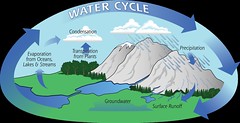
7353773878The water cycle (lol)Evaporation, Condensation, Precipitation42
7353773879Phosphorous cycleWeathering of rocks adds phosphorous to soil, some leaches into groundwater and surface water and may eventually reach the sea, producers take in phosphates, consumers eat producers, phosphate is returned to soil or water (Phosphorous never goes into the atmosphere)43
7353773880How have ecologists worked out the details of chemical cycling?Isotope usage -- follow nonradioactive naturally occurring isotopes --adding tiny amounts of traceable radioactive isotopes (C14)44
7353773881What factors control the rate of decompositionThe same factors that limit primary production: temperature, moisture, nutrient availability45
7353773882Hubbard Brook Deforestation StudyShowed that the amount of nutrients leaving an intact forest ecosystem is controlled mainly by the plants46
7353773883Ecosystem damagesFarming, Mining, Salts from irrigation, Oil spills47
7353773884What do restoration ecologists work to do?Identify and manipulate the processes that most limit recovery of ecosystems from disturbances48
7353773885BioremediationUsing organisms- usually prokaryotes, fungi, or plants, to detoxify polluted ecosystems49
7353773886Biological AugmentationUses organisms to add essential materials to a degraded ecosystem50
7353773887How much of visible light is converted to chemical energy by photosynthetic organisms?Only 1%51
7353773888Is net primary productivity higher in the summer or fall?Fall because there is a need for less respiration because less photosynthesis is occurring52

AP Biology Chapter 14 Flashcards

Gene Expression

Terms : Hide Images
6062834601How does DNA code for traits?the DNA inherited by an organism dictates the synthesis of proteins which are the link between genotype and phenotype.0
6062834602Gene Expressionthe process by which DNA directs protein synthesis, includes two stages: transcription and translation1
60628396051902 Archibold Garrod"One Gene - One Enzyme" - first suggested that genes dictate phenotypes through enzymes that catalyze specific chemical reactions - He thought symptoms of an inherited disease reflect an inability to synthesize a certain enzyme example: alkaptonuria2
6062863082Revision: One Gene - One Protein- some proteins are not enzymes (example: keratin in animal hair) - many proteins are composed of several polypeptides, each of which has its own gene (example: hemoglobin in blood - made of two polypeptides each coded its own gene) now: "One Gene - One Polypeptide"3
6062879580Basic Principles of Transcription and Translation- DNA provides the instructions to make a specific protein - RNA is the link between gene and protein - DNA codes for RNA and RNA codes for the protein4
6062895502Basics of Transcription & Translation cont'dRNA is chemically similar to DNA, but RNA has a ribose sugar and the base uracil (U) rather than thymine (T) - RNA is usually single-stranded - RNA can leave the nucleus - getting from DNA to protein requires two stages: Transcription and Translation5
6062906672Transcriptionsynthesis of RNA using information in DNA - site of Transcription: nucleus - end Product: messenger RNA (mRNA) - DNA: C A T G A C - RNA: G U A C U G6
6062914524Translationsynthesis of a polypeptide, using the information in the mRNA - site of translation: ribosomes - product: polypeptide (protein)7
6062938414Genetic Codesequence of DNA bases that describe which Amino Acid to place in what order in a polypeptide - the genetic code gives the primary protein structure8
6062959873Codons: Triplets of Nucleotidesproblem: RNA consists of four "letters" A, U, G, and C proteins consist of 20 "letters" - the amino acids - if 1 base = 1 amino acid, then 4 bases = 4 amino acids - we know there are 20! - Triplet Code: a series of three-nucleotide "words" that code for a specific amino acid - these "words" are then translated into a chain of amino acids - forming a polypeptide example: GGU = Glycine9
6062972551Genetic Code & Codonsgenetic code is based on codons Codon: non-overlapping mRNA base triplets that code for a specific amino acid - 64 possible codons known - has redundancy; some AA's have more than 1 code - however: each 3 letter code codes for only 1 specific amino acid10
6063014817How many codons does it take to make 3 amino acids?3 codons11
6063014818How many nucleotides does it take to make 5 amino acids?15 nucleotides12
6063017187How many amino acids are made by 6 codons?6 amino acids13
6063017188How many amino acids are made by 9 nucleotides?3 amino acids14
6074446467RNA Polymerasepries DNA strands apart and joins together the RNA nucleotides - assembles RNA nucleotides in the 5' -> 3' direction, using the DNA strand as a template - can start without a primer DNA Template: T A C G A T mRNA: A U G C U A15
6074469531Promotersequence signaling the end of transcription in bacteria16
6074468429TerminatorDNA sequence where RNA polymerase attaches to begin RNA synthesis17
6074471553Transcription Unitentire stretch of DNA that is transcribed into mRNA18
60744820923 Stages of Transcription: Initiation1. Transcription Factors: proteins that assist the binding of RNA polymerase to initiate transcription - recognize TATA box 2. Transcription Initiation Complex: completed assembly of transcription factors and RNA polymerase II bound to a promoter19
60745125223 Stages of TranscriptionInitiation: after the Transcription Initiation Complex is formed, RNA Polymerase unwinds and unzips DNA to start RNA synthesis Elongation: the polymerase moves downstream, unwinding the DNA and elongating the RNA transcript 5' -> 3' - in the wake of transcription, the DNA strands re-form a double helix Termination: stops when RNA Pol II reaches the polyadenylation signal sequence (AAUAAA) - the RNA transcript is released, and the polymerase detaches from the DNA after closing the helix20
6074523856Transcription Final ProductEukaryotes: Pre-mRNA - this is a "raw" RNA that will need further processing Prokaryotes: do not need any processing21
6074537575Eukaryotic Cells Modify RNA After Transcription- in Prokaryotes, mRNA is directly translated into the polypeptide (protein) - in Eukaryotes, mRNA is processed first before being sent out into the cytoplasm these modifications make the mRNA molecule ready for translation22
6074565235RNA Processingmodification of pre-mRNA - during RNA processing both ends of the primary transcript (mRNA) are altered23
6074556046Alteration of mRNA Ends5' end: receives a modified G nucleotide "5' cap" 3' end: gets a poly-A tail - repeated A sequence function: prevent mRNA degradation by hydrolytic enzymes - helps attach to the ribosome during translation - helps facilitate export of the mRNA from the nucleus24
6074577900RNA Splicingremoves noncoding (non-translating) regions of mRNA (introns) and joins together coding regions (exons) - this creates an mRNA strand that has a continuous coding sequence25
6074586071Intronsnoncoding regions of mRNA that lie between exons26
6074588663Exonscoding regions that are translated into amino acid sequences27
6074595048Spliceosomelarge complex of proteins and small RNAs - the spliceosome binds to several short nucleotide sequences along the intron - intron is released and the spliceosome joins together the two exons on either side28
6074613091RibozymesRNA molecules that act as enzymes - are sometimes Intron RNA and cause splicing without a spliceosome - in other words, can splice themselves out of the mRNA transcript!29
6124282451Translation is the RNA- directed synthesis of a polypeptide- genetic information flows from mRNA to protein through the process of translation - overall goal: use mRNA generated from transcription and form a polypeptide!30
6124291884Transfer RNA (tRNA)molecule that reads mRNA codons and builds a polypeptide accordingly - tRNAs transfer corresponding amino acids to the growing polypeptide in a ribosome - a tRNA molecule consists of a single RNA strand that is only 80 nucleotides long - 3' end of tRNA carries an amino acid - the other end of tRNA molecules contain an anticodon that pairs with the codon on the mRNA strand31
6124339583Accurate Translation Requires Two Steps:1st: a correct match between a tRNA and an amino acid - done by the enzyme aminoacyl-tRNA synthetase - 20 different synthetases! Uses ATP. 2nd: a correct match between the tRNA anticodon and mRNA codon32
6124361037Ribosomes- facilitate specific coupling of tRNA anticodons with mRNA codons during protein synthesis - large and small ribosomal units are made of proteins and ribosomal RNAs (rRNAs) - only join to form a ribosome when attached to an mRNA molecule33
6124387264Ribosome: 3 Binding Sites1. P site: holds the tRNA that carries the growing polypeptide chain 2. A site: holds the tRNA that carries the next amino acid to be added to the chain 3. E site: "exit" site, where discharged tRNAs leave the ribosome34
6124398428Building a Polypeptidethe three stages of translation require protein "factors" and ATP that aid in the translation process 1. Initiation 2. Elongation 3. Termination35
6124422397Ribosome Association and Initiation of Translation- initiation: brings together mRNA, tRNA (carrying 1st amino acid) and the two subunits of a ribosome - a small ribosomal subunit binds with mRNA and a special initiator tRNA carrying the a.a. Methionine to pair with mRNA "start" codon AUG - in eukaryotes, initiator tRNA binds to 5' Cap then scans downstream until reaching AUG - next a large ribosomal subunit arrives and forms "translation initiation complex" - requires energy and initiation factors36
6124440360Elongation of the Polypeptide Chain- elongation: amino acids are added one by one to the previous amino acid at the C-terminus (COOH) of the growing chain - occurs in three steps: codon recognition, peptide bond formation and translocation - translation proceeds along mRNA in the 5' -> 3' direction37
6124485158Termination of Translation- termination: Occurs when a stop codon in the mRNA reaches the A site of the ribosome - the A site accepts a protein called a release factor - the release factor adds a water instead of an amino acid - releasing the polypeptide (hydrolysis) - the translation assembly comes apart Stop Codons: UAG, UAA, and UGA - do not code for an amino acid38
6124517374Targeting Polypeptides to Specific Locations-after translation, polypeptides fold to assume their specific conformation and are sometimes modified further - the destination of a protein is determined by the sequence of about 20 amino acids at the leading end of a polypeptide chain called the signal peptide - the signal peptide serves as a cellular zip code - directing proteins to their final destination39
6124532743Polyribosomes - Proks AND Euks- cluster of ribosomes all reading the same mRNA - another way to make multiple copies of a protein simultaneously40
6156986445Mutationschanges in the genetic material of a cell - may be at a chromosome or DNA level41
6156986446Point Mutationschemical changes in one or a few nucleotide pairs of a gene - effects: none to fatal - Substitutions, Insertions and Deletions - the change of just one nucleotide in a DNA template strand can lead to the production of an abnormal protein42
6157003103Nucleotide-Pair Substitutionreplaces one nucleotide and its partner with another pair of nucleotides43
6157004588Silent Mutationshave no effect on the amino acid produced by a codon because of the redundancy in the genetic code44
6157021741Missense Mutationstill codes for an amino acid, but not the correct one - most common45
6157037752Nonsense Mutationchange in amino acid codon into a premature stop codon - nearly always leading to a nonfunctional protein46
6157051216Insertions and Deletionsadditions or losses of nucleotide pairs in a gene - NOT in multiples of three - can have disastrous effects on the resulting protein!!! - may produce a frameshift mutation (example: Tay Sach's) - alters the reading frame of the genetic message47
6157095937Mutagensmaterials that cause DNA changes 1. Radiation (example: UV light, X-rays) 2. Chemicals (example: 5-bromouracil) - any material that can chemically bond to DNA or is chemically similar to Nitrogen bases will be a strong mutagen48
6157105032What is a gene?a gene is a region of DNA that can be expressed to produce a final functional product - the product can be a protein or a RNA molecule49

AP Biology - Chemistry Review Flashcards

Terms : Hide Images
4776587160AtomIs made up of a nucleus with positively charged protons and neutrally charged neurons. It has electrons arranged outside the nucleus.0
4776592194MoleculesGroups of two or more atoms held together by chemical bonds.1
4776596689Chemical BondsThis bond happens because of the interaction between electrons.2
4776598536ElectronegativityMeasure of tendency for the ability of an atom to attract electrons towards it, from its bond.3
4776608423Ionic BondThis type of bong is formed when one or more electrons are transferred from one atom to another.4
4776628062Why Ionic bonding happens?When electronegativity of atoms differ and one has a stronger pull than the other for the electrons. The attraction of the charges constitutes for the bond.5
4776579856IonsAtoms that gain electrons have a negative charge. Atoms that lose electrons have a positive charge. Because of their charge the become this.6
4776653496Covalent BondA bond where electron pairs are shared and neither atom has them.7
4776662240Non-polar Covalent BondBond where electrons are shared equally. Usually the two atoms are identical, where the electronegativity is equal and so is the pull.8
4776673237Polar Covalent BondBond where electrons are shared unequally. Electronegativity are different, unequal electron distribution, and electrons forms bond closer to atom with higher electronegativity. It produces a pole, with weaker pole (+) and stronger pole(-).9
4776698313Hydrogen bondIts a weak bond between molecules. It forms when polar positive H molecules attract the polar negative molecules of other covalently bonded molecules.10
4782799006Excellent SolventProperty of water that makes ionic substances soluble (dissolvable) in water because of the ions that forms the two poles. When polar covalent bonded substances interact with water and the poles becomes soluble.11
4782865982Why non-polar substances do not dissolve in water?These substances are hydrophobic and do not dissolve in water because they lack charged poles.12
4782878421High Heat CapacityProperty of water that has to do with the change of temperature due to the increase or decrease of heat. This property is high on water as it changes temperature very slowly with stable changes.13
4783152394...Water expands and becomes less dense than liquid as it freezes, as a result it exalts this property.14
4783165330Strong cohesion...15
4783166550Strong adhesion...16
4783167211Organic MoleculesMolecules that have carbon17
4783169204MacromoleculesLarge organic molecules with many carbons. Carbohydrates, Lipids, Nucleic Acids, and Proteins are big ones.18
4783188068PolymerMolecules that consist of a single unit (monomer) repeatedly.19
4783192788Functional GroupsSpecific groups of molecules that are responsible for the characteristic of other molecules due to their make up. Main seven groups are hydroxyl, carboxyl, amino, phosphate, methyl, carbonyl ketone, and carbonyl aldehyde.20
4783208937Hydroxyl GropupAlcohols (like ethanol), glycerol, and sugars belong to this group. They are characterized as polar hydrophilic.21
4783217378Carboxyl GroupCarboxyl acids (like acetic acid), amino acids, fatty acids, and sugars belong to this group. Characterized as polar, hydrophilic, and weak acid.22
4783222883Amino GroupAmines and amino acids are examples for this group. They are characterized as polar, hydrophilic, and weak bases.23
4783226203Phosphate GroupOrganic phosphates that help to make up DNA, ATP, and phospholipids. They are categorized as polar, hydrophilic, and acids.24
4783253086KetoneAcetones and sugars are examples of this functional group. They are characterized as polar, hydrophilic. They are a type of carbonyl with a central carbon.25
4783259910AldehydeFormaldehyde is an example of it. It is a carbonyl with a carbon double bonded to an oxygen. It has characteristics that are polar and hydrophilic.26
4783266662MethylA group of only carbons and hydrogens. Fatty acids, oils, and waxes are examples of this group. They are characterized as non polar and hydrophobic.27
4783273827CarbohydratesMacromolecule composed of elements carbon, hydrogen, and oxygen in a 1:2:1 ratio ((CH2O)n), respectively. They are used as storage forms of energy and they are structural molecules.28
4783284695MonosaccharidesSimplest kind of carbohydrates. It is a single sugar molecule. Glucose and fructose are its most common examples.29
4782791183Excellent SolventProperty of water that makes ionic substances soluble (dissolvable)30
4785897623Inorganic CompoundCompounds tgat do not contain the element carbon. Salts and HCl are examples.31
4785897624GlucoseSingle sugar subunit. Exist in alpha and beta form. Its formula is that of C6H12O6.32
4785897625Disaccharide2 sugar molecules joined by glycosidic linkages. Maltose and sucrose are examples.33
4785897626Glycosidic linkagesProcess that links sugar molecules through a loss of water molecule. Also called dehydration synthesis or condensation reaction.34
4785982294Hydrolysis ReactionA process that breaks down large polymers into smaller subunits by adding water.35
4785982295PolysaccharidesPolymers or chains of repeating monosaccharide sububits. Glycogen and starch are examples.36
4785982296StarchPolymer of of alpha glucose molecules. It serves as a storage molecules for plant cells.37
4785982297GlycogenPolysaccharide made up of alpha glucose subunits. It is a major energy storage molecule in animal cells.38
4785982298CellulosePolymer of beta glucose. Serves as a structural molecule in plant cells. It is insoluble in water. Only some organisms like bacteria can break down their bonds.39
4786036233ChitinPolysaccharide of beta glucose. It's glucose molecule has nitrogen group attached to ring. It serves as a structural molecule in walls of fungus cells and in exoskeleton of insects, other anthropods, and mollusks.40
4787011773LipidA macromolecule composed of C,H,and O in big ratios. It consist of 3 fatty acid molecules bonded to a single glycerol backbone. They serve as food storaging molecules in animals. They also release a lot of energy and provide insulation and protection against injury since they are made up of fatty (adipose) tissue.41
4787011774Fatty AcidsHydrocarbons with carboxyl group at one end. They are attached to a glycerol molecule.42
4787011775HydrocarbonsChains of covalently bonded Carbon and Hydrogen's.43
4787011776Saturated Fatty AcidLipid structure that is a single covalently bonded between each pair of carbon atom. It said thag each carbon is full of hydrogens.44
4787011777Monosaturated Fatty AcidOne double covalent bond and each carbon has one hydrogen bound to it. A lipid structure.45
4787011778Poly Unsaturated Fatty AcidA lipid structure that is covalently bonded with carbon atoms and hydrogen. It has two or more double (C=C) bonds.46
4787011779PhospholipidsA lipid structure but with one of its fatty acids replaced with a phosphate group. Its tails are nonpolar hydrophobic while its phosphate head is hydrophilic and polar. This provides the structure and support of the cell membrane.47
4787011780SteroidsLipid derived structure that has a backbone of four rings. Three of its rings ar3 cyclohexanes and one fused cyclopebtane ring. Cholesterol, the sex hormones testosterone and estrogen, and corticosteroid are examples of it.48
4787011781WaxesEsters of fatty acids and monohydroxylic alcohols. They are found as protective coating on skin, fur, leaves, of higher plants, and on the exoskeleton of many insects.49
4787071579ProteinsMacromolecule composed primarily of elements C,H,O,N but may contain P and S. They are polymers of amino acids.50
4787071580Amino AcidsPolymers and the building blocks of proteins. They are bonded covalently. There are a total of 19 of them plus one amine group. It is constructed with a central (alpha) carbon bounded to an amino group, carboxyl group, an H-atom, and the R-groups (side chain groups). They are represented by three letters.51
4787071581Polypeptide ChainsChain of amino acids joined through peptide bonds. Also called a peptide because they have become a polymer.52
4787071582Structural ProteinsThese type of proteins contribute to the physical support of cell or tissue and movement. They may be extracellular like collagen in cartilage, bone, and tendons, or intracellular like proteins in cell membrane. Another example the keratin53
4789994456Storage ProteinProteins that store materials such as amino acids for later use.54
4789994457Transport ProteinThis type of protein carries important materials in and out of the cell. Hemoglobin is an example that carries oxygen in the circulation and the cytochromes carry electrons during cellular respiration.55
4820216533Signaling ProteinThese proteins control physiological processes such as hormones.56
4820222814Receptor ProteinsThese proteins receive and respond to chemical signals.57
4789994458Defensive ProteinsProteins that bind to foreign particles (antigens), including disease causing organism that have enetered the body. Antibodies is an example.58
4789994459EnzymesBiological catalyst that act by increasing the rate of chemical reactions important for biological functions. Amylase, lipase, and ATPase are examples.59
4790060858Primary StructureIt is the sequence of amino acids. It is the way that amino acids are ordered.60
4790060859Secondary StructureIts the 3D shaped property of amino acids that results from H-bonding of amino and carboxyl of adjecent group of amino acids. Produces alpha helixis (spiral) and beta-pleated sheets (folded planes). Fibrous proteins dominated by these shapes.61
4790060860Tertiary StructureProtein property that has 3D shaping and dominates globular proteins. It has hydrogen bonding and ionic bonding between r-groups of amino acids. it has hydrophobic effect happening among r-groups that move towards the center of the of the protein and away from the water. It also has disulfide bonds to help maintains turns of AA by binding to the sulfur atom of two different cystine AA.62
4798366868Quaternary StructureProtein assembled from two or more chains. Hemoglobin is an example as it consist of four peptide chains that are held together by the interactions between the r-groups.63
4798370004Nucleic AcidsA macromolecule that contains elements C,H,O,N, and P. Nucleotides are their polymers. They code all of the information required by an organism to produce proteins and replicate through DNA and RNA.64
4798378591DNAThe cells genetic info storage molecule. Also called Deoxynucleic Acid. It is a polymer of nucleotides. It consist of a nitrogenous base, a deoxyribose sugar, and a phosphate group. It appears as a two stranded spiral or double helix. Their strands are antiparallel (oriented in opposing directions).65
4798389978AdenineA two ring purine nitrogenous base that binds to thymine. Uracil if it is as a RNA molecule.66
4798392397GuanineA two ring purine nitrogenous base that binds to Cytosine.67
4798394274ThymineA one ring pyrimidine nitrogenous base that binds to adenine.68
4798395373CytosineA one ring nitrogenous base that binds to guanine.69
4798402808Double StrandedHow the DNA molecule is oriented. Its' spiral and double helix form is known as this. It is oriented from a five prime to a three prime orientation. The phosphate is on the fifth carbon and it ends where the other nucleotide would attach to the third deoxyribose carbon.70
4798461148RNAInformation transcribed here from a DNA molecule to direct various metabolic activity of the cell. It is a single stranded molecule that is made with a ribonucleic sugar. it differs from a DNA molecule because of its sugar ribose, thymine nitrogenous base is replaced with Uracil to pair with adenine, and it doesn't form a double helix.71
4798515011MetabolismChemical reaction that occurs in biological system. It happens because of the collision of reacting molecules.72
4798538079Activation EnergyMaximum amount of energy that is required in order to trigger the formation of a bond or start a chemical reaction.73
4798552933CatalystSubstance that accelerates reaction but does not go through chemical change.74
4798558320Catabolisma process that breaks down subtances75
4798564481AnabolismSynthesis- formation of new product76
4798568540Chemical EquilibriumA metabolic process where the concentration of reactant and end products drives the overall reaction. The rate of reaction equal and there is no net production.77
4820138597SulfhydrylBy giving up H, two —SH groups can react to form a disulfide bridge, thus stabilizing protein structure.78
4859228474SubstrateThe reactants in enzyme-catalyzed reactions.79
4859235530Induced FitDescribes how enzymes work. Enzymes have an active site where the reactants (substrates) readily interact due to the shape, polarity, and other characteristics matching. Their interaction changes the shape of the enzyme which places the substrate in a favorable position to interact. This interaction is referred as this.80
4859261835Co-factorAre non -polar molecules that assist enzymes81
4859284607HoloenzymeIs the complete enzyme with all of its associated parts (cofactors and coenzymes,)82
4859292262CoenzymesIts an organic molecule (cofactor) that functions to donate or accept some component of reaction (often the electrons).83
4859309156Inorganic CofactorsThese are inorganic molecules often metal ions such as iron.84
4859331120ATPAdenosine Triphosphate85

AP Biology Chapter 16 Flashcards

Terms : Hide Images
8556810480DNA Replicationthe process by which a DNA molecule is copied; also called DNA synthesis0
8556810481Transformationa change in genotype and phenotype due to the assimilation of external DNA by a cell transforming substance- DNA1
8556810482BacteriophagesViruses that infect bacteria Bacteria eaters2
8556810483Virusinfects a cell and takes over the cell's metabolic machinery3
8556810484Hershey and ChaseConcluded that phage DNA entered bacterial host cells, but phage proteins did not, so DNA functions as the genetic material4
8556810485GriffithConcluded that nonpathogenic bacteria transformed into pathogenic bacteria by an unknown, heritable substance from the dead S cells that enabled the R cells to make capsules5
8556810486Chargaff's Lawthe base compostion of DNA varies between species and for each species, the percentages of A and T bases are roughly equal to the percentages of the G and C bases6
8556810487Rosalind Franklinaccomplished X-ray crystallographer that discovered the double helix of DNA7
8556810488Antiparallelsubunits run in opposite directions8
8556810489Nitrogenous bases of DNAA, T, C, G9
8556810490PurinesA and G Nitrogenous bases with two organic rings10
8556810491PyrimidinesC and T Nitrogenous base with a single organic ring11
8556810492Conservative modeltwo parental strands reassociate after acting as templates for new strands thus restoring the parental double helix12
8556810493Semiconservative Modelthe two strands of the parental molecule separate and each functions as a template for synthesis of a new complementary strand- most common13
8556810494Dispersive Modeleach strand of both daughter molecules contains a mixture of old and newly synthesized DNA14
8556810495Origins of Replicationshort stretches of DNA having a specific sequence of nucleotides15
8556810496Replication Forka Y shaped region where the parental strands of DNA are being unwound16
8556810497Helicasesenzymes that untwist the double helix at the replication forks, separating the two parental strands and make them available as template strands17
8556810498Single Strand Binding ProteinsBind to the unpaired DNA strands keeping them from repairing18
8556810499TopoisomeraseThe untwisting of double helix causes tighter twisting and strain ahead of replication fork Relieve this strain by breaking swiveling, and rejoining DNA strands19
8556810500PrimerThe initial nucleotide chain that is produced during DNA synthesis is actually a short stretch of RNA20
8556810501PrimaseSynthesizes the primer Starts a complementary RNA chain from a single RNA nucleotide, adding more RNA nucleotides one at a time, using the parental DNA strand as a template21
8556810502DNA polymerasesEnzyme that catalyze the synthesis of new DNA by adding nucleotides to a preexisting chain22
8556810503Leading strandStrand that continuously adds nucleotides to the new complementary strand as the fork progresses DNA pol III23
8556810504Lagging StrandThe strand that DNA pol III works away from the replication fork Synthesized discontinuosly as a series of segments24
8556810505Okazaki fragmentsSeries of segments that are 1000-2000 nucleotides long25
8556810506DNA Ligasejoins the sugar phosphate backbones of all the Okazaki fragments into a continuous DNA strand26
8556810507DNA pol IIISynthesizes new DNA strands by adding nucleotides to an RNA primer or a pre-existing DNA strand27
8556810508DNA pol IRemoves RNA nucleotides of primer from 5' end and replaces them with DNA nucleotides28
8556810509Mismatch repairOther enzymes remove and replace incorrectly paired nucleotides that have resulted from replication errors29
8556810510NucleaseDNA cutting enzyme that cuts out the damaged parts of the strand and fills the space with nucleotides using the undamaged strand as a template30
8556810511Nucleotide excision repairDNA repair system where teams of enzymes detect and repair the DNA, the nuclease cuts out the damaged DNA and removes it, fills in the missing nucleotides and the DNA ligase seals the free end of the new DNA to the old DNA making the strand complete31
8556810512TelomeresSpecial nucleotide sequences at the ends of chromosomes TTAGGG is repeated between 100-1000 times Prevent the staggered ends of daughter molecule from activitating cell's system for monitoring DNA damage32
8556810513TelomeraseEnzyme that catalyzes the lengthening of telomeres in eukaryotic germ cells and restores the original length and compensating for the shortening that occurs during DNA replication33
8556810514HistonesProteins that are responsible for the first level of DNA packing in chromatin34
8556810515Nucleosomethe basic unit of DNA packing35
8556810516Chromatincomplex of DNA and protein36
8556810517Heterochromatincentromeres and telomeres exist in a highly condensed state with visible irregular clumps making it largely inaccessible37
8556810518Euchromatincentromeres and telomeres exist in a less compacted state that is very accessible38

Ap Biology Chapter 48 Flashcards

Terms : Hide Images
5199132303GangliaClusters of neurons(primitive brains)0
5199138496Sensory neuronsSensors detect external stimuli and internal conditions and transmit information along these1
5199150086InterneuronsNeurons that integrate the sensory information sent into the brain or ganglia2
5199157933Motor neuronsNeurons that trigger muscle or gland activity3
5199174044Central Nervous System (CNS)Where integration takes place; this includes the brain and a nerve cord4
5199184145Peripheral Nervous System (PNS)Brings information into and out of the CNS5
5199189842Cell bodyMost of a neuron's organelles are here6
5199193214DendritesHighly branched extensions that receive signals from other neurons7
5199200320AxonA much longer extension that transmits signals to other cells at synapses8
5199207923Axon hillockWhere the axon attaches to the cell body9
5199212557SynapseA junction between an axon and another cell10
5199216764Synaptic terminalOne axon passes information across the synapse in the form of chemical messengers11
5199226357NeurotransmittersChemical messengers12
5199231364Presynaptic cellA neuron13
5199234244Postsynaptic cellA neuron, muscle, or gland14
5199236739GliaMost neurons are nourished or insulated by this15
5199244406Membrane potentialA voltage (difference in electrical charge) across the plasma membrane16
5199251604Resting potentialThe membrane potential of a neuron not sending signals17
5199256089Ion channelsThe openings in the plasma membrane that convert chemical potential to electrical potential18
5199293866Equilibrium potential E(ion)The membrane voltage for a particular ion at equilibrium and can be calculated using the Nernst equation19
5199318996Nernst equationE(ion)=62mV*(log[ion](outside)/[ion](inside))20
5199336125Gated ion channelsOpen and close in response to stimuli21
5199339400HyperpolarizationAn increase in the magnitude of the membrane potential22
5199345619Graded potentialsChanges in polarization where the magnitude of the change varies with the strength of the stimulus.23
5199355627Voltage-gatedNa and K channels that respond to a change in membrane potential24
5199361218Action potentialA strong stimuli results in a massive change in membrane voltage25
5199366294Refractory periodAfter an action potential, a second action cannot be initiated during this period26
5199374147120m/sThe speed of an27
5199392903Myelin sheathsInsulates axons and causes an action potential's speed to increase28
5199412749Oliodendrocytes and Schwann cellsThe 2 types of glia cells that make myelin sheaths29
5199418112Nodes of RanvierAction potentials are formed only in gaps in the myelin sheath where voltage-gated Na+ channels are found30
5200398373Saltatory conductionAction potentials in myelinated axons jump between the nodes of Ranvier31
5200415266Synaptic vessiclesWhere the preneuron synthesizes and packages the neurotransmitter32
5200426024Synaptic cleftThe gap of a synapse where neurotransmitters diffuse and are received by the postsynaptic cell33
5200446728Excitatory postsynaptic potentials (EPSPs)Are depolarizations that bring the membrane potential toward threshold34
5200456753Inhbitory postsynaptic potentials (IPSPs)Are hyperpolarizations that move the membrane potential farther from threshold35
5200468359Temporal summationWhen 2 EPSPs are produced in rapid succession36
5200483245Spatial summationEPSPs produced nearly simultaneously by different synapses on the same postsynaptic neuron add together37
5200501398AcetylcholineA common neurotransmitter in vertebrates and invertebrates38

AP Language Unit 6 Vocab Flashcards

Terms : Hide Images
5780808838abject(adj.) degraded; complete and unrelieved0
5780810489agnostic(n.) one who believes that nothing is known about God (adj.) without faith1
5780811878complicity(n.) involvement in the wrongdoing; being an accomplice2
5780812984derelict(n.) someone or something that is neglected (adj.) left abandoned3
5780814317diatribe(n.) a bitter and prolonged attack4
5780815413effigy(n.) a crude image of a despised person5
5780816626equity(n.) fair and equal treatment; the money value of a property above and beyond any mortgage or claim6
5780818732inane(adj.) silly, empty of meaning7
5780819793indictment(n.) the act of accusing; an accusation8
5780820622indubitable(adj.) certain, undoubtable9
5780821244intermittent(adj.) stopping and beginning again sporadic10
5780822300moot(adj.) open to discussion and debate (v.) to bring up for discussion (n.) hypothetical law case11
5780823909motif(n.) a principle idea, feature, theme, or element; a repeated or dominant figure in a design12
5780825218neophyte(n.) a beginner, novice13
5780825673perspicacity(n.) keenness in observing and understanding.14
5780827053plenary(adj.) complete in all aspects or essentials; absolute15
5780828314surveillance(n.) a watch kept over a person16
5780829053sylvan(adj.) relating to forests17
5780830509testy(adj.) easily irritated18
5780831071travesty(n.) a grossly inferior imitation (v.) to imitate in a broad or burlesque fashion19

AP Biology Chapter 3 Flashcards

AP Biology Mader 11th ed. Chapter 3

Terms : Hide Images
4786317629ADP (adenosine diphosphate):nucleotide with two phosphate groups that can accept another phosphate group and become ATP 560
4786317630Amino acid:organic molecule composed of an amino group and an acid group; covalently bonds to produce peptide molecules. 501
4786317631ATP (adenosine triphosphate):nucleotide with three phosphate groups. The breakdown of ATP into ADP + P makes energy available for energy-requiring processes in cells. 552
4786317632Biomolecule:organic molecules such as proteins, nucleic acids, carbohydrates, and fats. 383
4786317633Carbohydrate:class of organic compounds that typically contain carbon, hydrogen, and oxygen in a 1:2:1 ratio; includes the monosaccharides, disaccharides, and polysaccharides. 414
4786317634Cellulose:a polysaccharide that is the major complex carbohydrate in plant cell walls, and chitin. 445
4786317635Chaperone protein:molecule that directs the folding of polypeptides. 536
4786317636Chitin:strong but flexible nitrogenous polysaccharides found in the exoskeleton of arthropods and in the cell walls of fungi 447
4786317637Coenzyme:non-protein organic molecule that aides the action of the enzymes to which it is loosely bound. 548
4786317638Complementary base pairing:hydrogen bonding between particular purines and pyrimidines; responsible for the structure of DNA, and some RNA, molecules. 559
4786317639Dehydration reaction:chemical reaction in which a water molecule is released during the formation of a covalent bond. 4010
4786317640Denatured:loss of protein's or enzyme's normal shape so that it no longer functions; usually caused by a less than optimal pH and temperature. 5311
4786317641Deoxyribose:pentose sugar found in DNA 4212
4786317642Disaccharide:sugar that contains two monosaccharide units; e.g. maltose 4213
4786317643DNA (deoxyribonucleic acid)nucleic acid polymer produced from covalent bonding of nucleotide monomers that contain the sugar deoxyribose; the genetic material of nearly all organisms 5414
4786317644Enzyme:organic catalyst, usually a protein, that speeds a reaction in cells due to its particular shape 4115
4786317645Fat:organic molecule that contains glycerol and three fatty acids; energy storage molecule 4616
4786317646Fatty acid:molecule that contains a hydrocarbon chain and ends with an acid group 4617
4786317647Fibrous protein:a protein that has only a secondary structure; generally insoluble; includes collagens, elastins, and keratins 5118
4786317648Functional group:specific cluster of atoms attached to the carbon skeleton of organic molecules that enters into reactions and behaves in a predictable way 3919
4786317649Globular protein:most of the proteins in the body; soluble in water or salt solution; includes albumins, globulins, histones 5220
4786317650Glucose:six-carbon monosaccharide; used as an energy source during cellular respiration and as a monomer of the structural polysaccharides. 4221
4786317651Glycerol:three-carbon carbohydrate with three hydroxyl groups attached; a component of fats and oils 4622
4786317652Glycogen:storage polysaccharide found in animals; composed of glucose molecules joined in a linear fashion but having numerous branches 4323
4786317653Hemoglobin (Hb):iron-containing respiratory pigment occurring in vertebrate red blood cells and in the blood plasma of some invertebrates 4924
4786317654Hexose:any monosaccharide that contains six carbons; examples are glucose and galactose 4225
4786317655Hydrolysis reaction:splitting of a chemical bond by the addition of water, with the H+ going to one molecule and the OH- going to the other. 4126
4786317656Hydrophilic:type of molecule, often polar, that interacts with water by dissolving in water and/or by forming hydrogen bonds with water molecules. "Water loving" 4027
4786317657Hydrophobic:type of molecule, that is typically nonpolar, and therefore does not interact easily with water. "afraid of water" 4028
4786317658Inorganic chemistry:branch of science that studies the chemical reactions and properties of all of the elements, except hydrogen and carbon 3929
4786317659Isomer:molecules with the same molecular formula but different structure, and therefore a different shape. 4030
4786317660Lipid:class of organic compounds that tends to be soluble in nonpolar solvents; includes fats and oils 4531
4786317661Monomer:small molecule that is a subunit of a polymer -e.g., glucose is a monomer of starch 4032
4786317662Monosaccharide:simple sugar; a carbohydrate that cannot be broken down by hydrolysis ---e.g., glucose; also any monomer of the polysaccharides 4233
4786317663Nucleic acid:polymer of nucleotides; both DNA and RNA are nucleic acids 5434
4786317664Nucleotide:monomer of DNA and RNA consisting of a sugar, a nitrogenous base and a phosphate group 5435
4786317665Oil:triglyceride, usually of plant origin, that is composed of glycerol and three fatty acids and is liquid in consistency due to many unsaturated bonds in the hydrocarbon chains of the fatty acids. 4636
4786317666Organic chemistry:branch of science that deals with organic molecules including those that are unique to living things 3837
4786317667Organic molecule:molecule that always contains carbon and hydrogen, and often contains oxygen as well; organic molecules are associated with living things. 3838
4786317668Pentose:five-carbon monosaccharide. Examples are deoxyribose found in DNA and ribose found in RNA. 4239
4786317669Peptide:two or more amino acids joined together by covalent bonding 5040
4786317670Peptide bond:type of covalent bond that joins two amino acids 5041
4786317671Peptidoglycan:polysaccharide that contains short chains of amino acids; foundin bacterial cell walls 4442
4786317672Phospholipid:molecule that forms the bilayer of the cell's membranes; has a polar, hydrophilic head bonded to two nonpolar, hydrophobic tails. 4643
4786317673Polymer:macromolecule consisting of a covalently bonded monomers; for example, a polypeptide is a polymer of monomers called amino acids. 4044
4786317674Polypeptide:polymer of many amino acids linked by peptide bonds. 5045
4786317675Polysaccharide:polymer made from carbohydrate monomers; the polysaccharides starch and glycogen are polymers of glucose monomers 4146
4786317676Prion:infectious particle consisting of protein only and no nucleic acid 5347
4786317677Protein:polymer of amino acids; often consisting of one or more polypeptides and having a complex three dimensional shape 4948
4786317678Ribose:pentose sugar found in RNA 4249
4786317679RNA (ribonucleic acid):nucleic acid produced from covalent bonding of nucleotide monomers that contain the sugar ribose; occurs in many forms, including: messenger RNA, ribosomal RNA, and transfer RNA 5450
4786317680Saturated fatty acid:fatty acid molecule that lacks double bonds between the carbons of its hydrocarbon chain. Th chain bears the maximum number of hydrogens possible. 4651
4786317681Starch:storage polysaccharide found in plants that is composed of glucose molecules joined in a linear fashion with a few side chains 4352
4786317682Steroid:type of lipid molecule having a complex of four carbon rings -e.g., cholesterol, estrogen, progesterone, and testosterone. 4653
4786317683Trans-fat:unsaturated fatty acid chains in which the configuration of the carbon-carbon double bonds is such that the hydrogen atoms are across from each other, as opposed to being on the same side (cis) 4554
4786317684Triglyceride:neutral fat composed of glycerol and three fatty acids; typically involved in energy storage 4655
4786317685Unsaturated fatty acid:fatty acid molecule that contains double bonds between some carbons of its hydrocarbon chain; thus contains fewer hydrogens than a saturated hydrocarbon chain 4656
4786317686Wax:sticky, solid, water-repellent lipid consisting of many long-chain fatty acids usually linked to long-chain alcohols 4857

AP Biology Biochemistry Unit 1 Questions Flashcards

Terms : Hide Images
5907708682monosaccharideWhat is this molecule?0
5907708683disaccharideWhat is this molecule?1
5907708684polysaccharide / carbohydrateWhat are these molecules?2
5907708685fatty acidWhat molecules are these?3
5907708686glycerolWhat molecule is this?4
5907708687amino acidWhat molecule is this?5
5907708688polypeptide / proteinWhat molecule are these?6
5907708689phospholipid / lipidWhat molecule is this?7
5907708690triglyceride / lipidWhat molecule is this?8
5907708691steroid / lipidWhat molecule is this?9
5907708692amino acidMonomer unit of a protein is...10
5907708693monosaccharideMonomer unit of a carbohydrate is...11
59077086943 fatty acids and 1 glycerolMonomer units of a triglyceride are...12
5907708695short term energy storage in plants & animals, structure in plant cell walls or animal exoskeletonsName TWO functions of carbohydrates in a living thing.13
5907708696Long term energy storage, hormone (cell signaling), form plasma membrane and organelle membrane barriersName TWO (or more) functions of lipids in living things.14
5907708697Catalyze chemical reactions, defend against disease, storage of amino acids, transport molecules across membranes, hormone (cell signaling), receptors on the surface of cell membranes, movement within cells or of larger body parts, structural (tip of nose, outer ear)Name THREE (or more) functions of proteins in living things.15
5907708698Amine groups & carboxyl (acid) groupsWhat functional groups are found in ALL proteins?16
5907708699Carbonyl groups & hydroxyl groupsWhat functional groups are found in carbohydrates?17
5907708700Methyl groups: CH2 or CH3What functional groups are found in lipids that make most lipids hydrophobic?18
5907708701glycosidic linkageWhat is the name of bond between monosaccharides?19
5907708702peptide bondWhat is the name of the bond between amino acids?20
5907708703ester linkageWhat is the name of the bond between glycerol & three fatty acids?21
5907708704POLAR; amine group contains a NITROGEN atom which is a highly electronegative elementIs the amine group polar or non polar? Explain...22
5907708705POLAR; phosphate group contains OXYGEN atoms which are very electronegative elementsIs the phosphate group polar or non polar? Explain...23
5907708706POLAR: hydroxyl group contains an OXYGEN atom which is a very electronegative elementIs the hydroxyl group polar or non polar? Explain...24
5907708707POLAR: sulfhydryl group contains a SULFUR atom which is a very electronegative elementIs the sulfhydryl group polar or non polar? Explain25
5907708708DEHYDRATION SYNTHESISMonomers are joined to each other during the process of...26
5907708709HYDROLYSISPolymers are broken apart into their monomer unit building blocks by the process of...27

AP Biology: Chapter 2 Flashcards

Terms : Hide Images
8361498839elementthe basic form of matter that cannot be broken down0
8361503272compoundtwo or more different elements combined in a fixed ration1
8361507353atomthe smallest unit of an element that still has the properties of that element2
8361512207neutron-no charge -found in the nucleus -mass of 1 amu3
8361518250protons-positive charge -found in the nucleus -mass of 1 amu4
8361524117electrons- negative charge -found outside the nucleus -little mass -potential energy increases as their distance from the nucleus increases -orbit the nucleus in energy levels5
8361530923atomic numbernumber of protons in the nucleus of an atom6
8361536392mass numbernumber of protons plus the number of neutrons in the nucleus7
8361541403isotopean element that has a different mass than normal due to a change in the normal number of neutrons8
83615726672the first energy level contains how many electrons9
83615726698the second energy level contains how many electrons10
83615773298the third energy level contains how many electrons11
8361583665inert or unreactivean element whose valence shell is complete is said to be what12
8361591179covalent bondsharing of a pair of valence electrons by two atoms13
8361601215non polar covalent bondequal sharing of electrons14
8361601216polar covalent bondunequal sharing of electrons15
8361606936iontransfer of electrons between atoms16
8361611490ionic bondattraction between two oppositely charged ions17
8361615768cationpositively charged ion (lost electron)18
8361620189anionnegatively charged ion (gained electron)19
8361639554polar covalentthis hogging of electrons results in which type of bond between oxygen and hydrogen within the water molecule20
8361645598hydrogen bondsoccur between two polar molecules or between different polar regions of one large macro molecule21
8361654089van der waals interactionsweak attractions that occur when atoms and molecules are very close together, may occur in regions of a single large molecule such as a protein22
8361668172shapedetermines how molecules recognize and respond to one another23
8361680660reactantsstarting materials are known as24
8361685662productsending materials are known as25
8361699979organic chemistrythe study of carbon compounds26
8361712344isomersmolecules with same molecular formula but different structures, different chemical properties27
8361721536hydrocarbonssimplest C molecules; combinations of C and H28
8361733741functional groupsdifferent elements added to organic molecules that change their properties29
8361739052hydroxyl-OH alcohols ex-ethanol30
8361746606carbonylC=O O double bonded to C C=O end= aldehyde C=o middle= ketone31
8361759623carboxyl-COOH compounds with COOH= acids fatty acids amino acids32
8361768583amino-NH233
8361777637Sulfhydryl-SH S bonded to H34
8361783401Phosphate-PO4 function is to transfer energy between organic molecules35
8361796310methyl-CH3 not a reactive group, serves as a recognizable tag on biomolecules used in DNA methylation36

Pages

Subscribe to CourseNotes RSS

Need Help?

We hope your visit has been a productive one. If you're having any problems, or would like to give some feedback, we'd love to hear from you.

For general help, questions, and suggestions, try our dedicated support forums.

If you need to contact the Course-Notes.Org web experience team, please use our contact form.

Need Notes?

While we strive to provide the most comprehensive notes for as many high school textbooks as possible, there are certainly going to be some that we miss. Drop us a note and let us know which textbooks you need. Be sure to include which edition of the textbook you are using! If we see enough demand, we'll do whatever we can to get those notes up on the site for you!