AP Notes, Outlines, Study Guides, Vocabulary, Practice Exams and more!

AP Biology - Chapter 28 Flashcards

Terms : Hide Images
7254695923StemVascular plant organ that consistes of alternating nodes and internodes that support the leaves and reproductive structures.0
7254695924LeavesMain photosynthetic organ of vascular plants.1
7401966170Bladethe flattened portion of a typical leaf.2
7401968420PetioleThe stalk of the leaf, joins leaf at the node of the stem.3
7401968421RootsAn organ in vascular plants that anchors the plant and enables it to absorb minerals and water through the soil.4
7401971574TaprootA main vertical root that develops from and embryonic root and gives rise to lateral roots.5
7401971575Fibrous Rootsnumerous branching roots that are about the same size and grow from a central point6
7401973966NodesA point along the stem of the plant that leaves are attached to.7
7401973967OrgansA specialized center of body function composed of several different types of tissues.8
7401976303Primary growthGrowth produced by apical meristems, lengthening stems and roots.9
7401976304Apical budBud at the tip of a plant stem. (terminal bud)10
7401978989Axillary budsStructure that has the potential to form a lateral shoot or branch. Appears between the angle of a leaf and stem.11
7401978990Dermal tissuethe outer protective layer covering plants.12
7401982732Vascular tissuePlant tissue consisting of cells joined into tubes that transport water and nutrients throughout the plant body.13
7401982733Ground tissuePlant tissues that are neither vascular or dermal, and have a variety of functions, ex. storage, photosynthesis and support14
7401985232Parenchyma cellsA relatively unspecialized cell that carries out most of the metabolism, synthesizes and stores organic products, and develops into a more differentiated cell type.15
7401985233Collenchyma cellsFlexible plant cell type that occurs in strands or cylinders that support young parts of the plants without restraining growth16
7401995998Sclerenchyma cellsA rigid, supportive cell usually lacking a protoplast and possessing thick secondary walls strengthened by lignin at maturity.17
7402000635TracheidsA long tapered water-conducting cell found in the xylem of nearly all vascular plants.18
7402000636Vessel elementsShort, wide, water conducting tube found in the xylem of most angiosperms and a few nonflowering vascular plants. Dead at maturity, aligned end to end to for vessels.19
7402003914Sieve-tube elementsA living cell that conducts sugars and other organic nutrients in the phloem of angiosperms, called a sieve-tube member where they connect end to end to form the sieve-tubes.20
7402007473Apical meristemsPlant tissue on the tips of buds and root and shoots. Dividing cells that enable the plant to grow in length21
7402007474Root capA cone of cells at the tip of the plant root that protects the apical meristem.22
7402033587InternodeA segment of a plant stem between the points where leaves are attached.23
7402033588Vascular cambiumA cylinder of meristematic tissue in woody plants that adds layers of secondary vascular tissue called secondary xylem (wood) and secondary phloem.24
7402062306Secondary growthGrowth produced by lateral meristems, thickening the roots and shoots of woody plants.25
7402062307Cork cambiumCylinder of meristematic tissue in woody plants that replaces the epidermis with thicker and tougher cork cells.26
7402036894PeridermThe protective coat that replaces the epidermis in woody plants during secondary growth, formed from the cork and cork cambium.27
7402036895BarkTissues outside the vascular cambium, consists mainly of secondary phloem and layers of periderm.28
7402043765Meristematic tissuePlant tissues that remains embryonic as long as the plant lives. Allows indeterminate growth29

Immunity - AP Biology Flashcards

Terms : Hide Images
6586952097Immune SystemThe totality of the body's physical barriers, immune cells, molecules, and physiological responses that enable you to block, fight, and destroy pathogens0
6586952098Innate ImmunityAll animals A defense that is active immediately upon infection and is the same whether or not the pathogen has been encountered before Nonspecific (less advanced, generic) Outer covering (skin/shell, chemical secretions, internal surfaces) Small preset group of receptor proteins bind to molecules/structures that are absent from animal bodies but common to viruses, bacteria, or other microbes Rapid Response1
6586952099Innate Immunity - Internal DefensesPhagocytic cells, Natural Killer cells, Antimicrobial Proteins, Inflammatory Reponse, Complement Protein Cascade Can have B and T cells2
6586952100Adaptive ImmunityVertebrates Only A defense that produces a a vast arsenal of receptors, each of which recognizes a feature typically found only on a particular part of a particular molecule in a particular pathogen Specific Slow development, slow response3
6586952101Adaptive Immunity - Internal DefensesAntibodies Cytotoxic cells (B and T Cells)4
6586952102LysozymeAn enzyme that breaks down cell walls to protect insect digestive systems5
6586952103PhagocytosisThe cellular ingestion and digestion of bacteria and other foreign susbtances6
6586952104Barrier DefensesBlock entry of many pathogens Skin Mucous membrane Mucous Ciliated cells Saliva, tears, mucous (inhibits colonization, hostile lysozymes) pH from stomach Oil and sweat (pH 3-5) prevent growth7
6586952105Toll-Like Receptor (TLR)A mammalian receptor that binds to fragments of molecules characteristic of a set of pathogens After detection, a phagocytic cell engulfs them (traps in a vacuole) Lysosome fuses and degrades components)8
6586952106NeutrophilsOne main type of phagocytic cell in the mammalian body Attracted by signals from infected tissues Engulf and destroy infecting pathogens9
6586952107MacrophagesSecond main type of phagocytic cell in the mammalian body Larger than neutrophils Migratory or localized10
6586952108Dendritic CellsPopulate tissues (ex. skin) that ocntact the environment) Stimulate adaptive immunity against pathogens they encounter and engulf11
6586952109Natural Killer CellsUnique to vertebrates Circulate body to detect abnormal array of surface proteins (virus-infected or cancerous cells)12
6586952110InterferonsAntimicrobial proteins that provide innate defenses by interfering with viral infection Infected cells secrete interferons, which induce nearby uninfected cells to produce substances and inhibit viral reproduction Some white blood cells secrete interferons to activate macrophages13
6586952111Complement System (Protein Cascade)30 proteins that circulate blood plasma Inactive until activated by substances on the surface of many microbes Activation results in a cascade of biochemical reactions, lysis of invading cells Inflammation14
6586952112Inflammatory ResponseChanges brought about by signaling molecules released upon injury or infection that causes swelling (increased blood flow)15
6586952113HistamineInflammatory signaling molecule Released at sites of damage, dilates blood vessels, permeates blood vessels16
6586952114Mast CellsFound in connective tissue Stores histamine in granules (vesicles)17
6586952115CytokinesSignaling molecules that enhance immune response by promoting blood flow to the site of infection/injury Produced by macrophages and neutrophils18
6586952116InflammationCycles of signaling and response Activated complement proteins promote histamine release, attracting more phagocytic cells to enter infected tissues Enhanced blood flow delivers more antimicrobial peptides Pus accumulates (rich in white blood cells, dead pathogens, cell debris) Fever, meningitis, appendicitis, septic shock19
6586952117Evasion of Innate Immunity by pathogensOuter capsule interferes with molecular recognition Resist breakdown by lysosomes Hides from innate defenses20
6586952118LymphocytesWhite blood cells T and B cells21
6586952119ThymusAn organ in the thoracic cavity above the heart Lymphocytes mature into T Cells22
6586952120B CellsLymphocytes that mature from bone marrow23
65869521213rd Lymphocyte typeNatural Killer Remain in blood24
6586952122AntigenAny substance that elicits a response from a B Cell or T Cell25
6586952123Antigen ReceptorA protein that binds to an antigen26
6586952124EpitoteAn antigenic determinant The small, accessible portion of an antigen that binds to an antigen receptor Determines T/B cell specificity27
6586952125B-Cell Antigen ReceptorEach B cell antigen is Y-Shaped (four polypeptide chains - two identical heavy chains, two identical light chains, with disulfide bridges) Transmembrane region near one end of a heavy chain anchors the receptor in the cell's plasma membrane) Short tail region at the end of the heavy chain extends into cytoplasma Variable regions bind to antigens (constant regions make up the rest) Bind to intact epitotes of intact antigens circulating in body fluids28
6586952126Variable RegionsAmino Acid sequence varies extensively from one B cell to another Specific binding29
6586952127Antibody/Immunoglobulin (Ig)A protein secreted when an antigen receptor binds to an antigen Y-Shaped organization May bind to antigens on surface of pathogens or free in body fluids30
6586952128T Cell Antigen ReceptorTwo different polypeptide chains (Alpha and Beta chain) linked by a disulfide bridge Transmembrane region anchors the receptor to plasma membrane Outer tip - Variable region Only bind to fragments of antigens displayed on the surface of host cells31
6586952129MHC (Major Histocompatibility Complex) MoleculeA host protein that displays the antigen gragment on the cell surface32
6586952130Antigen PresentationThe display of the antigen fragment in an exposed groove of the MHC protein Pathogen or part of a pathogen is taken in by a host cell Enzymes cleave the antigen into smaller peptides (antigen fragments) MHC binds to fragments MHC moves to surface and presents antigen33
6586952131B Cell and T Cell developmentDiversit, self tolerance (lack of reactivity to self), cell proliferation, stronger secondary response34
6586952132Generation of B and T Cell DiversityEach person makes more than 1 mil diff. B Cell antigen receptors and 10 mil. different T Cell antigen receptors Recombinase enzyme linkas a light chain V gene seg. to one J (joining) seg. to form a single exon Rnadomly links any one of 40 V to any one of 5 J35
6586952133Origin of Self ToleranceLymphocyte antigen receptors are tested for self-reactivity Those that are self reactive undergo apoptosis or rendered nonfunctional36
6586952134Proliferation of B and T Cells; Clonal SelectionBinding of antigen receptor to epitote activates lymphocyte B/T cell then undergoes multiple cell divisions to produce clones37
6586952135Effector CellsShort lived cells that take effect immediately against the antigen or any pathogen producing that sntigen38
6586952136Memory CellsLong-lived cells that can give rise to effector cells if the same antigen is encountered later in the animal's life39
6586952137Primary Immune ResponsePeaks 10-17 days after initial exposure Selected B and T cells give rise to effector and memory forms40
6586952138Secondary Immune ResponseHallmark of adaptive immunity Peaks 2-7 days after exposure Faster, stronger, longer response Relies on reservoir of memory T and B cells generated following the initial exposure41
6586952139Humoral Immune ResponseOccurs in blood/lymph Antibodies help neutralize or eliminate toxins and pathogens in blood/lymph42
6586952140Cell-Mediated immune responseSpecialized T cells destroy infected host cells43
6586952141Helper T-CellTriggers both humoral and cell-mediated immune response Do not carry out the responses themselves Signals the production of antibodies To activate adaptive immune responses, a foreign molecule must be present that can bind specifically to the antigen receptor of the T Cell AND the antigen must be displayed on the surface of an antigen-presenting cell44
6586952142Antigen-Presenting CellA dendritic cell, macrophage, or B Cell45
6586952143What distinguishes an antigen-presenting cell?Antigen-Presenting Cells can also be host cells Class I MHC - Body Cells Class I and Class II MHC - Antigen presenting cells Class II allows antigen presenting cells to be recognized46
6586952144Helper T/Antigen-Presenting Cell InteractionAntigen receptors on Helper T surface bind to specific epitote of an antigen frag. Accessory protein on helper T Cell attaches to Class II MHC (keeps them joined) Signals from cytokines are exchanges (antigen-presenting cell secrete cytokines to stimulate Helpter T, causing the Helpter T to produce cytokines) Helper T Cell proliferates (forms Activated Helpter T Cells) to stimulate cytotoxic T Cells B Cells present antigents to already activated helper T cells, which activates B Cells themselves47
6586952145Cytotoxic T CellsCell-mediated immune response effector cells Requires signaling molecules from helper T and the interaction with a antigen-presenting cell to activate Frag. of foreign proteins produced in infected host cells associate with Class I MHC (recognized by cytotoxic T) Secrete proteins that disrupt membrane integrity and tirgger apoptosis Deprives pathogen of reproduction host and exposes them to antibodies48
6586952146Activation of B CellsActivation by antigen is aided by cytokine (secreted by helper T) Stimulated by antigen and cytokines, B Cells proliferate into memory and effector/plasma cells (secrete antibodies)49
6586952147Antigen processing and display in B CellsPresents only the antigen to which it specifically binds (magrophages/dendritic cells present fragments from a wide variety of protein antigens) Antigen binds to receptor on B Cell surface Receptor-mediated endocytosis, class II MHC protein then presents antigen frag to helpter T50
6586952148B Cell ActivationCell-to-cell contact between B cell and Helper T Cell 1000's of plasma cells produced (these stop expressing a membrane bound antigen receptor) and produce/secrete antibodies (2000/sec for 4-5 days) Antigens recognized by B cells contain multiple epitotes (single antigen, variety of B cells activated)51
6586952149Antibody FunctionBinds to entigens, marks pathogens for inactivation/destruction52
6586952150Antibody Function - NeutralizationAntibodies bind to viral surface proteins Prevent infection of host cell, or recruits natural killer Bind to toxins released in body and prevent entrance53
6586952151Antibody Function - OpsonizationAntibodies bound to antigens on bacteria present a readily recognized structure for macrophages or neutrophils Increase phagocytosis May link bacterial cells, virus particles, or other foreign substances into aggregates (each antibody has 2 binding sites) Positive feedback (antibodies increase phagocytosis, phagocytic cells present antigens, more B cells formed, more antibodies released)54
6586952152Antibody Function - Membrane Attack ComplexComplement protein binds to antigen-antibody complex on a foreign cell (or enveloped virus) Complement system activates next protein Activated complement protein cascade generates membrane attack complex (forms pores in membrane of foreign cells, ions/water rush in, lysis)55
6586952153Active ImmunityDefenses that arise when a pathogen infects the body and prompts a primary or secondary immune response56
6586952154Passive ImmunityAntibodies provided by mother guard against pathogens that have never infected the newborn57
6586952155Immunization/VaccinationIntroduction of antigens into the body used to induce adaptive immunity Antibodies from an immune animal are injected into nonimmune animal (artificial passive immunization)58
6586952156Monoclonial AntibodiesAntibodies prepared from a single blone of B cells grown in a culture59
6586952157Immune RejectionAntigen receptors are not self-tolerant of a recipient's body cells (Immune system is health)60
6586952158Blood GroupsType A - A Carbohydrate, Anti-B Type B - B Carbohydrate, Anti-A Type AB - Both A and B carbohydrate, no antibody Type O - Neither, Anti-A and Anti-B61
6586952159Tissue and Organ TransplantsMHC stimulate immune response Diversity of MHC62
6586952160AllergiesExaggerated (hypersentive) responses to certain antigens (allergens)63
6586952161Autoimmune DiseaseImmune system is active against particular molecules of the body Immune system is self-reactive Lupus - Antibodies vs histones and DNA (breakdown of body cells - skin rashes, fevers, arthritis, kidney dysfunction) Rheumatoid Arthritis - Damage and inflammation of joints/cartilage Type I Diabetes Mellitus - Insulin producing Beta cells of pancreas are destroyed by cytotoxic T Cells Multiple sclerosis - T cells infiltrate central nervous system and destroy myelin sheath64
6586952162ImmunodeficiencyAn immune system response to antigens that is defective or absent65
6586952163Aquired Immunodeficiency SyndromeHIV virus66
6586952164Antigenic VariationChanges in epitote expression Lessens recognition by immune system67
6586952165LatencyViruses enter an inactive state No proteins made, no free virus particles, adaptive immunity is not triggered68
6586952166HIVInfects helper T Cells, high mutation (antigenic variation)69
6586952167CancerCancer frequency increases dramatically when adaptive immunity is inactivated70

Campbell AP Biology--CHAPTER 1 Flashcards

Terms and Concepts

Terms : Hide Images
7636774023Biology is...the study of life0
7636774024Properties of Life (7)Order Evolutionary Adaption Response to the environment Regulation Energy processing Growth and Development Reproduction1
7636774025Levels of Biological Organization (10)Biosphere Ecosystems Communities Populations Organisms Organs and organ systems Tissues Cells Organelles Molecules2
7636774026Biospheremost regions of land, bodies of water, and atmosphere to an altitude of several kilometers3
7636774027EcosystemsAll living things in a particular area along with all the nonliving components such as soil, water, atmospheric gases and light4
7636774028Communitiesmany kinds of trees, plants, animals, fungi/mushrooms. "species"5
7636774029Populationsall individuals of a species living within the bounds of a specified area6
7636774030OrganismsIndividual living things7
7636774031Organsa system of tissues; these can coordinate together to make a bigger system with a particular function.8
7636774032TissuesA group of cells tissues make up organs9
7636774033Cellsfundamental unit of structure and function.10
7636774034OrganellesEx) Chloroplasts are organelles of plants. Photosynthesis11
7636774035Moleculesa chemical structure consisting of two of more small chemical units called atoms.12
7636774036Producersplants and other photosynthetic organisms that convert light energy to chemical energy13
7636774037Consumersorganisms that feed on producers and other consumers14
7636774038deoxyribonucleic acid (DNA)the substance for genes, the units of inheritance that transmit information from the parents to the offspring.15
7636774039DNAtwo long chains arranged into a double helix each link of the chain is made up of 4 chemical building blocks called nucleotides16
7636774040proteinsgenes are instructions for making __17
7636774041Genomethe entire "library" of genetic instructions that an organism inherits18
7636774042prokaryotic CellsBacteria and Archaea DNA is not separated from the rest of the cell No nucleus19
7636774043eukaryotic CellsPlants and animals Nucleus and Cytoplasm20
7636774044Human Genome Projectsequenced many genomes.21
7636774045negative feedbackaccumulation of an end product of a process slows the process the cell's breakdown of sugar generates ATP. an excess amount would trigger an enzyme to slow it down22
7636774046Classification order (smallest to largest)Species Genus Family Order Class Phylum Kingdom Domain23
7636774047Taxonomythe branch of biology that names and classifies species, formalizes this ordering of species into a series of groups of increasing breadth.24
7636774048DomainThe 3 ___ of life: Bacteria, Archaea Eukarya25
7636774049Domain Bacteria and Archaeaprokaryotes unicellular and microscopic26
7636774050Domain Eukaryamicroorganisms (protozoans) includes kingdoms: plantae, fungi, and animalia27
7636774051Charles DarwinOn the Origin of Species by Natural Selection Descent with modification and Natural Selection Galapagos studying finches28
7636774052natural selectionthe natural environment "selects" for the propagation of certain traits,29
7636774053inquirya search for information and explanations, often focusing on specific questions.30
7636774054Dataitems of information on which scientific inquiry is based. Qualitative and Quantitative31
7636774055Inductive reasoningderive generalizations based on a large number of specific observations32
7636774056hypothesisa tentative answer to a well-framed question (explanation on trial) "if...then..." statements must be falsifiable and testable33
7636774057deductive reasoningfrom the general to the specific.34
7636774058experimental groupthe group that is being manipulated. the group being experimented on35
7636774059control groupthe group that stays the same as a reference.36
7636774060theorya broader scope than a hypothesis able to spin off specific hypotheses supported by a much more massive body of evidence37
7636774061Themes of BiologyThe Cell Heritable information Emergent properties of biological systems regulation Interaction with Environment Energy and life Unity and Diversity Evolution Structure and Function Scientific Inquiry Science, Technology, and Society38

AP Biology Chapter 6 Flashcards

Terms : Hide Images
7689697067light microscopeto magnify the image to see the nucleus and the cell membrane; the other organelles are too small to be seen0
7689774874magnificationthe enlargement of the specimen1
7689783354electron microscopebombards the specimen with electrons to see the cells organelles briefly2
7689793440resolutionthe clarity of the microscope3
7689805788prokaryotes-bacteria and archaea -no membrane or nucleus4
7736981394nucleolid-where DNA is concentrated -seen as a darkened spot inside the cell -not separated from cytosol5
7737026327eukaryotes-has a true nucleus with a nuclear envelope -is larger than prokaryote6
7737316689organellesinternal structures of the cell7
7737349893cytoplasmthe space between the nucleus and the cell membrane8
7737816143cytosol-the semi-fluid portion of the cytoplasm -made up of 80% water with suspended particles9
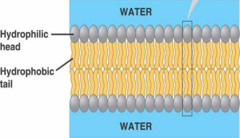
7737838095plasma membraneallows oxygen and nutrients in, and lets waste out (semi permeable) -made of phospholipids and proteins -has hydrophilic heads and 2 hydrophobic tails10
7737870692nuclear envelope-double membrane surrounding the nucleus -is perforated for RNA -the inner and outer membrane is fused at the pores11
7737889966nuclear laminaa fiber network that surrounds the nucleus and helps maintain its shape12
7737308005chromosome-found in the nucleus -help organize DNA -made of chromatin13
7737962114chromatinprotein that makes chromosomes14
7738286544ribosomes-made of ribosomal RNA protein -they make proteins15
7738341392bound ribosomesattached to the nucleus of the ER16
7738394359free ribosomes-suspended in the cytoplasm -makes the most proteins17
7738476445endoplasmic reticulumthere are two types: smooth and rough18
7738485333smooth ER-metabolism of carbohydrates -detoxification of poisons -synthesis of lipids, phospholipids, steroids, and sex hormones19
7738505523rough (transitional) ERsynthesis of glycoproteins and secretory proteins20
7738541048secretory proteins-(in rough ER) wraps the protein in a membrane vessel -the vessel is plasma membrane and used for transport21
7738564036golgi apparatus (body)-transport vessel from the ER -works as a factory: it packages and ships -made of flattened membrane -has Cis and Trans22
7738590465cis-the top near the ER (the closest to it) -this is where material will enter the golgi23
7738603729trans-this is the bottom of the ER (opposite end) -the farthest from it -packages vessels of plasma membrane leave from here24
7738619511lysosomes-cell defense system -works by engulfing to break down and recycle material or waste -uses hydrologic enzymes -used by hydrolysis to digest macromolecules -can hydrolyze proteins, polysaccharides fats, and nucleic acids -made by the rough ER -carry out phagocytosis25
7738773211vacuolesempty membrane bound sacs26
7738778093food vacuoleuses phagocytosis to hold food and nutrients27
7738793475contractile vacuoles-pumps out excess water out of the cell -provides a form of movement for some cells28
7738809783central vacuole-a large vacuole found in only plants -has tonoplasts -formed by smaller vacuoles produced by the ER and the golgi -can hold a reserve of proteins -can force the cell to grow by taking in water29
7738869662tonoplastsmembrane that surrounds the central vacuole30
7738896075mitochondria-performs cellular respiration -generates ATP by using sugars and fats -found in eukaryotic cells -the amount of mitochondria is based on the cells demand for energy31
7738929971membrane of mitochondria-has two layers of phospholipids with proteins embedded in them -outer membrane is smooth -inner has folds called CRISTAE32
7738953066cristae-increases the surface area -aids in the productivity of cellular respiration -increases the production of ATP33
7738976950mitochondria matrixcontains enzymes, ribosomes, and mitochondrial DNA34
7738992881chloroplasts-contains plastids (for storing starch) -chlorophyll (pigmentation) -photosynthetic organelles35
7739005181thylakoidsflattened membrane in the chloroplasts36
7739021000granum/granastack of thylakoids37
7739040670amyloplastscolorless (chlorophyll) plastid38
7739058382chromoplastsyellow and orange (chlorophyll) plastid39
7739083233peroxisomes-use oxidation to produce peroxide -detoxify alcohol40
7739107476cytoskeletonthe network if fibers extending throughout the cytoplasm that works to -give mechanical support -maintain shape -provide locomotion -separate chromosomes in mitosis and meioisis -holds cell together -involved in cell reproduction and muscle movements41
7739137312microfilaments(of the cytoskeleton) -made of monomers; are polymers -forms a band beneath the plasma membrane which provides mechanical strength -generates cytoplasmic streaming and locomotion -provides a force of muscular contractions42
7739178297intermediate filaments4 types: 1) keratin: found in epithelial cells, hair, and nails 2) nuclear laminas: forms a meshwork that stabilizes 3) neurofilaments: strengthen the axons of neurons 4) rimentins: provides mechanical strength43
7739214638microtubules-grow at each end, shrink by the release of Tubulin dimmers -participate in many cell activities, mainly motion44
7739236544cilia(made of microtubules) back and forth motion -tiny appendages45
7739256652flagellatail-like movement46
7739266541ECM-extra cellular matrix -things outside of the cell -found in animals cells -functions in support, adhesion, movement, and regulation -made of glycoproteins -can regulate the cells behavior as far as fluids -influences the activity of the genes in the nucleus47
7739290798collagen-found in the ECM -half of the total protein in our body -it forms strong fibers outside the cell48
7739301544basal body-anchors the flagellum -similar to the centriole49
7739322356dyneins-large proteins -connect microtubules: strengthening -called little minions to help movement50
7739345993proteoglycansnetwork in which the collagen fibers are embedded51
7739364370fibronectinsattach some cells to the ECM52
7739385935intergrins-receptor proteins that are built into the plasma membranes -spans the membrane -in the middle of the phospholipid bilayer53
7739480896intercellular junctionshelp integrate cells into higher levels of structure and function54
7739487841tight junction-prevents leakage of enzymes, fluid, or chemical signals between cells -membrane of different cells is fused together55
7739501977desmosomesfunctions as an anchor to tie down each sell to form sheets of cell (tissue)56
7739517342gap junctions-allows a current for passage of material between cells -allows cells to exchange material -allows cells to send signals/communicate -allows cells to act as one57

AP Biology - Unit 1 - Chemistry of Life Flashcards

Terms : Hide Images
7174677828Acidcompound that donates a proton (H+) when dissolved in a solution.0
7174677829Adhesionforce of attraction between different kinds of molecules1
7174677830AntiparallelThe opposite arrangement of the sugar-phosphate backbones in a DNA double helix. The opposite arrangement of the sugar-phosphate backbones in a DNA double helix.2
7174677831ArchaeaMicroorganisms that live in extreme environments. (resemble bacteria but are not bacteria)3
7174677832AtomThe smallest particle of an element4
7174677833Atomic MassNumber of protons and neutrons5
7174677834Atomic NucleusAn atom's dense central core, containing protons and neutrons. An atom's dense central core, containing protons and neutrons.6
7174677835Atomic Number7
7174677836ATP (Adenosine Triphosphate)main energy source that cells use for most of their work, energy currency for life8
7174677837BaseA substance that decreases the hydrogen ion concentration in a solution.9
7174677838Buffermixtures that can react with acids or bases to keep the pH within a particular range10
7174677839CalorieAmount of energy needed to raise temperature 1 gram of water 1 degree C11
7174677840Catalystsubstance that speeds up the rate of a chemical reaction12
7174677841Celsiusthe metric temperature scale in which water freezes at 0 degrees and boils at 100 degrees.13
7174677842Chemical Bondthe attractive force that holds atoms or ions together14
7174677843Chemical Equilibriumthe rate of formation of products equals the rate of formation of reactants15
7174677844Chemical ReactionA change in which one or more substances are converted into new substances.16
7174677845ChitinPolysaccharide found in arthropod exoskeletons and fungal cell walls.17
7174677846Cis/Trans IsomerCis-trans isomers are stereoisomers, that is, pairs of molecules which have the same formula but whose functional groups are rotated into a different orientation in three-dimensional space.18
7174677847CohesionAttraction between molecules of the same substance19
7174677848CompoundA substance made up of atoms of two or more different elements joined by chemical bonds20
7174677849Controlled ExperimentAn experiment in which only one variable is manipulated at a time.21
7174677850Covalent Bond22
7174677851Deoxyribonucleic Acid(DNA) nucleic acid that contains the sugar deoxyribose23
7174677852Double Bonda covalent bond produced by the sharing of two pairs of electrons between two atoms24
7174677853Double HelixThe shape of a DNA molecule25
7174677854Energythe ability to do work the capacity to cause change26
7174677855Enzymeprotein catalyst that speeds up the rate of specific biological reactions27
7174677856Essential ElementA chemical element required for an organism to survive, grow, and reproduce28
7174677857Eukaryotic Cellcell that has a nucleus and other membrane-bound organelles. cell that has a nucleus and other membrane-bound organelles.29
7174677858Evaporative CoolingA property of water whereby a body becomes cooler as water evaporates from it.30
7174677859EvolutionThe process through which species change over time31
7174677860FatA class of energy-giving nutrients; also the main form of energy storage in the body32
7174677861Fatty Acidhydrocarbon chain often bonded to glycerol in a lipid33
7174677862Functional GroupAn atom or group of atoms that determine the functions or properties of the compound34
7174677863Genomicsstudy of whole genomes, including genes and their functions35
7174677864Geometric Isomerisomer that differs in the placement of groups around a double bond; cis/trans isomerism36
7174677865Glycogenanimal starch Extremely branched polymer of glucose.37
7174677866Glycosidic LinkageA covalent bond formed between two monosaccharides by a dehydration reaction.38
7174677867Heatthe transfer of thermal energy39
7174677868HomeostasisA tendency to maintain a balanced or constant internal state A tendency to maintain a balanced or constant internal state40
7174677869HydrocarbonCompounds composed of only carbon and hydrogen41
7174677870Hydrogen Bonda weak interaction involving a hydrogen atom and a fluorine, oxygen, or nitrogen atom42
7174677871Hydrolysisthe chemical breakdown of a compound due to reaction with water.43
7174677872HypothesisA testable prediction, often implied by a theory44
7174677873Inquiryan official investigation or formal series of questions45
7174677874IonAn atom or group of atoms that has a positive or negative charge.46
7174677875Ionic BondA chemical bond resulting from the attraction between oppositely charged ions.47
7174677880IsomerCompounds that have the same chemical formula but different three-dimensional structures48
7174677881IsotopeAtoms of the same element that have different numbers of neutrons49
7174677882JouleSI unit of energy50
7174677883Kinetic Energythe energy an object has due to its motion51
7174677884Lawa summary of many experimental results and observations; a law tells how things work52
7174677885Lipidmacromolecule made mostly from carbon and hydrogen atoms; includes fats, oils, and waxes53
7174677886MatterAnything that has mass and takes up space54
7174677887Model OrganismMice, fruit flies, worms - organisms we use to understand biology because they are easy to maintain and have short generation times55
7174677888Molaritythe number of moles of solute in one liter of solution56
7174677889Mole6.02x10^23 The SI unit for measuring the amount of a substance57
7174677890Molecular MassThe sum of the masses of all the atoms in a molecule; sometimes called molecular weight.58
7174677891Monomera molecule that can be bonded to other identical molecules to form a polymer.59
7174677892MonosaccharideA single sugar molecule such as glucose or fructose, the simplest type of sugar.60
7174677893Natural SelectionA natural process resulting in the evolution of organisms best adapted to the environment.61
7174677894Negative FeedbackA response to changing conditions that acts to dampen or stop a system's reaction.62
7174677895NeutronA subatomic particle that has no charge and that is found in the nucleus of an atom63
7174677896Nonpolar Covalent Bonda covalent bond in which the electrons are shared equally by the two atoms64
7174677897Nucleic Acidpolymer of nucleotides; the genetic material of organisms.65
7174677898Nucleotidemonomer of nucleic acids (DNA and RNA)66
7174677899OrbitalA region of space around the nucleus where an electron is likely to be found.67
7174677900Organic Chemistrythe study of carbon compounds68
7174677901Peptide BondThe covalent bond between two amino acid units, formed by a dehydration reaction.69
7174677902Phospholipida lipid that contains phosphorus and that is a structural component in cell membranes70
7174677903Polar Covalent BondA covalent bond in which electrons are not shared equally71
7174677904PolymerA covalent compound made up of many small, repeating units linked together in a chain.72
7174677905PolypeptideA polymer (chain) of many amino acids linked together by peptide bonds.73
7174677906PolysaccharideA carbohydrate polymer of many monosaccharides linked by dehydration reactions74
7174677907Positive FeedbackA control mechanism that amplifies rather than reduces the stimulus75
7174677908Potential Energyenergy that results from the position or shape of an object76
7174677909Prokaryotic Cellcell lacking a nucleus and most other organelles (bacteria and archeae)77
7174677910ProteinA three dimensional polymer made of monomers of amino acids.78
7174677911Purinedouble-ring nitrogenous base Adenine and Guanine79
7174677912Pyrimidinesingle-ring nitrogenous base Cytosine and Thymine and Uracil80
7174677913Reactanta substance that takes part in and undergoes change during a reaction.81
7174677914Ribonucleic AcidRNA Nucleotide monomers that contain the sugar ribose82
7174677915Ribosesugar in RNA83
7174677916Saturated Fatty AcidThose where all carbons are filled with maximum number of hydrogen atoms84
7174677917ScienceAn organized way of gathering and analyzing evidence about the natural world.85
7174677918Sickle-Cell AnemiaCondition where red blood cells assume an abnormal sickle shape86
7174677920Single Bonda covalent bond in which two atoms share one pair of electrons87
7174677921Solutethe substance that is dissolved88
7174677922SolutionA homogeneous mixture of two or more substances89
7174677923SolventIn a solution, the substance in which the solute dissolves.90
7174677924Specific Heatthe amount of heat necessary to increase the temperature of a substance91
7174677925Steroidlarge family of chemical substances found in many drugs, hormones, and body components92
7174677926Structural Isomersdiffer in the covalent arrangements of their atoms93
7174677927Surface TensionA measure of how difficult it is to stretch or break the surface of a liquid that results from the cohesion of water molecules at the surface of a container of water94
7174677928TemperatureA measure of the average energy of motion of the particles of a substance.95
7174677929Theorya well-tested explanation for a broad set of observations96
7174677930Trace Elementfound in very small amounts in the body ex- calcium, iron, iodine97
7174677931Triacylglycerolthree fatty acids linked to one glycerol molecule.98
7174677932Triple BondA chemical bond formed when atoms share three pairs of electrons99
7174677933Unsaturated Fatty Acida fatty acid that lacks some hydrogen atoms and has one or more points of unsaturation100
7174677934Valence ElectronElectrons in the outermost energy shell of an atom101

AP Biology: Unit 1 Flashcards

Terms : Hide Images
4815937705Why are water molecules polar?uneven distribution of electrons between hydrogen and oxygen0
4815942451What are the 4 properties of water?cohesive behavior, ability to moderate temperature, expansion upon freezing, & universal solvent1
4815948742Cohesive behaviorthe linking of like molecules; water molecules stick together causing water to have a high surface tension2
4815953220Adhesionwater molecules stick to other molecules3
4815988505Transpirationwater travels against gravity from roots to leaves in plants due to adhesion and cohesion4
4815990991Moderation of temperaturewater has a high specific heat; it must absorb or give off a lot of energy before its temperature will increase or decrease5
4815996373Expansion upon freezingice floats at the top of large bodies of water, preventing them from freezing solid enabling a moderation of water temperature6
4816002088Universal solventthings easily dissolve in water7
4816006436Hydrophilic substancesare water soluble and dissolve easily in water8
4816008165Hydrophobic substancesdo not easily dissolve in water9
4816012170pH scaleruns from 0-14 measuring relative acidity and alkalinity ("basicity") of aqueous solutions10
4816016782Acidshave excess H+ ions and a pH below 7.011
4816018250Baseshave excess OH- and a pH above 7.012
4816019999Pure waterneutral with a pH of 7.013
4816022334Bufferssubstances that minimize the changes in pH within the body; a partnership between a weak acid and a weak base that forms as the acid dissolves in water14
4816064265Carboncan form many molecules by bonding to 4 other atoms15
4816067386Hydrocarbonscompounds made only of H atoms that are covalently bonded to C16
4816075049Isomerscompounds with the same number of atoms but different structures, and therefore different properties17
4821736762Polymerslong molecules made of many similar or identical building blocks linked by covalent bonds18
4821752617Monomerssmall building blocks to polymers19
4821763066Carbohydratesmain source of energy, most abundant molecules for life, monosacchrides20
4821913864Oligosaccharidesshort chain of 2 or more sugar monomers21
4821941507Polysaccharidescomplex carbohydrates; straight or branched chain of 100s or 1000s of sugar22
4821949606Starchplant storage of sugars, polysaccharide23
4821953960Cellulosefirebrick material in plant cell walls, polysaccharide24
4821957806Glycogenenergy storage in animal muscles and liver25
4822004925Lipidsmost consist of one glycerol and 3 fatty acids (triglyceride), hydrocarbon chain with a carboxyl group at one end can be saturated or unsaturated26
4822018097Saturated fatty acidanimal fats, linked to heart disease27
4822020349Unsaturated fatty acidhas 1 or more double bonds formed when a hydrogen is removed (plant fats)28
4822062047steroids '4 fused rings (3 6-C rings and 1 5-C ring)29
4822095589Proteinscomplex macromolecules that carry out bodily functions such as growth and repair, signaling between cells, defense against invaders, catalyze30
4822107184What is the structure of protein?made of amino acids (20 different ones), held together by peptide bonds making polypeptide chains31
4822165250Primarylinear32
4822169158Secondarycoils (alpha helix) or folds (beta pleated sheet)33
4822175703Tertiaryhydrogen bonding, ionic bonding and other interactions among the R groups= overall shape34
4822180314Quaternarymore than one polypeptide chain are attached (collagen or hemoglobin)35
4822192023Denaturationunraveling of protein/loss of 3D shape due to change in pH, temperature, salt conc; not able to function as a protein within the cell36
4822202637Fiborous proteinstructure is in strands or sheets, water insoluble, strong37
4822207749Globular proteinfolded in compact rounded shapes (tertiary structure), water soluble38
4822217340Nucleic acidmade of nucleotides (the monomers)39
4822220593Nucleotides5-C sugar (ribose or deoxyribose), nitrogen containing base (A, T, G, C, U), and a phosphate group40
4822234451Purinesdouble ring, must match with a pyrimidine41
4822239137Pyrimidinesingle ring, must match with a purine42
4822253672DNAdouble stranded helix that carries heritable information43
4822256997RNAsingle stranded, functions to translate the code from DNA to make proteins44
4822344411Specific heatthe amount of heat that must be absorbed or lost for 1 g of that substance to change by 1C45
4822350544Hydrophilicany substance that has an affinity for water46
4822354338Colloidstable suspension in fine particles of a molecule47
4822357677Hydrophobicsubstances that are nonionic or non polar and seem to repel water48
4822394984Structural isomersdiffer in arrangement of atoms49
4822394985Geometric isomershave the same covalent partnerships but differ in their spatial arrangements50
4822397374Enantiomersisomers that are mirror images of each other51
4822422866Phospholipidmake up cell membranes52
4822429061Steroidslipids characterized by a carbon skeleton consisting of 4 fused rings53
4822434101Cholesterolsteroid, common component of animal cell membranes and is also the precursor from which other steroids are synthesized54
4822442463Peptide bondthe chemical bond that forms between the carboxyl group of one amino acid and the amino group of another amino acid55

AP Biology - Chapter 10 Flashcards

Vocabulary words from the AP Edition of Campbell Biology, Chapter 10.

Terms : Hide Images
5947276644photosynthesisconversion of light energy and water into chemical energy0
5947276645autotrophsorganisms which sustain themselves without eating anything derived from other organisms1
5947276646heterotrophsorganisms which obtain compounds produced by other organisms2
5947276647chlorophyllthe green pigment located within the chloroplasts, responsible for the green color of leaves3
5947276648mesophyllthe tissue in the interior of the leaf4
5947276649stromathe dense fluid within the chloroplast5
5947276650thylakoidsan elaborate system of interconnected membranous sacs which are stacked in columns called grana6
5947276651light reactionsoccur on the thylakoid membranes of the chloroplast, convert solar energy to the chemical energy of ATP and NADPH, releasing oxygen7
5947276652calvin cyclefixates atmospheric CO2 and reduces the fixed carbon into a carbohydrate8
5947276653NADP+nicotinamide adenine dinucleotide phosphate, an electron carrier which is cousin of NAD+ which is used in cellular respiration9
5947276654photophosphorylationuse of chemiosmosis to power the addition of a phosphate group to ADP10
5947276655wavelengththe distance between the crests of electromagnetic waves11
5947276656electromagnetic spectrumthe entire spectrum of electromagnetic radiation ranging in wavelength from less than a nanometer to more than a kilometer12
5947276657visible lightthe segment of the electromagnetic spectrum from 380 nm to 750 nm which the human eye can detect13
5947276658photona discrete quantity of light energy that behaves as if it were a particle14
5947276659spectrophotometerdevice which measures the ability of pigments to absorb wavelengths of light15
5947276660absorption spectruma graph plotting a pigment's light absorption versus wavelength16
5947276661chlorophyll aphotosynthetic pigment which participates directly in the light reactions to convert solar energy to chemical energy17
5947276662action spectrumprofiles the relative effectiveness of different wavelengths of radiation in driving photosynthesis18
5947276663chlorophyll baccessory photosynthetic pigment which transfers energy to chlorophyll b19
5947276664carotenoidaccessory pigment which absorbs wavelengths of light that chlorophyll cannot, thus broadening the spectrum of colors that can drive photosynthesis20
5947276665photosystemlight-capturing unit in the thylakoid membrane of the chloroplast, consists of a reaction-center complex surrounded by numerous light-harvesting complexes21
5947276666reaction-center complexcomplex of proteins associated with a special pair of chlorophyll a molecules and a primary electron acceptor, triggers light reactions of photosynthesis by donating an electron to an ETC22
5947276667light-harvesting complexa complex of proteins associated with pigment molecules which captures light energy and transfers it to a reaction-center pigments in a photosystem23
5947276668primary electron acceptora molecule in the reaction-center complex which is capable of accepting electrons and becoming reduced24
5947276669photosystem IIlight-capturing unit in a chloroplast's thylakoid membrane, reaction center is two molecules of P680 chlorophyll a25
5947276670photosystem Ilight-capturing unit in a chloroplast's thylakoid membrane, reaction center is two molecules of P700 chlorophyll a26
5947276671linear electron flowa route of electron flow during the light reactions of photosynthesis, involves both photosystems I and II, produces ATP, NADPH, and O227
5947276672cyclic electron flowroute of electron flow during the light reactions of photosynthesis, involves only photosystem I, produces ATP but not NADPH or O228
5947276673G3Pglyceraldehyde-3-phosphate, a three-carbon sugar produced directly from the Calvin cycle29
5947276674carbon fixationinitial incorporation of carbon from CO2 in an organic compound by an autotrophic organism30
5947276675rubiscothe enzyme that catalyzes the first step of the calvin cycle, adding CO2 to RuBP31
5947276676C4 plantsplants which preface the Calvin cycle with an alternate mode of carbon fixation which forms a four-carbon compound as its first product32
5947276677bundle-sheath cellsphotosynthetic cells which are arranged into tightly packed sheaths around the veins of the leaf33
5947276678mesophyll cellsphotosynthetic cells between the bundle sheath and the leaf surface, more loosely arranged34
5947276679PEP carboxylaseenzyme in C4 plants which adds CO2 to PEP to from the four-carbon product oxaloacetate35
5947276680CAMcrassulacean acid metabolism, a photosynthetic adaptation for arid conditions, a plant takes up CO2 and incorporates it into a variety of organic acids at night, releasing CO2 during the day from organic acids for use in the Calvin cycle36
5947276681CAM planta plant which uses CAM to convert carbon dioxide entering open stomata during the night into organic acids, which release CO2 for the calvin cycle during the day, when stomata are closed37

AP Biology-Unit 1 Biochemistry Review Flashcards

Terms : Hide Images
5093829401Catabolic pathwaysmetabolic pathways that breaks down molecules into smaller units to release energy0
5093829402Word Roots: -lysissplit (glycolysis: the splitting of glucose into pyruvate)1
5093829403proton charge+1,2
5093829404proton mass in amu.13
5093829405electron charge-14
5093829406neutron charge05
5093829407proton locationnucleus6
5093829408neutron locationnucleus7
5093829409electron locationoutside nucleus in orbitals8
5093829410electron mass in amu.09
5093829411neutron mass in amu.110
5093829412isotopesatoms of one element that vary only in amount of neutrons. chemically identical.11
5093829413ionic bondstransfer of electrons12
5093829414Anionan atom that gains electrons (negative ion)13
5093829415Cationan atom that loses an electron (positive ion)14
5093829416covalent bondsatoms share electrons, creating a molecule15
5093829417single covalent bondtwo atoms share a pair of electrons16
5093829418non-polar bondelectrons are shared equally between two identical atoms. H-H. will not dissolve in water17
5093829419polar bondatoms are shared unequally. C-H. will dissolve in water polar bond does not necessarily equal polar molecule18
5093829420specific heatthe amount of heat a substance must absorb to increase 1 gram of the substance by 1C19
5093829421bicarbonate ionblood buffer20
5093829422universal solventwater21
5093829423organic compounda compound that contains carbon22
5093829424carbonalways forms 4 covalent bonds with carbon atoms as well as to atoms of many other elements23
5093829425major classes of organic compoundscarbohydrates, lipids, proteins, and nucleic acids24
5093829426ratio of hydrogen to oxygen in a carbohydrate2/125
5093829427empirical formula for all carbsCm(H2O)n26
5093829428three classes of carbsmonosaccharides, disaccharides, and polysaccharides.27
5093829429monosaccharideschemical formula: C6 H12 O6. Glucose, galactose, and fructose (isomers of one another).28
5093829430disaccharideschem formula: C12 H22 O11. consist of two monosaccharides joined by dehydration synthesis/condensation (removal of one molecule of water)29
5093829431hydrolysisbreakdown of a compound. reverse of dehydration synthesis30
5093829432sucrose + water --> glucose + fructosehydrolysis31
5093829433polysaccharidespolymers of carbohydrates and are formed as many monos. join via dehydration synthesis.32
5093829434five important polysaccharidescellulose, starch, chitin, glycogen, peptidoglycan33
5093829435chitinimportant polysaccharide, found in animals. makes up exoskeleton in arthropods (and cell walls in mushrooms) Contains peptide cross bridges.34
5093829436glycogenimportant polysaccharide, "animal starch". stored in liver and skeletal muscle in humans.35
5093829437lipidsfunctions: energy storage, structure, and endocrine. organic compouds: fats, oils, waxes, and steroids. hydrophobic. consist of 1 glycerol and 3 fatty acids.36
5093829438glycerola trihydoroxy alcohol37
5093829439fatty acida longnhydrocarbon chain with a carboxyl group at one end. either saturated or unsaturated38
5093829440steroidslipid based hormones ex: testosterone, cholesterol, and estradiol.39
5093829441saturated fatsgenerally come from animals, solid at room temp, linked to heart disease. ex: butter!40
5093829442proteinsenzymes, most hormones, antibodies, structural, pigments etc....41
5093829443-OHhydroxyl group42
5093829444-COOHcarboxyl43
5093829445-NH2amino44
5093829446PO4-2phosphate group45
5093829447dipeptidea molecule consisting of tow amino acids connected by one peptide bond46
5093829448nucleic acideither RNA or DNA. polymers, carry all heriditary info. made of nucleotides.47
5093829449nucleic acid make-upa phosphate, 5-carbon sugar, nitrogenous base48
5093829450induced fitThe change in shape of the active site of an enzyme, induced by entry of the substrate so that it binds more snugly to the substrate.49
5093829451kinetic energyThe energy of motion; the energy of a mass of matter that is moving. Moving matter does work by imparting motion to other matter.50
5093829452metabolic pathwayA series of chemical reactions that either builds a complex molecule or breaks down a complex molecule into simpler compounds.51
5093829453metabolismThe totality of an organism's chemical reactions.52
5093829454non-competitive inhibitorA substance that impedes the activity of an enzyme without entering an active site. By binding elsewhere on the enzyme, a noncompetitive inhibitor changes the shape of the enzyme so that the active site no longer functions.53
5093829455potential energyThe energy that matter possesses because of its location or arrangement. Water behind a dam and chemical bonds possess potential energy.54
5093829456substrate(1) A specific substance (reactant) on which an enzyme acts. Each enzyme recognizes only the specific substrate or substrates of the reaction it catalyzes. (2) A surface in or on which an organism lives.55
5093829457cholesterollipid used as the base for many steroids56
5093829458Phospholipids in Cell MembranesA phosphate group (PO4-) replaces one of the three fatty acids normally found on a lipid. The addition of this group makes a polar "head" and two nonpolar "tails". Aligned tail to tail so the nonpolar areas form a hydrophobic region between the hydrophilic heads on the inner and outer surfaces of the membrane.57
5093829459active siteThe part of an enzyme molecule where a substrate molecule attaches (by means of weak chemical bonds); typically, a pocket or groove on the enzyme's surface.58
5093829460adenosine triphosphate (ATP)main energy source for cells59
5093829461co enzymeAn organic molecule serving as a cofactor. Most vitamins function as coenzymes in important metabolic reactions.60
5093829462cofactorA nonprotein molecule or ion that is required for the proper functioning of an enzyme. (coenzyme)61
5093829463competitive inhibitorA substance that reduces the activity of an enzyme by binding to the enzyme's active site in place of the substrate. A competitive inhibitor's structure mimics that of the enzyme's substrate.62
5093829464endergonic reactionAn energy-requiring chemical reaction, which yields products with more potential energy than the reactants.63
5093829465energy of activationThe amount of energy that reactants must absorb before a chemical reaction will start.64
5093829466entropyA measure of disorder or randomness. also called S65
5093829467enzymeA protein (or RNA molecule) that serves as a biological catalyst, changing the rate of a chemical reaction without itself being changed into a different molecule in the process.66
5093829468CatabolismThe breaking down of materials67
5093829469Oxidative PhosphorolationThe production of ATP from ADP and P during Cellular Respiration ( oxidation of glucose)68
5093829470Glycosidic linkageThe bond between to monosaccharides to form a disaccharide69
5093829471Peptide bondThe bond between two amino acids70
5093829472Condensation Reactionanother name for Dehydration Synthesis71
5093829473amino acidBuilding blocks of protein (monomer)72
5093829474amine groupthe nitrogen-containing portion of an amino acid -NH273
5093829475carboxyl groupA functional group present in organic acids and consisting of a single carbon atom double-bonded to an oxygen atom and also bonded to a hydroxyl group -COOH74
5093829476R groupAmino acid side chain- different for each amino acid75
5093829477peptide bondThe chemical bond that forms between the carboxyl group of one amino acid and the amino group of another amino acid76
5093829478dipeptideTwo amino acids bonded together77
5093829479condensation reactionA reaction in which two molecules become covalently bonded to each other through the loss of a water78
5093829480hydrolysisBreaking down molecules by the chemical addition of water79
5093829481primary structureThe specific sequence of amino acids making up a polypeptide chain.80
5093829482secondary structurelevel of protein structure consisting of beta pleated sheets and alpha helices. Caused by Ionic and Hydrogen bonding between adjacent amino acids81
5093829483tertiary structure3D shape of single polypeptide using hydrogen bonding, ioning bonding and disulfide bridges82
5093829484quaternary structureThe shape resulting from the association of two or more polypeptide subunits.83
5093829485NonCompetitive Inhibition (Allosteirc)When a molecule blocks an enzyme action by binding to a site other than the active site84
5093829486PhospholipidOne phosphate replaces a fatty acid to make a polar end to the molecule85
5093829487Lactaseenzyme necessary to break down lactose86
5093829488Phosphodiester bondthe bond between the phosphate of one nucleotide and the Sugar of another87
5093829489Specific HeatThe amount of heat required to raise the temp of 1 gram of water(l) by 1 degree Celsius88
5093829490Allosteric Inhibition89
5093829491Competitive inhibition90
5093829492Surface Tensionon the surface of water, the result of Hydrogen bonding91
5093829493Capillary actionthe result of adhesion and cohesion, it is the rising of water in a thin tube.92
5093829494Sulfhydryl groupthis functional group is found in amino acids they form disulfide bridges in proteins93
5093829495Destroy Hydrogen and Ionic bondsHow can pH damage Enzyme Structure94

AP Biology: Big Idea 2 Flashcards

Terms : Hide Images
7821528912entropyA measure of disorder or randomness.0
7821528913endergonic reactionReaction that absorbs free energy from its surroundings.1
7821528914exergonic reactionReaction that proceeds with a net release of free energy.2
7821528915ATP (adenosine triphosphate)Composed of a sugar ribose, nitrogenous base adenine, and a chain of three phosphate groups bonded to it.3
7821528916endothermicAnimals that are warmed mostly by heat generated by metabolism.4
7821528917ectothermicAnimals that gain heat mostly from external sources.5
7821528918homeostasis"Steady state" or "constant internal milieu".6
7821528919heterotrophOrganism that obtains energy from the foods it consumes.7
7821528920chemosynthesisProcess by which some organisms, such as certain bacteria, use chemical energy to produce carbohydrates.8
7821528921autotrophOrganism that can capture energy from sunlight or chemicals and use it to produce its own food from inorganic compounds.9
7821528922chlorophyllGreen pigment located within the chloroplasts.10
7821528923stomataMicroscopic pores in the leaf which lets carbon dioxide in and oxygen out. Also where water is lost.11
7821528924granaStack of thylakoids.12
7821528925stromaFluid inside the chloroplast where the Calvin Cycle happens.13
7821528926thylakoidFlattened membranes in the chloroplast where the light reactions take place.14
7821528927photosynthesis equationH2O + CO2 + sun -> C6H12O6 + O215
7821528928light reactionsPart of photosynthesis that involves light. ATP and NADPH are produced. Takes place on the thylakoid membrane.16
7821528929pigmentsMolecules that absorb, reflect, or transmit light.17
7821528930photosystemA cluster of pigments embedded into a thylakoid membrane (II then I).18
7821528931photolysisIn the thylakoid membranes of a chloroplast during light-dependant reactions, two molecules of water are split to form oxygen, hydrogen ions, and electrons.19
7821528932phosphorylationProcess of adding a phosphate group (i.e. what is done by ATP synthase to make ATP)20
7821528933carbon fixationThe initial incorporation of carbon into organic compounds.21
7821528934glyceraldehyde 3-phosphate (G3P)The intermediate molecule that will be eventually turned into glucose in the Calvin cycle22
7821528935RuBisCOenzyme involved in the first step of carbon-fixation; must abundant enzyme on Earth23
7821528936Calvin cycleCarbon fixation process in photosynthesis. Forms sugar and other organic compounds.24
7821528937chemiosmosisProcess by which protons are pumped into the thylakoid membrane. Protons passively flow through the ATP synthase, which leads to the synthesis of ATP.25
7821528938fermentationA partial degradation of sugars that occur without the use of oxygen (only glycolysis).26
7821528939cellular respirationWhen oxygen is consumed as a reactant along with the organic fuel.27
7821528940electron transport chainBreaks the fall of electrons to oxygen in several energy-releasing steps.28
7821528941glycolosisBreaking glucose into two molecules of a compound called pyruvate.29
7821528942Krebs cycleCompletes the breakdown of glucose by oxidizing a derivative of pyruvate to carbon dioxide.30
7821528943oxidative phosphorylationWhen energy is released at each step of the chain is stored in a form the mitochondrion can use to make ATP.31
7821528944ATP synthaseThe enzyme that make ATP from ADP and inorganic phosphate.32
7821528945anaerobic respirationOccurs by fermentation33
7821528946alcohol fermentationWhen pyruvate is converted to ethanol in 2 steps.34
7821528947lactic acid fermetationWhen pyruvate is reduced directly by NADH to form lactic as am end product, with no release of carbon dioxide.35
7821528948polarMolecule with partial charges. Mixes with water. (Hydrophilic)36
7821528949nonpolarNo partial charges. Do not mix with water. (Hydrophobic)37
7821528950cohesionWater molecules sticking to each other.38
7821528951adhesionWater molecules sticking to other surfaces.39
7821528952specific heatThe heat required to raise the temperature of one gram of a substance one degree centigrade.40
7821528953heat of vaporizationThe heat absorbed by a unit mass of a material at its boiling point in order to convert the material into a gas at the same temperature.41
7821528954evaporative coolingThe property of a liquid whereby the surface becomes cooler during evaporation, owing to a loss of highly kinetic molecules to the gaseous state.42
7821528955plasma membraneThe membrane at the boundary of every cell that acts as a selective barrier, thereby regulating the cell's chemical composition.43
7821528956diffusionWhen a substance moves from an area of higher concentration to an area of lower concentration. Due to entropy.44
7821528957osmosisThe diffusion of water through a selectively permeable membrane.45
7821528958passive transportTransport of a substance across a cell membrane by diffusion. Going with a concentration gradient.46
7821528959active transportWhen a cell gets materials or excretes them by using its own energy, usually through ATP; going against a concentration gradient.47
7821528960hypertonicDescribes a solution that has a greater concentration of total solute.48
7821528961hypotonicDescribes a solution that has a lesser concentration of total solute.49
7821528962isotonicDescribes solutions that have an equal concentration of total solutes.50
7821528963turgor pressureThe pressure inside of a cell as a cell pushes itself against the cell wall.51
7821528964water potentialThe physical property predicting the direction in which water will flow, governed by solute concentration and applied pressure.52
7821528965selective permeabilityA property of a plasma membrane that allows some substances to cross more easily than others.53
7821528966amphipathicMolecules are said to be this when it has regions that are both hydrophilic and hydrophobic.54
7821528967fluid mosaic modelStructural model of the plasma membrane where molecules are free to move sideways within a lipid bilayer.55
7821528968transmembrane proteinsIntegral proteins that span the membrane.56
7821528969glycolipidsMembrane carbohydrates that are covalently bonded to lipids.57
7821528970glycoproteinsMembrane carbohydrates that are covalently bonded to proteins.58
7821528971transport proteinA membrane protein that is responsible for moving hydrophilic substances from one side to the other.59
7821528972channel proteinA membrane protein, specifically a transport protein, that has a hydrophilic channel that certain molecules or atomic ions use as a tunnel.60
7821528973aquaporinA membrane protein, specifically a transport protein, that facilitates the passage of water through channel proteins.61
7821528974carrier proteinA membrane protein, specifically a transport protein, that holds onto molecules and changes their shapes in a way that shuttles them across the membrane.62
7821528975concentration gradientA difference in the concentration of a substance across a distance.63
7821528976osmoregulationThe control of water balance.64
7821528977facilitated diffusionPassive diffusion that is aided by transport proteins, but that does not require cellular energy.65
7821528978membrane potentialThe voltage of a plasma membrane.66
7821528979gated channelA protein channel in a cell membrane that opens or closes in response to a particular stimulus.67
7821528980phagocytosisProcess in which extensions of cytoplasm surround and engulf large particles and take them into the cell.68
7821528981endomembrane systemA network of membranes inside and around a eukaryotic cell, related either through direct physical contact or by the transfer of membranous vesicles.69
7821528982smooth ERSynthesis of lipids, phospholipids and steroid sex hormones, and helps detoxify drugs and toxins.70
7821528983rough ERA network of interconnected membranous sacs in a eukaryotic cell's cytoplasm; covered with ribosomes that make membrane proteins and secretory proteins.71
7821528984Golgi apparatusStack of membranes in the cell that modifies, sorts, and packages proteins from the endoplasmic reticulum.72
7821528985lysosomeA cell organelle that contains digestive enzymes.73
7821528986cell wallStrong layer around the cell membrane in plants, algae, and some bacteria.74
7821528987negative feedbackA type of regulation that responds to a change in conditions by initiating responses that will counteract the change. Maintains a steady state.75
7821528988positive feedbackA type of regulation that responds to a change in conditions by initiating responses that will amplify the change. Takes organism away from a steady state.76
7821528989thermoregulationProcess of maintaining an internal temperature within a tolerable range.77
7821528990kinesisA simple change in activity or turning rate in response to a stimuli.78
7821528991taxisAutomatic, oriented movement toward or away from some stimuli.79
7821528992innate immunityImmunity that is present before exposure and effective from birth. Responds to a broad range of pathogens.80
7821528993acquired immunityImmunity that is present only after exposure and is highly specific.81
7821528994lymphocytesWhite blood cells.82
7821528995antibodiesProtein that is produced by lymphocytes and that attaches to a specific antigen.83
7821528996inflammtory responseInnate response with the purpose of containing a site of damage, localizing the response, eliminating the invader and restore tissue function.84
7821528997histamineChemical stored in mast cells that triggers dilation and increased permeability of capillaries.85
7821528998antigenAny foreign molecule that is specifically recognized by lymphocytes and elicits an immune response.86
7821528999B lymphocytes (B cells)Lymphocyte that matures in the bone marrow and secretes antibodies.87
7821529000T lymphocytes (T cells)Lymphocyte that matures in the thymus and acts directly against antigens in cell-mediated immune responses.88
7821529001antigen presentationThe process by which an MHC molecule binds to a fragment of an intracellular protein antigen and carries it to the cell surface, where it is displayed and can be recognized by a T cell.89
7821529002memory cellsGeneral term for lymphocytes that are responsible for immunological memory and protective immunity.90
7821529003primary immune responseImmune response the first time the body is exposed to a particular antigen. Does not peak until 10-17 days after exposure.91
7821529004secondary immune responseImmune response after the body has already been exposed to a specific antigen. Response is faster, of greater magnitude, and more prolonged.92
7821529005humoral immune responseThe branch of acquired immunity that involves the activation of B cells and that leads to the production of antibodies.93
7821529006cell-mediated immune responseThe branch of acquired immunity that involves the activation of cytotoxic T cells, which defend against infected cells.94
7821529007helper T cellsActivate macrophages, B cells and T cells.95
7821529008cytotoxic T cells or "killer T cells"T cells that directly attack infecting organisms; these cells attack antigen labeled foreign or host tissue.96
7821529009density-dependent inhibitionThe phenomenon observed in normal animal cells that causes them to stop dividing when they come into contact with one another.97
7821529010mutualismSymbiotic relationship in which both species benefit from the relationship.98
7821529011commensalismSymbiotic relationship in which one member of the association benefits and the other is neither helped nor harmed.99
7821529012parasitismSymbiotic relationship in which one organism lives in or on another organism, called the host, and consequently harms it.100
7821529013pathogenAn organism that causes disease.101
7821529014invasive speciesSpecies introduced to new areas that often disrupt the indigenous communities.102
7821529015macrophageA phagocytic cell present in many tissues that functions in both specific and nonspecific immunity.103
7821529016cell differentiationThe process by which a cell becomes specialized for a specific structure or function.104
7821529017zygoteDiploid cell resulting from the union of a haploid egg and a haploid sperm.105
7821529018apoptosisProgrammed cell death.106
7821529019totipotent stem cellsStem cell that can divide and become a full organism (i.e. the zygote)107
7821529020pluripotent stem cellsstem cell that can become any type of cell in an organism, but cannot actually divide into the full organism itself108
7821529021multipotent stem cellsstem cell that can become just a few different types (organ stem cells)109
7821529022homeotic (hox) genesgenes that control the general body blueprint of an organism; highly conserved through evolution110

AP Biology Chp 26 Phylogeny terms Flashcards

Terms : Hide Images
6649416035PhylogenyEvolutionary history of a species or a group of species.0
6649416036SystematicsFocused on classifying organisms and determining their evolutionary relationship.1
6649416037TaxonomyHow organisms are named and classified.2
6649416038BinomialGenus + specific epithet(unique for each species in a genus).3
6649416039Order of ClassificationDomain, Kingdom, Phylum, Class, Order, Family, Genus, Species.4
6649416040Phylogenetic TreeBranching diagram explaining the evolutionary history of a group of organisms.5
6649416041Branch PointsShows where the divergence of two evolutionary organisms are from a common ancestor.6
6649416042HomologiesSimilarities due to shared ancestry. Morphological divergence between related species can be great and their genetic divergence small. (Or vice versa).7
6649416043AnalogySimilarity due to convergent evolution rather than shared ancestry. (Not related, but have similar features.) Ex. A bird's wing and a Bats wing.8
6649416044Convergent EvolutionOccurs when similar environmental pressures and Natural selection produce similar (Analogous) adaptation in organisms from different evolutionary divergences.9
6649416045Molecular SystematicsThe Discipline that uses DNA and other molecular data to determine evolutionary history.10
6649416047CladisticsThe common ancestry is the primary criterion used to classify organisms. Scientists group species in Clades: each of which includes an ancestral species and all of its transcendence.11
6649416048MonophyleticAll descendants and ancestral species, this is the only way a clade can be equivalent with a taxon.12
6649416049ParaphyleticConsists of an ancestral species and some, but not all of its descendants.13
6649416050Polyphyleticincludes taxa with different ancestors.14
6649416052Character/CharacteristicsAnother word for Trait or Traits.15
6649416053Derived CharacterAn evolutionary novelty unique to a particular clade. Ex. Mammals have the character of hair which isn't seen in earlier ancestors.16
6649416054OutgroupThe species or group of species from an evolutionary lineage that is known to have diverged before the lineage that includes the species that is being studied.17
6649416055Parsimony"Occam's Razor" The principal that the simplest explanation (that explains the facts) is the most likely explanation.18

Pages

Subscribe to CourseNotes RSS

Need Help?

We hope your visit has been a productive one. If you're having any problems, or would like to give some feedback, we'd love to hear from you.

For general help, questions, and suggestions, try our dedicated support forums.

If you need to contact the Course-Notes.Org web experience team, please use our contact form.

Need Notes?

While we strive to provide the most comprehensive notes for as many high school textbooks as possible, there are certainly going to be some that we miss. Drop us a note and let us know which textbooks you need. Be sure to include which edition of the textbook you are using! If we see enough demand, we'll do whatever we can to get those notes up on the site for you!